
Article

Grokhovskyite, CuCrS2, a New Chromium Disulfide in Uakit Iron Meteorite (IIAB), Buryatia, Russia


by
Victor V. Sharygin
1,2,*,
Grigoriy A. Yakovlev
2,
Yurii V. Seryotkin
1,3,
Nikolai S. Karmanov
1,
Konstantin A. Novoselov
4 and
Maxim S. Karabanalov
5
1
V.S. Sobolev Institute of Geology and Mineralogy, Siberian Branch of the RAS, 3 Prospekt Akad. Koptyuga, Novosibirsk 630090, Russia
2
ExtraTerra Consortium, Institute of Physics and Technology, Ural Federal University, 21 Mira Str., Ekaterinburg 620002, Russia
3
Novosibirsk State University, Novosibirsk, 2 Pirogov Str., Novosibirsk 630090, Russia
4
Institute of Mineralogy, South Urals Federal Research Center of Mineralogy and Geoecology, Uralian Branch of the RAS, Miass 456317, Russia
5
Institute of New Materials and Technologies, Ural Federal University, 28 Mira Str., Ekaterinburg 620002, Russia
*
Author to whom correspondence should be addressed.
Minerals 2025, 15(12), 1295; https://doi.org/10.3390/min15121295
Submission received: 23 October 2025 / Revised: 5 December 2025 / Accepted: 8 December 2025 / Published: 11 December 2025
(This article belongs to the Collection New Minerals)

Abstract

Grokhovskyite, CuCrS2, was observed in small sulfide inclusions (up to 50–80 µm) in Ni-rich iron (kamacite) of the Uakit iron meteorite (IIAB) in the Republic of Buryatia, Russia. The grain sizes of this mineral are usually less than 5 μm, and the biggest detected crystals are 10 × 5 μm in size. It is commonly associated with daubréelite, troilite, schreibersite, and, sometimes, with carlsbergite and uakitite. Within inclusions, the mineral forms elongated splintered crystals, or, rarely, needle-shaped grains in daubréelite. The grokhovskyite-containing associations in the Uakit meteorite seem to form due to high-temperature (>1000 °C) separation of Fe-Cr sulfide liquid, which is locally enriched in Cu, from Fe-Ni metal melt. Physical and optical properties of grokhovskyite are quite similar to those of synthetic CuCrS2: yellow–brown and non-transparent phase with metallic luster; Mohs hardness ≈ 4; gray to light gray color with yellow tint in reflected light; weak to medium bireflectance, anisotropy, and pleochroism; density (calc.) = 4.559 g/cm3. Grokhovskyite is structurally related to the Cr-containing disulfide minerals with general formula Me+CrS2 (where Me+ = Na, Cu, Ag), including caswellsilverite, NaCrS2; schöllhornite, Na0.3CrS2·H2O; and cronusite, Ca0.2CrS2·2H2O. Structural data were obtained for one grokhovskyite crystal using the EBSD technique. Fitting of the EBSD patterns for a synthetic α-CuCrS2 model (trigonal R3m; a = 3.4794(8) Å; c = 18.702(4) Å; V = 196.08(10) Å3; Z = 3) resulted in the parameter MAD = 0.57–1.16° (good fit). Analytical data for grokhovskyite (n = 36, in wt.%) are as follows: Cu—32.97; Cr—27.65; Fe—3.69; Ni—0.16; S—35.71; Na, Zn, V, Mn, and Co—below detection limit (<0.005 wt.%). The empirical formula is (Cu0.930Cr0.952Fe0.118Ni0.005)2.005S1.995; however, different concentrations of Fe are indicated in two individual grains of grokhovskyite (0.09–0.17 apfu). Such variations may be explained by Fe incorporation in the grokhovskyite structure according to the scheme IVCu+ + VICr3+IVFe2+ + VIFe2+. The three main bands (near 110, 250, and 310 cm−1), which are common of synthetic CuCrS2, were observed in the Raman spectra of grokhovskyite.

1. Introduction

Grokhovskyite, found in the Uakit iron meteorite, is a rare Cr-containing disulfide, which belongs structurally to trigonal minerals with general formula Me+CrS2 (where Me+ = Na, Cu, Ag) [1]. This group includes caswellsilverite, NaCrS2 [2,3,4,5,6]; grokhovskyite, CuCrS2 [1,7,8,9,10]; a potentially new mineral, AgCrS2 [11]; schöllhornite, Na0.3CrS2·H2O [12,13,14,15]; and cronusite, Ca0.2CrS2·2H2O [16]. In addition, Cu- and Cu-Zn-bearing caswellsilverite and cation-deficient phase (Cu0.35Na0.32Zn0.01)0.68(Cr0.98Fe0.05)1.03S2 were also described [3].
The above minerals were firstly described in extraterrestrial environments (meteorites: enstatite chondrites and achondrites, iron meteorites IAB-IIIAB) and previously considered as “solely meteoritic” in origin. However, caswellsilverite, grokhovskyite, phase AgCrS2, schöllhornite, and a potentially new mineral, {Fe0.3(Ba,Ca)0.2}CrS2·0.5H2O, have been recently found in the terrestrial environment, namely in the specific phosphide-bearing breccia within reduced gehlenite paralavas of the Hatrurim Basin pyrometamorphic complex in Israel [17].
Unlike natural minerals, layered chromium disulfides Me+CrS2 (Me+ = Na, K, Li, Cu, Ag, Au), namely compound CuCrS2, are well-known in material science. They have a broad spectrum of useful properties, which are very perspective for microelectronics (antiferromagnetic, semiconductor, superionic conductor), batteries, solid state, catalytic chemistry, and so on [18,19,20,21,22,23,24,25,26,27,28,29,30,31,32,33,34,35,36,37,38,39]. The compound CuCrS2 was first synthesized in the late half of the last century [40]. It belongs to the family of trigonal compounds, covering sulfides, selenides, and oxides.
This paper presents detailed description of a new mineral grokhovskyite, CuCrS2, which has recently been discovered in the Uakit (IIAB) iron meteorite in Buryatia, Russia. The conditions and mechanisms of grokhovskyite genesis in meteorites are also discussed here. The mineral was approved by the Commission on New Minerals, Nomenclature and Classification (CNMNC) of the International Mineralogical Association (IMA) as a new mineral species in October 2019 (IMA 2019-065) [1]. The preliminary data on this mineral are given in [1,7,8,9]. It is remarkable that grokhovskyite was almost simultaneously identified both in the Uakit meteorite and in the Gove relict iron meteorite from Northern Territory, Australia [10]. Later, this mineral was documented in paralavas of the Hatrurim Basin pyrometamorphic complex in Israel [17].
Grokhovskyite is named in honor of Dr. Victor Iosifovich Grokhovsky (b. 1947), from Ekaterinburg, Russia. Victor Grokhovsky is a well-known Russian meteoritic scientist, who specialized in the different fields of meteoritics and planetary science [41,42,43,44,45,46,47,48,49,50]. He is a professor at the Institute of Physics and Technology, Ural Federal University, and head of the ExtraTerra Consortium Lab and UrFU Meteoritical expeditions.
The type specimens of grokhovskyite (meteorite samples) are deposited in the meteorite collections of the Central Siberian Geological Museum of V.S.Sobolev Institute of Geology and Mineralogy SB RAS (CSGM IGM SB RAS), Novosibirsk (registration number 52b, meteorite Uakit), and in the Museum of the Buryatian Scientific Centre SB RAS (MBSC SB RAS), Ulan-Ude (registration number Uakit-MBSC435/G84).

2. History of the Uakit Meteorite

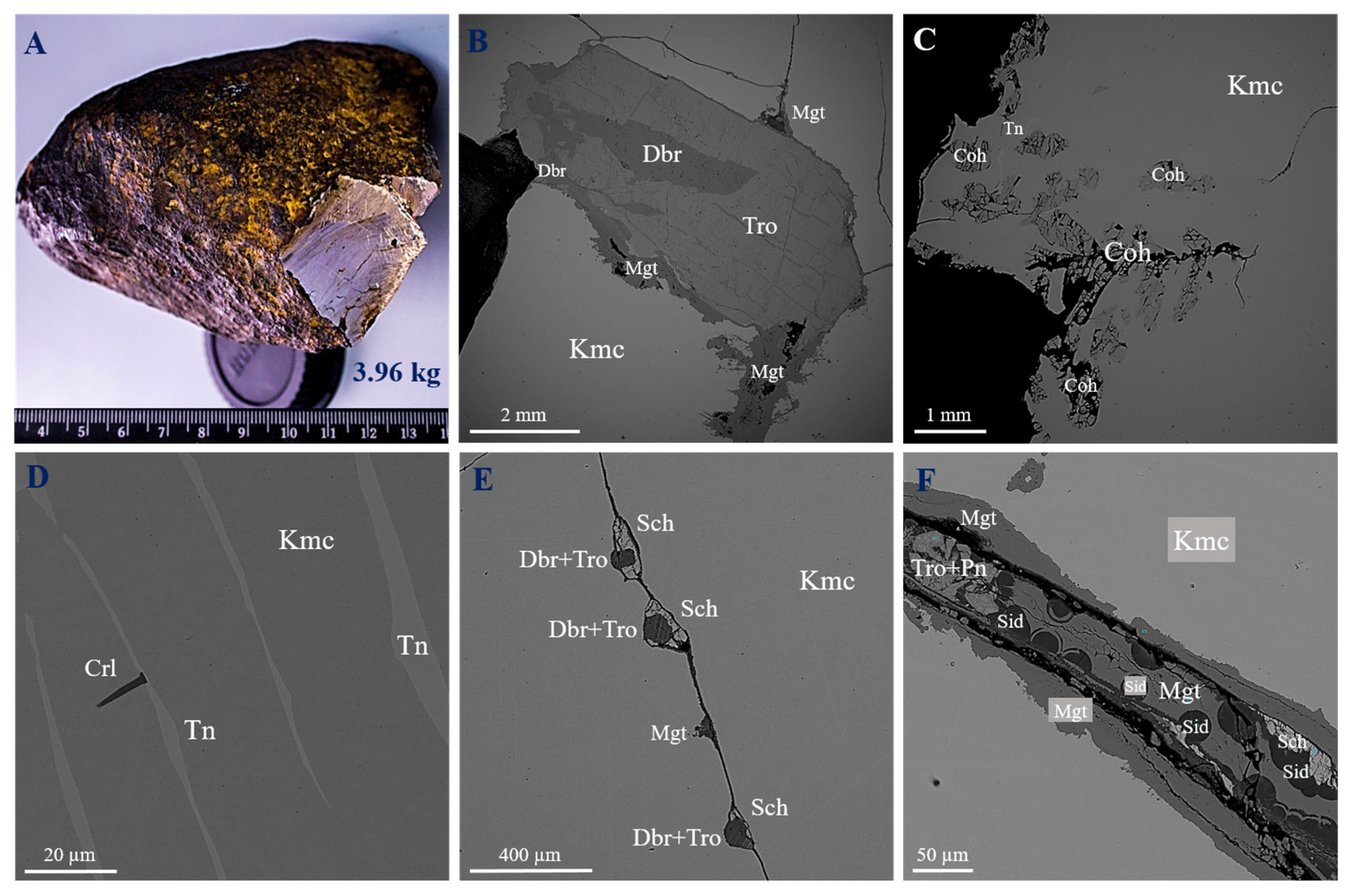
This iron meteorite (one sample 3.96 kg, Figure 1A) was discovered in summer 2016 during excavation works on river terrace (Mukhtunnyi Stream, left feeder of the Uakit River), 4 km west of the Uakit settlement, Baunt district, in the northern part of Republic of Buryatia, Russia (latitude—55°29′47.50″ N, longitude—113°33′47.98″ E). The detailed chronicle for this iron meteorite was given in [9]. The Uakit iron meteorite (IIAB) was registered by the Meteorite Nomenclature Committee in June 2017 (see Meteoritical Bulletin Database, https://www.lpi.usra.edu/meteor/metbull.php, accessed on 2 December 2025). The cut-off fragments of the meteorite were deposited in the meteorite collections of the CSGM IGM SB RAS, Novosibirsk (type specimens: 70.3 and 17.5 g); the MBSC SB RAS, Ulan-Ude, ExtraTerra Consortium Lab, Ural Federal University, Ekaterinburg; and the A.E. Fersman Mineralogical Museum, Moscow, Russia.
The detailed mineralogical studies revealed two new minerals in this meteorite: uakitite, VN (IMA 2018-003) [9]; and grokhovskyite, CuCrS2 (IMA 2019-065) [1]. Mineralogical, petrographic, and geochemical data for the Uakit meteorite were reported in a few previous publications [7,9,51]. A list of minerals found in the Uakit iron meteorite is given in Table 1.

3. Analytical Methods

Polished fragments of the Uakit meteorite were used for studies. The identification of all minerals was based on optical examination in reflected light and electron microscope falsilites at the IGM SB RAS, Novosibirsk, Russia. The energy-dispersive spectra (EDS), back-scattered electron (BSE) images, and elemental mapping were performed by a TESCAN MIRA 3MLU scanning electron microscope equipped with an INCA Energy 450 XMax 80 microanalysis system (Oxford Instruments Ltd., Abingdon, UK). Electron microprobe analyses (EMPA) in wavelength-dispersive (WDS) mode were provided by a JXA-8100 microprobe (Jeol Ltd., Tokyo, Japan). The PAP routine [52] was used for correction of matrix effects. Grains (sizes > 5 μm) of grokhovskyite and related minerals, previously analyzed by EDS, were selected for this purpose. The operating conditions, reference standards, detection limits for elements, and precision of analyses for both scanning electron microscope and electron microprobe were described in detail in [9].
Electron backscatter diffraction (EBSD) studies were provided for one grain of grokhovskyite. Specimens with this mineral intended for EBSD studies were subjected to polishing by BuehlerMasterMet2 non-crystallizing colloidal silica suspension (0.02 μm). EBSD measurements were carried out by means of a FE-SEM ZEISS SIGMA VP scanning electron microscope (Oberkochen, Germany) equipped with an Oxford Instruments Nordlys HKL EBSD detector at the Institute of Physics and Technology, and a ZEISS CrossBeam AURIGA (Oberkochen, Germany) with an Oxford Instruments Nordlys HKL EBSD detector at the Institute of New Materials and Technologies, Ural Federal University, Ekaterinburg, Russia. The EBSD data were operated at 20 kV and 1.4 nA in focused beam mode with a 70° tilted stage, WD of 15–20 mm, and apperture of 60 µm. Structural identification of grokhovkyite was performed by matching its EBSD patterns with the reference structural models of CuCrS2 using the FLAMENCO program.
The Raman spectra of grokhovskyite were obtained by a LabRAM HR 800 mm (HORIBA Scientific Ltd., Kyoto, Japan) spectrometer equipped with a CCD detector and coupled to an Olympus BX40 confocal microscope (objective x100) at IGM SB RAS. A semiconductor laser, emitting at 514.5 nm with a nominal power output of 50 mW, was used for excitation. In each case, 10 spectra were recorded for 10 s each, at a hole diameter of 200 μm and a resolution of 1.5 cm−1, and integrated. The spectra were recorded between 50 and 450 cm−1, and the monochromator was calibrated using the 520.7 cm−1 Raman line of elemental Si.
Quantitative reflectance measurements for grokhovskyite were provided in air relative to a SiC standard using a microscope–spectrophotometer LOMO MSP-R (objective x40, probe diameter of 2.25 μm, Saint Petersburg, Russia) equipped with spectrophotometric attachment PEI “R928” (Hamamatsu, Japan) in the Institute of Mineralogy, Miass, Russia.
The main results are shown in Figure 1, Figure 2, Figure 3, Figure 4, Figure 5, Figure 6 and Figure 7 and Table 1, Table 2, Table 3 and Table 4. The Cif file for grokhovskyite is given in the Supplementary Section.

4. General Description of the Uakit Meteorite

The 3.96 kg mass of the meteorite is oval (10 × 10 × 7 cm). The exterior part is covered by a thin crust of brown to yellow–brown secondary products (mainly, different Fe-rich hydroxides, Figure 1A). The alteration crust is less than 1 mm at the exterior and sometimes extends along some fractures of the outer part. Polished and then etched surfaces of the meteorite cut-offs show the presence of large (≈2 cm) Ni-rich iron (kamacite) crystals with evident Neumann lines; no Widmannstatten pattern is observed [9]. The shock stage is medium and mainly fixed by shifting blocks in some schreibersite and carlsbergite crystals, and by Neumann lines.
The Uakit iron meteorite is structurally and geochemically characterized as a hexahedrite, IIAB group, with tendency to the IIA subgroup [9]. It contains Ni—5.47 wt.% and Co—0.45 wt.% [9,51]. Other elements (ICP-MS data) of composition are given in [51].
Fe-Ni metal (kamacite) is the dominant mineral of the meteorite (≈93–98 vol.%, Figure 1). Minor and accessory primary minerals (Table 1) are represented by schreibersite (rhabdite), nickelphosphide, taenite, plessite (taenite + kamacite + tetrataenite), cohenite, tetrataenite, daubréelite, kalininite, troilite, carlsbergite, sphalerite or würzite, uakitite, copper, grokhovskyite (Figure 1B–E), unidentified Ni-Fe-Cr sulfide, and Mo-dominant phase (<0.5 µm, molybdenite MoS2/hexamolybdenum (Mo,Ru,Fe)/Mo or MoC, according to recent meteorite minerals list in [53,54]). The appearances of Ni-rich magnetite, pentlandite, heazlewoodite, awaruite or nickel, hematite, Ni-rich goethite, akaganeite, Ni-rich siderite, Ca-Fe carbonates, gypsum, unidentified hydrated Fe-rich phosphate, and Ca-Fe sulfate are related to different stages (high- and low-temperature) of the terrestrial alteration (Figure 1F) [7,8,9,51]. Chemical compositions of the principal minerals in the Uakit iron meteorite were given in ([9], Table 1).

5. Morphological, Optical, and Physical Properties of Grokhovskyite

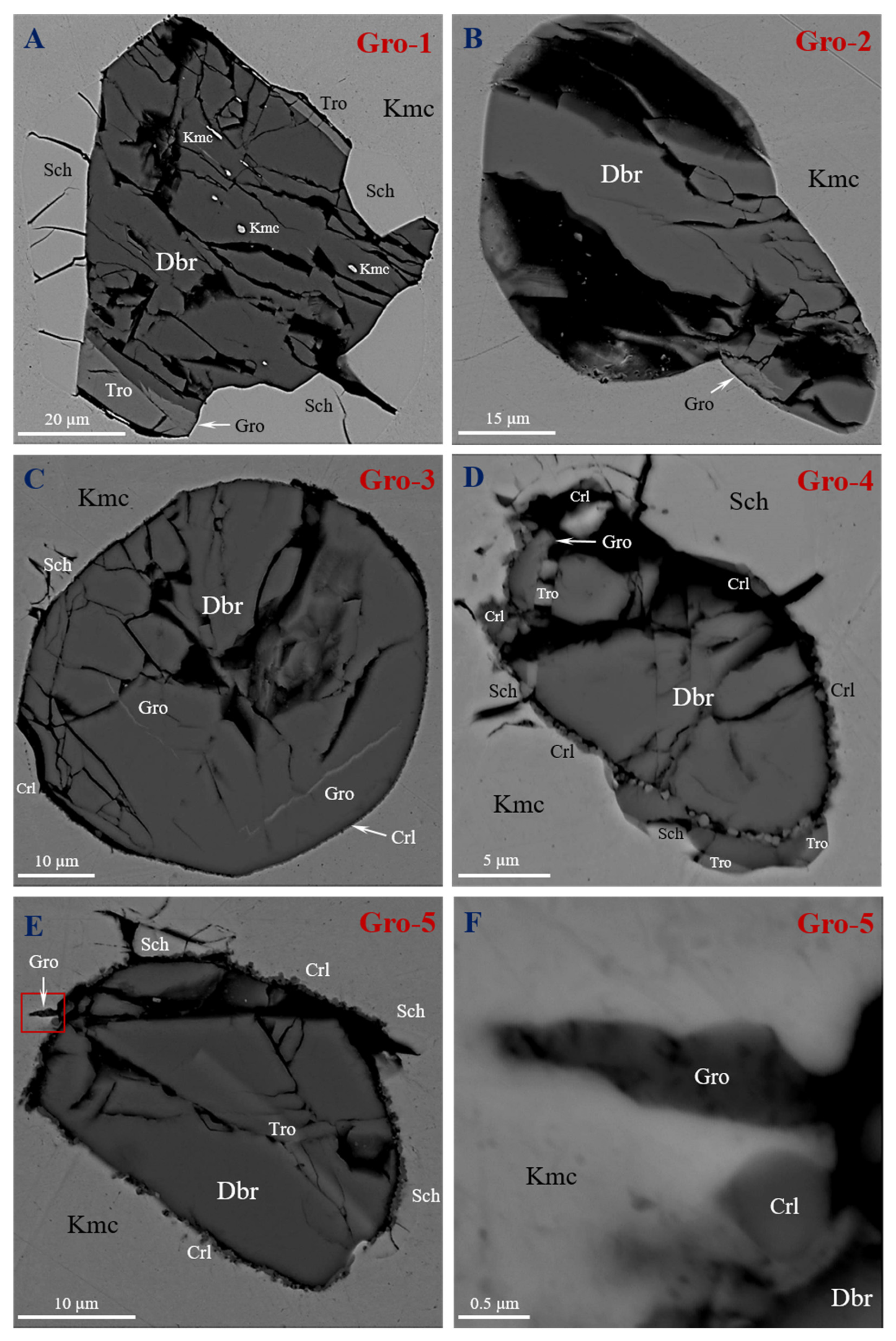
Grokhovskyite was found in small sulfide inclusions (globules, up to 50–80 µm) in Ni-rich iron (kamacite), which also contain daubréelite, troilite, and schreibersite, and, sometimes, carlsbergite and uakitite (Figure 2). These inclusions are mainly rounded, not resorbed by magnetite, and bear individual grains of troilite. Sometimes the outer zone is decorated by minute carlsbergite crystals (Figure 2C–E). Such globules are strongly distinguished from troilite–daubréelite inclusions with alternation of troilite and daubréelite layers (Figure 1E) [9]. The sizes of grokhovskyite grains are commonly less than 5 μm, and the biggest detected crystals are 10 × 5 μm (Figure 2A,B and Figure 3). Within inclusions, it occurs mainly in the outer part (boundary between globule and host kamacite) and forms elongated splintered crystals (Figure 2A,B), or, rarely, needle-shaped grains in daubréelite (Figure 2C).
We were unable to obtain physical and optical properties for grokhovskyite because of the very small sizes of the grains. So, in most cases, we have to refer to data for synthetic CuCrS2. It has a yellow–brown color, brownish black streak, and metallic luster. The mineral is non-transparent, non-fluorescent, and brittle. Cleavage is uneven, and no parting is observed. Hardness is ≈4 (Mohs), and microhardness could not be measured due to very small grains. Density (4.559 g/cm3) for grokhovskyite was calculated from unit cell dimensions and results of EDS analyses. Optical properties of grokhovskyite under reflected light are comparable with those of daubréelite. It is gray to light gray with yellow tint and does not show any internal reflections. Bireflectance and anisotropy are weak to medium. Pleochroism is weak, from gray to light gray. Reflectance data for one grokhovskyite grain are given in Table 2.
Figure 2. Grokhovskyite in the sulfide inclusions in Fe-Ni metal (kamacite), Uakit meteorite (IIAB), BSE images. Symbols: Gro—grokhovskyite; Dbr—daubréelite; Tro—troilite; Sch—schreibersite; Crl—carlsbergite; and Kmc—Ni-rich iron (kamacite).
Minerals 15 01295 g002
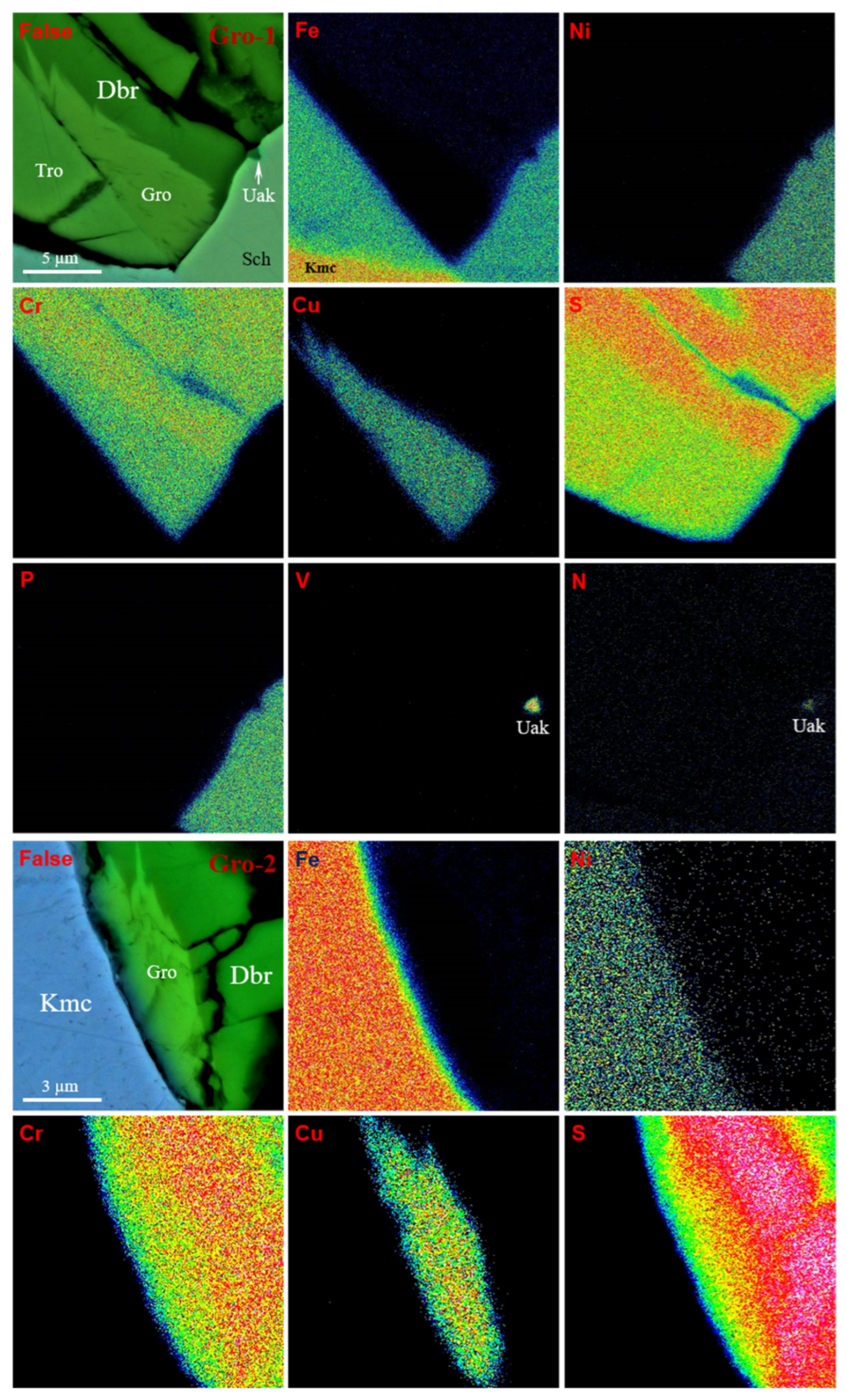
Figure 3. Elemental maps for two globules with grokhovskyite. Symbols: Gro—grokhovskyite (see Figure 2A,B); Uak—uakitite; Dbr—daubréelite; Tro—troilite; Sch—schreibersite; and Kmc—Ni-rich iron (kamacite).
Minerals 15 01295 g003
Table 2. Reflectance values for grokhovskyite (n = 3, Si standard, air, see grain in Figure 2A).
λ (nm)Rmax/Rminλ (nm)Rmax/Rmin
40028.91/27.0256031.71/31.33
42029.12/27.8058031.87/31.53
44029.51/28.50589 (COM)31.90/31.52
46029.93/29.2860031.99/31.61
470 (COM)30.16/29.5162032.11/31.66
48030.34/29.7564032.22/31.75
50030.72/30.25650 (COM)32.36/31.82
52031.11/30.7666032.36/31.72
54031.44/31.1068032.66/31.89
546 (COM)31.53/31.3270032.85/31.93

6. Chemical Composition of Grokhovskyite

Among all grokhovskyite grains found in the Uakit meteorite, only two crystals were suitable in sizes for microprobe (EDS) analysis (Figure 2A,B and Figure 3). In chemical composition, the Uakit grokhovskyite is slightly different from stoichiometric CuCrS2 in the constant presence of essential Fe and negligible Ni (Table 3), while other components (Na, Zn, V, Mn, Co) are below detection limits (<0.005 wt.%). Although its average composition is (Cu0.930Cr0.952Fe0.118Ni0.005)2.005S1.995 (n = 36), the two grains available for analysis (from two distinct sulfide globules in kamacite) indicated variable concentration of Fe, as follows: (Cu0.949Cr0.966Fe0.085Ni0.005)2.005S1.995 (n = 22, Figure 2A) and (Cu0.899Cr0.932Fe0.170Ni0.004)2.005S1.995 (n = 14, Figure 2B). The Grove meteorite grokhovskyite shows the following composition: (Cu0.920Cr1.034Fe0.039Co0.025Ni0.005Zn0.002)2.029S2.000 [10]. The mineral from Hatrurim Basin, Israel, has the empirical formula (Cu0.84Ca0.06Na0.01Sr0.01Ba0.01Cr0.94Fe0.15 V0.01)2.03S2.0·0.35H2O [17]. In general, the above occurrences indicate the absence or minimal concentration of sodium in grokhovskyite. Iron in grokhovskyite stucture possibly incorporates according to the scheme Cu1+ + Cr3+ → 2Fe2+, occupying both tetrahedral and octahedral sites.
In addition, the coexistence of caswellsilverite with grokhovskyite, and their relations (caswellsilverite is possibly overgrown by grokhovskyite), in the Hatrurim Basin paralava, and the broad variations in Na and Cu in caswellsilverite from the Yamato 691 EH chondrite [3] strongly suggest the existence of isomorphic series NaCrS2-CuCrS2. In fact, the Cu-richest caswellsilverite composition in the Yamato 691 EH chondrite (Table 13 in [3]) is nominally to be sodium grokhovskyite with the empirical formula (Cu0.39Na0.38K0.01Cr1.15Fe0.05Zn0.01)1.99S2.0 (analysis 5 in Table 3), very close to (Cu0.5Na0.5)CrS2. It should be also mentioned that “gentnerite”, Cu8Fe3Cr11S18, described in the Odessa IAB-MG iron meteorite [55], seems to be grokhovskyite with formula (Cu0.73Cr0.99Fe0.27)S2.0 (analysis 6 in Table 3). The related minerals in the grokhovskyite-containing sulfide inclusions of the Uakit iron have the following compositions: schreibersite—(Fe1.98Ni1.01Cr0.01)P1.0; daubréelite—(Fe1.01Zn0.01Mn0.01)Cr0.98S4.0; and troilite—(Fe0.98Ni0.01Cr0.01)S1.0.
Table 3. Chemical compositions of grokhovskyite from the Uakit meteorite and other localities.
1 2 3 456789
ElementGro (all grains) Gro-1 Gro-2 Gro-synGro-ideal
wt.%n = 36sdminmaxn = 22sdn = 14sdn = 1n = 1n = 1n = 7n = 44
Nan.d. n.d. n.d. 4.95 0.07n.d.
Kn.d. n.d. n.d. 0.10 n.d.n.d.
Can.d. n.d. n.d. n.d. 1.13n.d.
Ban.d. n.d. n.d. 0.45n.d.
Srn.d. n.d. n.d. 0.27n.d.
Cu32.970.8831.7133.9033.650.1831.910.1332.1014.7028.3028.9135.3535.37
Cr27.650.4926.7228.2328.020.1227.060.1429.5033.9031.4026.5128.9328.94
Vn.d. n.d. n.d. 0.20n.d.
Fe3.691.342.415.522.640.155.340.121.221.709.104.410.00
Ni0.160.050.050.250.180.050.130.030.31 n.d.
Con.d. n.d. n.d. 0.81 n.d.
Mnn.d. n.d. n.d. 0.05 n.d.n.d.
Znn.d. n.d. n.d. 0.090.40 n.d.n.d.
S35.710.0535.5835.7935.700.0535.730.0635.2042.8032.6034.7035.6635.69
H2O 3.36
Total100.18 100.19 100.17 99.2398.60101.40100.0099.94100.00
Formulas based on 4 ions
Na 0.38 0.01
K 0.00
Ca 0.05
Ba + Sr 0.01
Cu0.93 0.95 0.90 0.920.410.730.841.001.00
Cr + V0.95 0.97 0.93 1.021.130.990.951.001.00
Fe0.17 0.08 0.17 0.040.060.270.15
Ni + Co0.01 0.01 0.00 0.04
Zn + Mn 0.000.01
S2.00 2.00 1.99 1.992.002.002.002.002.00
H2O 0.35
n.d.—not detected. 1–3—grokhovskyite, Uakit iron meteorite IIAB (see Figure 2A,B and Figure 3); 4—grokhovskyite, Gove relict iron meteorite IIIAB [10]; 5—Na-rich grokhovskyite (normalized to S = 2 apfu), Yamato 691 EH chondrite [3]; 6—“gentnerite” (normalized to S = 2 apfu), Odessa iron meteorite IAB-MG [55]; 7—grokhovskyite, gehlenite paralava, Hatrurim Basin, Israel [17]; 8—synthetic grokhovskyite used for Raman study (author’s data, sample from D.A.Chareev); and 9—ideal composition of grokhovskyite.

7. Crystal Structural Data for Grokhovskyite

7.1. EBSD Data for Grokhovskyite

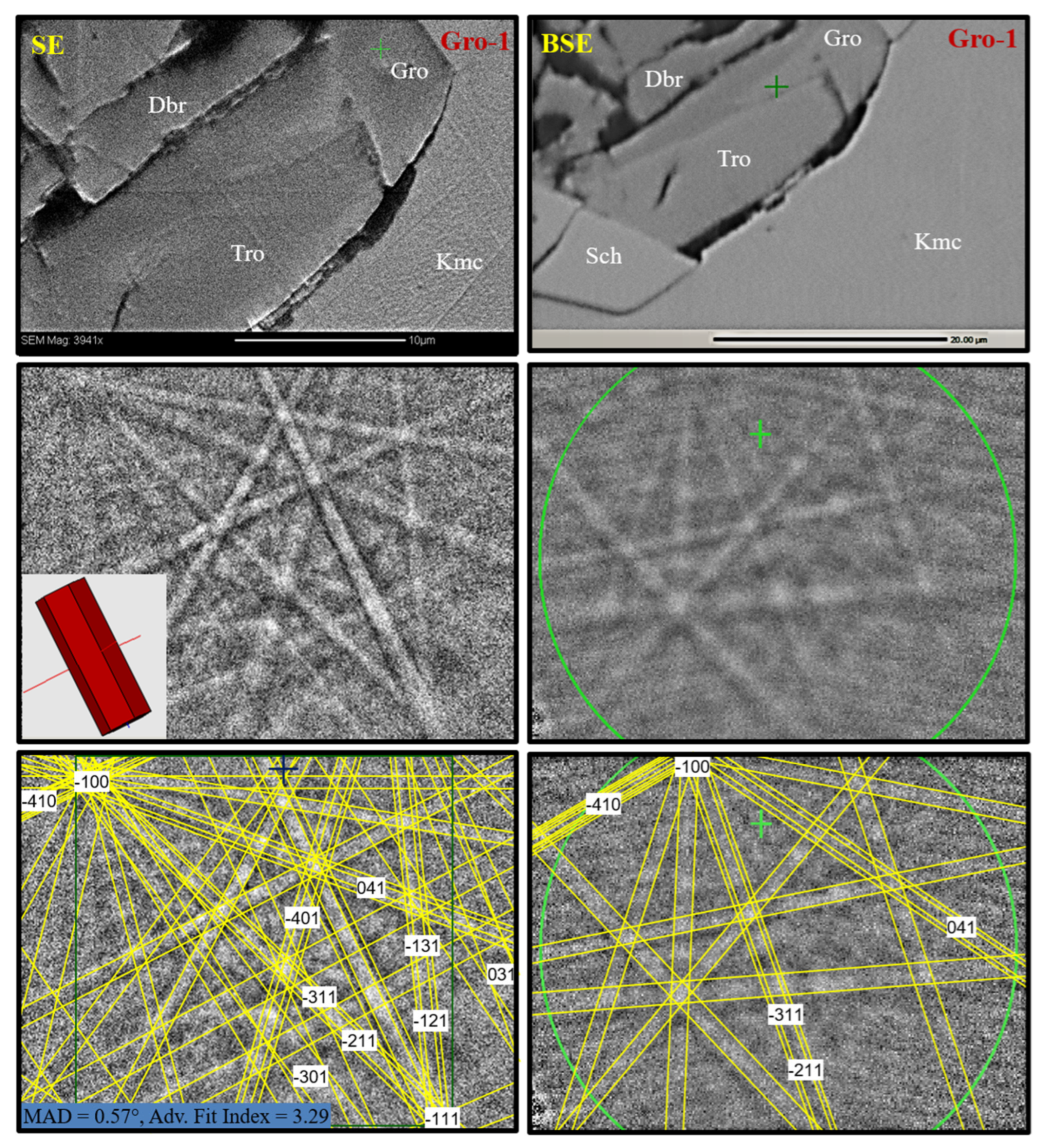
Single-crystal X-ray studies for the Uakit grokhovskyite could not be carried out because of the small crystal size. Structural data were obtained due to the EBSD technique (Figure 4). One grokhovskyite crystal (Figure 2A) was selected for the EBSD technique. Two structural patterns of synthetic CuCrS2 were applied for EBSD comparison studies: α-CuCrS2 [28] and β-CuCrS2 [56]. These studies showed full structural identity between grokhovskyite and its synthetic analogue α-CuCrS2 [28]. Fitting of the EBSD patterns for a α-CuCrS2 model with the cell parameters in [28] resulted in the parameter MAD = 0.57–1.16° (good fit). Thus, we stated the following structural parameters for grokhovskyite: crystal system—trigonal; space group—R3m; a = 3.4794(8) Å; c = 18.702(4) Å; V = 196.08(10) Å3; Z = 3.
Figure 4. Electron backscattered diffraction (EBSD) patterns and the Kikuchi patterns for one grain of grokhovskyite (see Figure 2A, average composition (Cu0.949Cr0.966Fe0.085Ni0.005)2.005S1.995). MAD—mean angular deviation, detector distance—15–20 mm. Symbols: Gro—grokhovskyite; Dbr—daubréelite; Tro—troilite; Sch—schreibersite; and Kmc—Ni-rich iron (kamacite).
Minerals 15 01295 g004
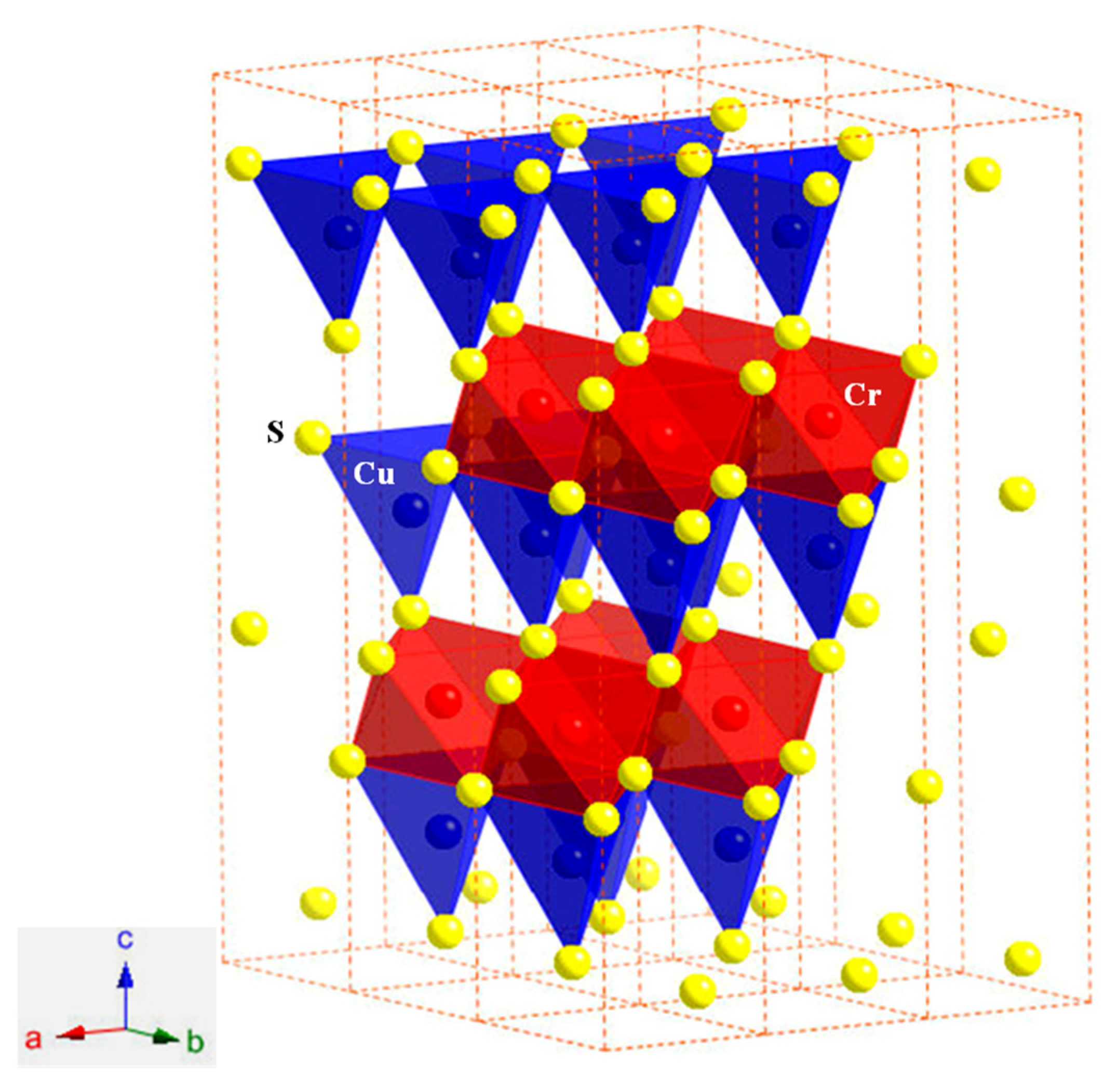
Composition and structural data obtained using EBSD revealed that grokhovskyite is an analogue of the well-known synthetic compound CuCrS2 [25,28,29,40,55,56,57,58,59,60]. The crystal structure of synthetic CuCrS2 is shown in Figure 5.

7.2. Diffraction Data for Grokhovskyite

Because grokhovskyite occurs only in small concentrations, X-ray powder diffraction data were not collected. The theoretical powder diffraction pattern was calculated using the structural data of the synthetic α-CuCrS2 analogue [28] and the empirical formula of grokhovskyite. Calculated XRD data are given in Table 4. Calculated structural data for grokhovskyite are presented in the Supplementary Materials (Cif file).
Table 4. Calculated powder diffraction data for grokhovskyite.
hkldhklIrelhkldhklIrel
0036.23410−2221.4875
0063.1171501111.4816
−1112.9751000241.4344
0122.86869−2251.3983
−1142.53344−1291.3344
0152.347340271.3128
0092.0785−11131.2981
−1171.99970−2281.2667
0181.8475000151.2472
−1201.7406701141.2212
−1231.6761−12121.1614
−11101.5895−2311.1372
00121.5594−1321.1312
−1261.5196−22111.1281
0211.5026−2341.1072
CuKα1 = 1.540598 Å, Bregg–Brentano geometry, I ≥ 1; data were calculated using PowderCell 2.4 [57]. The strongest diffraction lines are given in bold.

7.3. Crystal Structure of Synthetic CuCrS2 and Its Specific Properties

The compound CuCrS2 was first synthesized in the later half of the last century [40]. It belongs to the family of trigonal compounds, covering sulfides, selenides, and oxides. The crystal structure of disulfides Me+CrS2 (Me+ = Na, K, Li, Cu, Ag, Au) contains the triple layers S-Cr-S, among which monovalent ions are localized [34]. The crystal structure and properties of CuCrS2 changing at different temperatures have been studing in detail [25,28,29,37,40,58,59,60,61,62,63]. In general, the crystal lattice of CuCrS2 (with a ≈ 3.48 Å and c ≈ 18.70 Å) is essentially vacant, and only half of the tetrahedral sites are occupied by Cu+ ions, while the environment of Cr3+ ions is octahedral (Figure 5).
Figure 5. The crystal structure of synthetic CuCrS2 (adobed after [64,65]).
Minerals 15 01295 g005
At present, three structural modifications of CuCrS2 are known: α (high-temperature), β (room-temperature), and low-temperature. The high-temperature phase of CuCrS2 features as a centrosymmetric R-3m state, with Cr3+ ions in an octahedral environment and disordered arrangement of Cu in a tetrahedral site that provides high mobility of Cu and superionic conductor property [19]. In addition, the migration of some Cr from the octahedral environment into the tetrahedral layer is fixed in the α-CuCrS2 structure, and this disorder effect is intensified with increasing temperature [28].
The disorder–order phase transition occurs at near 670–700 K [20,32]. The crystal structure of room-temperature CuCrS2 (β-CuCrS2) is non-centrosymmetric R3m, and the right- and left-handed domains are possible in polydomain crystals [59,63]. At low temperatures (<100 K), the β-CuCrS2 may represent a mixture of two electronic phases: Cu2+Cr2+S2 and Cu+Cr3+S2 [24]. Moreover, a crystallographic transition from rhombohedral R3m to monoclinic Cm occurs at 37.5 K [26].
Thus, the specifics of the CuCrS2 structures are outlined in their useful properties for material science, such as antiferromagnetic, semiconductor, superionic conductor, etc. [19,20,21,23,24,25,27,28,29,31,33,37,64,65,66,67]. Moreover, compounds of CuCr1−xMexS2 (x = 0.0–0.4), doped by Me = V, Fe, and Mn, have also been studied to understand the changes in useful properties [19,20,21,22,25,27,31,64].

7.4. Raman Spectroscopy of Grokhovskyite and Synthetic CuCrS2

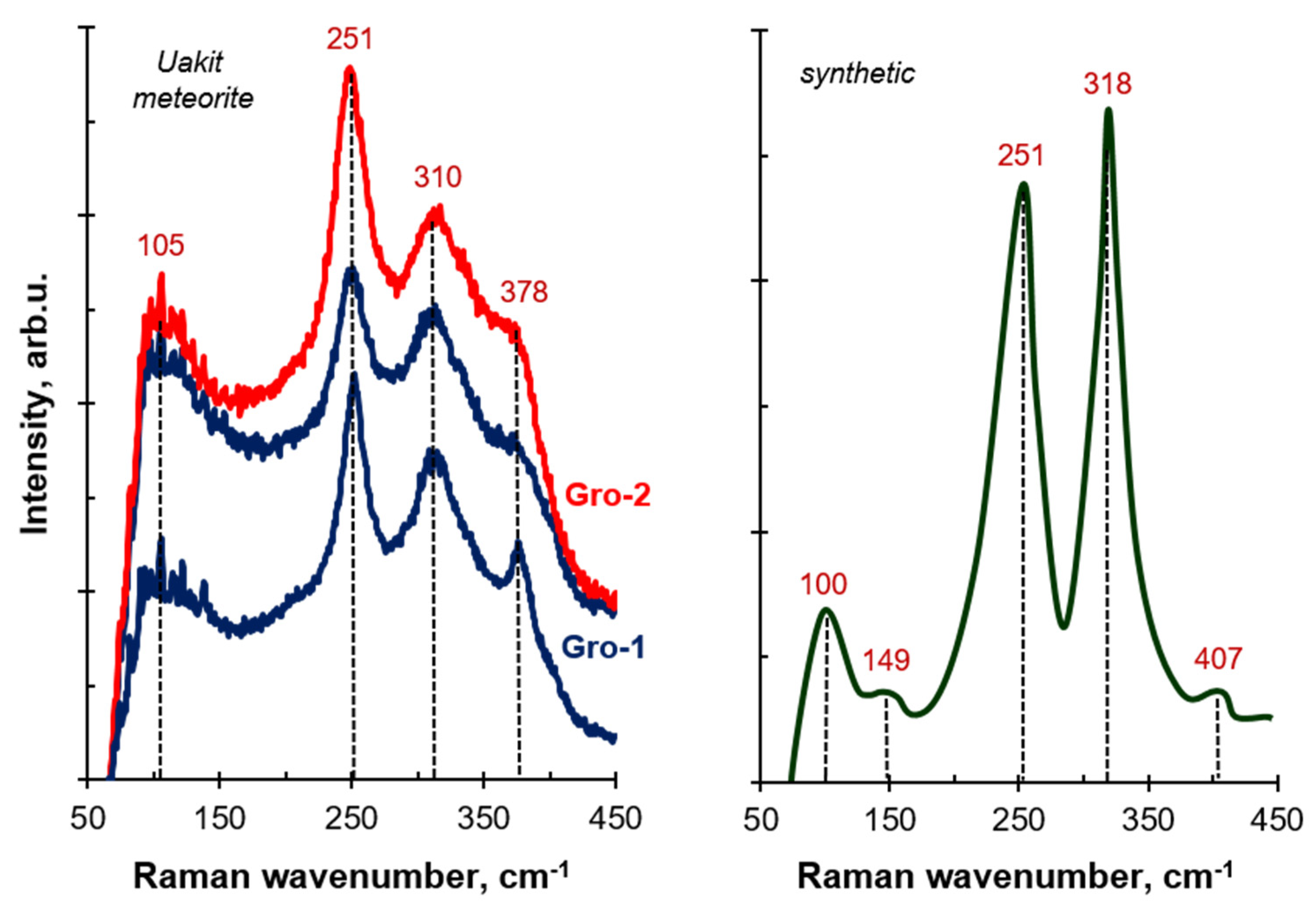
The four distinctive bands in the Raman spectra of the Uakit grokhovskyite were observed near 110, 250, 310, and 378 cm−1 (Figure 6). In general, its Raman spectra are identical to those of synthetic CuCrS2 [63,68] and the Hatrurim Basin grokhovskyite [17] in band suite.
Figure 6. Unoriented Raman spectra for two grains of grokhovskyite with different compositions (see Figure 2A,B and Figure 3), and oriented spectrum for synthetic β-CuCrS2 (perpendicular to [0001]).
Minerals 15 01295 g006
Unfortunately, the quality of Raman spectra for synthetic CuCrS2 strongly depends on crystallinity, temperature, and radiation wavelength [63,68]. So, in addition, for comparison, we used idiomorphic crystals of synthetic β-CuCrS2 (donation from D.A.Chareev), which were obtained by flux crystallization in salt melt using a steady-state temperature gradient [69,70]. The β-CuCrS2 crystals were synthesized due to recrystallization of powder material at steady-state temperature gradient in the LiCl/RbCl melt using a quartz glass ampoule. The temperature of the hot part, with powder, was 468 °C; the temperature of the cool part, in which crystals grew, was 376 °C; and the duration of synthesis was 16 weeks (personal communication, D.A.Chareev). The formation temperature of these crystals indicates the β-modification of CuCrS2. Before Raman studies, we performed chemical composition for these crystals, finding that the empirical formula is identical to that of ideal CuCrS2 (Table 3). In contrast to grokhovskyite, the β-CuCrS2 crystals show five distinctive bands in the Raman spectrum (100, 149, 251, 318, and 407 cm−1, Figure 6). The shifting of the mode in the 310–320 cm−1 region may be related to peculiarity of the crystal structure, crystal orientation, and chemical composition. It should also be noted that non-prounonced bands near 150, 380, and 410 cm−1 are sometimes fixed in the Raman spectra of other synthetic CuCrS2 samples [63,68] and grokhovskyite.
According to Abramova et al. [63], the theoretical Raman spectrum of the ordered R3m CuCrS2 structure (β-modification, room temperature) with Cr3+ ions at the octahedra, and Cu+ ions at the tetrahedra, contains two phonon fluctuation types: A1 lines—198 cm−1, 240 cm−1, and 307 cm−1; and E lines—99 cm−1, 211 cm−1, and 257 cm−1. A non-degenerated A1-type phonon mode, at 310 cm−1, indicates displacement of Cu and Cr atoms along the threefold c axis, and S2 atoms in the opposite direction. The second non-degenerated A1 mode, at 240 cm−1, is related to the displacements of Cu and Cr atoms along c axis and S1 atoms in the opposite direction. The simulated weak A1 mode, at 198 cm−1, is formed by the displacements of Cu and Cr atoms along c axis only. The E modes are twice-degenerated vibrations perpendicular to the threefold axis and can split after structural transition. The most intensive E line, at 257 cm−1, is related to displacement of Cr and S1 atoms in the ab plane in opposite directions. The simulated E optical phonon mode, at 211 cm−1, indicates the displacement of all atoms: S1 and Cr atoms shift together in ab plane in the direction opposite to the displacements of Cu and S2 atoms [63]. Unfortunately, general Raman data for CuCrS2 cannot possibly distinguish the α- and β-modifications.

8. Genesis of Grokhovskyite in the Uakit Iron Meteorite and Other Meteorites

Phase relations in kamacite-hosted sulfide inclusions indicate that grokhovskyite is a primary mineral in these associations (Figure 2 and Figure 3). It is mainly localized between daubréelite and troilite, and seems to be crystallized after them. It is suggested that grokhovskyite-containing associations in the Uakit meteorite appeared due to high-temperature (>1000 °C) separation of Fe-Cr-rich sulfide liquid, which was locally enriched in Cu from Fe-Ni metal melt.
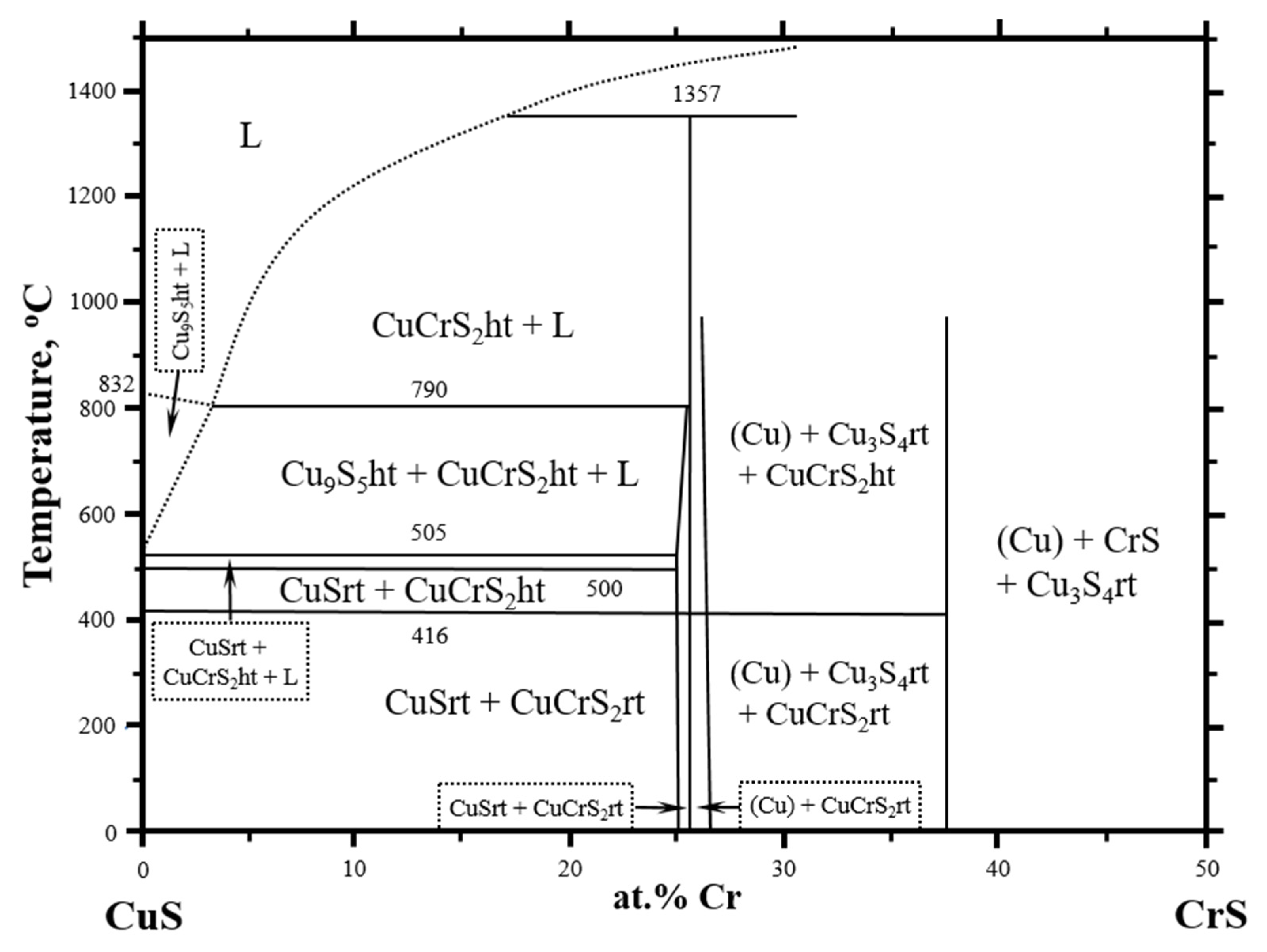
It should be mentioned that all Cu in the Uakit meteorite is mainly accumulated in sulfide-rich associations. In addition to grokhovskyite, native copper occasionally occurs in some troilite–daubréelite globules with “layered structure” [9,51]. Bulk compositions of whole meteorite and kamacite (ICP-MS and LA-ICP-MS) indicate 144–294 ppm copper concentrations [51]. In general, it is evidenced that most Cu was concentrated in sulfide (±phosphide) liquid after its separation from metal melt. Different mineral species for accumulation of Cu (Cu0 and CuCrS2) seem to be related to local conditions of crystallization and cooling in particular sulfide (±phosphide) inclusions. The phase relations in the system Cu-Cr-S [71] indicate that phase CuCrS2 may be in association with sulfide liquid in the very broad temperature range of 1363–500 °C (Figure 7). The α-β (disorder-to-order) phase transition occurs below 500 °C. Thus, we do not exclude that grokhovskyite in the Uakit meteorite was initially crystallized as α-CuCrS2, and then transformed into β-modification.
Figure 7. The phase diagram for CuS-CrS (adobed after [71]). rt—room-temperature modification; ht—high-temperature modification; CuCrS2rt—β-CuCrS2; CuCrS2ht—α-CuCrS2.
Minerals 15 01295 g007
It should be noted that the sulfide (daubréelite +troilite) associations with uakitite VN in the Uakit meteorite are also interpreted to form due to high-temperature (>1000 °C) separation of Fe-Cr-rich sulfide liquid from Fe-metal melt [9]. The crystallization of uakitite is suggested under high temperatures (≈1000 °C) from the sulfide melt, but not below 650 ± 50 °C according to the system Cr-Fe-S [72].
In addition to the Uakit meteorite, grokhovskyite has been described in the Gove relict iron meteorite from Arnhem Land, Northern Territory, Australia [10]. It was found as inclusions in former Ni-rich iron (kamacite), in association with daubréelite, or individually. The origin of the Gove grokhovskyite has been interpreted as secondary terrestrial alteration through prolonged weathering of primary daubréelite. To our mind, the association daubréelite + grokhovskyite represents primary paragenesis in the Gove meteorite, because both daubréelite and grokhovskyite are more resistent to terrestrial weathering than Ni-rich iron (kamacite); now, that association is a primary relict in altered kamacite. In general chemical composition and genesis of the Gove Cu-Cr-disulfide indicate that it seems to be a β-modification.
Na-rich grokhovskyite and caswellsilverite were found in Na-Cu-Cr-Zn multisulfide clasts of the Y-961 EH chondrite [3]. Their relations indicate that grokhovskyite is an earlier phase than caswellsilverite. “Gentnerite” (grokhovskyite ?) was observed in one graphite–troilite nodule of the Odessa iron meteorite [55]. In both meteorites, grokhovskyite-containing associations are considered to be primary, but formation conditions were not outlined. The rough overview of extraterrestrial occurrences for the Me+CrS2 minerals reveals that caswellsilverite is more common in silicate-rich meteorites (enstatite chondrites and achondrites), whereas grokhovskyite is dominant in iron meteorites [1,2,3,4,5,6,7,8,9,10,11,12,13,14,15,16].

9. Conclusions and Final Remarks

The comprehensive studies of grokhovskyite from the Uakit iron meteorite allow us to outline the following topics in structural, chemical, and genetic aspects:
  • Grokhovskyite is a natural analogue of CuCrS2. The specification of modification (α or β) is difficult, although EBSD data provide evidence about α-modification. The safety of grokhovskyite as a high-temperature α-modification of CuCrS2 in the Uakit meteorite is enigmatic, taking into account the disorder–order phase transition near 670–700 K in synthetic CuCrS2 [19,22,32]. The presence of minor Fe in grokhovskyite seems to preserve the structural disorder in the tetrahedral Cu sites and to “freeze” the structure as α-CuCrS2 modification with decreasing temperature.
  • Grokhovskyite, CuCrS2, is structurally related to the Me+CrS2 mineral group, including caswellsilverite, NaCrS2; schöllhornite, Na0.3(H2O)1[CrS2]; and cronusite, Ca0.2(H2O)2CrS2 [2,12,16]. In the structural context, these minerals are similar to trigonal oxides of the delafossite group (delafossite, CuFeO2; mcconnellite, CuCrO2).
  • The essential impurity of iron in grokhovskyite possibly incorporates according to the scheme IVCu+ + VICr3+IVFe2+ + VIFe2+, occupying both tetrahedral and octahedral sites.
Some rare and exotic minerals form very minute grains (size < 1–15 µm and smaller), It creates many problems in their identification and detailed description, especially in regards to new mineral species (composition, unit cell data, and crystal structure). However, current analytical methods promote the study of such minute objects. In addition to the classic analytical methods, the application of the TEM, EBSD, and other nanotechniques allows for improved studies of micron-sized minerals. In recent decades, these technologies were successfully used for detailed identification of new minerals in both meteorites and terrestrial rocks, especially when their synthetic analogues were known [73,74,75,76,77,78,79,80,81].
The Uakit meteorite is one of examples, when nanometodics helped to discovery and approve two new minerals: uakitite, VN (IMA 2018-003) [9]; and grokhovskyite, CuCrS2 (IMA 2019-065) ([1] and this work).

Supplementary Materials

The following supporting information can be downloaded at: https://www.mdpi.com/article/10.3390/min15121295/s1, Cif file: grokhovskyite.

Author Contributions

V.V.S. discovered grokhovskyite, provided the main idea of the article, conducted microprobe and Raman investigations, and wrote the article. G.A.Y. and M.S.K. performed EBSD data, Y.V.S. carried out XRD analysis, N.S.K. provided SEM analyses, and K.A.N. measured optical characteristics. All authors have read and agreed to the published version of the manuscript.

Funding

The petrographic, scanning microscopy, and Raman spectroscopic investigations were supported by the state assignment of IGM SB RAS (FWZN-2022-0035, № 122041400312-2) and the Fund of the Ministry of Science and Higher Education of the Russian Federation (Ural Federal University Program of Development within the Priority-2030 Program).

Data Availability Statement

At the request of other researchers, the authors of the article can provide the original data.

Acknowledgments

The authors would like to thank E.N. Nigmatulina and M.V. Khlestov (IGM SB RAS) for technical assistance during EMPA and SEM studies. D.A. Chareev (Institute of Experimental Mineralogy, RAS, Chernogolovka, Russia) and O.S. Vereshchagin (Saint Petersburg State University, Russia) are thanked for their donation of crystals of synthetic grokhovskyite and preliminary Raman data for synthetic grokhovskyite. We are highly appreciative of the valuable comments and suggestions of the three anonymous reviewers.

Conflicts of Interest

The authors declare no conflicts of interest.

References

  1. Sharygin, V.V.; Yakovlev, G.A.; Seryotkin, Y.V.; Karmanov, N.S.; Novoselov, K.A.; Karabanalov, M.S. Grokhovskyite, IMA 2019-065. CNMNC Newsletter No. 52. Mineral. Mag. 2019, 83, 890. [Google Scholar] [CrossRef]
  2. Okada, A.; Keil, K. Caswellsilverite, NaCrS2: A new mineral in the Norton County enstatite achondrite. Am. Mineral. 1982, 67, 132–136. [Google Scholar]
  3. El Goresy, A.; Yabuki, H.; Ehlers, K.; Woolum, D.; Pernicka, E. Qingzhen and Yamato-691: A tentative alphabet for the EH chondrites. Proc. NIPR Symp. Antarct. Meteor. 1988, 1, 65–101. [Google Scholar]
  4. Fahey, A.; Huss, G.R.; Wasserburg, G.J.; Lodders, K. REE abundances and CR isotopic composition of oldhamite and associate minerals from the Pena Blanca Spring Aubrite. Lunar Planet. Sci. Conf. 1995, 26, 385. [Google Scholar]
  5. Bunch, T.E.; Irving, A.J.; Wittke, J.H.; Kuehner, S.M. Zincian brezinaite and other rare minerals in two cumulate-textured aubrites from Northwest Africa. Meteorit. Planet. Sci. 2008, 43, 5309. [Google Scholar]
  6. Piani, L.; Marrocchi, Y.; Libourel, G.; Tissandier, L. Magmatic sulfides in the porphyritic chondrules of EH enstatite chondrites. Geochim. Cosmochim. Acta 2016, 195, 84–99. [Google Scholar] [CrossRef]
  7. Sharygin, V.V. Phase CuCrS2 in iron meteorite Uakit (IIAB), Buryatia: Preliminary data. In Minerals: Structure, Properties, Methods of Investigation, Proceedings of the 9th Russian Young Scientists Conference, Ekaterinburg, Russia, 5–8 February 2018; IGG UrB RAS: Yekaterinburg, Russia, 2018; pp. 215–218. (In Russian) [Google Scholar]
  8. Sharygin, V.V. Phase CuCrS2 in iron meteorite Uakit (IIAB), Buryatia, Russia: Preliminary data. In Minerals: Structure, Properties, Methods of Investigation, Proceedings of the 9th Russian Young Scientists Conference, Ekaterinburg, Russia, 5–8 February 2018; Votyakov, S., Kiseleva, D., Grokhovsky, V., Shchapova, Y., Eds.; Springer Proceedings in Earth and Environmental Sciences; Springer: Cham, Switzerland, 2020; pp. 229–236. [Google Scholar] [CrossRef]
  9. Sharygin, V.V.; Ripp, G.S.; Yakovlev, G.A.; Seryotkin, Y.V.; Karmanov, N.S.; Izbrodin, I.A.; Grokhovsky, V.I.; Khromova, E.A. Uakitite, VN, a new mononitride mineral from Uakit iron meteorite (IIAB). Minerals 2020, 10, 150. [Google Scholar] [CrossRef]
  10. Bevan, A.W.R.; Downes, P.J.; Henry, D.A.; Verrall, M.; Haines, P.W. The Gove relict iron meteorite from Arnhem Land, Northern Territory, Australia. Meteorit. Planet. Sci. 2019, 54, 1710–17191. [Google Scholar] [CrossRef]
  11. Lin, Y.T.; Al Goresy, A.; Hatcheon, I.D. The first meteoritic silver mineral in Peña Blanca Springs enstatite achondrite: Assemblage, composition and silver isotopes. Lunar Planet. Sci. Conf. 1989, 20, 572. [Google Scholar]
  12. Okada, A.; Keil, K.; Leonard, B.F.; Hutcheon, I.D. Schöllhornite, Na0.3(H2O)1[CrS2], a new mineral in the Norton County enstatite achondrite. Meteoritics 1984, 19, 284. [Google Scholar]
  13. Nehru, C.E.; Prinz, M.; Weisberg, M.K.; Delaney, J.S. Parsa: An unequilibrated enstatite chondrite (uec) with an aubrite-like impact melt clast. Lunar Planet. Sci. Conf. 1984, 15, 597–598. [Google Scholar]
  14. Ivanov, A.V.; MacPherson, G.J.; Kononkova, N.N.; Zolensky, M.E.; Migdisova, L.F. Unusual inclusions in metal of the enstatite chondrite clast in Kaidun: Composition and origin. Lunar Planet. Sci. Conf. 1995, 26, 659. [Google Scholar]
  15. Nakamura-Messenger, K.; Clemett, S.J.; Rubin, A.E.; Choi, B.-G.; Zhang, S.; Rahman, Z.; Oikawa, K.; Keller, L.P. Wassonite: A new titanium monosulfide mineral in the Yamato 691 enstatite chondrite. Am. Mineral. 2012, 97, 807–815. [Google Scholar] [CrossRef]
  16. Britvin, S.N.; Guo, X.Y.; Kolomensky, V.D.; Boldyreva, M.M.; Kretser, Y.L.; Yagovkina, M.A. Cronusite, Ca0.2(H2O)2CrS2, a new mineral from the Norton County enstatite achondrite. Zap. Vserossiyskogo Mineral. Obs. 2001, 130, 29–36. (In Russian) [Google Scholar]
  17. Galuskin, E.V.; Galuskina, I.O.; Vapnik, Y.; Zieliński, G. Discovery of “meteoritic” layered disulphides ACrS2 (A = Na, Cu, Ag) in terrestrial rock. Minerals 2023, 13, 381. [Google Scholar] [CrossRef]
  18. Wilson, J.A.; Yoffe, A.D. The transition metal dichalcogenides discussion and interpretation of the observed optical, electrical and structural properties. Adv. Phys. 1969, 18, 193–335. [Google Scholar] [CrossRef]
  19. Almukhametov, R.F.; Yakshibayev, R.A.; Gabitov, E.V. X-ray study of the superionic phase transition in CuCrS2. Ionics 1997, 3, 296–298. [Google Scholar] [CrossRef]
  20. Almukhametov, R.F.; Yakshibayev, R.A.; Gabitov, E.V.; Ableev, I.B. Structural studies and ionic conductivity of CuCr1−xVxS2 (0 ≤ x ≤ 0.3). Ionics 1997, 3, 292–295. [Google Scholar] [CrossRef]
  21. Almukhametov, R.F.; Yakshibayev, R.A.; Abdullin, A.R. Preparation and magnetic properties of CuCr1−xMnxS2 solid solutions. Inorg. Mater. 2002, 38, 447–449. [Google Scholar] [CrossRef]
  22. Almukhametov, R.F.; Yakshibayev, R.A.; Gabitov, E.V.; Abdullin, A.R.; Kutusheva, R.M. Structural properties and ionic conductivities of CuCr1−xVxS2 solid solutions. Phys. Status Solidi B 2003, 236, 29–33. [Google Scholar] [CrossRef]
  23. Niu, Y.; Gesmundo, F.; Fu, G.Y.; Douglass, D.L. Sulfidation of three two-phase Cu-Cr alloys in H2-H2S mixtures at 400–600 °C. Oxid. Met. 1998, 50, 327–354. [Google Scholar] [CrossRef]
  24. Abramova, G.M.; Vorotynov, A.M.; Petrakovskiy, G.A.; Kiselev, N.I.; Velikanov, D.A.; Bovina, A.F.; Almukhametov, R.F.; Yakshibaev, R.A.; Gabitov, E.V. Electron transition in intercalated disulfide CuCrS2. Phys. Solid State 2004, 46, 2225–2228. [Google Scholar] [CrossRef]
  25. Mazalov, L.N.; Sokolov, V.V.; Kryuchkova, N.A.; Vovk, E.I.; Filatova, I.Y.; Abramova, G.M. X-ray photoelectron spectroscopic studies of the charged state of 3d metal ions in CuCr1−xVxS2 (x= 0–0.4). J. Struct. Chem. 2009, 50, 439–445. [Google Scholar] [CrossRef]
  26. Rasch, J.C.E.; Boehm, M.; Ritter, C.; Mutka, H.; Schefer, J.; Keller, L.; Abramova, G.M.; Cervellino, A.; Löffler, J.F. Magnetoelastic coupling in the triangular lattice antiferromagnet CuCrS2. Phys. Rev. B 2009, 80, 104431. [Google Scholar] [CrossRef]
  27. Varnek, V.A.; Sokolov, V.V.; Filatova, I.Y.; Petrov, S.A. Mössbauer spectra of iron doped CuCrS2. J. Struct. Chem. 2009, 50, 351–355. [Google Scholar] [CrossRef]
  28. Tewari, G.C.; Tripathi, T.S.; Rastogi, A.K. Effect of chromium disorder on the thermoelectric properties of layered-antiferromagnet CuCrS2. Z. Krist.—Cryst. Mater. 2010, 225, 471–474. [Google Scholar] [CrossRef]
  29. Tewari, G.C.; Tripathi, T.S.; Kumar, P.; Rastogi, A.K.; Pasha, S.K.; Gupta, G. Increase in the thermoelectric efficiency of the disordered phase of layered antiferromagnetic CuCrS2. J. Electron. Mater. 2011, 40, 2368–2373. [Google Scholar] [CrossRef]
  30. Karmakar, A.; Dey, K.; Chatterjee, S.; Majumdar, S.; Giri, S. Spin correlated dielectric memory and rejuvenation in multiferroic CuCrS2. Appl. Phys. Lett. 2014, 104, 052906. [Google Scholar] [CrossRef]
  31. Korotaev, E.V.; Peregudova, N.N.; Mazalov, L.N.; Sokolov, V.V.; Kalinkin, A.V.; Kryuchkova, N.A.; Dikov, Y.P.; Buleev, M.I.; Filatova, I.Y.; Pichugin, A.Y. Photoelectron spectra of powder and single crystalline chromium-copper disulfides. J. Struct. Chem. 2013, 54, 255–258. [Google Scholar] [CrossRef]
  32. Korotaev, E.V.; Syrokvashin, M.M.; Filatova, I.Y.; Sotnikov, A.V. Effect of the order-disorder transition on the electronic structure and physical properties of layered CuCrS2. Materials 2021, 14, 2729. [Google Scholar] [CrossRef]
  33. Vorotynov, A.M.; Abramova, G.M.; Pankrats, A.I.; Petrakovskii, G.A.; Zharkov, S.M.; Zeer, G.M.; Tugarinov, V.I.; Rautskii, M.V.; Sokolov, V.V. Magnetic resonance in a Cu–Cr–S structure. J. Exp. Theor. Phys. 2013, 117, 879–884. [Google Scholar] [CrossRef]
  34. Ushakov, V.; Kukusta, D.A.; Yaresko, A.N.; Khomskii, D.I. Magnetism of layered chromium sulfides MCrS2 (M = Li, Na, K, Ag, and Au): A first-principles study. Phys. Rev. B 2013, 87, 014418. [Google Scholar] [CrossRef]
  35. Yano, R.; Sasagawa, T. Crystal growth and intrinsic properties of ACrX2 (A = Cu, Ag; X = S, Se) without a secondary phase. Cryst. Growth Des. 2016, 16, 5618–5623. [Google Scholar] [CrossRef]
  36. Naveen, N.; Park, W.B.; Singh, S.P.; Han, S.C.; Ahn, D.; Sohn, K.-S.; Pyo, M. KCrS2 cathode with considerable cyclability and highrate performance: The first K+ stoichiometric layered compound for potassium-ion batteries. Adv. Sci. News Nano Micro Small 2018, 14, 1803495. [Google Scholar] [CrossRef]
  37. Hansen, A.-L.; Dankwort, T.; Gross, H.; Etter, M.; König, J.; Duppel, V.; Kienle, L.; Bensch, W. Structural properties of the thermoelectric material CuCrS2 and of deintercalated CuxCrS2 on different length scales: X-ray diffraction, pair distribution function and transmission electron microscopy studies. J. Mater. Chem. C 2017, 5, 9331–9338. [Google Scholar] [CrossRef]
  38. Sanchez Rodriguez, J.J.; Nunez Leon, A.N.; Abbasi, J.; Shinde, P.S.; Fedin, I.; Gupta, A. Colloidal synthesis, characterization, and photoconductivity of quasi-layered CuCrS2 nanosheets. Nanomaterials 2022, 12, 4164. [Google Scholar] [CrossRef]
  39. Lee, H.-K.; Ban, Y.-J.; Lee, H.-J.; Kim, J.-H.; Park, S.-J. One-pot synthesis and characterization of CuCrS2/ZnS core/shell quantum dots as new blue-emitting sources. Materials 2023, 16, 762. [Google Scholar] [CrossRef]
  40. Hahn, H.; De Lorent, C. Über ternäre chalkogenide des chroms mit einwertigem kupfer und silber. Z. Anorg. Allg. Chem. 1957, 290, 68–81. [Google Scholar] [CrossRef]
  41. Axon, H.J.; Grokhovsky, V.I. Discontinuous precipitation reaction in the metal of Richardton chondrite. Nature 1982, 296, 835–837. [Google Scholar] [CrossRef]
  42. Grokhovsky, V.I.; Axon, H.J. Discontinuous precipitation reactions in α and γ phases of meteoritic metal. J. Mater. Sci. Lett. 1982, 1, 485–488. [Google Scholar] [CrossRef]
  43. Grokhovsky, V.I.; Bevan, A.W.R. Plessite formation by discontinuous precipitation reaction from γ-Fe,Ni in Richardton (H5) ordinary chondrite. Nature 1983, 301, 322–324. [Google Scholar] [CrossRef]
  44. Ivanov, A.V.; Grokhovsky, V.I.; Kononkova, N.N. Kaidun meteorite: Structure, composition and nature of a large metallic chondrule. Geochem. Int. 1992, 29, 113–118. [Google Scholar]
  45. Grokhovsky, V.I.; Oshtrakh, M.I.; Milder, O.B.; Semionkin, V.A. Mössbauer spectroscopy of iron meteorite Dronino and products of its corrosion. Hyperfine Interact. 2005, 166, 671–677. [Google Scholar] [CrossRef]
  46. Grokhovsky, V.I.; Oshtrakh, M.I.; Petrova, E.V.; Larionov, M.Y.; Uymina, K.A.; Semionkin, V.A. Mössbauer spectroscopy with high velocity resolution in the study of iron-bearing minerals in meteorites. Eur. J. Mineral. 2009, 21, 51–63. [Google Scholar] [CrossRef]
  47. Grokhovsky, V.I.; Muftakhetdinova, R.F.; Yakovlev, G.A.; Brusnitsyna, E.V.; Petrova, E.V. Post-impact metamorphism of the Chelyabinsk meteorite in shock experiment. Planet. Space Sci. 2020, 1921, 105050. [Google Scholar] [CrossRef]
  48. Popova, O.P.; Jenniskens, P.; Emel’yanenko, V.; Kartashova, A.; Biryukov, E.; Khaibrakhmanov, S.; Shuvalov, V.; Rybnov, Y.; Dudorov, A.; Grokhovsky, V.I.; et al. Chelyabinsk airburst, damage assessment, meteorite recovery, and characterization. Science 2013, 342, 1069–1073. [Google Scholar] [CrossRef]
  49. Kohout, T.; Gritsevich, M.; Grokhovsky, V.I.; Yakovlev, G.A.; Haloda, J.; Halodova, P.; Michallik, R.M.; Penttilä, A.; Muinonen, K. Mineralogy, reflectance spectra, and physical properties of the Chelyabinsk LL5 chondrite—Insight into shock-induced changes in asteroid regoliths. Icarus 2014, 228, 78–85. [Google Scholar] [CrossRef]
  50. Petrova, E.V.; Grokhovsky, V.I.; Kohout, T.; Muftakhetdinova, R.F.; Yakovlev, G.A. Shock-wave experiment with the Chelyabinsk LL5 meteorite: Experimental parameters and the texture of the shock-affected material. Geochem. Int. 2019, 57, 923–930. [Google Scholar] [CrossRef]
  51. Ripp, G.S.; Sharygin, V.V.; Izbrodin, I.A.; Ragozin, A.L.; Khromova, E.A. Mineralogy and geochemistry of iron meteorite Uakit (IIAB), Buryatia. In Proceedings of the 200th Anniversary Meeting of the Russian Mineralogical Society, Saint-Petersburg, Russia, 10–13 October 2017; Volume 2, pp. 311–313. (In Russian). [Google Scholar]
  52. Pouchou, I.L.; Pichoir, F. “PaP” (phi-rho-z) procedure for improved quantitative microanalysis. In Microbeam Analysis; Armstrong, I.T., Ed.; San Francisco Press: San Francisco, CA, USA, 1985; pp. 104–106. [Google Scholar]
  53. Rubin, A.E.; Ma, C. Meteoritic minerals and their origins. Chemie Erde 2017, 77, 325–385. [Google Scholar] [CrossRef]
  54. Rubin, A.E.; Ma, C. Meteorite Mineralogy; Cambridge University Press: Cambridge, UK, 2021; 435p. [Google Scholar] [CrossRef]
  55. El Goresy, A.; Ottemann, J. Gentnerite, Cu8Fe3Cr11S18, a new mineral from the Odessa meteorite. Z. Naturforschung A 1966, 21, 1160–1161. [Google Scholar] [CrossRef]
  56. Nagard, N.L.; Collin, G.; Gorochov, M.O. Etude structurale et propriétés physiques de CuCrS2. Mater. Res. Bull. 1979, 14, 1411–1417. [Google Scholar] [CrossRef]
  57. Kraus, W.; Nolze, G. POWDER CELL—A program for the representation and manipulation of crystal structures and calculation of the resulting X-ray powder patterns. J. Appl. Crystallogr. 1996, 29, 301–303. [Google Scholar] [CrossRef]
  58. Engelsman, F.M.R.; Wiegers, G.A.; Jellinek, F.; van Laar, B. Crystal structures and magnetic structures of some metal(I) chromium(III) sulfides and selenides. J. Solid State Chem. 1973, 6, 574–582. [Google Scholar] [CrossRef]
  59. Fitzgerald, A.G.; Al Mukhtar, J.H. An electron microscope study of copper chromium sulphide (CuCrS2) crystals. Phys. Status Solidi A 1980, 59, 233–239. [Google Scholar] [CrossRef]
  60. Wintenberger, M.; Allain, Y. Structure magnétique hélicoidale de CuCrS2. Solid State Commun. 1987, 64, 1343–1346. (In French) [Google Scholar] [CrossRef]
  61. Yakshibaev, R.A.; Akmanova, G.R.; Almukhametov, R.F.; Konev, V.N. Ionic conductivity and diffusion in CuCrS2-AgCrS2 mixed conductors and their alloys. Phys. Status Solidi A Appl. Res. 1991, 124, 417–426. [Google Scholar] [CrossRef]
  62. Vassilieva, I.G.; Kardash, T.Y.; Malakhov, V.V. Phase transformations of CuCrS2: Structural and chemical study. J. Struct. Chem. 2009, 50, 288–295. [Google Scholar] [CrossRef]
  63. Abramova, G.M.; Petrakovskiy, G.A.; Vtyurin, A.N.; Rasch, J.C.E.; Krylov, A.S.; Gerasimova, J.V.; Velikanov, D.A.; Boehm, V.M.; Sokolov, V. Anomalous Raman phenomenon of CuCrS2. J. Raman Spectrosc. 2010, 41, 1775–1778. [Google Scholar] [CrossRef]
  64. Tsujii, N.; Kitazawa, H. Substitution effect on the two-dimensional triangular-lattice system CuCrS2. J. Phys. Condens. Matter 2007, 19, 145245. [Google Scholar] [CrossRef]
  65. Boutbila, M.A.; Rasneur, J.; El Aatmani, M.; Lyahyaoui, H. Point defects in the ternary sulfide CuCrS2. J. Alloys Compd. 1996, 244, 23–26. [Google Scholar] [CrossRef]
  66. Bongers, P.F.; van Bruggen, C.F.; Koopstra, J.; Omloo, W.P.F.A.M.; Wiegers, G.A.; Jellinek, F. Structures and magnetic properties of some metal (I) chromium (III) sulfides and selenides. J. Phys. Chem. Solids 1968, 29, 977–984. [Google Scholar] [CrossRef]
  67. Xu, X.; Zhong, T.; Zuo, N.; Li, Z.; Li, D.; Pi, L.; Chen, P.; Wu, M.; Zhai, T.; Zhou, X. High-TC two-dimensional ferroelectric CuCrS2 grown via chemical vapor deposition. Am. Chem. Soc. Nano 2022, 16, 8141–8149. [Google Scholar] [CrossRef]
  68. Selivanova, A.V.; Sokolov, V.V.; Kolesov, B.A. Raman spectral study of CuCrS2 crystals in the temperature range of 5–300 K. J. Struct. Chem. 2015, 56, 874–879. [Google Scholar] [CrossRef]
  69. Chareev, D.A. General principles of the synthesis of chalcogenides and pnictides in salt melts using a steady-state temperature gradient. Crystallogr. Rep. 2016, 61, 506–511. [Google Scholar] [CrossRef]
  70. Chareev, D.A.; Volkova, O.S.; Geringer, N.V.; Koshelev, A.V.; Nekrasov, A.N.; Osadchii, V.O.; Osadchii, E.G.; Filimonova, O.N. Synthesis of chalcogenide and pnictide crystals in salt melts using a steady-state temperature gradient. Crystallogr. Rep. 2016, 61, 682–691. [Google Scholar] [CrossRef]
  71. Shabunina, G.G.; Aminov, T.G. Interactions in the system Cu-Cr-S. Zhurnal Neorg. Khimii 1994, 39, 1505–1509. (In Russian) [Google Scholar]
  72. El Goresy, A.; Kullerud, G. Phase Relations in the System Cr-Fe-S. In Meteorite Research, Proceedings of a Symposium on Meteorite Research, Vienna, Austria, 7–13 August 1968; Millman, P.M., Ed.; D. Reidel Publishing Co.: Dordrecht, Holland, 1969; pp. 638–656. [Google Scholar]
  73. Wirth, R. Focused Ion Beam (FIB): A novel technology for advanced application of micro- and nanoanalysis in geosciences and applied mineralogy. Eur. J. Mineral. 2004, 16, 863–876. [Google Scholar] [CrossRef]
  74. Wirth, R. Focused Ion Beam (FIB) combined with SEM and TEM: Advanced analytical tools for studies of chemical composition, microstructure and crystal structure in geomaterials on a nanometre scale. Chem. Geol. 2009, 261, 217–229. [Google Scholar] [CrossRef]
  75. Qian, G.; Li, Y.; Gerson, A.R. Applications of surface analytical techniques in Earth Sciences. Surf. Sci. Rep. 2015, 70, 86–133. [Google Scholar] [CrossRef]
  76. Watt, L.E.; Bland, P.A.; Prior, D.J.; Russell, S.S. Fabric analysis of Allende matrix using EBSD. Meteorit. Planet. Sci. 2006, 41, 989–1001. [Google Scholar] [CrossRef]
  77. Ma, C.; Beckett, J.R.; Rossman, G.R. Allendeite (Sc4Zr3O12) and hexamolybdenum (Mo,Ru,Fe), two new minerals from an ultrarefractory inclusion from the Allende meteorite. Am. Mineral. 2014, 99, 654–666. [Google Scholar] [CrossRef]
  78. Ma, C.; Krot, A.N. Hutcheonite, Ca3Ti2(SiAl2)O12, a new garnet mineral from the Allende meteorite: An alteration phase in a Ca-Al-rich inclusion. Am. Mineral. 2014, 99, 667–670. [Google Scholar] [CrossRef]
  79. Ma, C.; Beckett, J.R. Nuwaite (Ni6GeS2) and butianite (Ni6SnS2), two new minerals from the Allende meteorite: Alteration products in the early solar system. Am. Mineral. 2018, 103, 1918–1924. [Google Scholar] [CrossRef]
  80. Sharygin, V.V.; Yakovlev, G.A.; Wirth, R.; Seryotkin, Y.V.; Sokol, E.V.; Nigmatulina, E.N.; Karmanov, N.S.; Pautov, L.A. Nataliakulikite, Ca4Ti2(Fe3+,Fe2+)(Si,Fe3+,Al)O11, a new perovskite-supergroup mineral from Hatrurim Basin, Negev Desert, Israel. Minerals 2019, 9, 700. [Google Scholar] [CrossRef]
  81. Xu, H.; Lee, S.; Xu, H. Luogufengite: A new nano-mineral of Fe2O3 polymorph with giant coercive field. Am. Mineral. 2017, 102, 711–719. [Google Scholar] [CrossRef]
Figure 1. The Uakit iron meteorite (IIAB), ordinary light and BSE images. (A)—general view; (B)—a large troilite–daubréelite nodule, sourced from [9]; (C)—cohenite in Ni-rich iron (kamacite); (D)—taenite and carlsbergite in kamacite; (E)—“layered” troilite–daubréelite nodules with schreibersite in kamacite; and (F)—an association of secondary minerals filling fissure. Symbols: Kmc—Ni-rich iron (kamacite); Dbr—daubréelite; Tro—troilite; Sch—schreibersite; Coh—cohenite; Crl—carlsbergite; Tn—taenite; Mgt—magnetite; Pn—pentlandite; and Sid—siderite.
Minerals 15 01295 g001
Table 1. List of mineral phases found in the Uakit iron meteorite.
MineralFormulaMineralFormula
Iron (kamacite)α-(Fe,Ni)“Ni-Fe-Cr sulfide”(Ni,Fe)7Cr3S10
Taeniteγ-(Fe,Ni)GrokhovskyiteCuCrS2
TetrataeniteFeNi“Mo-dominant phase”Mo/MoS2/(Mo,Ru,Fe)/MoC
AwaruiteNi2Fe-Ni3FePentlandite(Fe,Ni)9S8
NickelNiHeazlewooditeNi3S2
CopperCuMagnetite(Fe,Ni)Fe2O4
Schreibersite(Fe,Ni)3PHematite(Fe,Ni)2O3
Nickelphosphide(Ni,Fe)3PGoethiteα-(Fe,Ni)OOH
CoheniteFe3CAkaganeiteβ-Fe3+O(OH,Cl)
CarlsbergiteCrNSiderite(Fe,Ni)(CO3)
UakititeVNAnkeriteCa(Fe,Ni)(CO3)2
TroiliteFeS“Fe-H2O-phosphate”Fe2+3(PO4)2·nH2O
Sphalerite/WürziteZnSGypsumCaSO4·2H2O
Daubréelite(Fe,Zn)Cr2S4“Ca-Fe-H2O sulfate”(Ca,Fe,Ni)SO4 2H2O
Kalininite(Zn,Fe)Cr2S4“Fe-H2O sulfate–carbonate”(Fe,Ni)(SO4,CO3)·nH2O
Data are from [1,7,8,9,51] and from this work. The names in inverted commas mean poorly identified phases or potentially new mineral species. The minerals in italics were first described in meteorites.
Disclaimer/Publisher’s Note: The statements, opinions and data contained in all publications are solely those of the individual author(s) and contributor(s) and not of MDPI and/or the editor(s). MDPI and/or the editor(s) disclaim responsibility for any injury to people or property resulting from any ideas, methods, instructions or products referred to in the content.