1. Introduction
In the fields of scientific computing, engineering design, and resource scheduling, complex global optimization problems commonly exhibit characteristics such as high dimensionality, non-convexity, multimodality, nonlinearity, and multiple constraints. Traditional deterministic optimization methods often impose strict requirements on the continuity and differentiability of objective functions [
1,
2]. Consequently, when solving such problems, they are prone to becoming trapped in local optima, making it difficult to achieve satisfactory computational efficiency and solution accuracy in practical applications [
3,
4,
5]. Metaheuristic optimization algorithms, which are inspired by natural phenomena or biological behaviors, possess several advantages, including independence from gradient information, strong global search capability, and wide applicability. Therefore, they have become one of the mainstream approaches for solving complex optimization problems. The concept of symmetry is closely related to the design and analysis of population-based metaheuristic algorithms. In an optimization process, symmetry can be reflected in the balanced distribution of candidate solutions, the paired interaction between individuals, and the coordinated transition between global exploration and local exploitation. However, complex optimization landscapes often require the algorithm to break such symmetry in a controlled manner, because strictly symmetric or purely random search behaviors may cause inefficient exploration, weak selection pressure, or premature convergence. Therefore, an effective optimizer should not only maintain a certain degree of search symmetry to preserve population diversity, but also introduce adaptive asymmetry to guide the population toward promising regions.
Metaheuristic algorithms achieve effective exploration of complex search spaces by simulating biological behaviors, physical processes, or social mechanisms observed in nature. Due to their independence from gradient information, strong robustness, and relatively simple implementation, these algorithms have become important tools for solving complex optimization problems. Currently, many classical intelligent optimization algorithms have been widely applied in various fields. For example, the Particle Swarm Optimization (PSO) algorithm [
6] simulates the foraging behavior of bird flocks to achieve collaborative population-based search; the Grey Wolf Optimizer (GWO) [
7] mimics the hierarchical leadership structure and hunting strategies of grey wolves; and the Harris Hawks Optimization (HHO) algorithm [
8] models the cooperative hunting behavior of hawks to achieve a dynamic balance between exploration and exploitation. In addition, other swarm intelligence algorithms such as the Ant Colony Optimization (ACO) [
9],Butterfly Optimization Algorithm (BOA) [
10] and Whale Optimization Algorithm (WOA) [
11] have also demonstrated promising performance in engineering optimization, machine learning, and resource scheduling applications.
However, according to the No Free Lunch (NFL) theorem, no single optimization algorithm can maintain optimal performance across all optimization problems [
12]. Consequently, researchers have continuously proposed new algorithms and improved existing intelligent optimization algorithms from different perspectives to enhance their search capabilities and adaptability. Examples include the Cuckoo Catfish Optimizer (CCO) [
13], Great Wall Construction Algorithm (GWCA) [
14],Wave Optics Optimizer (WOO) [
15], Octopus Optimization Algorithm(OOA) [
16], Animated Oat Optimization (AOO) [
17], Farthest better or Nearest worse Optimizer (FNO) algorithm [
18], Perpendicular Bisector Optimization Algorithm (PBOA) [
19], Newton’s Downhill Optimizer (NDO) [
20], Bounty hunter optimizer (BHO) [
21], and Sled Dog Optimizer (SDO) [
4]. In addition, researchers have enhanced algorithmic global exploration ability by incorporating mechanisms such as chaotic mapping, differential evolution operators, and adaptive parameter adjustment [
22]. Meanwhile, local search strategies or memory mechanisms have been introduced to improve convergence accuracy, and multi-strategy hybrid frameworks have been proposed to achieve collaborative interactions among different search mechanisms [
23,
24,
25]. Although these improvements have enhanced algorithm performance to some extent, several challenges remain when dealing with high-dimensional complex optimization problems, including insufficient population diversity, weak search directionality, and slow convergence in later iterations. Therefore, designing more efficient optimization algorithms with strong global search capabilities remains an important research topic.
The Love Evolution Algorithm (LEA) is a recently proposed swarm intelligence optimization algorithm [
26], inspired by the stimulus–value–role (SVR) theory in behavioral psychology. The algorithm simulates the interaction behavior among individuals to construct a dynamic search mechanism consisting of several phases, including encounter, stimulus, value, role, and reflection. Within this framework, individuals exchange information through stimulus perception and value evaluation, and perform local search around promising regions through a role transformation mechanism, thereby achieving a certain balance between exploration and exploitation. Due to its distinctive behavioral mechanism, LEA has demonstrated promising search capability in some optimization problems. However, when applied to complex high-dimensional optimization tasks, the original LEA still exhibits several limitations. From an algorithmic perspective, these limitations are mainly caused by three mechanisms of the original LEA. First, the linear search-radius control in the role phase assumes that the exploration demand decreases uniformly with iterations. However, the landscapes of CEC2017 and CEC2022 functions are usually rotated, shifted, hybrid, or composition-based, where the useful search scale does not decrease linearly. Therefore, a linear radius may remain too large in the middle stage, causing oscillation around promising regions, or become too small in the later stage, weakening the ability to escape local basins. Second, the behavioral switching mechanism of LEA is mainly distance-dominated. When two individuals are close in space but significantly different in fitness, the original rule may fail to identify the higher-quality individual as a useful learning reference. Conversely, when two individuals are far apart but both have poor fitness, the algorithm may still perform ineffective interactions. Third, the value-phase update depends heavily on stochastic perturbation, which lacks explicit directional information from superior individuals. These behaviors mathematically reduce the selection pressure and directional convergence capability of LEA, making it more likely to fall into local optimum traps on complex multimodal landscapes. Therefore, further improvement of the LEA is necessary to enhance its performance in complex optimization problems.
As an important carrier for integrating distributed energy resources and improving the flexibility and reliability of power systems, microgrids have attracted increasing attention. The day-ahead optimal scheduling problem of a microgrid is essentially a typical constrained nonlinear global optimization problem [
27,
28,
29]. In this problem, it is necessary to consider the stochastic outputs of renewable energy sources such as photovoltaic and wind power while coordinating the power outputs of controllable units such as micro gas turbines and fuel cells, as well as the charging and discharging behaviors of energy storage systems. Meanwhile, multiple engineering constraints must be satisfied, including power balance, generation capacity limits, ramp rate limits, and state-of-charge constraints of energy storage systems, in order to minimize the total operating cost of the system [
30,
31,
32]. When traditional metaheuristic algorithms are applied to solve such problems, issues such as high infeasibility rates of solutions, relatively high scheduling costs, and poor convergence stability may arise. Furthermore, existing studies have rarely applied LEA and its improved variants to the field of microgrid scheduling. Therefore, it is necessary to verify the effectiveness and practical applicability of improved LEAs in solving real-world constrained engineering optimization problems.
To address the aforementioned issues, this paper proposes a Multi-strategy Improved Love Evolution Algorithm (MSILEA). Based on the original LEA framework, several improvement strategies are introduced to optimize the search mechanism. First, a nonlinear two-stage search radius regulation strategy is proposed, enabling the algorithm to dynamically adjust the search range at different iteration stages, thereby better coordinating global exploration and local exploitation. Second, a quality–distance joint decision strategy is constructed to simultaneously consider fitness differences, spatial distances, and proximity to the global best solution during the behavioral decision process, thereby improving the rationality of behavioral selection. Finally, a winner-direction differential learning strategy is introduced into the value phase to enhance search directionality by exploiting the differential information between superior and inferior individuals, thus improving the search efficiency in complex search spaces.
The three proposed strategies enhance different stages of the LEA search process. The nonlinear search-radius regulation strategy improves the transition between exploration and exploitation, the quality–distance joint decision strategy improves behavioral selection, and the winner-direction differential learning strategy strengthens directional search capability. Through their combined action, MSILEA achieves improved convergence accuracy and robustness on complex optimization problems.
To verify the effectiveness of the proposed algorithm, extensive experiments are conducted on the CEC2017 and CEC2022 benchmark function suites, and comparative analyses are performed with several classical and improved intelligent optimization algorithms. Furthermore, the proposed MSILEA is applied to the day-ahead economic scheduling problem of a microgrid. By constructing a microgrid scheduling model that includes micro gas turbines, fuel cells, photovoltaic generation, wind power generation, and energy storage systems, the applicability of the proposed algorithm in practical engineering optimization problems is evaluated. The experimental results demonstrate that MSILEA outperforms the compared algorithms in terms of solution accuracy, convergence speed, and stability, and can significantly reduce the operating cost of the microgrid.
The main contributions of this paper can be summarized as follows:
- (1)
A multi-Strategy Improved LEA framework, named MSILEA, is proposed. Compared with the original LEA, the decision-making mechanism is upgraded from a single-criterion distance-dominated rule to a multi-criteria quality–distance joint rule that simultaneously considers fitness difference, spatial distance, and proximity to the current global best solution. In addition, the original linear search-radius control is replaced by a nonlinear two-stage regulation mechanism, and the stochastic value-phase update is enhanced by winner-direction differential learning.
- (2)
The performance of the proposed algorithm is systematically evaluated on the CEC2017 and CEC2022 benchmark test functions. Statistical analyses are conducted using the Wilcoxon rank-sum test and the Friedman average ranking test, which demonstrate the statistical significance of the performance improvement.
- (3)
The proposed algorithm is applied to the day-ahead economic scheduling problem of a microgrid, verifying its practical applicability in solving complex engineering optimization problems.
The remainder of this paper is organized as follows.
Section 2 introduces the basic principles of the Love Evolution Algorithm and the proposed MSILEA improvement strategies.
Section 3 presents the benchmark function experiments and performance analysis.
Section 4 applies MSILEA to the microgrid economic scheduling problem and analyzes the experimental results. Finally,
Section 5 summarizes the conclusions of this study and outlines future research directions.
2. Love Evolution Algorithm and Proposed Methodology
2.1. Love Evolution Algorithm
The Love Evolution Algorithm (LEA) [
26] is a population-based metaheuristic optimization algorithm inspired by the stimulus–value–role (SVR) theory in behavioral psychology. In this theory, individuals interact with each other through stimulus perception, value assessment, and role transformation, which together determine behavioral evolution. By simulating this interaction mechanism, LEA constructs an evolutionary optimization framework that consists of several key phases, including encounter, stimulus, value, role, and reflection. These phases allow individuals to exchange information, adaptively adjust their roles, and explore promising regions of the search space. The structure of the optimization process is shown in
Figure 1.
Assume that the population contains
individuals and the dimension of the optimization problem is
. Each individual represents a candidate solution and can be expressed as:
The fitness value of each individual is evaluated by the objective function:
During the optimization process, the global best individual is recorded as:
where
represents the best fitness value obtained so far and
denotes the corresponding optimal solution.
- (1)
Encounter Phase
In the encounter phase, individuals randomly interact with each other to form temporary pairs. The population is randomly permuted and divided into two subgroups
and
, where each pair
represents two interacting individuals. This process simulates random encounters among individuals in a social environment, which serves as the basis for subsequent behavioral interactions [
26].
- (2)
Stimulus Phase
After pairing, individuals evaluate the stimulus intensity generated by their interaction. The stimulus intensity reflects the difference between two individuals and determines whether deeper interaction will occur. It is calculated as [
26]:
To normalize the stimulus intensity, it can be expressed as:
where
denotes a random number within [0,1] and
is a small constant to avoid division by zero.
The stimulus intensity determines whether the pair enters the value phase or directly performs the reflection phase.
- (3)
Value Phase
If the stimulus intensity satisfies a predefined condition, the individuals enter the value phase, where they evaluate the interaction value and adjust their positions accordingly. The value phase introduces interaction coefficients defined as [
26]:
Based on these quantities, the interaction perturbations are defined as:
The positions of the individuals are then updated using stochastic perturbation mechanisms:
where
represents a Gaussian random variable.
This mechanism enables individuals to exchange information and generate new candidate solutions around promising regions.
- (4)
Role Phase
After the value phase, individuals may enter the role phase depending on the interaction probability. In this phase, individuals adjust their behavioral roles and search around the current best solution [
26].
First, the interaction factor is computed as:
where
represents element-wise multiplication. The vector
is then normalized as
where
is a control parameter that regulates the search radius.
The updated positions of individuals are generated around the current best solution as:
where
represents the population spread factor.
This mechanism enhances local search around promising areas and improves the exploitation ability of the algorithm.
- (5)
Reflection Phase
If the stimulus intensity does not trigger the value–role interaction, individuals perform a reflection operation. This mechanism allows individuals to generate new solutions by reflecting their positions relative to each other [
26].
The reflection coefficients are defined as
A random perturbation factor is then generated as:
where
and
are randomly selected dimensions.
The individuals are updated as
This reflection mechanism helps maintain population diversity and enables the algorithm to escape from local optima.
- (6)
Boundary Control and Fitness Update
After updating the positions of individuals, boundary control is applied to ensure that each decision variable remains within the search range:
The fitness values are then recalculated, and the global best solution is updated accordingly.
Through the cooperative interaction of the stimulus, value, role, and reflection phases, LEA achieves a dynamic balance between exploration and exploitation. The stimulus mechanism determines whether deeper interaction occurs, the value phase promotes information exchange between individuals, the role phase performs local exploitation around the best solution, and the reflection phase enhances population diversity. These mechanisms together enable LEA to effectively search complex optimization landscapes.
From the viewpoint of symmetry, the original LEA contains an implicit symmetric interaction structure because individuals are paired and updated through mutual stimulus, value assessment, role transformation, and reflection. Such paired interaction helps maintain population diversity and prevents the search from depending on a single individual. Nevertheless, when the interaction mechanism is dominated mainly by distance or stochastic perturbation, the algorithm may fail to introduce sufficient adaptive asymmetry between high-quality and low-quality individuals. This limitation motivates the present study to redesign the LEA search process by preserving useful interaction symmetry while introducing controlled symmetry breaking through quality-guided decision making and winner-direction learning.
2.2. Proposed Methodology
Although the original Love Evolution Algorithm (LEA) exhibits a distinctive bionic search mechanism through the encounter, stimulus, value, role, and reflection phases, its performance on complex benchmark suites is still constrained by three practical limitations. First, the control factor governing the role-phase search radius follows a simple linear decay, which cannot accurately match the different search requirements of the early, middle, and late optimization stages. As a result, the algorithm may maintain excessively large search amplitudes in the middle stage and insufficient local refinement ability in the later stage. Second, the switching criterion between the role phase and the reflection phase mainly depends on a distance-related indicator, which does not fully exploit the fitness quality difference between paired individuals or their relative proximity to the current global best. This weakens the algorithm’s ability to choose an appropriate search behavior under heterogeneous landscapes. Third, the original value phase mainly relies on stochastic perturbation driven by and , while its directional information is relatively weak. Consequently, the generated offspring may suffer from insufficient guidance toward promising regions, especially on rotated, hybrid, and composition functions.
To address these limitations, this paper proposes a Multi-Strategy Improved Love Evolution Algorithm (MSILEA), in which three complementary core-level enhancement strategies are embedded into the original LEA framework without destroying its biological inspiration mechanism. Specifically, a Nonlinear Two-Stage Search Radius Regulation Strategy (NTSRRS) is introduced to replace the original linear decay of the control factor , thereby enabling a more appropriate transition from global exploration to local exploitation. A Quality–Distance Joint Decision Strategy (QDJDS) is designed to reconstruct the phase-switching probability by simultaneously considering the fitness difference, spatial distance, and best-solution proximity of paired individuals. In addition, a Winner-Direction Differential Learning Strategy (WDDLS) is incorporated into the value phase to strengthen directional learning by exploiting the relative superiority relationship between interacting individuals. Through the coordinated action of these three mechanisms, MSILEA is expected to achieve a more stable exploration–exploitation balance and stronger adaptability in high-dimensional and complex optimization environments. The overall improvement idea follows the same methodological style as the hybrid enhancement framework in the uploaded draft.
2.2.1. Nonlinear Two-Stage Search Radius Regulation Strategy (NTSRRS)
In the original LEA, the role phase is controlled by a time-varying factor , which is linearly decreased from to . Although this mechanism provides a basic transition from exploration to exploitation, such a simple linear schedule is often too coarse for complex benchmark problems. In particular, during the early search stage, the algorithm needs sufficiently large search amplitudes to cover diverse regions; during the middle stage, it should reduce the search range more rapidly to avoid prolonged random wandering; and during the late stage, a smoother and more delicate shrinkage is required to improve local refinement precision. A purely linear decay cannot simultaneously satisfy these three conflicting requirements.
To overcome this limitation, MSILEA introduces a nonlinear two-stage regulation strategy for
. Let the normalized iteration progress be defined as
.
where
denotes the current iteration number and
is the maximum number of iterations,
, and
denote the initial, intermediate, and final search radius coefficients, respectively.
In the early stage, the proposed strategy maintains a relatively large search radius to preserve population diversity. In the middle stage, the radius decreases more rapidly to reduce ineffective exploration. In the later stage, a slower decay is adopted to improve local refinement accuracy near promising regions.
With this strategy, the role-phase update in MSILEA remains structurally consistent with the original LEA, but the scale of the local search radius becomes more adaptive to the optimization stage. Specifically, after computing the interaction factor
, the updated positions of paired individuals are still generated around the current best solution as:
where
denotes the population spread measure and
is calculated according to the role-phase mechanism. Since
contains the improved factor
, Equation (17) effectively inherits the two-stage nonlinear regulation. In this manner, MSILEA obtains a more reasonable search-radius evolution process than the original LEA, thereby improving both convergence stability and late-stage exploitation ability.
2.2.2. Quality–Distance Joint Decision Strategy (QDJDS)
Another important issue in the original LEA is that the switching between the role phase and the reflection phase is determined by a probability-like variable that depends mainly on the stimulus intensity and the Euclidean distance between paired individuals. Although such a design can capture part of the interaction strength, it does not explicitly incorporate the fitness difference between the two individuals, nor does it consider how close they are to the current best solution. Consequently, the algorithm may select an unsuitable search behavior. For example, when two individuals are relatively close to each other but one of them is clearly superior, the algorithm should tend to exploit the high-quality local region rather than perform excessive reflection. Conversely, if both individuals are far from the current best and their fitnesses are similar, a more exploratory reflection behavior may be preferable.
To improve the rationality of this decision process, MSILEA constructs a quality–distance joint criterion. For the
-th paired individuals
and
, the normalized pairwise distance is defined as
where
is the population spread term and
is a small positive constant to avoid division by zero.
Next, the normalized fitness-quality difference between the two individuals is defined as:
where
and
denote the fitness values of
and
, respectively. A larger
indicates that the pair contains more distinguishable quality information, meaning that one individual may provide a stronger learning reference for the other.
To describe how close the pair is to the current promising region, the best-solution proximity factor is introduced as:
A smaller means that at least one individual in the pair is already close to the global best region, suggesting that excessive exploratory movement may be undesirable.
Based on the above three quantities, a joint decision score is constructed as:
where
,
, and
are positive weighting coefficients used to balance the influence of fitness difference, pairwise distance, and best-solution proximity, respectively.
In this study, the weighting coefficients are fixed as , and . These values are selected according to the relative importance of the three decision factors. The fitness-quality difference is assigned a slightly larger weight because it directly reflects the learning value between paired individuals and provides the main selection pressure. The pairwise distance and best-solution proximity are assigned equal weights to jointly preserve diversity and avoid excessive exploitation around the current best solution. Since these coefficients are fixed throughout all benchmark and engineering experiments, MSILEA does not introduce an additional parameter-tuning burden for different problems. A sensitivity analysis of these weights will be considered in future work.
The switching probability is then obtained through a sigmoid transformation:
The role phase or reflection phase is selected according to
The proposed strategy simultaneously considers fitness quality, spatial distance, and proximity to the current best solution. Compared with the original distance-dominated mechanism, this strategy provides more reliable behavioral selection and improves the adaptability of LEA on complex landscapes.
2.2.3. Winner-Direction Differential Learning Strategy (WDDLS)
The value phase is the key stage in LEA for generating new candidate solutions after paired individuals interact under the stimulus mechanism. In the original algorithm, the updates of and in the value phase are mainly based on stochastic scaling and Gaussian perturbation driven by and . Although this design introduces randomness and diversity, its search direction is relatively weak because the newly generated positions depend heavily on random terms. As a result, the offspring may fail to move effectively toward more promising areas, especially on rotated and composition functions where purely stochastic perturbations are insufficient.
To address this issue, MSILEA introduces a winner-direction differential learning mechanism. For the
-th pair, the better and worse individuals are first identified according to their fitness values:
Then, for the
-th dimension, the winner-direction differential term is defined as
This term explicitly describes the directional advantage of the better individual relative to the worse one. Instead of relying solely on random perturbation, MSILEA injects this pairwise superiority information into the value-phase update.
For individual
and
, the improved value-phase update is formulated as:
In Equation (26), the first term preserves the current position, the second term introduces attraction toward the global best solution, the third term adds pairwise winner-direction differential learning, and the fourth term retains the stochastic perturbation inherited from the original LEA framework. The dynamic coefficients are defined as:
The adaptive coefficients dynamically balance exploration and exploitation during the optimization process. In the early stage, stronger stochastic perturbation and differential learning help maintain diversity, while in the later stage the algorithm focuses more on convergence toward promising regions. By incorporating winner–loser differential information into the value phase, WDDLS enhances search directionality while preserving the stochastic diversity of LEA.
2.2.4. Overall Mechanism of MSILEA
By integrating the above three strategies into the original LEA framework, MSILEA preserves the biological interaction mechanism of encounter–stimulus–value–role–reflection while substantially improving its internal decision quality and search dynamics. Specifically, the nonlinear two-stage regulation strategy provides a more suitable stage-dependent search radius for the role phase; the quality–distance joint decision strategy improves the behavioral switching between role and reflection phases; and the winner-direction differential learning strategy strengthens the directional guidance ability of the value phase. These three mechanisms act on different but tightly coupled parts of LEA and therefore complement each other naturally. As a result, MSILEA can achieve a more stable balance between exploration and exploitation, leading to improved convergence accuracy and robustness on complex global optimization problems.
Based on the three proposed enhancement strategies, the overall iterative procedure of MSILEA is summarized in Algorithm 1 and the framework is shown in
Figure 2.
| Algorithm 1. Pseudocode of MSILEA. |
| Input: |
| Output: Best fitness value |
| 1: Initialize the population |
| 2: Evaluate the fitness of all individuals: |
| 3: Determine the current global best individual: |
| 4: Set control parameters |
| 5: while do |
| 6: Compute normalized iteration ratio: |
| 7: Apply Strategy 1: compute the nonlinear two-stage search radius factor |
| 8: Randomly permute the population and divide it into two subgroups |
| 9: Compute the fitness values of the paired individuals. |
| 10: Compute the stimulus intensity for each pair using the original gap function. |
| 11: Compute the population spread factor |
| 12: for each pair do |
| 13: Determine the winner |
| 14: Compute |
| 15: Compute adaptive coefficients: |
| 16: Update |
| 17: Update |
| 18: Apply modified boundary handling and evaluate their fitness values |
| 19: Apply Strategy 2: compute the role/reflection decision criterion |
| 20: Compute joint decision score |
| 21: if Role phase |
| 22: Compute interaction factor |
| 23: Update |
| 24: else Reflection phase |
| 25: Compute reflection coefficients |
| 26: Update |
| 27: end if |
| 28: Apply ordinary boundary correction to |
| 29: Recalculate fitness values |
| 30: Update the current global best solution |
| 31: end for |
| 32: Merge the updated paired individuals back into the population: |
| 33: end while |
| 34: Return the global best solution |
2.3. Complexity Analysis of MSILEA
The computational complexity of the proposed Multi-strategy Improved Love Evolution Algorithm (MSILEA) mainly depends on the population initialization process, iterative search procedure, and fitness evaluations. Assume that the population size is , the problem dimensionality is , and the maximum number of iterations is . During the initialization stage, the algorithm randomly generates individuals within the search space, and each individual contains decision variables. Therefore, the initialization process requires computational cost. After initialization, the fitness value of each individual must be evaluated once using the objective function, which also introduces a complexity proportional to . Consequently, the overall computational cost of the initialization stage remains .
During the iterative search process, the population is randomly divided into paired individuals and updated through the encounter, stimulus, value, role, and reflection phases inherited from the original LEA framework. In each iteration, the update operations of individuals involve vector calculations across all decision dimensions, resulting in a computational complexity of . The proposed improvement strategies, including the nonlinear two-stage search radius regulation strategy, the quality–distance joint decision strategy, and the winner-direction differential learning strategy, only introduce a small number of additional arithmetic operations and vector calculations. These operations do not involve extra nested loops and therefore do not change the order of the algorithm’s computational complexity. Considering that the iterative update process repeats for iterations, the overall time complexity of MSILEA can be expressed as
Therefore, the proposed MSILEA maintains the same theoretical time complexity as the original LEA while enhancing the search capability through improved search dynamics and more informative update mechanisms.
Although the proposed strategies do not change the asymptotic complexity order of LEA, they inevitably introduce additional constant-time operations, including sigmoid transformation, quality–distance score calculation, and winner-direction differential vector calculation. Therefore, MSILEA has slightly higher structural complexity than the original LEA in implementation. However, these operations are simple vector-level arithmetic calculations and do not introduce additional nested loops or extra population sorting.
3. IEEE CEC Basic Benchmark Function Experiment
3.1. Configuration of Rival Algorithms and Their Parameter Settings
To evaluate the effectiveness of the proposed method, this section employs the functions from the CEC2017 and CEC2022 benchmark suites to assess the performance of MSILEA. The results are compared with several classical algorithms, including Particle Swarm Optimization (PSO) [
6], Grey Wolf Optimizer (GWO) [
7], Harris Hawks Optimization(HHO) [
8]; as well as their improved variants, namely Elite Archives-driven Particle Swarm Optimization (EAPSO) [
33], the Memory, Evolutionary operator, and Local search based improved Grey Wolf Optimizer (MELGWO) [
23], and Augmented Harris hawk optimization (AHHO) [
34]. In addition, comparisons are conducted with several recently proposed algorithms, including Kangaroo Escape Optimization (KEO) [
35], Birds of Prey-Based Optimization (BPBO) [
36], and the Love Evolution Algorithm (LEA) [
26]. The configuration details of all benchmark algorithms are presented in
Table 1.
A unified experimental protocol was adopted to ensure fairness and reduce the impact of randomness. Specifically, the population size was set to 30 individuals, the maximum number of iterations was limited to 500, and each algorithm was independently executed 30 times. The obtained results were analyzed using statistical indicators, including the average value (Ave) and the standard deviation (Std), with the best-performing results highlighted in bold. All simulations were conducted on a Windows 10 operating system using a computer equipped with an Intel® Core™ i5-13400 (13th generation) processor running at a base frequency of 2.5 GHz and 16 GB of RAM, with MATLAB R2024b serving as the computational platform.
To ensure the fairness of comparison, the parameter settings of all compared algorithms were selected according to their original publications or commonly used recommended configurations. For all algorithms, the population size, maximum number of iterations, number of independent runs, benchmark functions, stopping criterion, and computing platform were kept identical. No algorithm was assigned additional function evaluations or problem-specific parameter tuning. Therefore, the comparison focuses on the intrinsic search capability of each algorithm under a unified experimental protocol. Although further fine-tuning of some competitors may improve their individual performance, exhaustive parameter tuning for all algorithms would introduce a separate optimization problem and may reduce the reproducibility of the comparison.
3.2. CEC2017 Basic Benchmark Function Experiment
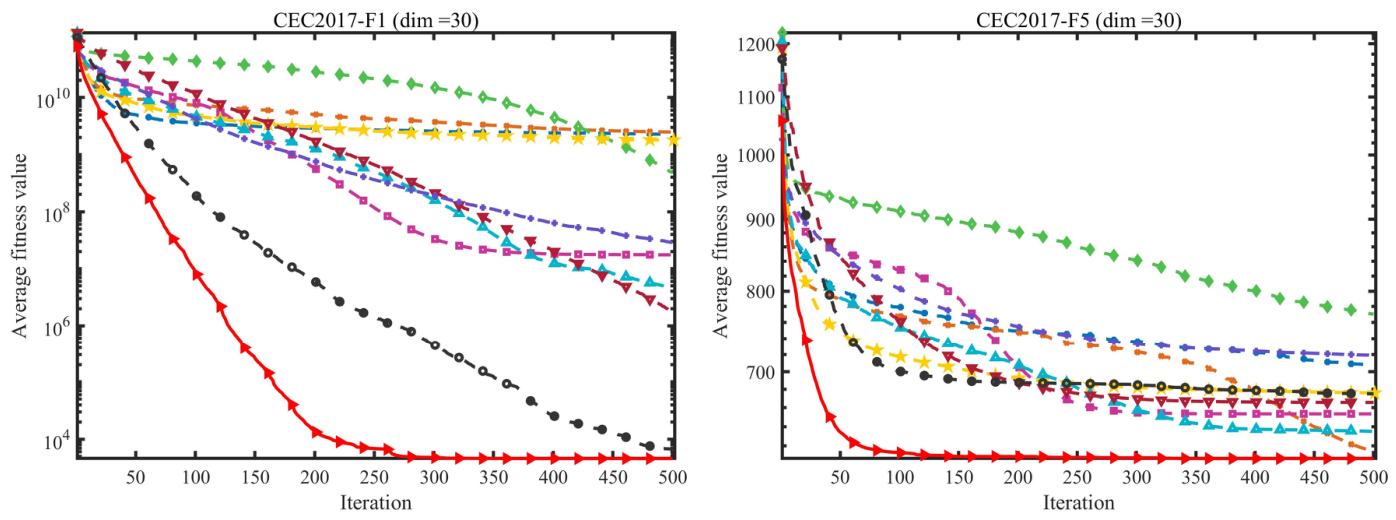
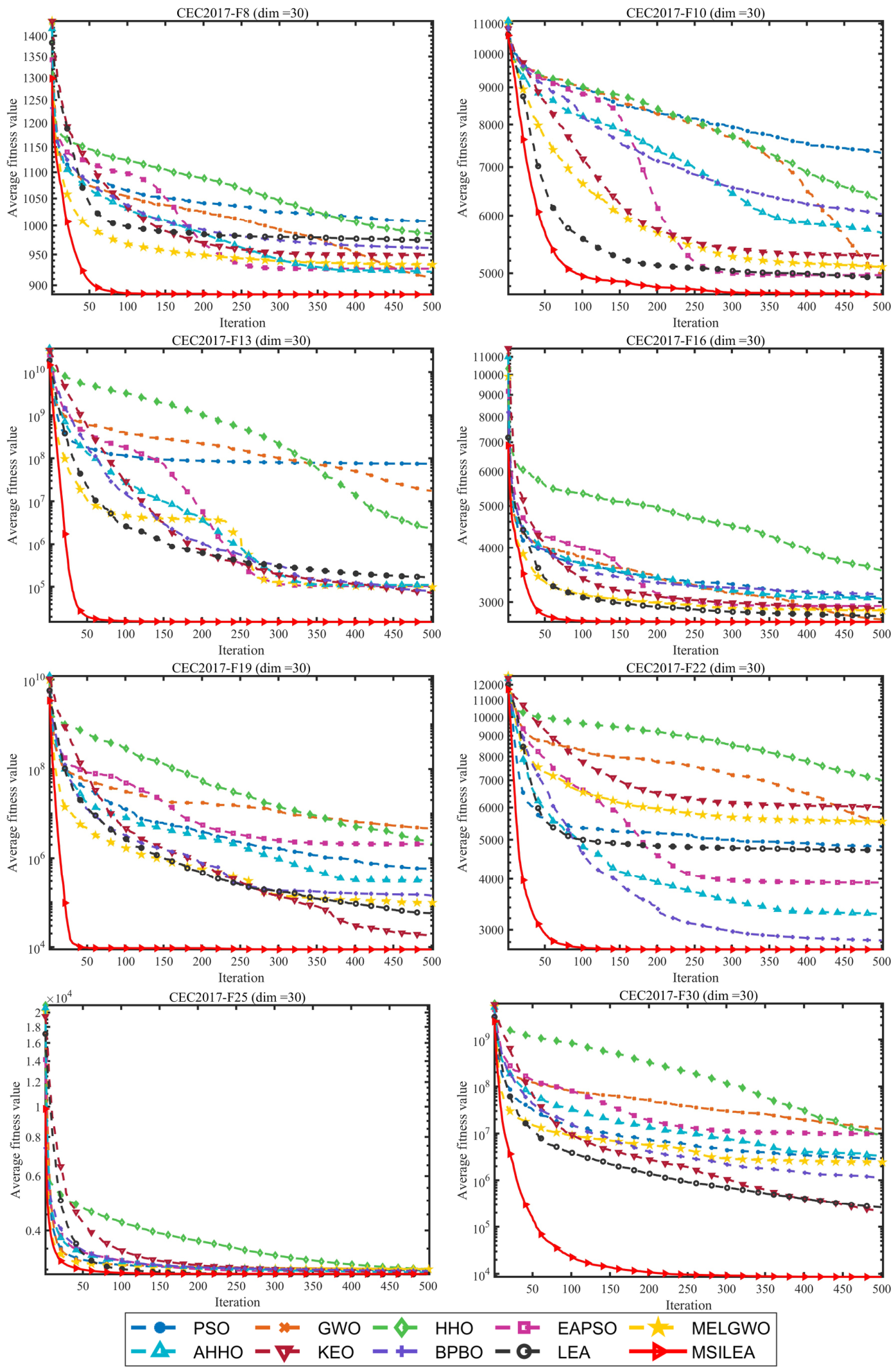
To verify the solving performance of the proposed multi-strategy improved Love Evolution Algorithm (MSILEA) on complex high-dimensional optimization problems, numerical experiments were conducted using the CEC2017 benchmark function suite (dimension = 30). MSILEA was compared with nine classical and improved metaheuristic algorithms, including PSO, GWO, and HHO. The performance of the algorithms was evaluated from three perspectives: optimal solution accuracy, convergence stability, and convergence speed. In the experiments, the population size was uniformly set to 30, and the maximum number of iterations was 500. Each algorithm was independently executed 30 times, and the average value (Ave) and standard deviation (Std) were adopted as performance evaluation metrics to ensure the fairness and validity of the experimental comparisons. The experimental results are shown in
Appendix A and
Figure 3.
Appendix A presents the experimental results on the 30-dimensional CEC2017 benchmark functions. In terms of optimal solution accuracy, MSILEA achieves the lowest average value on most functions, demonstrating a significant optimization advantage. For the unimodal functions F1–F3, the average results obtained by MSILEA are 4.5828 × 10
3, 2.0835 × 10
13, and 9.9808 × 10
2, respectively. Compared with the original Love Evolution Algorithm (LEA), which obtains 6.7152 × 10
3, 5.5535 × 10
4, and 1.3521 × 10
3, the solution accuracy of F1 and F3 is substantially improved, indicating that the proposed improvement strategies effectively enhance the local exploitation capability of the algorithm.
For the multimodal functions, such as F12–F15, F18–F19, and F30, which are characterized by complex high-dimensional search spaces, the superiority of MSILEA becomes even more pronounced. For instance, the average value of F14 obtained by MSILEA is 3.7684 × 10³, and that of F30 is 8.6128 × 10³, both of which are significantly lower than those achieved by the other compared algorithms and even represent an order-of-magnitude improvement over LEA. These results indicate that MSILEA can effectively avoid premature convergence to local optima and accurately locate the global optimum when dealing with optimization problems involving multiple local extrema and complex search landscapes.
It should also be noted that MSILEA does not outperform LEA on every single function. For example, on F2, the average value of MSILEA is 2.0835 × 10¹³, whereas LEA obtains 5.5535 × 10¹². This indicates that the original LEA performs better on this specific function. A possible reason is that F2 has a highly ill-conditioned and irregular landscape, where the strengthened directional learning and quality-guided selection in MSILEA may increase exploitation pressure and reduce the probability of maintaining scattered exploratory solutions. Therefore, although MSILEA achieves better overall performance across the benchmark suite, its improvement is not universal for all function landscapes. This observation also suggests that adaptive control of the strategy intensity may further improve the robustness of MSILEA in future research.
From the perspective of convergence stability, the standard deviations of MSILEA remain consistently low across most benchmark functions. For example, the standard deviations for F6 and F8 are 5.1200 and 2.1578 × 101, respectively, both of which are lower than those of all compared algorithms, including LEA. This demonstrates that MSILEA exhibits strong robustness and small performance fluctuations across multiple independent runs.
The stability of MSILEA also varies across different function landscapes. For example, on F2, MSILEA shows a larger standard deviation than on several other functions. This phenomenon may be related to the highly ill-conditioned and irregular landscape of F2. In such functions, small changes in several dimensions may cause large differences in the objective value, and the strengthened directional learning mechanism may guide different runs toward different local basins. Therefore, although MSILEA improves the overall search capability, its stability can still be affected by highly scalable or irregular multimodal structures.
Figure 3 illustrates the convergence curves of several representative CEC2017 benchmark functions, which visually reflect the convergence speed and convergence accuracy of the algorithms. In the convergence plots for F1, F13, F19, and F30, the curve of MSILEA consistently lies below those of all compared algorithms, indicating superior optimization performance. Moreover, the curve of MSILEA drops rapidly during the early iterations and approaches the optimal solution after approximately 200 iterations, whereas the curves of algorithms such as PSO, GWO, and HHO decline slowly and become flat in later iterations, making it difficult to further improve solution accuracy.
Although the original LEA exhibits faster convergence than traditional algorithms on certain functions, its convergence curve shows a smaller decline and lower final accuracy compared with MSILEA. For example, on function F8, the convergence limit of LEA is approximately 9.700 × 10², while MSILEA converges to around 8.8 × 10². Furthermore, on complex hybrid functions such as F22, the convergence curve of MSILEA shows no obvious stagnation phase and maintains a stable downward trend throughout the iterative process. In contrast, other algorithms experience premature convergence stagnation in the middle iterations. These results indicate that the proposed strategies—including the nonlinear two-stage search radius adjustment and the quality–distance joint decision mechanism—effectively balance the global exploration and local exploitation capabilities of the algorithm. As a result, MSILEA can both rapidly explore the search space and perform fine-grained exploitation near the optimal solution, achieving simultaneous improvements in convergence speed and solution accuracy.
In summary,
Table A1 and
Figure 3 demonstrate that MSILEA achieves competitive solution accuracy and convergence stability on most CEC2017 functions. However, the results also show that the advantage of MSILEA is function-dependent. On several highly irregular functions, the improvement is relatively limited, indicating that different landscape characteristics may affect the effectiveness of the proposed search mechanisms.
3.3. CEC2022 Basic Benchmark Function Experiment
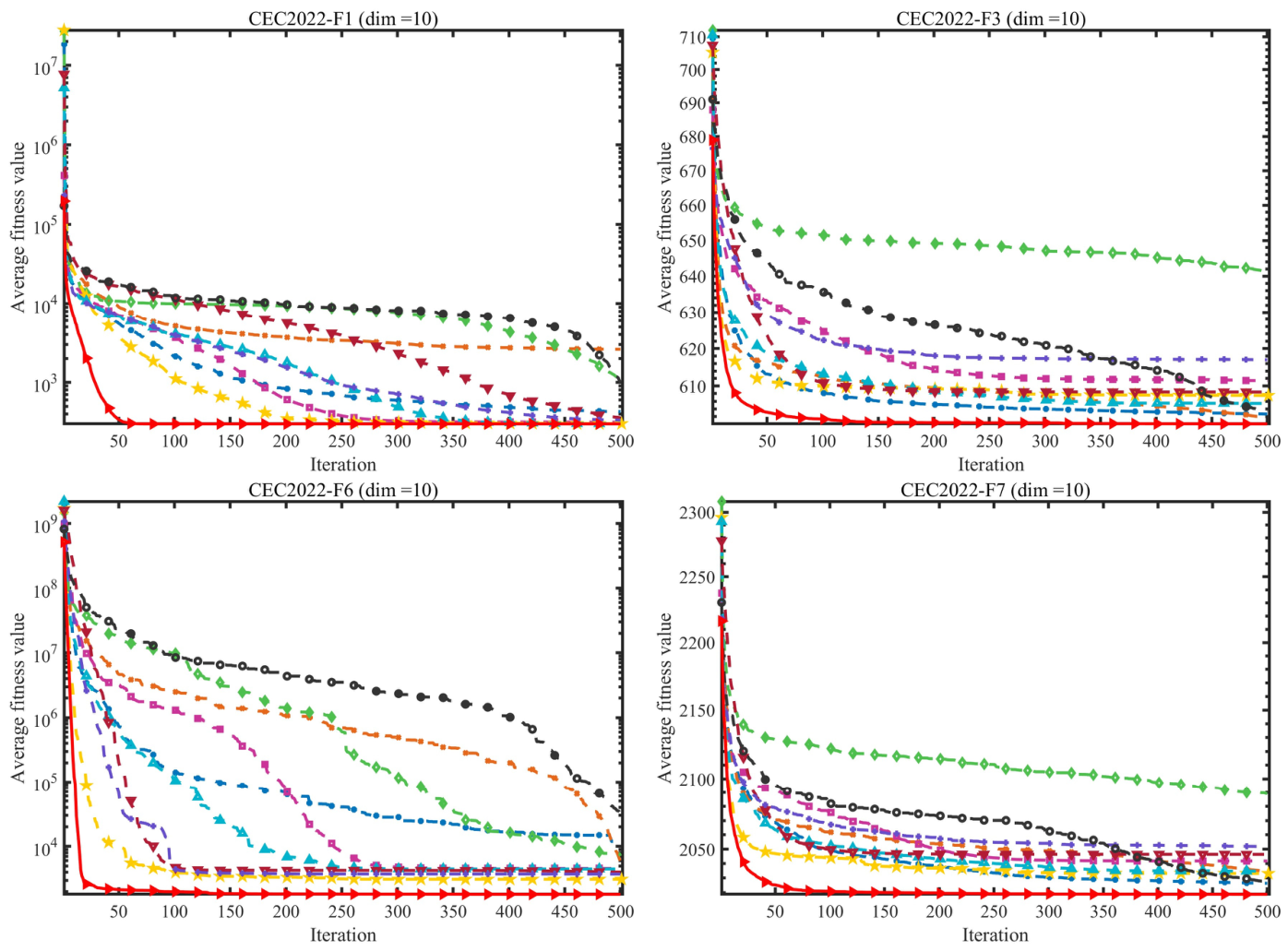
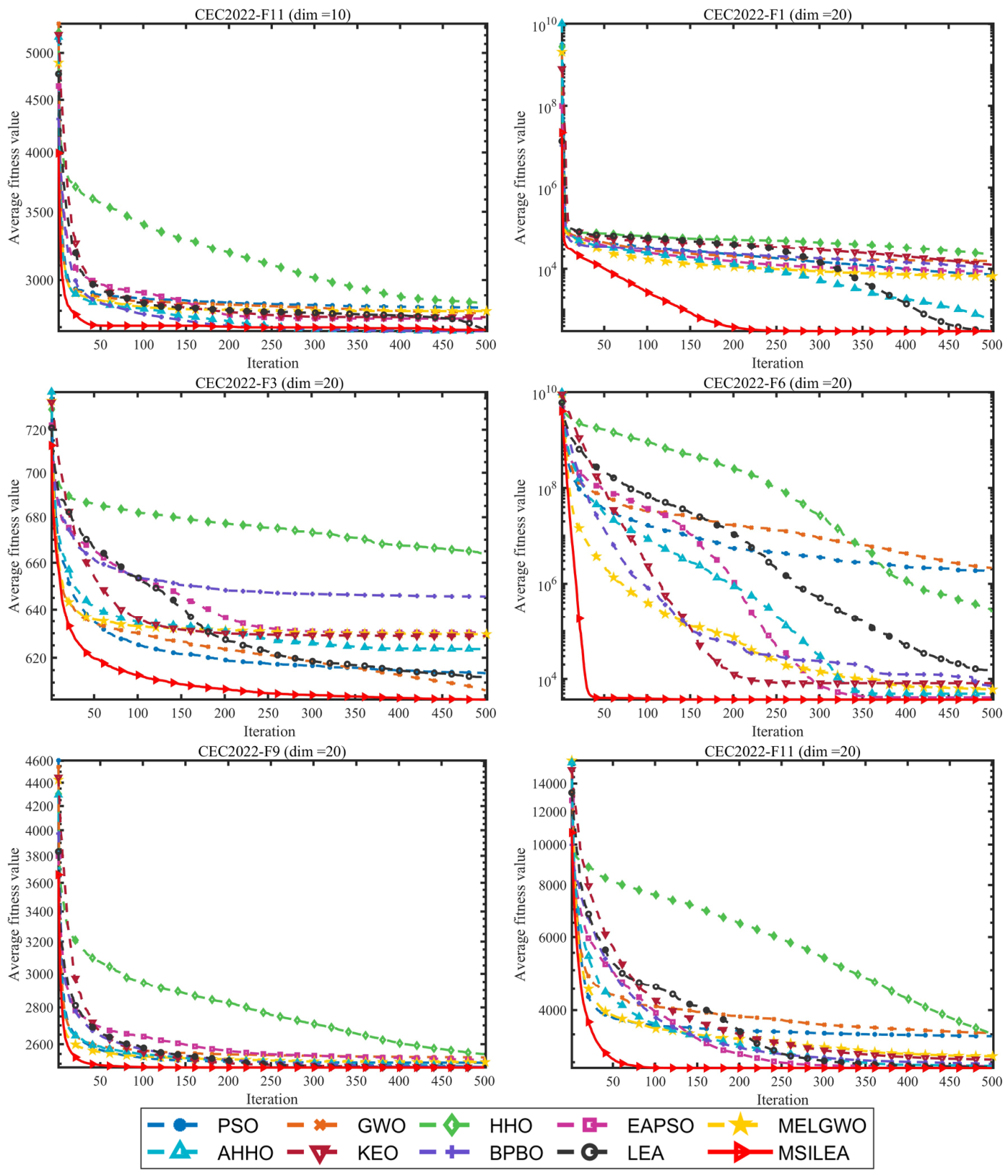
To further verify the adaptability and generalization capability of the proposed multi-strategy improved Love Evolution Algorithm (MSILEA) in complex optimization problems with different dimensionalities, numerical experiments were conducted on the CEC2022 benchmark function suite. Two dimensional scenarios, 10 dimensions and 20 dimensions, were considered. The experiments adopted the same parameter settings and evaluation criteria as those used in the CEC2017 tests. MSILEA was compared with nine benchmark algorithms in terms of solution accuracy and convergence stability under different dimensional conditions. In addition, convergence curves were analyzed to investigate the convergence speed characteristics of the algorithms across different dimensional scenarios, thereby comprehensively validating the performance improvements introduced by the proposed strategies. The experimental results are shown in
Table A2 and
Table A3 and
Figure 4.
Table A2 presents the experimental results for the 10-dimensional CEC2022 benchmark function suite. In this scenario, MSILEA demonstrates excellent solution accuracy and stability, achieving the best or second-best average value on all test functions, while its standard deviations are significantly lower than those of the other compared algorithms. For the unimodal functions F1–F4, MSILEA achieves near-ideal solution accuracy. Specifically, the average value for F1 is 3.0000 × 10
2, with a standard deviation as low as 4.0881 × 10
−14, successfully reaching the theoretical optimal solution. For F3, the average value is 6.0007 × 10
2, with a standard deviation of only 2.5632 × 10
−1. Compared with the results obtained by the original Love Evolution Algorithm (LEA)—with an average of 6.0354 × 10
2 and a standard deviation of 1.6438—MSILEA shows substantial improvements in both accuracy and stability.
For complex multimodal and hybrid functions, such as F6, F9, and F11, the superiority of MSILEA becomes even more evident. The average value for F6 obtained by MSILEA is 1.8258 × 10³, which is significantly lower than the 3.1763 × 10³ achieved by LEA. Meanwhile, the standard deviation for F9 is 1.3191 × 10⁻¹², indicating almost no fluctuation across independent runs. These results demonstrate that in the low-dimensional CEC2022 testing scenario, MSILEA can accurately locate the global optimum, while maintaining high consistency across multiple runs.
Table A3 presents the experimental results for the 20-dimensional CEC2022 benchmark function suite. As the problem dimensionality increases, the optimization difficulty becomes greater for all algorithms. Nevertheless, MSILEA maintains the best overall performance. It continues to achieve the lowest average values on several functions, including F1, F3, F4, and F9. For instance, the average value for F1 is 3.0006 × 10
2, with a standard deviation of only 8.3760 × 10
−2, which remains close to the theoretical optimum. For F9, the average value is 2.4808 × 10
3, with a standard deviation as low as 3.8719 × 10
−4, showing no obvious performance degradation compared with the 10-dimensional case.
Even for functions with strong dimensional sensitivity, such as F5 and F10, MSILEA still maintains superior performance compared with the other algorithms. For example, on F11, the average value of MSILEA is 2.9074 × 10³, with a standard deviation of 6.9189 × 101, outperforming LEA, which obtains 2.9221 × 10³ and 1.4104 × 10², respectively. These results demonstrate that the proposed improvement strategies can effectively mitigate the “curse of dimensionality”, enabling MSILEA to retain excellent optimization capability in medium- and high-dimensional complex optimization problems.
Figure 4 shows the typical convergence curves of the CEC2022 benchmark functions under the 10-dimensional and 20-dimensional scenarios, which visually illustrate the convergence speed and convergence limits of the algorithms at different dimensionalities. In the 10-dimensional convergence curves for functions such as F1, F6, and F9, the curve of MSILEA declines rapidly during the early iterations, approaching the optimal solution within approximately 50–100 iterations, and consistently remaining below all other algorithms throughout the process. In contrast, traditional algorithms such as PSO, GWO, and HHO show slow convergence, and even after 500 iterations, their solution accuracy still fails to reach that of MSILEA. Although the original LEA converges faster than some traditional algorithms, its convergence limit remains significantly higher than that of MSILEA.
In the 20-dimensional convergence curves for functions such as F1, F3, F9, and F11, the convergence speeds of all algorithms slow down to varying degrees due to the increased dimensionality. However, the performance ranking among algorithms remains unchanged, with MSILEA still achieving the fastest convergence speed and the lowest convergence limit. For example, on the 20-dimensional F9 function, MSILEA converges to a stable value after approximately 200 iterations, whereas the other algorithms continue to decline slowly during the later iterations and never reach the same solution accuracy as MSILEA.
Furthermore, when comparing the convergence curves of the same functions across the 10-dimensional and 20-dimensional scenarios, the curve shapes of MSILEA remain almost identical, with no significant performance degradation. In contrast, the other algorithms exhibit significantly higher convergence limits and substantially slower convergence speeds in the 20-dimensional case. These results indicate that the proposed strategies—including the nonlinear two-stage search radius adjustment and winner-direction differential learning—effectively improve the search efficiency of the algorithm across different dimensionalities, enabling MSILEA to maintain an efficient balance between global exploration and local exploitation in both low- and medium/high-dimensional scenarios, while avoiding performance deterioration caused by increasing dimensionality.
In summary, based on the numerical results presented in
Table A3 and the convergence curves in
Figure 4, MSILEA significantly outperforms the nine compared algorithms, including the original LEA, under both 10-dimensional and 20-dimensional scenarios of the CEC2022 benchmark function suite, demonstrating strong dimensional adaptability and generalization capability. In the low-dimensional scenario, MSILEA can accurately obtain the global optimal solution with extremely high stability. In medium- and high-dimensional scenarios, the algorithm effectively alleviates the increased optimization difficulty caused by higher dimensionality, while maintaining superior solution accuracy, convergence speed, and stability.
3.4. Statistical Methods for Analysis
To quantitatively verify the performance superiority of MSILEA over the compared algorithms from a statistical perspective, two nonparametric statistical tests, namely the Wilcoxon rank-sum test and the Friedman mean rank test, were employed to perform significance analysis on the experimental results obtained from three benchmark datasets: CEC2017 and CEC2022.
Specifically, the Wilcoxon rank-sum test was used to determine the statistical significance of performance differences between MSILEA and each compared algorithm, while the Friedman mean rank test was applied to comprehensively rank the overall performance of all algorithms across the benchmark functions. By combining these two statistical approaches, the analysis provides mutual validation, thereby ensuring the objectivity and reliability of the evaluation results.
3.4.1. Wilcoxon Rank-Sum Test Procedure
Table 2 reports the Wilcoxon rank-sum test results recalculated from the 30 independent runs of each algorithm. The signs “+/=/−” are determined according to the
p-value at the significance level of
and the relative mean performance. Therefore, the table reflects not only the average values in
Table 2, but also the distributional differences across repeated runs.
For the CEC2017 test suite, MSILEA shows significant advantages over most compared algorithms on a large number of functions, but it also performs worse on several specific functions for some competitors. Therefore, the Wilcoxon results should be interpreted as evidence of overall statistical superiority rather than absolute dominance on every function. For the CEC2022 (10-dimensional) and CEC2022 (20-dimensional) test suites, MSILEA achieves significantly superior performance on 11 functions in each case, with only one function showing equivalent performance.
Among the compared algorithms, HHO exhibits the most significant performance difference from MSILEA, yielding results of “30/0/0”, “12/0/0”, and “12/0/0” on the three test suites, respectively. Meanwhile, LEA, as the original algorithm of MSILEA, records “21/0/9” on the CEC2017 (30-dimensional) dataset and also fails to outperform MSILEA on the CEC2022 datasets. These results clearly indicate that the performance improvement achieved by MSILEA through multiple enhancement strategies is not due to randomness, but rather represents a statistically significant improvement. Moreover, this advantage remains consistent across different benchmark datasets and dimensional scenarios. In addition, none of the compared algorithms exhibit the reverse pattern “−/=/+” across the three test suites, which further confirms that MSILEA demonstrates a stable and statistically significant performance advantage in solving global optimization problems.
3.4.2. Friedman Mean Rank Evaluation
Table 3 summarizes the Friedman test results for the compared algorithms. The assessment is based on the mean rank (M.R) and total rank (T.R), where smaller values imply better overall effectiveness. These results provide an overall ranking of the ten algorithms on the considered benchmark datasets.
In all testing scenarios, MSILEA achieves the lowest mean rank and total rank, indicating the best overall performance among all algorithms. Specifically, on CEC2017 (30-dimensional), MSILEA obtains a mean rank of 1.93 and a total rank of 1; on CEC2022 (10-dimensional), the mean rank is 2.50 with a total rank of 1; and on CEC2022 (20-dimensional), the mean rank is 2.00 with a total rank of 1. These values are significantly lower than those of the other compared algorithms, making MSILEA the top-performing algorithm across all benchmark datasets.
Among the compared algorithms, AHHO and LEA exhibit relatively better overall performance, achieving comparatively lower mean ranks in certain test suites. For example, AHHO obtains a mean rank of 3.17 and a total rank of 2 on CEC2022 (20-dimensional), while LEA achieves a mean rank of 4.08 and a total rank of 3 on the same dataset. Nevertheless, their ranking values still show a clear gap compared with MSILEA. In contrast, HHO consistently obtains the largest mean ranks and total ranks across all three test suites, indicating the poorest overall performance among the algorithms. For instance, its mean ranks reach 9.53 (T.R = 10) on CEC2017 (30-dimensional) and 9.67 (T.R = 10) on CEC2022 (20-dimensional).
Furthermore, from the perspective of dimensional variation, the mean rank of MSILEA exhibits only slight fluctuations between the 10-dimensional and 20-dimensional CEC2022 test suites, without any significant increase. In contrast, several compared algorithms, such as PSO and BPBO, show a clear increase in mean rank as the dimensionality increases, indicating performance degradation. This observation suggests that MSILEA can maintain stable and optimal comprehensive performance across different dimensional scenarios, whereas the performance of other algorithms is more susceptible to degradation with increasing dimensionality.
In summary, based on the Wilcoxon rank-sum test results in
Table 2 and the Friedman mean rank test results in
Table 3, the performance advantage of MSILEA in solving complex global optimization problems is supported by clear statistical significance and overall superiority.
From the perspective of pairwise comparisons, the Wilcoxon rank-sum test verifies that MSILEA significantly outperforms the compared algorithms on the majority of benchmark functions, and this advantage remains consistently stable across both the CEC2017 and CEC2022 datasets, as well as across low-dimensional and medium/high-dimensional scenarios.
Meanwhile, from the perspective of global ranking, the Friedman mean rank test quantitatively demonstrates that the overall performance of MSILEA ranks first among the ten compared algorithms, identifying it as the best-performing algorithm for global optimization problems with varying characteristics and dimensionalities.
The results of these two nonparametric statistical tests mutually reinforce each other, effectively eliminating the possibility that the experimental outcomes are caused by random factors. More importantly, they provide strong statistical evidence for the effectiveness and synergy of the proposed improvement strategies, including the nonlinear two-stage search radius adjustment, quality–distance joint decision mechanism, and winner-direction differential learning strategy. The integration of these strategies fundamentally enhances the global exploration and local exploitation capabilities of the algorithm, thereby ensuring that the performance improvements achieved by MSILEA are both substantial and statistically significant.
3.5. Computational Time Analysis
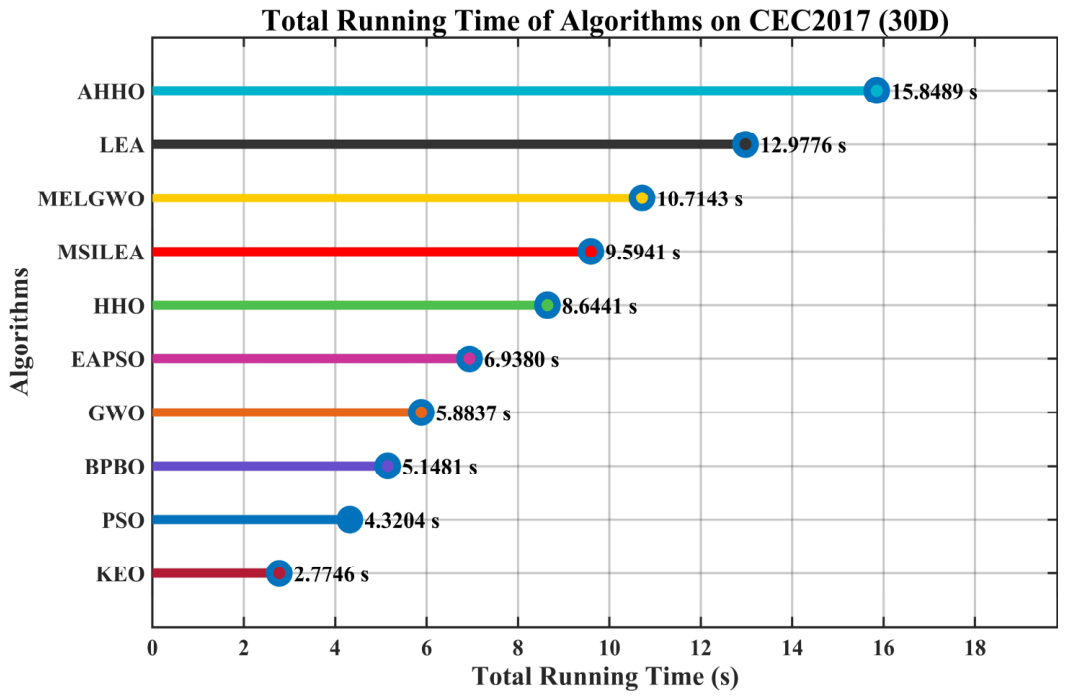
In addition to optimization accuracy and convergence performance, computational efficiency is also an important criterion for evaluating the practical applicability of metaheuristic algorithms. Therefore, the total CPU running time of all compared algorithms on the 30-dimensional CEC2017 benchmark suite was further analyzed. All algorithms were executed under the same experimental environment, population size, maximum number of iterations, and stopping conditions to ensure the fairness of the comparison. The total running times are illustrated in
Figure 5.
Figure 5 shows that the computational costs of different algorithms exhibit noticeable differences due to variations in algorithmic structures and update mechanisms. Among all compared methods, KEO achieves the shortest running time of 2.7746 s, followed by PSO and BPBO with running times of 4.3204 s and 5.1481 s, respectively. These algorithms possess relatively simple update mechanisms and fewer additional search operations, resulting in lower computational overhead.
Classical algorithms such as GWO, EAPSO, and HHO require moderate computational time, with total running times of 5.8837 s, 6.9380 s, and 8.6441 s, respectively. Compared with these methods, the proposed MSILEA requires 9.5941 s, which is slightly higher than several traditional algorithms. This increase is mainly caused by the additional calculations introduced by the nonlinear two-stage search radius regulation strategy, the quality–distance joint decision strategy, and the winner-direction differential learning strategy. Specifically, operations such as sigmoid transformation, pairwise quality–distance evaluation, and winner–loser differential vector computation inevitably increase the constant computational overhead of the algorithm.
However, despite the introduction of multiple enhancement strategies, the running time of MSILEA remains significantly lower than that of MELGWO, LEA, and AHHO, whose running times are 10.7143 s, 12.9776 s, and 15.8489 s, respectively. In particular, the original LEA requires substantially more computational time than MSILEA. This result indicates that the proposed improvement strategies not only enhance optimization performance, but also improve the search efficiency of the original LEA by accelerating convergence and reducing ineffective search behaviors during the iterative process.
Overall, although MSILEA introduces additional search mechanisms and slightly increases structural complexity compared with several lightweight algorithms, the computational burden remains at an acceptable level. More importantly, MSILEA achieves significantly better convergence accuracy and robustness while maintaining competitive running time. Therefore, the proposed algorithm demonstrates a favorable trade-off between optimization performance and computational efficiency, indicating its potential applicability to complex engineering optimization problems.
4. Microgrid Optimal Scheduling Model
In order to realize the economical and coordinated operation of the microgrid, this study establishes a day-ahead optimal scheduling model for a grid-connected microgrid composed of a microturbine, a fuel cell, a photovoltaic generation unit, a wind power generation unit, a battery energy storage system, and a bidirectional power exchange link with the utility grid. The scheduling horizon is one day and is divided into 24 time intervals. For each time interval, the output of dispatchable units and the charging/discharging behavior of the battery are optimally determined so that the overall operating cost of the system is minimized while all technical and operational constraints are satisfied.
The microgrid considered in this work contains both controllable and uncontrollable energy sources. Among them, the microturbine and fuel cell are dispatchable distributed generators, whose output power can be adjusted within given limits. The photovoltaic and wind power outputs are treated as forecasted renewable generation and are therefore regarded as known input quantities in the optimization process. The battery energy storage system is used to absorb surplus energy or compensate for generation shortages through charging and discharging. In addition, the microgrid is allowed to exchange power with the external utility grid within a prescribed capacity limit. Based on these components, the microgrid scheduling problem can be formulated as a constrained nonlinear optimization problem.
It should be clarified that the “love” metaphor in LEA and MSILEA is used only as a mathematical heuristic for modeling interaction, selection, and role transformation among candidate solutions. It does not correspond to a physical phenomenon in the microgrid system. In the microgrid dispatch problem, each individual represents a candidate scheduling scheme, and the interaction behaviors of MSILEA are optimization operators used to search for lower-cost and feasible schedules. Therefore, the bionic metaphor provides algorithmic inspiration, while the physical interpretation of the microgrid remains governed by power balance, generation constraints, ramp-rate limits, and battery SOC constraints.
4.1. Objective Function
The objective of the microgrid scheduling problem is to minimize the total operating cost over the 24 h scheduling horizon. The total cost mainly includes the fuel cost of dispatchable generators, operation and maintenance cost of generation units, start-up cost of controllable generators, electricity purchasing cost associated with grid interaction, and battery degradation or operating cost.
Therefore, the optimization objective can be expressed as:
where
represents the total operating cost of the microgrid during time interval
.
For each time period, the total cost is composed of several parts.
4.1.1. Fuel Cost of Dispatchable Generators
The microturbine and fuel cell consume natural gas during operation. Their fuel cost depends on the generated power and the corresponding energy conversion efficiency. Thus, the fuel cost at time
can be written as:
where
is the unit price of natural gas;
is the lower calorific value of natural gas;
is the operating efficiency of the microturbine at time
;
is the operating efficiency of the fuel cell at time
;
denotes the output power of the microturbine at time
;
denotes the output power of the fuel cell at time
.
According to the adopted component models, the efficiency of the microturbine is expressed as a cubic function of its normalized output power:
Similarly, the efficiency of the fuel cell is modeled as a linear function of output power:
These efficiency expressions reflect the nonlinear operating characteristics of the distributed generation units. As a result, the objective function of the microgrid scheduling problem is nonlinear.
4.1.2. Operation and Maintenance Cost
In addition to fuel consumption, each generation unit incurs operation and maintenance cost during operation. The operation and maintenance cost at time
is given by:
where the coefficients
,
,
and
represent the operation and maintenance costs of the microturbine, fuel cell, photovoltaic unit, and wind turbine, respectively.
Although photovoltaic and wind power outputs are not control variables, their generation still contributes to the total operating cost through maintenance-related expenses.
4.1.3. Start-Up Cost
When the microturbine or fuel cell changes from the off state to the on state, an additional start-up cost is incurred. To describe this process, binary-like unit state indicators are introduced:
Accordingly, the start-up cost at time
is formulated as:
where
is the start-up cost coefficient of the microturbine;
is the start-up cost coefficient of the fuel cell;
denotes the initial operating state of the units before the first scheduling period.
This formulation ensures that start-up cost is only counted when a unit is turned on.
4.1.4. Electricity Trading Cost with the Utility Grid
Since the microgrid is connected to the main grid, power can be purchased from or delivered to the utility grid. In the implemented model, the grid-related cost at time
is expressed as
where
is the time-varying electricity price at time
;
is the exchanged power between the microgrid and the grid.
This term reflects the economic effect of grid interaction on the total operating cost. A positive grid exchange power corresponds to purchasing more energy from the grid according to the sign convention implied by the power balance equation used in the code.
4.1.5. Battery Operating Cost
To account for battery wear and operational loss, the battery is assigned an operating cost proportional to the absolute charging/discharging power:
where
is the battery operating or degradation cost coefficient.
4.1.6. Total Cost Function
By summing the above components, the total operating cost in time interval
is obtained as
Therefore, the complete objective function of the microgrid optimal scheduling model can be written as:
This objective function quantitatively measures the economic performance of the microgrid over the whole scheduling horizon.
4.2. Constraints of the Microgrid Scheduling Model
To ensure the physical feasibility and operational security of the system, the optimization process must satisfy a set of equality and inequality constraints.
4.2.1. Power Balance Constraint
At each time interval, the total power supplied by dispatchable units, renewable generation, battery, and grid exchange must match the load demand. Because the battery has different efficiencies during charging and discharging, the power balance equation must be written separately for the two cases.
When the battery is charging, namely
, the power balance is expressed as
When the battery is discharging, namely
, the power balance is expressed as
where
is the battery charging efficiency;
is the battery discharging efficiency.
This constraint guarantees real-time balance between generation and demand in every scheduling period.
4.2.2. Battery Energy Constraint
The battery state evolves dynamically with the charging and discharging process. Let
denote the stored energy of the battery at the beginning of period
. Then the battery energy update equation is given by:
where
is the battery self-discharge rate; is the battery energy at time
.
The initial battery energy is and the state of charge (SOC) is defined as , where is the maximum battery energy capacity.
To ensure safe operation of the energy storage system, the battery energy must satisfy
In the implemented model, an additional daily energy neutrality condition is imposed:
This means that the total battery energy variation over the whole day is zero, ensuring that the battery returns to approximately its initial energy level at the end of the scheduling horizon. Such a constraint is commonly used in day-ahead scheduling to prevent the optimization from unrealistically shifting the burden to the following day.
4.2.3. Generator Output Limits
The dispatchable generation units cannot operate beyond their technical capacity limits. Therefore, the microturbine output must satisfy
and the fuel cell output must satisfy
These constraints define the feasible operating range of each controllable generator.
4.2.4. Grid Exchange Power Limits
The power exchanged with the utility grid is constrained by the transmission interface and contractual limits. Thus,
This limitation prevents the microgrid from purchasing or exporting unlimited power.
4.2.5. Battery Charging and Discharging Power Limits
The battery charging and discharging rate is limited by the rated power converter and battery characteristics. Accordingly,
where
corresponds to the maximum charging power and
corresponds to the maximum discharging power.
4.2.6. Ramp Rate Constraints of Dispatchable Generators
In practical operation, the output power of the microturbine and fuel cell cannot change abruptly between two adjacent scheduling periods. Therefore, ramp rate constraints are imposed on both units.
For the microturbine and the fuel cell, the ramp rate constraint is
where
and
are the ramp-up and ramp-down limits of the microturbine;
and
are the ramp-up and ramp-down limits of the fuel cell.
These constraints improve the practical realism of the dispatch solution and ensure smooth operation of generating units.
4.3. Complete Mathematical Formulation
Based on the above objective and constraints, the day-ahead microgrid scheduling problem can be summarized as
subject to
and the piecewise power balance constraint
for all
.
From the mathematical structure of the model, it can be seen that the scheduling problem is characterized by nonlinear generator efficiency, time-coupled battery dynamics, ramping constraints, and multiple operational limits. Therefore, the resulting optimization problem is nonlinear, constrained, and high-dimensional. Conventional deterministic optimization methods may encounter difficulty in obtaining high-quality solutions efficiently, especially when the objective landscape is complex and nonconvex. For this reason, intelligent optimization algorithms are adopted in this study to solve the proposed microgrid economic scheduling problem.
4.4. Parameter Settings of the Microgrid System
In order to accurately simulate the operation characteristics of the microgrid, the key parameters of distributed generation units, the battery energy storage system, and the grid interaction unit must be specified in advance. These parameters include the minimum and maximum output power of each dispatchable unit, ramp rate limits, operation and maintenance cost coefficients, start-up costs, and the technical parameters of the energy storage system.
In this study, the parameter values are selected according to typical operating characteristics of microgrid components and relevant literature. The photovoltaic (PV) and wind turbine (WT) outputs are considered as forecasted renewable generation profiles and therefore treated as known inputs in the optimization model. The microturbine (MT) and fuel cell (FC) act as dispatchable generators whose outputs are limited by capacity constraints and ramping constraints. The battery energy storage system is modeled with charging/discharging efficiency, self-discharge rate, and state-of-charge limits. In addition, the microgrid is allowed to exchange power with the main grid within a specified range.
The key parameters used in the proposed microgrid scheduling model are summarized in
Table 4.
As shown in
Table 4, the microturbine and fuel cell are the main dispatchable generation units in the microgrid. Their output power is constrained within the ranges of 0–65 kW and 0–50 kW, respectively. In addition, ramp rate limits are imposed on these generators to prevent abrupt power changes between adjacent time periods, thereby ensuring stable system operation.
The photovoltaic and wind power units are treated as uncontrollable renewable energy sources, whose outputs are determined according to forecasted generation profiles. Although their outputs are not optimized, operation and maintenance costs are still considered in the objective function.
The battery energy storage system plays a crucial role in balancing power fluctuations caused by renewable generation and load variations. The battery charging and discharging power is limited within the range of [−20,20] kW. The charging and discharging efficiencies are both assumed to be 0.9, and the self-discharge rate is 0.001. The initial battery energy is set to 10 kWh, while the minimum and maximum allowable energy levels are defined as 4 kWh and 16 kWh, respectively, corresponding to the allowable state-of-charge limits.
Furthermore, the microgrid is allowed to exchange power with the utility grid within the range of 0–20 kW. The electricity purchasing cost is determined according to a time-of-use electricity price scheme. The natural gas price used for calculating the fuel cost of dispatchable generators is set to , and the lower heating value of natural gas is .
These parameter settings ensure that the proposed microgrid scheduling model accurately reflects the operational characteristics of practical microgrid systems.
The operating cost is expressed in Chinese Yuan (CNY) throughout the microgrid scheduling experiment.
4.5. Results and Discussion for the Microgrid Scheduling Experiment
To verify the application value and solution effectiveness of the proposed multi-strategy improved Love Evolution Algorithm (MSILEA) in practical engineering optimization problems, it was applied to the 24 h economic dispatch problem of a microgrid integrating renewable energy sources and energy storage systems. The optimization objective is to minimize the total operating cost of the system, while simultaneously considering practical engineering constraints, including power balance constraints, generation output limits, and battery charging–discharging constraints.
MSILEA was compared with nine classical and improved metaheuristic algorithms. The practical performance of the algorithms was evaluated from four aspects: dispatch cost, solution stability, convergence speed, and rationality of the scheduling scheme. In the experiments, the population size was uniformly set to 30 and the maximum number of iterations was 100. Each algorithm was independently executed 30 times, and the maximum cost, minimum cost, average cost, standard deviation of cost, and average computation time were used as evaluation metrics to ensure the fairness of the comparison and the engineering practicality of the results. The experimental results are presented in
Table 5 and
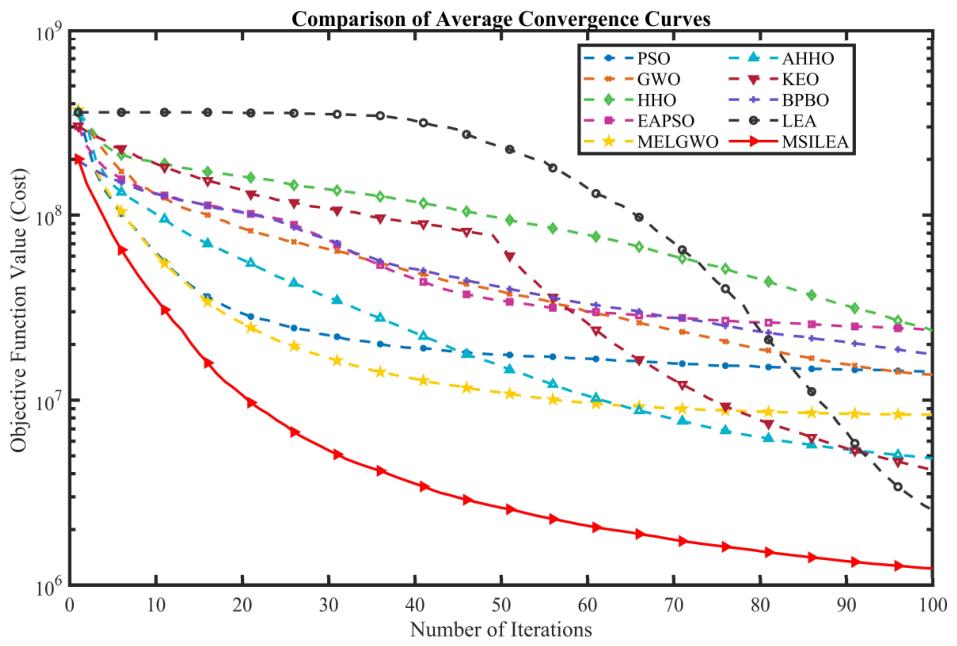
Figure 6,
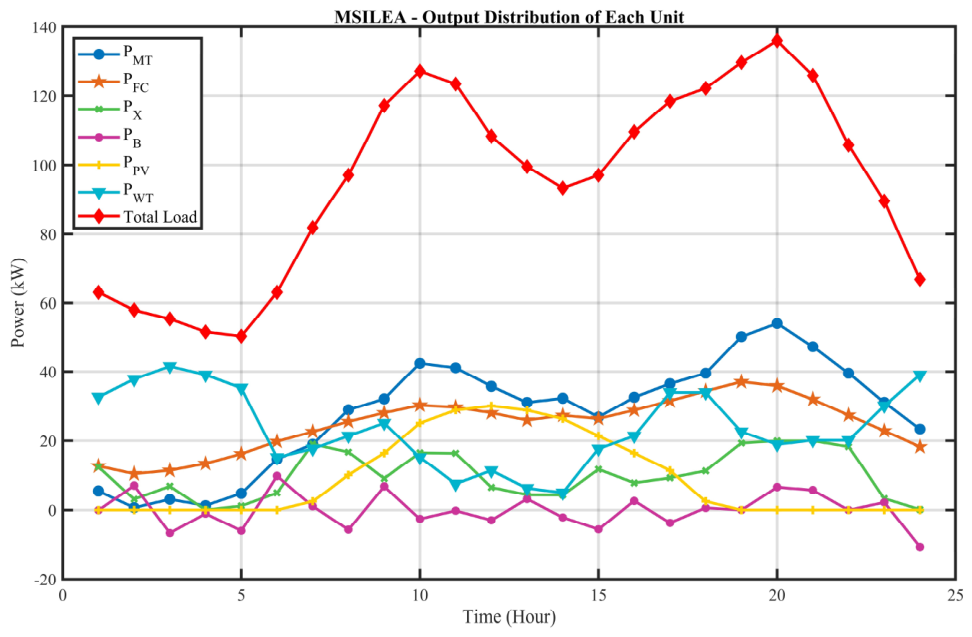
Figure 7 and
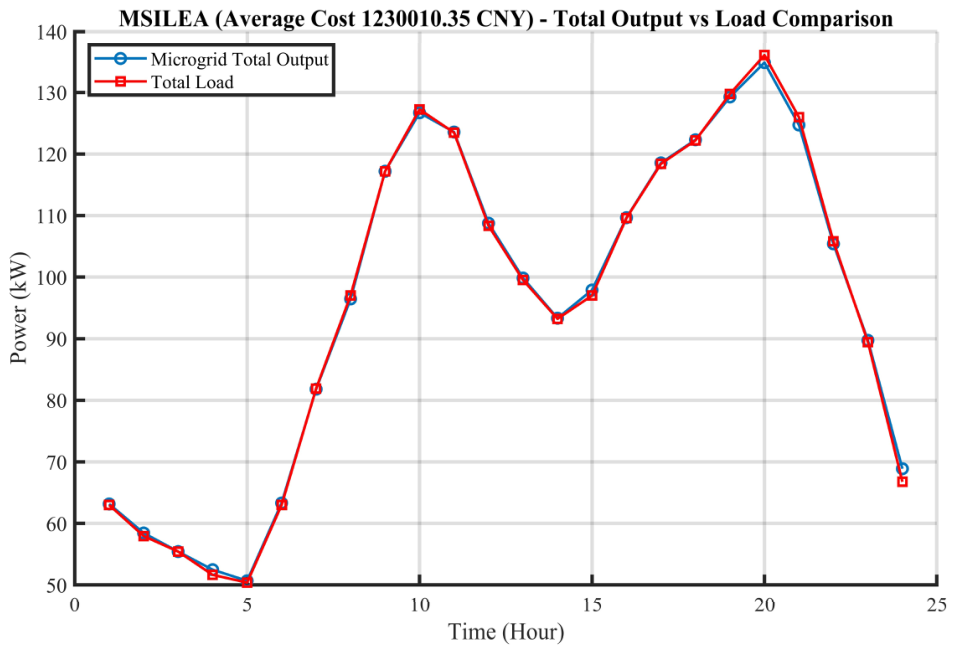
Figure 8.
Table 5 presents the statistical results of different algorithms applied to the microgrid economic dispatch problem. From the perspective of dispatch cost, MSILEA achieves the best results across all cost indicators. Specifically, its maximum cost, minimum cost, and average cost are 1.6076 × 10
6, 8.6388 × 10
5, and 1.2300 × 10
6, respectively. Compared with the original LEA, which obtains 4.1903 × 10
6, 1.6505 × 10
6, and 2.5464 × 10
6, the average dispatch cost is reduced by 51.7%. Even when compared with relatively competitive algorithms such as KEO and AHHO, the average cost of MSILEA is reduced by 70.7% and 74.6%, respectively. These results clearly demonstrate the cost optimization advantage of MSILEA in solving the microgrid economic dispatch problem.
In terms of solution stability, the standard deviation of dispatch cost obtained by MSILEA is only 2.0370 × 10⁵, which is significantly lower than those of the other compared algorithms, such as 7.0175 × 10⁵ for LEA and 9.0447 × 10⁵ for KEO. This indicates that MSILEA can consistently produce low-cost dispatch solutions across multiple independent runs, with very small performance fluctuations, thereby meeting the stability requirements of practical microgrid operation.
From the perspective of computational efficiency, the average solving time of MSILEA is 18.47, which is comparable to algorithms such as HHO, KEO, and LEA, and significantly lower than AHHO (36.91). This demonstrates that MSILEA achieves substantial improvements in economic performance and stability without sacrificing computational efficiency, making it suitable for practical daily scheduling applications in microgrids.
Figure 6 presents the average convergence curves of different algorithms over 100 iterations for the microgrid day-ahead scheduling problem. Since all algorithms were executed under the same maximum iteration number of 100, the convergence behaviors shown in the figure directly reflect their optimization efficiency and solution quality under a unified computational budget.
As illustrated in
Figure 5, the proposed MSILEA consistently achieves the fastest convergence speed and the lowest final objective value among all compared algorithms. During the early optimization stage (iterations 1–20), the convergence curve of MSILEA decreases sharply, indicating that the proposed strategies enable the algorithm to rapidly identify promising regions in the search space and effectively reduce the operating cost. In contrast, most classical algorithms, such as PSO, GWO, and HHO, exhibit relatively slower convergence rates and remain trapped at comparatively high cost levels throughout the optimization process.
In the middle optimization stage (approximately iterations 20–60), the convergence advantage of MSILEA becomes more evident. While several algorithms begin to show premature stagnation or only gradual improvement, the MSILEA curve continues to decrease steadily without obvious oscillation. This phenomenon indicates that the proposed nonlinear two-stage search radius regulation strategy and quality–distance joint decision strategy effectively maintain the balance between global exploration and local exploitation, thereby preventing the algorithm from becoming trapped in local optima too early.
During the later optimization stage (iterations 60–100), the convergence curves of most comparison algorithms become nearly flat, suggesting limited further optimization capability. By contrast, MSILEA still maintains a stable downward trend and finally converges to the lowest operating cost, approximately at the level of 1.0 × 10⁶. Although the original LEA demonstrates competitive convergence behavior in the middle and late stages, its convergence speed and final solution quality remain inferior to those of MSILEA. This result further demonstrates that the proposed winner-direction differential learning strategy can provide more effective directional guidance and improve the exploitation capability near promising regions.
Figure 7 presents the 24 h power output distribution of each microgrid unit obtained by MSILEA. From the perspective of dispatch rationality, MSILEA effectively coordinates the operation of different dispatch units according to the characteristics of renewable energy generation and load demand variations. During the daytime period, especially around 10:00–16:00, the renewable generation output becomes relatively high. The photovoltaic output reaches its peak around noon, while the wind power output varies with the assumed wind profile. Under this condition, MSILEA tends to reduce the output of controllable units such as microturbines and fuel cells when renewable generation is sufficient, and coordinates the battery charging/discharging behavior to maintain power balance. This indicates that the obtained dispatch scheme can effectively prioritize renewable energy utilization while satisfying load demand and operational constraints.
During periods of low renewable generation (e.g., 00:00–06:00), the algorithm appropriately increases the output of controllable units and allows the energy storage system to discharge, thereby compensating for the power deficit. At the same time, the power purchased from the main grid is maintained within a reasonable range to avoid excessive electricity purchase costs.
The output variations of all units comply with their respective generation limits and ramping constraints, without abrupt fluctuations. For example, the microturbine output is consistently regulated within the range of 0–65 kW, the fuel cell output change remains within the ramping limit of ±2 kW/h, and the charging and discharging power of the energy storage system is strictly controlled within ±20 kW. These results demonstrate that the dispatch scheme obtained by MSILEA is not only economically efficient, but also fully satisfies the technical constraints of practical microgrid operation, indicating strong engineering feasibility.
Figure 8 shows the 24 h comparison between the total power output of the microgrid and the load demand obtained by MSILEA. It can be observed that throughout the entire scheduling period, the total microgrid output closely matches the load demand, with no significant power shortages or surpluses, thereby achieving real-time power balance.
During low-load periods, the total microgrid output decreases synchronously with the load demand by reducing the output of controllable units and lowering grid power purchases, thereby minimizing operating costs. During peak-load periods (e.g., 08:00–10:00 and 18:00–20:00), the algorithm compensates for the load demand by increasing the output of controllable units, discharging the energy storage system, and appropriately purchasing electricity from the grid, ensuring the dynamic balance between total generation and load demand.
These results demonstrate that MSILEA can accurately handle the power balance constraints in microgrid economic dispatch problems, ensuring reliable power supply while minimizing operating costs, which reflects the strong capability of the algorithm in solving practical engineering optimization problems with multiple constraints.
Overall, based on the numerical results in
Table 5 and the dispatch characteristics shown in
Figure 6,
Figure 7 and
Figure 8, MSILEA exhibits excellent practical performance in the microgrid economic dispatch problem. Compared with the other algorithms, the scheduling solutions obtained by MSILEA demonstrate lower operating cost, stronger stability, faster convergence, and more rational dispatch schemes.
This is attributed to the ability of the proposed multi-strategy improvements to effectively adapt to the nonlinear, multi-constraint, and high-dimensional characteristics of the microgrid economic dispatch problem. The nonlinear two-stage search radius adjustment strategy enables rapid exploration of the feasible solution space during the early iterations to locate promising economic dispatch regions, followed by fine exploitation near the optimal solution in the later stages to further reduce operating costs. The quality–distance joint decision strategy allows the algorithm to adaptively select search behaviors based on solution quality and spatial distribution, thereby effectively handling constraints such as power balance and equipment limitations while avoiding infeasible solutions. Meanwhile, the winner-direction differential learning strategy provides clear directional guidance for position updates, reducing ineffective searches and improving convergence speed and solution accuracy in complex engineering problems.
Through the synergistic interaction of these strategies, MSILEA not only demonstrates superior performance in numerical optimization benchmarks, but also proves highly effective in solving practical engineering optimization problems such as microgrid economic dispatch, providing an efficient and reliable approach for complex engineering optimization tasks.
5. Conclusion and Future Work
This paper proposed a Multi-strategy Improved Love Evolution Algorithm (MSILEA) to address several inherent limitations of the original Love Evolution Algorithm (LEA), including the linear search-radius regulation mechanism, the distance-dominated behavioral selection strategy, and the weak directional guidance capability in the value phase. To overcome these shortcomings, three complementary enhancement strategies were introduced into the original LEA framework, namely the nonlinear two-stage search radius regulation strategy, the quality–distance joint decision strategy, and the winner-direction differential learning strategy. These mechanisms improve the adaptability of the search radius during different optimization stages, enhance the rationality of behavioral switching, and strengthen the directional learning ability of the population. As a result, MSILEA achieves a more effective balance between global exploration and local exploitation, thereby improving both convergence efficiency and optimization accuracy.
To verify the effectiveness of the proposed method, extensive experiments were conducted on the CEC2017 and CEC2022 benchmark suites. The experimental results demonstrate that MSILEA achieves competitive optimization performance on most benchmark functions and exhibits superior convergence behavior and robustness, especially on complex multimodal, hybrid, and composition functions. The statistical analyses based on the Wilcoxon rank-sum test and Friedman average ranking test further confirm the significant overall superiority of the proposed algorithm compared with several representative classical and advanced metaheuristic algorithms. At the same time, the experimental analysis also indicates that the improvement of MSILEA is not absolute for every benchmark function. On several highly irregular or ill-conditioned functions, the strengthened exploitation behavior may slightly reduce the diversity preservation capability, which suggests that adaptive control of strategy intensity could further improve the robustness of the algorithm in future studies.
In addition, MSILEA was successfully applied to the day-ahead economic dispatch problem of a microgrid containing micro gas turbines, fuel cells, photovoltaic generation units, wind turbines, and battery energy storage systems. The obtained scheduling results indicate that MSILEA can effectively reduce the operating cost while simultaneously satisfying practical engineering constraints, including power balance constraints, generation output limits, ramp-rate constraints, and battery state-of-charge constraints. Moreover, the convergence analysis demonstrates that MSILEA achieves faster cost reduction and more stable scheduling performance under the same computational budget, indicating that the proposed algorithm is not only effective for mathematical optimization problems, but also applicable to constrained engineering optimization scenarios.
Although MSILEA demonstrates promising performance in both benchmark optimization and engineering applications, several limitations still exist. First, the proposed multi-strategy framework introduces additional vector calculations, sigmoid transformations, and decision-making operations, which increase the structural complexity and constant computational overhead of the algorithm, even though the theoretical complexity order remains unchanged. Therefore, the computational burden of MSILEA may become more significant in very high-dimensional or real-time optimization tasks. Second, the current study mainly focuses on deterministic single-objective optimization problems. The applicability of MSILEA to multi-objective optimization, dynamic optimization, and uncertainty-aware scheduling problems still requires further investigation. Third, the current microgrid scheduling model does not explicitly consider renewable generation uncertainty, electricity price fluctuation, communication delay, or equipment degradation, which may affect the practical robustness of the scheduling strategy in real-world operating environments.
Future research will therefore focus on several aspects directly related to the above limitations. Adaptive strategy-control mechanisms will be investigated to dynamically adjust the exploration and exploitation intensity according to the landscape characteristics of different optimization stages. Lightweight implementation strategies and parallel computing frameworks will also be explored to reduce computational overhead and improve real-time optimization capability. In addition, future work will extend MSILEA to multi-objective, stochastic, and dynamic optimization problems, especially uncertainty-aware smart microgrid scheduling scenarios involving renewable energy fluctuations, load forecasting errors, and real-time energy management constraints. These studies are expected to further improve the practical applicability and engineering value of the proposed algorithm.