1. Introduction
Traffic congestion remains one of the most persistent challenges confronting contemporary transportation systems in both developed and developing countries, contributing to travel delay, operational inefficiency, elevated crash risk, and environmental burden. Rapid urbanisation, economic growth, and rising motorisation have intensified peak-hour congestion, prompting transportation agencies to seek intersection control strategies that can accommodate higher demand while maintaining acceptable safety and efficiency levels. In this context, roundabouts have been widely adopted as an alternative to conventional signalised intersections due to their capacity to reduce conflict points, lower severe crash rates, and promote continuous traffic flow with minimal energy consumption, typically limited to lighting and basic signage [
1]. Roundabouts are widely regarded as a safer and more efficient alternative for the management of at-grade intersections [
2,
3].
Despite these operational advantages, roundabouts present distinct safety challenges, particularly in mixed-traffic environments where vulnerable road users are prominent. Empirical evidence suggests that geometric design characteristics play a critical role in shaping user behaviour and error occurrence at roundabouts [
4,
5]. Parameters such as entry width, entry radius, exit width, and exit radius are intended to guide speed choice, lane discipline, and yielding behaviour; however, when these elements are overly permissive or poorly calibrated, they may unintentionally encourage risky manoeuvres.
Motorcyclists are especially sensitive to such geometric conditions due to their limited physical protection, higher stability demands during turning and braking, and reliance on early visual cues for hazard detection. As a result, design configurations that appear operationally efficient for passenger vehicles may produce disproportionate safety impacts for motorcyclists.
Motorcyclists exhibit distinct behavioural patterns at roundabouts due to their smaller size, higher manoeuvrability, and different stability constraints compared to four-wheeled vehicles. Two key behaviours are particularly relevant: filtering, defined as the movement of motorcycles between vehicles to gain positional advantage, and lateral positioning, which refers to the flexible use of lane width for stability and visibility. These behaviours influence how riders interact with geometric design, particularly under varying entry and exit configurations.
Existing studies on roundabout safety have largely focused on aggregate crash outcomes or vehicle-centric performance indicators, with comparatively limited attention given to behavioural mechanisms underlying motorcyclist risk [
6,
7]. Where behaviour has been examined, findings remain fragmented, and the nonlinear or threshold-based effects of geometric design on rider decision-making are not well established. This gap is particularly critical in Southeast Asian contexts, such as Malaysia, where motorcycles constitute a substantial proportion of urban traffic and exhibit distinct interaction patterns at intersections.
Against this background, the present study aims to investigate the relationship between roundabout geometric design and risky motorcyclist behaviours in mixed-traffic environments operating under left-hand traffic (LHT) conditions. Unlike previous studies that primarily focus on aggregate safety outcomes or vehicle-based performance measures, this study emphasises the behavioural responses of motorcyclists in relation to specific geometric features. The research particularly examines how key geometric parameters—such as entry width, entry radius, exit width, and exit radius—influence rider behaviour across different roundabout manoeuvring phases. By focusing on a motorcycle-dominant traffic context within LHT systems, this study provides new insights into the interaction between infrastructure design and vulnerable road user behaviour. The findings are expected to contribute to the development of more context-sensitive and motorcycle-oriented roundabout design guidelines.
2. Literature Reviews
Motorcyclist behaviour is shaped by a combination of internal rider characteristics and external roadway conditions. A substantial body of evidence indicates that younger and less experienced riders are more likely to engage in risky behaviours, travel at higher speeds, and experience greater crash severity than older and more experienced motorcyclists [
4,
8,
9,
10]. Using crash-based modelling approaches, previous studies have shown that age and riding experience are consistently associated with speed choice, braking behaviour, and injury severity at intersections and other conflict-prone locations [
4,
8]. More recent work further demonstrates that each additional year of age and riding experience significantly reduces injury–crash risk, while participation in formal training programmes improves overall safety outcomes [
11].
The influence of gender on motorcyclist risk behaviour remains less conclusive. Some studies associate masculinity norms with competitive riding motives and elevated risk-taking tendencies, reporting higher levels of aggression and non-compliance among male riders [
10,
12]. In contrast, other studies report weak or statistically insignificant gender effects once exposure, environment, and behavioural context are controlled [
13,
14]. These mixed findings suggest that gender-related risk is highly context-dependent and interacts with both rider experience and roadway characteristics. Overall, rider attributes such as age, experience, and selected behavioural tendencies play a meaningful role in shaping speed choice, throttle control, braking patterns, and crash severity.
Beyond individual rider characteristics, external roadway factors—particularly geometric design—exert a strong influence on motorcyclist behaviour. Geometric parameters such as entry width, entry radius, curve alignment, and sight distance have been shown to affect speed adjustment, gap acceptance, braking force, and stopping behaviour at intersections and roundabouts [
5,
15,
16]. Motorcyclists frequently avoid stopping behind large vehicles due to blind-spot concerns and may adopt aggressive filtering or lateral positioning strategies when intersection layouts lack adequate space or motorcycle-specific facilities [
5,
17]. Restricted sight distance, ambiguous lane configuration, and inadequate stopping zones further contribute to unsafe manoeuvres, including rolling stops, stopping ahead of the stop line, and acceptance of longer critical gaps when heavy vehicles are present. These findings highlight the interactive relationship between rider behaviour and geometric design, underscoring the importance of motorcycle-sensitive intersection layouts.
Motorcyclists exhibit distinctive speed-adjustment patterns when approaching and navigating roundabouts. Empirical evidence indicates that riders begin decelerating as early as 40 m upstream of the entry, with peak deceleration occurring within the final 30 m and braking typically completed before the last 20 m [
4,
18]. Entry speeds are commonly reported in the range of 30–40 km/h, while exit acceleration typically falls between 1.0 and 1.5 m/s
2. To maintain stability, riders tend to utilise the full lane width and avoid abrupt acceleration during leaning manoeuvres, generally keeping lean angles below 30° at exits. These behavioural adaptations differ substantially from those of passenger vehicles, reflecting motorcycles’ greater sensitivity to curvature, lateral forces, and balance constraints.
In contrast, car drivers demonstrate more uniform and geometry-driven speed behaviour at roundabouts. Previous studies have shown that roundabout design inherently induces speed reduction during the approach phase, primarily due to the need to yield to circulating traffic and follow a deflected, curved trajectory. Well-designed geometric features promote controlled and consistent driving behaviour by regulating speed prior to entry. However, high approach speeds remain one of the most frequently observed unsafe behaviours, suggesting that not all drivers adequately adjust their speed despite geometric constraints. Furthermore, geometric parameters such as entry radius and lane configuration significantly influence speed choice, with larger entry radii often associated with higher approach speeds and an increased likelihood of unsafe manoeuvres. These findings confirm that roundabout geometry plays a critical role in shaping driver speed behaviour, particularly during the approach phase. While these patterns are well established for car drivers, motorcyclists may respond differently due to their higher manoeuvrability and stability constraints, highlighting the need for further investigation [
19].
Roundabout control type and perceptual demands further shape motorcyclist behaviour. Signalised roundabouts may improve turn-signal compliance at exits but can also increase in-circulatory lane changes and reduce correct lane positioning due to congestion and longer delays [
20]. Cognitive and perceptual factors—including visual scanning, hazard anticipation, and mental workload—play a critical role in safety outcomes. Motorcyclists have been shown to exhibit weaker scanning and stopping practices than car drivers, increasing vulnerability to missed hazards at complex intersections with constrained sightlines [
15,
21]. Young or inexperienced riders are particularly susceptible to risky manoeuvres influenced by overconfidence, peer pressure, and prior crash involvement [
22].
More recently, studies employing UAV-based trajectory data and machine-learning techniques have demonstrated that traffic conflicts at roundabout approaches are strongly associated with flow, density, speed, and speed variability, with rear-end conflicts occurring most frequently [
23]. Although these traffic-state variables are not geometric parameters per se, they are strongly shaped by entry width, approach radius, circulatory roadway width, and exit taper design. Narrow entries, sharp approach angles, or insufficient circulatory width can increase speed variability and flow turbulence, thereby elevating conflict risk. Taken together, the literature highlights the complex interplay between rider-specific characteristics, perceptual and cognitive processes, traffic-state dynamics, and geometric design, reinforcing the need for integrated analytical approaches to improve motorcycle safety and operational performance at roundabouts.
Recent studies have increasingly applied data-driven approaches to examine unsafe driving behaviours at roundabouts. For instance, a study by Distefano et al. [
24] employed the CHAID method to investigate unsafe driving behaviours at single-lane roundabouts, demonstrating that driver behaviour is influenced by a combination of geometric and traffic-related factors, with clear interaction effects observed between variables. The study highlighted the effectiveness of CHAID in identifying critical behavioural patterns and segmenting traffic conditions into homogeneous groups.
Similarly, Pulvirenti et al. [
19] utilised CHAID analysis to explore driver behaviour and conflict mechanisms at roundabouts, revealing that behavioural responses are often governed by nonlinear relationships and threshold effects rather than simple linear trends. These findings reinforce the suitability of CHAID as a tool for uncovering complex behavioural dynamics in traffic environments. Previous studies have demonstrated the effectiveness of CHAID in identifying unsafe driving behaviours and interaction effects at roundabouts. However, these studies primarily focus on general vehicular traffic and do not explicitly consider motorcyclist-specific behavioural responses in motorcycle-dominant environments. The present study extends this line of research by focusing on motorcyclists and integrating CHAID with regression analysis to capture both threshold effects and continuous relationships.
3. Methods
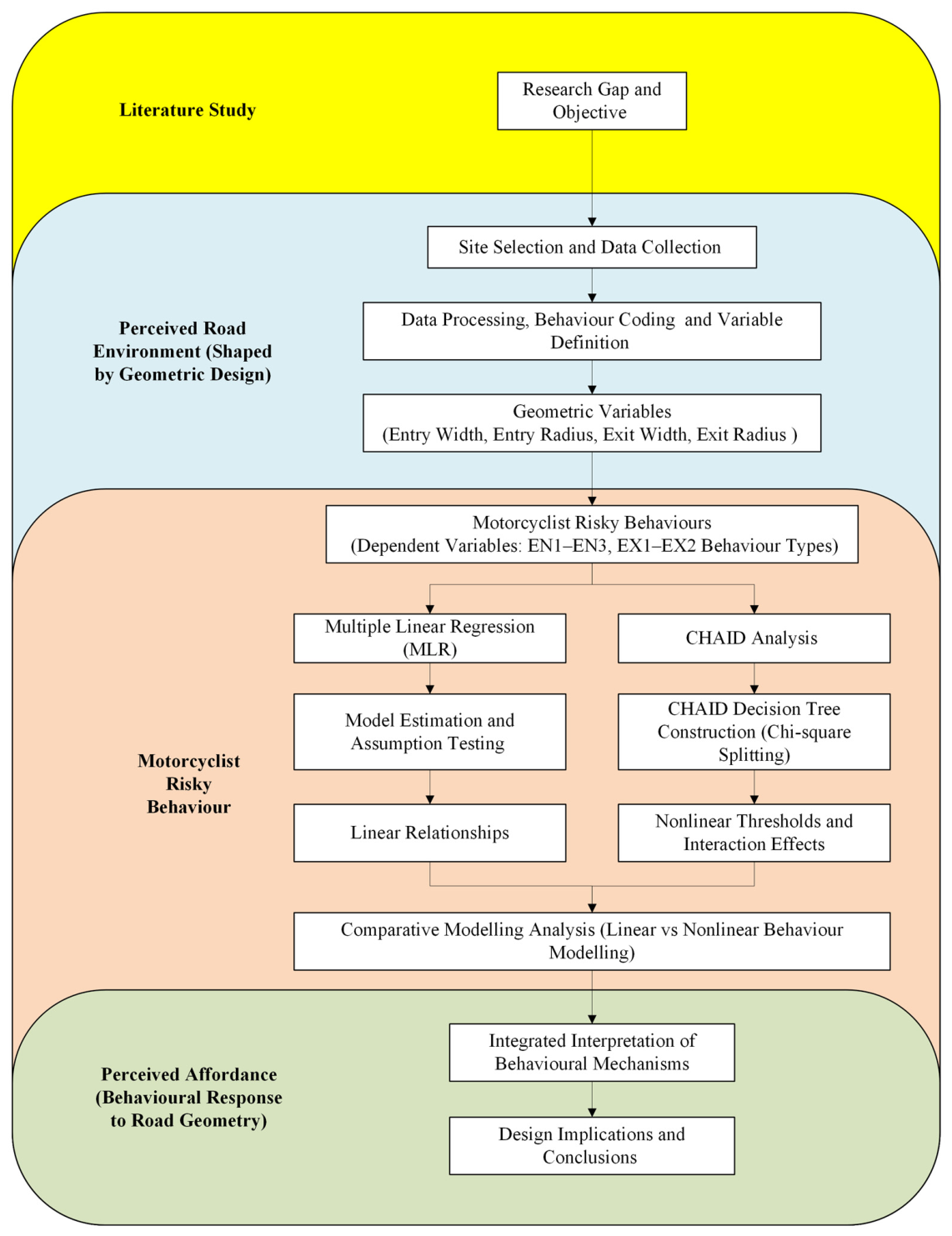
The methodology adopted in this study is intended to scientifically and systematically identify, classify, and analyse the behaviours of motorcyclists at selected multi-lane roundabouts in Malaysia, using an integrated conceptual and analytical framework, as depicted in
Figure 1. This framework clearly shows the link between roundabout geometry and risky behaviours of motorcyclists, with perception of the road environment by motorcyclists in between.
The research methodology commences by conducting an exhaustive literature review to lay a strong theoretical basis and identify research gaps in relation to roundabout geometry, behaviours of users, and their safety performance. Subsequently, based on this understanding, potential research sites are identified based on predefined geometric criteria, followed by data collection. Primary data is collected by using a drone and ground-level video recording, while secondary data is collected by collecting geometric parameters such as entry width, entry radius, exit width, and exit radius from existing reports and drawings.
Subsequently, the data were processed through a structured behavioural coding system, where the actions of motorcyclists were classified into predefined categories of risky behaviours, namely EN1, EN2, EN3, EX1, and EX2. These behavioural variables were considered as dependent variables, whereas the geometric variables were considered as independent variables. In this framework, it was conceptualised that the role of geometric design is to influence the perceived environment, which, in turn, influences the motorcyclists’ behavioural responses.
To establish the relationship between the variables, two separate modelling approaches, namely multiple linear regression (MLR) and Chi-squared automatic interaction detection (CHAID), were used in parallel to analyse the relationship between the variables. In the first step, multiple linear regression was used to establish the relationship between the geometric variables and the frequency of risky behaviours, including assumption testing to assess the validity of the model. In contrast, the CHAID model was used to establish the relationship between the variables, including the identification of nonlinear thresholds and interaction effects.
The outcomes of the two separate models were then used to perform a comparative modelling analysis, where a systematic evaluation of the outcomes was performed to understand the linear and nonlinear behavioural patterns of motorcyclists. The outcomes of the two separate models provide a more comprehensive understanding of the relationship between the variables, which, in turn, provide a better understanding of the influence of roundabout geometry on motorcyclists’ behavioural responses. The outcomes of the model are then used to understand the underlying behavioural responses, namely perceived affordance, which provide a better understanding of the behavioural responses of motorcyclists to the given conditions.
3.1. Study Sites and Data Collection
The selection of study sites was a critical step to ensure that the findings accurately reflect real-world traffic conditions in a motorcycle-dominant environment. Roundabouts were not chosen arbitrarily; instead, a systematic selection process was adopted based on predefined inclusion criteria to ensure the reliability, representativeness, and relevance of the collected data. Specifically, the selected sites satisfied four key criteria: (i) consistently high motorcycle volumes, (ii) geometric complexity in terms of entry and exit configurations, (iii) a documented history of frequent motorcyclist-related incidents, and (iv) adequate visibility to support accurate video-based observation.
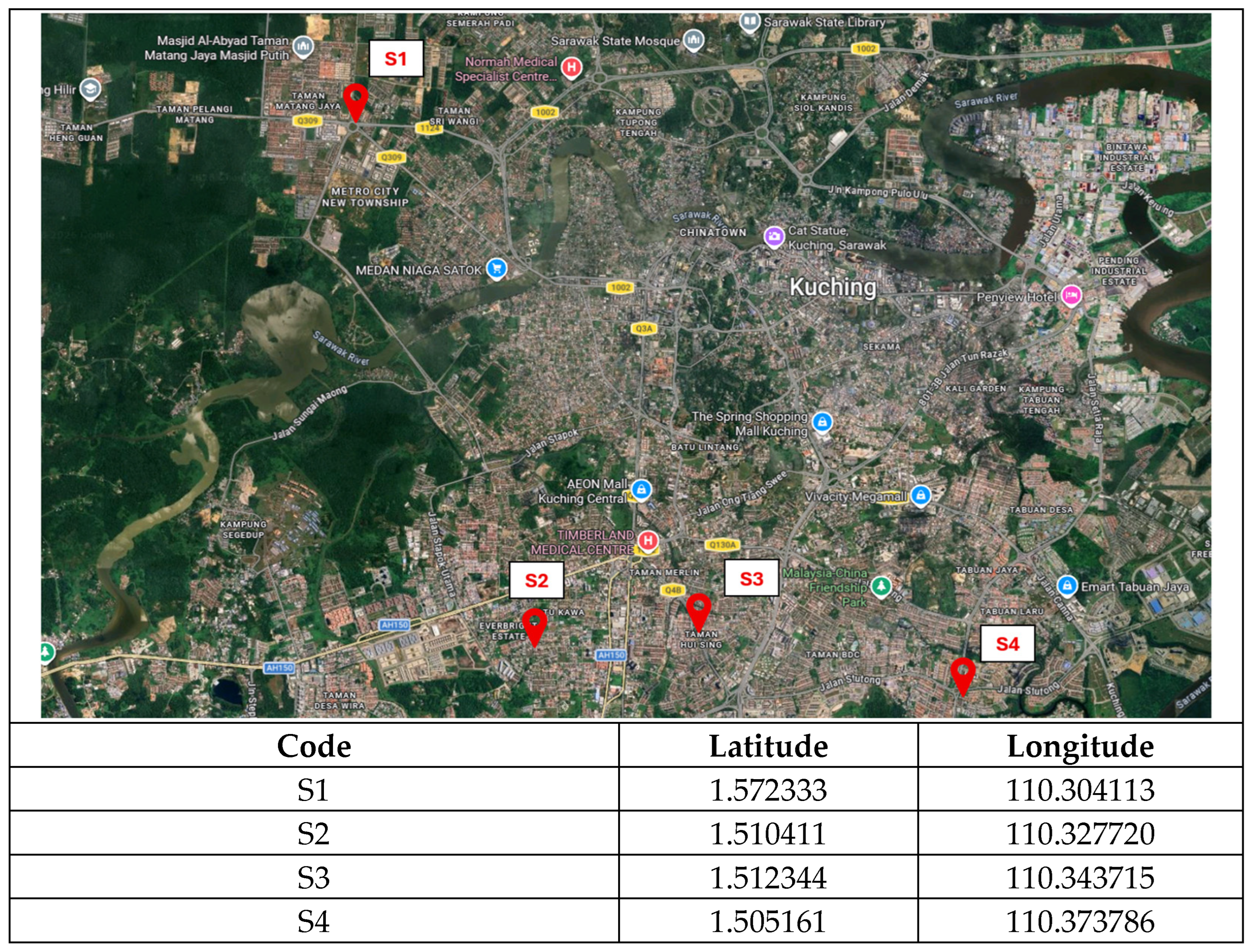
A total of four multi-lane roundabouts located in Kuching, Malaysia, were selected for analysis, as illustrated in
Figure 2. These sites were coded as S1 to S4, which represent a range of geometric layouts and urban traffic conditions. The corresponding geographic coordinates and site identifiers are summarised in
Figure 2, providing precise spatial references to enhance the transparency and replicability of the study.
Table 1 presents the descriptive statistics of the geometric characteristics of the selected roundabouts. The entry width ranges from 4.35 m to 16.00 m, with a mean of 10.03 m, indicating moderate variability in approach width across sites. Entry radius shows a wider spread, ranging from 13.00 m to 70.00 m, with a mean of 35.82 m and a relatively high standard deviation (20.30 m), suggesting substantial variation in entry curvature. Exit width is comparatively more consistent, with values between 3.75 m and 11.37 m and a mean of 7.20 m. In contrast, the exit radius exhibits the greatest variability among all parameters, ranging from 12.43 m to 180.00 m, with a mean of 59.18 m and a high standard deviation of 56.64 m. The median exit radius (32.57 m) is notably lower than the mean, indicating a skewed distribution influenced by larger values. Overall, the results demonstrate considerable heterogeneity in roundabout geometry, particularly in radius-related parameters, which may contribute to variations in motorcyclists’ behaviour.
Table 2 presents the different categories of risky behaviours exhibited by motorcyclists at roundabouts during entry and exit manoeuvres. For entry movements, the most frequently observed behaviour was EN3, which involved stopping at a close distance or within blind zones, accounting for 61% of the recorded cases and indicating interaction and visibility conflicts. This was followed by EN2, referring to motorcyclists not slowing down before entering the roundabout (25%), which is associated with speed management issues. EN1, defined as the failure to detect proper lanes when entering, contributed 17% of the cases and reflected lane discipline conflicts.
For exit movements, EX2 was identified as the most dominant risky behaviour, where motorcyclists failed to signal before exiting the roundabout, representing 74% of the recorded cases and indicating communication and signalling conflicts. Meanwhile, EX1, which refers to the failure to detect proper lanes when exiting, accounted for 54% of the observed cases and was associated with lane discipline issues. These findings demonstrate that both operational behaviour and roundabout geometry may influence the occurrence of risky manoeuvres among motorcyclists.
Traffic and behavioural data were collected using a combination of drone-based aerial recordings and ground-level video footage captured using a handycam. The drone recordings provided a comprehensive bird’s-eye view of the roundabout geometry, enabling the observation of full circulatory movements, lane usage, and interactions between vehicles. Complementarily, the ground-level recordings allowed for detailed inspection of motorcyclists’ manoeuvres, including stopping behaviour, lane positioning, and interactions within blind spots that may not be fully observable from an aerial perspective.
Data collection was conducted during both peak and off-peak periods to capture variability in traffic flow conditions and rider behaviour. The combination of spatial coverage and temporal variation ensured that the dataset reflects a wide range of real-world operating conditions.
A total of 7088 motorcyclist movements were extracted and systematically coded based on predefined behavioural criteria. Each observation was classified into one or more categories of risky behaviour (EN1–EN3 and EX1–EX2), as presented in
Table 3. The integration of site-specific geometric data with detailed behavioural observations provides a robust dataset for subsequent modelling and analysis of the relationship between roundabout design and motorcyclist risk behaviour.
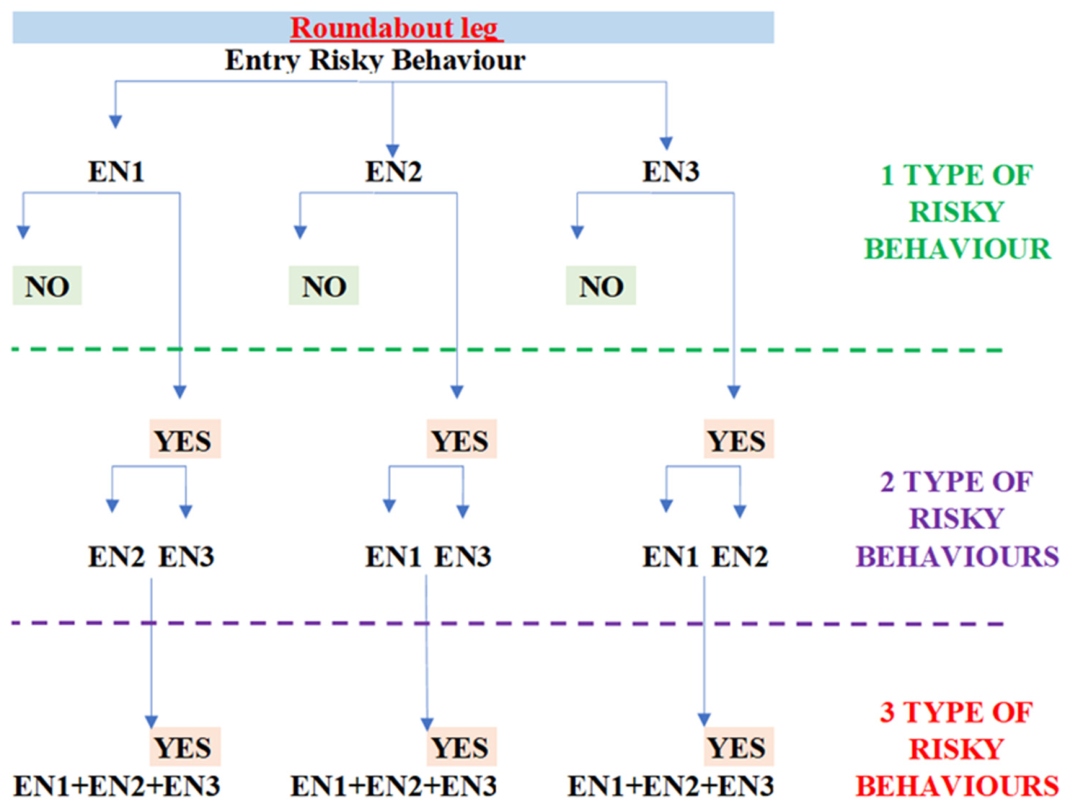
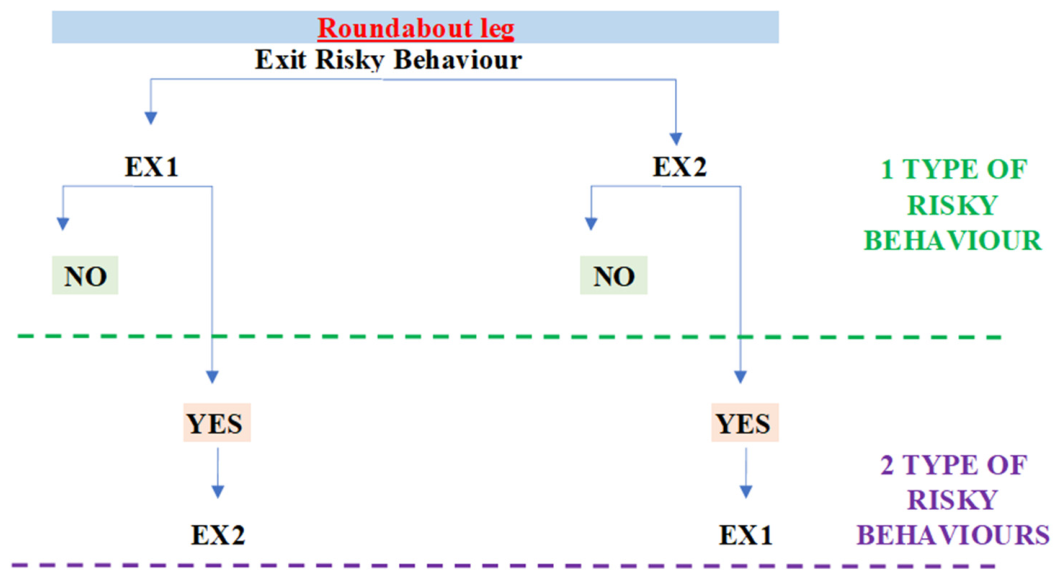
To systematically quantify the risky behaviours of motorcyclists, a structured count method was developed, as illustrated in
Figure 3. During the observation, it was found that one motorcyclist could show more than one type of risky behaviour at a roundabout leg. The decision framework in the figure shows how these behaviours were categorised. When the decision outcome was “No,” it meant the motorcyclist showed only one type of risky behaviour. When the outcome was “Yes,” it meant there was another risky behaviour, which was added to the previous one. Using this process, one, two, or up to three risky behaviours could be recorded at the entry or exit of a roundabout leg. Circulatory risky behaviour was not included in this framework because only one type was studied. Therefore, it was counted directly based on the total number of times it was observed.
In addition to the structured count method described earlier, the analysis of motorcyclist behaviour at roundabouts was further strengthened by collecting data at the individual motorcyclist level, as shown in
Figure 4. This approach ensured that each observation captured not only the presence of risky behaviours but also the direction of movement taken by the motorcyclist through the roundabout. Recording data at the disaggregated level of the individual motorcyclist provided greater precision, as it allowed multiple risky behaviours performed by the same motorcyclist to be identified and coded separately.
3.2. Video Analysis and Behavioural Coding Procedure
In order to guarantee the reliability and transparency of the behavioural data extraction process, a video analysis methodology was employed. All video recordings collected from drone-captured aerial views and ground-level cameras were systematically reviewed and coded following a manual observation approach.
The video analysis was performed by trained researchers who reviewed the video footage frame-by-frame to identify and classify the different behavioural patterns of the motorcyclists. The video footage was repeatedly analysed to guarantee the precise detection of the different manoeuvres performed by the motorcyclists, particularly during complex traffic interactions at multi-lane roundabouts. The video footage was coded following a predefined behavioural classification scheme in which each motorcyclist’s manoeuvre was evaluated against five different types of risky behaviour: EN1, EN2, EN3, EX1, and EX2, according to the classification scheme provided in
Table 1.
To guarantee the consistency and objectivity of the video analysis process, a standardised coding scheme was developed and implemented by the research team before the actual video analysis process was performed. The standardised coding scheme was based on the definition of the different behavioural patterns and the provision of visual references and decision rules for the evaluation of the video footage.
Each motorcyclist was considered an independent observation unit, and multiple risky behavioural patterns were coded for a single manoeuvre if and when applicable. To guarantee the reliability of the video analysis process and the extracted data, a validation process was performed by re-analysing a fraction of the collected video samples (approximately 10–15%).
A total of 22,052 observations were initially collected from video recordings. Among these, 8371 observations involved motorcyclists exhibiting risky behaviour. During data preprocessing, 1283 observations were excluded due to incomplete visibility or ambiguous behavioural classification. This resulted in a final dataset of 7088 observations used for subsequent analysis. A summary of the data preprocessing stages is presented in
Table 4.
3.3. Data Analysis
Both the Chi-squared automatic interaction detector (CHAID) and multiple regression analyses were employed to provide complementary perspectives on the relationship between roundabout geometry and motorcyclists’ risky behaviours. The CHAID analysis was first applied to explore and visualise nonlinear interactions among geometric variables and to identify key predictors of risky behaviour across different movement phases. Subsequently, multiple regression analysis was conducted to quantify the magnitude and direction of these relationships, thereby validating the CHAID findings through a parametric statistical approach. This dual-method strategy enhances the robustness, interpretability, and generalisability of the results by integrating exploratory pattern detection with confirmatory statistical modelling.
The CHAID algorithm was employed to examine the association between roundabout geometry and motorcyclists’ risky behaviours. The use of CHAID in this study is consistent with previous research [
20,
21]. which demonstrated its effectiveness in identifying unsafe driving behaviours and interaction effects at roundabouts. It generates a decision tree model by recursively partitioning the dataset into statistically distinct subgroups using chi-square tests of association. This approach is particularly advantageous in traffic-safety research because it identifies critical geometric thresholds and higher-order interaction effects that conventional linear models may overlook. In this study, the dependent variables comprised five categories of risky behaviours, whereas the independent variables represented the geometric characteristics of the roundabouts. Splits were determined using chi-square significance at
p < 0.05, with Bonferroni adjustment for multiple comparisons. To ensure reliability, the maximum tree depth was limited to three levels, and each terminal node required a minimum of 50 cases.
Following the CHAID analysis, multiple linear regression modelling was applied to further evaluate the relationships identified. The regression model estimated the relative contribution of each geometric parameter to the frequency of risky behaviours while controlling for potential multicollinearity. Standardised coefficients were used to facilitate comparison among predictors, and model assumptions, including normality, homoscedasticity, and independence of residuals, were tested to ensure validity. This step provided a continuous predictive framework and statistically verified the key factors highlighted through CHAID, thereby strengthening the inferential basis of the findings.
All analyses were conducted using SPSS Statistics v29, which incorporates an integrated CHAID module and regression analysis tool. Prior to modelling, incomplete or ambiguous observations were removed, and all variables were standardised for consistency. The analytical outputs, including decision tree structures, classification tables, regression coefficients, and risk metrics, collectively informed the interpretation of how roundabout geometry influences motorcyclist behaviour.
4. Results
This section presents the empirical results obtained from the video-based field observations and subsequent statistical analyses conducted at roundabouts in Malaysia. The analysis integrates two complementary techniques: multiple linear regression (MLR) for quantifying the directional and magnitude effects of geometric parameters on the frequency of risky behaviours, and Chi-square automatic interaction detector (CHAID) decision tree analysis to capture nonlinear relationships and interaction thresholds. The discussion is organised around three behavioural phases, which are entry, circulating, and exit, to highlight how roundabout geometry influences motorcyclists’ behavioural adaptation.
4.1. Traffic Composition and Behavioural Distribution
Across all sites, motorcycles constituted a dominant proportion of total traffic during the weekday evening peak hour, with observed volumes ranging between approximately 35% to 55% motorcyclists per hour per vehicle.
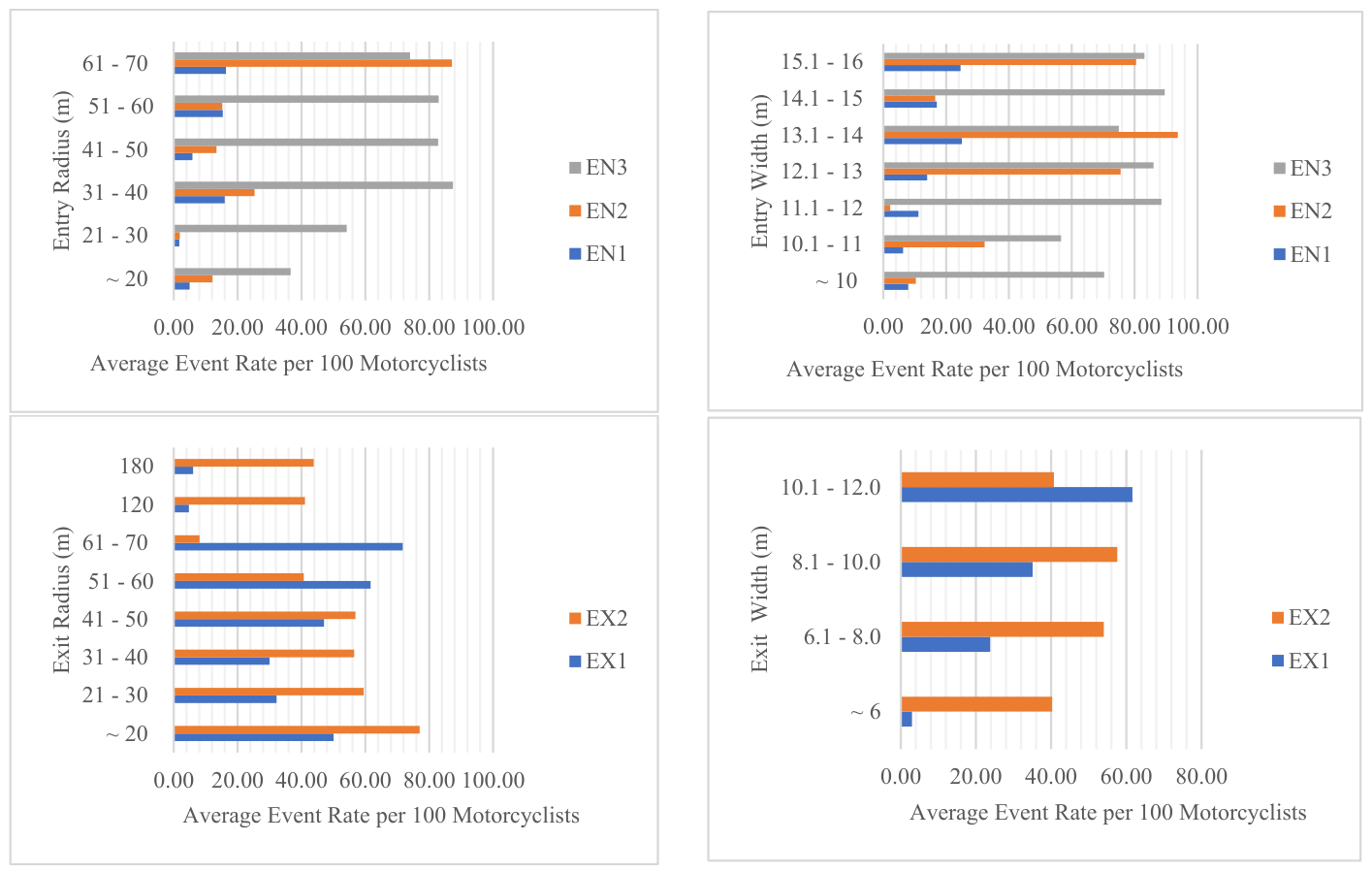
Figure 4 presents the distribution of average event rates per 100 motorcyclists across different geometric parameters of roundabouts, specifically entry and exit radii and widths. The results highlight distinct behavioural patterns, demonstrating how variations in roundabout geometry influence the frequency and nature of risky riding behaviours during entry and exit manoeuvres.
For entry geometry, the findings indicate that both larger entry radii and wider entry widths correspond to higher frequencies of risky behaviours (EN1–EN3). Event rates increase notably when the entry radius exceeds 30 m, particularly for EN3 (unsafe stopping) and EN2 (failure to slow down before entering). A larger entry radius provides a gentler curve that visually and physically allows smoother movement into the roundabout. This geometric condition reduces the perceived need to decelerate because riders experience less lateral deflection and lower centrifugal force. As a result, the approach appears easier to negotiate at higher speeds, leading riders to maintain or even increase their speed rather than slow down before entry. Similarly, wider entries (>13 m) exhibit greater occurrences of EN2 and EN3 events, implying that additional lane space encourages aggressive lane-splitting or uncertain lane positioning among motorcyclists. A wider entry provides a stronger sense of openness and multiple trajectory options, which can reduce perceived spatial constraints and weaken the psychological cues that typically prompt riders to slow down. This geometric configuration may also increase interaction with adjacent vehicles, creating competitive behaviour for lane access and elevating the likelihood of abrupt braking or unsafe manoeuvres. In contrast, smaller radii (≤20 m) and narrower widths (≤11 m) are associated with lower event rates across all entry-phase behaviours, indicating that tighter geometric control moderates speed, limits lateral movement, and promotes more cautious approach behaviour.
For the exit geometry, the behavioural trends differ slightly from those observed at the entry. Smaller exit radii (<30 m) exhibit the highest frequencies of risky behaviours (EX1 and EX2), particularly EX2 (failure to signal before exiting). This suggests that tighter curvature limits riders’ manoeuvring space and increases steering demand, making it more difficult to maintain stability or perform controlled lane changes while signalling. As the exit radius increases beyond 60 m, event rates decrease markedly, indicating smoother trajectory alignment and enhanced predictability during departure.
Exit width also exerts a noticeable influence on rider behaviour. Moderate exit widths (8–10 m) show relatively higher event rates compared with narrower (≤6 m) or wider (>10 m) configurations. This pattern may be attributed to ambiguous lane boundaries or increased side-by-side interactions at intermediate widths, which can encourage overtaking or late lane changes. In contrast, narrower exits constrain speed and movement, while wider exits provide clearer separation between traffic streams, both of which contribute to safer exit manoeuvres.
Overall, the results indicate that larger entry radii and widths amplify risky entry behaviours, whereas moderate exit dimensions provide more stable and predictable riding patterns. These findings underline the importance of optimising geometric design, particularly entry curvature and width, to balance operational efficiency with rider safety in multi-lane roundabouts.
4.2. Regression Analysis: Linear Effects of Roundabout Geometry
The regression analysis summarised in
Table 5 demonstrates that entry geometry exerts a significant influence on the frequency of risky motorcyclist behaviours at roundabouts. The R
2 values, ranging from 0.528 to 0.862, indicate that variations in entry radius and width explain between 53% and 86% of the behavioural variance, highlighting the critical role of geometric design in shaping rider manoeuvres. Entry-phase behaviours (EN1–EN3) exhibit the strongest dependence on geometry. Specifically, EN1 (R
2 = 0.753) shows that both entry radius and width significantly affect riders’ ability to detect and maintain appropriate lanes. Wider and larger entries tend to reduce lateral deflection and visual constraint, allowing riders to approach the roundabout with higher speeds and reduced lane discipline. EN2 (R
2 = 0.528) is predominantly influenced by entry radius, implying that curvature directly governs riders’ compliance with stopping rules; gentle curvature tends to encourage continuous movement rather than deceleration. The strongest association appears in EN3 (R
2 = 0.862), where unsafe stopping behaviour increases sharply with both geometric parameters, suggesting that the combination of a wide and smoothly curved approach promotes late or abrupt braking at the entry point.
At the exit, the geometric influence remains evident, although comparatively weaker. EX1 (R2 = 0.841) is mainly governed by exit radius, where continuity of curvature reduces riders’ ability to detect proper exit lanes, leading to lane deviation or delayed manoeuvres. Meanwhile, EX2 (R2 = 0.612) demonstrates moderate sensitivity to both radius and width, indicating that improper signalling behaviour is only partly geometric in nature and may also reflect habitual or perceptual factors. Overall, the results confirm that larger radii and wider entries encourage more aggressive and less cautious behaviours, while tighter geometric control moderates speed and promotes safer navigation. These findings reinforce the importance of context-sensitive geometric design in motorcycle-dominant environments, supporting the adoption of smaller entry radii, limited entry widths, or physical separators to enhance deflection, reduce approach speed, and improve behavioural compliance at multi-lane roundabouts.
4.3. CHAID Decision Tree Analysis: Thresholds and Interaction Effects
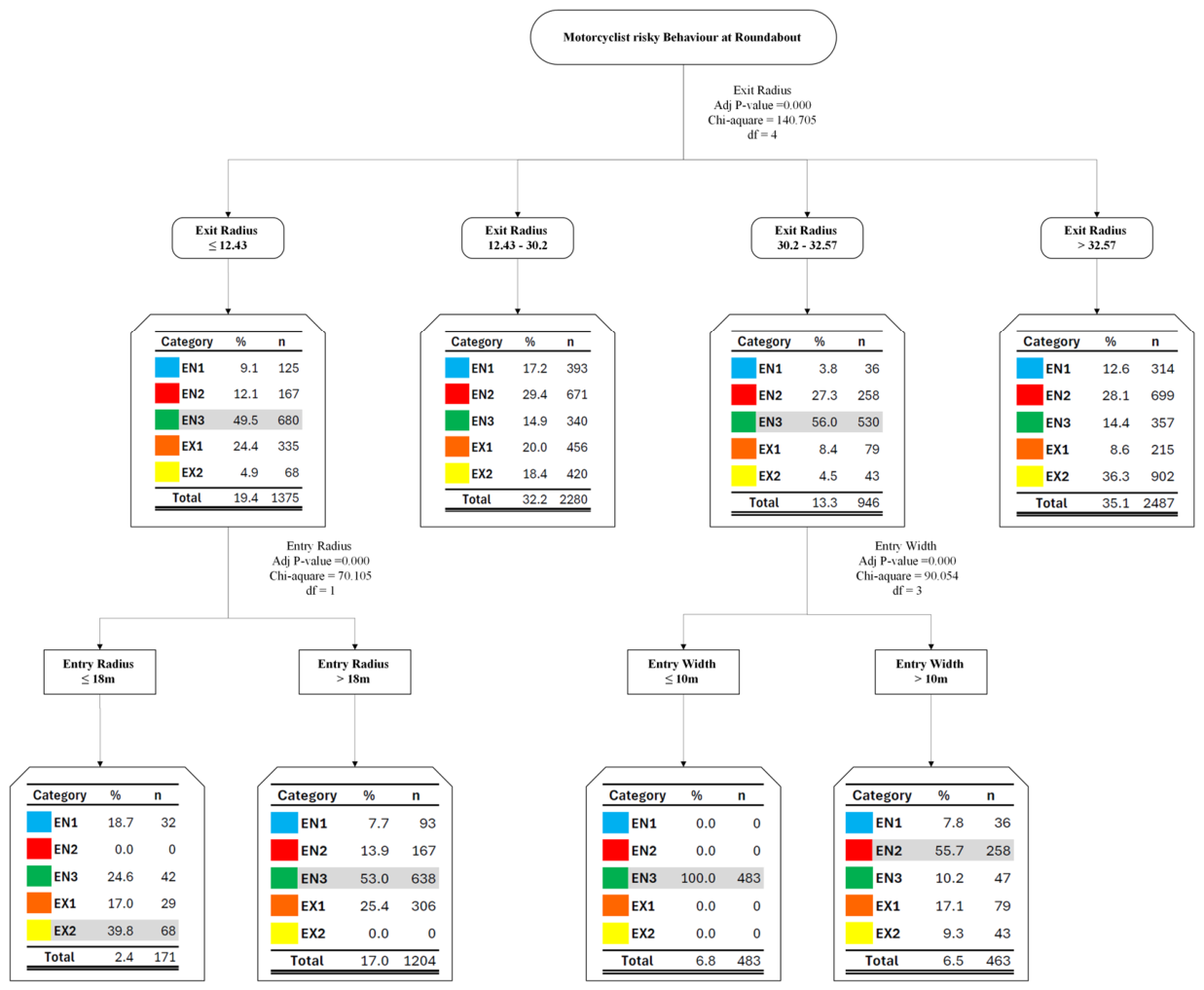
The CHAID (Chi-squared automatic interaction detection) analysis presented in
Figure 5 is interpreted at two levels: (i) statistical structure of the decision tree and (ii) behavioural implications of geometric design on motorcyclist risky behaviour. It should be noted that the presented tree is a simplified representation of the original CHAID output, focusing on the most interpretable and meaningful behavioural patterns. Detailed CHAID tree structures illustrating the variable interaction pathways are presented in
Supplementary Figures S1 and S2.
From a statistical perspective, the decision tree identifies exit radius as the primary splitting variable (Adj. p-value = 0.000; χ2 = 140.705), indicating that it is the most influential geometric factor affecting rider behaviour at roundabouts. The initial split categorises the data into four distinct exit radius ranges (≤12.43 m, 12.43–30.2 m, 30.2–32.57 m, and >32.57 m), each exhibiting different behavioural distributions. Among these, the ranges of 12.43–30.2 m and >32.57 m show relatively heterogeneous and mixed behavioural patterns, with no clearly dominant category. Consequently, these ranges are not examined in detail, as they provide limited explanatory value compared to more homogeneous groups.
In contrast, two exit radius ranges demonstrate clearer behavioural trends. For exit radius ≤ 12.43 m, EN3 behaviour (unsafe stopping) is dominant (49.5%), suggesting that sharper curvature imposes greater geometric constraint, resulting in more controlled yet abrupt stopping behaviour. Similarly, for exit radius between 30.2 m and 32.57 m, EN3 increases further to 56.0%, indicating a more consistent and concentrated behavioural response under this specific geometric condition.
Further refinement of the tree reveals that entry radius and entry width act as secondary influencing variables, shaping behaviour within specific exit radius conditions. For smaller exit radii (≤12.43 m), entry radius differentiates behaviour, where larger entry radii (>18 m) are associated with a higher proportion of EN3 (53.0%), reinforcing the influence of smoother entry geometry on rider approach behaviour. For exit radii between 30.2 m and 32.57 m, entry width becomes significant, where narrower entries (≤10 m) result in a fully homogeneous EN3 behaviour (100%), while wider entries (>10 m) shift behaviour towards EN2 (55.7%), indicating increased non-compliance.
From a behavioural perspective, the findings suggest that exit geometry governs the overall behavioural outcome, while entry-related variables refine how these behaviours manifest. The presence of distinct behavioural patterns within specific geometric ranges further highlights nonlinear threshold effects, where relatively small changes in geometric design can lead to significant shifts in rider behaviour.
4.4. Comparison Between Multiple Regression and CHAID Findings
The results obtained from multiple regression and CHAID analyses provide complementary insights into the influence of roundabout geometry on motorcyclist risky behaviour. While the regression model quantifies the linear relationships and overall effect strength of geometric variables, the CHAID analysis reveals nonlinear interactions and threshold-based behavioural patterns.
From the regression perspective, both entry/exit radius and width are consistently identified as significant predictors across behavioural types, with relatively high R2 values (0.528–0.862). The results indicate that larger radii and wider geometries are associated with increased risky behaviours, particularly for EN3 and EX1. This suggests that smoother curvature and reduced geometric constraint allow riders to maintain higher speeds and exhibit less cautious manoeuvres. However, regression treats these relationships as continuous and linear, implying gradual changes in behaviour as geometric parameters increase.
In contrast, the CHAID analysis highlights that rider behaviour does not change gradually, but rather exhibits distinct threshold effects. Exit radius emerges as the primary splitting variable, indicating that behavioural changes are highly sensitive to specific geometric ranges rather than continuous variation. For instance, exit radius values ≤ 12.43 m and between 30.2 and 32.57 m show a clear dominance of EN3 behaviour, whereas other ranges exhibit more heterogeneous distributions. This suggests that rider responses are triggered when geometric conditions fall within certain critical intervals, rather than increasing uniformly.
Furthermore, CHAID reveals interaction effects between variables that are not explicitly captured in the regression model. For example, within specific exit radius conditions, entry radius and entry width further differentiate behavioural outcomes, leading to highly homogeneous nodes such as EN3 = 100% under narrow entry width conditions. These findings indicate that risky behaviour is shaped by the combined influence of multiple geometric factors, rather than independent linear contributions.
Another key distinction lies in interpretability. Regression analysis provides a clear indication of direction and magnitude of influence (e.g., positive association between radius and risky behaviour), making it useful for general inference. In contrast, CHAID offers a more intuitive understanding of context-specific conditions, identifying exact geometric scenarios under which certain behaviours are most likely to occur.
Overall, both methods converge on the conclusion that larger and wider geometries tend to increase risky motorcyclist behaviour, while more constrained designs promote safer responses. However, CHAID extends this understanding by demonstrating that these effects are nonlinear and condition-dependent, with specific geometric thresholds playing a critical role. The combined use of both approaches therefore provides a more comprehensive understanding of rider behaviour, integrating both global trends and localised decision patterns.
These findings suggest that roundabout design should prioritise controlled geometric configurations, particularly by limiting excessive exit radii and entry widths to avoid threshold conditions that trigger risky behaviours. This is consistent with established design guidance, including the Austroads Guide to Road Design Part 4B (Australia), TRL roundabout design recommendations (United Kingdom), and the FHWA Roundabout Guide (United States), all of which emphasise the importance of adequate entry deflection, smaller entry radii, and controlled entry widths to reduce approach speeds and improve safety.
Similarly, European design frameworks such as the Dutch CROW guidelines and French SETRA recommendations advocate for compact roundabout geometry and tighter curvature to enhance speed control and minimise conflict severity. In the Malaysian context, these principles align with Arahan Teknik (Jalan) JKR, which also emphasises speed reduction and geometric control in roundabout design. Collectively, these international guidelines reinforce the need for context-sensitive geometric design, particularly in motorcycle-dominated environments, where wider and flatter layouts may unintentionally promote aggressive riding behaviour.
4.5. Integrated Interpretation and Design Implications
The combined findings from the multiple regression and CHAID analyses provide a comprehensive understanding of how roundabout geometry influences motorcyclist behaviour. While the regression model identifies the overall linear effects of geometric variables, the CHAID analysis demonstrates that these relationships are nonlinear and governed by critical threshold conditions. Together, the results confirm that rider behaviour is shaped not only by individual geometric parameters but also by their combined configuration within specific geometric ranges.
A key integrated finding is that larger radii and wider geometries consistently promote riskier riding behaviour, as they reduce geometric deflection and perceived constraint. Regression results indicate a general increase in risky behaviours (EN3, EX1, and EX2) with increasing radius and width. This trend is further refined by the CHAID model, which identifies distinct exit radius thresholds associated with behavioural changes. In particular, exit radius values of ≤12.43 m and 30.2–32.57 m are associated with a higher proportion of EN3 behaviour (49.5% and 56.0%, respectively), indicating more consistent and controlled riding responses under these conditions. In contrast, larger exit radii (>32.57 m) are associated with increased EX2 behaviour, reflecting reduced compliance and higher exit speeds.
These findings suggest that rider behaviour is highly sensitive to perceptual thresholds in road geometry, rather than gradual dimensional changes. From a behavioural perspective, wider entries and larger radii create an environment that encourages higher approach speeds, reduced lane discipline, and risk compensation, whereas tighter geometric configurations impose physical and visual constraints that promote speed reduction and safer manoeuvring.
Based on these integrated insights, a safer roundabout geometry for motorcyclists can be defined within the following recommended ranges and design principles:
Exit radius: Preferably ≤ 32 m, with optimal behavioural consistency observed around 30–32.5 m, while avoiding excessively large radii (>32.5 m) that may encourage acceleration and non-compliant exit behaviour.
Entry radius: Maintain moderate to small radii (e.g., ≤18–24 m) to enhance approach deflection and reduce entry speed.
Entry width: Limit to ≤10 m where feasible, as wider entries are associated with increased EN2 behaviour and reduced lane discipline.
Geometric deflection: Ensure sufficient entry curvature and alignment to prevent straight-line trajectories through the roundabout.
Consistency in design: Avoid abrupt geometric transitions between entry and exit that may disrupt rider perception and control.
These recommendations are consistent with established international guidelines, including Austroads (Australia), FHWA (United States), TRL (United Kingdom), and CROW (The Netherlands), all of which emphasise compact geometry, adequate deflection, and speed control as key safety principles.
Importantly, the results indicate that there is no single optimal geometric value, but rather a set of context-sensitive thresholds within which rider behaviour becomes safer and more predictable. This is particularly critical in motorcycle-dominated environments, where riders are more responsive to available space and may exploit wider or flatter geometries.
Overall, the integration of regression and CHAID analyses highlights the need to move beyond traditional linear design assumptions and adopt a behaviour-informed approach to roundabout design, where geometric thresholds and interaction effects are explicitly considered. By aligning design parameters with observed behavioural responses, it is possible to develop roundabouts that not only improve operational efficiency but also significantly enhance motorcyclist safety.
5. Conclusions
This study investigated the influence of roundabout geometric design on motorcyclist risky behaviour using a combination of multiple regression and CHAID analyses. The findings demonstrate that geometric characteristics, particularly radius and width, play a critical role in shaping rider behaviour at roundabouts.
The regression results indicate that larger radii and wider geometries are generally associated with increased risky behaviours, including unsafe stopping, poor lane discipline, and inadequate signalling. These relationships highlight the importance of geometric control in moderating rider speed and manoeuvring patterns. However, the CHAID analysis further reveals that these effects are not purely linear, but instead occur within distinct threshold ranges, where behavioural responses change more abruptly.
In particular, exit radius was identified as the most influential variable, with specific ranges (≤12.43 m and 30.2–32.57 m) associated with more consistent behavioural patterns. In contrast, larger exit radii were linked to increased non-compliant exit behaviours, suggesting that flatter geometries may encourage higher speeds and reduced caution. These findings confirm that rider behaviour is highly sensitive to perceptual and geometric cues, rather than gradual dimensional changes alone.
The integration of both analytical approaches provides a more comprehensive understanding of motorcyclist behaviour, combining the strength of regression in identifying general trends with the ability of CHAID to capture nonlinear interactions and context-specific conditions. This combined approach highlights the importance of considering both continuous effects and threshold-based responses in traffic-safety analysis.
From a practical perspective, the study suggests that safer roundabout design should prioritise compact and controlled geometric configurations, including smaller radii, moderate entry widths, and adequate deflection to reduce approach speeds and improve rider compliance. These recommendations are consistent with international design guidelines such as Austroads, FHWA, TRL, and CROW, reinforcing the applicability of the findings across different contexts.
Overall, this study contributes to the understanding of motorcyclist behaviour at roundabouts by demonstrating that safety is strongly influenced by geometric design, particularly through threshold effects and variable interactions. The findings support the adoption of behaviour-informed and context-sensitive design strategies to enhance safety, especially in motorcycle-dominated traffic environments.
Despite the valuable insights provided, this study has several limitations that should be acknowledged. First, the analysis is based on observational data from selected roundabouts, which may limit the generalisability of the findings to other traffic environments or geometric configurations. Second, the study focuses primarily on observable risky behaviours and does not incorporate dynamic variables such as speed profiles, acceleration patterns, or rider gaze behaviour, which could provide deeper behavioural insights. Third, although the CHAID and regression models capture important relationships, other unobserved factors such as traffic density, rider experience, and environmental conditions may also influence behaviour but were not explicitly controlled for in this study. Finally, the analysis is conducted within a left-hand traffic (LHT) context, and caution should be taken when extrapolating the findings to right-hand traffic systems.
Future research should expand the dataset across different urban contexts and integrate dynamic behavioural data (e.g., speed trajectories or gaze tracking) to deepen understanding of rider–geometry interactions. Overall, this study contributes to the development of context-sensitive and evidence-based roundabout design, aligning infrastructure geometry with real-world behavioural dynamics to improve safety outcomes in mixed-traffic environments.





 ,
,