1. Introduction
Synchronization and random-access preambles are fundamental for reliable communication in standards such as LTE, 5G, and emerging 6G satellite–terrestrial networks [
1,
2]. Current systems predominantly employ Zadoff–Chu (ZC) sequences owing to their constant-amplitude zero-autocorrelation (CAZAC) property [
3,
4,
5,
6,
7], which ensures ideal cyclic autocorrelation and low cross-correlation. However, ZC sequences are inherently complex-valued, requiring high-resolution digital-to-analog converters and multiplier-based correlation hardware, which limits their practicality in low-cost and quantized Internet-of-Things (IoT) systems.
In broadband power-line communication (PLC) standards such as G3-PLC and PRIME, synchronization preambles are used for timing, frequency, and channel acquisition [
8,
9,
10]. These preambles are typically correlated at the receiver for coarse timing and automatic gain control (AGC) adaptation, yet their complex-valued implementation poses similar hardware challenges.
Previous studies have explored discrete-valued or multilevel sequence designs that retain good correlation characteristics while employing finite-alphabet symbols [
7,
11,
12,
13,
14,
15]. Such sequences enable efficient synchronization in quantized digital systems, motivating the search for low-complexity, correlation-optimized preambles. The automorphism properties of cyclic codes have been analyzed in recent work [
16,
17]. The cyclic-shift invariance associated with these automorphisms corresponds to timing offsets in practical communication systems, which simplifies circular-correlation analysis and supports the use of CAZAC and other cyclic sequences for synchronization [
4]. However, the work in [
17] is framed over general finite fields, whereas [
16] is restricted to binary cyclic codes.
Earlier work on cyclic permutation coding (CPC), implemented for 230V AC PLC systems [
18], demonstrated error resilience through structured symbol permutations; however, its potential for synchronization was not explored. This study extends that concept by introducing a new class of non-binary cyclic permutation sequences (NCPS), derived from CPC principles but repurposed as discrete-valued preamble sequences. From a system perspective, synchronization sequences benefit from cyclic-shift invariance, as timing offsets manifest as circular shifts that preserve correlation structure. Leveraging this principle, the proposed NCPS framework exploits cyclic group invariance and controlled permutation symmetry to achieve near-orthogonal correlation behavior comparable to ZC sequences, while relying solely on integer-domain modular arithmetic followed by exponential mapping. This leads to reduced implementation complexity and retains a favorable Hamming-distance profile suitable for error-resilient operation. The receiver applies cyclic correlation with stored NCPS to estimate timing and frequency offsets, analogous to the use of ZC preambles in LTE systems.
Novel Contributions
The novel contributions of this work are summarized as follows.
Theoretical contributions:
A symmetry-driven formulation of NCPS based on cyclic group invariance and permutation structure, extending CPC beyond its traditional role in error correction.
An analytical characterization of the autocorrelation properties of additive NCPS and a structural explanation for the near-CAZAC behavior observed in nonlinear and modified NCPS families.
Methodological and practical contributions:
A unified synchronization-oriented framework for constructing additive, multiplicative, and modified NCPS families using integer-domain modular arithmetic.
A comprehensive simulation-based comparison with Zadoff–Chu sequences, demonstrating comparable cyclic correlation and synchronization performance under additive white Gaussian noise.
An evaluation of implementation complexity highlighting the suitability of NCPS for low-complexity, quantized, and resource-constrained communication systems, with particular relevance to PLC preamble design and IoT networks.
2. Sequence Construction
Standard ZC sequences of length
M are represented using a root parameter
r coprime with
M as
for odd
M [
5,
19]. The normalized cross-peak-to-sidelobe ratio (PSLR) between distinct ZC roots satisfies
yielding a normalized
of
[
1].
Throughout this paper, M denotes both the prime modulus and the sequence length, and N the number of unique members in each sequence family. Unless otherwise stated, all cyclic correlations are computed over .
NCPS sequences are constructed over the finite residue set
, where
denotes the additive group of integers modulo
M, and
its multiplicative group of units (
Table 1). The latter forms a cyclic group of order
, enabling non-degenerate modular permutations suitable for synchronization. The minimum pairwise Hamming distance
determines the codebook’s error correction capability [
20,
21].
2.1. Linear (Additive) NCPS
The linear additive NCPS (LNCPS) family is defined by affine mappings over the additive group of
:
where
denote the slope and offset parameters. The complex-valued representation is then
For prime
M, this yields
distinct members for all valid
combinations.
Example: For
and
,
Each offset
b produces a cyclic shift of the same phase ramp.
Let
denote the LNCPS sequence generated by the parameter pair
. The general cyclic correlation between any two LNCPS members
and
is given by
The cyclic correlation definition in (4) follows standard formulations used in synchronization and sequence analysis [
4,
22]. Throughout this paper, we use the notation
to denote the discrete cyclic correlation between arbitrary sequences
and
at lag (cyclic shift) index
. This general form applies to all sequence families unless otherwise specified.
The cross-correlation in (4) reduces to the autocorrelation
when
. Since
is constant in
n, every term in the cyclic autocorrelation sum shares identical phase. Substituting (2) into (4) confirms this property:
yielding
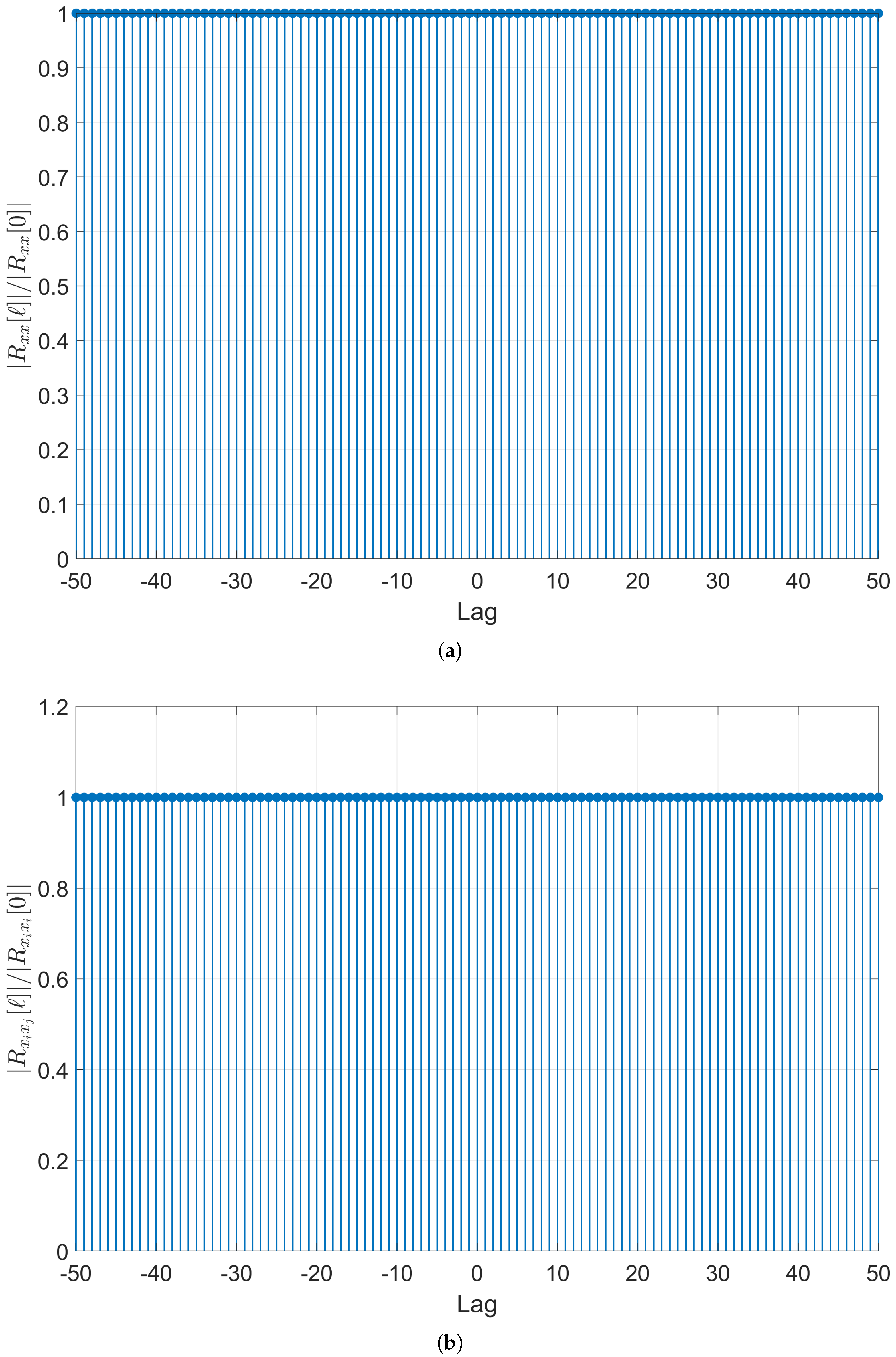
i.e., a completely flat autocorrelation spectrum.
Thus, LNCPS sequences are algebraically simple but unsuitable for synchronization. Nevertheless, this degeneracy provides complete code diversity (
) when only one offset per slope is retained [
18].
2.2. Nonlinear Primitive-Root (Multiplicative) NCPS
To obtain structured autocorrelation peaks, the nonlinear NCPS (NNCPS) employs the multiplicative group
. Let
g be a primitive root of
M such that
. The integer and complex sequences are then defined as
where
indexes each sequence.
The cyclic correlation is
No simple closed form exists because
varies nonlinearly in
n; however, analysis and simulation show that
has a strong mainlobe at
with small, near-uniform sidelobes, indicating quasi-CAZAC behavior suitable for synchronization and multiple access.
Since all sequences begin with , they share one common symbol position, reducing the minimum Hamming distance to .
2.3. Modified NCPS (MNCPS)
To restore full-symbol diversity without degrading correlation properties, the NNCPS codebook is diagonalized using a sequence-dependent permutation. Let
denote a cyclic permutation such that
. The modified integer sequence is defined as
For all
, the permutations satisfy
, ensuring diagonal placement of zero entries across the NCPS codebook. This operation preserves the multiset of symbols in each sequence and performs a sequence-dependent cyclic permutation such that, when the codebook is arranged as an
matrix with one sequence per row, the zero symbols occupy distinct column indices across sequences, forming a diagonal structure with exactly one zero per row and at most one zero per column.
Example: For , the diagonalized matrix cyclically rotates the zeros along the diagonal so that each row and column contains all residues of exactly once, maintaining complete symbol diversity.
Let
. The cyclic cross-correlation between diagonalized sequences is given by
Since diagonalization is implemented via bijective, sequence-dependent permutations, the multiset of symbols in each sequence is preserved. However, strict cyclic-correlation invariance holds only under a common cyclic shift applied to both sequences and does not generally hold under different sequence-dependent permutations. Accordingly, the correlation properties of the diagonalized MNCPS family are evaluated empirically.
Simulation results indicate that MNCPS sequences retain the quasi-CAZAC correlation characteristics observed for NNCPS while achieving full symbol diversity with . This construction unifies the structural diversity of additive NCPS with the favorable correlation behavior of multiplicative designs, providing an efficient discrete-valued preamble set for synchronization.
For clarity, the overall NCPS construction process is summarized in pseudo-code form in
Table 2. The correlation behavior, structural properties, and implementation implications of these sequence families are examined in the following section.
3. Analytical Properties and Complexity
3.1. Comparison with Existing CAZAC-like Sequences
Existing CAZAC-like and multilevel sequence constructions for synchronization typically rely on quadratic or multilevel phase laws, often optimized for specific correlation metrics rather than permutation structure or hardware simplicity [
11,
14,
23,
24]. Unlike these approaches, the proposed NCPS framework leverages cyclic group symmetry and structured permutations inherited from cyclic permutation coding [
18]. The NCPS families operate entirely in the integer domain using modular addition or multiplication followed by a single exponential mapping, enabling constant-magnitude sequences with strictly finite phase alphabets and multiplier-free generation. Furthermore, the diagonalized MNCPS construction introduces a structural degree of freedom (i.e., cyclic zero relocation) not present in existing CAZAC-like designs and improves
behavior for certain prime lengths. These distinctions clarify the novelty of NCPS and highlight how structured symmetry and controlled symmetry breaking enable properties not simultaneously achievable with existing CAZAC-like families.
A practical limitation of the current NCPS framework is its reliance on prime sequence lengths. This requirement ensures that is cyclic, enabling primitive-root permutations and guaranteeing non-degenerate mappings for the NNCPS and MNCPS families. In practice, many synchronization preamble lengths used in PLC and IoT systems are already prime or can be selected to be prime without affecting protocol design. However, for applications requiring composite lengths, the present construction cannot be applied directly. Extending NCPS to non-prime moduli, such as through multiplicative subgroups or CRT-based formulations, remains an important direction for future work.
3.2. Analytical Basis for Near-CAZAC Behavior
Although closed-form correlation expressions for the nonlinear and modified NCPS families are difficult to obtain due to their permutation-based structure, additional analytical insight can be provided. The NNCPS sequences inherit a pseudo-random permutation pattern generated by primitive roots modulo M, which ensures uniform phase dispersion and suppresses coherent sidelobe accumulation. For the MNCPS family, the cyclic relocation of the zero symbol breaks alignment patterns that otherwise elevate cross-correlation peaks while preserving the underlying multiplicative permutation structure. These properties explain the observed quasi-CAZAC behavior and the similarity in PSLR scaling to ZC sequences. Deriving tighter analytical bounds remains an open problem and represents a promising direction for future work.
3.3. Computational Complexity
Although all families ultimately rely on the same FFT-based circular correlation at the receiver, the discussion here focuses solely on transmitter-side sequence generation complexity. Receiver-side processing is identical across families and is therefore not a point of differentiation.
For a ZC sequence of length M, generating requires evaluating a quadratic phase term and computing M complex exponentials. In practice, this is often implemented using table look-ups or recursive phase accumulation combined with complex multiplications.
In contrast, the proposed NCPS families perform sequence generation predominantly in the integer domain, followed by a single modular-to-phase mapping per symbol. Specifically, LNCPS sequences require one modular addition per symbol, while NNCPS and MNCPS require one modular multiplication per symbol. All NCPS families then apply a table look-up to map to the transmitted symbol . No complex-valued arithmetic is required during the integer-domain sequence construction step.
It is important to note that both ZC and NCPS implementations may rely on look-up tables for phase generation; however, NCPS generation avoids per-symbol complex multipliers during the core sequence construction stage. As summarized in
Table 3, the resulting complexity reduction is therefore architectural rather than asymptotic.
The reduced implementation complexity thus stems from the use of integer-domain operations and a discrete phase alphabet during sequence synthesis, which can simplify digital and mixed-signal front-end implementations. This characteristic is particularly relevant for low-power IoT and PLC devices, where minimizing complex multipliers prior to modulation and supporting coarse phase quantization are advantageous.
4. Simulation Methodology
This section describes the simulation framework used to evaluate the correlation and synchronization performance of the proposed NCPS families relative to the ZC benchmark. The simulation setup is deliberately constructed to isolate the intrinsic correlation and synchronization properties of the proposed NCPS families under controlled and reproducible conditions. Sequence lengths are restricted to prime values to satisfy the mathematical requirements of the construction, in particular the existence of a cyclic multiplicative group and non-degenerate primitive-root permutations. The selected values of M span short to moderate preamble lengths, enabling assessment of scaling behavior while remaining relevant to practical synchronization design studies.
Zadoff–Chu sequences serve as the benchmark throughout, as they represent the widely adopted CAZAC reference for synchronization in cellular and related systems. All NCPS and ZC sequences are evaluated under identical conditions to ensure a fair and unbiased comparison.
4.1. Sequence Generation
Sequence families of prime length M were generated under four configurations. ZC sequences were produced using (1) for all valid roots r satisfying . The linear NCPS (LNCPS) were formed using the additive mappings in (2) and (3). The nonlinear primitive-root NCPS (NNCPS) were constructed from (6) and (7), where a primitive element was identified by exhaustive search. The MNCPS were obtained by cyclically relocating the zero entry of each NNCPS sequence to a unique diagonal position. All integer-valued sequences were mapped to constant-magnitude complex sequences via .
4.2. Correlation Evaluation
PSLR is widely used as a correlation quality metric for synchronization sequences and CAZAC analysis [
22,
25]. For each sequence
,
, cyclic autocorrelation and cross-correlation were computed using FFT-based circular convolution:
which is standard practice in synchronization receivers and enables exhaustive evaluation across all lags and sequence pairs with manageable complexity.
All sequences were normalized to constant magnitude, to satisfy
, ensuring
, so that PSLR values reflect correlation structure rather than energy differences. The PSLR was used as the primary metric:
Here,
denotes the worst-case normalized cross-correlation observed over all distinct sequence pairs in the family, which represents the most stringent metric for multiuser synchronization. All sequence pairs were evaluated exhaustively for each family. PSLR-versus-
M curves were obtained by repeating this procedure for various values of
M. For ZC sequences, theory predicts
, yielding
[
22].
4.3. Synchronization Performance
Synchronization reliability was assessed under additive white Gaussian noise (AWGN) using a standard correlation-based detector to establish a baseline comparison consistent with the synchronization literature [
7]. The AWGN model allowed the relative behavior of different sequence families to be compared without confounding effects from channel selectivity or impulsive interference. The received signal was modeled as
where
is zero-mean complex Gaussian noise with variance
[
22]. Detection was performed via cyclic correlation with the known reference sequence:
Synchronization was declared successful if
The tolerance parameter
in the detection rule was set to a very small constant value,
, in all simulations. This choice ensures that a detection is declared only when the correlation peak at the correct lag is strictly greater than all sidelobes, while avoiding numerical ties caused by floating-point precision. Because the correlation magnitudes are on the order of
M, the value
is negligible relative to both signal and noise terms and therefore does not bias the detection probability. We verified that varying
within the range
–
does not change the quantitative conclusions of the study.
Monte Carlo simulations were performed for SNR values from
dB to 10 dB in 2 dB steps, using 500 independent noise realizations per SNR point. This value was selected as a practical trade-off between statistical accuracy and computational cost; empirical testing confirmed that increasing the number of trials beyond 500 produced negligible changes in the estimated detection probability curves. For each trial, the worst sequence in the family was used as the reference preamble. The detection probability was computed as the fraction of trials satisfying the above condition. This model follows conventional correlation-based timing detection methods employed in LTE and 5G systems [
7,
19,
26].
5. Results
Simulations were conducted for two sequence lengths,
and
, representing short and moderate code lengths, respectively.
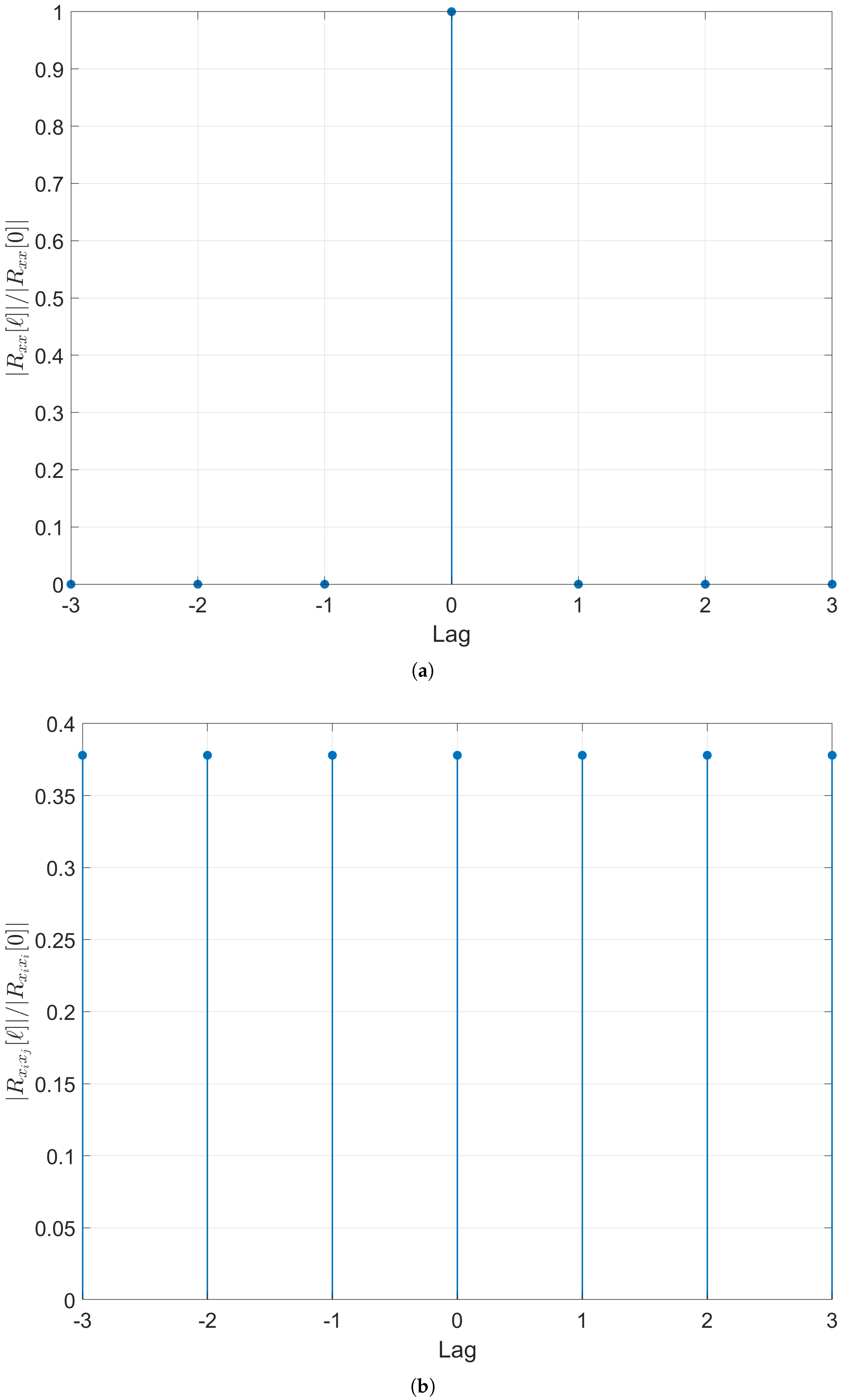
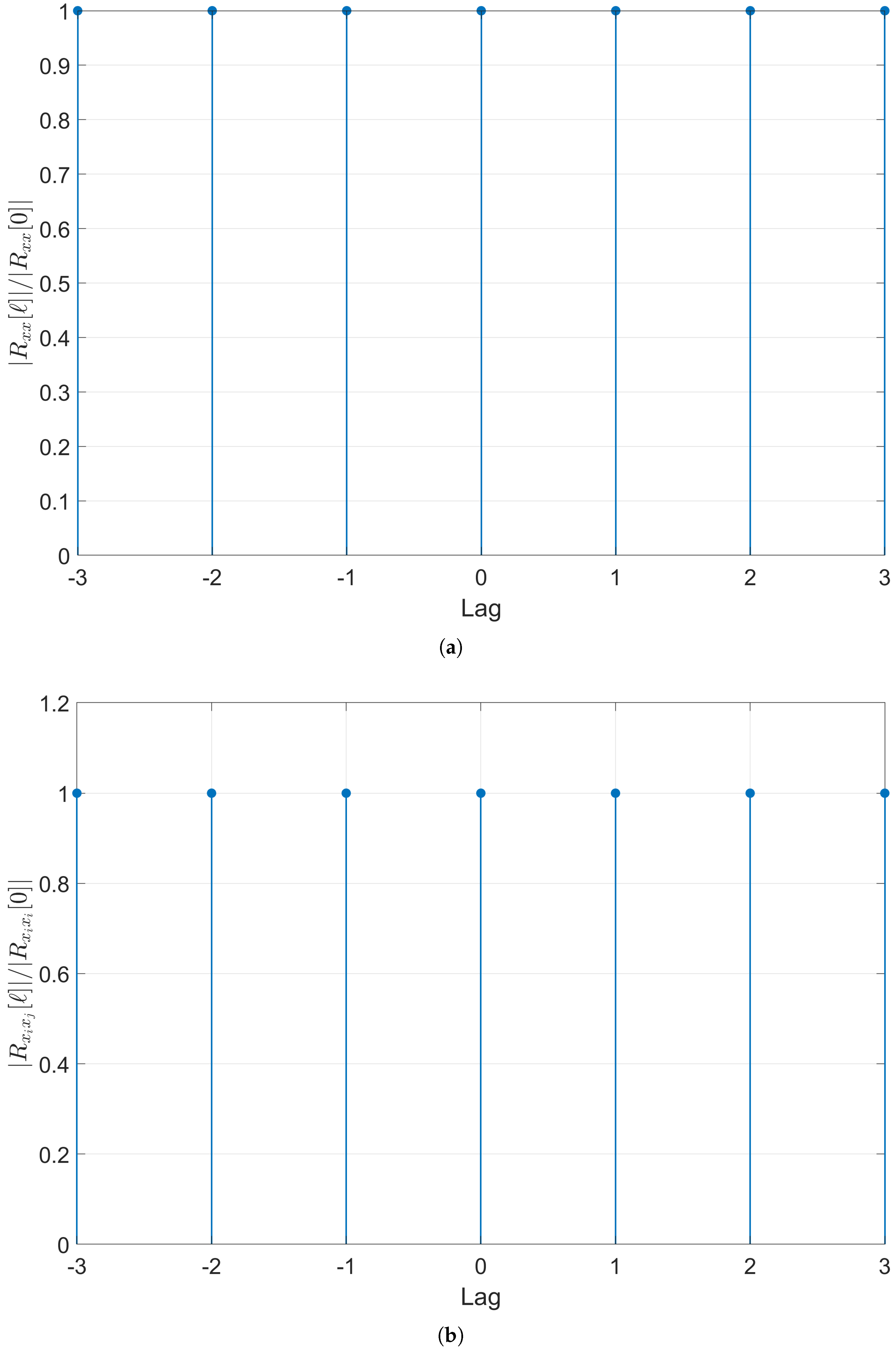
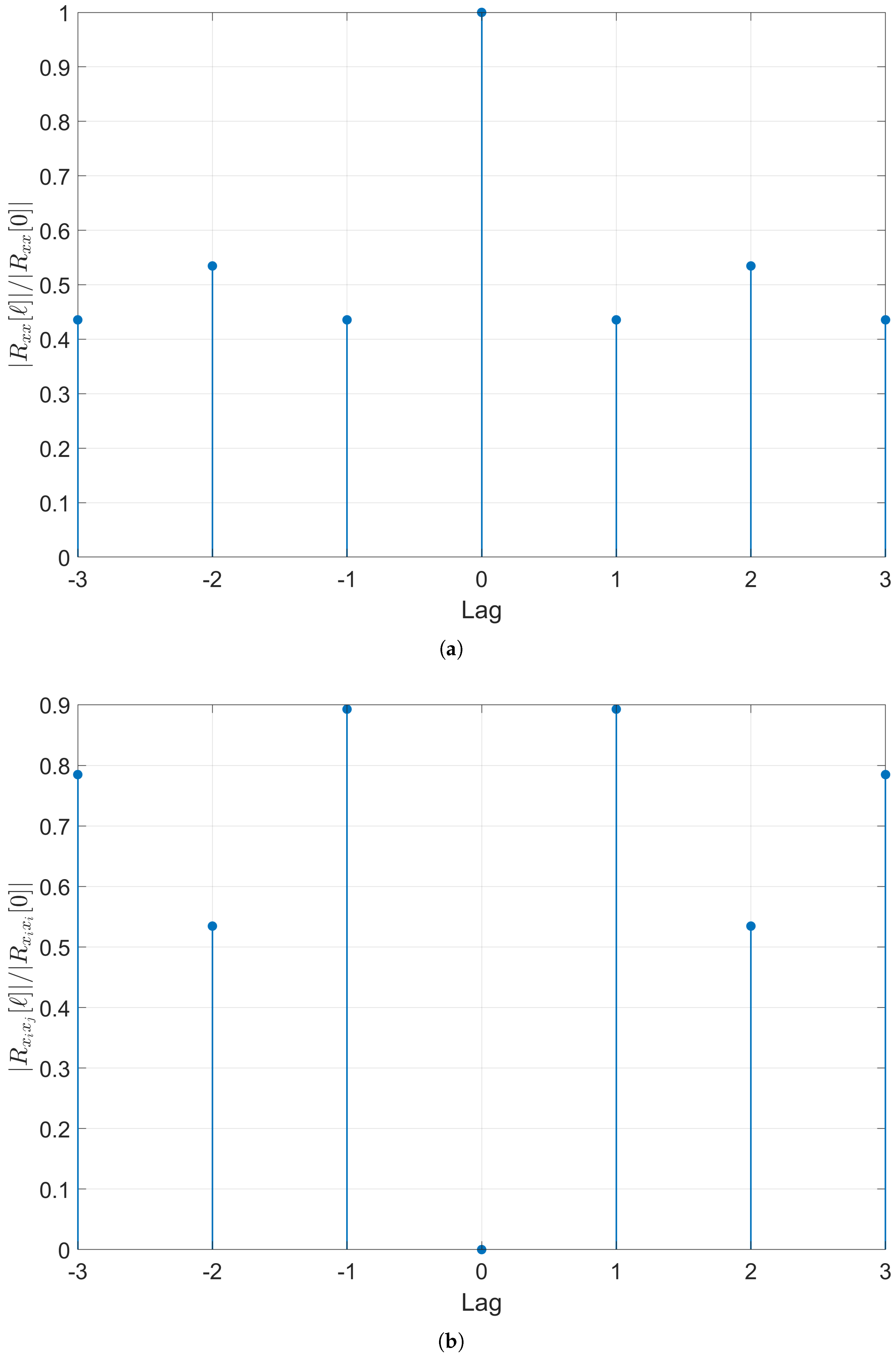
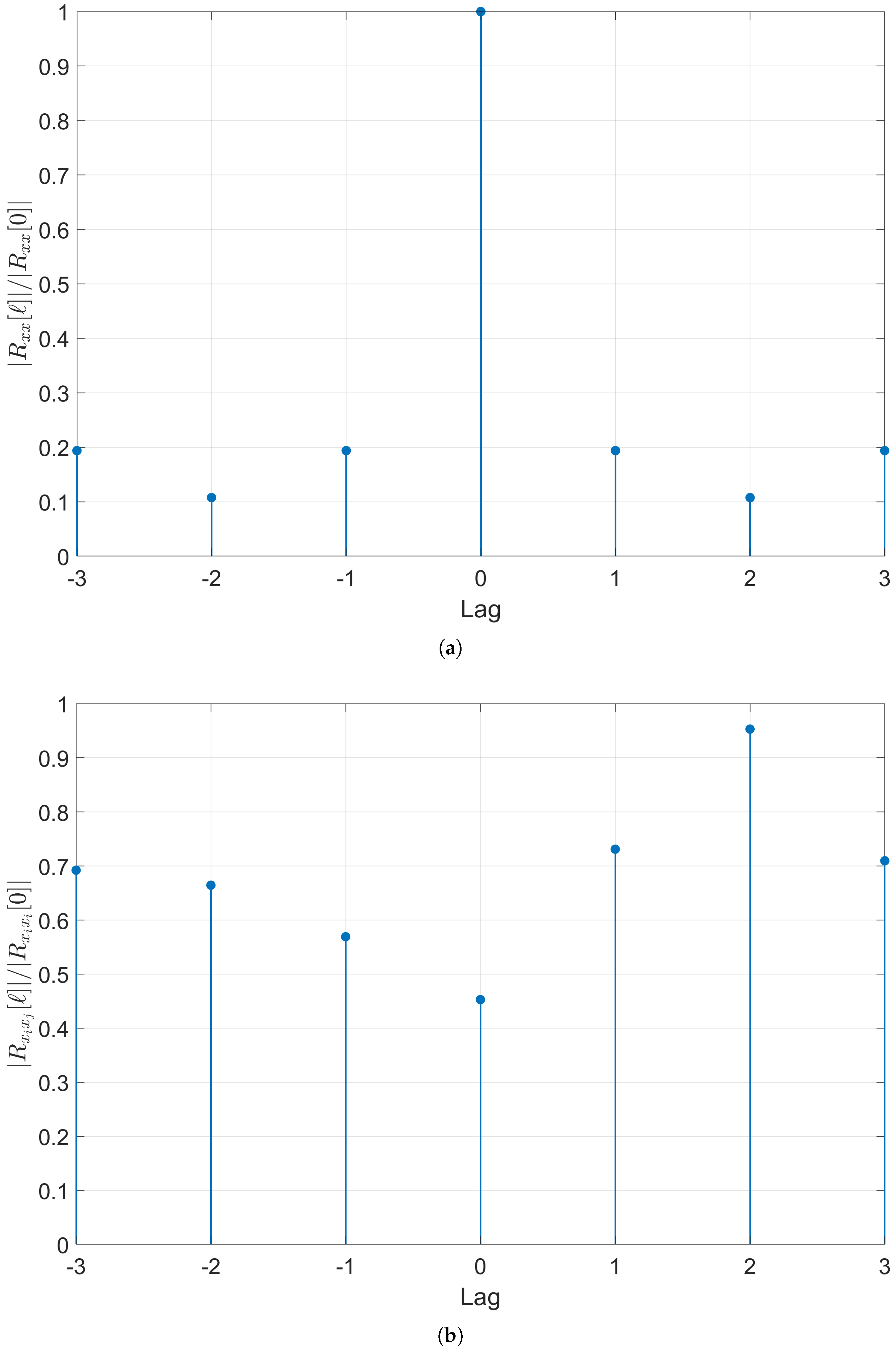
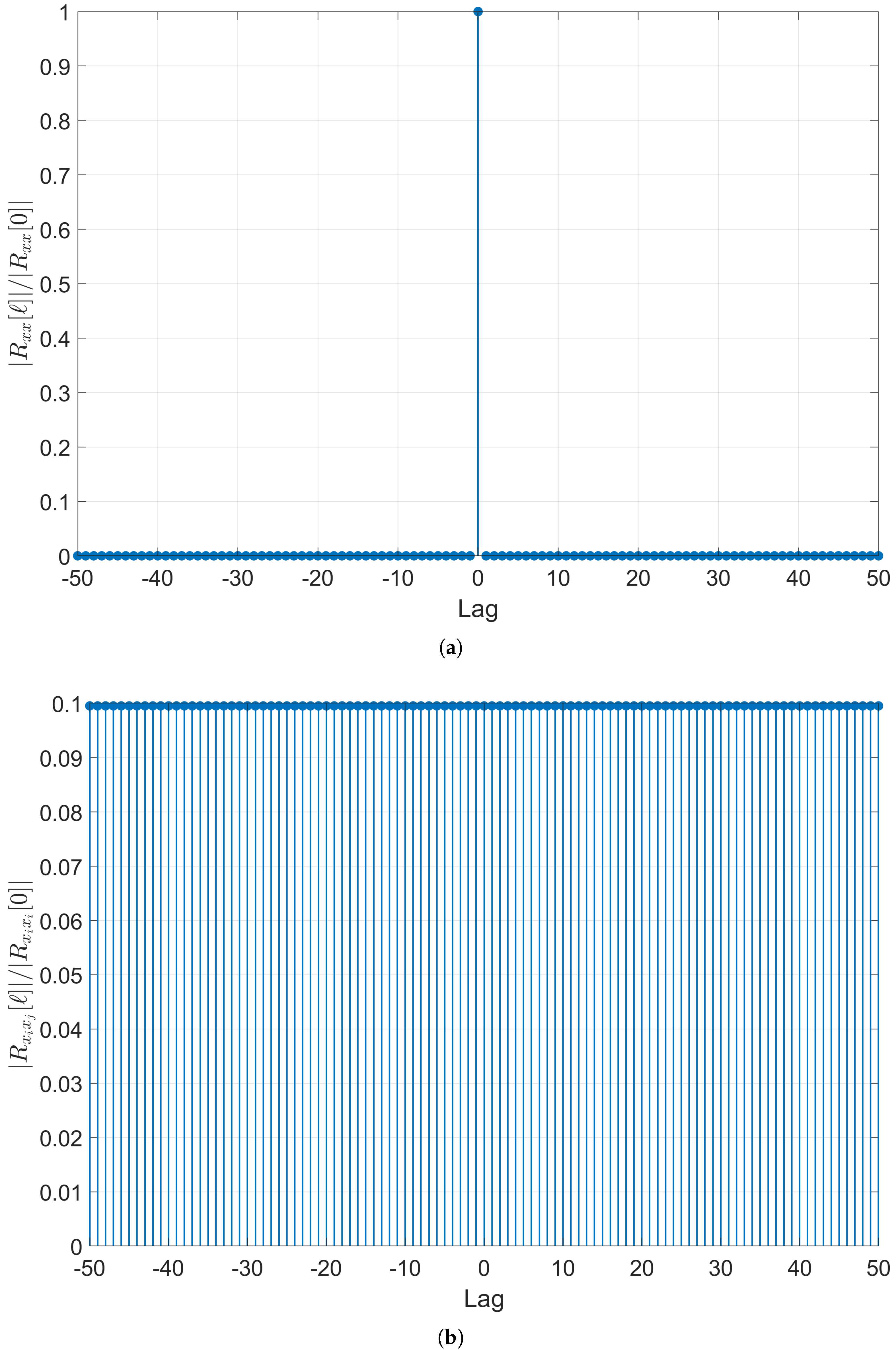
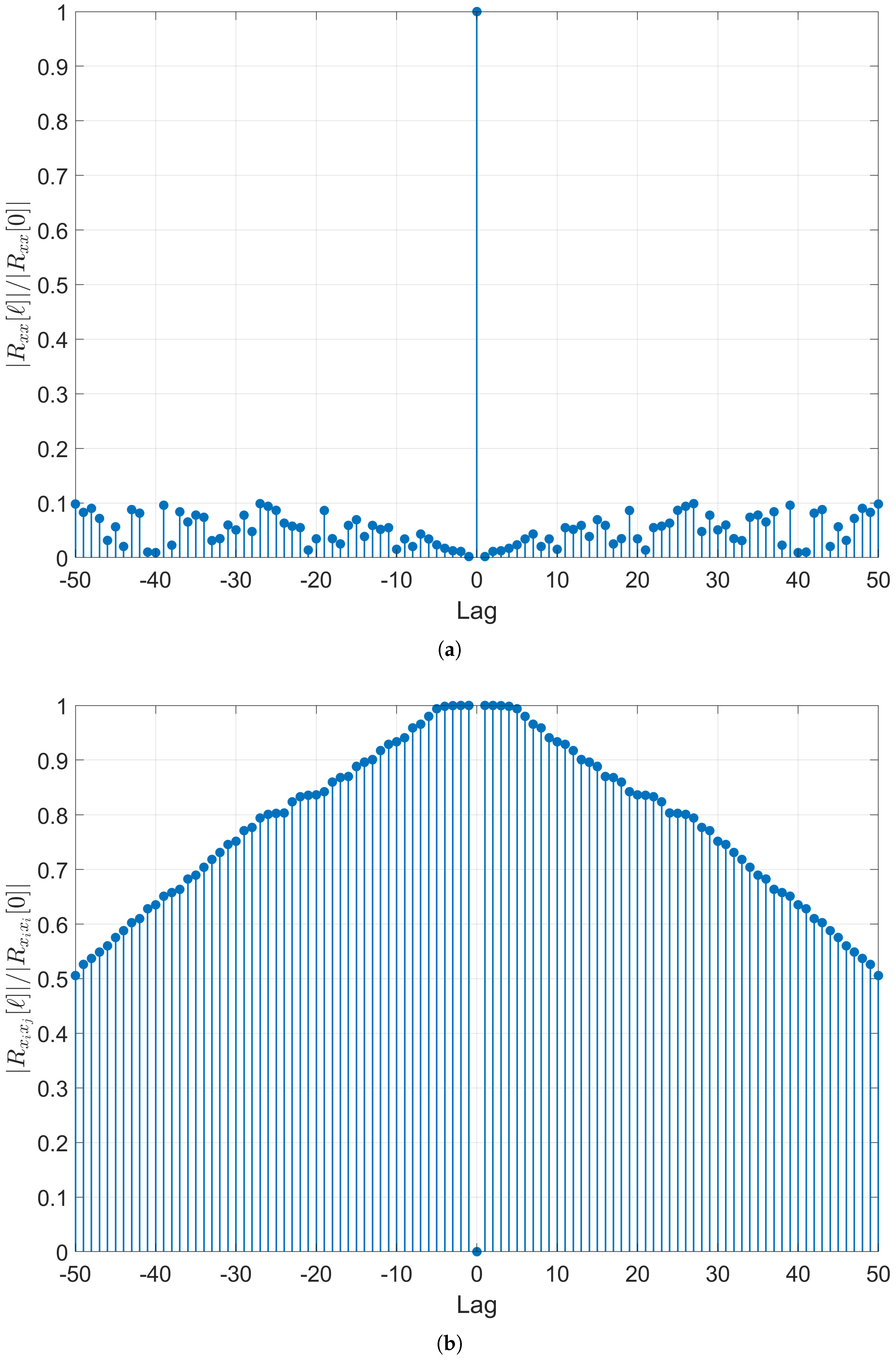
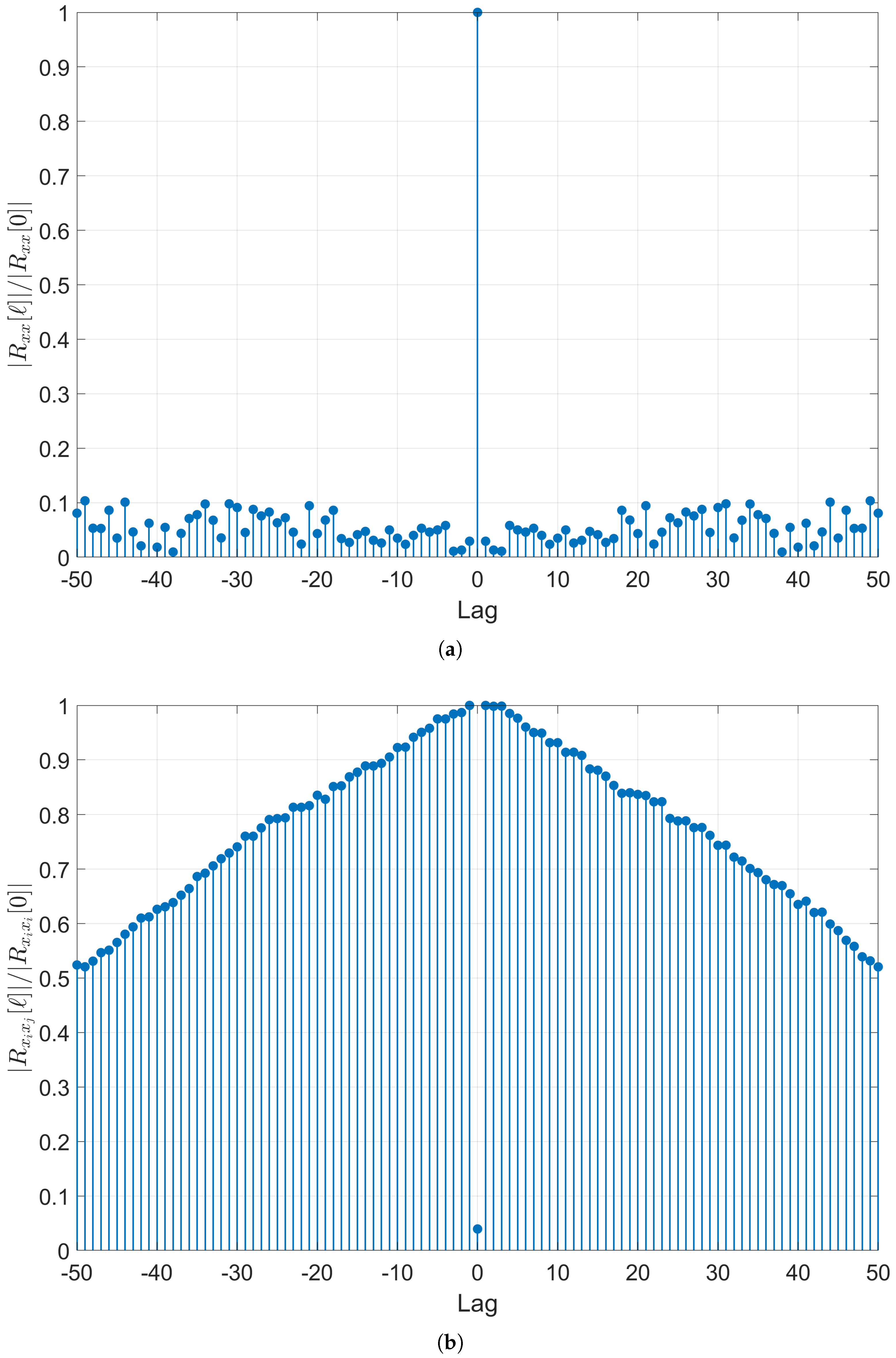
Figure 1,
Figure 2,
Figure 3 and
Figure 4 show the autocorrelation and cross-correlation results for
, while
Figure 5,
Figure 6,
Figure 7 and
Figure 8 present the corresponding results for
.
Autocorrelation properties are analytically derived where closed-form expressions exist and are presented explicitly in
Section 2. For cross-correlation behavior, analytical insight is provided in terms of structural properties and known scaling laws, while worst-case multiuser performance is evaluated numerically using FFT-based cyclic correlation, as described in
Section 4.2.
The ZC family exhibits the expected ideal impulse-like autocorrelation with zero sidelobes and a normalized cross-PSLR of , confirming theoretical predictions. In contrast, the NCPS families show correlation characteristics that depend on their underlying construction. The LNCPS family exhibits flat autocorrelation and unity cross-correlation sidelobes for both sequence lengths, indicating poor synchronization capability.
The NNCPS and MNCPS families exhibit structured autocorrelation with a dominant mainlobe and bounded sidelobes, consistent with quasi-CAZAC behavior. For the short-length case (), the MNCPS construction yields visibly reduced sidelobes compared to NNCPS, while for both families exhibit comparable envelope levels with occasional peaks.
Table 4 reports worst-case
and
values computed over all sequences, all distinct sequence pairs, and all cyclic shifts. ZC sequences retain ideal autocorrelation and bounded worst-case cross-correlation consistent with the theoretical
scaling, whereas LNCPS sequences exhibit unity sidelobes in both metrics. For the NNCPS and MNCPS families, worst-case autocorrelation sidelobes decrease with increasing
M, while the worst-case
approaches unity due to isolated unfavorable sequence pairs.
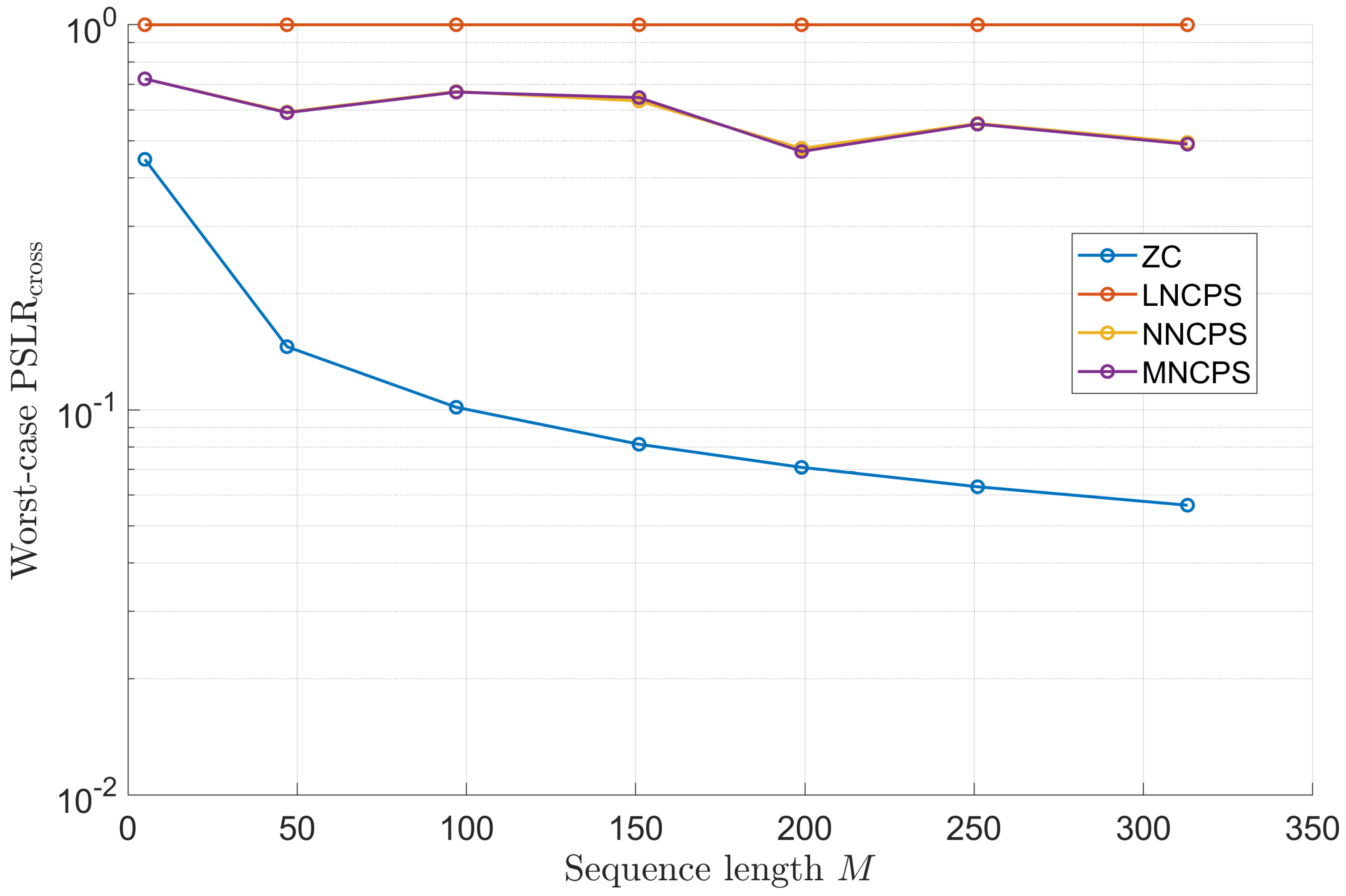
The variation of
with
is illustrated in
Figure 9. The ZC curve follows the theoretical
decay, while the NNCPS and MNCPS families exhibit comparable scaling behavior within a similar band. In contrast, the LNCPS family remains fixed at unity, confirming its lack of useful correlation properties for synchronization.
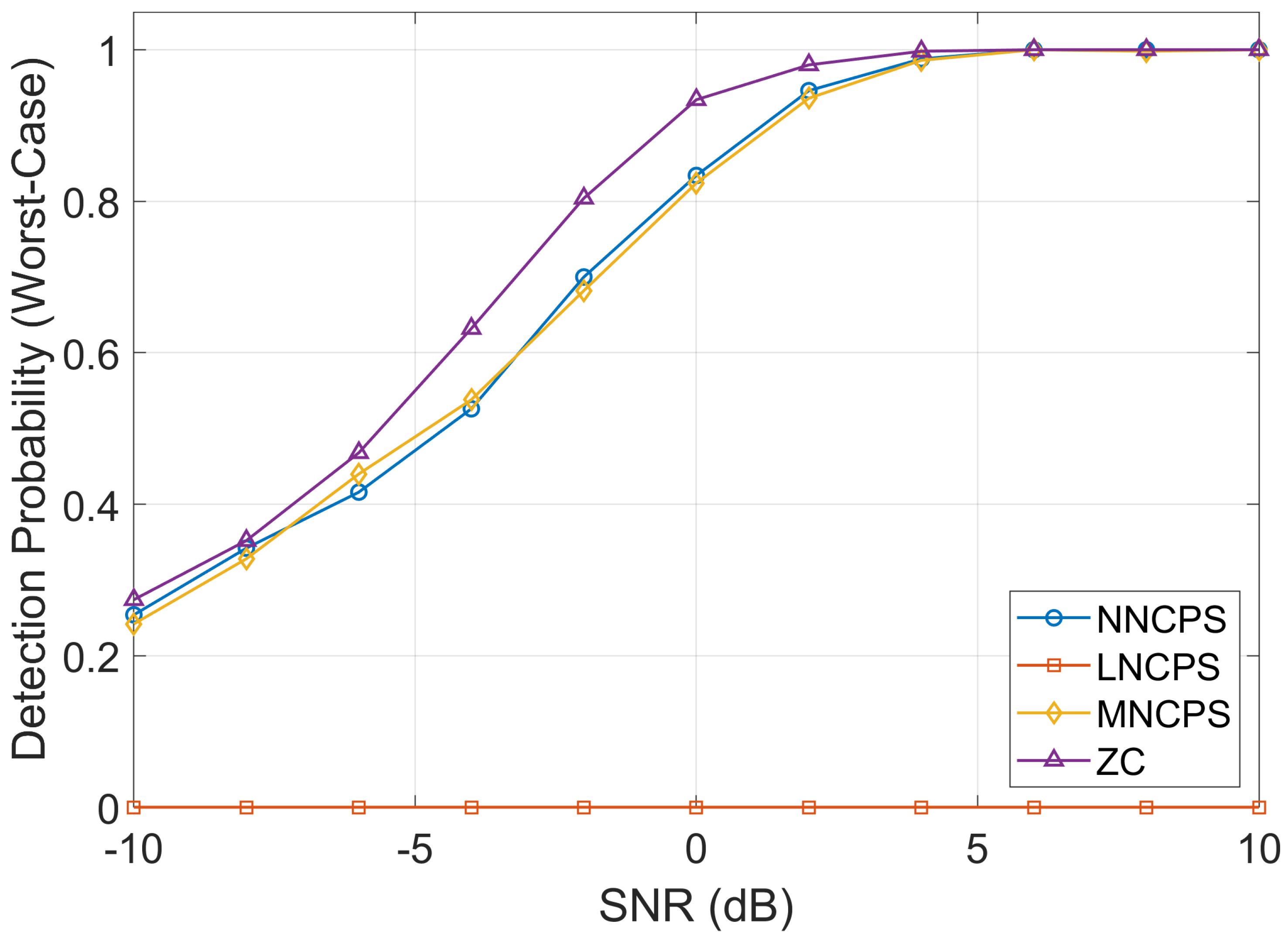
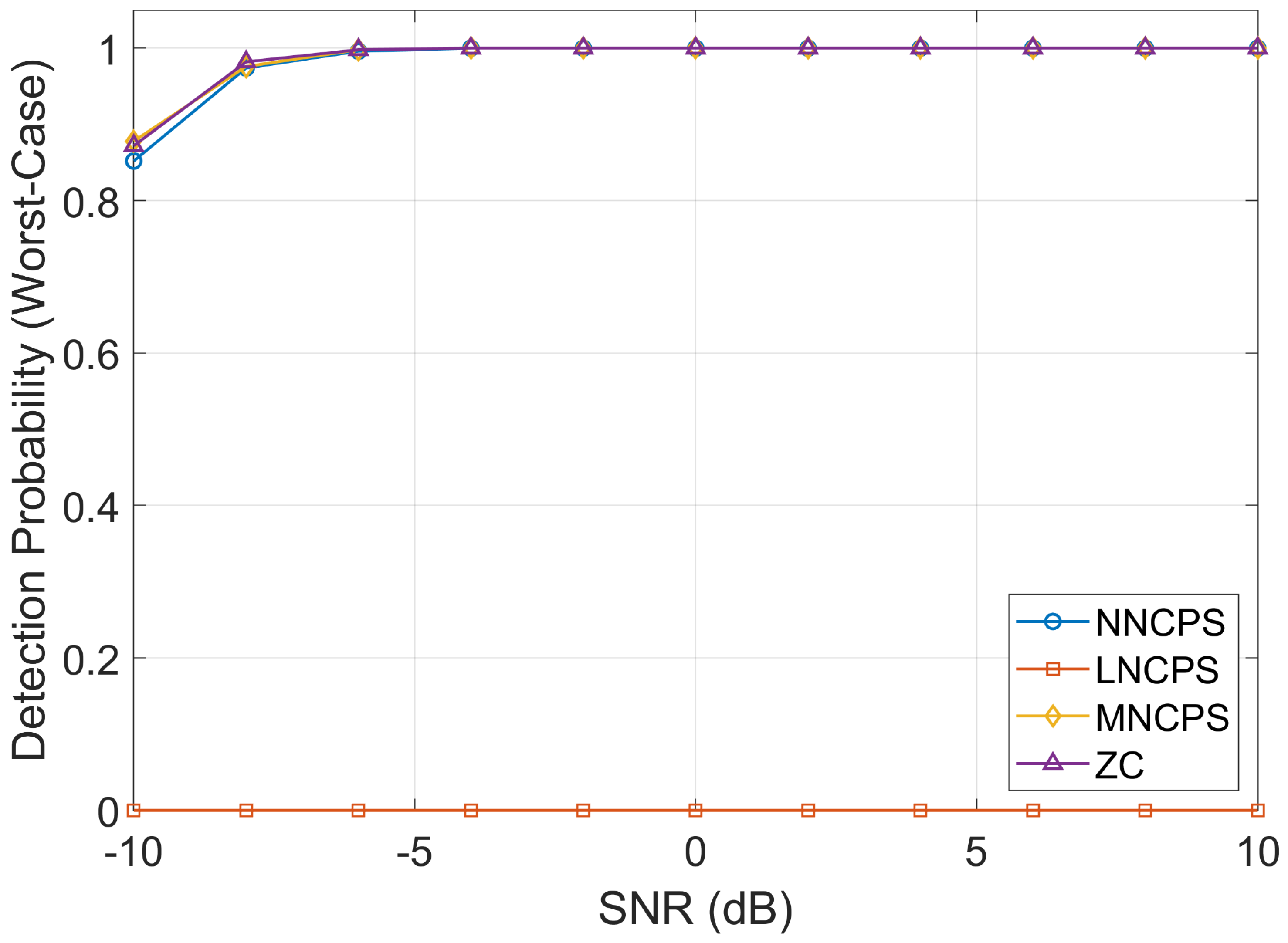
Figure 10 and
Figure 11 depict the synchronization detection probability versus SNR for all sequence families. For
, ZC sequences slightly outperform the NCPS variants at low SNRs (<3 dB), while both NNCPS and MNCPS achieve near-ideal detection at moderate SNRs. For the longer sequence length
, all families except LNCPS exhibit identical detection behavior, achieving reliable synchronization above
dB SNR. In both cases, the LNCPS family fails to achieve meaningful synchronization due to its non-impulsive autocorrelation.
Despite the stringent worst-case behavior summarized in
Table 4, the synchronization performance results in
Figure 10 and
Figure 11 show that both NNCPS and MNCPS achieve near-ideal timing detection at moderate SNRs, closely matching ZC performance and significantly outperforming LNCPS. This indicates that the observed worst-case correlation extremes do not dominate typical synchronization behavior in practice.
Performance differences were evaluated using worst-case PSLR metrics and synchronization detection probability curves obtained from Monte Carlo simulations. The synchronization results were obtained under AWGN to isolate the intrinsic correlation properties of the proposed sequence families. In practical PLC and IoT environments, additional impairments such as impulsive noise, frequency offset, and multipath dispersion are typically present. These effects primarily broaden or distort the correlation peak rather than fundamentally alter the relative behavior between sequence families. Since NCPS and ZC sequences exhibit comparable cyclic correlation envelopes and similar PSLR scaling, their relative synchronization performance is expected to remain consistent under such impairments. A detailed evaluation under standardized PLC noise models and frequency-selective channels is therefore an important direction for future work.
In practical deployments, NCPS offer advantages in systems constrained by coarse quantization or limited arithmetic precision. These include low-resolution DAC/ADC transceivers, narrowband and broadband PLC modems subject to impulsive noise, and ultra-low-power IoT physical layers where multiplier-free sequence generation reduces energy consumption and silicon cost. In such scenarios, NCPS provide ZC-like correlation reliability while avoiding the implementation overhead associated with true CAZAC sequences.
6. Conclusions
This paper proposed a unified framework for the design and evaluation of Non-Binary Cyclic Permutation Sequences (NCPS) for low-correlation synchronization. Four families, namely the Linear NCPS (LNCPS), Nonlinear NNCPS (NNCPS), Modified NCPS (MNCPS), and Zadoff–Chu (ZC) sequences, were analyzed under a common correlation and synchronization methodology. The NCPS construction, rooted in cyclic permutation coding and based solely on modular arithmetic and exponential mapping, offers an efficient means of generating constant-magnitude sequences suitable for implementation in resource-constrained transceivers.
Simulation results showed that the MNCPS family achieved near-ZC correlation performance while maintaining structural simplicity and optimal Hamming distance properties for error correction. These characteristics make NCPS promising candidates for practical preamble design in PLC, IoT, and other low-complexity communication systems, particularly in deployments constrained by low-resolution DAC/ADC hardware, impulsive-noise PLC channels, or ultra–low-power IoT PHYs where multiplier-free implementations are advantageous. Future work will explore sequence extensions to non-prime moduli, adaptive user mapping, and hardware-based validation for real-time synchronization performance.