Updatable Private Set Intersection with Low Communication Overhead

Abstract
1. Introduction
1.1. Related Work
Can we design a UPSI protocol with minimal communication overhead?
1.2. Our Results
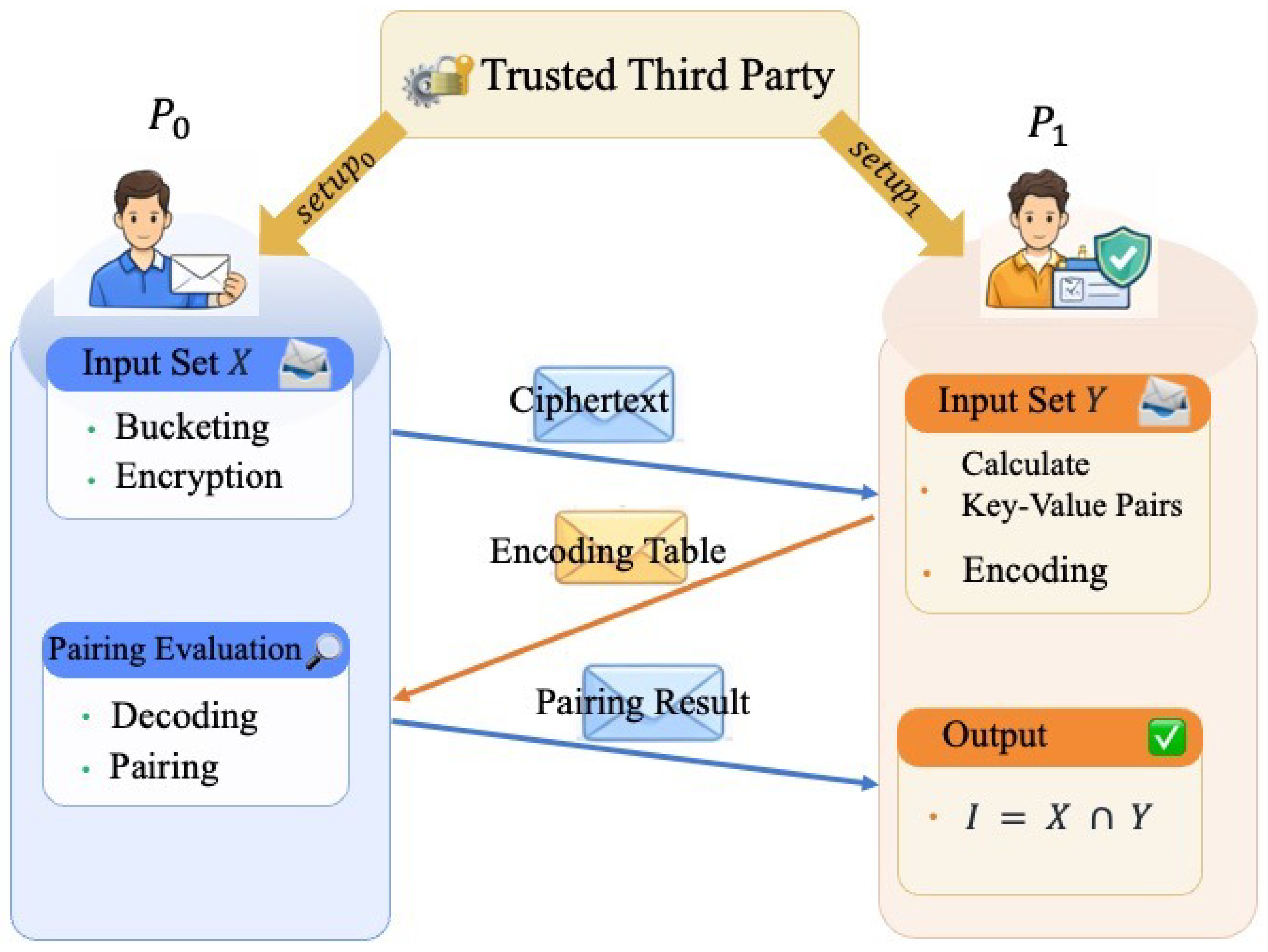
- LcUPSI requires only three rounds of communication with minimal communication overhead, whereas BMSTZ24 requires more than 14 rounds. This makes our protocol significantly more stable and efficient, particularly in low-bandwidth conditions.
- LcUPSI is particularly efficient for participant , who only needs to perform simple operations with a minimal computational cost. Although incurs higher computational costs, the majority of its computation is performed offline and can be flexibly scheduled during idle periods, leading to a practical balance between online efficiency and overall system performance.
1.3. Overview
2. Preliminaries
2.1. Notation
2.2. Updatable PSI
2.3. Oblivious Key–Value Store
3. Our UPSI Protocol
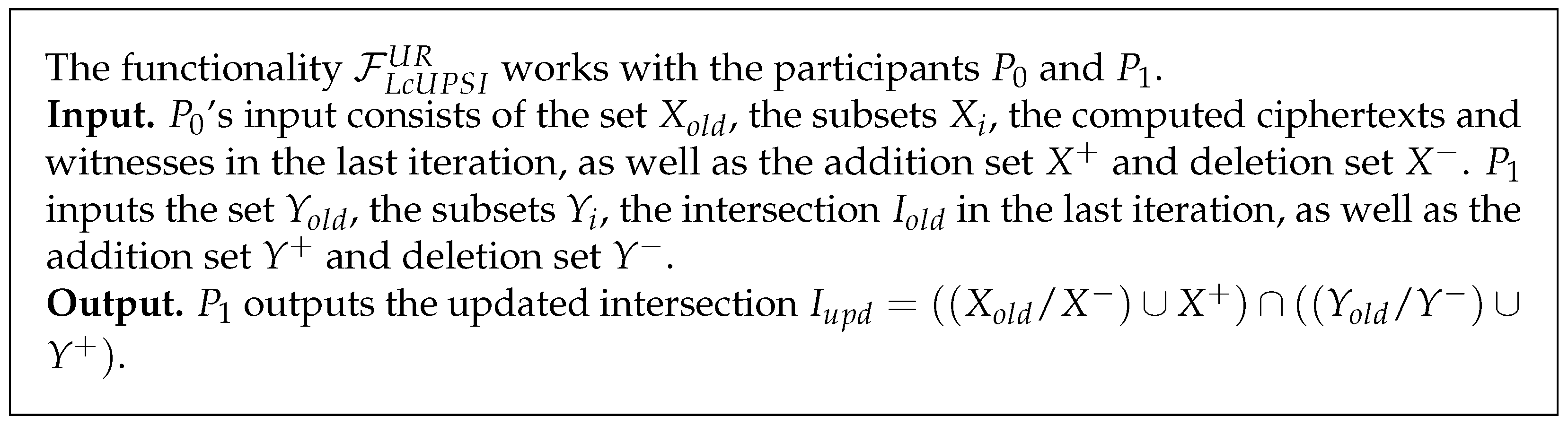
3.1. Definition
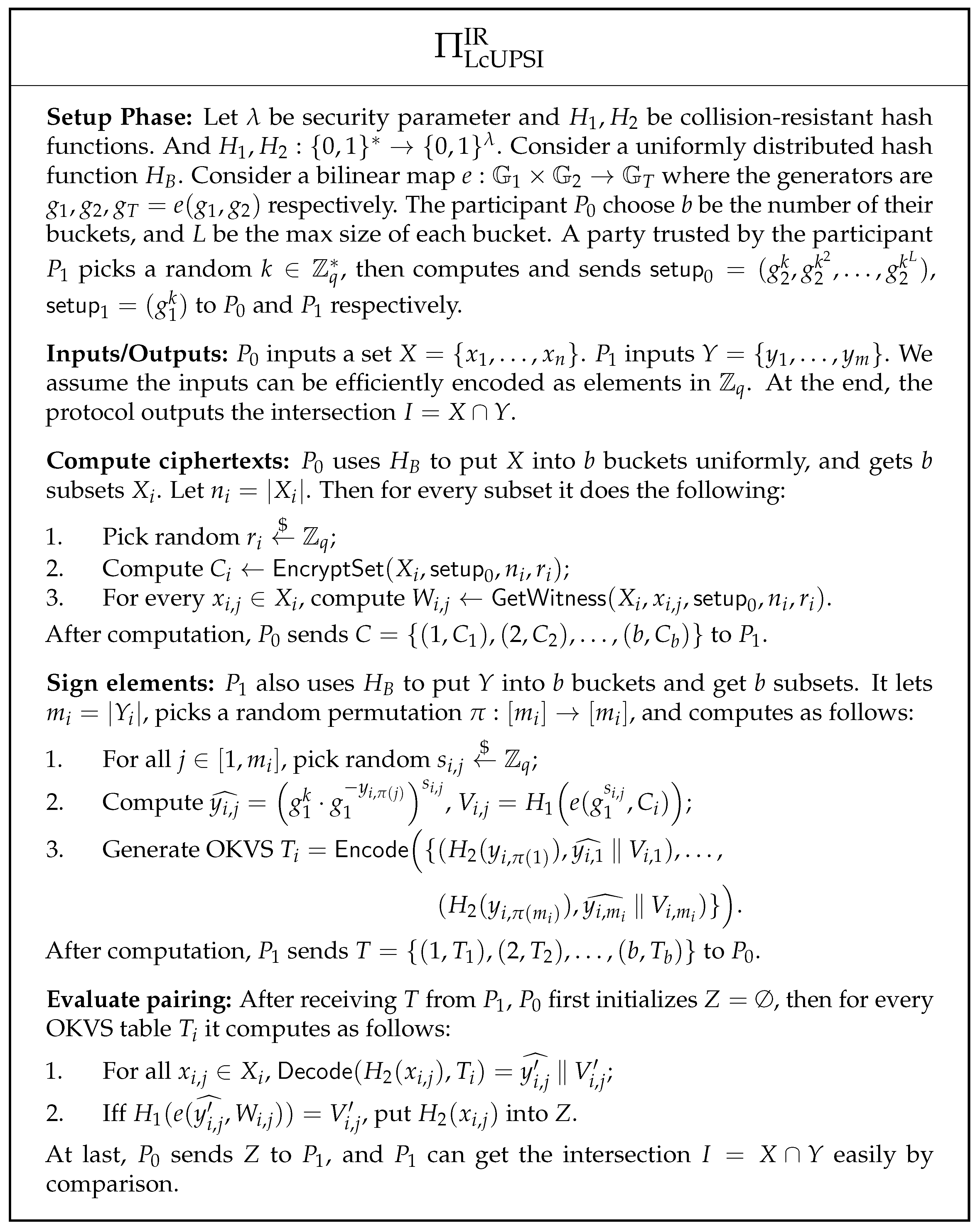
3.2. Construction of LcUPSI’s Initial Round
3.2.1. Setup Phase
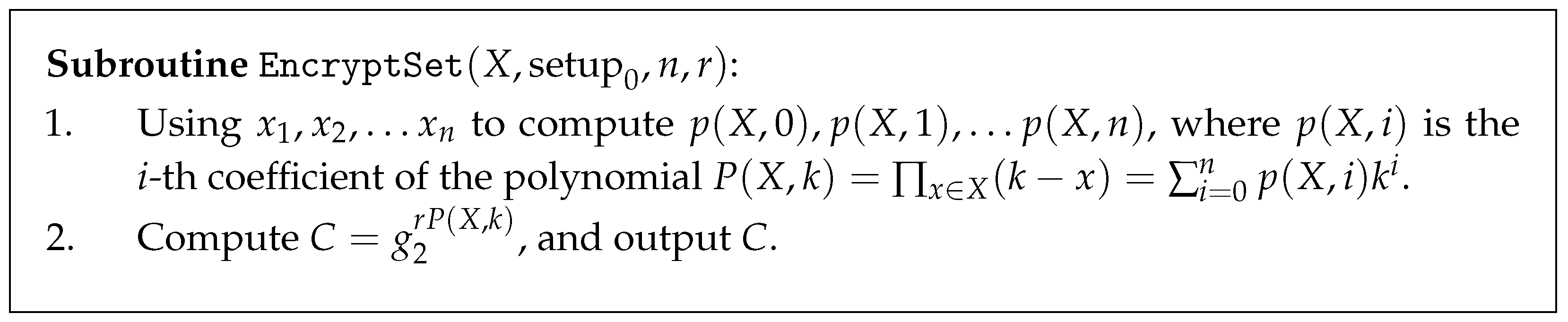
3.2.2. Compute Ciphertext
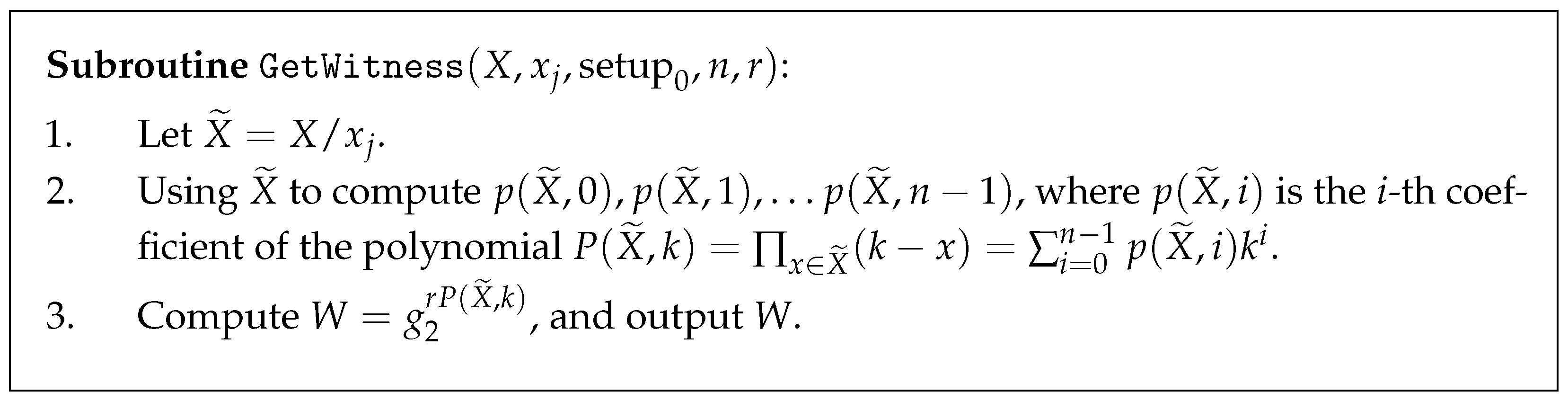
3.2.3. Sign Element
3.2.4. Evaluate Pairing
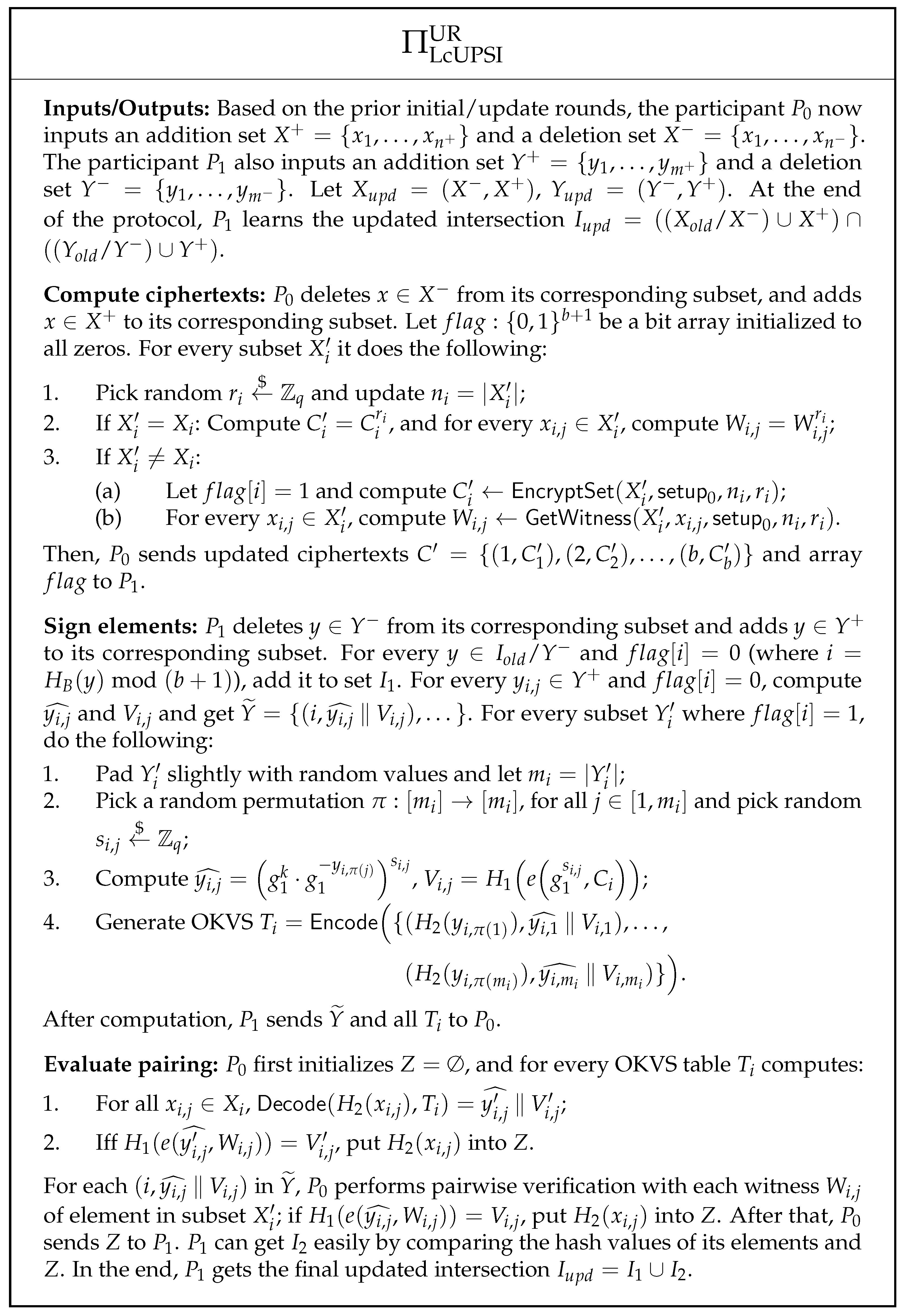
3.3. Construction of LcUPSI’s Update Rounds
3.4. Complexity, Correctness and Security
3.4.1. Complexity
3.4.2. Security
3.4.3. Correctness
- ’s Computation:
- ’s Computation:
4. Experiment and Evaluation
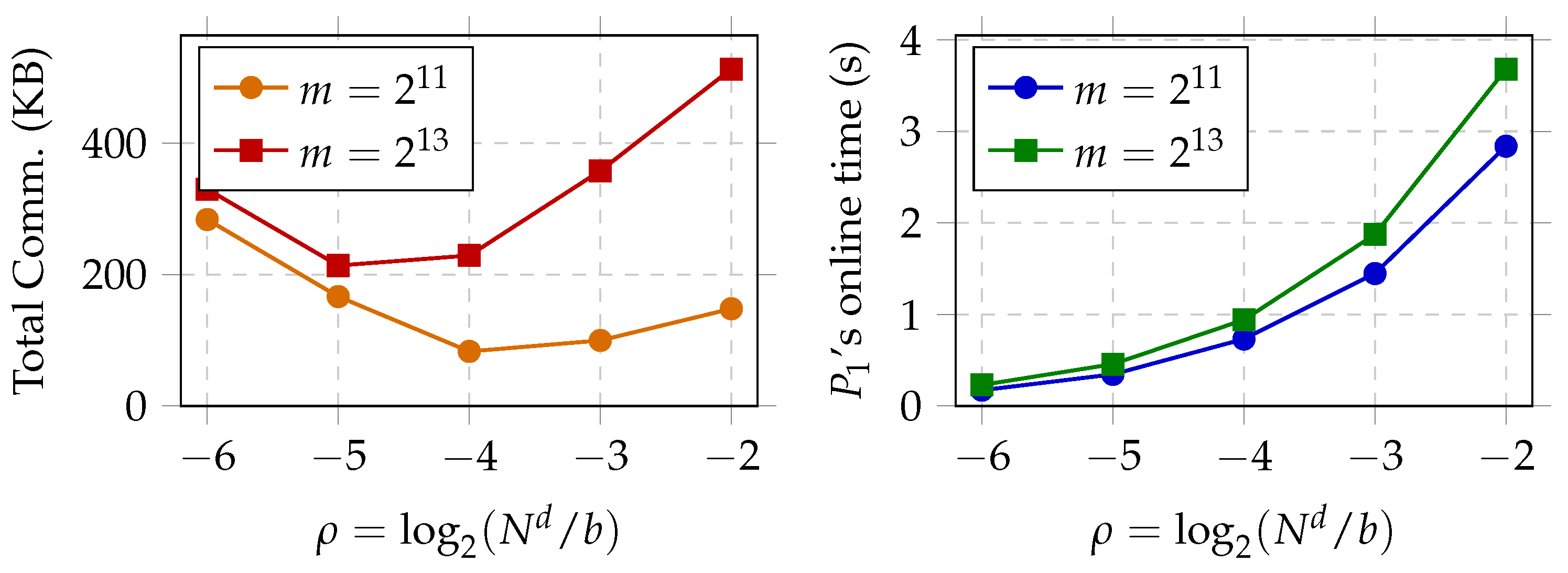
4.1. The Impact of Parameter on Efficiency
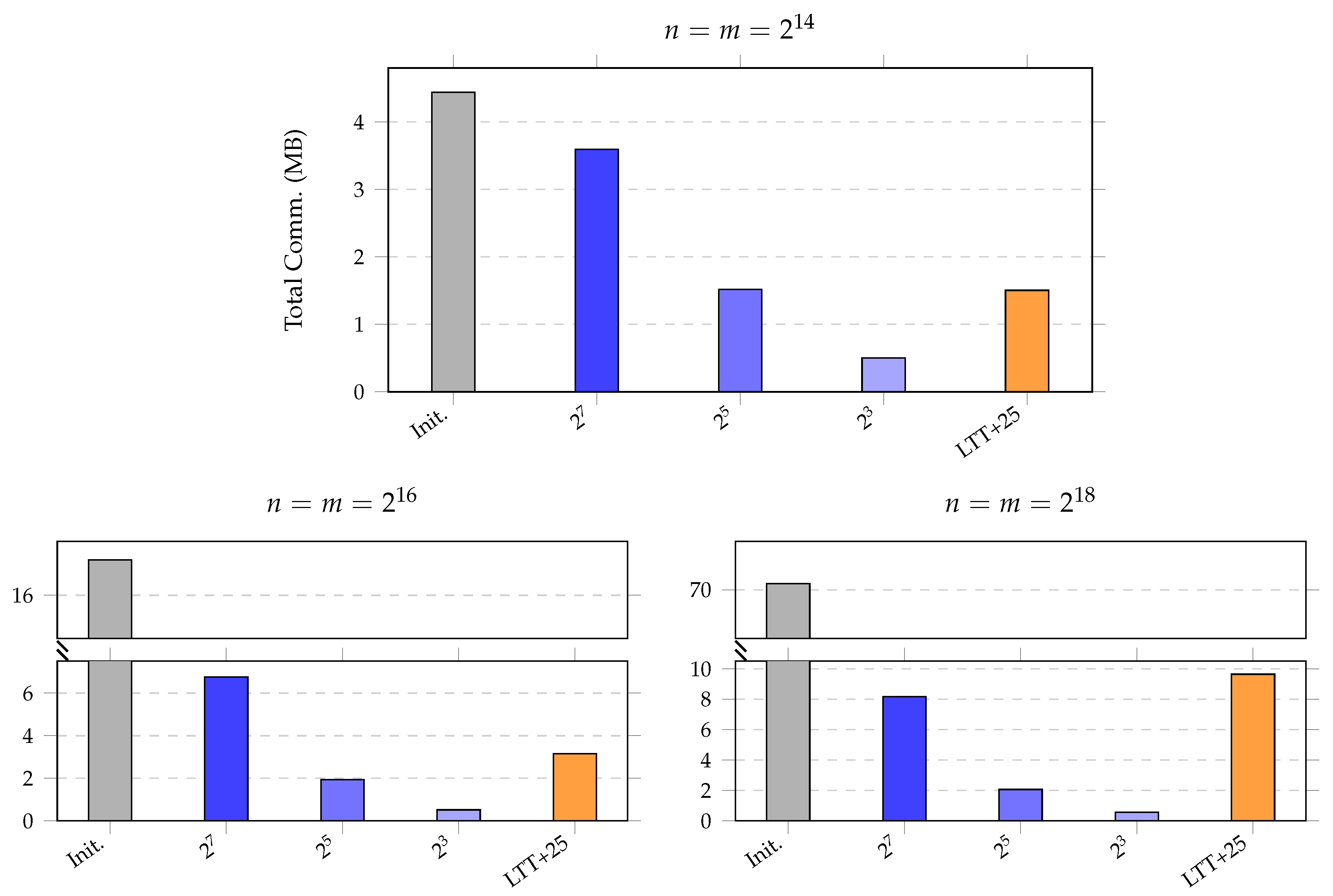
4.2. Comparison with State-of-the-Art Protocol
- Total Running Time: Across all nine data points in Table 2, LcUPSI consistently outperforms BMSTZ24 in total runtime. The advantage becomes more pronounced as the update size grows, especially when , where the runtime gap is particularly visible. This indicates that LcUPSI offers a clear practical benefit in total runtime across the tested parameter range.
- ’s Online Time: In this experiment, we did not directly measure the online time of individual participants in BMSTZ24. However, according to the protocol flow (see Figure 10 in BMSTZ24 [32]), a participant in BMSTZ24 remains engaged throughout almost the entire protocol execution. In contrast, in LcUPSI, most of the heavy preprocessing is carried out locally by , and is involved only in a much shorter online phase. As shown in Table 2, ’s online runtime in LcUPSI remains small across all tested settings, which makes the protocol particularly attractive in scenarios where is the relatively weaker participant.
- Communication Overhead: In terms of communication overhead, LcUPSI consistently outperforms BMSTZ24 across all tested parameter settings. The gap is especially pronounced when the update size is small and remains substantial even for larger updates. This advantage is closely related to the round complexity: BMSTZ24 requires at least 14 rounds of interaction (depending on the implementation of in BMSTZ24), whereas LcUPSI requires only three rounds, with a significantly smaller communication volume per round. This makes LcUPSI particularly attractive in bandwidth-constrained settings and in scenarios where is the relatively weaker online participant.
5. Optimizations
5.1. Strictly One-Sided Output
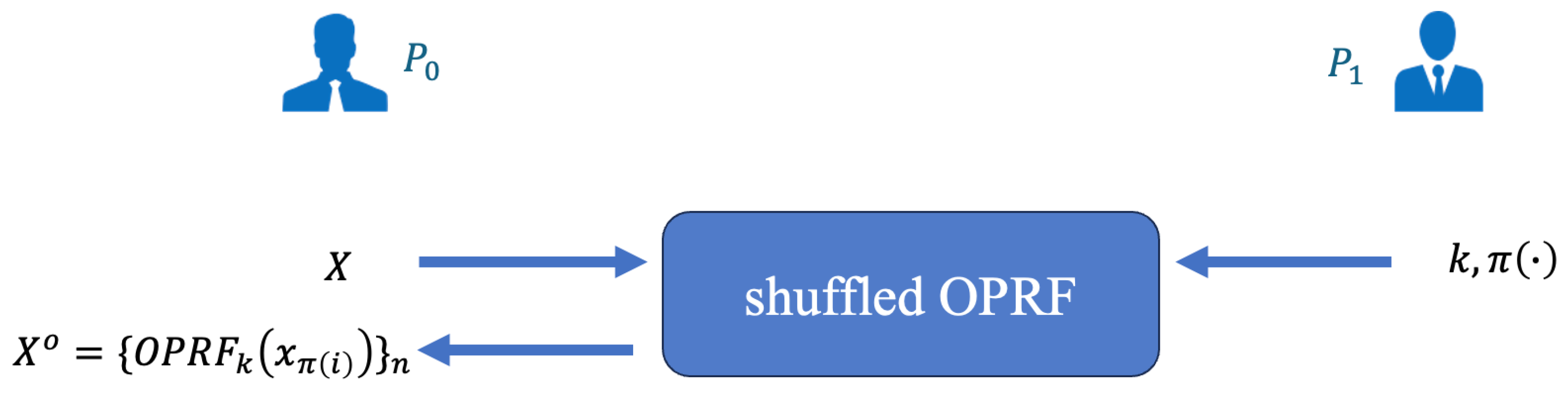
Shuffled OPRF
6. Conclusions
Author Contributions
Funding
Data Availability Statement
Acknowledgments
Conflicts of Interest
Appendix A. Security Proofs
Appendix A.1. Correctness of the Update Round
Appendix A.2. Security Proof of LcUPSI (Theorem 1)
- Case 1: Corrupted (Receiver).
- Case 2: Corrupted (Sender).
- Setup: randomly picks and generates the parameters and , adding them to the simulated view.
- Partitioning: computes ’s subsets and the corresponding ciphertexts exactly as an honest would.
- Simulating OKVS Tables: must generate the OKVS tables . For each bucket , determines the number of elements to encode. Let be the intersection elements in bucket i.
- For each , behaves honestly: it picks , computes and , and prepares the OKVS key–value pair .
- For the remaining dummy elements (representing elements in ), picks random , computes and , and encodes them using random keys in the OKVS.
- encodes these pairs into and appends them to the view.
- Hybrid 0: The real execution view.
- Hybrid ℓ: For the first ℓ non-intersecting elements (ordered arbitrarily across all buckets), the pairs are generated randomly as in the simulation. The remaining elements are generated using the real protocol logic.
- Security of the Update Round (UR):
- Remark on Forward Privacy.
References
- Ion, M.; Kreuter, B.; Nergiz, A.E.; Patel, S.; Saxena, S.; Seth, K.; Raykova, M.; Shanahan, D.; Yung, M. On Deploying Secure Computing: Private Intersection-Sum-with-Cardinality. In Proceedings of the 2020 IEEE European Symposium on Security and Privacy (EuroS&P), Genoa, Italy, 7–11 September 2020; pp. 370–389. [Google Scholar] [CrossRef]
- Kales, D.; Rechberger, C.; Schneider, T.; Senker, M.; Weinert, C. Mobile Private Contact Discovery at Scale. In Proceedings of the 28th USENIX Security Symposium (USENIX Security 19), Santa Clara, CA, USA, 13–15 August 2019; pp. 1447–1464. [Google Scholar]
- Pinkas, B.; Schneider, T.; Zohner, M. Faster Private Set Intersection Based on {OT} Extension. In Proceedings of the 23rd USENIX Security Symposium (USENIX Security 14), San Diego, CA, USA, 20–22 August 2014; pp. 797–812. [Google Scholar]
- Pinkas, B.; Rosulek, M.; Trieu, N.; Yanai, A. PSI from PaXoS: Fast, Malicious Private Set Intersection. In Proceedings of the Advances in Cryptology–EUROCRYPT 2020; Canteaut, A., Ishai, Y., Eds.; Springer International Publishing: Cham, Switzerland, 2020; pp. 739–767. [Google Scholar] [CrossRef]
- Chase, M.; Miao, P. Private Set Intersection in the Internet Setting from Lightweight Oblivious PRF. In Proceedings of the Advances in Cryptology–CRYPTO 2020; Micciancio, D., Ristenpart, T., Eds.; Springer International Publishing: Cham, Switzerland, 2020; pp. 34–63. [Google Scholar] [CrossRef]
- Kolesnikov, V.; Kumaresan, R.; Rosulek, M.; Trieu, N. Efficient Batched Oblivious PRF with Applications to Private Set Intersection. In Proceedings of the 2016 ACM SIGSAC Conference on Computer and Communications Security; ACM: New York, NY, USA, 2016; CCS ’16; pp. 818–829. [Google Scholar] [CrossRef]
- Dong, C.; Chen, L.; Wen, Z. When Private Set Intersection Meets Big Data: An Efficient and Scalable Protocol. In Proceedings of the 2013 ACM SIGSAC Conference on Computer & Communications Security; ACM: New York, NY, USA, 2013; CCS ’13; pp. 789–800. [Google Scholar] [CrossRef]
- Bienstock, A.; Patel, S.; Seo, J.Y.; Yeo, K. {Near-Optimal} Oblivious {Key-Value} Stores for Efficient {PSI}, {PSU} and {Volume-Hiding} {Multi-Maps}. In Proceedings of the 32nd USENIX Security Symposium (USENIX Security 23), Anaheim, CA, USA, 9–11 August 2023; pp. 301–318. [Google Scholar]
- Couteau, G.; Rindal, P.; Raghuraman, S. Silver: Silent VOLE and Oblivious Transfer from Hardness of Decoding Structured LDPC Codes. In Proceedings of the Advances in Cryptology–CRYPTO 2021; Malkin, T., Peikert, C., Eds.; Springer International Publishing: Cham, Switzerland, 2021; pp. 502–534. [Google Scholar] [CrossRef]
- Garimella, G.; Pinkas, B.; Rosulek, M.; Trieu, N.; Yanai, A. Oblivious Key-Value Stores and Amplification for Private Set Intersection. In Proceedings of the Advances in Cryptology–CRYPTO 2021; Malkin, T., Peikert, C., Eds.; Springer International Publishing: Cham, Switzerland, 2021; pp. 395–425. [Google Scholar] [CrossRef]
- Raghuraman, S.; Rindal, P. Blazing Fast PSI from Improved OKVS and Subfield VOLE. In Proceedings of the 2022 ACM SIGSAC Conference on Computer and Communications Security; Association for Computing Machinery: New York, NY, USA, 2022; CCS ’22; pp. 2505–2517. [Google Scholar] [CrossRef]
- Rindal, P.; Schoppmann, P. VOLE-PSI: Fast OPRF and Circuit-PSI from Vector-OLE. In Proceedings of the Advances in Cryptology–EUROCRYPT 2021; Canteaut, A., Standaert, F.X., Eds.; Springer International Publishing: Cham, Switzerland, 2021; pp. 901–930. [Google Scholar] [CrossRef]
- Ateniese, G.; De Cristofaro, E.; Tsudik, G. (If) Size Matters: Size-Hiding Private Set Intersection. In Proceedings of the Public Key Cryptography–PKC 2011; Catalano, D., Fazio, N., Gennaro, R., Nicolosi, A., Eds.; Springer: Berlin/Heidelberg, Germany, 2011; pp. 156–173. [Google Scholar] [CrossRef]
- De Cristofaro, E.; Tsudik, G. Practical Private Set Intersection Protocols with Linear Complexity. In Proceedings of the Financial Cryptography and Data Security; Sion, R., Ed.; Springer: Berlin/Heidelberg, Germany, 2010; pp. 143–159. [Google Scholar] [CrossRef]
- Huberman, B.A.; Franklin, M.; Hogg, T. Enhancing Privacy and Trust in Electronic Communities. In Proceedings of the 1st ACM Conference on Electronic Commerce, Denver, CO, USA, 3–5 November 1999; pp. 78–86. [Google Scholar] [CrossRef]
- Meadows, C. A More Efficient Cryptographic Matchmaking Protocol for Use in the Absence of a Continuously Available Third Party. In Proceedings of the 1986 IEEE Symposium on Security and Privacy, Oakland, CA, USA, 7–9 April 1986; p. 134. [Google Scholar] [CrossRef]
- Huang, Y.; Evans, D.; Katz, J. Private set intersection: Are garbled circuits better than custom protocols? In Proceedings of the NDSS, San Diego, CA, USA, 5–8 February 2012. [Google Scholar]
- Pinkas, B.; Schneider, T.; Segev, G.; Zohner, M. Phasing: Private Set Intersection Using Permutation-based Hashing. In Proceedings of the 24th USENIX Security Symposium (USENIX Security 15), Washington, DC, USA, 12–14 August 2015; pp. 515–530. [Google Scholar]
- Pinkas, B.; Schneider, T.; Tkachenko, O.; Yanai, A. Efficient Circuit-Based PSI with Linear Communication. In Proceedings of the Advances in Cryptology–EUROCRYPT 2019; Ishai, Y., Rijmen, V., Eds.; Springer International Publishing: Cham, Switzerland, 2019; pp. 122–153. [Google Scholar] [CrossRef]
- Pinkas, B.; Schneider, T.; Weinert, C.; Wieder, U. Efficient Circuit-Based PSI via Cuckoo Hashing. In Proceedings of the Advances in Cryptology–EUROCRYPT 2018; Nielsen, J.B., Rijmen, V., Eds.; Springer International Publishing: Cham, Switzerland, 2018; pp. 125–157. [Google Scholar] [CrossRef]
- Chen, H.; Huang, Z.; Laine, K.; Rindal, P. Labeled PSI from Fully Homomorphic Encryption with Malicious Security. In Proceedings of the 2018 ACM SIGSAC Conference on Computer and Communications Security; ACM: New York, NY, USA, 2018; CCS ’18; pp. 1223–1237. [Google Scholar] [CrossRef]
- Chen, H.; Laine, K.; Rindal, P. Fast Private Set Intersection from Homomorphic Encryption. In Proceedings of the 2017 ACM SIGSAC Conference on Computer and Communications Security; ACM: New York, NY, USA, 2017; CCS ’17; pp. 1243–1255. [Google Scholar] [CrossRef]
- Cong, K.; Moreno, R.C.; da Gama, M.B.; Dai, W.; Iliashenko, I.; Laine, K.; Rosenberg, M. Labeled PSI from Homomorphic Encryption with Reduced Computation and Communication. In Proceedings of the 2021 ACM SIGSAC Conference on Computer and Communications Security; ACM: New York, NY, USA, 2021; CCS ’21; pp. 1135–1150. [Google Scholar] [CrossRef]
- Chandran, N.; Gupta, D.; Shah, A. Circuit-PSI with Linear Complexity via Relaxed Batch OPPRF. Proc. Priv. Enhancing Technol. 2022, 2022, 353–372. [Google Scholar] [CrossRef]
- Yao, A.C.C. How to Generate and Exchange Secrets. In Proceedings of the 27th Annual Symposium on Foundations of Computer Science (Sfcs 1986), Toronto, ON, Canada, 27–29 October 1986; pp. 162–167. [Google Scholar] [CrossRef]
- Goldreich, O.; Micali, S.; Wigderson, A. How to Play Any Mental Game, or a Completeness Theorem for Protocols with Honest Majority. In Providing Sound Foundations for Cryptography: On the Work of Shafi Goldwasser and Silvio Micali; Association for Computing Machinery: New York, NY, USA, 2019; pp. 307–328. [Google Scholar]
- Chongchitmate, W.; Ishai, Y.; Lu, S.; Ostrovsky, R. PSI from Ring-OLE. In Proceedings of the 2022 ACM SIGSAC Conference on Computer and Communications Security; ACM: New York, NY, USA, 2022; CCS ’22; pp. 531–545. [Google Scholar] [CrossRef]
- Kiss, Á.; Liu, J.; Schneider, T.; Asokan, N.; Pinkas, B. Private Set Intersection for Unequal Set Sizes with Mobile Applications. In Proceedings of the Proceedings on Privacy Enhancing Technologies; De Gruyter: Berlin, Germany, 2017. [Google Scholar] [CrossRef]
- Abadi, A.; Dong, C.; Murdoch, S.J.; Terzis, S. Multi-Party Updatable Delegated Private Set Intersection. In Proceedings of the Financial Cryptography and Data Security; Eyal, I., Garay, J., Eds.; Springer International Publishing: Cham, Switzerland, 2022; pp. 100–119. [Google Scholar] [CrossRef]
- Badrinarayanan, S.; Miao, P.; Xie, T. Updatable Private Set Intersection. Proc. Priv. Enhancing Technol. 2022, 2022, 378–406. [Google Scholar] [CrossRef]
- Agarwal, A.; Cash, D.; George, M.; Kamara, S.; Moataz, T.; Singh, J. Updatable Private Set Intersection from Structured Encryption. 2024. Available online: https://eprint.iacr.org/2024/1183 (accessed on 7 April 2026).
- Badrinarayanan, S.; Miao, P.; Shi, X.; Tromanhauser, M.; Zeng, R. Updatable Private Set Intersection Revisited: Extended Functionalities, Deletion, and Worst-Case Complexity. In Proceedings of the Advances in Cryptology–ASIACRYPT 2024; Chung, K.M., Sasaki, Y., Eds.; Springer Nature: Singapore, 2025; pp. 200–233. [Google Scholar] [CrossRef]
- Wang, R.; Zhou, J.; Cao, Z.; Dong, X.; Raymond Choo, K.K. Updatable Private Set Intersection with Forward Privacy. IEEE Trans. Inf. Forensics Secur. 2024, 19, 8573–8586. [Google Scholar] [CrossRef]
- Aranha, D.F.; Lin, C.; Orlandi, C.; Simkin, M. Laconic Private Set-Intersection From Pairings. In Proceedings of the 2022 ACM SIGSAC Conference on Computer and Communications Security, Los Angeles, CA, USA, 7–11 November 2022; pp. 111–124. [Google Scholar] [CrossRef]
- Han, K.; Kim, S.; Lee, B.; Son, Y. Revisiting OKVS-Based OPRF and PSI: Cryptanalysis and Better Construction. In Proceedings of the Advances in Cryptology–ASIACRYPT 2024; Chung, K.M., Sasaki, Y., Eds.; Springer Nature: Singapore, 2025; pp. 266–296. [Google Scholar] [CrossRef]
- Ling, G.; Tang, P.; Tang, F.; Sun, S.; Ji, S.; Qiu, W. Ultra-Fast Private Set Intersection from Efficient Oblivious Key-Value Stores. IEEE Trans. Dependable Secur. Comput. 2025, 22, 4998–5014. [Google Scholar] [CrossRef]
- Wu, M.; Yuen, T.H. Efficient Unbalanced Private Set Intersection Cardinality and User-friendly Privacy-preserving Contact Tracing. In Proceedings of the 32nd USENIX Security Symposium (USENIX Security 23), Anaheim, CA, USA, 9–11 August 2023; pp. 283–300. [Google Scholar]



| Notations | Comments |
|---|---|
| ’s set and ’s set, | |
| ’s subset and ’s subset, | |
| The j-th element of subset | |
| The witness of | |
| The sets of and in the last iteration | |
| ’s deleted and added sets, | |
| ’s deleted and added sets, | |
| The updated sets of and | |
| A set that includes all elements of set X except for | |
| The intersection in the last round | |
| The updated intersection in the current update round | |
| b | The number of their buckets (as well as subsets) |
| The OKVS table corresponding to |
| Protocol | Total Time (s) | ’s Time (s) | Total Comm. (MB) | ||
|---|---|---|---|---|---|
| BMSTZ24 | 22.933 | — | 14.222 | ||
| LcUPSI | 15.874 | 1.172 | 0.500 | ||
| BMSTZ24 | 80.428 | — | 60.280 | ||
| LcUPSI | 42.726 | 3.485 | 1.518 | ||
| BMSTZ24 | 329.260 | — | 257.343 | ||
| LcUPSI | 96.437 | 8.315 | 3.596 | ||
| BMSTZ24 | 23.354 | — | 14.790 | ||
| LcUPSI | 15.352 | 1.158 | 0.517 | ||
| BMSTZ24 | 76.000 | — | 59.533 | ||
| LcUPSI | 52.451 | 4.487 | 1.931 | ||
| BMSTZ24 | 323.832 | — | 254.569 | ||
| LcUPSI | 176.460 | 15.076 | 6.761 | ||
| BMSTZ24 | 24.528 | — | 14.257 | ||
| LcUPSI | 14.708 | 1.208 | 0.563 | ||
| BMSTZ24 | 85.629 | — | 60.954 | ||
| LcUPSI | 55.700 | 4.629 | 2.066 | ||
| BMSTZ24 | 327.449 | — | 256.762 | ||
| LcUPSI | 214.027 | 17.713 | 8.162 |
Disclaimer/Publisher’s Note: The statements, opinions and data contained in all publications are solely those of the individual author(s) and contributor(s) and not of MDPI and/or the editor(s). MDPI and/or the editor(s) disclaim responsibility for any injury to people or property resulting from any ideas, methods, instructions or products referred to in the content. |
© 2026 by the authors. Licensee MDPI, Basel, Switzerland. This article is an open access article distributed under the terms and conditions of the Creative Commons Attribution (CC BY) license.
Share and Cite
Qi, C.; Zheng, M.; Xu, A.; Zhong, J.; Yuan, X.; Cai, Q. Updatable Private Set Intersection with Low Communication Overhead. Symmetry 2026, 18, 646. https://doi.org/10.3390/sym18040646
Qi C, Zheng M, Xu A, Zhong J, Yuan X, Cai Q. Updatable Private Set Intersection with Low Communication Overhead. Symmetry. 2026; 18(4):646. https://doi.org/10.3390/sym18040646
Chicago/Turabian StyleQi, Chao, Mingmei Zheng, Aoxiang Xu, Jinhan Zhong, Xiaowei Yuan, and Qinyun Cai. 2026. "Updatable Private Set Intersection with Low Communication Overhead" Symmetry 18, no. 4: 646. https://doi.org/10.3390/sym18040646
APA StyleQi, C., Zheng, M., Xu, A., Zhong, J., Yuan, X., & Cai, Q. (2026). Updatable Private Set Intersection with Low Communication Overhead. Symmetry, 18(4), 646. https://doi.org/10.3390/sym18040646