1. Introduction
Efficient use of radio resources and energy remains a central problem in wireless communications. Limited spectrum availability and heterogeneous service demands motivate transmission strategies capable of improving resource utilization, while the operational cost of communication networks has made energy efficiency (EE) an increasingly important design objective. Within this broad setting, underlay secondary access constitutes a relevant application scenario because multiple secondary users must be served efficiently over shared resources under coexistence constraints. This perspective is naturally connected with the broader cognitive-radio (CR) framework, in which spectrum sharing is commonly discussed through interweave, underlay, and overlay operation [
1,
2,
3].
Among the access strategies considered for such environments, non-orthogonal multiple access (NOMA) has received sustained attention because it allows multiple users to share the same time–frequency resource through power-domain superposition and successive interference cancellation (SIC). In power-domain NOMA, users are differentiated through ordered channel or signal-to-interference conditions, and SIC is employed at the receiver to separate the superposed signals. This operating principle can improve spectral use and simultaneous service capability relative to orthogonal access, which explains the continued relevance of NOMA in 5G, B5G, and IoT-oriented research [
2,
3,
4,
5]. At the same time, these gains do not come without cost since superposition and SIC introduce additional interference-management requirements and receiver-side processing burdens that become especially important when the metric of interest is EE.
A substantial portion of the literature has addressed EE-oriented design in NOMA systems through optimization of transmit power, bandwidth, subchannel assignment, scheduling, or related radio-resource variables [
6,
7,
8,
9]. More recent developments have extended this line toward dynamic resource allocation, imperfect-CSI formulations, cooperative variants, and broader survey treatments of energy-efficient NOMA design [
5,
10,
11,
12]. In parallel, underlay CR-NOMA research has considered increasingly diverse scenario-specific formulations, including energy harvesting, age-of-information-oriented allocation, user-clustering strategies, fairness-aware optimization, secrecy-aware designs, IRS-assisted architectures, and other specialized spectrum-sharing extensions [
13,
14,
15,
16,
17,
18,
19,
20,
21,
22,
23]. These studies confirm the vitality of the field, but they are predominantly optimization oriented and usually focus on fixed or scenario-specific active-user configurations.
By contrast, the present paper is concerned with how EE behaves when the active-user population evolves dynamically. In this respect, teletraffic-based approaches provide a natural analytical route because they model the stochastic arrival and departure of users and connect physical-layer behavior with long-term service dynamics. Prior work on OFDMA systems has shown that order statistics and birth–death models provide a tractable framework for representing scheduling behavior, transmission probability, and average-rate performance under dynamic traffic conditions [
24]. A related line of work extended this perspective to NOMA through a teletraffic framework based on order statistics and Markov modeling, thereby incorporating ordered channel conditions and traffic-state evolution into the analysis of NOMA systems [
25].
From this perspective, the main gap is not the absence of EE studies in NOMA or CR-NOMA. Rather, it lies in the limited integration of four elements within a unified analytical framework: (1) ordered-channel NOMA modeling, (2) QoS-constrained feasibility, (3) teletraffic dynamics describing how the active-user population evolves with the offered load, and (4) EE interpretation informed by power-consumption considerations, including SIC-related processing [
4,
5,
26]. This gap motivates the present work.
This paper addresses the EE analysis of QoS-constrained NOMA using an analytical framework grounded in order statistics, teletraffic modeling, and power-consumption considerations, with particular relevance to underlay secondary-access scenarios. First, the expected throughput is obtained from the ordered signal-to-interference-ratio distribution, considering both an orthogonal multiple-access reference and NOMA configurations under minimum-rate requirements. Then, a linear power model is incorporated to define the corresponding EE metric while retaining the role of SIC-related energy expenditure in the interpretation of the results [
26]. For the general
K-user case, the analysis shows that QoS requirements impose a structural feasibility limit on the supported user population, leading to a maximum feasible number of users. Finally, the user population is coupled to a birth–death teletraffic model, yielding an average system EE expression as a function of the offered load.
The main contributions of the paper can be summarized as follows:
An order-statistics-based throughput analysis is developed for an orthogonal reference and for QoS-constrained NOMA under ordered-user operation.
A QoS-driven feasibility condition is obtained for the general K-user NOMA case, leading to a maximum feasible user population.
A teletraffic formulation is incorporated to connect the feasible physical-layer behavior with the evolution of the active-user population and the offered load.
An EE interpretation is developed by combining throughput, feasibility, teletraffic dynamics, and SIC-aware power-consumption considerations within a single analytical framework.
In this sense, the contribution of the paper is developed for underlay-type secondary access through the analytical interaction among ordered-user NOMA operation, QoS-constrained feasibility, teletraffic dynamics, and energy-efficiency behavior. Explicit modeling of a primary transmitter–receiver pair, interference-temperature constraints, sensing stages, or overlay cooperation mechanisms lies outside the present formulation.
The remainder of the paper is organized as follows.
Section 2 reviews related work on EE-NOMA and EE-CR spectrum-sharing systems.
Section 3 presents the analytical basis of this document.
Section 4 develops the expected-throughput analysis based on order statistics.
Section 5 defines the power-consumption model and the EE metric.
Section 6 presents and discusses the results. Finally,
Section 7 concludes the paper.
2. Related Work
The literature relevant to the present manuscript is broad but not methodologically uniform. One major line studies energy efficiency (EE) in non-orthogonal multiple access (NOMA) through resource-allocation formulations. Another line examines NOMA in cognitive-radio (CR) and spectrum-sharing settings, where coexistence requirements introduce additional constraints and motivate underlay secondary-access operation. A third, smaller but highly relevant line adopts order statistics and teletraffic tools to model dynamic user populations and channel ordering. More recently, the literature has also emphasized that conclusions about EE in NOMA depend strongly on the adopted power-consumption model, especially when successive interference cancellation (SIC) is involved [
5,
26]. Since the contribution of the present paper lies at the intersection of these lines, the main methodological directions in the literature are compared below.
Table 1 summarizes the principal research tendencies relevant to this work.
It is also worth noting that rate-splitting multiple access (RSMA) has been identified in the literature as a relevant alternative for interference management and fairness/QoS tradeoffs. However, the present work is not intended as a broad benchmarking study across multiple access paradigms. Instead, it focuses on the analytical energy-efficiency characterization of QoS-constrained NOMA built on the order-statistics and teletraffic framework adopted throughout the manuscript.
2.1. Foundational Context and Broad Research Directions
The broader application context of this work lies in the convergence of spectrum sharing and NOMA. CR remains a relevant framework for improving spectrum utilization by enabling secondary access under coexistence modes such as (1) interweave, where secondary users exploit spectral white spaces left by primary users through uncoordinated OMA access; (2) overlay, characterized by coordination between the primary and secondary networks so that both can assist each other under adverse spectral conditions using OMA; and (3) underlay, where secondary users share the same spectrum as primary users subject to explicit interference constraints [
1,
2,
3]. In parallel, NOMA has been studied as a multiple-access technique in which several users share the same time–frequency resource through power-domain superposition and SIC. This makes underlay secondary access a natural application setting for examining how ordered-user operation, shared-resource transmission, and EE behavior interact.
Recent survey work confirms the breadth of this research area. In particular, CR technology integrated into NOMA-based B5G networks has been reviewed from the perspective of the state of the art, challenges, and enabling technologies [
4]. Likewise, recent overview work focused specifically on EE techniques in NOMA for 5G networks shows that the field now includes a large variety of formulations involving power allocation, resource allocation, architectural variants, and implementation-related issues [
5]. These survey references are useful for the present paper because they show that the field has expanded substantially, while also making it clear that the literature is dispersed across multiple methodological directions.
2.2. Energy-Efficiency Optimization in NOMA Systems
A substantial part of the NOMA literature studies EE as a resource-allocation problem. Early contributions formulated downlink NOMA EE in terms of energy-efficient resource allocation, joint power and bandwidth allocation, or energy-efficient resource allocation in heterogeneous NOMA networks [
6,
7,
8]. Related work also addressed joint energy-efficient subchannel and power optimization in downlink heterogeneous NOMA [
9]. These studies helped establish the now-standard view of EE in NOMA as an optimization problem subject to power and rate constraints.
This line was then extended in multiple directions. Multicarrier NOMA has been studied through energy-efficient resource-allocation formulations, including channel, subcarrier, and power assignment variants [
27,
28,
29,
30,
36]. Scheduling and allocation problems have also been considered in millimeter-wave NOMA, MIMO-NOMA, and game-theoretic formulations [
31,
32,
33]. Other works examined tradeoffs between spectral efficiency and EE, including beamforming-based or hybrid-access formulations such as hybrid TDMA–NOMA [
34,
35,
43]. A recent hybrid-NOMA contribution also analyzed FSIC and HSIC under random channel-gain ordering, using an energy-equivalent comparison with OMA and showing conditions under which the HSIC-aided scheme becomes preferable from an energy-efficiency perspective [
44]. Recent developments have continued this optimization-oriented perspective through dynamic downlink resource allocation, imperfect-CSI formulations, comparative massive-MIMO clustering and power allocation, and buffer-aided cooperative NOMA designs [
10,
11,
12,
37].
Taken together, these works show that EE in NOMA has been extensively studied under a wide variety of resource-allocation settings. However, they also share a common feature that is relevant for the present manuscript: the system is generally analyzed for a fixed or pre-specified active-user configuration, and the main task is to determine an efficient operating point under that configuration.
2.3. CR-NOMA and Spectrum-Sharing Constrained Formulations
When NOMA is examined in a CR setting, the EE problem becomes more restrictive because secondary transmission must satisfy coexistence requirements with the primary system. This has motivated a significant body of CR-NOMA work in which optimization remains central, while the feasible region is shaped by interference thresholds, spectrum-sharing rules, harvesting conditions, relay operation, or security constraints [
2,
4].
Representative examples include secure energy efficiency in NOMA-based cognitive-radio networks with nonlinear energy harvesting [
38], EE optimization for NOMA-based cognitive radio with energy harvesting [
13], and cooperative spectrum sharing based on a minimum energy-consumption criterion [
39]. Recent work has further developed this line through spectrum-sharing optimization based on user cluster pairing in CRN-NOMA systems [
15], fairness-oriented balancing of system performance and EE in downlink CR-NOMA resource allocation [
16], and underlay cognitive IoT formulations where secrecy and EE are optimized jointly [
17]. A recent complementary example is provided by Davoudian and Bakhshi, who studied an underlay CR-inspired NOMA downlink system with AF relaying, coordinated direct-and-relay transmission, combined-SINR decoding, asymptotic outage analysis, and energy-efficiency evaluation through power-allocation design [
45]. Other recent examples include efficient spectrum sharing in CR networks with NOMA using computational-intelligence methods [
20], as well as broader formulations aimed at maximizing EE in 6G cognitive-radio networks [
40].
This literature is relevant because it establishes the main coexistence constraints that arise when NOMA is considered in spectrum-sharing environments. At the same time, most of these studies are formulated as constrained optimization problems over static system variables. By contrast, the present work does not pursue scenario-specific allocation design. Instead, it develops an analytical EE framework for QoS-constrained NOMA with teletraffic dynamics and interprets the resulting OMA–NOMA comparison within an underlay secondary-access setting.
2.4. Specialized Recent EE Extensions
A more recent trend is the study of EE in specialized or hybrid architectures. Some works combine NOMA with wireless power transfer, wireless-powered IoT, or energy-scavenging receivers [
14,
18,
41]. Others study adaptive power optimization in IRS-assisted hybrid OFDMA–NOMA cognitive-radio networks, energy-efficient resource management in CIoT for B5G networks, or system-level EE maximization in active-IRS-aided energy-harvesting CR sensor networks [
19,
21,
22]. Recent extensions also include energy-efficient formulations for UAV-assisted relay communication networks [
23,
42].
These specialized studies are useful for positioning the present work because they show that the field remains active and has expanded toward increasingly rich architectural settings. However, many of them are strongly scenario-specific. Their main value in the present manuscript is therefore to show the breadth and recency of ongoing EE research around NOMA and CR-related systems, rather than to define the analytical route adopted here.
2.5. Order Statistics and Teletraffic as Analytical Backbone
A different and especially relevant line of research models wireless systems through order statistics and teletraffic tools. In this line, order statistics are used to represent the ordered channel or signal-to-interference conditions associated with scheduling or decoding, while teletraffic models describe user arrivals, departures, and state occupancy through Markov or birth–death processes.
For orthogonal systems, this perspective appears in the teletraffic analysis of OFDMA cellular systems with persistent VoIP users and maximum-SIR scheduling [
24]. A closely related development for NOMA is the teletraffic method proposed to evaluate the interoperation of different standards with NOMA systems through a Markovian framework [
25]. These works are especially important for the present paper because they provide the analytical basis for linking ordered channel conditions with traffic-state evolution, rather than treating the system only as a static optimization problem.
In this sense, the present manuscript is closer to the teletraffic/order-statistics tradition than to mainstream EE optimization. Its contribution is not the optimization of EE for a fixed state but the analytical characterization of throughput and EE under varying user population and QoS-constrained operation.
Table 2 positions the present work with respect to the closest prior lines on energy efficiency, QoS-constrained NOMA analysis, and underlay cognitive-radio operation.
2.6. Power-Consumption Modeling and the Remaining Gap
Another key issue in the EE literature concerns the adopted power-consumption model. A large number of NOMA EE studies evaluate performance primarily through transmit-power-aware formulations. However, more recent work has shown that the choice of power-consumption model can materially affect the resulting EE conclusions. In particular, the study by Magalhães et al. [
26] explicitly analyzes the impact of different power-consumption models on the EE of downlink NOMA systems and highlights the importance of SIC-related processing assumptions. This concern is also visible at the survey level, where recent overview work on NOMA EE techniques identifies modeling assumptions as an important part of the problem formulation [
5].
From this perspective, the main gap is not the absence of EE studies in NOMA or CR-NOMA. Rather, the gap lies in the limited integration of several elements within a unified framework: ordered-channel NOMA analysis, QoS-constrained feasibility, teletraffic dynamics governing the active-user population, and an EE interpretation informed by SIC-aware power-consumption considerations. The optimization literature addresses EE extensively, the CR-NOMA literature clarifies how coexistence constraints reshape the problem, and the teletraffic literature provides the analytical tools for state-dependent behavior. What remains comparatively less developed is the analytical combination of these ingredients in a CR-compatible NOMA framework. This is the methodological space addressed by the present work.
3. Analytical Basis
The present work builds on the complementary analytical references of Vásquez-Toledo et al. and Borja-Benitez et al. [
24,
25]. The first develops a teletraffic model for OFDMA with maximum-SIR scheduling under this analytical perspective, whereas the second develops a teletraffic model for NOMA based on order statistics. Together, these works provide a rigorous mathematical basis for characterizing the SIR distribution through order statistics, describing resource assignment and teletraffic evolution by means of birth–death processes, and deriving performance measures such as forced-termination probabilities and throughput. However, neither study formulates the problem from an explicit energy-efficiency perspective. Accordingly, the present paper adopts that analytical foundation and extends it toward an energy-efficiency formulation under QoS constraints. From this viewpoint, the contribution is not the introduction of a complete cognitive-radio coexistence model but the development of an energy-efficiency analysis whose results are relevant to underlay-type secondary-access settings.
For ease of reference,
Table 3 summarizes the principal notation used throughout the analytical development.
We define the conventional energy-efficiency metric for cellular systems as
From the previous works, we retain the ordered SIR distribution
, the assignment probability, and the average transmission rate
. With these elements, the average rate can be expressed as
A power model is then introduced. We adopt the traditional base-station model
where
denotes the fixed consumption associated with circuits and cooling,
is the transmitted power, and
is the amplifier efficiency (equivalently,
).
For NOMA, let
P denote the total transmit-power budget assigned to the superposed signal, and let
be the corresponding power-allocation coefficients, with
Therefore, the total transmitted power in the NOMA case is
For OMA, the transmitted power is written as
where
denotes the power assigned to the
b-th orthogonal band (or resource block).
This analytical basis leads to two central questions. In OMA, Maximum SIR improves throughput, but it may also increase average power consumption. The relevant issue is whether the spectral gain compensates for the associated energy expenditure. In NOMA, spectral efficiency is higher, but this gain requires successive interference cancellation (SIC), additional processing, and higher receiver-side power consumption. Therefore, it is necessary to determine whether NOMA remains more energy efficient under these conditions.
Based on the previous works, the present analysis combines the following elements. For the OMA model, we retain the ordered SIR distribution
and the average throughput
For the NOMA model, we retain the user superposition relation
and the SINR of user
i
that is, the interference terms observed by user
i are received through the same channel gain
, consistently with the two-user and general
K-user NOMA models developed later.
Using the standard base-station model in (
3), the energy efficiency is written as
where
Here,
denotes the expected number of active users obtained from the birth–death model. For the OMA reference adopted later, Maximum-SIR scheduling selects the strongest user, so
specializes to
. In the traffic state with
K active users and one orthogonal resource per active user
, the state-dependent OMA throughput becomes
Under equal per-band power,
, and therefore
All subsequent OMA and NOMA expressions should be understood as state-dependent specializations of this analytical basis, rather than as alternative system models.
4. Expected Throughput Based on Order Statistics
This section develops the expected-throughput analysis for the considered system using order statistics. The derivation begins with the general order-statistics route, then introduces the OMA reference case, and finally extends the analysis to NOMA under two-user and general
K-user settings [
24,
25].
4.1. General Analytical Route
Let
be a random variable with probability density function
and cumulative distribution function
. The PDF of the
k-th order statistic is given by
Accordingly, the expected throughput of the
k-th ordered user is written as
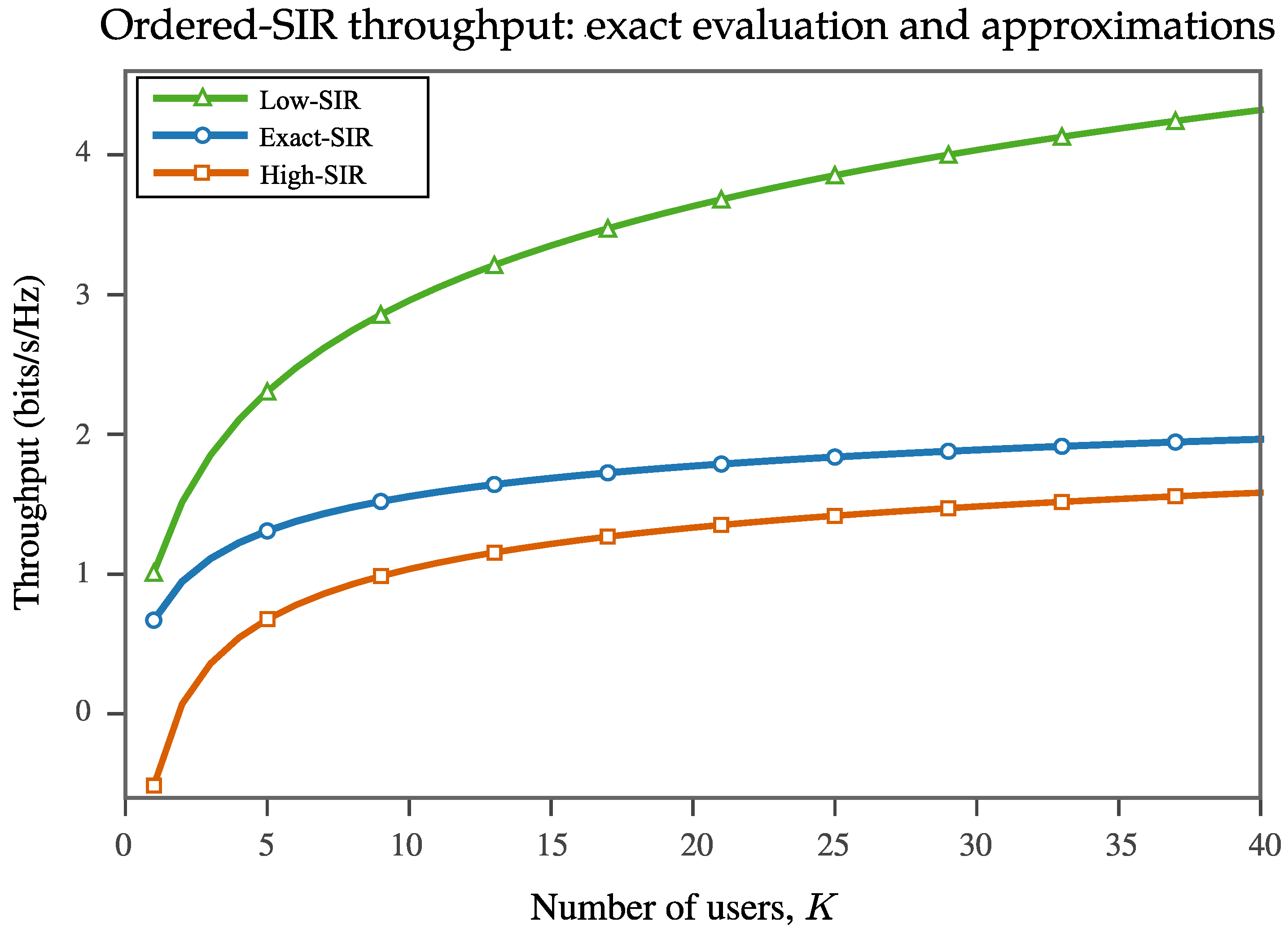
These two expressions define the analytical route used in the remainder of this section. Furthermore, to clarify the scope of the high-SIR approximation, we include a compact comparison of the throughput behavior under low-, moderate-, and high-SIR conditions. In particular, the exact numerical evaluation of (
16) is used as the reference, while the asymptotic expressions are interpreted as tractable limiting descriptions of the ordered-SIR behavior.
Table 4 summarizes the qualitative behavior of the ordered-SIR throughput under the low-, moderate-, and high-SIR regimes considered here. The low- and high-SIR cases are interpreted as asymptotic descriptions, whereas the moderate-SIR regime is represented through the non-approximated numerical evaluation of (
16).
Figure 1 illustrates this qualitative behavior as a function of the number of users.
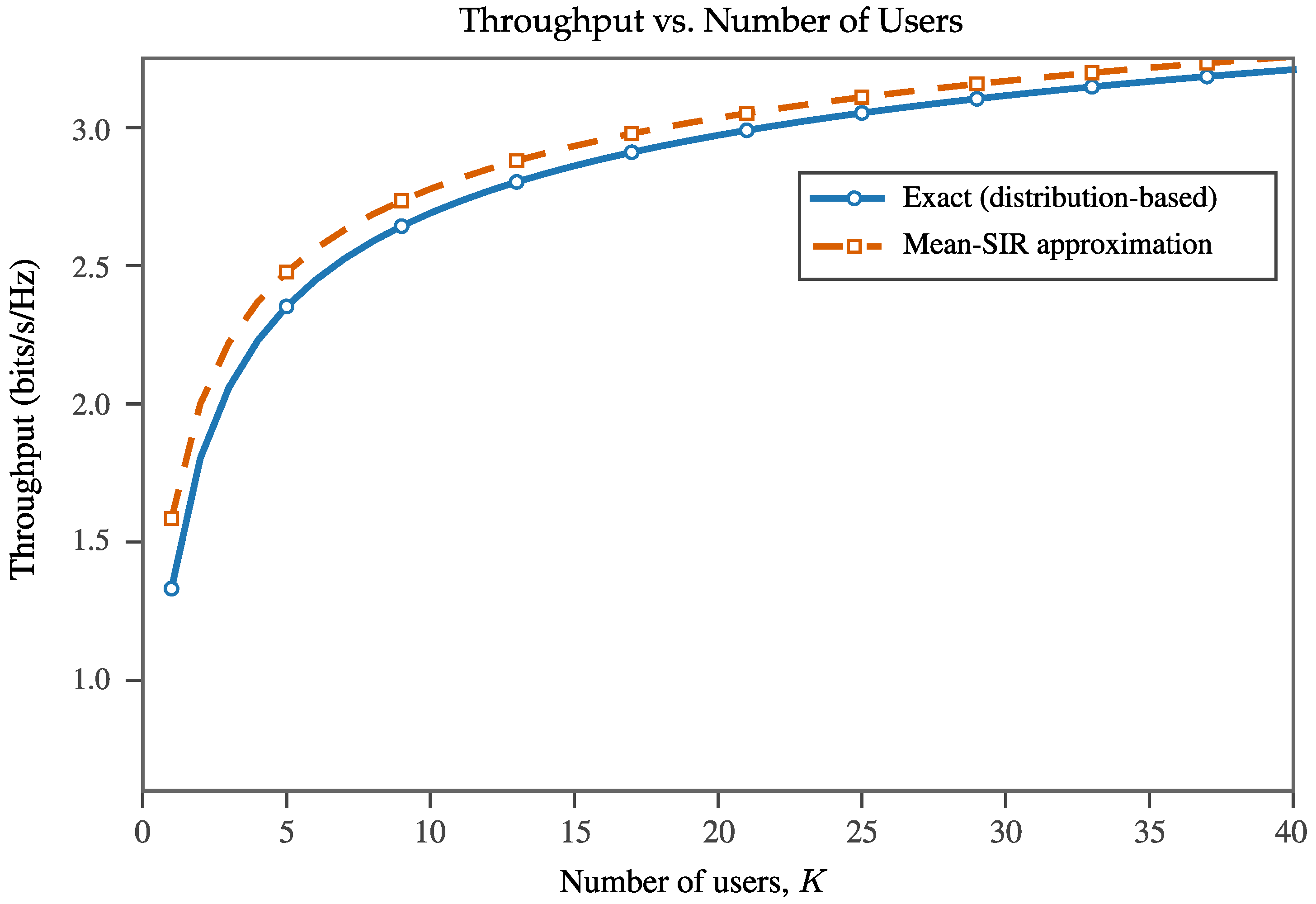
Figure 2 compares the distribution-based numerical evaluation with the corresponding mean-SIR approximation. The results indicate that replacing the random SIR by its mean tends to overestimate the achievable throughput, as expected from Jensen’s inequality, particularly under highly variable fading conditions. Nevertheless, the main qualitative trend with respect to the number of users is preserved. The mean-SIR approximation should therefore be interpreted as a tractable tool for structural insight rather than as a uniformly accurate predictor over all operating conditions.
4.2. OMA Reference Model Based on Ordered SIR
For the OMA reference case, the instantaneous SIR is defined as
where
P is the transmit power,
h is the channel gain,
I is the average interference term, and
is the noise power. Under Rayleigh fading,
. Hence, the SIR is modeled as
with average SIR
Therefore, the PDF and CDF of
are
and
Using the ordered-SIR relation in (
7) and substituting the exponential distribution into the k-th order-statistics PDF in (
15) yields
and, after simplification,
The instantaneous transmission rate of the
k-th ordered user is
and its expected value is shown in (
16). Therefore, if we now substitute the ordered-statistics PDF, we obtain
This integral does not admit a simple closed form. For analytical insight, a mean-SIR approximation is adopted in the high-SIR regime. If
, then
In addition, the expectation of the logarithm is approximated by the logarithm evaluated at the mean ordered SIR. Using the known property of exponential order statistics,
we obtain
If the scheduler selects the best user, then
, and therefore
Using again the exponential order-statistics property,
where
is the
K-th harmonic number. This result provides the OMA reference throughput behavior used later for comparison with NOMA.
For completeness, the exact integral in (
25) also admits a useful low-SIR asymptotic characterization. If
, then
so that
Using again the exponential order-statistics property in (
27), the low-SIR approximation becomes
In particular, if the scheduler selects the best user
, then
Since
for large
K, the strongest-user throughput grows as
in the low-SIR regime, whereas the high-SIR approximation above leads to the slower asymptotic behavior
. These two limiting regimes complement the exact integral in (
25) and help clarify the range of operating conditions in which the high-SIR route is most representative.
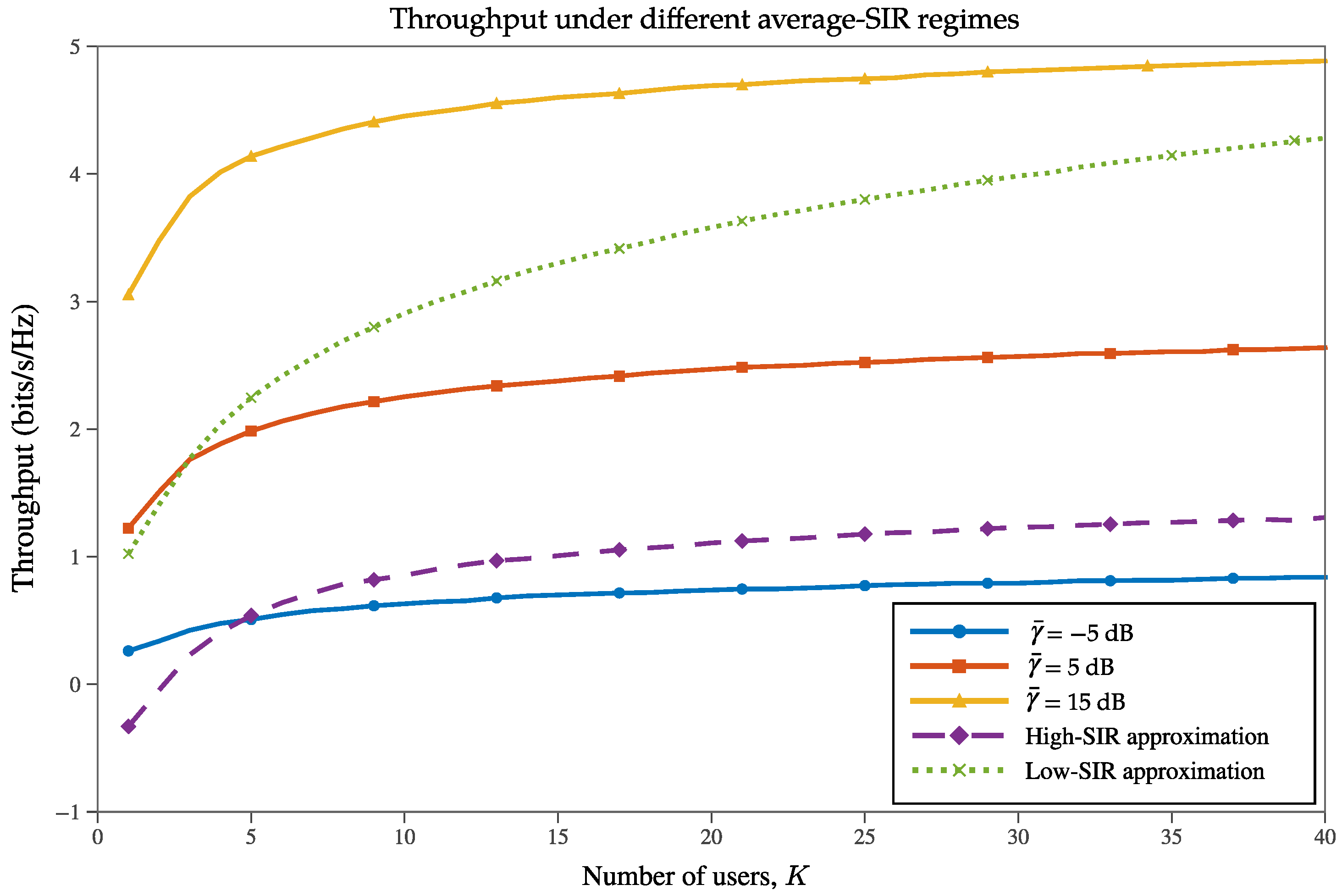
Figure 3 shows that the representativeness of the high-SIR approximation improves as the operating regime moves toward larger values of
, whereas the exact numerical evaluation provides the appropriate reference in moderate-SIR conditions. In this sense, the asymptotic expressions are useful for structural insight, but their quantitative accuracy depends on the operating regime.
To complement the qualitative regime-based comparison in
Figure 3 and the exact-versus-mean comparison in
Figure 2,
Table 5 provides a compact numerical validation of the high-SIR approximation for the strongest-user OMA reference. The exact ordered-SIR throughput is used as the reference, and the results show that the approximation error decreases as the user population grows, which is consistent with the asymptotic interpretation adopted in this section.
4.3. Two-User NOMA Without QoS Restriction
Consider now a two-user NOMA system with one weak user and one strong user, and let the power-allocation coefficients satisfy
For the weak user,
and for the strong user, after SIC,
Under the high-SNR approximation
, the two SINR/SNR terms become
and
Defining
and using
, the throughput can be approximated as
hence,
The optimality condition
gives
Multiplying both sides yields
which simplifies to
. Therefore, no interior solution exists. The derivative does not vanish in
, and the optimum is attained at the boundary.
Evaluating the two extremes shows that prioritizes the strong user and maximizes throughput, whereas leaves the system in a poor operating condition dominated by the weak user. Thus, . This result shows that, in the absence of QoS constraints, the throughput-maximizing solution collapses to serving only the strongest user.
4.4. Two-User NOMA with QoS Restriction
For the considered two-user NOMA setting, the unconstrained throughput-oriented solution tends to favor the strongest user. To obtain a nontrivial NOMA operating point, a minimum-rate requirement is therefore imposed on the weak user:
Recalling the weak-user SINR from (
37) and defining
we may rewrite
as
Since
, this expression can be substituted into the QoS constraint as follows:
Passing to exponential form,
Multiplying both sides, expanding, and grouping the terms in
,
Hence, the minimum required power coefficient for the weak user is
The optimization problem becomes
We have already shown that
is decreasing, and the optimum is always attained at the smallest admissible value. Therefore,
or, equivalently,
This expression makes the tradeoff explicit. If , then , and the solution approaches the throughput-oriented operating point that prioritizes the strong user. As increases, also increases, which forces more power toward the weak user and reduces the total throughput.
A critical feasibility limit is reached when the weak user consumes essentially all available power. This occurs at
which depends directly on the weak-user channel condition. Beyond this threshold, the two-user NOMA system becomes increasingly inefficient and eventually infeasible.
4.5. OMA and NOMA Under the Same QoS Restriction
Under the same QoS requirement, a clear difference between the feasible operating regions of OMA and NOMA is identified. In the OMA case, feasibility is lost when
whereas the two-user NOMA model can sustain operation as long as
Thus, under increasingly strict QoS requirements, NOMA preserves a wider feasible region than OMA. This comparison is important because it shows that, although OMA is preferred when no QoS constraint is imposed and only the strongest user is served, NOMA becomes advantageous once minimum-rate guarantees are enforced.
4.6. General K-User NOMA Model
We now extend the analysis to the general
K-user case. Let the users experience Rayleigh fading,
and let the ordered channel gains satisfy
For Rayleigh order statistics,
and, in particular,
Now assign power coefficients as
with
A common QoS requirement is
Under high SNR,
establishes that the throughput is decreasing in the powers assigned to the weaker users. Therefore, to preserve the best operating point under QoS, each weak user must receive only the minimum power needed to satisfy the corresponding requirement. Hence,
and the strongest user receives the remaining power,
To obtain a tractable feasibility condition, we now adopt a mean-gain approximation for the ordered channel coefficients. In particular, the QoS constraint in (
73) is evaluated by replacing the random gain
with its expectation
. Under this approximation, the minimum power required for each user is
Substituting the Rayleigh order-statistics expectation from (
67), the feasibility condition becomes
This condition defines the maximum number of users that can be supported while preserving the QoS requirement. Denoting this limit by , the model shows that the user population cannot increase without bound under NOMA when minimum-rate guarantees are imposed.
4.7. Closed-Form Approximation of the Feasibility Limit
To obtain a closed-form approximation for
, let us recall (
53). Then the minimum required power for user
k may be written as
For Rayleigh order statistics,
and for large
K,
so that
For weak users (
k small), we can use the first-order approximation
In the critical region dominated by weak users, and retaining only the first-order term
, the feasibility condition yields the asymptotic relation
Let
so that
and therefore
By the definition of the Lambert
W function,
and therefore
Using the identity
we obtain the equivalent form
Thus, the closed-form approximation is
and should therefore be interpreted as an asymptotic closed-form approximation of
, rather than as an exact feasibility expression.
This approximation shows that the feasible number of users grows only sublinearly with average SNR and decreases rapidly when the QoS target is tightened.
6. Results and Discussion
The following figures illustrate the behavior predicted by the analytical expressions through direct numerical evaluation. The emphasis of the paper is on the analytical characterization of throughput, feasibility, and energy efficiency under the proposed framework. First, the impact of the QoS requirement on the energy-efficiency behavior of the two-user NOMA case is examined. Next, OMA and NOMA are compared under the same QoS constraint. Finally, the feasibility limit of the general K-user model and the traffic-dependent behavior of the average energy efficiency are discussed.
Unless otherwise stated, the results in this section are obtained by direct numerical evaluation of the analytical expressions derived in
Section 4 and
Section 5 under the common numerical setting summarized in
Table 6. The figures therefore illustrate the behavior of the proposed analytical framework as the corresponding sweep variable changes, while the remaining parameters are kept fixed.
6.1. QoS-Driven Behavior in Two-User NOMA
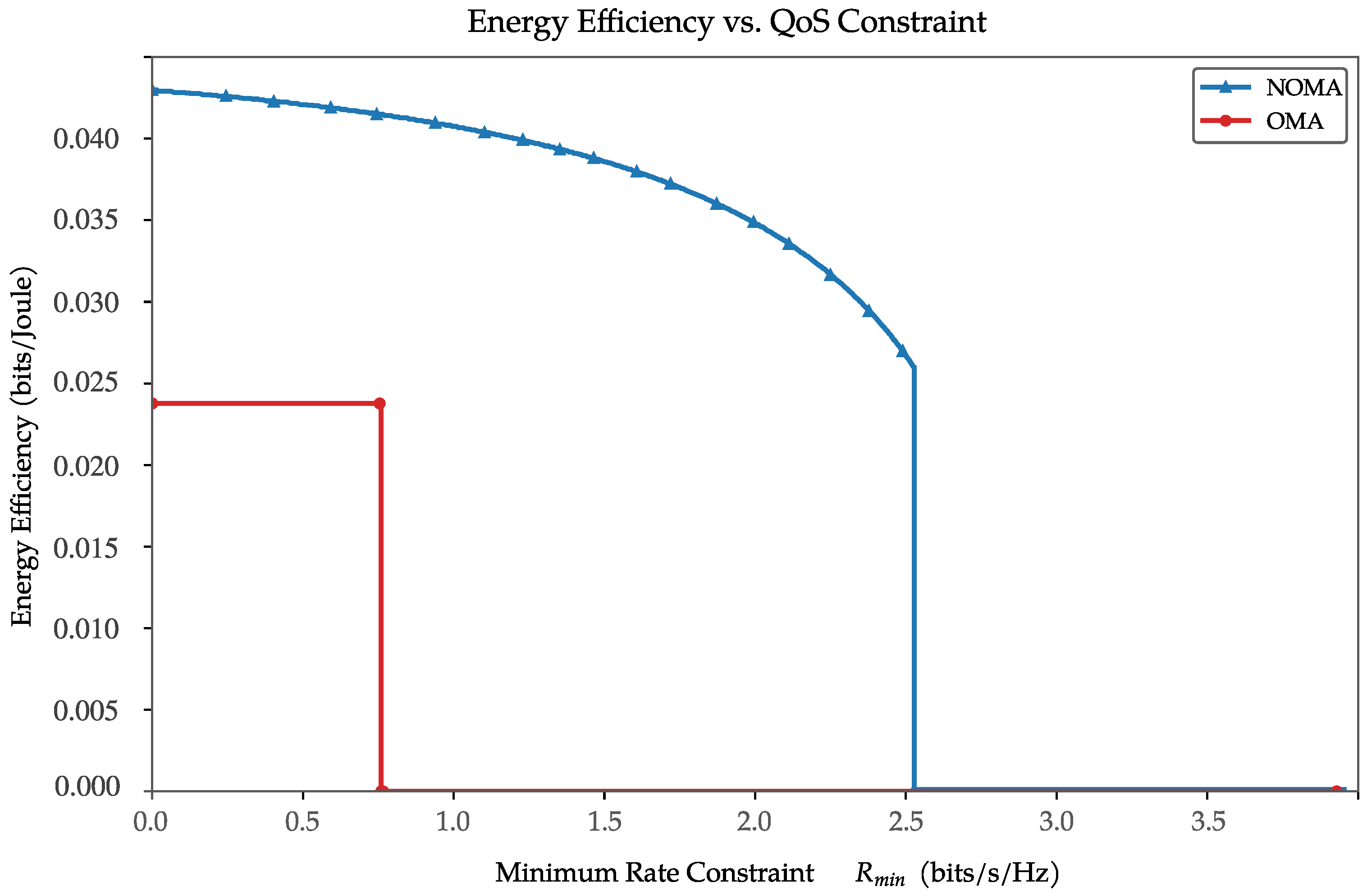
For the two-user NOMA case, the results show that the energy efficiency becomes directly dependent on the minimum-rate requirement imposed on the weak user. As shown by the NOMA curve in
Figure 4, when
is small, the minimum admissible power assigned to the weak user remains low, the strong user is still prioritized, and the system operates near its maximum energy-efficiency point. As
increases, the power allocated to the weak user also increases, the throughput of the strong user is reduced, and the energy efficiency decreases progressively.
When the QoS target approaches its critical value, the weak user requires nearly the entire power budget, leaving insufficient power for the strong user and driving the system toward an energetically inefficient regime.
Under strict QoS constraints, therefore, the energy-efficiency gain is gradually lost as the system approaches the feasibility boundary determined by the weak-user channel conditions.
6.2. Comparison Between OMA and NOMA Under QoS Constraints
When OMA and NOMA are compared under the same QoS requirement, three operating regimes can be identified. As illustrated in
Figure 4, in the low-QoS region, NOMA achieves higher energy efficiency because it exploits channel disparity more effectively, whereas the orthogonal reference divides power and bandwidth more conservatively. In the intermediate-QoS region, the energy efficiency of NOMA decreases smoothly, while the orthogonal scheme loses feasibility much earlier. In the critical-QoS region, the orthogonal system becomes infeasible once its admissible QoS bound is exceeded, whereas NOMA remains feasible up to the higher limit derived in the analytical section.
This comparison clarifies the operating conditions under which NOMA is preferable. Without QoS requirements, the orthogonal reference that prioritizes the best user remains more favorable from the energy-efficiency perspective. Once minimum-rate guarantees are imposed, however, NOMA preserves a wider feasible region. Therefore, the advantage of NOMA does not arise from an unconditional superiority, but from its ability to maintain feasible operation under stricter QoS demands.
From a cognitive-radio perspective, this comparison is especially relevant to underlay operation [
17]. In conservative secondary-access conditions, an orthogonal strategy may remain adequate when the offered load and QoS requirements are moderate. However, when multiple secondary users must be sustained over shared resources under stricter QoS demands, the wider feasible region preserved by NOMA makes it a more attractive underlay-oriented access strategy.
6.3. Feasibility Limit in the General K-User NOMA Model
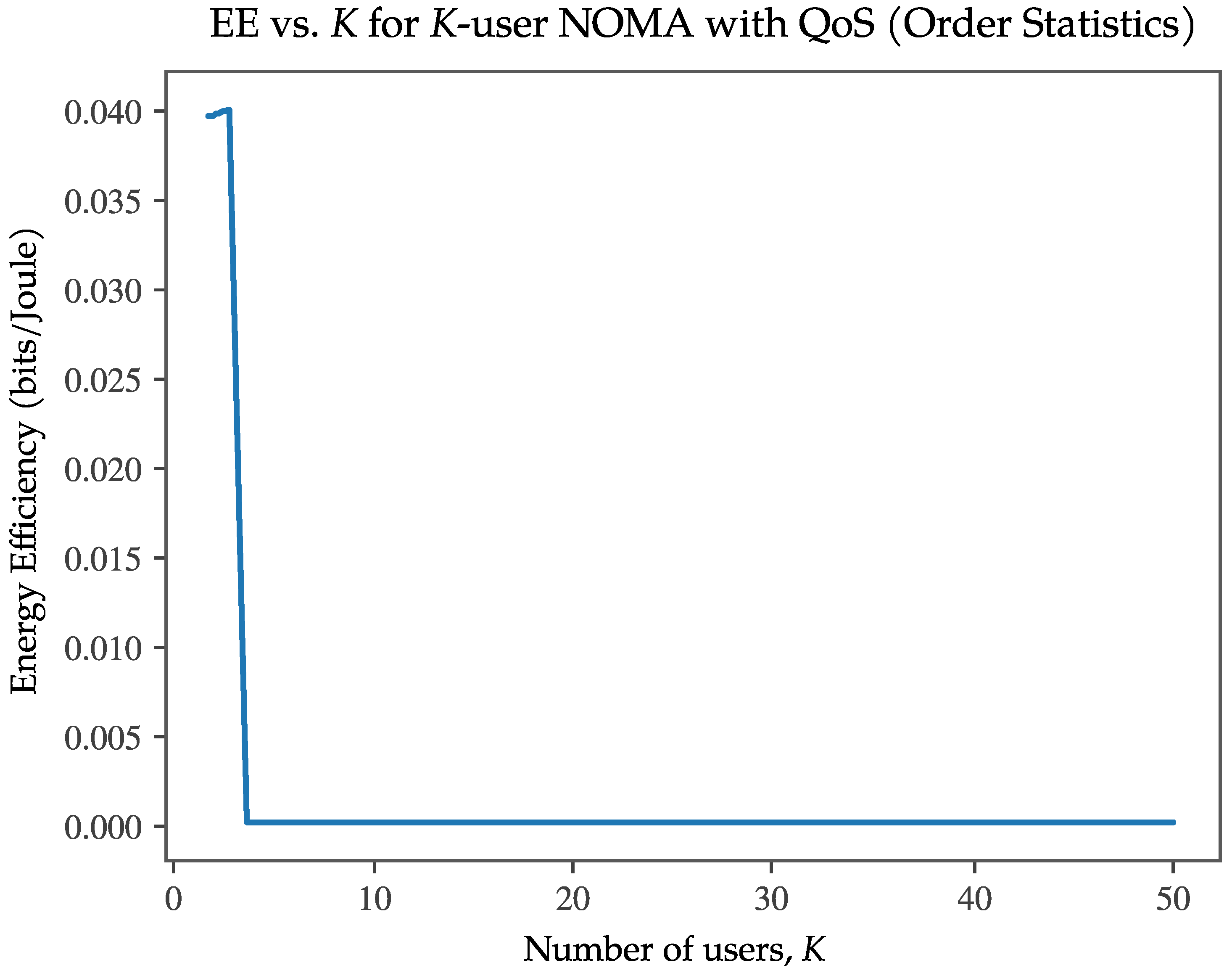
For the multiuser case, the results show that the system cannot support an arbitrarily large number of users under QoS constraints. As the number of users increases, the total power required to satisfy the minimum-rate condition of the weaker users also increases. Beyond a certain point, the sum of the minimum required powers exceeds the available power budget, and the system becomes infeasible. This defines a structural feasibility limit, denoted by .
As shown in
Figure 5, the energy efficiency remains positive only for very small values of
K. Once the number of users exceeds the feasibility limit
, the curve collapses to zero, indicating that the system can no longer satisfy the QoS requirement under the available power budget. This behavior reflects the fact that, as
K increases, the weaker users dominate the minimum power allocation and rapidly exhaust the feasible operating region.
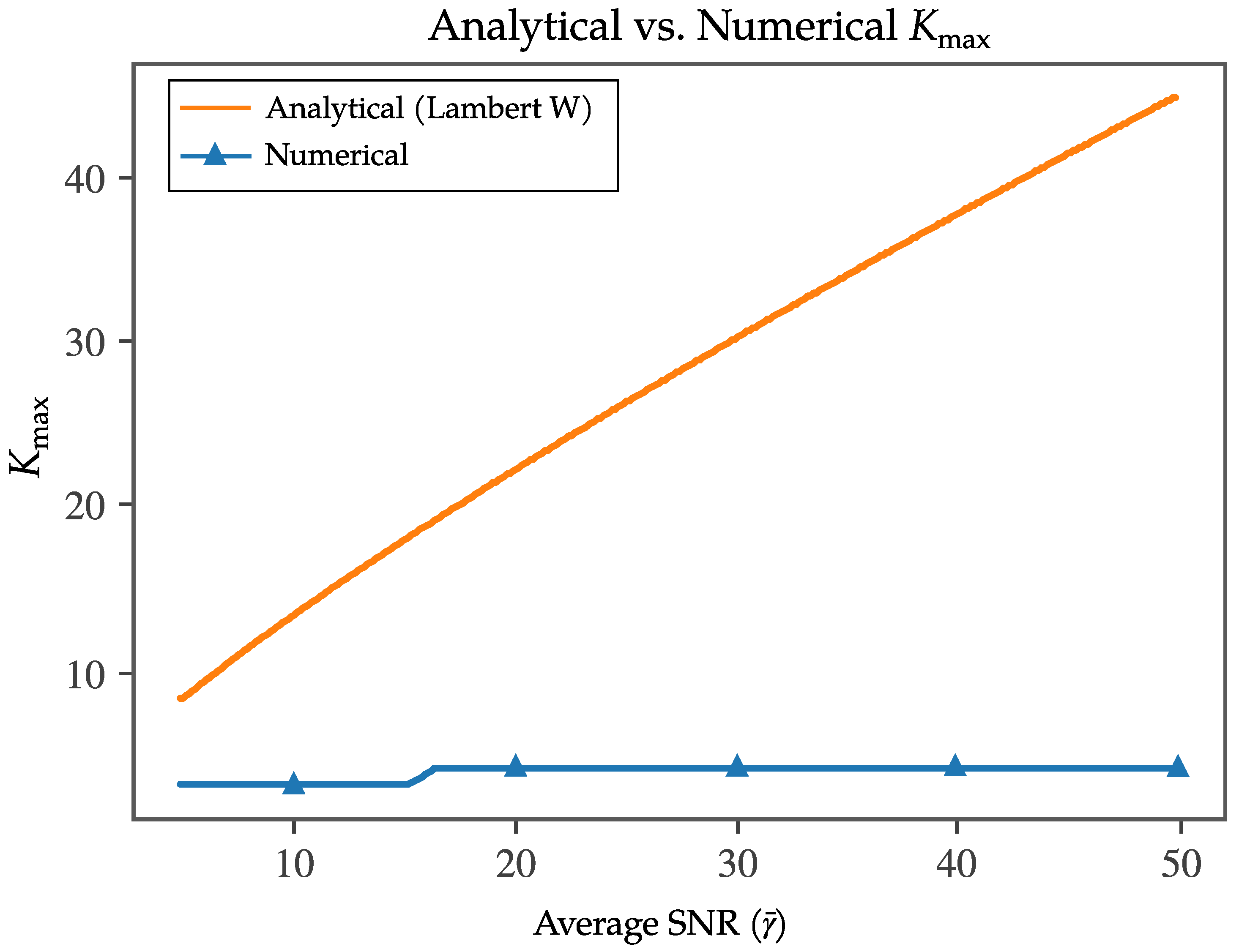
The closed-form expression based on the Lambert
W function reproduces the qualitative growth trend of the numerical solution, but it does not provide a tight estimate of
over the range shown in
Figure 6. Instead, the closed-form curve should be interpreted as an asymptotic upper characterization of the feasible-user limit, whereas the numerical solution provides the stricter effective bound. This comparison shows that the feasible number of users grows only sublinearly with average SNR and decreases rapidly as the QoS requirement is tightened. In practical terms, this means that multiuser NOMA remains strongly constrained by QoS, with the weaker users dominating the power-allocation structure.
These results indicate that the main limitation of the multiuser system is structural rather than purely traffic-related. The interaction among ordered channel conditions, QoS requirements, and the NOMA decoding mechanism imposes a hard bound on the number of users that can be supported efficiently.
6.4. Teletraffic-Based Average Energy Efficiency
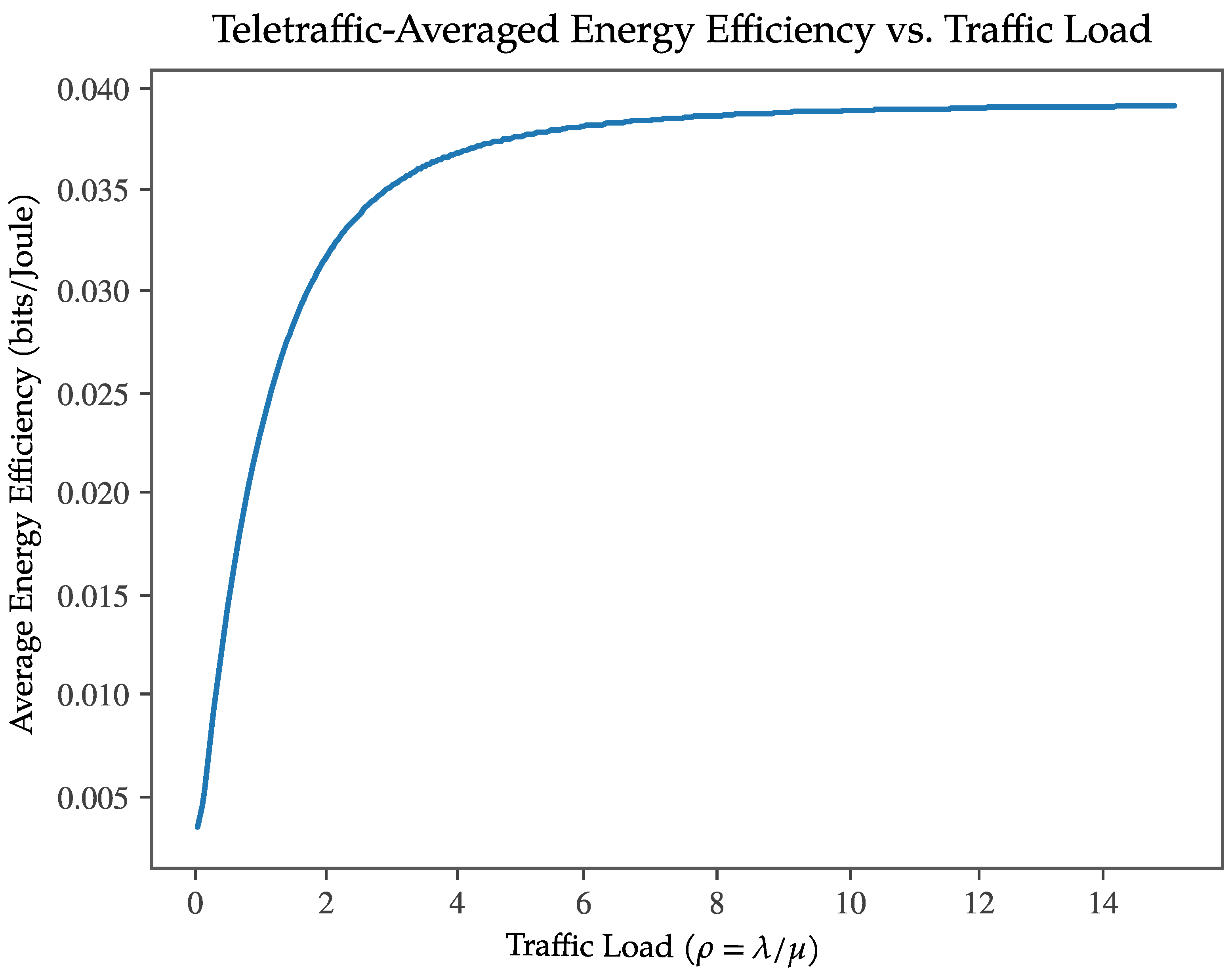
After incorporating the feasibility limit into the birth–death model, the average system energy efficiency becomes a function of the offered load . As increases, the probability of states with larger numbers of active users also increases. At the same time, the SIC-related power consumption grows linearly with the user population, and the operating point moves toward the truncation boundary imposed by . Consequently, the average energy efficiency depends not only on SNR, QoS, and transmit power but also on the traffic intensity of the system.
As shown in
Figure 7, the resulting behavior of
is characterized by an initial growth region followed by progressive stabilization. For low traffic loads, the average energy efficiency increases rapidly. As the offered load becomes larger, the curve tends to stabilize and does not collapse within the considered operating range.
This occurs because the system is truncated at
. When
becomes very large, the stationary probability concentrates near the most heavily loaded feasible state, but the system cannot move beyond that structural limit. Therefore, the asymptotic behavior is given by
This result shows that, in the considered NOMA system, the dominant limitation is not uncontrolled traffic growth but the structural feasibility boundary imposed by QoS. High traffic drives the system toward saturation at the maximum feasible state, rather than toward an unbounded deterioration of energy efficiency.
6.5. Discussion
Taken together, the results show that the energy-efficiency behavior of the system is governed by the joint effect of QoS, ordered channel conditions, SIC-related power consumption, and teletraffic dynamics. In the two-user case, the analysis makes explicit how increasingly strict QoS requirements shift the operating point away from the throughput-oriented solution that favors the strongest user. As the weak-user constraint becomes more demanding, additional power must be assigned to maintain feasibility, which reduces the aggregate throughput gain and, consequently, the resulting energy efficiency. From this viewpoint, the QoS requirement acts not only as a service constraint but also as the main mechanism that prevents the solution from collapsing toward a purely strongest-user operating point.
For the general K-user case, the main conclusion is structural. The feasibility condition shows that the supported user population cannot grow without bound once minimum-rate guarantees are imposed. The combination of ordered-user NOMA decoding and QoS-constrained power allocation leads to a hard feasibility limit since the weaker users progressively dominate the minimum required power budget. In this sense, the analytical results indicate that the advantage of NOMA is conditional rather than unconditional: NOMA preserves a wider feasible region than the orthogonal reference under the considered QoS-constrained setting, but this does not imply unlimited scalability as the number of users increases.
The teletraffic formulation complements this physical-layer interpretation by showing how the long-term energy-efficiency behavior depends on the occupancy distribution over feasible states. As the offered load increases, the system moves toward higher-population states, but the feasibility limit truncates the state space and bounds the asymptotic behavior of . Accordingly, the dominant limitation is not uncontrolled traffic growth by itself but the interaction between traffic loading and the feasibility boundary imposed by QoS-constrained NOMA operation. Likewise, the power model adopts a conventional linear base-station formulation, which is appropriate here as a tractable first-order analytical model but does not attempt to reproduce all nonlinear hardware-dependent scaling effects. For this reason, the resulting EE values should be interpreted primarily in terms of structural trends and tradeoffs rather than as hardware-specific absolute predictions.
These conclusions should also be interpreted in light of the modeling assumptions adopted in the paper. The throughput characterization relies on a high-SIR analytical route and on mean-value approximations for ordered quantities in the feasibility analysis, which are useful for tractable insight but may lose accuracy outside the regime in which the approximations are most representative. Likewise, the power model adopts a conventional linear base-station formulation and a linear SIC-related scaling with the number of decoded users, which captures the first-order growth of processing cost but does not attempt to represent all hardware-level nonlinearities. In the same spirit, the teletraffic layer is modeled through a truncated process, which provides a tractable description of user-population evolution but does not capture all forms of bursty traffic behavior. In particular, the numerical comparison between the distribution-based evaluation and the mean-SIR approximation indicates that the latter may overestimate the achievable throughput, although it preserves the main qualitative trend with respect to the user population.
Within these assumptions, the main value of the proposed framework is that it connects physical-layer ordering, QoS-constrained NOMA power allocation, SIC-aware energy interpretation, and traffic evolution within a single analytical model. This provides a traffic-aware basis for discussing energy-efficient underlay secondary access and clarifies the conditions under which NOMA remains attractive once feasibility restrictions and long-term user-population dynamics are taken into account.
From the standpoint of the existing literature, these results differ from the dominant EE-NOMA and CR-NOMA formulations, which typically optimize power, bandwidth, clustering, or scheduling for a fixed active-user configuration. Here, the main contribution is instead the analytical characterization of how ordered-user operation, QoS-constrained feasibility, SIC-aware power consumption, and teletraffic evolution jointly shape long-term energy-efficiency behavior. From a practical viewpoint, the results suggest that an orthogonal reference remains attractive when QoS requirements are mild and strongest-user service is acceptable, whereas NOMA becomes more attractive when stricter minimum-rate guarantees must be preserved over shared resources. At the same time, the feasibility analysis shows that QoS-constrained multiuser NOMA should not be interpreted as indefinitely scalable since the supported user population remains bounded by the structural limit .
7. Conclusions
This paper presented a teletraffic-based energy-efficiency analysis of QoS-constrained NOMA using an order-statistics framework. The development began from the ordered-channel formulation and the corresponding expected-throughput expressions, and then incorporated a power-consumption model that accounts for both transmit power and SIC-related processing. In this way, the energy-efficiency metric was linked to the physical-layer structure of NOMA and to the traffic dynamics represented by the birth–death model.
From the standpoint of spectrum sharing, the results are most naturally interpreted in the context of underlay-type secondary access, rather than as a complete analytical treatment of cognitive-radio coexistence. The contribution of the paper is therefore to clarify, through order statistics and teletraffic analysis, the conditions under which QoS-constrained NOMA can retain energy-efficiency and feasibility advantages over the orthogonal reference when dynamic user occupancy is taken into account.
The results showed that the energy-efficiency behavior of the system is strongly governed by the QoS requirement. In the two-user case, low QoS demands preserve a favorable operating point, whereas stricter minimum-rate constraints force additional power toward the weak user and progressively reduce energy efficiency. Under the same QoS restriction, the analysis showed that NOMA preserves a wider feasible operating region than the orthogonal reference within the setting considered here, even though this advantage does not hold in an unconstrained throughput-oriented scenario.
For the general K-user case, the analysis showed that the system is subject to a structural feasibility limit. As the number of users increases, the minimum power required to satisfy the weaker users grows rapidly, eventually exhausting the available power budget. This leads to a maximum feasible number of users, , for which a closed-form approximation based on the Lambert W function was also obtained. Finally, by incorporating this feasibility limit into the teletraffic model, the average system energy efficiency was shown to increase with the offered load in the considered range and to asymptotically stabilize at the energy-efficiency level associated with the maximum feasible state.
Overall, the developed framework connects order statistics, QoS-constrained NOMA operation, SIC-aware power-consumption considerations, and teletraffic dynamics within a single analytical model for energy-efficiency evaluation. From this perspective, the results provide a traffic-aware analytical basis for discussing NOMA in underlay-type secondary-access settings, while explicit primary-user coexistence constraints remain outside the scope of the present formulation.




 ,
,