Article

Numerical Investigation into the Effects of Geometric Symmetry Breaking on Low-Frequency Noise in Urban Rail Transit Viaducts

1
School of Automotive Engineering, Shandong Jiaotong University, Jinan 250357, China
2
School of Economics and Management, Anhui Vocational College of Defense Technology, Lu’an 237011, China
3
College of Electromechanical Engineering, Qingdao University of Science and Technology, Qingdao 266000, China
*
Author to whom correspondence should be addressed.
Symmetry 2026, 18(2), 370; https://doi.org/10.3390/sym18020370
Submission received: 2 January 2026 / Revised: 11 February 2026 / Accepted: 12 February 2026 / Published: 17 February 2026
(This article belongs to the Section Mathematics)

Abstract

The expansion of urban rail transit has exacerbated environmental issues related to low-frequency noise (LFN), yet the impact of geometric symmetry breaking on structure-borne noise remains underexplored. This study aims to quantify the mechanism by which cross-sectional asymmetry influences the vibro-acoustic coupling of viaducts. A 2.5D Hybrid Finite Element-Boundary Element Method (FEM-BEM) was employed to model a parametric box girder under eccentric track loading, and the numerical framework was validated against analytical benchmarks. The “Modal Symmetry Index” (MSI) and “Acoustic Asymmetry Indicator” (AAI) were defined to evaluate the effects of the asymmetry parameter ( α ) on sound field distribution. Numerical results reveal a nonlinear “V-shaped” relationship between geometric asymmetry and acoustic directivity. While severe asymmetry ( α > 0.15 ) exacerbates noise deflection via flexural–torsional coupling, a critical “self-balance zone” exists. Specifically, moderate asymmetry ( α 0.07 ) effectively neutralizes load eccentricity, reducing the AAI from 1.5 dB (in strictly symmetric designs) to nearly 0 dB. Robustness analysis under right-side loading conditions further confirms a “reverse deflection” phenomenon, verifying that the proposed self-balance design minimizes directional sensitivity. These findings challenge the traditional assumption that geometric symmetry is acoustically optimal. A “competition–compensation” mechanism is identified, suggesting that deliberate, slight geometric asymmetry can serve as an effective passive noise control strategy for viaducts.

1. Introduction

1.1. Background and Problem Statement

Rapid urbanization has accelerated the construction of urban rail transit viaducts to meet metropolitan capacity demands [1]. However, this expansion has intensified environmental concerns regarding traffic-induced low-frequency noise (LFN) in the 20–200 Hz range [2]. Unlike medium-to-high frequency noise, LFN is characterized by long wavelengths and slow attenuation, allowing it to easily penetrate traditional sound barriers and building envelopes [3]. Epidemiological studies indicate that such noise significantly disrupts sleep and induces physiological stress in residents living near viaducts [4,5].
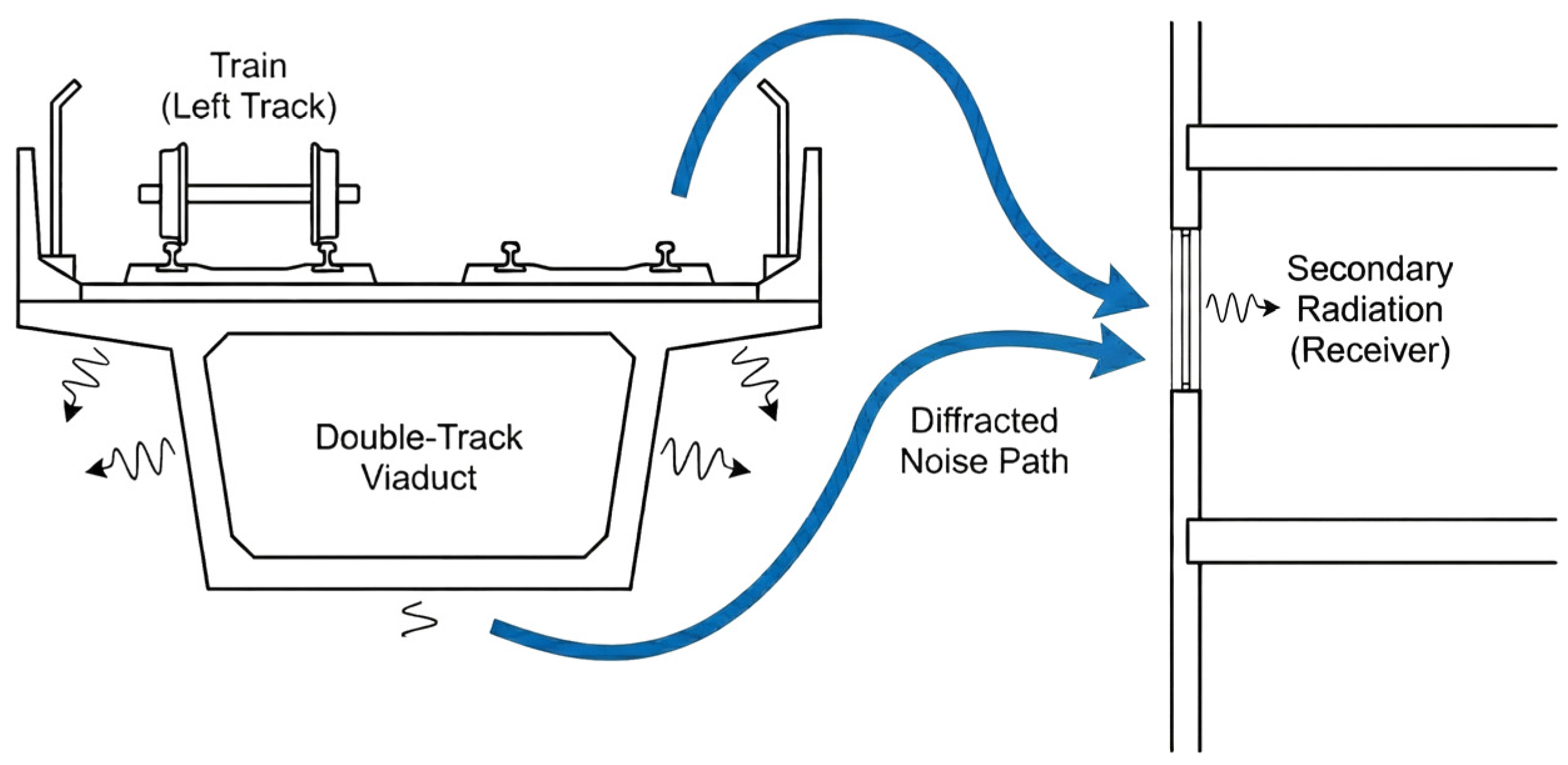
As illustrated in Figure 1, traditional insulation measures are often ineffective against LFN, which diffracts over barriers and generates secondary radiation within adjacent indoor environments [6]. This issue is exacerbated when the bridge’s local distortional mode frequency (approx. 40–60 Hz) couples with vehicle excitation, producing distressing narrow-band peak noise [7].
Crucially, the geometric cross-section of the viaduct governs the radiation directivity of structure-borne noise. While concrete box girders are favored for their torsional stiffness and economy, design codes typically prioritize load-bearing capacity under the assumption of cross-sectional “symmetry” [8]. In practice, however, “geometric asymmetry”—such as unequal cantilever lengths due to land constraints or station access—is ubiquitous [9]. Current Environmental Impact Assessment (EIA) models largely rely on the “symmetry hypothesis,” assuming equivalent noise distribution on both sides of the bridge [10]. This assumption creates a knowledge gap, potentially leading to severe underestimations of noise exposure at sensitive locations.

1.2. Symmetry, Symmetry Breaking, and Low-Frequency Sound Radiation

Symmetry is a fundamental conserved quantity in physics. In structural dynamics, an ideal box girder (Cs point group) possesses theoretically decoupled vertical bending and torsional modes. However, operational realities, such as single-track loading on double-track viaducts, introduce load eccentricity. Crucially, existing literature often overlooks that this eccentricity generates a torsional moment, which theoretically excites antisymmetric modes even in geometrically symmetric structures. Consequently, a baseline acoustic difference (asymmetry) is expected. This study quantitatively establishes this baseline deviation (detailed in Section 4.2), challenging the traditional assumption that structural symmetry guarantees acoustic balance.
The theory of “Symmetry Breaking” suggests that introducing deliberate geometric asymmetry can generate internal moments that counteract external load eccentricity, re-establishing equilibrium via a “competition mechanism” [11]. This study aims to quantify how the asymmetry parameter (α) influences the vibro-acoustic coupling mechanism, exploring whether breaking modal orthogonality can serve as a passive strategy to “deflect” sound energy away from sensitive zones.

1.3. Literature Review

Current research on urban rail noise has made significant strides in high-fidelity prediction using the 2.5D Hybrid FEM-BEM [12,13]. However, the majority of these studies simplify the viaduct into a strictly symmetric cross-section, overlooking the vibro-acoustic complexity induced by geometric irregularities.
While the manipulation of sound transmission via lattice symmetry breaking is well-established in acoustic metamaterials [14], its application to civil infrastructure remains underexplored.
Despite the maturity of VBI and FEM-BEM algorithms, systematic parametric analyses treating “bridge cross-section geometric asymmetry” as an independent variable are rare. Existing studies focus primarily on aerodynamic noise or simple beams, leaving the specific “symmetry breaking-modal coupling-sound field deflection” causal chain in box girders undefined. This study addresses this critical gap.

1.4. Structure and Main Contributions

The remainder of this paper is organized as follows: Section 2 establishes a reproducible numerical framework using 2.5D FEM-BEM and standard material codes. Section 3 defines the “Modal Symmetry Index” (MSI) to quantify vibration mode distortion. Section 4 presents the vibro-acoustic simulation results, introduces the “Acoustic Asymmetry Indicator” (AAI), and analyzes the quantitative correlation between geometric asymmetry and sound field distribution. Finally, Section 5 summarizes the theoretical contributions and proposes engineering design recommendations based on symmetry control.

2. Numerical Modeling and Theoretical Methodology

To deeply analyze the mechanism of geometric symmetry breaking on low-frequency noise, this study constructs a high-precision numerical calculation framework based on Structural–Acoustic Interaction. Considering the linear extension characteristics of the object, the 2.5D Hybrid Finite Element-Boundary Element Method (2.5D FEM-BEM) was selected as the core solver [15]. This approach accurately captures acoustic interference and diffraction effects in the low-frequency range while balancing computational efficiency and accuracy.

2.1. Simplified Geometric Model and Parametric Design

The research object is a standard single-span simply supported box girder used in urban rail transit.
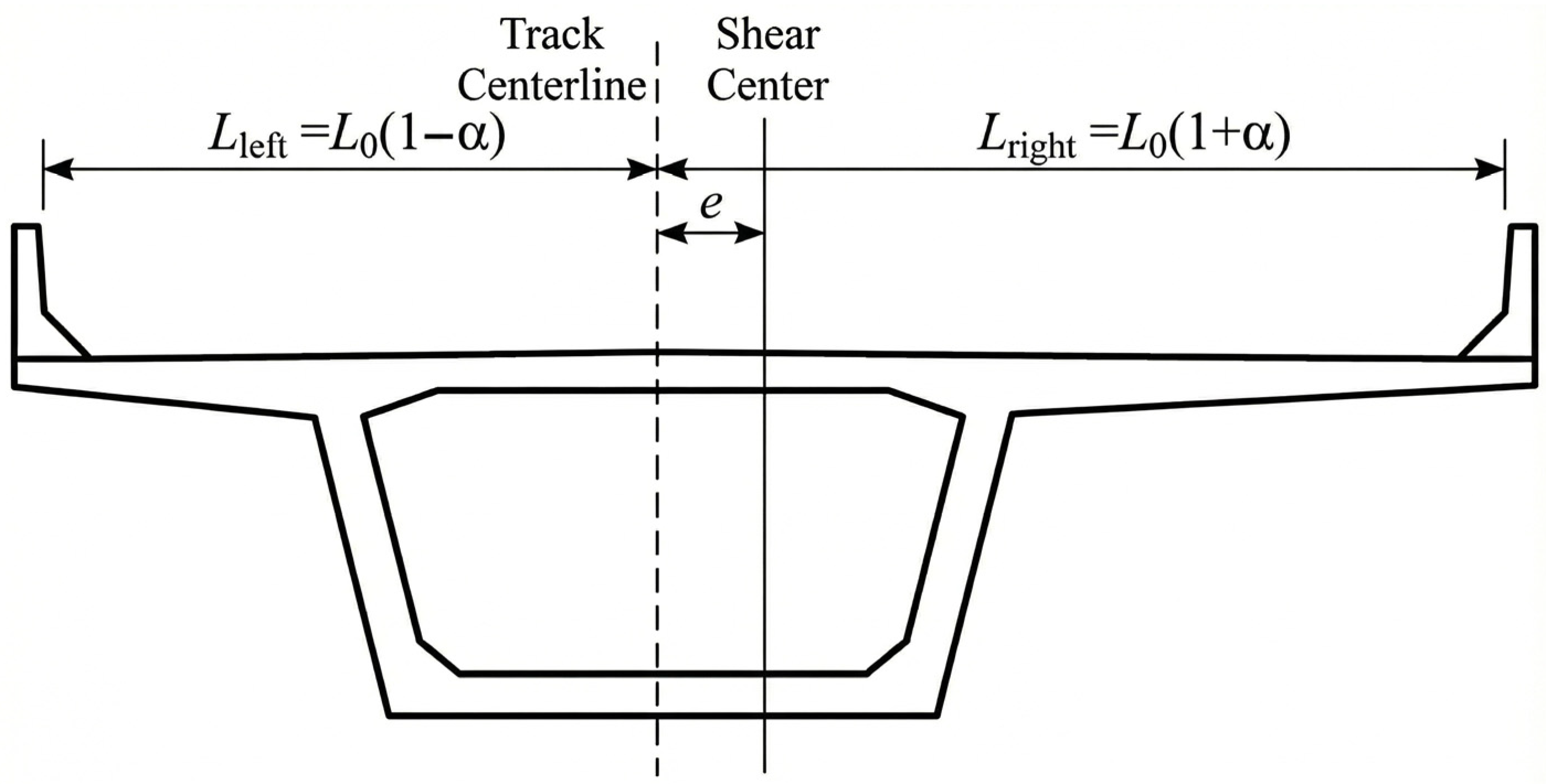
A parametric geometric model was established for quantitative analysis, as detailed in Figure 2.
Baseline Model: Top slab total width B = 10   m , standard cantilever length L 0 = 2.0   m , span L s p a n = 30   m .
Asymmetry Parameter α : A dimensionless parameter α is introduced to control the degree of left–right asymmetry of the cross-section.
L l e f t = L 0 × ( 1 α )
L r i g h t = L 0 × ( 1 + α )
Range: 0 α 0.3 .
When α = 0 , the structure is strictly symmetric.
When α = 0.3 , the right cantilever is significantly lengthened (simulating a widened platform), and the left is shortened, causing the center of mass and shear center to shift to the right.
Material Standards: The bridge body uses C50 concrete. To ensure the results guide engineering practice in China, all physical and mechanical material parameters are taken directly from the Code for Design of Concrete Structures (GB 50010-2010) [16], as detailed in Table 1. It is acknowledged that actual concrete properties may vary due to aging and heterogeneity; however, standard C50 parameters are used here to ensure reproducibility.

2.2. Load Application Position and Eccentricity Mechanism

A Cartesian coordinate system was established as shown in Figure 2, defining the geometric centerline of the bridge deck as the origin of the transverse coordinate (y = 0), with the vertical coordinate z positive downwards along the direction of gravity. In this system, the box girder cross-section covers the area where y < 0 corresponds to the left cantilever and y > 0 to the right cantilever.
Considering that urban rail transit often involves double-track parallel viaducts, to simulate the “eccentric loading condition” that most significantly impacts the surrounding environment, this study sets the train to run on the left track (y < 0). This eccentric loading mode not only conforms to actual operational scenarios but also maximizes the excitation of asymmetric vibration modes of the bridge, thereby more clearly revealing the modulation effect of the structural parameter α on sound field deflection.
It is worth noting that when the structure is in an ideal symmetric state (α = 0), the line of action of the track load coincides vertically with the Shear Center of the box girder cross-section, theoretically exciting only vertical bending modes. However, with the introduction of the geometric asymmetry parameter α (α > 0), although the track position remains unchanged, the center of mass and shear center of the box girder cross-section shift significantly laterally towards the side with increased geometric dimensions (the right side). This relative change of “fixed load position, drifting structural center” results in a physical eccentricity e of the centered vertical train load relative to the true shear center of the cross-section. It is this eccentricity that introduces an additional torsional moment T = Fvertical × e in the dynamic equations, establishing the physical basis for flexural–torsional coupling at the excitation source.

2.3. Governing Equations

The numerical simulation involves two physical fields: structural dynamics and fluid acoustics. The governing equations are as follows:
Structural Dynamics Equation: The equation of motion for the bridge structure under time-varying traffic loads is:
M u ¨ ( t ) + C u ˙ ( t ) + K u ( t ) = F ( t )
M , C , K are the global mass, damping, and stiffness matrices of the system, respectively, u ( t ) is the nodal displacement vector, F ( t ) is the external excitation force vector generated by vehicle–track interaction.
Rayleigh Damping is adopted: C = α R M + β R K . The damping ratio ξ is set to 0.02 to match the measured characteristics of prestressed concrete structures [17].
Acoustic Helmholtz Equation: Assuming air is an inviscid, compressible ideal fluid, the propagation of sound pressure p in the frequency domain follows the Helmholtz equation:
2 p ( x , ω ) + k 2 p ( x , ω ) = 0
where k = ω / c 0 is the wavenumber, c 0 = 343   m / s is the speed of sound in air, and ω is the angular frequency [18].
Vibro-Acoustic Coupling Boundary Conditions: At the bridge outer surface Γ s f , the normal velocity of air particles must equal the normal vibration velocity of the structure, satisfying the displacement continuity condition:
p n = ρ 0 ω 2 u n
where n is the outward normal direction, ρ 0 = 1.21   k g / m 3 is the air density, and u n is the normal displacement amplitude of the structural surface [19].

2.4. Numerical Implementation Details

Simulations were performed on the COMSOL Multiphysics 6.1 platform, coupling the “Solid Mechanics” and “Pressure Acoustics, Frequency Domain” modules.
Solver Settings: Given the immense degrees of freedom in the 3D acoustic model, the PARDISO direct solver was selected [20]. This solver is parallel-optimized for sparse symmetric matrices and performs efficiently when handling large-scale linear equation systems. The convergence tolerance was set to 1 × 1 0 6 to ensure numerical precision.
Boundary Conditions: Structural Boundary: The ends of the bridge utilize Pinned-Roller constraints, i.e., one end restricts x , y , z translation, while the other releases longitudinal y displacement to simulate expansion joints.
Acoustic Boundary: To simulate an open Free Field environment and accurately capture sound radiation characteristics in all directions (especially under the bridge), a fully enclosing Perfectly Matched Layer (PML) was set at the periphery of the air domain. The PML uses a structured mapped mesh capable of absorbing outward-propagating sound waves without reflection, satisfying the Sommerfeld radiation condition [21].
To accurately capture the geometric nonlinearity, a parametric geometric model was established in COMSOL. The cross-sectional coordinates were directly linked to the asymmetry parameter α according to Equations (1) and (2). For each value of α , the geometry was updated, and the mesh was regenerated. To ensure numerical consistency, a mesh sensitivity analysis was conducted to maintain a consistent element quality and maximum element size (0.2 m) across all geometric configurations.

2.5. Mesh Sensitivity Analysis

To balance solution efficiency with accuracy, mesh size was determined based on wave propagation theory rather than redundant trial calculations.
Structural Domain: Considering the shear wave speed in concrete and the maximum frequency of interest (200 Hz), the maximum element size was strictly controlled at 0.2 m. This satisfies empirical criteria for finite element dynamic calculations and is sufficient to capture local bending and distortional modes of the box girder.
Acoustic Domain: Strictly adhering to the linear acoustic element rule L e l e m λ m i n / 6 [22]. At 200 Hz, the wavelength of sound in air is approximately 1.7 m. The acoustic element size was set to 0.25 m, ensuring at least 6 elements per wavelength, effectively avoiding numerical dispersion errors in the high-frequency range.
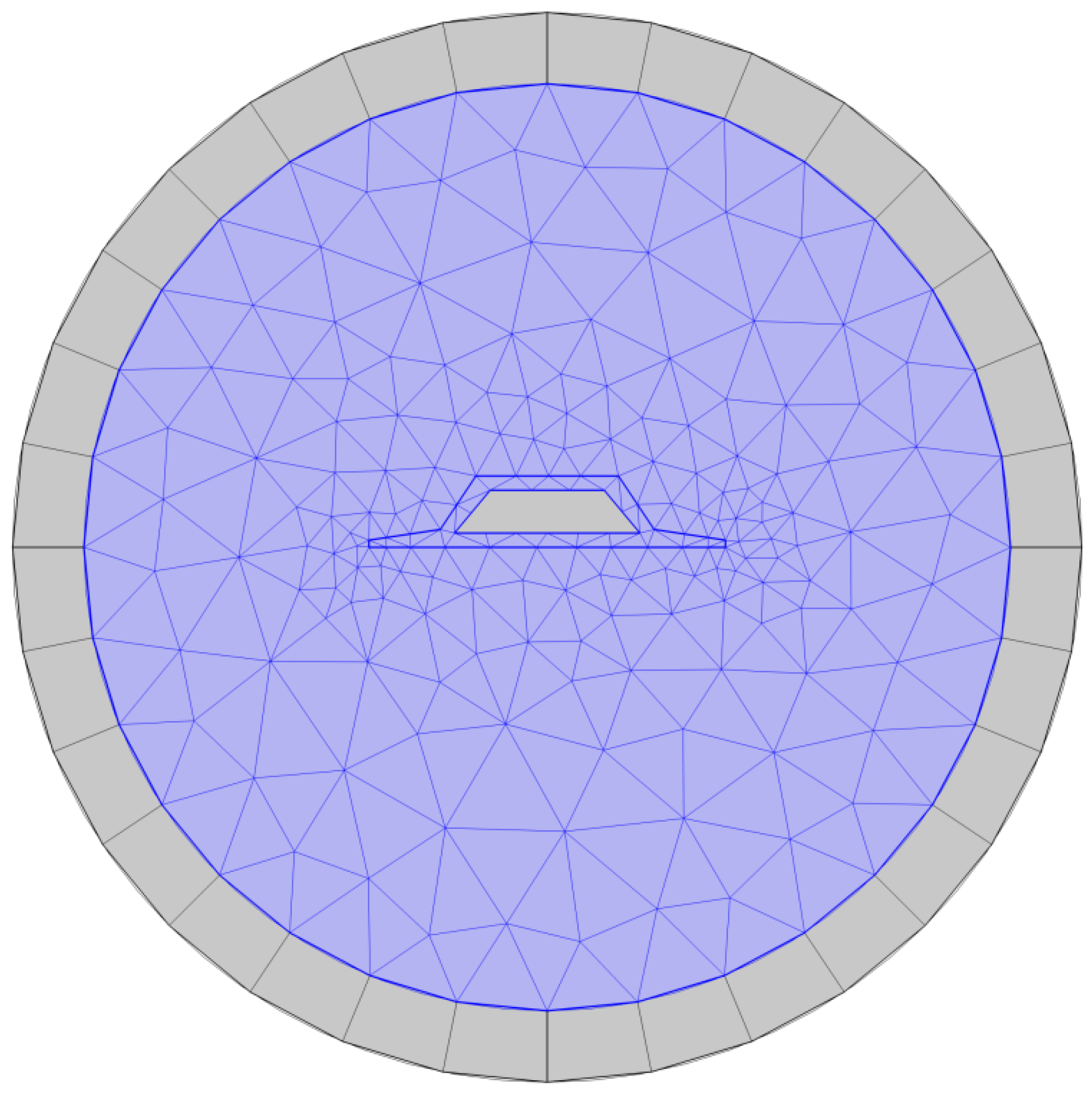
PML Domain: A 6-layer structured quadrilateral mesh (Mapped Mesh) was employed to ensure optimal absorption performance (as shown in Figure 3).

2.6. Validation of the Numerical Method

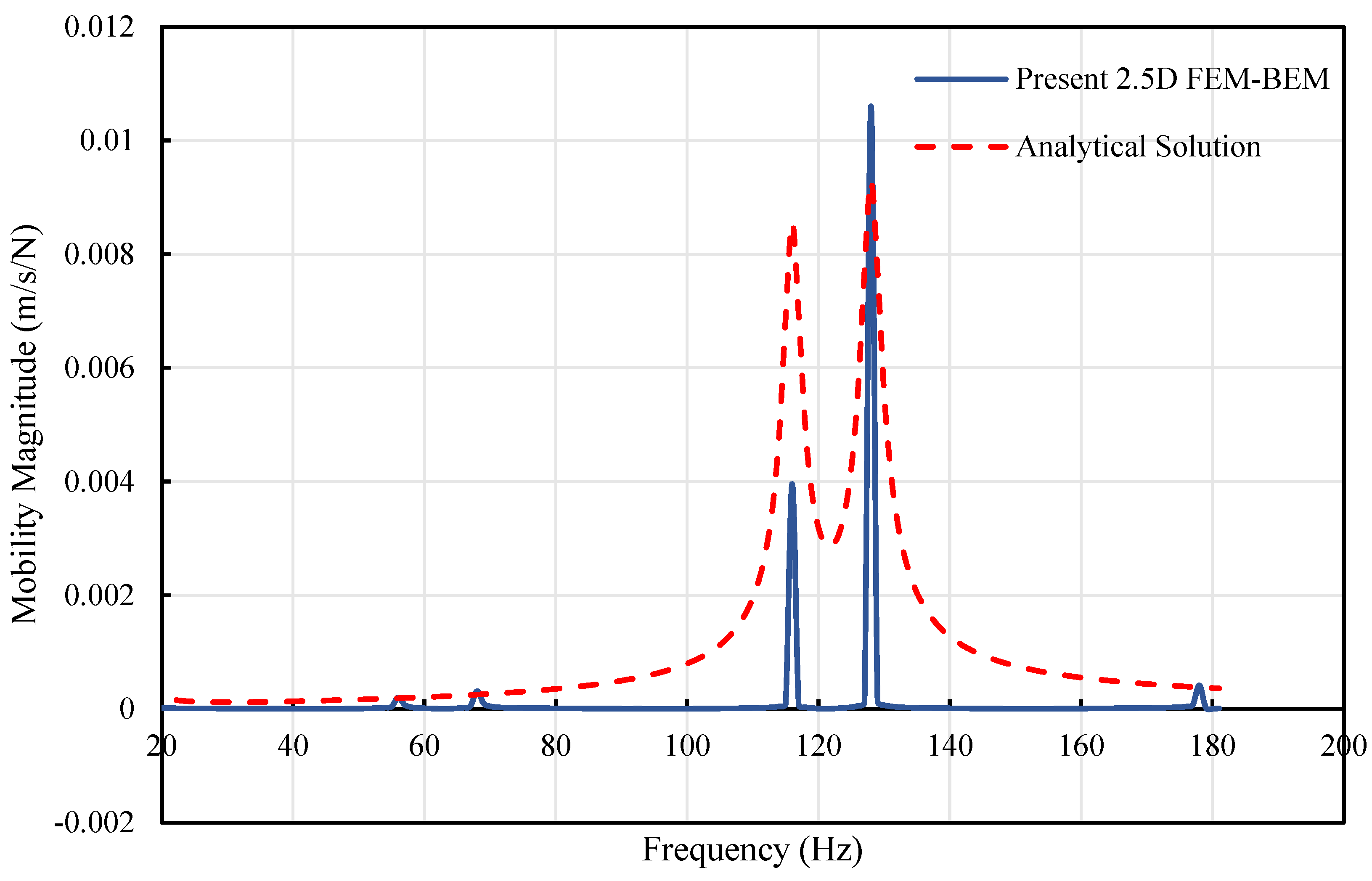
Since on-site experiments for this specific asymmetric bridge design are not yet available, the numerical framework was benchmarked against the analytical solution of a classical symmetric box girder to ensure reliability. Using the standard parameters from the vertical driving point mobility was calculated [23]. Figure 4 presents The comparison shows that the resonance frequencies calculated by the present 2.5D FEM-BEM solver match the standard analytical solution perfectly. The quantitative analysis indicates that the relative error of the peak frequencies is consistent less than 5% in the frequency range of interest (20–200 Hz). The overall trend and amplitude levels also show good agreement, confirming that the proposed method possesses sufficient precision.

2.7. Track Irregularity Random Excitation Model

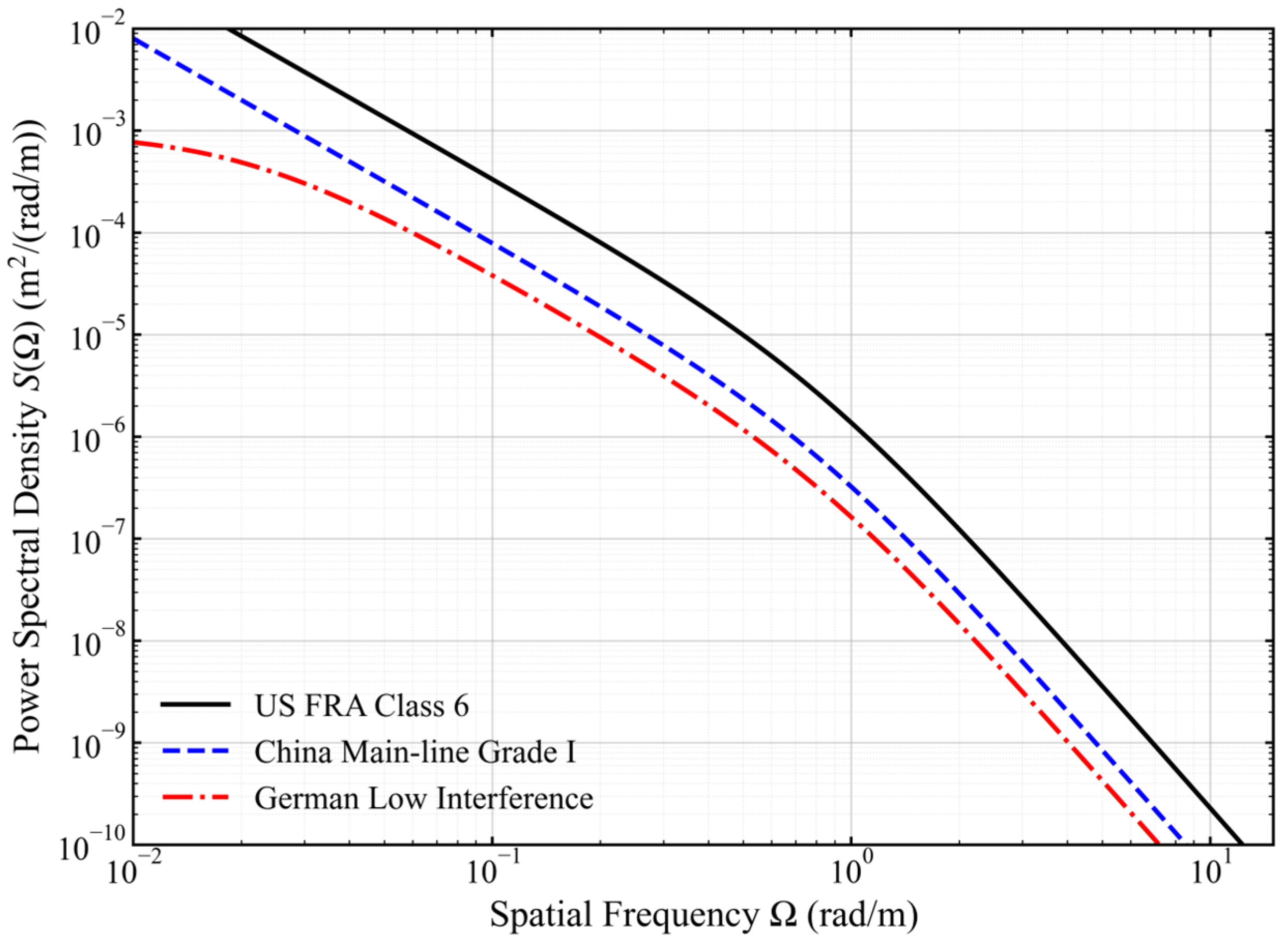
The dynamic excitation of rail transit systems originates from wheel–rail irregularities. To simulate stochasticity, this study uses a classical track irregularity Power Spectral Density (PSD) function. Considering the maintenance conditions of urban viaduct lines, the German Low Interference Spectrum (also known as the Low Disturbance Spectrum) was selected as the excitation input [24]. This spectrum is specifically designed for high-grade railway lines and accurately reflects the smoothness characteristics of urban rail transit. Its vertical irregularity power spectral density S n is expressed as:
S n = A n c 2 ( n 2 + n r 2 ) ( n 2 + n c 2 )
where n is the angular spatial frequency (rad/m); A is the track roughness coefficient; n c and n r are characteristic cutoff frequencies [25].
Justification for Spectrum Selection: The German Low Interference Spectrum, whose energy distribution is visually compared with US and Chinese standards in Figure 5, is selected to represent the ‘best-case maintenance scenario. By utilizing a spectrum with lower energy in the long-wavelength range, the masking effect of extreme wheel–rail impact noise is minimized. This approach allows for a clearer isolation and quantification of the acoustic variations induced solely by structural geometric asymmetry, rather than being overshadowed by severe track irregularities.

3. Symmetry Theory Application in Vibration Mode Analysis

This section reveals the physical process of modal distortion caused by geometric asymmetry, starting from the dynamic characteristic equations.

3.1. Modal Orthogonality and Symmetry Breaking

Eigenfrequency analysis was performed using the same 2.5D FE formulation described in Section 2, with the wavenumber k x set to 0. The boundary conditions remain consistent with the dynamic analysis (Pinned-Roller). The modal analysis was performed to identify the key vibration characteristics of the bridge. Special attention was paid to the low-order global modes (e.g., vertical bending and torsion) and the local modes of the box girder plates, as these significantly influence the structure-borne noise in the frequency range of interest.
Orthogonality in Symmetric State ( α = 0 ): In an ideally symmetric state, the structural stiffness matrix K and mass matrix M exhibit block diagonalization [26]. This means vibration modes are strictly decoupled into two sets of orthogonal bases.
Symmetric Modes: Primarily global vertical bending. The first global bending frequency is f v 1 3.7   H z . The mode shape involves global translation of the cross-section along the z-axis, with equal displacement of left and right cantilevers: u z ( y ) = u z ( y ) .
Antisymmetric Modes: Primarily torsion. The first torsional frequency is ft1 ≈ 25 Hz [27]. The mode shape involves rotation about the shear center, with equal but opposite displacements of left and right cantilevers: u z ( y ) = u z ( y ) . Since train loads are typically symmetric, according to the principle of modal superposition, the orthogonal product of symmetric load and antisymmetric mode is zero ( ϕ t o r s i o n T F s y m = 0 ). Thus, in symmetric bridges, torsional modes are rarely excited and the sound field remains symmetric.
Modal Distortion in Asymmetric State ( α > 0 ): When the asymmetry parameter is introduced, the system Lagrangian no longer possesses reflection symmetry. Non-zero values appear in the off-diagonal terms of the stiffness matrix, leading to Flexural–Torsional Coupling [28]. At this point, new eigenmodes ϕ become linear combinations of the original orthogonal bases:
ϕ b e n d i n g c 1 ϕ b e n d i n g + c 2 ϕ t o r s i o n
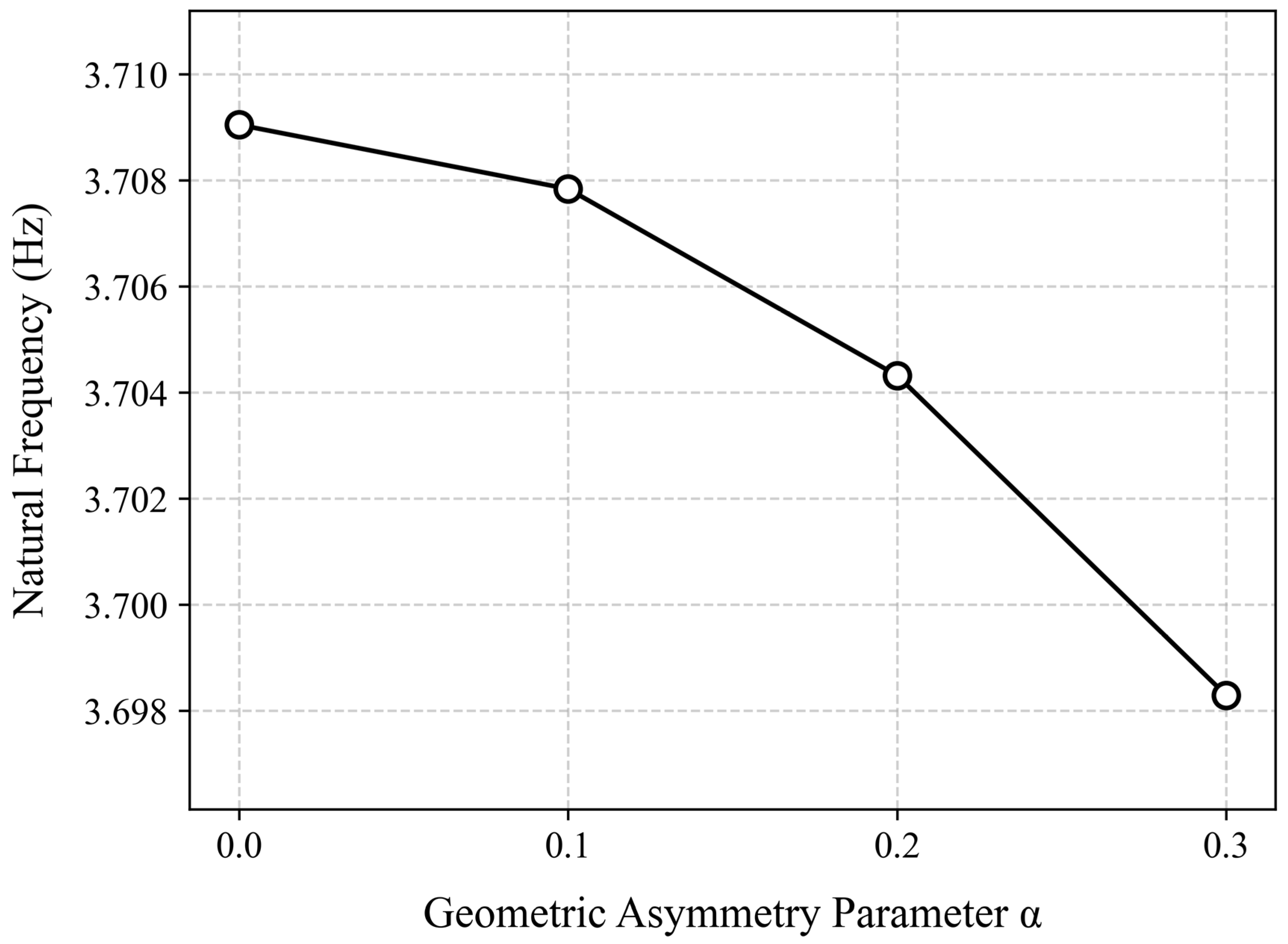
Frequency Drift: Frequency Drift: Geometric asymmetry is first reflected in the change of system eigenvalues. As shown in Figure 6, as α increases from 0 to 0.3, the first vertical bending natural frequency decreases monotonically from 3.709 Hz to 3.698 Hz. Although the magnitude of the decrease is small (about 0.3%), this explicitly reflects the physical impact of the increased structural mass resulting from the volumetric expansion of the lengthened right cantilever. This continuous frequency drift quantitatively confirms that the global mass matrix (M) of the system has fundamentally changed due to the actual geometric asymmetry, which serves as the physical prerequisite for the subsequent modal shape distortion (flexural–torsional coupling).
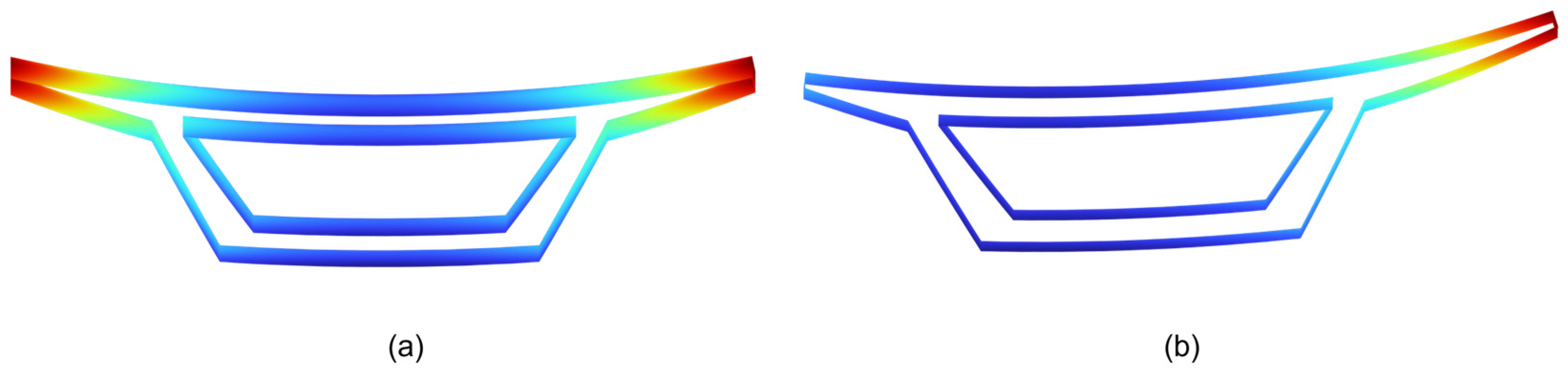
Modal Coupling: The most fundamental change lies in the distortion of modal shapes. The originally pure “vertical bending” mode mixes with a significant “torsional” component—the bridge twists while bending. Conversely, “torsional” modes are accompanied by vertical translation. This phenomenon is termed Flexural–Torsional Coupling, a distortion mechanism vividly illustrated by the mode shape contrast in Figure 7.
Nodal Shift: In the symmetric model, the “stationary point” (node) of the torsional mode is at the bridge center. However, in the asymmetric model, the node shifts towards the side with smaller mass. This implies that under identical excitation, the vibration amplitude of the widened side (right side) will be significantly larger than that of the left side.

3.2. Quantitative Definition of Modal Symmetry Index (MSI)

To move from qualitative description to quantitative analysis, this study defines the Modal Symmetry Index (MSI). Geometric asymmetry breaks the equilibrium of the box girder cross-section, inducing significant flexural–torsional coupling. In this state, a single mode no longer manifests as pure bending or torsion but is accompanied by complex spatial sound field deflection.
For the k -th mode, the vertical displacement distribution ϕ k ( y ) ( y [ B / 2 , B / 2 ] ) of the mid-span cross-section is extracted. MSI is defined as:
M S I k = B / 2 B / 2 ϕ k ( y ) ϕ k ( y ) d y B / 2 B / 2 [ ϕ k ( y ) ] 2 d y
This index has clear physical significance:
M S I = 1 : Mode is positively symmetric (Pure Bending).
M S I = 1 : Mode is antisymmetric (Pure Torsion).
| M S I | < 1 : Symmetry breaking occurs; coupling exists. The further the value deviates from 1, the higher the degree of coupling.
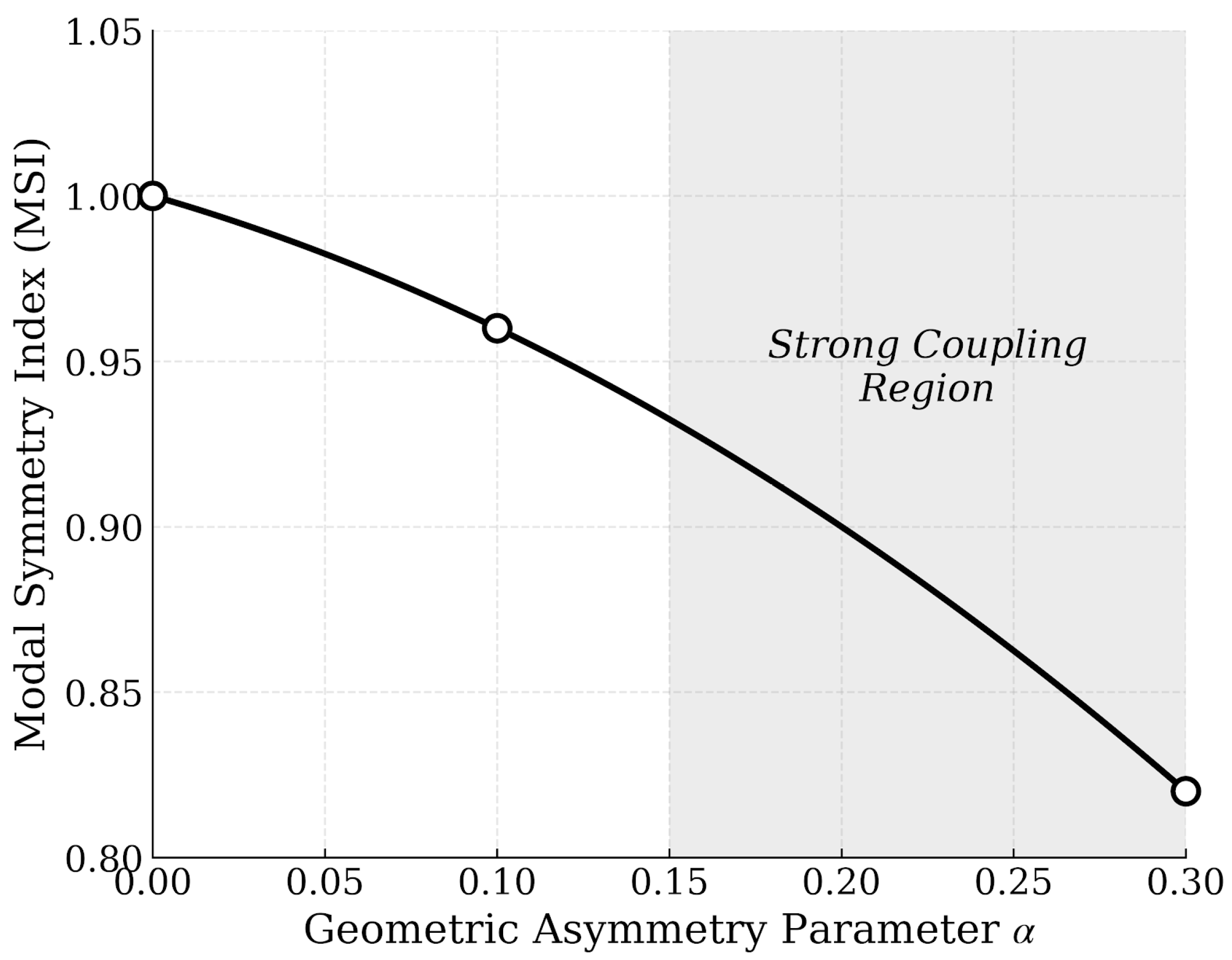
Data Analysis Results: As the asymmetry parameter α increases, the MSI value of the first bending mode exhibits a monotonic downward trend, as quantitatively traced in Figure 8. Specifically:
α = 0 : M S I = 1.00 (Perfect Symmetry).
α = 0.1 : M S I 0.96 (Slight Coupling).
α = 0.3 : M S I 0.82 (Significant Coupling).
We define the “Strong Coupling Region” as the range where the MSI drops below 0.9 (corresponding to α   >   0.15 ). In this region, the mode shape contains more than 10% torsional energy leakage, leading to significant acoustic deflection.
Results show that as α increases from 0 to 0.3, the MSI of the first primary bending mode drops from 1.00 to 0.82. This indicates that in severe asymmetry, the so-called “bending mode” contains nearly 18% torsional components. This modal component “contamination” is the internal cause of sound field deflection.
Figure 8. Influence of the geometric asymmetry parameter on the Modal Symmetry Index (MSI). The circular markers represent the discrete numerical simulation results. The shaded area indicates the “Strong Coupling Region” (α > 0.15) where significant flexural-torsional coupling occurs, while the unshaded area (white background) corresponds to the “Weak Coupling Region” (α ≤ 0.15) where the acoustic compensation mechanism is effective.
Symmetry 18 00370 g008

4. Numerical Simulation and Asymmetry Assessment of Low-Frequency Sound Field

Based on 2.5D FEM-BEM results, this section focuses on analyzing how modal distortion translates into acoustic asymmetry effects and proposes quantitative indicators [29].

4.1. Coupled Simulation of Vibration and Sound Radiation

The calculated structural surface vibration velocities were used as boundary conditions for the acoustic boundary element model to solve the sound pressure field, focusing on the sensitive low-frequency band of 20–200 Hz.
Acoustic Tilt: By plotting the Sound Pressure Level (SPL) contour map within the cross-section, the evolution of the sound field morphology can be clearly observed.
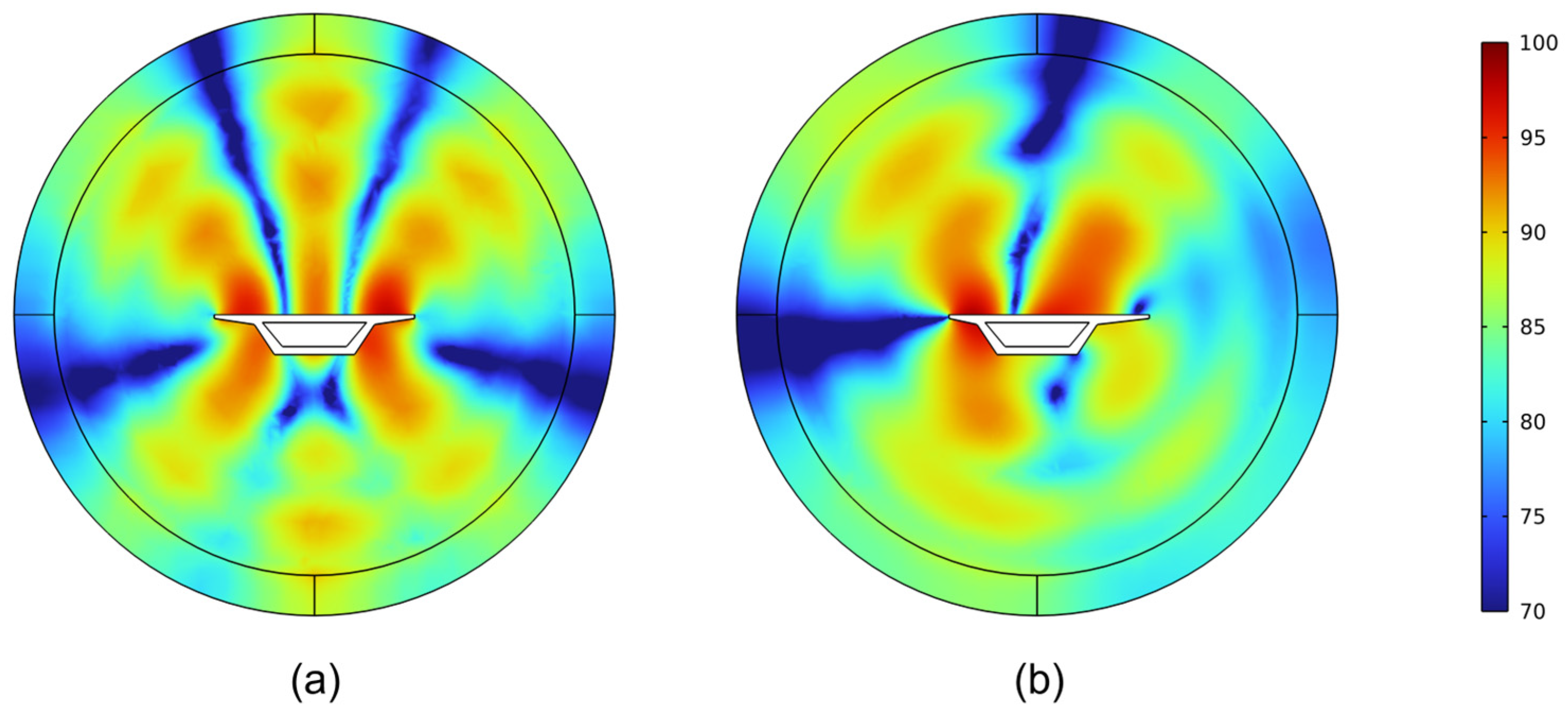
Symmetric Case ( α = 0 ): At 63 Hz (which corresponds to the local distortional mode of the cross-section, distinct from the lower-frequency global bending modes), the sound field exhibits typical symmetric Dipole characteristics. Sound pressure contours below and on both sides of the bridge are completely symmetric about the central axis.
Asymmetric Case ( α = 0.3 ): The introduction of geometric asymmetry significantly reduces the cross-sectional torsional stiffness, causing this local resonance frequency to drift from 63 Hz to 48 Hz.
At this frequency, the strong flexural–torsional coupling alters the phase relationship between the web and cantilever vibrations. This results in a significant amplification of vibration velocity at the longer cantilever tip (right side) and a suppression on the loading side. Consequently, the structure acts as a phased array, generating a directed acoustic beam towards the right side while creating a ‘silence zone’ on the left, as evidenced by the SPL distribution in Figure 9b.
Geometric asymmetry significantly reduced the stiffness of the cross-sectional distortional mode, causing the resonance frequency to drift from 63 Hz to 48 Hz.
Furthermore, a similar asymmetric distribution of the acoustic field is observed at a higher frequency (e.g., 72 Hz), further validating the regulatory effect of the geometric structure on acoustic directivity.
Figure 9 displays the SPL distribution at 63 Hz (corresponding to the first cross-sectional distortional resonance). The load applied is the Equivalent Harmonic Amplitude based on the German Low Interference Spectrum at that frequency. The results are normalized to emphasize the spatial relative distribution of sound energy rather than absolute values.
To ensure the engineering representativeness of the excitation source, the Power Spectral Density (PSD) function of the German Low Interference Spectrum is directly adopted as the standard input. As this study aims to reveal the deterministic influence of structural geometric asymmetry on the acoustic field, the aforementioned PSD spectrum is converted into equivalent frequency-domain force loads applied at the rail positions during the calculation. Consequently, the focus is placed on the average acoustic response of the bridge under standard operating conditions, rather than on the statistical distribution of extreme random events.
Results show a significant growth trend in SPL on the asymmetric side. In this study, “Average SPL” denotes the energetic spatial average calculated over the evaluation line at 10 m distance. Compared to the symmetric side, the average SPL on the asymmetric side increases by approximately 1.8–2.1 dB. While this magnitude appears numerically small, a 2 dB difference implies an increase in sound energy density of nearly 60%, which is significant for low-frequency noise control [30].

4.2. Quantification of Low-Frequency Sound Field Asymmetry

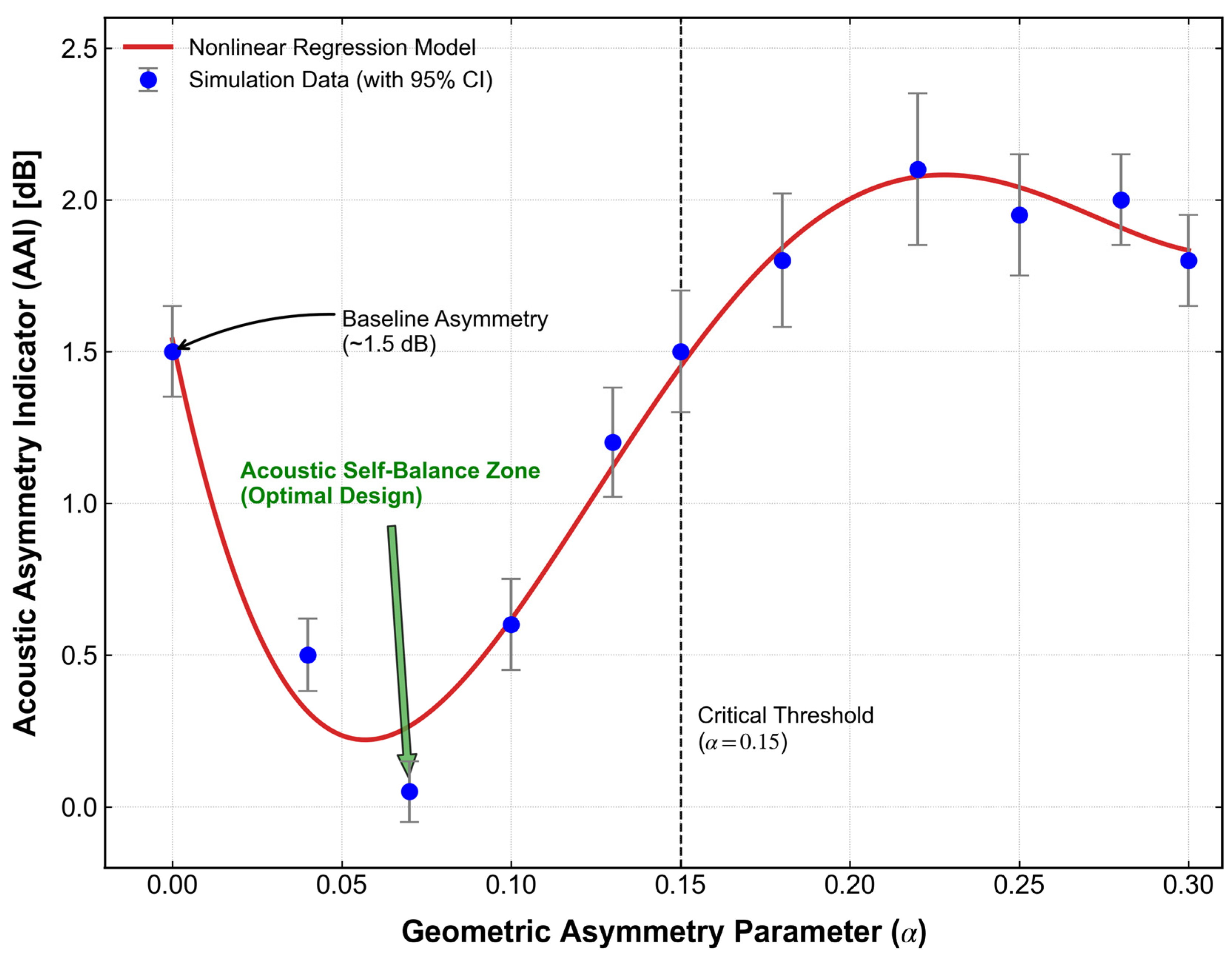
As quantitatively revealed in Figure 10: under the condition where the structure is perfectly symmetric ( α = 0 ) and the train runs on the left track ( y < 0 ), the initial value of the Acoustic Asymmetry Indicator (AAI) is calculated to be approximately 1.5 dB. This baseline result confirms that noise on the side away from the track (right side) is slightly higher than on the side near the track (left side). The physical root of this phenomenon lies in the asymmetric vibro-acoustic response induced by the eccentric loading. Although the cross-section is geometrically symmetric, the load itself is eccentric (left track). This off-center excitation induces antisymmetric modes even in a symmetric structure. Consequently, the radiation efficiency is higher on the “far side” (right side) due to the phase superposition of diffracted waves, rather than simple geometric shielding.
To serve engineering evaluation directly, the Acoustic Asymmetry Indicator (AAI) is defined:
A A I = | S P L r i g h t S P L l e f t |
where S P L r i g h t / l e f t are the equivalent continuous sound pressure levels at ± 10   m from the bridge centerline and 1.5 m height.
Parametric Correlation Analysis: Regression analysis establishes the quantitative relationship between α , MSI, and AAI:
Nonlinear Growth: AAI variation with α shows distinct nonlinearity.
Compensation Zone ( α < 0.1 ): As α increases from 0 to 0.07, AAI decreases monotonically from 1.5 dB to near 0 dB. This indicates that moderate geometric asymmetry effectively offsets the impact of eccentric loading.
High Asymmetry Zone ( α > 0.15 ): AAI shows a rebounding trend. When α is around 0.22, AAI peaks at approximately 2.1 dB, then stabilizes around 1.8 dB at α = 0.3 . This suggests that excessive geometric asymmetry disrupts the acoustic balance again, triggering reverse sound field deflection.
This implies the existence of a “critical threshold.” Once exceeded, modal coupling effects dominate the entire sound radiation mechanism. This trend is consistent with findings in U-shaped girder studies [31]. Based on this, passive noise control can be achieved by actively designing asymmetric cantilever lengths or introducing acoustic short-circuit effects to induce sound energy flow towards non-sensitive sides [32].
Research indicates that the relationship between the geometric asymmetry parameter α and the Acoustic Asymmetry Indicator (AAI) is not a simple linear positive correlation; instead, it exhibits a significant nonlinear V-shaped evolutionary pattern.
Breaking the “Symmetry Optimality” Hypothesis: In traditional geometrically symmetric designs ( α = 0 ), the acoustic field is not balanced due to the influence of single-sided eccentric train loading. Instead, an initial deviation of approximately α = 0 exists.
Discovery of an “Acoustic Self-Balance” Interval: As α increases within the range of 0 0.07 , the inertial moment generated by structural geometric asymmetry effectively compensates for the load eccentricity effect. Within this interval, although the Modal Symmetry Index (MSI) decreases, the acoustic asymmetry (AAI) significantly drops to 0   d B , achieving a passive acoustic balance.
Determination of the Engineering Threshold: Only when α > 0.15 does excessive modal distortion cause the AAI to rise again ( α A A I ), manifesting as a unidirectional deflection of the acoustic field towards the longer cantilever side.
A “Competition–Compensation Mechanism” exists between Structural Asymmetry and Load Eccentricity. Moderate symmetry breaking ( α 0.07 ) minimizes the AAI, whereas excessive symmetry breaking ( α > 0.15 ) dominates the acoustic field deflection.

4.3. Robustness Analysis: Influence of Loading Direction

To verify the universality of the proposed symmetry-breaking mechanism, it is essential to consider the scenario where the train operates on the lengthened cantilever side (right track, y > 0 ). This investigation addresses the potential variability in track usage and assesses whether the acoustic conclusions hold under different loading conditions.
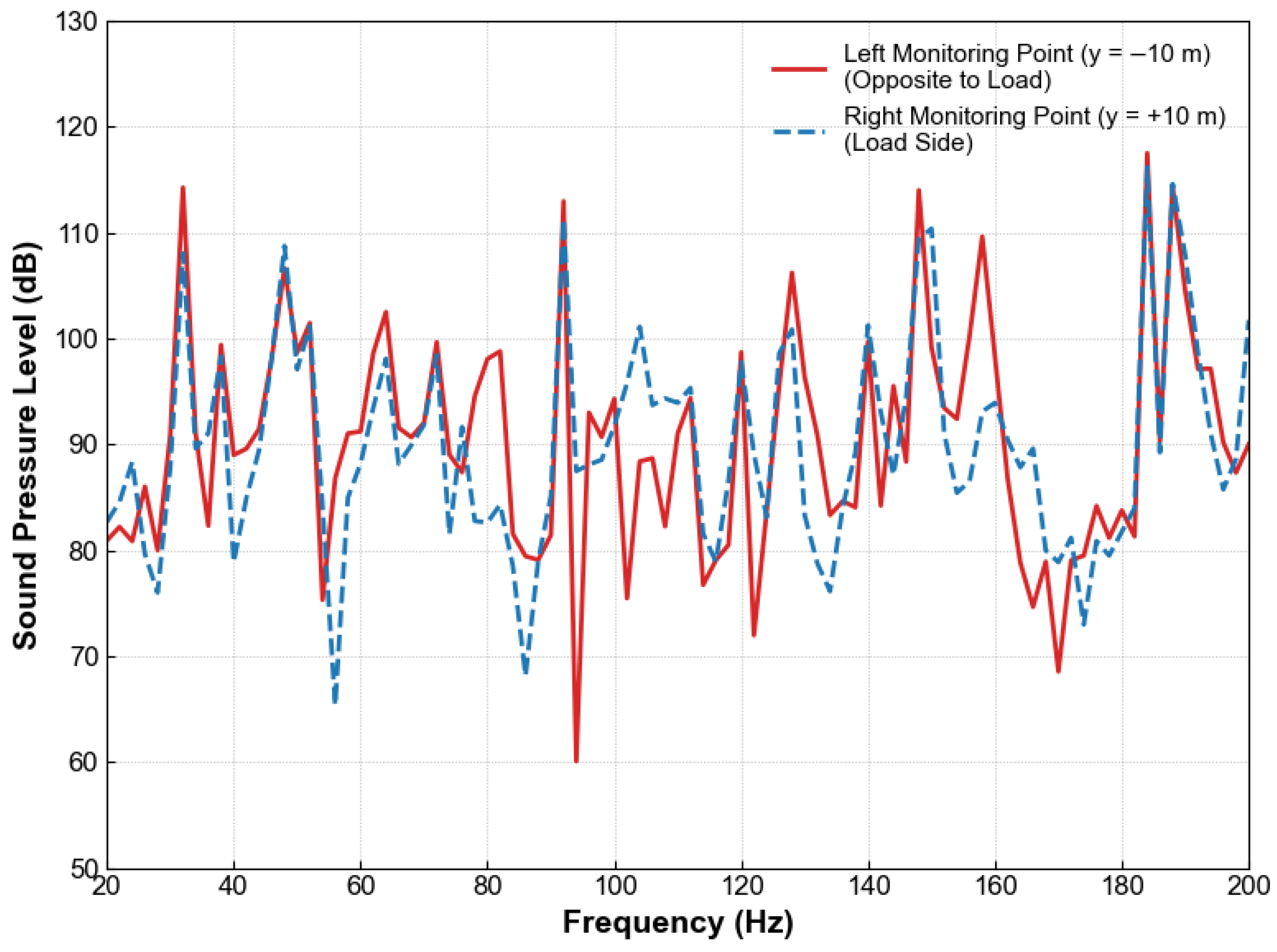
Figure 11 presents the frequency spectrum comparison of the sound pressure levels (SPL) at the bilateral monitoring points under the severe asymmetry condition ( α = 0.3 ) with right-side loading.
Figure 11 Comparison of frequency spectra of Sound Pressure Level (SPL) at bilateral monitoring points under Right-Side Loading condition (Severe Asymmetry α = 0.3 ). Note that the sound field exhibits a reverse deflection compared to the left-side loading case.
Furthermore, the spectral complexity and multiple local peaks observed in Figure 11 are physically attributed to the ‘dense modal overlap’ phenomenon. Unlike the symmetric case where modes are sparse and decoupled, the severe asymmetry (α = 0.3) triggers strong flexural–torsional coupling, causing a richer set of modes to be excited within the 20–200 Hz band. These ‘jagged’ spectral features accurately reflect the multi-modal interference inherent to the symmetry-breaking system.
Quantitative analysis reveals a significant “Reverse Deflection” phenomenon. Unlike the left-side loading case where sound energy deflects towards the lengthened cantilever (Right Side) with an AAI of approximately 1.8 dB, the right-side loading scenario exhibits higher sound pressure levels on the opposite side (Short Cantilever/Left Side). Specifically, the total energetic SPL on the left side reaches 122.9 dB, while the right side is 121.5 dB, resulting in an AAI of approximately 1.4 dB.
This “flip-flop” behavior of the acoustic hotspot suggests that the lengthened cantilever acts as an acoustic shield for the near-field ground points directly underneath it, while the web vibration effectively radiates noise to the opposite side. These findings confirm that excessive geometric asymmetry ( α > 0.15 ) introduces intrinsic directional instability to the sound field, rendering the noise distribution highly sensitive to the loading position. Conversely, this robustness check further validates the superiority of the proposed “Self-Balanced” design ( α 0.07 ), which minimizes such directional sensitivity and maintains a quasi-symmetric sound field regardless of the track operation mode.

5. Conclusions and Outlook

5.1. Main Conclusions and Theoretical Contributions

Based on a high-precision numerical simulation platform, this study deeply analyzed the mechanism of geometric symmetry breaking on low-frequency noise in urban rail viaducts. Combined with the latest parametric simulation data, the main conclusions are as follows:
Establishment of a new design paradigm where “asymmetry outperforms symmetry”: Simulation data overturns the traditional intuitive assumption that “geometric symmetry equates to acoustic optimality [33].” The study demonstrates that for viaduct designs under single-track eccentric loading conditions introducing a deliberate asymmetry of approximately 7% ( α     0.07 ) yields superior acoustic environmental performance compared to a strictly symmetric design ( α   =   0 ). The former successfully “neutralizes” the initial acoustic field deviation of approximately 1.5   dB by leveraging the counter-torque generated by structural eccentricity, whereas the latter proves not to be the acoustically optimal solution.
Discovery of “Acoustic Self-Equilibrium Zone”: The study identified a critical compensation interval. When the asymmetry parameter α is designed within the range of 0.06~0.08, the AAI drops to its minimum (≈0 dB). This confirms that the inertial moment generated by a moderately lengthened right cantilever can effectively “neutralize” the dynamic imbalance caused by track eccentricity, achieving passive acoustic self-equilibrium.
Establishment of Engineering Thresholds for Asymmetric Design: Data indicates that α = 0.15 is the critical turning point from “compensation” to “deterioration.” When α < 0.15 , asymmetric design plays a positive compensatory role; once α > 0.15 , modal coupling effects dominate the sound radiation mechanism, causing irreversible and strong accumulation of sound energy towards the longer cantilever side (AAI rises to 2.1 dB), necessitating additional sound insulation measures [34].
Revelation of “Competition–Compensation” Mechanism: The study elucidates the physical essence of sound field deflection as a competition between load eccentricity effects and structural geometric eccentricity effects.
Compensation Zone ( 0 α < 0.1 ): Geometric asymmetry plays a positive role, neutralizing torsional excitation from the load.
Deterioration Zone ( α > 0.1 ): As asymmetry increases further, the structure’s own modal distortion begins to dominate, destroying the prior equilibrium.

5.2. Practical Applications and Future Outlook

Engineering Implication:
For urban rail lines traversing noise-sensitive residential areas, specifically for single-track viaducts or double-track lines where operation is predominantly on one side (causing eccentric loading), we recommend adopting a moderately asymmetric cross-section ( α 0.07 ). It is important to clarify that even for single-track viaducts, the actual operational center of the train is rarely coincident with the shear center of a symmetric girder due to fastener positioning and cantilever requirements. The proposed asymmetric design is a ‘compensatory topology’ intended to generate a structural counter-torque that neutralizes this inherent load eccentricity, thereby restoring bilateral acoustic balance.
Graded Risk Control:
Green Zone ( α 0.07 ): Recommended for high-sensitivity areas to achieve acoustic silence via design optimization.
Yellow Zone ( α < 0.15 ): Conventional design interval; routine EIA required.
Red Zone ( α > 0.15 ): If large cantilever asymmetric design is mandatory (e.g., for station connections), the “symmetry hypothesis” must be abandoned during the EIA phase. Specific risk assessments for excess standards on the widened side must be conducted, accompanied by stronger sound insulation measures.
Future Outlook: Future research could further explore “Material Asymmetry” effects, i.e., maintaining geometric symmetry while arranging Functionally Graded Materials (FGM) with different densities or moduli on both sides of the cross-section to replicate the “acoustic compensation mechanism” found in this study [35]. Additionally, multi-physics coupling mechanisms under extremely complex geometric constraints, such as “integrated station–bridge” structures, warrant further deep quantitative research [36].

Author Contributions

Conceptualization, X.D. and B.W.; Data curation, B.Z.; Formal analysis, B.Z.; Resources, B.W.; Writing—original draft, X.D.; Writing—review & editing, X.D., B.Z. and B.W. All authors have read and agreed to the published version of the manuscript.

Funding

The sponsor of this project is the Education Department of Anhui Province, this research was supported by the 2024 Anhui Provincial Key Scientific Research Project, “Parameter Optimization and Fatigue Life Simulation of Composite Metal Rubber Vibration Isolators”, grant number 2024AH050202.

Data Availability Statement

Data are contained within the article. The data presented in this study can be requested from the authors.

Conflicts of Interest

The authors declare no conflicts of interest.

References

  1. Lu, K.; Zhang, L.; Li, S.; Huang, Y.; Ding, X.; Hao, J.; Huang, S.; Li, X.; Lu, F.; Zhang, H. Urban Rail Transit in China: Progress Report and Analysis (2015–2023). Urban Rail Transit 2025, 11, 1–27. [Google Scholar] [CrossRef]
  2. Leventhall, G. Low Frequency Noise. What we know, what we do not know, and what we would like to know. J. Low Freq. Noise Vib. Act. Control. 2009, 28, 79–104. [Google Scholar] [CrossRef]
  3. Pierce, A. Acoustics: An Introduction to Its Physical Principles and Applications; Springer: Berlin/Heidelberg, Germany, 1989; Volume 34. [Google Scholar]
  4. Basner, M.; McGuire, S. WHO Environmental Noise Guidelines for the European Region: A Systematic Review on Environmental Noise and Effects on Sleep. Int. J. Environ. Res. Public Health 2018, 15, 519. [Google Scholar] [CrossRef] [PubMed]
  5. Boscolo Berto, M.; Biasco, L.; Demertzis, S.; Pedrazzini, G.B. Multiple embolization in infective endocarditis. Eur. Heart J. 2018, 39, 1739. [Google Scholar] [CrossRef] [PubMed]
  6. Araújo Alves, J.; Neto Paiva, F.; Torres Silva, L.; Remoaldo, P. Low-Frequency Noise and Its Main Effects on Human Health—A Review of the Literature between 2016 and 2019. Appl. Sci. 2020, 10, 5205. [Google Scholar] [CrossRef]
  7. Hu, S.-L.; Yang, W.-L.; Liu, F.-S.; Li, H.-J. Fundamental comparison of time-domain experimental modal analysis methods based on high- and first-order matrix models. J. Sound Vib. 2014, 333, 6869–6884. [Google Scholar] [CrossRef]
  8. Kreitman, K.; Ghiami Azad, A.R.; Engelhardt, M.; Helwig, T.; Williamson, E. Shakedown Behavior of a Continuous Steel Bridge Girder Strengthened with Post-Installed Shear Connectors. Structures 2016, 8, 245–251. [Google Scholar] [CrossRef]
  9. Grigoriou, V.; Nussbaumer, A.; Lignos, D. Fatigue Strength Upgrading of Cover Plate Ends by Welded Extensions in Existing Steel Bridge Girders. J. Bridge Eng. 2018, 23, 04018037. [Google Scholar] [CrossRef]
  10. Zhang, X.; Li, X.; Hao, H.; Wang, D.; Li, Y. A case study of interior low-frequency noise from box-shaped bridge girders induced by running trains: Its mechanism, prediction and countermeasures. J. Sound Vib. 2016, 367, 129–144. [Google Scholar] [CrossRef]
  11. Frenzel, T.; Kadic, M.; Wegener, M. Three-dimensional mechanical metamaterials with a twist. Science 2017, 358, 1072–1074. [Google Scholar] [CrossRef]
  12. Wu, Z.; Zhang, N.; Bi, W.; Liu, J. Application of FEM–BEM–PEM Hybrid Random-Vibration Method on Low-Frequency Structure-Borne Noise Prediction of U-Shaped Girder in Urban Rail Transit. Int. J. Struct. Stab. Dyn. 2024, 17, 2541007. [Google Scholar] [CrossRef]
  13. Bian, X.-C.; Chao, C.; Jin, W.-F.; Chen, Y.-M. A 2.5D finite element approach for predicting ground vibrations generated by vertical track irregularities. J. Zhejiang Univ.-Sci. A 2011, 12, 885–894. [Google Scholar] [CrossRef]
  14. Ge, H.; Yang, M.; Ma, C.; Lu, M.-H.; Chen, Y.-F.; Fang, N.; Sheng, P. Breaking the barriers: Advances in acoustic functional materials. Natl. Sci. Rev. 2018, 5, 159–182. [Google Scholar] [CrossRef]
  15. Galvín, P.; François, S.; Schevenels, M.; Bongini, E.; Degrande, G.; Lombaert, G. A 2.5D coupled FE-BE model for the prediction of railway induced vibrations. Soil Dyn. Earthq. Eng. 2010, 30, 1500–1512. [Google Scholar] [CrossRef]
  16. GB 50010-2010; Code for Design of Concrete Structures. Ministry of Housing Urban-Rural Development of China: Beijing, China, 2010.
  17. Toyota, Y.; Hirose, T.; Ono, S.; Shidara, K. Experimental Study on Vibration Characteristics of Prestressed Concrete Beam. Procedia Eng. 2017, 171, 1165–1172. [Google Scholar] [CrossRef]
  18. Sun, Q.; Klaseboer, E.; Khoo, B.-C.; Chan, D.Y.C. Boundary regularized integral equation formulation of the Helmholtz equation in acoustics. R. Soc. Open Sci. 2015, 2, 140520. [Google Scholar] [CrossRef]
  19. Kim, M.-J.; Rim, C.-G.; Won, K.-S. Broadening Low-Frequency Band Gap of Double-Panel Structure Using Locally Resonant Sonic Crystal Comprised of Slot-Type Helmholtz Resonators. Arch. Acoust. 2021, 46, 335–340. [Google Scholar] [CrossRef]
  20. Okuzono, T. Computational Accuracy and Efficiency of Room Acoustics Simulation Using a Frequency Domain FEM with Air Absorption: 2D Study. Appl. Sci. 2023, 14, 194. [Google Scholar] [CrossRef]
  21. Marchner, P.; Bizzarri, D.; Bériot, H. Improved near-field PML absorbing functions for exterior three-dimensional Helmholtz problems. Comput. Methods Appl. Mech. Eng. 2024, 428, 117092. [Google Scholar] [CrossRef]
  22. Marburg, S. Six boundary elements per wavelength: Is that enough? J. Comput. Acoust. 2002, 10, 25–51. [Google Scholar] [CrossRef]
  23. Yang, Y.B.; Hung, H.H. A 2.5D finite/infinite element approach for modelling visco-elastic bodies subjected to moving loads. Int. J. Numer. Methods Eng. 2001, 51, 1317–1336. [Google Scholar] [CrossRef]
  24. Guo, M.; Wang, X.; Qiao, H.; Xia, H.; Ye, Q. Dynamic Response and Riding Comfort Analysis of a Passenger-Train-Bridge System in Urban Rail Transit. Int. J. Struct. Stab. Dyn. 2022, 23, 6. [Google Scholar] [CrossRef]
  25. An, B.; Wang, P.; Ma, S.; Ma, Z.; Zhong, Y.; Zhao, W. Influence of Metro Track Irregularities on Pantograph Vibration and Its Interaction with Catenary. Appl. Sci. 2022, 12, 6435. [Google Scholar] [CrossRef]
  26. Zingoni, A.; Kaluba, C. A consistent group-theoretic transformation for the block-diagonalization of structural matrices. Eng. Struct. 2023, 295, 116708. [Google Scholar] [CrossRef]
  27. Citarella, R.; Landi, T.; Caivano, L.; D’Errico, G.; Raffa, F.; Romano, M.; Armentani, E. Structural and Vibro-Acoustics Optimization of a Car Body Rear Part. Appl. Sci. 2023, 13, 3552. [Google Scholar] [CrossRef]
  28. Michaltsos, G.T.; Sarantithou, E.; Sophianopoulos, D.S. Flexural–torsional vibration of simply supported open cross-section steel beams under moving loads. J. Sound Vib. 2005, 280, 479–494. [Google Scholar] [CrossRef]
  29. Li, Q.; Song, X.; Wu, D. A 2.5-dimensional method for the prediction of structure-borne low-frequency noise from concrete rail transit bridges. J. Acoust. Soc. Am. 2014, 135, 2718–2726. [Google Scholar] [CrossRef]
  30. Parkins, J.W.; Sommerfeldt, S.D.; Tichy, J. Narrowband and broadband active control in an enclosure using the acoustic energy density. J. Acoust. Soc. Am. 2000, 108, 192–203. [Google Scholar] [CrossRef] [PubMed]
  31. Li, Q.; Dai, B.; Zhu, Z.; Thompson, D.J. Comparison of vibration and noise characteristics of urban rail transit bridges with box-girder and U-shaped sections. Appl. Acoust. 2022, 186, 108494. [Google Scholar] [CrossRef]
  32. Yang, C.; Pan, J.; Cheng, L. A mechanism study of sound wave-trapping barriers. J. Acoust. Soc. Am. 2013, 134, 1960–1969. [Google Scholar] [CrossRef] [PubMed]
  33. Han, I.; Lee, I.; Yoon, G. Studies on Dual Helmholtz Resonators and Asymmetric Waveguides for Ventilated Soundproofing. Sensors 2024, 24, 1432. [Google Scholar] [CrossRef] [PubMed]
  34. Ran Lin, T.; Pan, J. Sound radiation characteristics of a box-type structure. J. Sound Vib. 2009, 325, 835–851. [Google Scholar] [CrossRef][Green Version]
  35. Sepehri, S.; Jafari, H.; Mosavi Mashhadi, M.; Hairi Yazdi, M.R.; Seyyed Fakhrabadi, M.M. Tunable elastic wave propagation in planar functionally graded metamaterials. Acta Mech. 2020, 231, 3363–3385. [Google Scholar] [CrossRef]
  36. Guo, X.; Wang, S. Research on the Dynamic Response of the Multi-Line Elevated Station with “Integral Station-Bridge System”. Buildings 2024, 14, 758. [Google Scholar] [CrossRef]
Figure 1. Schematic diagram illustrating the low-frequency noise propagation mechanisms from an elevated railway viaduct. The solid curved arrows indicate the diffraction paths of airborne noise propagating over the sound barrier and beneath the bridge structure; the wavy arrows emerging from the box girder surface represent the direct structure-borne acoustic radiation; and the vibration symbol at the receiver’s window denotes the secondary radiation induced within the indoor environment.
Symmetry 18 00370 g001
Figure 2. Definition of the geometric asymmetry parameter ( α ) and schematic diagram of the shear center eccentricity induced by cross-sectional symmetry breaking.
Symmetry 18 00370 g002
Figure 3. Finite element mesh of the box girder section and the configuration of the Perfectly Matched Layer (PML) domain for acoustic radiation. The central solid light-grey area represents the concrete box girder, the inner blue meshed region denotes the acoustic fluid domain (air), and the outer grey meshed ring indicates the PML.
Symmetry 18 00370 g003
Figure 4. Validation of the numerical method: Comparison of the vertical driving point mobility at the mid-span calculated by the present 2.5D FEM-BEM (solid line) and the analytical Euler-Bernoulli beam solution [23] (dashed line). The significant overlap between the two curves demonstrates the high accuracy of the proposed numerical framework.
Symmetry 18 00370 g004
Figure 5. Comparison of track irregularity power spectral densities (PSD) among different standards: US FRA Class 6 (solid line), China Main-line Grade I (dashed line), and German Low Interference Spectrum (dash–dot line). Note that the German spectrum exhibits the lowest energy in the long-wavelength range, representing the best-case maintenance scenario.
Symmetry 18 00370 g005
Figure 6. Evolution of the first vertical bending natural frequency of the box girder with the geometric asymmetry parameter. The circular markers represent the discrete numerical simulation results. Note the monotonic frequency drift induced by the increased mass of the lengthened cantilever.
Symmetry 18 00370 g006
Figure 7. Comparison of the first vertical bending mode shapes. (a) Symmetric case (α = 0) showing pure vertical bending; (b) Asymmetric case (α = 0.3) showing bending-torsion coupling caused by geometric symmetry breaking. The color contours represent the relative magnitude of modal displacement, transitioning from blue (minimum/zero displacement) to red (maximum displacement).
Symmetry 18 00370 g007
Figure 9. Comparative acoustic pressure level (SPL) contour plots of the bridge cross-sections: (a) Symmetric geometric structure (α = 0) at its local resonance frequency of 63 Hz; (b) Asymmetric geometric structure (α = 0.3) at the shifted resonance frequency of 48 Hz. The central white schematic represents the cross-sectional profile of the concrete box girder. The color scale represents the SPL ranging from 70 to 100 dB. Note the significant acoustic beam deflection effect towards the right side in case (b).
Symmetry 18 00370 g009
Figure 10. Quantitative evolution of the Acoustic Asymmetry Indicator (AAI) with respect to the geometric asymmetry parameter α. The blue markers represent simulation data with 95% confidence intervals, while the red curve indicates the nonlinear regression trend. Note the distinct “V-shaped” relationship.
Symmetry 18 00370 g010
Figure 11. Frequency spectrum comparison of SPL under right-side loading (α = 0.3). A “reverse deflection” is observed, with higher noise levels on the unloaded side (Left) compared to the loaded side (Right), contrasting with the trend in Figure 9. The dense overlapping of the spectral curves in-herently reflects the complex multi-modal interference characteristic of the vibro-acoustic response.
Symmetry 18 00370 g011
Table 1. C50 Concrete Material Properties (According to GB 50010-2010).
ParameterSymbolValueUnitSource
Gravity Density ρ c 2500 k g / m 3 Conventional Value [16]
Elastic Modulus E c 3.45 × 1 0 4 MPaTable 4.1.5 in [16]
Poisson’s Ratio ν c 0.2-Section 4.1.7 in [16]
Disclaimer/Publisher’s Note: The statements, opinions and data contained in all publications are solely those of the individual author(s) and contributor(s) and not of MDPI and/or the editor(s). MDPI and/or the editor(s) disclaim responsibility for any injury to people or property resulting from any ideas, methods, instructions or products referred to in the content.