LOR-A2ABE: Lightweight and Revocable Attribute-Anonymous ABE with Outsourced Decryption in Centralized IoT
Abstract
1. Introduction
- Resource Constraints and Environmental Adaptability Issues: Schemes such as FABESA [31] achieve strong theoretical security but are not optimized for the resource-constrained nature of IoT environments. Moreover, they lack efficient attribute revocation mechanisms essential for dynamic IoT deployments.
- Insufficient Revocation Efficiency: Although revocation schemes like MTA [36] and TRH [37] exist, they introduce complexities of or that scale with system size. For large-scale IoT deployments with frequent attribute updates, such overhead becomes prohibitively high and contradicts the lightweight requirements of IoT terminals.
- Imbalanced Computation Distribution: Some IoT-oriented schemes, such as FOC-PH-CP-ABE [34], achieve computational outsourcing at the cost of significantly increased encryption time or server burden. This creates new bottlenecks in the “cloud–terminal” processing pipeline and shifts rather than resolves the computational challenges.
- The proposed LOR-A2ABE scheme achieves lightweight attribute revocation by partially updating keys and ciphertexts, providing an efficient attribute revocation management solution for large-scale IoT environments.
- A prominent advantage of our scheme lies in its highly efficient and practical decryption performance on the user side. We employ outsourcing techniques to offload the majority of computations to the cloud, requiring IoT terminal devices to perform only constant, low-complexity operations for decryption, thereby significantly alleviating the computational burden on end-users.
- In terms of security, our scheme incorporates a deliberate trade-off in its security design. We forgo backward security and operate under a limited collusion resistance assumption. Concurrently, we formally prove that the scheme achieves forward security, IND-CPA security, and anonymity security under the DLIN assumption.
2. Preliminaries
2.1. Bilinear Pairings
- Bilinearity: For any , .
- Non-degeneracy: is a generator of . For all , if and only if or .
- Computability: There exists an efficient algorithm such that is computable in deterministic polynomial time with respect to the security parameter .
2.2. Monotone Span Programs
- is a finite base field of prime order p.
- is an matrix over .
- is a labeling function that maps each row of M to an attribute in the universal attribute set U. Multiple rows may be mapped to the same attribute.
- is the target vector.
2.3. Partially Hidden Structure (Anonymity)
2.4. Decisional Linear (DLIN) Assumption
3. LOR-A2ABE
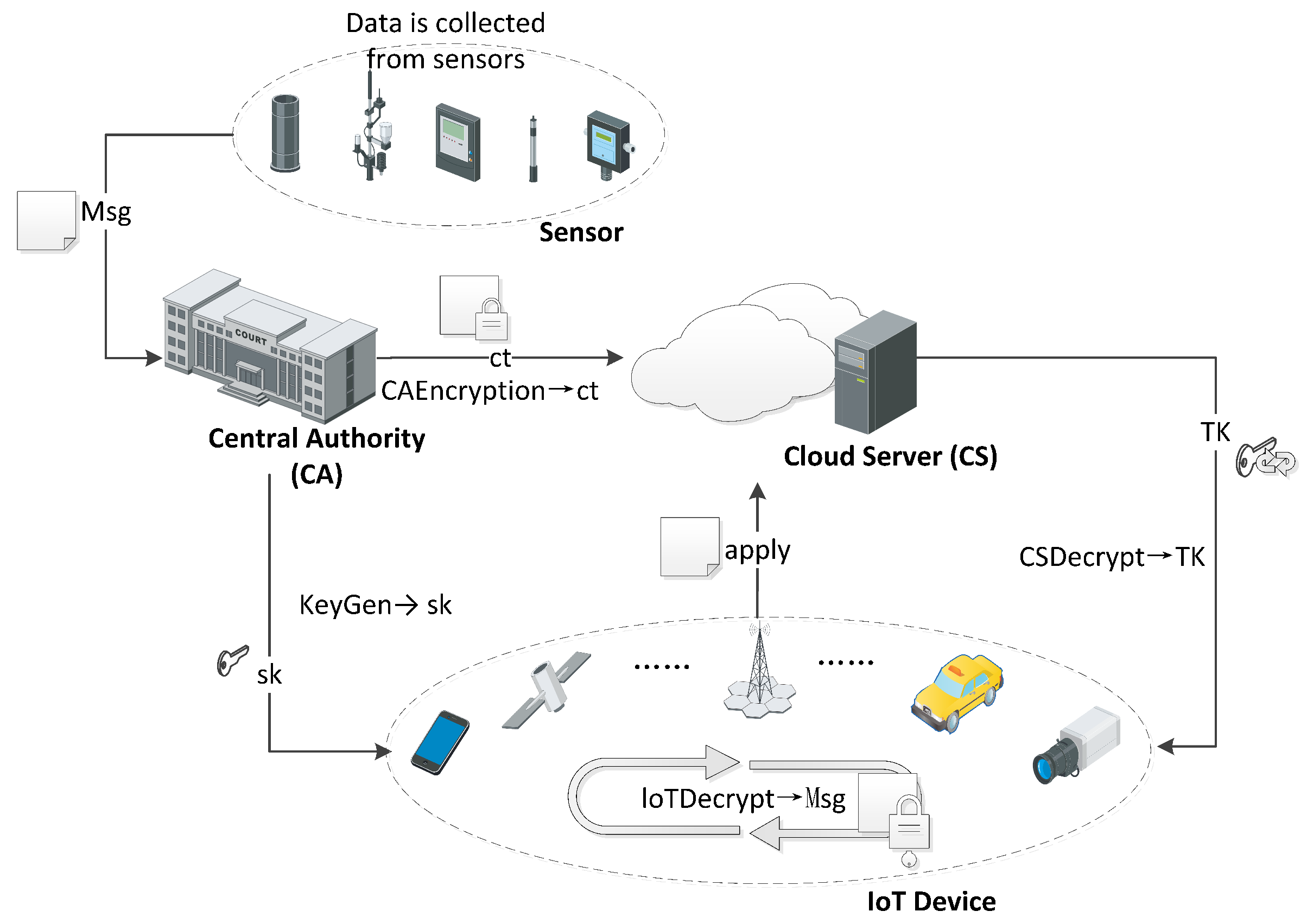
3.1. System Model
- System Initialization: The CA based on the security parameter , and runs the system initialization algorithm to produce the master key pair.
- Key Generation: The DU submits a registration request to the CA, and the CA generates attribute keys for the DU according to its attribute set.
- Data Encryption: The CA encrypts the data submitted by the Sensor under a access control structure, and uploads the resulting to the CS for storage, enabling the DU to apply for download on demand.
- Data Decryption: The DU applies to the CS for ciphertext download and submits part of its own attribute keys. Based on the request, the CS performs partial decryption on the ciphertext, generates a transformation key, and returns it to the DU. The DU then uses the transformation key to complete the final decryption and obtains the data .
- Revocation: The CA periodically generates key update information and updates the ciphertext stored in the CS. The key update information is sent to non-revoked DUs, who then update their own keys locally upon receipt.
3.2. Detailed Construction
- System Initialization. The CA performs system initialization according to the security parameter and generates the system master key pair via .The CA randomly selects . Then, the master secret key and the master public key are defined as
- Key Generation. Upon receiving a registration request from a DU, the CA generates attribute keys according to the DU’s attribute set by running .Randomly choose , a version number , and a timestamp . Compute:For each attribute , the full secret key is
- Encryption. The CA encrypts the received message under an access structure and uploads the resulting ciphertext to the CS via .Choose random and set . Additionally, choose a random vector where . For each row i of the matrix M, compute the share . Then compute:Here, equals the share computed for row i of the monotone span program M. The terms s, , and serve as attribute-specific blinding factors essential for security and anonymity. The complete ciphertext is
- Outsourced Decryption (CS-Side). After receiving a decryption request from a DU, the CS performs partial decryption on the ciphertext and obtains a transformation key by executing .If the terminal’s attribute set S is an authorized set under the access structure , there exists a set of constants such that . The CS then computes the transformation key as:
- Final Decryption (DU-Side). After obtaining the transformation key returned by the CS, the DU can complete the final decryption and recover the original message via .The DU first recovers the session key:The original message is then obtained as:
- Lightweight Attribute Revocation. The CA periodically generates key update information and refreshes the stored ciphertext by running .The CA randomly selects a new version number and updates the timestamp to . It then computes:The is sent to all non-revoked DUs. Upon receiving it, each DU locally updates its secret-key component:In LOR-A2ABE, the revocation mechanism is designed with built-in constraints to counter practical collusion attacks. First, the value is intrinsically linked to the specific pair generated in each update round. Devices that have been revoked are excluded from subsequent update distributions and thus cannot obtain the necessary and values. Without these parameters, even if the value itself is leaked, it is impossible to construct the correct versioned hash chain required for successful decryption. Second, any intercepted value has a limited validity window, typically restricted to the period before the next update. This design significantly limits the practical feasibility of collusion attacks that rely on sharing such critical update information.Concurrently, the CA updates the ciphertext. It chooses a fresh random and computes:The updated ciphertext components are:
4. Security Proofs
4.1. Design Trade-Offs for Security
4.1.1. Trade-Offs of Limited Collusion Resistance
- Terminal devices typically perform predefined single functions and lack the computational and communication capabilities required to dynamically coordinate and execute complex collusion protocols.
- The information is strongly bound to system version numbers and timestamps, possessing a strong timeliness attribute. Revoked devices struggle to obtain the version hash chain corresponding to the ciphertext. Missing any version hash value will prevent normal decryption.
- In practical deployments, terminal devices are often physically or logically isolated, making it difficult to establish direct and covert channels for key information exchange.
- In the target IoT scenarios, protected downlink data (e.g., control commands, configuration updates) usually have strong timeliness requirements. A successful collusion attack not only requires obtaining all historical values but must also be completed within the data’s validity period and before the next system update, which further increases the practical difficulty of the attack.
4.1.2. Trade-Offs of Backward Secrecy
4.2. Security Model
4.2.1. IND-CPA Security
- Random oracle query : maintains a query list and responds to each distinct query with a randomly generated value.
- Key-generation oracle : submits an attribute set S. runs to generate a secret key , records in a user list , and returns to .
- Revocation oracle : submits a user to be revoked, provided that and (the revocation list). generates a new version number and a timestamp , runs the algorithm to update the ciphertext to and to produce a key-update message , sends the updated ciphertext and the key-update message to , and records together with in the revocation list.
- Key-update oracle : submits a user and a key-update message , provided that and . updates the user’s secret key using and returns the updated key to .Remark 1.This step mimics the real-world scenario where each terminal or sensor can only update its own key. Because terminals are not actual users and their resources are extremely constrained, we consider a “limited-collusion” setting, i.e., the adversary is not allowed to use to refresh other users’ keys.
- Outsourced-decryption oracle : submits a ciphertext and a user . runs to compute the transformation key for and returns to .
- In any query, S must not satisfy .
- In any query, if the user possesses an attribute set that satisfies and has already obtained the corresponding key in Phase 2, then cannot be revoked in this phase.
- In any query, if has been revoked, the update information cannot be used to refresh its key.
- The oracle cannot be queried on the challenge ciphertext .
4.2.2. Anonymity Security
4.3. Practical Considerations for IoT Deployment
- Complete Version-Timestamp Chain Requirement: A revoked device must obtain every value from its revocation epoch onward. Missing even a single update breaks the chain integrity.
- Persistent Collusion Requirement: Colluding devices must share values continuously and in real-time, rather than through one-time exchanges.
- Increasing Attack Complexity: The longer a device remains revoked, the more values it must collect, making sustained collusion progressively more difficult to maintain.
- Update Frequency: In real-time IoT systems, key updates typically occur every few seconds to minutes.
- Continuous Monitoring Requirement: To maintain decryption capability, a revoked device would need to receive values continuously and reliably throughout the revocation period.
- Difficulty in Maintaining Covert Channels: Establishing and sustaining a hidden communication channel that operates at the same frequency as system updates is particularly challenging for resource-constrained IoT devices with limited computational and communication capabilities.
- Detection Risk: Such persistent, periodic communication patterns are more susceptible to detection by network monitoring and intrusion detection systems.
4.4. IND-CPA Security Proof
- Random oracle : maintains the lists , , , , , where , , , , . On a query for , or , checks whether the value already exists in the corresponding list. If yes, it returns the recorded , , , or ; otherwise it picks a random and returns , , , or , respectively, and stores the new entry in the list.
- Key-generation oracle : submits an attribute set . queries for each to obtain , and . Choosing random , constructs the secret key as:Indeed,returns to and records the user information in the user list .
- Revocation oracle : submits a user to be revoked, provided and . picks new and setsIt then simulates the updated ciphertext:and returns together with to . records .
- Key-update oracle : submits and , provided and . updates the user’s secret-key component as and returns the updated key.
- Outsourced-decryption oracle : provides a ciphertext and a user whose attribute set meets the access policy associated with . Assuming there exist coefficients satisfying , proceeds to compute the transformation key:and returns to .
- No query may use an attribute set S satisfying .
- No query is allowed for a user whose attribute set satisfies and who already obtained the corresponding key in Phase 2.
- No query may use an update for a revoked user.
- The oracle cannot be queried on the challenge ciphertext .
4.5. Anonymity Security Proof
- If : then , , . Substituting into givesBecause and , we havewhich is a valid encryption of under with attribute value .
- If : then , andThe term is completely random, making a random element of that carries no information about the attribute value .
4.6. Corollaries
- Revocation Security: Our scheme guarantees forward secrecy: a user revoked at time (epoch) cannot decrypt any ciphertext generated or updated after , even if the user’s pre-revocation secret key is compromised.This property is intrinsically ensured by our revocation mechanism and is covered by the IND-CPA security proof. Recall the decryption process from Section 3.2: successful recovery of the session key requires the cancellation of the version-timestamp term between and .For a user revoked at , its component is frozen with the hash value from the last update it received. Any ciphertext created or refreshed after will be associated with a new, independent hash value in its component. Since the revoked user does not receive the , its remains . The mismatch () prevents the necessary cancellation in the decryption equation, making decryption fail.Formally, in the IND-CPA security game (Section 4.2.1), an adversary modeling a forward secrecy attack would need to, after revoking a user, obtain a ciphertext encrypted under a new version/timestamp. The game’s restriction that “the oracle cannot be queried for a revoked user” (Phase 4) directly prohibits the adversary from acquiring the necessary updated key component. Therefore, any advantage might have in breaking forward secrecy translates into an advantage in the standard IND-CPA game against the updated system parameters, which is proven to be negligible under the DLIN assumption in Theorem 1. Hence, our scheme provides forward secrecy.
- Forward Secrecy: If a user is revoked at time t, it cannot decrypt any ciphertext generated after t. This holds because:
- After revocation, does not contain the new version number and timestamp, so it cannot cancel the corresponding terms in fresh ciphertexts.
- In the IND-CPA game, the adversary is prohibited from updating the keys of revoked users whose attribute sets satisfy the challenge policy.
Hence revoked users cannot adapt to the new version, achieving forward secrecy. The forward-security property is already embedded in the IND-CPA security proof, and our scheme provides forward secrecy under the DLIN assumption.
5. Performance Evaluation
5.1. Theoretical Analysis
5.2. Experimental Analysis
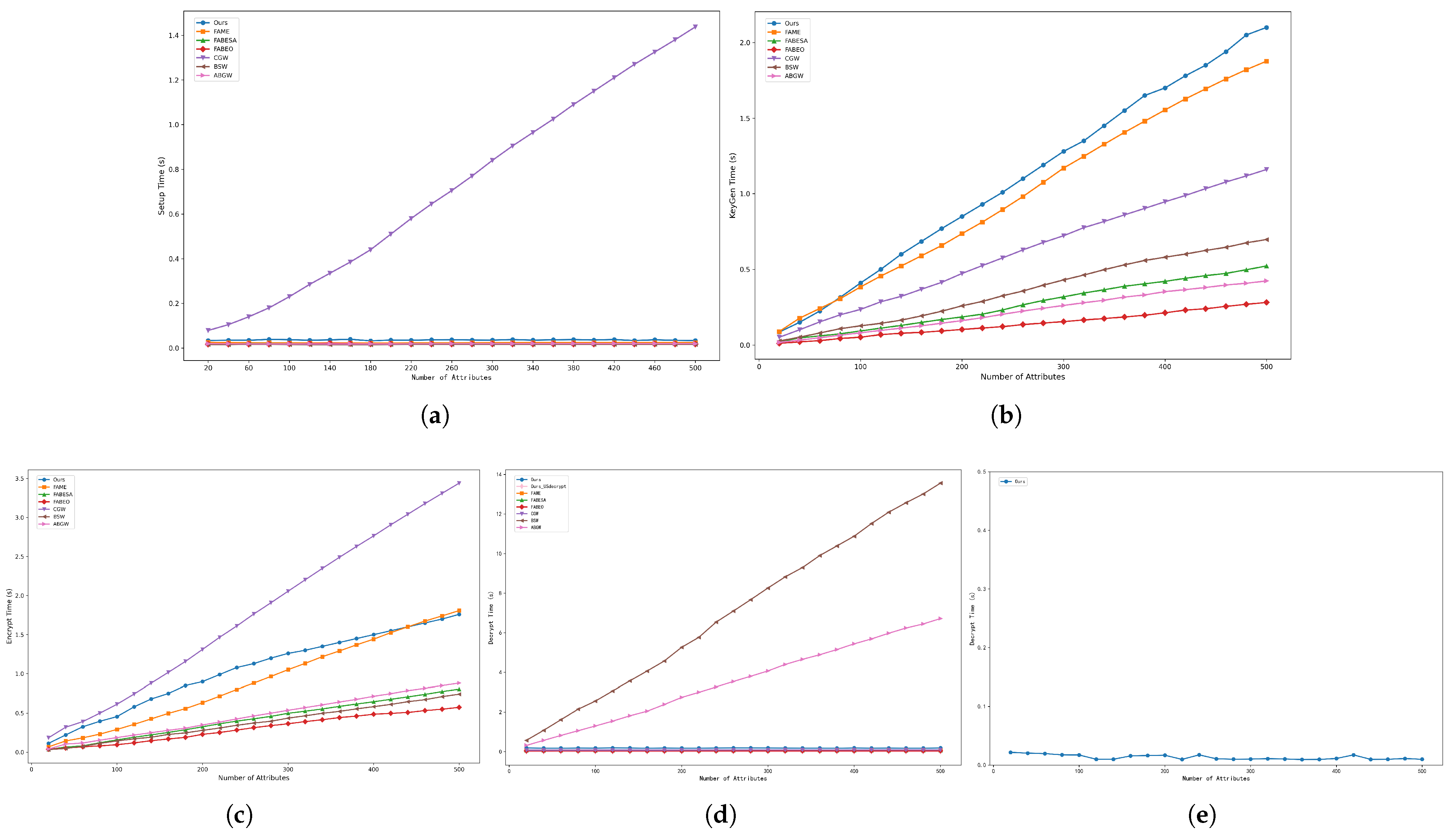
- Setup Time (Figure 2a): The LOR-A2ABE scheme demonstrates significantly higher efficiency in setup time compared to the CGW schemes (which grows from 79 ms to 1.44 s). While it exhibits a slightly longer initialization time (≈35 ms) than schemes such as FABESA (≈19 ms) and FABEO (≈18 ms), its overall setup duration remains low and stable, showcasing the scheme’s reliable and efficient initialization characteristics.
- Key Generation Time (Figure 2b): The experimental results for key generation align with the theoretical analysis. The introduction of a hash operation and an additional pairing to enable the revocation feature results in a higher key issuance time for LOR-A2ABE (86 ms to 2.1 s) compared to other schemes (e.g., FABEO: 11 ms to 281 ms). However, this overhead remains comparable to that of the FAME scheme (89 ms to 1.88 s) and within an acceptable range. It is important to note that LOR-A2ABE targets “cloud–terminal” Centralized IoT Management Environments, where data acquisition systems are relatively static, and key issuance is not a frequent operation. Consequently, the increased key generation overhead has minimal practical impact in real-world deployment.
- Encryption Time (Figure 2c): Consistent with the theoretical expectations, the encryption time of LOR-A2ABE (113 ms to 1.76 s) is marginally higher than that of other schemes (e.g., FABESA: 34 ms to 805 ms) due to the concentration of all computations within the group. Nevertheless, its time growth curve exhibits a relatively flat trend, in contrast to the near-linear growth observed in schemes like CGW (184 ms to 3.44 s) and FAME (68 ms to 1.81 s). This indicates that the LOR-A2ABE scheme can maintain stable encryption efficiency even when handling a large number of attributes.
- Total Decryption Time (Figure 2d): The LOR-A2ABE scheme demonstrates a distinct advantage in total decryption time (constant ≈185 ms). Its performance is comparable to that of efficient schemes like FABESA (≈60 ms) and FABEO (≈45 ms), and crucially, it remains largely invariant with respect to the number of attributes—unlike BSW (572 ms to 13.56 s) and ABGW (316 ms to 6.71 s). Notably, when employing outsourced decryption techniques, the user-side decryption efficiency of LOR-A2ABE drops to only ≈0.2 ms, which is the fastest among all evaluated schemes. This makes it particularly suitable for environments where decryption operations are frequent and user-end resources are severely constrained.
- Revocation Time (Figure 2e): The LOR-A2ABE scheme exhibits constant and low revocation overhead (9.7–22 ms) as the number of attributes increases. This scalability characteristic demonstrates the efficiency of its partial update mechanism, which avoids the linear-cost re-encryption required by traditional revocation approaches.
5.3. Theoretical Analysis of Revocation Mechanisms
5.4. Performance Inference and Analysis for IoT Terminals
6. Conclusions and Future Work
Author Contributions
Funding
Data Availability Statement
Conflicts of Interest
References
- Elhattab, K.; Abouelmehdi, K.; Elmoutaouakkil, A. Internet of things (iot) for smart city, agriculture and healthcare. J. Theor. Appl. Inf. Technol. 2022, 100, 1104–1112. [Google Scholar]
- Nassereddine, M.; Khang, A. Applications of internet of things (iot) in smart cities. In Advanced IoT Technologies and Applications in the Industry 4.0 Digital Economy; CRC Press: Boca Raton, FL, USA, 2024; pp. 109–136. [Google Scholar]
- Babayigit, B.; Abubaker, M. Industrial internet of things: A review of improvements over traditional scada systems for industrial automation. IEEE Syst. J. 2023, 18, 120–133. [Google Scholar] [CrossRef] [Scilit]
- Dangana, M. Suitability of NB-IoT for indoor industrial environment: A survey and insights. Sensors 2021, 21, 5284. [Google Scholar] [CrossRef] [Scilit]
- Shala, B. Novel trust consensus protocol and blockchain-based trust evaluation system for M2M application services. Internet Things 2019, 7, 100058. [Google Scholar] [CrossRef] [Scilit]
- Luft, A.; Luft, N.; Arntz, K. A basic description logic for service-oriented architecture in factory planning and operational control in the age of industry 4.0. Appl. Sci. 2023, 13, 7610. [Google Scholar] [CrossRef] [Scilit]
- Wang, W. Smart contract token-based privacy-preserving access control system for industrial internet of things. Digit. Commun. Netw. 2023, 9, 337–346. [Google Scholar] [CrossRef] [Scilit]
- Al-Hawawreh, M. Securing the industrial internet of things against ransomware attacks: A comprehensive analysis of the emerging threat landscape and detection mechanisms. J. Netw. Comput. Appl. 2024, 223, 103809. [Google Scholar] [CrossRef] [Scilit]
- Costa, B. Orchestration in fog computing: A comprehensive survey. ACM Comput. Surv. 2022, 55, 1–34. [Google Scholar] [CrossRef] [Scilit]
- Aljubayrin, S. Dynamic offloading strategy for computational energy efficiency of wireless power transfer based MEC networks in industry 5.0. J. King Saud Univ.-Comput. Inf. Sci. 2023, 35, 101841. [Google Scholar] [CrossRef] [Scilit]
- Abid, A.; Jemili, F.; Korbaa, O. Real-time data fusion for intrusion detection in industrial control systems based on cloud computing and big data techniques. Clust. Comput. 2024, 27, 2217–2238. [Google Scholar] [CrossRef] [Scilit]
- Ganga Shirisha, M.S. Secured iot data management using aes encryption and blockchain technology. J. Inf. Syst. Eng. Manag. 2025, 10, 728–735. [Google Scholar] [CrossRef] [Scilit]
- Ibrahim, Z.A.; Ilyas, M. Hidden hierarchy based on cipher-text attribute encryption for iot data privacy in cloud. Comput. Mater. Contin. 2023, 76, 939–956. [Google Scholar]
- Mohammed, M.A.; Abdul Wahab, H.B. Enhancing iot data security with lightweight blockchain and okamoto uchiyama homomorphic encryption. CMES-Comput. Model. Eng. Sci. 2024, 138, 1731–1748. [Google Scholar] [CrossRef] [Scilit]
- Mishra, N.; Islam, S.H.; Zeadally, S. A survey on security and cryptographic perspective of industrial-internet-of-things. Internet Things 2024, 25, 101037. [Google Scholar] [CrossRef] [Scilit]
- Aljrees, T. Enhancing iot security through a green and sustainable federated learning platform: Leveraging efficient encryption and the quondam signature algorithm. Sensors 2023, 23, 8090. [Google Scholar] [CrossRef] [Scilit]
- Li, Y. Research on Distributed Operation Mode of Internet of Things. J. Phys. Conf. Ser. 2021, 1827, 012129. [Google Scholar] [CrossRef] [Scilit]
- Bhalla, T.; Kaur, R. Convergence of Internet of Things (IoT) and Edge Computing: Enhancing Scalability and Efficiency Through Cloud Integration: A Review. Int. J. Eng. Sci. Humanit. 2024, 14, 233–239. [Google Scholar] [CrossRef] [Scilit]
- Mehta, A.; Verma, R.K. QoS-aware edge server placement for collaborative predictive maintenance in industrial internet of things. J. Supercomput. 2024, 80, 19324–19350. [Google Scholar] [CrossRef] [Scilit]
- Mishra, R.K.; Yadav, R.K.; Nath, P. Access control models and frameworks for the iot environment: Review, challenges, and future direction. Wirel. Pers. Commun. 2024, 138, 1671–1701. [Google Scholar] [CrossRef] [Scilit]
- Duan, L. Secure and fine-grained data sharing in internet of things: Integration of interplanetary file system and cross-blockchain for access control. IEEE Internet Things J. 2025, 12, 37301–37308. [Google Scholar] [CrossRef] [Scilit]
- Yao, M. Efficient and verifiable bilateral fine-grained access control for cloud-edge iot healthcare. IEEE Internet Things J. 2025, 12, 43181–43194. [Google Scholar] [CrossRef] [Scilit]
- Bethencourt, J.; Sahai, A.; Waters, B. Ciphertext-policy attribute-based encryption. In Proceedings of the 2007 IEEE Symposium on Security and Privacy, Berkeley, CA, USA, 20–23 May 2007; pp. 321–334. [Google Scholar]
- Hafizpour, H. New attribute-based encryption schemes with anonymous authentication and time limitation in fog computing. Concurr. Comput. Pract. Exp. 2023, 35, e7681. [Google Scholar]
- Chawla, S.; Gupta, N. A proxy-based and collusion resistant multi-authority revocable cpabe framework with efficient user and attribute-level revocation. Int. J. Saf. Secur. Eng. 2023, 13, 527–538. [Google Scholar]
- Zhao, H. Efficient key management scheme for health blockchain. CAAI Trans. Intell. Technol. 2018, 3, 114–118. [Google Scholar] [CrossRef] [Scilit]
- Chen, J.; Gay, R.; Wee, H. Improved dual system abe in prime-order groups via predicate encodings. In Annual International Conference on the Theory and Applications of Cryptographic Techniques; Springer: Berlin/Heidelberg, Germany, 2015. [Google Scholar]
- Ambrona, M. Attribute-based encryption in the generic group model: Automated proofs and new constructions. In Proceedings of the 2017 ACM SIGSAC Conference on Computer and Communications Security, Dallas, TX, USA, 30 October–3 November 2017; Association for Computing Machinery: New York, NY, USA, 2017; pp. 647–664. [Google Scholar]
- Agrawal, S.; Chase, M. FAME: Fast attribute-based message encryption. In Proceedings of the 2017 ACM SIGSAC Conference on Computer and Communications Security, Dallas, TX, USA, 30 October–3 November 2017; Association for Computing Machinery: New York, NY, USA, 2017. [Google Scholar]
- Riepel, D.; Wee, H. FABEO: Fast attribute-based encryption with optimal security. In Proceedings of the 2022 ACM SIGSAC Conference on Computer and Communications Security, Los Angeles, CA, USA, 7–11 November 2022; Association for Computing Machinery: New York, NY, USA, 2022; pp. 2491–2504. [Google Scholar]
- Meng, L. FABESA: Fast (and anonymous) attribute-based encryption under standard assumption. In Proceedings of the 2024 ACM SIGSAC Conference on Computer and Communications Security, Salt Lake City, UT, USA, 14–18 October 2024; Association for Computing Machinery: New York, NY, USA, 2024; pp. 4688–4702. [Google Scholar]
- Yang, H.; Feng, T.; Yan, Y. Implementing efficient attribute encryption in iov under cloud environments. Comput. Netw. 2022, 218, 109363. [Google Scholar]
- Zhang, Z.; Zhou, S. A decentralized strongly secure attribute-based encryption and authentication scheme for distributed internet of mobile things. Comput. Netw. 2021, 201, 108553. [Google Scholar] [CrossRef] [Scilit]
- Luo, W. FOC-PH-CP-ABE: An efficient CP-ABE scheme with fully outsourced computation and policy-hidden in the industrial internet of things. IEEE Sens. J. 2024, 24, 28971–28981. [Google Scholar] [CrossRef] [Scilit]
- Tao, Y. ORR-CP-ABE: A secure and efficient outsourced attribute-based encryption scheme with decryption results reuse. Future Gener. Comput. Syst. 2024, 161, 559–571. [Google Scholar]
- Deng, S. Flexible revocation in ciphertext-policy attribute-based encryption with verifiable ciphertext delegation. Multimed. Tools Appl. 2023, 82, 22251–22274. [Google Scholar] [CrossRef] [Scilit]
- Han, D.; Pan, N.; Li, K.-C. A traceable and revocable ciphertext-policy attribute-based encryption scheme based on privacy protection. IEEE Trans. Dependable Secur. Comput. 2020, 19, 316–327. [Google Scholar] [CrossRef] [Scilit]
- Lai, J.; Deng, R.H.; Li, Y. Expressive CP-ABE with partially hidden access structures. In Proceedings of the 7th ACM Symposium on Information, Computer and Communications Security, Seoul, Republic of Korea, 2–4 May 2012; Association for Computing Machinery: New York, NY, USA, 2012; pp. 18–19. [Google Scholar]
- Beuchat, J.-L.; González-Díaz, J.E.; Mitsunari, S.; Okamoto, E.; Rodríguez-Henríquez, F.; Teruya, T. High-speed software implementation of the optimal ate pairing over Barreto–Naehrig curves. In Pairing-Based Cryptography—Pairing 2010; Lecture Notes in Computer Science; Springer: Berlin/Heidelberg, Germany, 2010; Volume 6487, pp. 21–39. [Google Scholar]
- Perazzo, P.; Righetti, F.; Manna, M.L.; Vallati, C. Performance evaluation of Attribute-Based Encryption on constrained IoT devices. Comput. Commun. 2021, 170, 151–163. [Google Scholar] [CrossRef] [Scilit]
- Ameer, S.; Benson, J.; Sandhu, R. Hybrid approaches (ABAC and RBAC) toward secure access control in smart home IoT. IEEE Trans. Dependable Secur. Comput. 2022, 20, 4032–4051. [Google Scholar] [CrossRef] [Scilit]



| Schemes | Key Generation | Encryption | Decryption |
|---|---|---|---|
| BSW [23] | |||
| CGW [27] | |||
| ABGW [28] | |||
| FAME [29] | |||
| FABEO [30] | |||
| FABESA [31] | |||
| LOR-A2ABE |
| Scheme | Security Level | Key Update | Ciphertext Update | Outsourced Decryption |
|---|---|---|---|---|
| LOR-A2ABE | 128-bit (BN254) | ✓ | ||
| MTA [36] | 96-bit (SS512) | × | ||
| TRH [37] | 96-bit (SS512) | × |
Disclaimer/Publisher’s Note: The statements, opinions and data contained in all publications are solely those of the individual author(s) and contributor(s) and not of MDPI and/or the editor(s). MDPI and/or the editor(s) disclaim responsibility for any injury to people or property resulting from any ideas, methods, instructions or products referred to in the content. |
© 2026 by the authors. Licensee MDPI, Basel, Switzerland. This article is an open access article distributed under the terms and conditions of the Creative Commons Attribution (CC BY) license.
Share and Cite
Gao, D.; Xu, H.; Qian, S. LOR-A2ABE: Lightweight and Revocable Attribute-Anonymous ABE with Outsourced Decryption in Centralized IoT. Symmetry 2026, 18, 298. https://doi.org/10.3390/sym18020298
Gao D, Xu H, Qian S. LOR-A2ABE: Lightweight and Revocable Attribute-Anonymous ABE with Outsourced Decryption in Centralized IoT. Symmetry. 2026; 18(2):298. https://doi.org/10.3390/sym18020298
Chicago/Turabian StyleGao, Dan, Huanhuan Xu, and Shuqu Qian. 2026. "LOR-A2ABE: Lightweight and Revocable Attribute-Anonymous ABE with Outsourced Decryption in Centralized IoT" Symmetry 18, no. 2: 298. https://doi.org/10.3390/sym18020298
APA StyleGao, D., Xu, H., & Qian, S. (2026). LOR-A2ABE: Lightweight and Revocable Attribute-Anonymous ABE with Outsourced Decryption in Centralized IoT. Symmetry, 18(2), 298. https://doi.org/10.3390/sym18020298