The Influence of Machining Deformation on the Pointing Accuracy of Pod-Type Space Self-Deployable Structures
 ,
,
Abstract
1. Introduction
2. Simulation Methods and Experiment Design
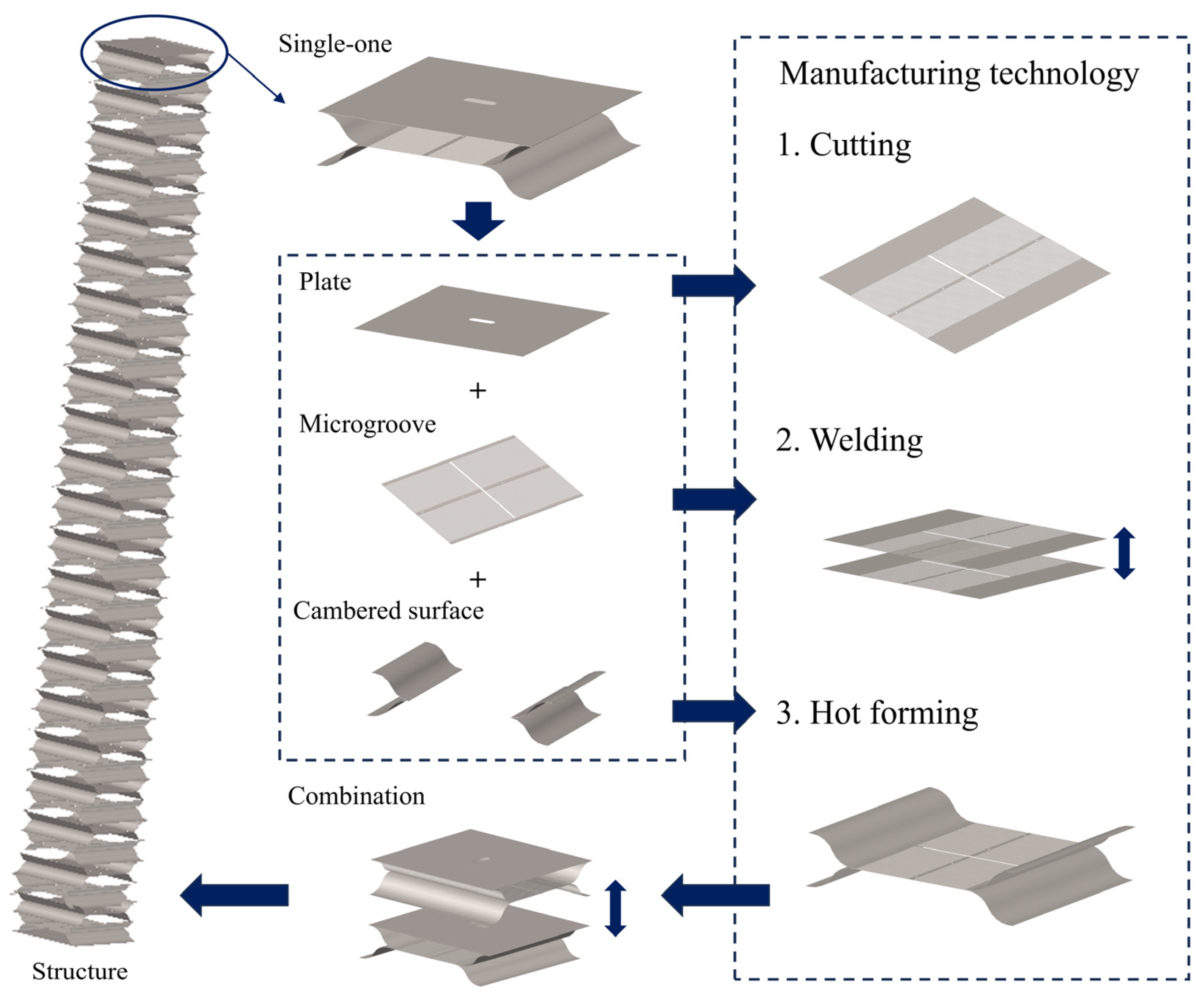
2.1. Structure Introduction and Processing Methods
2.2. Simulation Model Construction
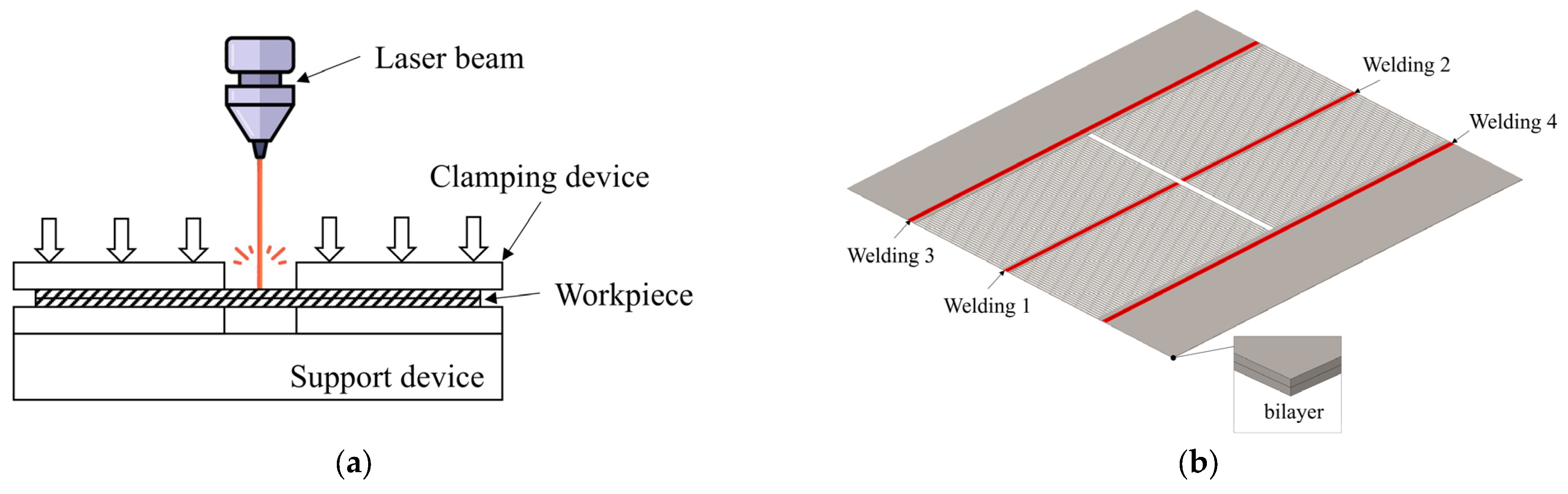
2.2.1. Welding Process
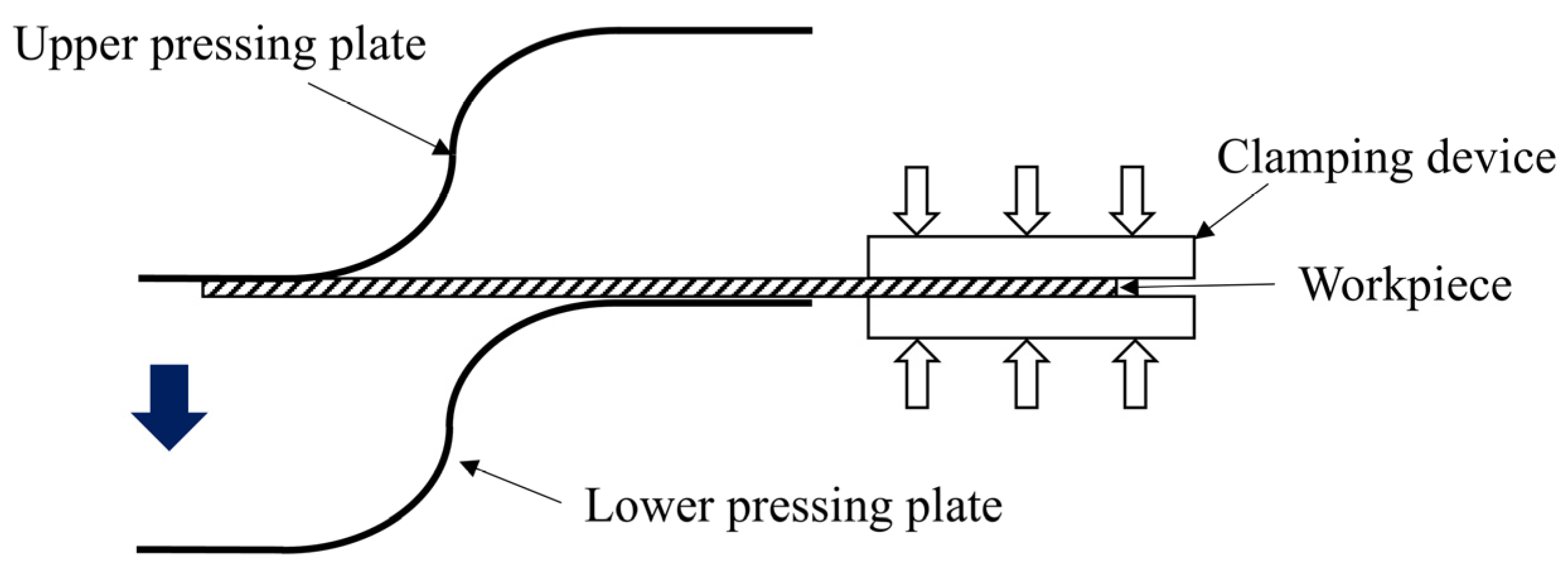
2.2.2. Hot Forming Process
2.3. Orthogonal Experiment Design
2.3.1. Scheme Design
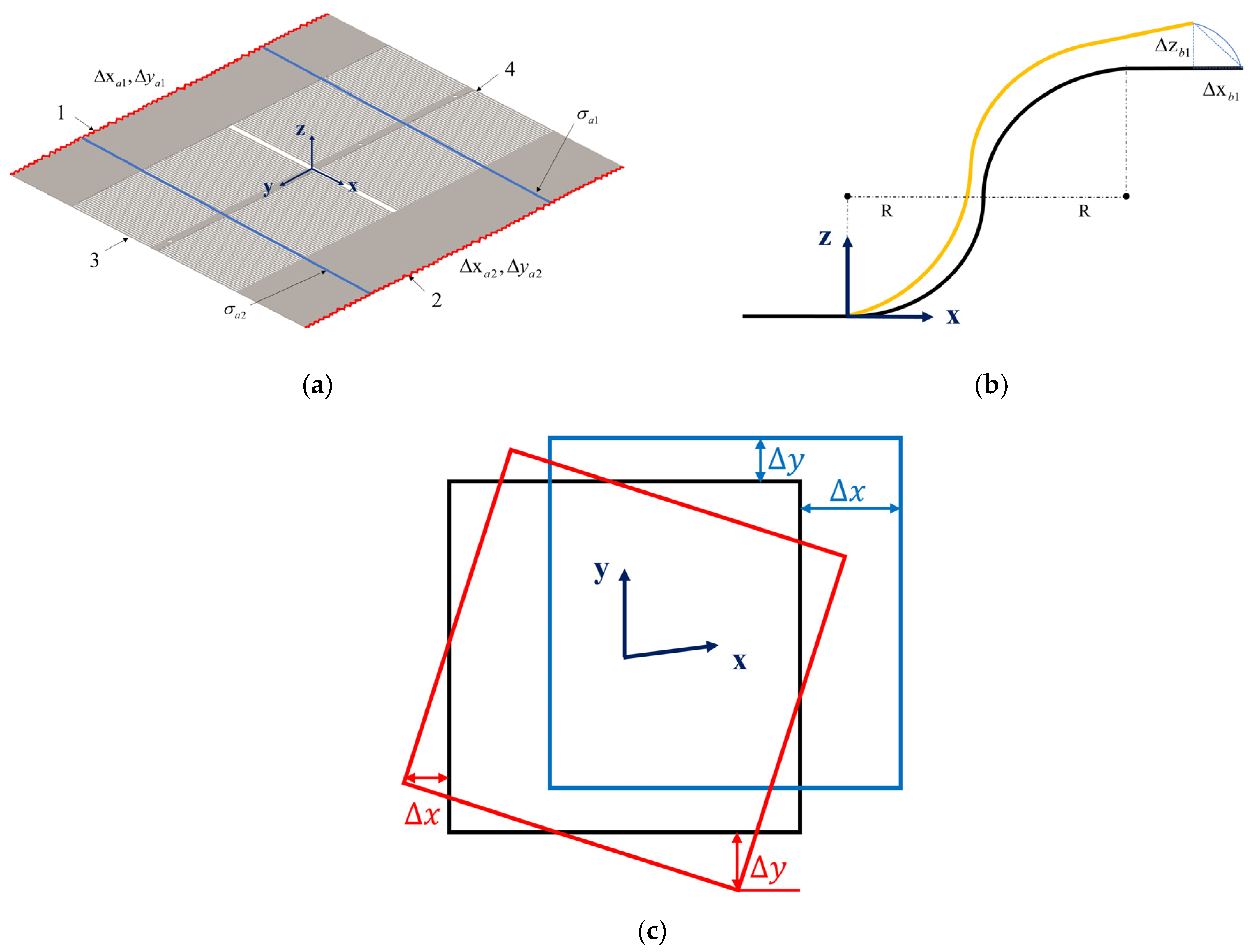
2.3.2. Evaluation Indicators
- Laser Welding
- 2.
- Hot Forming
- 3.
- Overall Pointing Accuracy
3. Results and Analysis
3.1. Simulation Results
3.2. Sensitivity Analysis of Process Parameters
3.3. Machining Experiment Verification
4. Conclusions
- (1)
- The sensitivity ranking of process parameters to pointing accuracy is quantified. In laser welding, welding speed is the most significant factor affecting structural deformation, followed by laser power, and spot diameter has the weakest influence; in hot forming, processing temperature and holding time have similar effects on deformation, and the sensitivity of holding time is slightly dominant.
- (2)
- The optimal parameter combination for machining pod-type structures is proposed. Laser welding adopts a laser power of 180 W, a spot diameter of 3.5 mm, and a welding speed of 6 mm/s; hot forming adopts a temperature of 650 °C and a holding time of 4800 s. Through physical machining verification, the measured terminal pointing deformation of a single pod structure is 0.164 mm and 0.034 mm, both meeting the engineering index of ≤0.2 mm and showing high consistency with the simulation results.
- (3)
- The engineering practical value of the research is clarified. This parameter combination can be directly applied to the machining and production of key components such as large spacecraft antennas and satellite solar wings, effectively controlling the machining deformation and residual stress of thin-walled special-shaped structures, reducing the trial-and-error cost of high-precision manufacturing, and providing reliable technical support for the stable application of high-pointing accuracy structures in missions such as deep space exploration and space communication.
Author Contributions
Funding
Data Availability Statement
Conflicts of Interest
References
- Tong, X.; Deng, Y.; Jing, S. Structure and Mechanism System Design and Optimization of China Manned Spacecraft. Spacecr. Eng. 2022, 31, 117–129. (In Chinese) [Google Scholar]
- Liu, Z.Q.; Qiu, H.; Li, X.; Yang, S.-L. Review of Large Spacecraft Deployable Membrane Antenna Structures. Chin. J. Mech. Eng. 2017, 30, 1447–1459. [Google Scholar] [CrossRef]
- Keith Belvin, W.; Dorsey, J.T.; Judith, J. Watson Technology Challenges and Opportunities for Very Large In-Space Structural Systems. In International Symposium on Solar Energy from Space; Langley Research Center: Hampton, VA, USA, 2009. [Google Scholar]
- Sharma, D.; Mishra, A.K.; Kumar, R.; Lad, C.B.; Mishra, S.; Bhan, R.K.; Rao, B.J.; Nath, P.K.; Rao, C.V.N. Autonomous Characterization of NISAR S-Band SAR Primary Antenna. In Proceedings of the 2022 URSI Regional Conference on Radio Science (USRI-RCRS), Indore, India, 1–4 December 2022. [Google Scholar]
- Liu, Q.H.; Shen, Z.Q.; Hong, X.Y.; Ye, Q.; Li, B.; Wang, J.; Zhao, R.; Fu, L.; Zhong, W.; Wang, L.; et al. The Tianma 65 m radio telescope at Shanghai. Astron. Tech. Instrum. 2024, 1, 239–246. [Google Scholar] [CrossRef]
- Zhao, B.; Zhang, B.; Lv, D.; Wang, Q.; Wang, L.; Zhang, Y.; Wang, Y. Precision assembly and testing technology for multi axis mechanisms of high-precision antennas in space. Aerosp. Manuf. Technol. 2022, 5, 41–44. (In Chinese) [Google Scholar]
- Ma, X.; Yu, D.; Sun, J.; Hu, S.W. The Researching Evolvement of Spacecraft Deployment and Driving Mechanism. J. Astronaut. 2006, 27, 1123–1131. (In Chinese) [Google Scholar]
- Shuo, Y. Design and Mechanical Properties of Electromagnetic-Like Orthogonal Preserving Elastic Self-Deployment Structures. Ph.D. Thesis, University of Science and Technology, Beijing, China, 2022. (In Chinese) [Google Scholar]
- Shuo, Y.; Jie, Z.; Ning, K. Deformation Law Model and Simulation Verification of Pod Structures with Large Exhibition-to-Receive Ratio for Aerospace Applications. China Mech. 2023, 34, 780–788. [Google Scholar]
- Wang, Y.; Zhang, T.; Meng, Q. Hot forming process of flanging structure for TC4 titanium alloy with thin wall and curved surface on both sides. J. Plast. Eng. 2022, 29, 62–68. (In Chinese) [Google Scholar]
- Zhang, T.; Xia, J.; Han, X.; Du, L.; Chen, L.; Han, Y.; Cao, F.; Wang, D.; Liu, X. Deformation Control of TC4 Titanium Alloy in Thin-Walled Hyperbolic Structures During Hot Forming Processes. Materials 2024, 17, 6146. [Google Scholar] [CrossRef]
- Guo, W.; Shi, L.; Cao, J.; Zhang, B.; Sun, G.; Fang, G. Hot drawing deep forming of Ti6Al4V titanium alloy box shaped parts. Forg. Technol. 2023, 48, 87–93. (In Chinese) [Google Scholar] [CrossRef]
- Shao, C.; Ma, J.; Huang, S.; Lan, L.; Wu, G. Numerical simulation study on laser welding deformation of curved sandwich structure. J. Mech. Eng. 2025, 61, 121–132. (In Chinese) [Google Scholar]
- Zhao, Y.; Zhan, X.; Gu, Y.; Wang, C. Simulation study on laser welding deformation of frame truss rocket storage tank wall structure. Aerosp. Mater. Technol. 2023, 53, 69–74. (In Chinese) [Google Scholar]
- Feng, D.; Zhou, W.; Jie, W. Effect of welding process on formation of weld and bearing capacity of thin-walled ring titanium alloy. Welding 2023, 4, 55–59. (In Chinese) [Google Scholar]
- Pushp, P.; Dasharath, S.; Arati, C. Classification and applications of titanium and its alloys. Mater. Today Proc. 2022, 54, 537–542. [Google Scholar] [CrossRef]
- GB/T 2965-2023; Titanium and Titanium Alloy Rods. China Standards Press: Beijing, China, 2023.
- Scintilla, L.; Palumbo, G.; Sorgente, D. Fiber laser cutting of Ti6Al4V sheets for subsequent welding operations: Effect of cutting parameters on butt joints mechanical properties and strain behaviour. Mater. Des. 2013, 47, 300–308. [Google Scholar] [CrossRef]
- Jing, Y.; Donghai, C.; Jihua, H. Microstructure and Mechanical Properties of Ti-6AL-4V Joints by Laser Beam Welding. Rare Met. Mater. Eng. 2009, 38, 259–262. (In Chinese) [Google Scholar]
- Liang, Q.; Xuan, S.; Wang, T. Comparison of Microstructure and Properties of TC4 Alloy Under Different Welding Processes. Hot Work. Technol. 2016, 45, 19–22+30. (In Chinese) [Google Scholar]
- Li, X. Study on the Effect of Stress Relaxation on Rebound in TC4 Titanium Alloy Hot Tensile Bending. Ph.D. Thesis, Yanshan University, Qinhuangdao, China, 2022. (In Chinese) [Google Scholar] [CrossRef]
- Du, S.; Chen, M.; Xie, L. Short-term creep constitutive relation and stress relaxation behavior of Ti6Al4V alloy at high temperature. Chin. J. Nonferrous Met. 2015, 25, 3344–3351. (In Chinese) [Google Scholar]
- Zuo, Y.; Guang, J.; Li, Z.; Xie, P.; Yang, F. Design of the spontaneous deployable structure for space diffractive telescope. Infrared Laser Eng. 2017, 46, 1218001. (In Chinese) [Google Scholar] [CrossRef]
- Huang, G.; Ma, K.; Bai, H.; Ma, X.; Wang, Y. Close-range Photogrammetry for Surface Thermal Deformation of Large-scale Deployable Antennas. J. Mech. Eng. 2020, 56, 65–71. [Google Scholar]
- Chen, H.; Huo, Y.; Wang, Z.; Yan, Z.; Hosseini, S.R.E.; Ji, H.; Yu, W.; Wang, Z.; Li, Z.; Yue, X. An unified viscoplastic micro-damage constitutive model for NiAlCrFeMo high-entropy alloys at elevated temperatures considering triaxiality stress. J. Alloys Compd. 2025, 1038, 182707. [Google Scholar] [CrossRef]
- Li, Y.; Chang, J.; Xuan, Y.; Yang, Z.; Yue, J.; Su, G.; Li, X.; Zhang, Z. High-strength TC4 alloy with modified composition and multiscale heterogeneity fabricated by direct energy deposition. J. Alloys Compd. 2025, 1026, 180458. [Google Scholar] [CrossRef]
- Zhou, Z.; Huo, Y.; Wang, Z.; Demir, E.; Jiang, A.; Yan, Z.; He, T. Experimental investigation and crystal plasticity modelling of dynamic recrystallisation in dual-phase high entropy alloy during hot deformation. Mater. Sci. Eng. A 2025, 922, 147634. [Google Scholar] [CrossRef]



| Elastic Modulus (GPa) | Density (g/cm3) | Poisson’s Ratio | Thermal Conductivity (W/(m·K)) | Specific Heat Capacity (J/(kg·K)) | Linear Expansion Coefficient (/°C) | Yield Strength (MPa) |
|---|---|---|---|---|---|---|
| 88 | 4.49 | 0.34 | 7.8 | 610 | 9.5 × 10⁻⁶ | 860 |
| Experiment No. | Laser Welding | Hot Forming | |||
|---|---|---|---|---|---|
| Laser Power P (kW) | Spot Diameter d (mm) | Welding Speed v (mm/s) | Forming Temperature T (°C) | Holding Time t (s) | |
| 1 | 0.18 | 2.5 | 4 | 550 | 2400 |
| 2 | 0.18 | 3.0 | 5 | 550 | 3600 |
| 3 | 0.18 | 3.5 | 6 | 550 | 4800 |
| 4 | 0.20 | 2.5 | 5 | 600 | 2400 |
| 5 | 0.20 | 3.0 | 6 | 600 | 3600 |
| 6 | 0.20 | 3.5 | 4 | 600 | 4800 |
| 7 | 0.22 | 2.5 | 6 | 650 | 2400 |
| 8 | 0.22 | 3.0 | 4 | 650 | 3600 |
| 9 | 0.22 | 3.5 | 5 | 650 | 4800 |
| Laser Welding | Condition | /μm | /μm | /μm | /μm | /Mpa |
| 1 | −124.3 | 95.214 | 134.51 | 43.211 | 113.37 | |
| 2 | −89.401 | 71.554 | 95.692 | 27.501 | 85.621 | |
| 3 | −65.251 | 46.925 | 137.29 | 42.671 | 57.878 | |
| 4 | −108.44 | 84.524 | 116.76 | 32.176 | 95.57 | |
| 5 | −83.334 | 64.982 | 89.853 | 26.224 | 74.979 | |
| 6 | −114.91 | 89.032 | 123.86 | 34.883 | 100.3 | |
| 7 | −99.155 | 76.608 | 106.94 | 31.1 | 88.472 | |
| 8 | −135.08 | 103.79 | 145.54 | 40.407 | 116.44 | |
| 9 | −102.43 | 80.64 | 109.35 | 27.598 | 90.74 | |
| Hot Forming | Condition | /μm | /μm | /Mpa | ||
| 1 | 78.2 | 99.1 | 25.76 | |||
| 2 | 52.4 | 64.6 | 24.13 | |||
| 3 | 44.5 | 53.8 | 21.52 | |||
| 4 | 65.4 | 80.6 | 24.04 | |||
| 5 | 46.9 | 58.0 | 23.47 | |||
| 6 | 41.9 | 51.9 | 22.38 | |||
| 7 | 42.9 | 53.2 | 21.91 | |||
| 8 | 40.0 | 49.2 | 20.78 | |||
| 9 | 39.1 | 47.8 | 18.78 | |||
| Type | Indicator | Parameters | Level | Laser Power | Spot Diameter | Welding Speed |
|---|---|---|---|---|---|---|
| Laser Welding | /μm | Average Value | 1 | 122.5 | 119.4 | 134.64 |
| 2 | 110.16 | 110.36 | 107.27 | |||
| 3 | 120.61 | 123.5 | 111.36 | |||
| Range R | 12.34 | 13.14 | 27.37 | |||
| Optimal Level | 2 | 2 | 2 | |||
| /μm | Average Value | 1 | 71.23 | 85.45 | 96.01 | |
| 2 | 79.51 | 80.11 | 78.91 | |||
| 3 | 87.01 | 72.2 | 62.84 | |||
| Range R | 15.78 | 13.25 | 33.17 | |||
| Optimal Level | 1 | 3 | 3 | |||
| /MPa | Average Value | 1 | 85.62 | 99.14 | 110.04 | |
| 2 | 90.28 | 92.35 | 90.64 | |||
| 3 | 98.55 | 82.97 | 73.78 | |||
| Range R | 12.93 | 16.16 | 36.26 | |||
| Optimal Level | 1 | 3 | 3 | |||
| Type | Indicator | Parameter | Level | Forming Temperature | Holding Time | |
| Hot Forming | /μm | Average Value | 1 | 58.37 | 62.17 | |
| 2 | 51.4 | 46.43 | ||||
| 3 | 40.67 | 41.83 | ||||
| Range R | 17.7 | 20.33 | ||||
| Optimal Level | 3 | 3 | ||||
| /MPa | Average Value | 1 | 23.8 | 23.9 | ||
| 2 | 23.3 | 22.79 | ||||
| 3 | 20.49 | 20.89 | ||||
| Range R | 3.31 | 3.01 | ||||
| Optimal Level | 3 | 3 | ||||
| Type | Indicator | Process Parameter | F | p | ||
|---|---|---|---|---|---|---|
| Laser Welding | /μm | Laser Power | 265.081 | 132.54 | 0.245 | 0.803 |
| Spot Diameter | 271.15 | 135.575 | 0.251 | 0.8 | ||
| Welding Speed | 1307.595 | 653.798 | 1.209 | 0.453 | ||
| /μm | Laser Power | 373.897 | 186.949 | 69.508 | 0.014 | |
| Spot Diameter | 266.632 | 133.316 | 49.567 | 0.020 | ||
| Welding Speed | 1651.277 | 825.639 | 306.976 | 0.003 | ||
| /MPa | Laser Power | 257.194 | 128.597 | 18.226 | 0.052 | |
| Spot Diameter | 395.281 | 197.641 | 28.011 | 0.034 | ||
| Welding Speed | 1975.407 | 987.704 | 139.983 | 0.007 | ||
| Hot Forming | /μm | Forming Temperature | 477.029 | 238.514 | 3.764 | 0.12 |
| Holding Time | 682.142 | 341.071 | 5.382 | 0.073 | ||
| /MPa | Forming Temperature | 19.112 | 9.556 | 22.563 | 0.007 | |
| Holding Time | 13.902 | 6.951 | 16.412 | 0.012 |
| Measurement No. | X-Direction Component (mm) | Y-Direction Component (mm) |
|---|---|---|
| 1 | 0.167 | 0.030 |
| 2 | 0.172 | 0.035 |
| 3 | 0.154 | 0.038 |
| Mean Value | 0.164 | 0.034 |
| Simulation Result | 0.176 | 0.047 |
Disclaimer/Publisher’s Note: The statements, opinions and data contained in all publications are solely those of the individual author(s) and contributor(s) and not of MDPI and/or the editor(s). MDPI and/or the editor(s) disclaim responsibility for any injury to people or property resulting from any ideas, methods, instructions or products referred to in the content. |
© 2026 by the authors. Licensee MDPI, Basel, Switzerland. This article is an open access article distributed under the terms and conditions of the Creative Commons Attribution (CC BY) license.
Share and Cite
Zhao, B.; Zhu, S.; Zhang, B.; Huang, N.; Wu, B.; Shen, X.; Li, R.; Liu, X.; Yang, J.; Wang, Y.; et al. The Influence of Machining Deformation on the Pointing Accuracy of Pod-Type Space Self-Deployable Structures. Symmetry 2026, 18, 196. https://doi.org/10.3390/sym18010196
Zhao B, Zhu S, Zhang B, Huang N, Wu B, Shen X, Li R, Liu X, Yang J, Wang Y, et al. The Influence of Machining Deformation on the Pointing Accuracy of Pod-Type Space Self-Deployable Structures. Symmetry. 2026; 18(1):196. https://doi.org/10.3390/sym18010196
Chicago/Turabian StyleZhao, Benhua, Shiyu Zhu, Bin Zhang, Ning Huang, Bin Wu, Xiaoyu Shen, Rongjun Li, Xin Liu, Jing Yang, Yongli Wang, and et al. 2026. "The Influence of Machining Deformation on the Pointing Accuracy of Pod-Type Space Self-Deployable Structures" Symmetry 18, no. 1: 196. https://doi.org/10.3390/sym18010196
APA StyleZhao, B., Zhu, S., Zhang, B., Huang, N., Wu, B., Shen, X., Li, R., Liu, X., Yang, J., Wang, Y., & Geng, H. (2026). The Influence of Machining Deformation on the Pointing Accuracy of Pod-Type Space Self-Deployable Structures. Symmetry, 18(1), 196. https://doi.org/10.3390/sym18010196