Article

Machine Learning-Based Diffusion Processes for the Estimation of Stand Volume Yield and Growth Dynamics in Mixed-Age and Mixed-Species Forest Ecosystems

by
Petras Rupšys
1,2,3
1
Department of Mathematics and Statistics, Faculty of Informatics, Vytautas Magnus University, 53361 Kaunas, Lithuania
2
Bioeconomy Research Institute, Vytautas Magnus University, 53361 Kaunas, Lithuania
3
VŠĮ Forest 4.0, Vytautas Magnus University, 53361 Kaunas, Lithuania
Symmetry 2026, 18(1), 194; https://doi.org/10.3390/sym18010194
Submission received: 5 November 2025 / Revised: 14 January 2026 / Accepted: 15 January 2026 / Published: 20 January 2026

Abstract

This investigation examines diffusion processes for predicting whole-stand volume, incorporating the variability and uncertainty inherent in regional, operational, and environmental factors. The distribution and spatial organization of trees within a specified forest region, alongside dynamic fluctuations and intricate uncertainties, are modeled by a set of nonsymmetric stochastic differential equations of a sigmoidal nature. The study introduces a three-dimensional system of stochastic differential equations (SDEs) with mixed-effect parameters, designed to quantify the dynamics of the three-dimensional distribution of tree-size components—namely diameter (diameter at breast height), potentially occupied area, and height—with respect to the age of a tree. This research significantly contributes by translating the analysis of tree size variables, specifically height, occupied area, and diameter, into stochastic processes. This transformation facilitates the representation of stand volume changes over time. Crucially, the estimation of model parameters is based exclusively on measurements of tree diameter, occupied area, and height, avoiding the need for direct tree volume assessments. The newly developed model has proven capable of accurately predicting, tracking, and elucidating the dynamics of stand volume yield and growth as trees mature. An empirical dataset composed of mixed-species, uneven-aged permanent experimental plots in Lithuania serves to substantiate the theoretical findings. According to the dataset under examination, the model-based estimates of stand volume per hectare in this region exhibited satisfactory goodness-of-fit statistics. Specifically, the root mean square error (and corresponding relative root mean square error) for the living trees of mixed, pine, spruce, and birch tree species were 68.814 m3 (20.4%), 20.778 m3 (7.8%), 32.776 m3 (37.3%), and 4.825 m3 (26.3%), respectively. The model is executed within Maple, a symbolic algebra system.

1. Introduction

Forest growth and yield models are useful in forest management and for developing stand harvesting strategies. Whole-stand volume growth and yield models often incorporate stand-level attributes such as dominant height, stem density, mortality, basal area, and quadratic diameter [1,2,3]. These characteristics naturally appear organically concerning the stand’s age (or time in years). One of the most popular uses of whole-stand volume models is to predict the future development of an existing forest based on National Forest Inventory measurements. Due to research on various forest types, forest statisticians have been developing a model system to quantify relationships between tree variables [4,5]. Such a system comprises several stages during the lifecycle of a stand, reflecting the development of various tree-size components as the stand matures. On the other hand, it allows us to state that tree age provides excellent insight into the changes in variables related to individual tree size and other whole-stand attributes [6]. Forests naturally undergo continual transformation due to growth, plant competition, and other factors, including individual tree death, which gives other plants momentary advantages in terms of increased access to light, water, and nutrients in the soil. It should be noted that, due to National Forest Inventories and other experimental research studies typically providing measurements of individual tree size variables, the integration of an individual tree growth model into a whole-stand growth model significantly broadens the applicability of growth models for forest management. In recent decades, it has been demonstrated that considerable impacts on forests have resulted from changes in biodiversity, anomalies in the allocation of water resources, and significant fluctuations in the atmosphere [7,8]. Because stand development is influenced by disturbance regimes, endogenous developmental processes, and intrinsic vegetation characteristics, it poses a significant challenge for the rigorous analysis and accurate modeling of forest resources. As a result, the conventional idea of using regression models in forest management policy and practice needs to be expanded. The process-driven stochastic differential equations approach formalizes individual tree growth projections that, with the introduction of random effects and long age (time) spans, might theoretically be implemented over large areas. If large-scale site data are available, it would be straightforward to integrate these projections into a whole-stand growth and yield model.
The current state of development for generative machine learning across various sciences, based on experimental data from fields such as biology, forestry, finance, and others, is grounded in diffusion models (as stochastic differential equations) and flow approaches [9,10]. That is why an ordinary differential equation with a small stochastic perturbation at each time point is referred to as a stochastic differential equation [11,12,13]. Given their inherent randomness, SDEs should not overfit the data, as the unpredictability will eliminate any attempt to fit the irregular elements of the data too precisely. Stochastic differential equations can be used to define the underlying time-dependent distributions and transition processes in forest stand yield and growth techniques, particularly those in Bayesian methods or generative models, which make use of the joint probabilistic distributions of tree size components, including diameter, total height, and occupied area (alternatively, stand density). These equations identify the development of tree size components and allow us to assess the consequences of different stand management strategies. A key empirical finding concerning tree size distributions is that they exhibit positive skewness [14]. Theoretical investigations of tree growth dynamics have further demonstrated that the size–frequency distribution of trees typically assumes an inverse J-shaped form, characterized by a high abundance of small individuals and a low abundance of large individuals, primarily as a consequence of asymmetric competition [15]. The solution of a 4-parameter Gompertz-type diffusion process is described by an asymmetric probability density function, whose first and second moments (mean and variance) converge to finite limiting values as time tends to infinity. In contrast, certain other diffusion processes exhibit different structural properties. For instance, the Vasicek process is symmetric around its long-term mean, whereas the Bertalanffy-type process does not possess a finite variance. Additional examples share analogous distinctions. The stand density, mean tree cross-sectional area, cross-sectional area per hectare, and mean tree volume in mixed and uneven-aged stands were all successfully modeled using diffusion processes with mixed (fixed plus random) effect parameters [16,17,18]. The variability observed for a given tree size variable over different stands can be modeled by adding a random effect parameter (a normally distributed random variable) to the specific shape stochastic differential equation for each sample unit. Numerous studies on stochastic systems utilizing Markovian processes have been published in recent decades [19,20]. Modern modeling techniques have discovered many uses for the Gompertz diffusion process, whose deterministic version [21], the Gompertz growth curve, has been thoroughly explored [22,23]. Three-dimensional tree size variables, such as diameter, height, and potentially occupied area, must be included in the stand volume per hectare diffusion process. Additionally, each tree species must have a well-defined tree stem volume regression equation. Applications of multi-dimensional diffusion processes, including Vasicek-type and von Bertalanffy-type diffusion processes, have been the subject of several studies in recent decades that analyze parameter estimation techniques concerning statistical decision-making [24,25,26].
This study aims to answer the following fundamental question: How can we identify the three-dimensional SDE system that represents the hidden stochastic dynamics of stand volume given observations of tree diameter, height, and occupied area (or stand density) for a particular forest stand? Moreover, how can we compute the stand volume per hectare directly from the derived three-dimensional transition probability density function? The following is a summary of our work’s primary contributions:
  • First, we introduce a system of three-dimensional Gompertz-type stochastic differential equations that incorporates both fixed effect parameters and random effects, which differentiate the dynamics for different forest stands.
  • Second, we obtain closed-form formulas for the three-dimensional transition probability density function, estimate its parameters using the approximated maximum likelihood procedure and data from 48 experimental permanent plots in central Lithuania, and apply them to formalize our stand volume per hectare dynamic model using the integration operation and the stem volume regression equation.
  • Third, we analyze the evolution of stand volume per hectare, its current and mean annual increments concerning various stand-size attributes.
The principal contribution and innovation of this study lies in the introduction of a newly established three-dimensional diffusion process, which facilitates the rigorous definition and quantification of multiple stand attributes (e.g., stand volume per hectare, stand basal area per hectare, mean tree volume within the stand, etc.) for both living and dying trees. The temporal dynamics of stand size-related attributes of dying trees within forest stands have received limited attention in the forestry literature, despite their critical importance for accurately quantifying CO2 emissions. The developed model further facilitates a detailed quantitative analysis of stand growth by providing mathematical formulations for both current and mean stand increment per hectare, as well as quantifying the effects of selected stand attributes (e.g., mean diameter, mean height) on stand increment and other relevant factors.

2. Materials and Methods

The primary objective of this study was to elucidate the relationships among tree diameter, height, and potentially occupied area, and stand volume yield and growth processes, to characterize more precisely the dynamics of stand volume per hectare for both dying and living trees. In this study, the temporal dynamics of individual tree size variables (diameter, height, and occupied area) were characterized within a univariate diffusion process framework. Pairwise correlation coefficients among these size components were utilized to reconstruct the corresponding covariance structure. On this basis, the exact three-dimensional transition probability density function characterizing their joint temporal evolution was rigorously derived. The temporal evolution of tree-size variables is modeled using a mixed-effects, 4-parameter Gompertz-type stochastic differential equation. Fixed and random effect parameters were estimated via an approximate maximum likelihood procedure, using the observed data as the estimation sample. The stand volume per hectare and its increments for both living and dying trees, as well as their relationships with mean tree diameter, mean tree height, and mean tree area occupancy, were investigated. The results are presented both graphically and through quantitative statistical analyses, and were obtained using the Maple computer algebra system [27] for symbolic computation.
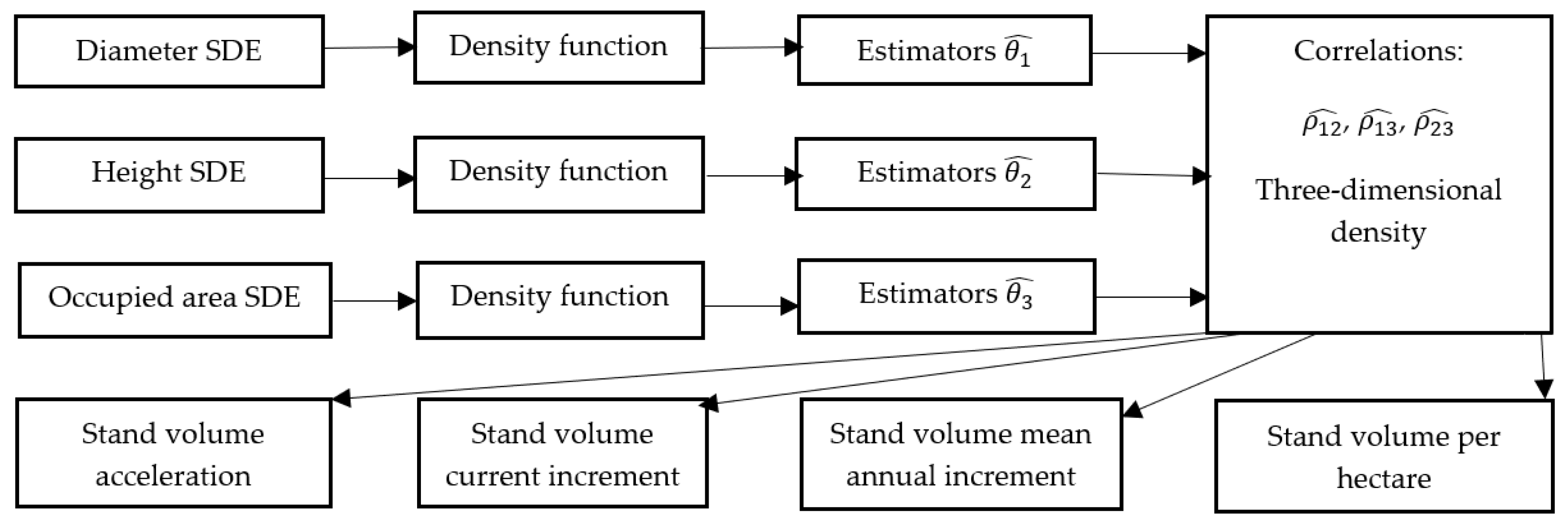
This formalization lets us express stand volume per hectare through explicit integrals, equipping foresters with a powerful tool to rigorously compare and optimize alternative management strategies. The framework was designed to optimize flexibility by enabling machine learning resources to dynamically adapt to heterogeneous forest regions throughout all operational phases, as illustrated in Figure 1.

2.1. Process-Driven Framework

For simplicity, we focus on integrating three Gompertz-type diffusions into a three-dimensional system: tree diameter, occupied area, and height. Most applied science fields frequently employ diffusions of the Gompertz type [28,29,30]. The framework of our proposal can be expanded to include multi-dimensional processes with more than three Gompertz-type diffusions; however, parameter estimations become more tedious and complex as the number of Gompertz-type diffusions increases (for instance, by including tree crown diameter, crown base height, and other components). A copula function method could be used to codify an additional technique for merging Gompertz-type diffusions [31]. In this study, the Itó form [32] system of stochastic differential equations is used to represent the three-dimensional 4-parameters Gompertz-type diffusion process (tree diameter Y 1 i t , tree height Y 2 i t , and tree occupied area Y 3 i t over age t in different M (i = 1, …, M) stands:
d Y i t = A Y i ( t ) d t + G Y i ( t ) d B i ( t ) ,
where the drift term A(y) has the following exact meaning:
A ( y ) = α 1 + ξ 1 i β 1 ln ( y 1 γ 1 ) ( y 1 γ 1 ) α 2 + ξ 2 i β 2 ln ( y 2 γ 2 ) ( y 2 γ 2 ) α 3 + ξ 3 i β 3 ln ( y 3 γ 3 ) ( y 3 γ 3 ) ,
also, the diffusion term G ( y ) is defined as follows:
G y = D y C 1 2 ,
D ( y ) = y 1 γ 1 0 0 0 y 2 γ 2 0 0 0 y 3 γ 3 ,   C = σ 11 σ 12 σ 13 σ 12 σ 22 σ 23 σ 13 σ 23 σ 33 .
Moreover, B i ( t ) (i = 1, …, M) are three-dimensional standard Wiener processes; the initial values Y i t 0 = y 0 = y 10 , y 20 , δ T > 0 (if t = t0); the random effects ξ j i , i = 1, …, M, j = 1, …, 3, are independent random variables having normal distributions with constant variances. σ j 2 , and zero means, respectively ξ j i ~ N ( 0 ;   σ j 2 ) , ξ i = ξ 1 i , ξ 2 i , ξ 3 i ; ξ j i is a random variable that is independent to B i ( t ) ; and the fixed-effect parameters that need to be estimated are Θ = α j , β j , γ j , σ j   j = 1 , , 3 , δ , σ j k   1 j , k 3 , j k . The intrinsic growth rate is represented by the parameter α j > 0 (j = 1, …, 3); the deceleration factor by the parameter β j > 0 (j = 1, …, 3); the threshold parameters γ j   ( y j 0 γ j > 0 ) (j = 1, …, 3); the volatility matrix C, and C 1 2 to be the Cholesky decomposition matrix C. The diagonal elements of matrix C quantify the magnitude of variation in individual tree-size variables, whereas the off-diagonal elements characterize the pairwise relationships between distinct tree-size variables. The random effects incorporated in this study constitute the primary rationale for adopting a multi-plot modeling framework. Conceptually, this framework is analogous to a state-space model in which observations of the system at each site are represented and estimated separately.
The following three-dimensional lognormal distribution L N 3 m i ( t ) ; Σ ( t ) represents the diffusion process Y(t)-γ (see, for instance, [33]):
  • with the mean vector m i ( t ) defined in the following form:
m i ( t ) = m 1 i t , m 2 i t , m 3 i t T = e β 1 ( t t 0 ) ln y 10 γ 1 + 1 e β 1 ( t t 0 ) 1 α 1 + ξ 1 i σ 11 2 e β 2 ( t t 0 ) ln y 20 γ 2 + 1 e β 2 ( t t 0 ) 2 α 2 + ξ 2 i σ 22 2 e β 3 ( t t 0 ) ln δ γ 3 + 1 e β 3 ( t t 0 ) 3 α 3 + ξ 3 i σ 33 2 ,
the covariance matrix Σ ( t )
Σ t = σ j k β j + β k 1 e β j + β k t t 0 j , k = 1 , , 3 = v j k ( t ) j , k = 1 , , 3 ,
and for given i = l, …, M, the L N 3 m i ( t ) ; Σ ( t ) density function
f y 1 , y 2 , y 3 , t θ , ξ i = 1 2 π 3 2 Σ ( t ) 1 2 y 1 y 2 y 3 exp 1 2 Ω ( y 1 , y 2 , y 3 , t | θ , ξ i ) ,
Ω y 1 , y 2 , y 3 , t θ , ξ i = ln y 1 γ 1 m 1 i ( t ) ln y 2 γ 2 m 2 i ( t ) ln y 3 γ 3 m 3 i ( t ) T Σ ( t ) 1 ln y 1 γ 1 m 1 i ( t ) ln y 2 γ 2 m 2 i ( t ) ln y 3 γ 3 m 3 i ( t ) .
As previously mentioned, the tree’s diameter, Y 1 i t γ 1 , height, Y 2 i t γ 2 , and occupied area, Y 3 i t γ 3 , have one-dimensional marginal distributions of the lognormal type, L N 1 m j i ( t ) ; σ j j ( t ) . Moreover, all two-dimensional distributions are also lognormal. The marginal process Y j i t γ j , i = 1,…, M; j = 1, …, 3, which is a Markov process, has a steady-state lognormal distribution with the variance σ j j 2 β j and the mean α j + ξ j i σ j j 2 1 β j . It should be emphasized that the parameters must maintain the conditions: σ j j 2 β j > 0   α j j + ξ j i > σ j j 2 ; if they do not, the original variable’s mean is less than 1. The tree diameter, height and occupied area marginal univariate transition probability density functions are defined in the following form:
g j y j , t Θ j , ξ j i = 1 2 π v j j ( t ) 1 2 y j exp ln y j γ j m j i ( t ) 2 2 v j j ( t ) ,   j = 1 , , 3 ,
where Θ j = α j , β j , γ j , σ j , σ j j   , j = 1, 2, and Θ 3 = α 3 , β 3 , γ 3 , σ 3 , δ , σ 33   .

2.2. Approximate Maximum Likelihood Procedure

The three-dimensional system of stochastic differential Equation (1) depends on 19 fixed-effect parameters and three random plot effects. In this paper, we will employ the maximum likelihood method to estimate mixed (fixed and random effects) parameters. It should be noted that the representation of the three-dimensional stochastic differential system in terms of separate diffusion processes, while providing only an approximate characterization of the full joint process in a specific sense, offers a substantial computational advantage for the estimation and subsequent analysis of unknown parameters. This reduction in computational complexity arises because the procedure entails the evaluation of Hessian matrices, and the decoupled formulation markedly decreases the associated computational burden. Since random effects are not immediately observable, the maximum likelihood function for the mixed-effects parameters, one-dimensional probability density functions developed in the paper, requires integration across the distributions of random effects. In this paper, we will apply the Laplace transform to approximate the maximum likelihood function and perform mixed-effects parameter estimation for each equation in the system separately, ensuring the convergence of the procedure for large datasets.
Assuming that each size component—such as height, diameter, and occupied area—has just one plot’s random effect, the maximum likelihood function is defined as:
l j Θ j , ξ j = + i = 1 M g j y , t Θ j , ξ j i ϕ ξ j i | σ j 2 d ξ j i ,   j = 1 , , 3 ;   i = 1 , , M ,
where ϕ | σ j 2 is the normal distribution’s density function having zero mean and a constant variance. The mixed-effects parameters Θ j , ξ j i , j = 1, …, 3; i = 1, …, M of the marginal density functions g j y j , t Θ j , ξ j i are estimated using a two-step approximate log-likelihood process. The Laplace approximation to the maximum log-likelihood function is constructed via a Taylor series expansion around the mode of the integrand. This approximation further relies critically on the assumption that the conditional distribution of the random effects, given the observed data, is unimodal [34]. In this study, potential multimodality was assessed by employing a wide range of initial values in the computation of random effect estimates using an approximate maximum likelihood estimation procedure. Given that varying the initial values does not yield different estimates of the random effects, it is advisable to employ the Laplace approximation method. Conversely, the high number of measurements represented in the plots provides robust empirical support for the validity and reliability of the Laplace approximation [35].
In the first step, the random-effects ξ j i , j = 1, …, 3; i = 1, …, M, for given values of the fixed effects Θ j ^ are evaluated by:
ξ j i ^ = max ξ j i h j ξ j i | Θ j ^ ,
h j ξ j i | Ɵ j ^ l = 1 n i ln g j y j l i , t l i Ɵ j ^ , ξ j i + ln ϕ ξ j i σ j 2 ^ .
In the second step, the fixed-effects parameters are evaluated by optimization of approximate maximum log-likelihood function l l j Θ j , ξ j ^ defined by Equation (13) after we insert random-effects ξ j ^ :
l l j Θ j , ξ j ^ i = 1 M h j ξ j i ^ Θ j + 1 2 ln 2 π 1 2 l n d e t 2 h j ξ j i Θ j ξ j i 2 ξ j i = ξ j i ^ .
The random effect value for a new stand can be found through sampling, allowing random effect calibration. New measurements are required to derive the localized stand volume dynamic equation utilizing the random effects calibration approach. The dataset that was newly observed y j 1 , y j 2 , , y j m at specific times t 1 , t 2 , , t m , j = 1, …, 3 can be utilized to adjust the random effects   ξ j 0 for each tree size component (m is the total amount of trees in a new stand that have been observed) as follows:
ξ j 0 ^ = a r g m a x ξ j 0 k = 1 m l n g j ( y j k , t k Θ j ^ , ξ j 0 ) + ln ϕ ( ξ j 0 σ j 2 ^ .

2.3. Evolution of Stand Volume per Hectare

In practical terms, yield and growth models of a forest stand are used in formalized forest management planning to assess specific characteristics of forest development. Many stakeholders regard the volume of a forest stand per hectare as its most important attribute. Stand-level variables, such as mean diameter, mean cross-sectional area, and mean height of dominant/co-dominant trees, are typically measured in standard forest inventories and are used in regularly published models for estimating stand-level yield. Unfortunately, the majority of models are deterministic and static, ignoring both the process nature of the stand variables and their statistical interdependence. The diffusion process framework was designed to describe the yield over age relationships for mixed tree species stands. Growth and yield models are not new to the area of forest management; many of them cover various types of tree species and are usually referred to as a power-type function in the forestry literature [36,37,38]. Forest development has already begun to shift rapidly as a result of climate change; hence, a more sensitive mathematical tool is required to explain these changes. To simulate the evolution of tree diameter, height, and occupied area in a forest stand over time, this work suggests a three-dimensional system of stochastic differential Equation (1) derived from sigmoidal Gompertz-type dynamics. The computation of stand volume per hectare additionally requires a tree stem volume regression function that links stem volume to diameter and height, once a three-dimensional (diameter, height, and occupied area) probability density function that varies over time has been derived (see Equation (7)). The stem volume model as a function of diameter and height is currently described by the q-exponential function [39] in the framework that follows:
v k x 1 , x 2 = λ 1 k x 2 λ 2 k ( 1 exp ( ( 1 λ 3 k ) x 1 ) ) + 1 1 λ 3 k ,   k S P ,
here ω + = ω ,   i f   ω 0 , 0 , i f   ω < 0 , , λ 1 k , λ 2 k , λ 3 k is the vector of evaluated parameters, kSP = {p, s, b} = {pine, spruce, birch}, and both x1 and x2 are measured in meters. The proposed tree volume equation exhibits satisfactory statistical goodness-of-fit metrics and possesses a relatively simple functional form, which is particularly advantageous given its intended incorporation into a three-dimensional integral. Following the foregoing description, the three-dimensional probability density function defined by Equation (7), and the stem volume regression Equation (15) may be used to estimate the stand volume per hectare for different scenarios of tree species in the following form (i = 1, …, M):
V i k t = 0 + 0 + 0 + 10000 x 3 v k x 1 , x 2 f x 1 , x 2 , x 3 , t θ ^ , ξ 1 i ^ , ξ 2 i ^ , ξ 3 i ^ d x 1 d x 2 d x 3 ,
Additionally, when calculating the volume per hectare of a stand, the volumes of individual tree species are taken into account as follows:
V S a t = k 1 V S p t + k 2 V S s t + k 3 V S b t ,
where k1 is the proportion of pine trees, k2 is the proportion of spruce trees, and k3 is the proportion of birch trees. Since the integrated function in integral (16) is sufficiently smooth, its integration ensures a more differentiable result than the original function; thus, we can use the derivatives of the function defined by equality (16) to examine the growth of stand volume per hectare. Equation (16) provides the following definitions for the stand volume per hectare dynamics of the live and dying trees, as well as their current annual increment, c a i i k t , mean annual increment, m a i i k t , relative increment, r a i i k t , and growth acceleration, g a i k t , are defined as follows:
c a i i k t = d d t V i k t ,
m a i i k t = V i k t t ,
r a i i k t = d d t l n V i k t ,
g a i k t = d 2 d t 2 V i k t .

2.4. Study Area and Data

The Kazlų Rūda forests are located in southwestern Lithuania, cover an area of 47,000 ha, and are defined as in our previous study [16]. According to the Kazlų Rūda forest type classification, the forest types in this study can be divided as follows: silver birch forests, spruce forests, pine forests, mixed deciduous forests, mixed coniferous-deciduous forests, and mixed coniferous forests. A pine (Pinus sylvestris) forest has the greatest proportion of the forest area (comprising 63.8%) and stand volume among different forest types. Most of the survey plots that were initially identified were re-measured two to seven times (1983–2020, at different intervals), for a total of 151 measurements. The sample plots ranged in size from 1600 m2 to 7200 m2, and they were rectangular. Table 1 summarizes observed data sets using statistical methods for characterizing forest stands, such as the mean and standard deviation of tree variables, such as tree age, height, diameter, occupied area, and volume. Diameter measurements were recorded to the nearest 1 mm, height measurements were obtained with an accuracy of approximately 1 dcm, and the positional accuracy of the planar coordinates was 1 dcm. Voronoi polygons were employed to delineate the theoretically occupied spatial area of each tree. The individual tree volume was calculated by the q-exponential volume Equation (15) based on the tree diameter and height. The least squares parameter estimates were based on a sample size of a few hundred or a few thousand trees that have been felled for different tree species and presented in [18]: for pine trees λ 1 p ^ = 0.3269 , λ 2 p ^ = 1.0579 , and λ 3 p ^ = 0.3269 ; for spruce trees λ 1 s ^ = 0.1701 , λ 2 s ^ = 1.23 , and λ 3 s ^ = 0.3459 , and for birch trees   λ 1 b ^ = 0.2924 , λ 2 b ^ = 1.0452 , and λ 3 b ^ = 0.3603 .
The most common technique for estimating the height of unmeasured trees is to model their height as a function of tree diameter and age using a sample of measured trees. The analogy of diffusion processes applied in this study enables the calculation of a tree’s height in a stand using the conditional distribution of tree height against diameter, which, as previously stated, has a lognormal distribution. Considering that the tree’s diameter, Y 1 i t γ 1 , and height, Y 2 i t γ 2 , have one-dimensional marginal distributions of the lognormal type, L N 1 m j i ( t ) ; σ j j ( t ) , the conditional mean of tree height on diameter takes the form [40]:
y 2 = γ 2 ^ + e x p m 2 i t + v 12 t v 11 t l n y 1 γ 1 ^ m 1 i t + 1 2 v 22 t v 12 t 2 v 11 t .
In this tree height equation, the fixed effect parameters, Θ j = α j , β j , γ j , σ j , σ j j   , j = 1, 2, are taken from Table 2 and Table 3, and the random effects, ξ j i , j = 1, 2; i = 1, …, M, are calibrated for each plot separately by Equation (14).
It should be emphasized that the predictions of dying-tree volume per hectare were likely associated with considerable uncertainty, primarily due to the underlying structural characteristics and design limitations of the data collection protocol. The chronological age of dying trees constituted a complex covariate to manage in this longitudinal measurement study, which likely contributed to the reduced precision observed in the stand volume per hectare growth models for dying trees. This is challenging to quantify because ‘dying’ trees were operationally defined either as individuals that disappeared from the dataset or as those explicitly recorded as dead during the continuous measurement period (1983–2020). The stand volume per hectare and the cross-sectional area per hectare of trees classified as ‘dying’ were allocated proportionally according to the duration of the time interval during which mortality was recorded.
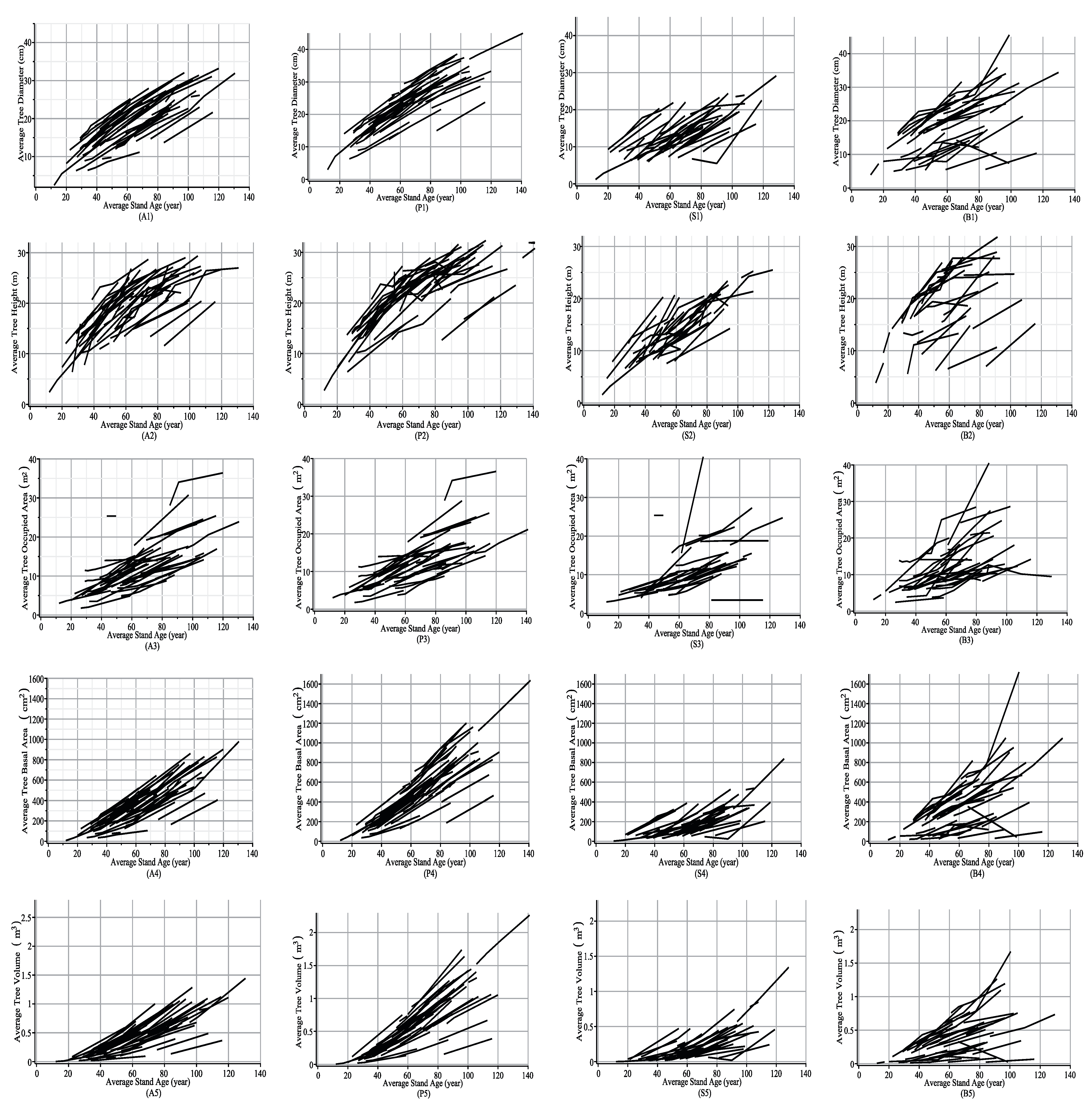
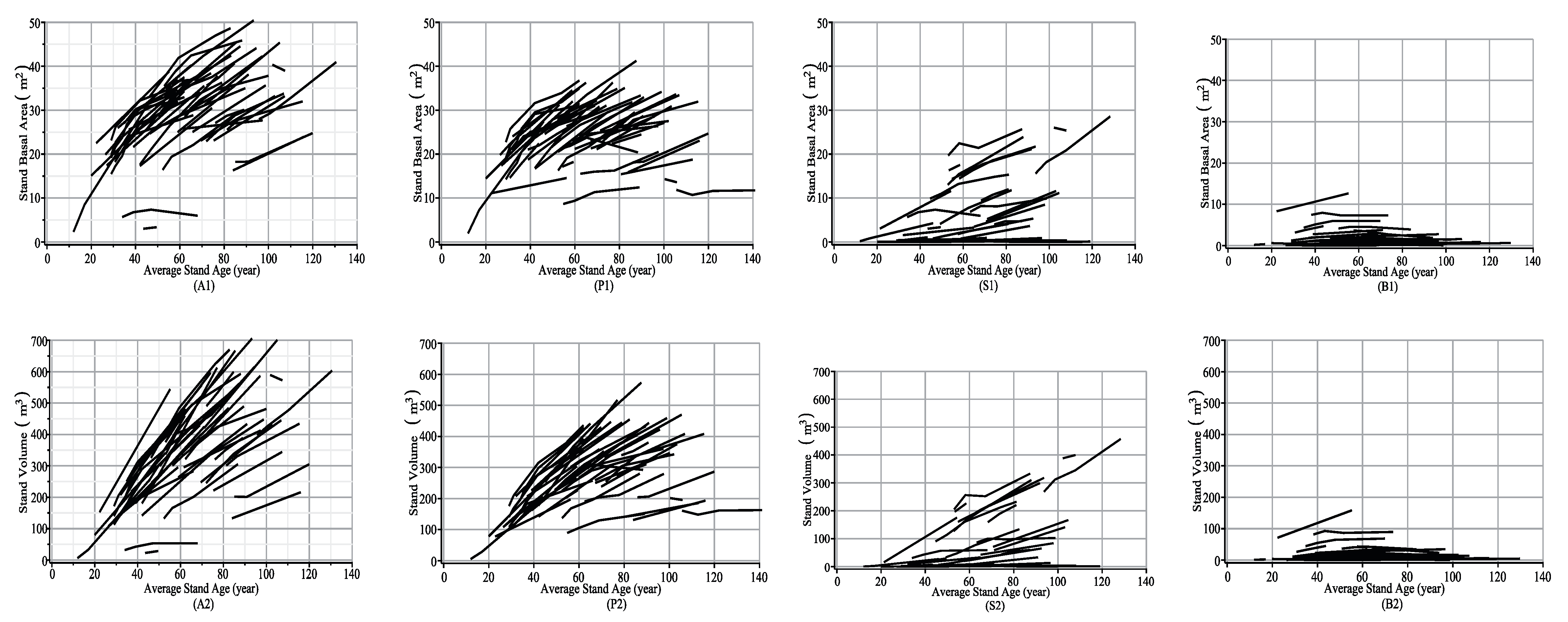
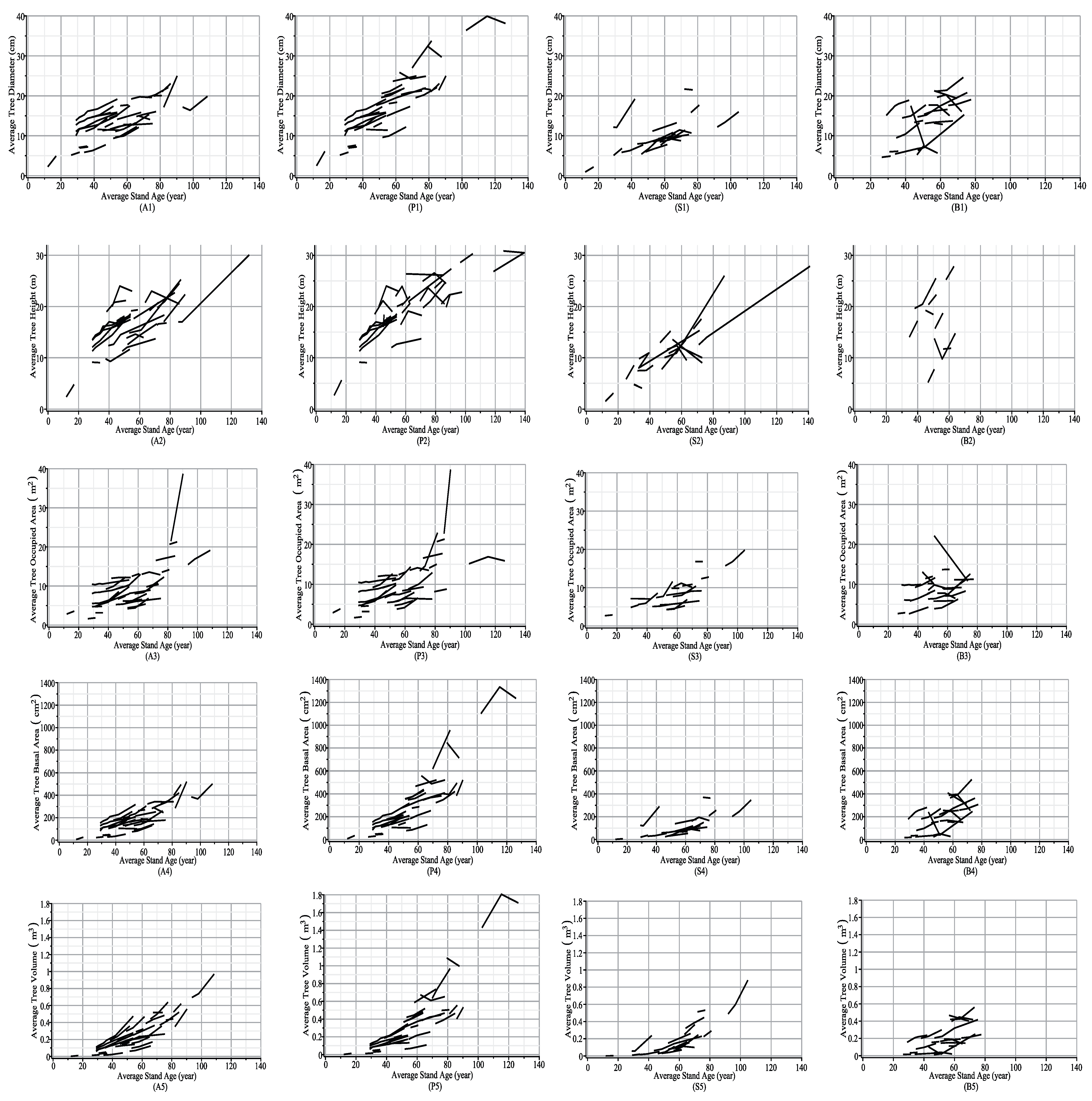
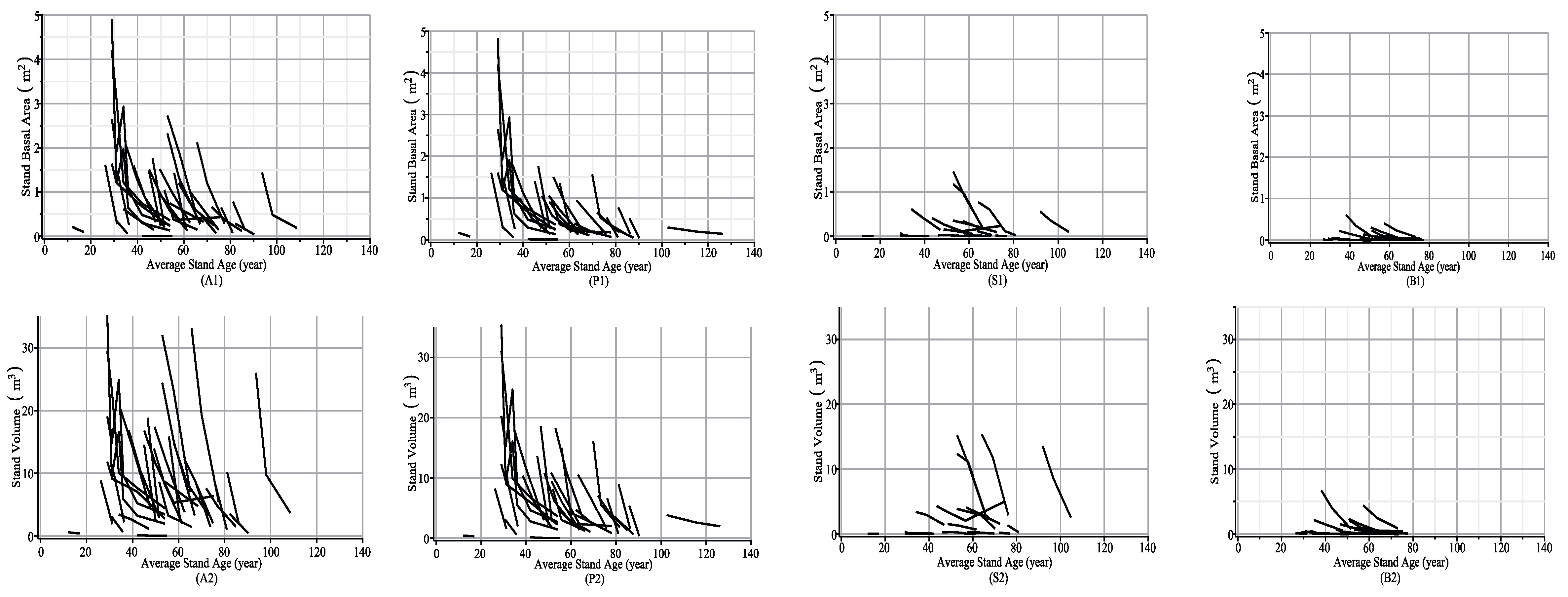
It is essential to note that the measurement data summarized in Table 1 were collected from uneven-aged and mixed-species stands. As can be seen from Table 1, the mean values of the size variables for living trees are significantly higher than for dying trees. Figure 2, Figure 3, Figure 4 and Figure 5 enable us to visually track the trends in the change in the corresponding size components of the average tree in the plot as the average age of the stand increases. Figure 3 and Figure 5 demonstrate the trends in plot characteristics, including tree cross-sectional area per hectare and tree volume per hectare. We can observe that the development trajectories of live trees are substantially greater than those of dying trees when we compare the growth trajectories of living trees in Figure 2 with the corresponding growth trajectories of dying trees in Figure 4.

3. Results and Discussion

3.1. Parameter Estimation

First, let’s identify the unknown fixed and random effect parameters a system of the stochastic differential Equation (1) using discrete and direct diffusions sampling. In this paper, the maximum log-likelihood for mixed-effect parameters stochastic differential equations is estimated using the Laplace approximation, which overcomes the intractability of the true log-likelihood function (see Section 2.2). The discrete observations are regarded as a collection of many stands from the same region and under the same climatic conditions, which enables us to mix the observations to imitate discrete observations. Estimates of the fixed and mixed effects parameters were obtained within the framework of a univariate stochastic model of tree size, which characterizes the temporal dynamics of tree diameter, height, and occupied area. The estimation was performed using an approximate maximum likelihood procedure. Table 2 reports the estimates of the fixed-effect parameters together with their associated standard errors, obtained via the observed Fisher information matrix [41]. The covariance coefficients were sequentially computed based on the correlation coefficients among tree diameter, height, and occupied area. Specifically, the calculations were as follows: σ 12 ^ = σ 11 ^ σ 22 ^ ρ 12 ^ , σ 13 ^ = σ 11 ^ σ 33 ^ ρ 13 ^ , and σ 23 ^ = σ 22 ^ σ 33 ^ ρ 23 ^ , where ρ 12 ^ , ρ 3 ^ , and ρ 23 ^ are the coefficients of correlation. The values of the correlation coefficient were computed based on the empirical data collected, and the results are systematically presented in Table 3.

3.2. Analysis of Stand Volume Trajectories Utilizing a Fixed Effect Methodology

Stand-volume-per-hectare models estimate total wood volume in a forest stand on a 1 ha basis by applying multiple statistical techniques, such as nonlinear regression and generalized additive models, to relate stand attributes—such as dominant height, diameter, and cross-sectional area—to volume. With the diversity of models discussed in the literature, it is important to note their static and deterministic nature [42,43,44]. The applicability of many current model designs to new locations and conditions is questionable because they were developed at a regional scale, using particular data, such as from a single region, a specific management approach, or a particular age class. Professional forest statisticians have continued to use linear and nonlinear regression to implement longstanding, traditional empirical models in studies of forest development modeling, overlooking the fact that stand attributes, such as diameter, dominant height, and cross-sectional area, are also process-driven in a sigmoidal stochastic pattern. It is crucial to develop more complex and theoretically sound dynamical models because these regression models depart from the theoretical assumptions of normality (symmetry) and variance constancy. The model used in this study (defined by Equation (17)) has the main advantage because it’s defined in terms of a three-dimensional stochastic process (tree diameter, height, and occupied area), where correlation coefficients between the variables are used to express the relationship between them. For forestry professionals, age-dependent models of the entire stand’s volume are particularly important, as they enable the forecasting of volume changes and the development of management strategies.
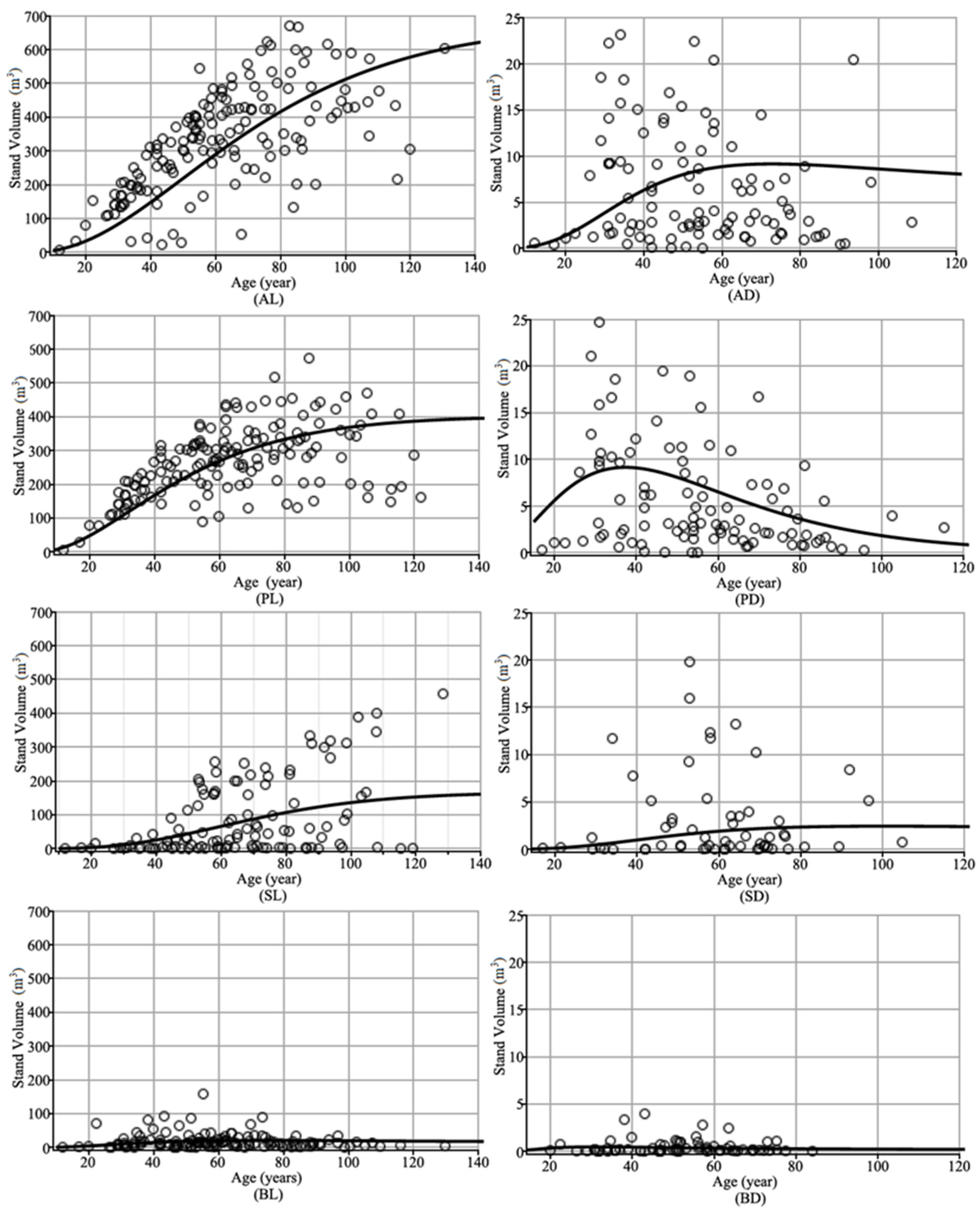
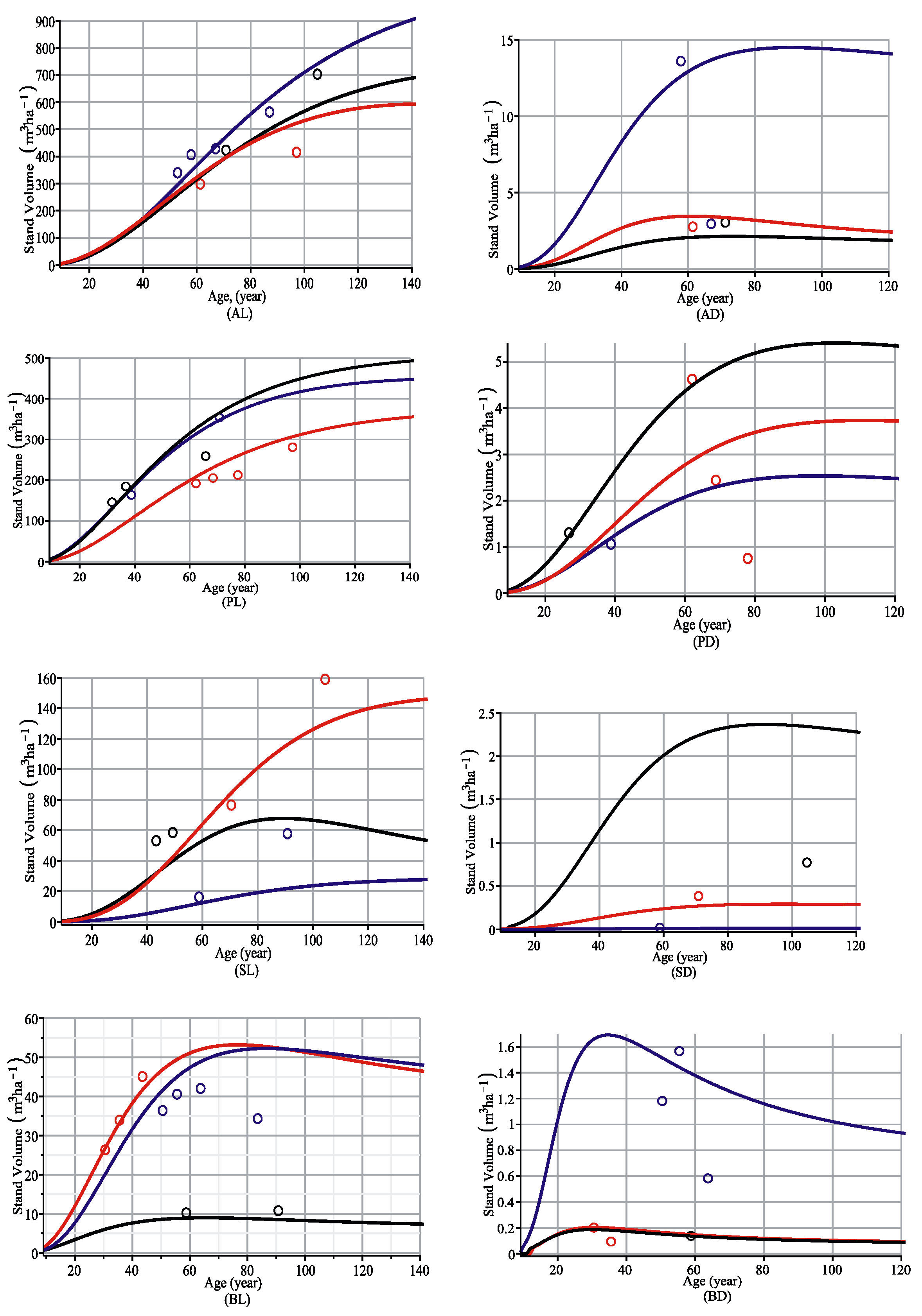
Figure 6 and Figure 7 were created to illustrate the stand volume per hectare trajectories (defined by Equation (17)) of living and dying trees in the fixed-effect mode for all species trees, pine species trees, spruce species trees, and birch species trees. In Equation (16), the fixed effect parameters θ ^ are taken from Table 2 and Table 3. The random effects ξ 1 i ^ , ξ 2 i ^ , ξ 3 i ^ are set to their mean values, namely 0. When conducting an analysis of Figure 6, Figure 7, Figure 8 and Figure 9, it is crucial to consider that the dataset encompasses a broad geographical region. The distributions of species within this dataset are as follows: pine and spruce exhibit a distribution range from 0% to 100%, while birch exhibits a distribution range from 0% to 39%. Furthermore, it is crucial to note the heterogeneity in the age distribution of the trees across the majority of the study plots. A comparative analysis of Figure 6AD,PD,SD,BD relative to Figure 6AL,PL,SL,BL reveals that the proportion of stand volume per hectare affected by mortality is minimal, comprising less than 1.5%. It is essential to note that the dynamics of pine, spruce, and birch volume per hectare, as illustrated in Figure 6PL,SL,BL, exhibit significant variation. This variability is attributed to the composition of the experimental population, wherein pine trees represent 65.4%, spruce trees constitute 28%, and birch trees account for a mere 6.6%. As depicted in Figure 6AD, the aggregate volume of mixed species senescent trees per hectare attains an estimated value of 9 cubic meters at 60 years of age. Subsequently, it exhibits a gradual diminution at a slow rate.
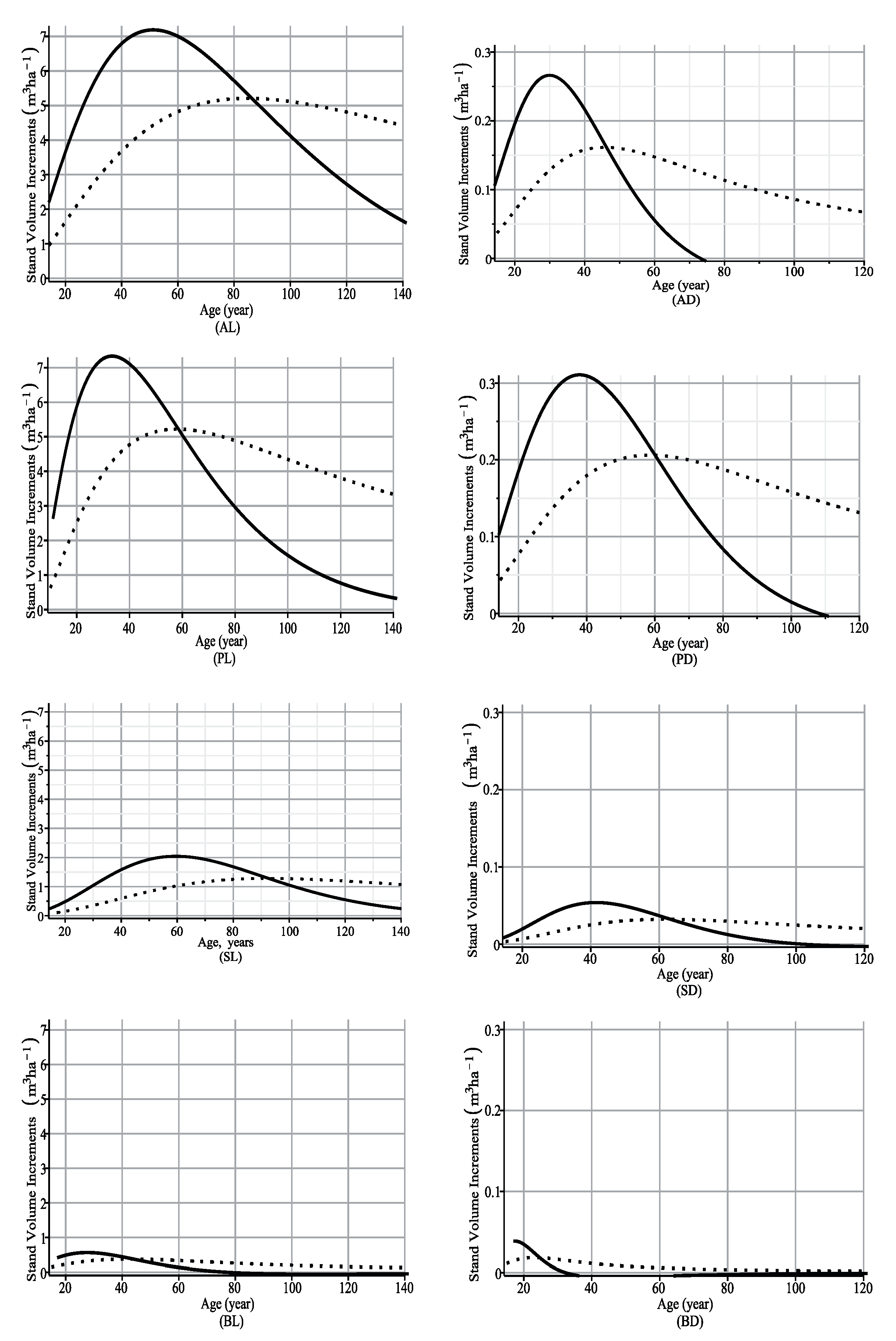
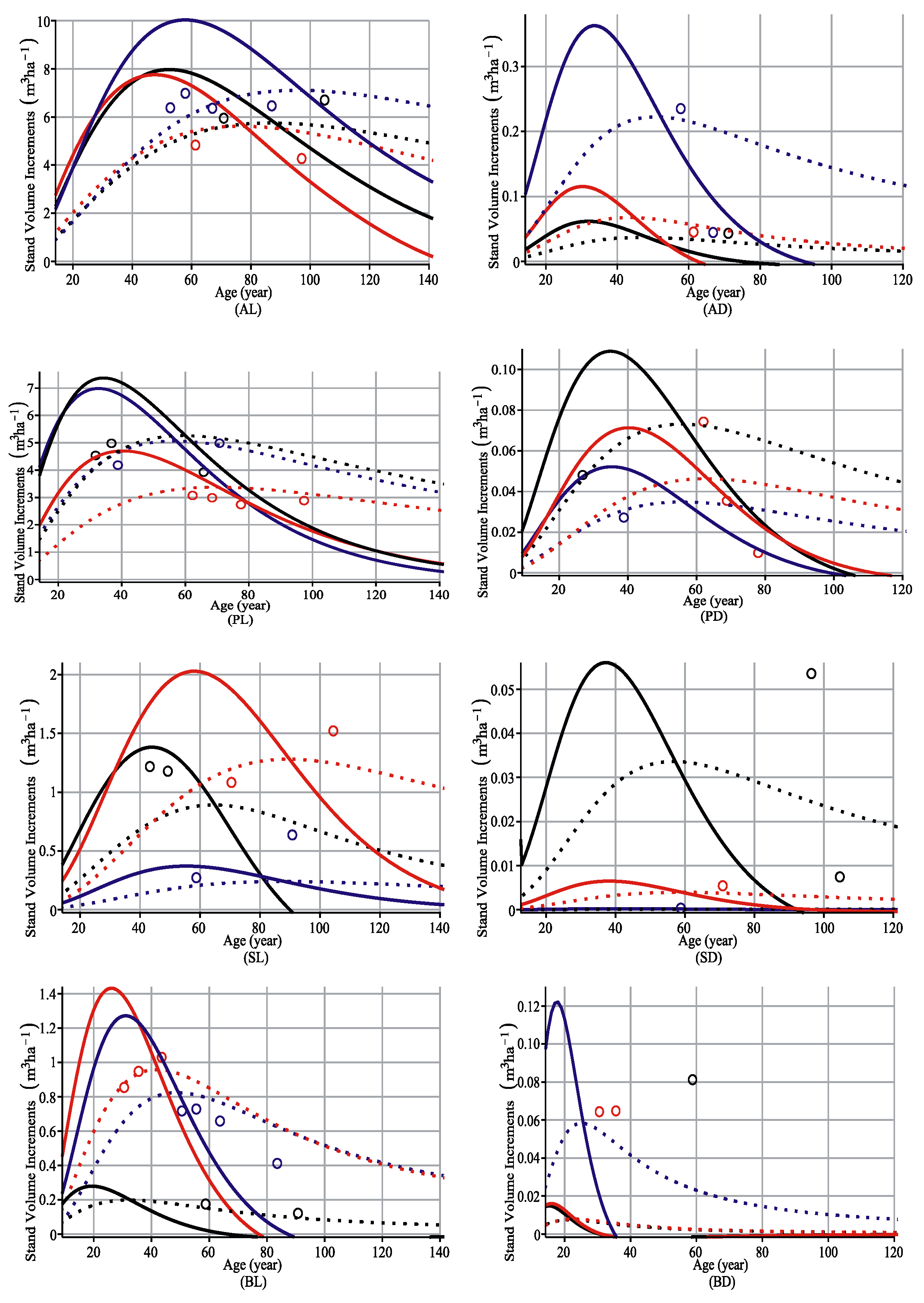
Within an uneven-aged forest stand, the mean annual increment demonstrates a distinct developmental pattern as a function of the stand’s chronological age. This relationship is illustrated in Figure 7. Through a comparative analysis of the trajectories of the mean annual increment for dying trees versus those for live cohorts, it is observed that dying trees attain the apex of their mean annual increment at an earlier phase. The trajectories of the current annual increment exhibit analogous patterns. In the analysis of the current and mean increment trajectories depicted in Figure 7, it is imperative to consider that these trajectories are represented as averages across all plots within the studied region, with plot-specific random effects assumed to be zero. Furthermore, it is important to note that the majority of the stands are characterized by mixed composition. The maximum value of the current annual increment generated by all tree species living trees is roughly 7.2 cubic meters per ha, reached at 50 years of age, as shown in Figure 7AL. At the same time, Figure 7AD shows that at 30 years of age, the maximum annual loss of all dead trees in the current year is 0.3 cubic meters per ha.
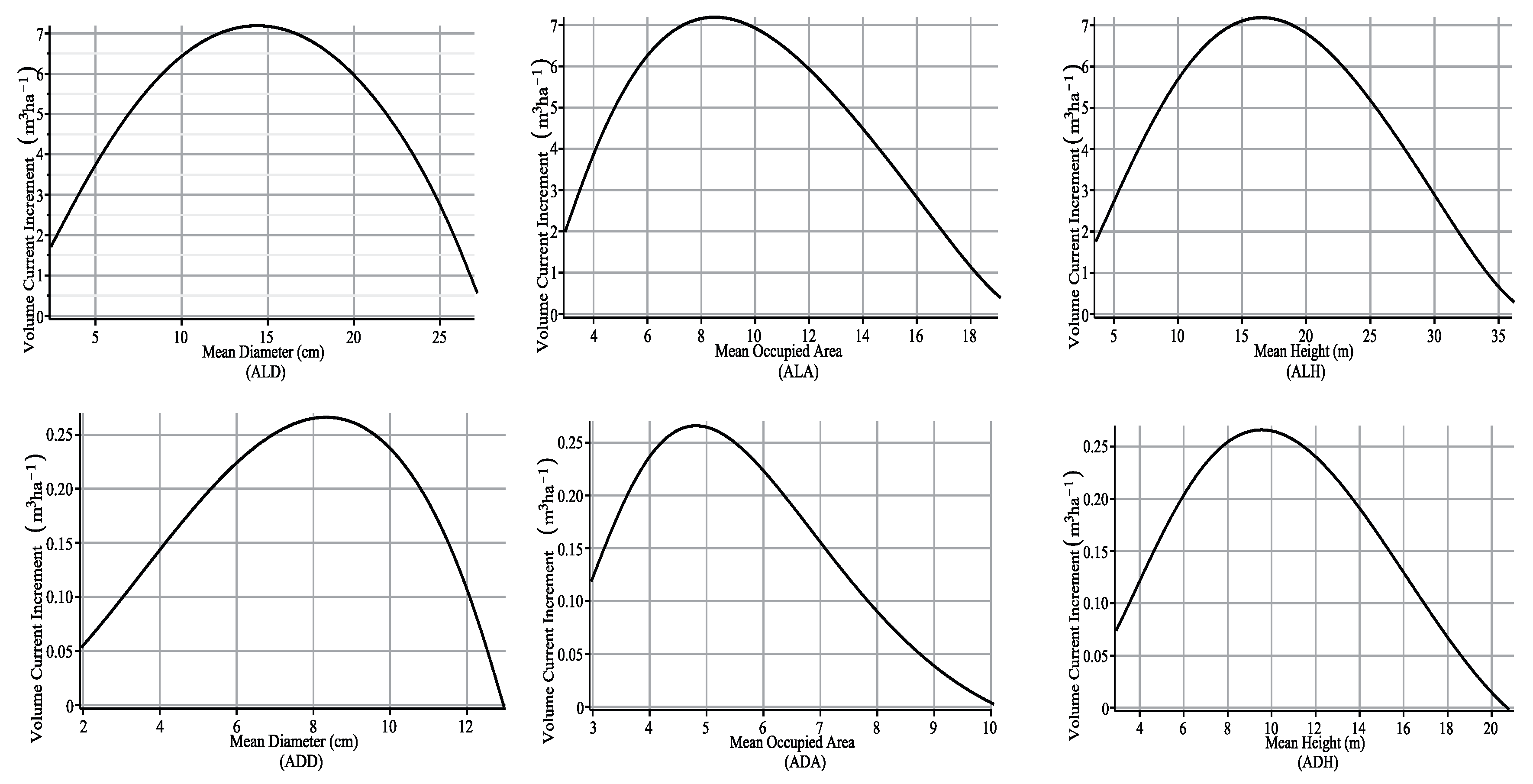
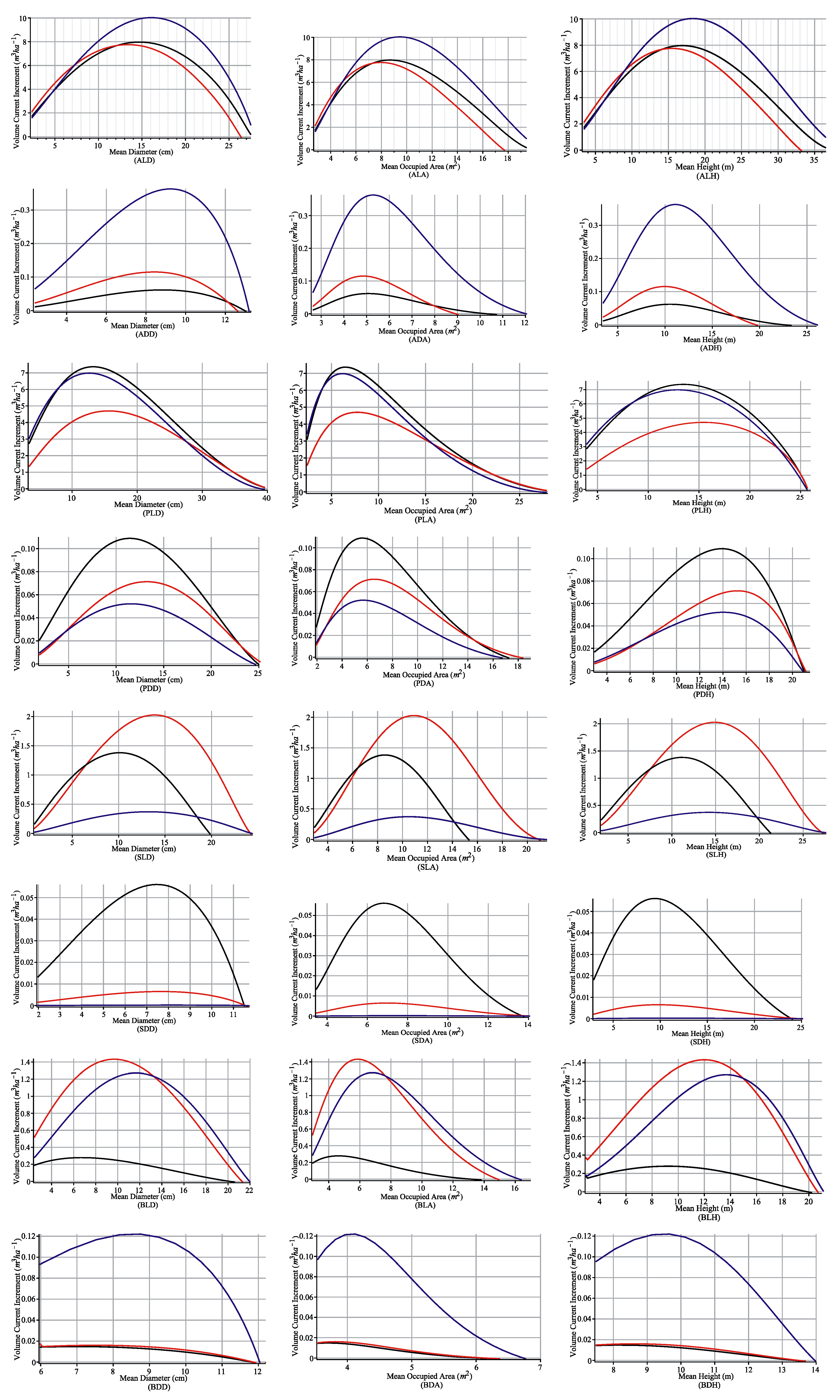
Figure 8 illustrates the trajectories of the current annual increment in stand volume per hectare, analyzed as a function of several stand size attributes such as mean height, diameter, and occupied area. This representation enables the evaluation of their respective influences. The current annual increment of the stand volume for living trees, measured over the mean tree diameter, potentially occupied area, and height, reaches its peak value significantly earlier than the corresponding metrics observed for dying trees. This is evident upon comparison of Figure 8ALD,ALA,ALH with Figure 8ADD,ADA,ADH. In the analysis of the influence of mean stand diameter on the current annual increment of stand volume, it is observed that the peak current annual increment for living trees occurs significantly later, at a mean diameter of 15 cm, compared to dying trees, which peak at a mean diameter of 8.5 cm (refer to Figure 8ALD,ADD). It is noteworthy that a similar pattern emerges when examining the effect of the mean height and the mean potentially occupied area on the current annual increment of stand volume. Specifically, the volume’s current annual increment for living trees peaks at a mean potentially occupied area of 8.5 m2 and a mean stand height of 17 m, whereas for dying trees, these peaks occur at a mean potentially occupied area of 5 m2 and a mean stand height of 9 m, respectively (refer to Figure 8ALA,ALH and Figure 8ADA,ADH). Comparable insights and graphical representations may be derived from an analysis of the impact of mean stand diameter, height, and occupied area on the current annual increment of stand volume for both living and dying trees per hectare, categorized by individual tree species.

3.3. Analysis of Stand Volume Trajectories Utilizing a Mixed Effect Methodology

Forest statisticians tend to prefer models that utilize fixed-effect parameters to predict dendrometric and stand variables, including attributes such as stand height and volume, by incorporating explanatory variables. While these models demonstrate utility, their limitations arise from an inability to incorporate stand-specific variations, which potentially results in less accurate predictions compared to mixed-effects parameter models that employ site-specific calibration data. Mixed-effects models are predominantly employed in the field of forestry to facilitate the analysis of data characterized by hierarchical structures. These structures may include trees nested within plots, stands within a region, or repeated measurements taken on the same individual. The models achieve this by integrating both fixed effects, which may encompass variables such as species or treatment variations, and random effects, which account for variations associated with stands or individual trees. In the following analysis, calibrated random-effect values derived from Equation (14) will be utilized to systematically investigate the variations in the weaving processes across different tree species and stands. Figure 9 illustrates the temporal dynamics of mixed stand volume per hectare as well as the volume of individual tree species per hectare across three randomly chosen stands, categorized into living and dying tree cohorts. The simulated trajectories of tree volume per hectare, differentiated by living and dying status across three distinct plots as illustrated in Figure 9, demonstrate a significant concordance with empirically observed volume values per hectare. These observed values were computed by Equation (16) from precise measurements of tree height and diameter obtained during the experimental procedure. The analysis of Figure 9PL,SL,BL reveals that the asymptotic values for the volume per hectare of live birch trees are markedly lower in comparison to those observed for pine and spruce trees. This phenomenon is predominantly attributed to the relatively low representation of birch trees within the examined stands. The analysis of the trajectories of living tree volume per hectare, denoted as Figure 9AL,PL,SL,BL, in conjunction with the corresponding trajectories of dying tree volume, represented as Figure 9AD,PD,SD,BD, indicates that the volume of dying trees is not directly proportional to the volume of living trees within the same species.
Figure 10 illustrates the current and mean annual increments in stand volume per hectare for three distinct stands. The species composition within the three randomly selected plots remains consistent with the configuration illustrated in Figure 9. Analysis of Figure 10AL,PL,SL,BL indicates that the mean annual increment in the stand volume of living trees attains its peak approximately 20 to 30 years after the peak of the current annual increment in the stand volume of dying trees. Furthermore, it can be highlighted that in living birch species trees, the current annual increment of the stand volume reaches equilibrium with the mean annual increment more rapidly compared to spruce species trees, where this concordance occurs at a later stage.
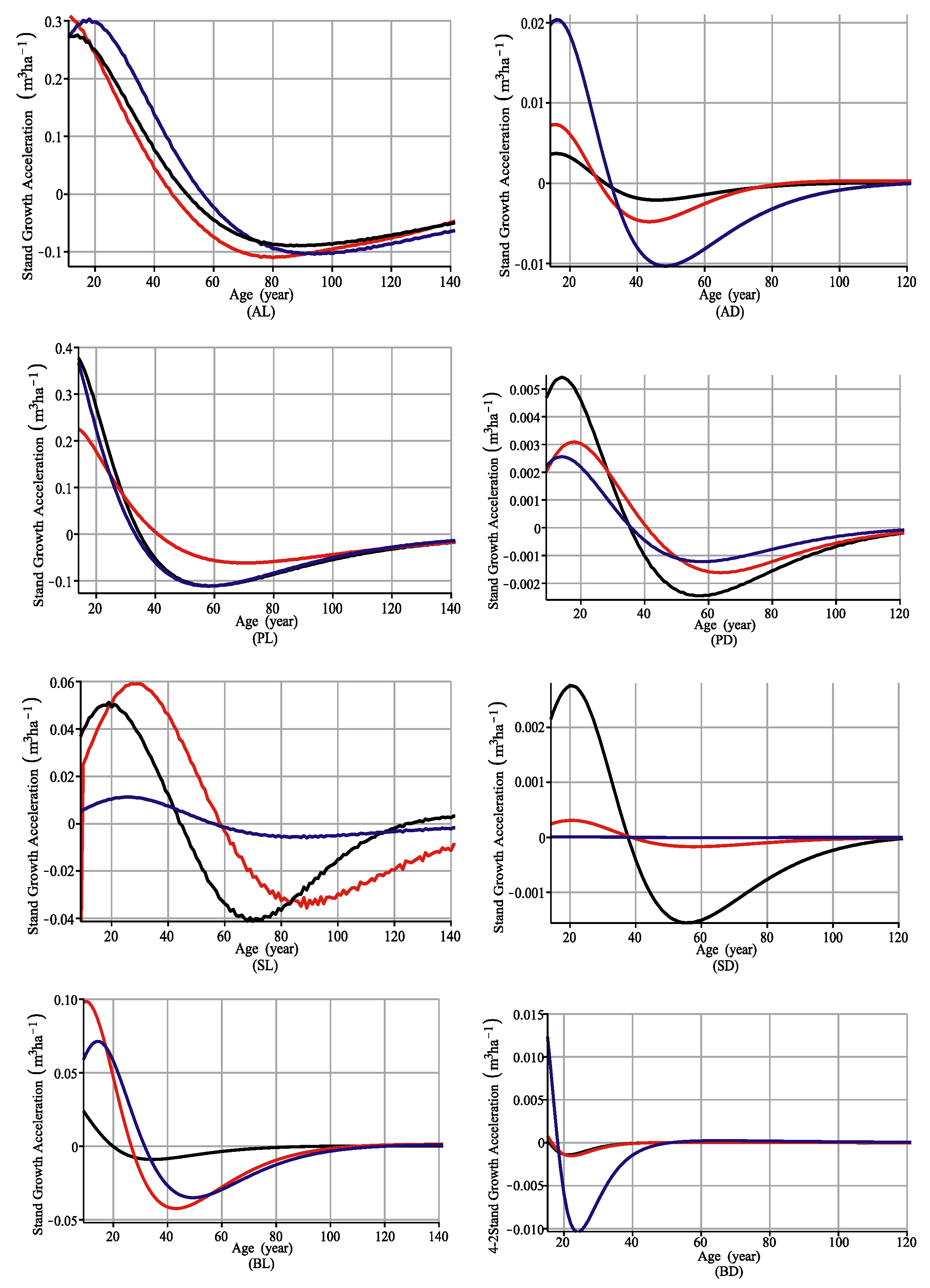
Figure 11 delineates the temporal dynamics in growth acceleration of stand volume per hectare across a variety of tree species. The species composition within the three randomly selected plots remains consistent with the configuration illustrated in Figure 9. As depicted in Figure 11AL,AD, within mixed-species stands, living trees achieve the zenith of the current annual increment per hectare approximately 20 years prior to diseased or dying trees. This pattern is also observed in both spruce and birch trees. Conversely, pine trees exhibit a congruent peak age for the volume’s current annual increment per hectare for both living and dying trees. Furthermore, as evidenced in Figure 11PL,SL,BL, living birch trees attain the peak of their volume’s current annual increment per hectare at the earliest stage, whereas spruce trees reach this peak at the latest stage.
Figure 12 illustrates the dynamics of the current annual increment in stand volume per hectare as a function of stand size variables, namely mean diameter, mean occupied area, and mean height. This analysis was conducted employing a mixed-effects modeling approach across three randomly selected plots, encompassing both the living and dying tree populations. The species composition within the three randomly selected plots remains consistent with the configuration illustrated in Figure 9. Figure 12 illustrates that the population of dying trees achieves the peak of the current annual increment in stand volume per hectare at reduced mean values of stand diameter, occupied area, and height in comparison to the population of dying trees. Based on the data presented in Figure 12ALD,ALA,ALH, it can be concluded that within mixed forest stands, the population of live trees achieves the peak of the volume’s current annual increment per hectare when the mean diameter is approximately between 13 to 17 cm, or the mean occupied area spans approximately 7 to 10 square meters, or the mean height ranges from 15 to 19 m. Living pine species exhibit their peak in current annual volume increment per hectare at an earlier stage of development, specifically when the mean diameter measures approximately 11 to 14 cm, or when the average occupied area ranges from 6 to 8 square meters, or when the mean height is between 13 and 16 m. In contrast, living spruce species achieve the peak of their current annual volume increment per hectare at a slightly later developmental stage. This occurs when the mean diameter falls within the range of approximately 11 to 15 cm, or when the mean occupied area per individual is approximately 9 to 11 square meters, or when the mean height is approximately 13 to 17 m. In living trees of the birch species, the peak of the current annual volume increment per hectare is attained relatively early. This occurs when the mean diameter of the trees is approximately 7 to 12 cm, or when the mean occupied area is about 5 to 7 square meters, or when the mean height is approximately 10 to 14 m.
In summary, this research aims to evaluate the validity of the proposed stand volume model by utilizing the analogy of the three-dimensional diffusion process. This assessment will be conducted through the application of several numerical indices to quantify the model’s fit accuracy. The indices include bias, relative bias, absolute bias, relative absolute bias, root mean square error, relative root mean square error, and the coefficient of determination. The statistical metrics are systematically presented in Table 4. The model exhibited superior goodness-of-fit statistical indices for the estimation of stand volume within this region. Specifically, the root mean square error (relative root mean square error) for the living population of mixed, pine, spruce, and birch species was 68.814 m3 (20.4%), 20.778 m3 (7.8%), 32.776 m3 (37.3%), and 4.825 m3 (26.3%), respectively. Furthermore, the coefficient of determination (R2) for mixed, pine, spruce, and birch species was observed to be 80.7%, 96.0%, 91.2%, and 95.5%, respectively. The regression models most commonly presented in the forestry literature are predominantly static, formulated for living trees, and are based on conventional ordinary regression methodologies. Moreover, they are typically fitted using datasets obtained from individual plots that are characterized by fixed age classes and monospecific (pure-species) stands. Previous studies have primarily focused on visualizing the standing volume of living trees in pure stands, as well as their increment, in relation to specific stand-level attributes or stand age [45,46].

4. Conclusions

The dynamics of a forest stand’s living and dying trees are inherently variable, evolving in response to environmental perturbations. This research investigates the growth dynamics of three tree size metrics—diameter, occupied area, and height—via adaptation of the sigmoidal, four-parameter Gompertz-type univariate stochastic differential equation. These equations are integrated into a three-dimensional stochastic framework through all bivariate correlations. The proposed stand volume model centers on the growth and mortality of individual trees, aptly termed the “whole stand model.” The properties of individual tree size variable models facilitate the development of an aggregate model that encapsulates stand yield and growth comprehensively. The model elucidates that the stand volume trajectory of a forest stand can be tracked and characterized as tree age advances. It is notably emphasized that model parameter estimation relies solely on measurements of tree diameter, occupied area, and height, eschewing direct tree volume measurements. These findings bear significant implications for forest stand volume prediction and the refinement of forest management strategies. This study makes a substantial contribution by transforming the analysis of tree size variables—namely height, occupied area, and diameter—into stochastic processes, thereby enabling the depiction of changes in stand volume over time. Historically, most models of mean stand volume and other tree or stand attributes proffered by forest statisticians have been static, even-aged, and rooted in empirical data (collected either in situ or via remote sensing) [47,48]. One advantageous property of the model is that, for any new plot comprising m (m ≥ 1) observations (e.g., from a National Forest Inventory or an experimental plot), it is possible to reliably calibrate the random effects using Equation (14), thereby enabling subsequent yield and growth analyses. It is obvious that a small number of observations (or even a single average value) will affect the accuracy of the random factor calibration.
Future research should concentrate on incorporating additional tree size variables, such as crown area and crown base height, into the stand volume model. Employing conditional distributions could enhance understanding of these variables’ impacts on stand volume. Subsequent investigations should naturally consider the potential application of diverse diffusion processes. Forests are increasingly facing heightened threats due to climate change and various environmental challenges. It is crucial to implement rigorous modeling methodologies, which have been developed through multi-dimensional diffusion processes, to thoroughly understand the dynamics of forest resources. One limitation of the proposed model is its constrained ability to accurately capture and characterize contemporary, high-priority issues that emerge from extensively documented and strongly manifested changes in atmospheric conditions. In future studies, it will be essential to explicitly characterize the diffusion dynamics of atmospheric variables (e.g., air temperature, relative humidity) and to quantify their links with the diffusion dynamics of tree size–related variables.

Funding

This research paper received funding from the Horizon Europe Framework Programme (HORIZON), called Teaming for Excellence (HORIZON-WIDERA-2022-ACCESS-01-two-stage)—Creation of the Centre of Excellence in Smart Forestry “Forest 4.0” No. 101059985. This research was complementary funded by the European Union under the project “FOREST 4.0—Center of Excellence for the Development of a Sustainable Forest Bioeconomy”, No. 10-042-P-0002.

Data Availability Statement

Original data presented in this study are included in the main text and field data presented in this study are available on request from the corresponding author.

Acknowledgments

I thank the reviewers for their constructive comments and criticisms, which were very insightful in enriching the quality of this article. I gratefully acknowledge the Edmundas Petrauskas research group for their support in conducting the field sampling activities.

Conflicts of Interest

The author declares no conflicts of interest.

References

  1. Gifford, T.S.; Zobel, J.M.; Hillard, S.C.; Edgar, C.B. Comprehensive review and evaluation of whole stand volume yield models for the aspen forest type in Minnesota, USA. Forestry 2023, 96, 561–574. [Google Scholar] [CrossRef]
  2. Ogana, F.N.; Green, P.C.; Radtke, P. Modeling the growth and yield of natural hardwood stands in the southern United States using the Forest Inventory and Analysis data. For. Ecol. Manag. 2025, 586, 122722. [Google Scholar] [CrossRef]
  3. Kohyama, T.I.; Sheil, D.; Sun, I.F.; Niiyama, K.; Suzuki, E.; Hiura, T.; Nishimura, N.; Hoshizaki, K.; Wu, S.-H.; Chao, W.-C.; et al. Contribution of tree community structure to forest productivity across a thermal gradient in eastern Asia. Nat. Commun. 2023, 14, 1113. [Google Scholar] [CrossRef] [PubMed]
  4. Maleki, K.; Astrup, R.; Kuehne, C.; McLean, J.P.; Antón-Fernández, C. Stand-level growth models for long-term projections of the main species groups in Norway. Scand. J. For. Res. 2022, 37, 130–143. [Google Scholar] [CrossRef]
  5. Papartė, M.; Bikuvienė, I.; Mozgeris, G. Evolution of forest inventory and management planning system in Lithuania. Balt. For. 2025, 31, 789. [Google Scholar] [CrossRef]
  6. Li, J.; Chen, D.; Yang, X.; Fan, N.; Wang, Y.; Zhang, Z. Effects of stand density, age, and drought on the size-growth relationships in Larix principis-rupprechtii forests. Forests 2024, 15, 413. [Google Scholar] [CrossRef]
  7. Augustaitis, A.; Pivoras, A. Sap Flow Density of the Prevailing Tree Species in a Hemiboreal Forest under Contrasting Meteorological and Growing Conditions. Forests 2024, 15, 1158. [Google Scholar] [CrossRef]
  8. Wijenayake, P.R.; Shitara, T.; Hirata, A.; Matsui, T.; Kubota, Y.; Masaki, T. Changes in forest ecosystem stability under climate change in a temperate landscape. Front. For. Global. Change 2025, 7, 1501987. [Google Scholar] [CrossRef]
  9. Bekesiene, S.; Nikitin, A.; Nechyporuk, S. Modeling Dynamic Regime Shifts in Diffusion Processes: Approximate Maximum Likelihood Estimation for Two-Threshold Ornstein–Uhlenbeck Models. Mathematics 2025, 13, 3450. [Google Scholar] [CrossRef]
  10. Herczyński, A.; Zenit, R. Symmetry and Symmetry-Breaking in Fluid Dynamics. Symmetry 2024, 16, 621. [Google Scholar] [CrossRef]
  11. Dietrich, F.; Makeev, A.; Kevrekidis, G.; Evangelou, N.; Bertalan, T.; Reich, S.; Kevrekidis, I.G. Learning effective stochastic differential equations from microscopic simulations: Linking stochastic numerics to deep learning. Chaos 2023, 33, 023121. [Google Scholar] [CrossRef]
  12. Cui, P.; Deng, Z.; Hu, W.; Zhu, J. SDE-HNN: Accurate and Well-Calibrated Forecasting Using Stochastic Differential Equations. ACM Trans. Knowl. Discov. Data 2025, 19, 54. [Google Scholar] [CrossRef]
  13. Gao, T.T.; Barzel, B.; Yan, G. Learning interpretable dynamics of stochastic complex systems from experimental data. Nat. Commun. 2024, 17, 6029. [Google Scholar] [CrossRef]
  14. Kohyama, T.S.; Potts, M.D.; Kohyama, T.I.; Kassim, A.R.; Ashton, P.S. Demographic properties shape tree size distribution in a Malaysian rain forest. Am. Nat. 2015, 185, 367–379. [Google Scholar] [CrossRef] [PubMed]
  15. Ishihara, M.I.; Konno, Y.; Umeki, K.; Ohno, Y.; Kikuzawa, K. A new model for size-dependent tree growth in forests. PLoS ONE 2016, 11, e0152219. [Google Scholar] [CrossRef]
  16. Petrauskas, E.; Rupšys, P. Diffusion Mechanisms for Both Living and Dying Trees Across 37 Years in a Forest Stand in Lithuania’s Kazlų Rūda Region. Symmetry 2025, 17, 213. [Google Scholar] [CrossRef]
  17. Rupšys, P. Compatible basal area models for live and dying trees using diffusion processes. J. For. Res. 2025, 36, 36. [Google Scholar] [CrossRef]
  18. Rupšys, P. Real-time Trajectory Modelling of the Mean Tree Volume in a Forest Stand Through a Nonsymmetric Diffusion Process Analogy. Contemp. Math. 2026; in press. [Google Scholar]
  19. Braumann, C.A. Introduction to Stochastic Differential Equations with Applications to Modeling in Biology and Finance; Wiley: Hoboken, NJ, USA, 2019. [Google Scholar]
  20. Mackevičius, V. Introduction to Stochastic Analysis: Integrals and Differential Equations; ISTE/Wiley: London, UK, 2011. [Google Scholar] [CrossRef]
  21. Gompertz, B. On the nature of the function expressive of the law of human mortality, and on a new mode of determining the value of life contingencies. Philos. Trans. R. Soc. Lond. 1825, 115, 513–583. [Google Scholar]
  22. Rupšys, P. Understanding the Evolution of Tree Size Diversity within the Multivariate Nonsymmetrical Diffusion Process and Information Measures. Mathematics 2019, 7, 761. [Google Scholar] [CrossRef]
  23. Ramos-Ábalos, E.M.; Gutiérrez-Sánchez, R.; Nafidi, A. Powers of the Stochastic Gompertz and Lognormal Diffusion Processes, Statistical Inference and Simulation. Mathematics 2020, 8, 588. [Google Scholar] [CrossRef]
  24. Rupšys, P. Modeling Dynamics of Structural Components of Forest Stands Based on Trivariate Stochastic Differential Equation. Forests 2019, 10, 506. [Google Scholar] [CrossRef]
  25. Nafidi, A.; Makroz, I.; Gutiérrez Sánchez, R.; Ramos-Ábalos, E. Multivariate stochastic Vasicek diffusion process: Computational estimation and application to the analysis of and concentrations. Stoch. Environ. Res. Risk Assess. 2024, 38, 2581–2590. [Google Scholar] [CrossRef]
  26. Rupšys, P.; Petrauskas, E. Evolution of the bivariate tree diameter and height distributions via the stand age: Von Bertalanffy bivariate diffusion process approach. J. For. Res. 2019, 24, 16–26. [Google Scholar] [CrossRef]
  27. Monagan, M.B.; Geddes, K.O.; Heal, K.M.; Labahn, G.; Vorkoetter, S.M.; Mccarron, J. Maple Advanced Programming Guide; Maplesoft: Waterloo, ON, Canada, 2007. [Google Scholar]
  28. Gurung, B.; Prajneshu, G. Gompertz Stochastic Differential Equation growth model with discrete delay: Application in forecasting all India marine and inland fish production. Indian J. Fish. 2018, 65, 95–98. [Google Scholar]
  29. Baltazar-Larios, F.; Delgado-Vences, F.; Ornelas, A. Parameter estimation and model selection for stochastic differential equations for biological growth. Environ. Ecol. Stat. 2025, 32, 195–227. [Google Scholar] [CrossRef]
  30. Lu, H.; Ma, H.; Sun, Z.; Wang, J. Analysis and prediction on vehicle ownership based on an improved stochastic Gompertz diffusion process. J. Adv. Transp. 2017, 2017, 4013875. [Google Scholar] [CrossRef]
  31. Rupšys, P. The use of copulas to practical estimation of multivariate stochastic differential equation mixed effects models. AIP Conf. Proc. 2015, 1684, 080011. [Google Scholar] [CrossRef]
  32. Itó, K. On Stochastic Differential Equations; Memoirs of the American Mathematical Society: New York, NY, USA, 1951; Volume 4, pp. 1–51. [Google Scholar]
  33. Krikštolaitis, R.; Mozgeris, G.; Petrauskas, E.; Rupšys, P. A Statistical Dependence Framework Based on a Multivariate Normal Copula Function and Stochastic Differential Equations for Multivariate Data in Forestry. Axioms 2023, 12, 457. [Google Scholar] [CrossRef]
  34. Joe, H. Accuracy of Laplace approximation for discrete response mixed models. Comput. Stat. Data Anal. 2008, 52, 5066–5074. [Google Scholar] [CrossRef]
  35. Davidian, M.; Giltinan, D. Nonlinear models for repeated measurements: An overview and update. J. Agric. Biol. Environ. Stat. 2003, 8, 387–419. [Google Scholar] [CrossRef]
  36. Walters, D.K.; Ek, A.R. Whole stand yield and density equations for fourteen forest types in Minnesota. North. J. Appl. For. 1993, 10, 75–85. [Google Scholar] [CrossRef]
  37. Heikes, D.D.; Gifford, T.S.; Zobel, J.M. Whole Stand Yield and Density Equations for the Basswood Forest Type in the Lake States. For. Sci. 2025, 71, 783–791. [Google Scholar] [CrossRef]
  38. Canadas-Lopez, A.; Gamboa-Trujillo, P.; Wehenkel, C. Growth and yield models for Centrolobium ochroxylum Rose ex Rudd in silvopastoral systems of Ecuadorian western lowlands. Front. For. Glob. Change 2025, 8, 1577103. [Google Scholar] [CrossRef]
  39. Rupšys, P.; Petrauskas, E. Development of q-exponential models for tree height, volume, and stem profile. Int. J. Phys. Sci. 2010, 5, 2369–2378. [Google Scholar]
  40. Yue, S. The bivariate lognormal distribution to model a multivariate flood episode. Hydrol. Process. 2000, 14, 2575–2588. [Google Scholar] [CrossRef]
  41. Fisher, R.A. On the mathematical foundations of theoretical statistics. Philos. Trans. R. Soc. Lond. Ser. A 1922, 222, 309–368. [Google Scholar] [CrossRef]
  42. Myroniuk, V.; Svynchuk, V.; Terentiev, A.; Matushevych, L.; Bala, O.; Lesnik, O.; Melnyk, O. Estimating current annual volume increment of pine stands using one-time tree measurements on temporary sample plots. J. For. Res. 2025, 31, 45–53. [Google Scholar] [CrossRef]
  43. Chen, Y.H.; Chai, Z. Comparative analysis of volume growth processes of Masson pine and Chinese fir forests in different regions of southern China. PeerJ 2025, 13, e18706. [Google Scholar] [CrossRef] [PubMed]
  44. Konôpka, B.; Pajtík, J.; Marčiš, P.; Šebeň, V. Aboveground Biomass Productivity Relates to Stand Age in Early-Stage European Beech Plantations, Western Carpathians. Plants 2025, 14, 2992. [Google Scholar] [CrossRef]
  45. Pretzsch, H.; Biber, P.; Schütze, G.; Uhl, E.; Rötzer, T. Forest stand growth dynamics in Central Europe have accelerated since 1870. Nat. Commun. 2014, 5, 4967. [Google Scholar] [CrossRef]
  46. Gavrikov, V.L. A theory to link relationships of stand volume, density, mean diameter and height in forestry data. J. For. Res. 2021, 32, 15–20. [Google Scholar] [CrossRef]
  47. Eslamdoust, J.; Vasiliauskas, S.; Little, T.; Ashiq, M.W. Height–diameter modeling of tree species in boreal and mixed forests using a mixed-effects approach and stand-level variables. For. Sci. Technol. 2025, 1–14. [Google Scholar] [CrossRef]
  48. Mehtätalo, L.; Räty, M.; Mehtätalo, J. A new growth curve and fit to the National Forest Inventory data of Finland. Ecol. Model. 2025, 501, 111006. [Google Scholar] [CrossRef]
Figure 1. Visualization of the algorithmic workflow for stochastic differential equations (SDEs).
Symmetry 18 00194 g001
Figure 2. Trajectories of the average live tree size attributes in a forest stand: (A1A5) all species trees in a forest stand, (P1P5) pine species trees in a forest stand, (S1S5) spruce species trees in a forest stand, (B1B5) birch species trees in a forest stand, (A1,P1,S1,B1) average tree diameter in a forest stand, (A2,P2,S2,B2) average tree height in a forest stand, (A3,P3,S3,B3) average tree occupied area in a forest stand, (A4,P4,S4,B4) average tree cross sectional area in a forest stand, and (A5,P5,S5,B5) average tree volume in a forest stand.
Symmetry 18 00194 g002
Figure 3. Trajectories of the stand cross sectional area and volume per hectare for live trees: (A1,A2) all species trees in a forest stand, (P1,P2) pine species trees in a forest stand, (S1,S2) spruce species trees in a forest stand, (B1,B2) birch species trees in a forest stand, (A1,P1,S1,B1) the stand cross sectional area per hectare, (A2,P2,S2,B2) the stand volume per hectare.
Symmetry 18 00194 g003
Figure 4. Trajectories of the average dying tree size attributes in a forest stand: (A1A5) all species trees in a forest stand, (P1P5) pine species trees in a forest stand, (S1S5) spruce species trees in a forest stand, (B1B5) birch species trees in a forest stand, (A1,P1,S1,B1) average tree diameter in a forest stand, (A2,P2,S2,B2) average tree height in a forest stand, (A3,P3,S3,B3) average tree occupied area in a forest stand, (A4,P4,S4,B4) average tree cross sectional area in a forest stand, and (A5,P5,S5,B5) average tree volume in a forest stand.
Symmetry 18 00194 g004
Figure 5. Trajectories of the stand cross sectional area and volume per hectare for dying trees: (A1,A2) all species trees in a forest stand, (P1,P2) pine species trees in a forest stand, (S1,S2) spruce species trees in a forest stand, (B1,B2) birch species trees in a forest stand, (A1,P1,S1,B1) the stand cross sectional area per hectare, (A2,P2,S2,B2) the stand volume per hectare.
Symmetry 18 00194 g005
Figure 6. Trajectories of the stand volume per hectare (solid line) for the fixed-effect mode: (AL,PL,SL,BL) the case of living trees; (AD,PD,SD,BD) the case of dying trees; (AL,AD) all trees species; (PL,PD) pine trees species; (SL,SD) spruce trees species; (BL,BD) birch trees species; circles show the observed stand volume per hectare.
Symmetry 18 00194 g006
Figure 7. Trajectories of the stand volume current (solid line) and mean (dotted line) annual increments per hectare for the fixed-effect mode: (AL,PL,SL,BL) the case of living trees; (AD,PD,SD,BD) the case of dying trees; (AL,AD) all trees species; (PL,PD) pine trees species; (SL,SD) spruce trees species; (BL,BD) birch trees species.
Symmetry 18 00194 g007
Figure 8. The trajectories of the stand volume’s current annual increment per hectare (solid line) are analyzed through stand attributes, specifically mean diameter, occupied area, and height, for the fixed-effect model. This analysis is conducted in two distinct cases: (ALD,ALA,ALH) representing living trees, and (ADD,ADA,ADH) representing dying trees.
Symmetry 18 00194 g008
Figure 9. Trajectories of the stand volume per hectare (solid line) for the mixed-effect mode: (AL,PL,SL,BL) the case of living trees; (AD,PD,SD,BD) the case of dying trees; (AL,AD) all species: in black—the first stand (pine 49%, spruce 48%, birch 3%); in red—the second stand (pine 92%, spruce 2%, birch 6%); in blue—the third stand (pine 14%, spruce 82%, birch 4%); (PL,PD) pine trees species: in black—the first stand (pine 100%); in red—the second stand (pine 18%, spruce 74%, birch 8%); in blue—the third stand (pine 60%, spruce 3%, birch 37%); (SL,SD) spruce trees species: in black—the first stand (spruce 100%); in red—the second stand (pine 49%, spruce 48%, birch 3%); in blue—the third stand (pine 48%, spruce 13%, birch 39%); (BL,BD) birch trees species: in black—the first stand (pine 48%, spruce 13%, birch 39%); in red—the second stand (pine 73%, spruce 5%, birch 22%); in blue—the third stand (pine 30%, spruce 61%, birch 9%); circles show the observed stand volume per hectare.
Symmetry 18 00194 g009
Figure 10. The developmental trajectories of both current annual increment (solid line) and mean annual increment (dotted line) of stand volume per hectare, employing a mixed-effects modeling approach: (AL,PL,SL,BL) the case of living trees; (AD,PD,SD,BD) the case of dying trees; (AL,AD) all species; (PL,PD) pine trees species; (SL,SD) spruce trees species; (BL,BD) birch trees species: in black—the first stand; in red—the second stand; in blue—the third stand; circles show the observed volume’s mean annual increment per hectare.
Symmetry 18 00194 g010
Figure 11. The stand volume growth acceleration of stand volume per hectare for a mixed-effects modeling approach and three randomly selected plots: (AL,PL,SL,BL) the case of living trees; (AD,PD,SD,BD) the case of dying trees; (AL,AD) all species; (PL,PD) pine trees species; (SL,SD) spruce trees species; (BL,BD) birch trees species; in black—the first stand; in red—the second stand; in blue—the third stand.
Symmetry 18 00194 g011
Figure 12. The examination of stand volume’s per hectare current annual increment trajectories in relation to stand size variables—specifically mean diameter, mean occupied area, and mean height—was conducted utilizing a mixed-effects modeling methodology across three arbitrarily selected plots: (ALD,ALA,ALH) the case of living trees within mixed-species stands; (ADD,ADA,ADH) the case of dying trees within mixed-species stands; (PLD,PLA,PLH) the case of living trees within pine species; (PDD,PDA,PDH) the case of dying trees within pine species; (SLD,SLA,SLH) the case of living trees within spruce species; (SDD,SDA,SDH) the case of dying trees within spruce species; (BLD,BLA,BLH) the case of living trees within birch species; (BDD,BDA,BDH) the case of dying trees within birch species; in black—the first stand; in red—the second stand; in blue—the third stand.
Symmetry 18 00194 g012
Table 1. Summary statistics of the tree age (t), the tree diameter (d), the tree height (h), the tree potentially available area (p), the tree cross-sectional area, the tree volume, and the stand cross-sectional area and volume per hectare.
DataNumber of Plots (Trees)MinMaxMeanSt. Dev.Number of Plots (Trees)MinMaxMeanSt. Dev.
Live treesDying trees
Mixed species
t (year)156 (58,829)12.0130.662.324.0107 (16,857)12.0108.553.219.5
d (cm)156 (58,829)2.533.218.76.1107 (16,857)2.325.013.64.3
h (m)151 (10,796)2.429.419.15.3102 (4555)2.430.115,74.9
p (m2)156 (58,829)1.836.411.86.1107 (16,857)1.638.79.35.1
b (cm2)156 (58,829)7.0978.3349.1201.4107 (16,857)6.2520.9190.0113.3
v (m3)156 (58,829)0.0021.4410.4210.301107 (16,857)0.0020.9700.2370.187
B (m2⸱ha−1)156 (58,829)2.350.429.39.3107 (16,857)0.0014.90.80.9
V (m3⸱ha−1)156 (58,829)6.183705.684336.534157.091107 (16,857)0.01535.2418.0868.189
Pine species
t (year)150 (36,689)12.0141.264.025.1104 (10,620)12.0126.355.021.5
d (cm)150 (36,689)3.045.023.07.9104 (10,620)2.539.917.47.1
h (m)147 (6774)2.732.421.86.298 (2630)2.832.117.96.9
p (m2)150 (36,689)1.836.611.95.9104 (10,620)1.638.79.75.4
b (cm2)150 (36,689)9.11638.7491.7307.3104 (10,620)6.91334.9296.7244.8
v (m3)150 (36,689)0.0022.2670.5950.478104 (10,620)0.0021.8060.3300.324
B (m2⸱ha−1)150 (36,689)2.041.223.86.9104 (10,620)0.0014.80.70.8
V (m3⸱ha−1)150 (36,689)5.211573.252266.617104.091104 (10,620)0.01235.5715.9536.744
Spruce species
t (year)111 (18,738)12.0128.466.023.760 (5049)12.0104.857.917.7
d (cm)111 (18,738)1.229.113.45.460 (5049)0.921.79.64.1
h (m)90 (3485)1.525.514.05.345 (1670)1.528.511.05.4
p (m2)111 (18,738)3.077.611.48.460 (5049)2.721.38.74.3
b (cm2)111 (18,738)1.7838.0187.6144.160 (5049)1.3369.8106.888.2
v (m3)111 (18,738)0.00031.3420.2260.22060 (5049)0.00030.8800.1600.174
B (m2⸱ha−1)111 (18,738)0.00628.66.87.860 (5049)0.00021.50.20.3
V (m3⸱ha−1)111 (18,738)0.045457.43787.545110.77560 (5049)0.00215.3432.6654.142
Birch species
t (year)128 (3270)12.0129.260.022.869 (1104)12.084.051.215.4
d (cm)128 (3270)3.946.918.77.869 (1104)2.441.513.76.5
h (m)88 (510)3.831.818.76.534 (182)3.229.014.56.6
p (m2)128 (3270)2.447.411.66.569 (1104)2.124.68.53.9
b (cm2)128 (3270)14.71727.6352.7264.269 (1104)5.71352.7198.7191.6
v (m3)128 (3270)0.0051.6710.3670.28869 (1104)0.0021.1850.1890.192
B (m2⸱ha−1)128 (3270)0.00712.61.72.069 (1104)0.0020.60.10.1
V (m3⸱ha−1)128 (3270)0.041158.37018.28822.85369 (1104)0.06.7300.6191.137
Table 2. Parameter estimations (standard errors) computed for a univariate stochastic differential Equation (1).
Tree SpeciesVariable α j ^ β j ^ ɣ j ^ δ ^ σ j j ^ σ j ^
Living trees
PineDiameter0.0815
(0.0005)
0.0198
(0.0001)
−20.086
(0.24)
-0.0008
(1.3 × 10⁻⁵)
0.0027
(0.0004)
Occupied area0.0633
(0.0006)
0.0177
(0.0003)
−1.9263
(0.045)
1.1978
(0.0291)
0.0074
(0.0001)
0.0083
(0.0012)
Height0.1279
(0.0008)
0.0358
(0.0003)
−9.5142
(0.2671)
-0.0009
(2.9 × 10⁻⁵)
0.0052
(0.0008)
SpruceDiameter0.0967
(0.0011)
0.0296
(0.0005)
−1.5744
(0.0583)
-0.0098
(0.0002)
0.0102
(0.0017)
Occupied area0.0568
(0.001)
0.018
(0.0004)
−0.8857
(0.054)
2.1211
(0.0482)
0.0131
(0.0003)
0.01
(0.0017)
Height0.0845
(0.0022)
0.0245
(0.0008)
−3.3976
(0.2627)
-0.0046
(0.0003)
0.0065
(0.0012)
BirchDiameter0.1422
(0.0022)
0.0427
(0.0008)
−4.7118
(0.1953)
-0.0071
(0.0003)
0.0158
(0.0025)
Occupied area0.0585
(0.0026)
0.0177
(0.0011)
−2.0636
(0.1909)
2.0184
(0.125)
0.0083
(0.0005)
0.0093
(0.0015)
Height0.1632
(0.0096)
0.04
(0.0022)
−37.454
(2.0801)
-0.0005
(4.3 × 10⁻⁵)
0.0051
(0.0009)
MixedDiameter t0.0905
(0.0006)
0.0252
(0.0002)
−6.3143
(0.079)
-0.0051
(0.0001)
0.0074
(0.0011)
Occupied area0.0578
(0.0005)
0.0179
(0.0002)
−1.3723
(0.0316)
1.7773
(0.0236)
0.0097
(0.0001)
0.0099
(0.0014)
Height0.0655
(0.001)
0.0155
(0.0003)
−28.358
(0.5052)
-0.0004
(1.3 × 10⁻⁵)
0.0024
(0.0003)
Dying trees
PineDiameter0.1044
(0.0009)
0.0292
(0.0003)
−7.3251
(0.1474)
-0.0021
(4.9 × 10⁻⁵)
0.0067
(0.001)
Occupied area0.0618
(0.0012)
0.0181
(0.0006)
−0.9726
(0.0471)
1.1978
(0.0361)
0.0095
(0.0002)
0.0115
(0.0017)
Height0.151
(0.0025)
0.0395
(0.0005)
−24.1669
(0.8295)
-0.0003
(1.6 × 10⁻⁵)
0.0046
(0.0007)
SpruceDiameter0.1415
(0.0027)
0.0564
(0.0013)
−0.5799
(0.0552)
-0.0185
(0.0007)
0.0233
(0.0044)
Occupied area0.0539
(0.0021)
0.018
(0.0011)
−0.6066
(0.0734)
2.1211
(0.0804)
0.015
(0.0007)
0.0102
(0.0021)
Height0.1019
(0.0041)
0.0297
(0.0016)
−1.2044
(0.1618)
-0.0095
(0.0009)
0.0135
(0.003)
BirchDiameter0.4667
(0.0232)
0.1865
(0.0096)
0.0487
(0.018)
-0.0504
(0.0018)
0.0937
(0.0305)
Occupied area0.0554
(0.0055)
0.0177
(0.0024)
−2.8847
(0.4101)
2.0184
(0.2102)
0.0064
(0.0007)
0.0091
(0.0016)
Height0.3191
(0.0211)
0.1108
(0.0066)
−2.9596
(0.7469)
-0.0121
(0.0018)
0.0454
(0.0096)
MixedDiameter0.1813
(0.0015)
0.0659
(0.0006)
−1.2632
(0.0452)
-0.0192
(0.0004)
0.0201
(0.0029)
Occupied area0.0555
(0.001)
0.0179
(0.0005)
−0.8279
(0.0383)
1.7773
(0.0334)
0.0115
(0.0002)
0.0112
(0.0016)
Height0.1228
(0.0025)
0.0364
(0.0009)
−3.1174
(0.188)
-0.007
(0.0004)
0.0113
(0.0017)
Table 3. Estimates of the correlation coefficients (standard errors) between the variables associated with tree size for both living and dying trees.
Tree Species ρ 12 ^ ρ 13 ^ ρ 23 ^ ρ 12 ^ ρ 13 ^ ρ 23 ^
Live treesDying trees
Mixed0.4511
(0.0033)
0.9224
(0.0013)
0.4732
(0.0075)
0.4622
(0.0061)
0.942
(0.0017)
0.5114
(0.0109)
Pine0.5179
(0.0038)
0.9198
(0.0019)
0.5099
(0.009)
0.5376
(0.0069)
0.9357
(0.0024)
0.5632
(0.0133)
Spruce0.3732
(0.0063)
0.9487
(0.0017)
0.4376
(0.0137)
0.4234
(0.0116)
0.9551
(0.0022)
0.531
(0.0176)
Birch0.336
(0.0155)
0.917
(0.0071)
0.2908
(0.0407)
0.2155
(0.0287)
0.906
(0.0134)
0.2013
(0.0717)
Table 4. The quantitative evaluation of model performance, particularly the goodness-of-fit indices, for the model estimating mean stand volume (m3) pertaining to living trees and dying trees.
Tree
Species
B
(%)
AB
(%)
RMSE
(%)
R2B
(%)
AB
(%)
RMSE
(%)
R2
Live treesDying trees
All−1.357
(−0.4)
56.341
(16.7)
68.814
(20.4)
0.8066−0.858
(−11.9)
2.334
(32.6)
3.585
(50.1)
0.757
Pine−14.125
(−5.3)
6.284
(6.1)
20.778
(7.8)
0.9599−1.106
(−18.5)
1.178
(19.7)
2.028
(34.0)
0.907
Spruce7.868
(8.9)
17.941
(20.4)
32.766
(37.3)
0.91181.246
(41.8)
1.291
(43.3)
2.531
(84.9)
0.6843
Birch−2.385
(−13.0)
2.779
(15.1)
4.825
(26.3)
0.9551−0.129
(−25.1)
0.142
(27.8)
0.277
(54.1)
0.8734
Disclaimer/Publisher’s Note: The statements, opinions and data contained in all publications are solely those of the individual author(s) and contributor(s) and not of MDPI and/or the editor(s). MDPI and/or the editor(s) disclaim responsibility for any injury to people or property resulting from any ideas, methods, instructions or products referred to in the content.