Article

Comprehensive Study of Li+/Ni2+ Disorder in Ni-Rich NMCs Cathodes for Li-Ion Batteries
by
Elena D. Orlova
1,
Aleksandra A. Savina
1,*,
Sergey A. Abakumov
2,
Anatolii V. Morozov
1 and
Artem M. Abakumov
1
1
Center for Energy Science and Technology, Skolkovo Institute of Science and Technology, Nobel Str. 3, 121205 Moscow, Russia
2
Laboratory for Molecular Imaging and Photonics, KU Leuven, Celestijnenlaan 200F, B-3001 Leuven, Belgium
*
Author to whom correspondence should be addressed.
Symmetry 2021, 13(9), 1628; https://doi.org/10.3390/sym13091628
Submission received: 15 August 2021 / Revised: 27 August 2021 / Accepted: 31 August 2021 / Published: 3 September 2021
(This article belongs to the Special Issue Electron Diffraction and Structural Imaging)

Abstract

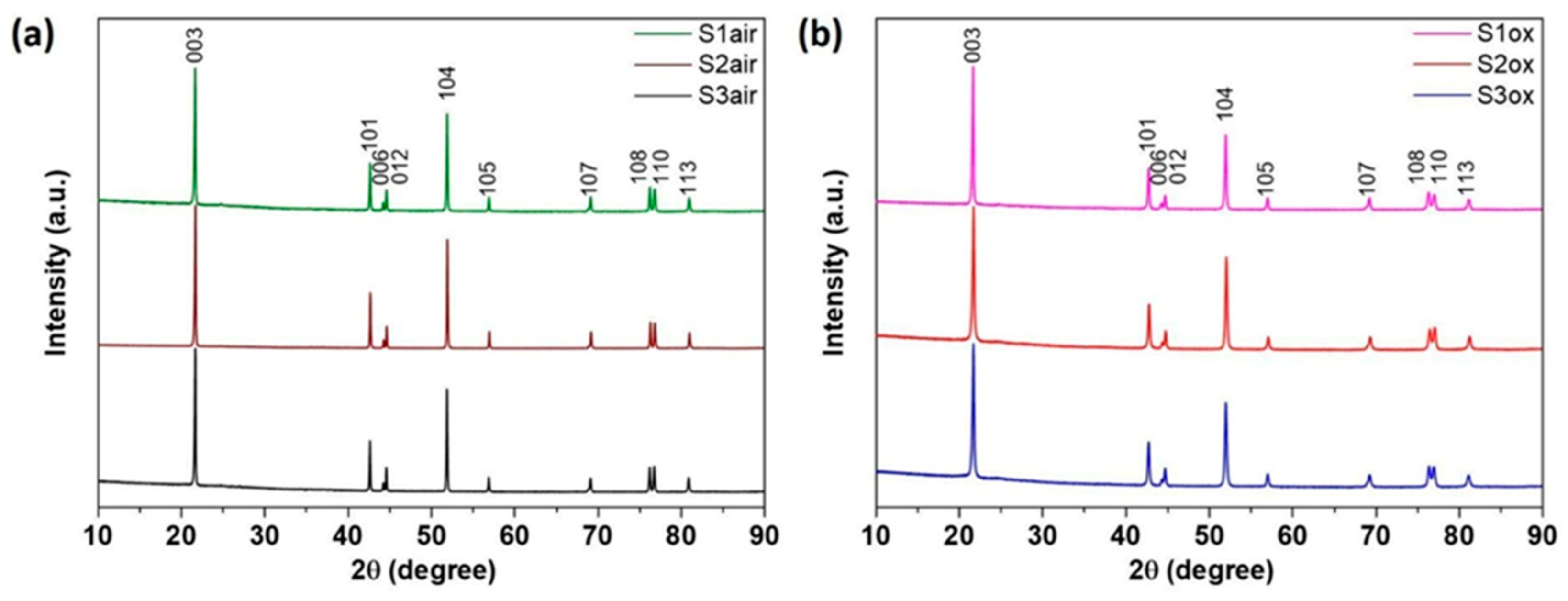
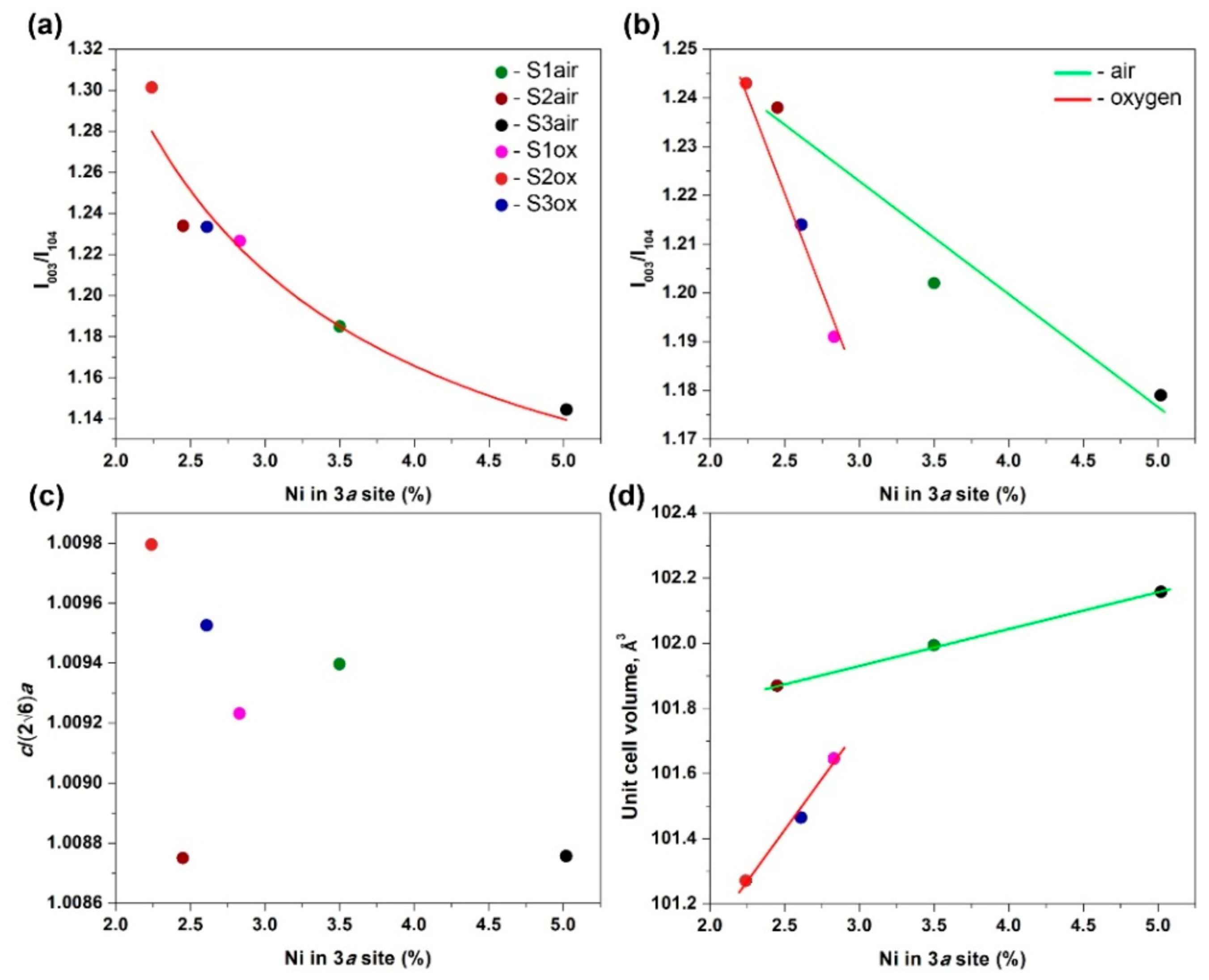
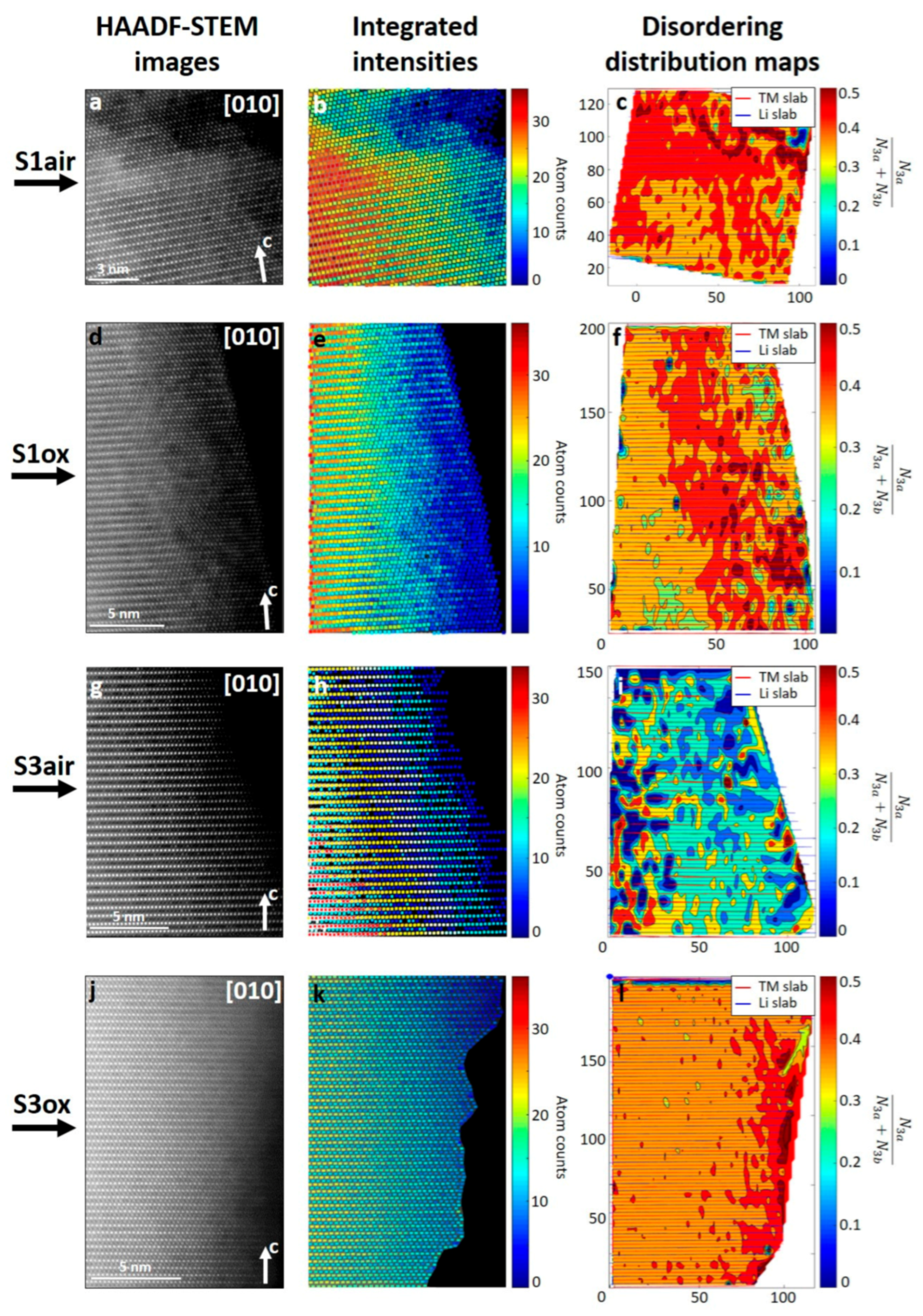
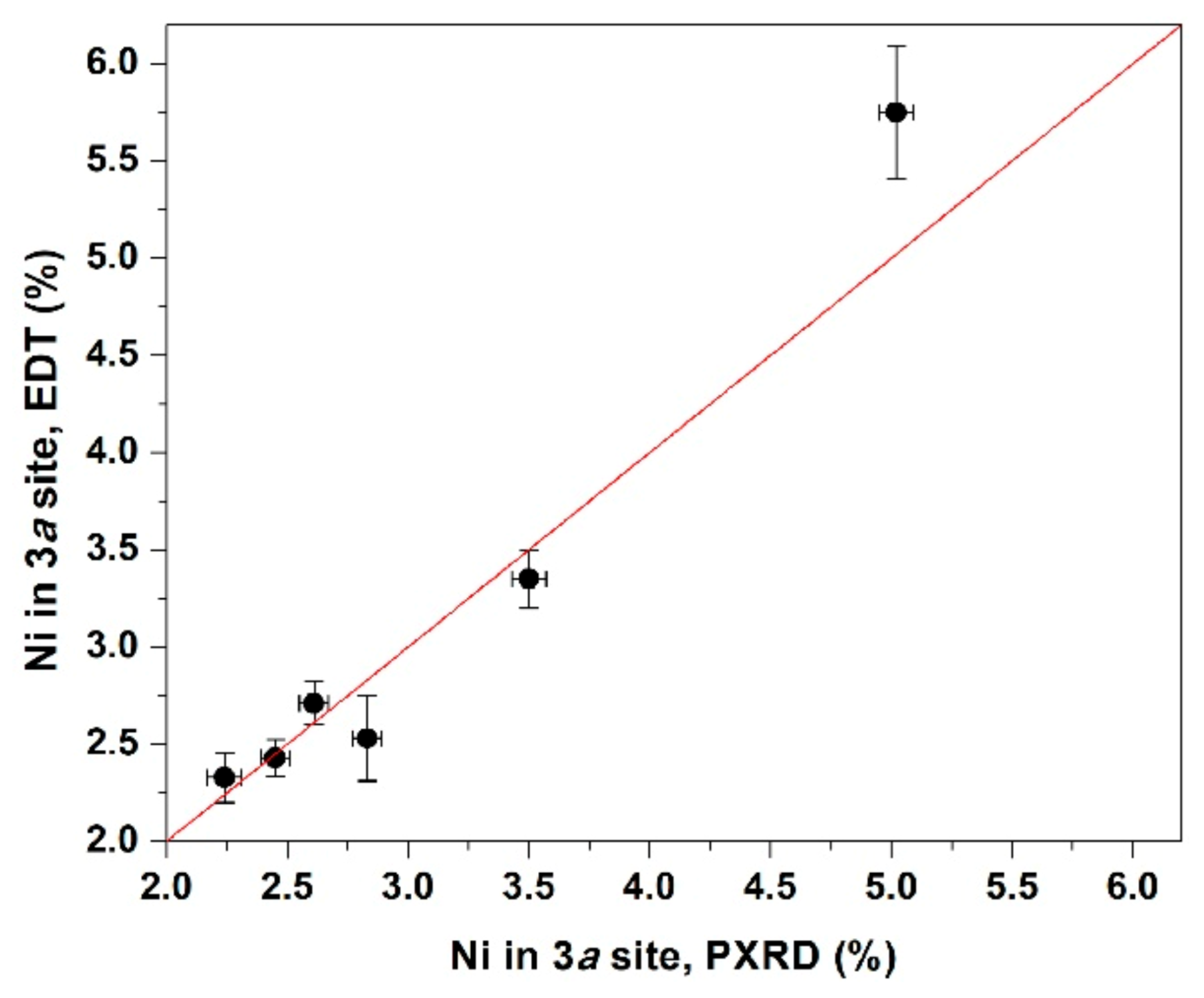
The layered oxides LiNixMnyCozO2 (NMCs, x + y + z = 1) with high nickel content (x ≥ 0.6, Ni-rich NMCs) are promising high-energy density-positive electrode materials for Li-ion batteries. Their electrochemical properties depend on Li+/Ni2+ cation disordering originating from the proximity of the Li+ and Ni2+ ionic radii. We synthesized a series of the LiNi0.8Mn0.1Co0.1O2 NMC811 adopting two different disordering schemes: Ni for Li substitution at the Li site in the samples finally annealed in air, and close to Ni↔Li antisite disorder in the oxygen-annealed samples. The defect formation scenario was revealed with Rietveld refinement from powder X-ray diffraction data, and then the reliability of semi-quantitative parameters, such as I003/I104 integral intensity ratio and c/(2√6a) ratio of pseudocubic subcell parameters, was verified against the refined defect concentrations. The I003/I104 ratio can serve as a quantitative measure of g(NiLi) only after explicit correction of intensities for preferred orientation. Being normalized by the total scattering power of the unit cell, the I003/I104 ratio depends linearly on g(NiLi) for each disordering scheme. The c/(2√6a) ratio appears to be not reliable and cannot be used for a quantitative estimate of g(NiLi). In turn, the volume of the R3¯m unit cell correlates linearly with g(NiLi), at least for defect concentrations not exceeding 5%. The microscopy techniques such as high-resolution high-angle annular dark-field scanning transmission electron microscopy (HAADF-STEM) and electron diffraction tomography (EDT) allow us to study the materials locally, still, there is no proper quantitative approach for comprehensive analysis of defects. In the present work, the TEM-assisted quantitative Li+/Ni2+ disordering analysis with EDT and HAADF-STEM in six Ni-rich NMC samples with various defects content is demonstrated. Noteworthy, while PXRD and EDT methods demonstrate overall defect amounts, HAADF-STEM allows us to quantitatively distinguish regions with various disordering extents. Therefore, the combination of mentioned PXRD and TEM methods gives the full picture of Li+/Ni2+ mixing defects in Ni-rich NMCs.
Keywords: Li-ion battery; cathode; layered oxide; Ni-rich NMCs; Li+/Ni2+ anti-site defects; transmission electron microscopy; electron diffraction tomography; qualitative high-resolution HAADF-STEM Li-ion battery; cathode; layered oxide; Ni-rich NMCs; Li+/Ni2+ anti-site defects; transmission electron microscopy; electron diffraction tomography; qualitative high-resolution HAADF-STEM