Article

Tripodal Podand Ligand with a Superhalogen Nature as an Effective Molecular Trap


Laboratory of Quantum Chemistry, Department of Theoretical Chemistry, Faculty of Chemistry, University of Gdańsk, Wita Stwosza 63, 80-308 Gdańsk, Poland
*
Author to whom correspondence should be addressed.
Symmetry 2020, 12(9), 1441; https://doi.org/10.3390/sym12091441
Submission received: 24 July 2020 / Revised: 20 August 2020 / Accepted: 25 August 2020 / Published: 1 September 2020
(This article belongs to the Special Issue Functional Materials Engineering and Biomolecular Structure)

Abstract

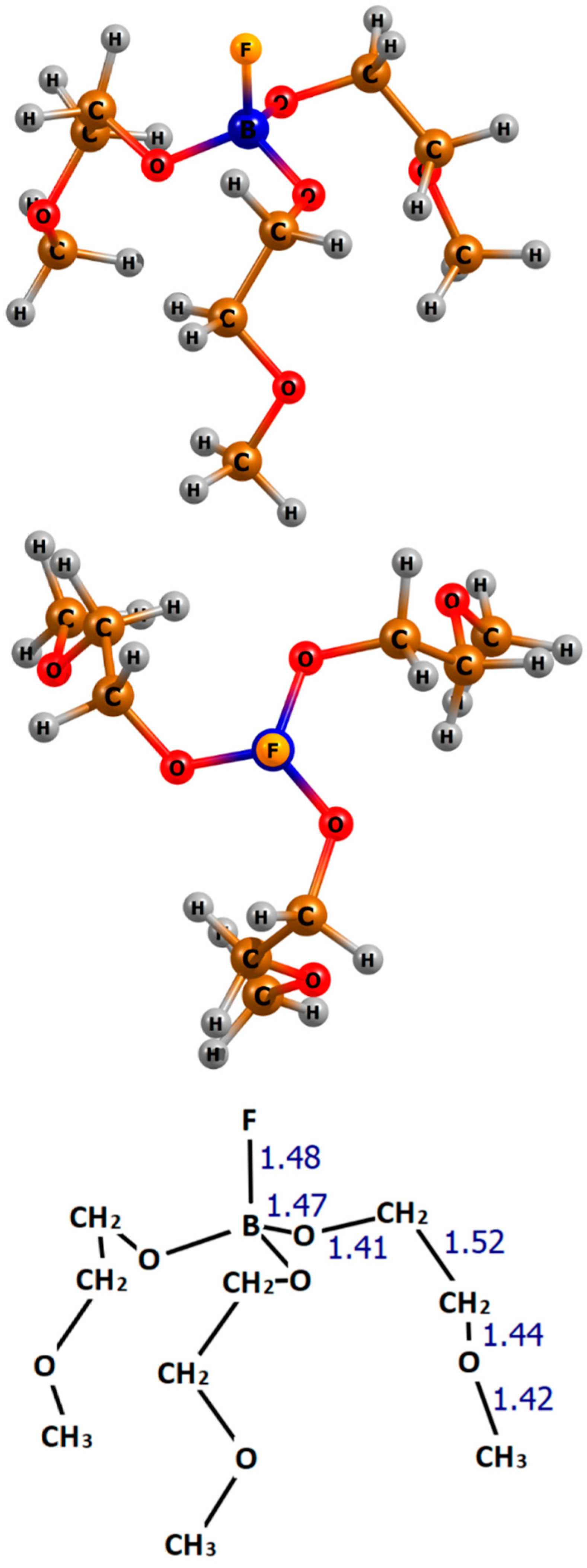
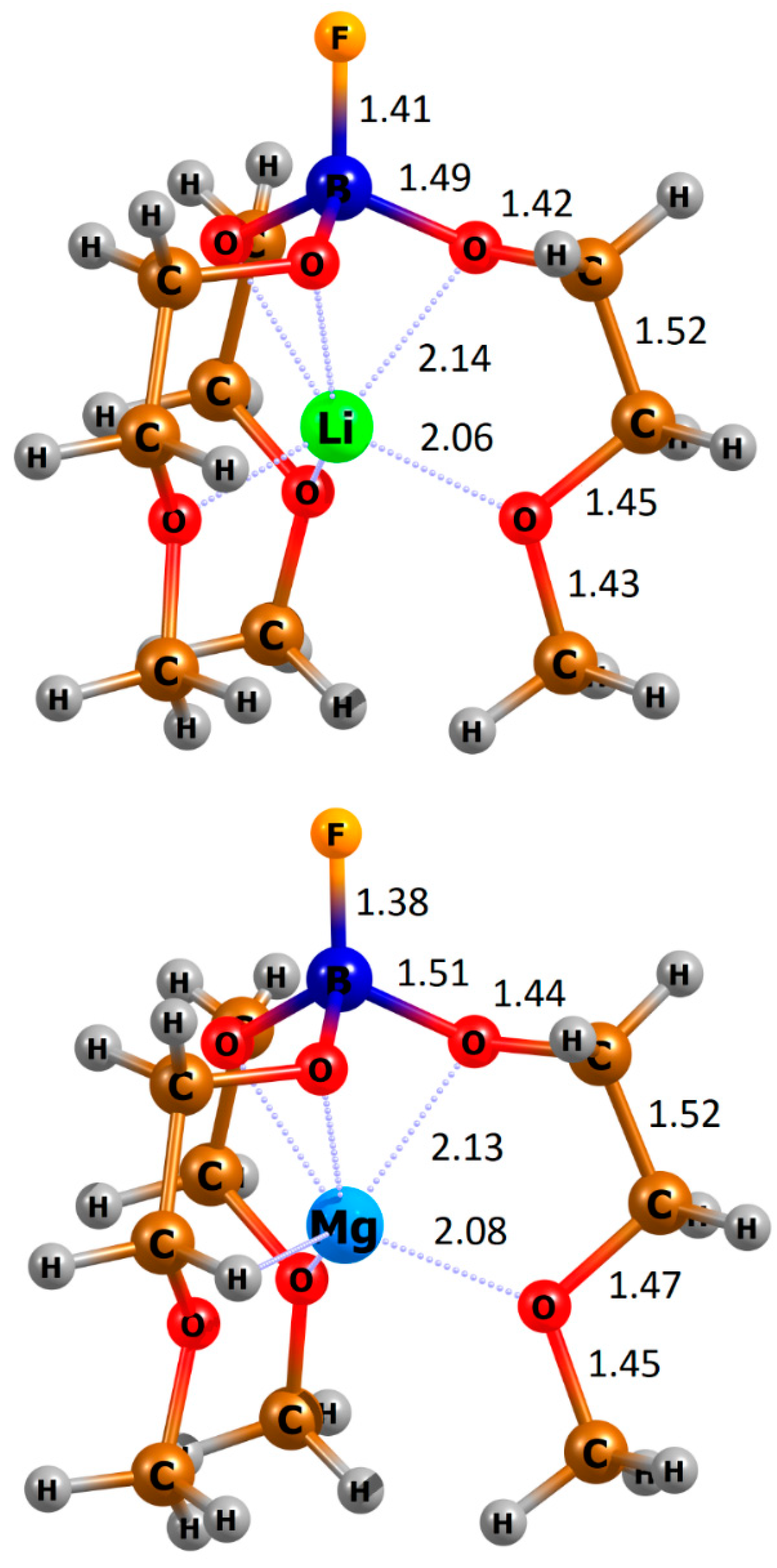
Tris(2-methoxyethyl) fluoroborate anion (TMEFA), anovel tripodal ligand based on the BF4 superhalogen anion, is proposed and was investigated theoretically using ab initio MP2 (second-order Møller-Plesset perturbational method) and OVGF (outer valence Green function) methods. The studied molecule comprises three 2-methoxyethoxy groups (-O-CH2-CH2-O-CH3) connected to a central boron atom, which results in the C3-symmetry of the compound. The resulting anion was stable against fragmentation processes and its vertical electron detachment energy was found to be 5.72 eV. Due to its equilibrium structure resembling that of classical tripodal podands, the [F-B(O-CH2-CH2-O-CH3)3] anion is capable of binding metal cations using its three arms, and thus may form strongly bound ionic complexes such as [F-B(O-CH2-CH2-O-CH3)3]/Li+ and [F-B(O-CH2-CH2-O-CH3)3]/Mg2+. The binding energies predicted for such compounds far exceed those of the similar neutral classical podand ligands, which likely makes the [F-B(O-CH2-CH2-O-CH3)3] system a more effective molecular trap or steric shielding agent with respect to selected metal cations.
Keywords: superhalogen anions; podand ligands; molecular trap superhalogen anions; podand ligands; molecular trap