Article

Symmetry in Infancy: Analysis of Motor Development in Autism Spectrum Disorders

Department of Cognitive Science and Education, University of Trento, via Matteo del Ben 5b, 38068 Rovereto TN, Italy
*
Author to whom correspondence should be addressed.
Symmetry 2009, 1(2), 215-225; https://doi.org/10.3390/sym1020215
Submission received: 27 October 2009 / Accepted: 5 December 2009 / Published: 10 December 2009
(This article belongs to the Special Issue Feature Papers: Symmetry Concepts and Applications)

Abstract

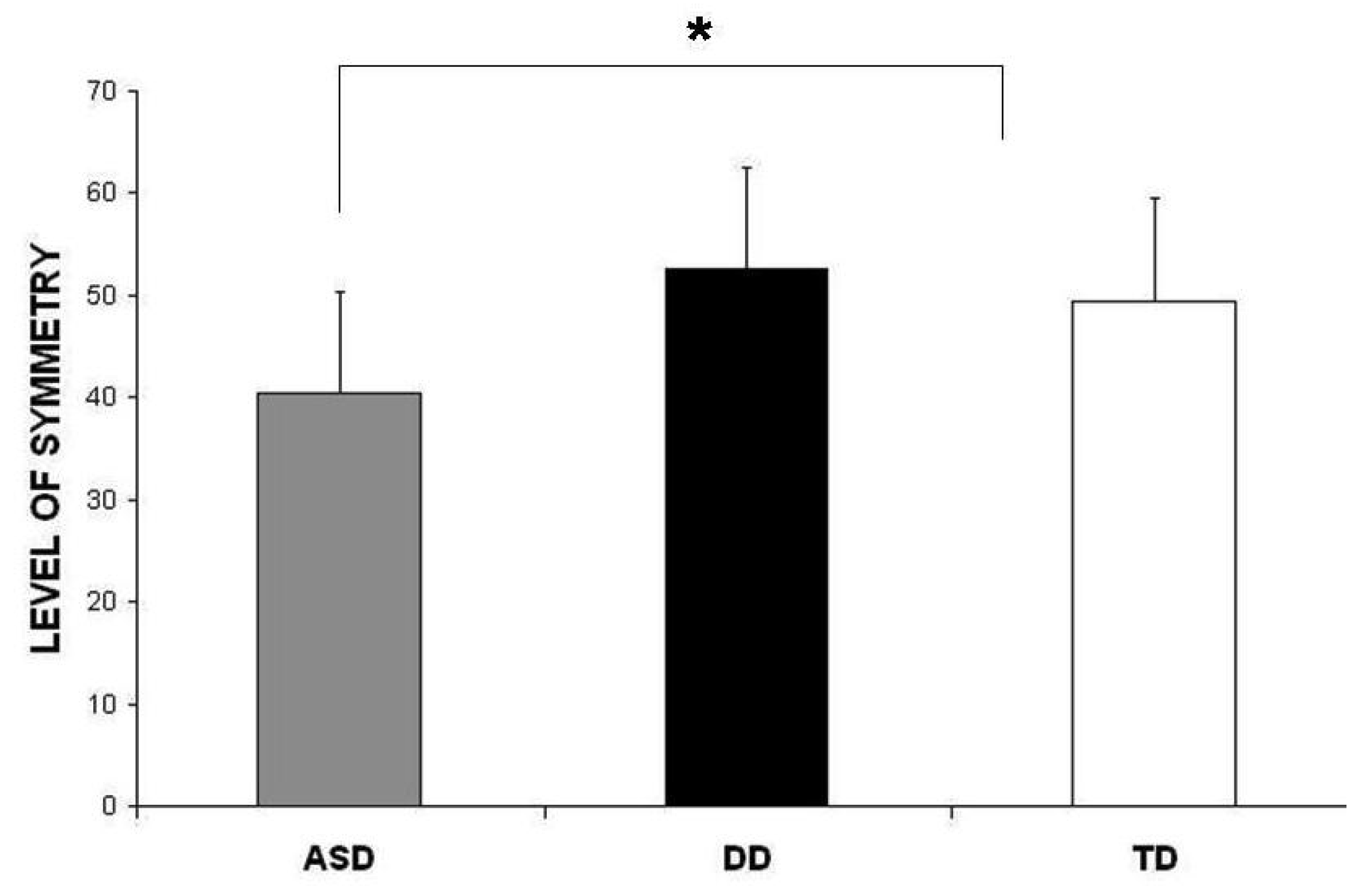
Motor asymmetry, defined as the lack of symmetry in movements or postures, is often observed briefly in many typically developing children. However, if such asymmetry persists, it may be a sign of neurological disease. Recent studies have suggested that motor asymmetries may be an early symptom of Autism Spectrum Disorders (ASD). ASD involve a range of social, cognitive, and behavioral problems, at different degrees of functioning, which are thought to be the final common pathway of multiple etiological mechanisms. Furthermore, early identification of ASD has been recognized as a critical aspect for treatment. Our study aims to analyze symmetry in the motor milestones of infants with ASD compared with typically developing infants (TD) or infants with other developmental delay (DD) during the first year of life. Our results highlight that there are different patterns of motor symmetry in the groups. In particular, infants with ASD scored significantly poorer (higher levels of asymmetry) then the TD and DD infants. We also identified two subgroups of infants with ASD, one with a typical level and the other with a lower level of motor functioning. Implications of the study for diagnosis and treatment are described.
Keywords: motor symmetry; postural symmetry; Autism Spectrum Disorders motor symmetry; postural symmetry; Autism Spectrum Disorders