Construction of Green Volume Quantity and Equity Indicators for Urban Areas at Both Regional and Neighborhood Scales: A Case Study of Major Cities in China †

Abstract
1. Introduction
2. Materials and Methods
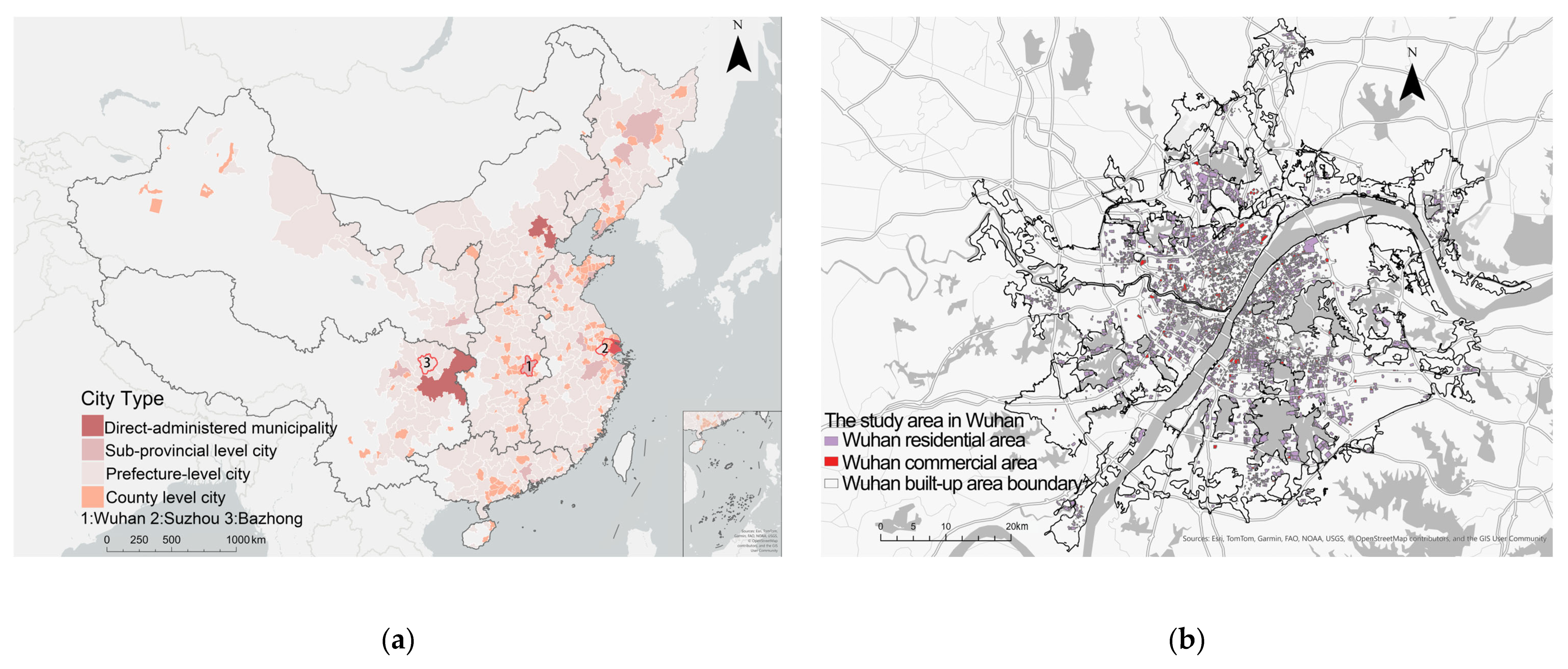
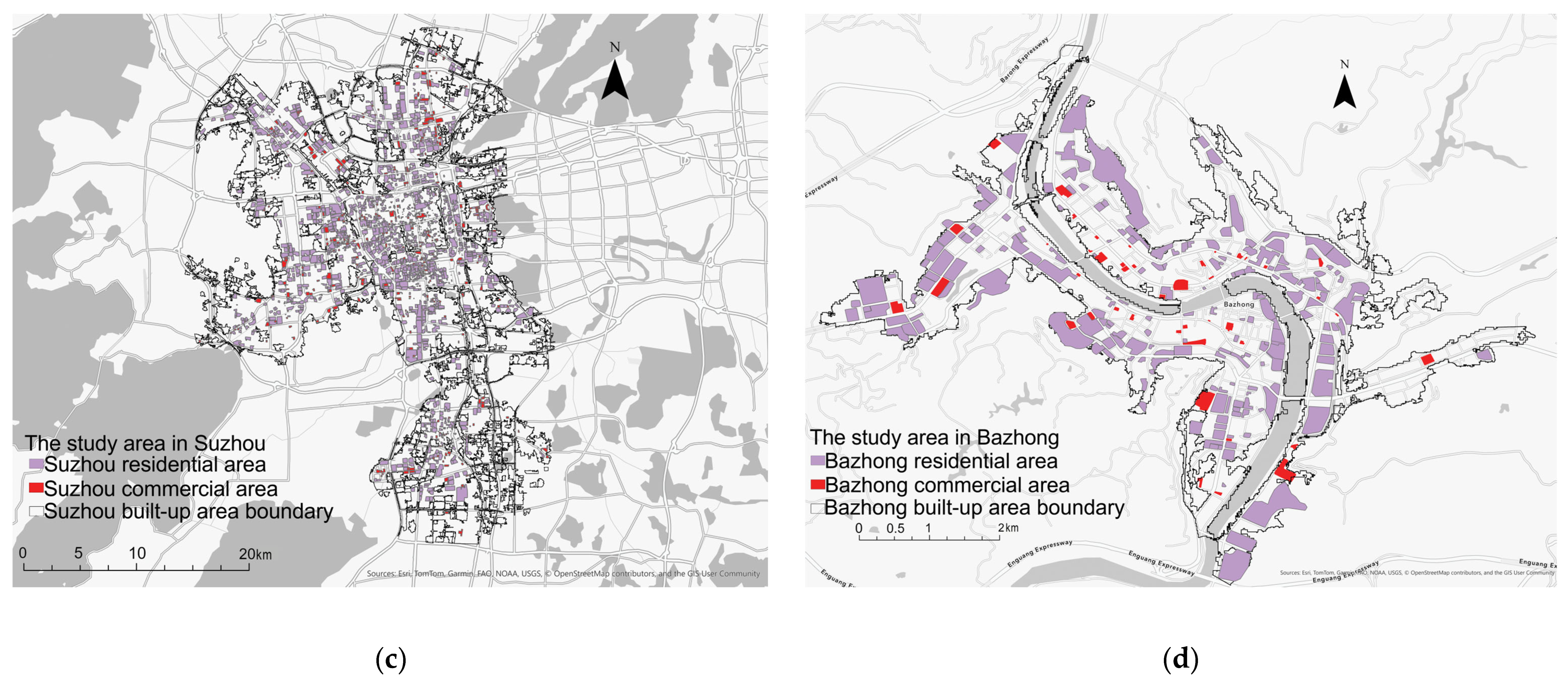
2.1. Research Area
2.2. Data Sources and Data Processing
2.3. Analytical Methods
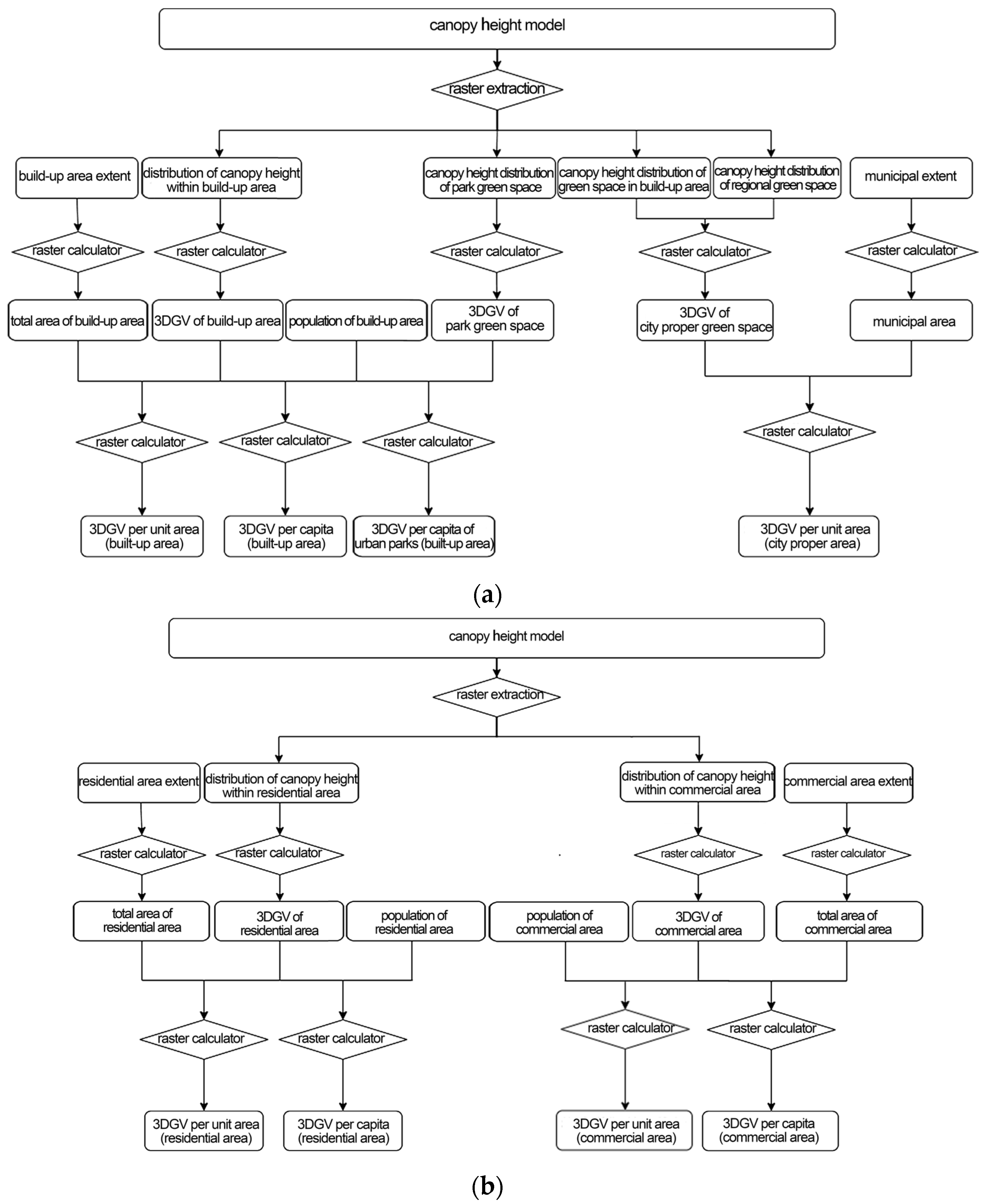
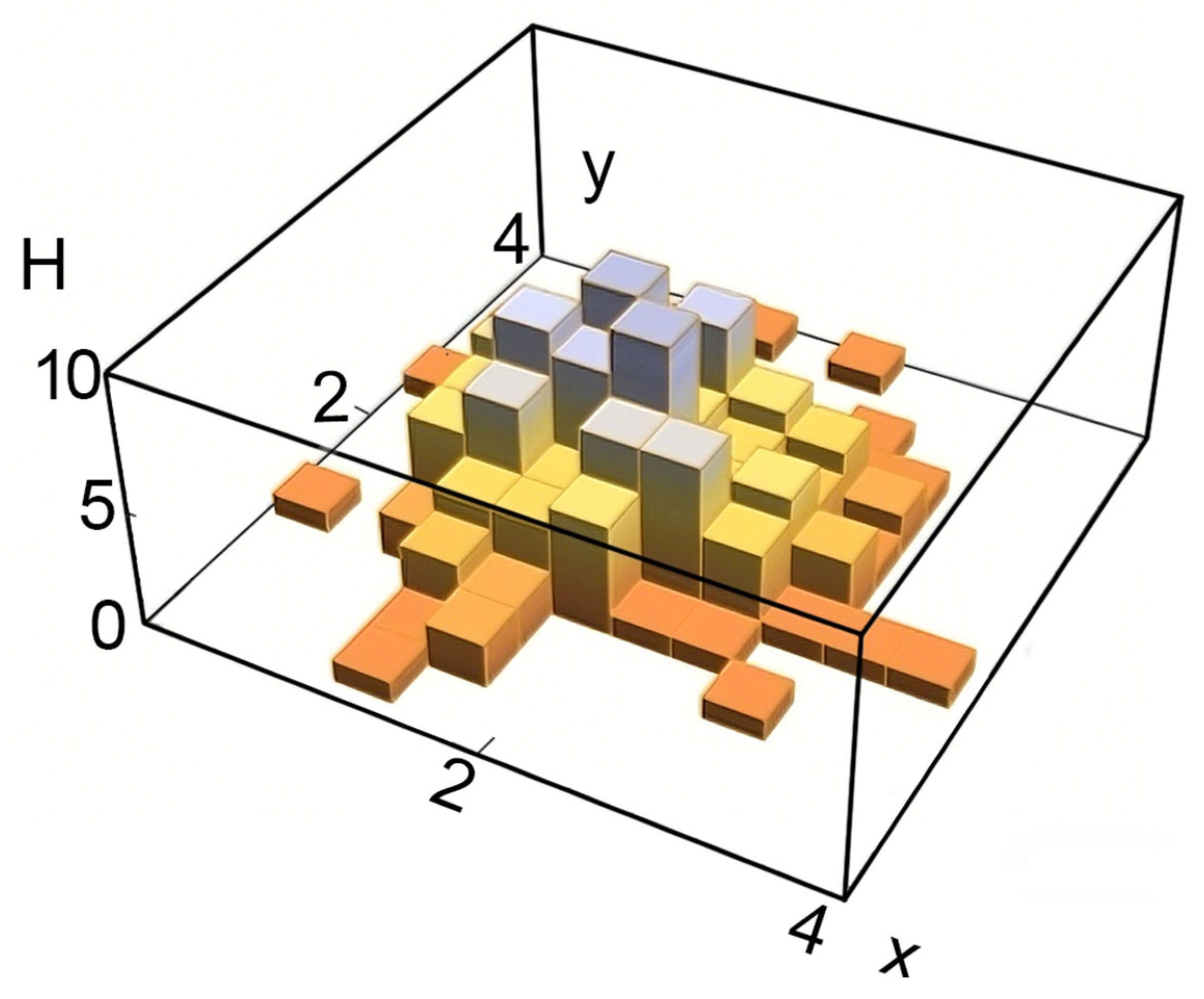
2.3.1. 3DGV Quantity Assessment Indicators
2.3.2. Green Volume Equity Evaluation Method
2.3.3. Classification of Green Volume Quantity and Equity Types
3. Results
3.1. 3DGV Quantity and Equity Distributions at the Regional Scale
3.1.1. 3DGV Quantity Distributions Among Different Cities
3.1.2. 2DGV and 3DGV Quantity Disparities Among the Cities
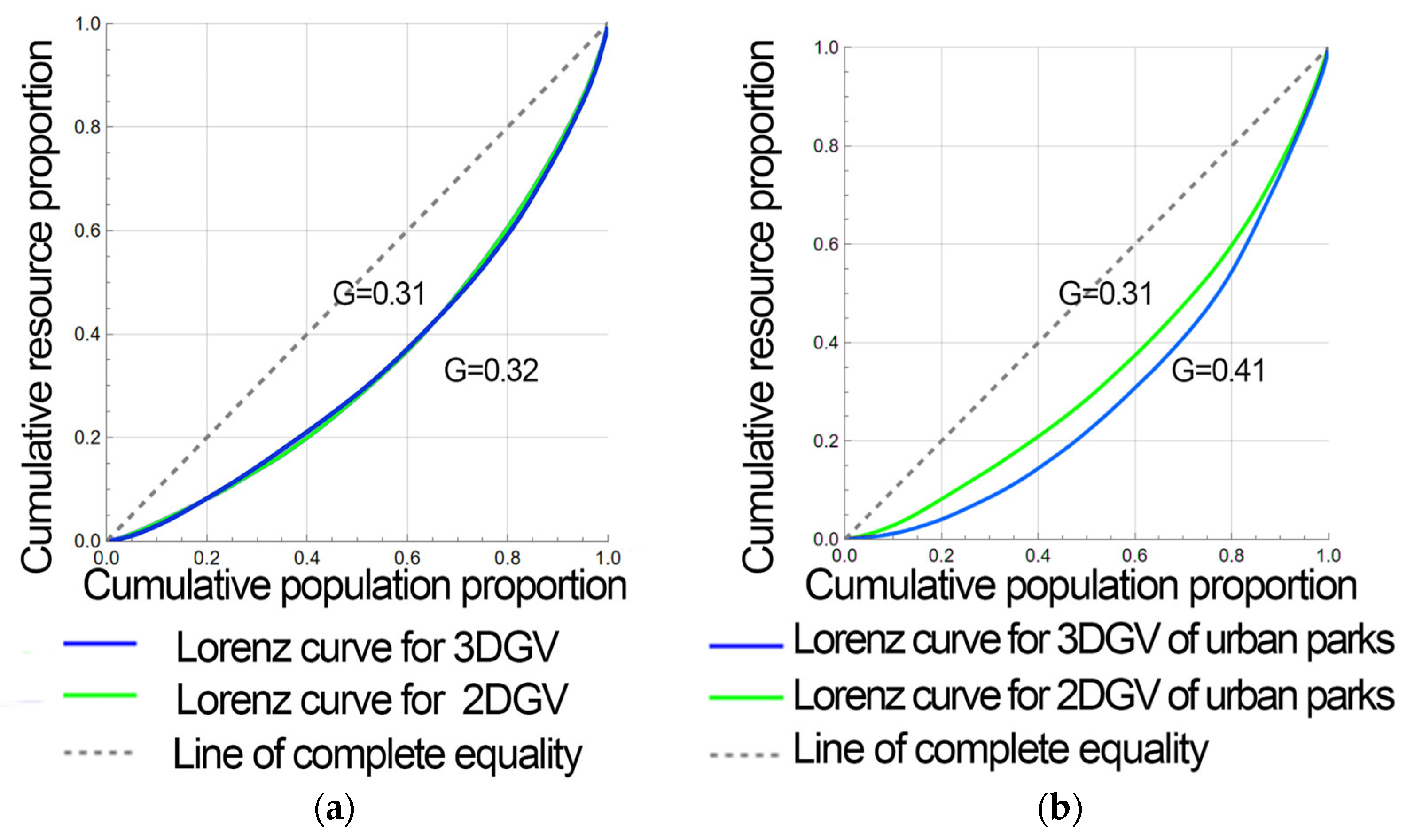
3.1.3. 2DGV and 3DGV Equity Disparities Among the Cities
3.2. 3DGV Quantity and Equity Distributions at the Neighborhood Scale
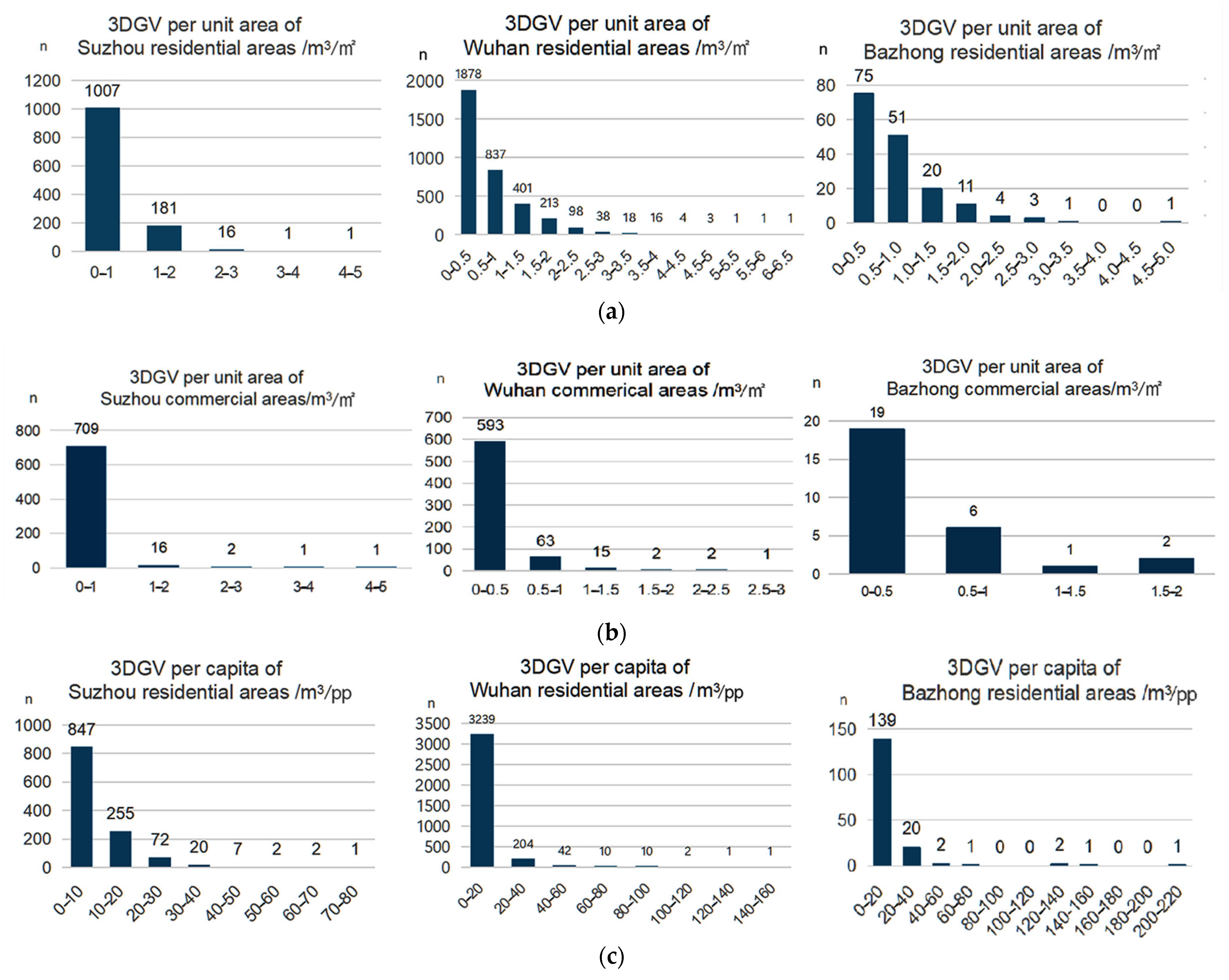
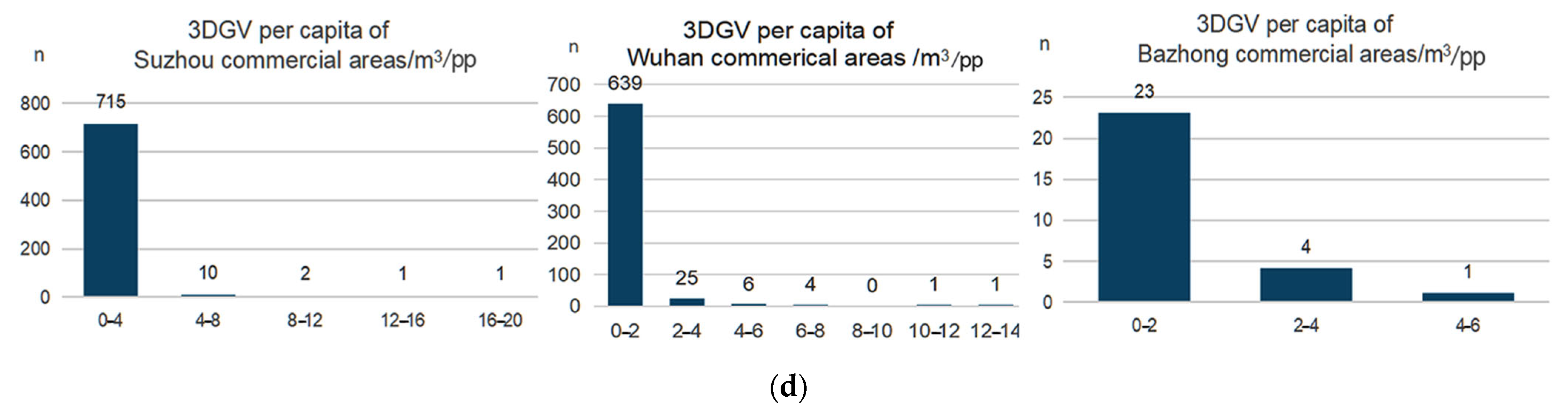
3.2.1. 3DGV Quantity Distribution in Residential and Commercial Areas
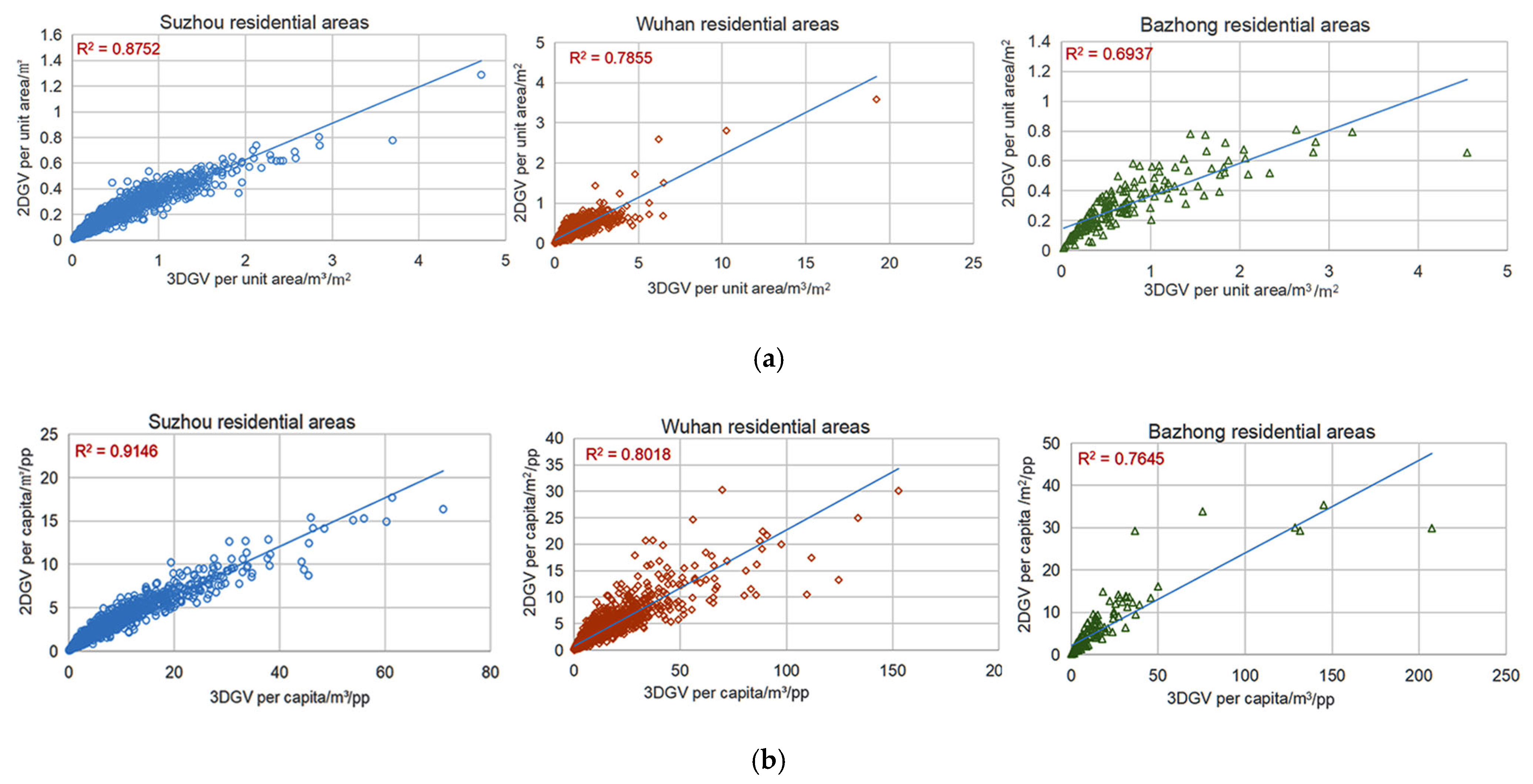
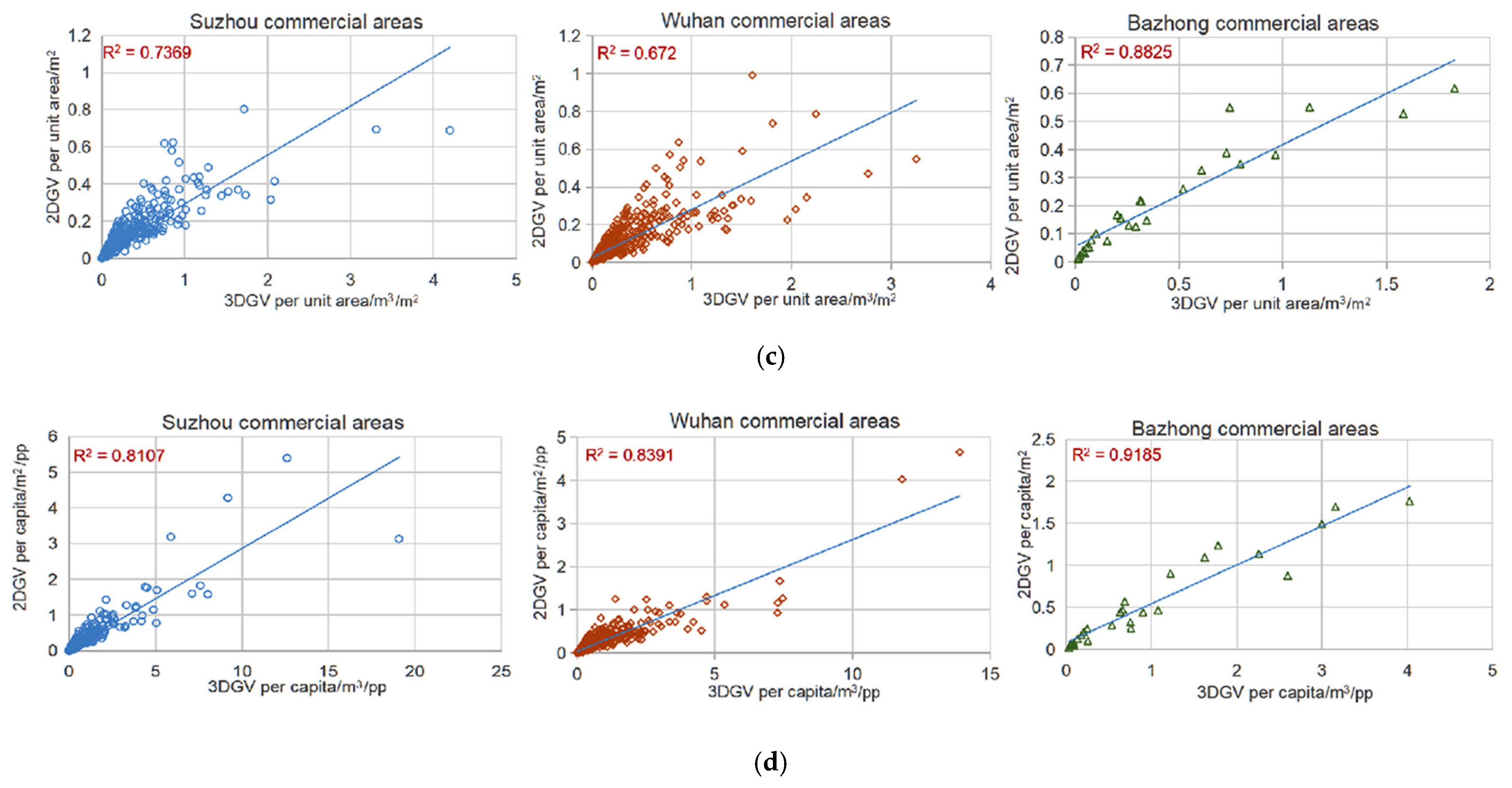
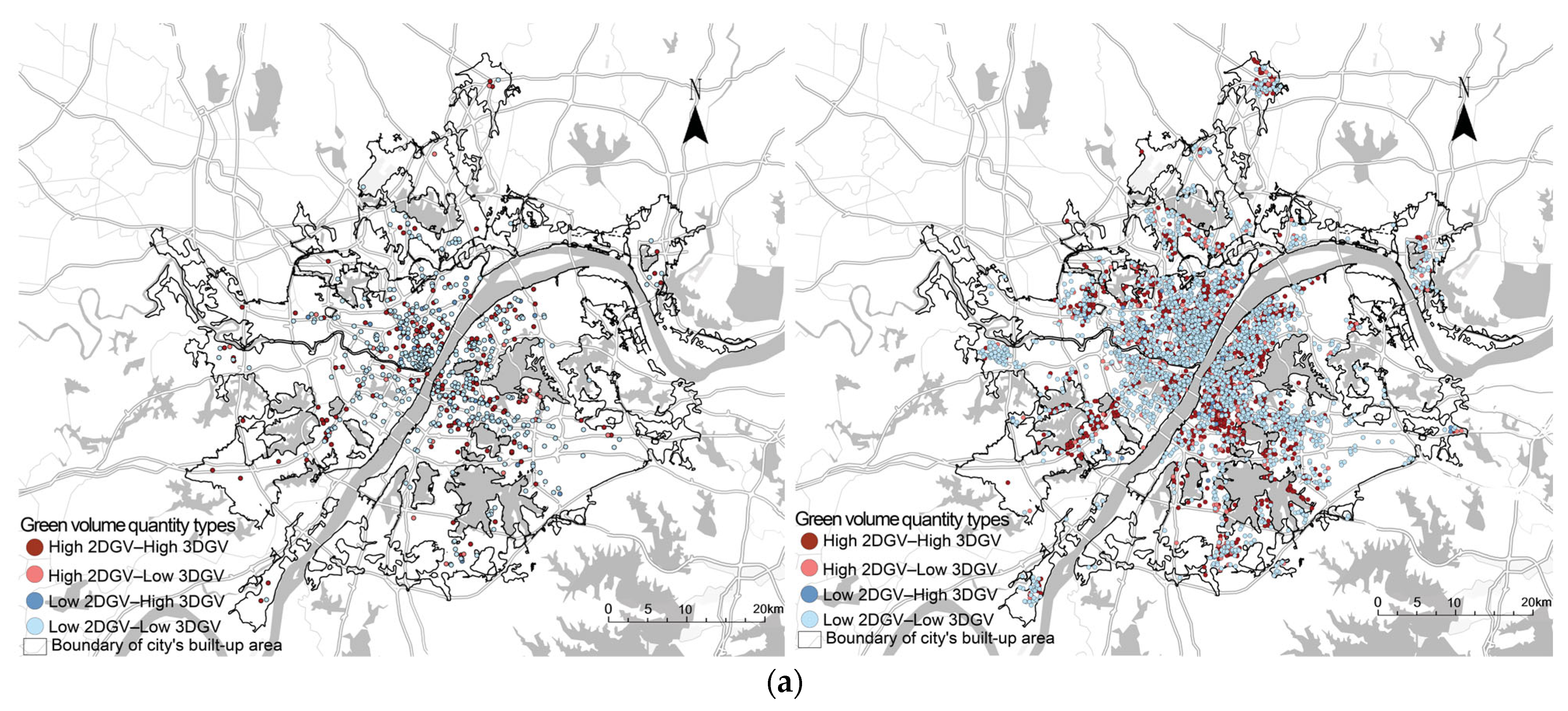
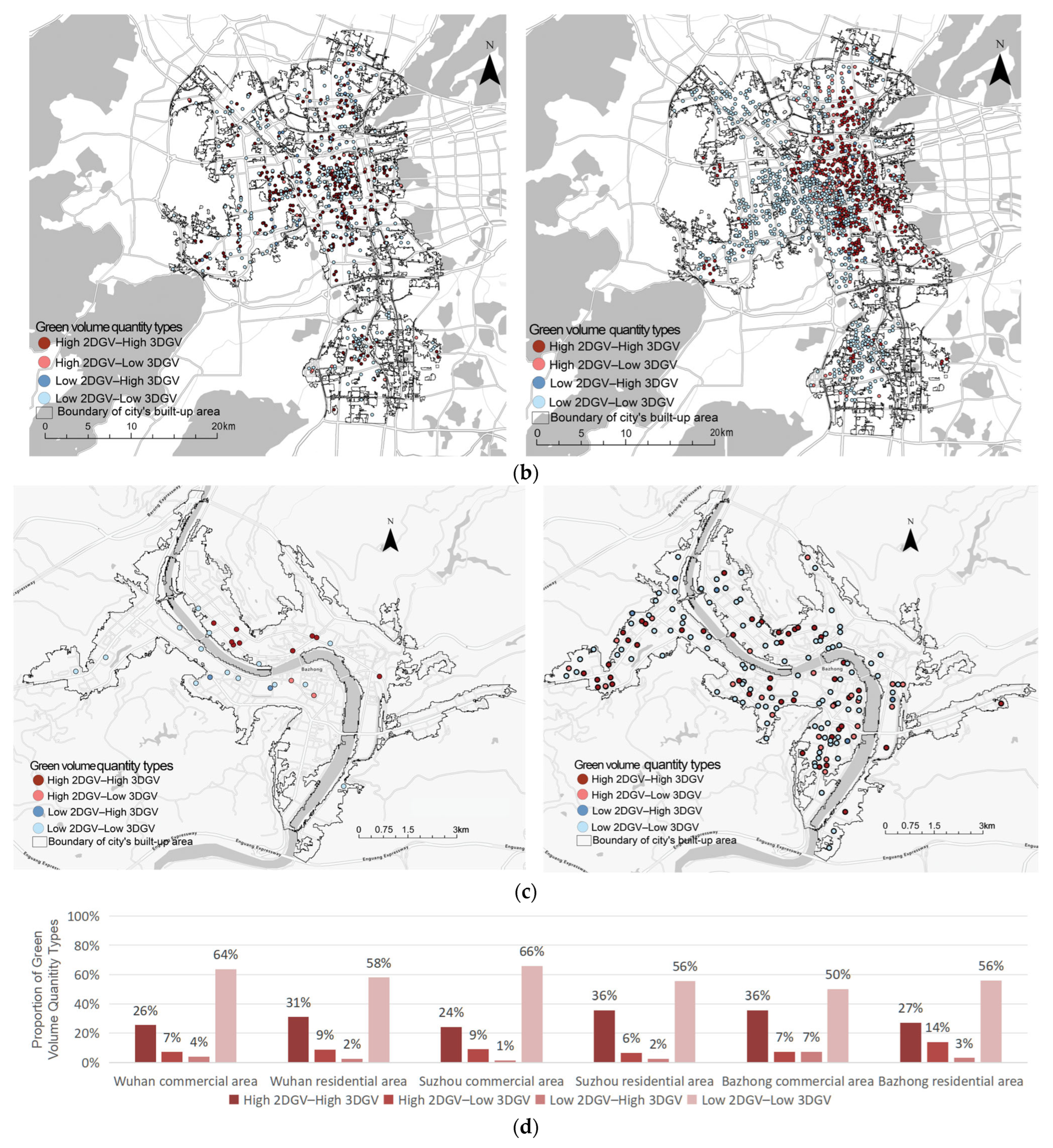
3.2.2. 2DGV and 3DGV Quantity Disparities in Residential and Commercial Areas
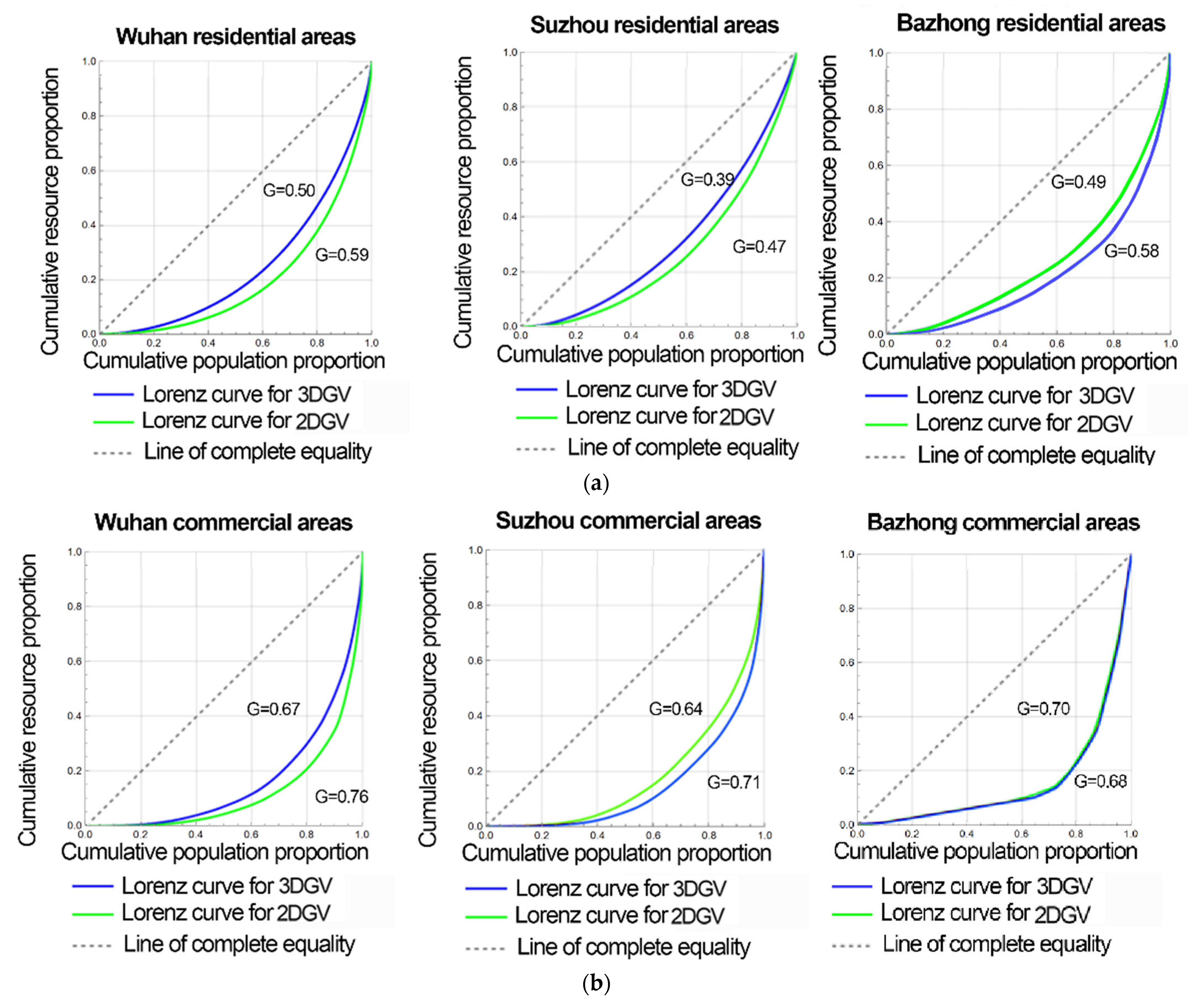
3.2.3. 2DGV and 3DGV Equity Disparities in Residential and Commercial Areas
4. Discussion
4.1. Potential Influential Factors of 3DGV Spatial Distribution
4.2. Differences in Green Volume Equity at Regional and Neighborhood Scales
4.3. Optimizations for Different Green Volume Quantity and Equity Types
4.3.1. Regulation Implementing Strategies for Different Green Volume Quantity and Equity Types
4.3.2. Optimization Strategies for Typical Green Space Development Patterns
4.4. Limitations and Future Prospects
5. Conclusions
Author Contributions
Funding
Data Availability Statement
Conflicts of Interest
References
- Zhu, T.; Chen, A.; Yan, Y.; Zhang, W. Construction of Green Space Assessment Indicators for Urban Residential Areas Based on 3D Vegetation Volume: A Case Study of Residential Communities in Wuhan. In Proceedings of the Fábos Conference on Landscape and Greenway Planning 2025, Amherst, MA, USA, 11–13 April 2025; Volume 8. Issue 1. [Google Scholar] [CrossRef]
- Jansson, M.; Lindgren, T. A review of the concept ‘management’ in relation to urban landscapes and green spaces: Toward a holistic understanding. Urban For. Urban Green. 2012, 11, 139–145. [Google Scholar] [CrossRef]
- CJ/T 85-2017; Ministry of Housing and Urban–Rural Development of the People’s Republic of China. Standard for Classification of Urban Green Space. China Architecture & Building Press: Beijing, China, 2017.
- United Nations. Transforming Our World: The 2030 Agenda for Sustainable Development; United Nations General Assembly: New York, NY, USA, 2015; Available online: https://sdgs.un.org/2030agenda (accessed on 3 December 2025).
- World Health Organization. Urban Green Spaces and Health: A Review of Evidence; WHO Regional Office for Europe: Copenhagen, Denmark, 2016. Available online: https://www.who.int/europe/publications/i/item/WHO-EURO-2016-3352-43111-60341 (accessed on 3 December 2025).
- UN-Habitat. New Urban Agenda; United Nations Human Settlements Programme: Nairobi, Kenya, 2017; Available online: https://unhabitat.org/about-us/new-urban-agenda (accessed on 3 December 2025).
- European Environment Agency. Green Infrastructure and Territorial Cohesion: The Concept of Green Infrastructure and Its Integration into Policies; European Environment Agency: Copenhagen, Denmark, 2011. Available online: https://www.eea.europa.eu/publications/green-infrastructure-and-territorial-cohesion (accessed on 3 December 2025).
- Regulations on Planning and Construction Indicators for Urban Greening. Available online: https://www.beijing.gov.cn/zhengce/zhengcefagui/qtwj/201609/t20160924_776512.html (accessed on 1 November 2025).
- National Garden City Evaluation Standards. Available online: http://www.gov.cn/zhengce/zhengceku/2022-01/14/content_5668177.html (accessed on 1 November 2025).
- GB 50137-2011; Code for Classification of Urban Land Use and Planning Standards of Development Land. China Construction Industry Press: Beijing, China, 2011. Available online: https://gaizaoban.nwu.edu.cn/chengshiyongdifenleiheguihuajiansheyongdibiaozhun.pdf (accessed on 1 November 2025).
- GB 50180-2018; Ministry of Housing and Urban–Rural Development of the People’s Republic of China. Standard for Urban Residential Area Planning and Design. China Architecture & Building Press: Beijing, China, 2018.
- Wuhan Urban Greening Regulation. Available online: https://ylj.wuhan.gov.cn/zwgk/zcwj/flfg_12325/202001/t20200113_794528.shtml (accessed on 1 November 2025).
- Suzhou Urban Greening Regulation. Available online: https://www.suzhou.gov.cn/szsrmzf/gbdfxfg/202302/a3bea3a503d44a499879cb5b3ed2511d.shtml (accessed on 1 November 2025).
- Sichuan Urban Landscaping Regulation. Available online: https://baike.baidu.com/reference/1023088/533aYdO6cr3_z3kATPDZza7zNybFP4-s67yBUuBzzqIP0XOpX5nyFJsx88c8sPBoAkXIvtd2etES2br6C0NF6ehUc-00SrUln3GQUDfFy7_4p51sxg (accessed on 1 November 2025).
- Xu, C.; Haase, D.; Pribadi, D.O.; Pauleit, S. Spatial variation of green space equity and its relation with urban dynamics: A case study in the region of Munich. Ecol. Indic. 2018, 93, 512–523. [Google Scholar] [CrossRef]
- Dong, Y.; Chen, X.; Lv, D.; Wang, Q. Evaluation of urban green space supply and demand based on mobile signal data: Taking the central area of Shenyang city as an example. Land 2023, 12, 1742. [Google Scholar] [CrossRef]
- Wen, C.; Albert, C.; Von Haaren, C. Equality in access to urban green spaces: A case study in Hannover, Germany, with a focus on the elderly population. Urban For. Urban Green. 2020, 55, 126820. [Google Scholar] [CrossRef]
- Ceriani, L.; Verme, P. The origins of the Gini index: Extracts from Variabilità e mutabilità (1912) by Corrado Gini. J. Econ. Inequal. 2012, 10, 421–443. [Google Scholar] [CrossRef]
- Nero, B.F. Urban green space dynamics and socio-environmental inequity: Multi-resolution and spatiotemporal data analysis of Kumasi, Ghana. Int. J. Remote Sens. 2017, 38, 6993–7020. [Google Scholar] [CrossRef]
- Kabisch, N.; Haase, D. Green justice or just green? Provision of urban green spaces in Berlin, Germany. Landsc. Urban Plan. 2014, 122, 129–139. [Google Scholar] [CrossRef]
- Duan, Z.; Huang, L.; Zhu, Z.; Long, S.; Liu, Y. Transformation and inequity of urban green space in Guangzhou: Drivers and policy implications under rapid urbanization. Sustainability 2025, 17, 2217. [Google Scholar] [CrossRef]
- Kazazi, A.K.; Rabiei-Dastjerdi, H.; McArdle, G. Emerging paradigm shift in urban indicators: Integration of the vertical dimension. J. Environ. Manag. 2022, 316, 115234. [Google Scholar] [CrossRef]
- Giannico, V.; Stafoggia, M.; Spano, G.; Elia, M.; Dadvand, P.; Sanesi, G. Characterizing green and gray space exposure for epidemiological studies: Moving from 2D to 3D indicators. Urban For. Urban Green. 2022, 72, 127567. [Google Scholar] [CrossRef]
- Zhu, S.; Du, S.; Li, Y.; Wei, S.; Jin, X.; Zhou, X.; Shi, X. A 3D spatiotemporal morphological database for urban green infrastructure and its applications. Urban For. Urban Green. 2021, 58, 126935. [Google Scholar] [CrossRef]
- Jin, Y.; Wang, F.; Zong, Q.; Jin, K.; Liu, C.; Qin, P. Spatial patterns and driving forces of urban vegetation greenness in China: A case study comprising 289 cities. Geogr. Sustain. 2024, 5, 370–381. [Google Scholar] [CrossRef]
- Meng, Q.; Chen, X.; Sun, Y.; Li, Y.; Wang, C.; Yang, J.; Liu, J. Exposure opportunity index: Measuring people-perceiving-greenery at floor level effectively. Earth Sci. Inform. 2020, 13, 29–38. [Google Scholar] [CrossRef]
- Wei, W.; Li, J. Assessing the three-dimensional vegetation carbon sink of urban green spaces using unmanned aerial vehicles and machine learning. Ecol. Indic. 2025, 173, 113380. [Google Scholar] [CrossRef]
- Zhou, L.; Li, X.; Zhang, B.; Xuan, J.; Gong, Y.; Tan, C.; Huang, H.; Du, H. Estimating 3D green volume and aboveground biomass of urban forest trees by UAV-LiDAR. Remote Sens. 2022, 14, 5211. [Google Scholar] [CrossRef]
- Zhou, J.H. Research on the Green Quantity Group of Urban Living Environment (5)—Research on Greening 3D Volume and Its Application. China Gard. 1998, 14, 61–63. [Google Scholar]
- Anderson, K.; Hancock, S.; Casalegno, S.; Griffiths, A.; Griffiths, D.; Sargent, F.; McCallum, J.; Cox, D.T.C.; Gaston, K.J. Visualising the urban green volume: Exploring LiDAR voxels with tangible technologies and virtual models. Landsc. Urban Plan. 2018, 178, 248–260. [Google Scholar] [CrossRef]
- Zhu, Y.; Li, J.; Xu, Y. Improvement of 3D Green Volume Estimation Method for Individual Street Trees Based on TLS Data. Forests 2025, 16, 690. [Google Scholar] [CrossRef]
- Zhou, Y.F.; Zhou, J.H. Fast method to detect and calculate LVV. Acta Ecol. Sin. 2006, 26, 4204–4211. [Google Scholar]
- Xiao, Q.; McPherson, E.G.; Ustin, S.L.; Grismer, M.E. A new approach to modeling tree rainfall interception. J. Geophys. Res. Atmos. 2000, 105, 29173–29188. [Google Scholar] [CrossRef]
- Zheng, G.; Moskal, L.M. Computational-geometry-based retrieval of effective leaf area index using terrestrial laser scanning. IEEE Trans. Geosci. Remote Sens. 2012, 50, 3958–3969. [Google Scholar] [CrossRef]
- Ma, H.; Song, J.; Wang, J.; Xiao, Z.; Fu, Z. Improvement of spatially continuous forest LAI retrieval by integration of discrete airborne LiDAR and remote sensing multi-angle optical data. Agric. For. Meteorol. 2014, 189–190, 60–70. [Google Scholar] [CrossRef]
- Liu, Q.; Cai, E.; Zhang, J.; Song, Q.; Li, X.; Dou, B. A modification of the finite-length averaging method in measuring leaf area index in field. Chin. Bull. Bot. 2018, 53, 671–685. [Google Scholar] [CrossRef]
- Li, F.; Li, M.; Feng, X. High-precision method for estimating the three-dimensional green quantity of an urban forest. J. Indian Soc. Remote Sens. 2021, 49, 1407–1417. [Google Scholar] [CrossRef]
- Hyyppä, E.; Kukko, A.; Kaijaluoto, R.; White, J.C.; Wulder, M.A.; Pyörälä, J.; Liang, X.; Yu, X.; Wang, Y.; Kaartinen, H.; et al. Accurate derivation of stem curve and volume using backpack mobile laser scanning. ISPRS J. Photogramm. Remote Sens. 2020, 161, 246–262. [Google Scholar] [CrossRef]
- Luo, J.; Zhou, Y.; Leng, H.; Meng, C.; Hou, Z.; Song, T.; Hu, Z.; Zhang, C.; Feng, S. Quick estimation of three-dimensional vegetation volume based on UAV imagery: A case study on Shanghai Botanical Garden. J. East China Norm. Univ. (Nat. Sci.) 2022, 2022, 122–134. [Google Scholar] [CrossRef]
- Hong, Z.; Xu, W.; Liu, Y.; Wang, L.; Ou, G.; Lu, N.; Dai, Q. Retrieval of three-dimensional green volume in urban green space from multi-source remote sensing data. Remote Sens. 2023, 15, 5364. [Google Scholar] [CrossRef]
- Yan, Z. Research on three-dimensional art greening design. Highlights Art Des. 2022, 1, 1–4. [Google Scholar] [CrossRef]
- Hong, Z.; Liu, Y.; Xu, W.; Wang, L.; Lu, N.; Ou, G.; Kou, W. A new method of three-dimensional green volume retrieval and its applications in urban greenery evaluation. Ecol. Indic. 2025, 176, 113629. [Google Scholar] [CrossRef]
- Yue, F.; Fu, F.; Dai, F.; Zeng, H. Correlation between particulate matter pollution concentration and 3D green space in mega cities based on remote sensing inversion. Chin. Landsc. Archit. 2021, 49, 83–88. [Google Scholar] [CrossRef]
- Xie, X.; Zhou, H.; Liu, X.; Yang, Y.; Gou, Z. Optimizing Green Space Accessibility in High-Density Business Districts: A Spatiotemporal Assessment Integrating Multi-Source Data and Behavioral Dynamics. J. Urban Manag. 2025, in press. Available online: https://www.sciencedirect.com/science/article/pii/S2226585625001736 (accessed on 1 December 2025). [CrossRef]
- Bolte, A.M.; Niedermann, B.; Kistemann, T.; Haunert, J.H.; Dehbi, Y.; Kötter, T. The green window view index: Automated multi-source visibility analysis for a multi-scale assessment of green window views. Landsc. Ecol. 2024, 39, 71. [Google Scholar] [CrossRef]
- Zhou, C.; Zong, Y. Research on the evolution of accessible equality of three-dimensional green volume based on machine learning. Chin. Landsc. Archit. 2024, in press. Available online: https://link.cnki.net/urlid/11.2165.TU.20241218.1422.002 (accessed on 1 December 2025).
- Jie, S.; Ma, J. Analysis of urban green space landscape pattern in Suzhou. In Journal of Physics: Conference Series; IOP Publishing: Bristol, UK, 2020; Volume 1549, p. 022034. [Google Scholar] [CrossRef]
- Zhang, L.; Wei, Y.D.; Meng, R. Spatiotemporal dynamics and spatial determinants of urban growth in Suzhou, China. Sustainability 2017, 9, 393. [Google Scholar] [CrossRef]
- Yan, Z.; Luo, Y.; Guo, S. Influence mechanism of perceived biodiversity on mental restoration in large waterfront green spaces. Landsc. Archit. 2024, 31, 111–119. [Google Scholar] [CrossRef]
- Ren, H.; Chen, C.; Li, Y.; Zhu, W.; Zhang, L.; Wang, L.; Zhu, L. Response of vegetation coverage to climate changes in the Qinling-Daba Mountains of China. Forests 2023, 14, 425. [Google Scholar] [CrossRef]
- Zhang, H.; Chang, Z.; Ma, S.; Wei, Y.; Chen, Y.; Zhu, R. Research on High-Resolution Prediction Method of Sichuan Province’s Natural Resources Based on Multi-Source Information Fusion. Pol. J. Environ. Stud. 2025, in press. [Google Scholar] [CrossRef]
- Çelik, F.; Jaiyeoba, E.B. The Contributions of the Green Areas in Residence Immediate Environment on Quality of Urban Life. SAGE Open 2023, 13, 21582440231220092. [Google Scholar] [CrossRef]
- Прямухіна, H.B. Ecological and economic competitiveness: The modern paradigm. Ekonomika. Finansy. Pravo 2019, 12, 17–21. [Google Scholar] [CrossRef]
- Sun, J.; Sun, Z.; Guo, H.; Wang, J.; Jiang, H.; Gao, J. A dataset of built-up areas of Chinese cities in 2020. China Sci. Data 2022, 7, 184–198. [Google Scholar] [CrossRef]
- Lang, N.; Jetz, W.; Schindler, K.; Wegner, J.D. A high-resolution canopy height model of the Earth. Nat. Ecol. Evol. 2023, 7, 1778–1789. [Google Scholar] [CrossRef]
- Tolan, J.; Yang, H.I.; Nosarzewski, B.; Couairon, G.; Vo, H.V.; Brandt, J.; Couprie, C. Very high resolution canopy height maps from RGB imagery using self-supervised vision transformer and convolutional decoder trained on aerial lidar. Remote Sens. Environ. 2024, 300, 113888. [Google Scholar] [CrossRef]
- Feng, L.; Tan, C.C.; Lu, S.X.; Kong, D. Statistical analysis and modeling for occupant density in commercial buildings. Fire Saf. Sci. 2009, 18, 130–137. [Google Scholar] [CrossRef]
- Gong, P.; Li, X.; Zhang, W. 40-Year (1978–2017) human settlement changes in China reflected by impervious surfaces from satellite remote sensing. Sci. Bull. 2019, 64, 756–763. [Google Scholar] [CrossRef] [PubMed]
- Sun, L.; Wu, X.; Xie, Z. A comparative study of urban built-up area change monitoring by remote sensing images and POI data—Taking Shenyang as an example. J. Phys. Conf. Ser. 2020, 1631, 012124. [Google Scholar] [CrossRef]
- Zhang, Y.; Li, Y.; Chen, Y.; Liu, S.; Yang, Q. Spatiotemporal heterogeneity of urban land expansion and urban population growth under new urbanization: A case study of Chongqing. Int. J. Environ. Res. Public Health 2022, 19, 7792. [Google Scholar] [CrossRef]
- Wei, Z.; Ban, P.; Yuan, Q. Guangzhou-Foshan cross-boundary city zoning based on multi-source data. South Archit. 2022, 1, 10–17. [Google Scholar]
- Bu, L.; Dai, D.; Tu, L.; Zhang, Z.; Deng, M.; Xie, X. An STP-HSI index method for urban built-up area extraction based on multi-source remote sensing data. R. Soc. Open Sci. 2022, 9, 220597. [Google Scholar] [CrossRef]
- ESA WorldCover 10 m 2020 v100. Dataset. 2021. Available online: https://worldcover2020.esa.int (accessed on 28 October 2025).
- Gao, B.; Ma, W. Capturing snowmelt runoff onset date under different land cover types using synthetic aperture radar: Case study of Sierra Nevada Mountains, USA. Appl. Sci. 2024, 14, 6844. [Google Scholar] [CrossRef]
- Residential Area Population Data in Wuhan, China. Available online: https://wuhan.anjuke.com (accessed on 29 October 2025).
- Zheng, S.; Meng, C.; Xue, J.; Wu, Y.; Liang, J.; Xin, L.; Zhang, L. UAV-based spatial pattern of three-dimensional green volume and its influencing factors in Lingang New City in Shanghai, China. Front. Earth Sci. 2021, 15, 543–552. [Google Scholar] [CrossRef]
- Huang, F.; Peng, S.; Chen, S.; Cao, H.; Ma, N. VO-LVV—A novel urban regional living vegetation volume quantitative estimation model based on the voxel measurement method and an octree data structure. Remote Sens. 2022, 14, 855. [Google Scholar] [CrossRef]
- Wei, Z.; Hao, J. Construction of plant information model and analysis of 3D green quantity based on L-system algorithm. Landsc. Archit. 2023, 30, 96–104. [Google Scholar]
- Zhang, W.; Yan, Y.H. Research progress on information model of urban green space. Landsc. Archit. 2025, 32, 62–70. [Google Scholar] [CrossRef]
- Wang, Z.; Zhang, L.; Fang, T.; Mathiopoulos, P.T.; Tong, X.; Qu, H.; Chen, D. A multiscale and hierarchical feature extraction method for terrestrial laser scanning point cloud classification. IEEE Trans. Geosci. Remote Sens. 2014, 53, 2409–2425. [Google Scholar] [CrossRef]
- Brooks, P. Meet Boston’s Digital Twin. Esri Blog. 2018. Available online: https://www.esri.com/about/newsroom/blog/3d-gis-boston-digital-twin (accessed on 1 December 2025).
- Yu, Q.; Ryan, M.G.; Ji, W.; Prihodko, L.; Anchang, J.Y.; Kahiu, N.; Nazir, A.; Dai, J.; Hanan, N.P. Assessing canopy height measurements from ICESat-2 and GEDI orbiting LiDAR across six different biomes with G-LiHT LiDAR. Environ. Res. Ecol. 2024, 3, 025001. [Google Scholar] [CrossRef]
- Zhu, L.; Chen, X.; Li, Z. Multiple-view geospatial comparison using web-based virtual globes. ISPRS J. Photogramm. Remote Sens. 2019, 156, 235–246. [Google Scholar] [CrossRef]
- Wen, L.; Cao, R.; Zhang, Y. Novel credibility approaches for Lorenz curve and Gini coefficient estimation. Statistics 2024, 58, 795–826. [Google Scholar] [CrossRef]
- Allen, E. Relation between two income inequality measures: The Gini coefficient and the Robin Hood Index. WSEAS Trans. Bus. Econ. 2022, 19, 760–770. [Google Scholar] [CrossRef]
- Fang, L.; Wang, Y. Multi-disciplinary determination of the rural/urban boundary: A case study in Xi’an, China. Sustainability 2018, 10, 2632. [Google Scholar] [CrossRef]
- Qiu, L.; Xin, W. Review on the weighting methods of indexes in the multi-factor evaluation. Knowl. Manag. Forum 2017, 2, 500–510. [Google Scholar]
- Zhang, X.; Wu, N.; Zhong, S.; Feng, Q.; Wu, J.; Fu, Z. Study on Temporal and Spatial Changes of Environmental Regulation Intensity in China. J. Environ. Eng. Technol. 2022, 12, 2140–2147. [Google Scholar]
- Liu, C.; Wang, Y.T.; Guo, X.H.; Wang, L.F. Equity evaluation of urban green space in the main urban area of Wuhan based on green view index. J. Appl. Ecol. 2023, 34, 1083–1090. [Google Scholar] [CrossRef]
- Vollrath, D. Land distribution and international agricultural productivity. Am. J. Agric. Econ. 2007, 89, 202–216. [Google Scholar] [CrossRef]
- Qian, M.Z. Gini coefficient based on Chinese existing statistic system. Econ. Theory Bus. Manag. 2002, 11, 5–8. [Google Scholar]
- Anguelovski, I.; Shi, L.; Chu, E.; Gallagher, D.; Goh, K.; Lamb, Z.; Reeve, K.; Teicher, H. Equity Impacts of Urban Land Use Planning for Climate Adaptation: Critical Perspectives from the Global North and South. J. Plan. Educ. Res. 2016, 36, 333–348. [Google Scholar] [CrossRef]
- NASA. Shuttle Radar Topography Mission (SRTM) 90 m Digital Elevation Data; NASA: Washington, DC, USA, 2000. Available online: https://www.earthdata.nasa.gov/data/instruments/srtm (accessed on 4 December 2025).
- Papini, S.; Rao, S.X.; Egger, P.H. Evolving Cityscape: A Dataset for Building Footprints and Heights from Satellite Imagery in China. Sci. Data 2025, 12, 1678. [Google Scholar] [CrossRef]
- Hope, D.; Gries, C.; Zhu, W.; Fagan, W.F.; Redman, C.L.; Grimm, N.B.; Nelson, A.L.; Martin, C.; Kinzig, A. Socioeconomics Drive Urban Plant Diversity. Proc. Natl. Acad. Sci. USA 2003, 100, 8788–8792. [Google Scholar] [CrossRef]
- Leong, M.; Dunn, R.R.; Trautwein, M.D. Biodiversity and Socioeconomics in the City: A Review of the Luxury Effect. Biol. Lett. 2018, 14, 20180082. [Google Scholar] [CrossRef]
- Liu, J.; Kong, F.; Yin, H.; Yan, W.; Sun, C.; Xu, F. Land use change and its effects on ecosystem service value in Jinan City of Shandong Province, East China. Chin. J. Appl. Ecol. 2013, 24, 1475–1482. [Google Scholar] [CrossRef]
- Jim, C.Y. Green-Space Preservation and Allocation for Sustainable Greening of Compact Cities. Cities 2004, 21, 311–320. [Google Scholar] [CrossRef]
- Haaland, C.; van den Bosch, C.K. Challenges and Strategies for Urban Green-Space Planning in Cities Undergoing Densification: A Review. Urban For. Urban Green. 2015, 14, 760–771. [Google Scholar] [CrossRef]
- Li, J.L.; Hu, D.W.; Chu, J.L.; Yin, H.W. Construction and optimization of ecological networks based on future scenario simulation in Qianshan City, Anhui Province. J. Appl. Ecol. 2023, 34, 1474–1482. [Google Scholar] [CrossRef]
- Li, G.; Fang, C.; Li, Y.; Wang, Z.; Sun, S.; He, S.; Qi, W.; Bao, C.; Ma, H.; Fan, Y.; et al. Global impacts of future urban expansion on terrestrial vertebrate diversity. Nat. Commun. 2022, 13, 4849. [Google Scholar] [CrossRef] [PubMed]
- Dobbs, C.; Nitschke, C.; Kendal, D. Assessing the Drivers Shaping Global Patterns of Urban Vegetation Landscape Structure. Sci. Total Environ. 2017, 592, 171–177. [Google Scholar] [CrossRef] [PubMed]
- Qi, L.; Hu, Y.; Bu, R.; Xiong, Z.; Li, B.; Zhang, C.; Liu, H.; Li, C. Spatial–Temporal Patterns and Influencing Factors of the Building Green View Index: A New Approach for Quantifying 3D Urban Greenery Visibility. Sustain. Cities Soc. 2024, 111, 105518. [Google Scholar] [CrossRef]
- Wu, Y.; Wang, Z.; Wang, H. Vertical Greenery Systems in Commercial Complexes: Development of an Evaluation Guideline. Sustainability 2023, 15, 2551. [Google Scholar] [CrossRef]
- García-Pardo, K.A.; Moreno-Rangel, D.; Domínguez-Amarillo, S.; García-Chávez, J.R. Urban Classification of the Built-Up and Seasonal Variations in Vegetation: A Framework Integrating Multisource Datasets. Urban For. Urban Green. 2023, 89, 128114. [Google Scholar] [CrossRef]
- Abuseif, M.; Dupre, K.; Michael, R.N. Trees on Buildings: Opportunities, Challenges, and Recommendations. Build. Environ. 2022, 225, 109628. [Google Scholar] [CrossRef]
- Wolch, J.R.; Byrne, J.; Newell, J.P. Urban Green Space, Public Health, and Environmental Justice: The Challenge of Making Cities “Just Green Enough”. Landsc. Urban Plan. 2014, 125, 234–244. [Google Scholar] [CrossRef]
- Zhang, X.; Zhao, K.; Jennings, E.T. Empirical Evidence and Determinants of Region-Based Environmental Injustice in China: Does Environmental Public Service Level Make a Difference? Soc. Sci. Q. 2016, 97, 1082–1095. [Google Scholar] [CrossRef]
- Gu, K.K.; Zhu, L.L. Study on the Relationships between Development Intensity and Microclimate in Urban Residential Areas—A Case of Hefei. Ecol. Environ. Sci. 2017, 26, 2084–2092. [Google Scholar]
- Martinuzzi, S.; Ramos-González, O.M.; Muñoz-Erickson, T.A.; Locke, D.H.; Lugo, A.E.; Radeloff, V.C. Vegetation Cover in Relation to Socioeconomic Factors in a Tropical City Assessed from Sub-Meter Resolution Imagery. Ecol. Appl. 2018, 28, 681–693. [Google Scholar] [CrossRef] [PubMed]
- Kazmierczak, A.; Carter, J. Adaptation to Climate Change Using Green and Blue Infrastructure: A Database of Case Studies; University of Manchester: Manchester, UK, 2010; Available online: https://research.manchester.ac.uk/en/publications/adaptation-to-climate-change-using-green-and-blue-infrastructure-/ (accessed on 1 December 2025).
- Ziter, C.D.; Pedersen, E.J.; Kucharik, C.J.; Turner, M.G. Scale-Dependent Interactions between Tree Canopy Cover and Impervious Surfaces Reduce Daytime Urban Heat during Summer. Proc. Natl. Acad. Sci. USA 2019, 116, 7575–7580. [Google Scholar] [CrossRef] [PubMed]
- Ong, B.L. Green Plot Ratio: An Ecological Measure for Architecture and Urban Planning. Landsc. Urban Plan. 2003, 63, 197–211. [Google Scholar] [CrossRef]
- Ng, E. Policies and Technical Guidelines for Urban Planning of High-Density Cities—Air Ventilation Assessment (AVA) of Hong Kong. Build. Environ. 2009, 44, 1478–1488. [Google Scholar] [CrossRef]
- Pincetl, S.; Porse, E.; Cheng, D. Fragmented Flows: Water Supply in Los Angeles County. Environ. Manag. 2016, 58, 208–222. [Google Scholar] [CrossRef]
- Tian, Y.; Jim, C.Y. Factors Influencing the Spatial Pattern of Sky Gardens in the Compact City of Hong Kong. Landsc. Urban Plan. 2011, 101, 299–309. [Google Scholar] [CrossRef]
- Newell, J.P.; Seymour, M.; Yee, T.; Renteria, J.; Longcore, T.; Wolch, J.R.; Shishkovsky, A. Green Alley Programs: Planning for a Sustainable Urban Infrastructure? Cities 2013, 31, 144–155. [Google Scholar] [CrossRef]
- Barroso, F.L.; Pinto-Correia, T.; Ramos, I.L.; Surová, D.; Menezes, H. Dealing with Landscape Fuzziness in User Preference Studies: Photo-Based Questionnaires in the Mediterranean Context. Landsc. Urban Plan. 2012, 104, 329–342. [Google Scholar] [CrossRef]
- Forman, R.T.T. Land Mosaics: The Ecology of Landscapes and Regions; Cambridge University Press: Cambridge, UK, 1995. [Google Scholar]
- Zhang, W.; Hou, X.; Zhang, H.; Wang, Y.; Dang, H.; Xing, S.; Chen, N. Level, distribution and sources of plutonium in northeast and north China. Environ. Pollut. 2021, 274, 116562. [Google Scholar] [CrossRef]
- Curran, W.; Hamilton, T. Just Green Enough: Contesting Environmental Gentrification in Greenpoint, Brooklyn. Local Environ. 2012, 17, 1027–1042. [Google Scholar] [CrossRef]
- Shu, Q.; Rötzer, T.; Yazdi, H.; Yazdi, H.; Reischl, A.; Ludwig, F. A comparative study of voxel-based leaf area density estimation from quantitative structure models of trees. Sci. Remote Sens. 2025, 12, 100246. [Google Scholar] [CrossRef]
- Yun, T.; Cao, L.; An, F.; Chen, B.; Xue, L.; Li, W.; Pincebourde, S.; Smith, M.J.; Eichhorn, M.P. Simulation of multi-platform LiDAR for assessing total leaf area in tree crowns. Agric. For. Meteorol. 2019, 276–277, 107610. [Google Scholar] [CrossRef]
- Fotheringham, A.S.; Yang, W.; Kang, W. Multiscale Geographically Weighted Regression (MGWR). Ann. Am. Assoc. Geogr. 2017, 107, 1247–1265. [Google Scholar] [CrossRef]
- Wang, J.F.; Li, X.H.; Christakos, G.; Liao, Y.L.; Zhang, T.; Gu, X.; Zheng, X.Y. Geographical Detectors-Based Health Risk Assessment and Its Application in the Neural Tube Defects Study of the Heshun Region, China. Int. J. Geogr. Inf. Sci. 2010, 24, 107–127. [Google Scholar] [CrossRef]



| Green Space Indicator | Scope | Definition | Requirements of the Standards |
|---|---|---|---|
| Urban Green Space Ratio | Built-up area | Proportion of total urban green space area to the city’s built-up area | Overall: ≥30% [8] |
| National Garden City: ≥40% (minimum 28% in each district) National Ecological Garden City: ≥40% (minimum 25% in each district) [9] | |||
| Urban Greening Coverage | Built-up area | Percentage of built-up area covered by the vertical projection of all vegetation | Overall: ≥35% [8] |
| National Garden City: ≥43%, with shrubs and trees accounting for ≥70%; National Ecological Garden City: ≥41%, with shrubs and trees accounting for ≥60% [9] | |||
| Urban Green Space Area Per Capita | Built-up area | Average area per capita of urban green space | ≥10 m2/person [10] |
| Urban Park Green Space Per Capita | Built-up area | Average area per capita of publicly accessible urban park green space | National Garden City: ≥14.8 m2/person (minimum 5.5 m2/person in each district); National Ecological Garden City: ≥12 m2/person(minimum 5.0 m2/person in each district) [9] |
| ≥8 m2/person [10] | |||
| Urban and Rural Green Space Ratio | City proper area | Proportion of total green space area to the city’s proper area | / |
| Green Space Ratio | Residential district | Proportion of green space area to the area of residential district | ≥30% (for new construction) [11] |
| ≥30% (for new construction in Wuhan) ≥25% (for renovation projects in Wuhan) [12] | |||
| ≥37% (for new construction in Suzhou) [13] | |||
| Green Space Area Per Capita | Residential district | Average per capita area of residential green space | ≥2.0 m2/person (within 15 min living circle) ≥1.0 m2/person (within 10 min living circle) ≥1.0 m2/person (within 5 min living circle) [11] |
| ≥1.5 m2/person (for new construction in Wuhan) ≥1.05 m2/person (for renovation projects in Wuhan) [12] | |||
| Green Space Ratio | Commercial district | Proportion of green space area to the area of commercial district | ≥20% (Wuhan) [12] |
| ≥25% (Suzhou) [13] | |||
| ≥20% (Bazhong) [14] | |||
| Green Space Area Per Capita | Commercial district | Average per capita area of commercial green space | Requirement varies by cities |
| Data Type | Dataset Name | Data Format | Data Source |
|---|---|---|---|
| Boundary extent data | China Administrative Boundary Data | vector data (shp) | National Geomatics Center of China (NGCC) www.ngcc.cn/dlxxzy/gjjcdlxxsjk/ (accessed on 10 December 2025) |
| China Urban 2020 Built-up Area Dataset | vector data (shp) | Developed by Sun et al. [54]. (CAS) based on urban impervious surface data www.doi.org/10.11922/sciencedb.j00001.00332 (accessed on 10 December 2025) | |
| NPP/VIIRS Nighttime Light Data (2020, 500 m) | raster data (tiff) | Full-sequence global annual HD nighttime light product from CAS based on Suomi-NPP satellite (2012–2020) | |
| Gaode Maps Urban Residential and Commercial Area Boundaries AOI | vector data (shp) | Acquired via Gaode Open Platform API lbs.amap.com (accessed on 10 December 2025) | |
| 3DGV calculation data | Global Canopy Height Data (10 m) | raster data (tiff) | Global Canopy Height Data developed by Lang et al. (ETH Zurich, Yale University) [55] langnico.github.io/globalcanopyheight/ (accessed on 10 December 2025) |
| Global Canopy Height Data (1 m) | raster data (tiff) | High-resolution 1 m global canopy height data developed by Meta and World Resources Institute using AI models [56]. | |
| Land Cover Type Data, (10 m) | raster data (tiff) | World Cover dataset (ESA) viewer.esa-worldcover.org/worldcover/ (accessed on 10 December 2025) | |
| Park Green Space Extent | vector data (shp) | OpenStreetMap | |
| Population distribution data | City Statistical Yearbooks | numerical data | National Bureau of Statistics of China (NBS) www.stats.gov.cn/sj/ndsj/2020/indexch.htm (accessed on 10 December 2025) |
| Anjuke Platform Residential Area Population Data | numerical data | Anjuke Platform www.anjuke.com (accessed on 10 December 2025) | |
| China’s Seventh National Population Census | numerical data | China’s 7th National Population Census (NBS) www.stats.gov.cn/sj/ndsj/2020/indexch.htm (accessed on 10 December 2025) | |
| Commercial Building Personnel Density Modeling Mean | numerical data | Mean personnel density modeled for commercial buildings by Feng et al. [57]. |
| Indicator | Scope | Formula | Description |
|---|---|---|---|
| 3DGV per capita (m3/pp) | Built-up area * | is the total 3DGV in built-up area is the total regional population | |
| Residential area | is the total 3DGV of residential area is the population of residential area | ||
| Commercial area | is the total 3DGV of commercial area is the population of commercial area | ||
| 3DGV per capita of urban parks (m3/pp) | Built-up area | is the total 3DGV of the region urban parks | |
| 3DGV per unit area (m3/m2) | Built-up area | is the total regional land area | |
| City proper area ** | is the total 3DGV in built-up area is the total 3DGV of suburban green space is the city proper area | ||
| Residential area | is the residential area | ||
| Commercial area | is the commercial area |
| Classification Metric | 2D Indicator | 3D Indicator | Classification Type |
|---|---|---|---|
| Green Volume Quantity | P2D ≥ Average | P3D ≥ Average | High 2DGV–High 3DGV |
| P2D ≥ Average | P3D < Average | High 2DGV–Low 3DGV | |
| P2D < Average | P3D < Average | Low 2DGV–High 3DGV | |
| P2D < Average | P3D < Average | Low 2DGV–Low 3DGV | |
| Green Volume Equity | Both Equitable | ||
| 2DGV Equitable Only | |||
| 3DGV Equitable Only | |||
| Both Inequitable |
| Area | City | 2DGV Gini Coefficient | 3DGV Gini Coefficient | Green Volume Equity Type |
|---|---|---|---|---|
| Commercial Areas | Wuhan | 0.76 | 0.67 | Both Inequitable |
| Residential Areas | Wuhan | 0.59 | 0.50 | Both Inequitable |
| Commercial Areas | Suzhou | 0.64 | 0.71 | Both Inequitable |
| Residential Areas | Suzhou | 0.39 | 0.47 | 2DGV Equitable Only |
| Commercial Areas | Bazhong | 0.68 | 0.70 | Both Inequitable |
| Residential Areas | Bazhong | 0.49 | 0.58 | Both Inequitable |
| Influential Factor | Data Source | Indicator | Correlation Direction | Correlation Coefficient (r) |
|---|---|---|---|---|
| Level of Economic Development | China Statistical Yearbooks www.stats.gov.cn/sj/ndsj/2020/indexch.htm (accessed on 10 December 2025) | GDP per Capita | Positive | +0.68 |
| Topographic Feature | China Elevation Data (SRTM90m) [83] | Elevation | Positive | +0.47 |
| Construction Intensity | Third National Land Survey | Percentage of Built-up Land | Negative | −0.56 |
| Climatic Condition | Building Volume Panel of 106 Chinese Cities 2018–2023 [84] | Regional Building Density | Negative | −0.61 |
| Influencing Factor | China Statistical Yearbooks www.stats.gov.cn/sj/ndsj/2020/indexch.htm (accessed on 10 December 2025) | Mean Annual Precipitation | Positive | +0.34 |
Disclaimer/Publisher’s Note: The statements, opinions and data contained in all publications are solely those of the individual author(s) and contributor(s) and not of MDPI and/or the editor(s). MDPI and/or the editor(s) disclaim responsibility for any injury to people or property resulting from any ideas, methods, instructions or products referred to in the content. |
© 2025 by the authors. Licensee MDPI, Basel, Switzerland. This article is an open access article distributed under the terms and conditions of the Creative Commons Attribution (CC BY) license.
Share and Cite
Zhou, Z.; Chen, A.; Zhu, T.; Zhang, W. Construction of Green Volume Quantity and Equity Indicators for Urban Areas at Both Regional and Neighborhood Scales: A Case Study of Major Cities in China. Land 2026, 15, 35. https://doi.org/10.3390/land15010035
Zhou Z, Chen A, Zhu T, Zhang W. Construction of Green Volume Quantity and Equity Indicators for Urban Areas at Both Regional and Neighborhood Scales: A Case Study of Major Cities in China. Land. 2026; 15(1):35. https://doi.org/10.3390/land15010035
Chicago/Turabian StyleZhou, Zixuan, Anqi Chen, Tianyue Zhu, and Wei Zhang. 2026. "Construction of Green Volume Quantity and Equity Indicators for Urban Areas at Both Regional and Neighborhood Scales: A Case Study of Major Cities in China" Land 15, no. 1: 35. https://doi.org/10.3390/land15010035
APA StyleZhou, Z., Chen, A., Zhu, T., & Zhang, W. (2026). Construction of Green Volume Quantity and Equity Indicators for Urban Areas at Both Regional and Neighborhood Scales: A Case Study of Major Cities in China. Land, 15(1), 35. https://doi.org/10.3390/land15010035