Review

Open Data Reuse in Agricultural, Livestock, and Environmental Systems: A Global Scoping Review with a Case Analysis of Ecuador


by
Juan Urdánigo-Zambrano
1,2,
Bolier Torres
3,
Carmen De-Pablos-Heredero
4,
Robinson Herrera-Feijoo
1 and
Antón García
5,*
1
Facultad de Ciencias Pecuarias y Biológicas, Universidad Técnica Estatal de Quevedo (UTEQ), Quevedo Av. Quito km, 1 ½ Vía a Santo Domingo de los Tsáchilas, Quevedo 120550, Ecuador
2
Natural Resources and Sustainable Management Doctoral Program, Department of Animal Production, Faculty of Veterinary Sciences, University of Cordoba, 14071 Cordoba, Spain
3
Departamento de Silvivultura y Producción Agrícola, Universidad Estatal Amazónica (UEA), Puyo 160101, Ecuador
4
Department of Business Economics (Administration, Management and Organization), Applied Economics II and Fundamentals of Economic Analysis, Rey Juan Carlos University, Paseo de los Artilleros s/n, 28032 Madrid, Spain
5
Department of Animal Production, Faculty of Veterinary Sciences, University of Cordoba, 14071 Cordoba, Spain
*
Author to whom correspondence should be addressed.
Land 2026, 15(1), 13; https://doi.org/10.3390/land15010013
Submission received: 3 November 2025 / Revised: 7 December 2025 / Accepted: 17 December 2025 / Published: 20 December 2025
(This article belongs to the Section Land Systems and Global Change)

Abstract

Open data reuse has become a strategic driver of the digital transformation of agricultural, livestock, and environmental systems. In this industry yet significant disparities persist in regions with limited technological and institutional capacity. This global scoping reviews systematically maps providing the scientific evidence on open data reuse and examines its thematic, geographic, and socioeconomic dimensions in relation to sustainability, food security, and biodiversity conservation. The search, conducted in Scopus for peer-reviewed articles from 1993 to 2025, identified 2863 records, of which 1261 met the eligibility criteria. Evidence charting combined Bibliometric mapping, Multiple Correspondence Analysis, Principal Component Analysis, and a modified Delphi method to characterize thematic domains and research alignment. Results reveal three dominant global clusters: Intelligent Digital Agriculture & Sustainability, Geospatial Monitoring & Land Management, and Biodiversity & Livestock Dynamics alongside persistent geographic inequalities that favor high-income regions. A case analysis of Ecuador illustrates how open data reuse is emerging in a peripheral context shaped by structural constraints. Overall, findings show that open data reuse reduces informational asymmetries, enables cross scale environmental and production monitoring, and supports data driven innovation for climate resilience. The proposed BiblioConsensus Framework offers a transferable basis for policy design, capacity building, and international collaboration aimed at strengthening inclusive global open data ecosystems.

1. Introduction

Open science has redefined how research is conceived and shared across agriculture, livestock, and environmental sciences [1,2,3,4,5]. The adoption of interoperable infrastructures for data exchange strengthens transparency, reproducibility, and sustained innovation in complex production systems. Recent studies demonstrate substantial advances in trustworthy frameworks for agricultural data sharing, including livestock event information schemas developed to standardize data exchange in animal production systems [1], farm-to-fork traceability models that incorporate pre-harvest and post-harvest transparency across agri-food supply chains [2], and trust-based agricultural data spaces that support structured data governance in agri-food value chains [3]. Open global data services also expand the capacity of hydrological and remote sensing platforms by supplying foundational datasets for distributed watershed modeling [4]. At the same time, critical analyses of data governance and corporate strategies of data association indicate that, without inclusive interoperability standards and equitable governance structures, open data ecosystems could reinforce existing power asymmetries [5].
In this scoping review, “open data reuse” is defined as the secondary utilization of openly accessible datasets for analytical, monitoring, and decision-support applications beyond their original purpose. This definition encompasses the reuse of geospatial, agricultural, environmental, and biodiversity-related open data. The conceptual framing adopted here is consistent with foundational scholarship on open data use and reuse across public-sector, scientific, and environmental domains [6,7] and aligns with established principles of data reusability articulated in the FAIR framework [8]. It further reflects documented practices of data sharing, interoperability, and data-driven analysis in ecological, environmental, and agri-food systems [9,10].
The livestock sector exemplifies how open and interoperable data reuse has become a cornerstone of innovation in animal production and welfare management. Recent research highlights the integration of IoT-enabled biosensors, wearable devices, and acoustic monitoring systems that capture real-time information on feeding behavior, rumination, and stress detection in dairy and beef cattle [11]. Machine-learning and deep-learning models have been applied to estimate dry-matter intake and biomass productivity in grazing systems, enhancing the precision of feed management and yield prediction [12]. Complementary advances in federated learning and body-area sensor networks have enabled the remote monitoring of animal health while protecting data privacy across distributed farms [13]. At the supply-chain level, cloud-edge computing systems are improving traceability and sustainability compliance, particularly in large-scale beef production contexts [14]. However, these technologies remain concentrated in industrialized nations with established digital infrastructure and investment capacity, while small and medium scale producers in developing economies face barriers related to cost, data interoperability, and limited broadband access [15]. Addressing these gaps through open-data frameworks can enhance traceability, efficiency, and resilience throughout global livestock value chains while contributing to narrowing the digital divide between high- and low-income economies [16].
In agriculture, the reuse of interoperable data has significantly advanced precision crop management, soil monitoring, and sustainable production practices. IoT-based automation systems have improved irrigation and fertilizer control by integrating sensor networks that collect continuous data on soil moisture and nutrient dynamics [17]. Remote-sensing platforms combined with artificial intelligence provide high-resolution insights into crop health, biomass distribution, and land use dynamics, enhancing early warning capabilities for climate-related risks [18,19]. Machine-learning applications have strengthened yield forecasting and resource optimization across spatial and temporal scales, increasing efficiency in both crop and livestock production systems [12,20]. Studies show that integrating IoT, AI, and remote-sensing technologies fosters real-time decision-making and reduces resource waste, particularly in smart-farming contexts [21,22]. However, digital inequality and limited interoperability continue to restrict adoption in developing regions, underscoring the need for standardized data-sharing frameworks and open repositories to promote inclusive innovation. Strengthening agricultural open-data ecosystems remains essential to bridge technological gaps between high- and low-income economies and support more equitable and sustainable food systems worldwide.
In environmental research, open data and advanced digital analytics are transforming how ecosystems are monitored and managed. Studies integrating remote sensing, wireless sensor networks, and atmospheric simulation models have demonstrated improvements in environmental monitoring accuracy and sustainability planning [23]. Recent approaches using deep learning and remote-sensing imagery enable high precision classification of environmental conditions and help predict the agricultural impact of climate change, enhancing resilience in food systems [24]. Likewise, integrating satellite-derived vegetation indices and climate variables has allowed early and reliable estimation of crop yields across large regions, showing how environmental and agricultural data fusion supports resource efficiency [25]. Machine learning and network analyses are also being used to trace environmental pollutants, identifying the sources and spatial pathways of micropollutants in mixed land-use watersheds with high predictive accuracy [26,27]. Meanwhile, research on livestock environments emphasizes the importance of continuous air quality monitoring systems to mitigate respiratory risks and improve welfare for both animals and workers [28]. Together, these studies illustrate how open and interoperable environmental datasets, when combined with explainable machine-learning techniques and sensor-based data collection, can strengthen predictive modeling, guide evidence-based policy, and support equitable participation in environmental decision-making.
Although previous bibliometric studies have mapped general trends in data reuse, empirical evidence on the participation of underrepresented countries and thematic disparities remains scarce. Furthermore, no integrated protocols currently exist to guide the definition and validation of national research lines using combined bibliometric and expert-based approaches. This study addresses these gaps through the development of a replicable five-phase framework applied to global data, with a dedicated focus on Ecuador’s peripheral role and its strategic integration into international networks. A comprehensive Scoping review was conducted using R Bibliometrix 5.0.1 and VOSviewer 1.6.20 to map global trends and research hotspots across agriculture, livestock, and environmental sciences, emphasizing Ecuador’s position in international collaboration structures. The study is guided by two hypotheses: (i) global scientific output in these areas has expanded steadily but remains marked by geographic and thematic inequality; and (ii) Ecuador continues to occupy a marginal position within the global research network. Based on these premises, the objectives are: (1) to quantify global scientific production; (2) to identify emerging thematic clusters and priority areas; (3) to analyze Ecuador’s research-network position and output; and (4) to derive evidence-based strategies for integrating Ecuador into global research ecosystems.
Results of this research will help identify concrete pathways to reduce scientific asymmetries and strengthen data-driven governance in agricultural, livestock, and environmental research systems. By revealing geographic and thematic patterns of open-data reuse, the study provides a foundation for policy formulation, and institutional coordination. The proposed framework also offers a transferable methodology that can be adapted by other countries seeking to align their research agendas with global open-science priorities and promote more equitable participation in international collaboration networks.
This study adopts a scoping review design because its purpose is to map the breadth, distribution, and thematic structure of global scientific evidence on open data reuse across agricultural, livestock, and environmental systems. The review follows the PCC framework established by the Joanna Briggs Institute [29], where the population comprises peer-reviewed scientific articles, the central concept refers to the reuse of open and interoperable datasets, and the context encompasses global research output with a specific focus on geographic inequalities and Ecuador’s peripheral positioning. This approach is appropriate for identifying research gaps, characterizing thematic trajectories, and informing evidence-based strategies that support institutional coordination and equitable participation in international open-science ecosystems.
After this introduction, Section 2 presents the materials and methods, describing the data sources, analytical workflow, and the design of the bibliometric and Delphi-based validation framework. Section 3 reports and discusses the main results, including global and national trends, thematic clusters, and Ecuador’s positioning in the international network. Finally, Section 4 concludes with key implications for policy and research management, highlighting opportunities for strategic integration and capacity building within the open-data ecosystem.

2. Materials and Methods

This review followed the PRISMA (Preferred Reporting Items for Systematic Reviews and Meta-Analyses) framework to ensure methodological transparency, reproducibility, and analytical rigor [30]. No preregistered protocol was developed for this review; instead, the methodological workflow was predefined internally through a structured procedure established prior to evidence selection. The methodological design integrated bibliometric analysis, thematic modeling, and expert validation within the BiblioConsensus Framework, which combines quantitative and qualitative stages to characterize global research trajectories and national research alignment. Bibliometrics served as a robust and efficient approach to examine publication patterns, thematic concentrations, and international collaboration networks [31]. This methodology has been widely applied across smart agriculture, livestock science, and environmental studies to evaluate scholarly output, citation dynamics, and the influence of authors and journals [32,33]. The combined approach enabled a systematic examination of the scientific landscape and supported the identification of critical gaps in geographic and thematic participation.
As illustrated in Figure 1, the document flow encompassed four stages: identification, screening, eligibility, and inclusion. This review sought to address the following guiding question: “What are the global scientific trends, thematic structures, and institutional dynamics associated with open data reuse in agriculture, environmental sciences, and live-stock research, and how is Ecuador positioned within this ecosystem?” To maintain analytical coherence and thematic relevance, documents were included only if they met the following eligibility criteria:
  • Eligibility Criteria
Only full-length articles written in English and published in peer reviewed journals were included. Editorials, conference proceedings, book chapters, short communications, non-English documents, and duplicate records were excluded.
  • Information Source and Search Strategy
The evidence was obtained exclusively from the Scopus (Elsevier) database, which offers consistent indexing policies and curated metadata essential for ensuring data reliability in longitudinal bibliometric analyses [34,35]. The search covered the period from 1993 to 21 April 2025. No additional information sources, grey literature searches, or author contacts were used to identify further records.
A tailored Boolean search string was developed to retrieve peer reviewed articles addressing open data reuse in agricultural, livestock, and environmental systems. The complete search strategy executed in Scopus was the following: TITLE-ABS-KEY (“open data” OR “Data Reusability” OR “Data Sharing” OR “Open Access” OR “Data Management” OR “Data Standardization” OR “Data Integration” OR “artificial intelligence” OR “machine learning” OR “deep learning” OR “internet of things” OR “big data” OR “data acquisition” OR “geodata” OR “GIS” OR “data science” OR “massive data” OR “IOT” OR “data ownership” OR “data communication” OR “data transmission”) AND TITLE-ABS-KEY (“Environmental Data” OR “Environmental Impact” OR “Environmental Monitoring” OR “Climate Change” OR “Biodiversity” OR “Ecological Modeling” OR “Sustainability” OR “sustainable development”) AND TITLE-ABS-KEY (“Livestock” OR “Agricultural Data” OR “Precision Agriculture” OR “Digital Agriculture” OR “Smart Farming”).
  • Selection of Sources of Evidence
The selection process followed the PRISMA workflow and consisted of four sequential stages: identification, screening, eligibility, and inclusion. The initial search retrieved 2863 records from Scopus. Automated filters available within the database removed 1595 records based on document type, publication stage, and language. A total of 1268 records remained for manual assessment. A duplicate checking procedure conducted in Excel identified and removed seven additional records, resulting in 1261 unique documents. All 1261 records progressed to the screening stage, in which titles, abstracts, and keywords were examined according to predefined eligibility criteria. Each of the 1261 documents met the inclusion criteria, and all full texts were successfully retrieved. No articles were excluded during the eligibility assessment, and the final sample comprised 1261 scientific articles included in the review.
  • Data Charting Process
Data extraction followed a predefined protocol anchored in the BiblioConsensus Framework. All metadata fields titles, abstracts, authorship, affiliations, keywords, subject categories, citation counts, and publication details were exported from Scopus in CSV format and standardized in Excel to correct coding inconsistencies and ensure uniform variable structure. A calibrated extraction template guided the charting process, which was conducted independently by the reviewer, without duplicate extraction, as it is appropriate for structured bibliometric evidence. All analyses relied exclusively on Scopus indexed metadata, and no additional information was requested from researchers. The charted dataset was subsequently processed in R to compute descriptive indicators, generate thematic and co-occurrence structures with Bibliometrix, perform MCA to identify latent dimensions, and apply PCA to evaluate the multivariate alignment of Ecuadorian institutions with validated research lines. A modified Delphi procedure confirmed the thematic coherence of the analytical outputs.
  • Data Items
The charted dataset included the following variables: title, authors, affiliations, country of origin, abstract, keywords, journal, publication year, subject categories, citation counts, and reference lists. Additional variables derived from Scopus metadata included institutional networks, keyword co-occurrence structures, and collaboration patterns. No assumptions were applied beyond standardizing metadata fields, and no imputation or reconstruction of missing information was required.
  • Critical Appraisal of Individual Sources of Evidence
No formal critical appraisal of individual sources was conducted, as this scoping review relied exclusively on Scopus indexed metadata and focused on mapping research patterns rather than evaluating study quality. The objectives of the review did not require methodological assessment of primary studies, and the synthesis was based on aggregated bibliometric indicators rather than on evidence derived from individual study designs.
  • Synthesis of Results
The charted data were analyzed in RStudio through a combination of bibliometric, network, and multivariate techniques. Descriptive and performance indicators, including citation patterns and keyword co-occurrence structures, were computed with the Bibliometrix package [36]. Community detection in collaboration and co-word networks was performed using Louvain clustering implemented through the igraph package [37]. Thematic visualizations, such as chord diagrams, were produced with custom scripts based on the circlize [38] and ggplot2 [39] packages. Principal Component Analysis (PCA) was conducted with the FactoMineR and factoextra packages [40] to evaluate the multivariate alignment of Ecuadorian institutions with the validated research lines. These analytical procedures enabled the synthesis of global thematic structures, institutional dynamics, and geographic participation patterns.
  • Temporal Segmentation
To ensure that the temporal segmentation adopted in this study was based on objective analytical criteria rather than subjective judgment, a multi-step statistical procedure was incorporated. First, interquartile ranges (IQR) were computed for Articles and Citations across all candidate periods to evaluate distributional separation and identify non-overlapping ranges indicative of structural changes in scientific output. Second, a Kruskal Wallis test was applied to assess whether the periods differed significantly in their central trends. Finally, Dunn’s post-hoc comparisons with Bonferroni correction were used to evaluate pairwise contrasts and confirm that each period represented a distinct phase in the temporal evolution of the field.

The BiblioConsensus Framework

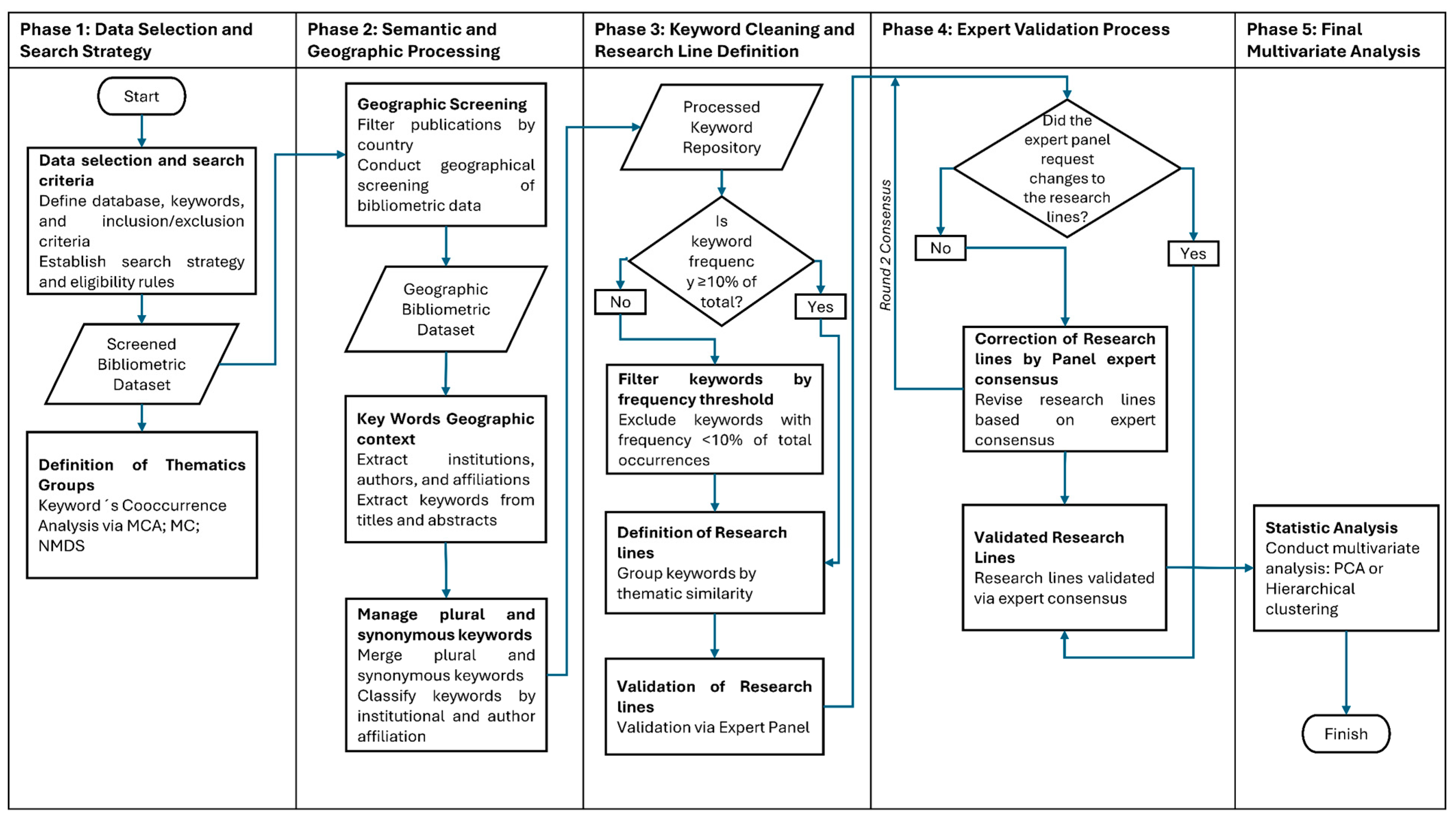
To complement the systematic filtering process established through PRISMA, this study implemented the BiblioConsensus Framework (Figure 2), a structured five phase protocol developed to extract, validate, and statistically analyze thematic research structures in bibliometric data. The BiblioConsensus Framework is highly useful because bibliometric analyses alone do not guarantee that the identified thematic groups are contextually relevant or aligned with research needs on the ground. Previous studies have shown that open data reuse patterns and research development are constrained by structural limitations, institutional fragmentation, and unequal data governance, particularly in capacity-limited regions [5,41]. In this context, the Framework provided an integrative and replicable approach by combining a data-driven scoping review with a modified Delphi process. This procedure allowed experts to validate, refine, or reassign keywords based on local priorities, governance conditions, and technological gaps; dimensions that could not be inferred solely from bibliometric data. By triangulating quantitative evidence with expert judgment, the framework addressed the limitations of relying exclusively on either approach and provided a more robust and contextualized basis for defining research agendas, particularly in regions where data infrastructures and capabilities remained uneven. The five phases of the framework are described as follows:
  • Phase 1: Dataset Construction and Preliminary Screening
Documents were retrieved from the Scopus Core Collection using a tailored search query targeting studies related to open data reuse in agriculture, environmental sciences, and livestock systems. The initial corpus of 2863 records was screened to exclude non peer-reviewed literature, irrelevant subject areas, and duplicate entries. Following the application of predefined inclusion criteria, the final working dataset comprised 1261 peer reviewed journal articles.
  • Phase 2: Keyword Extraction and Semantic Normalization
Author keywords were extracted from the refined dataset to establish the thematic basis for subsequent analysis. Semantic normalization procedures were implemented to ensure lexical consistency across the dataset, encompassing the unification of morphological variants, the standardization of singular and plural forms, and the consolidation of synonymous expressions [42,43].
A minimum frequency threshold was applied to exclude low-occurrence keywords, thereby minimizing statistical noise and enhancing indicator stability. This approach aligns with established discussions on the role of baselines and thresholds in empirical bibliometric analysis, as well as widely adopted practices in bibliometric and text mining methodologies [36,44].
  • Phase 3: Thematic Clustering via multiple correspondence analysis (MCA)
Multiple correspondence analysis (MCA) was applied to the normalized keyword matrix to reveal latent semantic structures. This technique is well established in bibliometric analysis for reducing dimensionality while preserving relational patterns, thereby facilitating the identification of thematically cohesive clusters [45]. This analysis yielded three coherent thematic clusters corresponding to: (i) Intelligent Digital Agriculture & Sustainability, (ii) Geospatial Monitoring & Land Management, and (iii) Biodiversity & Livestock Dynamics.
  • Phase 4: Delphi-Based Validation of Research Lines
To ensure the semantic coherence, thematic clarity, and applied relevance of the terms derived from Ecuadorian affiliated research, a two round modified Delphi method was implemented. This structured validation approach enabled systematic expert review of keywords extracted from national publications and facilitated the formal definition of research lines grounded in local scientific output [46,47].
  • Expert Panel and Selection Criteria
A Delphi panel was convened, comprising eleven academic researchers and professionals with recognized expertise in open data reuse across agricultural, livestock, and environmental domains, identified through the snowball sampling technique [48]. Eligibility criteria included: (i) at least five years of domain experience; (ii) authorship of peer-reviewed articles indexed in Scopus; and (iii) proven familiarity with at least one of the thematic areas under consideration.
  • Keyword Selection and Preliminary Grouping
The terms submitted for expert evaluation were drawn exclusively from titles and author keywords of the Ecuadorian affiliated articles within the core dataset. These keywords were initially grouped into thematic categories by the research team, based on conceptual similarity and alignment with the broader bibliometric clusters identified globally. The objective of the Delphi process was to validate these preliminary groupings and refine the thematic framework for subsequent analysis.
  • Delphi Procedure
The validation process consisted of two digital rounds, conducted via personalized email questionnaires. In Round 1, the full panel of seven active experts assessed each of the 43 candidate keywords based on the following criteria:
(i)
familiarity with the term (on a 5 point Likert scale),
(ii)
thematic fit within the assigned cluster, and
(iii)
optional suggestions for reassignment or elimination.
A consensus threshold was established to determine whether a keyword would be retained, reassigned, or re-evaluated.
Round 2 focused on keywords that failed to reach consensus or were flagged for reassignment in Round 1. This round included only those experts who had demonstrated high familiarity (≥4) with the respective terms in the previous round [46]. A total of five experts participated in this phase.
  • Validation Thresholds and Analytical Criteria
Consensus was evaluated using both quantitative and qualitative indicators. Statistical thresholds included an interquartile range (IQR) ≤ 1 for familiarity scores and a minimum percentage of agreement on thematic fit [49]. Expert comments were also reviewed to inform decisions on reassignment or removal. As a result of the Delphi process, keywords were validated and consolidated into thematic research lines, which served as the basis for subsequent multivariate and institutional analyses.
  • Phase 5: Institutional Mapping via Multivariate Analysis
Principal Component Analysis (PCA) was employed to position Ecuadorian higher education institutions according to their publication alignment with the five validated research lines. PCA is a robust dimension reduction technique that transforms complex multivariate data into a set of orthogonal components, facilitating the detection of patterns and relationships among variables [50]. This multivariate approach enabled the identification of institutional niches, thematic imbalances, and potential strategic roles within the national research ecosystem.

3. Results and Discussion

3.1. Global Scientific Production

Scientific Output over Time

A total of 2863 documents were retrieved from Scopus through a bibliometric analysis covering the period from 1993 to 2025. Following the filtering for peer-reviewed journal articles, the final dataset comprised 1261 records. The scientific output exhibited an annual growth rate of 16.97%, encompassing 590 distinct sources and contributions from 5442 authors. International co-authorship accounted for 31.64% of the publications. Complete bibliographic information for all included sources is provided in Supplementary Materials. A critical appraisal of the included sources was not conducted, as the review did not incorporate methodological quality assessment into its analytical framework.
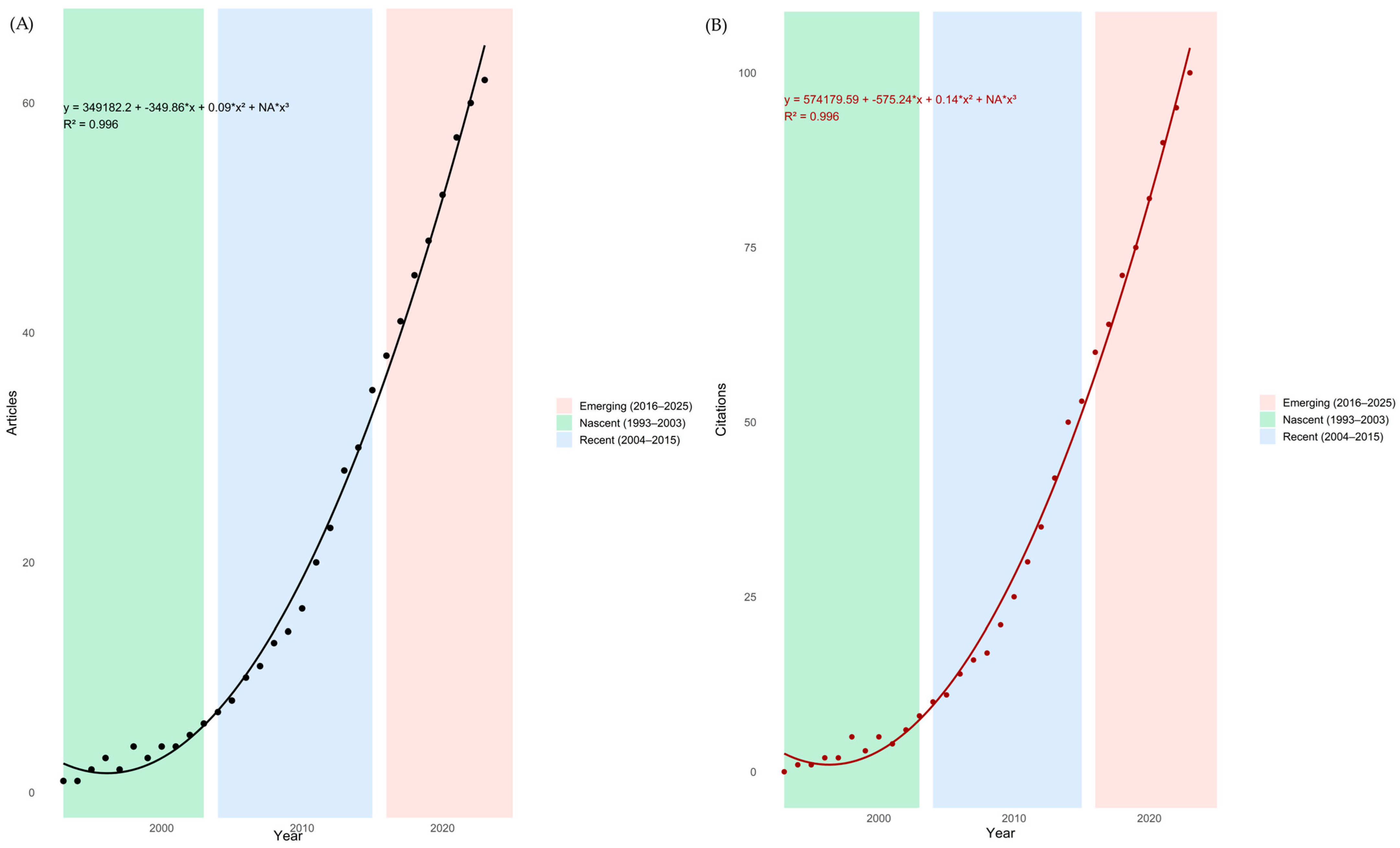
To analyze temporal trends, the dataset was divided into three periods: 1993–2003 (Period I), 2004–2015 (Period II), and 2016–2025 (Period III). Period I comprised 21 articles (778 citations), Period II included 122 articles (4759 citations), and Period III accounted for 1118 articles (21,748 citations). The mean annual output increased from 2.1 articles in Period I to 10.2 in Period II and 111.8 in Period III, accompanied by a rise in mean citations per period from 77.8 to 396.6 and 2174.8, respectively (Table 1). Statistical analyses confirmed that these periods differed significantly in both scientific production and citation impact. The Kruskal Wallis test detected significant differences for Articles (p = 1.07 × 10⁻⁶) and Citations (p = 1.91 × 10⁻⁵). Dunn’s post-hoc comparisons with Bonferroni correction showed significant pairwise differences for Articles across all contrasts Period I vs. Period II (p_adj = 0.00027), Period I vs. Period III (p_adj = 0.00049), and Period II vs. Period III (p_adj = 0.00026) and similarly for Citations, where all comparisons were significant: Period I vs. Period II (p_adj = 0.00058), Period I vs. Period III (p_adj = 0.00230), and Period II vs. Period III (p_adj = 0.00519). These results align with the first phase of the BiblioConsensus Framework, which encompassed the application of inclusion and exclusion criteria and the filtering of author keywords.
The temporal evolution of annual scientific output and citation counts is illustrated in Figure 3, using cubic regression models for each indicator and segmented according to the three defined periods: Nascent (1993–2003), Recent (2004–2015), and Emerging (2016–2025). In panel A, the number of articles per year shows a low and stable trend throughout the Nascent and Recent periods, followed by a pronounced increase beginning in the Emerging period. The fitted cubic regression model captures this trend with a high degree of precision (R2 = 0.996).
Panel B of Figure 3 presents the annual citation counts. A similar pattern is observed, with lower and more dispersed values during the first two periods and a notable upward trajectory beginning in the Emerging period. The regression model applied to citation data also yields a strong fit (R2 = 0.996), indicating consistent growth in the field’s citation impact over time. The colored vertical bands in both panels correspond to the three chronological stages and provide a visual context for the segmentation of trends.
These findings demonstrate the sustained growth of research on open data reuse in agriculture, livestock, and environmental sciences, in line with the assumptions of this study. Comparable upward trajectories have been reported in bibliometric analyses of smart agriculture, with publication increases nearly doubling between 2016 and 2017 and peaking at 338 in 2022 [51]. In the IoT-based Climate Smart Agriculture Succeeded by Blockchain Database analysis, annual output between 2019 and 2024 grew by 47.58%, rising from 3 publications in 2019 to 21 in 2022 and 20 in 2024, reflecting strong adoption of IoT and blockchain in agriculture [52]. Similarly, the Carbon Emissions and Environmental Management Based on Big Data and Streaming Data study reported a 56% growth rate between 2015 and 2019, driven by post COP21 policies and the increasing use of big data for environmental monitoring [53]. Together, these patterns reinforce the marked expansion observed in Period III of the present study, highlighting cross-sectoral technological and policy drivers behind the global rise in open data reuse.
The marked acceleration in Period III reflects the convergence of technological evolving in IoT, and big data analytics [54], with policy commitments adopted under the Paris Agreement (COP21), which have mobilized substantial multilateral and national funding [55]. These developments have expanded the capacity to collect and integrate large scale agricultural and environmental datasets, broadened participation in global data intensive initiatives, and steered research agendas toward high impact sustainability themes.

3.2. Thematic Clusters and Research Priorities in Open Data Resue Publications

3.2.1. Co-Occurrence Network by Periods

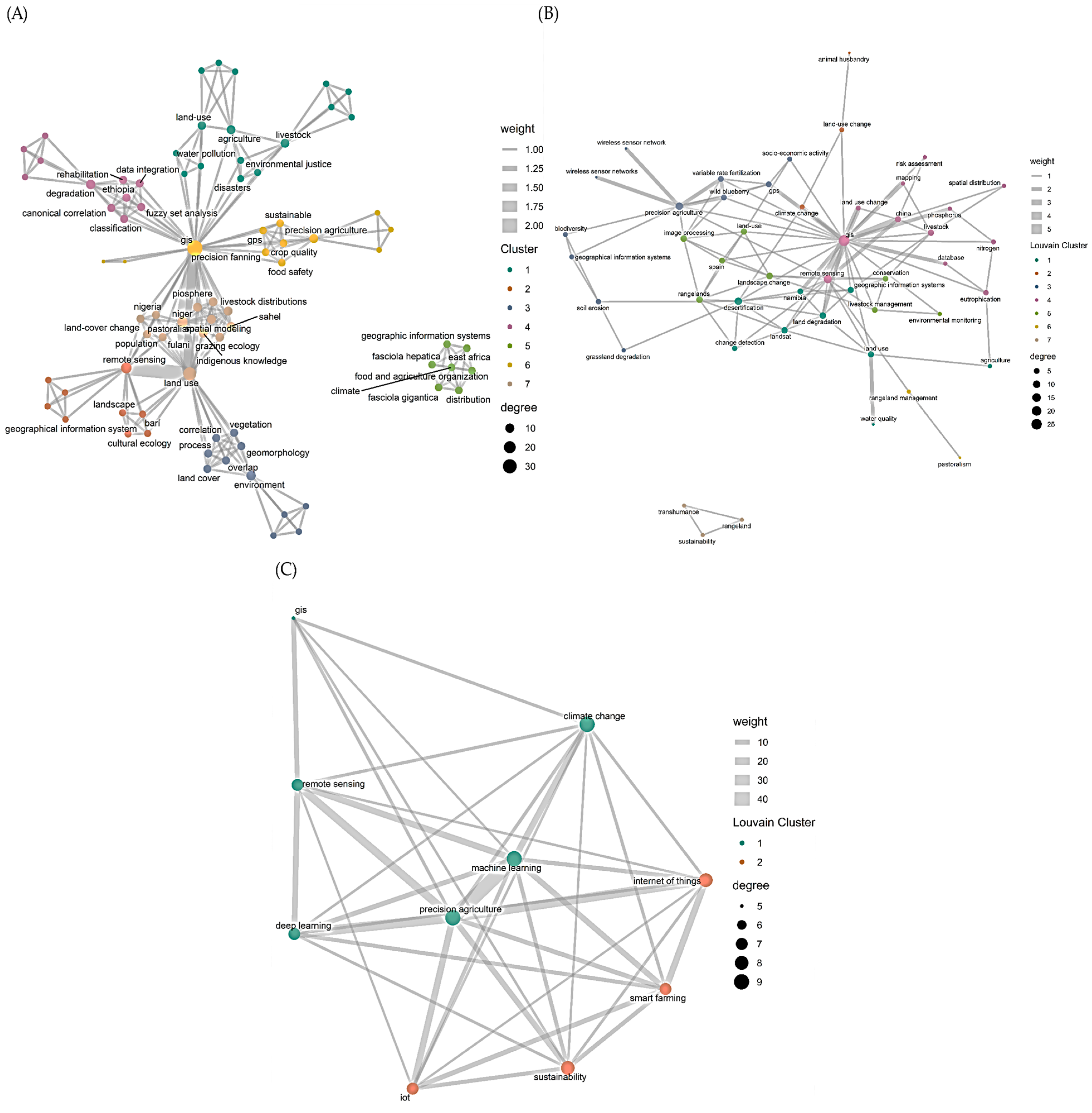
The evolution of thematic structures over time was analyzed through keyword co-occurrence networks segmented by period. Figure 4 presents the network visualizations for the Nascent (1993–2003), Recent (2004–2015), and Emerging (2016–2025) phases, enabling a comparative assessment of conceptual density, connectivity, and clustering patterns.
In Panel A, corresponding to the Nascent period, the network exhibited a dispersed structure with limited inter term connectivity. Several clusters were identifiable, although they remained relatively small and weakly linked. Keywords such as precision farming, land use, livestock, and remote sensing appeared in localized subgroups, while overall degree centrality remained low. During this stage, research output focused primarily on fundamental data management practices involving the use of Global Positioning Systems (GPS) and Geographic Information Systems (GIS) in agricultural production, which emerged as sustainable approaches aimed at minimizing environmental impacts [56]. Studies from this period were largely driven by early applications of GIS, through which researchers examined environmental degradation by integrating vegetation, geomorphological, land use change, erosion, and socioeconomic factors [57,58].
This early thematic configuration reflected a formative stage in which research priorities were guided by foundational mapping and monitoring efforts based on proprietary datasets. Explicit open data reuse was still incipient; however, global initiatives such as the Rio Principle 10, the Aarhus Convention, the Global Biodiversity Information Facility (GBIF), World Meteorological Organization Resolution 40 (Cg-XII), and the Bermuda Principles of the Human Genome Project established key frameworks for open access to environmental, agricultural, biodiversity, meteorological, and genomic data. These developments laid the political and infrastructural foundations that, in the subsequent period, began to materialize through the systematic integration of external datasets into agricultural, livestock, and environmental research workflows.
Panel B presents the co-occurrence network for the Recent period, which revealed a marked increase in both the number of nodes and edges compared with the Nascent phase. The network displayed higher interconnectivity, with terms such as geographic information systems, precision agriculture, and land use change occupying more central and influential positions. Cluster compactness improved, and initial thematic overlaps became evident, indicating a transition toward more integrated research domains. During this phase, scholars continued to incorporate technologies such as GIS into their analyses; however, the reuse of external datasets became increasingly evident across diverse topics. For instance, several studies leveraged satellite imagery of local resources to assess productive potential under sustainable land cover conditions [57]. In agricultural production, the most influential research focused on developing Internet of Things (IoT) based agricultural strategies [59], where sensor-based systems enabled real-time monitoring of micro-meteorological parameters, supporting flexible and customizable management practices and the establishment of threshold based alerts for critical agrometeorological conditions [60].
The progressive adoption of open data reuse in agricultural, livestock, and environmental research during this period was not only stimulated by advances in technologies such as GIS, remote sensing, and IoT, but also reinforced by the consolidation of an international policy environment favoring data accessibility and reuse. Initiatives such as the OECD Principles and Guidelines for Access to Research Data from Public Funding (2007), the Open Government Partnership (2011), the G8 Open Data Charter (2013), and the launch of GODAN (2013) established sector specific frameworks for opening and reusing agricultural and environmental datasets. Together, these technological and policy milestones signaled a decisive shift toward the active reuse of diverse external datasets, confirming that data reuse expanded in parallel with technological maturity and the establishment of robust global open data frameworks.
Panel C illustrates the keyword network for the Emerging period. The structure became more cohesive, with well-defined and densely interconnected clusters. Central keywords included climate change, precision agriculture, remote sensing, machine learning, sustainability, and IoT. Both degree centrality and edge weights were significantly higher than in previous periods, reflecting stronger thematic integration and co-occurrence intensity. Two dominant clusters characterized the network. The first focused on climate change adaptation and mitigation through precision agriculture [61], integrating remote sensing for high resolution environmental monitoring [62] and applying machine learning algorithms to enhance predictive models such as the Crop Yield Prediction Algorithm (CYPA) [63]. These approaches enabled data driven strategies to anticipate climate impacts and guide adaptive agricultural management.
The second cluster emphasized sustainability and production efficiency, integrating IoT enabled smart farming systems, sensor-based monitoring, and precision techniques to optimize resource use, reduce waste, and improve supply chain performance [64]. Studies within this group highlighted Agriculture 4.0 applications [65], including sector-specific innovations such as sustainability improvements in coffee production [22], underscoring the relationship between advanced technologies and data reuse as key drivers for food security and environmental stewardship. Collectively, the expansion of these thematic areas during this period validated the study’s central hypothesis: that the reuse of external datasets accelerated in tandem with technological maturity and the consolidation of global frameworks promoting open data reuse in agricultural, livestock, and environmental research.

3.2.2. Thematic Areas

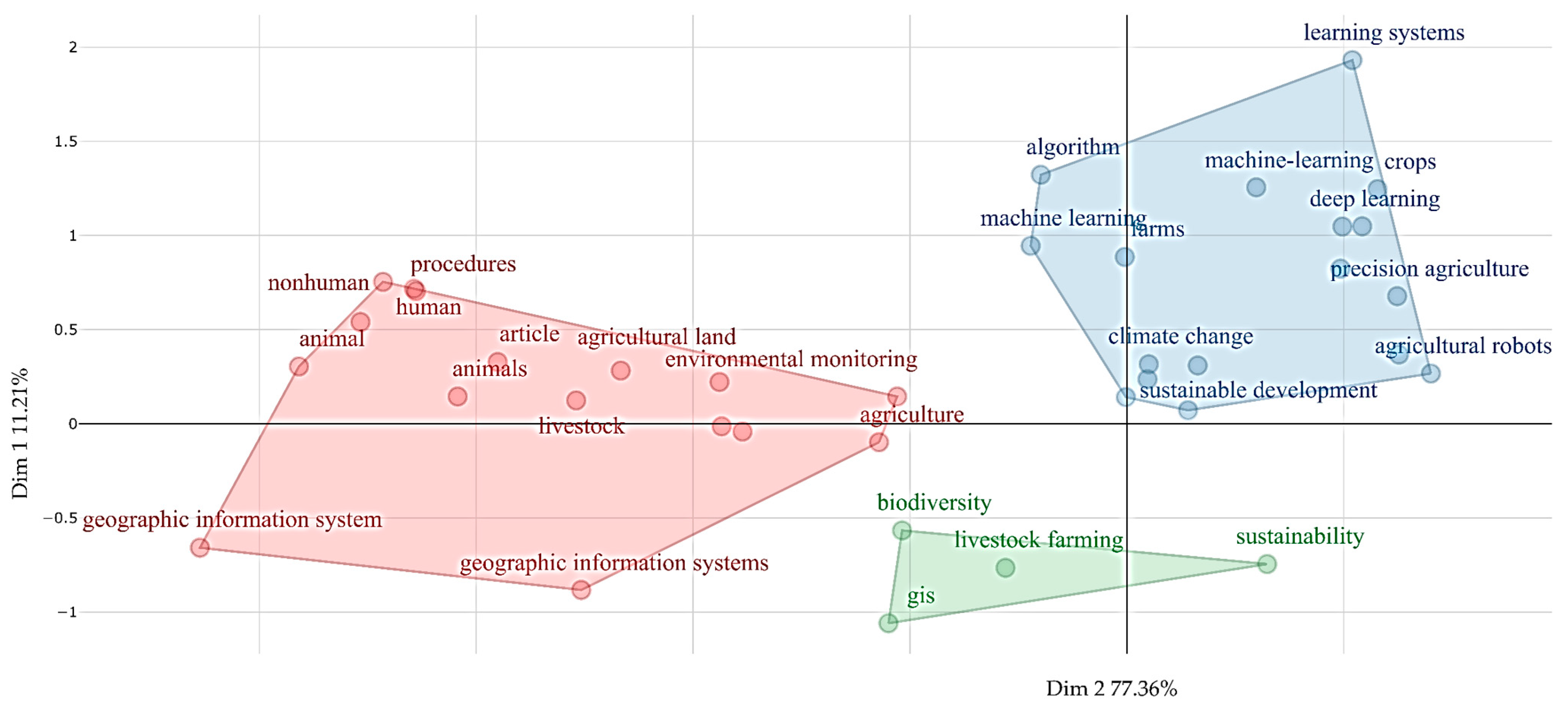
A total of 881 documents from the core dataset of 1261 peer reviewed articles were analyzed based on author keywords. Following the third phase of the BiblioConsensus Framework, thematic clusters were generated through Multiple Correspondence Analysis (MCA) applied to normalized keywords. Figure 5 shows the conceptual structure of keyword co-occurrence across agriculture, livestock, and environmental domains in the context of open data reuse.
Cluster 1—Intelligent Digital Agriculture & Sustainability (red) included terms such as machine learning, artificial intelligence, precision agriculture, agricultural robotics, and sustainable development. This cluster reflected research focused on collecting and using real time farm data from IoT based sensors to monitor plant and livestock conditions [66]. These datasets were processed with machine and deep learning algorithms for modeling and prediction [67,68], supporting applications such as disease detection, yield estimation, and biomass prediction. The sequence linking data acquisition, analysis, and decision-making illustrated a maturing path toward data reuse aimed at improving productivity, reducing environmental impacts, and advancing sustainability goals.
Research within Cluster 1 indicates a growing consolidation of intelligent digital agriculture, where IoT devices, machine learning models, and automated sensing systems improve productivity and resource efficiency through real-time monitoring. These tools enhance predictive capacity for disease detection, stress responses, and yield forecasting, while simultaneously strengthening sustainability indicators by reducing input waste and optimizing water and nutrient use [69]. Climate-smart livestock studies demonstrate that precision monitoring, wearables, and adaptive management systems increase resilience to climatic variability and mitigate environmental pressures across production systems [70]. Integrated crop–livestock approaches further show that data-enabled decisions support economic and social dimensions of biodiversity by diversifying production, stabilizing incomes, and improving food security in low- and middle-income regions [71]. Collectively, these findings indicate that digital agriculture offers global transferability and the potential to advance sustainability and socioecological resilience, although uneven digital infrastructure and limited technical capacity remain major barriers.
Cluster 2—Geospatial Monitoring & Land Management (blue) comprised keywords such as GIS, remote sensing, land use, and environmental monitoring. Research in this group emphasized spatial analyses of agricultural and pastoral systems using GIS and remote sensing. Studies documented forest and pasture conversion to cropland, with major biodiversity impacts [72], while deep learning methods improved land cover detection [73,74]. UAV and satellite imagery supported crop and ecosystem monitoring [75], increasingly enhanced by edge computing and IoT based sensor networks [76]. This cluster highlighted the reuse of geospatial and environmental data as key inputs for planning, livestock management [28], and sustainable land use strategies [77,78].
Local-scale sustainability studies show that integrating ecological footprint metrics with geospatial data strengthens territorial planning and supports evidence-based policies for sustainable resource use [79]. Additionally, research on ecological urban agriculture demonstrates that strategically planned urban and peri-urban food systems can mitigate the ecological pressures of urban expansion and reinforce socioecological sustainability in metropolitan landscapes [80]. Collectively, this cluster demonstrates that geospatial data reuse provides globally transferable tools for biodiversity conservation and sustainable land use strategies, although disparities in data access and technical capacity continue to limit adoption in resource constrained regions.
Cluster 3—Biodiversity & Livestock Dynamics (green) research in Cluster 3 highlights the interplay among livestock systems, land-use change, and ecological resilience, emphasizing how ecological and spatial data clarify biodiversity patterns. IoT and AI tools support species identification and help manage human wildlife interactions [81], although recent analyses show that these relationships are shaped by cultural norms, social tensions, and competing stakeholder interests rather than by ecological factors alone [82]. Evidence from East Africa indicates that fencing and land conversion fragment habitats and reduce biodiversity, with direct implications for ecosystem stability and rural livelihoods [83]. Complementary research on food waste shows that inefficiencies in agri-food chains intensify pressure on land and biomass resources, while circular strategies that convert waste into feed or bioenergy reinforce environmental sustainability and food security [84]. GIS-based approaches integrate genetic, demographic, and environmental data to guide conservation planning and identify landscapes where livestock production and wildlife can coexist under managed levels of risk [85]. Collectively, this cluster demonstrates that data reuse strengthens the capacity to address the ecological, social, and economic dimensions of biodiversity and supports globally transferable strategies for coexistence-oriented and sustainable livestock management.

3.2.3. Thematic Distribution by Country Income and Continental Origin

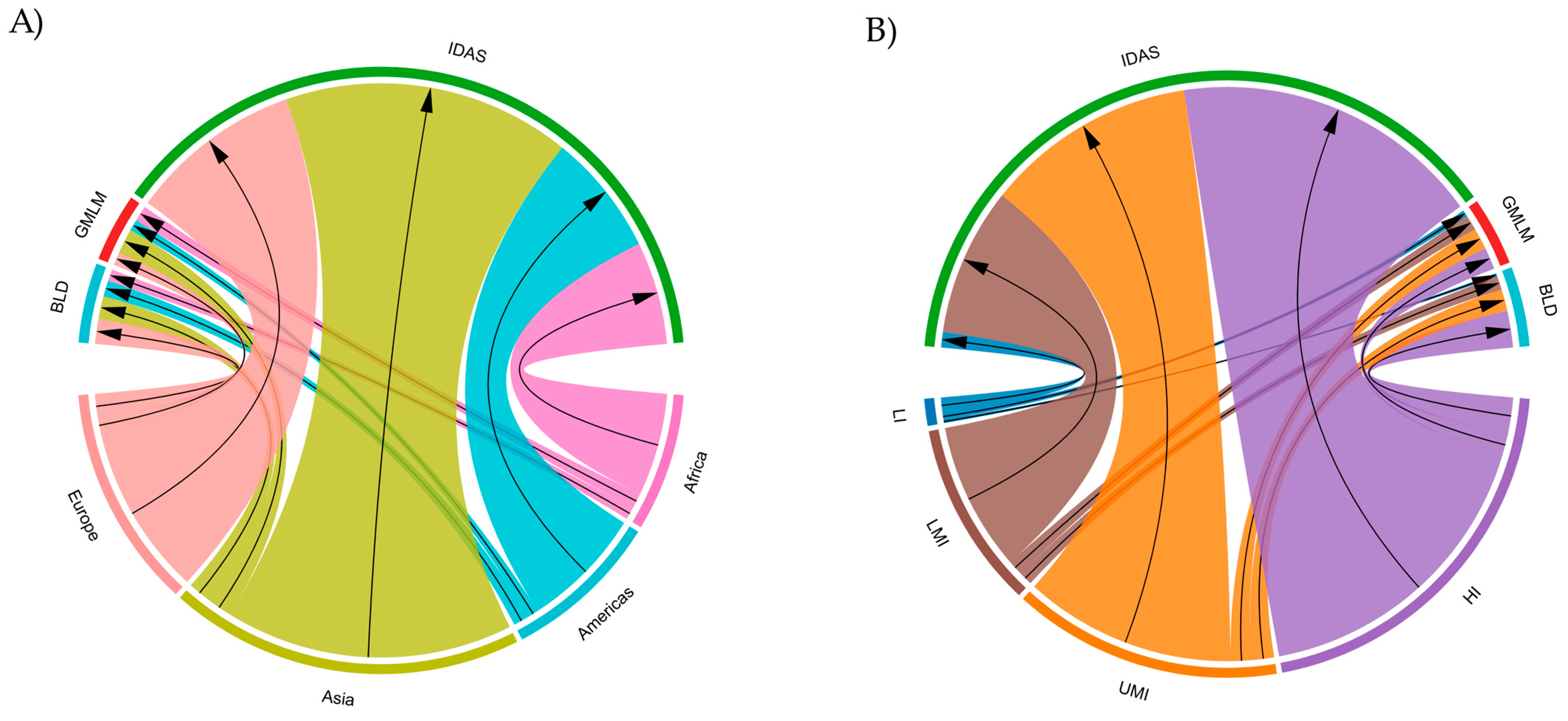
A total of 1261 manuscripts were simultaneously classified by thematic domain (derived from MCA clusters) and by country attributes (continent and World Bank income level) [86]. The chord diagram (Figure 6A) revealed that Europe exhibited the widest arch, primarily associated with Intelligent Digital Agriculture & Sustainability (IDAS) and, to a lesser extent, with Geospatial Monitoring & Land Management (GMLM). Asia also showed a strong presence in IDAS, with secondary contributions to GMLM. In contrast, the Americas displayed a more balanced distribution across the three thematic domains, while Africa although represented by a narrower arc demonstrated a notable concentration in GMLM. Results of the χ2 test further clarified these asymmetries: Europe presented positive standardized residuals in Biodiversity & Livestock Dynamics (BLD, ≈ +2), suggesting relative overrepresentation in this domain; Asia showed negative residuals in BLD, indicating underrepresentation; and Africa exhibited strong positive residuals in GMLM (> +2), reflecting a distinctive thematic specialization.
This pattern aligned with previous research. In Europe, the coexistence of diverse ecosystems and a consolidated livestock sector fostered advanced approaches to biodiversity and genetic resource conservation, in which Geographic Information Systems (GIS) were increasingly used to integrate ecological, demographic, and economic data into decision-making for sustainable breeding programs [85]. Recent studies further emphasized the growing role of Artificial Intelligence (AI) and Internet of Things (IoT) technologies in biodiversity management, spanning habitat protection, species identification, and resource efficient agricultural practices [87,88]. At the policy level, the European Green Deal promoted spatial strategies such as land sharing and land sparing, which not only enhanced landscape diversity and habitat coherence but also reduced greenhouse gas emissions, particularly methane from livestock systems [89]. Moreover, the rapid adoption of digital agriculture encompassing precision farming, big data, and blockchain positioned Europe at the forefront of agricultural digitalization, facilitating simultaneous gains in productivity, sustainability, and climate resilience [90].
In the Americas, research demonstrated a dual orientation that combined technological innovation with responses to environmental challenges. Precision agriculture and Agriculture 4.0 technologies were widely implemented in strategic crops such as coffee, where IoT devices, machine learning, and geostatistical tools were applied to optimize production and overcome adoption barriers [22]. In Brazil, blockchain inspired systems such as BovChain were deployed in livestock supply chains to ensure traceability and sustainability compliance in global beef markets [14]. Similarly, remote sensing and deep learning were used to generate high resolution soil pH maps in Canada and to monitor floods in Mexico, supporting land use management and disaster risk assessment [19]. Additional studies highlighted progress in greenhouse automation and robotic sensing systems for small farms, as well as innovative models for pasture monitoring that integrated animal parameters with spectral and environmental data, substantially improving predictions of biomass and dry matter in grazing systems [12].
In Asia, research activity concentrated primarily in digital and geospatial domains, reflecting the region’s rapid technological advancement in agriculture. Studies frequently addressed the integration of IoT systems, energy harvesting, and machine learning models to support smart farming architectures and optimize irrigation management [17]. This digital orientation contrasted with the comparatively lower emphasis on biodiversity and livestock dynamics, which remained secondary within the regional research landscape. In China, data driven approaches such as organic and conservation agriculture were examined to mitigate ammonia emissions while increasing grain yields, providing tangible pathways toward sustainable food systems [91]. On the Mongolian Plateau, machine learning methods were used to monitor grassland productivity and assess pasture–livestock balance, generating policy recommendations for grazing management and ecological restoration [92]. Additional research included the application of deep learning models for early detection of coconut diseases [20] and the development of intelligent wildlife recognition systems for biodiversity monitoring [93].
The chord diagram (Figure 6B) revealed distinct patterns in publication output and thematic orientation across income groups. High- and upper-middle-income countries dominated research volume, primarily within the Intelligent Digital Agriculture & Sustainability (IDAS) domain. Their leadership reflected mature digital ecosystems and advanced analytical capacity supporting artificial intelligence, big data analytics, and automation-driven innovation [94,95]. In contrast, lower-middle-income countries prioritized Geospatial Monitoring & Land Management (GMLM), leveraging spatial technologies and remote sensing as pragmatic responses to environmental and production challenges under constrained infrastructural conditions [96,97]. Although low-income countries contributed fewer publications overall, they demonstrated emerging engagement in GMLM through the use of open geospatial data platforms such as FAO’s Hand-in-Hand initiative which have strengthened research capacities in resource-limited contexts [41,98,99]. Nevertheless, as data increasingly underpinned digital agriculture, new governance challenges arose concerning ownership, access, and equity. The concentration of data control among a limited number of actors risked monopolization, potentially diverting benefits away from public goods and marginalizing smallholders and less-resourced nations [94]. Addressing these governance asymmetries remained essential to ensure that digital agriculture evolved as an inclusive, equitable, and sustainable global system.
Results of the χ2 test indicated a statistically significant overrepresentation of publications from Lower-Middle-Income (LMI) countries within the Geospatial Monitoring & Land Management (GMLM) cluster (standardized residual > +3). Residuals in all other cells remained below the ±2 threshold, confirming non-significant associations. This finding underscored the central role of geospatial research in addressing environmental and agricultural challenges within LMI contexts, where scalable and cost efficient spatial technologies provided practical alternatives to data intensive infrastructures [100,101]. Many of these nations faced persistent pressures such as land degradation, deforestation, and climate variability that threatened agricultural productivity and food security. Remote sensing, GIS, and Earth observation offered rapid and affordable tools for monitoring extensive and heterogeneous landscapes, representing a fit for purpose technological framework for data scarce environments [102]. The growing availability of open-access geospatial datasets and interoperable digital platforms further democratized these capabilities, facilitating their integration into local agricultural systems and policy frameworks. These findings suggested that international efforts promoting climate resilience and sustainable land management could serve as a strategic bridge, aligning regional research priorities with global development goals through the reuse of open geospatial data.

3.3. Ecuador’s Research Output and Network Position

The inclusion of Ecuador as a focal case was analytically complementary to the global findings. As a peripheral and capacity-constrained research system, Ecuador provided a critical test of whether global patterns of open data reuse held in contexts shaped by infrastructural and governance limitations [5,97]. The case analysis complemented global trends by showing how institutional fragmentation and uneven data governance influenced the uptake and impact of open data reuse in lower-capacity regions, where access to international open geospatial and environmental datasets could help reduce informational asymmetries and support research development [41,99].
The scientific output attributed to Ecuadorian institutions, identified within the core dataset of 1261 peer reviewed articles, was limited to the Emerging period (2021–2025). Most publications appeared in 2023–2024, when eight papers affiliated with Ecuadorian universities accrued 28 citations, averaging 3.5 per document. Universidad Técnica de Manabí was the most productive institution (three papers, five citations), while Universidad de Las Américas achieved the highest impact with one highly cited 2023 article (18 citations). Other contributions included Universidad Técnica Particular de Loja, UNIANDES, Escuela Superior Politécnica de Chimborazo, and Instituto Tecnológico Superior Rumiñahui.
These results reflected the early consolidation of Ecuador’s scientific presence and the selective impact of its recent research. Although overall output remained modest, policy reforms and new funding mechanisms had stimulated visible growth and diversification [103,104]. In the agricultural, livestock, and environmental sciences, universities had expanded research capacity and promoted technologies for sustainable production and integrated resource management [105,106]. Despite limited investment, Ecuador’s academic sector showed increasing expertise and commitment to sustainability, positioning the country for greater regional and global engagement.
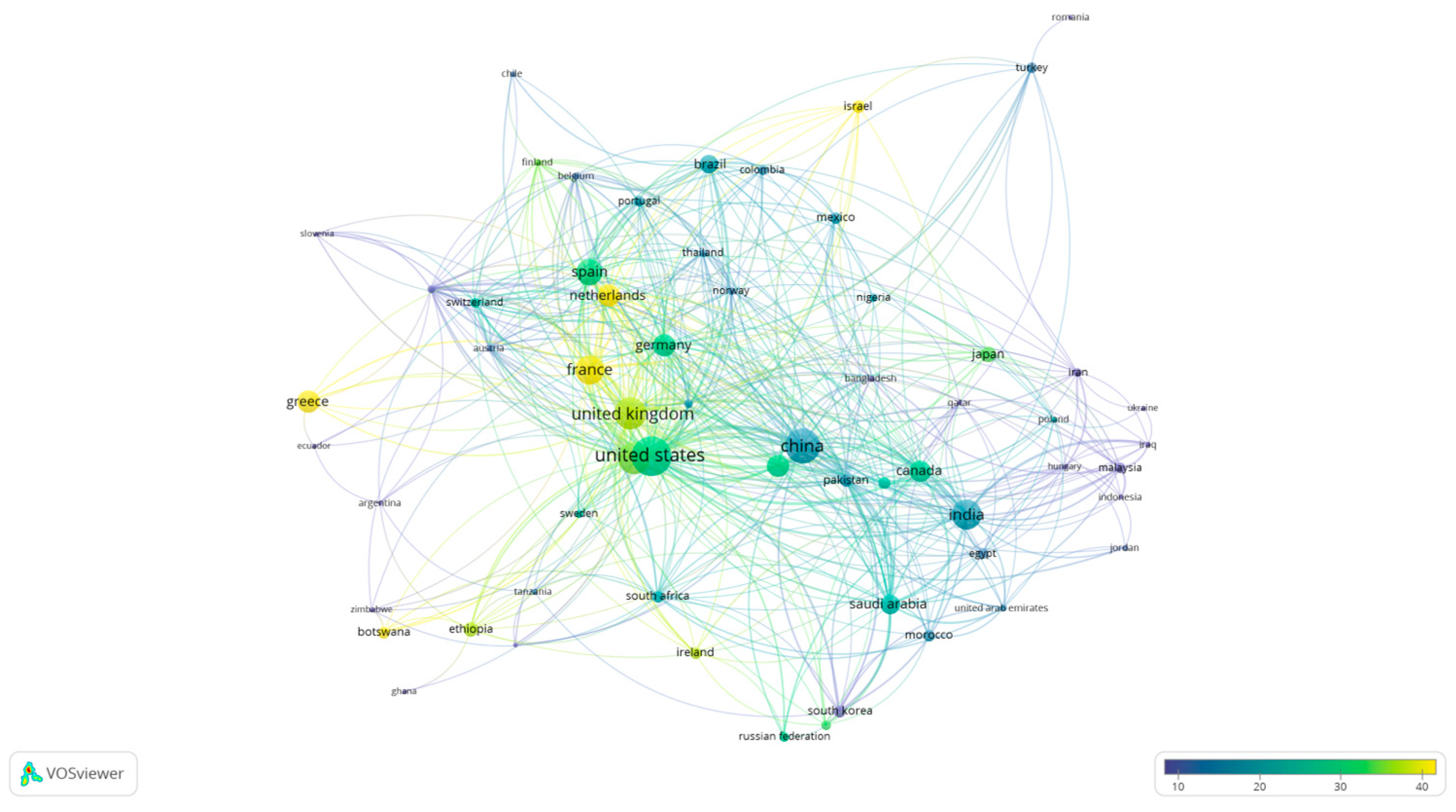
The global co-authorship network (Figure 7) exhibited a centralized structure dominated by the United States, United Kingdom, and China, whose large nodes and strong interconnections reflected advanced infrastructures and leadership in open-data collaboration. Spain, France, and Germany acted as intermediary bridges linking regional clusters, while peripheral nodes such as Ecuador, Greece, and Argentina showed lower integration and citation rates. Nevertheless, emerging collaborations with Spain and the United States indicated growing inclusion in international research networks.
Recent joint studies with Spain and the United States advanced digital agriculture and livestock monitoring technologies [107]. Ecuador–Spain collaborations produced automated greenhouse systems combining robotics, IoT, and machine learning to optimize small farm management [21]. Partnerships with the United States applied satellite remote sensing and ensembled learning models to map biodiversity in dry tropical forests, improving predictions of species richness and ecological diversity [108].
This asymmetric structure mirrored persistent disparities in access to infrastructure, funding, and data resources. Reducing these gaps required not only stronger collaboration but also systematic data sharing and open access. Expanding interoperable open-data infrastructures would enhance participation from emerging economies and promote more inclusive and equitable global knowledge production.

3.4. Evidence Based Strategies for Ecuador

3.4.1. Research Lines and Ecuador Affiliations

The fourth phase of the BiblioConsensus Framework employed a two round modified Delphi process to validate keyword clusters, resulting in the formal definition of five thematic research lines. Of the 43 keywords initially evaluated, 35 (81.4%) reached positive consensus during the first round, five required re-evaluation, and three were suggested for reassignment by majority opinion. In the second round, seven keywords were reassessed by selected experts with high familiarity and prior disagreement. Of these, six reached consensus, while one was recommended for elimination. In total, the Delphi process validated 41 of the original 43 keywords, confirming their relevance within five predefined thematic research lines, which remained unchanged throughout the evaluation (Table 2).
The first line, Smart Farming Systems and Sensor Integration, focuses on the application of intelligent technologies, the Internet of Things (IoT), and sensor networks to optimize agricultural decision making. The second, Remote Sensing and Land Use Analytics, centers on satellite data processing, spatial analysis, and land use classification techniques for agricultural and environmental monitoring. The third line, Crop Performance and Greenhouse Optimization, addresses modeling approaches, cultivation techniques, and controlled environment agriculture aimed at enhancing crop yields and resource efficiency. The fourth thematic line, Sustainable Bioeconomy and Waste Management, encompasses circular economy frameworks, biodegradable materials, and multi-criteria decision-making tools supporting sustainability transitions. Lastly, the fifth line, Geospatial Remote Sensing for Biodiversity Assessment, integrates remote sensing indicators and ecological metrics for evaluating biodiversity in agricultural and forested landscapes.
The research lines validated through the Delphi process represent more than a thematic classification; they outline a strategic roadmap for strengthening Ecuador’s research capacity in agriculture, livestock, and environmental sciences under the Agriculture 4.0 paradigm. Similar approaches have shown that Delphi consensus studies can effectively support the design of structured frameworks for assessing and transforming agricultural innovation systems across diverse contexts [109]. In this sense, the validated lines enable the transition from fragmented research initiatives toward a coordinated agenda aligned with national priorities for sustainable productivity, environmental monitoring, and digital innovation, consistent with the integrative approaches proposed for Latin American research systems that emphasize knowledge management and interdisciplinary coordination to overcome institutional fragmentation [110].
The research lines ranging from smart farming systems and land use analytics to bioeconomy and biodiversity assessment mirror global scientific trends that emphasize interoperability, open access, and data driven decision-making in sustainable agriculture. As highlighted in recent studies, the integration of information and communication technologies (ICTs), artificial intelligence (AI), and Internet of Things (IoT) infrastructures is reshaping agricultural practices worldwide, enabling real-time data collection, predictive analytics, and automation for more sustainable and resource efficient production systems [111]. Their adoption positions Ecuador to align with international initiatives advancing open and interoperable data infrastructures for agri-environmental research. Beyond their thematic scope, the lines also serve as a governance instrument to guide investments in digital infrastructure, foster inter-institutional and public–private collaboration, and establish enduring mechanisms for open data sharing. Ultimately, their validation lays the foundation for a coordinated national research agenda capable of bridging data gaps, enhancing scientific interoperability, and positioning Ecuador as an active contributor to the global network of smart and sustainable agricultural innovation.

3.4.2. Thematic Landscape of Ecuadorian Institutions in Open Data Resue Research

The fifth phase of the BiblioConsensus Framework consisted of a principal component analysis (PCA), applied to Ecuadorian institutions to evaluate thematic alignment across the validated research lines. PCA was applied to examine the thematic positioning of Ecuadorian higher education institutions in relation to five research lines derived from the open data reuse literature. The two principal dimensions (Dim1 and Dim2) jointly explain 74.97% of the total variance, with Dim1 (48.56%) separating institutions along a gradient from technology oriented agricultural research to environmental and ecological topics, and Dim2 (26.41%) capturing secondary distinctions related to biodiversity assessment and crop performance specialization.
The principal component analysis based on the Ecuadorian subset of the bibliometric database reveals a differentiated yet thematically coherent configuration of institutional specialization within the national open data ecosystem. Institutions such as the Universidad Técnica de Manabí (UTM) exhibit dual specialization: one axis aligned with Remote Sensing and Land Use Analytics (RSLA), driven by UAV-based monitoring and spectral index modeling, and another associated with Sustainable Bioeconomy and Waste Management (SBWM) through multi-criteria decision frameworks for agro-industrial waste valorization [112]. The Escuela Superior Politécnica de Chimborazo (ESPOCH), along with the Instituto Tecnológico Superior Rumiñahui (ITSR) and Universidad Regional Autónoma de los Andes (UNIANDES), converge on the Smart Farming Systems and Sensor Integration (SFS) vector, emphasizing IoT architectures, sensor-based automation, and machine learning models for yield optimization [113,114]. Conversely, the Universidad Técnica Particular de Loja (UTPL) anchors the Geospatial Remote Sensing for Biodiversity Assessment (GRSBA) dimension, integrating satellite data and ensemble machine learning approaches for dry-forest biodiversity mapping [108]. Meanwhile, the Universidad de Las Américas (UDLA) occupies an intermediate position, representing early experimentation with robotic sensing and autonomous greenhouse systems [21].
From a policy and governance perspective, the empirical evidence derived from the national subset of the bibliometric database underscores the need to consolidate these isolated research capacities into a coordinated framework for data-driven agricultural innovation. The dispersion of institutional niches across different research lines suggests the absence of a unified national agenda guiding data reuse and open science in the agro-environmental sector. Strengthening inter-university collaboration networks, shared open data infrastructures, and cross-sectoral funding mechanisms could facilitate thematic convergence and accelerate institutional specialization in strategic domains such as smart farming, environmental monitoring, and bioeconomy.

3.4.3. Evidence-Based Strategies to Enhance Ecuador’s Role in International Scientific Networks

Building upon the empirical evidence derived from the Ecuadorian subset of the bibliometric database, this section translates diagnostic insights into targeted policy and institutional actions. The recommendations presented in Table 3 synthesize results from the co-authorship network analysis, thematic clustering, and principal component mapping, integrating them into an actionable framework for strengthening Ecuador’s participation in global open-data research ecosystems. Each proposed strategy responds to specific structural gaps identified throughout the BiblioConsensus Framework, emphasizing thematic complementarity, institutional coordination, and capacity building for data reuse across agriculture, livestock, and environmental research domains.
Limitations and Future Research
This review does not include a direct assessment of the quality and interoperability of open data repositories in Ecuador, even though the accuracy, completeness, and standardization of datasets are essential for effective data reuse and evidence-based policymaking. The Ecuadorian subset consisted of only eight peer-reviewed articles, which represents the full Scopus indexed national output on the topic but introduces limitations in terms of scope and generalizability. Reliance on Scopus also excludes local publications, institutional reports, policy documents, and other forms of grey literature that may reflect additional national research efforts.
Future research should therefore incorporate systematic evaluations of Ecuador’s agri-environmental open data repositories considering accessibility, update frequency, metadata quality, and FAIR compliance while also integrating grey literature and triangulating multiple data sources. These steps would allow for a more comprehensive characterization of Ecuador’s research landscape and support the development of stronger open data governance frameworks.
The empirical findings of this review showed that open data reuse had expanded across agricultural, livestock, and environmental research, although its development remained uneven. Three principal thematic domains were identified: Intelligent Digital Agriculture and Sustainability, Geospatial Monitoring and Land Management, and Biodiversity and Livestock Dynamics. Participation patterns across these domains were clearly stratified. High-income countries led research in digital agriculture and sustainability, while lower- and middle-income regions were more concentrated in geospatial monitoring, largely due to infrastructural constraints. Ecuador reflected these global disparities, displaying a modest yet diversified body of research aligned with isolated institutional strengths identified through PCA, while occupying a peripheral position within international collaboration networks. Overall, the results indicated that although open data reuse had acted as a strategic driver of scientific innovation, its diffusion and impacts were limited by structural inequalities in digital capacity, governance, and access to interoperable data infrastructures.

4. Conclusions

This scoping review provides an integrated and data-driven assessment of global trends in open data reuse within agriculture, environmental sciences, and livestock research, with a particular emphasis on Ecuador’s peripheral yet emerging role within the international research landscape. Through the implementation of the five phase BiblioConsensus Framework, we combined bibliometric mapping, semantic normalization, expert validation, and multivariate analysis to identify thematic clusters, evaluate institutional alignment, and formulate strategic recommendations grounded in empirical evidence.
The results confirm both initial hypotheses. Global scientific output on open data reuse has grown consistently since 1993 but remains geographically and thematically unbalanced. High-income countries dominate research on digital agriculture and sustainability, while lower- and middle-income regions exhibit concentration in geospatial monitoring and limited representation in bioeconomy and livestock-related themes. Within this context, Ecuador’s scholarly output although nascent demonstrates growing diversification, with selected institutions such as UTM, ESPOCH, UNIANDES, UTPL, and UDLA showing differentiated but complementary thematic alignments across smart farming, remote sensing, and biodiversity monitoring.
The BiblioConsensus Framework thus represents a methodological innovation that can be replicated in other underrepresented contexts to inform national research agendas, promote thematic convergence, and strengthen participation in international scientific networks. The evidence-based strategies proposed ranging from national collaboration clusters and open-data repositories to South-South integration and capacity-building programs provide a coherent roadmap for enhancing Ecuador’s integration into global knowledge ecosystems.
Future research could expand this framework by conducting longitudinal analyses of institutional transformation, implementing cross-country benchmarking, and integrating advanced metrics of data reuse such as FAIR compliance and user-centered impact indicators. These extensions would help clarify how open data reuse contributes to sustainable innovation across diverse socioeconomic and governance contexts.
Strengthening institutional capacities in open data governance, interoperability, and digital infrastructure will be critical for ensuring that Ecuador and other emerging economies participate equitably and effectively in the global transition toward data-driven, sustainable agricultural innovation.

Supplementary Materials

The following supporting information can be downloaded at: https://www.mdpi.com/article/10.3390/land15010013/s1, Supplementary Material S1: Scopus dataset used for the PRISMA protocol.

Author Contributions

Conceptualization, B.T. and A.G.; methodology, B.T. and J.U.-Z.; soft-ware, B.T. and J.U.-Z.; validation, A.G., C.D.-P.-H. and R.H.-F. formal analysis, J.U.-Z. and R.H.-F.; writing original draft preparation, B.T., J.U.-Z., R.H.-F., C.D.-P.-H. and A.G.; writing review and editing, B.T., J.U.-Z., and A.G.; supervision, B.T., C.D.-P.-H. and A.G. All authors were involved in developing, writing, commenting, editing, and reviewing the manuscript. All authors have read and agreed to the published version of the manuscript.

Funding

Fondo Competitivo de Investigación, Ciencia y Tecnología (Competitive Fund for Research, Science, and Technology), Décima Convocatoria, Universidad Técnica Estatal de Quevedo. The funder had no influence on the study.

Data Availability Statement

The data are not available in any publicly accessible data repositories; however, if an editorial committee needs access, we will happily provide them with the data (please use this email: jurdanigo@uteq.edu.ec).

Acknowledgments

This work is part of the results of a joint research agreement between Amazon State University (UEA) and Universidad Técnica Estatal de Quevedo (UTEQ). We would also like to acknowledge the ECONGEST AGR267 Group at Cordoba University for their support. During the preparation of this manuscript/study, the author(s) used Generative AI (ChatGPT, OpenAI, GPT-4 model) was used to optimize R programming scripts for statistical analysis, network construction, text mining, and data visualization. All outputs were reviewed and validated by the authors to ensure analytical rigor. The authors have reviewed and edited the output and take full responsibility for the content of this publication.

Conflicts of Interest

The authors declare no conflicts of interest.

References

  1. Habib, M.; Kabir, M.A.; Zheng, L.; McGrath, S. LEI: Livestock Event Information Schema for Enabling Data Sharing. Comput. Electron. Agric. 2024, 220, 108874. [Google Scholar] [CrossRef]
  2. Moysiadis, T.; Spanaki, K.; Kassahun, A.; Kläser, S.; Becker, N.; Alexiou, G.; Zotos, N.; Karali, I. AgriFood Supply Chain Traceability: Data Sharing in a Farm-to-Fork Case. Benchmarking Int. J. 2023, 30, 3090–3123. [Google Scholar] [CrossRef]
  3. Šestak, M.; Copot, D. Towards Trusted Data Sharing and Exchange in Agro-Food Supply Chains: Design Principles for Agricultural Data Spaces. Sustainability 2023, 15, 13746. [Google Scholar] [CrossRef]
  4. Strobl, J.; Nazarkulova, A. Informing Distributed Hydrological Modeling with Worldwide Open Data Services. Int. J. Geoinform. 2024, 20, 1–9. [Google Scholar] [CrossRef]
  5. Hackfort, S.; Marquis, S.; Bronson, K. Harvesting Value: Corporate Strategies of Data Assetization in Agriculture and Their Socio-Ecological Implications. Big Data Soc. 2024, 11, 20539517241234280. [Google Scholar] [CrossRef]
  6. Janssen, M.; Charalabidis, Y.; Zuiderwijk, A. Benefits, Adoption Barriers and Myths of Open Data and Open Government. Inf. Syst. Manag. 2012, 29, 258–268. [Google Scholar] [CrossRef]
  7. Zuiderwijk, A.; Janssen, M. Open Data Policies, Their Implementation and Impact: A Framework for Comparison. Gov. Inf. Q. 2014, 31, 17–29. [Google Scholar] [CrossRef]
  8. Wilkinson, M.D.; Dumontier, M.; Aalbersberg, I.J.; Appleton, G.; Axton, M.; Baak, A.; Blomberg, N.; Boiten, J.-W.; da Silva Santos, L.B.; Bourne, P.E.; et al. The FAIR Guiding Principles for Scientific Data Management and Stewardship. Sci. Data 2016, 3, 160018. [Google Scholar] [CrossRef]
  9. Hampton, S.E.; Anderson, S.S.; Bagby, S.C.; Gries, C.; Han, X.; Hart, E.M.; Jones, M.B.; Lenhardt, W.C.; MacDonald, A.; Michener, W.K.; et al. The Tao of Open Science for Ecology. Ecosphere 2015, 6, 1–13. [Google Scholar] [CrossRef]
  10. Wolfert, S.; Ge, L.; Verdouw, C.; Bogaardt, M.-J. Big Data in Smart Farming—A Review. Agric. Syst. 2017, 153, 69–80. [Google Scholar] [CrossRef]
  11. Shorten, P.R. Acoustic Sensors for Detecting Cow Behaviour. Smart Agric. Technol. 2023, 3, 100071. [Google Scholar] [CrossRef]
  12. Defalque, G.; Santos, R.; Bungenstab, D.; Echeverria, D.; Dias, A.; Defalque, C. Machine Learning Models for Dry Matter and Biomass Estimates on Cattle Grazing Systems. Comput. Electron. Agric. 2024, 216, 108520. [Google Scholar] [CrossRef]
  13. Arshad, J.; Irtisam, A.; Arif, T.; Rasheed, M.S.; Chauhdary, S.T.; Rahmani, M.K.I.; Almajalid, R. A Federated Learning Model for Intelligent Cattle Health Monitoring System Using Body Area Sensors and IoT. Egypt. Inform. J. 2024, 27, 100488. [Google Scholar] [CrossRef]
  14. Bergier, I.; Papa, M.; Silva, R.; Santos, P.M. Cloud/Edge Computing for Compliance in the Brazilian Livestock Supply Chain. Sci. Total Environ. 2021, 761, 143276. [Google Scholar] [CrossRef] [PubMed]
  15. Dineva, K.; Atanasova, T. Health Status Classification for Cows Using Machine Learning and Data Management on AWS Cloud. Animals 2023, 13, 3254. [Google Scholar] [CrossRef]
  16. Ding, L.; Zhang, C.; Yue, Y.; Yao, C.; Li, Z.; Hu, Y.; Yang, B.; Ma, W.; Yu, L.; Gao, R.; et al. Wearable Sensors-Based Intelligent Sensing and Application of Animal Behaviors: A Comprehensive Review. Sensors 2025, 25, 4515. [Google Scholar] [CrossRef]
  17. Ouafiq, E.M.; Saadane, R.; Chehri, A.; Jeon, S. AI-Based Modeling and Data-Driven Evaluation for Smart Farming-Oriented Big Data Architecture Using IoT with Energy Harvesting Capabilities. Sustain. Energy Technol. Assess. 2022, 52, 102093. [Google Scholar] [CrossRef]
  18. Victor, N.; Maddikunta, P.K.R.; Mary, D.R.K.; Murugan, R.; Chengoden, R.; Gadekallu, T.R.; Rakesh, N.; Zhu, Y.; Paek, J. Remote Sensing for Agriculture in the Era of Industry 5.0—A Survey. IEEE J. Sel. Top. Appl. Earth Obs. Remote Sens. 2024, 17, 5920–5945. [Google Scholar] [CrossRef]
  19. Carrillo, V.C.; Heenkenda, M.K.; Nelson, R.; Sahota, T.S.; Serrano, L.S. Deep Learning in Land-Use Classification and Geostatistics in Soil PH Mapping: A Case Study at Lakehead University Agricultural Research Station, Thunder Bay, Ontario, Canada. J. Appl. Remote Sens. 2022, 16, 34519. [Google Scholar] [CrossRef]
  20. Karthikeyan, N.; Priyadharsini, V.; Subburathinam, K.; Kavitha, M. Precision Agriculture: Coconut Tree Disease Segmentation with Enhanced Fuzzy C Means and Hybrid Deep Learning Classification. Int. J. Fuzzy Syst. 2025, 1–19. [Google Scholar] [CrossRef]
  21. Rosero-Montalvo, P.D.; Gordillo-Gordillo, C.A.; Hernandez, W. Smart Farming Robot for Detecting Environmental Conditions in a Greenhouse. IEEE Access 2023, 11, 57843–57853. [Google Scholar] [CrossRef]
  22. Sott, M.K.; Furstenau, L.B.; Kipper, L.M.; Giraldo, F.D.; Lopez-Robles, J.R.; Cobo, M.J.; Zahid, A.; Abbasi, Q.H.; Imran, M.A. Precision Techniques and Agriculture 4.0 Technologies to Promote Sustainability in the Coffee Sector: State of the Art, Challenges and Future Trends. IEEE Access 2020, 8, 149854–149867. [Google Scholar] [CrossRef]
  23. Barrile, V.; Maesano, C.; Genovese, E. Optimization of Crop Yield in Precision Agriculture Using WSNs, Remote Sensing, and Atmospheric Simulation Models for Real-Time Environmental Monitoring. J. Sens. Actuator Netw. 2025, 14, 14. [Google Scholar] [CrossRef]
  24. Nirmal, K.R.; Reddy, C.M.; Jose, P.; Tulasi, R.; Maheswari, G.U.; Sapthami, I. Advancements in Environmental Data Analysis for Climate-Resilient Agriculture Using Remote Sensing and Deep Learning. Remote Sens. Earth Syst. Sci. 2024, 7, 670–680. [Google Scholar] [CrossRef]
  25. Lang, P.; Zhang, L.; Huang, C.; Chen, J.; Kang, X.; Zhang, Z.; Tong, Q. Integrating Environmental and Satellite Data to Estimate County-Level Cotton Yield in Xinjiang Province. Front. Plant Sci. 2023, 13, 1048479. [Google Scholar] [CrossRef]
  26. Ban, M.J.; Lee, D.H.; Lee, B.-T.; Kang, J.-H. Assessing the Environmental Determinants of Micropollutant Contamination in Streams Using Explainable Machine Learning and Network Analysis. Chemosphere 2025, 370, 144041. [Google Scholar] [CrossRef]
  27. Dávila-Santiago, E.; Shi, C.; Mahadwar, G.; Medeghini, B.; Insinga, L.; Hutchinson, R.; Good, S.; Jones, G.D. Machine Learning Applications for Chemical Fingerprinting and Environmental Source Tracking Using Non-Target Chemical Data. Environ. Sci. Technol. 2022, 56, 4080–4090. [Google Scholar] [CrossRef]
  28. Gray, J.; Banhazi, T.M.; Kist, A.A. Wireless Data Management System for Environmental Monitoring in Livestock Buildings. Inf. Process. Agric. 2017, 4, 1–17. [Google Scholar] [CrossRef]
  29. Peters, M.D.J.; Godfrey, C.; McInerney, P.; Munn, Z.; Tricco, A.C.; Khalil, H. JBI Manual for Evidence Synthesis; JBI: Adelaide, Australia, 2024; ISBN 978-0-6488488-2-0. [Google Scholar]
  30. Liberati, A.; Altman, D.G.; Tetzlaff, J.; Mulrow, C.; Gotzsche, P.C.; Ioannidis, J.P.A.; Clarke, M.; Devereaux, P.J.; Kleijnen, J.; Moher, D. The PRISMA Statement for Reporting Systematic Reviews and Meta-Analyses of Studies That Evaluate Healthcare Interventions: Explanation and Elaboration. BMJ 2009, 339, b2700. [Google Scholar] [CrossRef]
  31. Yousaf, A.; Kayvanfar, V.; Mazzoni, A.; Elomri, A. Artificial Intelligence-Based Decision Support Systems in Smart Agriculture: Bibliometric Analysis for Operational Insights and Future Directions. Front. Sustain. Food Syst. 2023, 6, 1053921. [Google Scholar] [CrossRef]
  32. Navarro, E.; Costa, N.; Pereira, A. A Systematic Review of IoT Solutions for Smart Farming. Sensors 2020, 20, 4231. [Google Scholar] [CrossRef]
  33. Kushartadi, T.; Mulyono, A.E.; Al Hamdi, A.H.; Rizki, M.A.; Sadat Faidar, M.A.; Harsanto, W.D.; Suryanegara, M.; Asvial, M. Theme Mapping and Bibliometric Analysis of Two Decades of Smart Farming. Information 2023, 14, 396. [Google Scholar] [CrossRef]
  34. Liu, W.; Huang, M.; Wang, H. Same Journal but Different Numbers of Published Records Indexed in Scopus and Web of Science Core Collection: Causes, Consequences, and Solutions. Scientometrics 2021, 126, 4541–4550. [Google Scholar] [CrossRef]
  35. Baas, J.; Schotten, M.; Plume, A.; Côté, G.; Karimi, R. Scopus as a Curated, High-Quality Bibliometric Data Source for Academic Research in Quantitative Science Studies. Quant. Sci. Stud. 2020, 1, 377–386. [Google Scholar] [CrossRef]
  36. Aria, M.; Cuccurullo, C. Bibliometrix: An R-Tool for Comprehensive Science Mapping Analysis. J. Informetr. 2017, 11, 959–975. [Google Scholar] [CrossRef]
  37. Csárdi, G.; Nepusz, T. Igraph Reference Manual. 2010. Available online: https://r.igraph.org/ (accessed on 6 October 2025).
  38. Gu, Z.; Gu, M.Z.; GlobalOptions, Inc. Package ‘Circlize’; R Package: Vienna, Austria, 2015. [Google Scholar]
  39. Wickham, H. Ggplot2. WIREs Comput. Stat. 2011, 3, 180–185. [Google Scholar] [CrossRef]
  40. Lê, S.; Josse, J.; Husson, F. FactoMineR: An R Package for Multivariate Analysis. J. Stat. Softw. 2008, 25, 1–18. [Google Scholar] [CrossRef]
  41. Urrutia, J.M.; Scheffczyk, K.; Riembauer, G.; Mendoza, J.; Yanez, D.; Jímenez, S.; Ramírez, A.; Acosta, M.; Argüello, J.; Huerta, B.; et al. A Validated Geospatial Model Approach for Monitoring Progress of the Sendai Framework: The Example of People Affected in Agriculture Due to Flooding in Ecuador. Prog. Disaster Sci. 2022, 15, 100233. [Google Scholar] [CrossRef]
  42. Grimmer, J.; Stewart, B.M. Text as Data: The Promise and Pitfalls of Automatic Content Analysis Methods for Political Texts. Political Anal. 2013, 21, 267–297. [Google Scholar] [CrossRef]
  43. Jung, H.; Lee, B.G. Research Trends in Text Mining: Semantic Network and Main Path Analysis of Selected Journals. Expert Syst. Appl. 2020, 162, 113851. [Google Scholar] [CrossRef]
  44. Pislyakov, V. On Some Properties of Medians, Percentiles, Baselines, and Thresholds in Empirical Bibliometric Analysis. J. Informetr. 2022, 16, 101322. [Google Scholar] [CrossRef]
  45. Zhao, Y.; Zhang, Y.; Guo, J.; Wang, J.; Li, Y. Shifts in Periphyton Research Themes over the Past Three Decades. Environ. Sci. Pollut. Res. 2023, 30, 5281–5295. [Google Scholar] [CrossRef] [PubMed]
  46. Quyên, Đ.T.N. Developing University Governance Indicators and Their Weighting System Using a Modified Delphi Method. Procedia Soc. Behav. Sci. 2014, 141, 828–833. [Google Scholar] [CrossRef]
  47. García Aracil, A.; Palomares Montero, D. Indicadores Para La Evaluación de Las Instituciones Universitarias: Validación a Través Del Método Delphi. Rev. Esp. Doc. Cient. 2012, 35, 119–144. [Google Scholar] [CrossRef]
  48. Bogner, A.; Littig, B.; Menz, W. Interviewing Experts; Springer: Berlin/Heidelberg, Germany, 2009; ISBN 0230244270. [Google Scholar]
  49. von der Gracht, H.A. Consensus Measurement in Delphi Studies. Technol. Forecast. Soc. Change 2012, 79, 1525–1536. [Google Scholar] [CrossRef]
  50. Greenacre, M.; Groenen, P.J.F.; Hastie, T.; D’Enza, A.I.; Markos, A.; Tuzhilina, E. Principal Component Analysis. Nat. Rev. Methods Primers 2022, 2, 100. [Google Scholar] [CrossRef]
  51. Abdullahi, H.O.; Mahmud, M.; Hassan, A.A.; Ali, A.F. A Bibliometric Analysis of the Evolution of IoT Applications in Smart Agriculture. Ingén. Syst. Inf. 2023, 28, 1495–1504. [Google Scholar] [CrossRef]
  52. Safeer, S.; De Mastro, G.; Pulvento, C. IoT Based Climate Smart Agriculture Succeeded by Blockchain Database—A Bibliometric Analysis. Front. Sustain. Food Syst. 2024, 8, 1406871. [Google Scholar] [CrossRef]
  53. Su, Y.; Yu, Y.; Zhang, N. Carbon Emissions and Environmental Management Based on Big Data and Streaming Data: A Bibliometric Analysis. Sci. Total Environ. 2020, 733, 138984. [Google Scholar] [CrossRef]
  54. Iaksch, J.; Fernandes, E.; Borsato, M. Digitalization and Big Data in Smart Farming—A Review. J. Manag. Anal. 2021, 8, 333–349. [Google Scholar] [CrossRef]
  55. Ruiz-Campillo, X. Post-Paris Agreement Negotiations: A Commitment to Multilateralism despite the Lack of Funding. Environ. Sci. Policy 2024, 156, 103754. [Google Scholar] [CrossRef]
  56. Yang, Y.; Wu, C.; Feng, C. The Status of Precision Agriculture in Japan. Nongye Jixie Xuebao/Trans. Chin. Soc. Agric. Mach. 2001, 32, 107–110. [Google Scholar]
  57. Dickinson, J.; Teeuw, R. Recent Land-Use Change in the Catchment of Llangorse Lake, Brecon Beacons National Park, Wales. Aquat. Conserv. 1999, 9, 411–423. [Google Scholar] [CrossRef]
  58. Feoli, E.; Vuerich, L.G.; Zerihun, W. Evaluation of Environmental Degradation in Northern Ethiopia Using GIS to Integrate Vegetation, Geomorphological, Erosion and Socio-Economic Factors. Agric. Ecosyst. Environ. 2002, 91, 313–325. [Google Scholar] [CrossRef]
  59. Ge, W.; Zhao, C. State-of-the-Art and Developing Strategies of Agricultural Internet of Things. Trans. Chin. Soc. Agric. Mach. 2014, 45, 222–230. [Google Scholar]
  60. Matese, A.; Di Gennaro, S.F.; Zaldei, A.; Genesio, L.; Vaccari, F.P. A Wireless Sensor Network for Precision Viticulture: The NAV System. Comput. Electron. Agric. 2009, 69, 51–58. [Google Scholar] [CrossRef]
  61. Javaid, M.; Haleem, A.; Singh, R.P.; Suman, R. Enhancing Smart Farming through the Applications of Agriculture 4.0 Technologies. Int. J. Intell. Netw. 2022, 3, 150–164. [Google Scholar] [CrossRef]
  62. Weiss, M.; Jacob, F.; Duveiller, G. Remote Sensing for Agricultural Applications: A Meta-Review. Remote Sens. Environ. 2020, 236, 111402. [Google Scholar] [CrossRef]
  63. Talaat, F.M. Crop Yield Prediction Algorithm (CYPA) in Precision Agriculture Based on IoT Techniques and Climate Changes. Neural Comput. Appl. 2023, 35, 17281–17292. [Google Scholar] [CrossRef]
  64. Lakhouit, A.; AL Rashed, W.S.; Abbas, S.Y.H.; Shaban, M. Integrating Machine Learning for Precision Agriculture Waste Estimation and Sustainability Enhancement. Comput. Electron. Agric. 2025, 230, 109933. [Google Scholar] [CrossRef]
  65. Vinod Chandra, S.S.; Hareendran, A.; Albaaji, G.F. Precision Farming for Sustainability: An Agricultural Intelligence Model. Comput. Electron. Agric. 2024, 226, 109386. [Google Scholar] [CrossRef]
  66. Bristow, N.; Rengaraj, S.; Chadwick, D.R.; Kettle, J.; Jones, D.L. Development of a LoRaWAN IoT Node with Ion-Selective Electrode Soil Nitrate Sensors for Precision Agriculture. Sensors 2022, 22, 9100. [Google Scholar] [CrossRef] [PubMed]
  67. Khan, N.; Kamaruddin, M.A.; Ullah Sheikh, U.; Zawawi, M.H.; Yusup, Y.; Bakht, M.P.; Mohamed Noor, N. Prediction of Oil Palm Yield Using Machine Learning in the Perspective of Fluctuating Weather and Soil Moisture Conditions: Evaluation of a Generic Workflow. Plants 2022, 11, 1697. [Google Scholar] [CrossRef]
  68. Liu, Z.; Bashir, R.N.; Iqbal, S.; Shahid, M.M.A.; Tausif, M.; Umer, Q. Internet of Things (IoT) and Machine Learning Model of Plant Disease Prediction–Blister Blight for Tea Plant. IEEE Access 2022, 10, 44934–44944. [Google Scholar] [CrossRef]
  69. Nautiyal, M.; Joshi, S.; Hussain, I.; Rawat, H.; Joshi, A.; Saini, A.; Kapoor, R.; Verma, H.; Nautiyal, A.; Chikara, A.; et al. Revolutionizing Agriculture: A Comprehensive Review on Artificial Intelligence Applications in Enhancing Properties of Agricultural Produce. Food Chem. X 2025, 29, 102748. [Google Scholar] [CrossRef]
  70. Oke, O.E.; Uyanga, V.A.; Oretomiloye, F.; Abioja, M.O. Editorial: Climate-Smart Livestock Production: Strategies for Enhanced Sustainability and Resilience. Front. Vet. Sci. 2025, 12, 1638289. [Google Scholar] [CrossRef]
  71. Sekaran, U.; Lai, L.; Ussiri, D.A.N.; Kumar, S.; Clay, S. Role of Integrated Crop-Livestock Systems in Improving Agriculture Production and Addressing Food Security—A Review. J. Agric. Food Res. 2021, 5, 100190. [Google Scholar] [CrossRef]
  72. Quintero-Gallego, M.E.; Quintero-Angel, M.; Vila-Ortega, J.J. Exploring Land Use/Land Cover Change and Drivers in Andean Mountains in Colombia: A Case in Rural Quindío. Sci. Total Environ. 2018, 634, 1288–1299. [Google Scholar] [CrossRef]
  73. Minta, M.; Kibret, K.; Thorne, P.; Nigussie, T.; Nigatu, L. Land Use and Land Cover Dynamics in Dendi-Jeldu Hilly-Mountainous Areas in the Central Ethiopian Highlands. Geoderma 2018, 314, 27–36. [Google Scholar] [CrossRef]
  74. Feizizadeh, B.; Mohammadzade Alajujeh, K.; Lakes, T.; Blaschke, T.; Omarzadeh, D. A Comparison of the Integrated Fuzzy Object-Based Deep Learning Approach and Three Machine Learning Techniques for Land Use/Cover Change Monitoring and Environmental Impacts Assessment. GIsci Remote Sens. 2021, 58, 1543–1570. [Google Scholar] [CrossRef]
  75. Liu, J.; Xiang, J.; Jin, Y.; Liu, R.; Yan, J.; Wang, L. Boost Precision Agriculture with Unmanned Aerial Vehicle Remote Sensing and Edge Intelligence: A Survey. Remote Sens. 2021, 13, 4387. [Google Scholar] [CrossRef]
  76. Peng, M.; Liu, Y.; Khan, A.; Ahmed, B.; Sarker, S.K.; Ghadi, Y.Y.; Bhatti, U.A.; Al-Razgan, M.; Ali, Y.A. Crop Monitoring Using Remote Sensing Land Use and Land Change Data: Comparative Analysis of Deep Learning Methods Using Pre-Trained CNN Models. Big Data Res. 2024, 36, 100448. [Google Scholar] [CrossRef]
  77. Tsipis, A.; Papamichail, A.; Angelis, I.; Koufoudakis, G.; Tsoumanis, G.; Oikonomou, K. An Alertness-Adjustable Cloud/Fog IoT Solution for Timely Environmental Monitoring Based on Wildfire Risk Forecasting. Energies 2020, 13, 3693. [Google Scholar] [CrossRef]
  78. Tsipis, A.; Papamichail, A.; Koufoudakis, G.; Tsoumanis, G.; Polykalas, S.E.; Oikonomou, K. Latency-Adjustable Cloud/Fog Computing Architecture for Time-Sensitive Environmental Monitoring in Olive Groves. AgriEngineering 2020, 2, 175–205. [Google Scholar] [CrossRef]
  79. Franco, S. Assessing the Environmental Sustainability of Local Agricultural Systems: How and Why. Curr. Res. Environ. Sustain. 2021, 3, 100028. [Google Scholar] [CrossRef]
  80. Posivakova, T.; Svajlenka, J.; Hromada, R.; Korim, P. Ecological Urban Agriculture from the Point of View Basic Elements of Sustainability. IOP Conf. Ser. Mater. Sci. Eng. 2019, 603, 022022. [Google Scholar] [CrossRef]
  81. Abed, N.; Murugan, R.; Deldari, A.; Sankarannair, S.; Ramesh, M.V. IoT and AI-Driven Solutions for Human-Wildlife Conflict: Advancing Sustainable Agriculture and Biodiversity Conservation. Smart Agric. Technol. 2025, 10, 100829. [Google Scholar] [CrossRef]
  82. Hill, C.M. Conflict Is Integral to Human-Wildlife Coexistence. Front. Conserv. Sci. 2021, 2, 734314. [Google Scholar] [CrossRef]
  83. Tyrrell, P.; Buitenwerf, R.; Brehony, P.; Løvschal, M.; Wall, J.; Russell, S.; Svenning, J.-C.; Macdonald, D.W.; du Toit, J.T.; Kamanga, J. Wide-Scale Subdivision and Fencing of Southern Kenyan Rangelands Jeopardizes Biodiversity Conservation and Pastoral Livelihoods: Demonstration of Utility of Open-Access LandDX Database. Front. Conserv. Sci. 2022, 3, 889501. [Google Scholar] [CrossRef]
  84. Wani, N.R.; Rather, R.A.; Farooq, A.; Padder, S.A.; Baba, T.R.; Sharma, S.; Mubarak, N.M.; Khan, A.H.; Singh, P.; Ara, S. New Insights in Food Security and Environmental Sustainability through Waste Food Management. Environ. Sci. Pollut. Res. 2023, 31, 17835–17857. [Google Scholar] [CrossRef]
  85. Joost, S.; Colli, L.; Baret, P.V.; Garcia, J.F.; Boettcher, P.J.; Tixier-Boichard, M.; Ajmone-Marsan, P. Integrating Geo-referenced Multiscale and Multidisciplinary Data for the Management of Biodiversity in Livestock Genetic Resources. Anim. Genet. 2010, 41, 47–63. [Google Scholar] [CrossRef][Green Version]
  86. World Bank the World by Income and Region. Available online: https://datatopics.worldbank.org/world-development-indicators/the-world-by-income-and-region.html (accessed on 31 August 2025).
  87. De Nunzio, G.; Rizzo, R. Artificial Intelligence and Biodiversity. SCIRES-IT 2024, 14, 53–70. [Google Scholar] [CrossRef]
  88. Kidd, P.T. The Role of the Internet of Things in Enabling Sustainable Agriculture in Europe. Int. J. RF Technol. 2012, 3, 67–83. [Google Scholar] [CrossRef]
  89. Gobin, A.; Uljee, I. European Green Deal Strategies for Agriculture in Dynamic Urbanised Landscapes. Land 2025, 14, 424. [Google Scholar] [CrossRef]
  90. Voronkova, V.; Nikitenko, V.; Oleksenko, R.; Blyznyuk, A.; Kolokolchykova, I.; Pyurko, O.; Arabadzhy-Tipenko, L.; Chernenko, K. The Impact of Digital Innovations on Sustainable Agricultural Practices in Europe. Pak. J. Life Soc. Sci. 2025, 23, 151–160. [Google Scholar] [CrossRef]
  91. Xu, P.; Li, G.; Houlton, B.Z.; Ma, L.; Ai, D.; Zhu, L.; Luan, B.; Zhai, S.; Hu, S.; Chen, A.; et al. Role of Organic and Conservation Agriculture in Ammonia Emissions and Crop Productivity in China. Environ. Sci. Technol. 2022, 56, 2977–2989. [Google Scholar] [CrossRef]
  92. Li, M.; Wang, J.; Li, K.; Liu, Y.; Ochir, A.; Davaasuren, D. Assessment of Grazing Livestock Balance on the Eastern Mongolian Plateau Based on Remote Sensing Monitoring and Grassland Carrying Capacity Evaluation. Sci. Rep. 2024, 14, 32151. [Google Scholar] [CrossRef]
  93. Liang, X.; Pan, D.; Yu, J. Intelligent Identification System of Wild Animals Image Based on Deep Learning in Biodiversity Conservation Law. J. Comput. Methods Sci. Eng. 2024, 24, 1523–1538. [Google Scholar] [CrossRef]
  94. Finger, R. Digital Innovations for Sustainable and Resilient Agricultural Systems. Eur. Rev. Agric. Econ. 2023, 50, 1277–1309. [Google Scholar] [CrossRef]
  95. Elbehri, A.; Chestnov, R. Digital Agriculture in Action: ArtificiaI Intelligence for Agriculture; Food and Agriculture Organization of the United Nations (FAO): Rome, Italy, 2021; ISBN 78-92-5-135102-4. [Google Scholar]
  96. Chamorro-Padial, J.; García, R.; Gil, R. A Systematic Review of Open Data in Agriculture. Comput. Electron. Agric. 2024, 219, 108775. [Google Scholar] [CrossRef]
  97. Porciello, J.; Coggins, S.; Mabaya, E.; Otunba-Payne, G. Digital Agriculture Services in Low- and Middle-Income Countries: A Systematic Scoping Review. Glob. Food Sec. 2022, 34, 100640. [Google Scholar] [CrossRef]
  98. Prince Czarnecki, J.M.; Jones, M.A. The Problem with Open Geospatial Data for On-farm Research. Agric. Environ. Lett. 2022, 7, e20062. [Google Scholar] [CrossRef]
  99. Food and Agriculture Organization. FAO Hand-in-Hand Geospatial Platform. Available online: https://www.fao.org/hih-geospatial-platform/en (accessed on 11 October 2025).
  100. Robinson, G.M. Global Sustainable Agriculture and Land Management Systems. Geogr. Sustain. 2024, 5, 637–646. [Google Scholar] [CrossRef]
  101. Kamali, M.I.; Nazari, R.; Karimi, M.; Nikoo, M.R. Mapping the Future of Urban Agriculture: A GIS-Based Spatial Framework for Food Equity. Sustain. Cities Soc. 2025, 131, 106786. [Google Scholar] [CrossRef]
  102. Chukwuma, E.C.; Afolabi, O.O.D.; Okonkwo, C.C.; Olamigoke, O.O.; Okonkwo, C.E. Application of Geospatial Technology and Decision Model in the Development of Improved Food Security Index. Sci. Rep. 2024, 14, 30204. [Google Scholar] [CrossRef]
  103. Chavez, H.; Tobar, J.J.G. Transformations in the Ecuadorian Scientific Landscape: A Bibliometric Analysis of the Main Publications Trends and the Role of the Scientific Networks and the Public International Scholarship Program. J. Scientometr. Res. 2021, 10, S115–S128. [Google Scholar] [CrossRef]
  104. Rodríguez, V.; Flores-Sanchez, M.; Zambrano, C.H.; Rincón, L.; Paz, J.L.; Torres, F.J. Analysis of Ecuador’s SCOPUS Scientific Production during the 2001–2020 Period by Means of Standardized Citation Indicators. Heliyon 2022, 8, e09329. [Google Scholar] [CrossRef]
  105. Stads, G.-J.; de los Santos, L. Agricultural R&D Indicators Factsheet: Ecuador; International Food Policy Research Institute (IFPRI) & Inter-American Development Bank (IDB): Washington, DC, USA, 2023. [Google Scholar]
  106. Cachipuendo, C.J.; Pilataxi, S. The Chakana: A Symbol of the Andean Worldview in Community Water Management, and a Form of Governance of Life. Ecol. Soc. 2025, 30, 24. [Google Scholar] [CrossRef]
  107. Torrusio, S.; Gonzalez, J.; Errázquin, M.; Cereceda, A.; Cassano, M.J.; Morales, N.; Saucedo, R. Counting Cattle in Argentina with AI and Satellite Images. Int. Arch. Photogramm. Remote Sens. Spat. Inf. Sci. 2024, XLVIII-4–2024, 459–464. [Google Scholar] [CrossRef]
  108. Sesnie, S.; Espinosa, C.; Jara-Guerrero, A.; Tapia-Armijos, M. Ensemble Machine Learning for Mapping Tree Species Alpha-Diversity Using Multi-Source Satellite Data in an Ecuadorian Seasonally Dry Forest. Remote Sens. 2023, 15, 583. [Google Scholar] [CrossRef]
  109. Toillier, A.; Mathé, S.; Saley Moussa, A.; Faure, G. How to Assess Agricultural Innovation Systems in a Transformation Perspective: A Delphi Consensus Study. J. Agric. Educ. Ext. 2022, 28, 163–185. [Google Scholar] [CrossRef]
  110. Osorio Viana, W.; Calderón Cuartas, P.A.; Naranjo Vasco, J.M. Strategies for Identification of Interdisciplinary Research Subjects: Approach, Tools, and Opportunities for Sustainable Development of Agricultural Economies. In Analysis of Science, Technology, and Innovation in Emerging Economies; Pardo Martínez, C.I., Cotte Poveda, A., Fletscher Moreno, S.P., Eds.; Springer International Publishing: Cham, Switzerland, 2019; pp. 275–295. [Google Scholar]
  111. Mishra, H.; Mishra, D. AI for Data-Driven Decision-Making in Smart Agriculture: From Field to Farm Management. In Artificial Intelligence Techniques in Smart Agriculture; Chouhan, S.S., Saxena, A., Singh, U.P., Jain, S., Eds.; Springer Nature: Singapore, 2024; pp. 173–193. [Google Scholar]
  112. Pacheco, H.; Delgado, C.; Delgado, R.; Fernández, L.; Caal, N.; Jarre, E. Remote Sensing Applied for the Estimation of Crop Coefficient and Detection of Forest Cover Changes. Rev. Fac. Agron. Univ. Zulia 2025, 42, e254211. [Google Scholar] [CrossRef]
  113. Naranjo, F.V.; Galarza, F.C.; Arias, E.J. Internet of Things Based Predictive Crop Yield Analysis: A Distributed Approach. Fusion Pract. Appl. 2023, 13, 106–113. [Google Scholar] [CrossRef]
  114. Catota, P.; Minaya, C.; Acurio, J.A.G.; Andrade, E.D.A.; Rosero, R. Sustainability of Precision Agriculture as a Proposal for the Development of Autonomous Crops Using IoT. Int. J. Electr. Electron. Res. 2024, 12, 146–153. [Google Scholar] [CrossRef]
Figure 1. Document Selection Workflow Based on PRISMA (Preferred Reporting Items for Systematic Reviews and Meta-Analyses) 2020 flow diagram for new systematic reviews which included searches of databases and registers only.
Land 15 00013 g001
Figure 2. BiblioConsensus Framework for defining strategic research lines from bibliometric data. The protocol consists of five sequential phases: (1) literature screening by scope and geography, (2) keyword extraction and semantic normalization, (3) cluster formation and thematic mapping, (4) expert validation through a modified Delphi process, and (5) multivariate statistical positioning.
Land 15 00013 g002
Figure 3. Temporal trends in (A) annual number of articles and (B) annual citation counts from 1993 to 2025 related to Open Data Reuse. Polynomial (cubic) regression curves are fitted for each dataset. The background shading represents the three defined periods: Nascent (1993–2003, green), Recent (2004–2015, blue), and Emerging (2016–2025, pink).
Land 15 00013 g003
Figure 4. Keyword co-occurrence networks related to Open Data Reuse, segmented by period: (A) Nascent (1993–2003), (B) Recent (2004–2015), and (C) Emerging (2016–2025). Node size represents degree centrality; edge thickness reflects co-occurrence weight; colors denote Louvain clusters.
Land 15 00013 g004
Figure 5. Conceptual structure derived from Multiple Correspondence Analysis (MCA) of author keywords related to Open Data Reuse. Three clusters were identified: Intelligent Digital Agriculture & Sustainability (red), Geospatial Monitoring & Land Management (blue), and Biodiversity & Livestock Dynamics (green).
Land 15 00013 g005
Figure 6. Chord diagrams and standardized residual heatmaps illustrating the relationship between country income levels, continents, and thematic research areas in Open Data Reuse publications. (A,B) Chord diagrams showing the distribution of publication volume across country income groups and continents in relation to thematic clusters: Intelligent Digital Agriculture & Sustainability (IDAS), Biodiversity & Livestock Dynamics (BLD), and Geospatial Monitoring & Land Management (GMLM). Each arc represents the total number of publications associated with a given category, while the width of the links indicates the volume of co-association. Directionality reflects the contribution flow from country groupings to thematic areas. Country income groups are abbreviated as follows: HI = High Income, UMI = Upper Middle Income, LMI = Lower Middle Income, LI = Low Income.
Land 15 00013 g006
Figure 7. Global co-authorship network in Open Data Reuse and environmental research. Node size corresponds to publication volume; color intensity indicates citation average. Ecuador is highlighted in the periphery of the network.
Land 15 00013 g007
Table 1. Scientific Production and Citation Impact in Open Data Reuse by Period.
PeriodTotal
Articles
Total
Citations
Mean
Articles
Mean
Citations
Standard Deviation
Articles
Standard Deviation
Citations
Period I (1993–2003)217782.177.81.4594.15
Period II (2004–2015)122475910.2396.63.74100.52
Period III (2016–2025)111821748111.82174.895.731520.74
Table 2. Summary of keyword evaluation results across two Delphi rounds.
RoundTotal
Keywords Evaluated
Positive
Consensus
Reassignments
Accepted
EliminatedNo Consensus
14335305
276110
A consensus threshold was established with a familiarity score ≥ 4 and a relevance score ≥ 4. Keywords that met these thresholds were considered positively validated. Items suggested for reassignment or elimination by multiple experts were further assessed in Round 2.
Table 3. Summary of Strategic Actions for Strengthening Open Data Reuse in Ecuador.
Strategic ActionCore ObjectiveRationale
Consolidate thematic clusters based on existing institutional strengthsStrengthen national specialization and reduce fragmentationThe PCA revealed well-defined but disconnected niches (IoT and sensor systems; remote sensing and land-use analytics; biodiversity monitoring). Improving coordination could enhance national research coherence.
Prioritize research areas where Ecuador is underrepresented relative to global trendsAlign national production with leading international themesMCA results showed limited Ecuadorian presence in Intelligent Digital Agriculture & Sustainability, the most influential global cluster. Strengthening this line would reduce thematic gaps.
Expand and diversify international collaboration networksIncrease visibility and reduce dependency on a few partner countriesThe global co-authorship network positioned Ecuador at the periphery, with strong reliance on Spain and the United States. Broader partnerships would enhance research integration and impact.
Establish national guidelines for open-data governance and interoperabilityImprove data quality, standardization, and reusabilityDelphi results highlighted conceptual inconsistencies and the absence of unified standards for open and interoperable data reuse across institutions.
Develop federated national repositories for agricultural, livestock, and environmental dataReduce informational asymmetries and support local research capacityEcuador relies heavily on international datasets (e.g., FAO HIH, Copernicus). National repositories would enhance autonomy and facilitate open-data reuse.
Strengthen digital and analytical infrastructure for advanced agri-environmental researchEnable participation in high-impact thematic areasThe income-level analysis showed that lower- and middle-income countries, including Ecuador, concentrate in geospatial monitoring due to limited digital capacity. Infrastructure investments would broaden thematic coverage.
Promote research in smart livestock systems and sustainable bioeconomyAddress national gaps in globally growing fieldsThe global cluster Biodiversity & Livestock Dynamics is prominent, but Ecuador shows low representation. Developing this line would enhance environmental monitoring and production sustainability.
Integrate grey literature and non-indexed sources in future assessmentsObtain a more complete and accurate representation of national researchThe exclusive use of Scopus excluded local reports, theses, and institutional studies, underrepresenting Ecuador’s research efforts.
Disclaimer/Publisher’s Note: The statements, opinions and data contained in all publications are solely those of the individual author(s) and contributor(s) and not of MDPI and/or the editor(s). MDPI and/or the editor(s) disclaim responsibility for any injury to people or property resulting from any ideas, methods, instructions or products referred to in the content.