1. Introduction
As a cornerstone of national food security, arable land resources hold unique strategic significance within China’s fundamental national context, characterized by a large population relative to limited land availability. The Chinese government has consistently prioritized the preservation of cultivated land as a core component of its governance framework. Systematic policy innovations have yielded substantial outcomes in safeguarding food security foundations, stabilizing agricultural production, fostering sustainable development practices, coordinating urban–rural integration, and ensuring societal stability. Specifically, the delineation of a red line for 1.8 billion mu of cultivated land and the establishment of a permanent fundamental cropland preservation system have substantially reinforced the foundation of food security. The integration of cultivated land protection into the holistic management framework of the “mountain, river, forest, farmland, lake, grassland, and sand” life community has further advanced the construction of an ecological civilization. The improvement of compensation mechanisms for cropland use conversion has effectively curbed non-grain use of cultivated land and construction encroachment. Moreover, the enactment of the Black Soil Protection Law has addressed critical issues of soil degradation in Northeast China’s black soil region. Consequently, to establish an integrated system ensuring food security, ecological sustainability, and the protection of farmers’ rights and interests, China has implemented one of the world’s most rigorous farmland protection mechanisms [
1]. However, data from the TNLS reveal that since the Second National Land Survey, approximately 7.53 million hectares of cultivated land have been converted to non-grain uses—such as orchards, woodlands, and grasslands—driven by accelerated urbanization and ongoing adjustments in the agricultural sector. This marked shift away from grain production poses substantial challenges to national food security [
2,
3].
To address the escalating issue of non-grain use of cultivated land, the Ministry of Natural Resources, in collaboration with two other departments, promulgated the “Notice on Strictly Regulating the Use of Cultivated Land” (Natural Resources Development [2021] No. 166) in November 2021. This policy introduced the innovative mechanism of “cultivated land balance through entry and exit”, representing a significant institutional advancement in the governance of cultivated land resources. The enforcement of stringent regulations governing the conversion of general cultivated land to NCAL is a cornerstone of the system. By implementing a “one-for-one” balance mechanism and adhering to the principle of “compensation before occupation”, it ensures that both the quantity and quality of cultivated land available for stable long-term use in a given region do not decline. In 2024, the General Office of the Central Committee of the Communist Party of China and the General Office of the State Council subsequently jointly promulgated Document No. 13, titled “Opinions on Strengthening the Protection of Cultivated Land, Enhancing Its Quality, and Improving the Balance between Occupation and Compensation”. This document introduces a novel mechanism for the balance of cultivated land occupation and compensation, centered on the principles of “large-scale occupation and compensation” and “compensation-determined occupation”. It explicitly stipulates that the replenishment of cultivated land must adhere to the principle of “prioritizing the restoration of high-quality cultivated land, supplemented by newly reclaimed land”. Against this policy backdrop, NCAL has emerged as a critical potential reservoir for supplementary cultivated land resources. Consequently, the development of a robust and scientifically grounded evaluation model to assess the restoration suitability of such land has significant theoretical and practical implications. Such a model is essential for precisely identifying recoverable plots, optimizing the timing of restoration initiatives, and ensuring the effective implementation of relevant policies.
Currently, academic research on the “occupation–compensation balance” of cultivated land has established a relatively comprehensive theoretical framework. In terms of evaluation methodology, studies have primarily employed agricultural land classification and standard grain yield calculations to develop grade conversion coefficients [
4,
5]. With respect to research dimensions, the field systematically examines critical issues such as spatiotemporal characteristics and driving mechanisms, implementation effectiveness and evaluation accounting, and existing challenges and corresponding countermeasures [
6,
7,
8]. Furthermore, the conceptual understanding of regulation has evolved from a singular focus on “quantity balance” toward an integrated “quantity–quality–ecology” trinity approach [
9,
10]. To address the critical issue of cultivated land diversion for “non-grain use of cultivated land” production, the “in–out balance” mechanism has been instituted. Its regulatory framework is anchored in two fundamental principles: first, it is scientifically anchored in land suitability assessments [
11,
12]; second, it is fundamentally oriented toward enhancing grain production capacity [
13,
14]. Although studies assessing land suitability for restoring agricultural functions to non-cultivated lands have demonstrated a growing trend, notable theoretical gaps persist. First, progress in model development has been relatively limited, with most existing studies adhering to the conventional paradigm of land suitability evaluation [
15] and lacking tailored modeling approaches specific to the restoration of cultivation functions. Second, the scope of research remains narrow, being predominantly focused on traditional domains such as the reclamation of unused land and land consolidation [
16,
17]. Furthermore, research on the conversion of typical NCAL types—such as garden plots and forested areas—remains underexplored. In addition, the methodological framework calls for innovative approaches. Although various techniques, including the weighted comprehensive evaluation method and niche models, have been applied in prior studies [
18,
19,
20,
21], an evaluation paradigm that aligns with the distinctive characteristics of cultivation function restoration remains underdeveloped. Importantly, significant gaps persist in current research regarding key aspects, such as the decision-making processes for restoration timing and the criteria for land classification. These limitations directly constrain the precise implementation of the “balance between requisition and compensation” system, constituting a critical academic bottleneck that currently impedes effective solutions to the challenge of cropland diversion from grain production.
On this basis, drawing upon the stipulations for constructing a quality classification index system of cultivated land resources, as outlined in the Technical Requirements for the Quality Classification of Cultivated Land Resources in the Third China Land Survey, this study integrates existing research on the “Cultivated Land Balance Policy” and land suitability evaluation. It systematically develops an evaluation framework to assess the functional restoration suitability of NCAL for reconversion to cultivated land. This study is structured around a theoretical analytical framework encompassing “conceptual clarification, model development, and empirical validation”. Initially, the core concepts of NCAL and the evaluation of its functional restoration suitability were precisely defined. A comprehensive evaluation model is subsequently constructed through the integrated application of multidimensional indicator screening, the entropy weight method for factor weighting, the restrictive factor evaluation method, and the weighted index sum model. Finally, by utilizing Shenyang City as an empirical case study and drawing upon data from the TNLS of Liaoning Province, ArcGIS spatial analysis techniques are employed to achieve a temporally optimized and categorized assessment of restoration suitability. This study offers three principal theoretical contributions. First, it refines the theoretical framework for the specialized evaluation of non-agricultural land functional restoration, addressing a critical gap in the literature. Second, a novel hybrid evaluation framework that integrates restrictive factors and comprehensive indices is formulated. Third, it constructs an integrated decision-support system structured around “evaluation–grading–timing”. At the practical level, the application of this framework in Shenyang illustrates its utility as a spatially explicit decision-support tool for cultivated land restoration initiatives by identifying restoration potential and constraints across different regions of the city. This approach demonstrates how the framework can support the scientifically grounded implementation of the ‘in–out balance’ policy and improve the efficiency of cultivated land restoration through optimized resource allocation. However, the framework’s ability to predict actual restoration outcomes—such as post-restoration crop yield, soil quality recovery, farmer adoption, and long-term cropland retention—remains to be tested in future studies using historical restoration cases or post-restoration monitoring data.
2. The Design of the Theoretical Analysis Framework
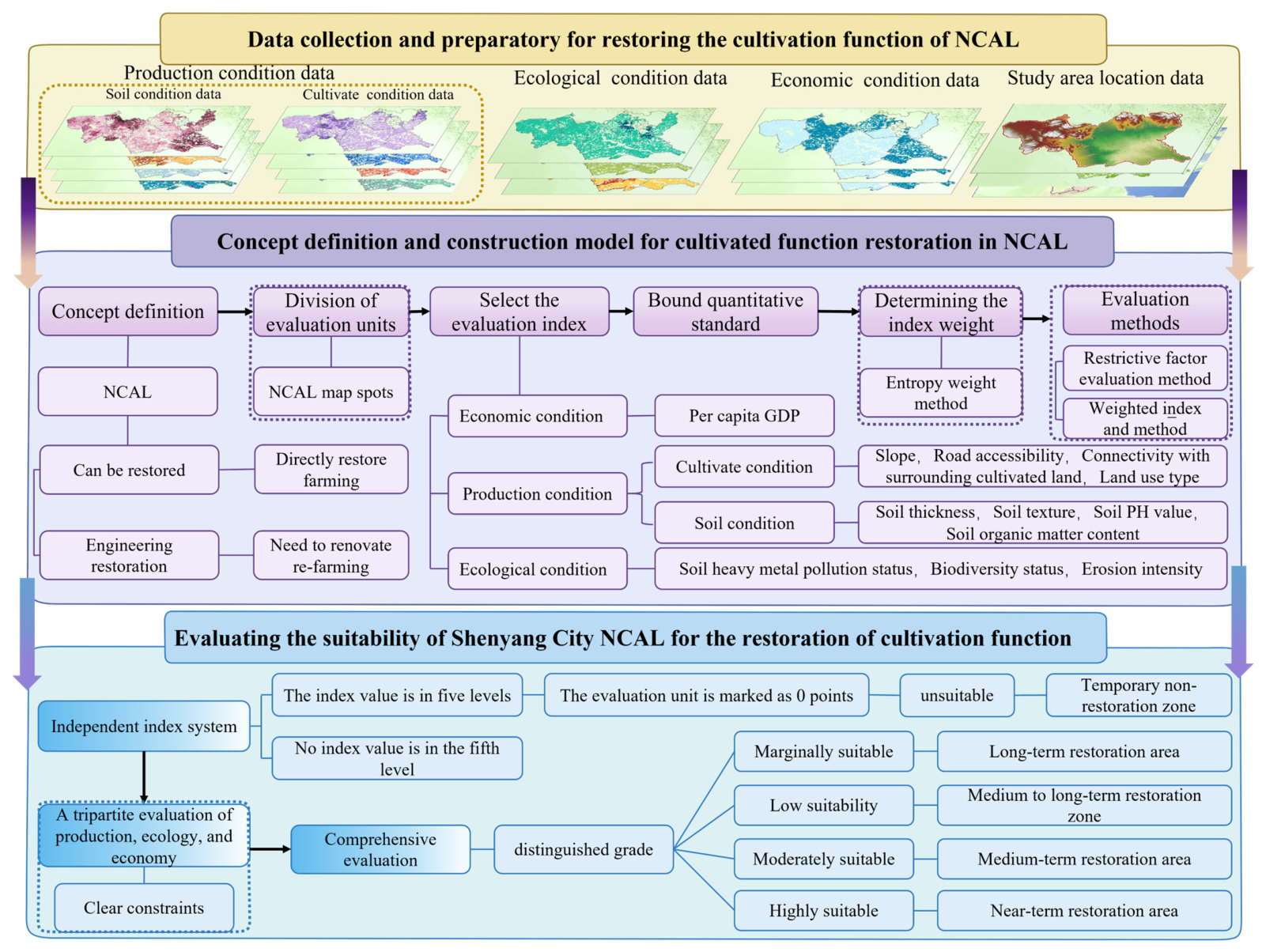
Following the three-stage analytical framework of “conceptual definition–model development–empirical validation” (
Figure 1), this study systematically develops an evaluation system for assessing the restoration suitability of NCAL. In the conceptual definition phase, the research scope is precisely delineated to include NCAL types identified in the TNLS as “can be restored” and “engineering restoration”. During the model construction phase, a novel evaluation index system was developed, encompassing three key dimensions: economic feasibility, production suitability, and ecological security. Using parcel-based evaluation units and integrating multisource data fusion techniques, this approach ensures that the evaluation precision aligns with the standards established in land surveys. For the empirical validation phase, Shenyang City was selected as an empirical case study. Through spatial stratification, the evaluation outcomes were categorized into five distinct grades on the basis of recovery timelines. This structured classification offers a scientifically grounded and actionable framework to support the implementation of cultivated land balance policy—specifically concerning land requisition–compensation equilibrium. The underlying logical flow is outlined as follows:
First and foremost, the term “NCAL” denotes agricultural land—including gardens, woodlands, grasslands, and aquaculture water surfaces—formed through the conversion of originally cultivated cropland to non-grain uses. The core scope of this research encompasses land types classified as “suitable for direct restoration” and “requiring engineering restoration” under the TNLS. This investigation is contextualized within the framework of the Cropland Requisition–Compensation Balance Policy (Natural Resources Development [2021] No. 166), which mandates that when cultivated land is converted to other agricultural uses, equivalent-quality cropland must be replenished through land consolidation initiatives. This policy aims to curb the trend of non-grain utilization of cultivated land and safeguard national food security. Consequently, the assessment of NCAL potential for restoring productive functions serves not only as a critical prerequisite for policy implementation—by assessing the potential of transferred plots—but also as a scientific foundation for maintaining the balance of cultivated land in terms of both quantity and quality. Following a clear delineation of the study area, diverse data sources were identified, including authoritative datasets such as the Liaoning Statistical Yearbook, the Resource and Environmental Science Data Center, and the TNLS. These sources underpin the accuracy and reliability of this research. Furthermore, the application of specialized software, including ArcGIS and IBM SPSS Statistics, ensures rigorous and scientifically sound data processing and analysis.
Additionally, this study systematically developed a suitability evaluation model for restoring agricultural functions on NCAL, following a scientifically rigorous construction process. First, the research scope was explicitly defined as NCAL with potential for agricultural rehabilitation. On this basis, a comprehensive evaluation framework was established. The evaluation units were delineated via recoverable sites identified from NCAL maps, and a parcel-based method was applied to ensure that the evaluation accuracy aligned with the land survey data. The evaluation system employs a multidimensional index framework encompassing three core dimensions: economic viability, production suitability, and ecological security. The economic dimension includes multiple economic indicators; the production dimension centers on key parameters characterizing soil properties; and the ecological dimension addresses indicators pertinent to environmental quality. In the context of quantitative standard setting, criterion weights were determined via an objective weighting approach. The proposed methodology innovatively integrates a limiting factor assessment with a comprehensive scoring system: the former serves to identify key constraints, whereas the latter quantifies overall suitability. A comprehensive regional evaluation was achieved through spatial analysis techniques. Empirical applications demonstrate that the model provides a consistent and spatially explicit basis for assessing restoration suitability, offers a scientific foundation for scheduling cultivated land restoration, and enhances both the comprehensiveness and reliability of evaluation outcomes.
Finally, taking Shenyang as a benchmark case, this study systematically evaluated the suitability of NCAL for the restoration of agricultural functions. The assessment was conducted via a multi-indicator integrated evaluation method, which involves the construction of a scientifically sound and rational indicator system. This framework enabled a holistic and systematic appraisal of the potential for agricultural function recovery in NCAL within the study area. On the basis of the composite index scores, the evaluation outcomes were categorized into five distinct grades: unsuitable areas denote regions where agricultural function restoration is currently unfeasible; marginally suitable areas (corresponding to long-term recovery) require extended periods of improvement before farming can be reinstated; low suitability areas (corresponding to mid- to long-term recovery) exhibit certain recovery potential but necessitate sustained investment; moderately suitable areas (corresponding to mid-term recovery) can achieve functional restoration within a mid-term horizon through appropriate improvement measures; and highly suitable areas (corresponding to near-term restoration) possess favorable site conditions and can be prioritized for immediate restoration. The research framework was designed following the logical sequence of “policy guidance → scientific evaluation → graded assessment → phased restoration”, with the strict preservation of cropland as the overarching policy objective. By systematically modeling a four-tiered structure “conceptual definition → delineation of evaluation units → construction of indicator system → selection of evaluation methods”, a rigorous and comprehensive evaluation system was established. Ultimately, this process yields a spatially explicit grading scheme, and the final output establishes a spatially explicit classification framework designed to provide technical support for decision-making processes aimed at restoring and rehabilitating cultivation functions in NCAL.
3. Materials and Methods
3.1. Characterization of the Study Area
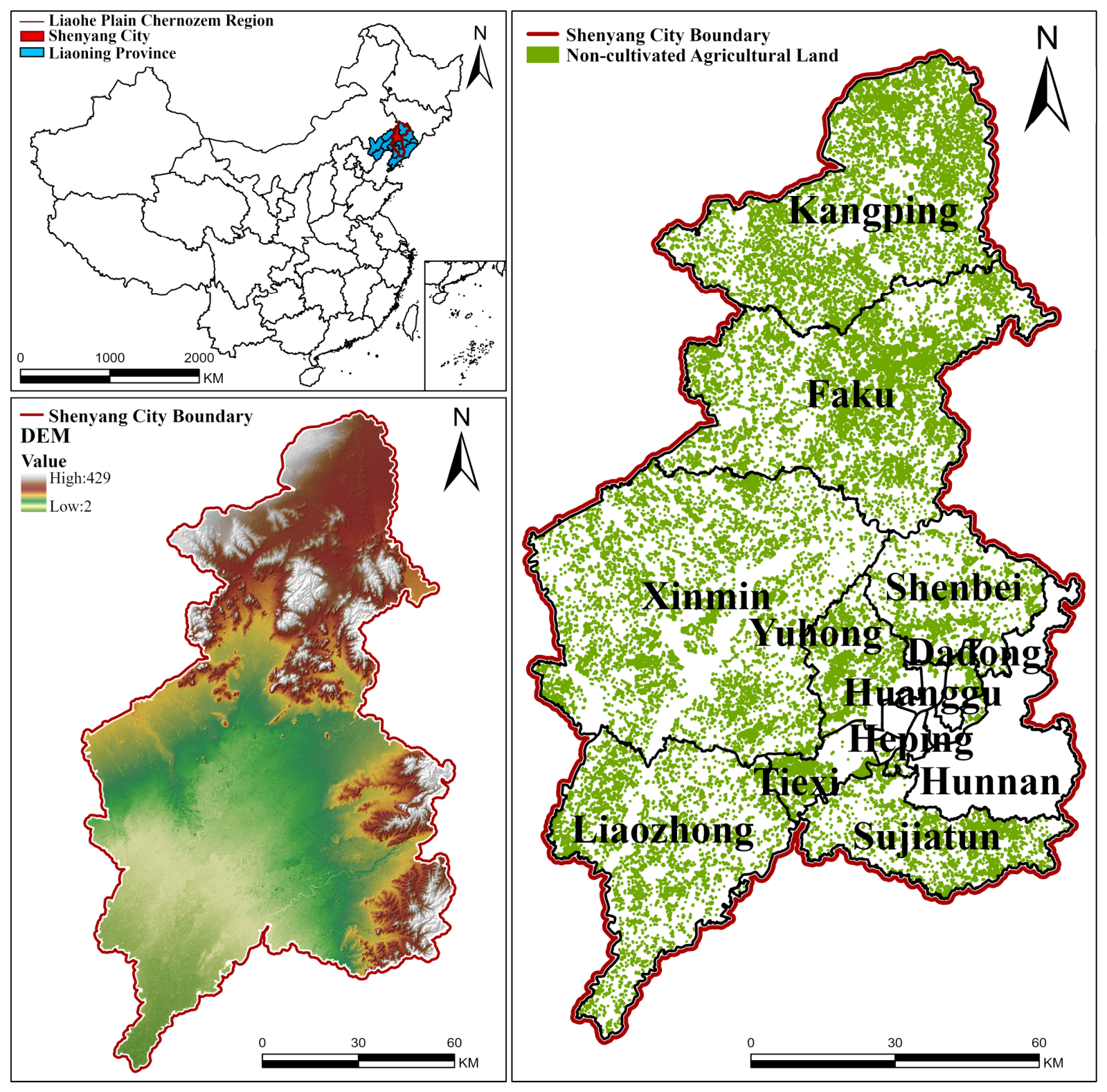
For this study, Shenyang City was selected as an example case study region. Its representativeness is manifested across three key dimensions (
Figure 2). Ecologically, it is situated within the core zone of the Liaohe Plain’s black soil region. As the largest commercial grain base in Northeast China, it accounts for a quarter of the nation’s total grain output. However, this critical region faces severe degradation trends—the black soil layer is thinning at an annual rate of 0.3–1.5 cm, the soil organic matter content has decreased by approximately 50%, and soil erosion has progressively undermined the sustainable productivity of cultivated land. In terms of land type composition, the total area of NCAL amounts to 27,408.39 hectares, of which engineering restoration accounts for 96.77%. This category encompasses multiple forms of reclaimed industrial and mining wastelands, including pond water surfaces, artificially established orchards and arbor forests, and naturally degraded grasslands. This highlights the compound characteristics of “abandonment in ecologically vulnerable zones” and the “high cost” of reclamation. In policy practice, as one of the first pilot cities to implement a “compensation-based balance” policy for cultivated land, the study area provides a standardized spatial carrier for verifying land restoration mechanisms. This is achieved through precisely delineated “can be restored” (cleaning followed by immediate cultivation) and “engineering restoration” (cultivation supported by engineering measures) TNLS parcels. This region encapsulates key challenges in repurposing concentrated NCAL: degradation pressures from natural constraints, difficulty of land type transformation under anthropogenic intervention, and pressing demands for policy implementation. These features collectively render it an ideal sample for constructing a universally applicable evaluation model.
3.2. Data Sources and Processing
3.2.1. Data Sources
This study used TNLS parcels within Shenyang Municipality as evaluation units. The parcels were limited to the TNLS categories “can be restored” and “engineering restoration”, with a total of 34,704 evaluation units and 27,408.39 ha. The evaluation index system incorporated production-condition data, ecological-condition data, and economic-capacity data.
- (1)
Production-condition data. Soil thickness, texture, pH, and organic matter content were obtained from the cultivated land resource quality information associated with the TNLS in Liaoning Province. Slope was derived from elevation data used in the TNLS quality classification workflow. Road accessibility was calculated from road vector data provided by the Resource and Environmental Science and Data Center of the Chinese Academy of Sciences (RESDC,
http://www.resdc.cn/). Connectivity with surrounding cultivated land was calculated from TNLS cultivated land parcels.
- (2)
Ecological-condition data. Soil heavy metal contamination, soil biological condition, and soil erosion intensity were used to characterize ecological constraints. Heavy metal and soil biological condition information was taken from the TNLS-related cultivated land resource quality database for Liaoning Province, while soil erosion intensity was obtained from RESDC. The soil biological condition indicator is interpreted as a soil quality and ecological-risk proxy; it is not used to justify converting high-biodiversity forests, wetlands, or grasslands into cropland.
- (3)
Economic-condition data. The dataset utilized for economic conditions exclusively comprises per capita GDP metrics. The spatially explicit kilometer grid dataset of per capita GDP was obtained from the Resource and Environmental Science and Data Center, Chinese Academy of Sciences (
http://www.resdc.cn/). The corresponding per capita GDP values were sourced from the Liaoning Statistical Yearbook.
3.2.2. Data Processing
On the ArcGIS 10.8 platform, this study established a structured spatial data processing workflow, divided into the following four levels. (1) Basic data preparation. The cultivated land layer and the NCAL layer of Shenyang City were extracted from the results of the TNLS of Liaoning Province. The NCAL parcels cover two land types: “can be restored” and “engineering restoration”, serving as the fundamental data layers for this study. All spatial data were projected using the Gauss–Krüger projection system (
Table 1). (2) Calculation of key indicators. Multi-level buffers (<500 m, 500–1000 m, 1000–1500 m, and 1500–2000 m) were constructed around the road vector data. The buffer layer was overlaid on the NCAL layer to quantify the road accessibility level of each parcel, which is a buffer-overlay procedure, i.e., buffer distance analysis. The Intersect tool was used to generate the adjacent boundary layer between cultivated land and NCAL. The connectivity with cultivated land was then calculated as the ratio of the adjacent boundary length to the perimeter of the NCAL parcel (K = adjacent boundary length/perimeter). In addition, county-level per capita GDP statistics were overlaid on the NCAL layer, and soil erosion intensity data were also overlaid on the same layer to obtain the corresponding attributes. (3) Index classification processing. From the attribute database of Shenyang’s NCAL layer, existing data on soil thickness, soil texture, soil pH, soil organic matter content, slope, land use type, soil heavy metal pollution status, and soil biodiversity status were exported together with the derived data on road accessibility, connectivity with cultivated land, per capita GDP, and soil erosion intensity. Using SPSS 27.0 and Excel software, the specific values of each indicator were classified into corresponding grades and assigned scores according to the pre-established grading criteria, thereby preparing for the subsequent comprehensive evaluation. (4) Implementation of comprehensive evaluation. Based on the determined indicator weights, the production condition scores, ecological condition scores, economic condition scores, and comprehensive scores for each evaluation unit were calculated in SPSS or Excel. The calculated scores were then linked back to the attribute table of Shenyang’s NCAL layer. It should be noted that no uniform 30 m grid was used as the evaluation unit; instead, the original TNLS parcels served as the basic spatial units. The natural breaks (Jenks) method was used to classify the suitability grades into five categories: highly suitable, moderately suitable, low suitability, marginally suitable, and unsuitable. This methodological framework leverages multi-source data fusion and spatial analysis techniques to establish a systematic and operable workflow for evaluating the suitability of NCAL for restoring cultivation functions.
3.3. Suitability Evaluation Method and Model Establishment for the Functional Restoration of NCAL
3.3.1. Evaluation Method
Using ArcGIS 10.8 software, the evaluation process begins with a restrictive factor assessment to delineate suitable and unsuitable areas. A weighted overlay approach is subsequently applied to calculate suitability scores within the suitable zones. Finally, the natural breaks classification method is employed to categorize the suitability levels for restoring cultivated functions in NCAL.
The restrictive factor evaluation method [
22] is specifically applied to conduct an initial screening of evaluation units by establishing threshold values for each indicator that is deemed unsuitable for cultivation prior to formal suitability assessment. If any single indicator meets or exceeds this restrictive threshold, the corresponding evaluation unit is classified as unsuitable. The remaining units are subsequently categorized into specific suitability levels. This approach is the key to clearly dividing the boundary between suitability and unsuitability and lays the foundation for the subsequent division of specific suitability grades. The weighted index sum method comprehensively accounts for various factors influencing cultivation potential, enabling a holistic and quantitative calculation of suitability scores. After suitable areas are identified via the restrictive factor evaluation method, the final evaluation score is computed by multiplying the assigned indicator weight by its indicator score. These scores are then classified into distinct suitability grades via the natural breaks method. Furthermore, ArcGIS software is utilized throughout the entire evaluation process, encompassing tasks such as TNLS parcel extraction, layer overlay analysis, grade classification, and the generation of spatial distribution maps.
3.3.2. Evaluation Unit Classification
The evaluation unit serves as the fundamental spatial component for assessing the rehabilitation potential of NCAL in this study. It must exhibit uniformity, homogeneity, and integrity [
23], criteria that TNLS parcels in this context satisfy. Accordingly, non-cultivated agricultural TNLS parcels designated “can be restored” and “engineering restoration” are defined as the evaluation units in this research.
3.3.3. Establishing the Model for Evaluation
Selection of the Evaluation Indicators
The core objective of assessing the restoration suitability of NCAL is to evaluate, within specific natural ecological and socioeconomic contexts, the feasibility and extent to which such land can be reverted to arable status and sustainably utilized for food crop cultivation. The scientifically grounded and comprehensive selection of evaluation indicators forms the foundational basis for accurately assessing the restoration suitability of NCAL for cropping functions. The factors influencing the restoration suitability of cultivation functions in NCAL are complex and diverse. Guided by the objective of realizing the agricultural utility of farmland, a total of 12 evaluation indicators (
Table 2) were selected across three dimensions—production conditions, ecological conditions, and economic conditions—as primary determinants for assessing the suitability of cultivation function restoration. Production conditions represent the foundational and decisive factors governing restoration suitability. Ecological conditions reflect the ecological sustainability of farmland, whereas economic conditions indicate the potential economic capacity for restoring NCAL in the study area.
- (1)
Production Conditions
The fundamental attribute of cultivated land lies in its capacity for cyclical crop cultivation, ultimately fulfilling the objective of grain production. Favorable production conditions of cultivated land establish the foundation for achieving high and stable grain yields. The quality of these production conditions serves as the primary factor in evaluating the suitability of restoring NCAL. To characterize this suitability, eight indicators spanning two dimensions—soil conditions and cultivated conditions—were selected.
High-quality soil conditions are fundamental to realizing the productive functions of cultivated land. Soil thickness governs crop growth by influencing root development. The soil texture governs water and nutrient retention and supply capacities, thereby reflecting the tillage performance of cultivated land [
24]. Soil pH influences crop development and quality by modulating the availability of soil nutrients and the formation of harmful substances [
25]. Soil organic matter serves as a primary determinant of soil fertility [
26], and its content is a key indicator of the productive capacity of the soil [
27]. Therefore, this study selects four indicators—soil thickness, soil texture, soil pH, and soil organic matter content—to evaluate the impact of soil conditions on the suitability of cultivated land for agricultural production.
Convenient cultivation conditions are essential for realizing the full production potential of cultivated land. Variations in slope gradient critically influence soil erosion and aggregate stability, which are critical determinants of the suitability of converting NCAL to cultivated land. Moreover, high road access density provides fundamental infrastructure support for routine plot cultivation. When NCAL is entirely surrounded by cultivated land, its future restoration to cultivated status is more feasible and holds greater significance for achieving consolidated and contiguous farming plots. Conversely, if such land does not form a contiguous farming area with adjacent cultivated plots [
28], its suitability for restoration is considerably lower. Therefore, this study adopts the degree of contiguity with surrounding cultivated land as an indicator to quantify the potential for future consolidated and contiguous farming between NCAL and surrounding cultivated areas. This metric is expressed as the K value, which is calculated as K = X/C, where X represents the shared boundary length with adjacent cultivated land and where C denotes the perimeter of the NCAL parcel. The current utilization status of uncultivated agricultural land determines the difficulty of restoring its agricultural function. In the TNLS, land designated “immediately restorable” indicates minimal impairment of its cultivable properties, allowing for restoration to cultivated land with minimal intervention; thus, the difficulty of land recovery is low. In contrast, land categorized as “requiring engineering restoration” necessitates the implementation of engineering measures before it can be returned to cultivated use, representing a greater level of restoration difficulty [
29]. Therefore, this study selected slope, road accessibility, connectivity with surrounding cultivated land, and current land use type as indicators to characterize farming conditions.
- (2)
Ecological Condition
During the current era of ecological civilization development, assessing the feasibility of reinstating cultivation functions on NCAL should account not only for grain productivity, but also for the ecological conditions of the farming environment [
30]. Heavy metal contamination of cultivated soils is widespread in China [
31], posing a significant threat to national food security and thus demanding considerable attention in agricultural production. Accordingly, the soil heavy metal pollution index was selected to assess the extent of soil contamination. Soil biodiversity serves as a critical indicator of the health of cultivated land ecosystems [
32,
33,
34,
35]. The inclusion of this metric helps represent, to some degree, the overall health of these ecosystems. Soil erosion can lead to the degradation of soil structure [
36], deterioration of soil properties [
37], and loss of nutrients [
38]. Moreover, it critically influences land suitability for cultivation. Therefore, the soil erosion intensity index was adopted to reflect the potential risk of soil erosion.
- (3)
Economic Condition
The regional economic level also significantly influences the feasibility of restoring NCAL [
39]. Regions with greater economic development are likely to allocate greater financial resources toward such restoration efforts in the future. Through technological investment and economies of scale, it becomes possible to mitigate the disadvantages posed by natural ecological factors [
40], thereby enhancing the agricultural production conditions. This financial backing ensures both the continuity of restoration activities and the quality of newly reclaimed farmland. In this study, we adopt the per capita GDP indicator as a proxy for potential future capital investment in NCAL restoration [
41,
42]. Per capita GDP is only a regional fiscal-capacity proxy, not a direct measure of parcel-level economic viability. This metric serves to characterize the economic viability of converting such land back to cultivated use in the target region.
Establishment of a Standardized Framework for Index Quantification
The influence of individual indices on the restoration suitability of cultivation functions in NCAL varies, as do their measurement dimensions. It is therefore necessary to establish preliminary rating criteria for the restoration suitability of each indicator. Considering data accessibility, this study draws on classification standards from the “TNLS” for cultivated land resource quality and the “Standard for Classification and Gradation of Soil Erosion (SL190-2007)”. Accordingly, soil thickness, soil pH, soil organic matter content, slope, and soil erosion intensity were classified into five levels, which were assigned scores of 4, 3, 2, 1, and 0, respectively. The soil texture and soil biological condition were categorized into three levels, whereas the soil heavy metal contamination was divided into two levels. On the basis of previous research findings and regional realities [
43], road accessibility, connectivity with surrounding cultivated land, land use type, and per capita GDP were classified into four levels.
Among the twelve evaluation indices, six—specifically, soil thickness, soil pH, soil organic matter content, slope gradient, soil heavy metal pollution, and soil erosion intensity—reached critical thresholds that have a deterministic impact on the restoration of cultivation function in the evaluation units. In accordance with China’s “Soil and Water Conservation Law” and the “Soil Pollution Prevention and Control Law of the People’s Republic of China”, cultivated land with a slope exceeding 25° or identified as contaminated is legally prohibited from farming. Furthermore, relevant research findings indicate that land characterized by a soil layer thinner than 20 cm, strongly acidic or alkaline conditions, low soil organic matter content, or severe soil erosion is unsuitable for cultivation. Accordingly, for the six indicators specified above, unsuitable tillage values were defined on the basis of their respective evaluation criteria characteristics. The remaining six indicators did not play a decisive role in determining whether an evaluation unit could regain agricultural functionality; therefore, no unsuitable tillage values were assigned to them (the detailed grading criteria and scores are provided in
Table 3). The classification criteria we adopted were based on authoritative national standards and industry guidelines. Specifically, the thresholds for soil depth (<20 cm) and organic matter (<10 g/kg) followed the classification and grading standards for cultivated land resource quality used in China’s TNLS. The pH thresholds (<5 or ≥9) were also referenced from the same TNLS classification system. The slope threshold (>25°) was based on China’s national regulations for cropland protection and ecological restoration planning. For heavy metal contamination and severe erosion, the criteria followed the “Standard for Classification and Gradation of Soil Erosion” (SL190-2007) issued by the Chinese Ministry of Water Resources, where Class V (extremely/severe erosion) was taken as the reference.
For the indicators of soil thickness, texture, pH, organic matter content, slope, heavy metal pollution, and soil biological condition, evaluation criteria were established on the basis of the characteristics of the soil physicochemical properties and the impact of each indicator on farming conditions. With respect to road accessibility, proximity to roads is more conducive to farming. Consistent with previous studies [
44,
45], the evaluation criteria for preliminary restoration suitability were defined according to the principle that suitability decreases with increasing distance from roads. With respect to the indicator of connectivity with surrounding cultivated land, the calculated K value ranges from 0 to 1. A higher K value indicates a greater degree of connectivity between the NCAL and the surrounding cultivated land. Accordingly, the restoration suitability levels for this indicator were classified on the basis of the magnitude of the K value. For the land use type index, evaluation units were first classified into two categories: those that can be restored and those that can be engineered for restoration. Among the remaining types, NCAL—such as shrubland, other forestland (including grassland), and adjustable orchard land—typically develop naturally without human intervention, making them relatively easy to restore. In contrast, land uses such as orchards, arbor forestland, aquaculture ponds, and pond water surfaces generally result from intentional human modification and investment. Restoring these lands to cultivated status often involves economic compensation, thereby increasing the degree of restoration difficulty. The soil erosion intensity index was classified according to the Soil Erosion Classification and Grading Standard (SL190-2007), which categorizes erosion into six levels: slight, light, moderate, intense, extreme, and severe. For the per capita GDP index, divisions were based on the economic conditions within the study area. Consistent with the principle that higher per capita GDP reflects greater regional economic development and thus greater potential funding for restoring NCAL, the per capita GDP values in the study area were classified into four tiers, from highest to lowest.
Determination of the Weights
The weight of each indicator reflects its relative contribution to the restoration suitability of the cultivation function. A higher weight signifies a greater influence of the indicator on restoration suitability, and vice versa. The entropy weight method [
46] provides a more objective approach for determining weights and was employed in this study to calculate the weight of each indicator (
Table 2). Using statistical software such as SPSS, all index values were normalized via the min–max standardization method to mitigate distortions arising from differing indicator attributes and dimensions (moderate indicators were first converted into positive indicators prior to data processing). The normalization procedure was applied as follows:
In the formula, yij denotes the normalized value of the j-th indicator within the i-th evaluation unit, while xij, ximin, and ximax represent the actual, minimum, and maximum values, respectively, of the same indicator.
For each normalized indicator, a matrix, R = (r
ij)
m×n is constructed, comprising n evaluation units and m evaluation indicators. The information entropy for the j-th evaluation indicator is then calculated:
In the formula, ej denotes the information entropy of the j-th index. The term represents the proportion of the j-th index within the i-th evaluation unit. When xij = ximin (for a positive index) or xij = ximax (for a negative index), is defined as zero.
The difference coefficient g
j for index ‘j’ is defined as:
The weight w
j of the ‘ j ‘ index is:
Suitability Evaluation for Restoring Cultivation Functions in NCAL
The suitability of nonagricultural land for functional restoration to farming was evaluated via the restrictive factor evaluation method in combination with the weighted index sum approach. Initially, the evaluation units were classified into suitable and unsuitable areas. A preliminary suitability grade was assigned on the basis of the restrictive factor evaluation method. If any of the following conditions were met within an evaluation unit—soil layer thickness < 20 cm, soil pH < 5.0 or ≥9.0, soil organic matter content < 10 g/kg, slope > 25°, presence of heavy metal contamination in soil, or soil erosion reaching extreme/severe (if a single indicator met the threshold for the lowest suitability grade 5)—a “one-veto” rule was applied. These units were designated unsuitable areas, assigned a suitability score of 0 for farming function restoration, and excluded from further assessment. The remaining units were classified as suitable areas. The comprehensive restoration suitability score for each evaluation unit within the suitable area was subsequently calculated via the weighted index sum method with ArcGIS software. A higher composite score indicates a greater suitability of NCAL for restoring farming functionality, and vice versa. The formula is as follows.
In the formula, Ri represents the composite score of the i-th evaluation unit; fij denotes the quantitative score of the j-th evaluation indicator within the i-th evaluation unit.
Finally, the suitability evaluation scores of each assessment unit within the delineated suitable area were classified into final grades representing the potential for restoring cultivation function on NCAL. Given the inherent spatial heterogeneity in the actual conditions of NCAL across different regions, the resulting evaluation scores varied considerably. Consequently, the equal-interval classification method is suboptimal for categorizing these scores. Instead, this study employed the more adaptable natural breaks method to define the final suitability grades. On the basis of the five-tier grading framework established earlier and the specific evaluation results of the study area, the suitability scores within the suitable zone were classified via the natural breaks method in ArcGIS. The resulting grades, in descending order of suitability, are highly suitable, moderately suitable, low suitability, and marginally suitable. Areas deemed unsuitable were categorized into a separate unsuitable class.
4. Results
4.1. Single-Factor Evaluation of Functional Restoration Suitability for NCAL
4.1.1. Production Conditions
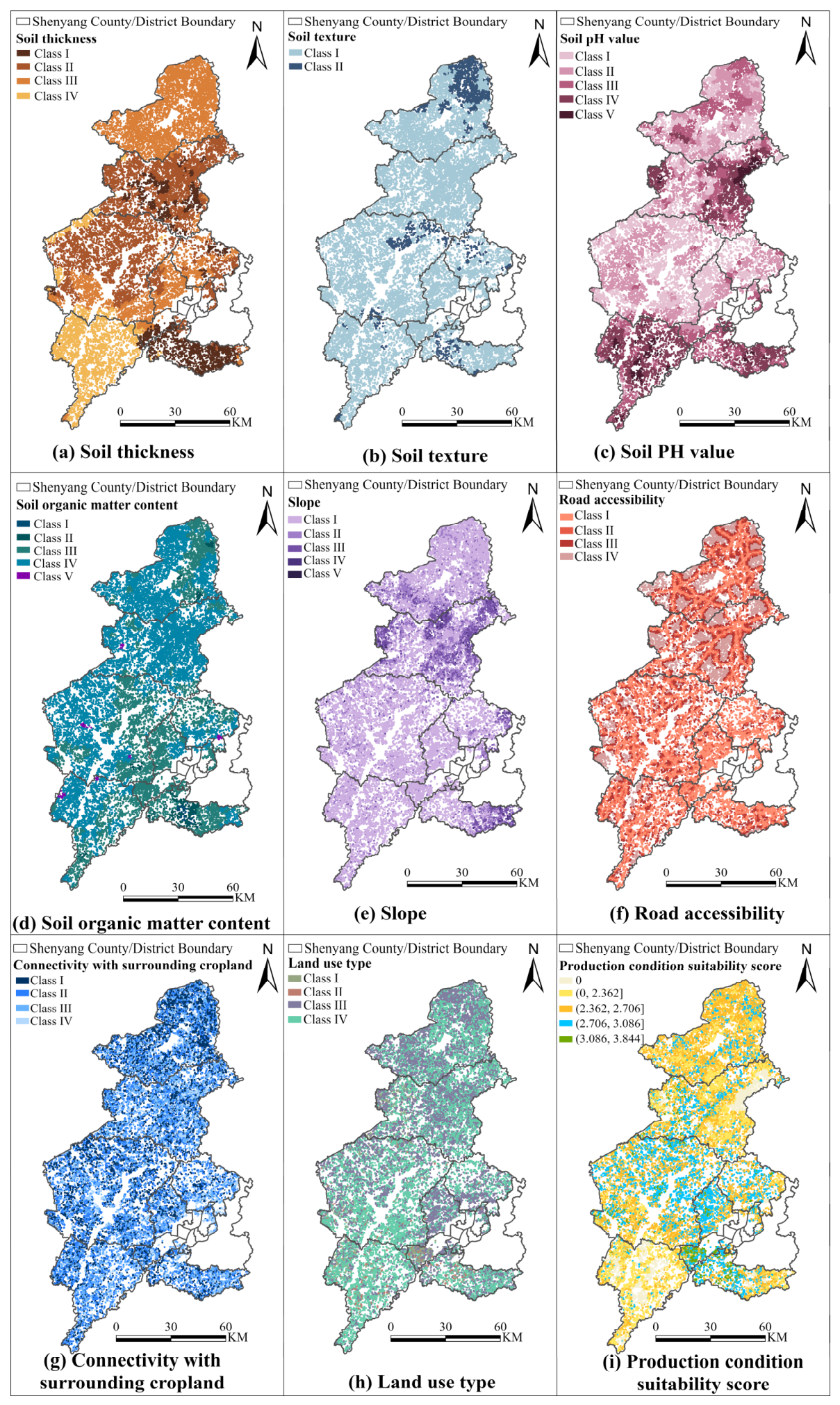
On the basis of 34,704 evaluation units delineated from NCAL TNLS parcels in Shenyang City, this study conducted a single-factor assessment of production condition suitability using eight indicators: soil thickness, soil texture, soil pH, soil organic matter content, slope, road accessibility, connectivity with surrounding cultivated land, and land use type (
Figure 3). The results indicate that the soil layer thickness was predominantly classified as Class II (60–100 cm), accounting for 38% of the sampled parcels. However, the citywide average score for this parameter was only 2.5 (on a 4-point scale), with 97% of the plots in the central Liaoning region falling into the Class IV category, characterized by thin soil layers (20–40 cm). The soil texture was generally favorable, with loam representing 90% of the sample parcels. The soil pH was suboptimal: although 28% of the parcels fell within the ideal neutral range (pH 6.5–7.5), 5% were deemed unsuitable due to strongly acidic or alkaline conditions (pH < 5.0 or ≥9.0), resulting in an average score of 2.5. A notable issue was the soil organic matter (SOM) content: 62% of the parcels were rated Class IV, indicating low SOM (10–20 g/kg), and the municipal average was merely 19 g/kg, leading to a low mean score of 1.4. The slope conditions were relatively favorable, with 73% of the parcels having slopes ≤ 2° and an average score of 3.5. Road accessibility was moderate, as 49% of the parcels were located within 500 m of a road, yet the average score was 2.9. The connectivity to adjacent farmland was also moderate, with 33% of the parcels exhibiting a K value between 0.2 and 0.5 (Class III), with an average score of 2.7. The land use type posed significant constraints, as 94% of the parcels fell into the “engineering restoration” category (e.g., orchards, woodlands), which is associated with high restoration difficulty and an average score of only 1.9. Overall, the production suitability of NCAL in Shenyang is poor, with fewer than 30% rated as moderately suitable or higher. Key limiting factors include insufficient organic matter, suboptimal pH, widespread thin soil layers, and high cultivation layer restoration difficulty due to land use types requiring engineering intervention.
4.1.2. Ecological Conditions
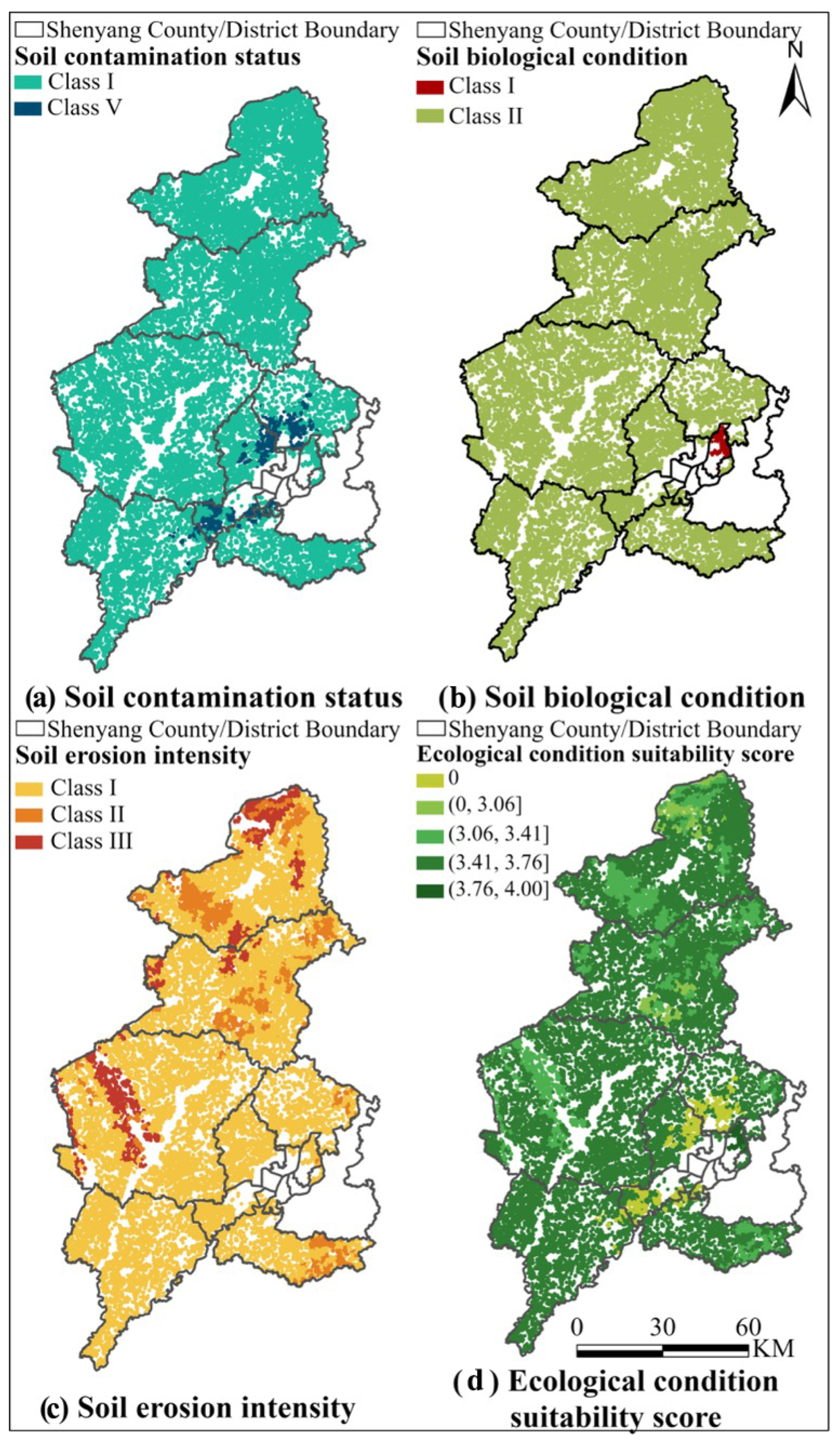
This study conducted a systematic evaluation of the ecological suitability of NCAL in Shenyang. Three key indicators—soil heavy metal contamination, soil biodiversity status, and soil erosion intensity—were identified through individual factor analysis (
Figure 4). These findings indicate that soil heavy metal pollution is largely manageable across the study area. Specifically, 92.47% (25,343.34 hectares) of the parcels were classified as uncontaminated (with an average score of 3.8). However, moderate and heavy pollution was identified in 7.53% (2065.05 hectares) of the parcels, which were predominantly distributed across nine counties and districts, including Tiexi District (608.90 ha), Yuhong District (378.48 ha), and Liaozhong District (700.49 ha). Within these districts, northeastern Faku County exhibited a linear distribution pattern, whereas Shenbei New District and Tiexi District presented clustered distributions. Owing to associated food security risks, these polluted areas were directly designated as unsuitable for restoration. The soil biodiversity levels were generally stable. The vast majority of parcels (99.53% or 27,278.52 hectares) were rated as ‘moderate‘ (Class II), with only 0.47% (129.87 hectares) in Dadong District reaching the ‘abundant‘ (Class I). No areas were classified as ‘not rich’, resulting in an overall average score of 3.0. The risk of soil erosion was notably low. A total of 81% (22,208.39 hectares) of the parcels experienced minimal erosion (Class I), 16.33% (4475.56 hectares) experienced mild erosion (Class II), and only 2.34% (641.83 hectares) experienced moderate erosion (Class III). No severe or extreme erosion was observed, yielding an average score of 3.8. Parcels with higher erosion risk were located primarily in northwestern regions, such as Faku County and Kangping County. The comprehensive evaluation revealed that 73.79% (20,222.87 hectares) of the total area possessed moderately suitable or superior ecological conditions. This indicates an overall excellent ecological baseline for NCAL in Shenyang, characterized by stable soil biological activity and manageable erosion risk, thereby demonstrating the ecological sustainability necessary for supporting the restoration of cultivated land functions. Nevertheless, localized heavy metal pollution (particularly prominent in Faku County (934.44 ha) and Shenbei New District (910.96 ha)) constitutes a critical ecologically limiting factor. Strict avoidance of these areas is imperative during the implementation of the “in–out balance” policy. Priorities for recultivation projects should be assigned to regions with lower ecological risk.
4.1.3. Economic Conditions
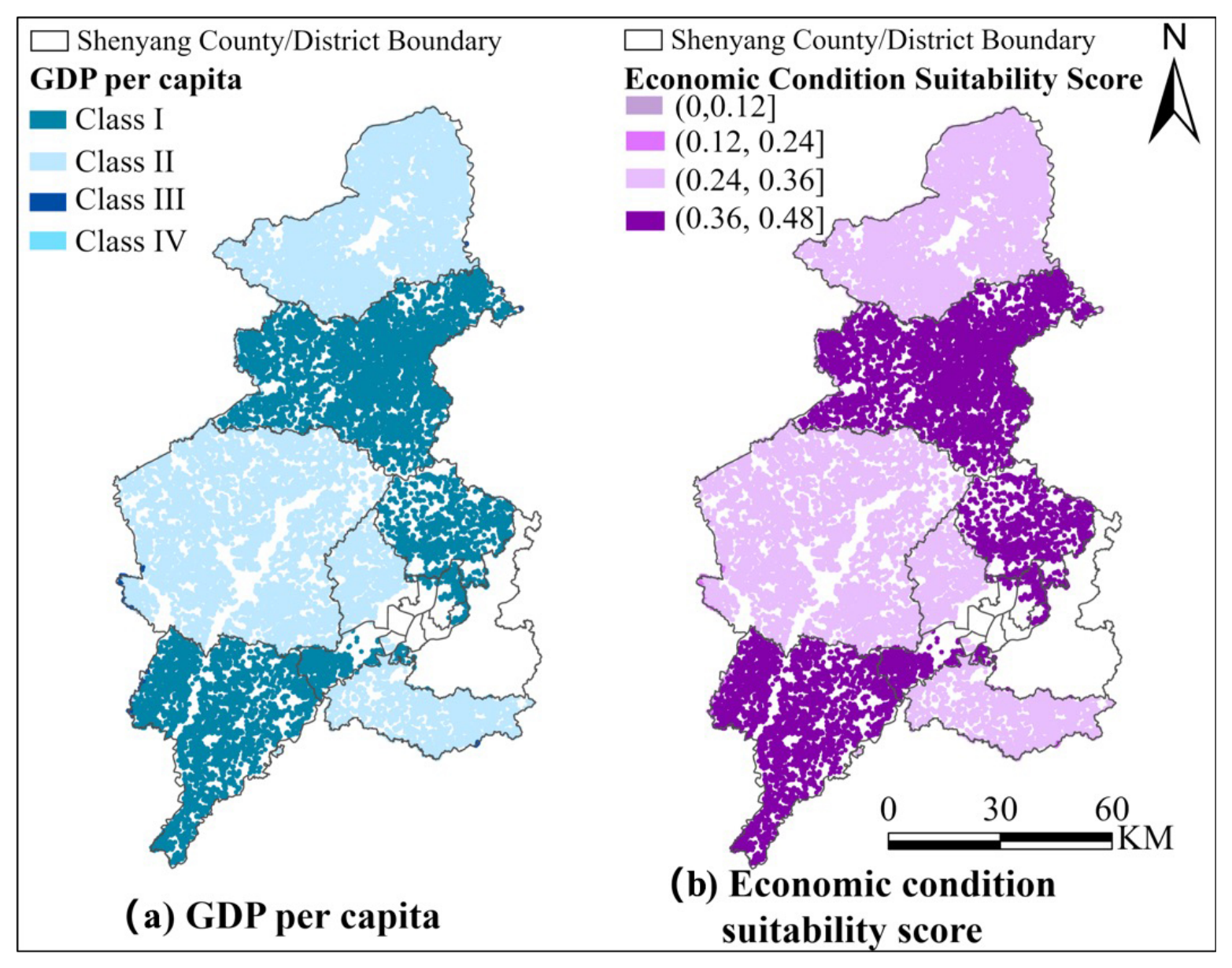
This study conducted a single-factor evaluation of the economic suitability of 27,408.39 hectares of NCAL in Shenyang City, constructing a spatial analysis model with per capita GDP as the key indicator (
Figure 5). The results demonstrate that the overall economic conditions in the city are highly favorable, with an average score of 3.5 (out of 4), meeting the second-grade “moderately suitable” standard. Spatial differentiation reveals a distinct concentric pattern characterized by “highly suitable in the central urban area—moderately suitable in the inner suburbs—low suitability in the outer suburbs”. Specifically, the central urban area (encompassing Dadong and Shenhe Districts) and the core zones of Liaozhong District/Shenbei New District formed a high-intensity economic belt. Here, 45.337% (12,426.13 hectares) of the plots presented a per capita GDP ≥ ¥50,000, classifying them as Class I “highly suitable”. The inner suburban agricultural counties (e.g., Kangping County, Xinmin City, Yuhong District, and Sujiatun District) constituted a moderate economic circle, where 54.47% (14,929.61 hectares) of the plots fell within the ¥30,000–50,000 range, corresponding to Class II “moderately suitable”. Low economic gradient areas were sporadically distributed in the outer suburbs, with only 0.19% (52.03 hectares) of the plots classified as Class III “low suitability” (per capita GDP ¥10,000–30,000). These areas are concentrated in northwestern Faku County (20.66 hectares), southwestern Kangping County (6.40 hectares), and northern Xinmin City (23.15 hectares). An extremely low-value area of 0.002% (0.61 hectares) with per capita GDP < ¥10,000, identified as Class IV “marginally suitable”, was found in northeastern Kangping County. The land use type analysis indicated that the highly suitable areas were predominantly characterized by engineering restoration forestlands (76.30%) and orchards (18.7%), and the moderately suitable zone was dominated by other forestland types necessitating engineering restoration (76.30%). This reflects the greater feasibility of implementing high-cost forest restoration projects in economically developed regions. The comprehensive evaluation confirmed that 99.8% of the NCAL lies within the moderately suitable grade or above. This underscores the robust capacity of Shenyang’s county-level economies to effectively support investments in recultivation projects (e.g., 5295.37 hectares in Kangping County and 5618.18 hectares in Xinmin City, where the moderately suitable area constitutes 99.8% of the county’s NCAL). However, attention must be given to the economic gradient disparities observed in outer suburban counties, such as Kangping (6.4 hectares of low suitability area) and Faku (2.24 hectares of low suitability area). Targeted measures, including enhanced fiscal transfer payments and ecological compensation mechanisms, are imperative to mitigate the impact of regional economic imbalances on restoration timelines. This ensures the equitable spatial implementation of the “in–out balance” policy for cultivated land.
4.2. Comprehensive Suitability Evaluation for Restoring Cultivation Functions in NCAL
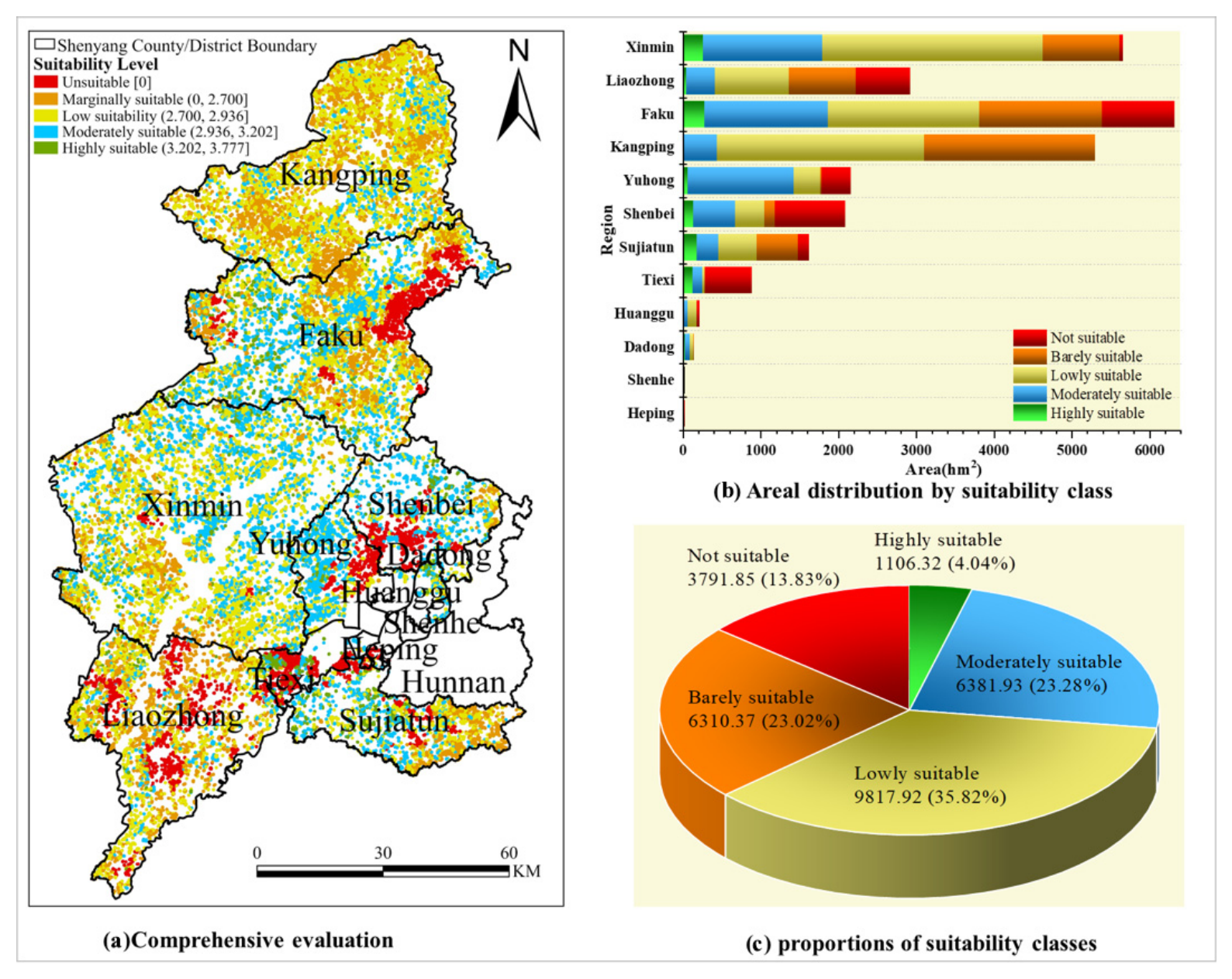
This study conducted a comprehensive suitability assessment for the restoration of cultivation functions on NCAL in Shenyang, integrating production, ecological, and economic dimensions. The comprehensive evaluation score range for the areas suitable for restoring cultivation functions to non-cultivated agricultural land (NCAL) in Shenyang City is (0, 3.777]. The results demonstrate that the scores for these suitable areas are relatively concentrated, ranging from 2.700 to 3.777 (
Figure 6). The citywide average score is only 2.50 (out of a maximum of 4 points), falling within the “marginally suitable” category, with significant spatial heterogeneity. The highly suitable area accounts for the smallest proportion (4.04%, 1106.32 hectares) and is concentrated in northeastern Faku County, central Sujiatun District, and southern Xinmin City. This area is predominantly composed of other engineering forestlands (35.3%) and can be restored to other forestlands (35.3%). Moderately suitable areas constitute 23.28% (6381.93 hectares), forming clustered zones in central-western Xinmin City, northern Yuhong District, and southwestern Faku County, with 76.30% being engineering restoration of other forestlands. The low suitability area represents the largest proportion (35.82%, 9817.92 hectares) and is densely distributed along the Xinmin City—Kangping County axis, primarily consisting of engineering restoration arbor forestland (31.2%) and orchards (30.5%). The marginally suitable area accounts for 23.02% (6310.37 hectares) of the total area, exhibiting a concentrated distribution pattern throughout Kangping County, comprising only engineering restoration orchards (37.1%) and arbor forestland (33.2%). Unsuitable areas constitute 13.83% (3791.85 hectares), are distributed in a belt-like pattern in northeastern Faku County (934.44 hectares), and are clustered in Shenbei New District (910.95 hectares) and Tiexi District (608.90 hectares) (
Table 4). Spatial distribution patterns reveal underlying constraints: the production dimension demonstrates a distinct “east-superior, west-inferior” dichotomy. Eastern counties (Sujiatun, Xinmin) are constrained by organic matter deficits (62% of plots contain 10–20 g/kg) and land use types (94% are designated engineering restorations). Western counties (Kangping, Liaozhong) face compound limitations from thin soil layers (97% of plots in Liaozhong are 20–40 cm thick) and steep slopes (0.02% of Kangping plots exceed 25°). Ecologically, a “multipoint pollution” pattern emerges, with 2065.05 hectares of metal-contaminated plots across nine counties—particularly Tiexi and Yuhong—forming spatial exclusion zones. Economically, center-periphery differentiation is evident, marked by highly suitable areas in central urban districts (Dadong, Shenhe) and low-suitability zones in the outer suburbs (0.61 hectares in northeastern Kangping). A comprehensive evaluation identified shortfalls in production conditions (mean organic matter: 19 g/kg; dominance of engineering restoration) and localized ecological risks (7.53% contaminated parcels) as the core limiting factors, whereas economic support (99.8% of parcels were moderately suitable or above) provided the foundational capacity for restoration.
4.3. Sensitivity Analysis of the Suitability Classification
To test the sensitivity of the spatial classification to the entropy weights, we recalculated suitability under an equal-weight scheme and under +/−20% changes to the production, ecological, and economic dimensions, with all weights renormalized to sum to one. The restrictive-factor rule was retained in all scenarios because it reflects legal and food-safety constraints. The high-suitability area remained small under the dimension-weight perturbations (3.37–5.63% of total NCAL). Under equal weights, the high-suitability area increased to 2341.26 ha (8.54%), but 99.19% of the baseline highly suitable area remained classified as highly or moderately suitable under the equal-weight scenario (
Table 5). These results indicate that the priority restoration zone identified by the framework remains largely unchanged under plausible weight perturbations, supporting the framework’s internal consistency as a screening tool. However, boundaries among moderate, low, and marginally suitable classes remain sensitive to weighting assumptions, suggesting that the fine-tuning of weights requires further empirical justification.
4.4. Restoration Sequencing and Implementation Matrix for NCAL
4.4.1. Strategic Analysis of Restoration Sequencing and Governance Measures for NCAL
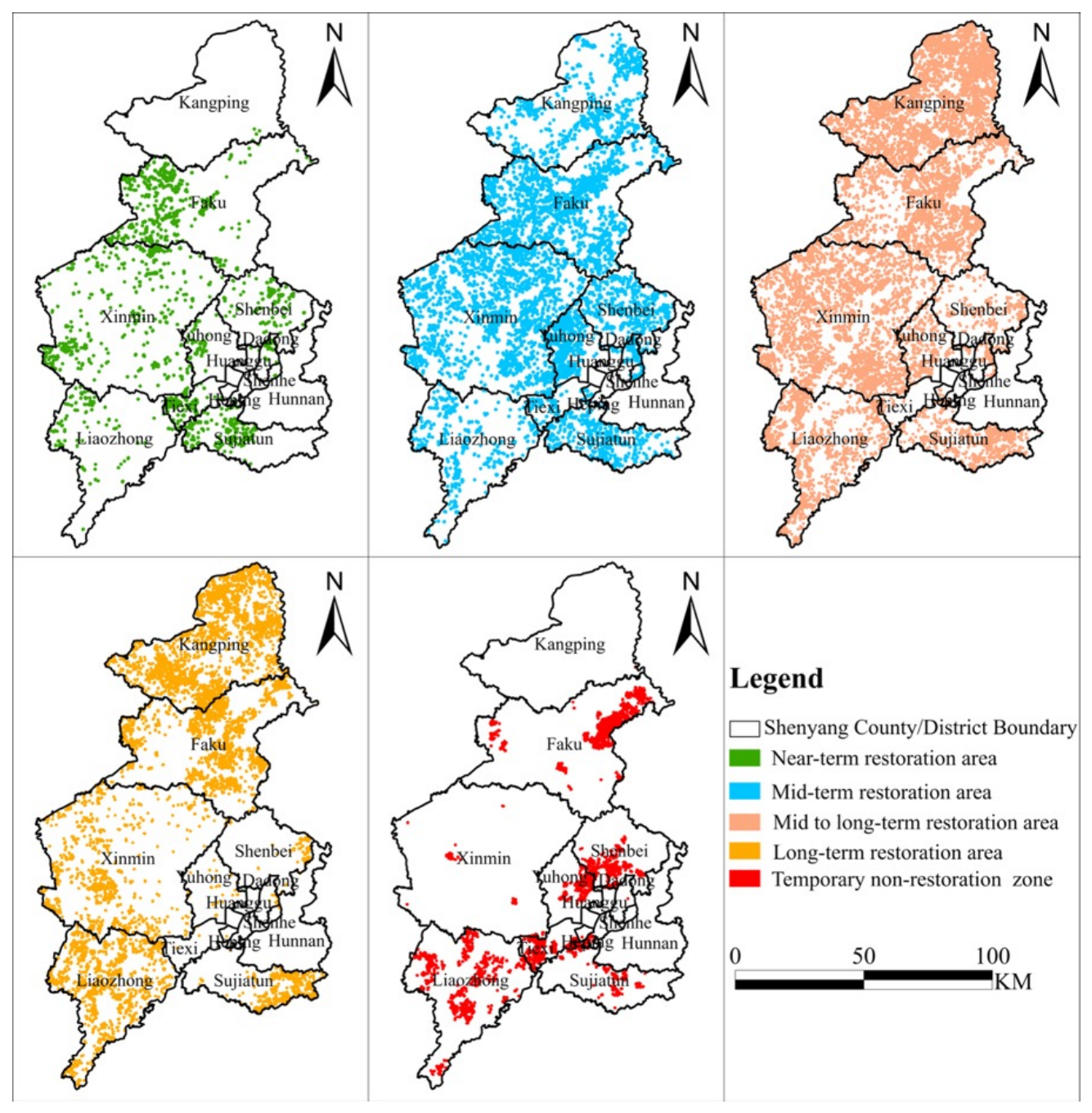
On the basis of the suitability evaluation for restoring cultivation functionality to NCAL in Shenyang City, a tripartite decision-support system integrating “evaluation–classification–timing” was applied to delineate five sequential restoration zones according to the complexity of restoration—from low to high. Corresponding management strategies were formulated for each zone (
Figure 7). The near-term restoration area (highly suitable area) is primarily distributed in regions such as Faku County and Xinmin City, where restoration is prioritized within a five-year timeframe. These areas present distinct advantages for reclamation because of their relatively low cost. Key initiatives include land clearance, deep plowing, and soil fertility enhancement programs [
47,
48], aimed at rapidly improving soil quality and serving as a significant source of newly cultivated land. The mid-term restoration area (moderately suitable area) is located primarily in regions such as Faku County and Xinmin City, with a planned completion timeline of 10 years. Key challenges to address include severe degradation of the cultivated layer and low soil organic matter content. Core remediation measures involve implementing topsoil reconstruction projects—such as clearing arboreal forests and orchards [
49] and backfilling ponds—alongside enhancing organic matter through targeted improvement initiatives [
50]. The medium- to long-term restoration zones (low suitability areas) are distributed across the broader study area and are scheduled for restoration within 15 years. In addition to constraints related to land use and insufficient organic matter, special attention must be given to areas with inadequate soil thickness (<60 cm). An innovative approach involves integrating Shenyang’s topsoil stripping and reuse project [
51,
52] by backfilling with high-quality soil to increase the effective soil depth. The long-term restoration area (marginally suitable area), which is situated mainly in Kangping County and Faku County, requires a phased restoration approach over 20 years. This area faces compound limitations, including soil pH imbalance, steep slopes, and poor road accessibility. Comprehensive strategies are necessary, such as applying soil amendments [
53] (e.g., lime or acidic substances to regulate pH), constructing terraced fields on slopes [
54], improving rural road infrastructure, and importing fertile soil—although these strategies entail relatively high costs. The temporary non-restoration zone (unsuitable area), which is found in areas such as Faku County and Tiexi District, is characterized by severe contamination (e.g., heavy metal exceedances in 9 counties/districts) or extreme slope gradients (>25°). Agricultural reclamation is strictly prohibited; instead, these areas should transition to ecological conservation or economic uses [
55]. Steep slopes are recommended for afforestation to prevent soil erosion, whereas gently sloping land may retain fruit forests for the development of leisure agriculture. Global management adheres to two principles: first, all four restoration zone types, from short- to long-term, are incorporated into the strictest cropland protection system, rigorously prohibiting non-grain use of cultivated land to ensure post-restoration stability of cropland functions; second, the governance pathway follows the principle of “tackling easier tasks first and harder ones later, adapting measures to local conditions”—high/moderate suitability areas undergo rapid recultivation by engineering remediation, low suitability and marginally suitable areas require supplementary soil improvement and infrastructure, and unsuitable areas are completely withdrawn from farming and converted to ecological spaces. This temporal framework, through systematic zoning and tailored strategies, effectively addresses the core issues of “restoration location, timing and technical path” for restoration, providing a blueprint for balancing food security and ecological conservation.
4.4.2. Implementation Matrix for NCAL
On the basis of the suitability evaluation, restoration sequencing should be treated as an implementation screening tool rather than a direct construction order. A technically highly suitable parcel should enter a priority restoration list only after a cost–benefit and institutional feasibility check (
Table 6). This implementation matrix makes explicit that technical suitability—as measured by our evaluation framework—is only the first filter. Each technically suitable parcel must then pass an economic and institutional feasibility screen before being scheduled for restoration. For each parcel, the minimum economic screen can be expressed as: net restoration benefit = expected grain output value + policy benefits + ecological co-benefits—engineering cost—soil improvement cost—irrigation and maintenance cost—compensation cost—land-user opportunity cost—monitoring cost [
56,
57]. Where this value is negative or where farmer, village collective, or local government support is weak, restoration should be postponed or redesigned even if the spatial suitability score is high.
5. Discussion
To construct the theoretical framework, this study innovatively proposes a three-dimensional “production–ecology–economy” evaluation model comprising 12 indicators, transcending conventional land suitability assessment paradigms and addressing a critical theoretical gap in the specialized evaluation of NCAL. Methodologically, the approach integrates restrictive factor screening (based on six critical thresholds for unsuitability) with the entropy weight method and weighted index model (with a weight accuracy ranging from 0.042 to 0.193), which is supported by ArcGIS spatial analysis to enable collaborative processing of multisource data. A comprehensive methodological chain—encompassing evaluation unit delineation, indicator grading, score calculation, and suitability classification—has been systematically established. Empirical results reveal the spatial differentiation mechanism of restoration suitability for NCAL in Shenyang. Overall, the area is marginally suitable (average score: 2.50 out of 4), with highly suitable zones accounting for only 4.04% of the total and exhibiting a triangular spatial pattern encompassing Faku, Sujiatun, and Xinmin. Key constraints include organic matter deficiency in the production dimension (62% of plots contain 10–20 g/kg) and a predominance of engineering-based restoration (94%). In the ecological dimension, scattered heavy metal pollution (affecting 7.53% of the plots) created spatially exclusive zones. In contrast, economic support capacity is generally favorable, with 99.8% of the plots rated as moderately suitable or better. The outcome provides spatially explicit decision-making schemes through a five-level temporal zoning framework (from highly suitable to unsuitable), offering a scientifically grounded and operational implementation pathway for the national cultivated land “in–out balance” policy. In this sense, the case study of Shenyang serves not to report post-restoration outcomes, but to demonstrate the operational applicability and internal consistency of the theoretical framework. This demonstration is the primary goal of our empirical stage, and we explicitly avoid using the term “validation” here, as it would require independent outcome data on post-restoration crop yield, soil quality, and long-term land-use persistence, which are not available in the current study. The framework should thus be seen as a screening tool that identifies technically promising parcels, not as a forecast of actual restoration success.
Compared with existing studies, the present research aligns with mainstream methodologies in employing multidimensional indicators and spatial analysis for land suitability assessment; however, it differs in three key respects. First, while prior work has focused predominantly on conventional land consolidation or undeveloped land utilization [
58], this study evaluates a broader range of non-cultivated agricultural land (NCAL) parcels—including orchards, woodlands, grasslands, and aquaculture water surfaces—thereby pioneering a specialized framework for the functional restoration of NCAL and addressing a theoretical gap in the implementation of the “in–out balance” policy. Second, although methods such as weighted comprehensive evaluation and niche modeling have been widely adopted, our approach innovatively integrates restrictive-factor screening (with six critical thresholds) with the entropy-weighted composite index method [
59]. Moreover, we conduct sensitivity tests for alternative weights, which further enhances the identification accuracy of non-recoverable areas (e.g., the precise delineation of 7.53% of plots contaminated by heavy metals) [
60]. Third, contrary to existing assessments that often overlook spatiotemporal restoration pathways or fail to separate different feasibility dimensions, this study introduces a five-level sequential zoning framework (ranging from near-term restoration areas to non-restoration areas) along with corresponding engineering measures, systematically addressing the “location–timing–technique” synergy in policy implementation [
61]. In addition, we develop an implementation matrix that explicitly distinguishes technical suitability from economic feasibility, institutional feasibility, and local acceptability. Key empirical findings reveal unique regional constraint mechanisms in Shenyang—such as organic matter deficiency (mean value: 19 g/kg) and the predominance of engineering-based restoration (94% of cases)—which have not been previously documented. Together, these contributions establish a transferable paradigm that transforms the “in–out balance” mechanism into spatially explicit restoration actions. Therefore, although our empirical analysis does not directly measure actual restoration outcomes such as crop yield or soil quality after restoration, it successfully demonstrates the proposed theoretical framework by demonstrating its applicability in Shenyang City. The suitability evaluation results provide a reasonable and operational basis for policy adjustments, confirming that the framework itself is robust and fit for its intended purpose.
This study has several limitations. First, it relies mainly on static TNLS and auxiliary datasets with a 2019 reference year, so it cannot capture all subsequent changes in land use, soil contamination, or economic conditions. Second, the analysis does not include observed post-restoration outcomes such as crop yields, restored soil quality, farmer adoption, project approval speed, or long-term survival of restored cropland. Therefore, the Shenyang application should be understood as model application and robustness assessment rather than outcome validation. Third, per capita GDP is only a regional fiscal-capacity proxy and cannot replace parcel-level cost–benefit analysis. Consequently, our conclusion that highly suitable areas are attractive for restoration should not be interpreted as a claim of automatic economic viability. A parcel flagged as “highly suitable” in our framework requires additional, site-specific evidence on engineering costs, compensation to land users, maintenance expenditures, and expected agricultural returns before a final restoration decision can be made. Fourth, harmonizing vector parcels and raster/classified auxiliary data introduces scale and interpolation uncertainties, especially for soil and ecological indicators.
Future research should address these limitations by building a dynamic monitoring database that combines TNLS updates, Sentinel-2 or Landsat time-series indicators such as NDVI/EVI, land-cover change trajectories, soil moisture proxies, and field sampling [
62,
63,
64]. Historical restoration projects should be used to compare predicted suitability classes with observed yield, restoration cost, approval time, farmer acceptance, and cropland survival [
65,
66,
67]. The economic module should also be expanded into a multi-actor cost–benefit model covering government investment, compensation, farmer opportunity costs, enterprise participation, and ecological gains or losses [
68,
69]. Moreover, future research should develop an elastic evaluation model that incorporates a remediation potential coefficient (reflecting, for instance, the feasibility of phytoremediation for lightly contaminated plots [
70,
71]) to replace rigid “one-vote veto” criteria, and the indicator weights should be optimized via a coupled Delphi-entropy weight model [
72,
73]. Such efforts are essential for moving from technical suitability screening to fully validated decision support.
6. Conclusions
This study developed a specialized suitability assessment system for restoring agricultural functionality on non-cultivated farmland (i.e., NCAL) by constructing a three-dimensional “production–ecology–economy” evaluation model comprising 12 indicators. This framework addresses a critical theoretical gap in implementing the cultivated land “in–out balance” policy. Using Shenyang as a case study and the TNLS data, and based on 34,704 TNLS parcels covering 27,408.39 hectares, a comprehensive evaluation was conducted via the restrictive factor method (with six critical thresholds for non-suitability) and the entropy weight-based weighted index sum model. The results indicate that the overall restoration suitability of NCAL in Shenyang is marginally suitable (average score: 2.50/4). Only 4.04% (1106.30 hectares) of the land area was classified as highly suitable and was distributed in a triangular pattern spanning northeastern Faku County, central Sujiatun District, and southern Xinmin City, whereas 13.83% (3791.83 hectares) was classified as unsuitable under current restrictive conditions. Key limiting factors include severe soil organic matter deficiency in the production dimension (62% of plots had 10–20 g/kg, against a municipal average of 19 g/kg), dominance of land types requiring engineering restoration (94%), and localized heavy metal pollution in the ecological dimension (7.53% of plots were contaminated, forming a spatial exclusion zone of 2065.05 hectares). In contrast, the economic support conditions were generally favorable (99.8% of the plots were moderately suitable or above). On the basis of these findings, an innovative five-tier sequential restoration zoning framework was proposed: a near-term restoration area (highly suitable), which prioritizes re-farming in highly suitable areas by restoring engineering restoration forests/grasslands; a mid-term recovery zone (moderately suitable), which focuses on topsoil reconstruction and organic matter improvement in moderately suitable areas; a medium-to-long-term recovery zone (low suitability), which implements soil layer thickening combined with topsoil stripping in low-suitability areas; a long-term recovery zone (marginally suitable), which involves comprehensive soil improvement and slope-to-terrace engineering in marginally suitable areas; and a temporary non-restoration zone (unsuitable), which prohibits farming and transitions to ecological uses in unsuitable areas. This study proposes a spatially explicit “assessment–classification–timing” decision-support system that identifies restoration potential and core obstacles. Sensitivity analysis confirms that the priority restoration zone remains limited under plausible changes in dimension weights. The framework serves as a technical screening tool to identify parcels facing fewer biophysical constraints. However, it is crucial to emphasize that the suitability scores reflect technical potential, not economic viability. A highly suitable parcel is not automatically restorable; whether it should be restored depends on site-specific cost–benefit performance, compensation arrangements, institutional feasibility, ecological risk, and local stakeholder acceptance. These factors must be evaluated before any final restoration decision is made. This research offers an operable framework for scientifically implementing the cultivated land “in–out balance” policy, optimizing resource allocation, and maintaining dynamic regional cultivated land equilibrium, However, as noted above, the framework’s predictive accuracy should be further tested through empirical outcome monitoring in future studies. It holds strategic significance for addressing the “non-grain” utilization of cultivated land and safeguarding national food security. Future studies should integrate dynamic monitoring data and economic simulation models to increase spatiotemporal accuracy.