Do Cultural Ecological Policies Deliver Ecological Co-Benefits? A Quasi-Natural Experiment for CEPZs in China



Abstract
1. Introduction
2. Methods and Materials
2.1. Hypotheses and Study Areas
2.2. Research Data and Variables
2.2.1. Dependent Variables and Data Sources
2.2.2. Explanatory Variables
2.2.3. Mediating Variables
2.2.4. Control Variables
2.3. Specification of the Multi-Period Difference-in-Differences (Multi-Period DID) Model
3. Results
3.1. Spatio-Temporal Evolution of Ecosystem Functions and Landscape Patterns
3.1.1. Ecosystem Function
3.1.2. Landscape Pattern Evolution
3.2. Multi-Period DID Analysis
3.2.1. Baseline Regression
3.2.2. Robustness Tests
- (1)
- Parallel Trend Test
- (2)
- Placebo Test
- (3)
- Additional Robustness Checks
3.3. Mechanism of the Effects
3.4. Heterogeneity Analysis
3.4.1. Local Government Management
3.4.2. Regional Heterogeneity
4. Discussion and Conclusions
4.1. Discussion
4.2. Theoretical and Practical Implications
4.3. Limitations and Future Directions
4.4. Conclusions
- (1)
- The policy significantly enhanced vegetation coverage, reflecting improved vegetation health due to targeted conservation measures. However, the impacts on water bodies (NDWI) and productivity (NPP) were statistically insignificant, likely due to the short-term nature of the policy (most areas established post-2010) and interference from regional climate variability. It should be clarified that NDWI cannot distinguish artificial water bodies (such as reservoirs, ponds, artificial wetlands, and irrigation canals) and natural water bodies (such as natural rivers, lakes, and natural wetlands). Natural water bodies are mainly affected by natural factors such as extreme climate (e.g., extreme precipitation, drought) and topography, and are less directly affected by short-term human policy interventions and time scales; while artificial water bodies, although theoretically likely to be affected by CEPZ policies (such as ecological restoration and facility construction), did not show significant statistical differences in NDVI indicators due to the short policy implementation period and the interference of regional climate fluctuations.
- (2)
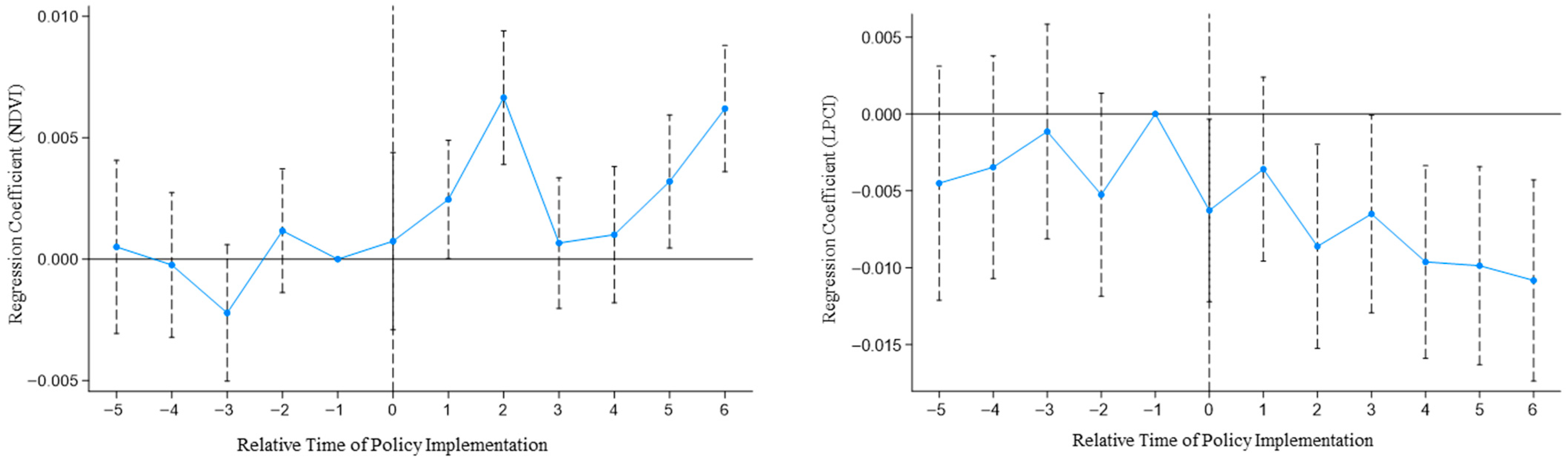
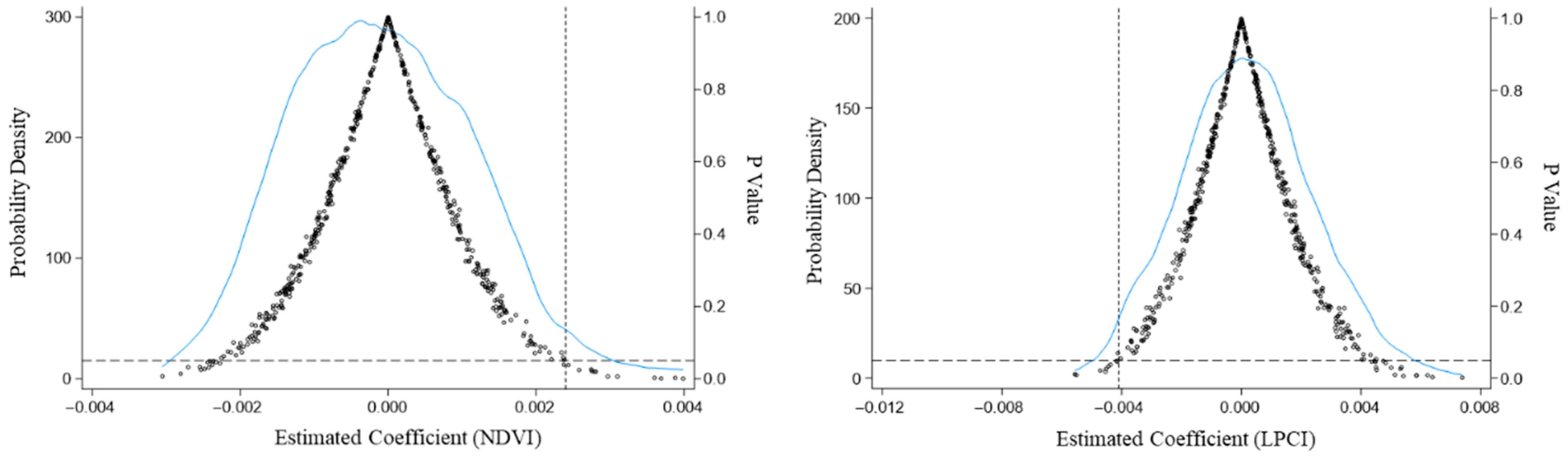
- While the policy aimed to preserve cultural–ecological integrity, it inadvertently reduced landscape connectivity and increased fragmentation in most regions. The relevant results were validated through parallel trend testing, placebo testing, and robustness testing.
- (3)
- The mediation effect analysis shows that the CEPZ policy has a significant promoting effect on ecological protection and construction land expansion in key areas, and further affects the regional ecosystem through the role of two intermediary factors. Specifically, CEPZ promotes ecological protection in key areas and significantly improves NDVI, but its effect on LPCI is not significant; CEPZ promotes the expansion of construction land through facility construction and cultural tourism development, but significantly reduces the NDVI and LPCI.
- (4)
- Establishing an independent management organization can help implement the CEPZ and have a positive impact on the ecosystem. From the perspective of regional differentiation, the impact of the CEPZ policy on the western region is higher than that on the central and eastern regions.
Author Contributions
Funding
Data Availability Statement
Conflicts of Interest
References
- Rozzi, R.; May, R.H., Jr.; Chapin, F.S., III; Massardo, F.; Gavin, M.C.; Klaver, I.J.; Pauchard, A.; Nuñez, M.A.; Simberloff, D. From biocultural homogenization to biocultural conservation: A conceptual framework to reorient society toward sustainability of life. In From Biocultural Homogenization to Biocultural Conservation; Springer: Cham, Switzerland, 2019; pp. 1–17. [Google Scholar]
- Díaz, S.; Settele, J.; Brondízio, E.S.; Ngo, H.T.; Guèze, M.; Agard, J.; Arneth, A.; Balvanera, P.; Brauman, K.A.; Butchart, S.H.M.; et al. The Global Assessment Report on Biodiversity and Ecosystem Services; The United Nations’ Intergovernmental Science-Policy Platform on Biodiversity and Ecosystem Services: Bonn, Germany, 2019. [Google Scholar]
- Fish, R.; Church, A.; Winter, M. Conceptualising Cultural Ecosystem Services: A Novel Framework for Research and Critical Engagement. Ecosyst. Serv. 2016, 21, 208–217. [Google Scholar] [CrossRef]
- Lockwood, M. Good Governance for Terrestrial Protected Areas: A Framework, Principles and Performance Outcomes. J. Environ. Manag. 2010, 91, 754–766. [Google Scholar] [CrossRef]
- Jones, K.R.; Venter, O.; Fuller, R.A.; Allan, J.R.; Maxwell, S.L.; Negret, P.J.; Watson, J.E.M. One-Third of Global Protected Land Is Under Intense Human Pressure. Science 2018, 360, 788–791. [Google Scholar] [CrossRef]
- Duncanson, L.; Liang, M.; Leitold, V.; Armston, J.; Moorthy, S.M.K.; Dubayah, R.; Costedoat, S.; Enquist, B.J.; Fatoyinbo, L.; Goetz, S.J.; et al. The Effectiveness of Global Protected Areas for Climate Change Mitigation. Nat. Commun. 2023, 14, 2908. [Google Scholar] [CrossRef] [PubMed]
- Maffi, L. Linguistic, Cultural, and Biological Diversity. Annu. Rev. Anthropol. 2005, 34, 599–617. [Google Scholar] [CrossRef]
- Gavin, M.C.; McCarter, J.; Mead, A.; Berkes, F.; Stepp, J.R.; Peterson, D.; Tang, R. Defining Biocultural Approaches to Conservation. Trends Ecol. Evol. 2015, 30, 140–145. [Google Scholar] [CrossRef] [PubMed]
- Steward, J.H. The Concept and Method of Cultural Ecology. In Anthropology in Theory: Issues in Epistemology; Wiley: Hoboken, NJ, USA, 2005; pp. 100–106. [Google Scholar]
- Díaz, S.; Pascual, U.; Stenseke, M.; Martín-López, B.; Watson, R.T.; Molnár, Z.; Hill, R.; Chan, K.M.A.; Baste, I.A.; Brauman, K.A.; et al. Assessing Nature’s Contributions to People. Science 2018, 359, 270–272. [Google Scholar] [CrossRef]
- Daniel, T.C.; Muhar, A.; Arnberger, A.; Aznar, O.; Boyd, J.W.; Chan, K.M.A.; Costanza, R.; Elmqvist, T.; Flint, C.G.; Gobster, P.H. Contributions of Cultural Services to the Ecosystem Services Agenda. Proc. Natl. Acad. Sci. USA 2012, 109, 8812–8819. [Google Scholar] [CrossRef]
- Melaku, A.; Pastor Ivars, J. Urban Sacred Forests Support Human Well-Being Through Cultural Ecosystem Services. J. Cult. Herit. Manag. Sustain. Dev. 2024; in press. [Google Scholar]
- UNESCO. Knowledge and Practices Concerning Nature and the Universe; UNESCO: Paris, France, 2019. [Google Scholar]
- Hølleland, H.; Skrede, J.; Holmgaard, S.B. Cultural Heritage and Ecosystem Services: A Literature Review. Conserv. Manag. Archaeol. Sites 2017, 19, 210–237. [Google Scholar] [CrossRef]
- Huntington, H.P. Using Traditional Ecological Knowledge in Science: Methods and Applications. Ecol. Appl. 2000, 10, 1270–1274. [Google Scholar] [CrossRef]
- Tengberg, A.; Fredholm, S.; Eliasson, I.; Knez, I.; Saltzman, K.; Wetterberg, O. Cultural Ecosystem Services Provided by Landscapes: Assessment of Heritage Values and Identity. Ecosyst. Serv. 2012, 2, 14–26. [Google Scholar] [CrossRef]
- Sutton, P.C.; Anderson, S.J.; Costanza, R.; Kubiszewski, I. The Ecological Economics of Land Degradation: Impacts on Ecosystem Service Values. Ecol. Econ. 2016, 129, 182–192. [Google Scholar] [CrossRef]
- Zhu, H. Understanding and Optimizing Cultural-Ecological Patterns in Protection Zones: A Case Study from Qiang CEPZ. Ecol. Indic. 2025, 179, 114084. [Google Scholar] [CrossRef]
- Esfehani, M.H.; Albrecht, J.N. Roles of Intangible Cultural Heritage in Tourism in Natural Protected Areas. J. Herit. Tour. 2018, 13, 15–29. [Google Scholar] [CrossRef]
- Qiu, Q.; Zuo, Y.; Zhang, M. Intangible Cultural Heritage in Tourism: Research Review and Investigation of Future Agenda. Land 2022, 11, 139. [Google Scholar] [CrossRef]
- Miller, C. Hybrid Management: Boundary Organizations, Science Policy, and Environmental Governance in the Climate Regime. Sci. Technol. Hum. Values 2001, 26, 478–500. [Google Scholar] [CrossRef]
- Xu, K.; Chen, J.; Feng, Y.; Wang, J.; Bai, Z. How are nature-based solutions contributing to the improvement of ecosystem quality in China: A systematic review. Ecol. Indicator. 2023, 155, 110985. [Google Scholar] [CrossRef]
- Shao, S.; Pan, Y.; Huang, A. Spatiotemporal analysis of landscape patterns and ecological risk in Northwest Hubei, China. Environ. Dev. Sustain. 2026. [Google Scholar] [CrossRef]
- Li, K.; Wu, W.; Li, Z.; Wu, Y. Ecosystem quality dynamics and attribution in protected areas: An integrated analysis framework based on the structure-function-resilience-pressure. J. Environ. Manag. 2026, 398, 128600. [Google Scholar] [CrossRef]
- Zhang, Y.; Zhang, J.; Wang, F.; Yang, W. Spatiotemporal Landscape Pattern Analyses Enhanced by an Integrated Index: A Study of the Changbai Mountain National Nature Reserve. Remote Sens. 2023, 15, 1760. [Google Scholar] [CrossRef]
- Collinge, S.K. Ecological consequences of habitat fragmentation: Implications for landscape archi-tecture and planning. Landsc. Urban Plan 1996, 36, 59–77. [Google Scholar] [CrossRef]
- Riitters, K.; Vogt, P. Mapping landscape ecological patterns using numeric and categorical maps. PLoS ONE 2023, 18, 0291697. [Google Scholar] [CrossRef] [PubMed]
- Gong, P.; Li, X.; Wang, J.; Bai, Y.; Chen, B.; Hu, T.; Liu, X.; Xu, B.; Yang, J.; Zhang, W.; et al. Annual Maps of Global Artificial Impervious Area (GAIA) Between 1985 and 2018. Remote Sens. Environ. 2020, 236, 111510. [Google Scholar] [CrossRef]
- Huang, D.; Peng, Q.; Wang, J.; Tian, M.; Wang, Q. Integrating morphological spatial pattern analysis and the minimal cumulative resistance model to optimize urban ecological networks: A case study in Shenzhen City, China. Ecol Process. 2021, 10, 63. [Google Scholar] [CrossRef]
- Zhang, T.; Chen, W.; Sheng, Z.; Wang, P.; Guan, F. Ecological network construction and identification of important elements based on morphological spatial pattern analysis and circuit theory in Pingxiang City. J. Nat. Conserv. 2025, 86, 126902. [Google Scholar] [CrossRef]
- Soille, P.; Vogt, P. Morphological spatial pattern analysis: Open source release. Int. Arch. Photogramm. Remote Sens. Spat. Inf. Sci. 2022, 48, 427–433. [Google Scholar] [CrossRef]
- Soille, P.; Vogt, P. Morphological segmentation of binary patterns. Pattern Recognit. Lett. 2009, 30, 456–459. [Google Scholar] [CrossRef]
- Pu, L.; Wang, X.; Tan, Z.; Wang, H.; Yang, J.; Wu, J. Is China’s Electricity Price Cross-Subsidy Policy Reasonable? Comparative Analysis of Eastern, Central, and Western Regions. Energy Policy 2020, 138, 111250. [Google Scholar] [CrossRef]
- Angrist, J.D.; Pischke, J.S. Mostly Harmless Econometrics: An Empiricist’s Companion; Princeton University Press: Princeton, NJ, USA, 2009. [Google Scholar]
- Bertrand, M.; Duflo, E.; Mullainathan, S. How Much Should We Trust Differences-in-Differences Estimates? Q. J. Econ. 2004, 119, 249–275. [Google Scholar] [CrossRef]
- Gu, X.; Gu, B.; Luo, X.; Chen, H.; Zhao, H.; Fan, G.; Wang, M. Achieving a Balance Between Supply and Demand for Urban Cultural Infrastructure: A Case Study of Nanjing, China. Appl. Geogr. 2025; in press. [Google Scholar]
- Geldmann, J.; Barnes, M.; Coad, L.; Craigie, I.D.; Hockings, M.; Burgess, N.D. Effectiveness of Terrestrial Protected Areas in Reducing Habitat Loss and Population Declines. Biol. Conserv. 2013, 161, 230–238. [Google Scholar] [CrossRef]
- Chen, Z.H.; Li, J.X.; Cui, H.Y.; Li, X.W.; Wang, Z.B. Land Use Dynamics and the Fate of Indigenous Culture in China’s Cultural Ecological Protection Areas. Geogr. Sustain. 2026, 7, 100390. [Google Scholar] [CrossRef]
- Gui, Y.; Ma, Y.; Chen, Y.; Zhou, C.; Xiao, T. Ecosystem services in UNESCO World Heritage sites: A review of research trends and future directions. npj Herit. Sci. 2026, 14, 115. [Google Scholar] [CrossRef]
- Li, N.; Li, X.; Xiao, W. Intangible Cultural Heritage Threatened-Level Categories and Criteria. Hum. Soc. Sci. Commun. 2025, 12, 271. [Google Scholar] [CrossRef]
- Wang, X.H.; Jing, Y.; Xu, J. Understanding Policy Implementation Capacity in China. Glob. Public Policy Gov. 2024, 4, 105–112. [Google Scholar] [CrossRef]





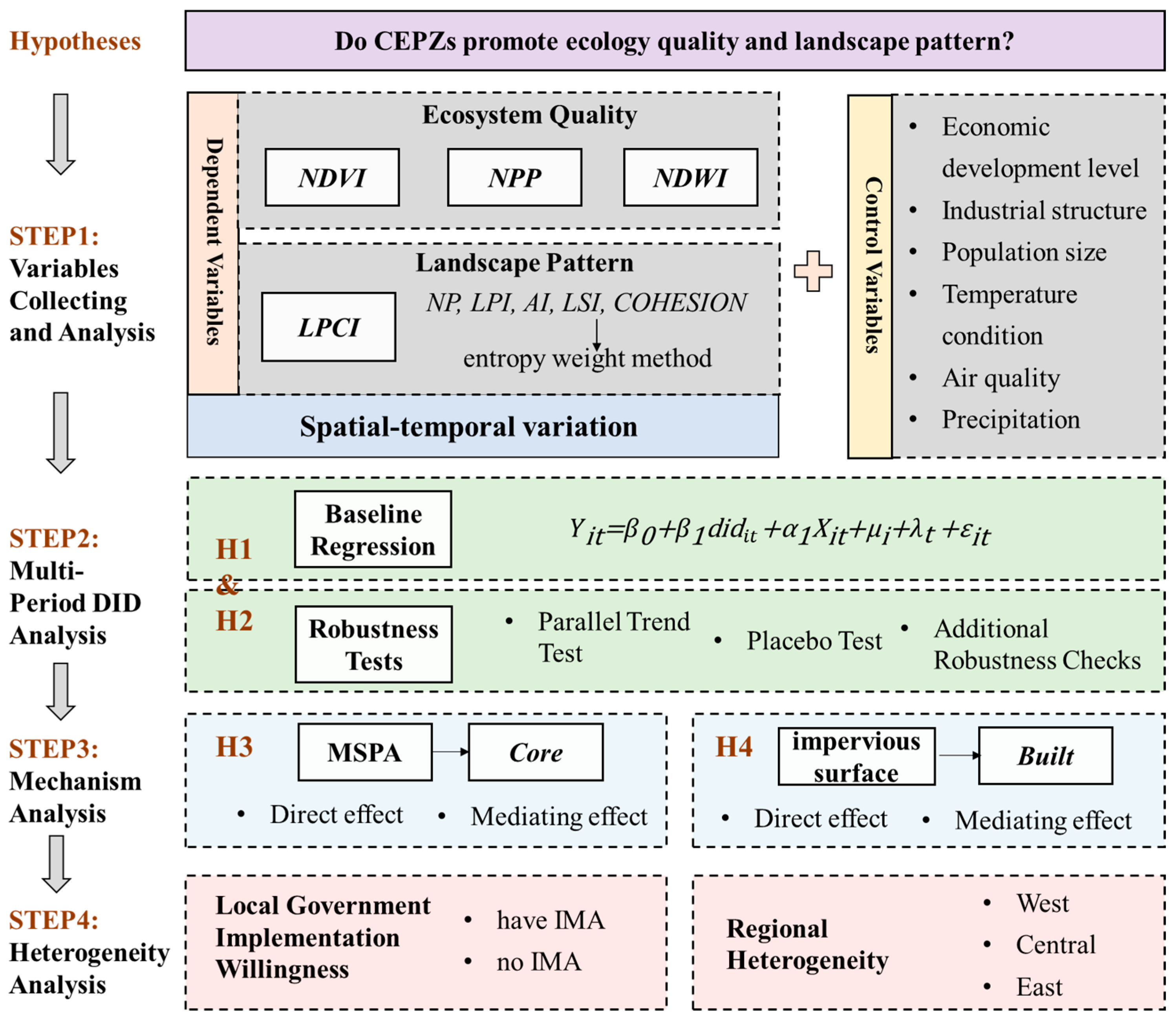
| Dependent Variables | Definition | Calculation and Data Source |
|---|---|---|
| NDVI | The NDVI is a widely used remote sensing index to quantify vegetation health status and coverage. It is calculated as the normalized difference between near-infrared and red reflectance, with values ranging from −1 to 1 (higher values indicating denser, healthier vegetation). | Resource and Environment Science Data Center, Chinese Academy of Sciences (https://www.resdc.cn/) |
| NPP | NPP represents the net amount of carbon fixed by vegetation through photosynthesis minus autotrophic respiration, reflecting vegetation growth status, ecosystem resilience, and environmental carrying capacity. | Land Processes Distributed Active Archive Center (LPDAAC), NASA/USGS (https://lpdaac.usgs.gov/) |
| NDWI | NDWI is an indicator of surface water extent, derived from the normalized difference between green and near-infrared bands to enhance water body detection. | NDWI = (Band3 − Band5)/(Band3 + Band5) [Landsat 8 from NASA/USGS (https://lpdaac.usgs.gov/)] |
| Dependent Variables | Definition | Calculation | Ecological Implication |
|---|---|---|---|
| NP | The total count of discrete patches in a landscape. | Simple count of all patches (regardless of type or size). | NP positively correlates with landscape fragmentation, and higher NP indicates greater fragmentation (more subdivided habitats), while lower NP suggests more contiguous landscapes. |
| LPI | The proportion of the largest patch area relative to the total landscape area, reflecting the dominance of a single patch. | LPI = Total landscape area/Area of the largest patch × 100% | High LPI indicates the presence of large, dominant patches with good connectivity; low values suggest fragmented landscapes dominated by small patches. It emphasizes the influence of keystone patches on overall landscape structure. |
| AI | A measure of patch clustering, quantifying the degree to which patches of the same type are aggregated. | Where be the perimeter of the i-th patch, and be the maximum possible perimeter of the i-th patch. | AI ranges from 0 (completely dispersed) to 100 (perfectly aggregated). Higher values indicate stronger patch clustering, which enhances local habitat continuity but may reduce landscape diversity. |
| LSI | A measure of patch shape complexity, comparing actual patch perimeters to the minimum perimeter of a compact (circular) shape of equivalent area. | Where be the perimeter of the j-th polygon in patch i, be its area, and A be the total landscape area. | LSI is dimensionless. Higher values indicate more complex shapes (e.g., elongated, irregular patches) with increased edge effects (e.g., higher exposure to disturbances); lower values suggest simpler, more compact shapes. |
| COHESION | A measure of patch connectivity, considering both adjacency and shared boundaries. | Where be the length of the boundary adjacent to other patches for the j-th polygon in patch i, B be the total landscape boundary length, and be the area of patch i. | COHESION ranges from 0 (no connectivity) to 100 (fully connected). Unlike AI (which focuses on clustering), COHESION emphasizes continuous connections between patches, with higher values indicating better functional connectivity (e.g., for species movement). |
| Variable | Sample Size | Mean | Standard Deviation | Minimum | Median | Maximum |
|---|---|---|---|---|---|---|
| NDVI | 8172 | 0.548 | 0.151 | 0.0550 | 0.603 | 0.766 |
| NDWI | 8172 | −0.433 | 0.0720 | −0.605 | −0.438 | −0.140 |
| NPP | 8172 | 0.719 | 0.371 | 0.111 | 0.707 | 3.158 |
| LPCI | 8172 | 0.647 | 0.184 | 0.129 | 0.651 | 0.989 |
| did | 8172 | 0.288 | 0.453 | 0.000 | 0.000 | 1.000 |
| temp | 8172 | 13.27 | 6.366 | −6.178 | 14.93 | 22.82 |
| Built | 8172 | 0.004 | 0.001 | 0.001 | 0.004 | 0.007 |
| Core | 8172 | 0.406 | 0.113 | 0.322 | 0.412 | 0.519 |
| ln precip | 8172 | 6.830 | 0.478 | 3.712 | 6.888 | 7.814 |
| ln PM2.5 | 8172 | 3.599 | 0.388 | 2.446 | 3.637 | 4.681 |
| ln population | 8172 | 3.386 | 0.828 | 0.818 | 3.517 | 5.176 |
| ln GDP | 8172 | 13.42 | 1.331 | 8.924 | 13.50 | 17.33 |
| ln structure | 8172 | 0.760 | 0.404 | 0.0420 | 0.681 | 4.025 |
| Variables | (1) NDVI | (2) NDWI | (3) NPP | (4) LPCI |
|---|---|---|---|---|
| did | 0.002 *** | 0.000 | 0.002 | −0.004 *** |
| (3.340) | (0.487) | (1.213) | (−2.645) | |
| temp | 0.010 *** | −0.012 *** | −0.003 ** | −0.008 *** |
| (11.889) | (−11.330) | (−1.965) | (−6.004) | |
| ln population | −0.029 *** | 0.009 * | −0.028 *** | −0.017 |
| (−6.501) | (1.879) | (−4.033) | (−1.475) | |
| ln GDP | 0.004 *** | 0.007 *** | −0.011 *** | 0.019 *** |
| (3.522) | (5.367) | (−5.173) | (7.269) | |
| ln PM2.5 | −0.010 *** | −0.034 *** | 0.021 *** | 0.010 ** |
| (−3.929) | (−11.080) | (4.441) | (2.008) | |
| ln structure | 0.002 ** | 0.001 | −0.003 | 0.007 *** |
| (2.005) | (0.399) | (−1.411) | (3.167) | |
| ln precip | 0.027 *** | 0.033 *** | −0.006 * | −0.004 |
| (16.476) | (16.541) | (−1.933) | (−1.218) | |
| _cons | 0.312 *** | −0.508 *** | 0.980 *** | 0.538 *** |
| (10.152) | (−14.244) | (18.339) | (7.874) | |
| N | 8172 | 8172 | 8172 | 8172 |
| R2 | 0.990 | 0.924 | 0.994 | 0.973 |
| Individual Fixed Effects | YES | YES | YES | YES |
| Time Fixed Effect | YES | YES | YES | YES |
| Variables | Eliminate Some Samples | Consider the Time Trend | Eliminate the Influence of Outliers | |||
|---|---|---|---|---|---|---|
| (1) | (2) | (3) | (4) | (5) | (6) | |
| NDVI | LPCI | NDVI | LPCI | NDVI | LPCI | |
| did | 0.002 *** | −0.006 *** | 0.002 *** | −0.004 *** | 0.002 *** | −0.004 *** |
| (3.154) | (−4.062) | (3.253) | (−2.616) | (3.257) | (−2.680) | |
| temp | 0.011 *** | −0.008 *** | 0.010 *** | −0.008 *** | 0.010 *** | −0.009 *** |
| (12.347) | (−5.502) | (11.648) | (−5.890) | (11.457) | (−6.477) | |
| ln population | −0.028 *** | −0.025 * | −0.031 *** | −0.016 | −0.026 *** | −0.013 |
| (−5.702) | (−1.846) | (−6.902) | (−1.389) | (−5.836) | (−1.127) | |
| ln GDP | 0.004 *** | 0.020 *** | 0.004 *** | 0.019 *** | 0.007 *** | 0.019 *** |
| (3.275) | (7.514) | (3.665) | (7.223) | (5.916) | (7.678) | |
| ln PM2.5 | −0.010 *** | 0.005 | −0.010 *** | 0.010 ** | −0.009 *** | 0.009 * |
| (−4.147) | (1.038) | (−4.179) | (2.093) | (−3.686) | (1.815) | |
| ln structure | 0.002 * | 0.006 *** | 0.002 ** | 0.007 *** | 0.004 *** | 0.009 *** |
| (1.675) | (2.620) | (2.374) | (3.062) | (3.868) | (3.531) | |
| ln precip | 0.024 *** | −0.004 | 0.027 *** | −0.004 | 0.027 *** | −0.005 |
| (14.281) | (−1.376) | (16.407) | (−1.175) | (16.009) | (−1.637) | |
| Time Trend Item | −0.000 *** | 0.000 * | ||||
| (−6.933) | (1.818) | |||||
| _cons | 0.332 *** | 0.568 *** | 1.165 *** | 0.019 | 0.267 *** | 0.548 *** |
| (10.354) | (7.446) | (9.130) | (0.068) | (8.765) | (8.254) | |
| N | 7555 | 7555 | 8172 | 8172 | 8172 | 8172 |
| R2 | 0.990 | 0.973 | 0.990 | 0.973 | 0.990 | 0.973 |
| Individual Fixed Effects | YES | YES | YES | YES | YES | YES |
| Time Fixed Effect | YES | YES | YES | YES | YES | YES |
| Variables | (1) Core | (2) Core-NDVI | (3) Core-LPCI | (4) Built | (5) Built-NDVI | (6) Built-LPCI |
|---|---|---|---|---|---|---|
| did | 0.009 *** | 0.001 ** | 0.003 | 0.012 *** | −0.001 ** | −0.009 *** |
| (2.891) | (2.037) | (1.678) | (3.126) | (−2.153) | (−3.233) | |
| Core | 0.004 *** | 0.006 ** | ||||
| (2.673) | (1.998) | |||||
| Built | 0.005 *** | 0.008 *** | ||||
| (2.554) | (3.237) | |||||
| Control Variable | YES | YES | YES | YES | YES | YES |
| Sobel test | 0.000 (7.298) | 0.000 (8.486) | 0.000 (6.633) | |||
| Proportion of mediating effect | 0.329 | 0.277 | 0.315 | |||
| Individual Fixed Effects | YES | YES | YES | YES | YES | YES |
| Time Fixed Effect | YES | YES | YES | YES | YES | YES |
| N | 8172 | 8172 | 8172 | 8172 | 8172 | 8172 |
| R2 | 0.979 | 0.954 | 0.963 | 0.982 | 0.943 | 0.956 |
| Variables | (1) Have IMA-NDVI | (2) No IMAs-NDVI | (3) Have IMA-LPCI | (4) No IMA-LPCI |
|---|---|---|---|---|
| did | 0.004 *** | 0.001 | −0.002 ** | −0.005 *** |
| (2.821) | (1.673) | (−2.192) | (−3.945) | |
| Control Variable | YES | YES | YES | YES |
| Individual Fixed Effects | YES | YES | YES | YES |
| Time Fixed Effect | YES | YES | YES | YES |
| N | 4914 | 3258 | 4914 | 3258 |
| R2 | 0.952 | 0.938 | 0.947 | 0.943 |
| Variables | (1) East-NDVI | (2) Central-NDVI | (3) West-NDVI | (10) East-NPP | (11) Central-NPP | (12) West-NPP | (4) East-LPCI | (5) Central-LPCI | (6) West-LPCI |
|---|---|---|---|---|---|---|---|---|---|
| did | 0.001 | 0.003 ** | 0.005 *** | 0.001 | 0.003 * | 0.002 ** | −0.002 | −0.003 ** | −0.006 *** |
| (1.121) | (2.152) | (3.893) | (1.468) | (1.876) | (2.131) | (−1.050) | (−2.340) | (−3.560) | |
| Control Variable | YES | YES | YES | YES | YES | YES | YES | YES | YES |
| Individual Fixed Effects | YES | YES | YES | YES | YES | YES | YES | YES | YES |
| Time Fixed Effect | YES | YES | YES | YES | YES | YES | YES | YES | YES |
| N | 1818 | 2464 | 3708 | 1818 | 2464 | 3708 | 1818 | 2464 | 3708 |
| R2 | 0.965 | 0.907 | 0.902 | 0.941 | 0.953 | 0.935 | 0.915 | 0.875 | 0.935 |
| Hypothesis | Results | Instructions |
|---|---|---|
| H1: CEPZ designation has a positive effect on ecosystem quality. | Partially Supported | Has a positive effect only on NDVI |
| H2: CEPZ designation has a positive effect on landscape pattern optimization. | Unsupported | Has a negative effect on landscape pattern optimization |
| H3: CEPZs enhance the quality of protected areas, transmitting these effects to ecosystem quality and landscape patterns. | Partially Supported | Has enhanced the quality of protected areas and transmitted to NDVI, but has not affected the landscape pattern |
| H4: CEPZs increase the area of construction land, which in turn influences ecosystem quality and landscape patterns. | Partially Supported | Has enhanced the area of built-up land, and transmitted negative effect on NDVI and landscape patterns. |
Disclaimer/Publisher’s Note: The statements, opinions and data contained in all publications are solely those of the individual author(s) and contributor(s) and not of MDPI and/or the editor(s). MDPI and/or the editor(s) disclaim responsibility for any injury to people or property resulting from any ideas, methods, instructions or products referred to in the content. |
© 2026 by the authors. Licensee MDPI, Basel, Switzerland. This article is an open access article distributed under the terms and conditions of the Creative Commons Attribution (CC BY) license.
Share and Cite
Yang, X.; Liu, D.; Hao, M.; Jiang, D.; Zhu, H. Do Cultural Ecological Policies Deliver Ecological Co-Benefits? A Quasi-Natural Experiment for CEPZs in China. Land 2026, 15, 461. https://doi.org/10.3390/land15030461
Yang X, Liu D, Hao M, Jiang D, Zhu H. Do Cultural Ecological Policies Deliver Ecological Co-Benefits? A Quasi-Natural Experiment for CEPZs in China. Land. 2026; 15(3):461. https://doi.org/10.3390/land15030461
Chicago/Turabian StyleYang, Xiaohui, Dongmin Liu, Mengmeng Hao, Dong Jiang, and He Zhu. 2026. "Do Cultural Ecological Policies Deliver Ecological Co-Benefits? A Quasi-Natural Experiment for CEPZs in China" Land 15, no. 3: 461. https://doi.org/10.3390/land15030461
APA StyleYang, X., Liu, D., Hao, M., Jiang, D., & Zhu, H. (2026). Do Cultural Ecological Policies Deliver Ecological Co-Benefits? A Quasi-Natural Experiment for CEPZs in China. Land, 15(3), 461. https://doi.org/10.3390/land15030461