


Abstract
In the context of escalating global warming and the urban heat island effects, recurrent extreme heat events will increase the exposure risk of cyclists, which will have a detrimental effect on both health and the sustainability of active mobility. Nevertheless, this risk has not been given sufficient attention. To accurately quantify the levels of solar radiation exposure experienced by cyclists in high-temperature conditions and the impact of the built environment on these levels, this study focuses on central Shanghai as a case study. The integration of Mobike trajectories, street view imagery, and solar radiation data sets enabled the quantification of trip-level cumulative radiation exposure and per-minute exposure levels. Subsequently, the XGBoost–SHAP interpretability framework was employed to decipher the mechanisms of the built environment. The following key findings have been identified: (1) Spatiotemporally, the radiation exposure level of cyclists exhibited an inverted U-shaped pattern, peaking at midday (10:00–15:00), with per-minute values of 862–943 W/m2. This intensity significantly exceeded that observed during the morning (407 W/m2) and evening (253 W/m2). (2) It was determined that geometric factors dominated the radiative exposure level. The shading index demonstrated a critical influence (57% contribution), with exposure reduction intensifying beyond 0.41 yet exhibiting diminishing marginal effects after 0.6. The sky view factor and building height elevated exposure risk by amplifying direct solar radiation. (3) Socioeconomic factors had divergent effects on the radiation exposure level of cyclists: commercial/business densities reduced exposure through continuous building shade, whereas transportation facility density increased exposure due to low-shaded layouts. Consequently, this study proposes “shaded corridors” as a core mitigation strategy, establishing a tripartite intervention framework (spatial-facility-governance) for radiation exposure reduction. The present study provides scientific foundations for the targeted enhancement of heat resilience in active mobility.
1. Introduction
The acceleration of urbanization has been demonstrated to drive continuous growth in the urban population and expansion of impervious surface, thereby intensifying the urban heat island effect (UHI) [1,2]. Compounded by global warming, resulting in a demonstrable increase in the frequency, intensity and duration of summer extreme heat events (EHEs) in urban areas [3,4]. A substantial corpus of research has confirmed that exposure to heat induced by EHEs has emerged as a significant adverse factor endangering the health of urban residents [5,6,7,8]. Such exposure has been demonstrated to have a detrimental effect on mental health, in addition to elevating acute health risks, including heat stress, heat cramps and dehydration. Concurrently, it has been shown to heighten the risk of chronic diseases, including cardiovascular, respiratory and neurological disorders, and to contribute directly to increased excess mortality among urban residents. A recent multinational study has revealed that excess mortality triggered by extreme heat events surpasses the cumulative deaths from all other natural disasters [9].
In addition to posing a threat to public health, frequent EHEs also pose a significant challenge to the sustainability of non-motorized active mobility in urban areas [10,11], which are primarily cycling and walking. Given the inherent open or semi-open characteristics of non-traffic spaces in streets and squares, their micro-environmental thermal comfort is easily disrupted by EHEs [12]. Concurrently, heat and radiation exposure risks for outdoor cycling in this context rise significantly, resulting in substantial reductions in cycling reliability and appeal during extreme heat episodes [13,14]. Some empirical evidence corroborates this hypothesis. For example, Villarrasa-Sapiña et al. [15] and Xue et al. [16] both documented declines in bike-sharing ridership from extreme heat days, while Ahn et al. [17] further identified temperatures exceeding 34.3 °C as negatively influencing cycling intentions.
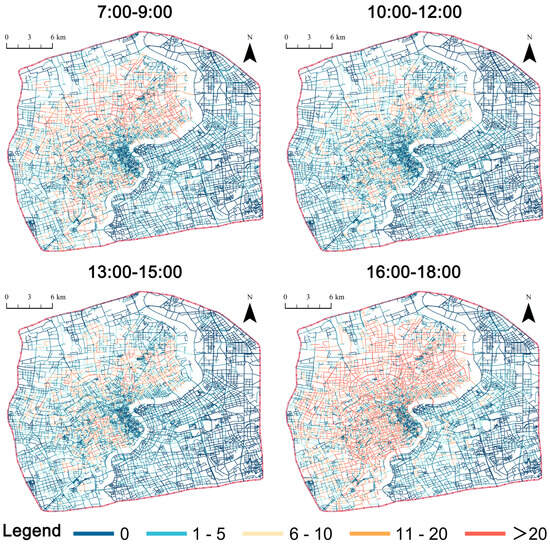
The necessity for the improvement of the adaptability of exposure to extreme temperatures during cycling has driven the emergence of research on the quantitative assessment of cycling heat and radiation exposure risk. A number of studies have previously sought to quantify the spatiotemporal distribution of heat exposure risk through relatively direct means. These studies have done so by examining the overlap among populations affected by high-temperature areas [4]. Concomitantly, alternative researchers have employed the “hazard–exposure–vulnerability” framework to assess the comprehensive heat exposure risk in specific regions [12]. However, research analyses based on static data overlook the fact that exposure to heat changes dynamically as cyclists move, resulting in a certain degree of spatial and temporal inaccuracy in the findings of previous studies [18]. Furthermore, during cycling and walking, the cumulative effect of thermal stress on the human body has been demonstrated [19]. In high-temperature environments, an individual’s thermal stress gradually accumulates as exposure time increases. This risk is significantly exacerbated during sustained physical activity. Consequently, evaluating heat and radiation exposure from a static perspective alone is insufficient; it is also necessary to comprehensively assess the duration of cumulative heat stress throughout the entire journey and its potential impact on the human body [20].
With the deepening integration of the people-oriented concept for addressing climate challenges, perspectives in related research are increasingly focusing on the microscopic individual scale [21]. In light of these considerations and the practical requirements, the utilization of GPS trajectory data, along with data from urban microclimate models, has emerged as a highly effective approach for the characterization of individual spatial behavioral paths and the assessment of the heat and radiation exposure risk. For instance, Karner et al. [22] assessed outdoor heat exposure during non-motorized travel in the San Francisco Bay Area by combining simulated urban meteorology and transportation-activity data. Usmani et al. [23] assessed the heat exposure experienced by cyclists in Karachi, Pakistan, by recording ground temperature data during their bicycle excursions. Jiang et al. [24] integrated GPS trajectory and Tmrt (mean radiant temperature) data, which were simulated by using the SOLWEIG model, to quantify the transient and cumulative heat stress experienced by 6 food delivery riders in Nanjing. Fang et al. [25] advanced the state of the field by integrating substantial cycling trajectory data with the SOLWEIG model to evaluate cycling heat exposure in Shanghai.
Nevertheless, preceding research on the assessment of heat and radiation exposure continues to demonstrate significant limitations. The majority of studies have measured and evaluated the heat and radiation exposure levels and associated risks for specific travel routes. However, these studies have not yet comprehensively investigated the impact of urban built environment characteristics on the spatiotemporal dynamics of heat and radiation exposure levels throughout the entire cycling process or at specific moments. In the domain of built environment regulatory effects, specific studies have been undertaken at the grid or regional scales. For instance, Li et al. [13] employed mean radiant temperature (Tmrt) to quantify spatiotemporal heterogeneity in thermal environments and investigated the interactions between built environment factors and bike-sharing usage. Chen et al. [26] directed their attention towards the central urban bike-sharing system of Shanghai, undertaking an examination of the interactive mechanisms of physical environments and socioeconomic factors that influence bike-sharing traffic resilience under extreme heat. Chen et al. [11] developed a framework for analyzing urban travel resilience, the results of which indicated that weekend cycling is more likely to be inhibited by extreme heat than it is on weekdays. Furthermore, this study revealed that the impacts of the built environment on thermal travel resilience are non-linear. The extant research provides substantiation for the enhancement of high-temperature adaptability in the cycling behavior of urban residents.
However, analyses at the regional scale have not yet fully elucidated the mechanisms by which micro-scale built environment factors influence heat and radiation exposure at the individual cycling route level. Comprehension of these mechanisms is imperative for enhancing the heat acclimatization of cyclists and for formulating urban streets that are more resilient to high temperatures and more conducive to bicycling. To address these discrepancies, we employ a multifaceted approach that utilizes Shanghai’s 2016 Mobike GPS dataset, which is integrated with Baidu street view (BSV) imagery and solar trajectory-radiation modeling. This approach aims to:
(1) Develop a dynamic radiation exposure assessment model simulating real-time and cumulative radiation loads (W/m2·min) across entire cycling journeys;
(2) Quantitatively identify dominant built environment regulators of radiation exposure intensity using XGBoost–SHAP machine learning frameworks;
(3) Decipher causal mechanisms and inflection points for mitigating exposure.
By establishing links between streetscape design and the thermal safety of cyclists, this research provides a foundational science for climate-adaptive urban mobility.
2. Materials and Methods
2.1. Study Area
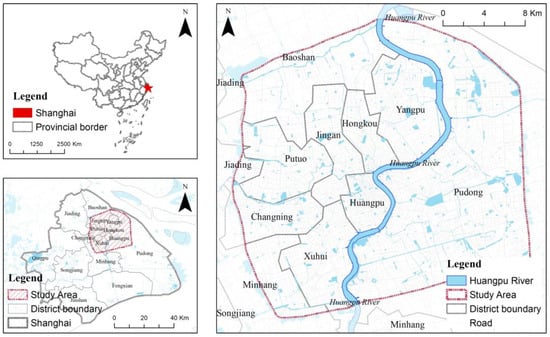
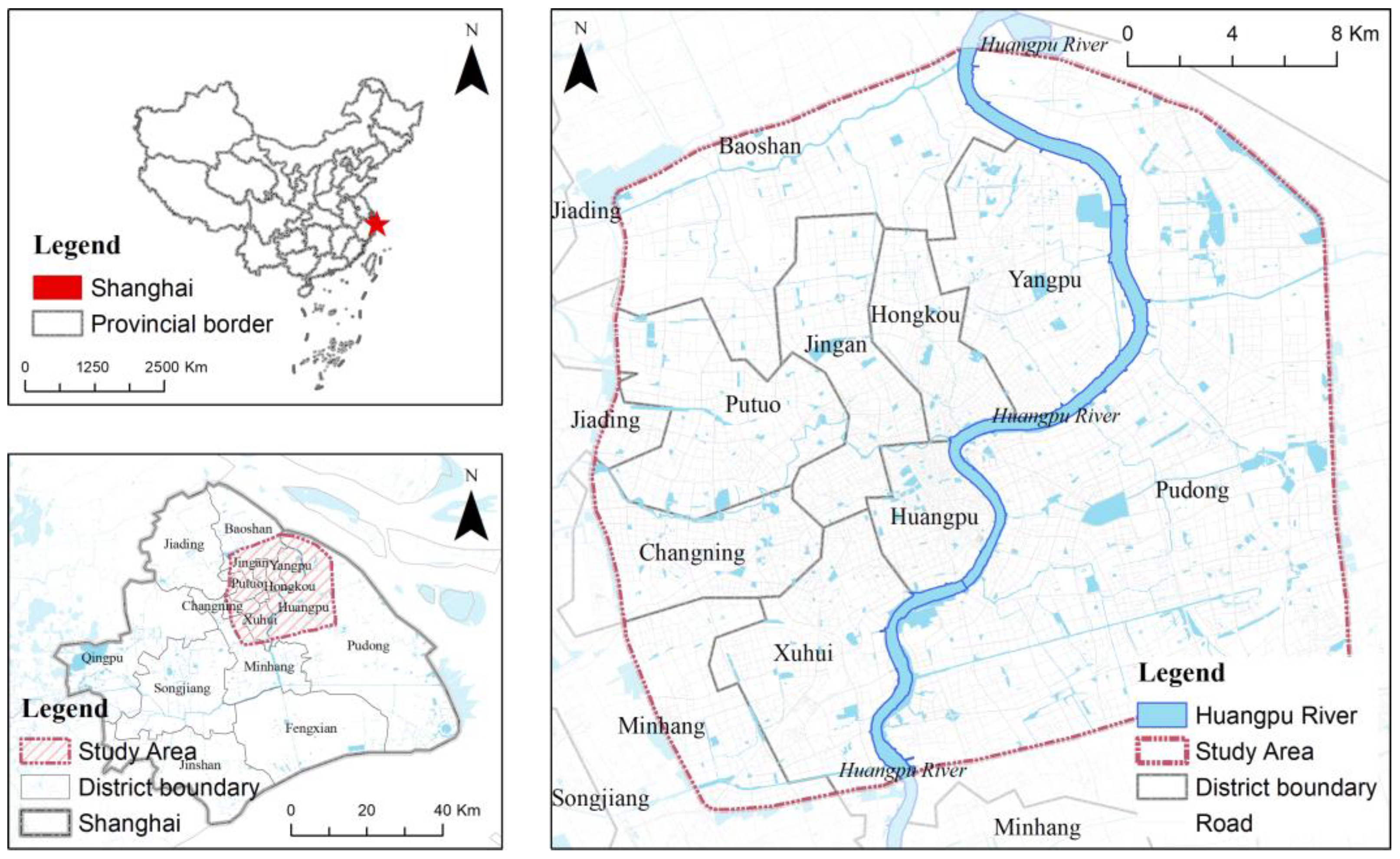
Shanghai is located at the convergence of the eastern coastline and the Yangtze River estuary of China, and it serves as a model megacity in China (Figure 1). The process of rapid urbanization was initiated at the beginning of the 21st century. However, by 2014, Shanghai’s land supply for construction began to decline. A review of statistical data indicates that the permanent population of Shanghai exhibited continuous growth from 18.9 million in 2005 to 24.5 million in 2015. Subsequently, a marked decline in population growth was observed, with the population reaching 24.8 million by 2025. Despite the recent stagnation in the population and the amount of land used for construction, the occurrence of extreme heat waves continues to be a prevalent phenomenon. In 2022, Shanghai experienced 50 high-temperature days, defined as days with a maximum temperature of at least 35 °C. By 2024, this number had increased to 52. In August 2024, the monthly average maximum temperature was recorded at 37 °C, with extreme daily highs reaching over 41 °C. In the face of mounting thermal stress, it is imperative to undertake precise assessments of the radiation exposure level faced by urban cycling residents under extreme high temperatures. Furthermore, this evaluation is contingent upon a comprehensive comprehension of the regulatory mechanisms that govern the built environment. These efforts are imperative for enhancing cycling safety and fortifying the resilience of urban non-motorized systems.
Figure 1.
Location of the study area.
The present study focuses on the central urban area of Shanghai. According to the Master Plan of Shanghai, the study area encompasses Huangpu, Xuhui, Changning, Yangpu, Hongkou, Putuo, Jing’an districts, and Pudong New Area sectors enclosed within the Outer Ring Expressway, encompassing an approximate total area of 664 km2.
2.2. Data Source and Pre-Process
The data that were employed in this research are detailed in Table 1. The BSV imagery was utilized to calculate solar radiation on specific streets and to assess the built environment of those streets; Mobike trajectory data and OpenStreetMap (OSM) road network data were used to generate cycling routes; and the remaining built environment indicators were used to calculate the characteristics of the built environment and analyze its impact on radiation exposure during cycling.
Table 1.
Data source.
2.2.1. OSM Road Network Data
The road network data utilized in this study is derived from the OpenStreetMap (OSM) platform (http://www.openstreetmap.org, accessed on 10 April 2025). In order to align with the requirements of bike-sharing trajectory matching and street view analysis, the acquired road network data underwent a triple-layer topological optimization. Firstly, the elimination of road segments that are not conducive to cycling is contingent upon their functional attributes. Such attributes include exclusive motor vehicle corridors, such as highways and motorways. Secondly, spatial filtering rules were implemented to remove micro-segments with a length under 50 m. This was done to prevent short-path noise in the HMM matching process. Additionally, inaccessible closed roadways for street view image collection cars were also removed. Finally, intersecting road segments were processed by using topological splitting algorithms in ArcGIS 10.8, in order to generate distinct nodes at intersections.
2.2.2. Mobike Trajectory Data
The present study employed bike-sharing trajectory records for Shanghai, encompassing the entire period of 1–31 August 2016, obtained from Mobike. The dataset encompassed approximately 2000 valid ride orders per day on average, exhibiting robust spatiotemporal continuity and significant research representativeness. The objective of this study was to examine the relationship between radiation exposure levels during daytime cycling on extreme-heat days. To this end, meteorological data for Shanghai in August 2016 were analyzed. The definition of “high-temperature days” in this study was based on the maximum temperature, which was set at ≥35 °C. The analysis identified 12 high-temperature days, which were predominantly concentrated in the mid-to-late months. We therefore extracted 12 days’ worth of ride routes from 31 days’ worth of Mobike trajectory data that were significantly affected by high temperatures. Subsequent to this, a further filtration process was implemented, eliminating orders where the ride start and end times fell between 7:00 and 18:00, as rides during this period are influenced by solar radiation. In order to examine intraday variation patterns in radiation exposure levels experienced by cyclists, the bicycle-sharing data were categorized into four intervals: 7:00–9:00 (morning peak), 10:00–12:00 (noon), 13:00–15:00 (afternoon), and 16:00–18:00 (evening peak). Based on this segmentation, radiation exposure levels were quantified for cycling behaviors within each sub-period, and the relationship between radiation exposure levels experienced over the course of the day and characteristics of the built environment was analyzed.
This research employed a Hidden Markov Model (HMM) map-matching algorithm to precisely align Mobike trajectory data with the preprocessed urban road networks. The method utilizes the sequence of Mobike trajectory data as HMM observations to identify candidate road segments where the trajectory may deviate via a neighborhood search. The initial search radius is set to 100 m, and if no match is found, the radius is incrementally increased by 50 m up to a maximum of 200 m. In the following step, the transition probability—that is, the likelihood of moving between consecutive road segments—is calculated separately from the transition probability of moving between adjacent road segments. Subsequently, the Viterbi algorithm is employed to select the optimal path sequence based on these probability values [31].
2.2.3. BSV Image Data
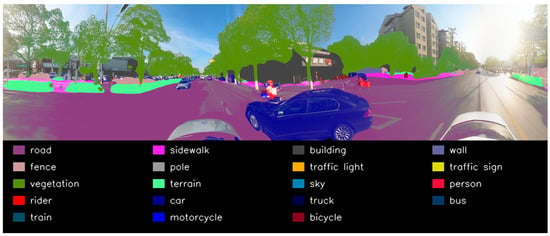
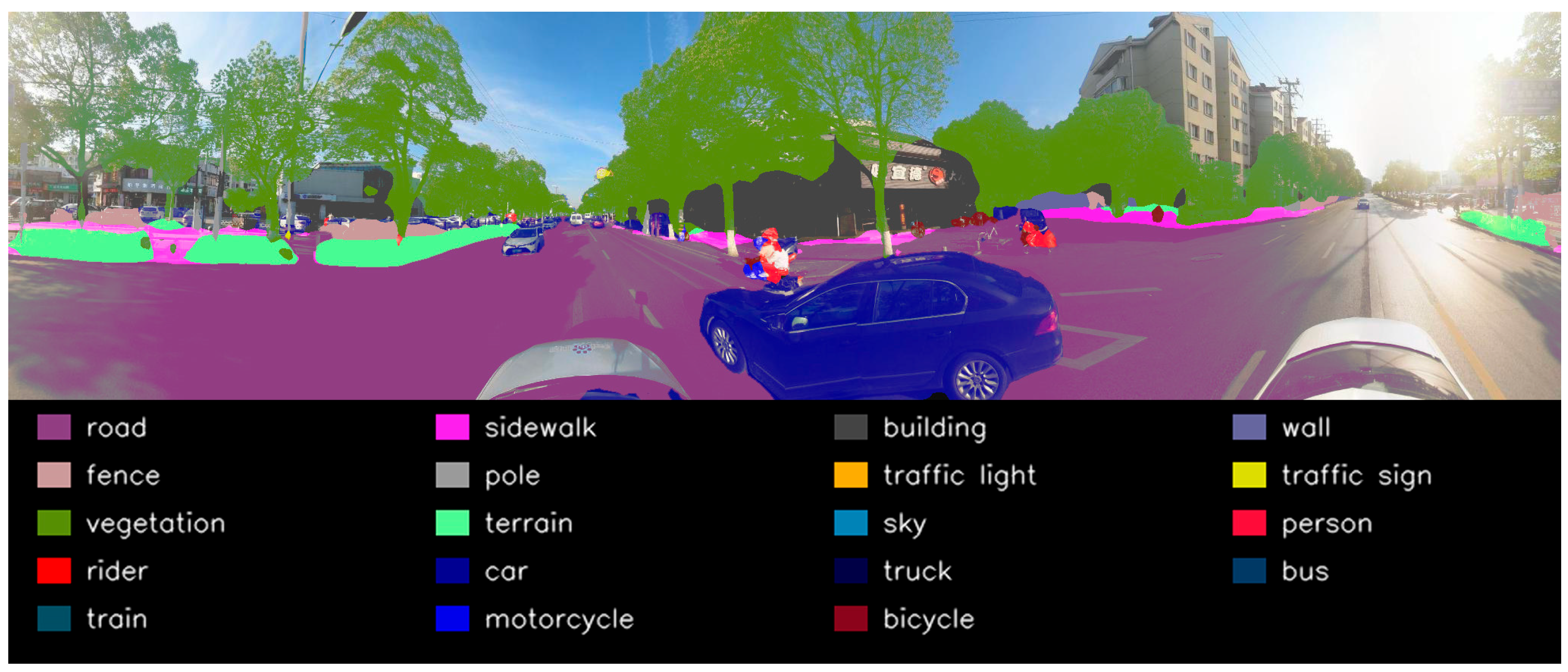
These BSV images are sourced from the Baidu Maps Open Platform. In addition to calculating solar radiation on streets, they are also used to describe the microspatial geometric characteristics of streets. The collection process was executed in accordance with spatial sampling strategies and perspective parameter configurations. Firstly, based on the preprocessed OSM road networks, street view image collection points (>70,000 total samples) were deployed at 50 m equal intervals along segment centerlines to ensure spatial coverage uniformity [32,33]. Secondly, the capture time parameter in API requests was set to 15 August 2016, ensuring temporal alignment between street view environmental representation and the study period (August 2016). The platform returned historically valid images closest to this date. Thirdly, panoramic image tile data (default 32 tiles per panorama) for designated points were downloaded by calling the Baidu Maps Application Programming Interface (API). Subsequent to the initiation of the download process, image processing algorithms amalgamated these image blocks into complete panoramic images. The application of quality control measures, the exclusion of samples lacking street view imagery, and the filtration of invalid images, which precluded the retrieval of complete street view images, resulted in the retention of over 70,000 valid panoramic image samples. Finally, the Pyramid Scene Parsing Network (PSPNet)—a deep semantic segmentation model pre-trained on the Cityscapes dataset—was employed to perform pixel-level classification on the acquired panoramic images [34,35]. The PSPNet model achieved an average F1 score of 83.6% on the Cityscapes test set. This process enabled the accurate identification and quantitative extraction of the spatial distribution information of key street environment elements (Figure 2).
Figure 2.
A semantic segmentation map of street view imagery.
2.2.4. Built Environment Indicators and Calculation
The study statistically analyzed and computed eight factors representing the physical built environment of streets and eight factors representing the socioeconomic built environment. Firstly, the shading index is calculated using several variables, including building height, vegetation canopy height, and Digital Elevation Model (DEM) data. The specific procedure for calculating the shading index is outlined in detail in Reference [36]. To ensure a consistent resolution, the building height, canopy height, and FathomDEM datasets were resampled to a resolution of 10 m. The house price data was converted from points to raster data using Kriging interpolation, and the resolution was set to 10 m. Secondly, a categorization of POIs into five types has been established: public services, green spaces, transportation, commercial, and business. The detailed procedure is outlined in Table 2.
Table 2.
Built environment indicators and calculation method.
2.3. Radiation Exposure Assessment and the Impact of the Built Environment
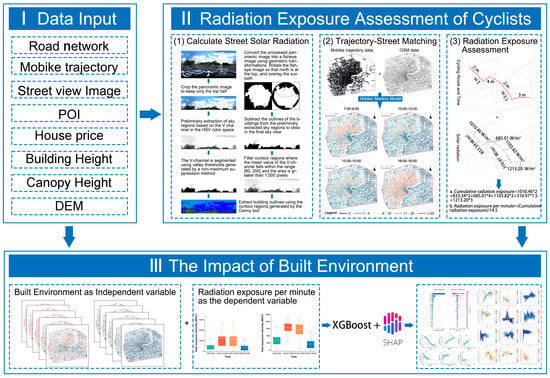
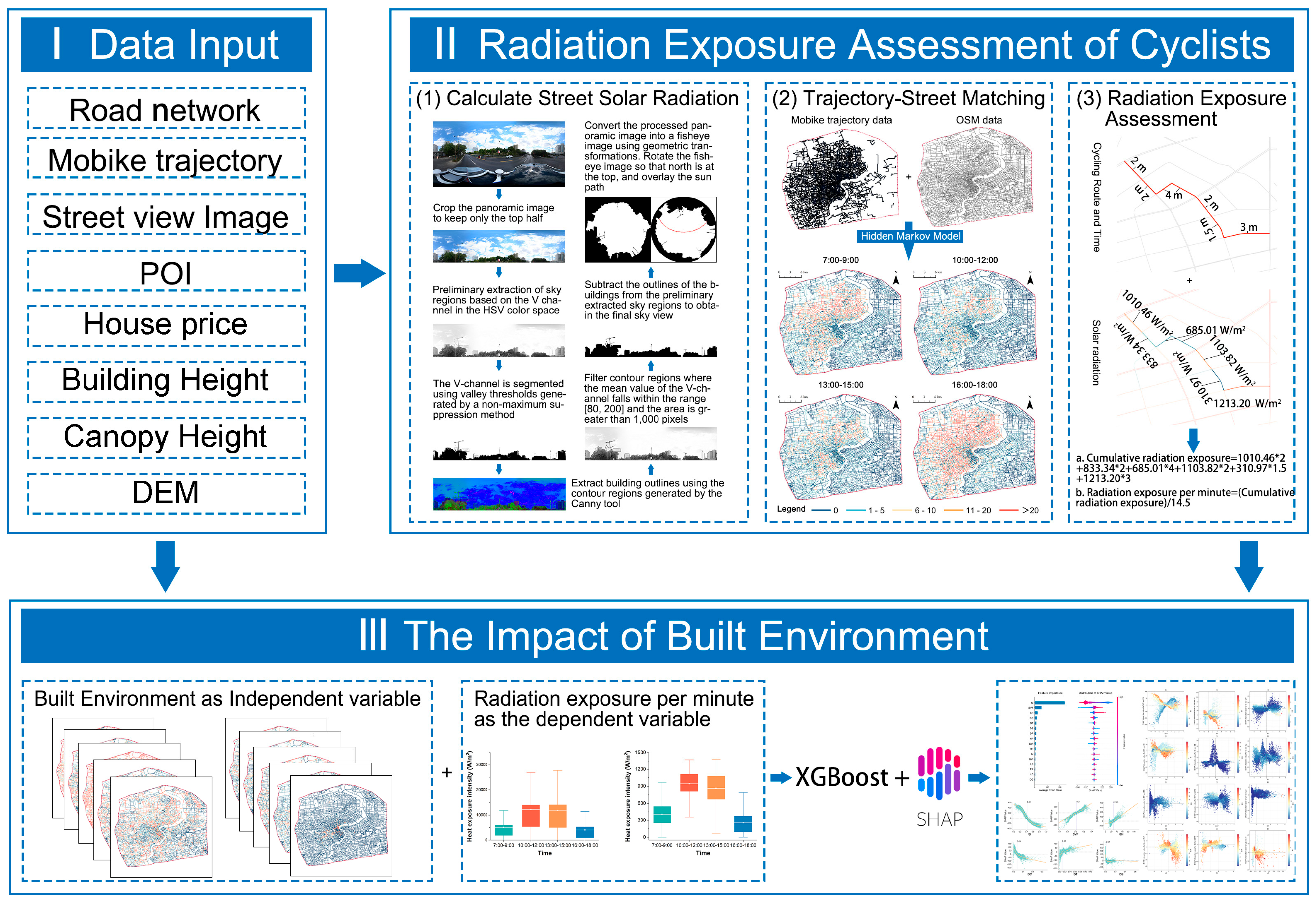
To systematically assess cyclists’ real-time and cumulative solar radiation exposure and identify the underlying built environment factors, this study implemented a multi-step analytical process. (1) BSV imagery, combined with fisheye projection and a solar position model (incorporating date, time, and latitude), was used to calculate the direct solar radiation intensity for each road segment every 10 min. (2) The cumulative exposure model integrated data along each trip to derive the radiation exposure level per minute. (3) The XGBoost–SHAP framework is a quantitative tool that can be used to assess the contributions of built environment factors (e.g., points of interest, housing prices, and shading indices) to radiation exposure over short time periods. It can also be used to consider nonlinear thresholds and interaction effects. Consequently, the output encompasses trip-level cumulative radiation exposure (W/m2), per-minute radiation exposure (W/m2), and SHAP-based interpretable results (global importance, dependency graphs, and interaction networks). The ensuing subsections will delineate each step in the process. The processing flow is illustrated in Figure 3.
Figure 3.
The processing workflow of this study.
2.3.1. The Calculation of Solar Radiation of the Street
This study combines BSV panoramic images and solar radiation data in order to provide a quantitative characterization of direct solar radiation intensity and sunshine duration within street canyons. The core computational workflow consists of the following steps.
Initially, Processing obtained street view images to generate sky view fisheye images. (1) The original panoramas were subjected to cropping in order to retain the upper hemisphere, thereby ensuring dimensional consistency with fisheye images. (2) The following methodology is employed in order to process cropped panoramas in order to create sky view images: (a) Preliminary sky regions are extracted using the value channel in the HSV color space. The V-channel is then segmented using valley-emphasis thresholds generated via non-maximum suppression in order to mitigate multi-sky interference. (b) The building contours are detected through Canny-generated edge regions. Subsequently, the contours undergo a filtration process. Preliminary testing has indicated that the optimal filtering criteria are an average V-value between 80 and 200 and an area greater than 1000 pixels. The objective of this procedure is to avoid misclassifying sky-building from glass reflections. (c) In order to obtain the final sky view masks, it is necessary to remove the building contours from the preliminary sky regions. (3) The conversion of processed upper-hemisphere panoramas into fisheye images was achieved through geometric transformation. It should be noted that the camera orientations during image acquisition were not strictly northward [38], necessitating rotational alignment. The conversion of images into binarized fisheye formats was then used to derive sky obstruction profiles, with full procedures illustrated in Figure 3. In the event that a solar pixel falls on a sky pixel (white area), the point is designated as illuminated, and the direct solar radiation intensity at that specific point can be calculated. Conversely, if it falls on an occlusion pixel (black area), the direct radiation is set to zero, thereby indicating complete occlusion. This pixel-based shading determination is a comprehensive approach that accounts for both buildings and vegetation. This is due to the fact that fisheye images are capable of capturing all visible obstacles on the street. Consequently, the geometric features extracted from the fisheye images are directly linked to the dynamics of solar exposure over time.
Subsequently, in order to enhance the accuracy of the calculation of sunshine duration during solar radiation intensity estimation, this study computes solar position at 10 min intervals. By projecting the fisheye image and solar path diagram within a unified coordinate system, the solar pixel coordinates in the fisheye image are derived from the solar zenith angle and solar azimuth angle (where denotes the fisheye image radius). The calculation of key parameters and , associated with specific dates and times. These incorporate local latitude , solar declination (indicating the Sun’s ray angle relative to Earth’s equatorial plane), hour angle (reflecting the Sun’s position relative to local solar noon, varying by 15° per hour), and day of year . For a detailed exposition of the calculation method, please refer to the references provided [39,40].
Finally, a solar radiation estimation model was employed to compute direct radiation intensity at 10 min intervals for each street view image acquisition point [41]. Direct radiation is typically the most significant radiative component, followed by diffuse radiation, with reflected radiation being negligible due to its marginal influence. A previous study has demonstrated a substantial negative relationship between the diffuse fraction and the clearness index. This correlation is especially evident during the summer months of July and August, with a decline in the diffuse fraction to 10.2% at a clearness index of 0.8 [42]. Secondly, while the reflection of solar radiation by the cityscape does have some impact, it accounts for only 8.0% to 9.1% [43]. In particular, direct radiation has been identified as the primary factor contributing to the variation in radiation levels between shaded and unshaded areas [38]. Therefore, the quantification of the residents’ exposure to radiation from cycling may be adequately determined through the utilization of direct radiation. Consequently, direct radiation intensity was computed solely when the solar position fell within the sky of the fisheye image; it was set to zero otherwise, attributed to shadow obstruction.
2.3.2. Assessment of Radiation Exposure Level While Cycling
The present study aims to quantify the radiation exposure level experienced by cyclists during their journeys by employing two distinct metrics: cumulative radiation exposure and per-minute radiation exposure. Specifically, the cumulative radiation exposure signifies the total amount of solar radiation absorbed by the cyclist over the course of the entire ride, while the radiation exposure per minute denotes the amount of solar radiation absorbed by the cyclist every minute during the ride. It is imperative to note that both metrics are of equal importance. A long trip with moderate intensity can produce a cumulative load as high as a short trip with extreme intensity. However, the physiological and behavioral responses differ. The cumulative load governs overall heat debt and water loss, while the per-minute intensity drives immediate heat stress and route-choice decisions. It is imperative to consider both metrics when conducting a risk assessment, as the exclusion of either one may result in an incomplete evaluation.
The calculation respects the temporal resolution of the underlying solar radiation data, which are precomputed at 10 min intervals for each street segment. The initial step in the analysis involves the alignment of each cycling trajectory with the road network, which is subsequently divided into consecutive 10 min time windows that are synchronized with the radiation timestamps (e.g., 07:00–07:10, 07:10–07:20, and so forth). Within each designated window, the trajectory of the cyclist may intersect with multiple street segments. For each segment, the direct solar radiation intensity (computed as delineated in Section 2.3.1) is presumed to remain constant over the 10 min interval. The radiation exposure contributed by that segment is the product of the intensity and the time spent riding on that segment (in minutes). By summing over all segments within the designated time frame and subsequently over all windows, the cumulative exposure for the entire trip is obtained. The per-minute exposure is derived by dividing the cumulative exposure by the total trip duration, which is measured in minutes. This time-integration scheme guarantees that the exposure assessment is consistent with the 10 min radiation update frequency, obviating the necessity for sub-minute radiation estimates. For a comprehensive overview of the methodology employed to calculate the cumulative radiation exposure level for each cycling route, please refer to the references provided [41,44].
2.3.3. XGBoost–SHAP Model
The XGBoost–SHAP model has been extensively applied in urban and environmental studies due to its capacity to model complex nonlinearities, handle multicollinearity among predictors, and maintain robust performance under imbalanced sample distributions [45]. In this study, the dependent variable was the per-minute radiation exposure level during cycling trips, with the independent variables being built environment factors of street settings. An XGBoost regression model was implemented with an 80%/20% train-test split, utilizing Bayesian optimization to tune hyperparameters including maximum depth, learning rate, subsample ratio, minimum child weight, column sampling rate, regularization terms, and so forth. Model performance was evaluated using R2, mean squared error (MSE), root mean squared error (RMSE), and mean absolute error (MAE).
In addition, SHAP (SHapley Additive exPlanations) interpretation was utilized to calculate the contributions of factors to the radiation exposure levels experienced by cyclists. To obtain global feature importance, the average of the absolute SHAP values for each feature across all samples is calculated. The results are presented as a bar chart, with features sorted in descending order by average absolute SHAP. To elucidate the direction of influence and nonlinearities, SHAP dependency plots are generated. The quantification of the interaction strength between two features is achieved through the calculation of the SHAP interaction value, which represents the additional contribution of the interaction term to the prediction. The global interaction strength between two features is defined as the average of the absolute interaction SHAP values across all samples. Consequently, the SHAP aggregation process commences with the individual contributions of each feature across each sample and is then scaled up to global importance (average absolute SHAP), directionality (dependency graph), and interaction networks (average absolute interaction SHAP). This multi-level aggregation ensures the statistical robustness of interpretable results and provides actionable insights for urban planning [46].
3. Results
3.1. Descriptive Analysis
3.1.1. Spatio-Temporal Distribution Characteristics of Cycling
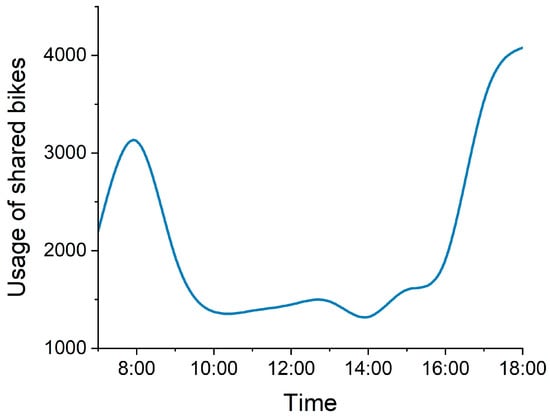
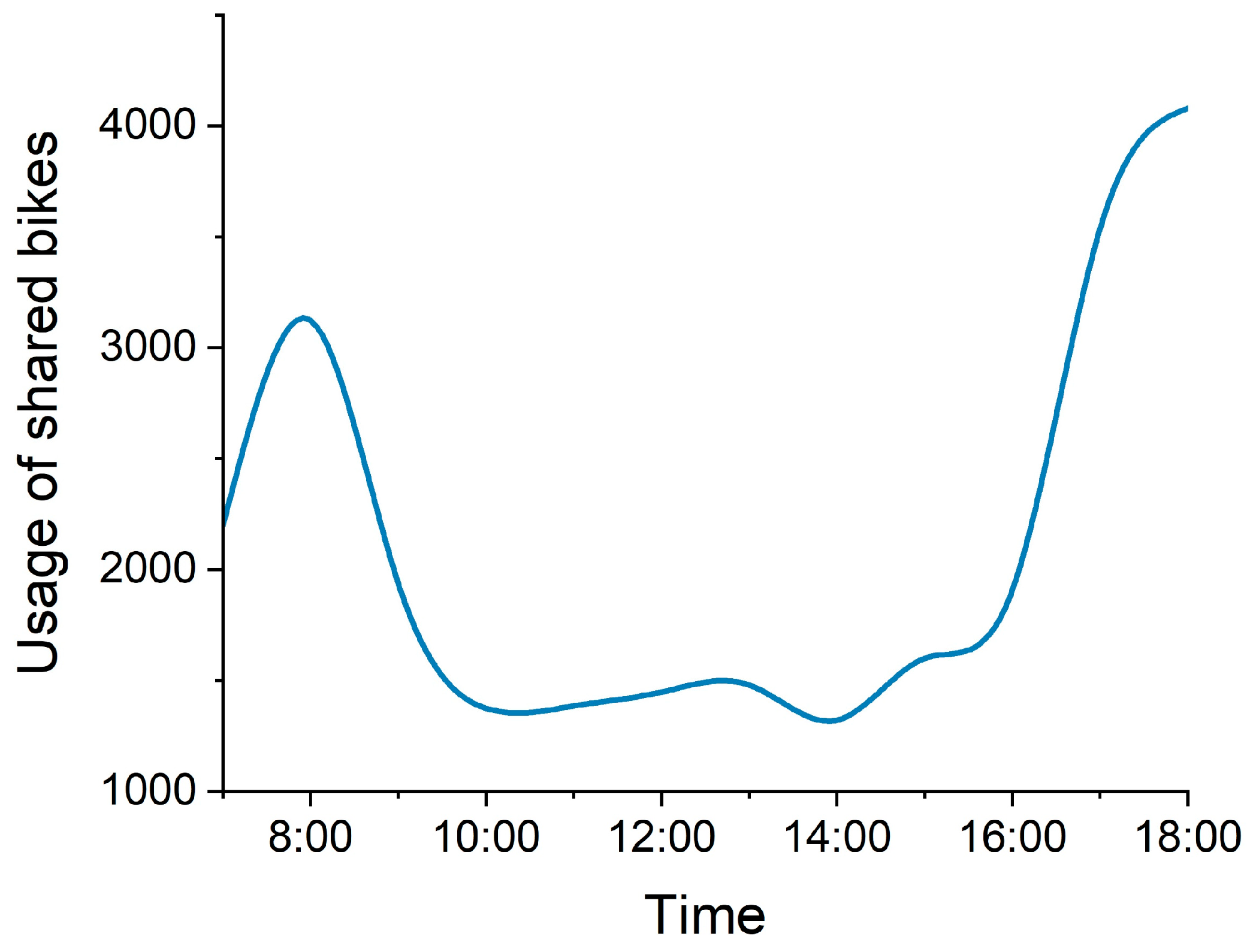
The statistical analysis revealed pronounced patterns of variation in shared-bike usage during days of high temperatures (Figure 4). The periods of peak usage coincided with the commuting times, with the highest volumes of traffic occurring during evening rush hours (16:00–18:00) and morning rush hours (07:00–09:00), which far exceeded the off-peak intervals (10:00–12:00 and 13:00–15:00). Evening peak trips (mean 4174.3) surpassed morning peak volumes (mean 2420.3), with midday periods registering minimum usage (10:00–12:00: 1402.3; 13:00–15:00: 1466.7). Specifically, temporal maxima occurred at 18:00 (daily peak, 4080 trips) and minima at 14:00 (daily trough, 1321 trips).
Figure 4.
Temporal distribution patterns of bike-sharing usage.
As demonstrated in Figure 5, there was a clear spatial differentiation in terms of cycling activities across the Huangpu River. High-intensity clusters were predominant in the historic urban core to the west of the river, while low-density zones were concentrated in the inner-ring area of Pudong New Area to the east of the river and in the peripheral western and northern sectors of the central city. The core cycling hotspots in the area to the west of the Huangpu River demonstrated a concentric distribution, with lower frequencies at the riverfront Bund and peripheral western/northern streets. Meanwhile, intermediate zones exhibited higher trip concentrations and notable diurnal heterogeneity patterns.
Figure 5.
Spatial distribution patterns of shared bicycle usage.
The temporal delineation of the hotspot areas revealed a concentration of activity during specific hours of the day. The periods of greatest activity were observed to be in the morning (7:00–9:00) and evening (16:00–18:00), with the most significant concentrations of activity located within Yangpu, Hongkou, Jing’an, and Putuo Districts, as well as southwestern Huangpu and northern Xuhui Districts. During the midday periods (10:00–12:00, 13:00–15:00), high-intensity cycling was observed in Yangpu and Hongkou Districts, as well as in southwestern Huangpu and northern Xuhui.
The quantification of street-scale cycling volume using OSM-processed networks confirmed the conformity of aggregate and mean values with macro-level patterns. The period during which the greatest number of passes occurred was between 16:00 and 18:00, with a total of 137,897 passes recorded across all streets, averaging 8.57 passes per street. Secondary peaks between 7:00 and 9:00 registered 79,709 passes (mean 4.95 passes per street). The afternoon periods (13:00–15:00) recorded 51,646 passes, with a mean of 3.21 passes per street. The minimum usage observed between 10:00 and 12:00 was 45,187 passes, with a mean of 2.80 passes per street.
3.1.2. Calculated Values for Solar Radiation on the Street
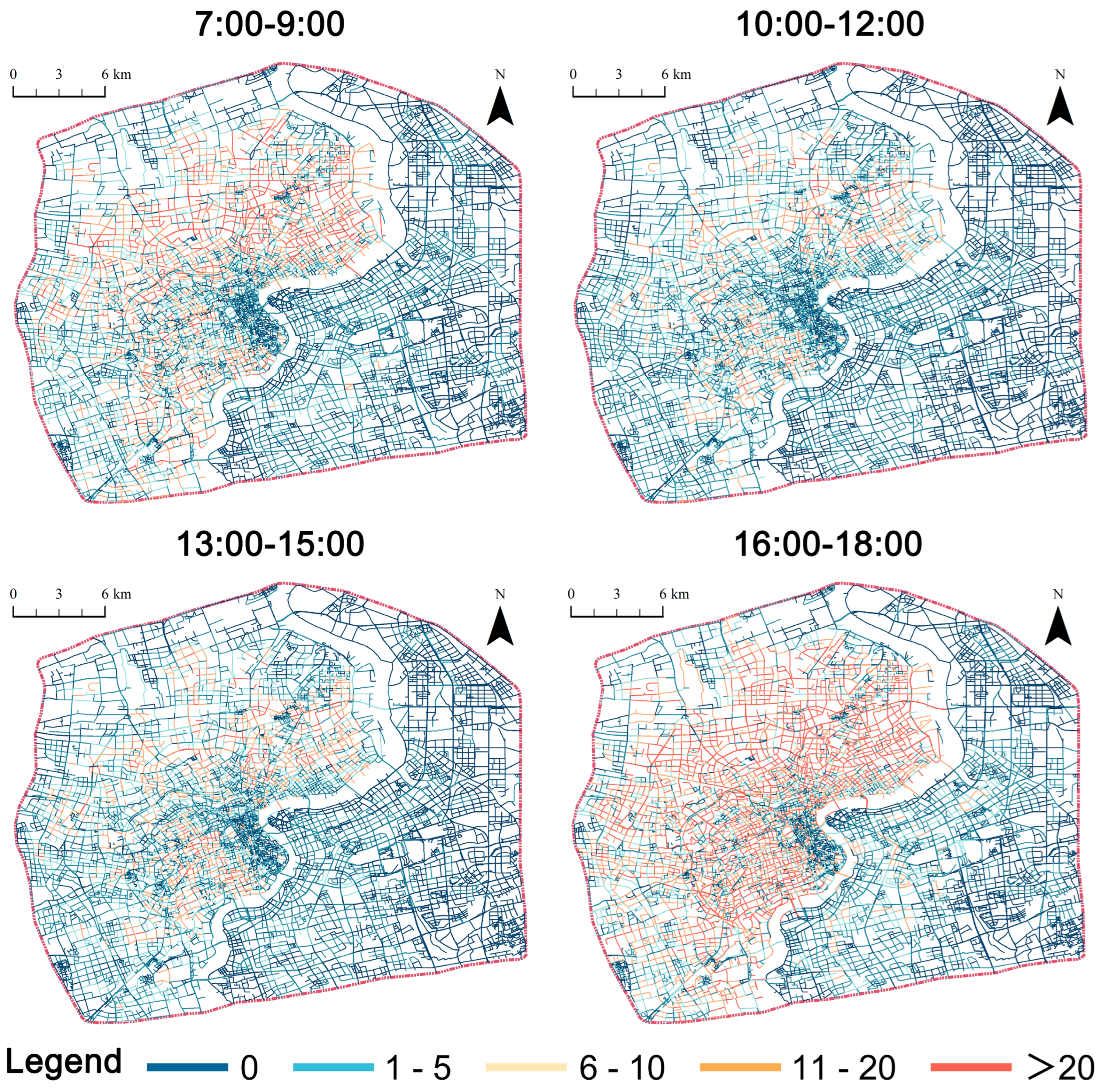
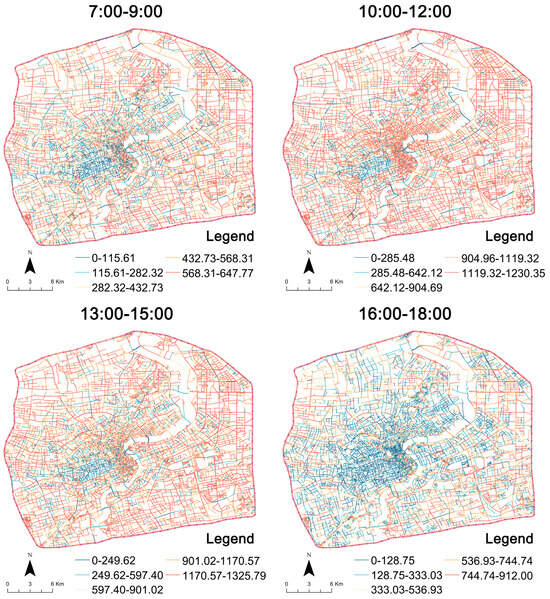
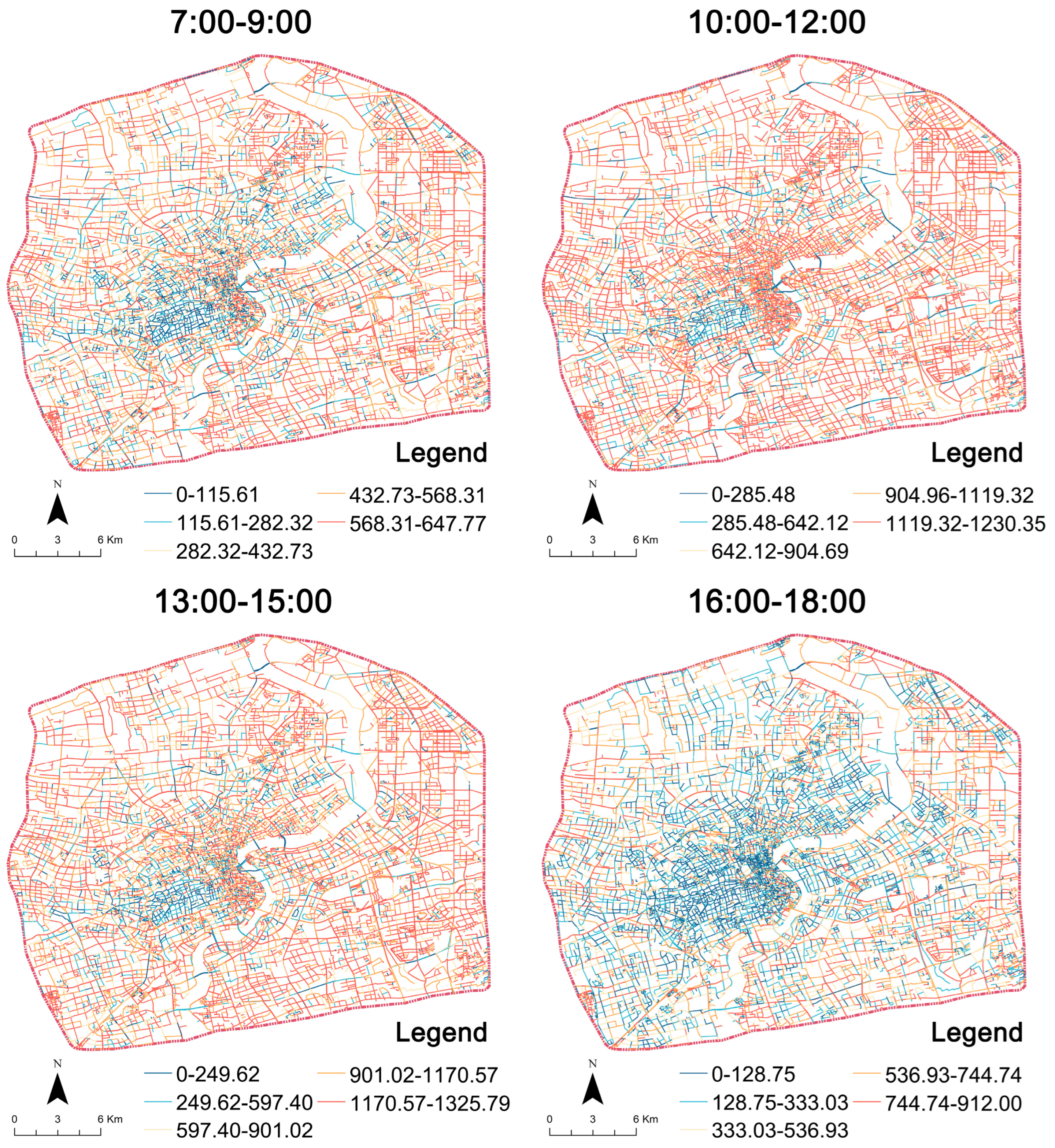
In accordance with the methodology outlined in Section 2.3.1, solar radiation data were calculated at 10 min intervals for all street view image sampling points. The mean value per street was derived as the street-level solar radiation intensity by aggregating point data within each street segment. Subsequent statistical analysis of these street-scale radiation intensities was conducted at 3 h intervals, with the objective of characterizing spatiotemporal distribution patterns. The results of this analysis are presented in Figure 6.
Figure 6.
Spatio-temporal distribution characteristics of solar radiation levels on streets.
The results demonstrated substantial cross-street variations in radiation intensity across temporal periods, exhibiting pronounced spatiotemporal heterogeneity. Spatially, a concentric pattern emerged, with higher intensities observed in peripheral areas and lower values in the urban core. It was determined that there were persistent low-radiation zones along Changshu, Hengshan, and Middle Huaihai Roads, with consistently depressed levels recorded throughout the day.
Furthermore, diurnal variations exhibited pronounced temporal dynamics across the streets. The period between 07:00 and 09:00 saw the presence of clustered low-radiation streets in the southern Yangpu, eastern Changning, and eastern Putuo Districts, extending beyond the persistent low-radiation zones. The maximum recorded radiation reached 647.77 W/m2, with a mean of 427.27 W/m2 across all streets. The 10:00–12:00 and 13:00–15:00 periods exhibited analogous spatial distributions, with secondary low-intensity streets demonstrating increased fragmentation and spatial dispersion beyond the persistent core low-radiation zones. Quantitatively, the 10:00–12:00 interval recorded the highest daily mean radiation intensity (996.14 W/m2), though its peak value (1230.35 W/m2) ranked second highest. The mean radiation intensity remained elevated between 13:00 and 15:00, with a recorded value of 965.40 W/m2. Concurrently, the peak radiation intensity surged to a daily maximum of 1325.79 W/m2. This phenomenon may be interpreted as indicative of a substantial decline in the thermal comfort experienced by cyclists in urban streets. By 16:00–18:00, a significant attenuation of radiation was observed, with elevated levels persisting only in peripheral streets. Despite a residual peak of 912.00 W/m2, the mean radiation intensity declined to the daily minimum of 386.50 W/m2.
3.2. Result of Radiation Exposure Level of Cycling
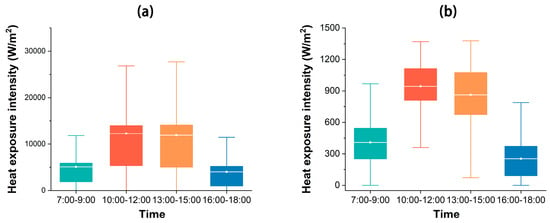
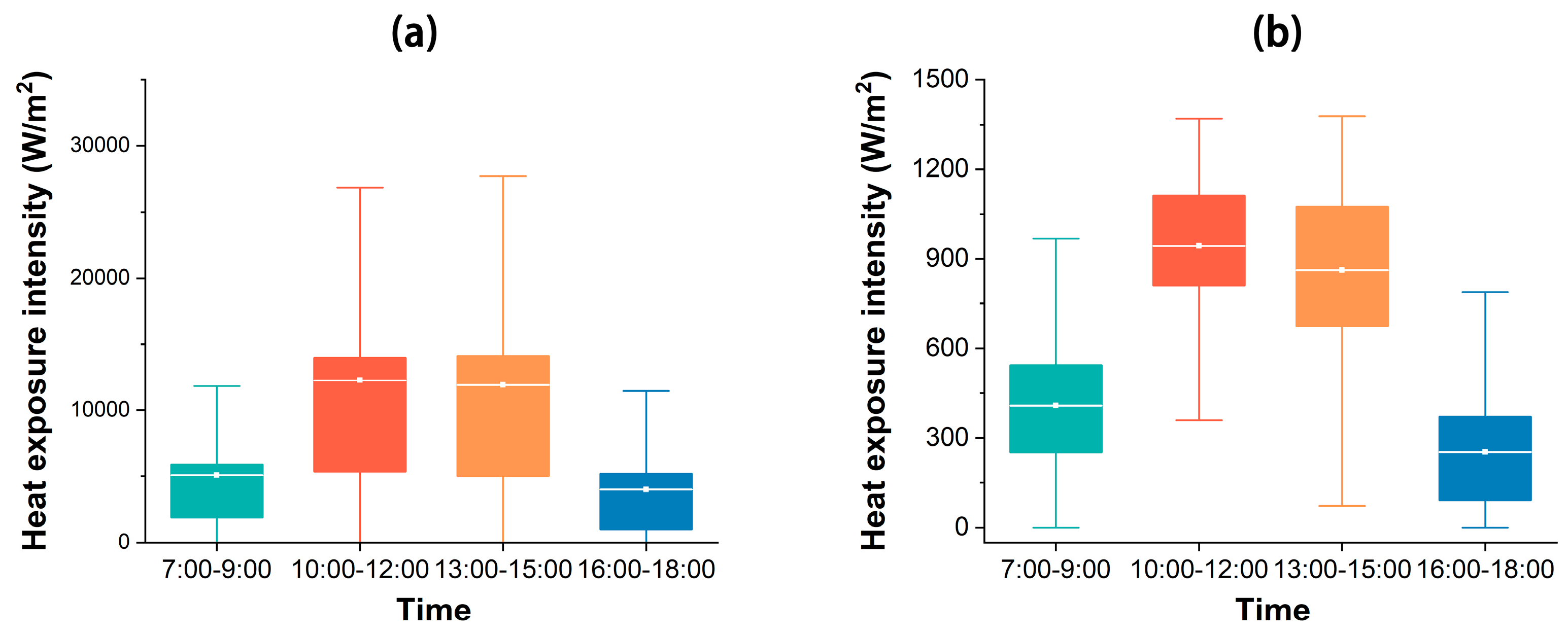
Utilizing cycling trajectories in conjunction with street-level solar radiation data, Formulas 8 and 9 were employed to compute cumulative radiation exposure level per trip and per-minute radiation exposure level, with the results illustrated in Figure 7.
Figure 7.
The result of the radiation exposure level assessment among cyclists. (a) The radiation exposure intensity of the entire cycling process; (b) the radiation exposure intensity per minute of the cycling process.
Temporally, both cumulative and per-minute radiation exposure intensities exhibited inverted U-shaped patterns during high-temperature days, increasing initially before declining. The mean intensity of the radiation exposure level reached its zenith at 10:00–12:00, with a value of 12,257.61 W/m2 (cumulative) and 943.45 W/m2 (per minute). These figures indicate a high level of radiation exposure risk. However, it should be noted that the maximum values recorded during this period were marginally lower than those observed in the 13:00–15:00 time frame. The 13:00–15:00 interval exhibited elevated mean radiation exposure levels (11,910.45 W/m2 cumulative; 862.15 W/m2 per minute), though these were slightly reduced from 10:00 to 12:00, while demonstrating heightened individual heterogeneity—with cumulative exposure extremes potentially exceeding noon values. The radiation exposure levels were found to be substantially lower in the morning (07:00–09:00) and evening (16:00–18:00) periods. Morning exposure levels were found to exceed evening exposure levels, with a cumulative radiation exposure of 5075.75 W/m2 in the morning as opposed to 4004.25 W/m2 in the evening. A similar trend was observed in the per-minute radiation exposure, with a reading of 408.16 W/m2 in the morning as compared to 253.45 W/m2 in the evening. These findings indicate that minimal heat risk is likely to be experienced by cyclists during their evening journeys.
3.3. The Impact of the Built Environment on Radiation Exposure Level
Following the evaluation of radiation exposure levels, XGBoost modeling with SHAP interpretability was employed to analyze global effects, nonlinear responses, and critical thresholds of built environment factors on per-minute radiation exposure levels during bike-sharing trips. Prior to the implementation of the XGBoost model, an initial multiple linear regression analysis was conducted to ascertain the absence of multicollinearity (all VIF < 10) between built environment factors for per-minute radiation exposure.
The optimal hyperparameters identified using Bayesian optimization are as follows: n_estimators = 350, max_depth = 6, learning_rate = 0.04386, subsample = 0.7986, reg_alpha = 2.544, and reg_lambda = 3.931. The employment of Bayesian-optimized XGBoost has been demonstrated to yield robust performance (training: R2 = 0.78, MAE = 132.96, RMSE = 167.29; testing: R2 = 0.67, MAE = 164.44, RMSE = 210.09), thereby demonstrating generalizability and interpretive reliability.
3.3.1. The Global Impact of the Built Environment
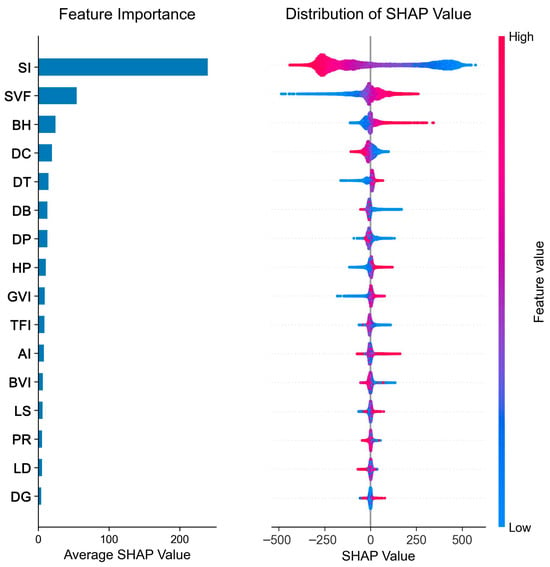
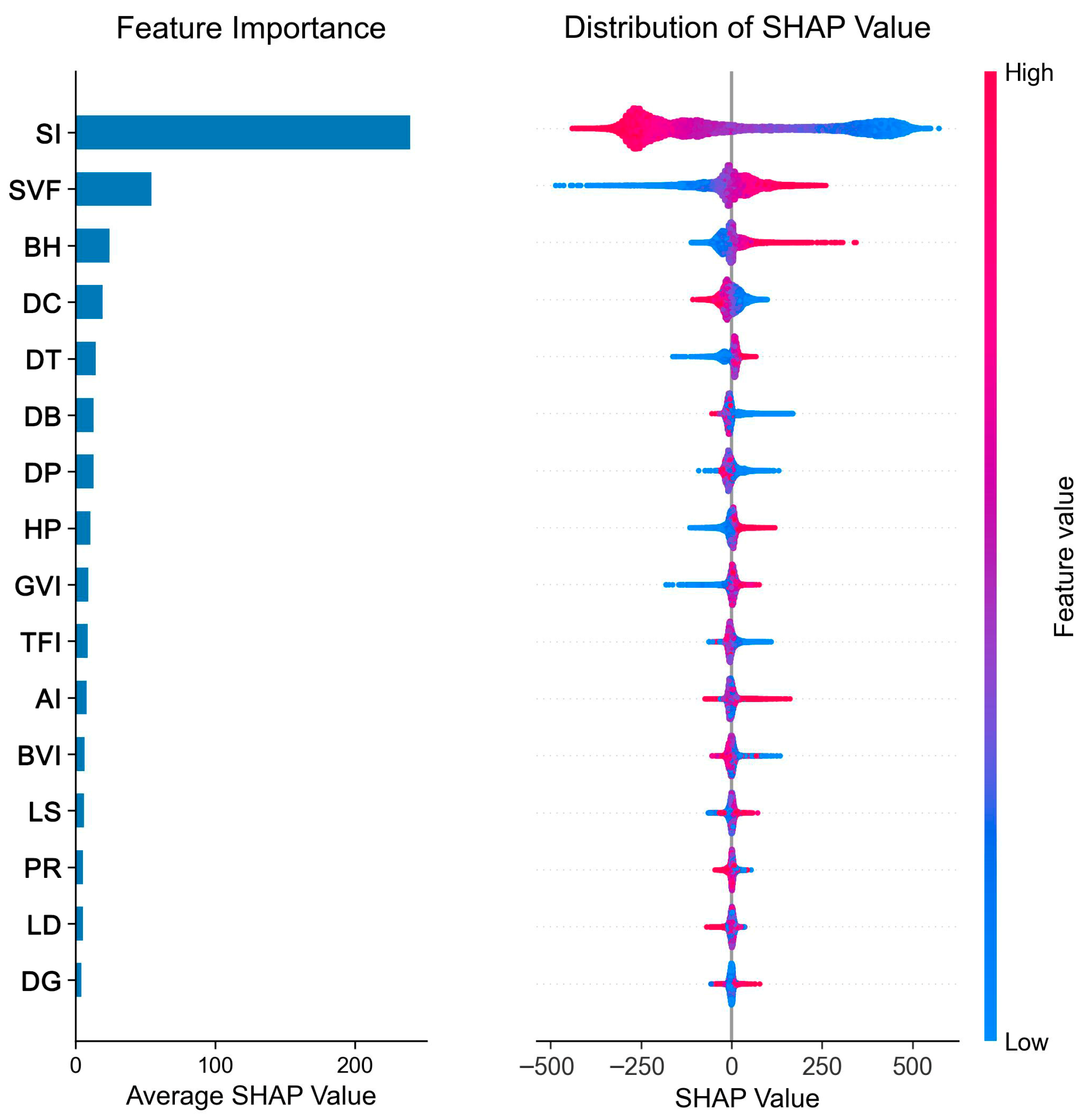
As illustrated in Figure 8, the mean SHAP value and SHAP value distributions of built environment factors are presented. The findings indicated significant heterogeneity amongst the factors, with physical street-level metrics, specifically geometric attributes, demonstrating a stronger influence than socioeconomic factors. The SI was identified as the predominant influence factor, with a contribution greater than 57%, demonstrating robust negative associations with radiation exposure. The secondary influential factor, the SVF, exhibited a positive association and constituted a greater than 7% contribution. Additional built environment factors that exhibited contributions in excess of 3% BH (positive effect), and DC, DT, and DB—the latter three demonstrating complex associations. The impact of the remaining factors was demonstrated to be limited, as indicated by marginal mean SHAP values.
Figure 8.
The global impact of the built environment on the radiation exposure level per minute.
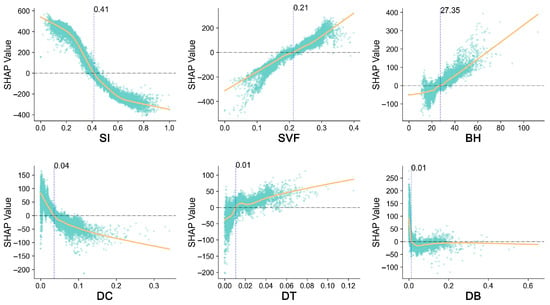
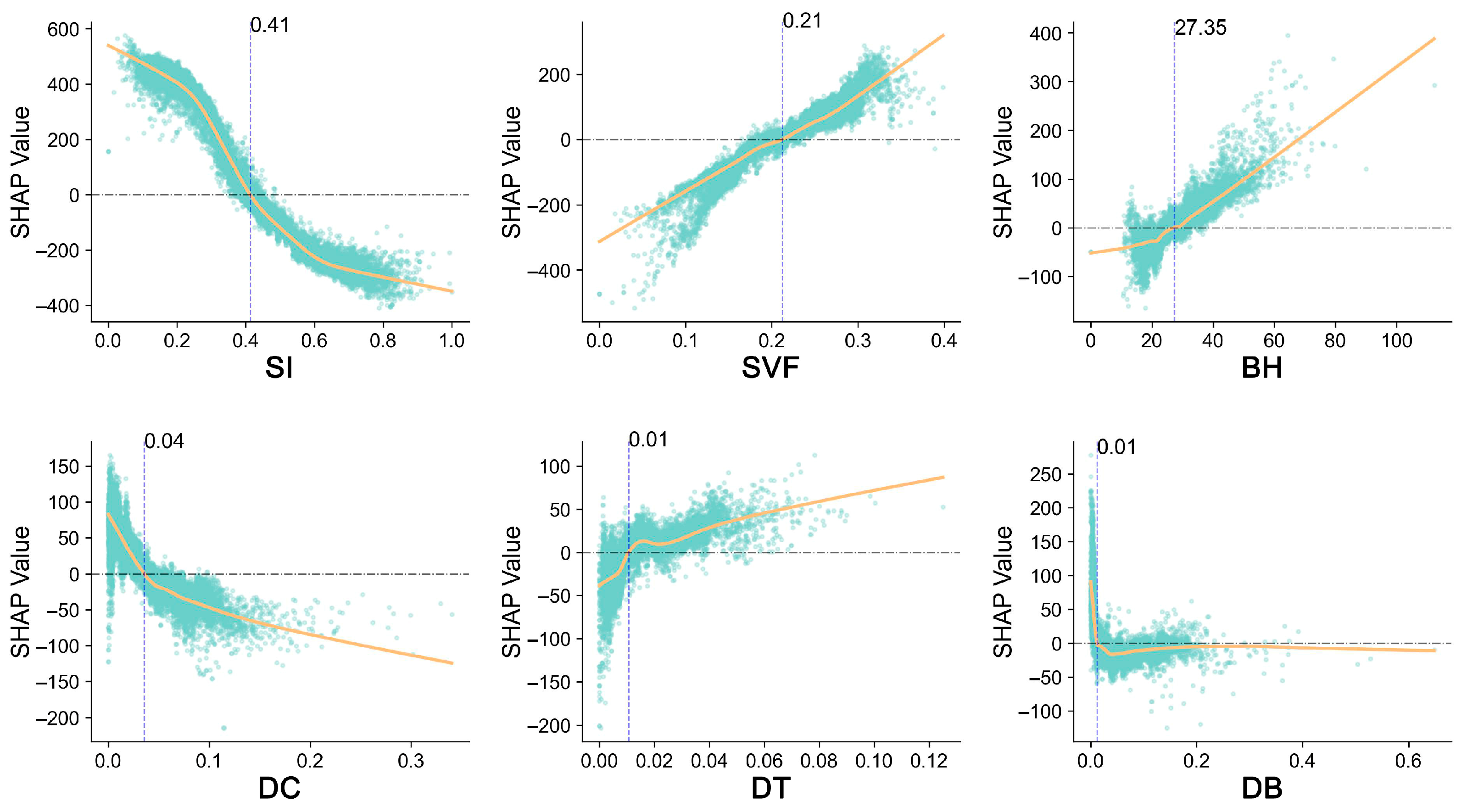
The nonlinear effects of these six key influence factors were the subject of further examination (Figure 9). The SI demonstrated a monotonically negative correlation with the radiation exposure level, exhibiting threshold effects. The reduction in exposure level was initiated at a shading index greater than 0.41, while marginal benefits became negligible at approximately 0.6. The findings indicated a quasi-linear positive relationship between both the SVF and the BH and the radiation exposure level. Intensification occurred at SVF > 0.21 and building height > 27.35 m. Research has shown that DC is associated with negative outcomes, which appear to be threshold-mediated. Specifically, the suppression of radiation exposure level is observed to activate at a density greater than 0.04. Furthermore, the DT exhibited a positive correlation, with radiation exposure levels increasing at densities greater than 0.01. The DB exhibited complex nonlinear characteristics, manifesting as prominent thresholds. At densities greater than 0.01, a suppression effect was observed, which plateaued beyond approximately 0.03 with minimal subsequent variation.
Figure 9.
The nonlinear impact of the built environment on the radiation exposure level per minute.
3.3.2. The Interaction Effect of the Built Environment
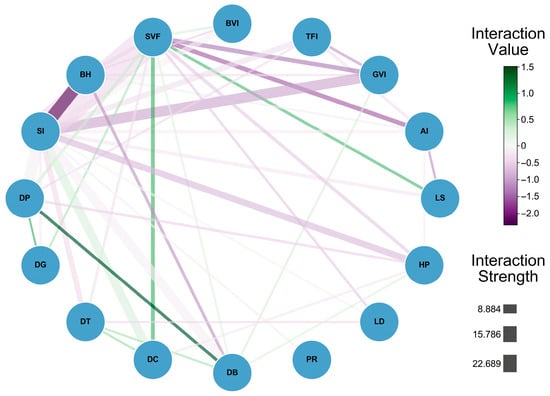
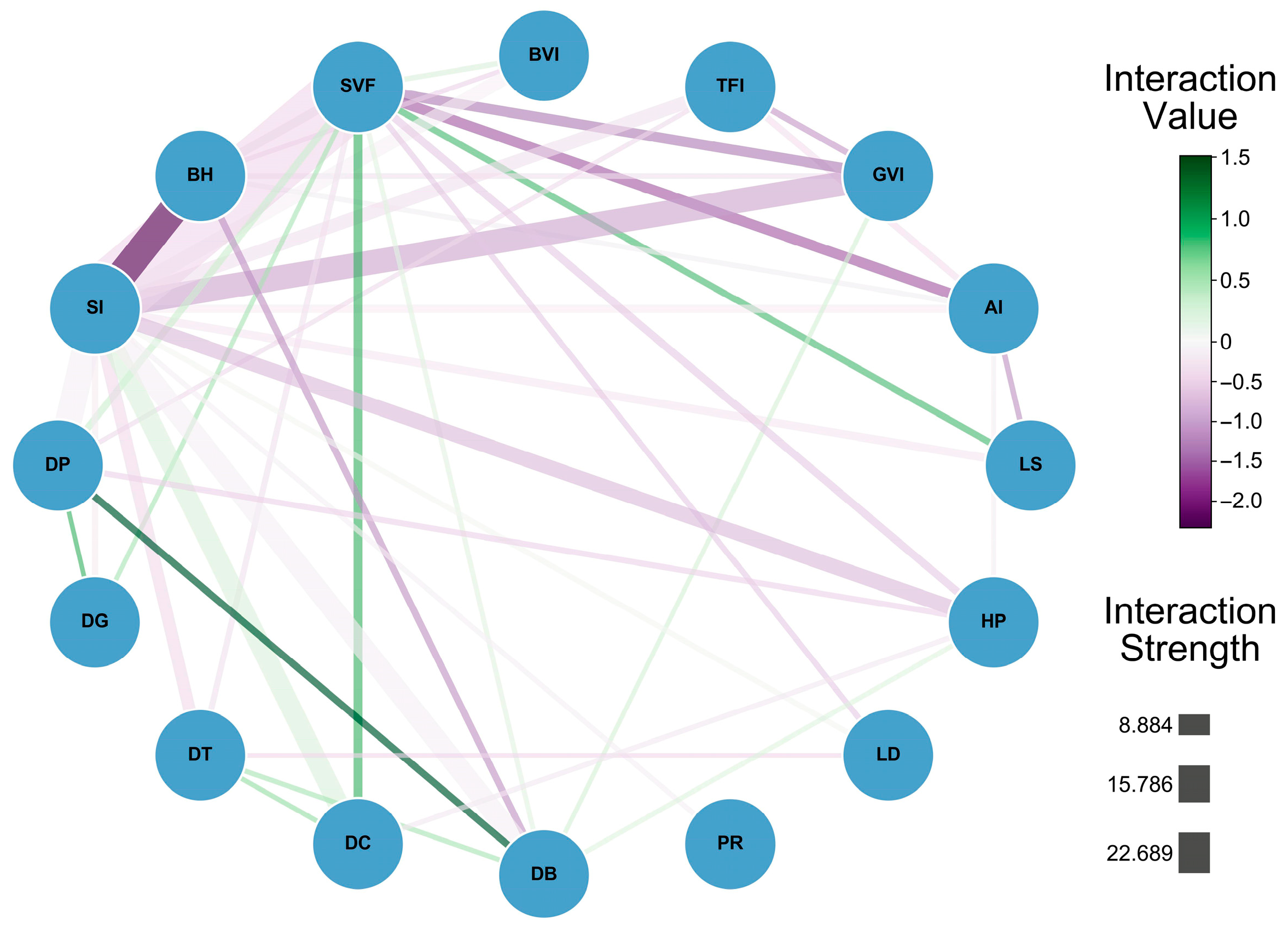
Subsequent to determining the effects of individual built environment factors, the study undertook an analysis of the interaction effects and interaction strengths among different factors. Figure 10 presents a network diagram illustrating the top 10% of the strongest interactions among the various factors.
Figure 10.
Feature interaction network.
Among all factors, the SVF-SI interaction intensity peaked at 29.59, thereby confirming their significant influence on cycling radiative exposure. However, the interaction value of −0.47 indicates a marginal negative synergistic effect between shading index and sky view factor. The BH-SI combination demonstrated the second-most robust interaction strength (12.36) and the most pronounced negative synergy (−2.33). This finding suggests a robust negative synergy between building height and shading index. SI-DP was ranked third in terms of intensity (11.36), yet it demonstrated near-neutral interaction (−0.09), reflecting minimal net effect despite substantial coupling magnitude.
Among the remaining pairs, DP-DB demonstrated the most pronounced positive synergism (interaction: 1.51), although at a low intensity (3.01). SVF-DC pairs demonstrated a second-place ranking in terms of positive effect (interaction: 0.92) with similarly modest intensity (3.82). DP-DG was placed third, with an interaction of 0.90 and an intensity of 2.00. Collectively, these findings suggest weak yet consistently positive synergistic effects. With regard to substantial adverse interactions, AI-SVF demonstrated the second most substantial negative synergy (interaction: −1.60; strength: 4.43). GVI-SVF ranked third (interaction: −1.35; intensity: 4.37), and LS-AI exhibited −1.14 of interaction and 2.36 of intensity. These results also indicate a weak but negative synergy among these factors.
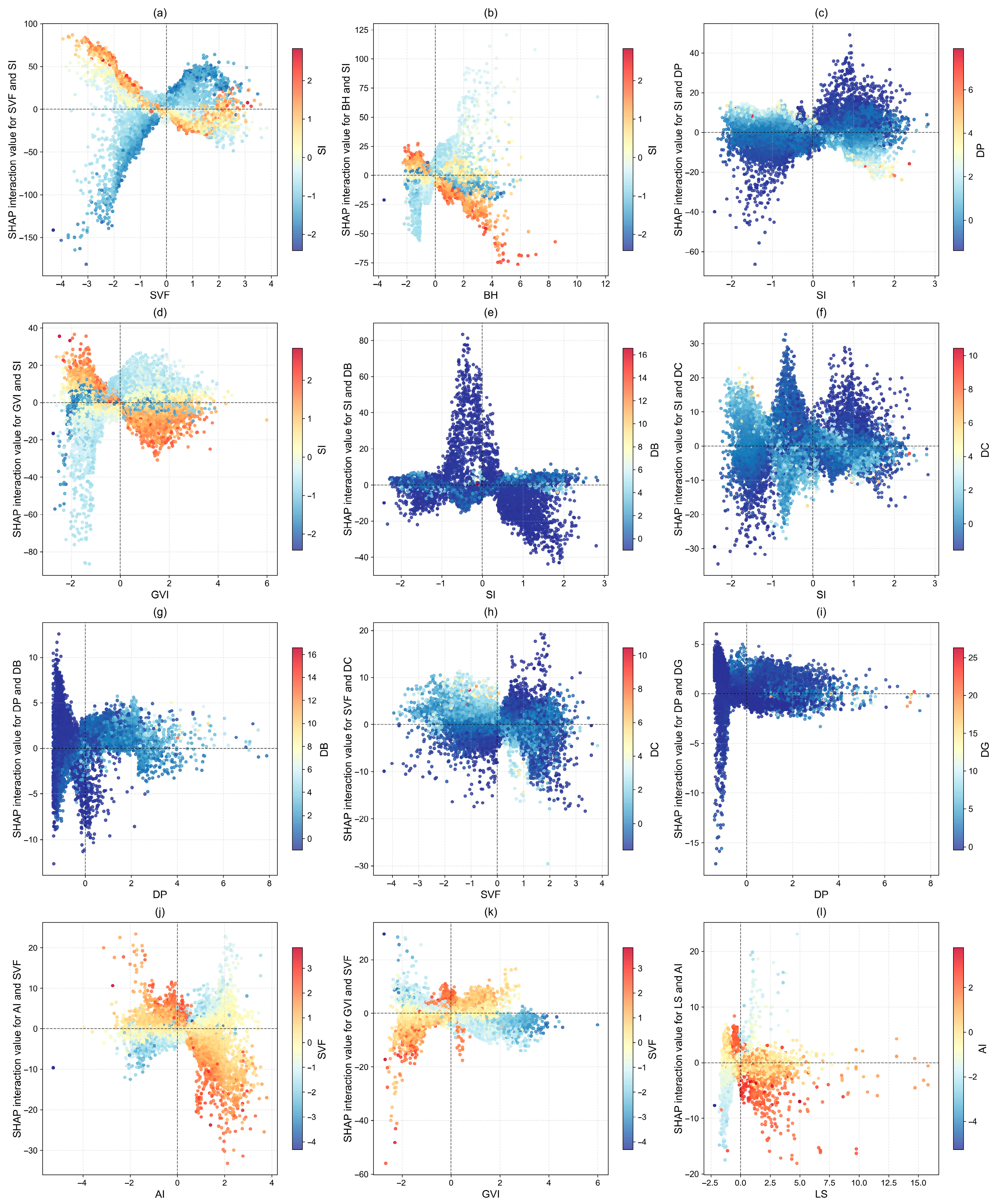
Subsequently, SHAP dependence plots were generated for the following conditions. The initial group consists of the top six intensity-ranked pairs. The subsequent group consists of the maximally positive/negative trios exclude the aforementioned group. The purpose of including these trios is to capture the dominant interaction effect and reveal the synergism enhancement/cancelation mechanisms illustrated in Figure 11.
Figure 11.
Interaction effect dependency plot for the built environment. (a) The SHAP interaction value for SVF and SI; (b) BH and SI; (c) SI and DP; (d) GVI and SI; (e) SI and DB; (f) SI and DC; (g) DP and DB; (h) SVF and DC; (i) DP and DG; (j) AI and SVF; (k) GVI and SVF; (l) LS and AI.
Specifically, in dense streets with low SVF (SVF < 0, Z-score normalized), high SI demonstrates a strong positive interaction, peaking at SHAP values near 100. This indicates that shading enhancement in constrained spaces significantly amplifies its radiation exposure intensification effect. As SVF rises, a distinct X-shaped transition emerges: contributions from high SI diminish to negative values in open streets, whereas low SI transitions from negative to positive impact. This finding indicates a threshold-dependency relationship, whereby the radiation exposure modulation of shading is contingent on the inherent spatial openness of the context. A similar bipolar divergent transition has been observed in the following interactions: BH-SI, SI-DP, GVI-SI, SVF-DC, AI-SVF, and LS-SVF. This observation confirms the prevalence of crossover-type nonlinearity across built environment metrics. It is noteworthy that GVI-SVF exhibits inverse transitional behavior relative to other pairs. Collectively, these findings underscore the high-context dependency of built environment influences on cycling radiation exposure.
The remaining factor pairs demonstrate heightened nonlinear complexity and threshold manifestations. Firstly, SI-DB/DC interactions intensify nonlinearly (Figure 11e), reaching a maximum at SI ≈ −0.5, which indicates the activation of critical synergy zones. In contrast, DC’s multiphasic oscillation across SI gradients (Figure 11f) unveils intricate regulatory dynamics. Subsequently, DP manifests a discernible threshold-sensitive response with density-induced saturation. At low DP levels (Figure 11g,i), DB and DG initiate volatile SHAP fluctuations, thereby signifying a more pronounced mediating influence by commercial and green facilities in transit-sparse corridors. Beyond critical DP thresholds, interaction curves expeditiously converge toward stability. This finding indicates that the marginal benefits of optimizing radiation exposure through green/commercial adjustments alone are diminishing in high public service density districts.
4. Discussion
4.1. Temporal Patterns and Behavioral Responses to Cycling Radiation Exposure Level
During periods of high temperature, the distribution of cycling trips exhibited a bimodal pattern, with peaks occurring during the morning and evening hours. This bimodal distribution can be attributed to the demand for commuting during these times. In contrast, the radiation exposure levels, both cumulative and measured per minute, followed a unimodal inverted-U diurnal pattern, peaking at midday (10:00–12:00). This phenomenon is primarily attributable to the dynamics of solar radiation within street canyon environments. An increase in solar elevation angles has been observed to result in an intensification of direct beam radiation penetration, an expansion of irradiated surfaces, and an amplification of radiative loads [47].
It is important to note that the proactive risk-avoidance behaviors of cyclists substantially mitigated the radiation exposure level. As demonstrated in Figure 6, the mean per-minute radiation exposure level (253.45–943.45 W/m2) remained consistently below the mean street-level radiation level (386.50–996.14 W/m2) during the same period, with the differential widening temporally: −19.11 (07:00–09:00), −52.69 (10:00–12:00), −103.25 (13:00–15:00), and −133.05 W/m2 (16:00–18:00). This demonstrates systematic preferential selection of low-radiation routes across all periods, with avoidance intensification escalating under heightened thermal stress, evidenced by greater afternoon differentials. It is noteworthy that, despite lower evening radiation levels, there was a peak in vigilance with regard to route selection. This finding suggests the presence of hysteretic behavioral responses. Whilst earlier studies had identified temporal shifting to evening/night as a means of demand compensation [48], the present research demonstrates the superior effectiveness of spatial optimization over temporal displacement in heat and radiation exposure risk mitigation.
4.2. Built Environment Effects on Cycling Radiation Exposure Level
Empirical studies conducted in various locations have found that the presence of shade can result in a decrease in surface temperatures [36,49], with temperature differences reaching up to 21.1 °C between shaded areas and areas exposed to direct sunlight [24]. Moreover, a study conducted by Gu et al. in the Netherlands found that PET decreases by 0.018 °C for every 1% increase in pedestrian shading coverage [50]. Additionally, the presence of shade is believed to have a significant impact on the enhancement of cycling activities [51,52], our study corroborates the critical efficacy of shading as an urban planning intervention. The results revealed that shading efficiency dominated radiation exposure attenuation, with a contribution of >57%. The effectiveness of this approach increased beyond the threshold of 0.41, which is consistent with the findings of a study conducted by Deng et al. in Beijing [53]. However, it should be noted that after the threshold of 0.60 was reached, marginal returns decreased. The mechanism is the interception of shortwave radiation from the sun, thereby establishing shading coverage enhancement (0.4–0.6 range) as the optimal mitigation strategy for streets facing high thermal hazard. The sky view factor (SVF > 0.21) and the building height (>27.35 m) exhibited quasi-linear positive associations with radiation exposure level (>7% and >3% contributions, respectively); this positive relationship was also observed in a previous study by Ge et al. in Nanjing [54]. It was demonstrated that risk escalated markedly beyond thresholds. It has been demonstrated that high-rise clusters can indirectly intensify exposure by reducing shade continuity through altered H/W ratios and setback configurations, thereby exacerbating surface heating [55]. Notwithstanding the documented benefits of high SVF with respect to cycling [56], the amplification of radiation effects necessitates meticulous trade-off management in the context of street design. In regard to the interactions among built environment factors, higher levels of shade can work in conjunction with other built environment factors to reduce radiation exposure levels for cyclists, remaining effective even under conditions of higher BH and SVF. This further underscores the important role of shade.
The result indicates that commercial and business facility densities (>3% contribution) have been demonstrated to suppress radiation exposure levels, likely through continuous building shade provision and narrowed street sections. This aligns with documented cooling effects of commercial agglomeration [57]. Conversely, transportation facilities intensified radiation exposure level (>3% contribution), attributable to their low-coverage layouts, impervious surfaces, and limited shading—consistent with known surface heating effects [58]. In the context of the interactions among diverse facilities, a significant threshold effect has been identified. However, synergy with SI has also been demonstrated to effectively reduce radiation exposure, thereby further underscoring the critical role of shading in reducing radiation exposure during cycling and mitigating heat-related risks.
4.3. Planning “Shaded Corridors” for Active Travel Heat Mitigation
Non-motorized active travel modes (e.g., cycling) deliver dual benefits: enhanced public health and reduced carbon/pollutant emissions [59]. In addition to confirming the effectiveness of shading for cyclists, the available evidence indicates that there are concomitant reductions in pedestrian radiation exposure levels and improvements in thermal discomfort [50]. In view of the documented inflexibility in heat-adaptive routing [60] and inequitable shade distribution [61], a “shaded corridor” framework with tripartite interventions (spatial, facility and governance) is proposed in order to enhance non-motorized active travel heat resilience.
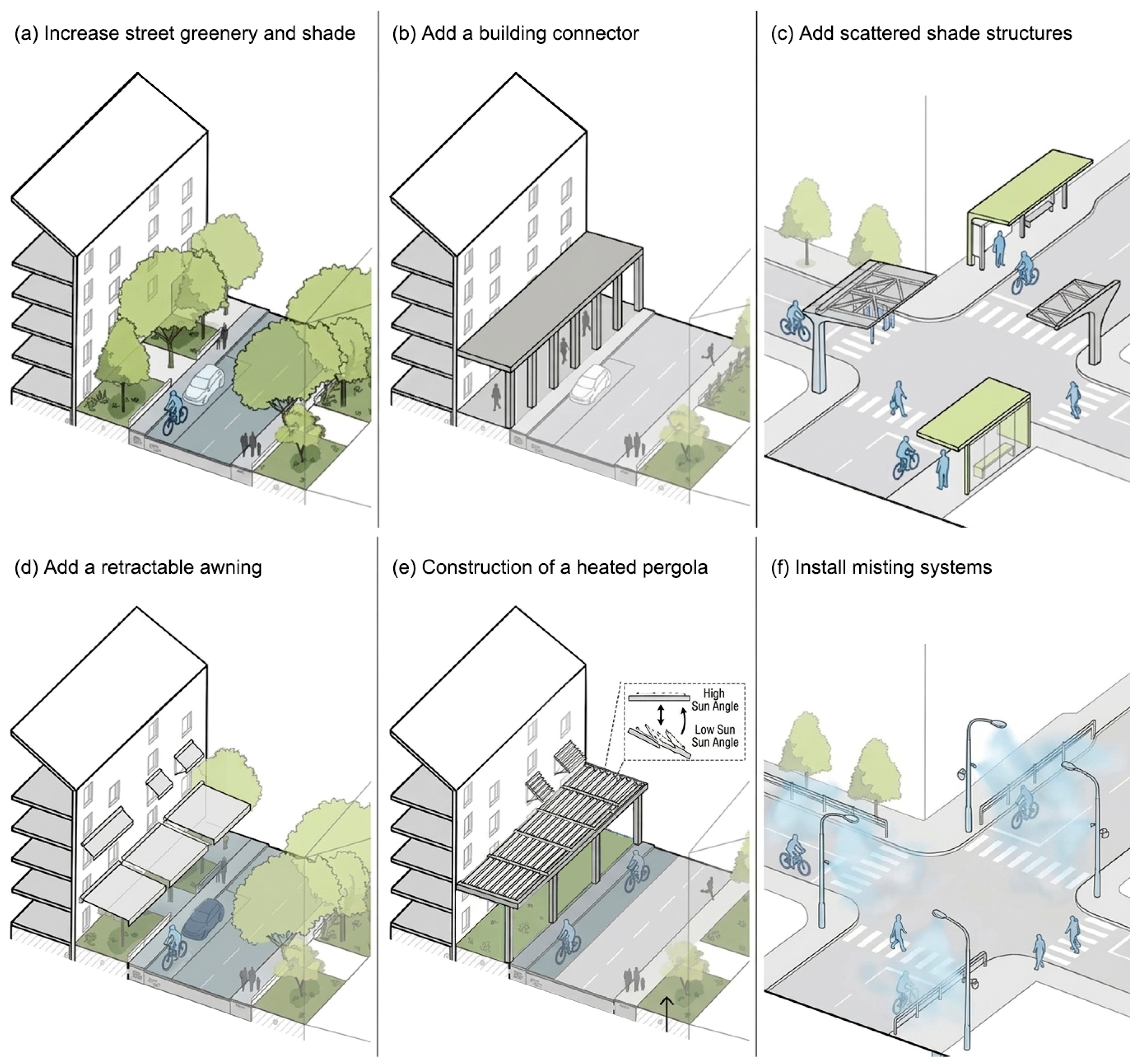
(1) Spatial: Establishing continuous shading networks. Strategic interventions have the potential to reconfigure street radiative geometries through the implementation of planning instruments. The incorporation of “shade corridors” into neighborhood-level planning is imperative, as this approach facilitates the establishment of minimum standards for optimal street tree coverage. Furthermore, it is imperative that different minimum standards be applied to roads of varying categories, such as residential streets and thoroughfares, to ensure that streets with higher usage rates enjoy better shade conditions. The closure of the canopy over roadway centroids can be accomplished by selecting broad-crowned deciduous trees. Additionally, climbing vegetation can be integrated into building facades to attenuate longwave radiative reflection. Financial inducements are attainable for commercial and public plots that erect arcades or continuous covered walkways. These incentives pertain to the design of the structures, specifically the overhang depths. The overhang depths are solar-geometrically calibrated to the summer solstice angles. This configuration is designed to ensure sufficient shading from the structures during the hours of 10:00 a.m. to 3:00 p.m., a critical aspect that enables the street to provide adequate shading during those hours. The implementation of targeted shading interventions at transit stops and intersections is imperative. This involves the expansion of shelter footprints, accompanied by the integration of evaporative cooling mechanisms to mitigate radiative exposure. Additionally, the integration of smart lighting systems with photovoltaic-powered auxiliary cooling systems at crossing nodes is crucial (Figure 12).
Figure 12.
Schematic diagram of urban planning strategies.
(2) Infrastructure: Dynamic thermo-regulatory response. During the midday hours, when traffic volume peaks, cyclists face greater risks due to the more extreme heat, necessitating solutions that go beyond static shade. Therefore, a three-tier thermo-regulatory infrastructure shall be implemented on high-traffic corridors from 11:00 a.m. to 3:00 p.m. Firstly, the installation of photosensitive retractable awnings on buildings is imperative. These awnings must be designed to deploy automatically when specific radiative and thermal thresholds are reached. Secondly, the implementation of smart thermal-responsive pergolas over cycle tracks, with solar-adaptive louver angles, is proposed. Thirdly, the implementation of intermittent high-pressure misting nozzles on street fixtures can reduce the apparent temperature by 3–5 °C without compromising safety (Figure 12). In addition, data interoperability with bicycle-sharing platforms and navigation services shall entail the following: The integration of street-level radiative grids and shading operations into routing algorithms, thereby ensuring the provision of “minimal thermal stress cost” cycling routes. The redirection of users toward high-canopy-coverage or active-cooling-enabled segments.
(3) Governance: Dynamic risk assessment and loop control. Cross-departmental data integration establishes closed-loop sensing-to-action frameworks. The creation of “Street Thermal Exposure Profiles” is imperative for each road. The documentation of these profiles is to be conducted in a dynamic manner, encompassing the following metrics: mean radiant temperature (MRT), green coverage ratio, cycling, GPS heatmaps, and video analytics. Algorithms have been developed to generate hourly dynamic heat risk maps, which are intended to classify areas into four-tier alerts. The objective of this profile is to construct 100 m-resolution, radiative digital twins. Once the radiation maps are obtained, they will be integrated with a comprehensive set of factors, including access to shade, transportation accessibility, and access to medical care. This systematic assessment will evaluate heat risks in different areas, thereby providing a reference for prioritizing urban renewal and facility upgrades.
4.4. Limitations and Future Work
Firstly, there are shortcomings regarding the timeliness of the shared bicycle data. The shared bicycle data utilized in the present study encompasses trajectory data from 2016, which reflects the prevailing cycling patterns and spatial distribution of urban residents. However, it must be noted that these data are not up to date. In subsequent research, the utilization of more contemporary shared bicycle trajectory data could prove beneficial.
Secondly, owing to constraints in data sources and time frames, the multi-source data utilized in this study have been aligned as closely as possible with the bike-sharing trajectory data to reflect the influence of the built environment. However, the time scales are not entirely consistent, which may introduce certain limitations to the study’s findings. In subsequent research, the utilization of more temporally consistent built environment data is anticipated to rectify this bias.
Finally, this study exclusively utilized direct solar radiation data, thus disregarding other environmental factors such as diffuse reflection, scattering, air temperature, and atmospheric conditions. Consequently, a discrepancy emerges between the findings and the actual thermal perception of the human body. Consequently, in subsequent research, Tmrt data could be calculated by incorporating a range of climatic indicators, thereby providing a more accurate reflection of cyclists’ thermal exposure.
5. Conclusions
The objective of this study was to address a critical yet underexplored question: How can we dynamically quantify cyclists’ solar radiation exposure under extreme heat and identify which built environment attributes regulate such exposure? Integration of shared-bike trajectories, street view imagery, high-resolution solar radiation modeling, and an interpretable machine learning framework (XGBoost–SHAP) has been demonstrated to advance methodological and practical knowledge on heat-resilient active mobility.
First, in contrast to static heat risk assessments, our dynamic exposure model captures both cumulative (trip-level) and per-minute radiation loads. This reveals that cyclists’ actual exposure is consistently lower than street-level radiation due to adaptive route choices. This adaptive behavior was previously overlooked in macro-scale studies. Secondly, we advance beyond the identification of “influential factors” to the revelation of nonlinear thresholds and interaction mechanisms. The shading index (SI) is not merely important; it dominates exposure reduction with a >57% contribution. However, it exhibits diminishing returns beyond 0.60 and becomes effective only above 0.41. Thirdly, the contradictory effects of socioeconomic factors are disentangled: commercial and business densities reduce exposure by providing continuous shade, whereas transport facility density increases exposure due to low-shade, heat-retentive layouts. Fourthly, the interaction analysis demonstrates that the protective effect of shading is context-dependent, being amplified in dense, low-SVF streets but reversed in open settings. This indicates that shade-oriented interventions must be spatially tailored.
In the context of escalating heatwaves, ensuring the sustainability of active mobility necessitates a comprehensive examination of built environment factors that influence cyclists’ exposure to solar radiation. This examination provides a robust foundation for the development of climate-resilient street planning and design. The findings of this study offer actionable insights that can inform the development of climate-resilient planning strategies.
Author Contributions
Conceptualization, J.C. and Y.Z.; methodology, J.C. and Y.Z.; software, J.C.; validation, Y.Z., J.C. and X.S.; formal analysis, Y.Z. and J.C.; investigation, J.C. and Y.Z.; data curation, Y.Z.; writing—original draft preparation, Y.Z. and J.C.; writing—review and editing, Y.Z., J.C. and X.S.; visualization, J.C. and Y.Z.; supervision, J.C. and Y.Z.; project administration, J.C. and Y.Z.; funding acquisition, J.C. and Y.Z. All authors have read and agreed to the published version of the manuscript.
Funding
This research was funded by the National Natural Science Foundation of China (No. 72504233) and the Shanghai Key Laboratory of Urban Renewal and Spatial Optimization Technology (No. 20250201).
Data Availability Statement
Data will be available on reasonable request.
Conflicts of Interest
The authors declare no conflicts of interest.
References
- Yu, H.; Yu, L.; Zhang, C.; Qi, Y. How Does Urbanization Process Affect Urban Heat Island Effect? Interpretation of 31 Cities in China Based on Local Climate Zones. Environ. Res. Lett. 2025, 20, 114013. [Google Scholar] [CrossRef] [Scilit]
- Li, Z.; Wang, X.; Zhao, H.; Xu, X. Spatiotemporal Patterns of the Evolution of the Urban Heat Island Effect and Population Heat Exposure Risks in Xi’an, One of China’s Megacities, from 2003 to 2023. Land 2025, 14, 2021. [Google Scholar] [CrossRef] [Scilit]
- Zou, Y.; Chen, J.; Li, H. Dynamic Heat Exposure Risk Assessment of Urban Residents Based on SOLWEIG Model: A Case Study of Chengdu Central City. Trop. Geogr. 2025, 45, 1799–1814. [Google Scholar] [CrossRef]
- Xia, T.; Zhang, L.; Zou, Y. Mismatch Between Heat Exposure Risk and Blue-Green Exposure in Wuhan: A Coupled Spatial Analysis. Sustainability 2025, 17, 8440. [Google Scholar] [CrossRef] [Scilit]
- Zhang, X.; Chen, F.; Chen, Z. Heatwave and Mental Health. J. Environ. Manag. 2023, 332, 117385. [Google Scholar] [CrossRef] [Scilit]
- Guo, M.; Zheng, J.; Zhang, J.; Li, J.; Wang, Q.; Lai, D.W.L. Impact of Extreme Weather Events on Mental Health among Older Adults in China: A Longitudinal Study. Sustain. Cities Soc. 2025, 130, 106580. [Google Scholar] [CrossRef] [Scilit]
- Bell, M.L.; Gasparrini, A.; Benjamin, G.C. Climate Change, Extreme Heat, and Health. N. Engl. J. Med. 2024, 390, 1793–1801. [Google Scholar] [CrossRef] [Scilit]
- Xu, J.; Wang, Q.; Anikeeva, O.; Zhu, P.; Bi, P.; Huang, C. Effects of Extreme Heat on Physiology, Morbidity, and Mortality under Climate Change: Mechanisms and Clinical Implications. BMJ 2025, 391, e084675. [Google Scholar] [CrossRef] [Scilit]
- Ebi, K.L.; Capon, A.; Berry, P.; Broderick, C.; De Dear, R.; Havenith, G.; Honda, Y.; Kovats, R.S.; Ma, W.; Malik, A.; et al. Hot Weather and Heat Extremes: Health Risks. Lancet 2021, 398, 698–708. [Google Scholar] [CrossRef] [Scilit] [PubMed]
- Abuwaer, N.; Ullah, S.; Al-Ghamdi, S.G. Establishing the Nexus between Urban Walkability and Thermal Comfort in a Changing Climate. Nat. Cities 2025, 2, 801–881. [Google Scholar] [CrossRef] [Scilit]
- Chen, Z.; Qiao, R.; Li, S.; Zhou, S.; Zhang, X.; Wu, Z.; Wu, T. Heat and Mobility: Machine Learning Perspectives on Bike-Sharing Resilience in Shanghai. Transp. Res. Part D Transp. Environ. 2025, 142, 104692. [Google Scholar] [CrossRef] [Scilit]
- Zou, Y.; Chen, J.; Yu, Y. Heat Exposure Risk Assessment of Street Canyons around Urban Rail Transit Station Areas: A Case Study of Shanghai. Int. J. Disaster Risk Reduct. 2025, 123, 105522. [Google Scholar] [CrossRef] [Scilit]
- Li, H.; Yan, L.; Chen, L. Riding under Heat Extremes: Exploring Thermal and Environmental Interactions on Bike-Sharing. Transp. Res. Part D Transp. Environ. 2025, 145, 104792. [Google Scholar] [CrossRef] [Scilit]
- Hsu, C.-K.; Quistberg, D.A.; Sánchez, B.N.; Kephart, J.L.; Bilal, U.; Gouveia, N.; Ferrer, C.P.; Caiaffa, W.T.; de Lima Friche, A.A.; Yannone, I.; et al. Individual and City-Level Variations in Heat-Related Road Traffic Deaths in Latin America. Nat. Cities 2025, 2, 897–906. [Google Scholar] [CrossRef] [Scilit]
- Villarrasa-Sapiña, I.; Toca-Herrera, J.-L.; Pellicer-Chenoll, M.; Taczanowska, K.; Rueda, P.; Devís-Devís, J. Effects of Meteorology on Bike-Sharing: Cases of 13 Cities Using Non-Linear Analyses. Cities 2024, 155, 105457. [Google Scholar] [CrossRef] [Scilit]
- Xue, M.; Zhang, B.; Chen, S.; Zhao, Y.; Wang, Z. How Does Extreme Temperature Affect Shared Travel? Evidence from Bike-Sharing Order Flow in China. J. Transp. Geogr. 2024, 118, 103928. [Google Scholar] [CrossRef] [Scilit]
- Ahn, Y.; Okamoto, D.; Uejio, C. Investigating City Bike Rental Usage and Wet-Bulb Globe Temperature. Int. J. Biometeorol. 2022, 66, 679–690. [Google Scholar] [CrossRef] [Scilit] [PubMed]
- Zhai, W.; Ye, X. Moving towards Climate-Resilient Mobility: Challenges and Emerging Trends. Travel Behav. Soc. 2025, 39, 100971. [Google Scholar] [CrossRef] [Scilit]
- Huang, B.; Matzarakis, A.; He, B.-J. Nonlinear Law of Cumulative Heat Exposure and Dynamic Thermal Comfort during Pedestrians’ Walking: Field Experiments and Machine Learning Predictions. Sustain. Cities Soc. 2025, 131, 106696. [Google Scholar] [CrossRef] [Scilit]
- Xiong, K.; Guan, C.; Ghaffarianhoseini, A.; Cheshmehzangi, A.; Zahed, L.M.; Prasad, D.; He, B.-J. Cool Walkable and Cyclable Community Planning for Heat-Resilient Transportation System: An Empirical Analysis. Sustain. Cities Soc. 2025, 130, 106658. [Google Scholar] [CrossRef] [Scilit]
- Nazarian, N.; Lee, J.K. Personal Assessment of Urban Heat Exposure: A Systematic Review. Environ. Res. Lett. 2021, 16, 033005. [Google Scholar] [CrossRef] [Scilit]
- Karner, A.; Hondula, D.M.; Vanos, J.K. Heat Exposure during Non-Motorized Travel: Implications for Transportation Policy under Climate Change. J. Transp. Health 2015, 2, 451–459. [Google Scholar] [CrossRef] [Scilit]
- Usmani, B.A.; Ahmed, M.; Waqar, T.; Allana, A.; Ahmed, Z.; Fatmi, Z. Microscale Urban Heat Variability and Time-Location Patterns: Elevated Exposure for Bikers and Rickshaw Drivers beyond Average City Temperatures in Megacity. Urban Clim. 2024, 58, 102177. [Google Scholar] [CrossRef] [Scilit]
- Jiang, L.; Wang, J.; Castaño-Rosa, R.; Zhong, C.; Cao, S. Heat Exposure and Coping Strategies for Food Delivery Riders under Urban Heat Extremes. Energy Build. 2024, 322, 114693. [Google Scholar] [CrossRef] [Scilit]
- Fang, C.; Gao, M. Cycling Maps in Heatwaves: Urban Cycling Exposure Assessment Based on Personal Trajectories and Mean Radiant Temperature. J. Transp. Health 2025, 45, 102202. [Google Scholar] [CrossRef] [Scilit]
- Chen, Z.; Zhang, X.; Li, S.; Wu, T.; Qiao, R.; Zhao, J.; Zhou, S.; Wu, Z. Interactive Effects of Physical Environment and Socio-Economic Factor on Urban Mobility Resilience: The Case of Bike-Sharing in Shanghai. Cities 2026, 169, 106550. [Google Scholar] [CrossRef] [Scilit]
- Gong, P.; Chen, B.; Li, X.; Liu, H.; Wang, J.; Bai, Y.; Chen, J.; Chen, X.; Fang, L.; Feng, S.; et al. Mapping Essential Urban Land Use Categories in China (EULUC-China): Preliminary Results for 2018. Sci. Bull. 2019, 65, 182–187. [Google Scholar] [CrossRef] [Scilit]
- Uhe, P.; Lucas, C.; Hawker, L.; Brine, M.; Wilkinson, H.; Cooper, A.; Saoulis, A.A.; Savage, J.; Sampson, C. FathomDEM: An Improved Global Terrain Map Using a Hybrid Vision Transformer Model. Environ. Res. Lett. 2025, 20, 034002. [Google Scholar] [CrossRef] [Scilit]
- Lang, N.; Jetz, W.; Schindler, K.; Wegner, J.D. A High-Resolution Canopy Height Model of the Earth. Nat. Ecol. Evol. 2023, 7, 1778–1789. [Google Scholar] [CrossRef] [Scilit]
- Che, Y.; Li, X.; Liu, X.; Wang, Y.; Liao, W.; Zheng, X.; Zhang, X.; Xu, X.; Shi, Q.; Zhu, J.; et al. 3D-GloBFP: The First Global Three-Dimensional Building Footprint Dataset. Earth Syst. Sci. Data Discuss. 2024, 16, 5357–5374. [Google Scholar] [CrossRef] [Scilit]
- Li, W.; Wang, S.; Zhang, X.; Jia, Q.; Tian, Y. Understanding Intra-Urban Human Mobility through an Exploratory Spatiotemporal Analysis of Bike-Sharing Trajectories. Int. J. Geogr. Inf. Sci. 2020, 34, 2451–2474. [Google Scholar] [CrossRef] [Scilit]
- Huang, Y.; Zhang, F.; Gao, Y.; Tu, W.; Duarte, F.; Ratti, C.; Guo, D.; Liu, Y. Comprehensive Urban Space Representation with Varying Numbers of Street-Level Images. Comput. Environ. Urban Syst. 2023, 106, 102043. [Google Scholar] [CrossRef] [Scilit]
- Lu, X.; Li, Q.; Ji, X.; Sun, D.; Meng, Y.; Yu, Y.; Lyu, M. Impact of Streetscape Built Environment Characteristics on Human Perceptions Using Street View Imagery and Deep Learning: A Case Study of Changbai Island, Shenyang. Buildings 2025, 15, 1524. [Google Scholar] [CrossRef] [Scilit]
- Zhao, H.; Shi, J.; Qi, X.; Wang, X.; Jia, J. Pyramid Scene Parsing Network; IEEE Computer Society: Washington, DC, USA, 2017; pp. 6230–6239. [Google Scholar]
- Cordts, M.; Omran, M.; Ramos, S.; Rehfeld, T.; Enzweiler, M.; Benenson, R.; Franke, U.; Roth, S.; Schiele, B. The Cityscapes Dataset for Semantic Urban Scene Understanding. In Proceedings of the 2016 IEEE Conference on Computer Vision and Pattern Recognition (CVPR); IEEE: Las Vegas, NV, USA, 2016; pp. 3213–3223. [Google Scholar]
- Zou, Y.; Chen, J.; Zong, H. Is Shading a Better Way to Cool down? Evaluation and Comparison of the Cooling Capacity of Blue-Green Spaces and Urban Shade. Ecol. Indic. 2024, 167, 112688. [Google Scholar] [CrossRef] [Scilit]
- Cooper, C.H.V.; Chiaradia, A.J.F. sDNA: 3-d Spatial Network Analysis for GIS, CAD, Command Line & Python. SoftwareX 2020, 12, 100525. [Google Scholar] [CrossRef] [Scilit]
- Li, X.; Ratti, C. Mapping the Spatio-Temporal Distribution of Solar Radiation within Street Canyons of Boston Using Google Street View Panoramas and Building Height Model. Landsc. Urban Plan. 2019, 191, 103387. [Google Scholar] [CrossRef] [Scilit]
- Deng, M.; Yang, W.; Chen, C.; Wu, Z.; Liu, Y.; Xiang, C. Street-Level Solar Radiation Mapping and Patterns Profiling Using Baidu Street View Images. Sustain. Cities Soc. 2021, 75, 103289. [Google Scholar] [CrossRef] [Scilit]
- Gopinathan, K.K.; Soler, A. Effect of Sunshine and Solar Declination on the Computation of Monthly Mean Daily Diffuse Solar Radiation. Renew. Energy 1996, 7, 89–93. [Google Scholar] [CrossRef] [Scilit]
- Li, X.; Wang, G. Examining Runner’s Outdoor Heat Exposure Using Urban Microclimate Modeling and GPS Trajectory Mining. Comput. Environ. Urban Syst. 2021, 89, 101678. [Google Scholar] [CrossRef] [Scilit]
- Fan, J.; Huang, Q.; Sumner, D.M.; Wang, D. A Simple Method for Partitioning Total Solar Radiation into Diffuse/Direct Components in the United States. Int. J. Green Energy 2018, 15, 497–506. [Google Scholar] [CrossRef] [Scilit]
- Xu, F.; Wong, M.S.; Zhu, R.; Dang, Y. Solar Cities: Multiple-Reflection within Urban Canyons. ISPRS J. Photogramm. Remote Sens. 2025, 227, 205–218. [Google Scholar] [CrossRef] [Scilit]
- Liu, Y.; Zhang, G.; Yang, W. Dynamic Estimation of Urban Heat Exposure for Outdoor Jogging: Combining Individual Trajectory and Mean Radiant Temperature. Urban Clim. 2024, 55, 101871. [Google Scholar] [CrossRef] [Scilit]
- Zhang, Y.; Xia, X.; Zhang, Y.; Jian, L. Mobilities in the Heat: Identifying Travel-Related Urban Heat Exposure and Its Built Environment Drivers Using Remote Sensing and Mobility Data in Chengdu, China. ISPRS Int. J. Geo-Inf. 2025, 14, 372. [Google Scholar] [CrossRef] [Scilit]
- Yu, L.; Li, W.; Zheng, C.; Lin, X. Quantifying the Carbon Reduction Potential of Urban Parks Under Extreme Heat Events Using Interpretable Machine Learning: A Case Study of Jinan, China. Atmosphere 2025, 16, 79. [Google Scholar] [CrossRef] [Scilit]
- Xu, J.; Xu, X.; Wang, Z.; Chen, H.; Ren, Q.; Huang, H.; Cui, Y.; An, R.; Liu, Y. Investigating Thermal Exposure during Daily Walking through a Human-Scale Approach: An Analysis of a Hot Summer in Wuhan. Build. Environ. 2024, 264, 111932. [Google Scholar] [CrossRef] [Scilit]
- Tian, H.; Cai, H.; Hu, L.; Qiang, Y.; Zhou, B.; Yang, M.; Lin, B. Unveiling Community Adaptations to Extreme Heat Events Using Mobile Phone Location Data. J. Environ. Manag. 2024, 366, 121665. [Google Scholar] [CrossRef] [Scilit]
- Takebayashi, H.; Takasaki, A. Strategies for Implementing Sunshades and Street Trees for Pedestrian Heat Avoidance in Street Canyons. Energy Build. 2025, 348, 116414. [Google Scholar] [CrossRef] [Scilit]
- Gu, X.; Zhang, J. Green and Grey Cooling: Mitigating Pedestrians Perceived Temperature via Urban Shades. Build. Environ. 2025, 285, 113585. [Google Scholar] [CrossRef] [Scilit]
- Huang, J.; Fang, C. Does Shadow Matter? Exploring the Influence of Shade Provision on Cycling Activity from the Perspective of Urban Climate Resilience. Sustain. Cities Soc. 2026, 136, 107103. [Google Scholar] [CrossRef] [Scilit]
- Xia, T.; Cheng, Y.; Wei, X.; Zhang, J.; Yin, Y.; Qiu, M.; Mao, Y.; Xu, H.; Zhao, B.; Zhang, J. Cycling in the Shade: Uncovering the Spatiotemporal Heterogeneity of Building and Vegetation Shading on Dockless Bike-Sharing Usage during Hot Summer Days. Landsc. Urban Plan. 2026, 267, 105538. [Google Scholar] [CrossRef] [Scilit]
- Deng, Q.; Liu, G.; Xue, N.; Chang, W.; Li, Z.; Yang, Q.; Sohail, S.; Su, M. An Efficient 3D Morphological Analysis Framework for Pedestrian-Level Thermal Stress Assessment in Megacities: Integrating Large-Scale Modeling and Physical Simulation. Sustain. Cities Soc. 2026, 139, 107229. [Google Scholar] [CrossRef] [Scilit]
- Ge, Y.; Hu, Y.; He, Z.; Hu, W.; Lu, Y.; Zhai, G. Exploring Pedestrian Thermal Risk Exposure and Its Determinants among Various Types of Walking Trips: A Gendered Examination from a GPS-Based Study in Nanjing. Travel Behav. Soc. 2024, 37, 100841. [Google Scholar] [CrossRef] [Scilit]
- Qian, H.; Wang, M.; Zheng, S.; Qiu, B.; Zhang, F. Does Multidimensional Urban Morphology Affect Thermal Sensation? Evidence from Shanghai. Land 2025, 14, 769. [Google Scholar] [CrossRef] [Scilit]
- Hu, P.; Huang, J.; Fang, L.; Luo, C.; Zhang, E.; Wang, G. How Do Street Landscapes Influence Cycling Preferences? Revealing Nonlinear and Interaction Effects Using Interpretable Machine Learning: A Case Study of Xiamen Island. Land 2025, 14, 2253. [Google Scholar] [CrossRef] [Scilit]
- Qi, J.; Xiong, W.; Li, J.; Zheng, J.; Ye, Q.; Hu, M. Investigating Non-Linear and Synergistic Effects of Urban Functional Zone Morphology on Land Surface Temperature. Sustain. Cities Soc. 2025, 130, 106546. [Google Scholar] [CrossRef] [Scilit]
- Yan, C.; Wang, X.; Ren, Y.; Liang, Y.; Gong, Z.; Yuan, Q. Freight Footprints and Urban Heat Islands: Interactions between Freight Facilities, Built Environment and Thermal Consequences. Sustain. Cities Soc. 2026, 136, 107105. [Google Scholar] [CrossRef] [Scilit]
- Millard-Ball, A.; Reginald, M.; Yusuf, Y.; Bian, C. Global Health and Climate Benefits from Walking and Cycling Infrastructure. Proc. Natl. Acad. Sci. USA 2025, 122, e2422334122. [Google Scholar] [CrossRef] [Scilit] [PubMed]
- Derakhshan, S.; Dialesandro, J.; Turner, V.K.; Longcore, T. Space-Time Dynamics in Hazard Exposure Analysis: Smartphone Locations Show Pedestrian Routes Are Inflexible to Extreme Heat Events. NPJ Nat. Hazards 2025, 2, 2. [Google Scholar] [CrossRef] [Scilit]
- Gu, X.; Beuster, L.; Liu, X.; van Leeuwen, E.; Venverloo, T.; Duarte, F. Global Patterns of Inequality in Pedestrian Shade Provision. Nat. Commun. 2026, 17, 2563. [Google Scholar] [CrossRef] [Scilit]

Disclaimer/Publisher’s Note: The statements, opinions and data contained in all publications are solely those of the individual author(s) and contributor(s) and not of MDPI and/or the editor(s). MDPI and/or the editor(s) disclaim responsibility for any injury to people or property resulting from any ideas, methods, instructions or products referred to in the content. |
© 2026 by the authors. Licensee MDPI, Basel, Switzerland. This article is an open access article distributed under the terms and conditions of the Creative Commons Attribution (CC BY) license.