Article

Development Evaluation and Optimization Paths of Comprehensive Transportation Hub Cities in Gansu Province: A Multi-Functional Perspective


1
Gansu Provincial Transportation Development Research Center, Lanzhou 730030, China
2
School of Architecture and Design, Beijing Jiaotong University, Beijing 100044, China
3
School of Traffic and Transportation, Beijing Jiaotong University, Beijing 100044, China
4
School of Traffic and Transportation, Lanzhou Jiaotong University, Lanzhou 730070, China
5
Transit Oriented Development Academy, Beijing Jiaotong University, Beijing 100044, China
6
Institute of Transportation Planning, Ministry of Transport, Beijing 100028, China
*
Author to whom correspondence should be addressed.
These authors contributed equally to this work.
Land 2026, 15(6), 1098; https://doi.org/10.3390/land15061098 (registering DOI)
Submission received: 10 May 2026 / Revised: 13 June 2026 / Accepted: 16 June 2026 / Published: 21 June 2026

Abstract

Transportation hub cities serve as pivotal nodes within integrated transport systems. This study reveals the corridor-oriented characteristics of comprehensive transportation system, confirms the progress of its transportation hub city development, and identifies future improvement directions based on diagnostic evaluation, taking Gansu Province, China as the research subject. To address hierarchical differentiation and structural constraints in the development of integrated transportation hubs, this study develops an evaluation framework integrating the entropy-weighted TOPSIS method, a coupling coordination model, and indicator-based diagnostic analysis. This framework was applied to 14 prefecture-level cities and autonomous prefectures in Gansu, classifying them into four hub tiers according to the comprehensive evaluation index. The results reveal a pronounced hierarchical and corridor-oriented spatial structure: Lanzhou is identified as the only Tier 1 core hub, five cities are classified as Tier 2 backbone hubs, seven cities and prefectures as Tier 3 general hubs, and Pingliang as Tier 4 terminal hub. Lanzhou exhibits the highest development level, with a comprehensive evaluation index of 0.9640, which is substantially higher than the provincial mean of 0.3867, but its radiation-driving capacity still needs to be strengthened. In terms of subsystem coordination, Lanzhou reaches the primary coordination stage with a coupling coordination degree of 0.532, while Jiuquan, Jiayuguan, and Tianshui are classified into the near-coordination stage with D values of 0.353, 0.351, and 0.321, respectively; the remaining ten units are classified as uncoordinated relatively. Based on the combined perspectives of development level and subsystem coordination, the study identifies future development directions for hub operational organization, multimodal transport integration, feeder connectivity, and industry-logistics coupling. The findings reveal the corridor-oriented characteristics and development progress of Gansu’s transportation hub system, highlight the analytical value of distinguishing hub development level from subsystem coordination, and provide empirical evidence for understanding hierarchical and functional differentiation in corridor-oriented inland regions.

1. Introduction

Transportation is a fundamental and strategic element supporting regional socio-economic development and plays a crucial role in guiding the optimization of spatial structures and the efficient circulation of factors. As key nodes where multiple transport modes converge and transfer, transportation hub cities undertake essential functions such as traffic distribution, network connectivity, and regional radiation within integrated transportation systems. Their development level directly affects the operational efficiency of regional transportation networks and the degree of regional coordination. As China enters the 15th Five-Year Plan period, systematically evaluating recent transportation hub development and identifying the functional orientations of tiered hub cities are critical prerequisites for formulating future comprehensive transportation plans. National policy documents, including the Outline of the National Comprehensive Three-Dimensional Transportation Network, emphasize optimizing the integrated transportation network structure around hub cities, enhancing hub aggregation and radiation capacity, and promoting a transition from large-scale infrastructure expansion toward improvements in quality, efficiency, and system performance. Located in the hinterland of northwestern China, Gansu Province is an important node along the Silk Road Economic Belt, where national transportation corridors such as the Longhai–Lanzhou–Xinjiang corridor intersect. It exhibits typical characteristics of both corridor-oriented and node-oriented transportation locations. Therefore, the development of its comprehensive transportation hub system significantly impacts both provincial growth and the overall performance of northwestern China’s transport network. Addressing these policy orientations, this study systematically evaluates and classifies the transportation hub cities in Gansu Province. The findings aim to provide actionable insights for optimizing spatial layouts and fostering tiered hub development during the 15th Five-Year Plan period.
In the context of corridor-oriented inland regions, the development of transportation hub cities is not only reflected in the scale of transport infrastructure or the administrative hierarchy of hub functions, but also in the degree to which socio-economic support, multimodal operation, and regional radiation capacities are coordinated within the urban system. A hub city with a relatively high infrastructure or operational scale may still exhibit functional imbalance if its regional spillover capacity remains weak, while a city with a lower overall development level may perform specific corridor-supporting functions within the provincial network. Therefore, this study treats comprehensive transportation hub cities as composite territorial systems and develops a dual-dimensional analytical perspective that jointly examines their overall development level and the coordination among key functional subsystems. By integrating entropy-weighted TOPSIS with a coupling coordination degree model within a consistent indicator framework, this study seeks to reveal not only the relative hierarchy of hub cities, but also the structural mismatches between development level and subsystem coordination. This analytical perspective helps explain the spatial differentiation and functional constraints of provincial hub systems in Gansu Province and provides a basis for understanding hub development in other corridor-type inland regions.
Existing research provides multiple conceptual and methodological foundations for understanding the interaction between land use, transportation infrastructure, and transportation hub development. From the perspective of land-use and transport planning, studies on policy packaging and sustainable mobility emphasize that transport infrastructure should not be considered in isolation, but should be coordinated with land-use organization, regional development objectives, and implementation conditions [1,2]. Accessibility has also been widely regarded as a key mechanism through which transport investment influences economic growth, spatial interaction, and territorial development [3]. In parallel, integrated land-use/transport models have been developed to simulate the long-term interaction between transport networks, land-use change, and spatial development under different planning assumptions [4]. These studies provide an important background for understanding the dynamic relationship between land use and transportation systems, although the present study focuses on a cross-sectional diagnostic evaluation rather than scenario simulation.
In the field of comprehensive transportation networks and hub systems, multimodal network models provide methodological support for analyzing mode choice, traffic assignment, and network organization [5], while empirical studies on high-speed rail and multimodal hubs have examined station-area commercial agglomeration, inter-regional accessibility, regional innovation, passenger behavior, and hub service performance [6,7,8]. Recent studies have further explored how comprehensive transportation shapes spatial expansion patterns and how hierarchical hub-covering models can support the organization of urban agglomeration transport systems [9,10].
Beyond these studies, research has examined comprehensive transportation corridor layout and key-node identification in regional networks [11,12], multimodal trip-chain estimation and transport–economy interactions [13,14], sustainable financing and carrying-capacity issues in integrated transport systems [15,16], and logistics- and airport-related spatial organization, including multi-airport logistics, express-delivery networks, airport landside access, and cross-border logistics hub location [17,18,19,20]. Recent hub-related studies have also assessed economic resilience, spatial efficiency, network vulnerability, passenger-flow characteristics, resilience performance, and disaster impacts of transportation hubs [21,22,23,24,25,26]. In addition, broader studies on transport infrastructure impacts, land-use–transport–environment interactions, mobility and accessibility policy paradigms, transfer evaluation, multimodal hub service quality, and civil-aviation supply–demand coordination further support the need to understand transportation hubs as integrated spatial-functional systems [27,28,29,30,31,32].
These studies indicate that transportation hub cities should be understood not only as transport nodes, but also as spatial-functional systems embedded in land-use transformation, accessibility restructuring, multimodal network organization, and regional development processes. For the purpose of this review, the existing literature can therefore be organized into two related analytical directions: one focusing on land-use–transport interaction and integrated planning or modeling, and the other focusing on quantitative evaluation of multimodal networks, hub functions, and spatial effects. This classification is used as an organizing framework for the present study rather than as a fixed taxonomy established in the literature.
Although the above studies have provided important insights into land-use–transport interaction, accessibility improvement, multimodal network organization, and hub-related spatial effects, two issues remain particularly relevant for the evaluation of provincial transportation hub systems. First, many existing evaluations focus either on the overall development level of transport infrastructure and hub functions or on selected aspects of accessibility and network performance. Such approaches are useful for identifying relative advantages among cities, but they may not fully reveal whether the supporting, operational, and radiation-driving capacities of a hub city are internally coordinated. In other words, a city may have a relatively high composite development score while still facing functional imbalance among its subsystems. Second, indicator weighting in comprehensive evaluation often involves both statistical information and expert judgment, especially when policy positioning, qualitative attributes, and functional hierarchy are included. However, the integration of objective and subjective weights requires clearer methodological explanation and transparency to ensure that the evaluation results are reproducible and interpretable.
In response to these issues, this study focuses on within-province differentiation among 14 prefecture-level cities and prefectures in Gansu Province under a common institutional and regional planning context. Rather than addressing cross-scale comparability, the study compares administrative units at the same prefecture-level scale and examines how their comprehensive development level and internal coordination differ within a corridor-oriented inland province. The analytical framework is informed by China’s national transportation planning documents, particularly the Outline of the National Comprehensive Three-Dimensional Transportation Network and the 14th Five-Year Plan for the Development of the Modern Comprehensive Transportation Hub System. These documents define the hierarchical structure of international, national, and regional comprehensive transportation hubs and emphasize multimodal integration, hub agglomeration and radiation capacity, and coordinated corridor–node development. In this study, they are used as institutional references for defining hub functional hierarchy and for operationalizing the policy and planning positioning indicator, rather than as direct policy evaluation criteria.
Compared with previous studies, this research provides innovations in both theoretical interpretation and methodological practice. First, it proposes a dual-dimensional evaluation perspective that jointly considers the relative development hierarchy of transportation hub cities and the coupling coordination among their internal subsystems. This perspective helps identify not only differences in overall hub development, but also structural weaknesses and potential coordination risks within hub systems. Second, the study develops a replicable evaluation procedure by integrating entropy-weighted TOPSIS, hierarchical weighting, expert scoring, the coupling coordination degree model, and network accessibility analysis. A flattened weight calculation strategy is used to balance the influence of scale indicators and structural indicators, while the special treatment of missing infrastructure variables and sensitivity discussions are introduced to reduce potential bias caused by zero-value processing.
Based on the above framework and datasets, this study provides a cross-sectional diagnosis of the comprehensive transportation hub system in Gansu Province and identifies differentiated development implications according to hub hierarchy and subsystem coordination status. The proposed policy directions are derived from the empirical classification results and the diagnosed subsystem weaknesses. Specifically, cities with different development levels and coordination patterns are associated with different priorities, such as improving hub operational organization, strengthening multimodal connectivity, enhancing regional radiation capacity, or promoting industry–logistics linkage. These recommendations should therefore be understood as evidence-informed implications based on the diagnostic results, rather than as tested interventions that can directly ensure accessibility improvement or coordinated transformation. The analytical framework and empirical findings may also provide a reference for understanding transportation hub development in other corridor-oriented inland regions with uneven spatial and functional development.

2. Study Area and Research Methods

2.1. Study Area and Research Objects

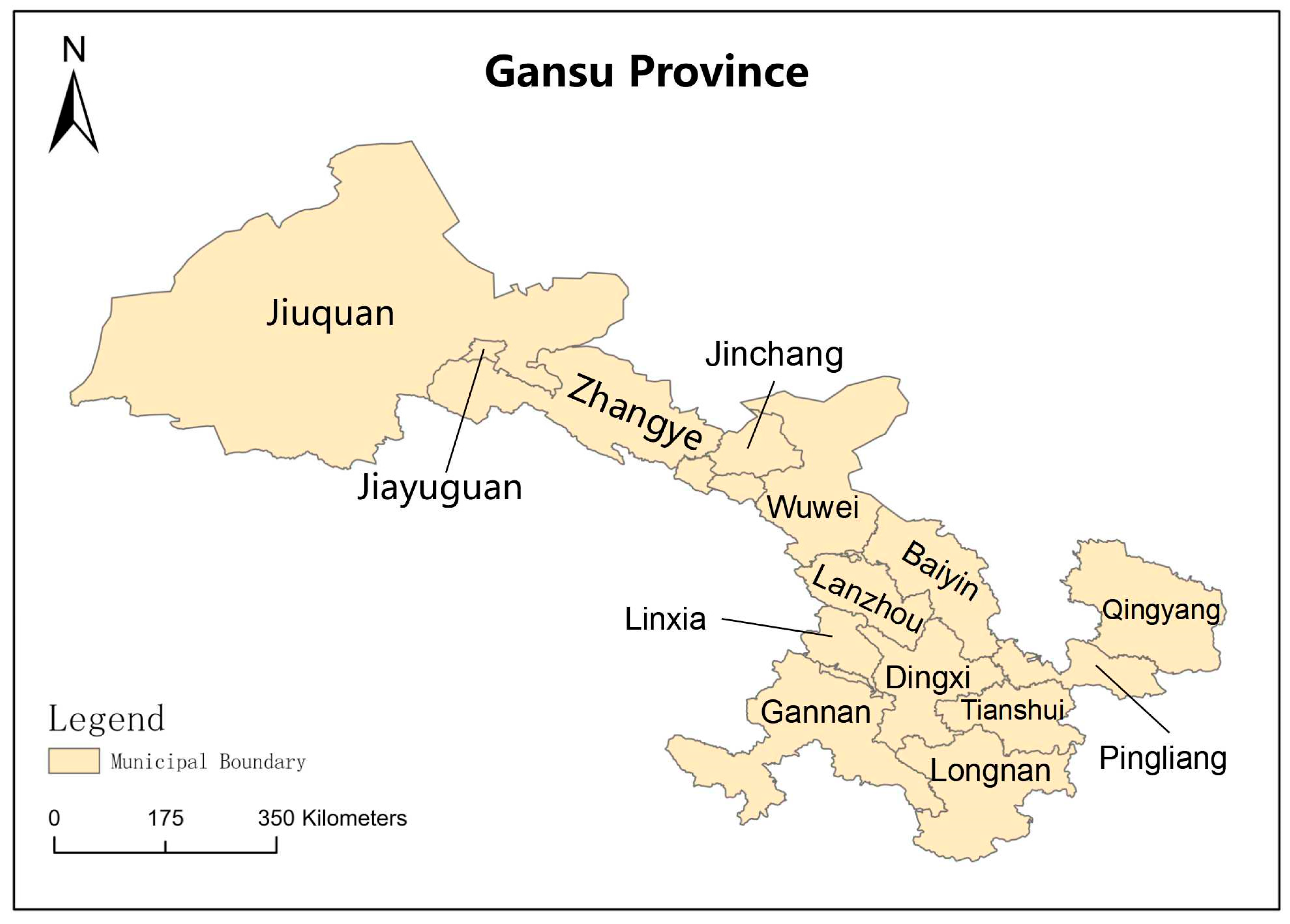
Gansu Province is located in northwestern China, bordering Shaanxi to the east, Sichuan and Qinghai to the south, Xinjiang to the west, and Ningxia and Inner Mongolia to the north. It serves as an important gateway for China’s westward opening and forms a key component of the national comprehensive transportation corridor system. Major national transport corridors, including the Longhai–Lanzhou–Xinjiang corridor and the Baotou–Lanzhou corridor, intersect within the province, giving Gansu distinctive characteristics as both a corridor-oriented and node-oriented region within China’s national integrated transportation network. The study area is shown in Figure 1.
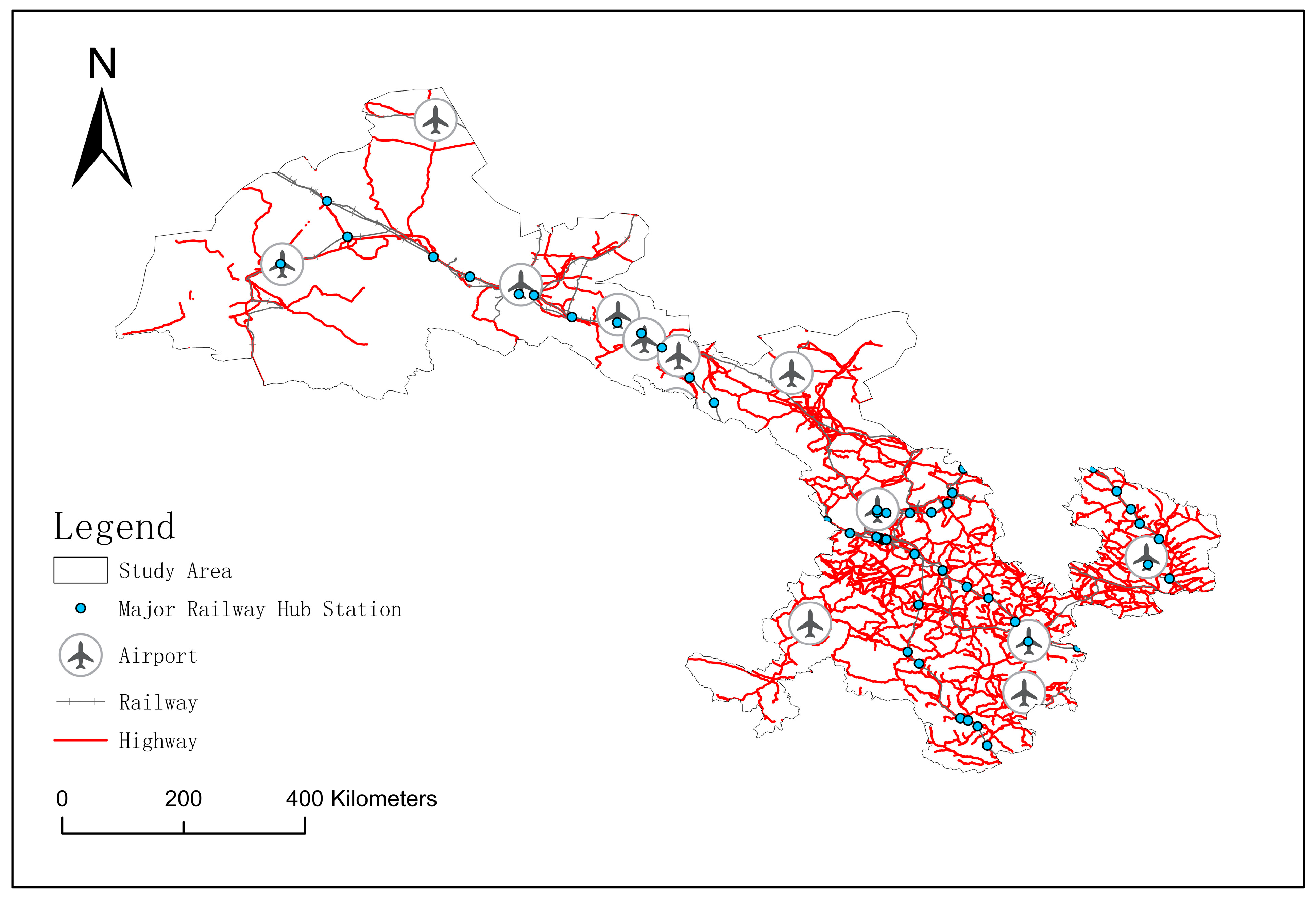
The comprehensive transportation hub system in Gansu Province exhibits a multi-nodal network structure centered on Lanzhou and distributed along major transportation corridors. As the provincial capital and a national-level comprehensive transportation hub, Lanzhou occupies a core position within the railway, aviation, and highway transport systems. It functions as a key gateway connecting Gansu Province to the national transportation network and plays a prominent role in traffic organization, distribution, and modal transfer within the provincial transport system. With Lanzhou as the central hub, cities such as Tianshui, Baiyin, Zhangye, and Jiuquan have developed secondary hub nodes along major transportation corridors. These cities undertake important functions in regional traffic transfer and external connectivity and constitute essential components supporting the operation of the provincial integrated transportation network. The spatial structure of the hub system is shown in Figure 2.

2.2. Research Methods

To systematically evaluate the development levels and internal subsystem coordination of comprehensive transportation hub cities in Gansu Province, this study proposes a dual-dimensional analytical framework.
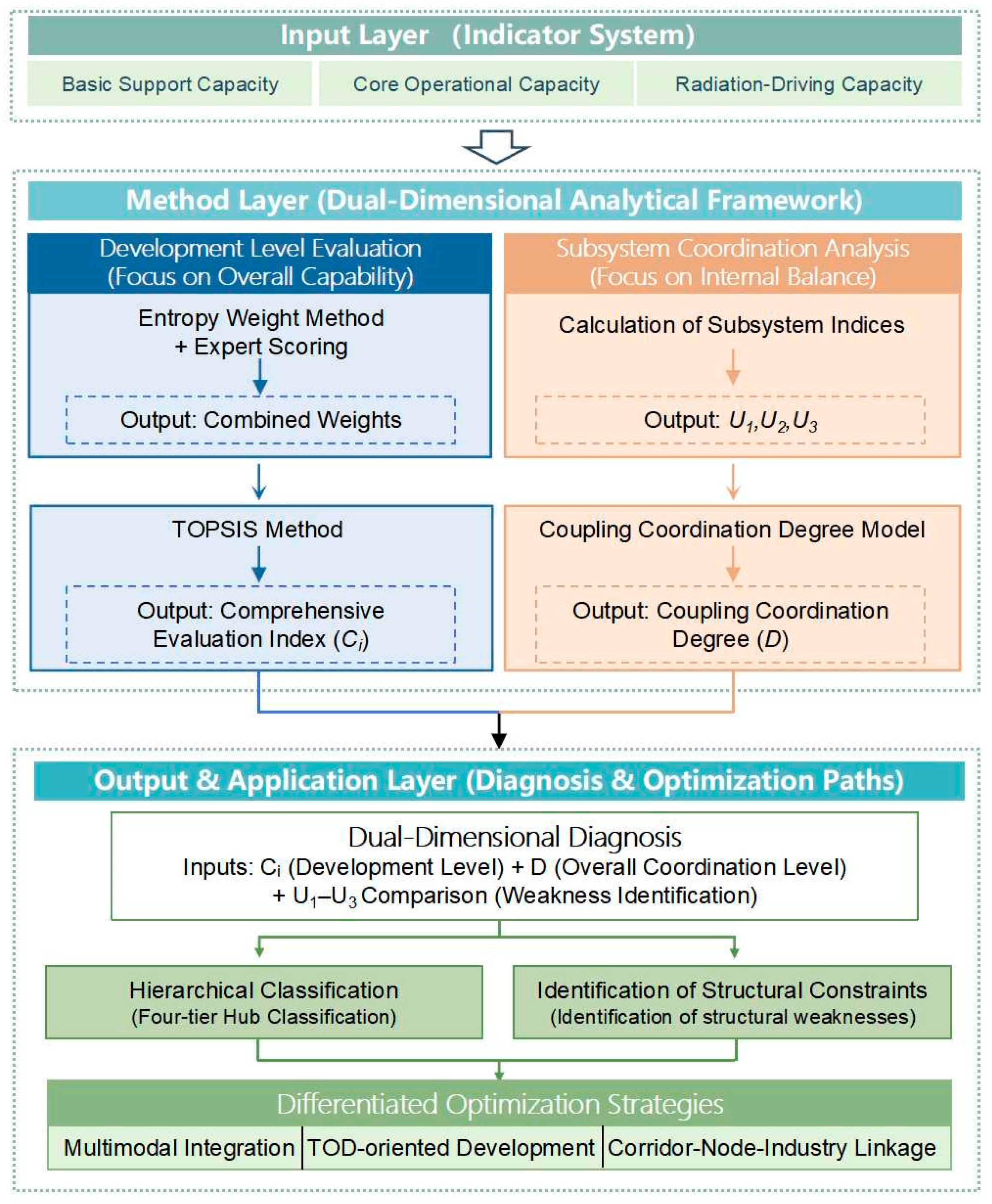
Shown in Figure 3, the methodological framework consists of three sequential layers: the indicator input layer, the dual-dimensional evaluation layer, and the diagnostic application layer. First, the input layer organizes the evaluation indicators into three functional dimensions: basic support capacity, core operational capacity, and radiation-driving capacity. These dimensions jointly describe the socio-economic foundation, transport operation function, and regional spillover role of comprehensive transportation hub cities. Second, the evaluation layer contains two parallel analytical procedures. The development-level evaluation branch applies entropy weighting, expert scoring, and the TOPSIS method to calculate the comprehensive evaluation index (Ci), which is used to identify the relative development hierarchy of hub cities. The subsystem-coordination branch aggregates the same indicator system into three subsystem indices (U1, U2, and U3) and further calculates the coupling coordination degree (D), which reflects the overall coordination state among the subsystems. Finally, the diagnostic application layer combines the development-level result and the subsystem-coordination result to support hierarchical classification, structural constraint identification, and differentiated optimization strategies. Through this workflow, the study links indicator construction, quantitative evaluation, and policy-oriented diagnosis within a unified analytical process.
Within this framework, the interpretation of the numerical indices is grounded in the functional structure of comprehensive transportation hub cities. The comprehensive evaluation index C i obtained through TOPSIS measures the relative closeness of each city to an ideal hub profile defined by the selected indicators. Since the indicator system covers socio-economic support, multimodal transport operation, and regional radiation capacity, C i is interpreted as a relative measure of the overall development level of a transportation hub city within the provincial comparison. By contrast, the subsystem indices U 1 , U 2 , and U 3 represent the performance of the three functional dimensions, and the coupling coordination degree D reflects the extent to which these dimensions develop in a balanced manner. A higher D therefore indicates stronger internal consistency among the supporting foundation, operational function, and radiation-driving capacity, rather than simply a larger transport scale. The combined interpretation of C i and D enables the study to distinguish between inter-city development hierarchy and intra-city subsystem coordination.

2.2.1. Construction of the Indicator System

This study considers both the scientific robustness of the evaluation method and the operational feasibility of the analysis, while placing particular emphasis on the availability and representativeness of indicators. Based on these considerations and in combination with locational characteristics and actual development conditions, an evaluation indicator system for the development level of comprehensive transportation hub cities in Gansu Province was constructed. The entropy weight method was adopted to determine objective weights. To prevent extreme value differences from compressing the weight distribution, natural logarithmic transformation was applied to selected indicators before calculation. Each indicator was then quantitatively processed. In addition, an expert scoring method was applied. Through questionnaire surveys, eight experts from the fields of transportation engineering, urban and rural planning, and geography were invited to evaluate the importance of each indicator. The final weights of the indicators were determined by integrating the entropy weight results with the expert evaluation scores. The results are shown in Table 1.
The indicator system was constructed according to the functional logic of comprehensive transportation hub cities rather than solely according to data availability. A comprehensive transportation hub city is understood in this study as a spatial-functional node that requires three interrelated capacities. First, basic support capacity reflects the socio-economic foundation that generates transport demand and supports hub development, including economic scale, population base, income level, and the development of transport-related industries. Second, core operational capacity reflects the actual ability of a city to organize multimodal transport services, and is represented by the availability of major transport facilities and the operational scale of railway, aviation, and highway systems. Third, radiation-driving capacity reflects the external service function and regional spillover role of a hub city, including its planning hierarchy and its contribution to provincial passenger and freight distribution. Therefore, the selected indicators correspond to the main functional requirements of comprehensive transportation hub cities: socio-economic support, multimodal operation, and regional radiation. Within the constraints of comparable prefecture-level data, these indicators provide a functional and operational basis for evaluating the development level and subsystem coordination of transportation hub cities in Gansu Province.

2.2.2. Data Processing

A data matrix was constructed using the “city–indicator” framework. Considering the differences in measurement units among the original data, the data were standardized before analysis. After standardization, all indicator values fall within the range of 0–1. Since all indicators in this study are positive indicators, the standardization formula is expressed as follows:
y i j = x i j m i n ( x j ) max x j m i n ( x j )
where y i j denotes the standardized value, and m a x ( x j ) denotes the maximum and minimum values of the dataset, respectively.

2.2.3. Evaluation Parameters

(1)
Calculation of the Difference Coefficient d j Using the Entropy Weight Method
First, the proportion matrix is calculated as follows:
p i j = y i j i = 1 m y i j
Next, the entropy value is calculated according to
e j = k i = 1 m p i j ln ( p i j )
where
k = 1 ln ( m )
The natural logarithm is used in the entropy calculation. Since the entropy value is normalized by k = 1 / ln ( m ) , the choice of logarithm base does not affect the final entropy weights.
Then, the difference coefficient is calculated using the following formula:
d j = 1 e j
where i = 1,2 , , m   denotes the evaluation units, namely the 14 prefecture-level cities and prefectures in Gansu Province, and j = 1,2 , , n   denotes the tertiary indicators. In the proportion matrix p i j , the summation is taken over all evaluation units i ; therefore, m refers to the number of cities or prefecture-level units rather than the number of indicators. In this study, m = 14 and n = 19 . The entropy constant is defined as k = 1 / ln ( m ) , which is used to normalize the entropy value. p i j denotes the proportion of the standardized value of the j -th tertiary indicator for the i -th city, e j denotes the entropy value of the j -th tertiary indicator, and d j denotes the difference coefficient of the j -th tertiary indicator.
(2)
Weight Calculation
To prevent scale indicators from dominating institutional indicators and to avoid extreme values causing a single dimension to dominate the results, this study adopts a hierarchical weighting approach followed by a flattening process. The calculation formula is as follows:
w j c = d j d j
In hierarchical weighting, d j denotes the sum of the difference coefficients of all tertiary indicators under the corresponding secondary indicator.
The weights of secondary indicators are obtained by summing the difference coefficients of their corresponding tertiary indicators and then normalizing the results. Similarly, the weights of primary indicators are derived from the normalized sums of the difference coefficients of their corresponding secondary indicators.
After the hierarchical weighting process, the final objective weight of each tertiary indicator was obtained by expanding the weights along its corresponding indicator hierarchy:
w j = w j a × w j b × w j c
where w j denotes the final objective weight of the j -th tertiary indicator; w j a denotes the weight of the first-level indicator to which the j -th tertiary indicator belongs; w j b denotes the weight of the corresponding second-level indicator within that first-level indicator; and w j c denotes the local weight of the j -th tertiary indicator within its second-level indicator group. Through this hierarchical expansion, the final weight reflects the relative importance of each tertiary indicator within the overall indicator system while maintaining the structural relationship among first-level, second-level, and tertiary indicators.
The final weight of each tertiary indicator was obtained by combining the objective weight and the expert-scoring weight:
W j = λ w j + ( 1 λ ) w j e
where W j denotes the final weight of the j -th tertiary indicator, w j denotes the objective weight derived from the hierarchical entropy-weighting procedure, and w j e denotes the normalized expert-scoring weight. In the baseline evaluation, λ = 0.5 was used, meaning that equal importance was assigned to the data-driven objective weight and the expert-based judgment. This setting was adopted because the indicator system contains both quantitative statistical indicators and qualitative or policy-related indicators, such as planning positioning and facility availability. The equal-weight combination avoids relying solely on statistical dispersion while also preventing expert judgment from dominating the evaluation results.
Table 2 reports the objective weights, expert-derived weights, and final combined weights of the 19 tertiary indicators.
(3)
Calculation of Closeness Using the TOPSIS Method
The final weights are multiplied by the standardized matrix obtained from the entropy weight method to generate the weighted normalized matrix:
z i j = y i j × W j
where z i j denotes the weighted normalized value of the j -th tertiary indicator for the i -th city. The maximum value of each column in the weighted matrix is defined as the positive ideal solution z j + , while the minimum value is defined as the negative ideal solution z j .
Next, the Euclidean distance is used to calculate the distance between each city and the positive and negative ideal solutions.
Distance to the positive ideal solution D i + :
D i + = j = 1 n ( z i j z j + ) 2
Distance to the negative ideal solution D i :
D i = j = 1 n ( z i j z j ) 2
Finally, the relative closeness to the ideal solution C i is calculated, which serves as the comprehensive evaluation index in this study:
C i = D i D i + + D i

2.2.4. Coupling Coordination Degree Model

To characterize the synergistic relationships among the three subsystems of comprehensive transportation hub cities in Gansu Province, this study introduces a coupling coordination degree model to comprehensively measure the Basic Support Capacity of Hubs (U1), Core Operational Capacity of Hubs (U2), and Radiation-Driving Capacity of Hubs (U3), based on the established indicator system and corresponding weights.
First, a “city–indicator” raw data matrix is constructed. Min–max normalization (range standardization) is applied to all positive indicators to eliminate dimensional differences, normalizing the values of each indicator to the range [0, 1]. Subsequently, weighted summation of the standardized indicators is performed using the weights of the third-level indicators, and the results are aggregated according to their respective subsystems to obtain the subsystem comprehensive indices U 1 , U 2 , and U 3 for each city.
On this basis, a three-subsystem coupling function is adopted to calculate the coupling strength among the subsystems:
Coupling   degree :   C = 3 U 1 × U 2 × U 3 ( U 1 + U 2 + U 3 ) 3 1 / 3
Comprehensive   coordination   index   ( T ) :   T = α × U 1 + β × U 2 + γ × U 3
Coupling   coordination   degree   ( D ) :   D = C × T
where T denotes the comprehensive coordination index of the three subsystems, and α , β , and γ denote the weights assigned to basic support capacity, core operational capacity, and radiation-driving capacity, respectively. In this study, these parameters were derived from the final combined weights of the first-level indicators in the evaluation system. Specifically, the weights were set as α = 0.2473 , β = 0.5602 , and γ = 0.1925 , corresponding to the first-level weights of basic support capacity, core operational capacity, and radiation-driving capacity reported in Table 1.
A higher D value indicates a stronger degree of transition from “mutual interaction” to “synergistic enhancement” among the three subsystems.

2.2.5. Indicator Operationalization

The measurement approaches for the relevant indicators are described as follows.
(1)
Quantification of Qualitative Attributes
Dummy variables were introduced to quantify qualitative attributes, specifically whether a city is connected to the high-speed rail network and whether it possesses an airport. The assignment rules are defined as follows:
x i j = 1                     H a v i n g   H i g h S p e e d   R a i l w a y s   O r   A i r p o r t s 0                     N o t   H a v i n g   H i g h S p e e d   R a i l w a y s   O r   A i r p o r t s
(2)
Policy and Planning Positioning
The policy and planning positioning of each city was determined using a hierarchical scoring method. The assignment rules are presented in Table 3.
(3)
Calculation of the Share of Municipal Passenger Volume in the Provincial Total
Within the transportation structure of Gansu Province, due to differences in comprehensive transport infrastructure such as railways and airports, highway transportation undertakes the majority of intercity passenger flows. Therefore, this study uses the highway passenger transport volume of each prefecture-level city as the statistical measure and calculates its proportion of the provincial total to represent the passenger distribution capacity of each hub city.
(4)
Calculation of the Share of Municipal Freight Volume in the Provincial Total
Since highway freight transport accounts for the dominant share of the total comprehensive freight volume in the province, the highway freight transport volume of each prefecture-level city is used as a proxy indicator for municipal freight transport volume.
The above operationalization involves two necessary simplifications. First, high-speed railway access and airport availability are treated as binary variables because these indicators are intended to identify whether a prefecture-level city possesses key multimodal transport facilities within the provincial hub system. This treatment ensures comparability across all 14 prefecture-level units, but it does not fully capture differences in service frequency, facility scale, timetable intensity, or actual accessibility. These differences are partly reflected by other operational indicators, such as high-speed train trips and civil aviation passenger throughput, cargo and mail throughput, and aircraft movements. Nevertheless, the binary treatment may still simplify the functional differences among cities.
Second, highway passenger and freight volumes are used as proxy indicators for prefectural passenger and freight distribution capacity because complete and comparable intercity passenger- and freight-flow data across railway, aviation, and highway modes are not consistently available at the prefecture level. According to official transport statistics for Gansu Province, highway transport has accounted for more than 80% of intercity passenger and freight transport in recent years (Statistical Communiqués on National Economic and Social Development of Gansu Province). Therefore, highway passenger and freight volumes can provide a reasonable and comparable approximation of the relative distribution capacity of each prefecture-level unit within the provincial transport system.

2.3. Data Collection and Indicator Measurement

The specific data sources and calculation methods used in this study are summarized in Table 4.

3. Results

3.1. Development-Level Evaluation and Classification

Using the established evaluation index system, this study calculates the comprehensive development index of each prefecture-level city and prefecture in Gansu Province. The results are presented in Table 5.
The comprehensive evaluation index and classification results are consolidated in Table 5. The mean value of the comprehensive evaluation index is 0.3867, and the standard deviation is 0.1909. Based on the mean–standard deviation classification method, the 14 prefecture-level units are divided into four hub tiers. Lanzhou is the only Tier 1 core hub, with a C i value of 0.9640, far exceeding the provincial mean and indicating a strong concentration of hub resources and operational capacity. The Tier 2 backbone hubs include Tianshui, Jiayuguan, Jiuquan, Qingyang, and Zhangye, all of which have C i values above the provincial mean but below the Tier 1 threshold. These cities generally serve as important corridor nodes or regional transfer centers within the provincial transport network.
The Tier 3 general hubs, including Dingxi, Baiyin, Wuwei, Longnan, Jinchang, Linxia, and Gannan, have C i values below the provincial mean but above μ σ , indicating that they maintain certain basic hub functions but remain limited in comprehensive operational scale or regional radiation capacity. Pingliang is classified as the only Tier 4 terminal node, with a C i value of 0.1383, which is substantially lower than the provincial average.

3.2. Sensitivity Analysis of the Weighting Scheme

To examine whether the comprehensive evaluation results are sensitive to the combination of entropy-based objective weights and expert-derived weights, a focused sensitivity analysis was conducted by changing the value of λ in the final weighting formula. In addition to the baseline setting λ = 0.5 , two alternative scenarios were tested: λ = 0.3 , which assigns greater importance to expert-derived weights, and λ = 0.7 , which assigns greater importance to entropy-based objective weights. For each scenario, the final weights of the 19 tertiary indicators were recalculated, and the TOPSIS procedure and mean–standard deviation classification were repeated to obtain the comprehensive evaluation index C i , ranking, and hub tier of each prefecture-level unit.
Table 6 reports the sensitivity analysis results under the three weighting schemes. Overall, the main hub hierarchy remains generally stable across the three scenarios. Lanzhou remains the Tier 1 core hub and the highest-ranked city under all weighting schemes, indicating that its leading position is not sensitive to the choice of λ . Tianshui, Jiayuguan, Jiuquan, and Qingyang also remain stable as high-ranking backbone hubs. Pingliang remains the lowest-ranked unit and is consistently classified as the Tier 4 terminal hub.
Some variation is observed among middle-ranking cities whose C i values are close to the classification thresholds. In particular, Dingxi and Zhangye shift between Tier 2 and Tier 3 when λ = 0.3 , indicating that the classification of adjacent middle-tier cities is more sensitive to the relative importance assigned to expert-derived and entropy-based weights. However, under the baseline setting λ = 0.5 and the entropy-oriented setting   λ = 0.7 , the hub tiers remain unchanged. These results suggest that the main conclusion of a provincial-capital-led and corridor-oriented hub hierarchy is robust-to-moderate changes in the weighting scheme, while the interpretation of adjacent middle-tier cities should be treated with caution.

3.3. Spatial Distribution of Hub Development Levels

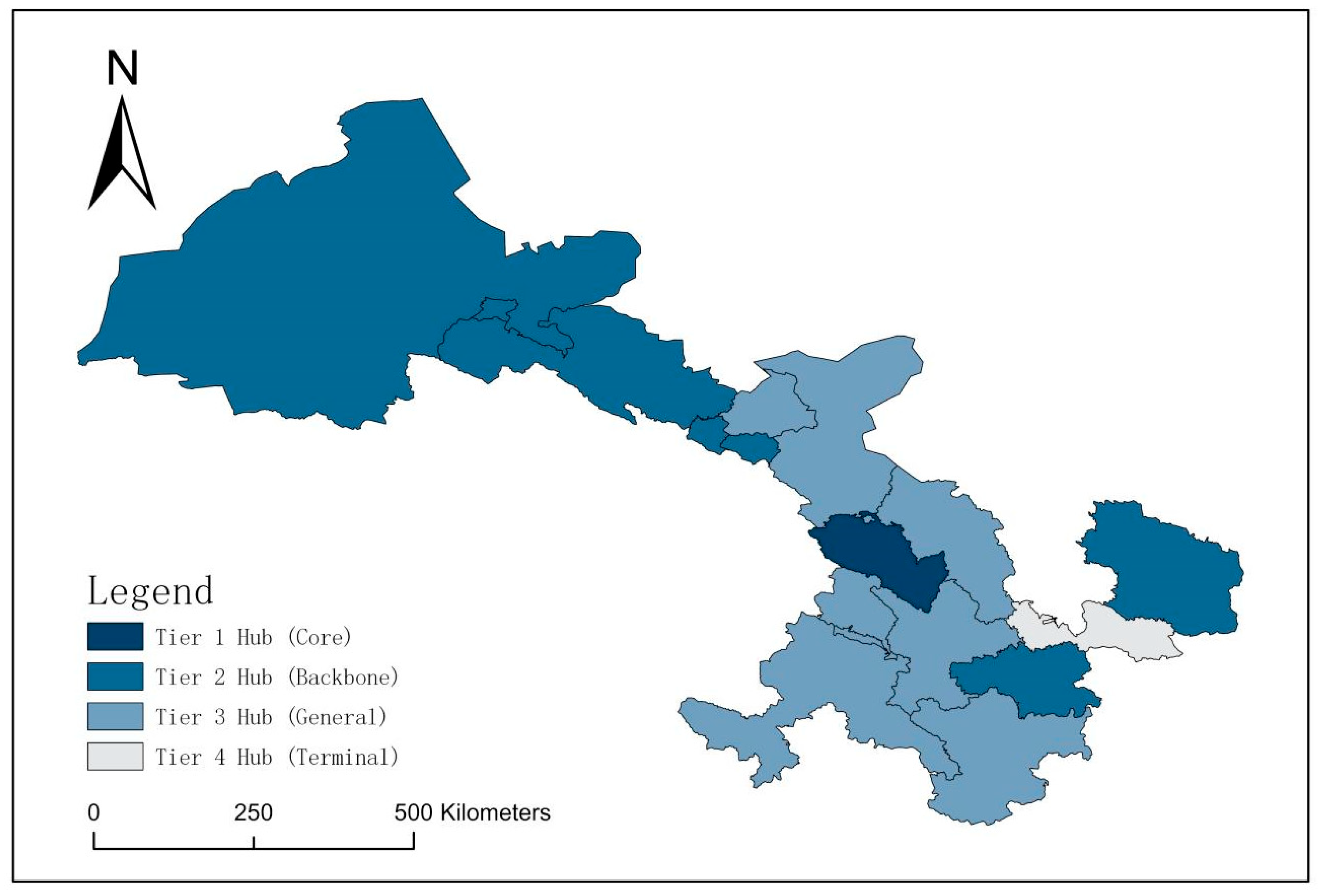
Figure 4 visualizes the spatial distribution of the four-tier classification of comprehensive transportation hub cities in Gansu Province. Overall, the development levels show a clear gradient pattern characterized by provincial-capital dominance and corridor-oriented distribution. Lanzhou, as the only Tier 1 core hub, occupies the highest position in the provincial hub system and forms the primary concentration of transport resources and hub functions. Tier 2 backbone hubs, including Tianshui, Jiayuguan, Jiuquan, Qingyang, and Zhangye, are mainly distributed along major transportation corridors or key regional connection axes. These cities play important supporting roles in regional traffic organization and corridor-based transfer functions, but their overall development levels remain lower than that of Lanzhou.
Tier 3 general hubs and the Tier 4 terminal hub are more widely distributed across the province and generally show lower comprehensive development levels. These cities maintain certain basic transport functions within their respective service areas, but their comprehensive hub capacity remains relatively limited compared with the core and backbone hubs. The spatial pattern indicates that the comprehensive transportation hub system of Gansu Province is not evenly distributed, but is shaped by the combined effects of provincial-capital concentration, corridor accessibility, and regional functional differentiation. This result further supports the need to interpret hub development not only through overall development rankings, but also through spatial position and subsystem coordination.

3.4. Coupling Coordination and Subsystem Weaknesses

The development-level classification based on C i describes the relative position of each hub city in the provincial system, while the subsystem scores U 1 , U 2 , and U 3 further reveal the internal functional structure behind this classification. Therefore, the tier results are interpreted together with the subsystem performance to identify whether each city is mainly supported or constrained by basic support capacity, core operational capacity, or radiation-driving capacity.
For descriptive interpretation, the coupling coordination degree D was classified into three categories in this study: D 0.50 indicates primary coordination, 0.30 D < 0.50 indicates near-coordination, and D < 0.30 indicates an uncoordinated state. These thresholds are adopted as descriptive categories for comparing the relative coordination status of the 14 prefecture-level units in this study, rather than as fixed policy standards or universally applicable classification criteria. Therefore, the categories are used to support the interpretation of subsystem balance and structural constraints, and the results should be understood as a relative diagnostic classification within the provincial sample.
Table 7 reports the subsystem indices and coupling coordination degree of the 14 prefecture-level units.
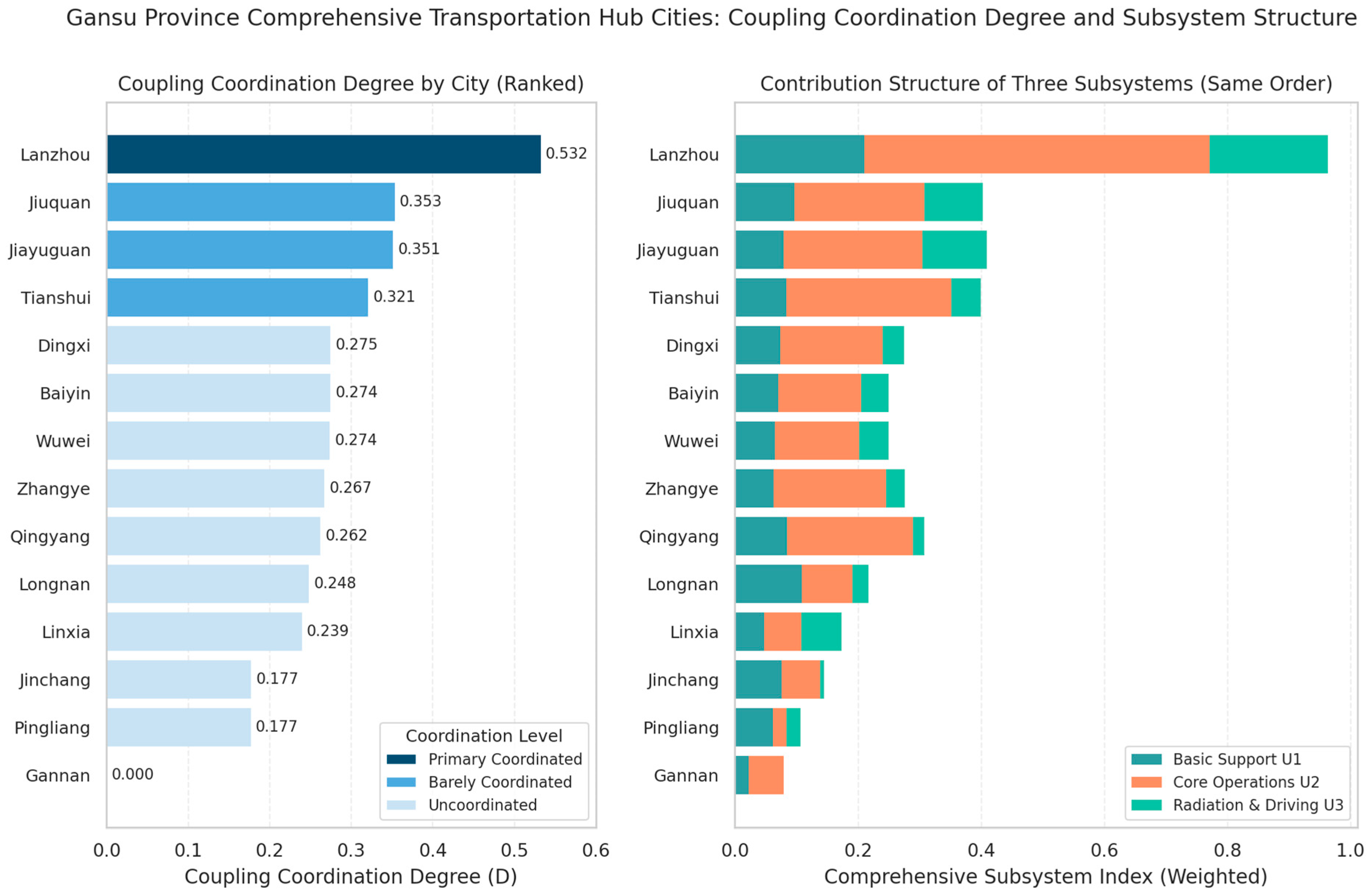
As shown in Table 7, Lanzhou has the highest coupling coordination degree ( D = 0.532 ) and reaches the primary coordination stage. Jiuquan ( D = 0.353 ) , Jiayuguan ( D = 0.351 ) , and Tianshui ( D = 0.321 ) fall into the near-coordination stage, while the remaining cities are classified as uncoordinated. These results indicate that the internal balance among basic support capacity, core operational capacity, and radiation-driving capacity remains uneven across the provincial hub system.
The comparison of U 1 , U 2 , and U 3 further shows that radiation-driving capacity is the weakest subsystem for most cities, indicating relatively limited performance in provincial passenger and freight distribution, planning hierarchy, or regional spillover capacity. By contrast, Jiayuguan and Linxia are mainly constrained by basic support capacity, while Pingliang is mainly constrained by core operational capacity.
For cities without civil airports, aviation-related indicators, including airport availability, passenger throughput, cargo and mail throughput, and aircraft movements, were assigned zero values to reflect the absence of aviation service capacity. In the current indicator system, these aviation-related indicators account for 22.85% of the total final weights and approximately 40.79% of the core operational capacity subsystem U 2 . Therefore, this treatment mainly affects cities without airports, especially Dingxi, Baiyin, Wuwei, Linxia, and Pingliang. Among them, Linxia and Pingliang are more sensitive to this treatment because their railway and highway operational indicators are also relatively weak, resulting in lower U 2 scores and consequently lower coupling coordination degrees. However, the effect of zero-valued aviation indicators should not be interpreted as the sole cause of low coordination, because   D is jointly determined by U 1 , U 2 , and U 3 . The results therefore indicate that the absence of aviation capacity may amplify existing core-operational constraints, while the overall coordination level still depends on the balance among all three subsystems.
Figure 5 visualizes the coupling coordination degree and subsystem structure reported in Table 6. The left panel presents the ranking of D , while the right panel compares the relative structure of U 1 , U 2 , and U 3 for each prefecture-level unit. This visualization further supports the diagnosis that hub development differences should be interpreted through both overall development level and subsystem coordination.

4. Discussion and Implications

Based on the comprehensive development-level evaluation and the coupling coordination analysis of the three subsystems—basic support capacity U 1 , core operational capacity U 2 , and radiation-driving capacity U 3 —the results indicate that the comprehensive transportation hub system in Gansu Province shows clear hierarchical differentiation and uneven subsystem coordination. The development-level classification reveals a four-tier hub structure, reflecting differences in resource endowment, infrastructure scale, and operational capacity among the 14 prefecture-level units. Meanwhile, the coupling coordination results show that some cities with a certain facility or operational foundation still face internal imbalance, especially in radiation-driving capacity. These findings suggest that a single comprehensive index cannot fully explain the structural constraints of hub development, while the coordination analysis alone cannot capture absolute differences in development level. Therefore, the following discussion is framed as possible planning implications derived from the dual-dimensional diagnostic results, rather than as tested policy prescriptions.
The following recommendations are policy implications derived from the diagnostic classification. They are intended as differentiated directions for hub development, whose feasibility and effectiveness can be examined in future work.
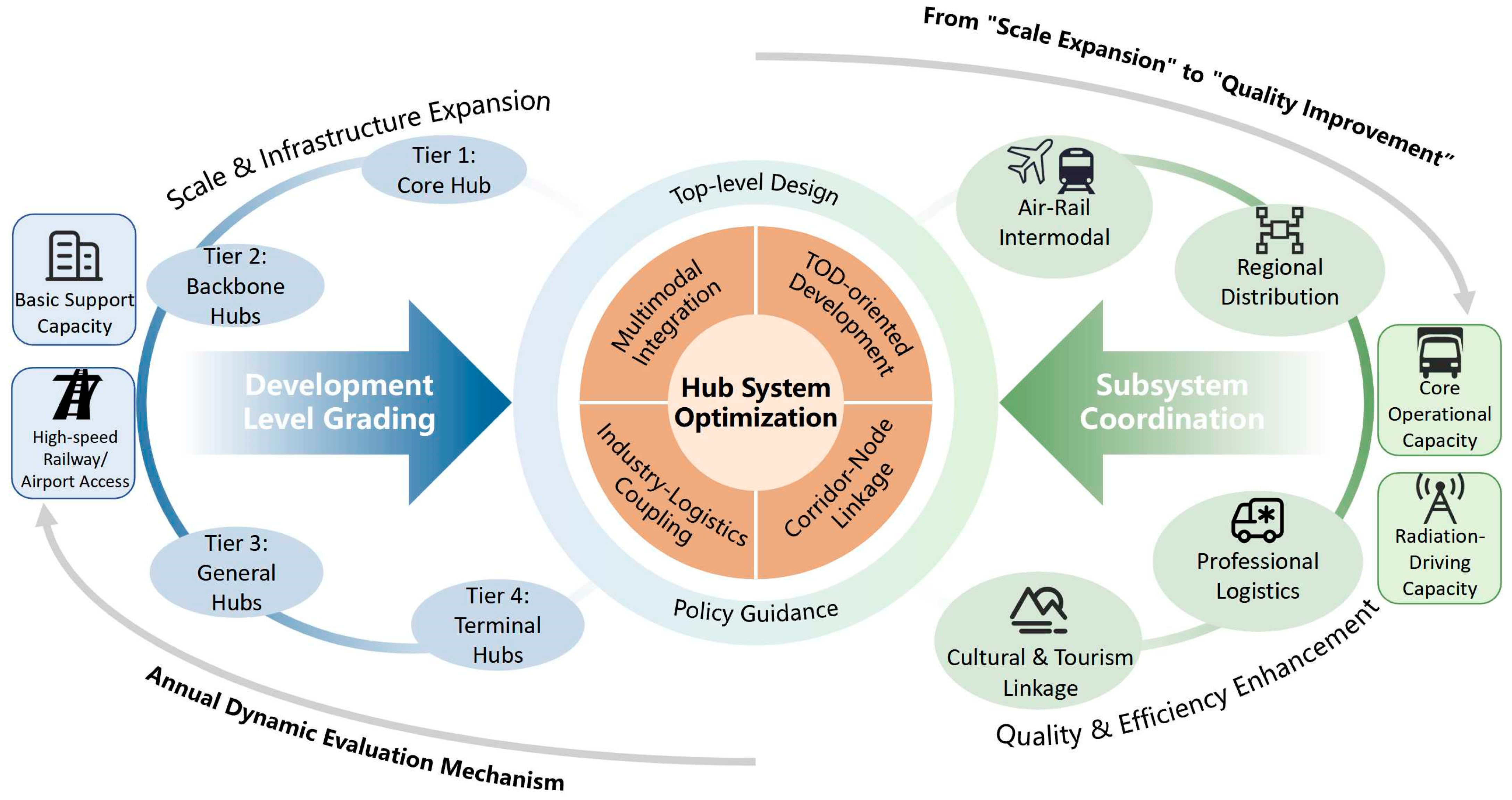
Based on the dual-dimensional evaluation results, Figure 6 organizes the diagnostic implications for provincial transportation hub development and illustrates possible directions for shifting from scale expansion toward quality improvement.

4.1. Province-Wide Overall Analysis

From a provincial perspective, future provincial planning may consider shifting attention from isolated infrastructural deficits toward the coordination of hub operation, multimodal connectivity, and regional radiation capacity. While maintaining backbone network accessibility and infrastructure inclusivity, greater attention could be given to improving hub operational organization and regional radiation capacities. At the provincial level, the development of a multimodal transport system and the coordinated layout of “corridor–node–industry” linkages could be further considered. Taking the Longhai–Lanxin National Comprehensive Transportation Corridor as the core axis, coordinated services among hubs along this corridor may help support the implementation of the “one document through” whole-process service for highway–railway–aviation multimodal transport. With the improvement of operational efficiency and the release of spillover driving effects as the core goals, such measures may support a stronger interaction between transportation facilities and territorial spatial development by optimizing the collection and distribution system, promoting Transit-Oriented Development (TOD) and hub economy cultivation. Meanwhile, an annual dynamic evaluation mechanism could be explored as a decision-support tool, while any linkage with funding allocation or project selection would require further institutional assessment and the warehousing of major projects, to help improve the consistency between investment priorities, project arrangements, and diagnosed development constraints.

4.2. Targeted Policy Implementation by Hub Grade

For the Tier 1 Core Hub (Lanzhou City), its comprehensive evaluation index is far higher than the provincial average, with outstanding advantages in infrastructure and scale. However, the coupling analysis shows that the radiation-driven capacity is still the core shortboard, and the improvement of regional linkage efficiency may deserve further attention. In this regard, on the basis of consolidating the existing scale advantages, possible planning attention could be placed on strengthening the multimodal transport organization capacity and the in-depth coupling level of industry and logistics. The development of air–rail intermodal services between Lanzhou Inland Port and Zhongchuan International Airport could be considered as one possible direction for strengthening Lanzhou’s hub function. Further coordination among port, station, airport, and logistics functions may help improve multimodal organization and support stronger links between the hub and leading provincial industries such as new energy and equipment manufacturing. These measures may contribute to a gradual transition from scale advantage toward stronger functional integration and regional spillover capacity.
For Tier 2 Backbone Hubs (Tianshui City, Jiayuguan City, Jiuquan City, Qingyang City, Zhangye City), they have a certain foundation in comprehensive development level, but their coupling coordination degrees are mostly in the near-coordination range, with insufficient matching between subsystems and limited radiation radius. The diagnostic results suggest that possible planning priorities may include addressing structural weaknesses with city-specific targeted policies and improving regional distribution and transfer capacity: Tianshui may further improve passenger distribution functions in southeastern Gansu; Jiuquan and Jiayuguan could explore coordinated hub functions; Zhangye may consider cold-chain logistics services for characteristic agricultural products; and Qingyang may strengthen logistics services related to the energy industry. These measures could support the gradual functional upgrading of backbone hubs from transit corridor nodes toward regional distribution centers. Meanwhile, stable passenger and freight demand could be cultivated through local industries and characteristic resources, which may help improve hub operation intensity and subsystem coordination.
For Tier 3 general hubs and the Tier 4 terminal hub, the diagnostic results indicate relatively low comprehensive development levels and weak subsystem coordination. For these cities, short-term development should not be understood as the immediate pursuit of a large-scale high-speed railway or regional aviation projects, as such investments may be constrained by demand, cost, planning priorities, and implementation feasibility. More practical priorities may include improving feeder connections to nearby higher-tier hubs, strengthening road-based collection and distribution systems, optimizing scheduled intercity passenger and freight services, and enhancing the linkage between transport services and local industries such as agriculture, animal husbandry, cultural tourism, and mineral resources. Major rail or aviation investments would need to be considered only when supported by planning, demonstrated demand, and feasibility assessment. Therefore, the development path for lower-tier hubs may emphasize a gradual process of basic accessibility improvement, operational organization enhancement, and demand cultivation, rather than the direct expansion of high-cost hub infrastructure.

4.3. Methodological Discussion and Limitations

In general, the dual-dimensional evaluation framework of “development-level grading + coupling coordination degree analysis” helps address some limitations of relying on a single evaluation method. The development-level grading results clarify the relative position and resource endowment differences in different cities within the provincial hub system, while the coupling coordination analysis helps identify internal structural constraints among basic support capacity, core operational capacity, and radiation-driving capacity. Therefore, the framework provides an analytical basis for differentiated planning discussion.
Future planning and empirical evaluation may further examine how differentiated hub development support, cross-departmental coordination, dynamic monitoring, infrastructure improvement, operational organization, and industrial layout adjustment can be combined in practice. This would help assess whether improvements in hub capacity can be translated into broader regional development effects. Meanwhile, the dual-dimensional evaluation framework constructed in this study may provide an analytical reference for the evaluation of transportation hubs in similar corridor-oriented inland regions, although its applicability should be further tested through comparative and longitudinal studies.
The zero-value treatment of aviation-related indicators provides a consistent way to represent the absence of aviation service capacity, but it may also increase the sensitivity of U 2 and D for cities without airports. Future studies could further test this effect by recalculating the subsystem coordination results after excluding aviation-related indicators or by replacing binary facility variables with more detailed accessibility, service-frequency, and facility-scale measures.

5. Conclusions and Outlook

Based on the development-level grading via the entropy weight TOPSIS method and the coupling coordination degree model of the three subsystems U 1 , U 2 , and U 3 , this study conducts a systematic evaluation and typological analysis of comprehensive transportation hubs at the provincial level in 14 prefectures and cities of Gansu Province. The results reveal the corridor-oriented and multi-nodal characteristics of Gansu’s transportation hub system, confirm the progress made in corridor connectivity and hub network development, and identify differentiated directions for future improvement. The main conclusions are drawn as follows:
First, the comprehensive transportation hubs in Gansu Province show obvious characteristics of hierarchical structure and zonal distribution along the Longhai–Lanxin Corridor, forming a clear four-tier gradient structure. Lanzhou City is the only Tier 1 Core Hub, with a comprehensive evaluation index of 0.9640, which is 2.49 times the provincial average of 0.3867, showing an extremely significant leading advantage. The 5 Tier 2 Backbone Hubs, including Tianshui, Jiayuguan, Jiuquan, Qingyang, and Zhangye, all have comprehensive indexes higher than the provincial average, and all high-grade hubs are concentrated in the provincial capital and the Longhai–Lanxin national main traffic axis. The 7 Tier 3 General Hubs and 1 Tier 4 Terminal Hub have comprehensive indexes lower than the provincial average, and most medium and low-grade hubs are distributed in the provincial marginal areas, ecologically restricted areas or resource-based cities, with a prominent characteristic of unbalanced spatial distribution.
Second, there is a significant complementarity between hub development level and coupling coordination degree: facility scale expansion alone cannot achieve the collaborative improvement of hub functions. Among the 14 prefectures and cities, only Lanzhou City has a coupling coordination degree of 0.532, which is the only city in the province entering the primary coordination range. The coupling coordination degrees of the three Tier 2 Hubs, Jiuquan, Jiayuguan, and Tianshui, are 0.353, 0.351, and 0.321 respectively, all in the near-coordination range. The remaining 10 prefectures and cities have coupling coordination degrees lower than 0.3, all in the imbalance range, indicating a low overall coordination level in the province. Meanwhile, the weakest subsystem of 12 out of the 14 prefectures and cities is the Radiation-Driving Capacity of Hubs (U3). Although some cities have high scores in scale or infrastructure indicators, the internal imbalance of subsystems leads to insufficient spillover effects. Core cities represented by Lanzhou show a high development level but need to strengthen the radiation-driven function; backbone nodes represented by Jiuquan and Tianshui need to transform from “transit corridor nodes” to “regional distribution centers” to solve the problem of insufficient matching between subsystems.
Third, for low-grade hubs in the imbalance range, priority should be given to breaking through core bottlenecks in the short term. Among them, Pingliang City, the Tier 4 Terminal Hub, has a comprehensive evaluation index of only 0.1383, less than 36% of the provincial average, with the core shortboard being the Core Operational Capacity of Hubs (U2). The 7 Tier 3 Hubs, including Gannan and Linxia, score below the provincial average, sharing common deficiencies in basic support infrastructure and operational organization. For these cities, short-term priorities should focus on overcoming bottlenecks in network access and operational management. Furthermore, stable passenger and freight flows must be cultivated by integrating local industries and cultural tourism, thereby laying the groundwork for long-term functional expansion. Overall, improving a single indicator alone is difficult to achieve a qualitative change in hub functions, and attention must be paid to both core paths of scale expansion and subsystem coordination.
Based on these findings, future improvement of Gansu’s comprehensive transportation hub system may focus on three aspects. First, corridor–node coordination should be further strengthened by improving the functional linkage between Lanzhou, backbone corridor hubs, and lower-tier regional nodes. Second, multimodal transport organization, feeder connectivity, and collection–distribution services could be improved to enhance the operational efficiency of hub cities and reduce subsystem imbalance. Third, the linkage between transportation hubs and local industries, such as logistics, energy, agriculture, cultural tourism, and characteristic manufacturing, should be further examined to support the transformation of hub development from infrastructure expansion toward functional integration. Future research may also introduce time-series data, facility-level operation data, mobile signaling data, and freight tracking data to examine the dynamic evolution of hub hierarchy and coupling coordination, and to further test the applicability of the proposed framework in other corridor-oriented inland regions.

Author Contributions

Conceptualization, H.C. and T.S.; methodology, H.C., T.S., G.Z. and F.G.; software, J.Y. and G.L.; validation, Y.L. and Y.Y.; formal analysis, H.C. and T.S.; investigation, F.G. and J.Y.; resources, G.Z.; data curation, T.S. and G.L.; writing—original draft preparation, H.C. and T.S.; writing—review and editing, G.Z., H.C. and T.S.; visualization, Y.L. and Y.Y.; supervision, G.Z.; project administration, G.Z.; funding acquisition, G.Z. All authors have read and agreed to the published version of the manuscript.

Funding

This research was funded by the Gansu Provincial Project of the Central Government-guided Local Science and Technology Development Fund (No. 25ZYJA015).

Data Availability Statement

Data will be made available on request.

Conflicts of Interest

The authors declare no conflicts of interest.

References

  1. Buser, M.A.; Ramezani, S.; Stead, D.; Arts, J. Policy packaging for land-use and transport planning: The state-of-the-art. Transp. Rev. 2025, 45, 333–365. [Google Scholar] [CrossRef]
  2. Banister, D. The sustainable mobility paradigm. Transp. Policy 2008, 15, 73–80. [Google Scholar] [CrossRef]
  3. Cho, S.; Choi, K. Transport accessibility and economic growth: Implications for sustainable transport infrastructure investments. Int. J. Sustain. Transp. 2021, 15, 641–652. [Google Scholar]
  4. Moeckel, R.; Garcia, C.L.; Chou, A.T.M.; Okrah, M.B. Trends in integrated land-use/transport modeling: An evaluation of the state of the art. J. Transp. Land Use 2018, 11, 463–476. [Google Scholar] [CrossRef]
  5. Fan, Y.; Ding, J.; Liu, H.; Wang, Y.; Long, J. Large-scale multimodal transportation network models and algorithms-Part I: The combined mode split and traffic assignment problem. Transp. Res. Part E Logist. Transp. Rev. 2022, 164, 102832. [Google Scholar] [CrossRef]
  6. Liang, P.; Cui, X.; Lin, M.; Yang, T.; Wu, B. High-speed rail effects on station area-level business commercial agglomeration: Evidence from 110 stations in China. Front. Environ. Sci. 2022, 10, 1045959. [Google Scholar] [CrossRef]
  7. Komikado, H.; Morikawa, S.; Bhatt, A.; Kato, H. High-speed rail, inter-regional accessibility, and regional innovation: Evidence from Japan. Technol. Forecast. Soc. Change 2021, 167, 120697. [Google Scholar] [CrossRef]
  8. Zeng, Z.; Wang, M.; Gao, X.; Wang, N. Exploring Passenger Satisfaction in Multimodal Railway Hubs: A Social Media-Based Analysis of Travel Behavior in China’s Major Rail Stations. Sustainability 2024, 16, 4881. [Google Scholar] [CrossRef]
  9. Fan, Z.; Luo, W.; Liu, C.; Xie, M. The Role of Comprehensive Transportation in Shaping Spatial Expansion Patterns: A Case Study of the Yangtze River Middle Reaches Urban Agglomeration. Land 2025, 14, 1064. [Google Scholar] [CrossRef]
  10. Shang, X.; Yang, K.; Luo, Q.; Miao, B. Robust optimization models for the hierarchical cost-minimizing hub covering problem in the urban agglomeration comprehensive transport system. Int. J. Gen. Syst. 2026, 55, 367–401. [Google Scholar]
  11. Xiong, Q.; Hu, J.; Kuai, J. Comprehensive Transportation Corridor Layout of Urban Agglomeration Based on Improved Ant Colony Algorithm. In Proceedings of the Sixth International Conference on Transportation Engineering (ICTE 2019), Chengdu, China, 20–22 September 2019; pp. 77–85. [Google Scholar]
  12. Zhang, Y.; Zheng, S.; Chen, Y. Identification of Key Nodes in Comprehensive Transportation Network: A Case Study in Beijing-Tianjin-Hebei Urban Agglomeration, China. Transp. Res. Rec. 2024, 2678, 827–840. [Google Scholar]
  13. Yue, M.; Ma, S.; Zhou, W.; Chen, X. Estimation Markov Decision Process of Multimodal Trip Chain between Integrated Transportation Hubs in Urban Agglomeration Based on Generalized Cost. J. Adv. Transp. 2022, 2022, 5027133. [Google Scholar] [CrossRef]
  14. Zhao, L.; Jia, Y. Interactive Correlation between Economy and Integrated Transportation Development of Metropolitan Areas in China: Quantitative Study. J. Urban Plan. Dev. 2021, 147, 05021041. [Google Scholar] [CrossRef]
  15. DeCorla-Souza, P. A Sustainable and Equitable Approach to Financing Multimodal Transportation Alternatives in Metropolitan Areas. J. Am. Plan. Assoc. 2024, 90, 486–493. [Google Scholar]
  16. Zhao, J.; Li, X.; Lu, H.; Yang, X.; Shen, K. Research on Carrying Capacity of Integrated Transportation in Guanzhong Plain Urban Agglomeration. In CICTP 2019: Transportation in China-Connecting the World; American Society of Civil Engineers (ASCE): Reston, VA, USA, 2019; pp. 4829–4840. [Google Scholar]
  17. Shen, D.; Li, X.; Zhao, H. Spatial Differentiation of Multi-Airport Logistics in Four Urban Agglomerations in China. Sustainability 2023, 15, 7346. [Google Scholar] [CrossRef]
  18. Li, J.; Li, H.; Zhao, X. Spatial-temporal evolution theory and influencing mechanisms of the express delivery network: A case on YTO express in China. Transp. Policy 2025, 171, 408–424. [Google Scholar] [CrossRef]
  19. Geng, Q.; Jia, Y.; Yin, X. How Rail Transit Access Mode Affects Airport Landside Traffic Sharing Rate: Evidence from Beijing, China. J. Urban Plan. Dev. 2024, 150, 04023051. [Google Scholar] [CrossRef]
  20. Xie, F.; Wang, T.; Xu, H. Research on the Location of Cross-Border Logistics Hub for the Belt and Road Initiative. Transp. Res. Rec. 2025, 2679, 358–376. [Google Scholar] [CrossRef]
  21. Wang, Y.; Xu, Z.; Liang, J. Impact of transportation hubs on urban economic resilience: Evidence from national comprehensive transportation hub cities. Transp. Res. Part A Policy Pract. 2026, 203, 104751. [Google Scholar] [CrossRef]
  22. Yu, J.; Weng, J.; Chai, J.; Lin, P.; Wang, T. The spatial efficiency evaluation and classification of multi-modal passenger transportation hubs: A case study in Beijing-Tianjin-Hebei urban agglomeration, China. Transp. Policy 2025, 173, 103811. [Google Scholar] [CrossRef]
  23. Liu, J.; Lu, H.; Chen, M.; Wang, J.; Zhang, Y. Macro perspective research on transportation safety: An empirical analysis of network characteristics and vulnerability. Sustainability 2020, 12, 6267. [Google Scholar] [CrossRef]
  24. Zhong, G.; Wan, X.; Zhang, J.; Yin, T.; Ran, B. Characterizing passenger flow for a transportation hub based on mobile phone data. IEEE Trans. Intell. Transp. Syst. 2017, 18, 1507–1518. [Google Scholar]
  25. Wen, X.; Si, B.; Xu, M. A comprehensive resilience assessment model for transportation hub considering passenger spatial mobility efficiency. Transp. A Transp. Sci. 2025, 1–37. [Google Scholar] [CrossRef]
  26. Zhang, M.; Yang, X.; Li, Y.; Li, G. Comprehensive impact analysis of a transportation hub complex under earthquake effects: A case in China. J. Infrastruct. Syst. 2024, 30, 04024026. [Google Scholar] [CrossRef]
  27. Rosik, P.; Wójcik, J. Transport Infrastructure and Regional Development: A Survey of Literature on Wider Economic and Spatial Impacts. Sustainability 2023, 15, 548. [Google Scholar]
  28. Yigitcanlar, T.; Kamruzzaman, M. Investigating the Interplay between Transport, Land Use and the Environment: A Review of the Literature. Int. J. Environ. Sci. Technol. 2014, 11, 2121–2132. [Google Scholar] [CrossRef]
  29. Akse, R.; Geurs, K.; Thomas, T. Mobility and Accessibility Paradigms in Dutch Policies: An Empirical Analysis. J. Transp. Land Use 2021, 14, 1317–1340. [Google Scholar] [CrossRef]
  30. Yao, L.-Y.; Xia, X.-F.; Sun, L.-S. Transfer Scheme Evaluation Model for a Transportation Hub Based on Vectorial Angle Cosine. Sustainability 2014, 6, 4152–4162. [Google Scholar] [CrossRef]
  31. Chauhan, V.; Gupta, A.; Parida, M. Demystifying Service Quality of Multimodal Transportation Hub (MMTH) through Measuring Users’ Satisfaction of Public Transport. Transp. Policy 2021, 102, 47–60. [Google Scholar] [CrossRef]
  32. Yang, Y.; Hu, M.; Yin, J.; Wu, W. Spatio-Temporal Evolution and Influencing Factors of Supply-Demand Coupling and Coordination in Civil Aviation Passenger Transport. Appl. Sci. 2025, 15, 1362. [Google Scholar] [CrossRef]
Figure 1. Study Area.
Land 15 01098 g001
Figure 2. Comprehensive Transportation Hub System of Gansu Province.
Land 15 01098 g002
Figure 3. Research framework.
Land 15 01098 g003
Figure 4. Classification of Development Levels of Comprehensive Transportation Hub Cities in Gansu Province.
Land 15 01098 g004
Figure 5. Coupling coordination degree and subsystem structure of comprehensive transportation hub cities in Gansu Province.
Land 15 01098 g005
Figure 6. Diagnostic implication framework for comprehensive transportation hub development based on dual-dimensional evaluation.
Land 15 01098 g006
Table 1. Evaluation Indicator System for the Development Level of Comprehensive Transportation Hub Cities in Gansu Province.
First-Level Indicators and WeightsSecond-Level Indicators and WeightsThird-Level IndicatorsIndicator Weight
Basic Support Capacity of Hubs (24.73%)Basic Economic and Social Development (14.57%) D 1 GDP in 2024 (100 million yuan)4.73%
D 2 Permanent Urban and Rural Population (10,000 persons)3.02%
D 3 Per Capita Disposable Income of Urban Residents (yuan)2.49%
D 4 Revenue of Transportation, Warehousing and Postal Services (10,000 yuan)4.33%
Economic and Social Development Potential (10.16%) D 5 GDP Increment during the 14th Five-Year Plan Period (100 million yuan)3.17%
D 6 Increment of Permanent Urban and Rural Population (10,000 persons)2.59%
D 7 Increment of Per Capita Disposable Income of Urban Residents (yuan)2.28%
D 8 Value-Added of Transportation, Warehousing and Postal Services (10,000 yuan)2.12%
Core Operational Capacity of Hubs (56.02%)Scale of Comprehensive Transportation Hub Infrastructure (13.23%) D 9 Access to High-Speed Railway Network7.64%
D 10 Availability of Airport5.59%
Railway Operation Scale (14.44%) D 11 High-Speed/EMU Train Trips (trains)14.44%
Civil Aviation Operation Scale (17.26%) D 12 Passenger Throughput (10,000 persons)6.21%
D 13 Cargo and Mail Throughput (10,000 tons)6.4%
D 14 Aircraft Movements (take-offs and landings)4.65%
Highway Operation Scale (11.09%) D 15 Total Highway Passenger Volume (10,000 persons)6.12%
D 16 Total Highway Freight Volume (10,000 tons)4.97%
Radiation-Driving Capacity of Hubs (19.25%)Industrial Status (7.03%) D 17 Policy and Planning Positioning7.03%
Radiation Intensity Dimension (12.22%) D 18 Proportion of Prefectural Passenger Volume in the Province (%)6.34%
D 19 Proportion of Prefectural Freight Volume in the Province (%)5.88%
Note: D 9 and D 10 are binary variables indicating whether a city is connected to the high-speed railway network and whether it has a civil airport. D 17 is an assigned score based on policy and planning positioning. D 18 and D 19 are calculated as the shares of prefectural passenger and freight volumes in the provincial total.
Table 2. Objective weights, expert-derived weights, and final combined weights of tertiary indicators.
CodeTertiary IndicatorObjective Weight ( w j )Expert-Derived Weight ( w j e )Final Weight ( W j )
D 1 GDP in 20246.86%2.60%4.73%
D 2 Permanent Urban and Rural Population4.17%1.87%3.02%
D 3 Per Capita Disposable Income of Urban Residents3.17%1.81%2.49%
D 4 Revenue of Transportation, Warehousing and Postal Services6.06%2.60%4.33%
D 5 GDP Increment during the 14th Five-Year Plan Period3.74%2.60%3.17%
D 6 Increment of Permanent Urban and Rural Population3.31%1.87%2.59%
D 7 Increment of Per Capita Disposable Income of Urban Residents2.75%1.81%2.28%
D 8 Value-Added of Transportation, Warehousing and Postal Services1.64%2.60%2.12%
D 9 Access to High-Speed Railway Network6.31%8.97%7.64%
D 10 Availability of Airport6.32%4.86%5.59%
D 11 High-Speed/EMU Train Trips11.34%17.54%14.44%
D 12 Passenger Throughput7.53%4.89%6.21%
D 13 Cargo and Mail Throughput9.19%3.61%6.4%
D 14 Aircraft Movements6.57%2.73%4.65%
D 15 Total Highway Passenger Volume5.58%6.66%6.12%
D 16 Total Highway Freight Volume4.80%5.14%4.97%
D 17 Policy and Planning Positioning1.20%12.86%7.03%
D 18 Proportion of Prefectural Passenger Volume in the Province 4.65%8.03%6.34%
D 19 Proportion of Prefectural Freight Volume in the Province4.80%6.96%5.88%
Table 3. Scoring Rules for Policy and Planning Positioning.
ClassificationInternational Comprehensive Transportation Hub CityNational Comprehensive Transportation Hub CityRegional Comprehensive Transportation Hub City
Assigned score321
Table 4. Data Sources.
Main DataSources
D 1 GDP in 2024 (100 million yuan)Gansu Statistical Yearbook
D 2 Permanent urban and rural population (10,000 persons)
D 3 Per capita disposable income of urban residents (yuan)
D 4 Revenue of transportation, warehousing, and postal services (10,000 yuan)
D 5 GDP increment during the 14th Five-Year Plan period (100 million yuan)
D 6 Increment of permanent urban and rural population (10,000 persons)
D 7 Increment of per capita disposable income of urban residents (yuan)
D 8 Value-added of transportation, warehousing, and postal services (10,000 yuan)
D 9 Access to high-speed railway networkChina Railway 12306 official mobile application, version 5.9.5
D 10 Availability of civil airport2024 Statistical Communiqué on Civil Aviation Transport Airport Operations in China
D 11 High-speed/EMU train trips (trains)China Railway 12306 official mobile application
D 12 Passenger throughput (10,000 persons)Statistical Communiqué on National Economic and Social Development
D 13 Cargo and mail throughput (10,000 tons)2024 Statistical Communiqué on Civil Aviation Transport Airport Operations in China
D 14 Aircraft movements (take-offs and landings)2024 Statistical Communiqué on Civil Aviation Transport Airport Operations in China
D 15 Total highway passenger volume (10,000 persons)Statistical Communiqué on National Economic and Social Development
D 16 Total highway freight volume (10,000 tons)Statistical Communiqué on National Economic and Social Development
D 17 Policy and planning positioningThe 14th Five-Year Plan for the Development of the Modern Comprehensive Transportation Hub System and related documents
D 18 Proportion of prefectural passenger volume in the province (%)Calculated using total highway passenger volume as a proxy for comprehensive passenger volume
D 19 Proportion of prefectural freight volume in the province (%)Calculated using total highway freight volume as a proxy for comprehensive freight volume
Table 5. Development-level evaluation and classification of comprehensive transportation hub cities in Gansu Province.
RankCityComprehensive Evaluation IndexClassification CriterionHub Tier
1Lanzhou City0.9640 C i     μ   + σ Tier 1 Core Hub
2Tianshui City0.5122 μ     C i   <   μ + σ Tier 2 Backbone Hub
3Jiayuguan City0.4771 μ     C i   <   μ + σ Tier 2 Backbone Hub
4Jiuquan City0.4636 μ     C i   <   μ + σ Tier 2 Backbone Hub
5Qingyang City0.4346 μ     C i   <   μ + σ Tier 2 Backbone Hub
6Zhangye City0.3975 μ     C i   <   μ + σ Tier 2 Backbone Hub
7Dingxi City0.3712 μ σ     C i   <   μ Tier 3 General Hub
8Baiyin City0.3270 μ   σ     C i   <   μ Tier 3 General Hub
9Wuwei City0.3193 μ σ     C i   <   μ Tier 3 General Hub
10Longnan City0.2849 μ σ     C i   <   μ Tier 3 General Hub
11Jinchang City0.2697 μ σ     C i   <   μ Tier 3 General Hub
12Linxia Hui Autonomous Prefecture0.2309 μ σ     C i   <   μ Tier 3 General Hub
13Gannan Tibetan Autonomous Prefecture0.2283 μ σ     C i   <   μ Tier 3 General Hub
14Pingliang City0.1383 C i   <   μ σ Tier 4 Terminal Hub
Mean (μ)0.3867
Standard Deviation (σ)0.1909
Note: μ = 0.3867 and σ = 0.1909 . The classification thresholds are defined using the mean–standard deviation method: Tier 1, C i μ + σ ; Tier 2, μ C i < μ + σ ; Tier 3, μ σ C i < μ ; and Tier 4, C i < μ σ .
Table 6. Sensitivity analysis of hub rankings and tiers under alternative weighting schemes.
City/PrefectureCi (λ = 0.3)RankTierCi (λ = 0.5)RankTierCi (λ = 0.7)RankTier
Lanzhou City0.96371Tier 10.96401Tier 10.96341Tier 1
Tianshui City0.53052Tier 20.51222Tier 20.49032Tier 2
Jiayuguan City0.47073Tier 20.47713Tier 20.48343Tier 2
Jiuquan City0.45214Tier 20.46364Tier 20.4754Tier 2
Qingyang City0.42215Tier 20.43465Tier 20.44545Tier 2
Zhangye City0.38757Tier 30.39756Tier 20.4076Tier 2
Dingxi City0.39046Tier 20.37127Tier 30.34867Tier 3
Baiyin City0.33798Tier 30.32708Tier 30.31278Tier 3
Wuwei City0.3329Tier 30.31939Tier 30.303110Tier 3
Longnan City0.262910Tier 30.284910Tier 30.3069Tier 3
Jinchang City0.243511Tier 30.269711Tier 30.294411Tier 3
Linxia Hui Autonomous Prefecture0.23712Tier 30.230912Tier 30.222713Tier 3
Gannan Tibetan Autonomous Prefecture0.204213Tier 30.228313Tier 30.242212Tier 3
Pingliang City0.138514Tier 40.138314Tier 40.135414Tier 4
Table 7. Subsystem indices and coupling coordination degree of comprehensive transportation hub cities in Gansu Province.
CityBasic Support Capacity
(U1)
Core Operational Capacity
(U2)
Radiation-Driving Capacity
(U3)
Coupling Coordination Degree (D)Coordination Category
Lanzhou City0.2110.5600.1930.532Primary coordination
Jiuquan City0.0970.2100.0950.353Near-coordination
Jiayuguan City0.0790.2250.1050.351Near-coordination
Tianshui City0.0840.2670.0490.321Near-coordination
Dingxi City0.0730.1670.0350.275Uncoordinated
Baiyin City0.0710.1340.0450.274Uncoordinated
Wuwei City0.0650.1370.0480.274Uncoordinated
Zhangye City0.0630.1820.0310.267Uncoordinated
Qingyang City0.0850.2040.0190.262Uncoordinated
Longnan City0.1080.0830.0260.248Uncoordinated
Linxia Hui Autonomous Prefecture0.0480.0600.0660.239Uncoordinated
Jinchang City0.0760.0630.0060.177Uncoordinated
Pingliang City0.0620.0220.0230.177Uncoordinated
Gannan Tibetan Autonomous Prefecture0.0230.0560.0000.000Uncoordinated
Disclaimer/Publisher’s Note: The statements, opinions and data contained in all publications are solely those of the individual author(s) and contributor(s) and not of MDPI and/or the editor(s). MDPI and/or the editor(s) disclaim responsibility for any injury to people or property resulting from any ideas, methods, instructions or products referred to in the content.