1. Introduction
Non-point source pollution refers to pollution from a variety of sources such as agricultural production, urban surfaces, traffic, and distributed human activity, which, under the action of rainfall runoff or snow melting, enters the water environment through diffuse pathways [
1]. A large number of studies have indicated that non-point source pollution has become the main contributing source of nitrogen, phosphorus, and other nutrient salts and organic pollutants in many drainage basins, which has a profound impact on the eutrophication of water bodies, ecosystem degradation, and regional sustainable development [
2,
3]. At present, the problem of non-point source pollution is becoming increasingly prominent and is considered an important factor restricting the continuous improvement of water environment quality in basins and the construction of ecological civilization [
4].
Against the background of strategies for new urbanization and high-quality development, urban development has transformed from scale expansion to quality improvement, paying more attention to ecological environment protection and coordinated economic and social development [
5]. However, during high-quality development in urban areas, the increase in land use intensity and the acceleration of population growth and industrial clustering have a profound impact on non-point source pollution in drainage basins by changing the structure and hydrological process of the underlying surface [
6]. If urban development does not consider the carrying capacity of the ecological environment and pollution prevention, it may lead to a structural imbalance between the quality of development and environmental pressure [
7]. Therefore, exploring the impact of high-quality development in urban areas on non-point source pollution is not only conducive to revealing the inherent contradiction between economic and social development and environmental constraints but also provides a scientific basis for optimizing the urban development strategy, promoting improved governance of drainage basins and achieving regionally coordinated high-quality development.
Domestic and international scholars have carried out extensive research on the identification, quantitative evaluation, and driving mechanism behind pollution in the water environment of drainage basins [
8,
9]. The existing research is mainly based on multi-source data and model methods. At the data level, traditional research has relied on land use, agricultural statistics, meteorological hydrology, and water quality monitoring data, combining remote sensing images to depict the characteristics of the underlying surface [
10,
11,
12,
13]. At the methodological level, output coefficient methods, empirical statistical models, and distributed hydrological–water quality models such as SWAT and HSPF are commonly used to simulate and analyze non-point source pollution loads and their spatiotemporal distribution [
14,
15,
16,
17]. Relevant studies have reported results revealing differences in the contribution of different land use types to pollutants such as nitrogen and phosphorus, identifying the key source areas of non-point source pollution in basins, and evaluating the effect of management measures [
18,
19,
20,
21,
22,
23,
24]. However, the non-point source pollution process depends strongly on rainfall events and the intensity of human activity, giving it significant randomness and nonlinear characteristics [
25].
As China’s urbanization transitions from high-speed growth to high-quality development, evaluation methods for assessing the quality of urban development have gradually become the focus of the academic community [
26]. Existing studies generally suggest that the high-quality development of urban areas is no longer only based on economic scale or growth rate but also emphasizes the coordination and unification of multi-dimensional goals such as economic efficiency, resource and environmental constraints, and governance capacity [
27,
28]. The relevant literature has mainly quantitatively measured the high-quality development level of urban areas by building comprehensive evaluation index systems [
29]. In terms of index selection, early research has focused on the economic development level and industrial structure optimization. In recent years, elements such as population structure, innovation capacity, and ecological environment have been gradually introduced, reflecting the trend of transitioning from single- to multi-dimensional evaluation [
30,
31,
32]. In terms of methods, the entropy method, principal component analysis, hierarchical analysis, and the coupling coordination model are widely used to analyze the spatiotemporal evolution characteristics and regional differences in urban development quality [
33,
34,
35]. Researchers employing these methods have made significant progress in revealing the characteristics of uneven urban development and identifying the key factors that restrict high-quality development [
36,
37,
38].
Studying the relationship between urban development and environmental pollution has evolved from assuming a one-way influence to two-way interaction and then to coordinated governance [
39]. Early studies mostly took the perspective of urbanization and economic growth and explored the role of population expansion, industrial clustering, and spatial expansion in pollution emissions. It is believed that urban development is an important factor driving increased environmental pressure [
40,
41]. Subsequently, with the introduction of the concept of sustainable development, scholars have gradually started to pay attention to the feedback effect of pollution on the quality of urban development, pointing out that environmental degradation constrains the long-term development of cities by affecting the health of residents, the attractiveness of factors, and the carrying capacity of space [
42,
43]. On this basis, the environmental Kuznets curve, decoupling analysis, and coupling coordination model are widely used to portray the stage characteristics and nonlinear relationship between urban development and pollution [
44]. Relevant research has developed a relatively well-established analytical framework in the fields of atmospheric pollution and carbon emissions. Current research systems lack organic integration and clear scientific questions in three aspects: First, non-point source pollution research relies on traditional data but lacks atmospheric remote sensing data. This limits data precision and fails to reflect emissions from complex human activity in rapidly urbanizing areas. These studies isolate pollution and lack systematic analysis within the urban transformation framework [
45,
46]. Second, high-quality urban development evaluation uses multi-dimensional indicators but struggles with dimension overlapping and static representation. It poorly depicts the full impact in small towns and lacks multi-source spatial big data measurement, neglecting spatial heterogeneity [
47,
48]. Third, development and pollution research focuses on point source pollution but neglects diffused forms, like non-point source pollution. Studies mostly use global analysis for evaluating linear relationships, ignoring the stage characteristics, spatial heterogeneity, internal mechanisms, and coupling effects of development, location, and governance [
49]. These deficiencies obscure answers to core questions: What are the spatial and temporal coupling characteristics of urban high-quality development and non-point source pollution in plateau lake drainage basins? What are their spatial association rules? Does development’s impact on non-point source pollution exhibit stage evolution and spatial differentiation, and what are the driving mechanisms? Consequently, research fails to provide precise scientific support for the coordinated governance of drainage basin urban development and non-point source pollution.
This study takes the Chenghai Lake drainage basin as the research object, and systematically analyzes the relationship between high-quality urban development and non-point source pollution at this location. First of all, we introduce remote sensing data for atmospheric pollutants like NO2 and PM2.5 to construct a long-term comprehensive indicator for characterizing non-point source pollution, thereby fully depicting its spatiotemporal characteristics driven by regional human activity. Secondly, starting from the core dimensions of population concentration, economic development, and infrastructure construction, a comprehensive evaluation system for high-quality urban development is developed to reflect the multi-dimensional connotation of urban transformation from scale expansion to quality improvement. On this basis, we then systematically explore the spatial characteristics and their evolutionary laws between the high-quality development level of urban areas and the intensity of non-point source pollution. This research thus helps deepen our understanding of the transformation of urban development and the response mechanism of non-point source pollution, thus providing a scientific basis and decision-making support for the high-quality development and environmental collaborative governance of small-scale towns.
2. Materials and Methods
2.1. Study Area
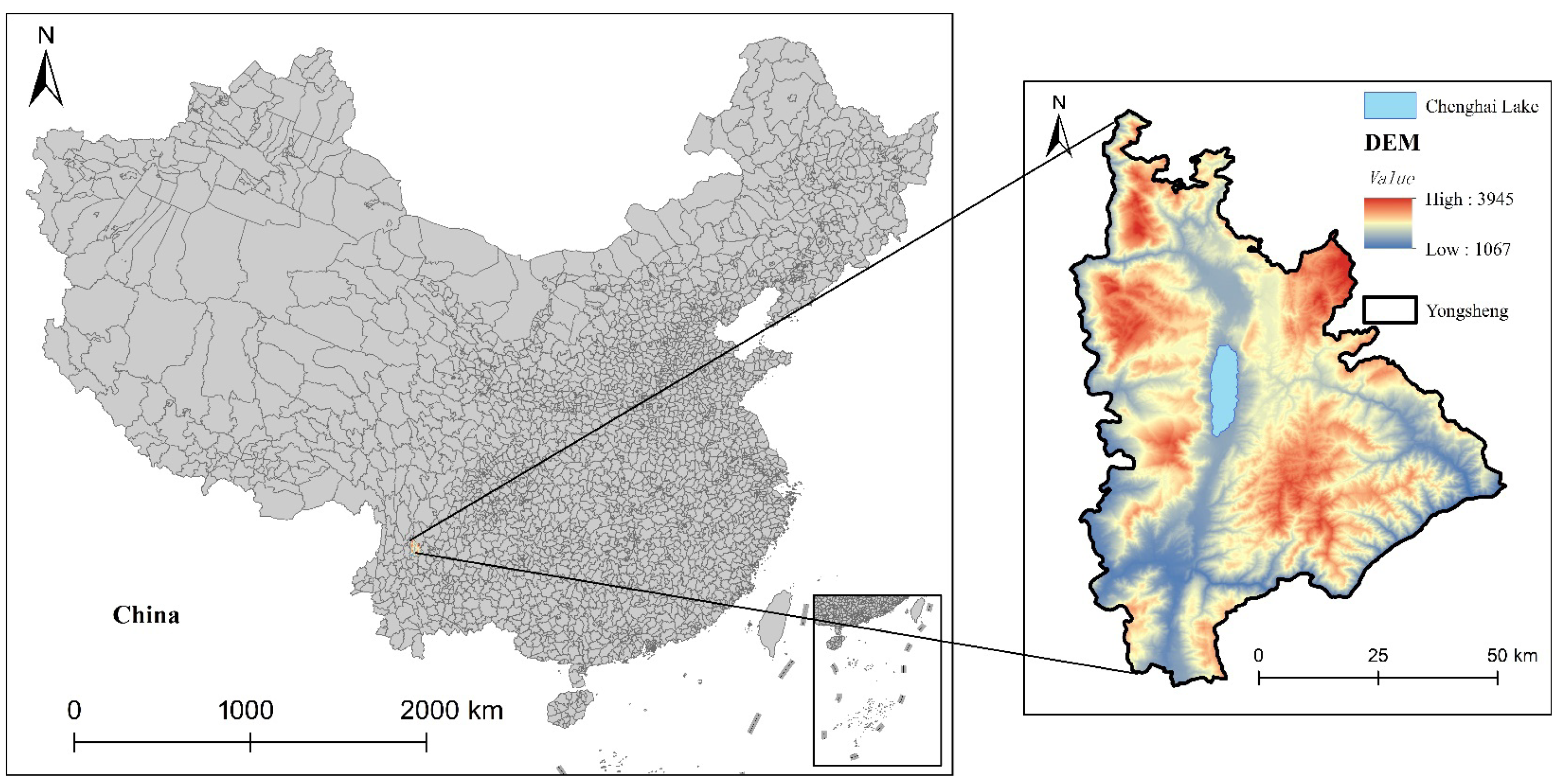
The Chenghai Lake drainage basin in Yongsheng County, Lijiang City, Yunnan Province (
Figure 1) is a representative closed plateau lake basin in the northwestern Yunnan Plateau. It features both the ecological vulnerability of plateau lakes and rapid urbanization [
50]. The basin has undulating terrain, a complex underlying surface, uneven rainfall distribution, and limited water exchange, making pollutants easy to accumulate and the basin highly sensitive to non-point source pollution changes. Yongsheng County, dominated by county towns, is transitioning from traditional growth to high-quality development. This provides an ideal case for analyzing the spatial relationship between high-quality urban development and non-point source pollution. Thus, the Chenghai Lake drainage basin serves as a study area that helps reveal their interaction mechanism in a plateau lake basin and offers a reference for coordinating environmental governance and development in similar plateau closed basins and small to medium-sized urban areas.
2.2. Study Data
To scientifically represent the urban high-quality development level in the Chenghai drainage basin, this study closely follows the core connotations of innovation, coordination, greenness, openness and sharing under the new urbanization background. It integrates the development characteristics of small and medium towns in the northwest Yunnan Plateau. These towns center on county towns, rely on element agglomeration and basic guarantees as core driving forces, and face significant ecological constraints without an independent ecological governance evaluation dimension. This study also considers the availability, spatial continuity and dynamic representation ability of multi-source spatial big data. Therefore, it constructs a comprehensive evaluation indicator system for urban high-quality development from three core dimensions including population agglomeration, economic development and infrastructure construction. The correspondence between each dimension and the high-quality development connotations and the construction reasons are as follows.
Population agglomeration dimension: Population constitutes the core urban development element. High-quality development emphasizes human-centered urbanization. Population scale and spatial agglomeration directly reflect urban element agglomeration and carrying capacity, forming the basic evaluation dimension. LandScan population raster data precisely portrays actual spatial population distribution, overcoming the spatial heterogeneity absence in traditional statistics.
Economic development dimension: High-quality economic development remains the core goal. County urban high-quality development relies on enhanced economic activity intensity and vitality. Nighttime light remote sensing data objectively reflects regional energy consumption and human economic activities. This eliminates caliber biases and data lags in traditional statistics, serving as the optimal indicator for county economic development.
Infrastructure construction dimension: High-quality development emphasizes shared development. The completeness of infrastructure and public service facilities directly reflects urban public service supply capacity. It marks the key transition of county towns from scale expansion to quality improvement. POI data finely depict the spatial distribution and agglomeration characteristics of traffic, municipal and public service facilities. They accurately reflect spatial differences in urban infrastructure construction.
To comprehensively portray the non-point source pollution characteristics and urban high-quality development level in the Chenghai drainage basin, this study uses multi-source remote sensing and spatial big data from 2013 to 2025 to conduct research. Data acquisition and preprocessing follow unified spatiotemporal scale specifications.
Table 1 shows the different data of this study.
2.2.1. Remote Sensing Data of Atmospheric Pollution
This study selects NO
2 and PM
2.5 atmospheric pollutant remote sensing data as indirect proxies for non-point source pollution. NO
2 and PM
2.5 are key indicators of regional energy use, traffic emissions, and urban activity intensity. Their remote sensing products offer wide coverage, strong temporal continuity, and relatively high spatial resolution. They effectively capture the spatiotemporal variation in pollution emissions driven by human activities, making them suitable for drainage basin scale and long-term analysis. Compared to ground monitoring data, remote sensing data have clear advantages in spatial continuity and regional comparability, helping to overcome uneven station distribution and data gaps. The NO
2 data come from satellite-based tropospheric column concentration products, while the PM
2.5 data come from a dataset fusing multi-source remote sensing and ground observations [
51,
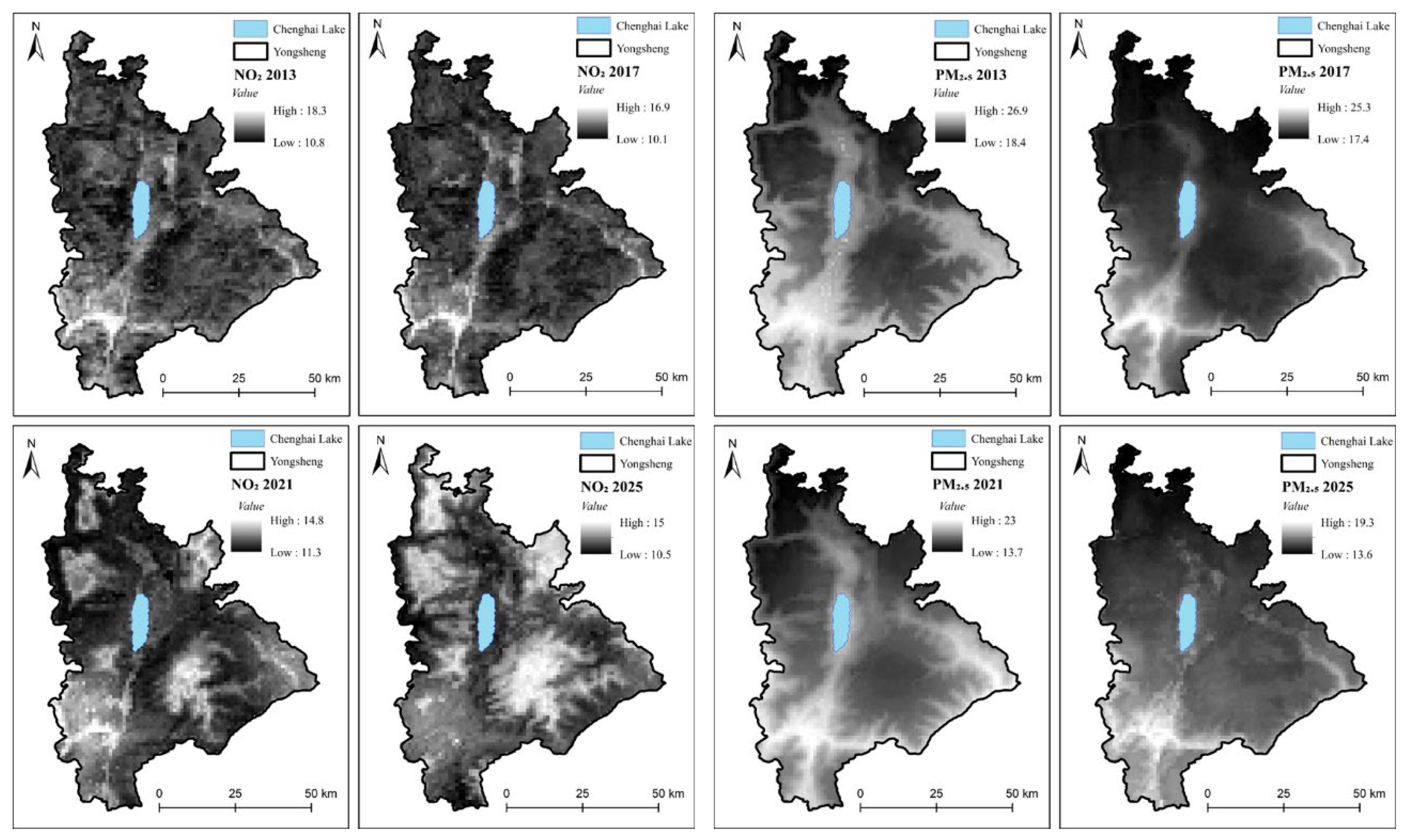
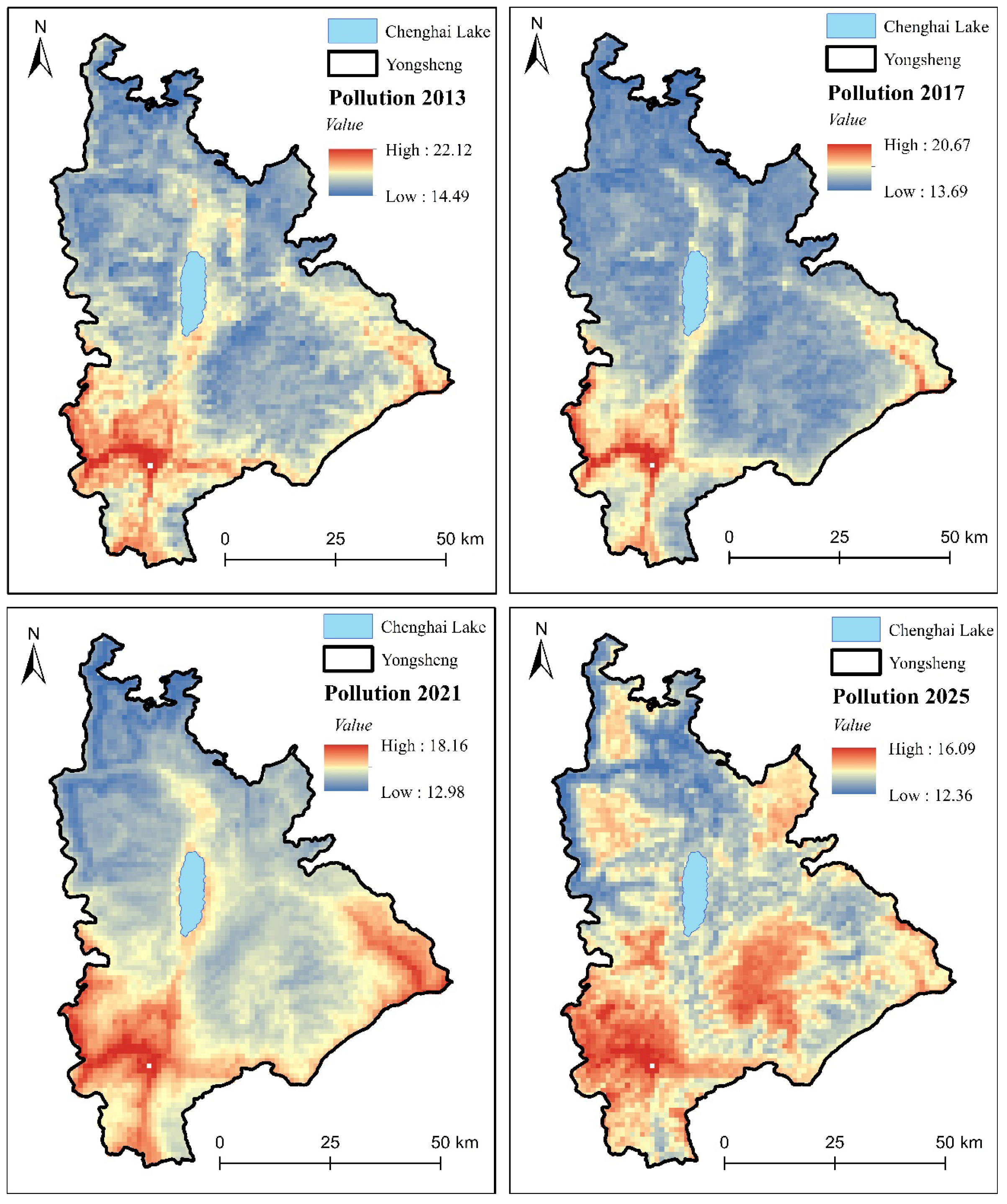
52]. Both datasets are accessible via public platforms and show good temporal consistency and stability. To ensure data suitability for the study area, this study selects data from 2013 to 2025 and unifies the spatial reference and resolution. During preprocessing, the study first clips the original data to the Chenghai Lake drainage basin. It then aggregates multitemporal data to reduce the impact of short-term fluctuations on long-term trends. It also screens and processes outliers and missing values to ensure data continuity and reliability. After the above steps, the study forms a long-term time series dataset of NO
2 and PM
2.5 for subsequent non-point source pollution characterization and spatial analysis (
Figure 2).
2.2.2. NTL Data
NTL remote sensing data directly reflects human night activity intensity and energy consumption. It is widely used to study economic development, urbanization, and spatial structure evolution. The data has wide spatial coverage, good temporal continuity, and is insensitive to changes in statistical boundaries. It effectively captures the spatial distribution and dynamics of regional economic activity. Thus, this study uses NTL data as a key indicator for the economic development level of the Chenghai Lake drainage basin. The data comes from global night lighting products based on satellite observations, with a stable time series and high spatial resolution, and is accessible through public data platforms [
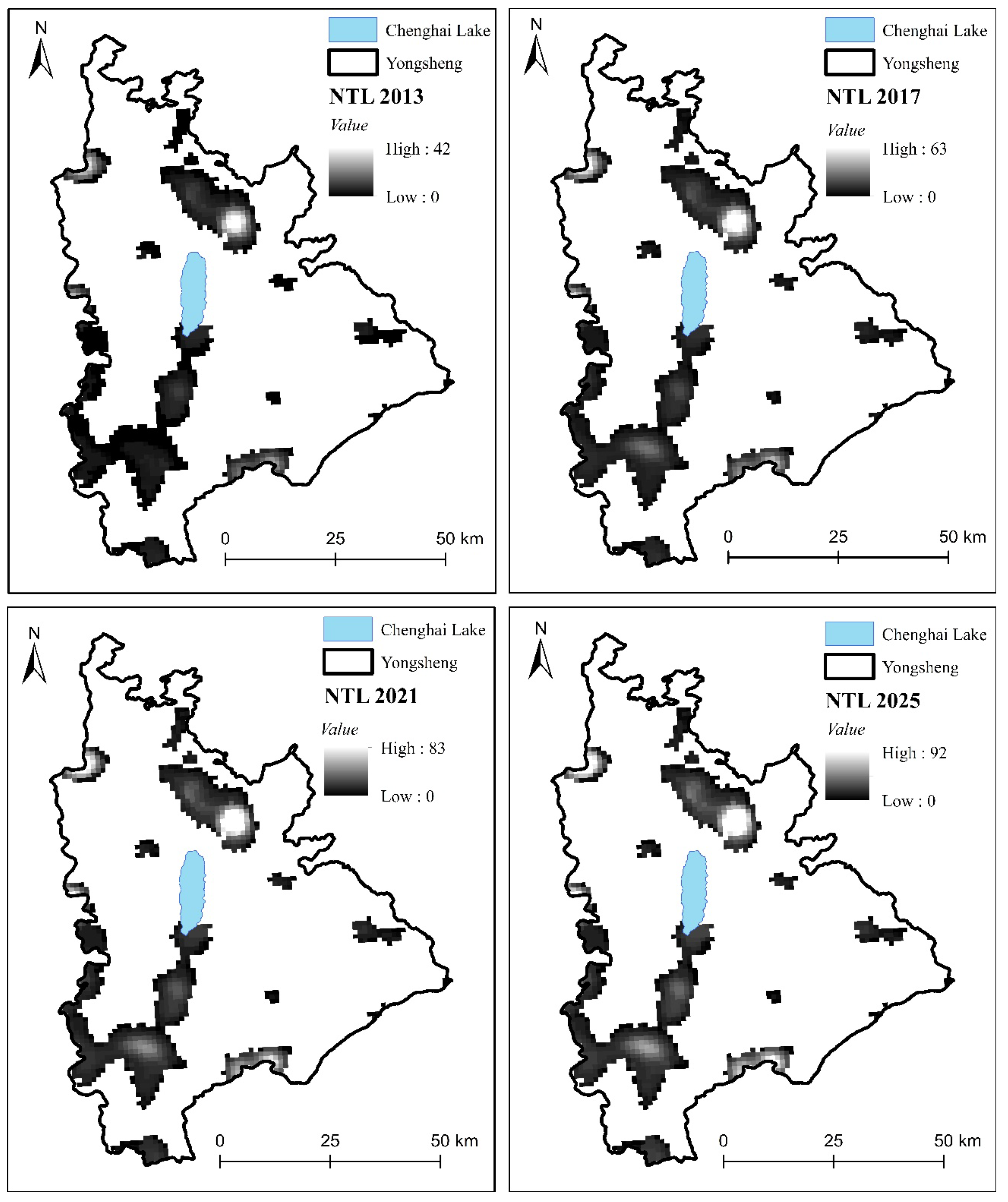
53]. This study selects the NPP/VIIRS global nighttime light monthly composite product (resolution 500 m) as the NTL data, which is publicly released by the National Oceanic and Atmospheric Administration (NOAA). The acquisition period covers monthly data for each of the 12 months from 2013 to 2025. First, this study performs a mean synthesis of the monthly NTL data for each year to obtain annual NTL data, eliminating seasonal fluctuations and cloud cover interference. Next, this study sets a brightness threshold to remove abnormal pixels with pixel values equal to 0 (areas without lights) and pixel values greater than 100 (extremely bright values, such as strong light from industrial and mining areas or sensor noise). Then, this study uses a 3 × 3 moving window method for neighborhood smoothing to eliminate the influence of isolated noise pixels. Finally, this study uses 2013 as the base year to perform linear normalization correction on the light brightness values from 2014 to 2025, correcting the annual brightness deviation caused by satellite sensor updates. After preprocessing, this study obtains the annual NTL raster data for the Chenghai drainage basin from 2013 to 2025, laying the foundation for subsequent unified processing (
Figure 3).
2.2.3. LandScan Data
LandScan population data is a high-resolution population distribution product based on multi-source information modeling. It reflects the real spatial pattern of population. Compared to traditional administrative data, LandScan data offers strong spatial continuity, high resolution, and the ability to capture population agglomeration and diffusion. It is widely used in urbanization, resource and environmental carrying capacity, and regional development research [
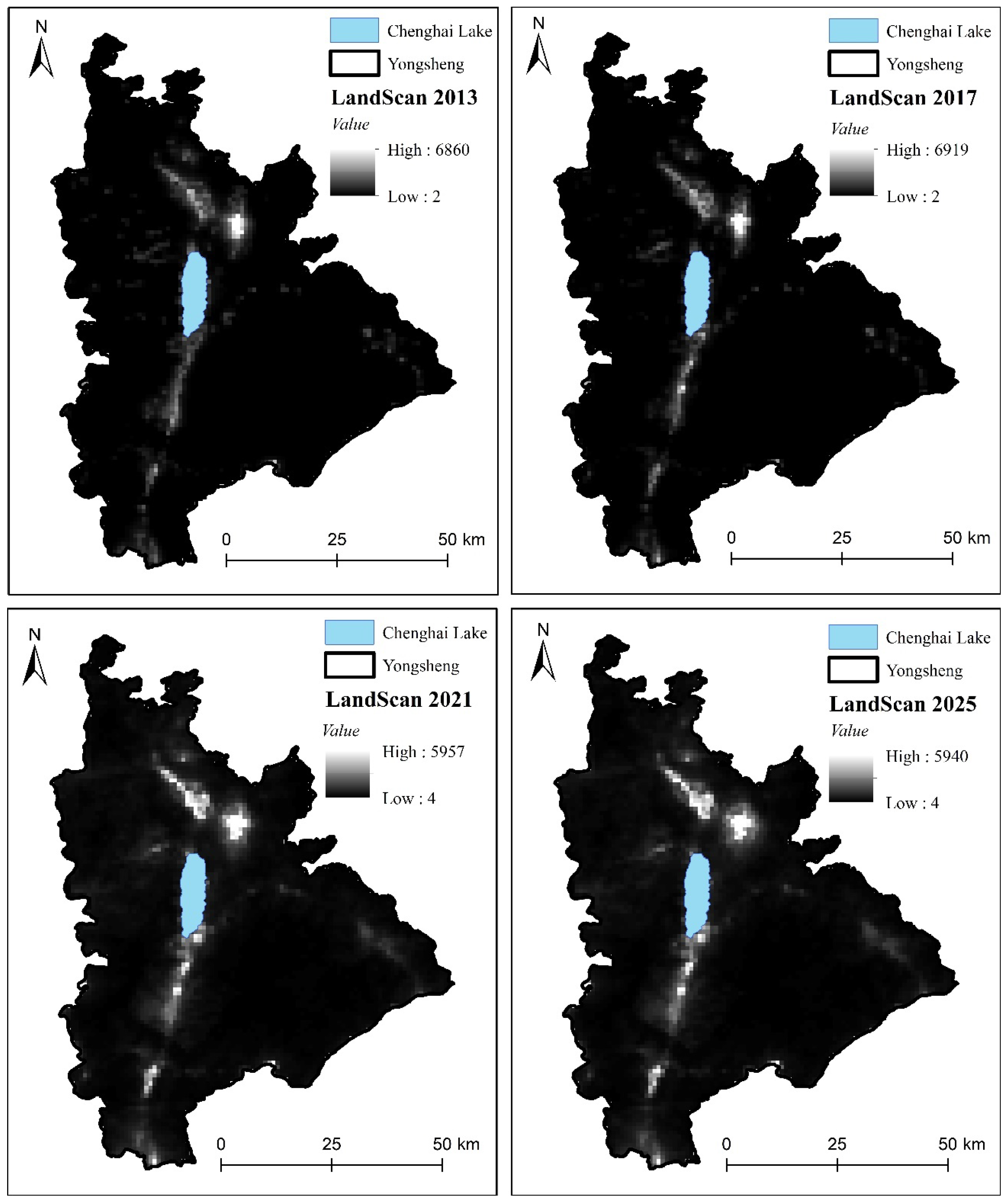
54]. As population size and spatial concentration are key factors in high-quality urban development, this study uses LandScan data to describe the population scale and spatial distribution of the Chenghai Lake drainage basin. The data is produced by an internationally authoritative institution through the comprehensive inversion of remote sensing imagery, land use, transportation networks, and nighttime lights. It has good temporal consistency and spatial accuracy and is accessible via public data platforms. This study selects the LandScan population data as the global high-resolution population raster product with a resolution of 1 km released by Oak Ridge National Laboratory (ORNL). The acquisition period covers annual data from 2013 to 2025, with the data using population per grid cell as the basic unit. In the data processing, this study first converts the original population per grid cell data into population density, with the unit of people per square kilometer, using the formula D = SP, where D represents population density, P represents the population within the grid cell, and S represents the grid cell area of 1 square kilometer, achieving uniform dimension of the indicator. Next, this study screens and corrects outliers by applying the 3σ principle to identify outliers, removing grid cell values beyond μ ± 3σ, where μ is the mean population density in the study area and σ is the standard deviation. For grid cells with outliers, this study uses inverse distance weighting (IDW) interpolation with a search radius set to 3 km to fill in values, ensuring the spatial continuity of the population distribution. Finally, this study performs spatial consistency verification by overlaying the population density data with the land use data of the Chenghai drainage basin and setting the population density values of areas without human habitation, such as water bodies and bare land, to zero, ensuring data consistency with underlying surface characteristics. After preprocessing, this study obtains the population density raster data for the Chenghai drainage basin from 2013 to 2025 (
Figure 4).
2.2.4. POI Data
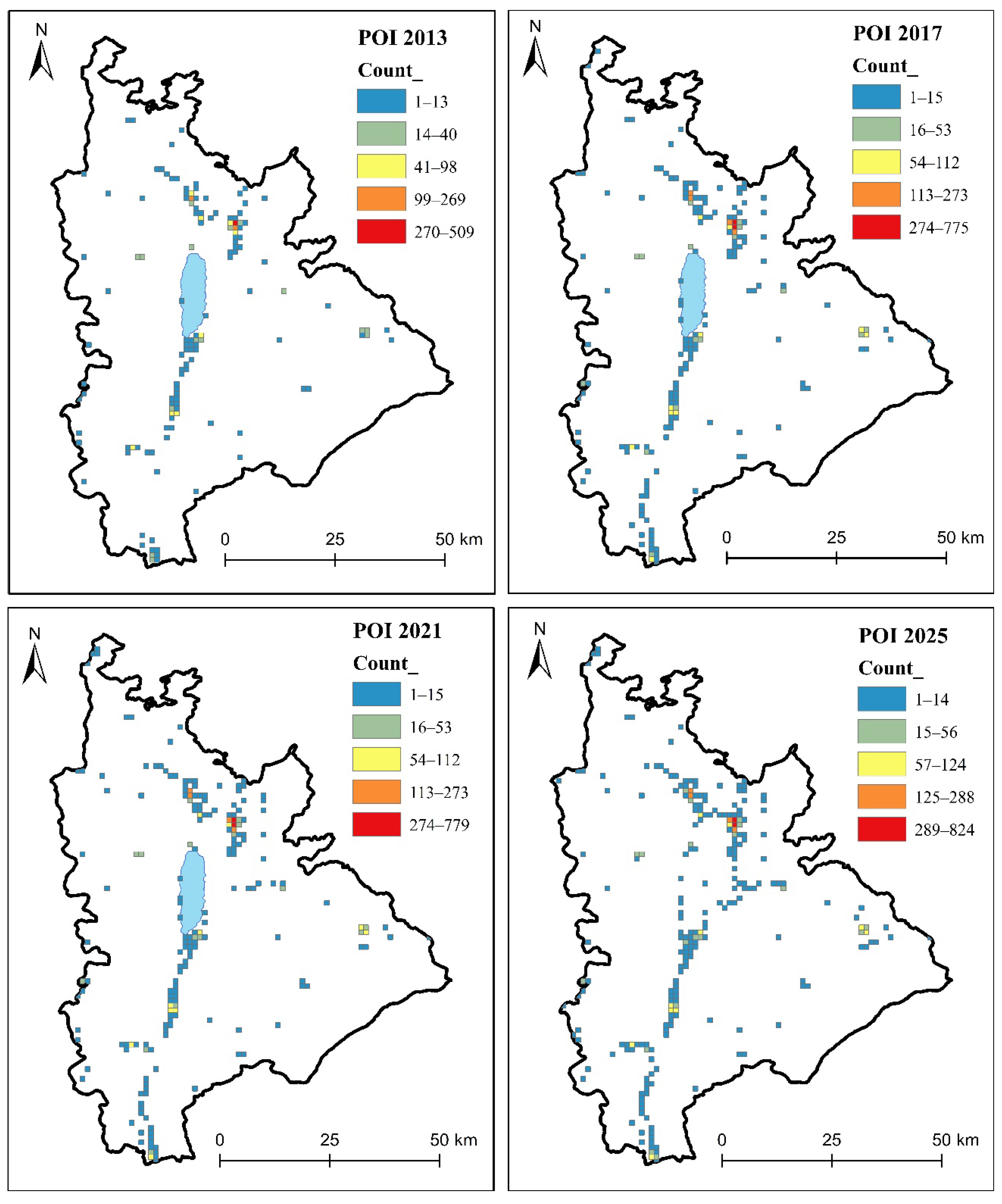
POI data accurately depicts the spatial distribution of infrastructure and public service facilities. It serves as a key data source for reflecting urban construction intensity and functional completeness. Compared to traditional statistics, POI data offers high update frequency, precise spatial positioning, and the ability to capture micro-scale urban structure. It is widely used in urban functional zone identification, public service allocation, and urban development quality evaluation [
55]. As infrastructure and public service capacity are important components of high-quality urban development, this study uses Amap POI data to characterize infrastructure features in the Chenghai Lake drainage basin. The data comes from the Amap open platform and includes categories such as transportation, public services, commercial services, and municipal infrastructure. It has a complete classification system and good spatial accuracy. This study selects POI data from 2013 to 2025 for temporal consistency with the other data. During preprocessing, the study screens and cleans the original POI data to remove records with incomplete or duplicate location information. It then classifies and integrates the data based on research objectives and uses spatial analysis to rasterize the POI data for consistent spatial scale with the other remote sensing data. By calculating indicators like POI density, the study depicts the spatial agglomeration of infrastructure. After the above steps, a POI dataset is formed that reflects the level of urban infrastructure construction and its spatial variation, providing data support for the comprehensive evaluation of high-quality urban development. This study selects POI data as vector data obtained from the AMap Open Platform API. The acquisition period covers annual data from 2013 to 2025, covering 4 major categories including transportation facilities, public service facilities, municipal facilities, and commercial service facilities, with a total of 12 subcategories. The original data fields include POI name, longitude and latitude, type, address, and so on. In the data processing, this study first performs data cleaning, including location cleaning to remove POI records with missing longitude and latitude or with longitude and latitude beyond the Chenghai drainage basin range; duplicate cleaning to remove duplicate POI records based on the combination of name and longitude and latitude; and type cleaning to remove POI types unrelated to urban development, such as agricultural production points and natural scenic spots, retaining the 4 major categories of core POI. Next, this study performs a coordinate projection conversion, converting the original WGS84 geographic coordinates to WGS_1984_UTM_Zone_47N projection coordinates to maintain spatial reference consistency with the NTL and LandScan data. Finally, this study performs a kernel density calculation, using the Gaussian kernel density estimation method to calculate POI kernel density to represent the level of infrastructure agglomeration. After preprocessing, this study obtains the POI kernel density raster data for the Chenghai drainage basin from 2013 to 2025 (
Figure 5).
2.2.5. Land Use Data
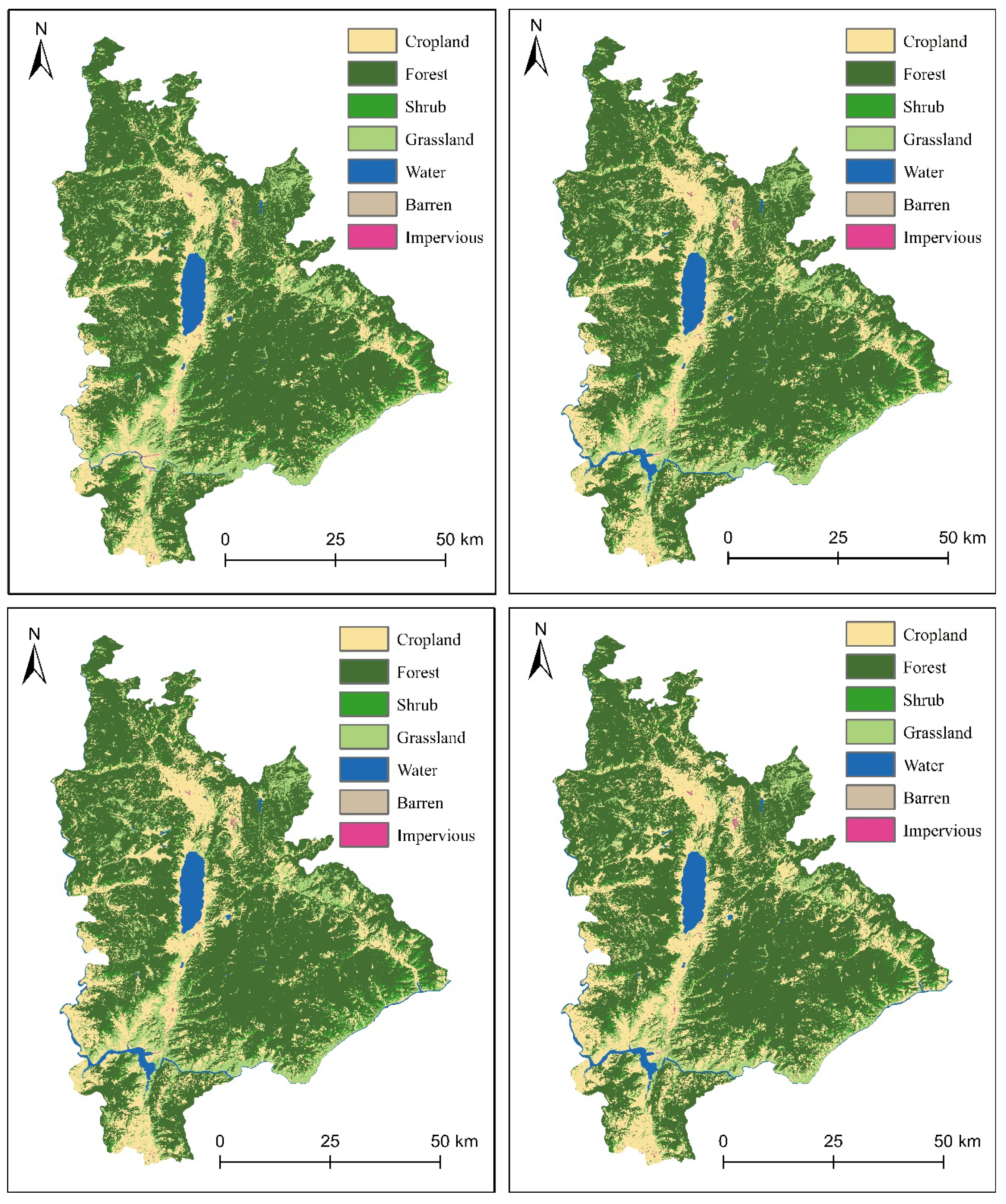
Land use type and structural change are the core influences on underlying surface change in the basin. They directly affect rainfall runoff, pollutant adsorption and migration, and serve as key drivers of non-point source pollution formation and transport. At the same time, optimal land use allocation is an important representation of high-quality development on spatial carriers. Thus, this study uses the China Land Cover Dataset (CLCD) released by Wuhan University to characterize land use in the Chenghai Basin. This dataset is built from long-term remote sensing images and offers high spatial resolution, accurate classification, continuous time series, and timely updates. It accurately captures the spatiotemporal evolution of regional land use and cover and is widely used in research on basin ecology, urban expansion, and land use change effects.
This study selects CLCD land use data from 2013 to 2025 at 30 m resolution. In preprocessing, it first clips the original grid data to the Chenghai Basin boundary. Second, it unifies the spatial reference across years to match other data. It also performs accuracy checks and corrects anomalous pixels caused by noise or cloud shadows. Finally, it reclassifies primary land use types and calculates area proportion, dynamism, and spatial agglomeration. This characterizes land use evolution, including urban expansion, farmland conversion, and ecological land change. After processing, a long-term land use dataset is formed for analyzing non-point source pollution drivers and high-quality urban development carriers, supporting subsequent analysis of land use impacts and the environmental effects of urban expansion (
Figure 6).
2.3. Methods
2.3.1. Deposition Flux Method
Non-point source pollution is the result of multiple media and processes. Atmospheric pollutants enter land and water through dry and wet deposition, forming a key part of basin non-point source pollution. Unlike methods relying solely on water monitoring or statistics, the deposition flux method focuses on pollutant transport and deposition. It captures the actual input intensity of human emissions into the surface system and has clear physical meaning [
56,
57]. At the basin scale, traditional models like SWAT and HSPF depend heavily on parameters and high frequency hydrological data, posing difficulties in small to medium basins with limited monitoring. In contrast, the deposition flux method based on remote sensing data offers strong data accessibility, good spatial continuity, and suitability for long-term analysis. It is especially useful for studying non-point source pollution in regions lacking dense monitoring stations [
57]. Thus, this study uses the dry and wet deposition flux method based on NO
2 and PM
2.5 remote sensing data to characterize non-point source pollution intensity in the Chenghai Lake drainage basin.
The total deposition flux of pollutants can be expressed as the sum of the dry deposition flux and the wet deposition flux, with its basic form expressed as:
where
represents the total deposition flux of pollutant
,
represents the dry deposition flux of pollutant
, and
represents the wet deposition flux of pollutant
.
Dry deposition refers to the process by which pollutants settle to the land surface under precipitation-free conditions through mechanisms such as gravitational settling and turbulent diffusion. Its flux calculation formula is:
where
represents the atmospheric concentration of pollutant
, obtained from remote sensing inversion data; and
represents the dry deposition velocity of pollutant
, used to reflect the efficiency of pollutant settling from the atmosphere to the land surface.
Wet deposition refers to the process by which pollutants enter the land surface and water system through dissolution, adsorption, and other means during rainfall or snowfall events. Its flux can be expressed as:
where
represents precipitation;
represents the elution coefficient of pollutant
, used to characterize the precipitation’s ability to remove pollutants; and the meanings of other symbols are as previously defined. In practical application, the wet deposition flux can reflect the intensity of pollutant input into the surface system under precipitation conditions, which is particularly important for monsoon climate regions and areas with significant spatiotemporal differences in precipitation.
To comprehensively characterize the non-point source pollution level of multiple pollutants, after calculating the total deposition flux of NO
2 and PM
2.5 separately, their results undergo standardized processing, and a non-point source pollution index (NPSPI) is constructed:
where
and
represent the standardized total deposition fluxes of
and PM
2.5, respectively; and
and
are weight coefficients, and this study assigns them using an equal weight approach. By simultaneously considering both dry and wet deposition processes, the non-point source pollution indicator constructed in this study can more comprehensively reflect the actual input levels of atmospheric pollutants into the drainage basin system. This provides a reliable methodological foundation for the subsequent analysis of the spatial mismatch relationship between high-quality urban development and non-point source pollution.
2.3.2. Deep Autoencoder (DAE)
The three dimensions of population agglomeration, economic activity, and functional completeness in high-quality urban development have a complex nonlinear coupling relationship. NTL, LandScan population, and POI density data are heterogeneous spatial big data. Traditional weighting methods cannot meet the research needs. The equal weight method assumes the three dimensions contribute equally to high-quality urban development, ignoring the heterogeneity of the development stage and the actual differences in indicator driving forces. As a county level drainage basin in northwest Yunnan, the Chenghai drainage basin is transitioning from scale expansion to quality improvement. Economic activity intensity is the core driving force, infrastructure completeness is important support, and population agglomeration is a basic condition. Differences exist in their contribution. Equal weight assignment leads to evaluation results disconnected from actual development characteristics and fails to portray the spatial heterogeneity of high-quality development [
58]. The entropy weight method assigns weights based on indicator information entropy, with larger entropy resulting in higher weights. This method has two major defects. First, it heavily depends on data distribution and is sensitive to outliers, but some annual data in this study have low dispersion, which easily causes weight distortion. Second, it only captures linear statistical characteristics and cannot depict the nonlinear coupling relationship among the three dimensions. This nonlinear relationship is a core feature of high-quality urban development, and the entropy weight method struggles to integrate it, which easily causes loss of evaluation information [
59].
Compared with traditional weighting methods, the DAE is an unsupervised deep learning model. It does not require manual weight setting. It can automatically learn the latent nonlinear features of heterogeneous data through multi-layer neural networks and accurately capture the coupling relationship among the three dimensions of population, economy, and facilities. At the same time, the model trains based on the data reconstruction objective, maximizing the retention of core information from the original data and avoiding the subjective assignment bias of traditional methods or the bias caused by data dispersion. In addition, the spatial output characteristic of the model highly matches the spatial analysis goal of this study in the drainage basin. It can quantify the level of high-quality urban development at the raster scale and accurately portray its spatial heterogeneity. Therefore, the DAE is the optimal method for this study to fuse multi-source heterogeneous big data and construct the UHDI [
58,
59].
Therefore, this study adopts a method based on the DAE to integrate NTL, LandScan population, and POI data, thereby constructing a comprehensive index for high-quality urban development.
A DAE typically consists of two parts: an encoder and a decoder. Its core idea is to map the original high-dimensional input data into a low-dimensional latent feature space through the encoding process, and then reconstruct the original data as accurately as possible through the decoding process, thereby retaining the main information characteristics of the data in the latent layer.
The encoding process can be expressed as:
The decoding process can be expressed as:
where
represents the input vector, composed of indicators such as nighttime light intensity, population size, and POI density;
represents the latent feature layer output, used to comprehensively characterize the level of high-quality urban development;
and
are the weight matrices of the encoder and decoder, respectively;
and
are the bias terms; and
and
are nonlinear activation functions.
The model is trained by minimizing the error function between the input data and the reconstructed data, and its objective function can be expressed as:
This study builds a DAE model based on the TensorFlow2.10 + Keras framework. The operating environment is Python 3.9, with a CPU of Intel i7-13700H and a GPU of NVIDIA RTX 4070 for accelerated training. The model is a fully connected deep autoencoder with a symmetric structure of encoder, latent feature layer, and decoder. The specific network architecture and training hyperparameter settings are as follows. All parameters are optimized through grid search and 5-fold cross validation to ensure model fitting and stability. In the encoder structure, the input layer has 3 neurons corresponding to three standardized indicators of nighttime light, population density, and POI kernel density. Hidden layer 1 has 64 neurons with ReLU activation function. Hidden layer 2 has 32 neurons with ReLU activation function. The latent feature layer has 1 neuron with linear activation function, outputting the initial index of high-quality urban development. In the decoder structure, the latent feature layer has 1 neuron. Hidden layer 1 has 32 neurons with ReLU activation function. Hidden layer 2 has 64 neurons with ReLU activation function. The output layer has 3 neurons with Sigmoid activation function, reconstructing the input indicators. Among the training hyperparameters, the optimizer is Adam with a learning rate of 0.001, a β1 of 0.9, β2 of 0.999, and a ε of 1 × 10⁻⁷. The loss function is mean squared error, used to minimize the deviation between input and reconstructed values. The batch size is 32. The number of epochs is 100. The study uses early stopping to prevent overfitting, with validation set MSE as the monitoring metric, a patience of 10, and restore best weights set to True. The study uses L2 regularization with a λ of 0.0001 to constrain the weights of each layer and reduce model complexity. Finally, for data splitting, the study divides the standardized multi-source data into a training set of 70 percent for model training, a validation set of 20 percent for hyperparameter optimization and early stopping judgment, and a test set of 10 percent for final model accuracy validation. After testing, the model achieves a reconstruction MSE of 0.028 and an R2 of 0.926 on the test set, indicating that the model performs well in feature extraction and the reconstruction of the input data, and the output of the latent feature layer effectively integrates the core information of the three indicators.
After the model training is completed, the latent feature layer output is taken as the comprehensive representation indicator for high-quality urban development. To facilitate comparison between different spatial units, the latent feature results undergo standardized processing, ultimately forming the urban high-quality development index (UHDI). This index comprehensively reflects multi-dimensional information such as population agglomeration degree, economic activity intensity, and infrastructure construction level. It can effectively characterize the spatial variation features of high-quality urban development, providing a quantitative foundation for the subsequent analysis of its spatial mismatch relationship with non-point source pollution.
2.3.3. Bivariate Spatial Autocorrelation
Bivariate spatial autocorrelation analysis reveals the spatial correspondence of different elements and their local differences. Traditional correlation or regression methods capture statistical relationships at an overall scale, making it difficult to reflect spatial heterogeneity and local agglomeration [
60]. At the basin scale, high-quality urban development and non-point source pollution often show significant spatial imbalance. Global analysis methods alone cannot reveal their match at local spatial units. The Local Indicators of Spatial Association (LISA) method identifies local spatial agglomeration types and significance, serving as a key tool for revealing spatial heterogeneity [
61]. The Bivariate Local Moran’s I considers both a unit’s own attribute and the values of another variable in neighboring units. It characterizes the spatial correlation between two different variables, making it suitable for analyzing the spatial match between high-quality urban development and non-point source pollution. Thus, this study uses the bivariate local spatial autocorrelation method to systematically analyze their spatial relationship.
The calculation formula for the Bivariate Local Moran’s I is as follows:
where
represents the Bivariate Local Moran’s I index for spatial unit
;
represents the standardized value of the urban high-quality development index (UHDI) for spatial unit
;
represents the standardized value of the non-point source pollution index (NPSPI) for spatial unit
; and
is the element of the spatial weight matrix, used to describe the spatial adjacency relationship between spatial units
and
. By conducting significance tests on
, the local spatial association patterns between high-quality urban development and non-point source pollution in different spatial units can be identified.
2.3.4. Geographical Weighted Regression (GWR)
The traditional global regression model treats the study area as a homogeneous whole. It can only capture the average linear relationship between variables and fails to reflect spatial heterogeneity. However, the relationship between non-point source pollution and high-quality urban development in the Chenghai drainage basin has significant spatial differentiation characteristics. GWR, as a local spatial regression method, embeds geographic coordinates into the model and builds an independent regression equation for each spatial unit. It can effectively capture the spatial non-stationarity of the relationship between variables. Compared with global regression, its core advantage is that it can reduce the spatial autocorrelation of residuals and improve model fitting accuracy. Based on this, this study selects the GWR model for quantitative analysis and verifies the model suitability through core diagnostic indicators.
It must be made clear that although the core explanatory variable UHDI and the control variables of population density and POI density both involve information related to population and facilities, they have essential differences. UHDI is a latent feature index extracted by fusing the three dimensions of nighttime light (economic activity), population density (population agglomeration), and POI density (facility completeness) through a deep autoencoder. It represents the quality level of high-quality urban development with the coordinated coupling of population, economy, and facilities. In contrast, the control variables of population density and POI density are single dimensional intensity indicators. They represent the absolute quantity or agglomeration degree of a certain element and do not involve coupling relationships with other elements. The information overlap between them is low. This is the core reason why the VIF values are low in the collinearity test. Therefore, including them together in the model does not cause multicollinearity problems.
The basic expression of the GWR model is as follows:
where
is the geographic coordinate of the
-th spatial unit;
is the dependent variable (NPSPI) of the
-th spatial unit;
is the
-th independent variable of the
-th spatial unit;
is the local intercept term of the
-th spatial unit;
is the local regression coefficient of the
-th independent variable of the
-th spatial unit, which reflects the local influence degree of the independent variable on the dependent variable in this spatial unit; and
is the random error term, which meets the classical assumptions of having a mean of 0 and a constant variance.
3. Results
3.1. Analysis of Non-Point Source Pollution in the Chenghai Lake Drainage Basin
The non-point source pollution index from 2013 to 2025 shows clear stages of changes in the Chenghai Lake drainage basin (
Figure 7). From 2013 to 2017, pollution generally declined slowly and weakened. From 2017 onward, pollution rose continuously, with a notable increase from 2021 to 2025. Spatially, by 2025, large high-value pollution zones had appeared in the southern basin, with levels much higher than elsewhere. In the northern county center, pollution showed a fluctuating pattern of declining, rising, and then declining again, indicating complex spatiotemporal evolution. Overall, pollution first eased and then intensified over time. Spatially, there was increasing agglomeration in the south and fluctuating adjustment in the northern core urban areas.
The spatiotemporal variation in non-point source pollution in the Chenghai Lake drainage basin closely relates to changes in human activity intensity and spatial restructuring. From 2013 to 2017, growing environmental awareness and management measures eased pressure from high-intensity activities, reducing pollution. After 2017, urban expansion, infrastructure for faster transport, and higher development intensity increased emissions, driving pollution upward, especially from 2021 to 2025. Spatially, the southern basin saw major land use change and much more intense human activity. With rainfall runoff, this area more easily formed diffuse pollution inputs, leading to significant pollution agglomeration. In contrast, the northern county center experienced an initial rise in pollution due to early urban development, followed by a decline as infrastructure and management improved. This created a fluctuating pattern of first rising then falling. Thus, pollution evolution depends not only on changes in human activity intensity but also on the urban development stage and management capacity.
3.2. Spatiotemporal Dynamics and Structural Evolution of Land Use in the Chenghai Drainage Basin from 2013 to 2025
Land use is the facilitator of spatial high-quality urban development and also represents the core underlying surface factor driving the formation and migration of non-point source pollution. From 2013 to 2025, the land use structure in the Chenghai drainage basin shows overall evolution characterized by a continuous expansion of impervious surfaces, a slight shrinkage of agricultural land, and an initial decrease followed by an increase in ecological land. Specifically, urban impervious surface is the fastest-expanding land use type in the whole drainage basin. The period 2013 to 2017 was one of rapid expansion with a dynamic degree of 7.02 percent; then, after 2017, expansion slowed down but still maintained a positive growth rate. Over the 12 years studied, the area increased by 25.67 square kilometers, with an increase rate of 89.6 percent, reflecting the continuous advancement of urbanization in the drainage basin. Agricultural land showed a slow and continuous shrinking trend, with a total decrease of 16.67 square kilometers over the 12 years, mainly due to occupation by urban expansion and ecological restoration. The speed of shrinking accelerated slightly from 2021 to 2025, which is related to the conversion of agricultural land to ecological land in the southern part of the drainage basin. Ecological land showed a phased characteristic of first decreasing and then increasing. From 2013 to 2017, it shrank slightly due to the expansion of urban impervious surface and the development of agricultural land. After 2017, with the implementation of ecological protection policies in the drainage basin, such as the restoration of Chenghai Lake’s shore wetlands and the conversion of farmland to forest, the area of ecological land gradually recovered and by 2025 it had returned to the level it was in 2013, reflecting the positive effect of ecological protection.
Based on the land use transfer matrix for the three periods of 2013 to 2017, 2017 to 2021, and 2021 to 2025, the first was dominated by urban expansion. The key change was the conversion of agricultural land to impervious surface, accompanied by a small amount of ecological land converted to agricultural land, reflecting the development model of traditional scale expansion. The period from 2017 to 2021 showed a balance between development and protection. The conversion of agricultural land to impervious surface remained the main trend, but the proportion of agricultural land converted to ecological land significantly increased, reflecting the initial coordination between high-quality development and ecological protection. The period from 2021 to 2025 was dominated by ecological protection. The conversion of agricultural land to ecological land became the core pathway, and the area of agricultural land converted to impervious surface greatly decreased, reflecting the transformation of the development model in the drainage basin toward prioritizing the environment. At the same time, there was no reconversion of impervious surface to agricultural or ecological land, indicating that the spatial expansion of urbanization in the drainage basin was irreversible, and the optimization of land use structure was mainly achieved through the two-way conversion of agricultural land.
3.3. High-Quality Urban Development Analysis
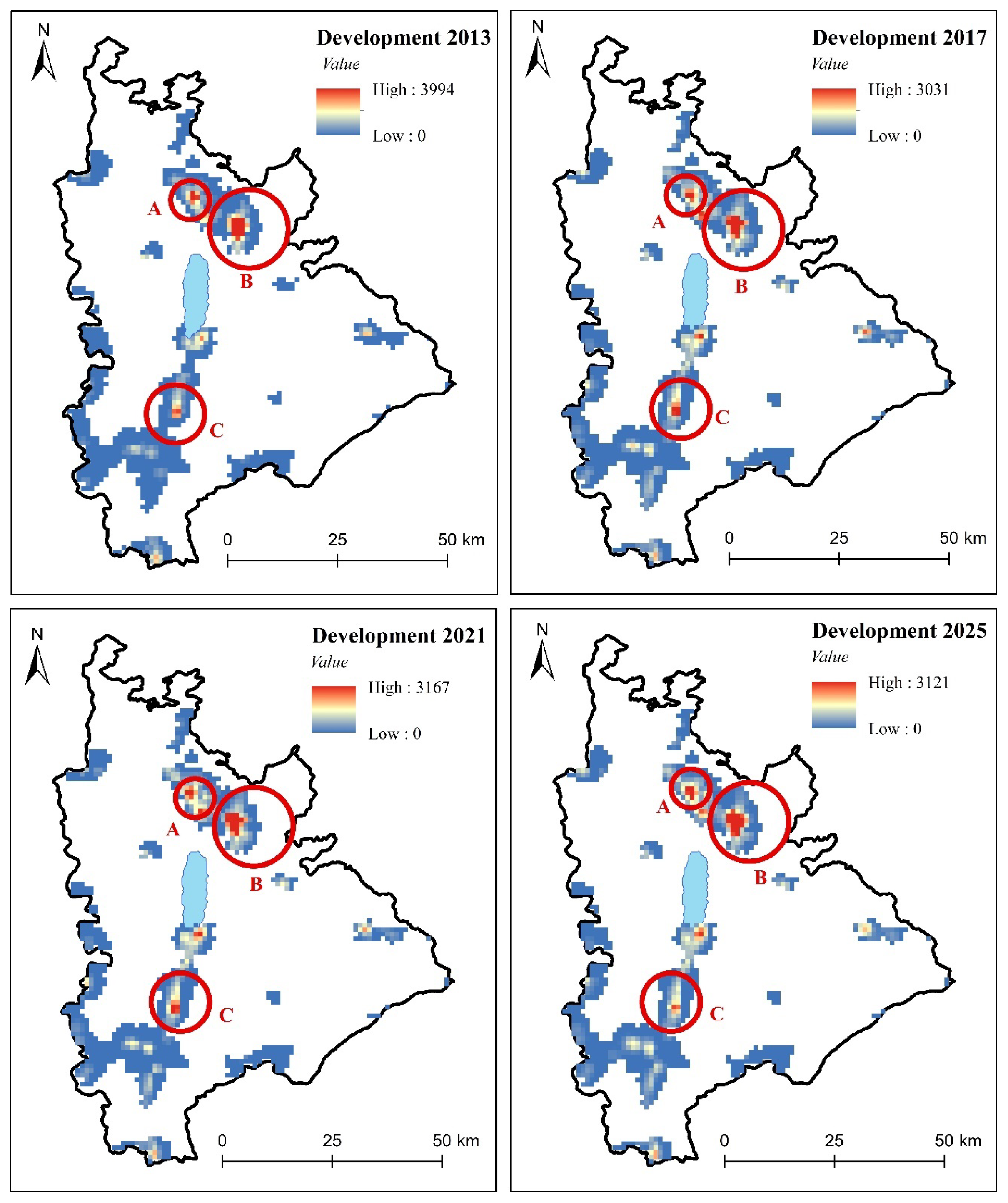
This study defines three core urban nodes based on the spatial structure characteristics of the multicenter Chenghai drainage basin, combined with the three dimensions of administrative boundaries, UHDI spatial clustering characteristics, and urban morphology patterns. These nodes are the northern county subcenter A, the northern main center B, and the southern subcenter C. The northern main center is the location of the Yongsheng County administrative center, serving as the core of administration, economy, and public services in the drainage basin. Its average UHDI value from 2013 to 2025 was greater than or equal to 0.7. The northern county subcenter is the administrative seat of a town that is under the jurisdiction of Yongsheng County, acting as a satellite supporting node for the northern main center B. Its average UHDI value from 2013 to 2025 was greater than or equal to 0.5 and less than 0.7. The southern subcenter is the location of the Chenghai Town administrative center, serving as the only town center in the southern part of the drainage basin. Its average UHDI value from 2013 to 2025 was greater than or equal to 0.4.
The urban high-quality development index from 2013 to 2025 shows clear phased changes in the Chenghai Lake drainage basin (
Figure 8). From 2013 to 2017, the development level declined notably. From 2017 to 2025, it slowly rebounded and continued upward. However, the levels in 2021 and 2025 remained below that in 2013, indicating incomplete recovery to the initial level. Spatially, different urban nodes show distinct patterns: northern subcenter A saw continuous improvement; main center B showed a decline followed by slow rise; and the southern subcenter showed a rise then a decline. Overall, the development level first declined then rose over time, with diverging paths among urban nodes.
The evolution of high-quality urban development in the Chenghai Lake drainage basin is closely related to changes in development stages and factor allocation. From 2013 to 2017, traditional growth inertia caused issues like population restructuring, economic transition pressure, and lagging infrastructure, leading to a decline in development quality. After 2017, with the advance of new urbanization and high-quality development concepts, the region shifted from scale expansion to quality improvement, and the development quality slowly recovered. However, resource limits and different development foundations slowed the recovery here. Spatially, northern subcenter A improved steadily through population concentration, public services, and infrastructure. Main center B faced early transition pressure but later improved through functional optimization and governance, achieving a slow rebound. The southern subcenter saw phased acceleration followed by a decline due to weak development momentum and reduced factor attraction. Thus, the spatiotemporal evolution of high-quality urban development depends not only on development speed but also on model transformation and governance capacity.
To test the reliability of the high-quality urban development index and avoid UHDI reflecting only the intensity rather than quality of development, we select the county-level administrative statistical data of Yongsheng County from 2013 to 2025 as independent validation indicators. These indicators include the GDP per capita, which reflects the quality of economic development; urban permanent resident population, which reflects the quality of population agglomeration; and the proportion of infrastructure investment in GDP to reflect the quality of facility construction. We conduct correlation validation between UHDI and the independent indicators in both the temporal and spatial dimensions, and also perform a classification matching analysis. The validation results are as follows.
We calculate Pearson correlation coefficients between the annual average UHDI in the entire Chenghai drainage basin and the county-level GDP per capita, urban permanent resident population, and proportion of infrastructure investment, respectively. The results show that the correlation coefficient between the UHDI and GDP per capita is 0.897, with a p value less than 0.01; the correlation coefficient between the UHDI and urban permanent resident population is 0.852, with a p value less than 0.01; and the correlation coefficient between the UHDI and the proportion of infrastructure investment is 0.826, with a p value less than 0.01. All coefficients show a highly significant positive correlation, indicating that the temporal evolution trend in UHDI is highly consistent with the trend in development quality, reflected by county-level administrative records, and can effectively characterize the temporal variation characteristics of high-quality urban development in the drainage basin. This study divides the Chenghai drainage basin into three administrative zones: the northern urban core zone, the central basin transition zone, and the southern basin marginal zone. We calculate the spatial correlation between the annual average UHDI of each zone and the zonal GDP per capita, which is disaggregated from county-level data based on population weight. The results show that the UHDI and zonal GDP per capita have a significant positive correlation in all three zones, with a correlation coefficient of 0.913 in the north, 0.876 in the center, and 0.841 in the south, all with p values less than 0.01. According to administrative statistics, the spatial high-UHDI area completely matches the area of high economic development quality, which is the area around Yongsheng County town in the north. The spatial gradient characteristics of the UHDI are highly consistent with the administrative evaluation results of zonal development quality, indicating that the UHDI can accurately portray the spatial heterogeneity of high-quality urban development. We divide the UHDI into five levels: low, from 0 to 0.2; medium low, from 0.2 to 0.4; medium, from 0.4 to 0.6; medium high, from 0.6 to 0.8; and high, from 0.8 to 1.0. We also divide the county-level GDP per capita into five levels using the same method and compare the accuracy of classification matching between the two. The results show that the classification matching accuracy between the two reaches 89.2 percent. Only a small number of low-level deviations exist in the central transition zone, which occur because the UHDI integrates facility and population dimensions while the GDP per capita only reflects the economic dimension. This indicates that the classification of the UHDI closely matches that of the independent economic quality indicator and can effectively characterize the grade differences in development quality.
The above validation results show that the UHDI constructed in this study closely matches independent development quality indicators such as county-level GDP per capita and administrative records. It does not simply reflect development intensity but can comprehensively and accurately represent the characteristics of high-quality urban development in the Chenghai drainage basin.
4. Analysis of the Impact of High-Quality Urban Development on Non-Point Source Pollution in the Chenghai Lake Drainage Basin
To avoid multicollinearity between the core explanatory variable UHDI and the control variables—including population density, POI density, land use dynamic degree, and proportion of ecological land, which could distort the regression coefficients—we perform a collinearity test on all explanatory variables using the variance inflation factor (VIF) before constructing the GWR model. The test standard is as follows: a VIF less than 10 indicates no serious collinearity; a VIF between 10 and 30 indicates moderate collinearity; and a VIF greater than or equal to 30 indicates serious collinearity.
The collinearity test results are shown in
Table 2, where it can be seen that the VIF values of all variables range from 1.23 to 3.87, far below the critical value of 10, with an average VIF value of 2.41, indicating no serious multicollinearity among the model variables. The VIF value of the core explanatory variable UHDI is 2.15, and the VIF values of the control variables population density and POI density are 1.89 and 2.37, respectively. All three have low VIF values, proving that the UHDI is distinctly informative compared to the single-dimensional population density and POI density. Their coexistence does not cause model collinearity problems, and the regression coefficients are statistically robust.
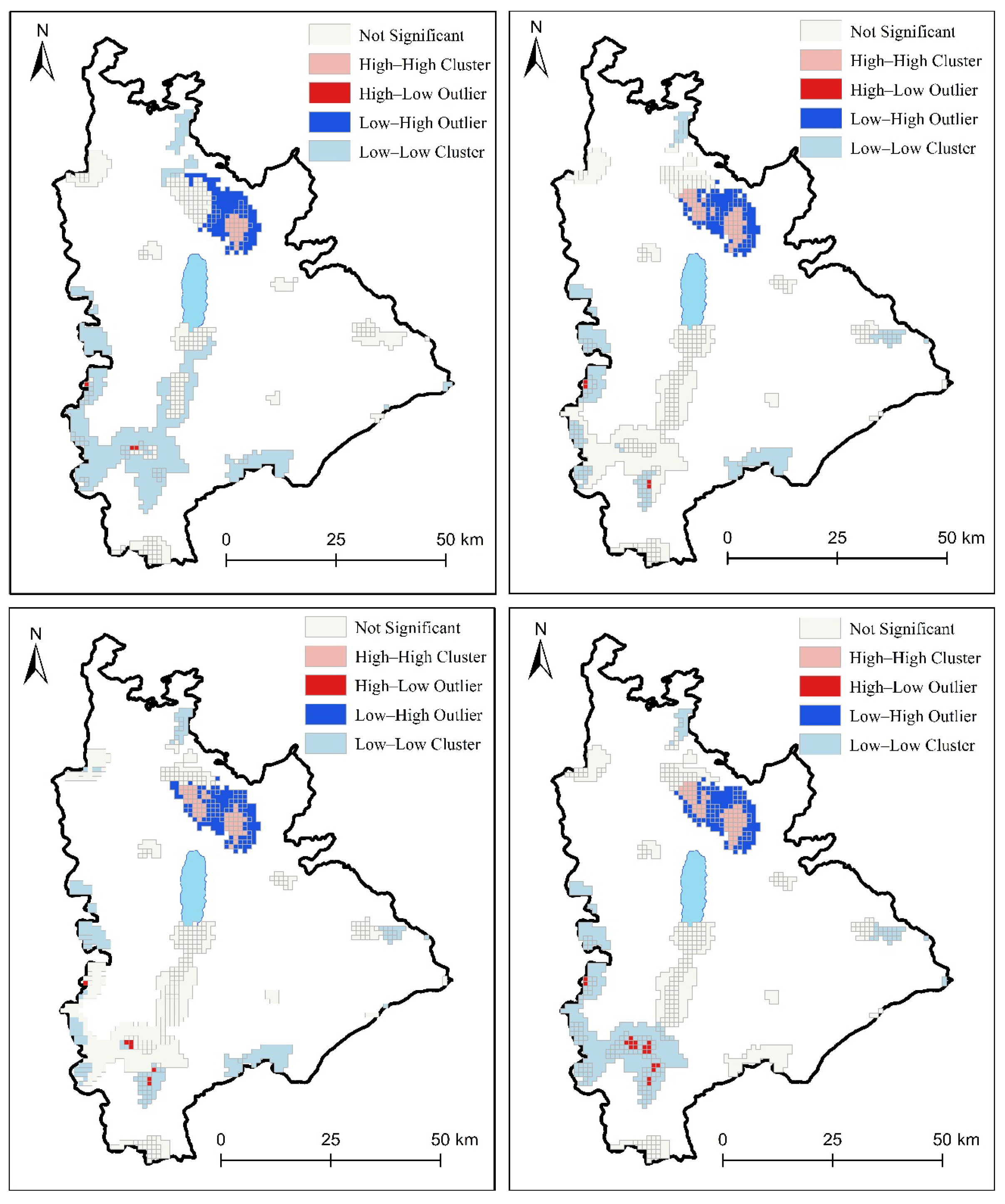
In order to clarify the spatial correlation basis between the high-quality development of urban areas in the Chenghai Basin and non-point source pollution, and to provide a prerequisite for the subsequent quantitative analysis of the local impact of high-quality urban development on non-point pollution, we adopt the bivariate local spatial autocorrelation method to identify the spatial correlation characteristics of the high-quality development level of urban areas in the basin and the intensity of non-point source pollution from 2013 to 2025. The diagnostic indicators of the GWR model, shown in
Table 3, indicate that the model has a high goodness of fit and that the residuals display no significant spatial autocorrelation. The results show that the two exhibit significant spatial correlation, with the various spatial association types not randomly distributed but instead demonstrating distinct spatial clustering characteristics (
Figure 9).
Spatially, high-quality development–high non-point source pollution is the dominant association type in the core basin area during the study period. It mainly concentrates in the northern main center and its surrounding subcenters, forming the core agglomeration zone. The northern subcenter shows phased evolution: before 2017, it was mostly non-significant; from 2017 onward, it gradually became an area of significant high–high association. The northern main center consistently shows a stable, significant high–high association throughout the study period, representing the closest spatial link in the basin. In contrast, high-quality development–low non-point source pollution areas mainly lie in the peripheral zones of the northern centers, forming a spatial gradient with adjacent core areas.
From 2013 to 2025, the spatial correlation between high-quality development and non-point source pollution in the Chenghai Basin remained unevenly distributed. The high-value correlation pattern centered on the northern urban agglomeration did not fundamentally change. Their significant spatial correlation and clustering showed that the two are not independent but exhibit close spatial interaction. This provides a spatial and analytical basis for using the GWR model to quantify the impact intensity, direction, and spatial characteristics of urban high-quality development on non-point source pollution at a local scale.
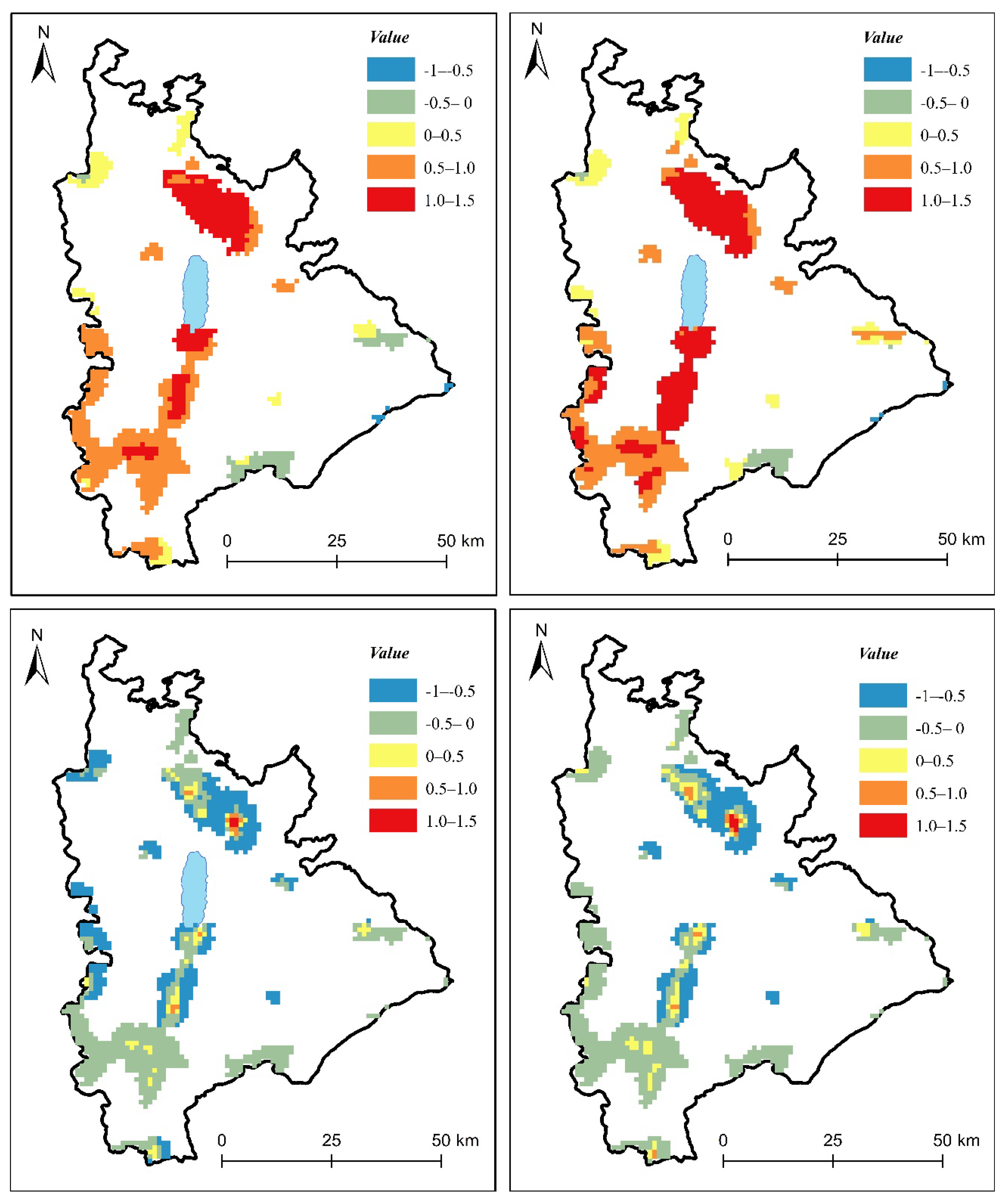
Based on their significant spatial correlation, we use the non-point source pollution index as the dependent variable and the urban high-quality development index as the core independent variable. We also employ land use dynamics and population density as control variables. The GWR model quantifies the local impact of high-quality urban development on non-point source pollution in the Chenghai Basin from 2013 to 2025, and the results show clear differences in impact intensity and spatial patterns across periods, with an overall phased evolution (
Figure 10).
From 2013 to 2017, high-quality urban development in the Chenghai Basin showed a strong positive driving effect on non-point source pollution across the whole area. The GWR coefficient mostly remains above 0.5, and all coefficients pass significance tests. This means that higher development levels strongly increase pollution intensity. Generally, urban development is accompanied by significantly higher levels of pollution, with no inhibitory effect yet observed. In this period, the basin was in the early transformation stage, in which population agglomeration, economic activity, and infrastructure construction increased the intensity of human activity globally, driving pollution upward across the area.
The year 2017 served as a stage transition node regarding the effect of high-quality urban development on non-point source pollution. Starting from 2017, the impact of high-quality urban development on non-point source pollution no longer showed globally uniform characteristics but instead presented a significant spatial differentiation pattern, in which the spatial distribution of regression coefficients underwent a fundamental transformation. This pattern mainly originated from the structural reorganization of land use in the drainage basin and may have also been indirectly influenced by differences in regional development and governance orientations. Specifically, the area with a regression coefficient greater than 0.5 shrank significantly and became highly concentrated in the northern urban core zone, encompassing the main center and its adjacent subcenter areas. This zone became the only cluster in which high-quality urban development maintained a strong positive driving effect on non-point source pollution. This occurred because the extensive expansion of impervious surface continued as the main characteristic of land use in the core zone, and the advancement of urban development remained closely linked to increasingly intensifying non-point source pollution. In contrast, in other areas of the drainage basin outside the northern urban core zone, the regression coefficient of the high-quality urban development index is generally below 0, and most areas pass the significance test. This indicates that in these areas, the effect of high-quality urban development on non-point source pollution shifted from a positive driving effect to a negative inhibiting effect. An increase in the urban development level began to reduce the non-point source pollution intensity. This was mainly due to the slowing of impervious surface expansion in the peripheral areas and the conversion of agricultural land to ecological land, which significantly enhanced the counteraction of pollution and the purification of ecological land.
From 2017 to 2025, the above spatial differentiation pattern maintained stable development, and the regression coefficients in the northern urban core area consistently remain above 0.5, continuously exhibiting a strong positive driving effect. The regression coefficients in other areas of the drainage basin consistently remain below 0, with the negative inhibitory effect remaining stable and showing no reversal of changes. This indicates that the impact of high-quality urban development on non-point source pollution in the Chenghai drainage basin displays stable spatial differentiation characteristics. In different locations, the interaction between urban development and non-point source pollution displays distinct evolution paths.
The impact of high-quality urban development on non-point source pollution in the Chenghai Basin reflects the dynamic adaptation of development mode, governance capacity, and environmental response. In its early stages, high-quality development displays factor accumulation and scale expansion, driving pollution upward across the area. This shows unidirectional pressure from development on the environment. As high-quality development advances, the focus shifts to efficiency, structural optimization, and stronger governance. The impact then shows significant spatial differentiation; for example, the northern core areas continue to experience a strong positive drive due to highly concentrated development and cumulative environmental pressure. Peripheral areas display suppression of pollution through improved development modes and governance, highlighting a differentiated mechanism across spatial scales and development stages. This evolution shows that the impact is not a simple linear relationship but the result of multiple factors, including development stage, spatial location, and governance level. The positive effect of high-quality development on the environment is not automatic; it requires active development model transformation and precise governance measures to achieve coordinated progress.
5. Discussion
In this study, we take the Chenghai drainage basin as the research object and clearly propose three core research objectives and scientific questions (see
Section 1). By integrating multi-source big data and applying methods such as the sedimentation flux method, a DAE, spatial autocorrelation, and GWR for empirical analysis, we systematically answer the above core scientific questions and effectively achieve the outlined research objectives. Based on the research results and through comparisons with existing research, in the following section, we systematically explain the degree to which this study answers each core question, the innovative aspects of our findings, and the connections and breakthroughs with regard to existing research. We also objectively analyze the study’s limitations and directions for further research.
From the perspective of the core aim proposed in
Section 1—accurately portraying the spatiotemporal evolution of non-point source pollution—the existing literature focuses on pollution load, source analysis, and water quality impacts. Methods include land-use-based output coefficients, hydrological–water quality models, and monitoring data analysis [
62,
63,
64], which mainly reveal how different land uses and human activity contribute to non-point source pollution. Previous studies have generally found that urbanization and increased human activity make pollution more dispersed, complex, and harder to manage, posing ongoing pressure on basin water ecology [
65,
66]. Our assessment of the Chenghai Lake basin echoes this trend: pollution closely follows changes in human activity intensity [
67]. However, unlike existing pollution-focused research, this study places non-point source pollution within the concept of urban high-quality development transformation. It depicts pollution evolution over a long time period and continuous space, showing that pollution does not simply move in one direction with urban development. Instead, it has clear phased and spatially heterogeneous characteristics.
Regarding another core issue raised in the Introduction—constructing a scientific evaluation system for high-quality urban development and portraying its spatiotemporal evolution characteristics—the existing literature mostly focuses on the comprehensive evaluation of urban development quality around dimensions such as economic efficiency improvement, industrial structure optimization, population agglomeration effects, and infrastructure enhancement [
68]. It is generally believed that high-quality development can promote regional coordinated development by improving the efficiency of resource allocation and governance capacity [
69,
70]. The conclusions of this study on the overall evolution of high-quality development in urban areas are consistent with the existing research in that urban development presents a long-term trend of transforming from being factor-driven to becoming quality-driven [
71]. However, this study spatially measures the high-quality development of urban areas through multi-source spatial big data, which further reveals the significant differences in the development path and evolution of distinct urban nodes, showing that high-quality development is not promoted synchronously within the basin but is instead deeply influenced by differences in spatial structure, development foundation, and functional positioning [
72]. To a certain extent, this finding supplements the problem of the insufficient attention that has been paid to the spatial heterogeneity of high-quality development in urban areas in previous studies.
Regarding the final core scientific issue proposed in the Introduction—analyzing the spatial correlation characteristics and influence mechanism between high-quality urban development and non-point source pollution—in research on pollution and urban development, the environmental Kuznets curve, decoupling analysis, or coupling coordination are often used. This research field mainly focuses on concentrated or point source pollution, like air pollution, industrial wastewater, and carbon emissions [
73,
74]. Most studies assume a synchronous or monotonic relationship, where pollution gradually decreases as development improves [
75]. This study partly supports that view: as high-quality urban development advances, non-point source pollution shows an overall downward trend [
76]. However, our analysis also shows that this relationship is not linear or immediate but instead exhibits clear spatial and temporal inconsistencies. Unlike previous studies, we incorporate process-based, diffuse non-point source pollution into the urban development framework and reveal its complex structure using GWR [
77]. The results show that in the early development stages or in areas with concentrated urban functions, higher development levels often accompany high non-point source pollution pressure. Only when the development model shifts to quality improvement and stronger governance is pollution gradually suppressed [
78]. This phased, spatially heterogeneous mechanism is rarely discussed in previous pollution development studies, because non-point source pollution, unlike concentrated emissions, depends heavily on land use, the distribution of human activity, and hydrological processes. Its response to urban development transformation shows a significant lag and structural dependence. Using long-term data and local spatial analysis, this study shows that high-quality urban development does not automatically and immediately reduce non-point source pollution, offering new empirical support for understanding their nonlinear relationship. In summary, this study fully achieves the core research objectives presented in the Introduction through the integrated use of multi-source big data and spatial analysis methods. It also facilitates a new understanding of the relationship between urban development and non-point source pollution; that is, the interaction between the two is not a single linear relationship but a dynamic process impacted by multiple factors. This conclusion also provides a new analytical perspective for subsequent related research.
The core scientific contributions of this study are mainly related to three aspects. First, NO2 and PM2.5 atmospheric pollution remote sensing data are combined with the sedimentation flux method to construct a comprehensive characterization system for non-point source pollution that is suitable for plateau lake drainage basins. This enriches the data sources and characterization methods available for non-point source pollution and improves the accuracy of portraying its spatiotemporal characteristics. Second, we integrate multi-source spatial big data and use a deep learning method to achieve the spatial measurement of high-quality urban development. This compensates for the deficiencies of previous research in portraying the spatial heterogeneity of high-quality urban development in small and medium-sized towns and improves evaluation methodologies for high-quality urban development. Third, this study incorporates high-quality urban development and non-point source pollution into a unified spatial analysis framework for the first time. It reveals the spatiotemporal coupling characteristics between the two, as well as the stage evolution law and core periphery spatial differentiation pattern of the impact of high-quality urban development on non-point source pollution. It also clarifies the coupling mechanism of development stage, spatial location, and governance level. This avoids the assumptions of a single linear relationship made in traditional research and deepens our understanding of the transformation of urban development models and the response mechanism of non-point source pollution. The results of this study provide scientific basis and decision support for promoting the coordinated governance of high-quality urban development and non-point source pollution by region and by stage in plateau lake drainage basins and small and medium-sized towns, thereby improving the sustainable development of drainage basins.
Although this study systematically explores the mechanism and spatial impact characteristics of non-point source pollution in the drainage basin from the perspective of high-quality urban development, certain limitations still exist and require further exploration in subsequent research. First, a certain conceptual discrepancy exists between the non-point source pollution characterization method and the research’s findings. This study uses NO2 and PM2.5 atmospheric pollution remote sensing data combined with the sedimentation flux method to characterize non-point source pollution. The core logic of this method relies on the dry and wet deposition of atmospheric pollutants to reflect the pollutant load input into the drainage basin surface and water body driven by human activity. This is an indirect and substitute characterization of non-point source pollution. However, the essence of non-point source pollution is the process by which it is generated from agricultural production, urban surfaces, and transportation activities and then enters water bodies through non-point sources, driven by rainfall or snowmelt runoff. Its core characteristics include that it is driven by runoff, exhibits multi-media migration, and is affected by river or lake inflow load. Although both are highly correlated with human activity intensity and can achieve macro-characterization of the spatiotemporal pattern of non-point source pollution, a micro-level conceptual discrepancy still exists for pollutant type, migration process, and pollution effect. This method cannot accurately portray the specific formation and water impact process of non-point source pollution. Second, the interpretability of the fusion modeling method for high-quality urban development is insufficient. Here, we used a DAE to perform the nonlinear fusion of multi-source data. Although it can effectively capture the latent features of the data and quantify the high-quality development level, it is a black box model; therefore, it cannot clarify the contribution degree and weight relationship of the three indicators—nighttime light, population density, and POI kernel density—to the high-quality urban development index. It is thus difficult to explain the driving intensity of each factor on high-quality urban development at the mechanism level. We obtain a comprehensive evaluation result only, which lacks direct methodological support for formulating targeted development optimization strategies in the future. Third, the data type used for characterizing non-point source pollution is distinct and disconnected from that for the core pollutants. We selected remote sensing data for only two types of atmospheric pollutant, NO2 and PM2.5, which allows for the indirect characterization of non-point source pollution. However, the core non-point source pollutants in the drainage basin are nitrogen, phosphorus nutrients, and organic pollutants. Although both atmospheric and core pollutants are highly correlated with the intensity of human activity, significant differences exist in their sources, migration patterns, and environmental effects. Only one type of atmospheric pollutant data cannot reflect the spatiotemporal characteristics of core pollutants. At the same time, the study lacks field-monitored non-point source pollution load data in the drainage basin and thus cannot perform field validation and calibration of the results characterized by remote sensing data. The validity of the data therefore lacks direct support. Finally, we did not directly include environmental ecological indicators in the high-quality urban development evaluation framework. This was not performed to ignore the green connotations of high-quality development but instead represents a scientific choice based on the development stage of the study area and the research design. On one hand, as a county-level town in the northwest Yunnan Plateau, the Chenghai drainage basin is still in the early stages of transitioning from traditional scale expansion to high-quality development. The independent development of ecological environment protection has not yet been evaluated, but exists as a constraint condition for urban development. Ecological effects are reflected more through the interaction between development and pollution. On the other hand, the core scientific objective of this study is to explore the mechanism of high-quality urban development’s influence on non-point source pollution. Directly including environmental ecological indicators in the development evaluation framework would cause collinearity between the explained variable, non-point source pollution, and the explanatory variable, high-quality development, weakening the model’s explanatory power for the causal relationship between the two.
Future research could include comparative analyses on larger spatial scales or in different types of drainage basins to test the applicability and generalizability of the spatial impact framework of urban high-quality development on non-point source pollution proposed in this study, thereby further expanding the theoretical depth and practical value of related studies.
6. Conclusions
This study integrates multi-source spatial big data from 2013 to 2025, including atmospheric pollution remote sensing, NTL, and population grids, and combines methods that involve deposition flux, deep learning fusion, spatial autocorrelation, and GWR. By focusing on the Chenghai drainage basin, it systematically explores the spatiotemporal evolution of high-quality urban development and non-point source pollution and their interaction, allowing for the following conclusions to be drawn. Non-point source pollution and high-quality urban development in the Chenghai drainage basin both show distinct stages of changes and spatial differentiation trends. First, from the perspective of spatiotemporal evolution, non-point source pollution showed a decreasing trend from 2013 to 2017, but it gradually intensified after 2017. Spatially, a pattern of southern pollution agglomeration and fluctuations in the northern urban core area is shown. Meanwhile, high-quality urban development diminished slightly from 2013 to 2017, but gradually improved after 2017. Furthermore, the evolution patterns of different urban nodes in the drainage basin show obvious differences. Secondly, regarding their interaction, the impact of urban high-quality development on non-point source pollution evolves in stages. Specifically, it showed a strong positive driving role across the entire region from 2013 to 2017, with regression coefficients all above 0.5. However, the year 2017 was an important turning point, after which the impact pattern presented distinct core–periphery differentiation. The northern urban core area maintained a strong positive driving role, with a regression coefficient of over 0.5. The peripheral area exhibited a negative inhibition effect. In addition, this spatial differentiation characteristic remained stable later on in the period being studied. Therefore, the relationship between high-quality urban development and non-point source pollution is not singular or linear, but is the result of the joint action of multiple factors, such as development stage, spatial location, and environmental governance level. The positive effect of the ecological environment relies on the active development of model transformation and accurate environmental governance policies.
The conclusions of this study provide a practical reference for enabling differentiated, synergistic governance of development and pollution in plateau lake drainage basins. The core areas of the basin need to strengthen pollution control, while the peripheral areas should continue to consolidate the inhibiting effect of development on pollution while also promoting coordinated ecological protection and urban development in the basin.