Article

Spatiotemporal Modeling and Future Trends of Land Surface Temperature Using Remote Sensing and CA-ANN in Industrial Narayanganj, Bangladesh


by
Sayed Abu Johany
1,
Sajid Ibne Jamalfaisal
1,
Md Sabit Mia
1,
Sujit Kumar Roy
2,
Md. Tahsinur Rahman
1,
Md. Mahmudul Hasan
3,4,5,
Wafa Saleh Alkhuraiji
6,
Martin Boltižiar
7 and
Mohamed Zhran
8,*
1
Department of Environmental Science and Disaster Management, Noakhali Science and Technology University, Noakhali 3814, Bangladesh
2
Institute of Water and Flood Management (IWFM), Bangladesh University of Engineering and Technology (BUET), Dhaka 1000, Bangladesh
3
Department of Geography & Environment, Jagannath University, Dhaka 1100, Bangladesh
4
Data-Driven Research on Environment and AI Modelling (DREAM Laboratory), Jagannath University, Dhaka 1100, Bangladesh
5
Dream Research and Development Foundation (DRDF), Dhaka 1207, Bangladesh
6
Department of Geography and Environmental Sustainability, College of Humanities and Social Sciences, Princess Nourah Bint Abdulrahman University, P.O. BOX 84428, Riyadh 11671, Saudi Arabia
7
Department of Geography, Geoinformatics and Regional Development, Faculty of Natural Sciences and Informatics, Constantine the Philosopher University in Nitra, 94901 Nitra, Slovakia
8
Public Works Engineering Department, Faculty of Engineering, Mansoura University, Mansoura 35516, Egypt
*
Author to whom correspondence should be addressed.
Land 2026, 15(3), 423; https://doi.org/10.3390/land15030423
Submission received: 27 January 2026 / Revised: 20 February 2026 / Accepted: 3 March 2026 / Published: 5 March 2026

Abstract

The thermal consequences of industrial land transformation remain underexplored in rapidly urbanizing regions of Bangladesh. This study presents a novel approach of how extensive industrial expansion in Narayanganj, a major manufacturing hub dominated by textile, knitwear and dyeing industries, has altered land surface temperature (LST) dynamics over the past three decades, including its variation across classes, relationships with biophysical indices and future patterns. Landsat 5 TM and Landsat 8 OLI imagery from 1991, 2007, and 2023 were utilized to map LULC using winter-season images through supervised classification, while multi-seasonal thermal bands were used to derive LST. LST variations were further evaluated using cross-sectional profiles across different land cover types, and correlations were examined with indices including the greenness index (NDVI), moisture index (NDMI), built-up index (NDBI), and barrenness index (NDBAI). Additionally, a future LST map for 2039 was generated using the cellular automata–artificial neural network (CA-ANN) model. Results show that between 1991 and 2023, built-up area and bare land expanded by 16.72% and 14.15%, while vegetation area and water bodies decreased by 26.62% and 4.25%. Average LST increased from 25.94 °C in 1991 to 28.68 °C in 2023, with projections indicating an additional 2 °C rise by 2039. Cross-sectional analysis found that built-up areas consistently showed the maximum surface temperatures, followed by bare land, vegetation and water bodies. In addition, correlation analysis revealed that LST showed an inverse relation with NDVI and NDMI, while showing a positive relationship with NDBI and NDBAI. These findings show the necessity of sustainable urban planning and green infrastructure to reduce surface heating in rapidly urbanizing areas.

1. Introduction

In today’s globalized world, more than fifty percent of people worldwide live in cities, seeking a better quality of life [1]. As a result, rapid urban expansion has transformed natural landscapes and disrupted the local and regional microclimates [2]. In recent years, researchers have increasingly used index-based analyses to investigate how human activities drive land use and land cover (LULC) changes and, in turn, influence climate variability [3,4,5]. In particular, the shift of vegetation or water bodies into impermeable surfaces such as residential or industrial buildings, roads, and parking lots significantly raises temperature and causes regional or global warming [6,7,8]. These impermeable surfaces absorb solar radiation throughout the day and slowly emit it from the afternoon until late at night, causing a significant rise in land surface temperature (LST) [9,10]. On the other hand, dense vegetation cools the urban region and ensures the ecosystem’s sustainability through preventing nutrient loss, reducing soil erosion, and regulating the hydrological cycle [11,12]. Therefore, mapping of LULC is an effective way of monitoring the temporal and spatial changes in various land features and identifying associated problems with these changes.
Satellite remote sensing (RS) is frequently used combined with geographic information systems (GISs) for this purpose [6,7]. On-site collection of data is expensive, and the lack of historic records can pose a significant challenge. LST and LULC mapping have recently made use of a number of satellite sensors, such as the thematic mapper (TM), enhanced thematic mapper plus (ETM+), operational land imager/thermal infrared sensor (OLI/TIRS), and the moderate resolution imaging spectroradiometer (MODIS) [13,14,15]. This study uses Landsat multi-spectral data (OLI/TIRS and TM) because of their high resolution and longest availability record. These datasets also include thermal bands that allow for simultaneous analysis of LST and LULC from a single image and have been widely applied by researchers [16,17,18] for similar purposes over extended periods. The association among LULC and LST can be examined using two main approaches: directly relating LULC and LST or analyzing the correlation with various biophysical indices. Previous studies have widely applied both approaches to show how LULC changes influence the rise in LST [18,19,20].
Moreover, LST and LULC simulations are also crucial as they provide insights into the present and future development requirements [21,22]. Artificial neural network (ANN) [23], Markov chains and Cellular automata [24,25] models are the most widely used methods of simulation and prediction with respective advantages and disadvantages. This study employed the CA-ANN model to estimate LST for 2039, since index-based predictions cannot capture past trends. CA-ANN offers a more effective simulation approach, particularly in research areas where underlying processes are not well understood [26,27]. To rebuild the underlying process and provide predictions, the model does not require large previous knowledge of complex network dynamics in the real world [28]. In addition, studies consistently found that ANN models achieve lower error metrics and higher correlation coefficients compared to traditional regression or index-based methods, making them more reliable for future LST estimation [27,29].
Previous studies mostly relied on single-month datasets to characterize annual conditions, overlooking the seasonal variability in surface temperature [5,15,17,30,31,32,33]. To address this limitation, the present study employs multi-seasonal satellite data and multiple analytical techniques. This approach may provide a more precise and complete representation of annual LST fluctuations and their correlation with LULC in an industrial urban area. Several studies have showed the connection between LULC and LST in different areas of Bangladesh [30,34,35,36,37,38,39]. However, prior studies in Bangladesh have examined LULC–LST dynamics in metropolitan contexts such as Dhaka and Chittagong; none have focused specifically on districts where industrial land use, particularly export-oriented textile, knitwear and dyeing manufacturing, constitutes the dominant driver of landscape transformation [19,40]. Narayanganj is uniquely positioned as Bangladesh’s foremost industrial district, contributing approximately 33% of national textile output and 55% of knitwear production, yet its thermal environment remains systematically under characterized. This industrial specificity introduces distinct surface energy balance dynamics including concentrated anthropogenic heat flux from factory operations, large impervious rooftop surfaces, and chemical effluent-driven water body degradation that differ fundamentally from residential urbanization patterns studied elsewhere. Methodologically, most studies have examined historical LULC–LST relationships, seasonal variability, or predictive modeling separately. Few have integrated long-term land transformation analysis, class-specific thermal response, biophysical index correlation, cross-sectional spatial profiling and nonlinear CA–ANN-based future simulation within a unified analytical framework. By combining these components over a 32-year period (1991–2023) and applying them to an intensively industrialized landscape, this study advances methodological integration and captures complex interactions between land transformation and surface thermal amplification. Therefore, the study focuses on the following objectives: (a) to examine the temporal and spatial patterns of LULC and LST shifts in the Narayanganj district for the previous two decades using Landsat satellite images from 1991, 2007, and 2023; (b) to analyze the relation between LST and LULC indices such as NDVI, NDMI, NDBI, and NDBAI, including LST variations across different LULC classes, using cross-sectional profiles to assess spatial variability; and (c) to predict changes in LST for 2039 based on changes in LULC and LST over the past 30 years. Insights from this research may provide strategies for developing and improving sustainable urban and industrial ecosystems and policy guidance in the region.

2. Literature Review

A wide range of global studies have investigated the relationship between LULC changes and LST, highlighting how urbanization-driven transformations—particularly the conversion of vegetation and water bodies into built-up and impervious surfaces intensify urban heat islands (UHIs) and elevate LST [6,7]. Biophysical indices such as NDVI, NDMI, NDBI and NDBAI have been widely used to quantify these associations, often revealing strong negative correlations between LST and vegetation/moisture indices and positive correlations with built-up and bare soil indices [19,29]. These indices enable detailed analysis of seasonal variability and spatial heterogeneity in thermal responses across LULC classes.
Numerous studies have applied remote sensing techniques, primarily Landsat data, to map LULC and LST dynamics in urbanizing regions of developing countries. For instance, in rapidly urbanizing cities, built-up expansion has been linked to significant LST increases, with vegetation and water bodies providing cooling effects [7,21]. In tropical and subtropical contexts, seasonal differences influence these relationships, with stronger LST-NDBI correlations often observed in post-monsoon or summer periods compared to winter [6,41]. Predictive modeling has advanced through integration of Cellular Automata (CA) and Artificial Neural Networks (ANNs), which outperform traditional regression or index-based methods in capturing nonlinear dynamics and simulating future LST scenarios [42,43].
In South Asian cities, particularly in Bangladesh, multiple studies have demonstrated the pronounced impact of LULC changes on LST due to rapid industrialization and urban sprawl. In Dhaka, built-up areas increased significantly from 2000 to 2020, resulting in a 7.24 °C rise in mean LST, with strong positive correlations between LST and NDBI, and negative correlations with NDVI and NDWI [21]. Similar trends were observed in Chattogram, where built-up expansion by 4.57% between 1990 and 2020 correlated positively with LST rises, while vegetation and water bodies showed cooling effects [19]. In Rajshahi, urban areas expanded by 18% and vegetation decreased by 17% from 1990 to 2020, leading to LST increases of up to 14 °C [44]. Barishal City exhibited a 5.75 °C mean LST rise from 1998 to 2024, driven by 11.29% built-up growth and reductions in vegetation and agriculture, with NDBI positively and NDWI negatively correlated to LST [45].
Specific to industrialized and peri-urban areas, research in Narayanganj has shown that heavy industrial development and urbanization from 2011 to 2019 led to a 1.86 °C mean LST increase, with built-up and industrial zones exhibiting the highest temperatures and strong negative correlations with NDVI [46]. Industrial combustion and impervious surfaces amplified thermal responses, while vegetation mitigated UHI effects. Broader analyses in Dhaka metropolitan regions, including Gazipur and Narayanganj, from 1993 to 2023, confirmed upward LST trends linked to urban encroachment on green spaces [47]. However, most Bangladesh-based studies have focused on major cities like Dhaka or used single-season data, often overlooking multi-seasonal variability, class-specific thermal responses, and integrated long-term analysis in highly industrialized districts dominated by textile and manufacturing sectors [21,48].
Predictive approaches using CA-ANN have been effectively applied in Bangladesh and similar contexts to forecast LULC and LST changes. In Dhaka, CA-ANN modeling projected continued warming by 2030 due to urban expansion [49]. In other regions, such as Lucknow (India), CA-ANN predicted built-up increases and LST intensification by 2031, with ANN outperforming other methods in accuracy [50]. Studies consistently report that CA-ANN achieves higher correlation coefficients and lower error metrics (e.g., RMSE, Kappa > 0.7–0.8) compared to standalone index-based or regression models, making it reliable for nonlinear, process-unknown simulations [51,52,53]. Overall, extensive research has established the LULC-LST nexus using biophysical indices and predictive models. However, research specifically targeting industrial districts where manufacturing operations introduce distinct thermal dynamics beyond residential urbanization remains limited. Additionally, methodological approaches have typically addressed historical trends, biophysical correlations, or future projections separately rather than within integrated analytical frameworks. Selecting appropriate multi-seasonal datasets and combining multiple analytical techniques remains crucial for comprehensive understanding of LST dynamics in rapidly industrializing contexts.

3. Materials and Methods

3.1. Study Area

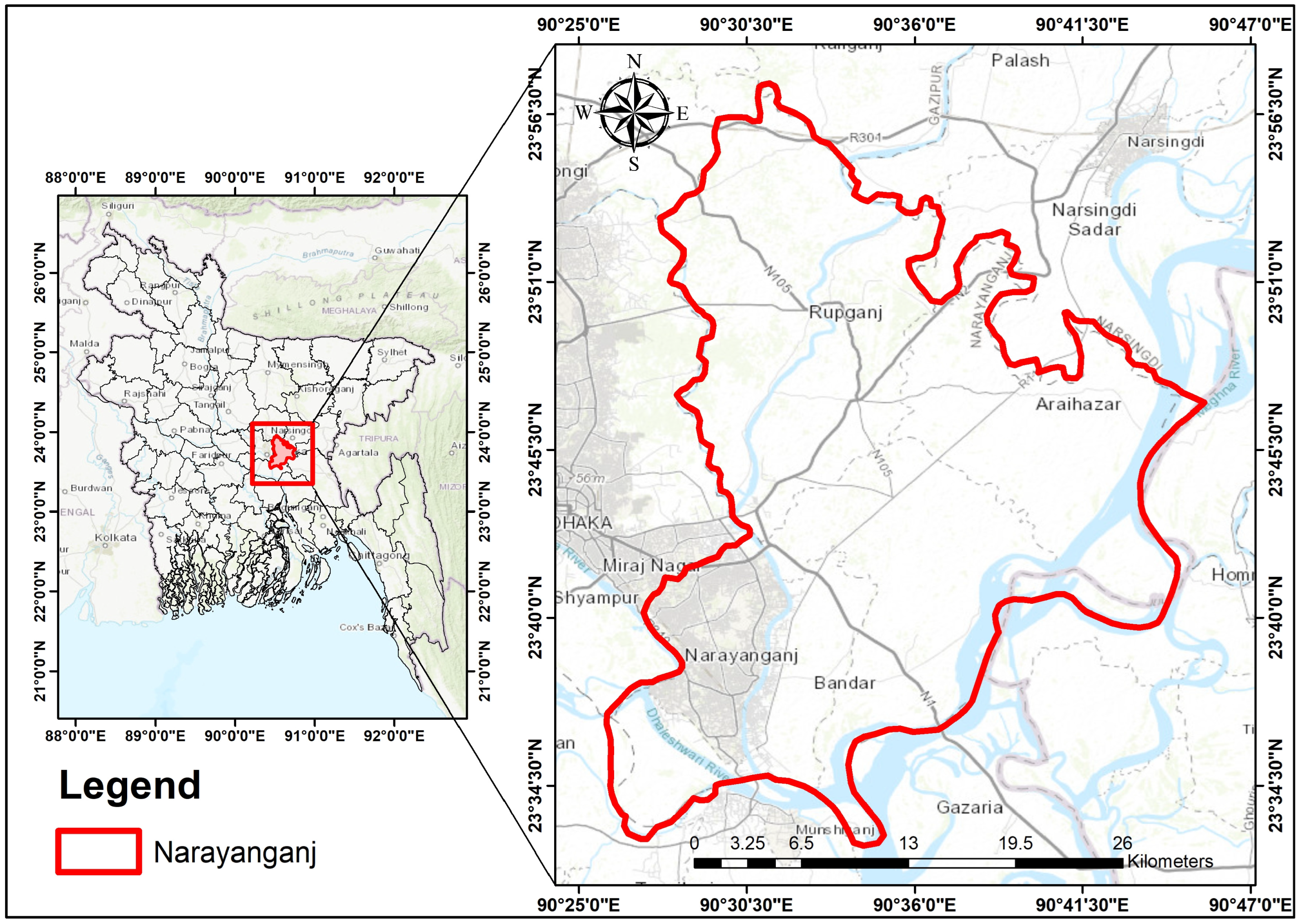
Narayanganj is a fast-developing district near Dhaka with significant industrial and commercial activity, geographically located between 23°34′ and 24°15′ north latitude and 90°27′ to 90°59′ east longitude. The district is a major hub for Bangladesh’s textile (33%) and knitwear sector (55%), with numerous dyeing, washing, and garment factories concentrated in areas such as Fatullah, Kanchpur, and the BSCIC industrial zone [54,55]. In addition, it also hosts several significant power plants. It is located by the Shitalakshya River, close to the capital city Dhaka, the oldest and busiest river port [46]. The city gradually built many industries because of its easy accessibility to raw materials, markets and human resources. Most of those industrial facilities are located on both the east banks of the Shitalakshya and Buriganga rivers. Due to the growing industrialization, the district may experience rapid population growth and urban development [56]. The total area of this district is 684.4 km2, with a population of 4,034,461 people, and the population density was 5897 km−2 in 2022 [46,57]. The region experiences hot and humid weather extending from mid-April till mid-June. Normally, the monsoon typically lasts from early or mid-May to mid-October, contributing about 80–90% of the annual rainfall during this period [58]. The city of Narayanganj receives a mean annual rainfall of 2004 mm. During summer, the average temperature reaches 29.4 °C, with a maximum of 34.7 °C. Winter spans from mid-December to mid-February, with January experiencing the lowest temperature of about 13.4 °C. December is the driest of all, with only about 5 mm of precipitation, whereas July is the wettest, receiving an average of 374 mm [46]. The spatial configuration of Narayanganj shown in Figure 1 provides important context for interpreting land surface temperature patterns observed in this study. The close proximity of industrial zones, dense built-up areas, and major river systems creates a heterogeneous urban landscape, which plays a key role in shaping land use transitions and surface thermal variability.

3.2. Data Collection and Image Pre-Processing

Table 1 presents the total number of 18 images of the Landsat 5 TM (1991 and 2007) and Landsat 8 OLI/TIRS (2023) sensors that were obtained for two distinct seasons (summer and winter) from the United States Geological Survey (USGS) (https://earthexplorer.usgs.gov, accessed on 5 January 2025).
These images originated from paths 137/43 and 137/44 and were combined into a mosaic. Using the WGS-84 datum, the Level 1 Terrain Corrected format data were georeferenced to UTM zone 46.
The images were acquired during the same months across different years to minimize seasonal variability and under cloud cover conditions of less than 10% [59,60]. Before calculating biophysical indicators, atmospheric correction was performed on the multispectral bands to derive surface reflectance values using standard USGS-recommended procedures [61,62]. To ensure consistency between Landsat 5 TM and Landsat 8 OLI/TIRS thermal data, all images were radiometrically calibrated using standard USGS procedures by converting digital numbers to spectral radiance and then to at-sensor brightness temperature. To reduce scaling artifacts due to differences in native spatial resolution, thermal bands were resampled to a common resolution prior to LST retrieval and land surface emissivity was estimated using an NDVI-based approach [63,64]. Although these procedures minimize cross-sensor discrepancies, inherent spectral response differences between TM Band 6 (10.40–12.50 µm) and OLI/TIRS Band 10 (10.60–11.19 µm) may introduce residual uncertainty in absolute LST comparisons across the study period [29,65]. All image preprocessing, LULC classification, and LST estimation were carried out using ArcGIS 10.8.

3.3. Methods

3.3.1. LULC Categorization and Change Analysis

Winter images were selected for LULC analysis from the summer and winter seasons because the skies are typically clearer during this period [66]. The images were classified into four categories: built-up area, vegetation, water body, and bare land, applying the maximum likelihood algorithm within the supervised classification method. The maximum likelihood algorithm was selected because it assumes normal distribution of spectral signatures and considers both class variance and covariance, which makes it particularly effective for medium-resolution multispectral data such as Landsat. It has been widely used in LULC classification studies and provides reliable results when adequate and representative training samples are available [46]. For Landsat-5 TM images, Bands 1–5 and 7 were considered for classifying LULC for 1991 and 2007; Band 6 was excluded because it is a thermal band. In contrast, Bands 1–7 were used for the classification of LULC in 2023 from Landsat-8 (OLI/TIRS) imagery. To generate LULC maps, the Image Analyst tool in ArcGIS 10.8 was used to stack all the bands. The Training Sample Manager was used to determine the pixel signatures, including multiple training samples randomly selected across the image to ensure representative coverage [67]. To ensure spatial independence, training and validation samples were selected from spatially separated locations with a minimum distance threshold applied to avoid spatial autocorrelation between sample sets [68]. Moreover, the change matrix tool in ArcGIS 10.8 was used to compare the LULC classifications of 1991 and 2023 [69]. Based on the change matrix results, a change map was produced in the ArcGIS environment utilizing spatial analysis tools.

3.3.2. Accuracy Evaluation of LULC

For each LULC category, 80 training samples (total = 240) were created to assess the accuracy of the LULC maps. Since LULC classification can produce errors, statistical techniques are necessary to evaluate result reliability. Field surveying is the most reliable method for collecting sample data for accurate assessment. However, rapid changes in land use often make fieldwork challenging. Consequently, the scientific community commonly accepts satellite imagery as a reference source. The most widely used validation method for LULC maps is kappa coefficient (KC) [70], which provides more precise results compared to other validation techniques [71]. The KC ranges between 0 and 1, where 0 indicates minimal agreement and 1 represents almost perfect agreement. In addition, the accuracy of each LULC category can be assessed using producer’s accuracy and user’s accuracy [72]. In this study, the samples were used to create a confusion (error) matrix, where the classified image was validated by comparison with reference data. Based on this matrix, the producer’s accuracy (PA), user’s accuracy (UA), overall accuracy (OA) and KC were calculated by using Equations (1)–(4), respectively. In addition, the F1 score was calculated to evaluate the classification performance by jointly considering both producer’s and user’s accuracies, representing their weighted harmonic mean, as defined in Equation (5) [73].
U A = N u m b e r   o f   p i x e l   i n   e a c h   c a t e g o r y   t h a t   a r e   c o r r e c t l y   c l a s s i f i e d T o t a l   c o u n t   o f   c l a s s i f i e d   p i x e l s   i n   t h a t   c a t e g o r y   ( T h e   r o w   t o t a l )  
P A = N u m b e r   o f   p i x e l   i n   e a c h   c a t e g o r y   t h a t   a r e   c o r r e c t l y   c l a s s i f i e d T o t a l   c o u n t   o f   r e f e r e n c e   p i x e l s   i n   t h a t   c a t e g o r y   ( T h e   c o l o u m   t o t a l )
O A = T h e   n u m b e r   o f   c o r r e c t l y   c l a s s i f i e d   p i x e l D i a g o n a l T o t a l   n u m b e r   o f   p i x e l s   ( R e f e r e n c e )  
K C = T S × T C S ( C o l u m n   T o t a l × R o w   T o t a l ) T S 2 ( ( C o l u m n   T o t a l × R o w   T o t a l ) )  
F 1   S c o r e = 2 × U s e r s   a c c u r a c y   U A × P r o d u c e r s   a c c u r a c y   P A U s e r s   a c c u r a c y   U A + P r o d u c e r s   a c c u r a c y   P A  

3.4. LST Extraction Method

LST data was extracted using the thermal bands of Landsat-8 OLI (Band 10) and Landsat-5 TM (Band 6) for the summer and winter seasons, corresponding to April and January, respectively. However, slight variations exist in the method of calculating LST between Landsat-5 TM and Landsat-8 OLI, particularly in the computation of spectral radiance ( L λ ). Several studies have outlined the steps involved in extracting LST [19,74].
  • Step 1: Calculating spectral radiance ( L λ ) from DN values
Since each object has a temperature more than absolute zero or 0 Kelvin (K), they all emit electromagnetic radiation. The collected data were subsequently converted into spectral radiance. Band 6 is a thermal band used for Landsat 5 (TM) imagery, and the spectral radiance ( L λ ) was calculated using Equation (6) [75].
L λ = L M I N λ L M A X λ L M I N λ Q C A L M A X Q C A L M I N × Q C A L
Here, the highest and lowest spectral radiance for band 6 is denoted by L M A X λ   and L M I N λ  
L M A X λ = 15.303
L M I N λ = 1.238
Q C A L M A X = M a x i m u m   d i g i t a l   n u m b e r   v a l u e   ( 255 )
Q C A L M I N = M i n i m u m   d i g i t a l   n u m b e r   v a l u e   ( 1 )
Q C A L = D i g i t a l   n u m b e r   v a l u e   f o r   e a c h   p i x e l
For Landsat-8 (OLI) imagery, Band 10 is the designated thermal band, and the spectral radiance ( L λ ) was calculated using Equation (7) [76].
L λ = M L × Q C A L + A L
Here,
L λ = S p e c t r a l   r a d i a n c e   o f   t h e   s e n s o r
M L = T h e   m u l t i p l i c a t i v e   r e s c a l i n g   f a c t o r   s p e c i f i c   t o   a   b a n d   ( 0.0003342 )
Q C A L = C a l i b r a t e d   a n d   q u a n t i z e d   r a d i a n c e   v a l u e
A L = T h e   b a n d s p e c i f i c   a d d i t i v e   r e s c a l i n g   f a c t o r   ( 0.1 )
  • Step 2: Calculation of brightness temperature (BT)
After the conversion of the digital number (DN) to radiance, the values were further transformed into brightness temperature (BT), applying the thermal constants given in the metadata file. Equation (8) was used to transform radiance into BT.
B T = K 2 ( l n K 1 L λ + 1 ) 273.16
Here, K 1 and K 2 are calibrated constants based on the OLI, TM, and ETM + sensors. For Landsat 5 TM, the values of K 1 and K 2 were 607.76 and 1260.56, and for Landsat 8 OLI, they were 774.89 and 1321.08 [75,76].
  • Step 3: Determining the emissivity of land surface
Plank’s Law considers land surface emissivity to be a proportionality element. This can be computed using Equations (9) and (10) [77]:
ε = 0.004 P v + 0.986
Here,
P v =   P r o p o r t i o n   o f   v e g e t a t i o n stands
ε = L a n d   s u r f a c e   e m i s s i v i t y
P v = N D V I N D V I m i n N D V I m a x N D V I m i n 2
Here,
N D V I m i n =   M a x i m u m   N D V I   v a l u e
N D V I m a x = M i n i m u m   N D V I   v a l u e  
  • Step 4: LST calculation
This step completes the last step of the LST calculation and is calculated by Equation (11).
L S T = B T 1 + λ × B T × S h × c × l n ε
Here, L S T stands for land surface temperature, and B T is for brightness temperature obtained by the sensor. The radiation wavelength that is emitted is represented by λ, and the land surface’s spectral emissivity is represented by Ɛ (0.97–0.99). Additionally, the light velocity is indicated by c , equivalent to 2.998 × 10 8   m s 1 ; h is the Plank’s constant, equal to 6.626 × 10 34   J s ; and the Boltzmann constant is denoted by S ( 1.38 × 10 23   J K 1 ) [7,35,78]. Moreover, the normalization or standardization of LST values is recommended for comparing LST measurements from various periods, particularly when studying seasonal variations in LST [79].

3.5. Methods for Extracting Various Biophysical Parameters

Four major biophysical indices, the NDVI, NDBI, NDMI and NDBAI, were extracted to provide a clearer understanding of land cover changes. The relationship between these biophysical indices and LST was also analyzed to assess their influence on surface temperature. NDVI is frequently used to measure the health of vegetation [80]. The index was calculated by comparing the amount of light reflected by satellite images in the near-infrared (NIR) band and red (RED) band ranges. The value of NDVI varies from −1 to +1, where positive values representing areas of dense vegetation and negative values indicating non-vegetated surfaces [81]. It was calculated using Equation (12) [82].
N D V I = B N I R B R E D B N I R + B R E D
NDBI is a widely used technique to evaluate built-up area in metropolitan areas [83]. Higher NDBI values generally represent impervious surfaces (such as urban areas), while lower or negative values indicate non-built-up features like vegetation, bare land or water bodies [84]. The index was computed using Short-Wave Infrared1 (SWIR1) and NIR bands based on Equation (13) [85].
N D B I = B S W I R 1 B N I R B S W I R 1 + B N I R
NDMI is another important measure of urban environment that reflects the moisture content of the landscape [86]. It varies from −1 to +1, where a positive number indicates vegetation and water bodies, while a negative one denotes built-up regions and barren soils [87]. The index was calculated using Equation (14), which incorporates the SWIR1 and NIR bands [88].
N D M I = B N I R B S W I R 1 B N I R + B S W I R 1
NDBAI helps to determine the bare land of an area and ranges from −1 to +1. Higher values suggest elevated bareness, whereas lower values may reflect vegetated or water-covered areas [89]. The SWIR1 and thermal infrared band1 (TIRS1) bands were used to calculate the index, as shown in Equation (15) [90]. Spatial distribution maps of these indices for 1991, 2007, and 2023 are given in Figure S1. To examine heterogeneity in LST–index relationships across land cover types, Pearson correlation coefficients between LST and each biophysical index were additionally computed separately for each LULC class using zonal pixel extraction, and statistical significance was assessed at p < 0.05 and p < 0.01 levels.
N D B A I = B S W I R 1 B T I R S 1 B S W I R 1 + B T I R S 1

3.6. Method for Predicting the Future LST

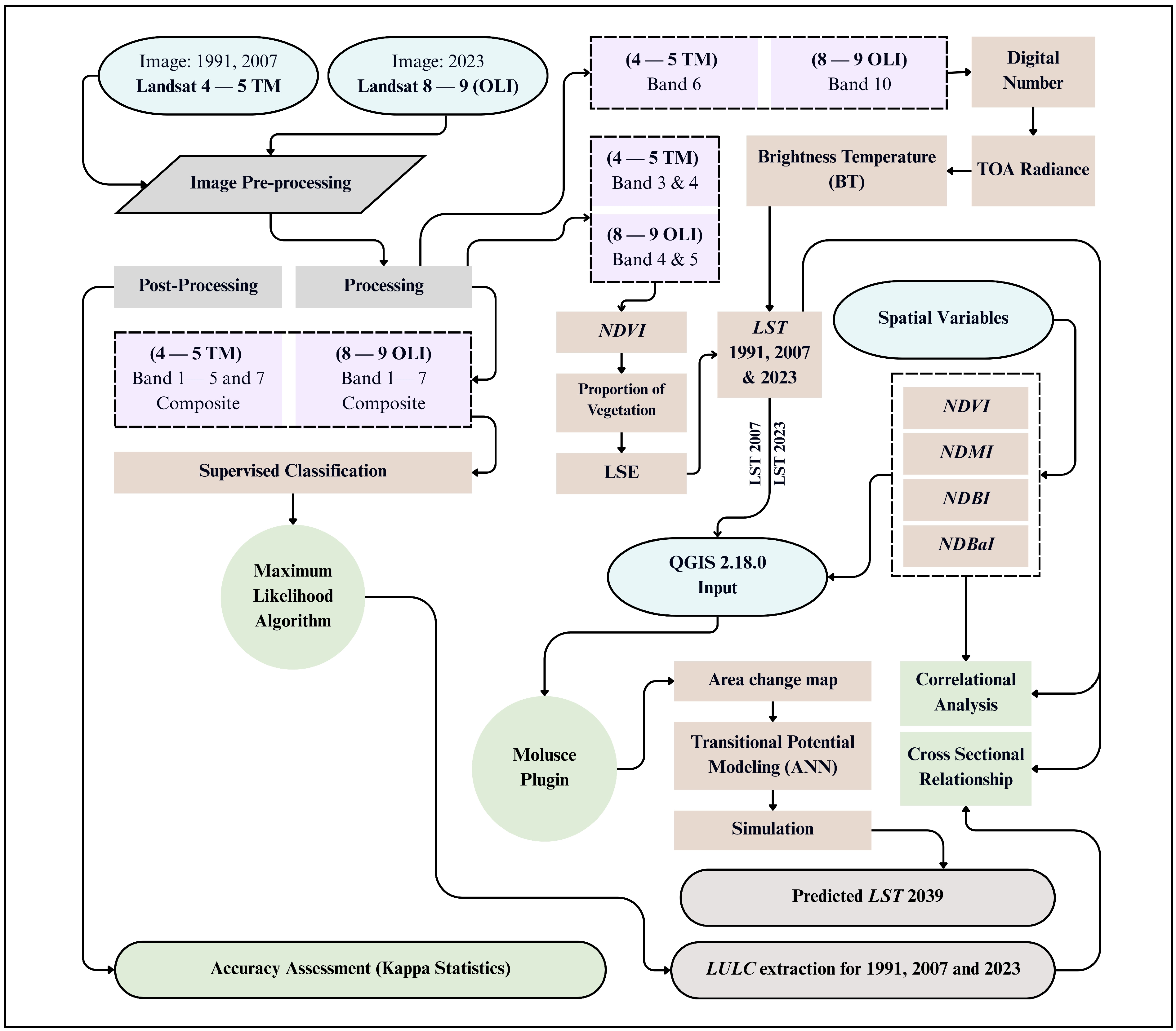
Predicting future LST scenarios under the current LULC shift is essential for assessing their long-term impacts on surface temperature. Various techniques, such as artificial neural networks (ANNs), hybrid neural models, Markov chain analysis, and regression models, have been employed in previous studies [7,21,91,92] for the projection of the LST. In this study, the CA-ANN approach was applied to forecast LST for 2039, as it has proven effective for making predictions based on historical data [7,91]. Prior to future prediction, the CA–ANN model was evaluated using a temporal hindcasting approach, where LST data from 1991 and 2007 were used to simulate LST conditions for 2023. QGIS software (version 3.44) was used to generate future temperature projections through the MOLUSCE tool. Figure 2 summarizes the integrated methodological framework adopted in this study, illustrating how satellite data preprocessing, LULC classification, LST extraction, biophysical index analysis and CA-ANN-based prediction are sequentially linked. This framework ensures methodological consistency across historical analysis and future projection of land surface temperature.

3.7. Validation of Predicted LST Scenario

The reliability of predictive models largely depends on appropriate validation of simulated outputs [93]. Prior to generating future land surface temperature (LST) scenarios, the CA–ANN model was validated using a temporal hindcasting approach. Observed LST maps from 1991 and 2007 were used to simulate LST conditions for 2023. The predicted LST map was then compared with the observed 2023 LST data using the MOLUSCE plugin in QGIS. Model performance was evaluated using kappa-based agreement indices, including kappa for no information (Kno), kappa for location (Klocation), kappa for location of strata (Klocation strata) and standard kappa (Kstandard), which collectively assess both spatial agreement and locational accuracy of the predicted LST patterns.

4. Results

4.1. LULC Change Analysis

Table 2 presents the temporal changes in LULC from 1991 to 2023. Vegetation showed a continuous decline during the study period, decreasing from 70.28% (54,864.07 ha) in 1991 to 64.11% (50,051.17 ha) in 2007 and further to 43.66% (34,070.28 ha) in 2023. Water bodies also decreased steadily, from 13% (10,148.87 ha) in 1991 to 11.7% (9130.82 ha) in 2007 and 8.75% (6834.20 ha) in 2023, resulting in a net loss of 4.25% (3314.67 ha). In contrast, built-up areas expanded substantially over the same period. The proportion increased from 9.7% (7560.57 ha) in 1991 to 15.69% (12,241.59 ha) in 2007 and reached 26.42% (20,625.88 ha) in 2023, corresponding to a net gain of 16.72% (13,065.30 ha). Similarly, bare land exhibited significant growth, rising from 7.02% (5482.67 ha) in 1991 to 8.5% (6635.41 ha) in 2007 and 21.17% (16,526.53 ha) in 2023. The overall increase in bare land was 14.15% (11,043.86 ha), representing the highest annual change rate (2.01%) among all LULC classes. Overall, the 32-year period shows a consistent reduction in vegetation and water bodies, accompanied by marked expansion of built-up and bare land areas.
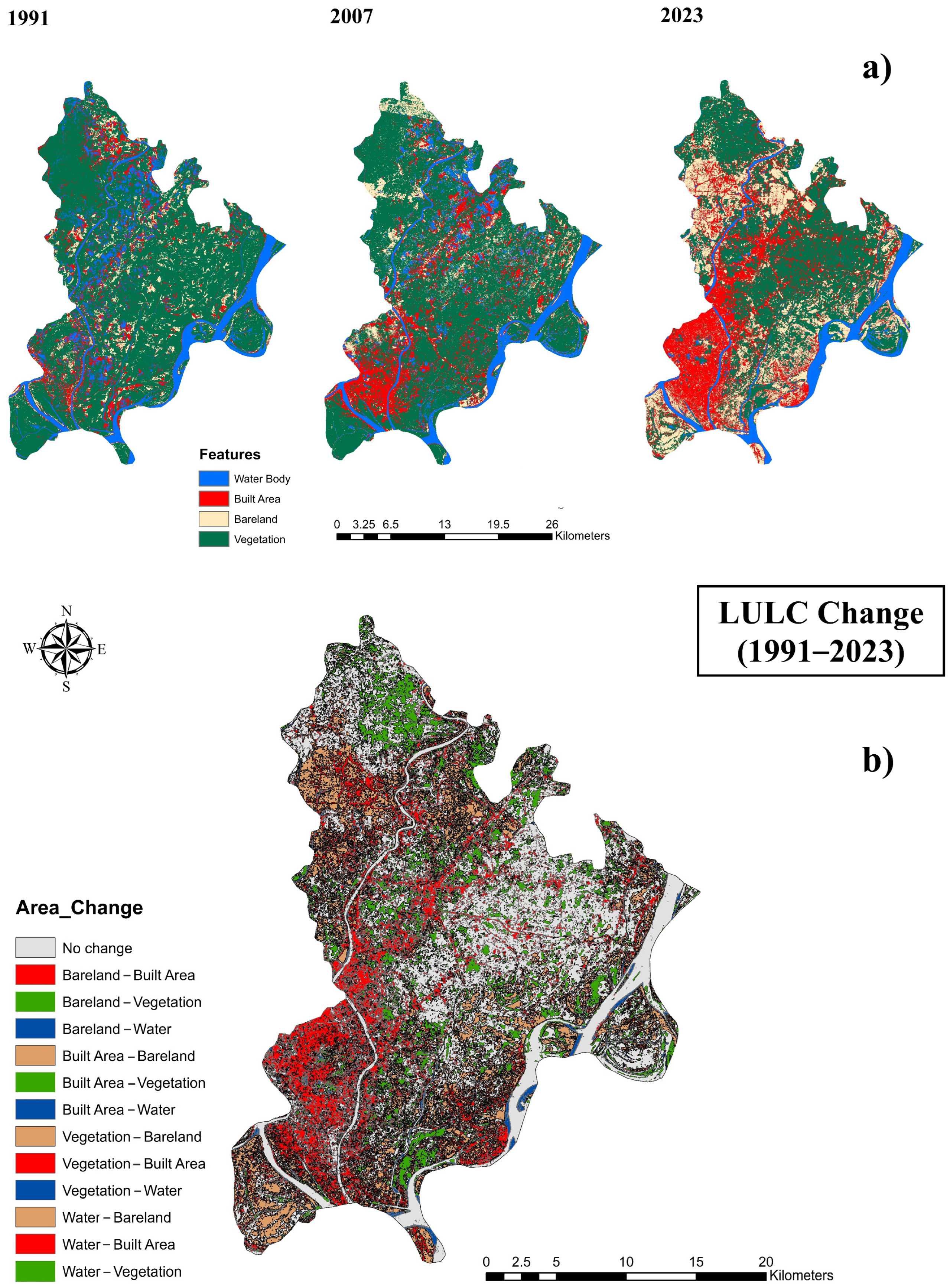
Figure 3a illustrates the spatial distribution of LULC classes for 1991, 2007, and 2023, along with the corresponding change map (1991–2023). Vegetation dominated the landscape in 1991 but showed a noticeable reduction by 2023, particularly in the southern and central western parts of the study area. Water bodies displayed spatial contraction and fragmentation, especially along river corridors. Built-up areas expanded progressively from the southern and central zones toward the northern part of the district. Bare land increased prominently by 2023, particularly in northern areas and scattered patches throughout the study region. Furthermore, Figure 3b shows major conversion zones, primarily from vegetation and water bodies to built-up and bare land classes.

4.2. LULC Classification Accuracy Results

Table 3 presents the accuracy assessment, including UA and PA for each LULC category, with OA and KC for 1991, 2007, and 2023. The results indicate that water bodies and built-up areas were mostly classified with higher accuracy across all years, while bare land and vegetation showed slightly lower accuracy in certain years. Moreover, the OA of the classified maps was 89.16%, 85.83%, and 92.08% for 1991, 2007, and 2023, respectively. Correspondingly, the KC values were 0.85, 0.81, and 0.89 above 0.8, indicating a strong relationship between the classified and reference data [91]. Furthermore, the class-wise F1 scores confirmed the robustness of the LULC classification, with consistently high values across all classes for 1991, 2007 and 2023, indicating balanced producer’s and user’s accuracies despite class prevalence differences. These results confirm that the classification quality of the LULC maps meets the standard accuracy requirements consistent with similar studies [6,19,59].

4.3. Changing Pattern of LST

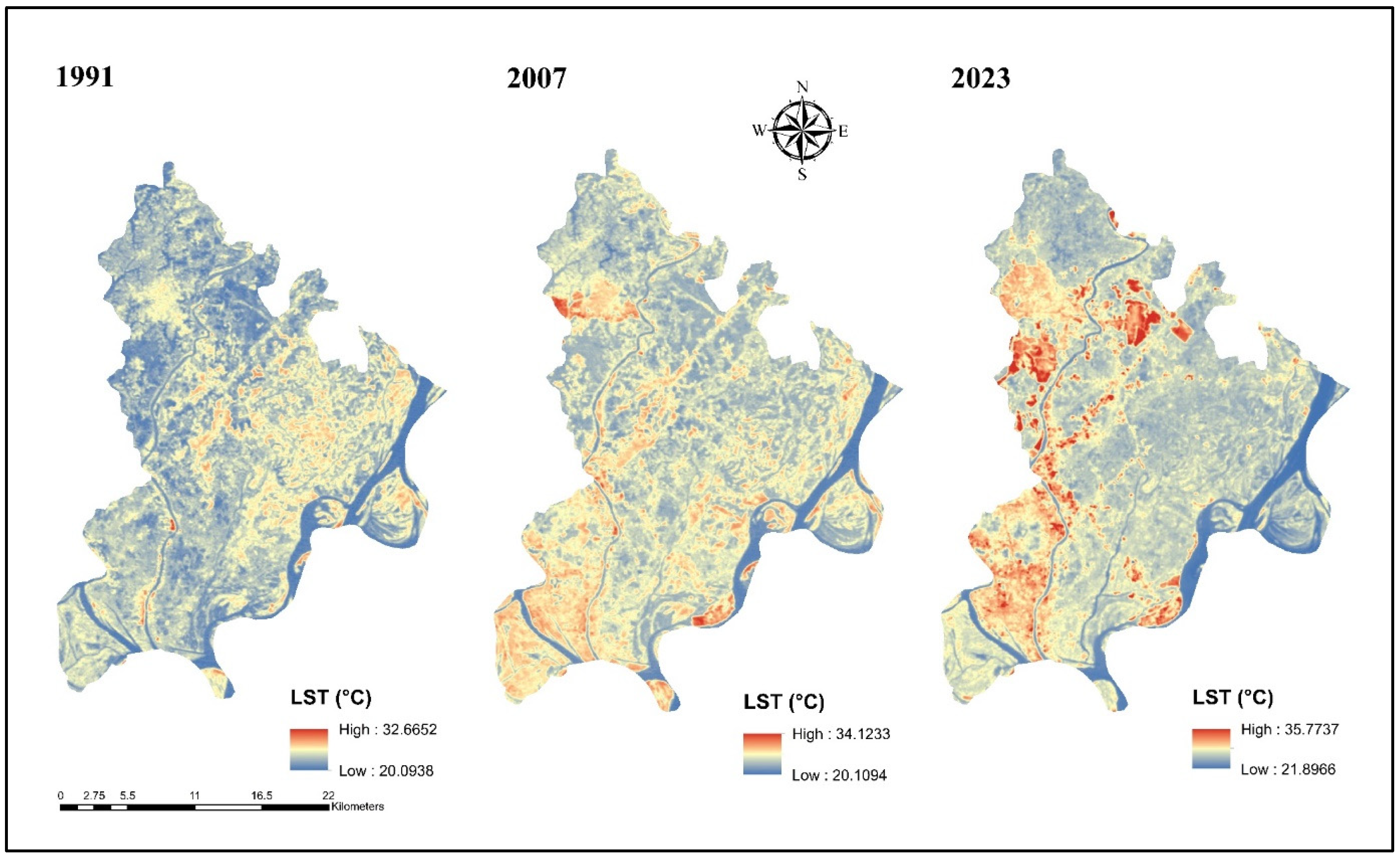
Table 4 presents the variation in land surface temperature (LST) from 1991 to 2023. During the winter season, the minimum temperature (Tmin) remained relatively stable, increasing slightly from 15.64 °C in 1991 to 16.10 °C in 2007 and 16.24 °C in 2023. In contrast, the maximum temperature (Tmax) increased consistently from 25.40 °C in 1991 to 27.93 °C in 2007 and 31.14 °C in 2023, representing a net increase of 5.74 °C over the study period. The winter seasonal average temperature (TSA) also increased from 20.52 °C in 1991 to 22.61 °C in 2007 and 23.69 °C in 2023. In summer, both Tmin and Tmax exhibited upward trends. The minimum temperature increased from 22.81 °C in 1991 to 23.25 °C in 2007 and 24.61 °C in 2023. The maximum temperature rose from 39.92 °C in 1991 to 41.07 °C in 2007 and 42.73 °C in 2023. Similarly, the summer TSA increased from 31.36 °C in 1991 to 32.16 °C in 2007 and 33.67 °C in 2023. The yearly average temperature (TYA) also showed a consistent increase, rising from 25.94 °C in 1991 to 27.38 °C in 2007 and 28.68 °C in 2023, indicating an overall increase of 2.74 °C over three decades. Figure 4 illustrates the spatial distribution of yearly average LST for 1991, 2007, and 2023. The maps show a progressive expansion of higher temperature zones from the southern and central parts of the study area toward the northern region.
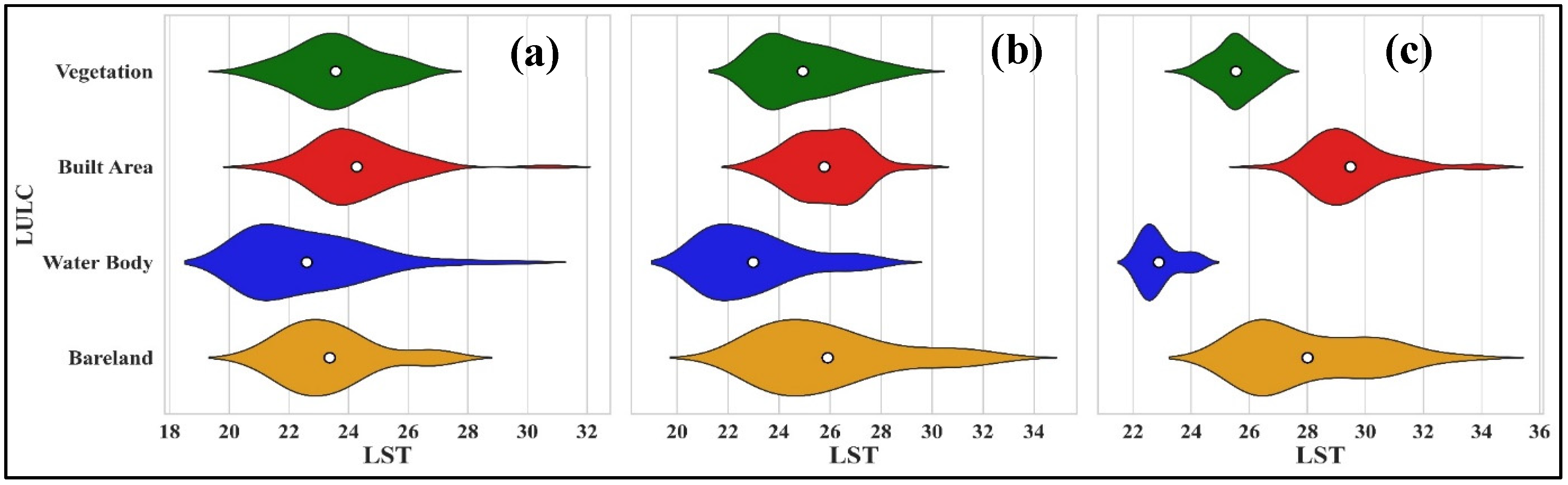
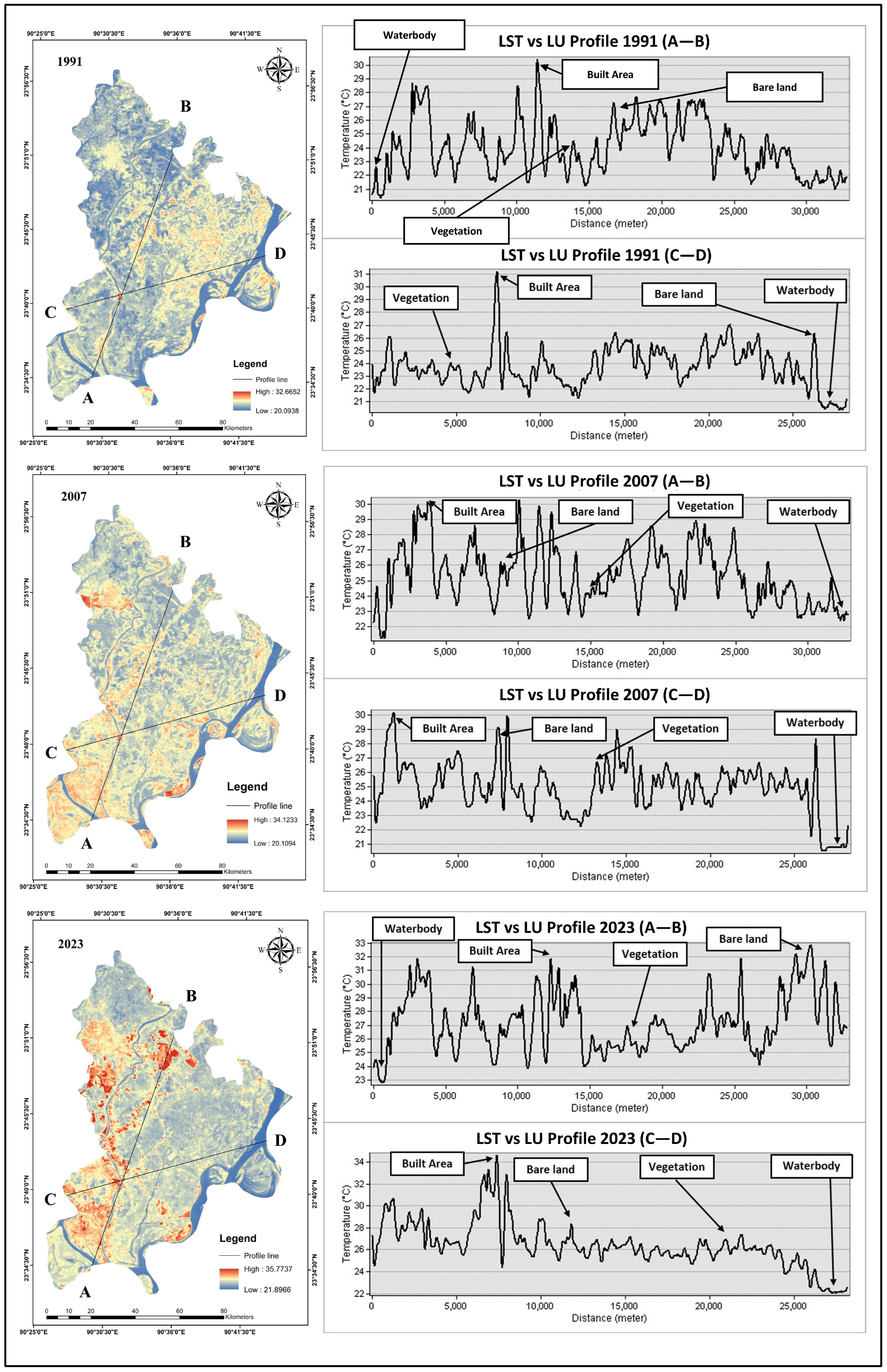
Figure 5 shows the distribution of LST values for each LULC class, where white markers represent the average temperatures (Table S1). The distribution patterns indicate concentration of pixel values around the mean for each class, with fewer pixels representing extreme temperature ranges. Between 1991 and 2023, the average LST of built-up areas increased from 24.27 °C to 29.49 °C, while bare land increased from 23.37 °C to 28.01 °C. Vegetation showed a moderate increase from 23.57 °C to 25.55 °C, whereas water bodies remained relatively stable, increasing slightly from 22.60 °C to 22.89 °C. Additionally, Figure 6 presents cross-sectional temperature profiles (A–B and C–D), highlighting distinct variations across different LULC classes. Higher temperature peaks were observed over built-up areas and bare land, while comparatively lower temperatures were recorded over vegetation and water bodies.

4.4. Relationship Among LST and Biophysical Indices

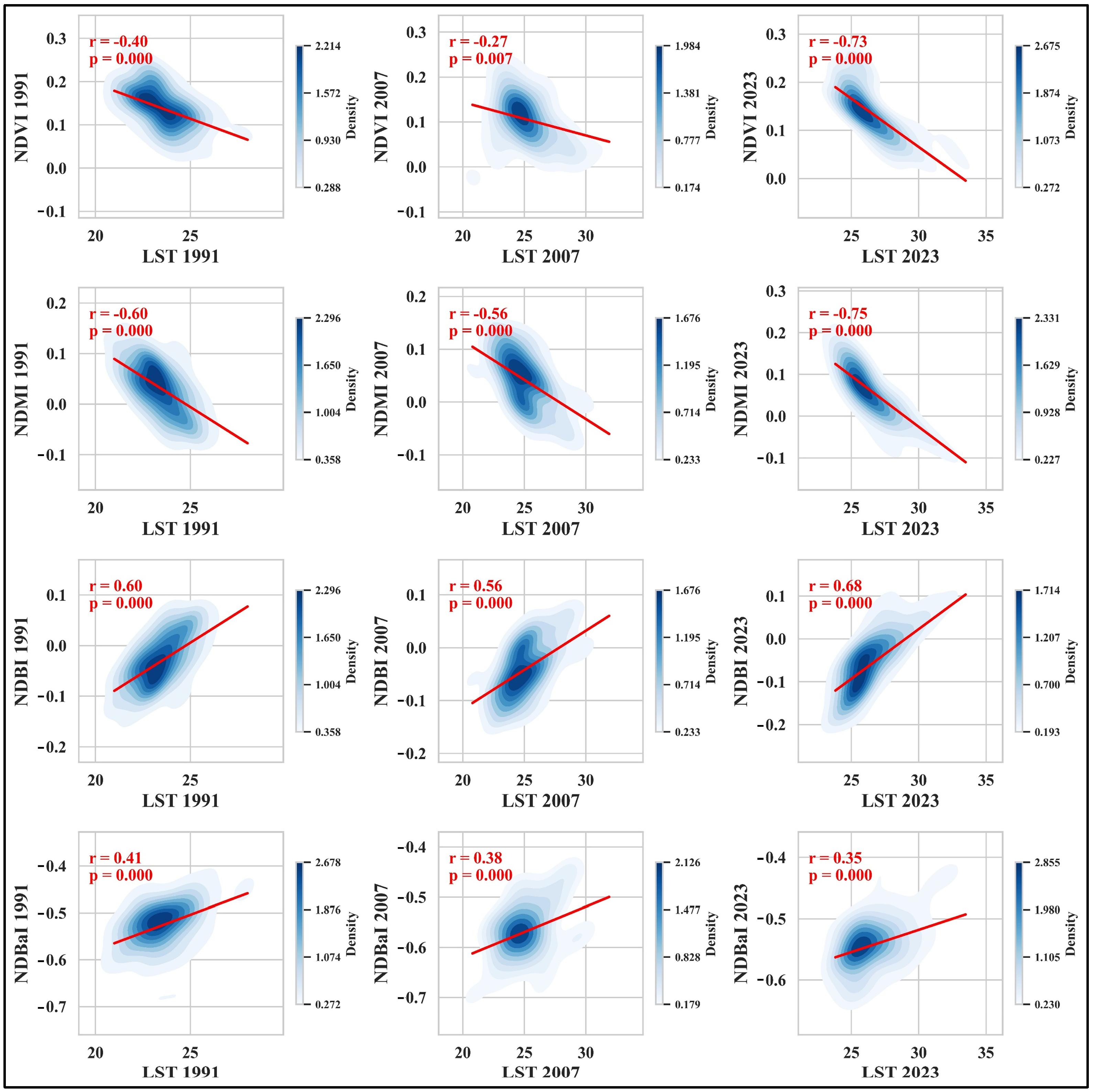
Figure 7 illustrates the correlation between LST and biophysical indices (NDVI, NDMI, NDBI and NDBAI) that revealed clear but contrasting relationships across 1991, 2007 and 2023. The slope between NDVI and LST is downward for all three years, which indicates that NDVI and LST are negatively correlated: r = −0.40 (p = 0.000), r = −0.27 (p = 0.007) and r = −0.73 (p = 0.000) for 1991, 2007 and 2023, respectively. Similarly, NDMI also shows the downward slope, highlighting its negative relationship with LST, with r = −0.60 (p = 0.000), r = −0.56 (p = 0.000) and r = −0.75 (p = 0.000). In contrast, NDBI demonstrated positive correlations with LST across all years. The coefficients were r = 0.60 (p = 0.002) in 1991, r = 0.56 (p = 0.000) in 2007 and r = 0.68 (p = 0.000) in 2023. NDBAI also showed positive correlations with LST, with values of r = 0.41 (p = 0.000) in 1991, r = 0.38 (p = 0.000) in 2007 and r = 0.35 (p = 0.000) in 2023. The results indicate statistically significant negative relationships between LST and vegetation/moisture indices (NDVI and NDMI) and significant positive relationships between LST and built-up or bare land indices (NDBI and NDBAI) throughout the study period. Class-specific correlation analysis further revealed notable heterogeneity across LULC types (Table 5). Vegetation consistently showed the strongest negative correlations with LST for both NDVI and NDMI across all years, while built-up areas exhibited the strongest positive correlations with NDBI and NDBAI, with values intensifying from 1991 to 2023. Water bodies showed comparatively weaker and occasionally non-significant correlations with built-up indices, suggesting limited thermal sensitivity to surface imperviousness.

4.5. Prediction of LST for 2039

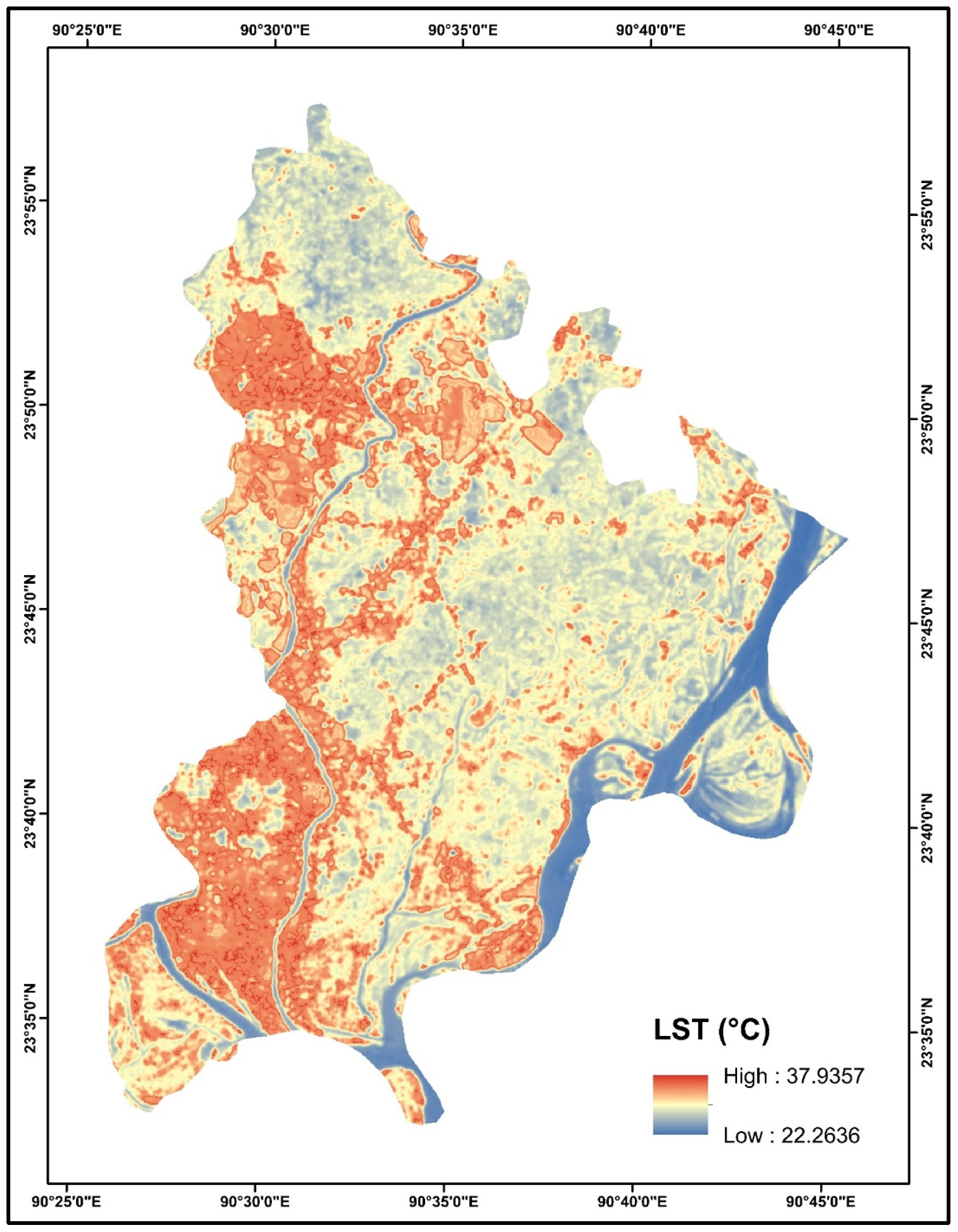
Figure 8 presents the predicted LST distribution for 2039, with values ranging from 22.26 °C to 37.94 °C. Based on the projection results, the average temperature is expected to increase from 28.68 °C in 2020 to 30.09 °C in 2039 (Table 4). Spatially, the predicted warming pattern follows the previously observed expansion trends, extending from the southern and central zones toward the northern part of the study area. The western portion shows comparatively higher temperature intensification, while the eastern region remains relatively cooler in comparison. The model performance was evaluated using kappa-based agreement statistics. The validation results demonstrate high agreement values (Kno = 0.86, Klocation = 0.88, Klocation strata = 0.87, and Kstandard = 0.86), indicating strong consistency between predicted and observed LST patterns (Table 6). The prediction results indicate a continued increase in surface temperature and expansion of higher-temperature zones across the study area by 2039.

4.6. Limitations and Future Research Scope

This study primarily depends on medium-resolution Landsat imagery, which is effective for capturing long-term and large-scale LULC and LST patterns but may limit the detailed discrimination of fine-scale urban features, such as residential and industrial sub-classes within built-up areas. Additionally, the use of two different sensor generations (Landsat 5 TM and Landsat 8 OLI/TIRS) introduces potential cross-sensor uncertainty in absolute LST values; while consistent calibration procedures and emissivity algorithms were applied to minimize this effect, long-term thermal comparisons should be interpreted with this limitation in mind. To ensure temporal consistency, LULC mapping was based on winter-season imagery, which minimizes cloud contamination and classification uncertainty; however, this approach may not fully capture seasonal variations in vegetation phenology and agricultural land use, which can influence surface thermal responses. Although extensive training samples and visual verification were applied to distinguish bare land from temporarily fallow agricultural fields, some transitional land uses may still introduce classification uncertainty. Furthermore, future LST projections using the CA–ANN model are driven by historical spatial trends and biophysical variables and do not explicitly incorporate policy-driven or socio-economic interventions, such as large-scale development plans or zoning regulations, which could alter future land-use trajectories in non-linear ways. Consequently, the 2039 projection should be interpreted as a business-as-usual scenario reflecting the continuation of observed historical land transformation trajectories, rather than a deterministic forecast. Future research could benefit from integrating higher-resolution satellite data, season-specific LULC mapping, ground-based observations, and policy or scenario-based drivers to improve the representation of complex urban thermal dynamics and enhance predictive robustness. In addition, research should further investigate the impacts of rising LST on residents’ well-being and human–environment interactions to deepen understanding of the causes and consequences of urban heat dynamics.

5. Discussion

The results show substantial land transformation in Narayanganj between 1991 and 2023, characterized by a pronounced decline in vegetation and water bodies and a marked expansion of built-up and bare land areas. Such trends reflect rapid urbanization and industrial intensification in the region over the past three decades. Similar land conversion patterns have been widely reported in rapidly growing South Asian cities, where agricultural and vegetated lands are progressively replaced by impervious surfaces due to demographic and economic pressures [46,94,95]. The sharp increase in built-up areas, particularly after 2007, indicates accelerated industrial and infrastructural development, consistent with the historical growth trajectory of Narayanganj as a major industrial hub near Dhaka [46].
The observed rise in LST corresponds closely with these land cover transitions. While winter minimum temperatures remained relatively stable, maximum temperatures and seasonal averages increased consistently, particularly during summer. Comparable magnitudes of urban thermal amplification have been documented in metropolitan regions such as Dhaka, Kolkata, and Jakarta, where rapid urban expansion has altered the surface energy balance [48,96]. The pronounced increase in summer Tmax suggests increased heat stress risks under ongoing land transformation.
The correlation analysis further clarifies the biophysical controls of surface temperature dynamics. The consistently negative relationships between LST and NDVI and NDMI indicate the cooling influence of vegetation density and surface moisture. However, the positive associations between LST and NDBI and NDBAI demonstrate the warming effect of built-up and exposed surfaces. The stronger negative LST–NDVI relationship observed in 2023 compared to earlier years suggests that vegetation loss has become increasingly influential in controlling thermal variability. Class-specific correlations further demonstrate that thermal amplification mechanisms differ substantially across LULC types. While vegetation-driven cooling is primarily regulated by evapotranspiration and moisture availability, built-up and bare land surfaces intensify warming through increased sensible heat flux and reduced latent heat exchange. Similar vegetation–temperature coupling patterns have been reported in studies of urban thermal environments across Asian megacities, where reductions in green cover intensify surface heating through diminished evapotranspiration and shading effects [19,97].
The multi-seasonal approach adopted in this study reveals distinct thermal dynamics that would not be captured through single-season analysis. Winter LST showed a more distinct increase in Tmax (5.74 °C over three decades) compared to summer Tmax (2.81 °C), suggesting that cold-season thermal amplification driven primarily by reduced vegetation cover and lower solar angles is accelerating faster than warm-season warming. Similarly, winter TSA increased compared to summer TSA over the same period. These seasonal contrasts demonstrate that multi-temporal analysis provides mechanistically distinct insights beyond what any single season can capture, and that relying solely on winter or summer imagery would systematically underestimate the full magnitude of thermal intensification across the annual cycle.
The spatial prediction for 2039 indicates continued expansion of high-temperature zones, particularly toward the western and northern sectors of the study area. The projected increase in average LST to 30.09 °C suggests that ongoing land conversion may further intensify the urban heat environment [46]. The relatively cooler eastern zones, associated with remaining vegetation and proximity to the Shitalakshya River, highlight the moderating influence of natural land cover and water bodies on surface temperature patterns. These findings align with established urban climate theory, which emphasizes the thermal buffering role of vegetated and aquatic systems in rapidly industrializing landscapes [98,99].
The validation statistics demonstrate strong model performance, indicating that the CA–ANN framework effectively captures the nonlinear interactions between land cover change and thermal dynamics [29]. Similar hybrid modeling approaches have been successfully applied in other urban climate studies to simulate spatiotemporal temperature evolution under complex land–atmosphere interactions [19,42]. The robust agreement values strengthen confidence in the projected 2039 scenario and its relevance for urban planning.
Overall, the findings underscore the critical linkage between land transformation and surface thermal intensification in industrial urban regions. Without strategic land management and green infrastructure interventions, continued expansion of impervious surfaces may amplify heat stress, environmental degradation, and public health vulnerability [100]. To address these challenges, several policy measures can be considered. First, the incorporation of urban green infrastructure such as roadside plantations, urban parks, rooftop gardens and vertical greening systems can help enhance evapotranspiration and reduce surface heat accumulation [101]. Specifically, targeting a 30% increase in tree canopy cover in identified UHI hotspots such as Fatullah and Kanchpur industrial zones through urban forestry initiatives could lower local temperatures by 0.4–2.9 °C, based on UNEP and European benchmarks [46]. Second, strict land-use zoning regulations should be enforced to control uncontrolled industrial and built-up expansion, particularly in high-temperature hotspots identified in this study [8]. Protecting and restoring existing vegetation patches and conserving major water bodies, including mandating 20% riparian buffer zones along the Shitalakshya River for moisture retention, would help maintain natural thermal regulation functions [102]. In addition, promoting climate-responsive urban design strategies such as reflective or cool roofing materials on at least 50% of new industrial buildings to reduce rooftop LST by 2–4 °C, permeable pavements in 25% of expansion areas to cut heat absorption by 15–20%, and increased open spaces can reduce heat storage in impervious surfaces [103]. Integrating LST-based spatial monitoring into municipal planning frameworks would enable evidence-based decision-making, allowing planners to prioritize intervention zones. Finally, embedding thermal risk assessment into future industrial development plans, supported by community-led programs like annual planting of 10,000 trees, could ensure that economic expansion does not disproportionately increase environmental and thermal vulnerability, potentially preventing up to 40% of UHI-attributable premature deaths, as seen in European models [100]. These coordinated planning and environmental management strategies are essential for mitigating long-term urban heat risks in rapidly industrializing cities like Narayanganj.

6. Conclusions

This study provides a comprehensive assessment of the long-term interaction between LULC transformation and LST dynamics in Narayanganj, one of the country’s most rapidly industrializing urban regions. By integrating multi-temporal Landsat imagery (1991–2023), biophysical indices (NDVI, NDMI, NDBI, and NDBAI) and a CA–ANN-based predictive framework, the study offers a robust evaluation of both historical thermal changes and future temperature scenarios. The findings reveal substantial land transformation over the past three decades, characterized by a 16.72% increase in built-up areas and significant reductions in vegetation (−26.62%) and water bodies (−4.25%). These structural land cover shifts were accompanied by a 2.74 °C rise in average LST, with built-up and bare land classes consistently exhibiting the highest thermal intensities. The projected 2039 scenario indicates further expansion of high-temperature zones and an increase in average LST to 30.09 °C, showing the persistence of warming trends under ongoing land conversion patterns. A key contribution of this study lies in its integrated analytical framework that links LULC transitions, class-specific thermal responses and statistically validated biophysical correlations within a single modeling structure. Unlike studies that examine urban heat patterns in isolation, this research combines spatial change detection, correlation analysis, cross-sectional profiling and machine learning-based prediction to capture nonlinear interactions between land transformation and thermal dynamics. The strong validation performance of the CA–ANN model further strengthens confidence in the reliability of future LST projections. By identifying spatial hotspots, quantifying class-wise temperature amplification and simulating future thermal scenarios, the study provides location-specific evidence to support climate-responsive urban planning. The findings emphasize the importance of preserving vegetation cover, protecting water bodies and integrating green infrastructure into industrial development planning.

Supplementary Materials

The following supporting information can be downloaded at https://www.mdpi.com/article/10.3390/land15030423/s1, Figure S1: Spatial distribution maps of biophysical indices for different years; Table S1: Mean LST values for different LULC categories in 1991, 2007 and 2023.

Author Contributions

S.A.J.: Conceptualization, Methodology, Formal analysis, Writing—original draft, Software; S.I.J.: Methodology, Formal analysis, Writing—original draft; M.S.M.: Data curation, Formal analysis, Writing—original draft; S.K.R.: Writing—review and editing; M.T.R.: Methodology, Writing—review and editing; M.M.H.: Supervision, Methodology; Software; Project management; Writing—original draft, Formal analysis; Writing—review and editing. W.S.A.: Writing—review and editing, Resources. M.B.: Writing—review and editing, Resources, Validation. M.Z.: Investigation, Writing—review and editing, Resources, Project management. All authors have read and agreed to the published version of the manuscript.

Funding

This research was funded by Princess Nourah bint Abdulrahman University Researchers Supporting Project number (PNURSP2026R680), Princess Nourah bint Abdulrahman University, Riyadh, Saudi Arabia.

Institutional Review Board Statement

Not applicable.

Informed Consent Statement

Not applicable.

Data Availability Statement

The datasets generated during the current study are available from the corresponding author on reasonable request.

Acknowledgments

The authors extend their appreciation to Princess Nourah bint Abdulrahman University Researchers Supporting Project number (PNURSP2026R680), Princess Nourah bint Abdulrahman University, Riyadh, Saudi Arabia. The authors thank the Editor and the anonymous reviewers for their valuable comments and suggestions. The authors also gratefully acknowledge the organizations and agencies that made their datasets freely available for research purposes.

Conflicts of Interest

The authors declare no conflict of interest.

References

  1. Hibbs, G. UNSD Goal 11: Sustainable Cities and Communities. In SDG Indicators: SDG Report 2022; United Nations Department of Economic and Social Affairs (UN DESA): New York, NY, USA, 2022. [Google Scholar]
  2. Jahan, K.; Pradhanang, S.M.; Bhuiyan, M.A.E. Surface Runoff Responses to Suburban Growth: An Integration of Remote Sensing, GIS, and Curve Number. Land 2021, 10, 452. [Google Scholar] [CrossRef]
  3. Hasan, M.M.; Ferdous, M.T.; Talha, M.; Mojumder, P.; Roy, S.K.; Zim, M.N.F.; Akter, M.M.; Nasher, N.R.; Hasher, F.F.B.; Boltižiar, M.; et al. Analyzing ecological environmental quality trends in Dhaka through remote sensing based ecological index (RSEI). Land 2025, 14, 1258. [Google Scholar] [CrossRef]
  4. Liu, X.; Li, Z.-L.; Li, Y.; Wu, H.; Zhou, C.; Si, M.; Leng, P.; Duan, S.-B.; Yang, P.; Wu, W.; et al. Local Temperature Responses to Actual Land Cover Changes Present Significant Latitudinal Variability and Asymmetry. Sci. Bull. 2023, 68, 2849–2861. [Google Scholar] [CrossRef] [PubMed]
  5. Choudhury, D.; Das, K.; Das, A. Assessment of Land Use Land Cover Changes and Its Impact on Variations of Land Surface Temperature in Asansol-Durgapur Development Region. Egypt. J. Remote Sens. Space Sci. 2019, 22, 203–218. [Google Scholar] [CrossRef]
  6. Hosen, M.I.; Hasan, M.M.; Talha, M.; Akter, M.M.; Nasher, N.R. Exploring the cooling benefits of Urban Lakes: A multi-year analysis of Dhaka, Bangladesh. HydroResearch 2025, 8, 361–373. [Google Scholar] [CrossRef]
  7. Ullah, S.; Qiao, X.; Abbas, M. Addressing the Impact of Land Use Land Cover Changes on Land Surface Temperature Using Machine Learning Algorithms. Sci. Rep. 2024, 14, 18746. [Google Scholar] [CrossRef] [PubMed]
  8. Wang, C.; Li, Y.; Myint, S.W.; Zhao, Q.; Wentz, E.A. Impacts of Spatial Clustering of Urban Land Cover on Land Surface Temperature across Köppen Climate Zones in the Contiguous United States. Landsc. Urban Plan. 2019, 192, 103668. [Google Scholar] [CrossRef]
  9. Imran, H.M.; Kala, J.; Ng, A.W.M.; Muthukumaran, S. Effectiveness of Vegetated Patches as Green Infrastructure in Mitigating Urban Heat Island Effects During a Heatwave Event in the City of Melbourne. Weather Clim. Extrem. 2019, 25, 100217. [Google Scholar] [CrossRef]
  10. Jacobs, S.J.; Gallant, A.J.E.; Tapper, N.J.; Li, D. Use of Cool Roofs and Vegetation to Mitigate Urban Heat and Improve Human Thermal Stress in Melbourne, Australia. J. Appl. Meteorol. Climatol. 2018, 57, 1747–1764. [Google Scholar] [CrossRef]
  11. Mashagiro, G.Q.; Mujinya, B.B.; Colinet, G.; Mahy, G. Vegetation Degradation Alters Soil Physicochemical Properties and Potentially Affects Ecosystem Services in Green Spaces of a Tropical Megacity (Lubumbashi, DR Congo). Geoderma Reg. 2024, 37, e00810. [Google Scholar] [CrossRef]
  12. De Carvalho, R.M.; Szlafsztein, C.F. Urban Vegetation Loss and Ecosystem Services: The Influence on Climate Regulation and Noise and Air Pollution. Environ. Pollut. 2019, 245, 844–852. [Google Scholar] [CrossRef]
  13. Ghasempour, F.; Sekertekin, A.; Kutoglu, S.H. How landsat 9 is superior to landsat 8: Comparative assessment of land use land cover classification and land surface temperature. ISPRS Ann. Photogramm. Remote Sens. Spat. Inf. Sci. 2023, 10, 221–227. [Google Scholar] [CrossRef]
  14. Ejiagha, I.R.; Ahmed, M.R.; Hassan, Q.K.; Dewan, A.; Gupta, A.; Rangelova, E. Use of Remote Sensing in Comprehending the Influence of Urban Landscape’s Composition and Configuration on Land Surface Temperature at Neighbourhood Scale. Remote Sens. 2020, 12, 2508. [Google Scholar] [CrossRef]
  15. Xue, Z.; Hou, G.; Zhang, Z.; Lyu, X.; Jiang, M.; Zou, Y.; Shen, X.; Wang, J.; Liu, X. Quantifying the Cooling-Effects of Urban and Peri-Urban Wetlands Using Remote Sensing Data: Case Study of Cities of Northeast China. Landsc. Urban Plan. 2019, 182, 92–100. [Google Scholar] [CrossRef]
  16. Arnous, M.O.; Mansour, B.M.H. Utilizing Multi-Temporal Thermal Data to Assess Environmental Land Degradation Impacts: Example from Suez Canal Region, Egypt. Environ. Sci. Pollut. Res. 2023, 30, 2145–2163. [Google Scholar] [CrossRef] [PubMed]
  17. Khan, R.; Li, H.; Basir, M.; Chen, Y.L.; Sajjad, M.M.; Haq, I.U.; Ullah, B.; Arif, M.; Hassan, W. Monitoring Land Use Land Cover Changes and Its Impacts on Land Surface Temperature over Mardan and Charsadda Districts, Khyber Pakhtunkhwa (KP), Pakistan. Environ. Monit. Assess. 2022, 194, 409. [Google Scholar] [CrossRef] [PubMed]
  18. Roy, S.; Pandit, S.; Eva, E.A.; Bagmar, M.S.H.; Papia, M.; Banik, L.; Dube, T.; Rahman, F.; Razi, M.A. Examining the Nexus Between Land Surface Temperature and Urban Growth in Chattogram Metropolitan Area of Bangladesh Using Long Term Landsat Series Data. Urban Clim. 2020, 32, 100593. [Google Scholar] [CrossRef]
  19. Abdullah, S.; Barua, D.; Abdullah, S.M.A.; Rabby, Y.W. Investigating the Impact of Land Use/Land Cover Change on Present and Future Land Surface Temperature (LST) of Chittagong, Bangladesh. Earth Syst. Environ. 2022, 6, 221–235. [Google Scholar] [CrossRef]
  20. Hussain, S.; Mubeen, M.; Ahmad, A.; Majeed, H.; Qaisrani, S.A.; Hammad, H.M.; Amjad, M.; Ahmad, I.; Fahad, S.; Ahmad, N.; et al. Assessment of Land Use/Land Cover Changes and Its Effect on Land Surface Temperature Using Remote Sensing Techniques in Southern Punjab, Pakistan. Environ. Sci. Pollut. Res. 2022, 30, 99202–99218. [Google Scholar] [CrossRef]
  21. Kafy, A.-A.; Rahman, M.S.; Faisal, A.-A.; Hasan, M.M.; Islam, M. Modelling Future Land Use Land Cover Changes and Their Impacts on Land Surface Temperatures in Rajshahi, Bangladesh. Remote Sens. Appl. Soc. Environ. 2020, 18, 100314. [Google Scholar] [CrossRef]
  22. Handayanto, R.T.; Kim, S.M.; Tripathi, N.K. Herlawati Land Use Growth Simulation and Optimization in the Urban Area. In Proceedings of the 2017 Second International Conference on Informatics and Computing (ICIC), Jayapura, Indonesia, 1–3 November 2017; IEEE: Jayapura, Indonesia, 2017; pp. 1–6. [Google Scholar]
  23. Civco, D.L. Artificial Neural Networks for Land-Cover Classification and Mapping. Int. J. Geogr. Inf. Syst. 1993, 7, 173–186. [Google Scholar] [CrossRef]
  24. Santé, I.; García, A.M.; Miranda, D.; Crecente, R. Cellular Automata Models for the Simulation of Real-World Urban Processes: A Review and Analysis. Landsc. Urban Plan. 2010, 96, 108–122. [Google Scholar] [CrossRef]
  25. Zenil, H. Compression-Based Investigation of the Dynamical Properties of Cellular Automata and Other Systems. Complex Syst. 2010, 19, 1–28. [Google Scholar] [CrossRef]
  26. Gupta, N.; Aithal, B.H. Urban Land Surface Temperature Forecasting: A Data-Driven Approach Using Regression and Neural Network Models. Geocarto Int. 2024, 39, 2299145. [Google Scholar] [CrossRef]
  27. Suthar, G.; Singh, S.; Kaul, N.; Khandelwal, S. Prediction of Land Surface Temperature Using Spectral Indices, Air Pollutants, and Urbanization Parameters for Hyderabad City of India Using Six Machine Learning Approaches. Remote Sens. Appl. Soc. Environ. 2024, 35, 101265. [Google Scholar] [CrossRef]
  28. Dhamge, N.R.; Atmapoojya, S.L.; Kadu, M.S. Genetic Algorithm Driven ANN Model for Runoff Estimation. Procedia Technol. 2012, 6, 501–508. [Google Scholar] [CrossRef]
  29. Sekertekin, A.; Arslan, N.; Bilgili, M. Modeling Diurnal Land Surface Temperature on a Local Scale of an Arid Environment Using Artificial Neural Network (ANN) and Time Series of Landsat-8 Derived Spectral Indexes. J. Atmos. Sol.-Terr. Phys. 2020, 206, 105328. [Google Scholar] [CrossRef]
  30. Raja, D.R.; Hredoy, M.S.N.; Islam, M.K.; Islam, K.M.A.; Adnan, M.S.G. Spatial Distribution of Heatwave Vulnerability in a Coastal City of Bangladesh. Environ. Chall. 2021, 4, 100122. [Google Scholar] [CrossRef]
  31. Taloor, A.K.; Manhas, D.S.; Chandra Kothyari, G. Retrieval of Land Surface Temperature, Normalized Difference Moisture Index, Normalized Difference Water Index of the Ravi Basin Using Landsat Data. Appl. Comput. Geosci. 2021, 9, 100051. [Google Scholar] [CrossRef]
  32. Rousta, I.; Sarif, M.O.; Gupta, R.D.; Olafsson, H.; Ranagalage, M.; Murayama, Y.; Zhang, H.; Mushore, T.D. Spatiotemporal Analysis of Land Use/Land Cover and Its Effects on Surface Urban Heat Island Using Landsat Data: A Case Study of Metropolitan City Tehran (1988–2018). Sustainability 2018, 10, 4433. [Google Scholar] [CrossRef]
  33. Chaudhuri, G.; Mishra, N.B. Spatio-Temporal Dynamics of Land Cover and Land Surface Temperature in Ganges-Brahmaputra Delta: A Comparative Analysis Between India and Bangladesh. Appl. Geogr. 2016, 68, 68–83. [Google Scholar] [CrossRef]
  34. Sonet, M.S.; Hasan, M.Y.; Kafy, A.A.; Shobnom, N. Spatiotemporal Analysis of Urban Expansion, Land Use Dynamics, and Thermal Characteristics in a Rapidly Growing Megacity Using Remote Sensing and Machine Learning Techniques. Theor. Appl. Climatol. 2025, 156, 79. [Google Scholar] [CrossRef]
  35. Saha, J.; Ria, S.S.; Sultana, J.; Shima, U.A.; Hasan Seyam, M.M.; Rahman, M.M. Assessing Seasonal Dynamics of Land Surface Temperature (LST) and Land Use Land Cover (LULC) in Bhairab, Kishoreganj, Bangladesh: A Geospatial Analysis from 2008 to 2023. Case Stud. Chem. Environ. Eng. 2024, 9, 100560. [Google Scholar] [CrossRef]
  36. Tabassum, A.; Basak, R.; Shao, W.; Haque, M.M.; Chowdhury, T.A.; Dey, H. Exploring the Relationship Between Land Use Land Cover and Land Surface Temperature: A Case Study in Bangladesh and the Policy Implications for the Global South. J. Geovis. Spat. Anal. 2023, 7, 25. [Google Scholar] [CrossRef]
  37. Dewan, A.; Kiselev, G.; Botje, D.; Mahmud, G.I.; Bhuian, M.H.; Hassan, Q.K. Surface Urban Heat Island Intensity in Five Major Cities of Bangladesh: Patterns, Drivers and Trends. Sustain. Cities Soc. 2021, 71, 102926. [Google Scholar] [CrossRef]
  38. Gazi, M.Y.; Rahman, M.Z.; Uddin, M.M.; Rahman, F.M.A. Spatio-Temporal Dynamic Land Cover Changes and Their Impacts on the Urban Thermal Environment in the Chittagong Metropolitan Area, Bangladesh. GeoJournal 2021, 86, 2119–2134. [Google Scholar] [CrossRef]
  39. Roy, B.; Bari, E.; Nipa, N.J.; Ani, S.A. Comparison of Temporal Changes in Urban Settlements and Land Surface Temperature in Rangpur and Gazipur Sadar, Bangladesh After the Establishment of City Corporation. Remote Sens. Appl. Soc. Environ. 2021, 23, 100587. [Google Scholar] [CrossRef]
  40. Miah, M.T.; Fariha, J.N.; Kafy, A.-A.; Islam, R.; Biswas, N.; Duti, B.M.; Fattah, M.A.; Alsulamy, S.; Khedher, K.M.; Salem, M.A. Exploring the Nexus Between Land Cover Change Dynamics and Spatial Heterogeneity of Demographic Trajectories in Rapidly Growing Ecosystems of South Asian Cities. Ecol. Indic. 2024, 158, 111299. [Google Scholar] [CrossRef]
  41. Guha, S.; Govil, H.; Gill, N.; Dey, A. A Long-Term Seasonal Analysis on the Relationship Between LST and NDBI Using Landsat Data. Quat. Int. 2021, 575–576, 249–258. [Google Scholar] [CrossRef]
  42. Anurogo, W.; Tarigan, A.P.A.; Seftyarizki, D.; Prihantarto, W.J.; Woo, J.; Catarino, L.d.S.; Arora, A.S.; Gohaud, E.; Meller, B.; Schuetze, T. Cellular Automata–Artificial Neural Network Approach to Dynamically Model Past and Future Surface Temperature Changes: A Case of a Rapidly Urbanizing Island Area, Indonesia. Land 2025, 14, 1656. [Google Scholar] [CrossRef]
  43. Zambrano-Asanza, S.; Morales, R.E.; Montalvan, J.A.; Franco, J.F. Integrating Artificial Neural Networks and Cellular Automata Model for Spatial-Temporal Load Forecasting. Int. J. Electr. Power Energy Syst. 2023, 148, 108906. [Google Scholar] [CrossRef]
  44. Rahman, M.R.; Mark, B.G. Geospatial Analysis of Urban Warming: A Remote Sensing and GIS-Based Investigation of Winter Land Surface Temperature and Biophysical Composition in Rajshahi City, Bangladesh. Sustainability 2025, 17, 5107. [Google Scholar] [CrossRef]
  45. Hasan, I.; Goni, O.; Katha, Z.T.; Rabby, M.I.; Hossain, S.; Banik, A.; Hasan, S.; Rahman, I. Prediction Modeling of Land Surface Temperature in Relation to Land Cover Dynamics and Health Risk Perception Analysis in Barishal City of Bangladesh. Sci. Rep. 2025, 15, 30730. [Google Scholar] [CrossRef] [PubMed]
  46. Rashid, N.; Alam, J.A.M.M.; Chowdhury, M.A.; Islam, S.L.U. Impact of Landuse Change and Urbanization on Urban Heat Island Effect in Narayanganj City, Bangladesh: A Remote Sensing-Based Estimation. Environ. Chall. 2022, 8, 100571. [Google Scholar] [CrossRef]
  47. Begum, M.S.; Bala, S.K.; Islam, A.S.; Islam, G.T.; Roy, D. An Analysis of Spatio-Temporal Trends of Land Surface Temperature in the Dhaka Metropolitan Area by Applying Landsat Images. J. Geogr. Inf. Syst. 2021, 13, 538–560. [Google Scholar] [CrossRef]
  48. Rahman, M.N.; Rony, M.R.H.; Jannat, F.A.; Pal, S.C.; Islam, M.S.; Alam, E.; Islam, A.R.M.T. Impact of Urbanization on Urban Heat Island Intensity in Major Districts of Bangladesh Using Remote Sensing and Geo-Spatial Tools. Climate 2022, 10, 3. [Google Scholar] [CrossRef]
  49. Kafy, A.-A.; Dey, N.N.; Al Rakib, A.; Rahaman, Z.A.; Nasher, N.M.R.; Bhatt, A. Modeling the Relationship between Land Use/Land Cover and Land Surface Temperature in Dhaka, Bangladesh Using CA-ANN Algorithm. Environ. Chall. 2021, 4, 100190. [Google Scholar] [CrossRef]
  50. Khan, D.; Khan, N. Modelling Urban Future: Integrating CA-ANN Model for Comprehensive Understanding of Land Use, Land Cover Changes, and Temperature Dynamics in Lucknow City, India. Geol. Ecol. Landsc. 2025, 9, 1–26. [Google Scholar] [CrossRef]
  51. Montoye, A.H.K.; Begum, M.; Henning, Z.; Pfeiffer, K.A. Comparison of Linear and Non-Linear Models for Predicting Energy Expenditure from Raw Accelerometer Data. Physiol. Meas. 2017, 38, 343. [Google Scholar] [CrossRef]
  52. Lauret, P.; Heymes, F.; Aprin, L.; Johannet, A. Atmospheric Dispersion Modeling Using Artificial Neural Network Based Cellular Automata. Environ. Model. Softw. 2016, 85, 56–69. [Google Scholar] [CrossRef]
  53. Memarian, H.; Balasundram, S.K.; Tajbakhsh, M. An Expert Integrative Approach for Sediment Load Simulation in a Tropical Watershed. J. Integr. Environ. Sci. 2013, 10, 161–178. [Google Scholar] [CrossRef][Green Version]
  54. Tajwar, M.; Hasan, M.; Shreya, S.S.; Rahman, M.; Sakib, N.; Gazi, M.Y. Risk Assessment of Microplastic Pollution in an Industrial Region of Bangladesh. Heliyon 2023, 9, e17949. [Google Scholar] [CrossRef]
  55. Yuan, D.; Gazi, A.I.; Rahman, A.; Dhar, B.K.; Rahaman, A. Occupational Stress and Health Risk of Employees Working in the Garments Sector of Bangladesh: An Empirical Study. Front. Public Health 2022, 10, 938248. [Google Scholar] [CrossRef]
  56. Hasan, M.M.; Rana, M.S.P.; Ferdous, M.T. Prediction of Groundwater Potential Zone Using Machine Learning and Geospatial Approaches for an Industry-Dominated Area in Narayanganj, Bangladesh. J. Indian Soc. Remote Sens. 2025, 53, 3635–3651. [Google Scholar] [CrossRef]
  57. BBS. Bangladesh Population Census 2011; Bangladesh Bureau of Statistics, Government of Bangladesh: Dhaka, Bangladesh, 2011.
  58. Hossain, M.S.; Roy, K.; Datta, D.K. Spatial and temporal variability of rainfall over the south-west coast of Bangladesh. Climate 2014, 2, 28–46. [Google Scholar] [CrossRef]
  59. Kafy, A.-A.; Islam, M.; Khan, A.R.; Ferdous, L.; Hossain, M. Identifying Most Influential Land Use Parameters Contributing Reduction of Surface Water Bodies in Rajshahi City, Bangladesh: A Remote Sensing Approach. Remote Sens. Land 2019, 2, 87–95. [Google Scholar] [CrossRef]
  60. Islam, M.R.; Haque, M.N. Identifying Urban Heat Effect through Satellite Image Analysis: Focusing on Narayanganj Upazila, Bangladesh. J. Appl. Sci. Process Eng. 2022, 9, 1223–1241. [Google Scholar] [CrossRef]
  61. Nazeer, M.; Nichol, J.E.; Yung, Y.-K. Evaluation of Atmospheric Correction Models and Landsat Surface Reflectance Product in an Urban Coastal Environment. Int. J. Remote Sens. 2014, 35, 6271–6291. [Google Scholar] [CrossRef]
  62. Hadjimitsis, D.G.; Papadavid, G.; Agapiou, A.; Themistocleous, K.; Hadjimitsis, M.G.; Retalis, A.; Michaelides, S.; Chrysoulakis, N.; Toulios, L.; Clayton, C.R.I. Atmospheric Correction for Satellite Remotely Sensed Data Intended for Agricultural Applications: Impact on Vegetation Indices. Nat. Hazards Earth Syst. Sci. 2010, 10, 89–95. [Google Scholar] [CrossRef]
  63. Sekertekin, A.; Bonafoni, S. Land Surface Temperature Retrieval from Landsat 5, 7, and 8 over Rural Areas: Assessment of Different Retrieval Algorithms and Emissivity Models and Toolbox Implementation. Remote Sens. 2020, 12, 294. [Google Scholar] [CrossRef]
  64. Parastatidis, D.; Mitraka, Z.; Chrysoulakis, N.; Abrams, M. Online Global Land Surface Temperature Estimation from Landsat. Remote Sens. 2017, 9, 1208. [Google Scholar] [CrossRef]
  65. Barsi, J.A.; Schott, J.R.; Hook, S.J.; Raqueno, N.G.; Markham, B.L.; Radocinski, R.G. Landsat-8 Thermal Infrared Sensor (TIRS) Vicarious Radiometric Calibration. Remote Sens. 2014, 6, 11607–11626. [Google Scholar] [CrossRef]
  66. Debele, G.B.; Beketie, K.T. Monitoring the Dynamics of Land Use and Land Cover, and Their Impact on Seasonal Land Surface Temperature in the Upper Awash Basin, Central Ethiopia. Discov. Appl. Sci. 2025, 7, 321. [Google Scholar] [CrossRef]
  67. Nayak, D.P.; Fulekar, M.H. Coastal Geomorphological and Land Use and Land Cover Study on Some Sites of Gulf of Kachchh, Gujarat, West Coast of India Using Multi-Temporal Remote Sensing Data. Int. J. Adv. Remote Sens. GIS 2017, 6, 2192–2203. [Google Scholar] [CrossRef][Green Version]
  68. Diniz-Filho, J.A.F.; De Campos Telles, M.P. Spatial Autocorrelation Analysis and the Identification of Operational Units for Conservation in Continuous Populations. Conserv. Biol. 2002, 16, 924–935. [Google Scholar] [CrossRef]
  69. Weng, Q.; Lu, D.; Schubring, J. Estimation of Land Surface Temperature–Vegetation Abundance Relationship for Urban Heat Island Studies. Remote Sens. Environ. 2004, 89, 467–483. [Google Scholar] [CrossRef]
  70. Cohen, J. A Coefficient of Agreement for Nominal Scales. Educ. Psychol. Meas. 1960, 20, 37–46. [Google Scholar] [CrossRef]
  71. Foody, G.M. On the Compensation for Chance Agreement in Image Classification Accuracy Assessment. Photogramm. Eng. Remote Sens. 1992, 58, 1459–1460. [Google Scholar]
  72. Story, M.; Congalton, R.G. Accuracy Assessment: A User’s Perspective. Photogramm. Eng. Remote Sens. 1986, 52, 397–399. [Google Scholar]
  73. Hasan, M.M.; Roy, S.K.; Talha, M.D.; Ferdous, M.T.; Nasher, N.R. Predictive landslide susceptibility modeling in the southeastern hilly region of Bangladesh: Application of machine learning algorithms in Khagrachari district. Environ. Sci. Pollut. Res. 2025, 32, 31204–31221. [Google Scholar] [CrossRef]
  74. Govind, N.R.; Ramesh, H. The Impact of Spatiotemporal Patterns of Land Use Land Cover and Land Surface Temperature on an Urban Cool Island: A Case Study of Bengaluru. Environ. Monit. Assess. 2019, 191, 283. [Google Scholar] [CrossRef] [PubMed]
  75. USGS. Landsat 7 Data Users Handbook 2019; U.S. Geological Survey (USGS): Reston, VA, USA, 2019.
  76. USGS. Landsat 8 Data Users Handbook 2019; U.S. Geological Survey (USGS): Reston, VA, USA, 2019.
  77. Sobrino, J.A.; Jiménez-Muñoz, J.C.; Paolini, L. Land Surface Temperature Retrieval from LANDSAT TM 5. Remote Sens. Environ. 2004, 90, 434–440. [Google Scholar] [CrossRef]
  78. Morsy, S.; Ahmed, S. Monitoring of Land Surface Temperature from Landsat Imagery: A Case Study of Al-Anbar Governorate in Iraq. Geomat. Environ. Eng. 2023, 17, 61–81. [Google Scholar] [CrossRef]
  79. Trotter, L.; Dewan, A.; Robinson, T. Department of Spatial Sciences, Curtin University, Kent Street Bentley, Building 207, Perth Western Australia 6845, Australia Effects of Rapid Urbanisation on the Urban Thermal Environment Between 1990 and 2011 in Dhaka Megacity, Bangladesh. AIMS Environ. Sci. 2017, 4, 145–167. [Google Scholar] [CrossRef]
  80. Li, M.; Cao, S.; Zhu, Z.; Wang, Z.; Myneni, R.B.; Piao, S. Spatiotemporally Consistent Global Dataset of the GIMMS Normalized Difference Vegetation Index (PKU GIMMS NDVI) from 1982 to 2022. Earth Syst. Sci. Data 2023, 15, 4181–4203. [Google Scholar] [CrossRef]
  81. Martinez, A.D.L.I.; Labib, S.M. Demystifying Normalized Difference Vegetation Index (NDVI) for Greenness Exposure Assessments and Policy Interventions in Urban Greening. SSRN Electron. J. 2022, 220, 115155. [Google Scholar] [CrossRef]
  82. Bannari, A.; Morin, D.; Bonn, F.; Huete, A.R. A Review of Vegetation Indices. Remote Sens. Rev. 1995, 13, 95–120. [Google Scholar] [CrossRef]
  83. Ghosh, D.K.; Mandal, A.C.; Majumder, R.; Patra, P.; Bhunia, G.S. Analysis for Mapping of Built-Up Area Using Remotely Sensed Indices—A Case Study of Rajarhat Block in Barasat Sadar Sub-Division in West Bengal (India). J. Landsc. Ecol. 2018, 11, 67–76. [Google Scholar] [CrossRef]
  84. Shah, S.A.; Kiran, M.; Nazir, A.; Ashrafani, S.H. Exploring NDVI and NDBI relationship using Landsat 8 oli/TIRS in Khangarh Taluka, Ghotki. Malays. J. Geosci. 2022, 6, 8–11. [Google Scholar] [CrossRef]
  85. Zha, Y.; Gao, J.; Ni, S. Use of Normalized Difference Built-Up Index in Automatically Mapping Urban Areas from TM Imagery. Int. J. Remote Sens. 2003, 24, 583–594. [Google Scholar] [CrossRef]
  86. Varouchakis, E.A.; Komnitsas, K.; Galetakis, M. Spatiotemporal Analysis of Vegetation Health and Moisture Dynamics in Rehabilitated Mining Quarries Using Satellite Imagery. Environ. Process. 2025, 12, 45. [Google Scholar] [CrossRef]
  87. Mahdi, S.A.; Jasim, S.N. Utilizing Geospatial Techniques for Change Detection of the Baghdad Campus Landscape from 1988 to 2022. IOP Conf. Ser. Earth Environ. Sci. 2024, 1371, 042045. [Google Scholar] [CrossRef]
  88. Gao, B. NDWI—A Normalized Difference Water Index for Remote Sensing of Vegetation Liquid Water from Space. Remote Sens. Environ. 1996, 58, 257–266. [Google Scholar] [CrossRef]
  89. Hung, T.L. Urban Bare Land Classification Using NDBaI Index Based on Combination of Sentinel 2 MSI and Landsat 8 Multiresolution Images. VNU J. Sci. Earth Environ. Sci. 2020, 36, 68–78. [Google Scholar] [CrossRef]
  90. Chen, X.-L.; Zhao, H.-M.; Li, P.-X.; Yin, Z.-Y. Remote Sensing Image-Based Analysis of the Relationship Between Urban Heat Island and Land Use/Cover Changes. Remote Sens. Environ. 2006, 104, 133–146. [Google Scholar] [CrossRef]
  91. Kafy, A.-A.; Faisal, A.-A.; Shuvo, R.M.; Naim, M.N.H.; Sikdar, M.S.; Chowdhury, R.R.; Islam, M.A.; Sarker, M.H.S.; Khan, M.H.H.; Kona, M.A. Remote Sensing Approach to Simulate the Land Use/Land Cover and Seasonal Land Surface Temperature Change Using Machine Learning Algorithms in a Fastest-Growing Megacity of Bangladesh. Remote Sens. Appl. Soc. Environ. 2021, 21, 100463. [Google Scholar] [CrossRef]
  92. Rahman, M.T.; Aldosary, A.S.; Mortoja, M.G. Modeling Future Land Cover Changes and Their Effects on the Land Surface Temperatures in the Saudi Arabian Eastern Coastal City of Dammam. Land 2017, 6, 36. [Google Scholar] [CrossRef]
  93. Steyerberg, E.W.; Vickers, A.J.; Cook, N.R.; Gerds, T.; Gonen, M.; Obuchowski, N.; Pencina, M.J.; Kattan, M.W. Assessing the Performance of Prediction Models: A Framework for Traditional and Novel Measures. Epidemiology 2010, 21, 128. [Google Scholar] [CrossRef]
  94. Jamalfaisal, S.I.; Rahman, M.T.; Johany, S.A.; Ismail, M.; Mia, M.S.; Tithi, S.Z.; Hasan, M.M. Integrated Assessment of Environmental Sustainability and Urban Green Space Suitability Using PCA-AHP with Zonal Prioritization: A Remote Sensing and GIS Approach. Environ. Sustain. Indic. 2026, 29, 101093. [Google Scholar] [CrossRef]
  95. Ismail, M.; Tahsinur Rahman, M.d.; Abu Johany, S.; Ridwan, M.; Emran Hossain, M.d. A Machine Learning Framework for Predicting Bangladesh’s Economic Growth: Emphasizing the Sector-Specific Carbon Emission Dynamics. Soc. Sci. Humanit. Open 2025, 12, 102081. [Google Scholar] [CrossRef]
  96. Lefevre, A.; Malet-Damour, B.; Boyer, H.; Rivière, G. Urban Heat Island in the Tropics: A Review of Advances, Challenges, and Future Directions. City Environ. Interact. 2025, 28, 100265. [Google Scholar] [CrossRef]
  97. Yu, Z.; Chen, J.; Chen, J.; Zhan, W.; Wang, C.; Ma, W.; Yao, X.; Zhou, S.; Zhu, K.; Sun, R. Enhanced Observations from an Optimized Soil-Canopy-Photosynthesis and Energy Flux Model Revealed Evapotranspiration-Shading Cooling Dynamics of Urban Vegetation During Extreme Heat. Remote Sens. Environ. 2024, 305, 114098. [Google Scholar] [CrossRef]
  98. Faridatul, M.I.; Islam, M.; Joy, M.J.H.; Wakil, M.A.; Rahman, M.M.; Sarker, D. Impact of Greenery and Waterbody on the Cooling of City’s Environment: A Case of Rajshahi City. Geol. Ecol. Landsc. 2025, 9, 1065–1086. [Google Scholar] [CrossRef]
  99. Gomez-Martinez, F.; Beurs, K.M.; de Koch, J.; Widener, J. Multi-Temporal Land Surface Temperature and Vegetation Greenness in Urban Green Spaces of Puebla, Mexico. Land 2021, 10, 155. [Google Scholar] [CrossRef]
  100. Iungman, T.; Cirach, M.; Marando, F.; Barboza, E.P.; Khomenko, S.; Masselot, P.; Quijal-Zamorano, M.; Mueller, N.; Gasparrini, A.; Urquiza, J.; et al. Cooling Cities Through Urban Green Infrastructure: A Health Impact Assessment of European Cities. Lancet 2023, 401, 577–589. [Google Scholar] [CrossRef] [PubMed]
  101. Halder, N.; Kumar, M.; Deepak, A.; Mandal, S.K.; Azmeer, A.; Mir, B.A.; Nurdiawati, A.; Al-Ghamdi, S.G. The Role of Urban Greenery in Enhancing Thermal Comfort: Systematic Review Insights. Sustainability 2025, 17, 2545. [Google Scholar] [CrossRef]
  102. Salan, M.S.A.; Bhuiyan, M.A.H. Estimating Impacts of Micro-Scale Land Use/Land Cover Change on Urban Thermal Comfort Zone in Rajshahi, Bangladesh: A GIS and Remote Sensing Based Approach. Urban Clim. 2024, 58, 102187. [Google Scholar] [CrossRef]
  103. Mihalakakou, G.; Souliotis, M.; Papadaki, M.; Menounou, P.; Dimopoulos, P.; Kolokotsa, D.; Paravantis, J.A.; Tsangrassoulis, A.; Panaras, G.; Giannakopoulos, E.; et al. Green Roofs as a Nature-Based Solution for Improving Urban Sustainability: Progress and Perspectives. Renew. Sustain. Energy Rev. 2023, 180, 113306. [Google Scholar] [CrossRef]
Figure 1. Map of the study region.
Land 15 00423 g001
Figure 2. Detailed methodological flow chart of the study.
Land 15 00423 g002
Figure 3. (a) LULC maps for 1991, 2007 and 2023; (b) LULC change map of 1991 to 2023.
Land 15 00423 g003
Figure 4. Spatial distribution of LST for 1991, 2007 and 2023.
Land 15 00423 g004
Figure 5. LST distribution according to LULC: (a) 1991 (b) 2007 and (c) 2023.
Land 15 00423 g005
Figure 6. Cross-sectional relationship analysis of LST and LULC for 1991, 2007 and 2023.
Land 15 00423 g006
Figure 7. Correlation analysis between LST and biophysical indices for 1991, 2007 and 2023.
Land 15 00423 g007
Figure 8. Predicted land surface temperature for 2039.
Land 15 00423 g008
Table 1. Attributes of Landsat images used in this study.
Acquisition DateSeasonSatelliteSensorResolution (m)Data Used ForSource
LULCLSTBiophysical Indices
26 January 1991WinterLandsat 5TM30/120USGS
(https://earthexplorer.usgs.gov, accessed on 5 January 2025)
29 April 1991SummerLandsat 5TM30/120X
22 January 2007WinterLandsat 5TM30/120
6 April 2007SummerLandsat 5TM30/120X
10 January 2023WinterLandsat 8OLI/TIRS30/100
8 April 2023SummerLandsat 8OLI/TIRS30/100X
Table 2. Area under each category and the shift in the LULC.
LULC Type199120072023(1991–2023)
Area
(Ha)
(In %)Area
(Ha)
(In %)Area
(Ha)
(In %)Area (Ha)(In %)Change Rate
Water body10,148.87139130.8211.76834.208.75−3314.67−4.25−0.33
Built area7560.579.712,241.5915.6920,625.8826.4213,065.3016.721.73
Vegetation54,864.0770.2850,051.1764.1134,070.2843.66−20,793.7−26.6−0.38
Bare land5482.677.026635.418.516,526.5321.1711,043.8614.152.01
Table 3. Accuracy assessment for LULC categories at different years.
YearLULC ClassWater BodyVegetationBuilt-UpBare LandTotalUA (%)F1 ScoreKC
2023Water bodies600006010096.770.89
Vegetation35430609086.38
Built-up115806096.6695.07
Bare land0101496081.6689.90
Total64656249240
PA (%)93.7583.0593.54100
OA (%)92.08
2007Water bodies537006088.3389.070.81
Vegetation456006093.3383.01
Built-up174756078.3384.67
Bare land154506083.3386.95
Total59755155240
PA (%)89.8374.7692.1590.9
OA (%)85.83
1991Water bodies554016091.6693.210.85
Vegetation253146088.3384.79
Built-up025626093.3393.33
Bare land163506083.3385.46
Total58656057240
PA (%)94.8281.5393.3387.71
OA (%)89.16
Table 4. LST statistics for different years in the study area.
YearSeasonTmin (°C)Tmax (°C)TSA (°C)TYA (°C)
1991Winter15.6425.4020.5225.94
Summer22.8139.9231.36
2007Winter16.1027.9322.6127.38
Summer23.2541.0732.16
2023Winter16.2431.1423.6928.68
Summer24.6142.7333.67
Predicted 2039-22.2637.94-30.09
Table 5. Class-specific correlation between LST and biophysical indices.
YearLULC Classnr (LST–NDVI)r (LST–NDMI)r (LST–NDBI)r (LST–NDBAI)
1991Built-up368−0.28 **−0.33 **0.49 **0.36 **
Vegetation421−0.69 **−0.74 **0.22 *0.18 *
Bare land352−0.41 **−0.46 **0.57 **0.63 **
Water bodies309−0.22 *−0.51 **0.140.09
2007Built-up402−0.34 **−0.38 **0.54 **0.41 **
Vegetation447−0.72 **−0.76 **0.26 *0.21 *
Bare land376−0.46 **−0.49 **0.61 **0.68 **
Water bodies318−0.26 **−0.55 **0.180.12
2023Built-up439−0.39 **−0.44 **0.63 **0.48 **
Vegetation463−0.76 **−0.79 **0.31 **0.24 *
Bare land401−0.52 **−0.57 **0.69 **0.74 **
Water bodies336−0.31 **−0.59 **0.22 *0.17
* p < 0.05 ** p < 0.01.
Table 6. Validation statistics of predicted LST.
ModelANN
Kappa ParametersK-LocationK-NoK-Location StrataK-Standard%-CorrectnessOverall Kappa
Kappa values0.880.860.870.8688.370.87
Disclaimer/Publisher’s Note: The statements, opinions and data contained in all publications are solely those of the individual author(s) and contributor(s) and not of MDPI and/or the editor(s). MDPI and/or the editor(s) disclaim responsibility for any injury to people or property resulting from any ideas, methods, instructions or products referred to in the content.