Article

Clustering Urban Tree Climate Responses: A Multi-Metric Ensemble SDM Approach Across SSP Scenarios


1
Department of Urban Planning, Landscape Architecture, Dong-A University, Busan 49315, Republic of Korea
2
Department of Landscape Architecture, Dong-A University, Busan 49315, Republic of Korea
*
Author to whom correspondence should be addressed.
Land 2026, 15(4), 616; https://doi.org/10.3390/land15040616
Submission received: 9 March 2026 / Revised: 3 April 2026 / Accepted: 7 April 2026 / Published: 9 April 2026
(This article belongs to the Special Issue Monitoring Forest Dynamics Using Remote Sensing and Spatial Data)

Abstract

Urban trees deliver multiple ecosystem services. However, rapid climate change may alter species-specific growth suitability, necessitating climate-informed planting and management. We developed 1 km grid-based ensemble species distribution models (ensemble SDMS) for 18 tree species widely planted in South Korean cities and projected growth suitability under SSP1-2.6, SSP2-4.5, SSP3-7.0, and SSP5-8.5 across four future periods (2021–2040, 2041–2060, 2061–2080, 2081–2100) relative to a historical baseline (2000–2019). We quantified multidimensional redistribution signals from SDM outputs, including binary suitable area changes, centroid displacement, latitudinal boundary shifts, and mean suitability changes, using multivariate climatic predictors and complementary environmental variables. These indicators were integrated to classify species responses into four management-relevant types: Stable, Northward Expansion, Poleward Shift, Range Contraction. Model performance was generally high (AUC = 0.74–0.97). Although the median change in suitable area remained near 0%, interspecific variability increased toward later periods and under stronger forcing, with the largest dispersion under SSP3-7.0 (2041–2060). Stable type was most frequent overall (36.8–63.2%), but Northward Expansion increased to 42.1% under late-century SSP3-7.0, and Range Contraction reached 36.8% under mid-century SSP3-7.0. This indicator-based typology provides a practical basis for decision-support tools to prioritize climate-adaptive urban tree selection, replacement, and monitoring.

1. Introduction

Urban trees are a core part of urban green infrastructure. They cool built-up areas, improve air quality, store carbon, and provide habitat, making them essential to the ecological function and livability of cities [1,2,3]. As climate change intensifies, however, the long-term performance of commonly planted tree species is becoming less predictable [4,5]. Decisions about what to plant, where to plant it, and how to manage it therefore need to be informed not only by aesthetics, maintenance considerations, or nursery availability, but also by how species are likely to respond to future climate conditions.
This is especially important because urban trees are exposed not only to regional climate change, but also to urban-specific stresses such as heat-island effects, expanding impervious surfaces, soil compaction and drying, air pollution, and repeated management disturbance [6,7]. As a result, the same species may perform quite differently from one site to another, leading to uneven stability and ecosystem-service delivery across urban green spaces. Assessing climate risk for urban trees therefore requires an analytical framework that can capture both species vulnerability and shifts in climatically suitable planting areas over time.
The Korean Peninsula has experienced rising temperatures and more frequent extreme weather events in recent decades, with annual mean temperature reportedly increasing by approximately 1.5 °C since the late 20th century [8,9]. According to the IPCC AR6, Shared Socioeconomic Pathway (SSP)-based projections indicate that the frequency and intensity of heatwaves and heavy precipitation are likely to increase toward the late 21st century [10]. Such changes are expected to reorganize the climatic conditions that support urban tree growth and affect species-specific physiological responses and potential distributions [11]. Cities therefore need quantitative, scenario-specific evidence showing which species are likely to become more or less suitable and where so that planting zones and management strategies can be adjusted accordingly [12].
Recent studies have shown more broadly that climate change and urbanization affect ecological environments through coupled biophysical pathways, altering land surface temperature, vegetation productivity, and environmental risk patterns across space. These effects are not spatially uniform. Recent studies have shown that climate-driven changes in land surface temperature can significantly influence vegetation productivity, highlighting the sensitivity of ecosystem functioning to thermal variability [13]. Urbanization has been shown to alter regional climate conditions and vegetation dynamics through complex biophysical interactions, reshaping local ecological environments [14]. In addition, ecological responses are closely linked to broader socio-environmental dynamics, reflecting the spatial coupling between environmental risk and urban systems [15]. Advances in land-use modeling further indicate that spatial patterns of environmental change are highly dependent on underlying system structures and modeling approaches [16]. They vary by landscape context, urban form, and local environmental conditions, which means that ecological responses cannot be understood adequately through coarse or single-metric assessments alone. This broader literature underscores the need for spatially explicit approaches that can capture heterogeneous environmental responses and support more differentiated planning decisions.
Within this context, species distribution models (SDMs) provide a useful tool for assessing how the climatic suitability of urban trees may change over time [17,18,19,20,21]. However, their application to urban trees remains limited. Many previous studies have focused on natural ecosystems or a small number of taxa, and even when urban trees are included, the results are often presented only as suitability maps or as gains and losses in suitable area for individual species [12,21,22,23,24]. These outputs are useful, but they do not fully describe how urban trees respond to climate change.
Urban-tree responses are inherently multidimensional [25,26,27]. For some species, the area of suitable habitat may decrease while the distribution centroid shifts; for others, spatial shifts may be limited, but overall suitability may decline sharply [28,29]. In other words, climate responses of urban trees are shaped by multiple dimensions, including changes in suitable area, spatial displacement, shifts in suitability intensity, and the relative influence of environmental drivers. Comparing species in a structured way therefore requires integrating these indicators within a common analytical framework rather than relying on a single metric alone [27,28,29,30].
Although climate-driven changes in suitable habitat directly affect species selection and management strategies for urban trees, many projection studies either report species-specific outcomes or rely on a single output metric (e.g., change in suitable area), making it difficult to systematically compare and interpret interspecific differences [31]. In addition, climatic and environmental predictors used in SDMs are often highly correlated, and the predictors that act as key drivers may differ by species, necessitating species-specific variable selection that accounts for collinearity. Moreover, changes in the suitable area alone cannot adequately capture the directionality and management relevance of distributional shifts. Thus, a comparative framework that jointly considers area, spatial shifts, suitability magnitude, and driving factors is required [32]. Finally, it is necessary to move beyond individual-species projections and cluster species showing similar responses into interpretable management units to translate multidimensional outputs into actionable management information [33,34].
In this study, we developed 1 km grid-based ensemble SDMs for major tree species widely planted in Korean cities and projected changes in habitat suitability under the historical baseline (HIST; 2000–2019) and four SSP scenarios (SSP1-2.6, SSP2-4.5, SSP3-7.0, and SSP5-8.5) across four future periods (2021–2040, 2041–2060, 2061–2080, and 2081–2100). We then compared interspecific responses by deriving multiple response indicators from SDM outputs—including (i) change in suitable area, (ii) centroid shift, (iii) latitudinal boundary shift, and (iv) change in mean suitability. Furthermore, we classified species with similar responses after standardization using clustering to propose an analytical framework that translates projections into management-relevant units. Here, “species-specific correlation structure” refers to the correlation/collinearity structure among predictor variables (climatic and environmental), whereas “multi-metric (multidimensional) response indicators” refer to a set of response metrics derived from SDM outputs rather than the predictors themselves.
The following hypotheses were tested:
H1. 
Selecting key predictors by accounting for inter-predictor correlation/collinearity and using species-appropriate predictor sets (rather than a single predictor) enables clearer differentiation of climate-response patterns among species.
H2. 
Changes in habitat suitability vary systematically across SSP scenarios and time periods, with larger magnitudes and greater spatial displacement under higher-emission and late-century scenarios.
H3. 
Joint use of multi-metric response indicators—including latitudinal boundary shifts together with changes in area, centroid displacement, and mean suitability—allows urban-tree climate responses to be systematically classified into distinct spatial redistribution response types.
By presenting climate responses of urban trees as an interpretable typology based on multi-metric indicators (e.g., area, centroid, latitudinal boundary, mean suitability, and variable contributions) rather than as a simple list of species-specific projections, this study expands the interpretive scope of SDM applications. In addition, we provide empirical evidence that can support climate-adaptive species composition and the design and management of urban green infrastructure by translating projections into management typologies.

2. Materials and Methods

2.1. Framework

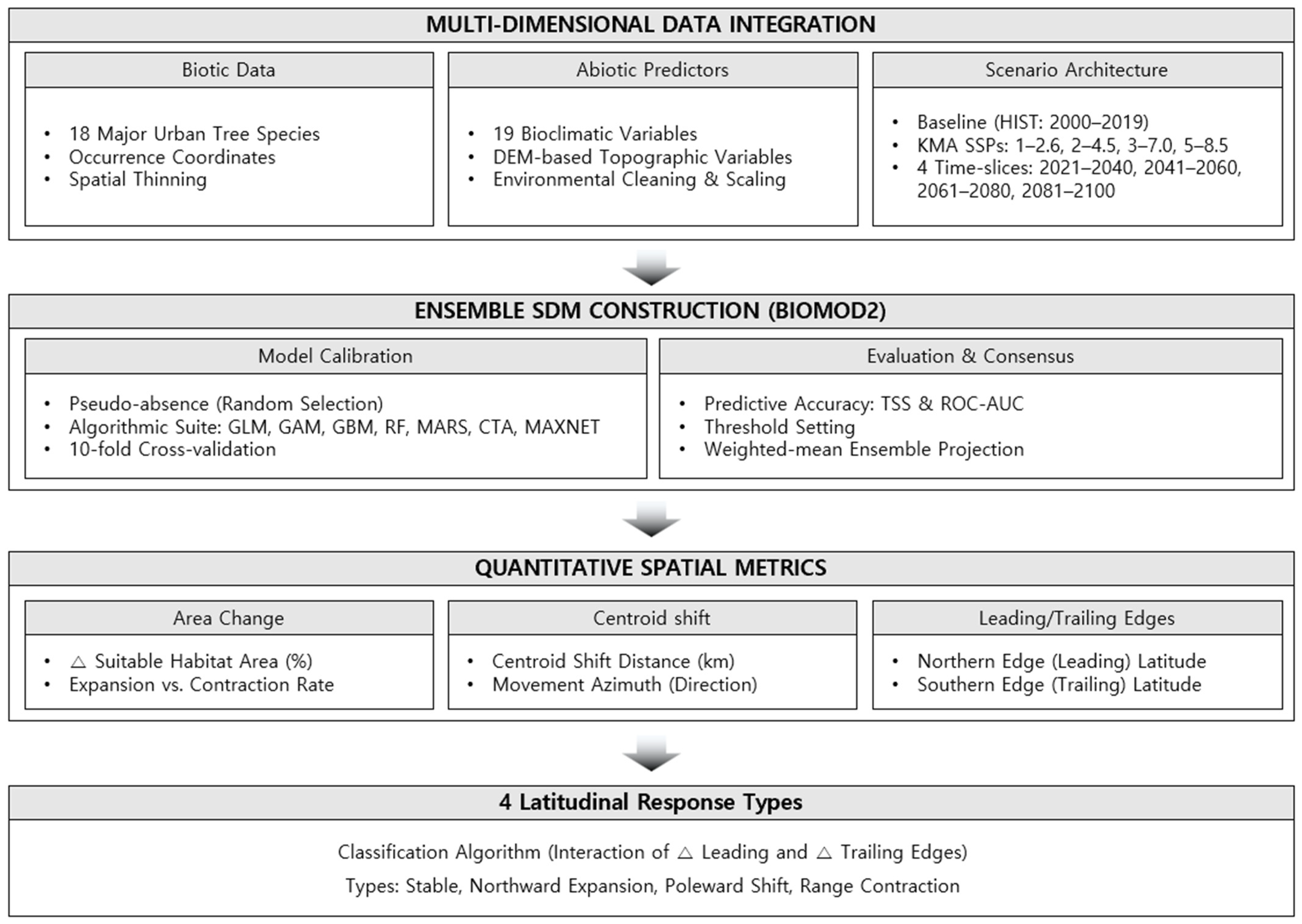
The overall analytical framework is illustrated in Figure 1. Briefly, we built ensemble SDMs using environmental predictors and species occurrence records under HIST. Then we projected the calibrated models to future climate scenarios (SSPs). The projections produced continuous suitability maps and corresponding binary suitable/unsuitable maps. We subsequently quantified key response metrics from the projections, including changes in the suitable area, centroid displacement, changes in mean suitability, and shifts in latitudinal range limits. Finally, we organized species-specific climate responses into management-relevant, interpretable types using the derived indicators.
Unlike approaches that rely on arbitrary thresholds, this study adopts a data-driven classification framework based on standardized response indicators.
All analyses were conducted in R version 4.3.3.

2.2. Study Scope and Area

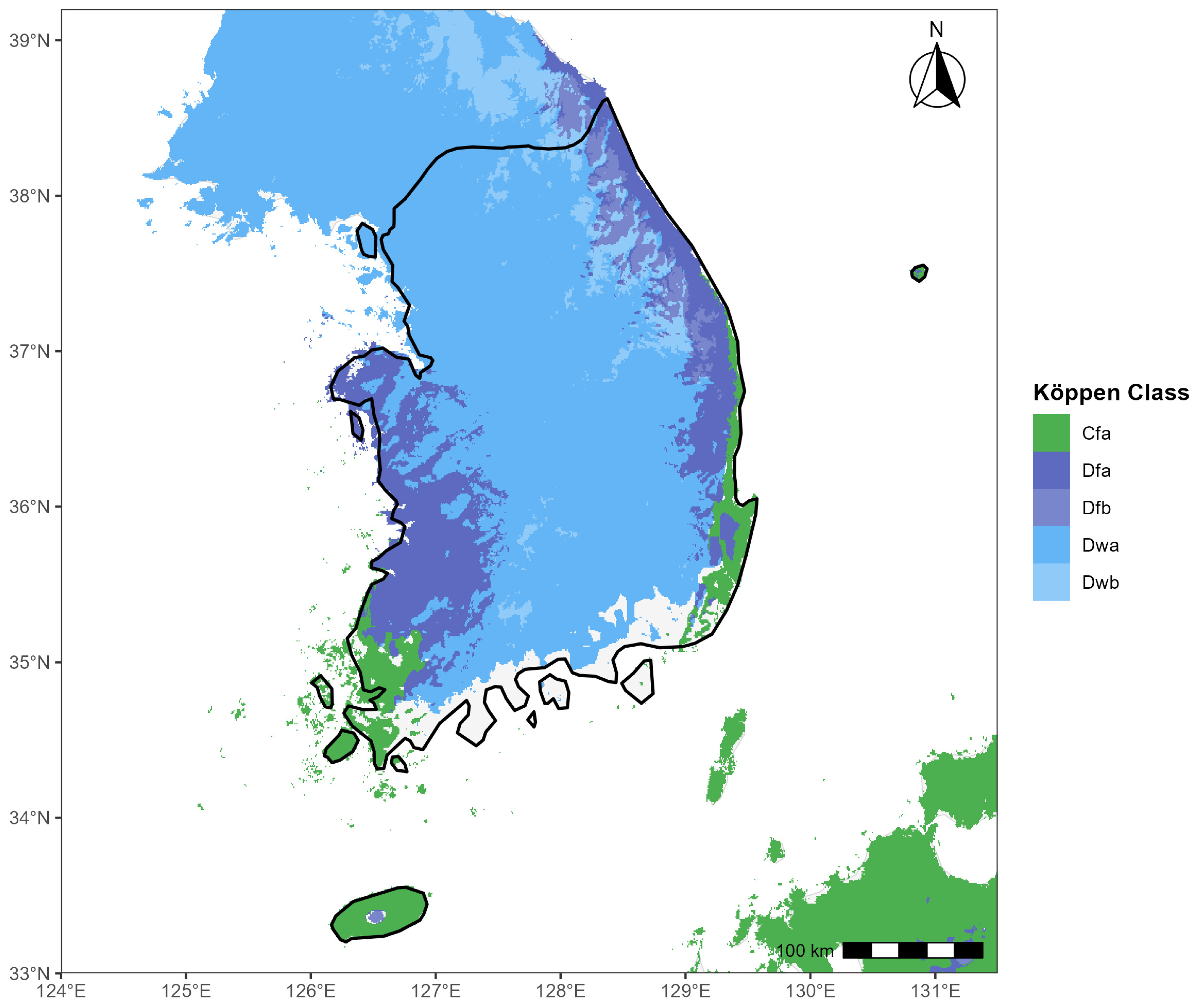
In this study, we focused on urban tree species in South Korea and developed 1 × 1 km grid-based ensemble SDMs to predict current and future growth (habitat) suitability under changing climate conditions [35,36,37]. South Korea is located in the mid-latitudes and has a distinct four-season climate (Figure 2). According to the Köppen climate classification, South Korea is predominantly classified as a humid continental (Dwa/Dwb) and humid subtropical (Cfa) climate zone, reflecting strong seasonal variability in temperature and precipitation. Strong north–south and elevational gradients create a wide range of vegetation zones—from warm-temperate to cold-temperate/boreal—suggesting that climate-change impacts on tree growth environments are likely to be pronounced and spatially heterogeneous.
Candidate species were systematically identified based on (i) high planting frequency across urban parks, street plantings, and urban green spaces, and (ii) empirically documented vulnerability to climate-induced stressors (e.g., heatwaves, drought, and cold damage), using planting records from 124 urban parks and public residential complexes in South Korea. Species occurrence data were compiled from distribution information provided by the National Institute of Biological Resources (NIBR), primarily from the “Biodiversity of the Korean Peninsula” resource and vascular plant distribution maps. Because point coordinates were not directly available for all records, occurrence locations were manually georeferenced by the authors from the mapped distribution information. Prior to model calibration, all records were validated against the environmental raster layers. Only occurrences located within South Korea and falling within valid raster cells were retained. Duplicate records within the same 1 km grid cell, records located in cells with missing predictor values, and records with obvious spatial errors were removed during data cleaning. The occurrence data represent general species distributions, including both natural ecosystems and managed landscapes such as urban green spaces and parks, rather than strictly natural forest occurrences. To ensure minimum model reliability, only species represented by at least 100 cleaned occurrence records were retained for further analysis. We computed cross-validation-based performance metrics and retained species with AUC ≥ 0.7 as the final analysis set to ensure model reliability. This screening procedure was intended to focus on species of practical importance for urban tree management while excluding species for which projections would be highly uncertain, thereby improving interpretability and applicability.
Predictor variables for the SDMs included bioclimatic variables (BIO1–BIO19), warmth index (WI), topographic variables (topographic position index (TPI) and topographic wetness index (TWI)), and soil pH. All predictors were harmonized to a common coordinate system (WGS84) and a common spatial resolution (1 km) and integrated into a single environmental predictor stack for SDM inputs [38]. Because climatic and environmental predictors often exhibit strong intercorrelations, which can lead to multicollinearity, we evaluated species-specific correlation/collinearity among predictors and removed redundant variables. We then constructed a core predictor set for each species, balancing statistical considerations with ecological interpretability. In this study, “species-specific correlation structure” refers to the fact that the correlation/collinearity relationships among predictors can differ across species. We aimed to enhance consistency and interpretability in cross-species comparisons of climate responses by reflecting this structure in variable selection.
The HIST was defined as the 2000–2019 mean. Future climate was represented using four SSP scenarios from IPCC AR6 (SSP1-2.6, SSP2-4.5, SSP3-7.0, and SSP5-8.5) and four future periods (2021–2040, 2041–2060, 2061–2080, and 2081–2100) (Table 1) [39]. For each species, SDMs were trained and evaluated using HIST predictors and occurrence data with 10 repeated runs. The trained models were then projected to the environmental predictors for each SSP–period combination to generate scenario-specific continuous suitability maps [35,40,41,42]. We applied the same suitability threshold derived from HIST to all future projections to produce binary suitable-area maps [43,44,45], following established practices for scenario comparisons [46], to ensure comparability across scenarios and periods.
From SDM projections, we quantified changes in suitable area, mean suitability, latitudinal range limits (northern and southern boundaries), and centroid displacement distance. Response-type classification was performed using unsupervised clustering based on multidimensional response indicators.
A spatial resolution of 1 km was selected as a balance between data availability, computational feasibility, and the spatial scale of national climate datasets.

2.3. Climate Predictors (BIOCLIM + WI)

Bioclimatic variables (BIO1–BIO19) were developed based on synoptic and disaster-prevention meteorological observation data (2000–2019) obtained from the Korea Meteorological Administration (KMA), Seoul, Republic of Korea [47,48]. These data were reconstructed as gridded climate surfaces at approximately 1 × 1 km resolution using MK-PRISM v2.1, a statistical downscaling approach that incorporates Korea’s complex topography and regional climatic characteristics [49,50,51].
Using monthly mean temperature, monthly maximum and minimum temperatures, and monthly precipitation, we derived 19 BIOCLIM variables (BIO1–BIO19) in R using the BIOCLIM algorithm widely used in WorldClim-based applications [52,53,54]. HIST was defined as the 2000–2019 mean, and future climate predictors were prepared for each SSP–time-period combination in Table 1 using MK-PRISM-based high-resolution gridded datasets [47,48].
Additionally, we calculated the WI to better represent the thermal growing environment of urban trees [55,56,57,58]. WI was computed for months with monthly mean temperature exceeding 5 °C using Equation (1) [54,55].
( T I 5 ) ( T I > 5   ° C )

2.4. Non-Climate Predictors (Topography and Soil)

Topographic predictors were derived from a digital elevation model (DEM) with a spatial resolution of approximately 30 m [57]. We calculated the following indices from the DEM to quantify terrain factors relevant to tree growth [58,59,60]:
  • TPI: a measure of relative topographic position compared with the mean elevation of the surrounding area, used to distinguish terrain positions such as ridges, slopes, and valleys [58].
  • TWI: defined as ln(A/tanβ), where A is the upslope contributing area, and β is the slope angle, representing relative wetness conditions and potential soil-moisture accumulation driven by topography [59,60,61].
As the soil predictor, we used topsoil (0–30 cm) pH data at 250 m resolution from ISRIC SoilGrids. The SoilGrids pH data were aggregated and resampled to a 1 km grid, producing a nationwide soil pH raster for South Korea [42], to ensure consistency with the study grid system.
All non-climatic predictors (WI, TPI, TWI, and pH) were harmonized to the WGS84 coordinate system and 1 km spatial resolution. They were then resampled to match the spatial extent and resolution of the bioclimatic variables and integrated into the final environmental predictor stack used as SDM inputs [42,57].

2.5. Variable Screening and Selection

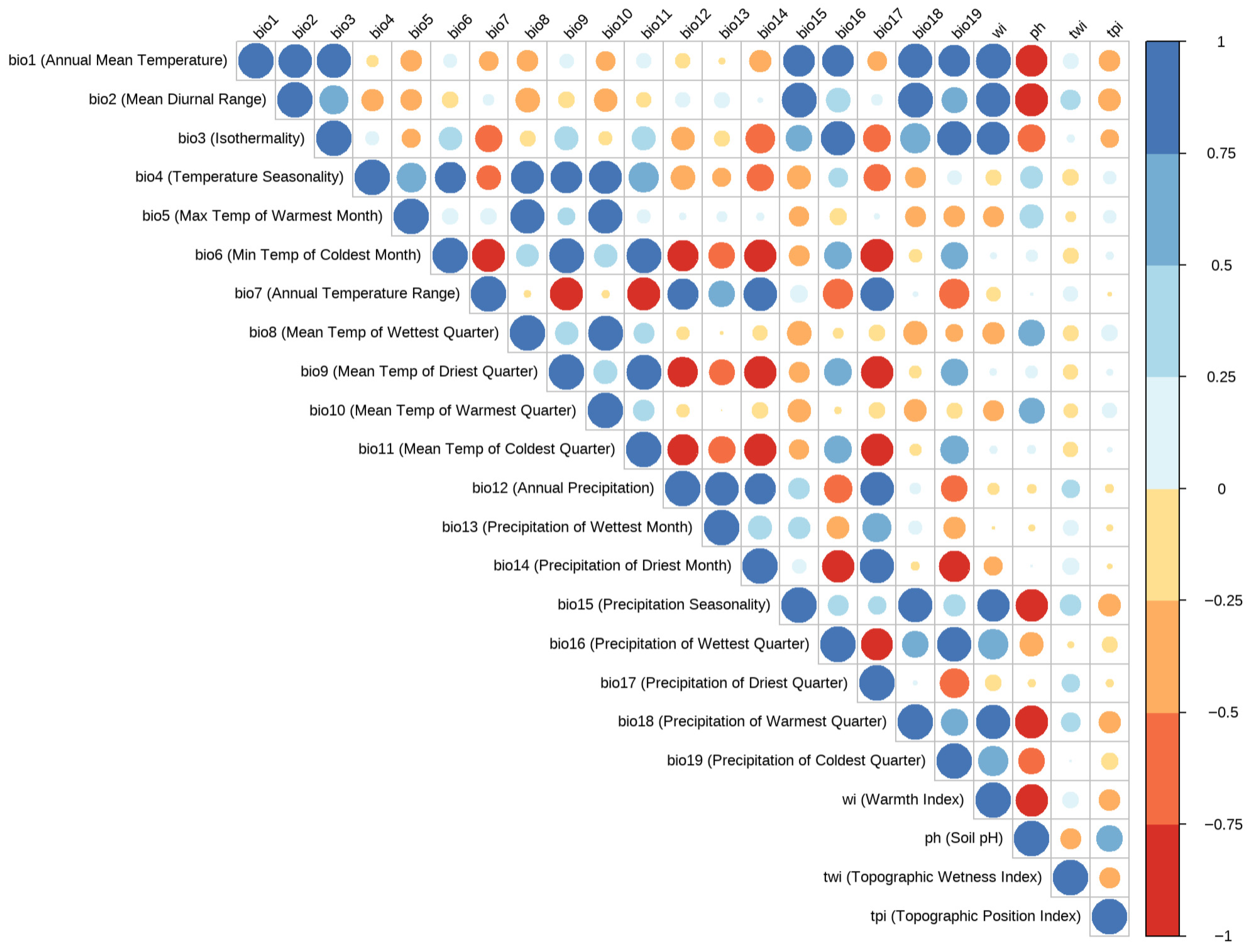
We applied a correlation-based screening procedure for the bioclimatic variables during SDM construction [44,45] to minimize the adverse effects of multicollinearity among predictors on model stability and predictive performance. First, we computed Pearson correlation coefficients for the full predictor set, including WorldClim BIO1–BIO19, WI, TPI, TWI, and pH, and defined high correlation as ∣r∣ ≥ 0.75 [44]. When highly correlated predictor pairs were identified, we preferentially retained variables that have been repeatedly reported as ecologically relevant to plant distributions in previous studies (BIO1, BIO5, BIO6, and BIO12) and removed redundant variables [44,45].
To reduce multicollinearity, we used a correlation-based screening procedure for variable selection. BIO1, BIO5, BIO6, and BIO12 were retained as common core bioclimatic predictors across species, together with pH, TWI, and TPI (Table 2). Additional climatic variables were then selected on a species-specific basis after correlation screening.
Although predictor sets differ among species due to collinearity screening, all response indicators were derived from standardized model outputs, ensuring comparability across species.

2.6. SDM Calibration and Evaluation (BIOMOD2)

Species distribution predictions were generated using an ensemble SDM framework implemented with the biomod2 package in R (version 4.2-6-2) [62]. We used seven algorithms, comprising regression-based methods (GLM and GAM), tree- and machine learning approaches (GBM, RF, MARS, and CTA), and a presence-only method (MAXNET) [18].
This threshold was adopted based on commonly used minimum sample size criteria in SDM studies to ensure model stability and reliability.
Pseudo-absence data were generated with a prevalence of 0.3 (presence:pseudo-absence ≈ 3:7). Pseudo-absence points were sampled twice using a disk strategy within a 30–100 km buffer around occurrence locations [61]. Model evaluation used 5-fold cross-validation repeated twice (10 train–test splits in total), and performance was assessed using AUC and TSS [63].

2.7. Ensemble, Projection, and Thresholding

Based on cross-validation results, we included single-model runs satisfying AUC ≥ 0.7 in the ensemble [64]. Ensemble models were built using BIOMOD_EnsembleModeling, and final ensemble predictions were obtained as a TSS-weighted mean (EMmeanByTSS) [65,66]. This approach is widely used to reduce uncertainty across individual algorithms and improve prediction robustness.
Future suitability was projected by applying the same models trained under HIST conditions to the environmental predictor stacks corresponding to each SSP scenario and future period. This produced species- and scenario-specific continuous suitability maps. Ensemble predictions were linearly rescaled to a 0–1 range using min–max normalization to facilitate comparisons across scenarios.
For binary classification (suitable vs. unsuitable), we defined a single threshold by extracting the maxTSS cutoff (the threshold that maximizes TSS) from each cross-validation run and then averaging across runs [67]. If a maxTSS value could not be obtained or yielded an abnormal value close to 0 or 1, we applied a conservative threshold of 0.5 to avoid extreme over- or under-prediction. Final prediction outputs were saved as GeoTIFFs for subsequent spatial analyses.

2.8. Multidimensional Indicators and Clustering

We quantified changes under future conditions relative to HIST using multidimensional response indicators to overcome the limitations of interpreting SDM projections using a single metric. This approach was designed to capture multiple facets of distributional change simultaneously, including magnitude, location, range boundaries, and suitability intensity.
We calculated the following four response indicators for each species:
  • Percentage change in binary suitable area (%)
  • Centroid displacement distance (km)
  • Change in mean continuous suitability (Δ mean suitability)
  • Latitudinal boundary shifts (southern and northern limits)
The distribution centroid for each SSP–period combination was computed as the mean latitude and longitude of grid cells classified as suitable in the binary suitability map. Centroid displacement relative to HIST was then calculated in kilometers after applying a latitude-based correction. Distances were calculated using great-circle distance to account for geographic curvature.
Latitudinal range limits were defined using the latitude distribution of suitable grid cells: the southern limit was set at the 5th percentile, and the northern limit at the 95th percentile. This percentile-based definition reduces the risk of exaggerating range extremes due to sparse suitable cells near the map edges. Changes in latitudinal limits relative to HIST were converted to distance units using the approximation 1° ≈ 111 km. Finally, based on the combination of shifts in the southern and northern boundaries, we classified species into four latitudinal response types.
Importantly, the classification of latitudinal response types was not based on fixed absolute distance thresholds (e.g., kilometers), but on the relative direction and magnitude of shifts in the southern and northern boundaries between periods. Magnitude was interpreted based on within-species differences, allowing consistent comparison across species with different distribution extents while avoiding bias from arbitrary thresholds. Species were then classified using an unsupervised, data-driven clustering approach based on standardized (z-score) response indicators to ensure comparability across variables. Clustering was performed using the k-means algorithm, and the optimal number of clusters was determined based on cluster separation and interpretability. This framework prioritizes relative response patterns over absolute criteria, providing a more robust basis for interspecific comparison.

3. Results

3.1. Species-Specific Results of Variable Selection

Following species-specific variable screening, the final predictor sets differed among species. However, BIO1, BIO5, BIO6, BIO12, pH, TWI, and TPI were retained across all models as common core variables (Figure 3). Additional climatic predictors, including BIO4, BIO7, BIO14, BIO15, BIO17, and BIO19, were selected for individual species (Table 3). These results indicate that, although several predictors were consistently important across species, species-specific differences in climatic sensitivity required additional variables in some models.

3.2. Ensemble Performance Evaluation and Selection of Target Species

We excluded species with a mean AUC < 0.7 from the analysis to ensure the predictive reliability of the ensemble SDMs. Of the 24 candidate tree species, 18 species met this criterion and were retained for the final analyses.
Overall, the ensemble models for the selected 18 species showed high discriminatory performance, with AUC values ranging from 0.74 to 0.97 (Table 4). In particular, Machilus thunbergii, Pinus densiflora, Camellia japonica, Ilex rotunda, and Styrax japonicus achieved mean AUC values above 0.95, indicating highly stable suitability predictions based on climate predictors. TSS values ranged from 0.36 to 0.90, showing relatively large interspecific variability: some species showed very high classification accuracy, whereas others exhibited moderate performance.

Changes in Suitable Area

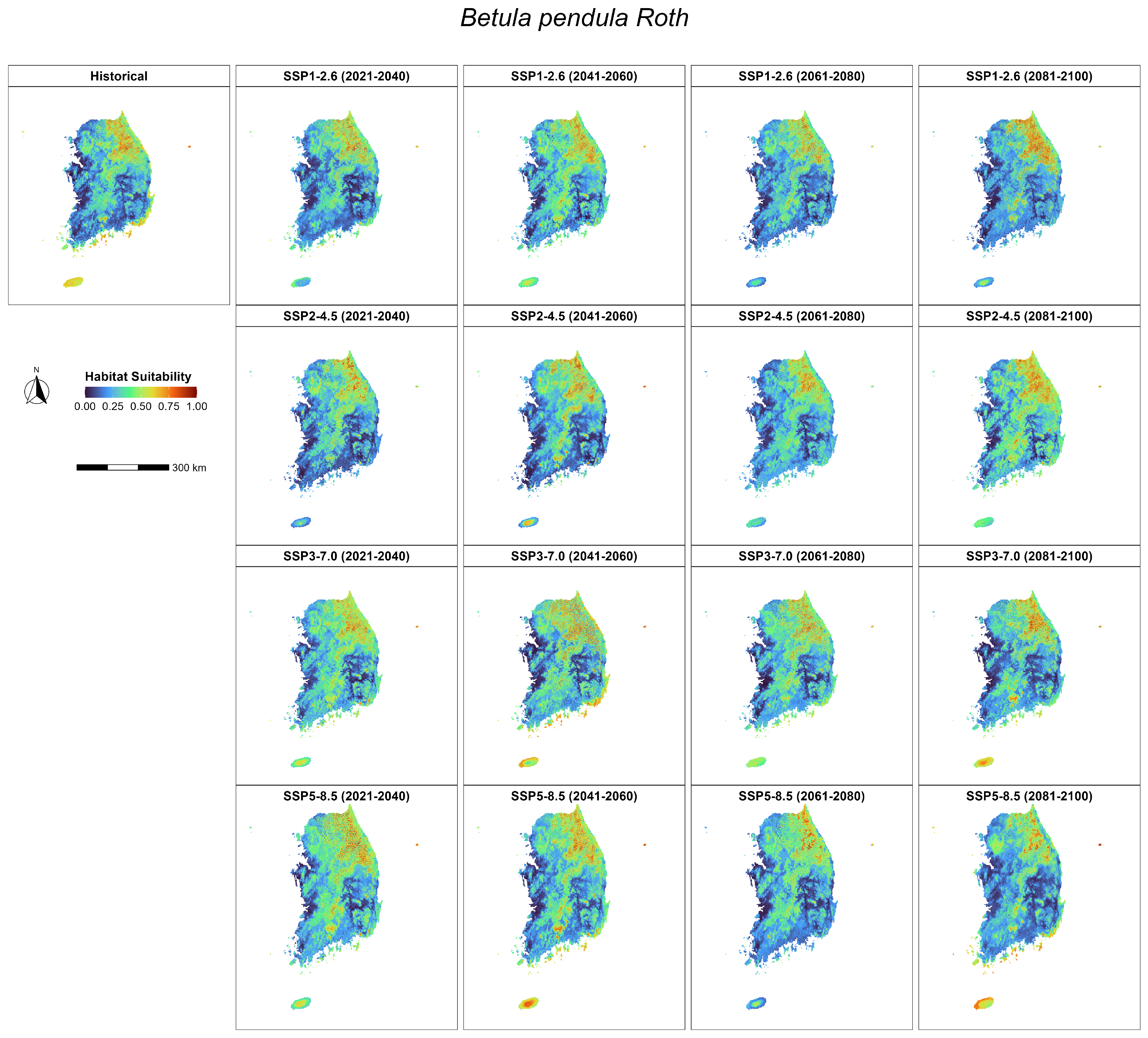
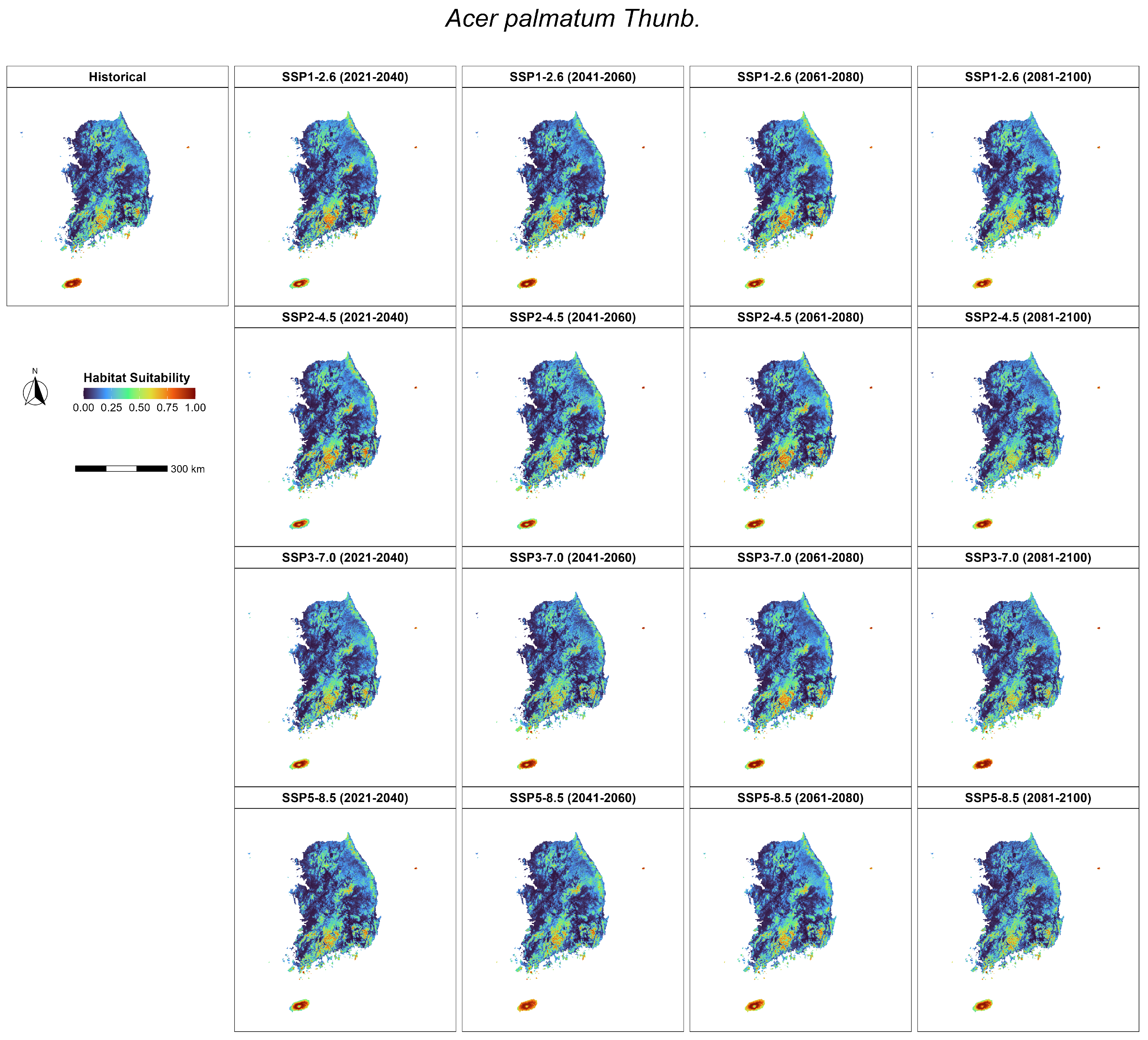
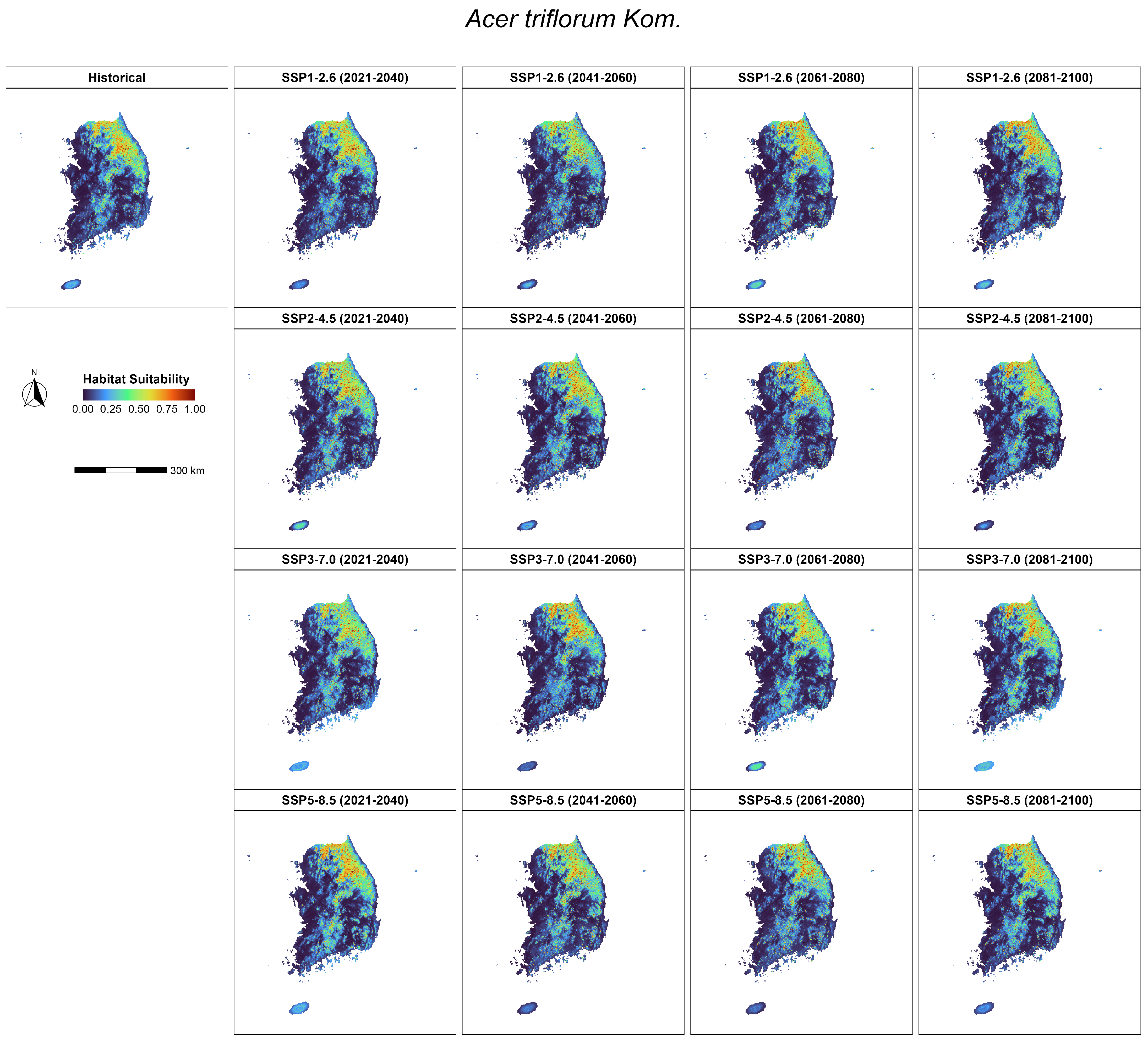
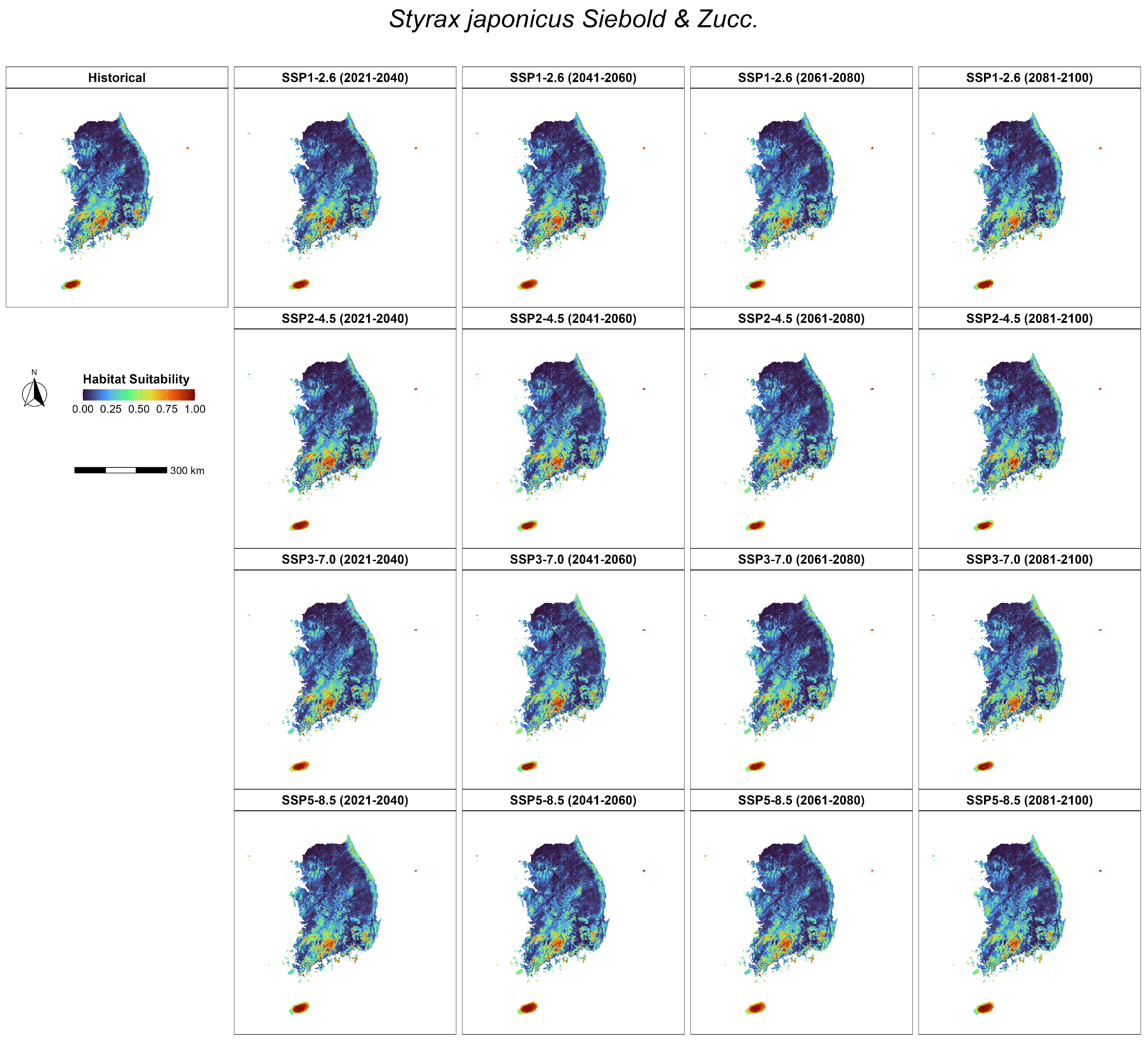
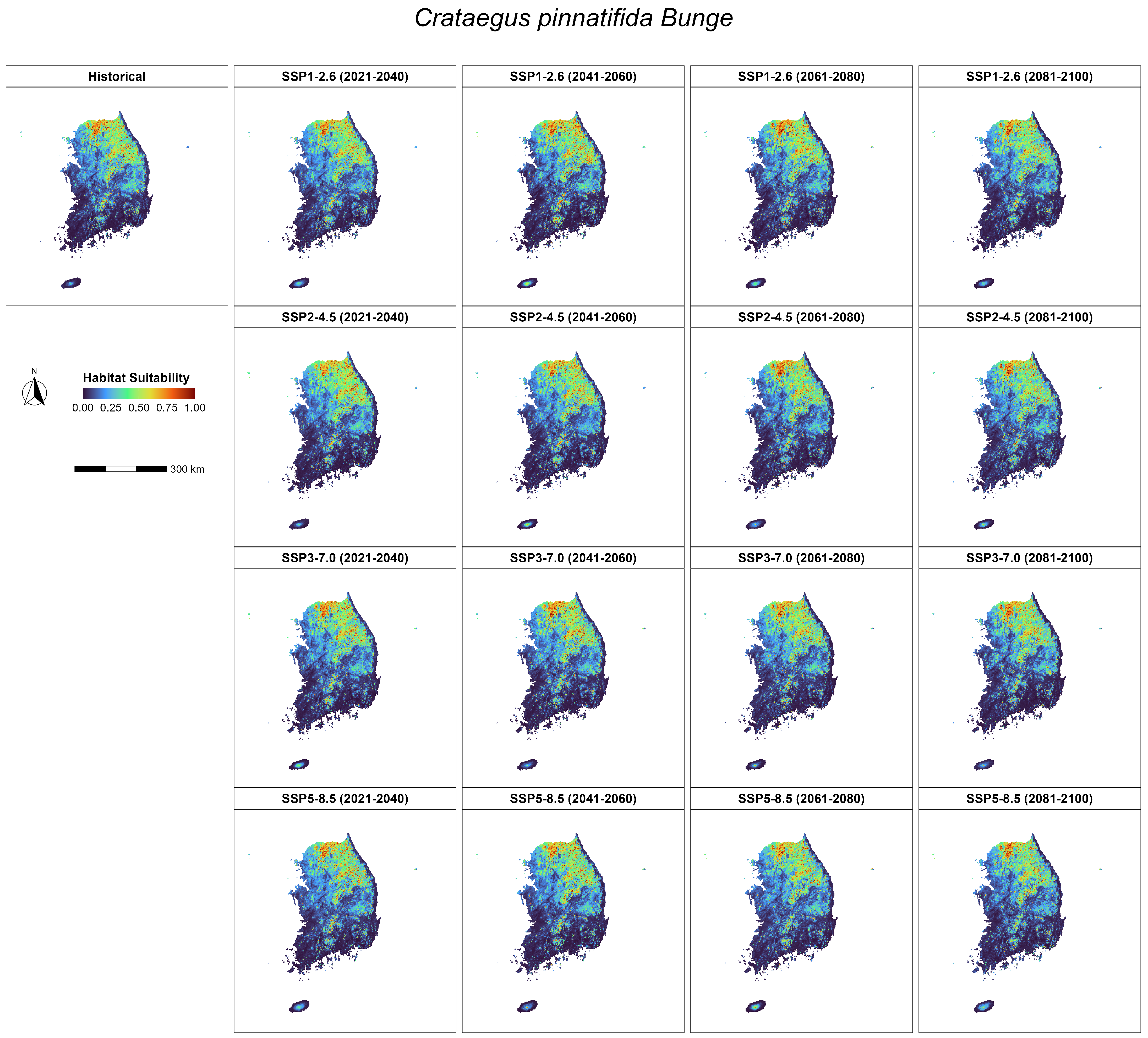
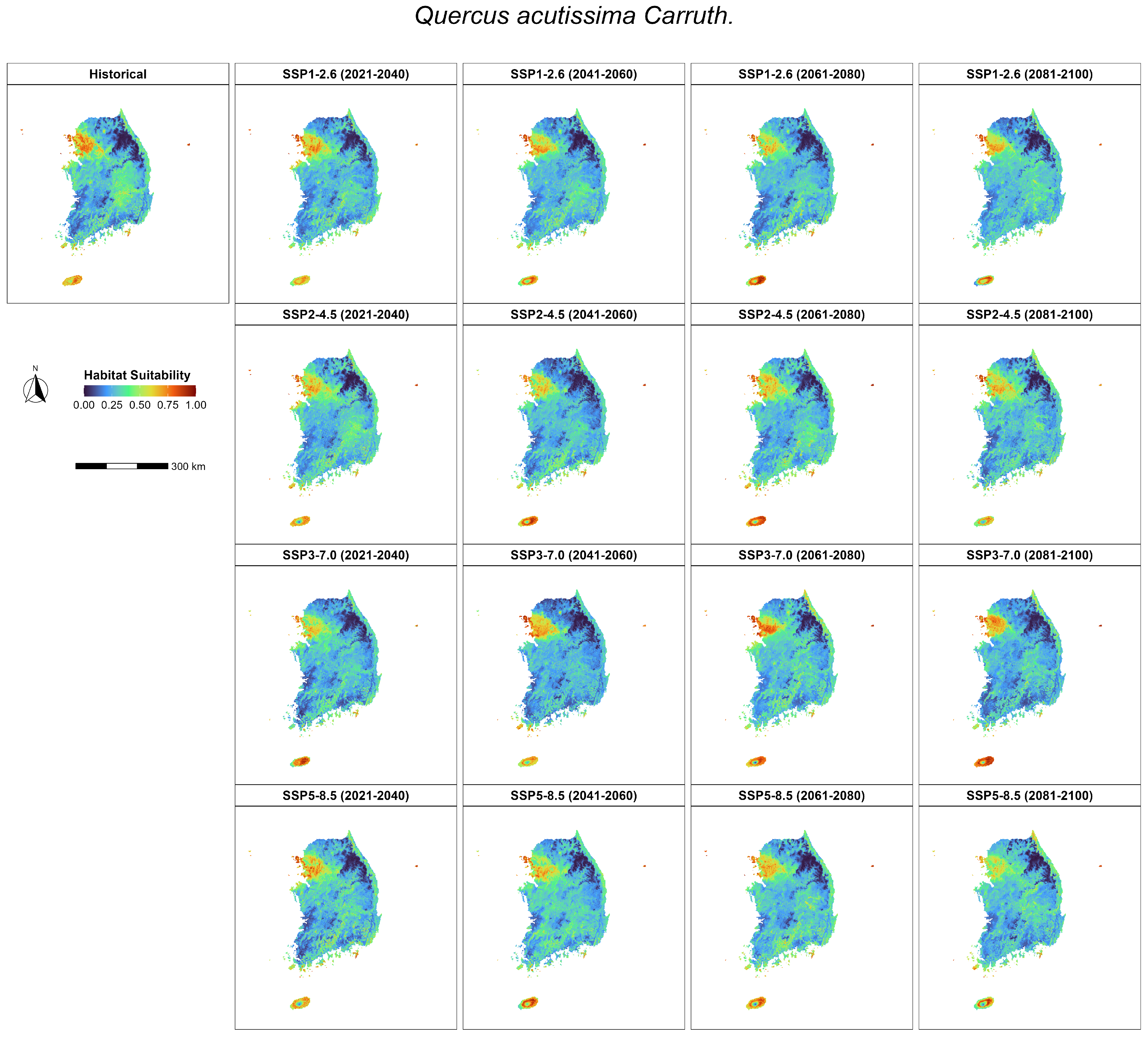
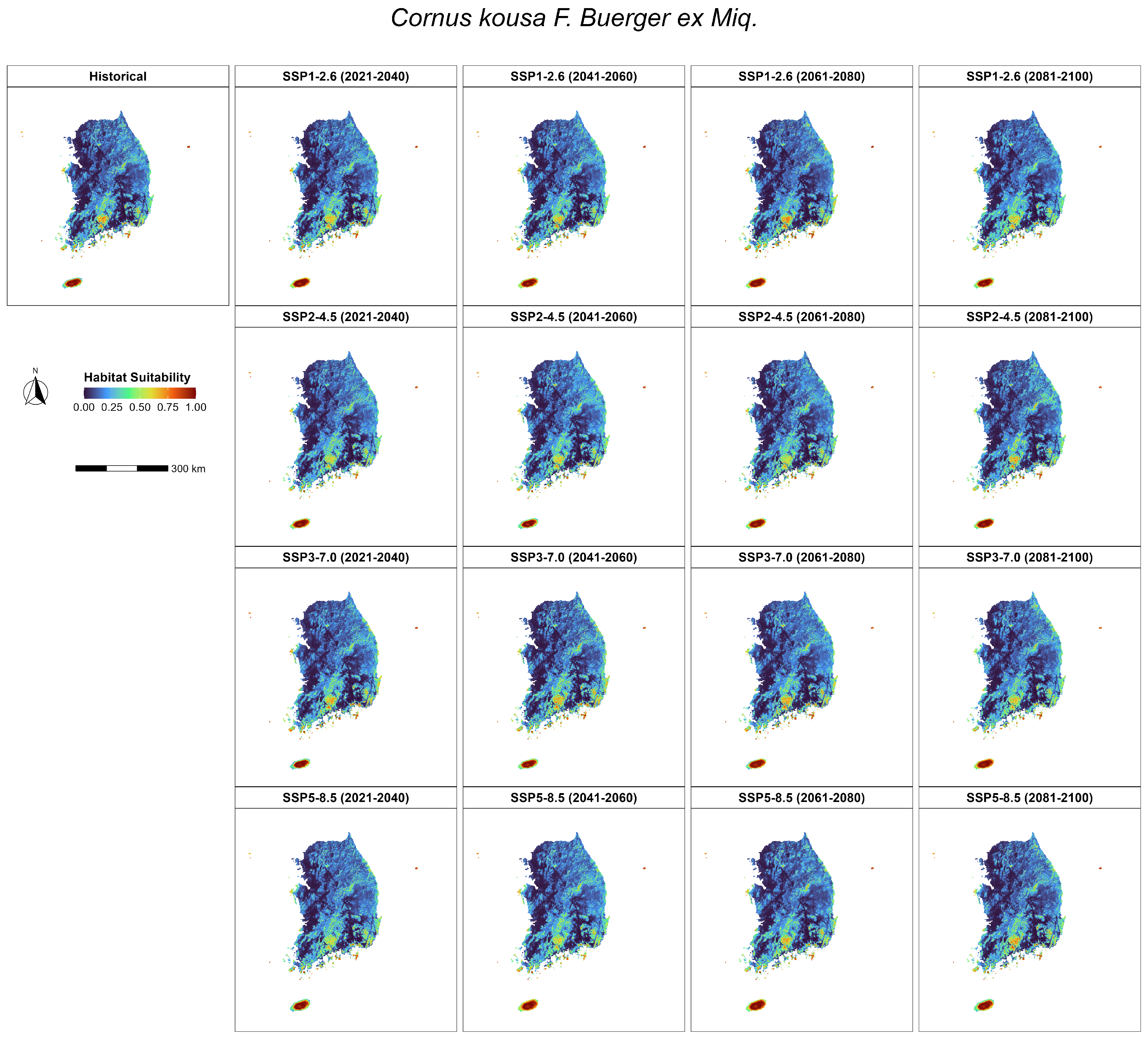
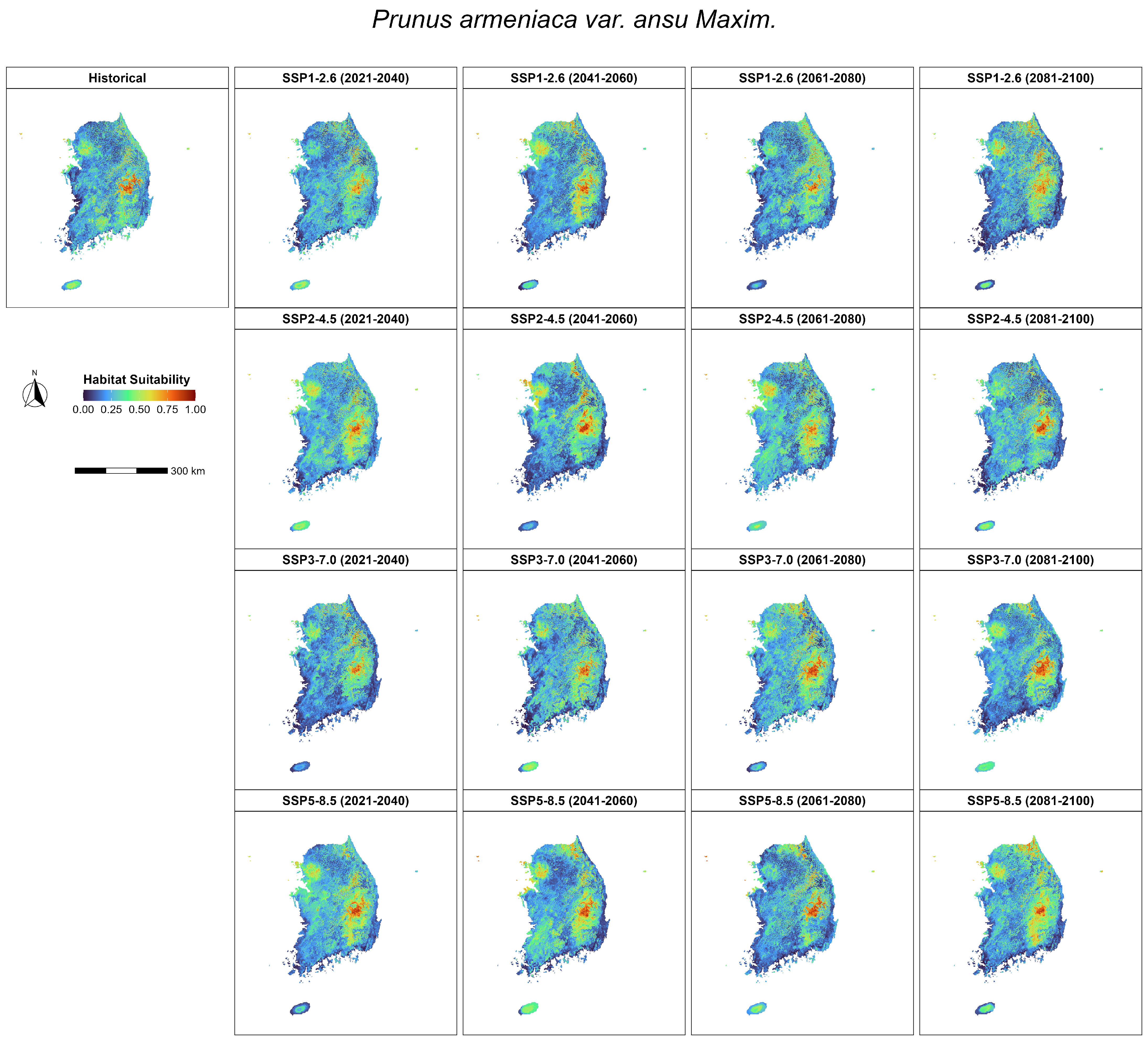
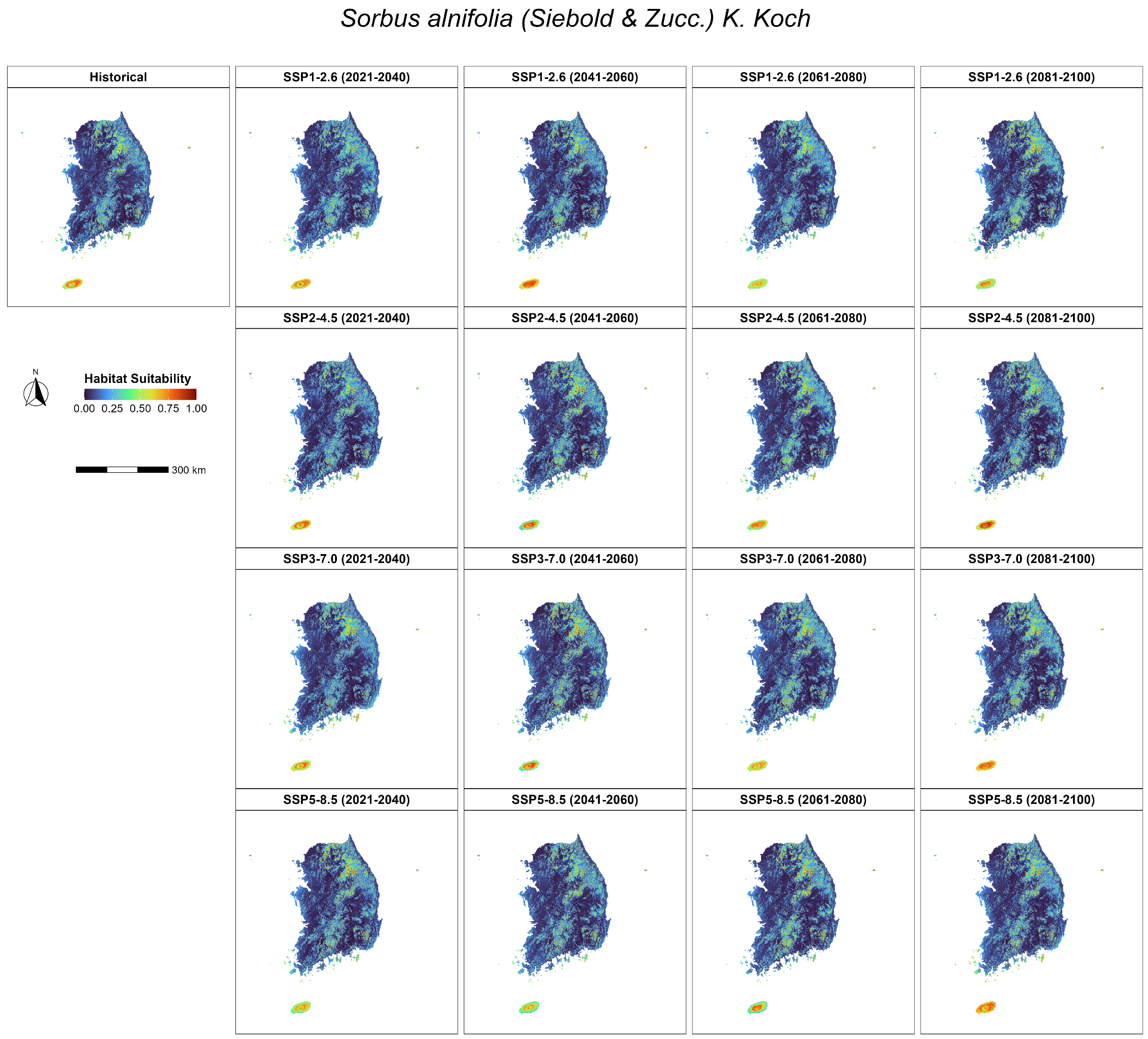
We mapped the potential suitability distributions of the 18 focal species under historical climate conditions (HIST; 2000–2019) before evaluating changes in the suitable area under future scenarios to establish a baseline (Figure 4).
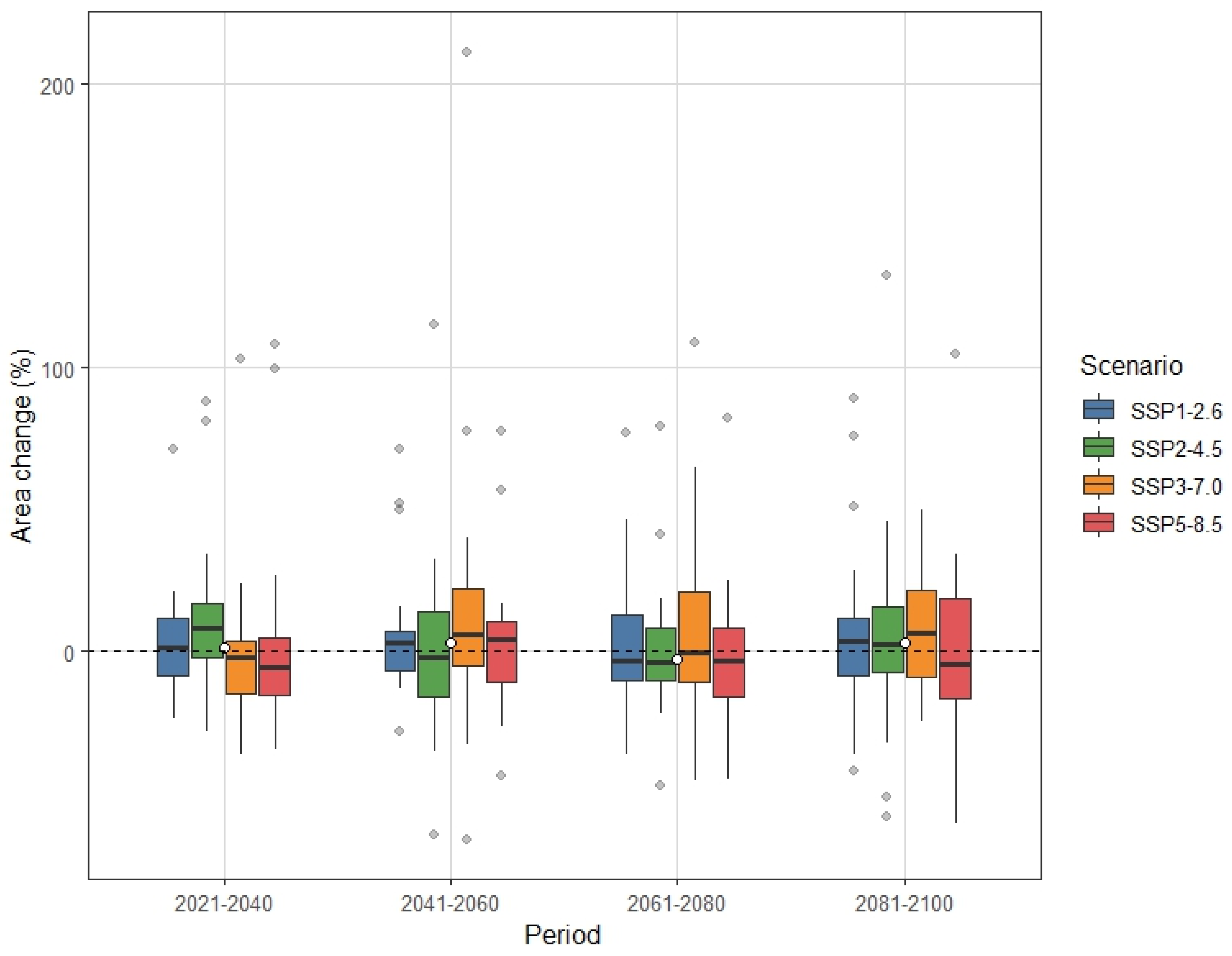
Across the four future periods, the percentage change in suitable area showed mixed patterns of increase and decrease across species under all SSP scenarios (Figure 5). Overall, the median change was close to 0% for most periods and scenarios, indicating that, on average, changes in suitable area tended to remain relatively limited. This pattern, however, should not be interpreted as distributional stability; rather, it reflects the offsetting effects of simultaneous expansions in some species and contractions in others.
As time progressed, the interquartile range and extremes gradually widened, and interspecific heterogeneity became more pronounced, particularly in the mid- to late-century periods. Comparisons among SSPs further showed that high-forcing scenarios (SSP3-7.0 and SSP5-8.5) exhibited greater dispersion in area changes than the low-forcing scenario (SSP1-2.6). Notably, the largest variance in area-change rates occurred in SSP3-7.0 during 2041–2060, suggesting that under stronger climatic forcing, differences in species-specific ecological traits are amplified, leading to larger contrasts in both the direction and magnitude of responses.
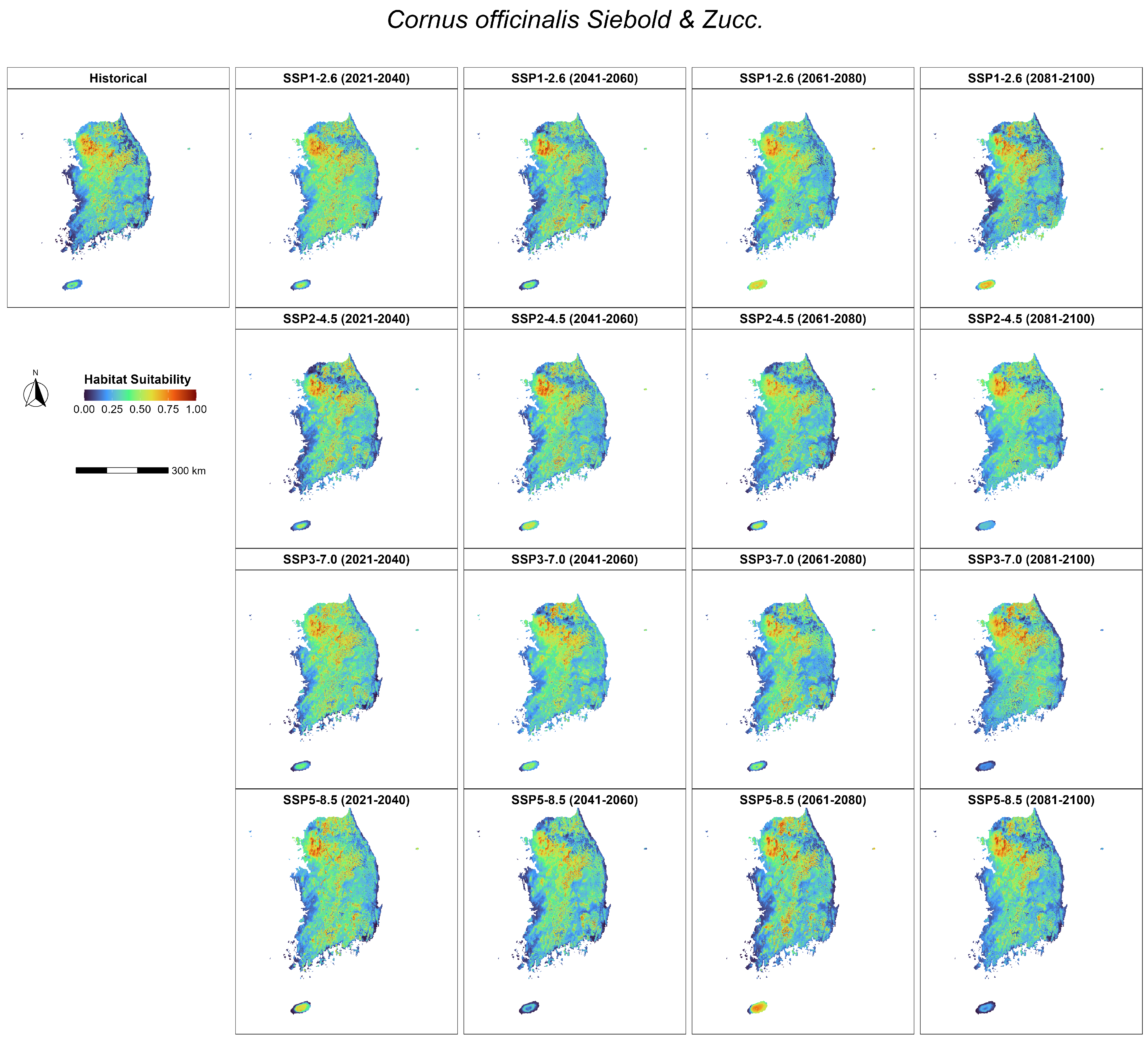
At the species level, Betula pendula showed the greatest expansion, with suitable area increasing up to +211.5% during the mid-century period under SSP3-7.0 (Figure 5). In contrast, Cornus officinalis exhibited the largest contraction, with a −66.4% change under SSP5-8.5 in the late-century period (2081–2100) (Figure 6). The proportion of species showing a decrease in suitable area relative to HIST ranged from 33.3% to 55.6% across scenarios and periods, indicating that both expansion and contraction co-occur under all climate conditions considered.
The mean absolute magnitude of area change was approximately 14–31%, with the largest overall changes again observed in SSP3-7.0 during 2041–2060. Taken together, these results indicate that climate change does not impose a uniform directional effect on the spatial distributions of urban trees; instead, contrasting spatial reorganizations emerge depending on species-specific ecological characteristics and climate sensitivities. Scenario-specific spatiotemporal distributions of suitability for the remaining 16 species (beyond the representative examples shown in the main text) are provided in Appendix A.1.

3.3. Latitudinal Boundary Shifts and Response Types

While changes in suitable area and centroid displacement capture the magnitude of distributional reorganization, they do not directly distinguish whether such reorganization reflects expansion, shift, or contraction. Therefore, we estimated the southern and northern latitudinal range limits from the latitude distribution of binary suitable grid cells for each future period relative to HIST and categorized species responses based on combinations of boundary shifts.
These response types were defined based on the relative direction and magnitude of boundary shifts rather than fixed distance thresholds, allowing flexible classification across species with varying distribution ranges.

3.3.1. Shift Patterns of Latitudinal Limits (Southern and Northern Boundaries)

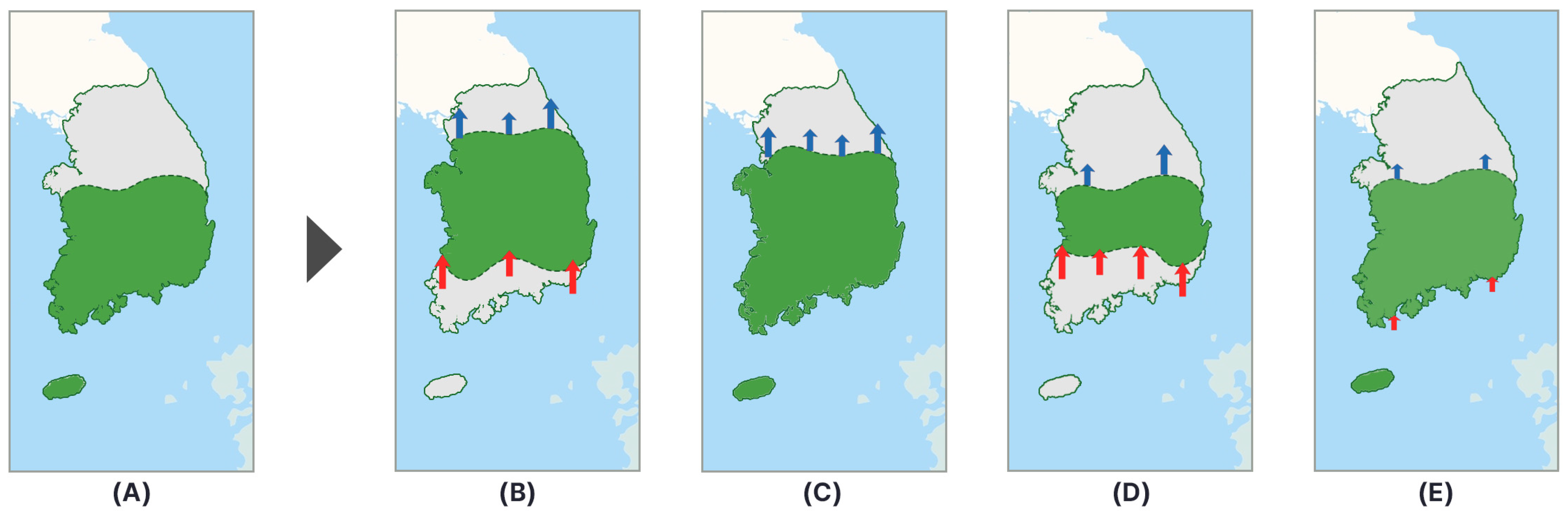
For each species, we calculated the southern (5th percentile) and northern (95th percentile) latitudinal limits and compared changes relative to HIST. Boundary shifts varied clearly across species and climate conditions. Based on the direction and magnitude of shifts in the southern and northern boundaries, distributional boundary reorganization was classified into four types (Figure 7):
  • Northward Expansion: both southern and northern boundaries shift northward, indicating an overall expansion of the distribution.
  • Poleward Shift: the northern boundary shifts markedly northward while the southern boundary shows limited change, indicating a net displacement toward higher latitudes.
  • Range Contraction: the southern boundary shifts northward to a greater extent, reducing the latitudinal breadth of the distribution.
  • Stable: shifts in both boundaries are limited, resulting in relatively small changes in both distributional position and extent.
Figure 7. Conceptual classification of range responses based on latitudinal boundary shifts relative to HIST (2000–2019). Green shading indicates the climatically suitable habitat for a species, whereas unshaded areas indicate unsuitable habitat. (A) HIST baseline; (B) Northward Expansion; (C) Poleward Shift; (D) Range Contraction; (E) Stable. Blue arrows denote northern-margin shifts and red arrows denote southern-margin shifts.
Land 15 00616 g007

3.3.2. Scenario and Period-Specific Frequencies of Response Types

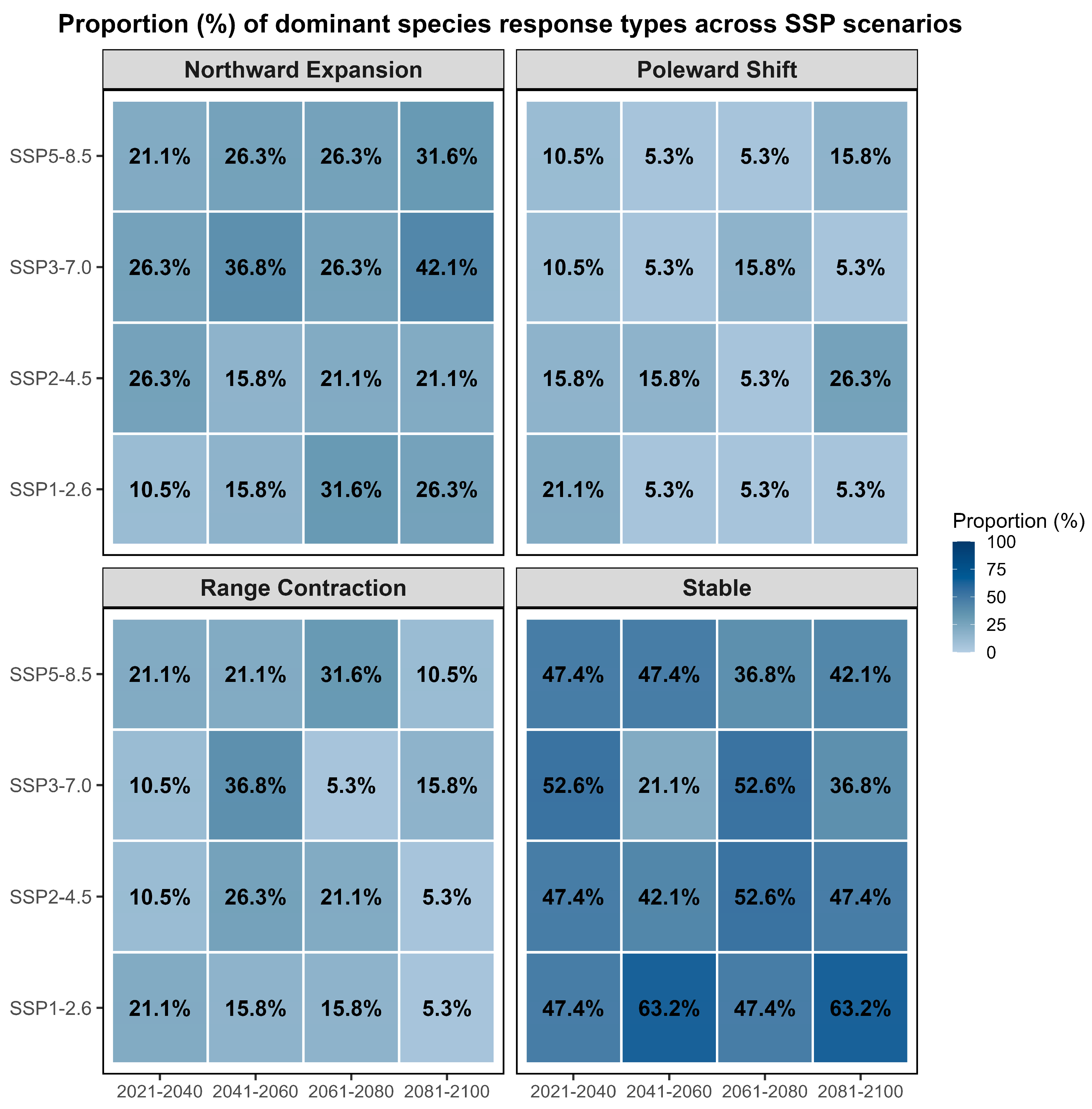
Analysis of scenario and period-specific frequencies showed that Stable was the most prevalent response type across future periods (Figure 8). The proportion of stable responses ranged from 36.8% to 63.2%, reaching the maximum (63.2%) under SSP1-2.6 during 2041–2060 and 2081–2100. This indicates that a substantial share of species may largely maintain suitability distributions comparable to HIST under future climate conditions.
Northward Expansion accounted for 10.5–42.1% of responses, with the highest frequency (42.1%) observed under SSP3-7.0 in the late-century period (2081–2100). Poleward Shift occurred less frequently (5.3–26.3%) and remained below 15% in most periods. Range Contraction ranged from 5.3% to 36.8%, peaking at 36.8% under SSP3-7.0 during 2041–2060.
Across scenarios, SSP1-2.6 consistently showed relatively high frequencies of the Stable type throughout the projection periods (47.4–63.2%). In contrast, under SSP3-7.0 and SSP5-8.5, the proportions of Northward Expansion and Range Contraction varied substantially over time. For example, underSSP3-7.0 Northward Expansion increased from 26.3% to 42.1%, while Contraction increased from 10.5% to 36.8%. These patterns suggest that, even under the same warming pathway, species responses may diverge toward either expansion or contraction rather than following a single uniform trend.
The relatively high proportion of stable types may be related to the use of threshold-based binary classification and ensemble averaging.
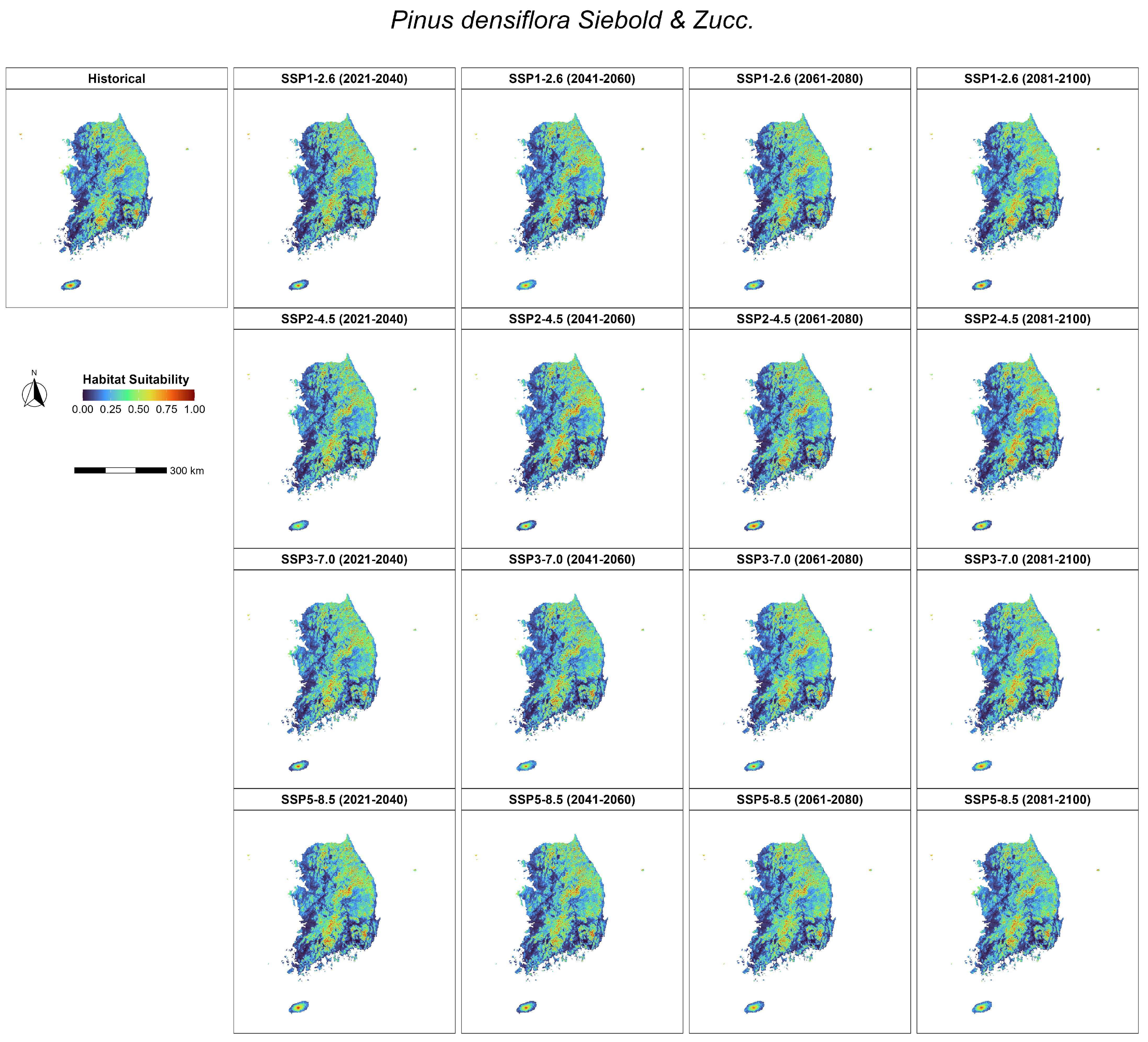
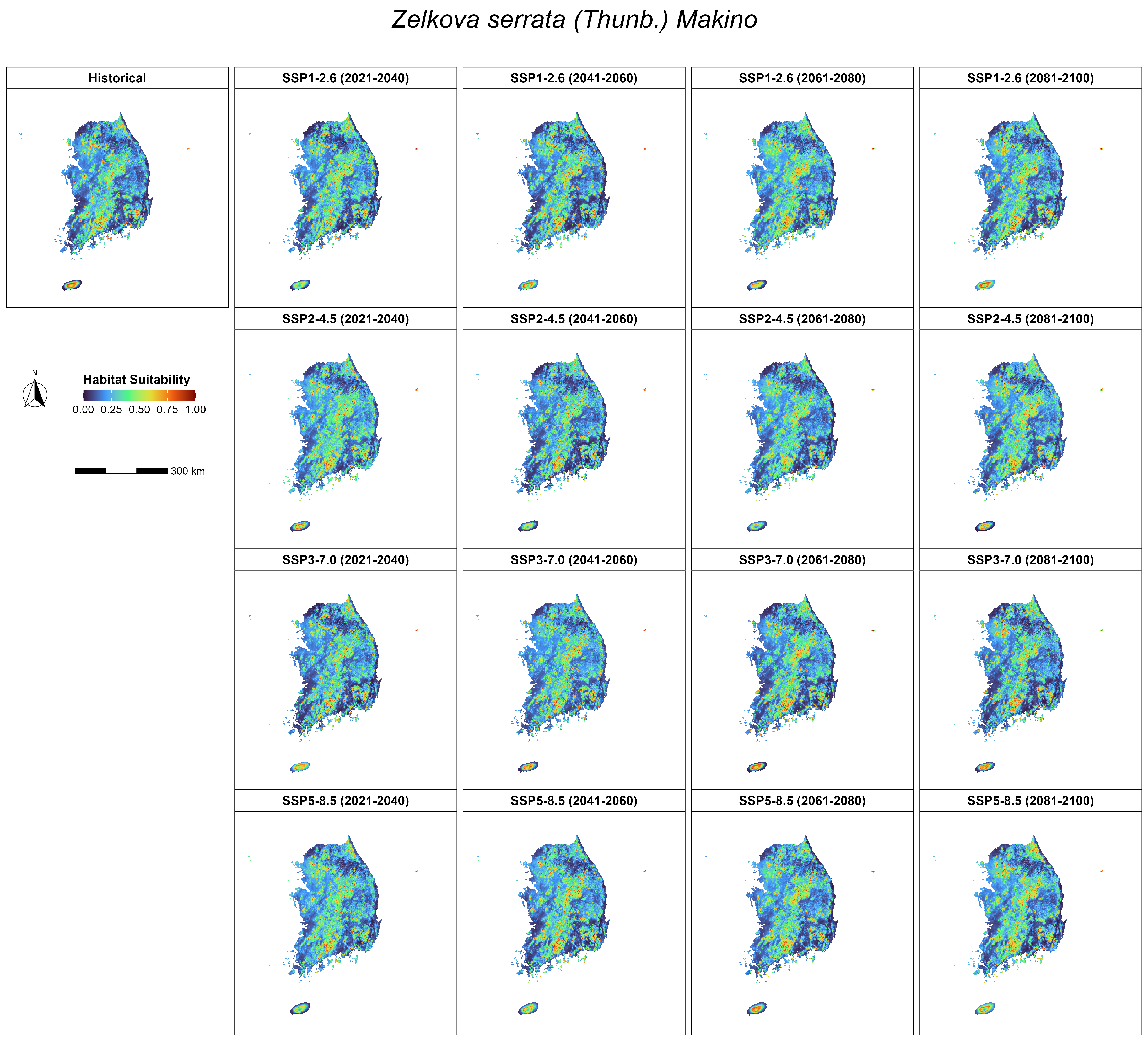
Given the generally low frequency of Poleward Shift, the dominant response patterns can be summarized as a combination of Stable, Expansion, and Contraction. Species composition by response type is provided in Appendix A. For example, the Stable type repeatedly included Ulmus davidiana var. japonica, Zelkova serrata, and Pinus densiflora. In contrast, the Range Contraction type primarily included a subset of species such as Betula pendula, Pinus koraiensis, and Abies holophylla.
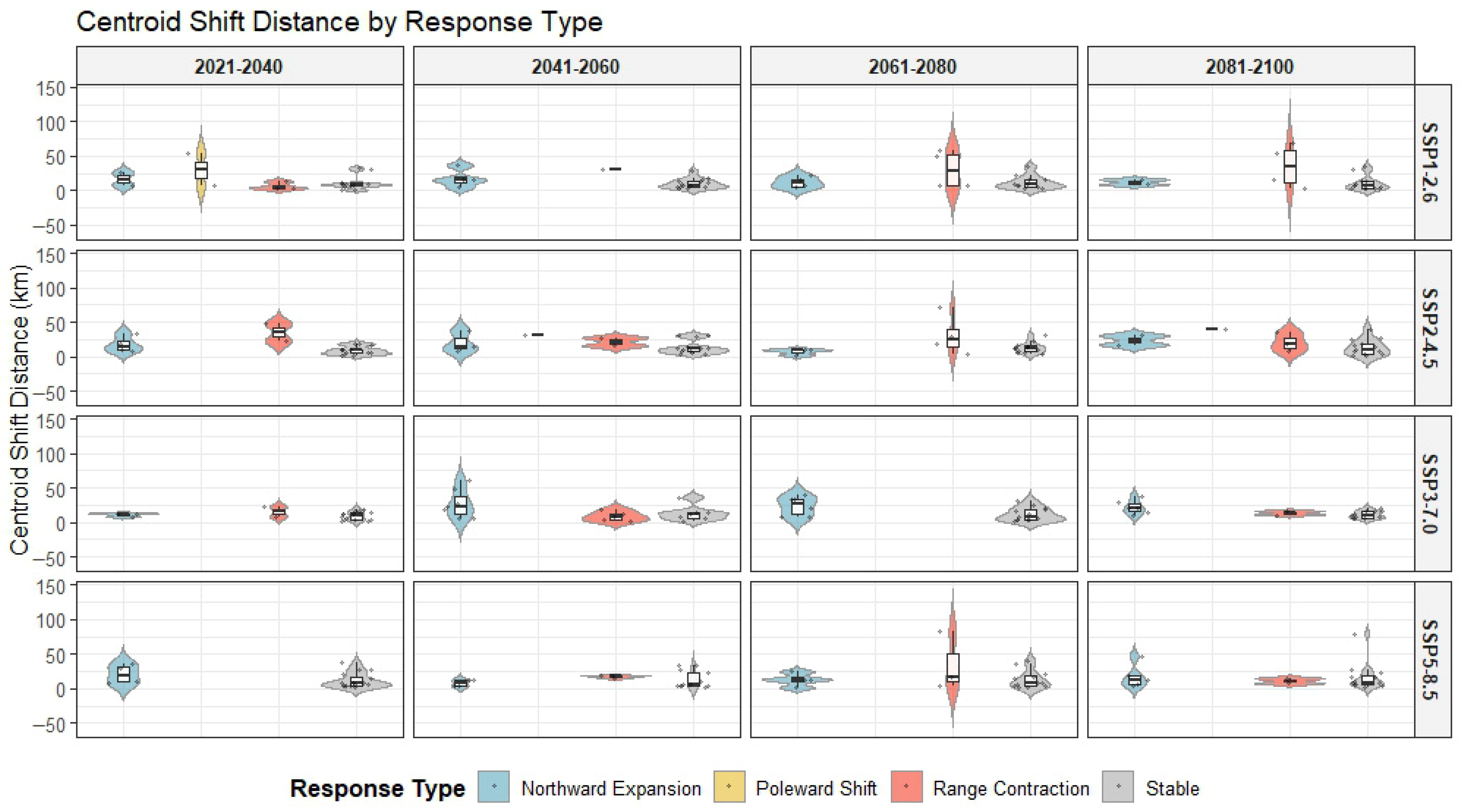
We also examined centroid displacement as a complementary measure of spatial redistribution (Figure 9). Centroid shifts were generally smallest in the Stable type and largest in the Poleward Shift type. In the non-stable response types, centroid movement often reached several tens of kilometers and, in some late-century scenario–period combinations, approached 80–100 km. These results show that boundary-based response types do not fully capture the scale of redistribution, as species assigned to the same type can still differ markedly in the distance over which their suitable range shifts. When the 18 species were classified according to the most frequently observed response type across all four future periods, Stable was the most common dominant type (11 species), followed by Northward Expansion (3 species), Range Contraction (3 species), and Poleward Shift (1 species) (Table 5). This indicates that, although non-stable redistribution patterns were observed under several scenario–period combinations, many species were still most frequently classified as Stable when summarized across the full projection horizon.

4. Discussion

This study was motivated by whether climate-change responses of urban trees can be translated beyond species-specific projections into response types that are interpretable and actionable for management units. Our first research question asked whether, after accounting for multicollinearity in predictive modeling, constructing species-specific sets of key predictors—rather than uniformly applying the same predictor set to all species—would enable clearer discrimination of interspecific differences in climate responses. While a core group of predictors was consistently selected across species, the inclusion of additional variables varied by species. This result is meaningful because it departs from prior approaches that apply an identical predictor set across species and instead provides a structure that supports a more direct interpretation of interspecific response differences.
This study is intended as a macroclimate-based first-stage screening framework, which should be complemented by finer-scale urban environmental assessments incorporating microclimate, soil, and management conditions.
Predictive performance for the species retained in the final analysis was generally strong (AUC ≈ 0.75–0.97; TSS ≈ 0.36–0.90), indicating that subsequent typology construction and scenario comparisons were conducted on a reasonably reliable modeling basis. By classifying responses using multiple indicators boundary shifts, centroid displacement, and changes in suitability intensity—rather than relying solely on area change, we aimed to reduce a key interpretive pitfall: vulnerability may be underestimated even when average area change appears small. These differences may also reflect underlying variation in species ecology, particularly in sensitivity to thermal extremes and water availability, which were repeatedly represented by the common core predictors. From this perspective, contraction in some species may be associated with greater sensitivity to heat or moisture stress, whereas expansion in others may reflect the relaxation of temperature constraints under warming. conditions. Even when the proportion of the Stable type remains high under some scenario–period combinations, concurrent shifts in the shares of Northward Expansion and Range Contraction can occur, implying that response heterogeneity can accumulate beneath an apparently stable overall signal.
The scenario and temporal dependence results are better understood not as a simple pattern of “higher emissions always leading to uniformly worse outcomes,” but rather as one in which stronger climatic forcing increases the degree of divergence among species. The relatively high prevalence of the Stable type under low-forcing conditions suggests that some species may not substantially alter their suitability distributions under limited warming. However, the increasing variability in the proportions of Northward Expansion and Range Contraction under moderate- to high-forcing conditions (Expansion up to ~42%, Contraction up to ~37%) indicates that, even under the same warming pathway, species-specific ecological limits may simultaneously amplify both opportunities and risks. Accordingly, planting and replacement strategies that incorporate future scenarios should not be framed as uniform recommendations; instead, they should be flexibly adjusted by response type. In practice, however, such type-specific strategies would also need to be evaluated against operational and economic constraints, including nursery stock availability, maintenance burden, replacement costs, and site-level feasibility.
The response typology based on latitudinal boundary shifts also translates the general notion of “northward movement” into more concrete information for management. In this study, the Stable type accounted for the largest share across scenarios and periods (36.8–63.2%) and was particularly prevalent under SSP1-2.6. Northward Expansion is relevant to the potential introduction and scaling-up of species and varied widely depending on conditions (10.5–42.1%), reaching its maximum under late-century SSP3-7.0 (42.1%). Poleward Shift is directly linked to the spatial planning of planting zones and deployment strategies, reflecting positional transitions of suitable areas with limited change in range breadth; it generally occurred at low frequencies, remaining below ~15% in most cases. Range Contraction, characterized by predominant loss at the southern boundary, indicates the emergence of vulnerable zones where suitability retreats and thus represents a priority for management, monitoring, and phased transition. Importantly, even when stability appears plausible in the short term, the Stable type may not remain dominant in the long term, suggesting that maintenance strategies should be paired with monitoring indicators that detect early signals of transition.
Unlike in natural ecosystems where the emergence of suitable habitat may translate into range shifts through natural dispersal—urban trees cannot be assumed to relocate autonomously as suitability changes. Instead, urban-tree distributions are reconfigured through planting, transplantation, and management interventions. From this perspective, mobility indicators such as centroid displacement provide an informative signal of where management burdens may shift spatially. In our results, centroid displacement for the Stable type was largely confined to ~0–20 km, whereas the Poleward Shift type and some non-stable responses exhibited centroid movements on the order of several tens of kilometers, expanding to ~80–100 km in the late-century period. These values are presented for descriptive interpretation rather than as classification thresholds, and should not be interpreted as fixed criteria for defining response types. Future studies may further refine this framework by introducing threshold-based classification criteria to enhance interpretability and standardization. The relatively high proportion of stable types may reflect the conservative nature of threshold-based binary classification and the averaging effects of ensemble projections. This suggests that even if distributional breadth does not change substantially, positional shifts in suitable areas may become an earlier and more immediate management challenge. Conversely, relatively small centroid displacements do not necessarily imply low risk, because contraction driven by southern-boundary loss can occur without large centroid movement; thus, caution is required to avoid underestimating vulnerability when relying solely on centroid-based metrics.
Several limitations should be considered when interpreting these results. First, the models estimate broad-scale climatic suitability rather than realized tree health or performance in urban planting sites. In addition, the present study did not validate predicted suitability against empirical growth metrics such as tree height, canopy width, health condition, or phenological change. Important urban-specific conditions, including heat-island intensity, impervious surface cover, soil compaction, irrigation, and management practices, were not explicitly included. In addition, the framework is correlative rather than mechanistic and does not directly account for physiological thresholds, functional traits, or species-specific stress tolerance. Projected redistribution should also not be interpreted as realized movement, because urban tree distributions are shaped by planting, replacement, and management decisions. Practical application may further be constrained by nursery stock availability, maintenance requirements, replacement costs, and site-level feasibility. The framework should therefore be understood as a comparative tool for identifying broad climate-response patterns, rather than as a direct predictor of site-level urban tree performance. The proposed typology can support practical decision-making by identifying species that require monitoring, replacement, or expansion under future climate conditions.
In summary, this study proposes a logical pathway for converting diverse response signals derived from SDM projections into a typology of urban-tree climate responses and translating that typology into management-relevant units. These findings support the view that climate adaptation for urban trees should not be a reactive response to changes in individual species suitability but rather a proactive process in which risks and opportunities are distinguished by response type and prioritized in planning and management.

5. Conclusions

This study developed 1 km grid-based ensemble SDMs for 18 urban tree species in South Korea and compared their climate responses under four SSP scenarios and four future periods using four complementary indicators: change in suitable area, centroid displacement, latitudinal boundary shift, and mean suitability change. Although median changes in suitable area were often modest, species responses diverged more strongly under higher forcing and in later periods, with Stable responses remaining common but Northward Expansion and Range Contraction becoming more pronounced in some scenario–period combinations. Rather than relying on species-specific suitability maps alone, this framework offers a comparative way to interpret broad climate-response patterns and can support climate-informed screening, monitoring, and planning for urban tree management.
Future research should further improve the applicability of this framework in urban settings. First, urban-specific drivers—such as the urban heat island effect, impervious surface cover, land-cover and land-use change, and management interventions—should be incorporated stepwise to better reproduce suitability dynamics in real cities. Second, cross-validation against observation-based evidence, together with long-term monitoring designs, is needed to evaluate how type-specific vulnerability translates into realized impacts. Third, uncertainty associated with thresholding and boundary definitions, as well as climate-data selection, should be quantified through sensitivity analyses to strengthen the robustness of the typology. With these extensions, the framework could be developed further as a practical tool for supporting climate-resilient urban green infrastructure planning.

Author Contributions

Conceptualization, J.Y., E.G. and G.-S.B.; Methodology, J.Y. and E.G.; Investigation, J.Y. and E.G.; Writing—original draft preparation, J.Y., E.G. and G.-S.B.; Writing—review and editing, J.Y. and G.-S.B. All authors have read and agreed to the published version of the manuscript.

Funding

This research received no external funding.

Data Availability Statement

All data of this study are contained within the article.

Acknowledgments

The authors would like to thank the Editor and Reviewers for their contribution, which helped improved this article for publication.

Conflicts of Interest

The authors declare no conflicts of interest.

Abbreviations

The following abbreviations are used in this manuscript:
IPCCIntergovernmental Panel on Climate Change
SSPShared Socioeconomic Pathways
SDMsSpecies Distribution Models
AUCArea Under the Curve
WIWarmth Index
TPITopographic Position Index
TWITopographic Wetness Index
WGSWorld Geodetic System
pHPotential of Hydrogen
MK-PRISM v2.1Modified Korean-Parameter-elevation Regressions on Independent Slopes Model
BIOBioclimatic
GLMGeneralized Linear Model
GAMGeneralized Additive Model
GBMGeneralized Boosting Model
RFRandom Forest
MARSMultivariate Adaptive Regression Splines
CTAClassification Tree Analysis
MAXNETMaximum Entropy
NANot Available
TSSTrue Skill Statistic
GeoTIFFGeographic Tagged Image File Format
HISHabitat Suitability Index
HISTHistorical
IQRInterquartile Range

Appendix A

Appendix A.1

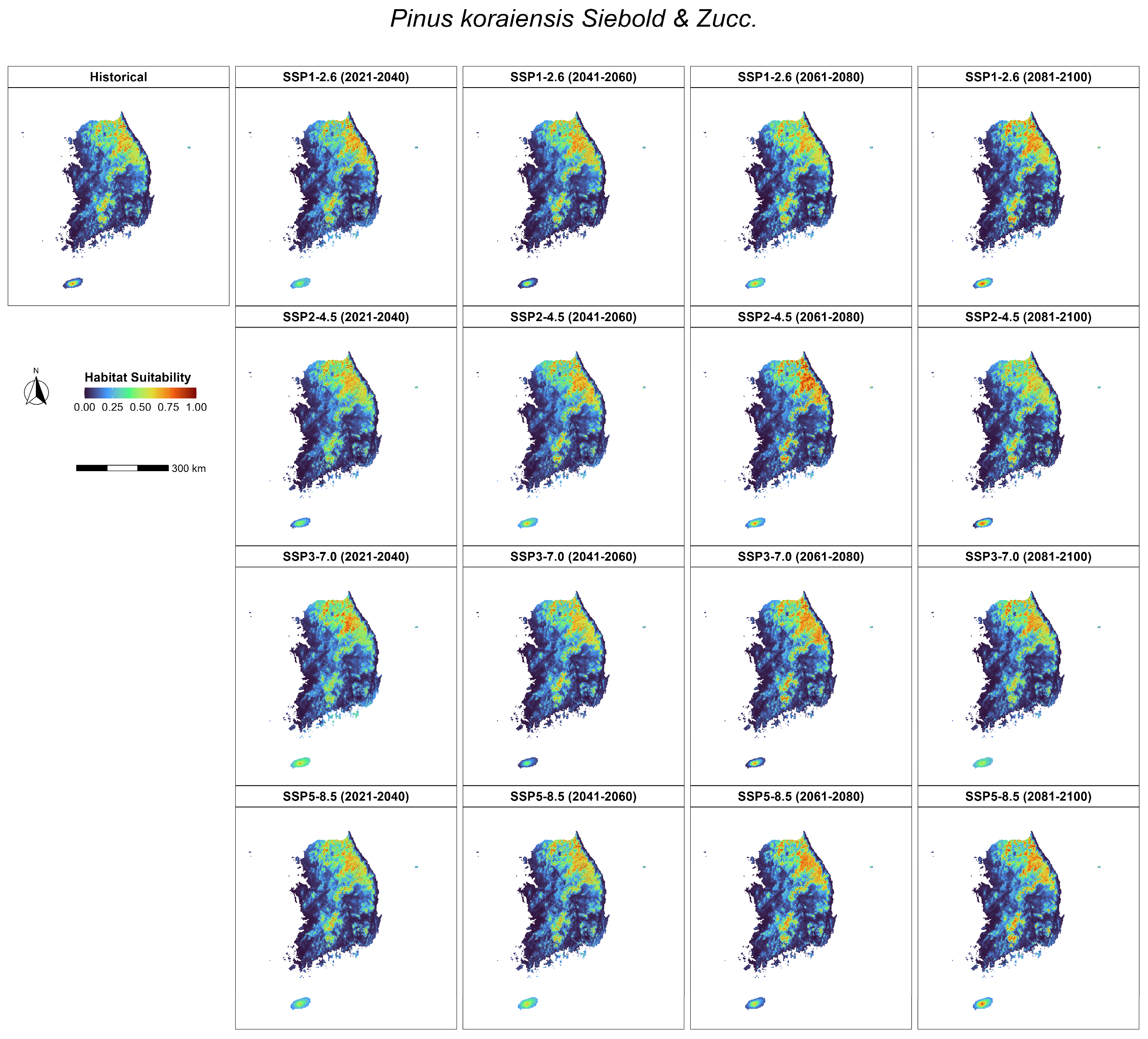
Figure A1. Ensemble SDM projections of habitat suitability for Pinus koraiensis Siebold & Zucc. across historical and future climate scenarios.
Land 15 00616 g0a1
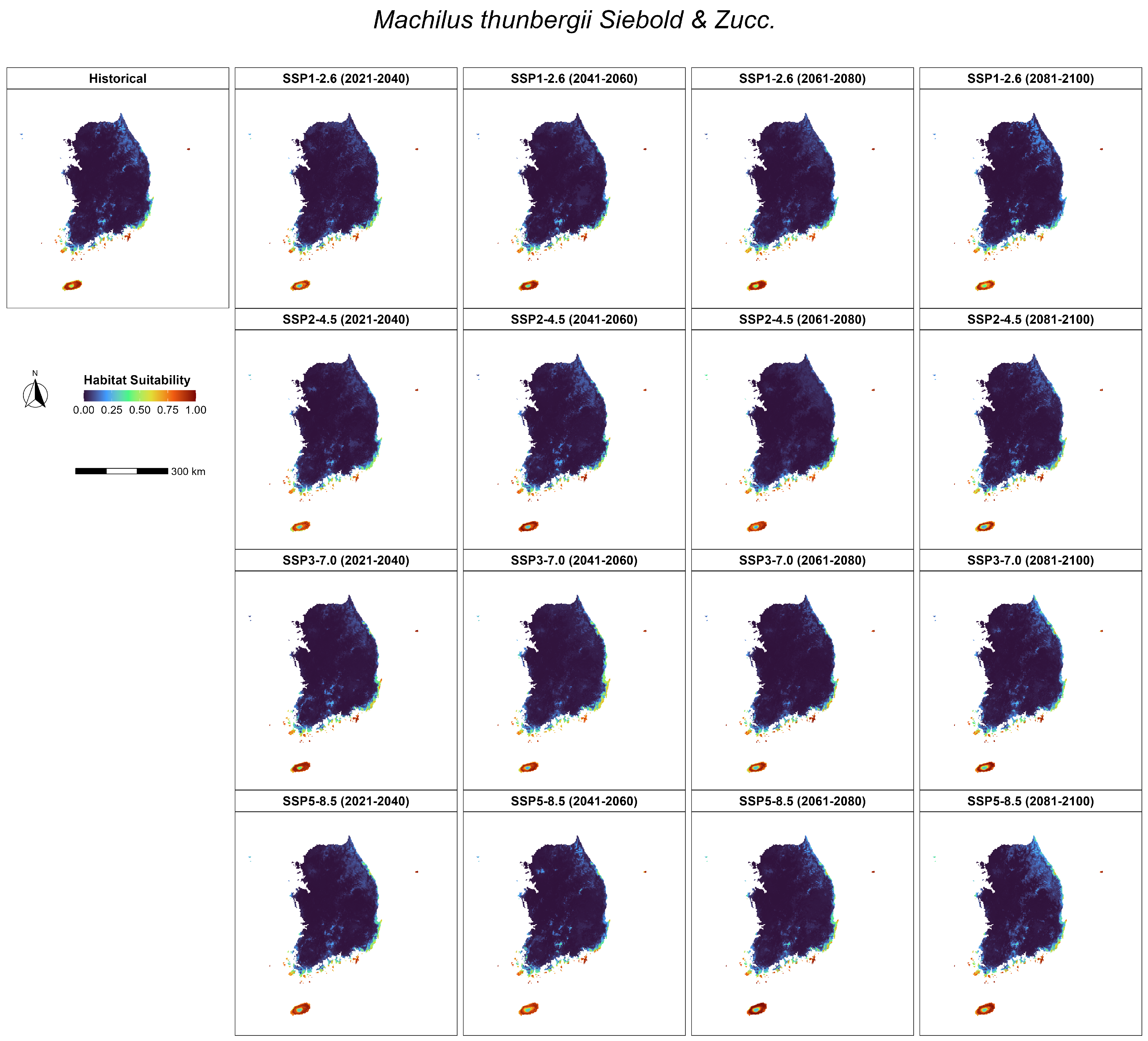
Figure A2. Ensemble SDM projections of habitat suitability for Machulus thunbergii Siebold & Zucc. across historical and future climate scenarios.
Land 15 00616 g0a2
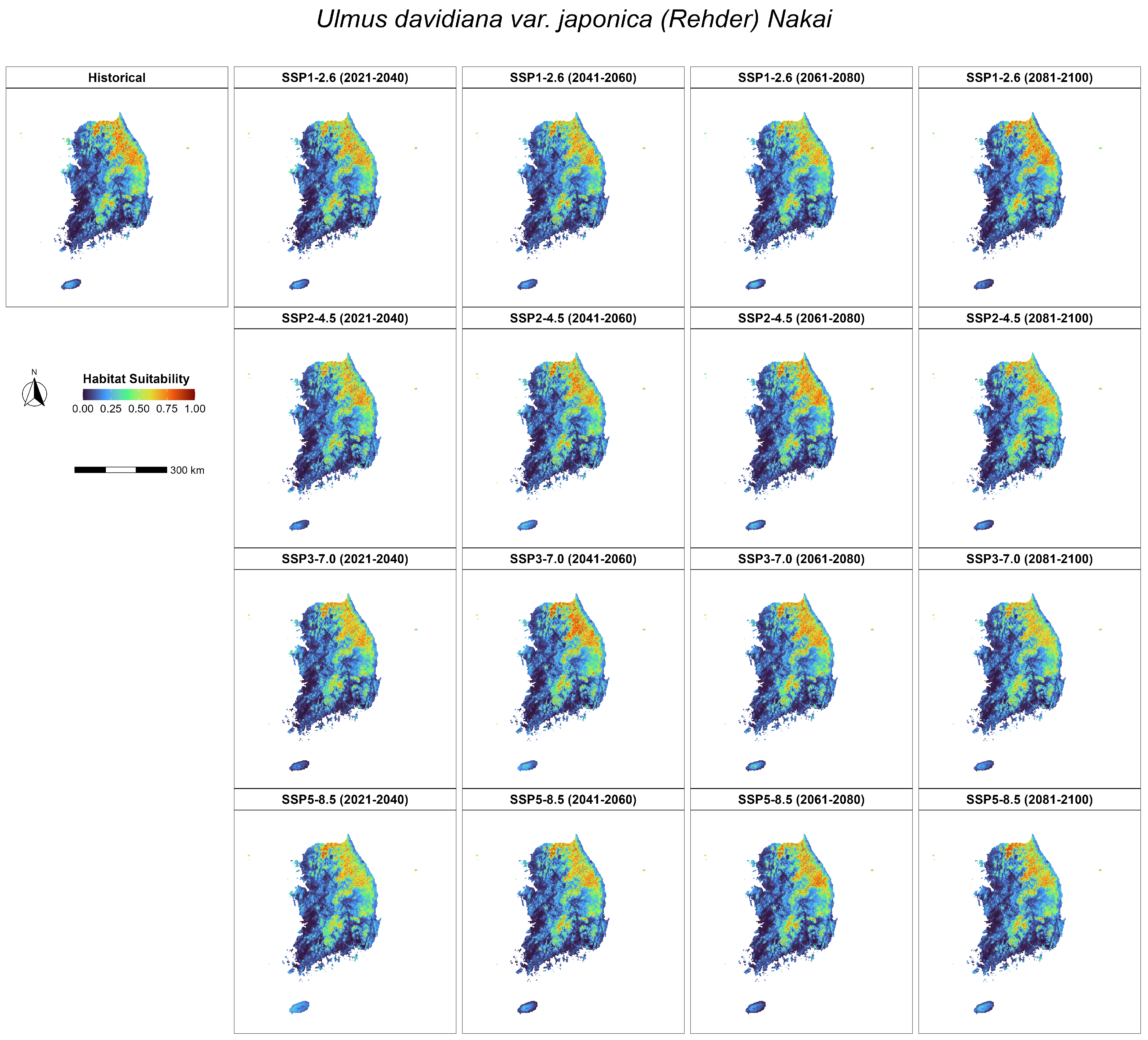
Figure A3. Ensemble SDM projections of habitat suitability for Ulmus davidiana var. japonica (Rehder) Nakai across historical and future climate scenarios.
Land 15 00616 g0a3
Figure A4. Ensemble SDM projections of habitat suitability for Acer palmatum Thnb. across historical and future climate scenarios.
Land 15 00616 g0a4
Figure A5. Ensemble SDM projections of habitat suitability for Acer triflorum Kom. across historical and future climate scenarios.
Land 15 00616 g0a5
Figure A6. Ensemble SDM projections of habitat suitability for Styrax japonicus Siebold & Zucc. across historical and future climate scenarios.
Land 15 00616 g0a6
Figure A7. Ensemble SDM projections of habitat suitability for Pinus densiflora Siebold & Zucc. across historical and future climate scenarios.
Land 15 00616 g0a7
Figure A8. Ensemble SDM projections of habitat suitability for Crataegus pinnatifida Bunge. across historical and future climate scenarios.
Land 15 00616 g0a8
Figure A9. Ensemble SDM projections of habitat suitability for Quercus acutissima Carruth. across historical and future climate scenarios.
Land 15 00616 g0a9
Figure A10. Ensemble SDM projections of habitat suitability for Cornus kousa F. Buerger ex Miq. across historical and future climate scenarios.
Land 15 00616 g0a10
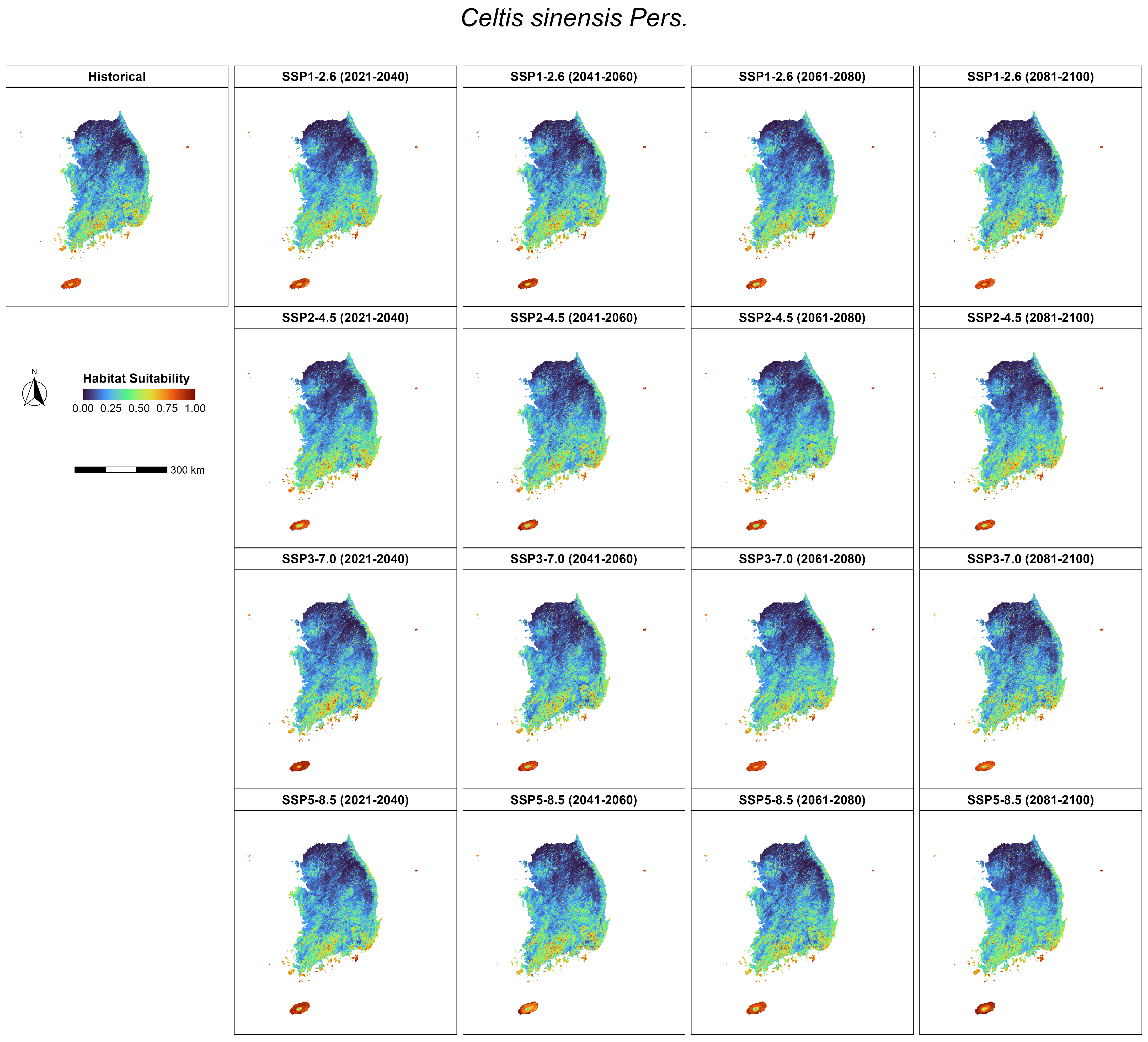
Figure A11. Ensemble SDM projections of habitat suitability for Celtis sinensis Pers. across historical and future climate scenarios.
Land 15 00616 g0a11
Figure A12. Ensemble SDM projections of habitat suitability for Prunus armeniaca var. ansu Maxim. across historical and future climate scenarios.
Land 15 00616 g0a12
Figure A13. Ensemble SDM projections of habitat suitability for Sorbus alnifolia (Siebold & Zucc.) K. Koch. across historical and future climate scenarios.
Land 15 00616 g0a13
Figure A14. Ensemble SDM projections of habitat suitability for Zelkova serrata (Thunb.) Makino. across historical and future climate scenarios.
Land 15 00616 g0a14
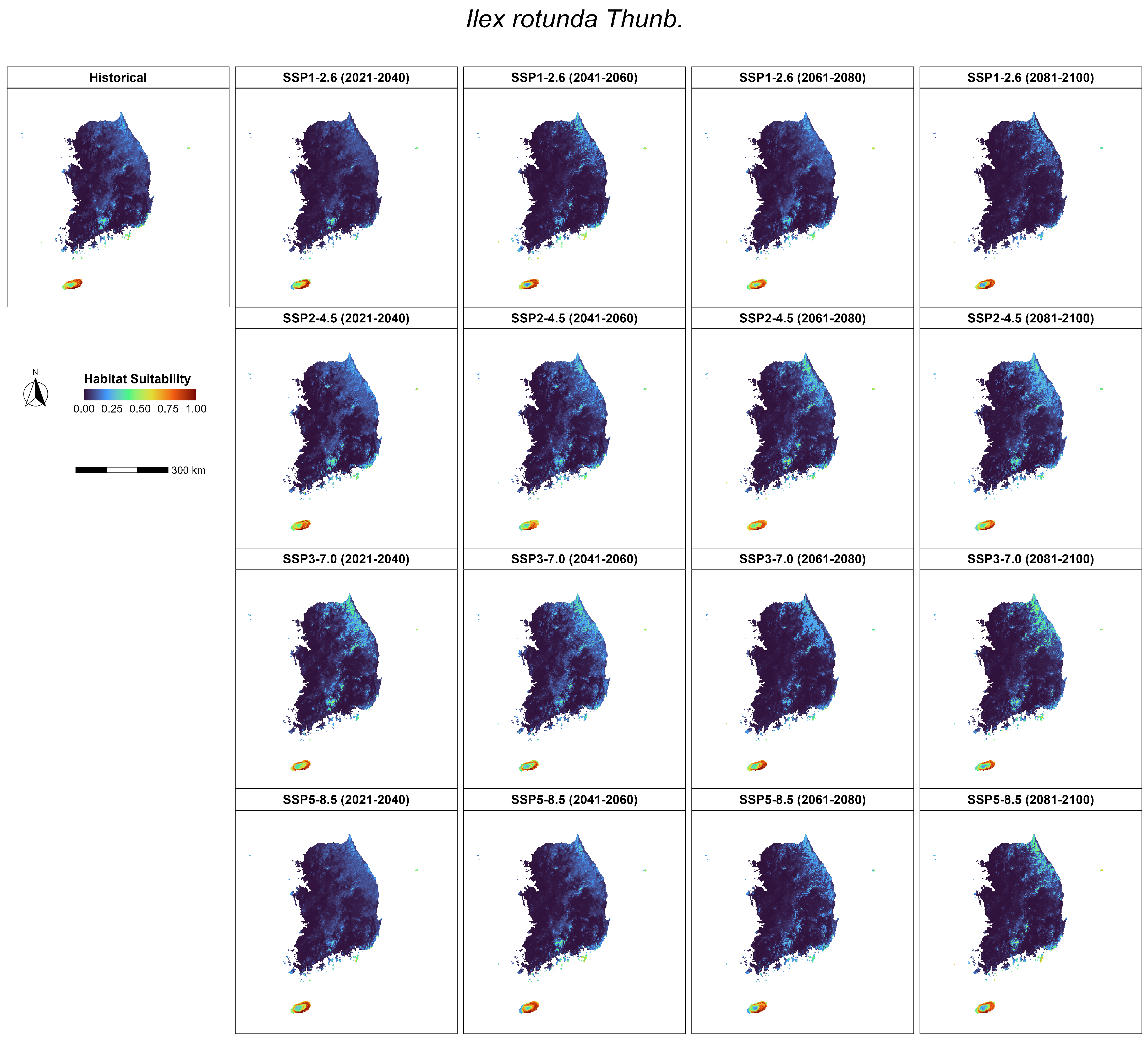
Figure A15. Ensemble SDM projections of habitat suitability for Ilex rotunda Thunb. across historical and future climate scenarios.
Land 15 00616 g0a15

Appendix A.2

Table A1. Species composition of latitudinal response types by SSP scenario and future period. For each scenario–period combination, the table reports the number of species (count) assigned to each response type and the corresponding species list.
ScenarioPeriodTypeCountSpecies_List
SSP1-2.62021–2040Northward Expansion2Camellia japonica L., Cornus officinalis Siebold & Zucc.
SSP1-2.62021–2040Poleward Shift2Acer palmatum Thunb., Betula pendula Roth.
SSP1-2.62021–2040Range Contraction2Acer triflorum Kom., Pinus koraiensis Siebold & Zucc.
SSP1-2.62021–2040Stable12Ulmus davidiana var. japonica (Rehder) Nakai, Machilus thunbergii Siebold & Zucc., Abies holophylla Maxim., Ilex rotunda Thunb., Zelkova serrata (Thunb.) Makino, Sorbus alnifolia (Siebold & Zucc.) K. Koch, Celtis sinensis Pers., Cornus kousa F. Buerger ex Miq., Quercus acutissima Carruth., Crataegus pinnatifida Bunge, Pinus densiflora Siebold & Zucc., Styrax japonicus Siebold & Zucc.
SSP1-2.62041–2060Northward Expansion4Acer palmatum Thunb., Ilex rotunda Thunb., Cornus kousa F. Buerger ex Miq., Cornus officinalis Siebold & Zucc.
SSP1-2.62041–2060Poleward Shift0 -
SSP1-2.62041–2060Range Contraction1Betula pendula Roth.
SSP1-2.62041–2060Stable13Prunus sargentii Rehder, Camellia japonica L., Ulmus davidiana var. japonica (Rehder) Nakai, Machilus thunbergii Siebold & Zucc., Pinus koraiensis Siebold & Zucc., Abies holophylla Maxim., Zelkova serrata (Thunb.) Makino, Sorbus alnifolia (Siebold & Zucc.) K. Koch, Celtis sinensis Pers., Quercus acutissima Carruth., Crataegus pinnatifida Bunge, Pinus densiflora Siebold & Zucc., Styrax japonicus Siebold & Zucc.
SSP1-2.62061–2080Northward Expansion4Acer palmatum Thunb., Camellia japonica L., Ilex rotunda Thunb., Cornus kousa F. Buerger ex Miq.
SSP1-2.62061–2080Poleward Shift0 -
SSP1-2.62061–2080Range Contraction3Betula pendula Roth., Abies holophylla Maxim., Quercus acutissima Carruth.
SSP1-2.62061–2080Stable11Acer triflorum Kom., Ulmus davidiana var. japonica (Rehder) Nakai, Machilus thunbergii Siebold & Zucc., Pinus koraiensis Siebold & Zucc., Zelkova serrata (Thunb.) Makino, Sorbus alnifolia (Siebold & Zucc.) K. Koch, Celtis sinensis Pers., Crataegus pinnatifida Bunge, Cornus officinalis Siebold & Zucc., Pinus densiflora Siebold & Zucc., Styrax japonicus Siebold & Zucc.
SSP1-2.681100Northward Expansion2Acer palmatum Thunb., Camellia japonica L.
SSP1-2.681100Poleward Shift0 -
SSP1-2.681100Range Contraction3Betula pendula Roth., Cornus kousa F. Buerger ex Miq., Quercus acutissima Carruth.
SSP1-2.681100Stable13Acer triflorum Kom., Ulmus davidiana var. japonica (Rehder) Nakai, Machilus thunbergii Siebold & Zucc., Pinus koraiensis Siebold & Zucc., Abies holophylla Maxim., Ilex rotunda Thunb., Zelkova serrata (Thunb.) Makino, Sorbus alnifolia (Siebold & Zucc.) K. Koch, Celtis sinensis Pers., Crataegus pinnatifida Bunge, Cornus officinalis Siebold & Zucc., Pinus densiflora Siebold & Zucc., Styrax japonicus Siebold & Zucc.
SSP2-4.52021–2040Northward Expansion4Acer palmatum Thunb., Camellia japonica L., Ilex rotunda Thunb., Cornus officinalis Siebold & Zucc.
SSP2-4.52021–2040Poleward Shift0 -
SSP2-4.52021–2040Range Contraction2Betula pendula Roth., Pinus koraiensis Siebold & Zucc.
SSP2-4.52021–2040Stable12Acer triflorum Kom., Ulmus davidiana var. japonica (Rehder) Nakai, Machilus thunbergii Siebold & Zucc., Abies holophylla Maxim., Zelkova serrata (Thunb.) Makino, Prunus armeniaca var. ansu Maxim., Celtis sinensis Pers., Cornus kousa F. Buerger ex Miq., Quercus acutissima Carruth., Crataegus pinnatifida Bunge, Pinus densiflora Siebold & Zucc., Styrax japonicus Siebold & Zucc.
SSP2-4.52041–2060Northward Expansion3Acer palmatum Thunb., Camellia japonica L., Cornus officinalis Siebold & Zucc.
SSP2-4.52041–2060Poleward Shift1Betula pendula Roth.
SSP2-4.52041–2060Range Contraction2Acer triflorum Kom., Quercus acutissima Carruth.
SSP2-4.52041–2060Stable12Ulmus davidiana var. japonica (Rehder) Nakai, Machilus thunbergii Siebold & Zucc., Pinus koraiensis Siebold & Zucc., Abies holophylla Maxim., Ilex rotunda Thunb., Zelkova serrata (Thunb.) Makino, Sorbus alnifolia (Siebold & Zucc.) K. Koch, Celtis sinensis Pers., Cornus kousa F. Buerger ex Miq., Crataegus pinnatifida Bunge, Pinus densiflora Siebold & Zucc., Styrax japonicus Siebold & Zucc.
SSP2-4.52061–2080Northward Expansion3Acer palmatum Thunb., Camellia japonica L., Ilex rotunda Thunb.
SSP2-4.52061–2080Poleward Shift0 -
SSP2-4.52061–2080Range Contraction3Acer triflorum Kom., Betula pendula Roth., Quercus acutissima Carruth.
SSP2-4.52061–2080Stable12Ulmus davidiana var. japonica (Rehder) Nakai, Machilus thunbergii Siebold & Zucc., Pinus koraiensis Siebold & Zucc. Abies holophylla Maxim., Zelkova serrata (Thunb.) Makino, Sorbus alnifolia (Siebold & Zucc.) K. Koch, Celtis sinensis Pers., Cornus kousa F. Buerger ex Miq., Crataegus pinnatifida Bunge, Cornus officinalis Siebold & Zucc., Pinus densiflora Siebold & Zucc., Styrax japonicus Siebold & Zucc.
SSP2-4.581100Northward Expansion2Camellia japonica L., Styrax japonicus Siebold & Zucc.
SSP2-4.581100Poleward Shift1Acer palmatum Thunb.
SSP2-4.581100Range Contraction3Acer triflorum Kom., Betula pendula Roth., Cornus officinalis Siebold & Zucc.
SSP2-4.581100Stable12Ulmus davidiana var. japonica (Rehder) Nakai, Machilus thunbergii Siebold & Zucc., Pinus koraiensis Siebold & Zucc., Abies holophylla Maxim., Ilex rotunda Thunb., Zelkova serrata (Thunb.) Makino, Sorbus alnifolia (Siebold & Zucc.) K. Koch, Celtis sinensis Pers., Cornus kousa F. Buerger ex Miq., Quercus acutissima Carruth., Crataegus pinnatifida Bunge, Pinus densiflora Siebold & Zucc.
SSP3-7.02021–2040Northward Expansion3Acer palmatum Thunb., Camellia japonica L., Machilus thunbergii Siebold & Zucc.
SSP3-7.02021–2040Poleward Shift0 -
SSP3-7.02021–2040Range Contraction2Quercus acutissima Carruth., Cornus officinalis Siebold & Zucc.
SSP3-7.02021–2040Stable13Acer triflorum Kom., Ulmus davidiana var. japonica (Rehder) Nakai, Betula pendula Roth., Pinus koraiensis Siebold & Zucc., Abies holophylla Maxim., Ilex rotunda Thunb., Zelkova serrata (Thunb.) Makino, Sorbus alnifolia (Siebold & Zucc.) K. Koch, Celtis sinensis Pers., Cornus kousa F. Buerger ex Miq., Crataegus pinnatifida Bunge, Pinus densiflora Siebold & Zucc., Styrax japonicus Siebold & Zucc.
SSP3-7.02041–2060Northward Expansion7Acer palmatum Thunb., Camellia japonica L., Machilus thunbergii Siebold & Zucc., Betula pendula Roth., Ilex rotunda Thunb., Cornus officinalis Siebold & Zucc., Styrax japonicus Siebold & Zucc.
SSP3-7.02041–2060Poleward Shift0 -
SSP3-7.02041–2060Range Contraction4Acer triflorum Kom., Pinus koraiensis Siebold & Zucc., Quercus acutissima Carruth., Crataegus pinnatifida Bunge
SSP3-7.02041–2060Stable7Ulmus davidiana var. japonica (Rehder) Nakai, Abies holophylla Maxim., Zelkova serrata (Thunb.) Makino, Sorbus alnifolia (Siebold & Zucc.) K. Koch, Celtis sinensis Pers., Cornus kousa F. Buerger ex Miq., Pinus densiflora Siebold & Zucc.
SSP3-7.02061–2080Northward Expansion6Acer palmatum Thunb., Camellia japonica L., Ulmus davidiana var. japonica (Rehder) Nakai, Machilus thunbergii Siebold & Zucc., Cornus officinalis Siebold & Zucc., Styrax japonicus Siebold & Zucc.
SSP3-7.02061–2080Poleward Shift0 -
SSP3-7.02061–2080Range Contraction0 -
SSP3-7.02061–2080Stable12Acer triflorum Kom., Betula pendula Roth., Pinus koraiensis Siebold & Zucc., Abies holophylla Maxim., Ilex rotunda Thunb., Zelkova serrata (Thunb.) Makino, Sorbus alnifolia (Siebold & Zucc.) K. Koch, Celtis sinensis Pers., Cornus kousa F. Buerger ex Miq., Quercus acutissima Carruth., Crataegus pinnatifida Bunge, Pinus densiflora Siebold & Zucc.
SSP3-7.081100Northward Expansion6Acer palmatum Thunb., Camellia japonica L., Machilus thunbergii Siebold & Zucc., Ilex rotunda Thunb., Cornus kousa F. Buerger ex Miq., Styrax japonicus Siebold & Zucc.
SSP3-7.081100Poleward Shift0 -
SSP3-7.081100Range Contraction2Abies holophylla Maxim., Cornus officinalis Siebold & Zucc.
SSP3-7.081100Stable10Acer triflorum Kom., Ulmus davidiana var. japonica (Rehder) Nakai, Betula pendula Roth., Pinus koraiensis Siebold & Zucc, Zelkova serrata (Thunb.) Makino, Sorbus alnifolia (Siebold & Zucc.) K. Koch, Celtis sinensis Pers., Quercus acutissima Carruth., Crataegus pinnatifida Bunge, Pinus densiflora Siebold & Zucc.
SSP5-8.52021–2040Northward Expansion4Acer palmatum Thunb., Camellia japonica L., Cornus officinalis Siebold & Zucc., Styrax japonicus Siebold & Zucc.
SSP5-8.52021–2040Poleward Shift0 -
SSP5-8.52021–2040Range Contraction0 -
SSP5-8.52021–2040Stable14Acer triflorum Kom., Ulmus davidiana var. japonica (Rehder) Nakai, Machilus thunbergii Siebold & Zucc., Betula pendula Roth., Pinus koraiensis Siebold & Zucc., Abies holophylla Maxim., Ilex rotunda Thunb., Zelkova serrata (Thunb.) Makino, Sorbus alnifolia (Siebold & Zucc.) K. Koch, Celtis sinensis Pers., Cornus kousa F. Buerger ex Miq., Quercus acutissima Carruth., Crataegus pinnatifida Bunge, Pinus densiflora Siebold & Zucc.
SSP5-8.52041–2060Northward Expansion4Acer palmatum Thunb., Camellia japonica L., Machilus thunbergii Siebold & Zucc., Ilex rotunda Thunb.
SSP5-8.52021–2040Poleward Shift0 -
SSP5-8.52041–2060Range Contraction3Acer triflorum Kom., Quercus acutissima Carruth., Cornus officinalis Siebold & Zucc.
SSP5-8.52041–2060Stable11Ulmus davidiana var. japonica (Rehder) Nakai, Betula pendula Roth., Pinus koraiensis Siebold & Zucc., Abies holophylla Maxim., Zelkova serrata (Thunb.) Makino, Sorbus alnifolia (Siebold & Zucc.) K. Koch, Celtis sinensis Pers., Cornus kousa F. Buerger ex Miq., Crataegus pinnatifida Bunge, Pinus densiflora Siebold & Zucc., Styrax japonicus Siebold & Zucc.
SSP5-8.52061–2080Northward Expansion4Acer palmatum Thunb., Camellia japonica L., Machilus thunbergii Siebold & Zucc., Ilex rotunda Thunb.
SSP5-8.52061–2080Poleward Shift0 -
SSP5-8.52061–2080Range Contraction3Acer triflorum Kom., Betula pendula Roth., Abies holophylla Maxim.
SSP5-8.52061–2080Stable11Ulmus davidiana var. japonica (Rehder) Nakai, Pinus koraiensis Siebold & Zucc., Zelkova serrata (Thunb.) Makino, Sorbus alnifolia (Siebold & Zucc.) K. Koch, Celtis sinensis Pers., Cornus kousa F. Buerger ex Miq., Quercus acutissima Carruth., Crataegus pinnatifida Bunge, Cornus officinalis Siebold & Zucc., Pinus densiflora Siebold & Zucc., Styrax japonicus Siebold & Zucc.
SSP5-8.581100Northward Expansion5Acer palmatum Thunb., Camellia japonica L., Machilus thunbergii Siebold & Zucc., mun, Cornus kousa F. Buerger ex Miq.
SSP5-8.581100Poleward Shift0 -
SSP5-8.581100Range Contraction2Acer triflorum Kom., Cornus officinalis Siebold & Zucc.
SSP5-8.581100Stable11Ulmus davidiana var. japonica (Rehder) Nakai, Betula pendula Roth., Pinus koraiensis Siebold & Zucc., Abies holophylla Maxim., Siebold & Zucc., Zelkova serrata (Thunb.) Makino, Sorbus alnifolia (Siebold & Zucc.) K. Koch, Celtis sinensis Pers., Quercus acutissima Carruth., Crataegus pinnatifida Bunge, Pinus densiflora Siebold & Zucc., Styrax japonicus Siebold & Zucc.

References

  1. Wolch, J.R.; Byrne, J.; Newell, J.P. Urban green space, public health, and environmental justice: The challenge of making cities “just green enough”. Landsc. Urban Plan. 2014, 125, 234–244. [Google Scholar] [CrossRef]
  2. Gómez-Baggethun, E.; Gren, Å.; Barton, D.N.; Langemeyer, J.; McPhearson, T.; O’Farrell, P.; Andersson, E.; Hamstead, Z.; Kremer, P. Urban ecosystem services. In Urbanization, Biodiversity and Ecosystem Services: Challenges and Opportunities; Elmqvist, T., Fragkias, M., Goodness, J., Güneralp, B., Marcotullio, P.J., McDonald, R.I., Parnell, S., Schewenius, M., Sendstad, M., Seto, K.C., et al., Eds.; Springer: Dordrecht, The Netherlands, 2013; pp. 175–251. [Google Scholar] [CrossRef]
  3. Klimanova, O.; Kolbowsky, E.; Illarionova, O. Impacts of urbanization on green infrastructure ecosystem services: The case study of post-Soviet Moscow. Belgeo 2018, 4, 1–15. [Google Scholar] [CrossRef]
  4. Pataki, D.E.; Alberti, M.; Cadenasso, M.L.; Felson, A.J.; McDonnell, M.J.; Pincetl, S.; Pouyat, R.V.; Setälä, H.; Whitlow, T.H. The benefits and limits of urban tree planting for environmental and human health. Front. Ecol. Evol. 2021, 9, 603757. [Google Scholar] [CrossRef]
  5. Pamukcu-Albers, P.; Ugolini, F.; La Rosa, D.; Grădinaru, S.R.; Azevedo, J.C.; Wu, J. Building green infrastructure to enhance urban resilience to climate change and pandemics. Landsc. Ecol. 2021, 36, 665–673. [Google Scholar] [CrossRef]
  6. Conway, T.M.; Vander Vecht, J. Growing a diverse urban forest: Species selection decisions by practitioners planting and supplying trees. Landsc. Urban Plan. 2015, 138, 1–10. [Google Scholar] [CrossRef]
  7. Churkina, G.; Grote, R.; Butler, T.M.; Lawrence, M. Natural selection? Picking the right trees for urban greening. Environ. Sci. Policy 2015, 47, 12–17. [Google Scholar] [CrossRef]
  8. Korea Meteorological Administration (KMA). National Climate Change Standard Scenario (SSP-Based): Future Climate Change Projection Reports (전망보고서). Climate Information Portal. Available online: https://www.climate.go.kr/home/CCS/contents_2021/36_fcstReport.php (accessed on 6 April 2026).
  9. Park, B.-J.; Kim, Y.-H.; Min, S.-K.; Kim, M.-K.; Choi, Y.; Boo, K.-O.; Shim, S. Long-term warming trends in Korea and contribution of urbanization: An updated assessment. JGR Atmos. 2017, 122, 10637–10654. [Google Scholar] [CrossRef]
  10. Intergovernmental Panel on Climate Change (IPCC). The Physical Science Basis; Working Group I contribution to the sixth assessment report of the Intergovernmental Panel on Climate Change. Climate Change; Cambridge University Press: Cambridge, UK, 2021. [Google Scholar]
  11. Pretzsch, H.; Biber, P.; Uhl, E.; Dahlhausen, J.; Schütze, G.; Perkins, D.; Rötzer, T.; Caldentey, J.; Koike, T.; van Con, T.; et al. Climate change accelerates growth of urban trees in metropolises worldwide. Sci. Rep. 2017, 7, 15403. [Google Scholar] [CrossRef]
  12. Lanza, K.; Stone, B. Climate adaptation in cities: What trees are suitable for urban heat management? Landsc. Urban Plan. 2016, 153, 74–82. [Google Scholar] [CrossRef]
  13. Wang, A.; Zhang, M.; Chen, E.; Zhang, C.; Han, Y. Impact of seasonal global land surface temperature (LST) change on gross primary production (GPP) in the early 21st century. Sustain. Cities Soc. 2024, 110, 105572. [Google Scholar] [CrossRef]
  14. Lee, D.; Oh, J.-H.; Kam, J.; Park, S.-W.; Kug, J.-S. Biophysical impacts of urbanization on climate change and vegetation in Borneo Island. J. Environ. Manag. 2026, 398, 128446. [Google Scholar] [CrossRef]
  15. Mohammed, A.M.S. Coupling coordination between environmental risk and urban economic vitality in hot arid climates: An open-source remote sensing-based assessment model. Hum. Settl. Sustain. 2026, 2, 67–81. [Google Scholar] [CrossRef]
  16. He, F.; Yang, J.; Zhang, Y.; Yu, W.; Xiao, X.; Xia, J. Does partition matter? A new approach to modeling land use change. Comput. Environ. Urban Syst. 2023, 106, 102041. [Google Scholar] [CrossRef]
  17. Guisan, A.; Thuiller, W. Predicting species distribution: Offering more than simple habitat models. Ecol. Lett. 2005, 8, 993–1009. [Google Scholar] [CrossRef] [PubMed]
  18. Elith, J.; Leathwick, J.R. Species distribution models: Ecological explanation and prediction across space and time. Annu. Rev. Ecol. Evol. Syst. 2009, 40, 677–697. [Google Scholar] [CrossRef]
  19. Franklin, J. Mapping Species Distributions: Spatial Inference and Prediction; Cambridge University Press: Cambridge, UK, 2010. [Google Scholar] [CrossRef]
  20. Araújo, M.B.; Peterson, A.T. Uses and misuses of bioclimatic envelope modeling. Ecology 2012, 93, 1527–1539. [Google Scholar] [CrossRef]
  21. Burley, H.; Beaumont, L.J.; Ossola, A.; Baumgartner, J.B.; Gallagher, R.V.; Laffan, S.W.; Esperon-Rodriguez, M.; Manea, A.; Leishman, M.R. Substantial declines in urban tree habitat predicted under climate change. Sci. Total Environ. 2019, 685, 451–462. [Google Scholar] [CrossRef]
  22. Thuiller, W.; Georges, D.; Gueguen, M.; Engler, R.; Breiner, F.; Lafourcade, B.; Patin, R.; Blancheteau, H. biomod2: Ensemble Platform for Species Distribution Modeling, Version 4.2-6-2; Comprehensive R Archive Network (CRAN). 2025. Available online: https://CRAN.R-project.org/package=biomod2 (accessed on 6 April 2026).
  23. Araújo, M.B.; New, M. Ensemble forecasting of species distributions. Trends Ecol. Evol. 2007, 22, 42–47. [Google Scholar] [CrossRef]
  24. Thuiller, W.; Guéguen, M.; Renaud, J.; Karger, D.N.; Zimmermann, N.E. Uncertainty in ensembles of global biodiversity scenarios. Nat. Commun. 2019, 10, 1446. [Google Scholar] [CrossRef]
  25. Chen, I.-C.; Hill, J.K.; Ohlemüller, R.; Roy, D.B.; Thomas, C.D. Rapid range shifts of species associated with high levels of climate warming. Science 2011, 333, 1024–1026. [Google Scholar] [CrossRef]
  26. Parmesan, C. Ecological and evolutionary responses to recent climate change. Annu. Rev. Ecol. Evol. Syst. 2006, 37, 637–669. [Google Scholar] [CrossRef]
  27. Lenoir, J.; Svenning, J.-C. Climate-related range shifts—A global multidimensional synthesis and new research directions. Ecography 2015, 38, 15–28. [Google Scholar] [CrossRef]
  28. Zhou, J.; Xiong, J.; Ni, J.; Xie, X.; Liu, Y. Nitrogen transfer and transformation in bioretention cells under low temperature conditions. Sci. Total Environ. 2023, 871, 162087. [Google Scholar] [CrossRef]
  29. Araújo, M.B.; Thuiller, W.; Pearson, R.G. Climate warming and the decline of amphibians and reptiles in Europe. J. Biogeogr. 2006, 33, 1712–1728. [Google Scholar] [CrossRef]
  30. Araújo, M.B.; Alagador, D.; Cabeza, M.; Nogués-Bravo, D.; Thuiller, W. Climate change threatens European conservation areas. Ecol. Lett. 2011, 14, 484–492. [Google Scholar] [CrossRef] [PubMed]
  31. Reynolds, H.L.; Mincey, S.K.; Montoya, R.D.; Hamlin, S.; Sullivan, A.; Thapa, B.; Wilson, J.; Rosing, H.; Jarzen, J.; Grove, J.M. Green infrastructure for urban resilience: A trait-based framework. Front. Ecol. Environ. 2022, 20, 231–239. [Google Scholar] [CrossRef]
  32. Sokolova, M.V.; Fath, B.D.; Grande, U.; Buonocore, E.; Franzese, P.P. The role of green infrastructure in providing urban ecosystem services: Insights from a bibliometric perspective. Land 2024, 13, 1664. [Google Scholar] [CrossRef]
  33. Liang, D.; Huang, G. Influence of urban tree traits on their ecosystem services: A literature review. Land 2023, 12, 1699. [Google Scholar] [CrossRef]
  34. Pandey, B.; Ghosh, A. Urban ecosystem services and climate change: A dynamic interplay. Front. Sustain. Cities 2023, 5, 1281430. [Google Scholar] [CrossRef]
  35. Thuiller, W.; Lafourcade, B.; Engler, R.; Araújo, M.B. BIOMOD—A platform for ensemble forecasting of species distributions. Ecography 2009, 32, 369–373. [Google Scholar] [CrossRef]
  36. Marmion, M.; Parviainen, M.; Luoto, M.; Heikkinen, R.K.; Thuiller, W. Evaluation of consensus methods in predictive species distribution modelling. Divers. Distrib. 2009, 15, 59–69. [Google Scholar] [CrossRef]
  37. Beck, H.E.; Zimmermann, N.E.; McVicar, T.R.; Vergopolan, N.; Berg, A.; Wood, E.F. Present and future Köppen-Geiger climate classification maps at 1-km resolution. Sci. Data 2018, 5, 180214. [Google Scholar] [CrossRef] [PubMed]
  38. Fielding, A.H.; Bell, J.F. A review of methods for the assessment of prediction errors in conservation presence/absence models. Environ. Conserv. 1997, 24, 38–49. [Google Scholar] [CrossRef]
  39. O’Neill, B.C.; Tebaldi, C.; van Vuuren, D.P.; Eyring, V.; Friedlingstein, P.; Hurtt, G.; Knutti, R.; Kriegler, E.; Lamarque, J.-F.; Lowe, J.; et al. The scenario model intercomparison project (ScenarioMIP) for CMIP6. Geosci. Model Dev. 2016, 9, 3461–3482. [Google Scholar] [CrossRef]
  40. Meinshausen, M.; Nicholls, Z.R.J.; Lewis, J.; Gidden, M.J.; Vogel, E.; Freund, M.; Beyerle, U.; Gessner, C.; Nauels, A.; Bauer, N.; et al. The SSP greenhouse gas concentrations and their extensions to 2500. Geosci. Model Dev. 2020, 13, 3571–3605. [Google Scholar] [CrossRef]
  41. Riahi, K.; van Vuuren, D.P.; Kriegler, E.; Edmonds, J.; O’Neill, B.C.; Fujimori, S.; Bauer, N.; Calvin, K.; Dellink, R.; Fricko, O.; et al. The Shared Socioeconomic Pathways and their energy, land use, and greenhouse gas emissions implications: An overview. Glob. Environ. Change 2017, 42, 153–168. [Google Scholar] [CrossRef]
  42. Poggio, L.; de Sousa, L.M.; Batjes, N.H.; Heuvelink, G.B.M.; Kempen, B.; Ribeiro, E.; Rossiter, D. SoilGrids 2.0: Producing soil information for the globe with quantified spatial uncertainty. Soil 2021, 7, 217–240. [Google Scholar] [CrossRef]
  43. Dormann, C.F.; Elith, J.; Bacher, S.; Buchmann, C.; Carl, G.; Carré, G.; Marquéz, J.R.G.; Gruber, B.; Lafourcade, B.; Leitão, P.J.; et al. Collinearity: A review of methods to deal with it and a simulation study evaluating their performance. Ecography 2013, 36, 27–46. [Google Scholar] [CrossRef]
  44. Zuur, A.F.; Ieno, E.N.; Elphick, C.S. A protocol for data exploration to avoid common statistical problems. Methods Ecol. Evol. 2010, 1, 3–14. [Google Scholar] [CrossRef]
  45. Parmesan, C.; Yohe, G. A globally coherent fingerprint of climate change impacts across natural systems. Nature 2003, 421, 37–42. [Google Scholar] [CrossRef]
  46. Kim, M.-K.; Han, M.-S.; Jang, D.-H.; Baek, S.-G.; Lee, W.-S.; Kim, Y.-H.; Kim, S. Production technique of observation grid data of 1 km resolution. J. Clim. Res. 2012, 7, 55–68. [Google Scholar]
  47. Jeong, S.; Kim, M.-K. A Performance Analysis of MK-PRISM according to Resolution. J. Clim. Res. 2019, 14, 259–266. [Google Scholar] [CrossRef]
  48. Daly, C.; Neilson, R.P.; Phillips, D.L. A statistical-topographic model for mapping climatological precipitation over mountainous terrain. J. Appl. Meteorol. 1994, 33, 140–158. [Google Scholar] [CrossRef]
  49. Daly, C.; Halbleib, M.; Smith, J.I.; Gibson, W.P.; Doggett, M.K.; Taylor, G.H.; Curtis, J.; Pasteris, P.P. Physiographically sensitive mapping of climatological temperature and precipitation across the conterminous United States. Int. J. Climatol. 2008, 28, 2031–2064. [Google Scholar] [CrossRef]
  50. Hijmans, R.J.; Cameron, S.E.; Parra, J.L.; Jones, P.G.; Jarvis, A. Very high resolution interpolated climate surfaces for global land areas. Int. J. Climatol. 2005, 25, 1965–1978. [Google Scholar] [CrossRef]
  51. Fick, S.E.; Hijmans, R.J. WorldClim 2: New 1-km spatial resolution climate surfaces for global land areas. Int. J. Climatol. 2017, 37, 4302–4315. [Google Scholar] [CrossRef]
  52. Nix, H.A. A biogeographic analysis of Australian elapid snakes. In Atlas of Elapid Snakes of Australia; Longmore, R., Ed.; Australian Government Publishing Service: Canberra, Australia, 1986. [Google Scholar]
  53. Kira, T. A New Classification of Climate in Eastern Asia as the Basis for Agricultural Geography; Horticultural Institute, Kyoto University: Kyoto, Japan, 1945. [Google Scholar]
  54. Yim, Y.-J.; Kira, T. Distribution of forest vegetation and climate in the Korean Peninsula I. Distribution of some indices of thermal climate. Jpn. J. Ecol. 1975, 25, 77–88. [Google Scholar]
  55. Federici, F.; Pignatti, S. The warmth index of Kira for the interpretation of vegetation belts in Italy and SW. Australia: Two regions with Mediterranean type bioclimates. Vegetatio 1991, 93, 91–99. [Google Scholar] [CrossRef]
  56. Wilson, J.P.; Gallant, J.C. (Eds.) Terrain Analysis: Principles and Applications; John Wiley & Sons: New York, NY, USA, 2000. [Google Scholar]
  57. De Reu, J.; Bourgeois, J.; Bats, M.; Zwertvaegher, A.; Gelorini, V.; De Smedt, P.; Chu, W.; Antrop, M.; De Maeyer, P.; Finke, P.; et al. Application of the topographic position index to heterogeneous landscapes. Geomorphology 2013, 186, 39–49. [Google Scholar] [CrossRef]
  58. Beven, K.J.; Kirkby, M.J. A physically based, variable contributing area model of basin hydrology/Un modèle à base physique de zone d’appel variable de l’hydrologie du bassin versant. Hydrol. Sci. Bull. 1979, 24, 43–69. [Google Scholar] [CrossRef]
  59. Moore, I.D.; Grayson, R.B.; Ladson, A.R. Digital terrain modelling: A review of hydrological, geomorphological, and biological applications. Hydrol. Process. 1991, 5, 3–30. [Google Scholar] [CrossRef]
  60. Sørensen, R.; Zinko, U.; Seibert, J. On the calculation of the topographic wetness index: Evaluation of different methods based on field observations. Hydrol. Earth Syst. Sci. 2006, 10, 101–112. [Google Scholar] [CrossRef]
  61. Hengl, T.; de Jesus, J.M.; Heuvelink, G.B.M.; Gonzalez, M.R.; Kilibarda, M.; Blagotić, A.; Shangguan, W.; Wright, M.N.; Geng, X.; Bauer-Marschallinger, B.; et al. SoilGrids250m: Global gridded soil information based on machine learning. PLoS ONE 2017, 12, e0169748. [Google Scholar] [CrossRef] [PubMed]
  62. Booth, T.H.; Nix, H.A.; Busby, J.R.; Hutchinson, M.F. Bioclim: The first species distribution modelling package, its early applications and relevance to most current MaxEnt studies. Divers. Distrib. 2014, 20, 1–9. [Google Scholar] [CrossRef]
  63. Barbet-Massin, M.; Jiguet, F.; Albert, C.H.; Thuiller, W. Selecting pseudo-absences for species distribution models: How, where and how many? Methods Ecol. Evol. 2012, 3, 327–338. [Google Scholar] [CrossRef]
  64. Kohavi, R. A study of cross-validation and bootstrap for accuracy estimation and model selection. In Proceedings of the 14th International Joint Conference on Artificial Intelligence, Montreal, QC, Canada, 20–25 August 1995; Volume 2, pp. 1137–1143. [Google Scholar]
  65. Fawcett, T. An introduction to ROC analysis. Pattern Recognit. Lett. 2006, 27, 861–874. [Google Scholar] [CrossRef]
  66. Allouche, O.; Tsoar, A.; Kadmon, R. Assessing the accuracy of species distribution models: Prevalence, kappa and the true skill statistic (TSS). J. Appl. Ecol. 2006, 43, 1223–1232. [Google Scholar] [CrossRef]
  67. Liu, C.; Berry, P.M.; Dawson, T.P.; Pearson, R.G. Selecting thresholds of occurrence in the prediction of species distributions. Ecography 2005, 28, 385–393. [Google Scholar] [CrossRef]
Figure 1. Analytical framework for translating ensemble SDM projections into management-oriented climate response types for urban trees.
Land 15 00616 g001
Figure 2. Geographical location and Köppen–Geiger climate classification of the study area (South Korea). The map illustrates the current climatic zones across the Korean Peninsula, characterized by a transition from humid subtropical (Cfa) in the southern coastal regions to humid continental (Dwa, Dwb) climates in the central and northern regions. Climate zones are derived from a high-resolution (1 km) global Köppen–Geiger climate classification dataset [37].
Land 15 00616 g002
Figure 3. Pearson correlation matrix of candidate predictors (BIO1–BIO19, WI, Ph, TWI, TPI) used for collinearity screening (∣r∣ ≥ 0.75). Circle color and size represent the sign and magnitude of correlations.
Land 15 00616 g003
Figure 4. Boxplots showing percentage change in suitable habitat area relative to HIST (2000–2019) across four future periods (2021–2040, 2041–2060, 2061–2080, 2081–2100) under four SSP climate scenarios. Boxes represent interquartile ranges (IQR), horizontal lines within boxes indicate medians, whiskers denote 1.5× IQR, and points represent outliers. The dashed horizontal line indicates no change (0%).
Land 15 00616 g004
Figure 5. Ensemble SDM projections of habitat suitability for Betula pendula across multiple climate scenarios in South Korea. Maps illustrate the shifting suitable habitats from the historical baseline (left panel) through four future periods (2021–2100, columns) under four SSP scenarios (rows). The suitability index ranges from 0.00 to 1.00, with warmer (red/orange) and cooler (blue) colors indicating high and low suitability, respectively.
Land 15 00616 g005
Figure 6. Ensemble SDM projections of habitat suitability for Cornus officinalis across multiple climate scenarios in South Korea. Maps illustrate the shifting suitable habitats from the historical baseline (left panel) through four future periods (2021–2100, columns) under four SSP scenarios (rows). The suitability index ranges from 0.00 to 1.00, with warmer (red/orange) and cooler (blue) colors indicating low suitability, respectively.
Land 15 00616 g006
Figure 8. Proportion (%) of dominant species response types across SSP scenarios. Rows represent SSP scenarios, and columns represent four projection periods (2021–2040, 2041–2060, 2061–2080, and 2081–2100). Values in each cell indicate the percentage of dominant species assigned to each response type.
Land 15 00616 g008
Figure 9. Distribution of centroid shift distance (km) by latitudinal response type across SSP scenarios and future periods. Violin plots summarize species-level centroid shift distances for Northward Expansion, Poleward Shift, Range Contraction, and Stable within each scenario (rows) and period (columns).
Land 15 00616 g009
Table 1. Description of the Shared Socioeconomic Pathway (SSP) scenarios used for future climate projections in this study, including scenario narratives, mitigation effort, and projected atmospheric CO2 concentration by 2100.
ScenarioCO2 Concentration (2100)Climate Mitigation EffortInterpretation
SSP1-2.6432 ppmVery strongSustainable development; environmentally oriented economic structure
SSP2-4.5567 ppmModeratecontinuation of current policies; gradual responses
SSP3-7.0834 ppmLowLimited international cooperation; high population growth
SSP5-8.51089 ppmMinimalFossil fuel-driven growth; accelerated climate crisis
Table 2. Common core predictor variables used across species in the ensemble species distribution models (SDMs), with brief descriptions, units, and ecological relevance.
VariableDescriptionUnitEcological Relevance
BIO1Annual mean temperature°COverall thermal conditions
BIO5Max temp warmest month°CHeat stress tolerance
BIO6Min temp coldest month°CCold hardiness
BIO12Annual precipitationmmWater availability
WIWarmth index-Growing season productivity
TPITopographic position index-Landform position
TWITopographic wetness index-Soil moisture potential
pHSoil pH-Nutrient availability
Table 3. Additional predictors selected for each species after collinearity screening Note: Core predictors (BIO1, BIO5, BIO6, BIO12, pH, TWI, and TPI) were included for all species.
SpeciesAdditional Variables
Acer triflorum Kom.bio4
Acer palmatum Thunb.bio15
Camellia japonica L.bio7
Ulmus davidiana var. japonicabio4, bio14
Machilus thunbergiibio14, bio19
Betula platyphyllabio4, bio7
Pinus koraiensis Siebold & Zucc.bio4, bio7
Abies holophylla Maxim.-
Ilex rotunda Thunb.-
Zelkova serrata Makinobio4, bio7
Sorbus alnifolia (Siebold & Zucc.) K. Kochbio7
Celtis sinensis Pers.bio7, bio15
Cornus kousa F. Buerger ex Miq.-
Quercus acutissima Carruth.bio14
Crataegus pinnatifida Bungebio4, bio7
Cornus officinalis Siebold & Zucc.bio4, bio7, bio17
Pinus densiflora Siebold & Zuccbio7
Styrax japonicus Siebold & Zucc.bio14, bio15
Table 4. Predictive performance of the ensemble SDMs for the 18 urban tree species evaluated by cross-validation, reported as AUC and TSS.
SpeciesAUC (Mean ± SD)TSS (Mean ± SD)
Acer triflorum Kom.0.9155 ± 0.02800.7227 ± 0.0587
Acer palmatum Thunb.0.8566 ± 0.03040.5620 ± 0.0651
Camellia japonica L.0.9639 ± 0.01530.8427 ± 0.0468
Ulmus davidiana var. japonica0.9432 ± 0.04100.7573 ± 0.0327
Machilus thunbergii0.9683 ± 0.01820.9034 ± 0.0447
Betula platyphylla0.8083 ± 0.03710.4598 ± 0.0810
Pinus koraiensis Siebold & Zucc.0.9247 ± 0.02450.7380 ± 0.0525
Abies holophylla Maxim.0.8075 ± 0.05330.4714 ± 0.1045
Ilex rotunda Thunb.0.9495 ± 0.02860.8353 ± 0.0781
Zelkova serrata Makino0.8500 ± 0.02180.5766 ± 0.0448
Sorbus alnifolia (Siebold & Zucc.) K. Koch0.8962 ± 0.02380.6520 ± 0.0528
Celtis sinensis Pers.0.9387 ± 0.01390.7412 ± 0.0387
Cornus kousa F. Buerger ex Miq.0.8742 ± 0.02330.5862 ± 0.0526
Quercus acutissima Carruth.0.7924 ± 0.03000.4383 ± 0.0610
Crataegus pinnatifida Bunge0.9282 ± 0.01730.7383 ± 0.0424
Cornus officinalis0.7520 ± 0.04390.3617 ± 0.0811
Pinus densiflora0.9710 ± 0.00700.8776 ± 0.0183.
Styrax japonicus Siebold & Zucc.0.9673 ± 0.00700.8280 ± 0.0255
Table 5. Dominant latitudinal response type for each species across the four future periods.
Response TypologyScientific Name
Northward ExpansionAcer palmatum Thunb.
Camellia japonica L.
Cornus officinalis Siebold & Zucc.
Ilex rotunda Thunb.
Machilus thunbergii Siebold & Zucc.
Poleward ShiftBetula pendula Roth.
Range ContractionPinus koraiensis Siebold & Zucc.
Abies holophylla Maxim.
Quercus acutissima Carruth.
Acer triflorum Kom.
StablePinus densiflora Siebold & Zucc.
Styrax japonicus Siebold & Zucc.
Zelkova serrata (Thunb.) Makino
Sorbus alnifolia (Siebold & Zucc.) K. Koch
Celtis sinensis Pers.
Cornus kousa F. Buerger ex Miq.
Crataegus pinnatifida Bunge
Ulmus davidiana var. japonica (Rehder) Nakai
Disclaimer/Publisher’s Note: The statements, opinions and data contained in all publications are solely those of the individual author(s) and contributor(s) and not of MDPI and/or the editor(s). MDPI and/or the editor(s) disclaim responsibility for any injury to people or property resulting from any ideas, methods, instructions or products referred to in the content.