Time-Series Satellite-Based Monitoring of Land-Use Change and Forest Loss in Bhutan: Implications for Forest Carbon Measurement, Reporting, and Verification



Abstract
1. Introduction
2. Materials and Methods
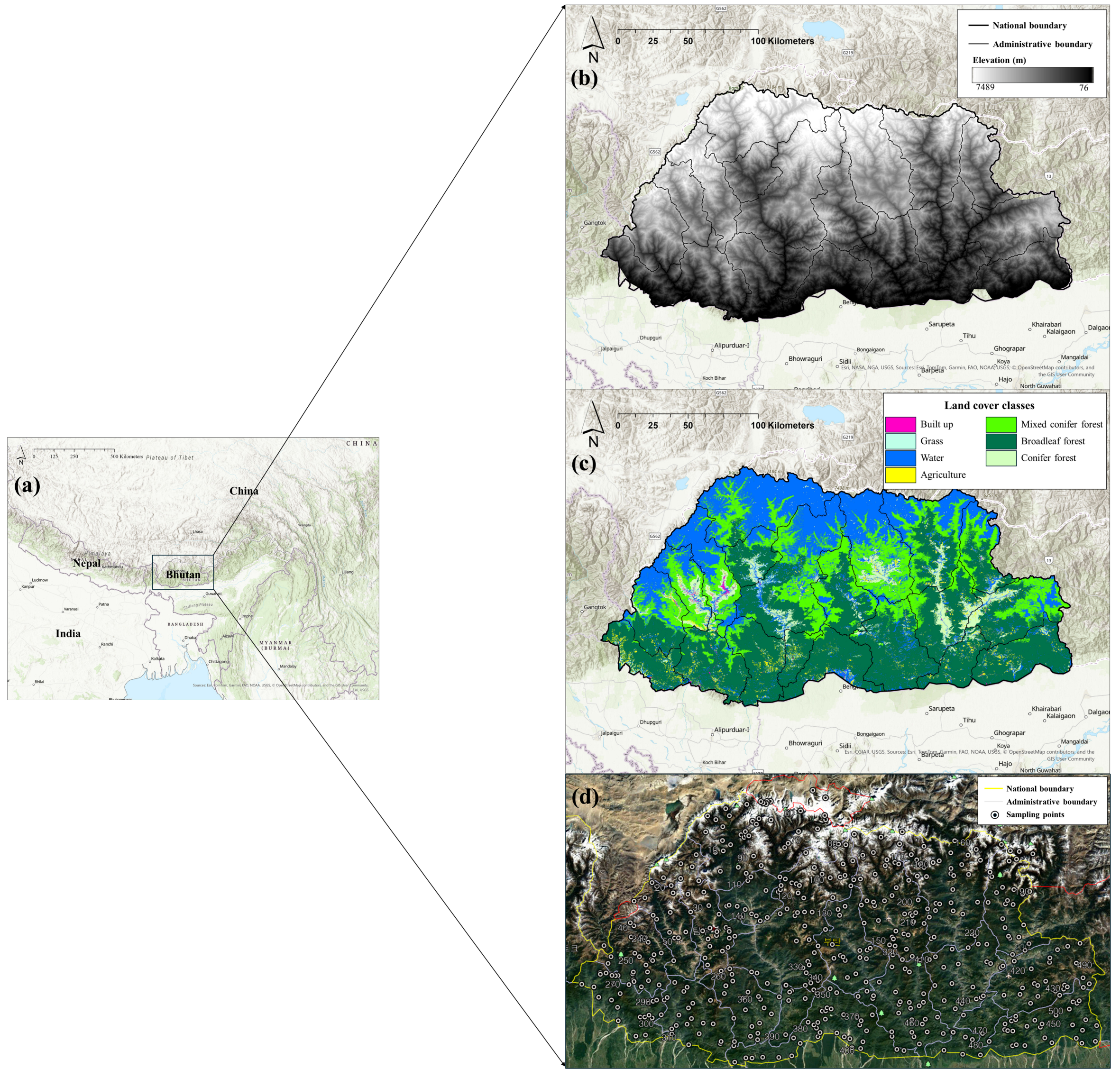
2.1. Study Area
2.2. Data Acquisition and Preparation
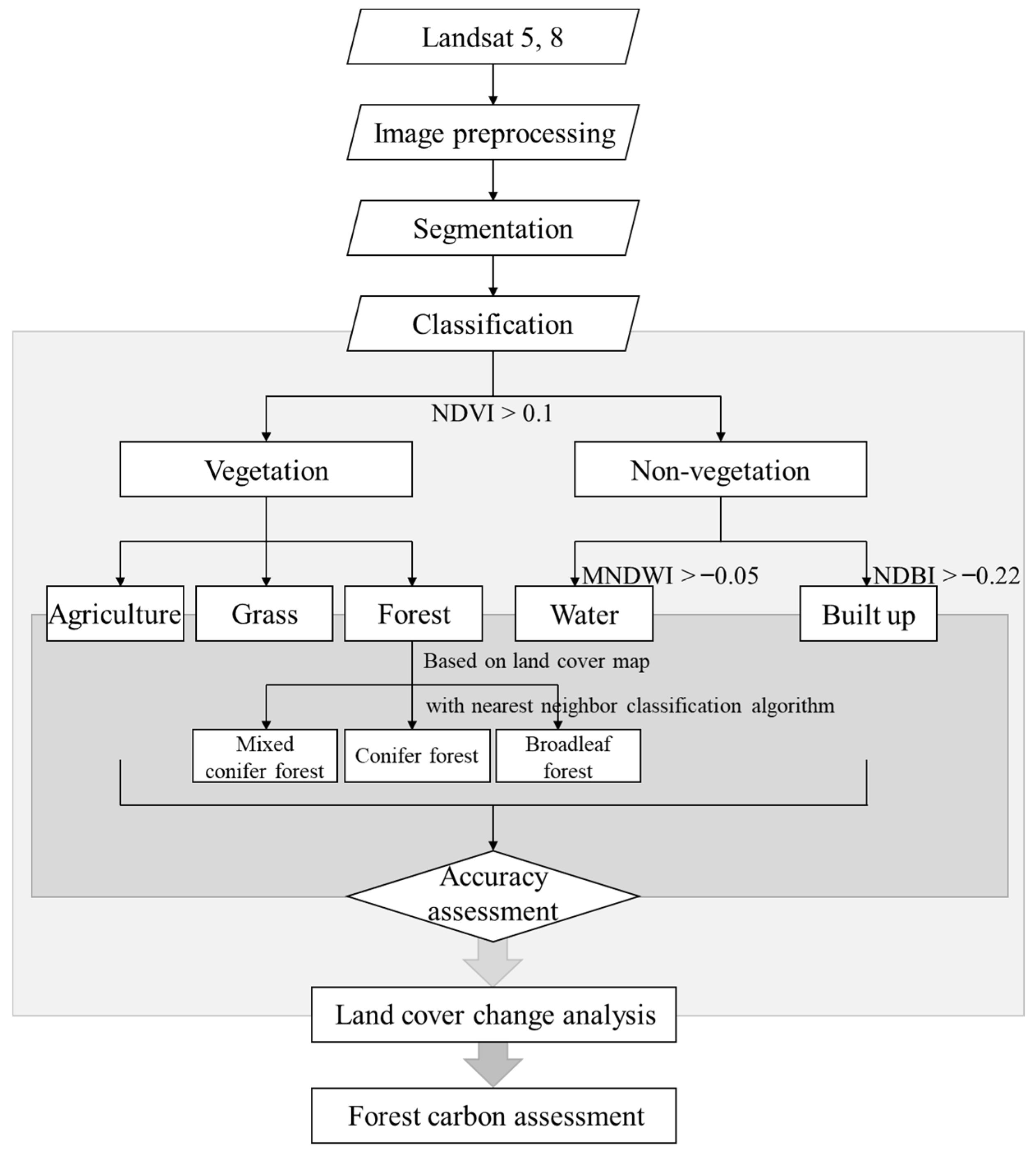
2.3. Pre-Processing and Classification
2.4. Assessment of Classification Accuracy
2.5. Land Cover and Forest Carbon Sink Change Analysis
- = Change in forest carbon stock (tonnes of C);
- = Change in forest area between two time periods (ha);
- = Forest type-specific carbon stock density (tonnes C ha−1).
3. Results
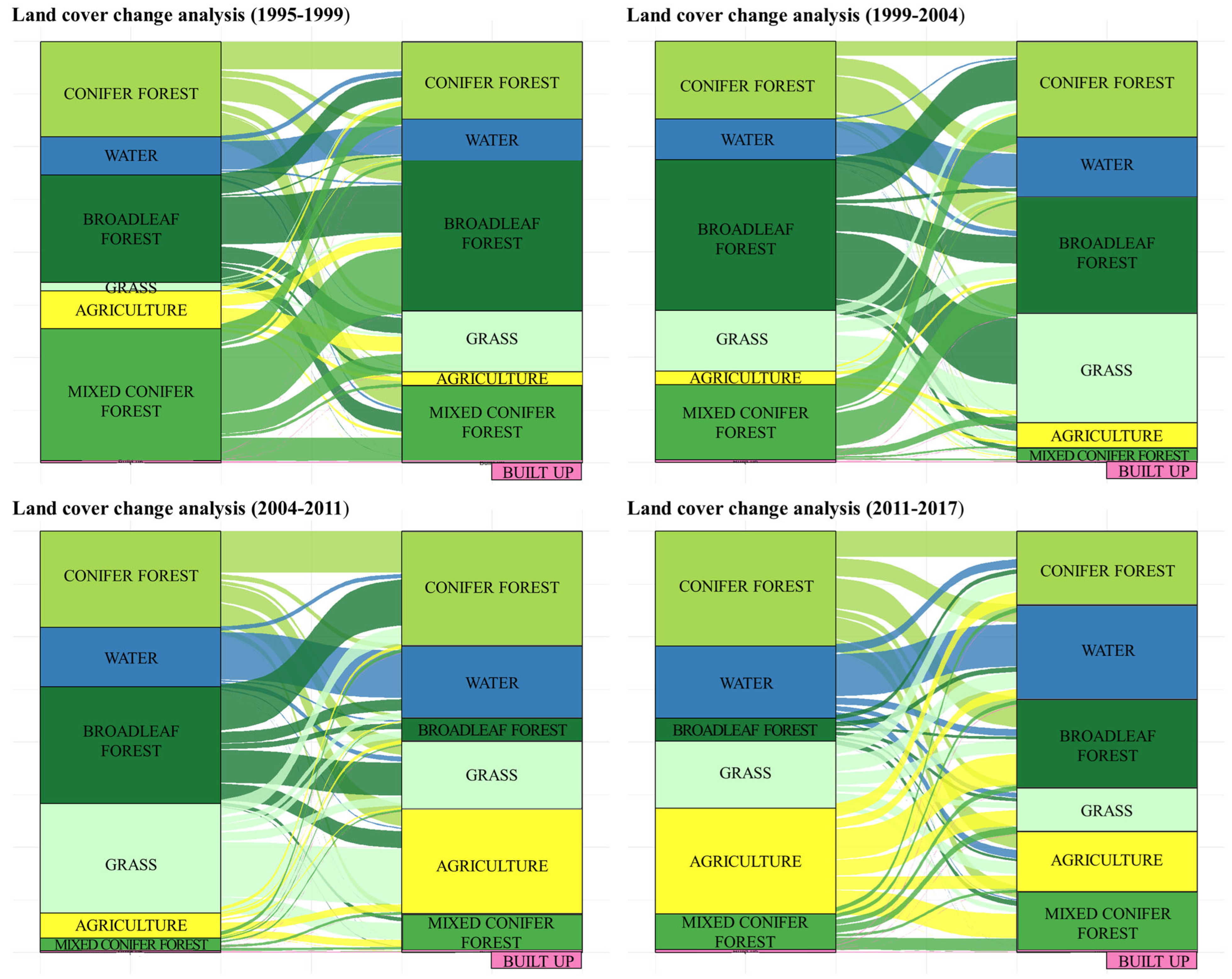
3.1. Land Cover Change
3.2. Validation Results and Accuracy Metrics
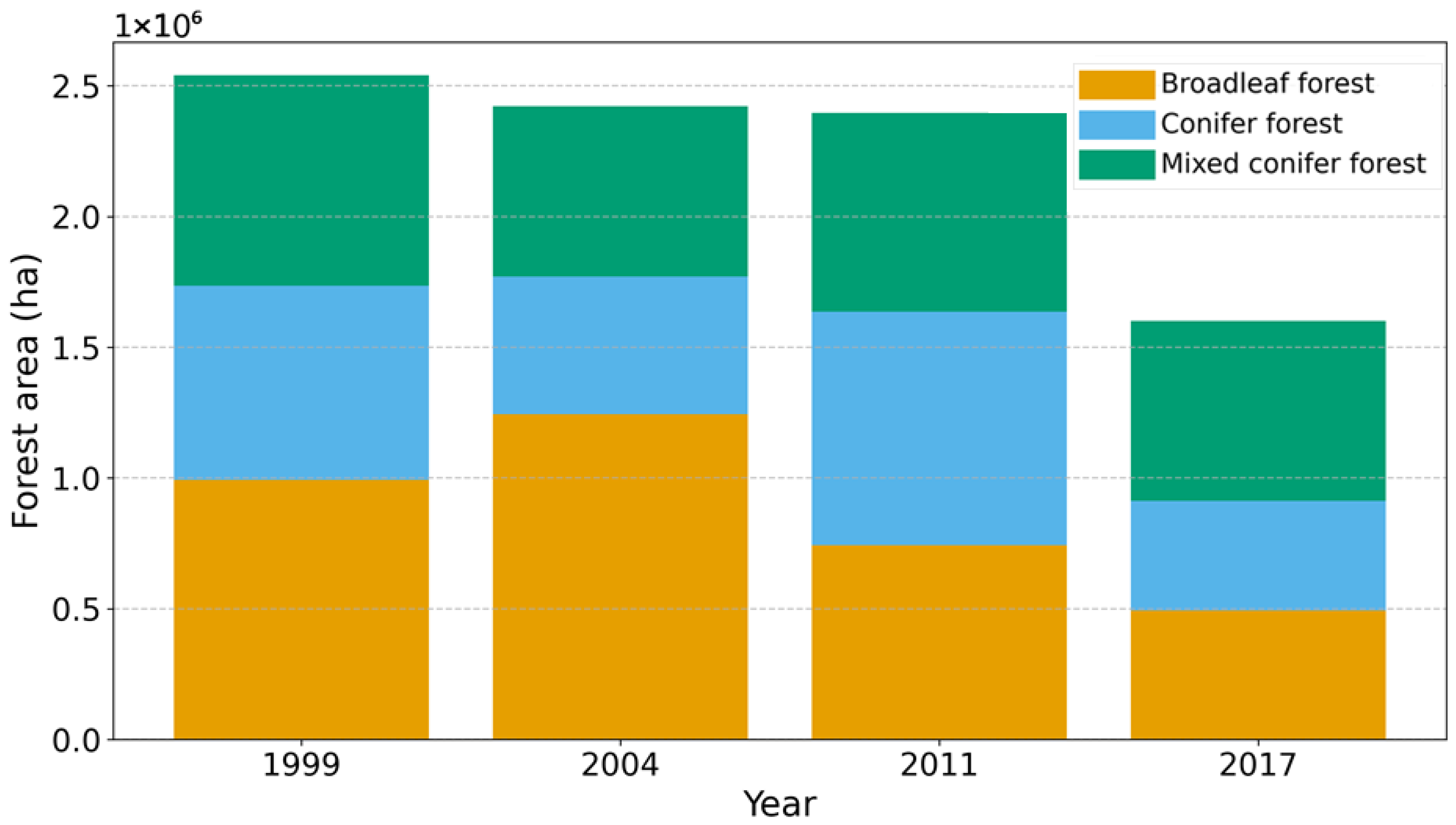
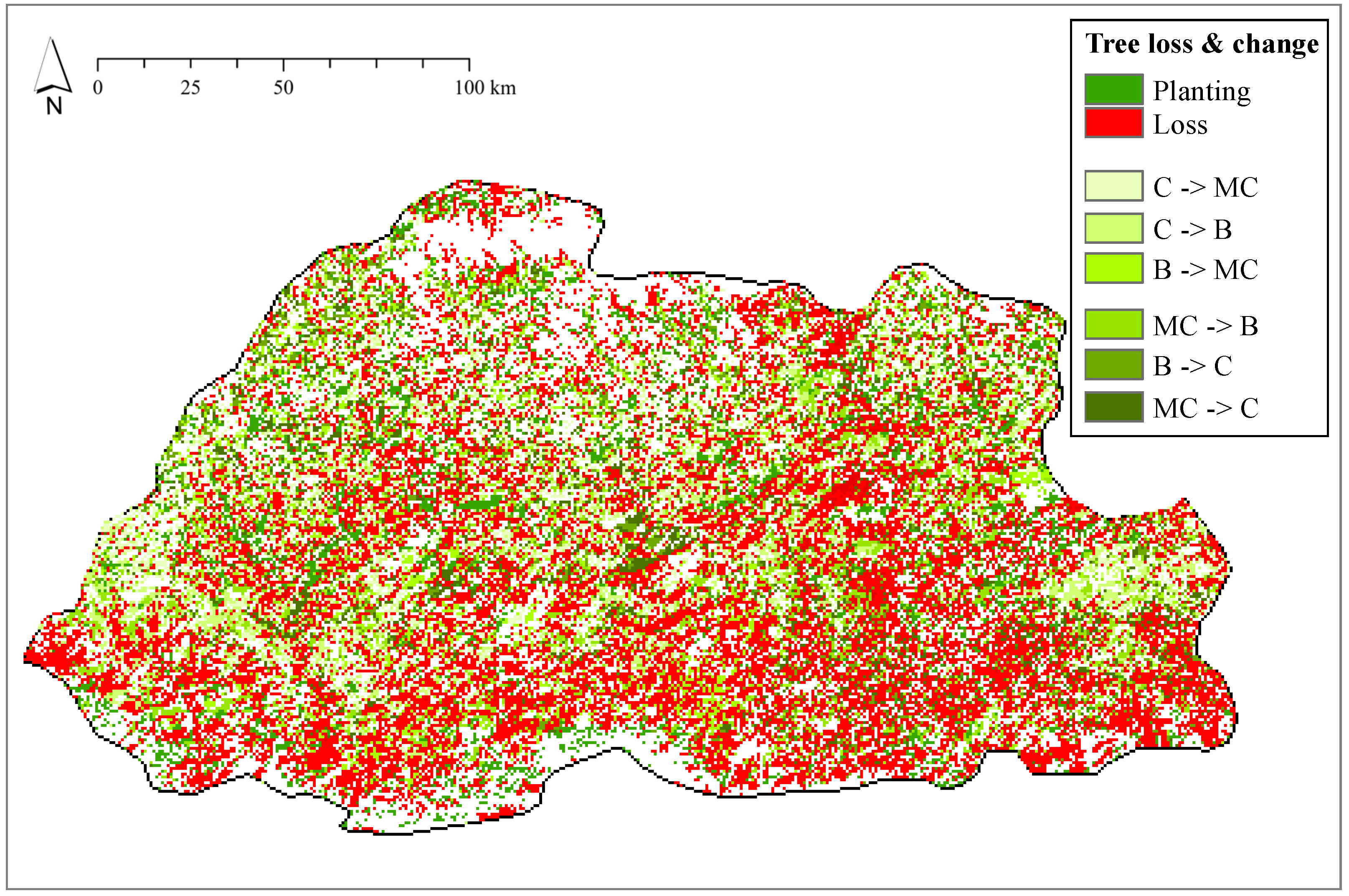
3.3. Forest Cover Change
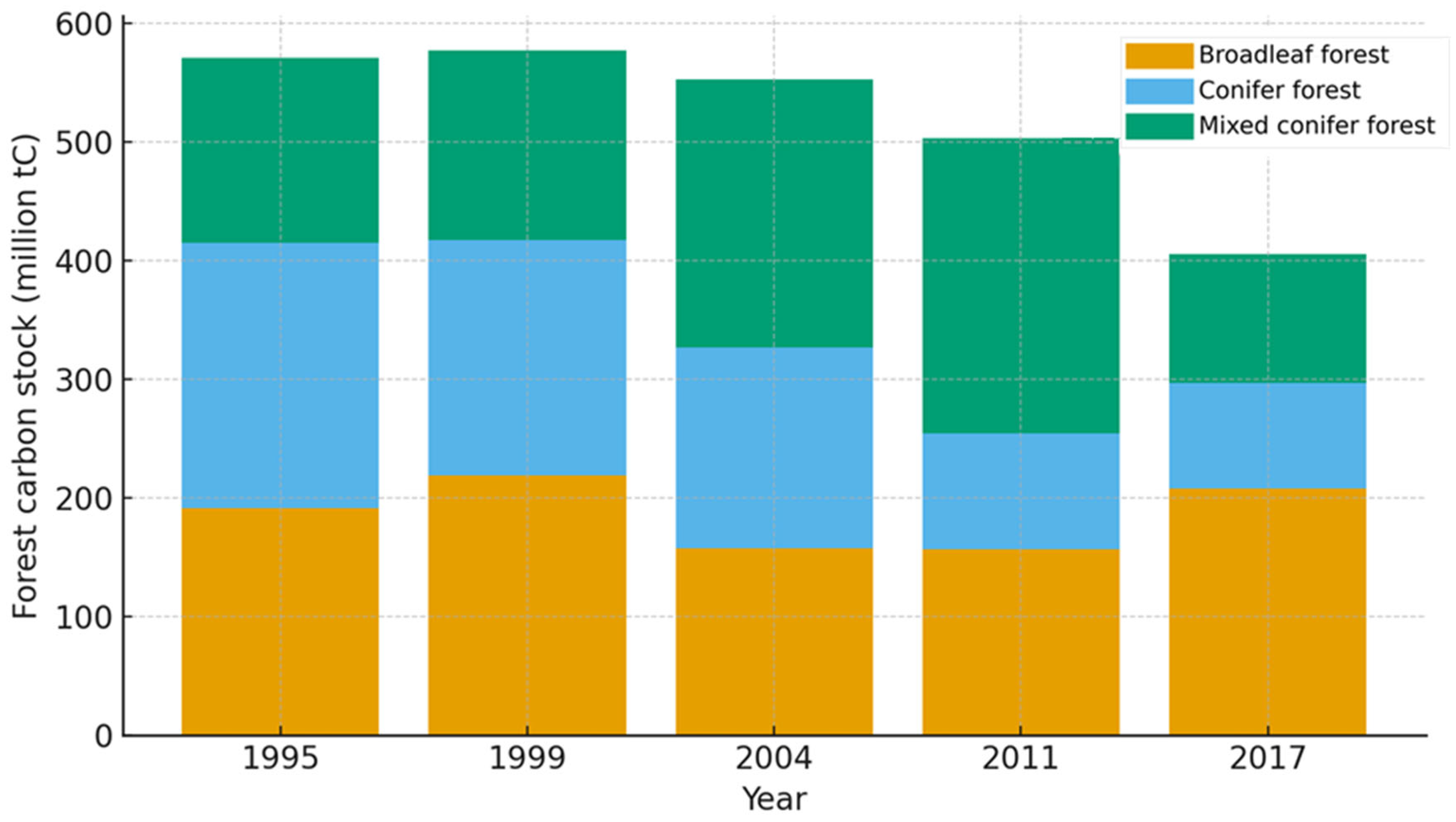
3.4. Forest Carbon Stocks
4. Discussion
5. Conclusions
Author Contributions
Funding
Data Availability Statement
Acknowledgments
Conflicts of Interest
Abbreviations
| COP | Conference of the Parties |
| DEM | Digital Elevation Model |
| ENVI | Environment for Visualizing Images |
| FAO | Food and Agriculture Organization of the United Nations |
| FLAASH | Fast Line-of-sight Atmospheric Analysis of Hypercubes |
| FRL | Forest Reference Level |
| FREL | Forest Reference Emission Level |
| IPCC | Intergovernmental Panel on Climate Change |
| LDC | Least Developed Country |
| LULUCF | Land Use, Land-Use Change and Forestry |
| MNDWI | Modified Normalized Difference Water Index |
| MRV | Measurement, Reporting, and Verification |
| NAP | National Adaptation Plan |
| NDBI | Normalized Difference Built-up Index |
| NDC | Nationally Determined Contribution |
| NIR | Near-Infrared |
| NDVI | Normalized Difference Vegetation Index |
| REDD+ | Reducing Emissions from Deforestation and Forest Degradation in developing countries |
| UNFCCC | United Nations Framework Convention on Climate Change |
Appendix A

References
- Winkler, K.; Fuchs, R.; Rounsevell, M.; Herold, M. Global land use changes are four times greater than previously estimated. Nat. Commun. 2021, 12, 2501. [Google Scholar] [CrossRef] [PubMed]
- Arneth, A.; Brown, C.; Rounsevell, M.D.A. Global models of human decision-making for land-based mitigation and adaptation assessment. Nat. Clim. Change 2014, 4, 550–557. [Google Scholar] [CrossRef]
- Powers, R.P.; Jetz, W. Global habitat loss and extinction risk of terrestrial vertebrates under future land-use-change scenarios. Nat. Clim. Change 2019, 9, 323–329. [Google Scholar] [CrossRef]
- Lambin, E.F.; Meyfroidt, P. Global land use change, economic globalization, and the looming land scarcity. Proc. Natl. Acad. Sci. USA 2011, 108, 3465–3472. [Google Scholar] [CrossRef] [PubMed]
- Arneth, A.; Denton, F.; Agus, F.; Elbehri, A.; Erb, K.; Elasha, B.O.; Rahimi, M.; Rounsevell, M.; Spence, A.; Valentini, R.; et al. Framing and Context. In Climate Change and Land: An IPCC Special Report on Climate Change, Desertification, Land Degradation, Sustainable Land Management, Food Security, and Greenhouse Gas Fluxes in Terrestrial Ecosystems; Cambridge University Press: Cambridge, UK, 2022; pp. 77–129. [Google Scholar]
- Grassi, G.; House, J.; Dentener, F.; Federici, S.; Den Elzen, M.; Penman, J. The key role of forests in meeting climate targets requires science for credible mitigation. Nat. Clim. Change 2017, 7, 220–226. [Google Scholar] [CrossRef]
- Prestele, R.; Arneth, A.; Bondeau, A.; De Noblet-Ducoudré, N.; Pugh, T.A.M.; Sitch, S.; Stehfest, E.; Verburg, P.H. Current challenges of implementing anthropogenic land-use and land-cover change in models contributing to climate change assessments. Earth Syst. Dyn. 2017, 8, 369–386. [Google Scholar] [CrossRef]
- IPCC. Agriculture, Forestry and Other Land Uses (AFOLU). In Climate Change 2022—Mitigation of Climate Change; Cambridge University Press: Cambridge, UK, 2022; pp. 747–860. [Google Scholar]
- Psistaki, K.; Tsantopoulos, G.; Paschalidou, A.K. An overview of the role of forests in climate change mitigation. Sustainability 2024, 16, 6089. [Google Scholar] [CrossRef]
- Kingdom of Bhutan. First Biennial Update Report (BUR) to the UNFCC; National Environment Commission, Royal Government of Bhutan: Timphu, Bhutan, 2022.
- Global Forest Watch. Forest Change of Bhutan. 2025. Available online: https://www.globalforestwatch.org/dashboards/country/BTN/?map=eyJjYW5Cb3VuZCI6dHJ1ZX0%3D (accessed on 20 October 2025).
- Penjor, Y. Royal Government of Bhutan at the High Level Segment of COP26/CMP16/CMA3 to UNFCCC; UNFCCC: Glasgow, UK, 2019; pp. 1–4. [Google Scholar]
- UNDP. Climate Change Vulnerability Analyses and Mapping for National Adaptation Plan (NAP) Formulation Process in Bhutan. 2022. Available online: https://www.undp.org/bhutan/publications/climate-change-vulnerability-analyses-and-mapping-national-adaptation-plan-nap-formulation-process-bhutan (accessed on 20 October 2025).
- Sabin, T.P.; Krishnan, R.; Vellore, R.; Priya, P.; Borgaonkar, H.P.; Singh, B.B.; Sagar, A. Climate Change over the Himalayas. In Assessment of Climate Change over the Indian Region: A Report of the Ministry of Earth Sciences (MoES), Government of India; Springer: Singapore, 2020; pp. 207–222. [Google Scholar] [CrossRef]
- World Bank Group. Bhutan Development Update Harnessing Urbanization 2 Government Fiscal Year. June 2019. Available online: https://openknowledge.worldbank.org/entities/publication/de50573d-1397-56fe-bf62-dec6ba562889 (accessed on 20 October 2025).
- Nimesh, C.; Karma, T.; Lily, G.; Cheki, D. Association of Climate Change to Landslide Vulnerability and Occurrences in Bhutan. In Impact of Climate Change, Land Use and Land Cover, and Socio-Economic Dynamics on Landslides; Springer Nature: Berlin/Heidelberg, Germany, 2022. [Google Scholar]
- Kingdom of Bhutan. Kingdom of Bhutan Second Nationally Determined Contribution; Royal Government of Bhutan: Timphu, Bhutan, 2021.
- Kingdom of Bhutan. National Adaptation Plan (NAP) of the Kingdom of Bhutan; Department of Environment and Climate Change, Ministry of Energy and Natural Resources, Royal Government of Bhutan: Timphu, Bhutan, 2023.
- Lobzang, D.; Sigyel, D.; Jigme, T. National REDD+ Strategy & Action Plan; Watershed Management Division, Department of Forests and Park Services, Royal Government of Bhutan: Timphu, Bhutan, 2020.
- Thongley, T.; Tshering, Y. Digital Landslide Risk Mapping and Landslide Database for Bhutan Through Mobile App for Bhutan. In Proceedings of the 2024 Geoinformatics for Spatial-Infrastructure Development in Earth and Allied Sciences (GIS-IDEAS); IEEE: New York, NY, USA, 2024; pp. 1–5. [Google Scholar] [CrossRef]
- Rai, A.; Yangden, K.; Lobzang, D. Global Forest Resources Assessment 2020 Report, Bhutan; FAO: Rome, Italy, 2020. [Google Scholar]
- Korea Environment Institute. A Study on the Development of Technical Guidelines for Formulating Climate Change Adaptation Plans in Least Developed Countries (LDCs) at the Subnational Level; Korea Environment Institute: Sejong City, Republic of Korea, 2016. [Google Scholar]
- Lehner, F.; Formayer, H. Insights on the climate of Bhutan from a new daily 1 km gridded data set for temperature and precipitation. Int. J. Climatol. 2023, 43, 4927–4943. [Google Scholar] [CrossRef]
- Rinzin, P.; Malla, M.K.; Arya, D.S. Past and future climate variability analysis in Bhutan. Theor. Appl. Climatol. 2024, 155, 6213–6239. [Google Scholar] [CrossRef]
- Sears, R.R.; Choden, K.; Dorji, T.; Dukpa, D.; Phuntsho, S.; Rai, P.B.; Wangchuk, J.; Baral, H. Bhutan’s forests through the framework of ecosystem services: Rapid assessment in three forest types. Forests 2018, 9, 675. [Google Scholar] [CrossRef]
- Rinzin, S.; Zhang, G.; Wangchuk, S. Glacial lake area change and potential outburst flood hazard assessment in the Bhutan Himalaya. Front. Earth Sci. 2021, 9, 775195. [Google Scholar] [CrossRef]
- Dorji, U.; Olesen, J.E.; Bøcher, P.K.; Seidenkrantz, M.S. Spatial variation of temperature and precipitation in Bhutan and links to vegetation and land cover. Mt. Res. Dev. 2016, 36, 66–79. [Google Scholar] [CrossRef]
- Khandu, Y.; Polthanee, A.; Isarangkool Na Ayutthaya, S. Dendroclimatic reconstruction of mean annual temperatures over treeline regions of northern Bhutan Himalayas. Forests 2022, 13, 1794. [Google Scholar] [CrossRef]
- Sovacool, B.K.; Del Rio, D.F.; Zhang, W. The political economy of net-zero transitions: Policy drivers, barriers, and justice benefits to decarbonization in eight carbon-neutral countries. J. Environ. Manag. 2023, 347, 11954. [Google Scholar] [CrossRef] [PubMed]
- Kamei, M.; Wangmo, T.; Leibowicz, B.D.; Nishioka, S. Urbanization, carbon neutrality, and gross national happiness: Sustainable development pathways for Bhutan. Cities 2021, 111, 102972. [Google Scholar] [CrossRef]
- Rash, A.; Mustafa, Y.; Hamad, R. Quantitative assessment of land use/land cover changes in a developing region using machine learning algorithms: A case study in the Kurdistan Region, Iraq. Heliyon 2023, 9, e21253. [Google Scholar] [CrossRef]
- Yu, H.; Li, L.; Zhu, W.; Piao, D.; Cui, G.; Kim, M.; Jeon, S.W.; Lee, W.K. Drought monitoring of the wetland in the Tumen River Basin between 1991 and 2016 using Landsat TM/ETM+. Int. J. Remote Sens. 2019, 40, 1445–1459. [Google Scholar] [CrossRef]
- Lindquist, E.J.; D’Annunzio, R. Assessing global forest land-use change by object-based image analysis. Remote Sens. 2016, 8, 678. [Google Scholar] [CrossRef]
- Huo, L.Z.; Boschetti, L.; Sparks, A.M. Object-based classification of forest disturbance types in the conterminous united states. Remote Sens. 2019, 11, 477. [Google Scholar] [CrossRef]
- Flanders, D.; Hall-Beyer, M.; Pereverzoff, J. Preliminary evaluation of eCognition object-based software for cut block delineation and feature extraction. Can. J. Remote Sens. 2003, 29, 441–452. [Google Scholar] [CrossRef]
- Lemenkova, P. Topology, homogeneity and scale factors for object detection: Application of eCognition software for urban mapping using multispectral satellite image. In Proceedings of the 7th International Conference ‘Internet and Society Modelling’ INSO; ATSU Press: Kutaisi, Georgia, 2015; pp. 80–85. [Google Scholar]
- Akcay, O.; Avsar, E.O.; Inalpulat, M.; Genc, L.; Cam, A. Assessment of segmentation parameters for object-based land cover classification using color-infrared imagery. ISPRS Int. J. Geo-Inf. 2018, 7, 424. [Google Scholar] [CrossRef]
- Cechim Junior, C.; Araki, H.; de Campos Macedo, R. Object-based image analysis (OBIA) and machine learning (ML) applied to tropical forest mapping using Sentinel-2. Can. J. Remote Sens. 2023, 49, 2259504. [Google Scholar] [CrossRef]
- Torres-Sánchez, J.; López-Granados, F.; Peña, J.M. An automatic object-based method for optimal thresholding in UAV images: Application for vegetation detection in herbaceous crops. Comput. Electron. Agric. 2015, 114, 43–52. [Google Scholar] [CrossRef]
- Taufik, A.; Ahmad, S.S.S. Land cover classification of Landsat 8 satellite data based on fuzzy logic approach. Proc. IOP Conf. Ser. Earth Environ. Sci. 2016, 37, 012062. [Google Scholar] [CrossRef]
- Rasouli, A.; Milani, M.; Milani, B. Mastering Object-Based Image Analysis; Iksad Publications: Ankara, Turkey, 2021. [Google Scholar]
- Bilotta, G.; Barrile, V.; Bibbò, L.; Meduri, G.M.; Versaci, M.; Angiulli, G. Enhancing land cover classification: Fuzzy similarity approach versus random forest. Symmetry 2025, 17, 929. [Google Scholar] [CrossRef]
- Chaudhary, A.K.; Acharya, A.K.; Khanal, S. Forest type mapping using object-based classification method in Kapilvastu district, Nepal. Banko Janakari 2016, 26, 38–44. [Google Scholar] [CrossRef][Green Version]
- Kwon, S.; Kim, E.; Lim, J.; Yang, A.R. The analysis of changes in forest status and deforestation of North Korea’s DMZ using RapidEye satellite imagery and Google Earth. J. Korean Assoc. Geogr. Inf. Stud. 2021, 24, 113–126. [Google Scholar] [CrossRef]
- Tilahun, A.; Teferie, B. Accuracy assessment of land use land cover classification using Google Earth. Am. J. Environ. Prot. 2015, 4, 193–198. [Google Scholar] [CrossRef]
- Rwanga, S.S.; Ndambuki, J.M. Accuracy assessment of land use/land cover classification using remote sensing and GIS. Int. J. Geosci. 2017, 8, 611–622. [Google Scholar] [CrossRef]
- Xu, X.; Li, D.; Liu, H.; Zhao, G.; Cui, B.; Yi, Y.; Yang, W.; Du, J. Comparative validation and misclassification diagnosis of 30-meter land cover datasets in China. Remote Sens. 2024, 16, 4330. [Google Scholar] [CrossRef]
- Hashemian, M.S.; Abkar, A.A.; Fatemi, S.B. Study of sampling methods for accuracy assessment of classified remotely sensed data. In International Congress for Photogrammetry and Remote Sensing; ISPRS: Hannover, Germany, 2004; pp. 1682–1750. [Google Scholar]
- IPCC. 2006 IPCC Guidelines for National Greenhouse Gas Inventories Volume 4 Agriculture, Forestry and Other Land Use; Cambridge University Press: Cambridge, UK, 2006. [Google Scholar]
- Lobzang, D.; Wangda, P.; Yangden, K.; Wangdi, D.; Rai, A.; Phuntsho; Dem, K.; Dema, S.; Tenzin, J. Bhutan’s Proposed National Forest Reference Emission Level and National Forest Reference Level Submission for Technical Assessment to UNFCCC; Department of Forests & Park Services, Ministry of Agriculture & Forests, Royal Government of Bhutan: Timphu, Bhutan, 2019.
- Chhogyel, N.; Kumar, L. Climate change and potential impacts on agriculture in Bhutan: A discussion of pertinent issues. Agric. Food Secur. 2018, 7, 79. [Google Scholar] [CrossRef]
- Vilà-Vilardell, L.; Keeton, W.S.; Thom, D.; Gyeltshen, C.; Tshering, K.; Gratzer, G. Climate change effects on wildfire hazards in the wildland-urban-interface—Blue Pine Forests of Bhutan. For. Ecol. Manag. 2020, 461, 117927. [Google Scholar] [CrossRef]
- Dukpa, D.; Cook, E.R.; Krusic, P.J.; Rai, P.B.; Darabant, A.; Tshering, U. Applied dendroecology informs the sustainable management of Blue Pine Forests in Bhutan. Dendrochronologia 2018, 49, 89–93. [Google Scholar] [CrossRef]
- Norbu, N.; Chhetri, P.; Wakimoto, R.; Myint, M.; Vilà Vilardell, L.; Ryan, K. Assessment of Climate Risks on Forests and Biodiversity for National Adaptation Plan (NAP) Formulation Process in Bhutan Assessment Report; UNDP: New York, NY, USA, 2021. [Google Scholar]
- Phyntsho, P.; Wangchuk, S.; Tshering, C.; Tshering, T. Relationship Between Land-Use Management and Hydropower Development in Bhutan; Ugyen Wangchuck Institute for Conservation and Environmental Research: Timphu, Bhutan, 2018.
- Tshering, C. Population Projections Bhutan 2017–2047; National Statistics Bureau: Thimphu, Bhutan, 2019.
- Tshering, C. Rural-Urban Migration and Urbanization Policy Brief Migration and Urbanization Trends; National Statistics Bureau: Thimphu, Bhutan, 2020.
- Kingdom of Bhutan. The 3rd UN Conference on Housing and Sustainable Urban Development; Ministry of Works and Human Settlement, Royal Government of Bhutan: Timphu, Bhutan, 2016.
- Environment and Natural Resources Global Practice. Bhutan Forest Note Pathways for Sustainable Forest Management and Socio-Equitable Economic Development; The World Bank: Washington, DC, USA, 2019. [Google Scholar]
- Wangchuk, S.; Siebert, S.; Belsky, J. Fuelwood use and availability in Bhutan: Implications for national policy and local forest management. Hum. Ecol. 2014, 42, 127–135. [Google Scholar] [CrossRef]
- Katel, O.N.; Nair, A.; Yangchen, U.; Wangmo, C. Climate Change, Agriculture, and Internal Human Mobility in the Bhutan Himalayas. In Climate-Related Human Mobility in Asia and the Pacific; Springer Nature: Singapore, 2024; pp. 105–120. [Google Scholar] [CrossRef]
- Du, J.; Watts, J.D.; Jiang, L.; Lu, H.; Cheng, X.; Duguay, C.; Farina, M.; Qiu, Y.; Kim, Y.; Kimball, J.S.; et al. Remote sensing of environmental changes in cold regions: Methods, achievements and challenges. Remote Sens. 2019, 11, 1952. [Google Scholar] [CrossRef]
- Næsset, E.; Bollandsås, O.M.; Gobakken, T.; Gregoire, T.G.; Ståhl, G. Model-assisted estimation of change in forest biomass over an 11 year period in a sample survey supported by airborne LiDAR: A case study with post-stratification to provide “activity data”. Remote Sens. Environ. 2013, 128, 299–314. [Google Scholar] [CrossRef]
- Doser, J.W.; Itter, M.S.; Domke, G.M.; Finley, A.O. Multivariate spatial models for small area estimation of species-specific forest inventory parameters. For. Ecol. Manag. 2025, 597, 123112. [Google Scholar] [CrossRef]
- Zhao, Z.; Dong, P.; Fu, B.; Wu, D.; Zhao, Z. Soil organic carbon distribution and factors affecting carbon accumulation in natural and plantation forests in tropical China. Ecol. Indic. 2023, 148, 110127. [Google Scholar] [CrossRef]
- Reddy, C.S.; Satish, K.V.; Jha, C.S.; Diwakar, P.G.; Murthy, Y.V.N.K.; Dadhwal, V.K. Development of deforestation and land cover database for Bhutan (1930–2014). Environ. Monit. Assess. 2016, 188, 658. [Google Scholar] [CrossRef]
- Nkonya, E.; Mirzabaev, A.; Von Braun, J. (Eds.) Economics of Land Degradation and Improvement—A Global Assessment for Sustainable Development; Springer Nature: London, UK, 2016; p. 686. [Google Scholar]
- Wang, S.W.; Lee, W.-K.; Kim, J.-G. Understanding the relationships in nature-human systems to improve social-ecological resilience in the Hindu-Kush Himalayas. Asian J. Conserv. Biol. 2018, 7, 17–27. [Google Scholar]
- Yeshey; Shrestha, R.P.; Schmidt-Vogt, D.; Qasim, S. A comparative assessment of land management approaches in Bhutan. Int. J. Sust. Dev. World Ecol. 2018, 25, 143–151. [Google Scholar] [CrossRef]



| Landsat Scene ID | Date | Path/Row | Cloud (%) |
|---|---|---|---|
| LT51370411995309BKT01 | 5 November 1995 | 137/41 | 2 |
| LT51380411999327BKT00 | 23 November 1999 | 138/41 | 5 |
| LT51390411999334BKT01 | 30 November 1999 | 139/41 | 6 |
| LT51370412004334BKT01 | 29 November 2004 | 137/41 | 8 |
| LT51390412011239KHC00 | 27 August 2011 | 139/41 | 16 |
| LT51380412011296KHC00 | 23 October 2011 | 138/41 | 7 |
| LC81380412017312LGN00 | 8 November 2017 | 138/41 | 4.09 |
| LC81390412017335LGN00 | 1 December 2017 | 139/41 | 6.71 |
Disclaimer/Publisher’s Note: The statements, opinions and data contained in all publications are solely those of the individual author(s) and contributor(s) and not of MDPI and/or the editor(s). MDPI and/or the editor(s) disclaim responsibility for any injury to people or property resulting from any ideas, methods, instructions or products referred to in the content. |
© 2026 by the authors. Licensee MDPI, Basel, Switzerland. This article is an open access article distributed under the terms and conditions of the Creative Commons Attribution (CC BY) license.
Share and Cite
Hong, M.; Yu, H.; Song, Y.; Song, M.; Kim, K.; Lee, W.-K. Time-Series Satellite-Based Monitoring of Land-Use Change and Forest Loss in Bhutan: Implications for Forest Carbon Measurement, Reporting, and Verification. Land 2026, 15, 432. https://doi.org/10.3390/land15030432
Hong M, Yu H, Song Y, Song M, Kim K, Lee W-K. Time-Series Satellite-Based Monitoring of Land-Use Change and Forest Loss in Bhutan: Implications for Forest Carbon Measurement, Reporting, and Verification. Land. 2026; 15(3):432. https://doi.org/10.3390/land15030432
Chicago/Turabian StyleHong, Mina, Hangnan Yu, Yongho Song, Minkyung Song, Kyoungmin Kim, and Woo-Kyun Lee. 2026. "Time-Series Satellite-Based Monitoring of Land-Use Change and Forest Loss in Bhutan: Implications for Forest Carbon Measurement, Reporting, and Verification" Land 15, no. 3: 432. https://doi.org/10.3390/land15030432
APA StyleHong, M., Yu, H., Song, Y., Song, M., Kim, K., & Lee, W.-K. (2026). Time-Series Satellite-Based Monitoring of Land-Use Change and Forest Loss in Bhutan: Implications for Forest Carbon Measurement, Reporting, and Verification. Land, 15(3), 432. https://doi.org/10.3390/land15030432