Article

Assessing Urban Flood Resilience in the Low-Elevation Capital, Georgetown, Guyana: A Principal Component Analysis-Driven Census-Based Index


1
Department of Mathematics, Physics and Statistics, University of Guyana, Georgetown, Guyana
2
Stuckeman School, Pennsylvania State University, University Park, PA 16802, USA
3
School for the Future of Innovation in Society, Arizona State University, Tempe, AZ 85281, USA
*
Author to whom correspondence should be addressed.
Land 2026, 15(3), 467; https://doi.org/10.3390/land15030467
Submission received: 31 January 2026 / Revised: 6 March 2026 / Accepted: 13 March 2026 / Published: 14 March 2026
(This article belongs to the Special Issue Multiscalar Interactions Between Climate and Land Management Regimes)

Abstract

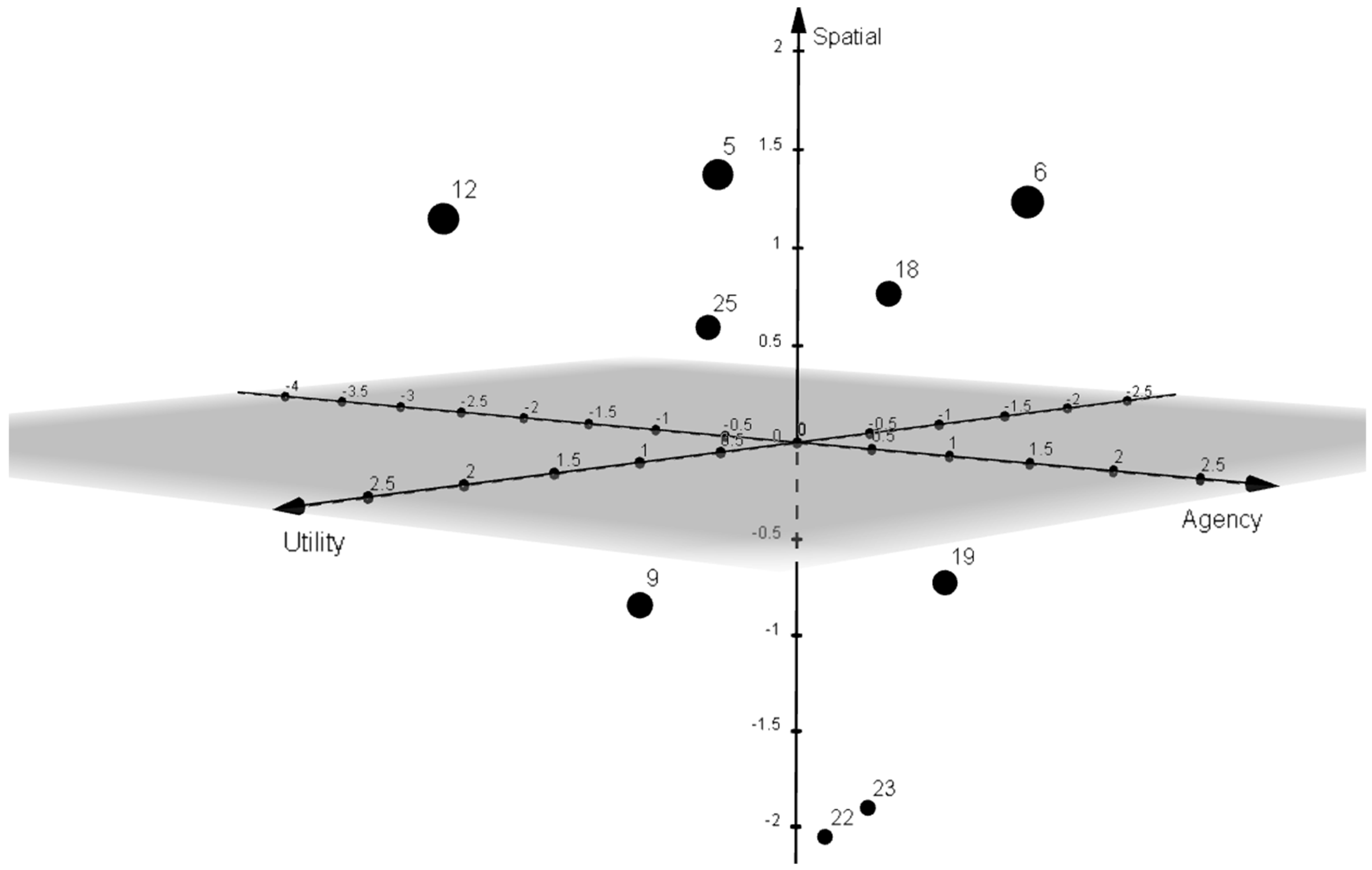
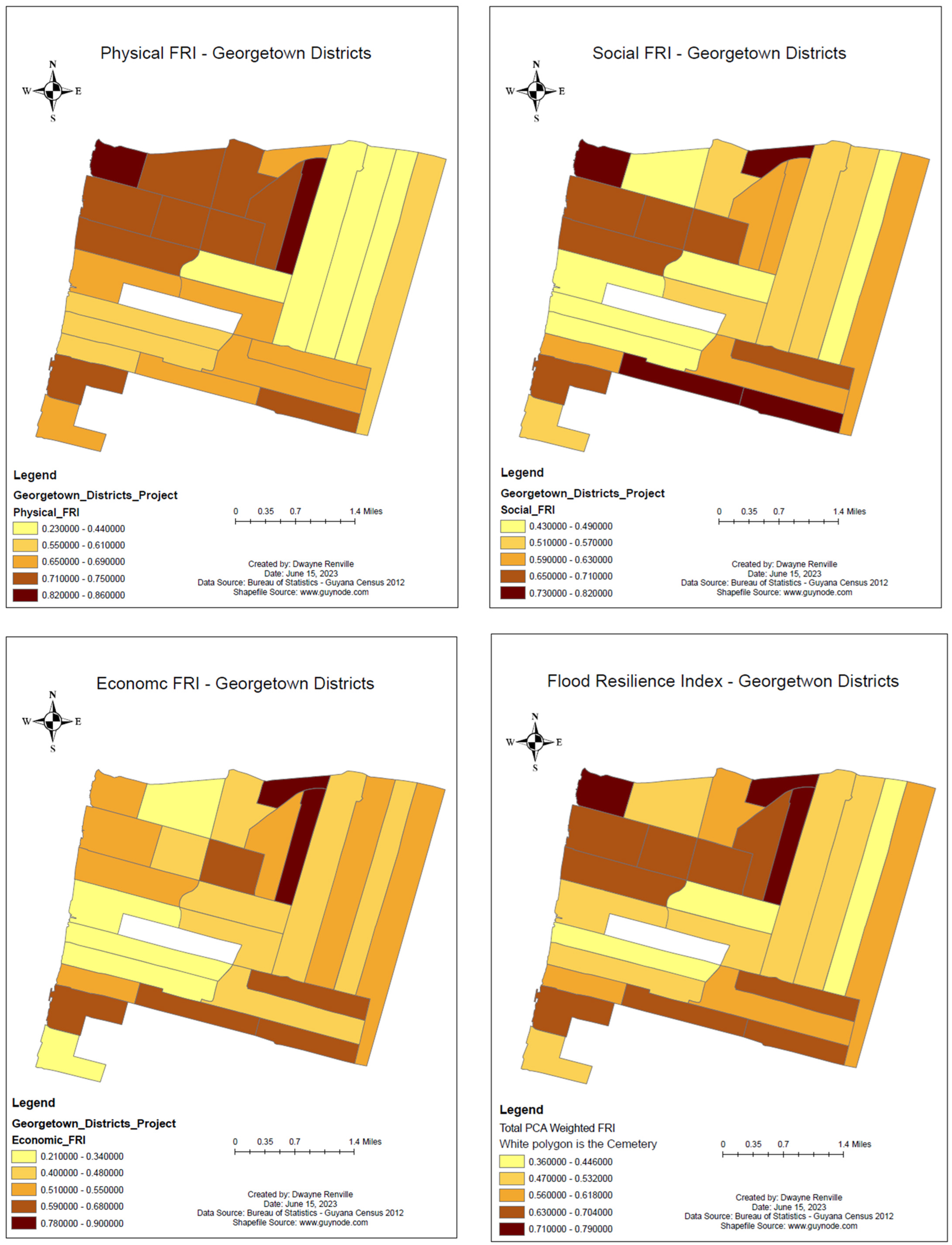
Urban flood resilience has emerged as a holistic citywide approach for mitigating flood hazards and navigating the impacts of extreme weather patterns induced by climate change. This is particularly pertinent for high-risk, low-elevation coastal cities like Georgetown, Guyana. However, while the literature on Georgetown includes assessments, analyses, modeling, vulnerability, and the socio-political history of flooding, we found no evidence of flood resilience assessment for the city. Therefore, this study presents a data-driven evaluation of flood resilience at the sub-district level in Georgetown. To accomplish this, we constructed flood resilience indices (FRIs) using the aggregated weighted mean index approach and census-based indicators across physical, social, and economic dimensions. Principal component analysis (PCA) was employed to generate these weights and, subsequently, to perform dimensionality reduction and determine a linear regression model for the FRI values. To evaluate the stability of the constructed indices, robustness tests were conducted using alternative normalization and weighting schemes to demonstrate the consistency of resilience rankings across specifications. The results show that (a) economic resilience is lowest, (b) there is notable clustering and sharp disparities in the physical and social dimensions, and (c) the social dimension has the strongest correlation with the total FRI, which is generally heterogeneous. PCA-derived principal components explained 77.347% of the variation in the FRI values, enabling dimensionality reduction and three-dimensional graphical presentations. Our findings provide urban planners with insights into the distribution of flood resilience needs across the city. This study enables informed decision-making, serving as a pathway to achieve equitable resource allocation and build the city’s resilience.
Keywords: urban flood resilience; PCA; FRI; flood risk; flood hazard; low-elevation coastal city; Georgetown; Guyana urban flood resilience; PCA; FRI; flood risk; flood hazard; low-elevation coastal city; Georgetown; Guyana