1. Introduction
Land is a basic carrier of production and ecosystems [
1,
2,
3]. Changes in land use and cover can reshape carbon, water, and food systems, and they can lock in long-term development paths [
4,
5]. Land change can also affect regional climate extremes through land-surface processes [
6]. In arid and semi-arid regions, water scarcity is a binding constraint: it narrows feasible land-use options and intensifies tradeoffs [
7]. Risk-based assessments under land-use change are therefore often required in planning practice [
8].
The Yellow River Basin is a key arena where ecological protection and development must be coordinated under tight natural constraints [
9]. Ningxia Hui Autonomous Region is a representative dryland transition zone along the upper Yellow River. It includes irrigated plains, desert margins, and mountain landscapes. Land cover has changed markedly during periods of landscape restoration in the region [
6], while land competition has also grown. Urban growth, infrastructure, and energy-related land uses create additional pressure and distinct spatial footprints [
10]. Population distribution patterns further shape demand and exposure across space [
11]. Under these conditions, cropland needs to remain productive and spatially coherent, yet ecological security objectives restrict where conversion can occur [
12].
Land-use and land-cover change simulation supports hypothesis testing and forward-looking assessment [
9,
13]. Many modeling families have been developed, among which cellular automata and Markov-based approaches remain widely used [
14]. Learning-based methods have also been applied to forecast land transformation from spatial variables [
15]. For cropland, scenario-based simulation is often used to connect demand assumptions with spatial allocation rules [
16,
17]. Classic frameworks such as CLUE-S and FLUS provide multi-scenario capabilities through competition and allocation mechanisms [
18,
19]. Recent work has advanced this line through dynamic PLUS-based frameworks and multi-objective designs [
20,
21].
Scenario-based LUCC and cropland simulations in China have grown rapidly in recent years, including applications in dryland and arid settings. Coupled frameworks have been used to simulate land trajectories under alternative pathways and to map conversion hotspots [
22]. Basin-scale studies have also linked land-change scenarios to ecosystem service outcomes in the Yellow River Basin [
23]. Model development continues to diversify: spatiotemporal convolution-based cellular automata improve representation of temporal dependence [
24], while patch-generating simulation approaches improve spatial realism in rapidly changing landscapes [
25]. Broader evidence also confirms strong urban expansion pressure at large scales, and this pressure can spill into accessible cropland [
26]. Scenario studies increasingly report ecological risk responses to land change [
27].
Several gaps remain for dryland cropland scenario work. Demand projection is often weak for medium- to long-term horizons under policy-sensitive trajectories [
17]. Ecological constraints are commonly treated as static masks, while the pathway-shaping role of binding rules is rarely analyzed. Displacement of conversion pressure is often overlooked [
7,
20]. Scale sensitivity is under-reported in heterogeneous landscapes, even though it affects model performance and hotspot credibility [
28]. Baseline land-cover inputs also matter—classification choices can propagate uncertainty into simulation and validation [
29].
This study addresses these gaps by building an integrated simulation framework for cropland change in Ningxia through coupling an improved demand-forecast module with the CLUMondo allocation model. Here, the methodological contribution is the improved demand-forecast module and its coupling workflow, which translate policy-sensitive trajectories into model-ready demand inputs; CLUMondo is used as an established allocation engine to generate spatially explicit patterns under competition and constraint rules. Three scenarios are implemented to represent contrasting development trajectories and ecological-constraint pathways. Outputs are evaluated in both quantity and spatial pattern, and scale sensitivity is examined to improve robustness. This study is guided by four research questions. We ask what mechanisms dominate cropland change in an ecologically constrained dryland system. We examine the robustness of medium- to long-horizon cropland demand projections under policy-sensitive trajectories. We further ask how binding ecological constraints reshape spatial pathways of change and whether they displace conversion pressure across space. Finally, we assess how scale choice influences model performance and the credibility of cropland risk hotspots across scenarios.
2. Materials and Methods
2.1. Study Area
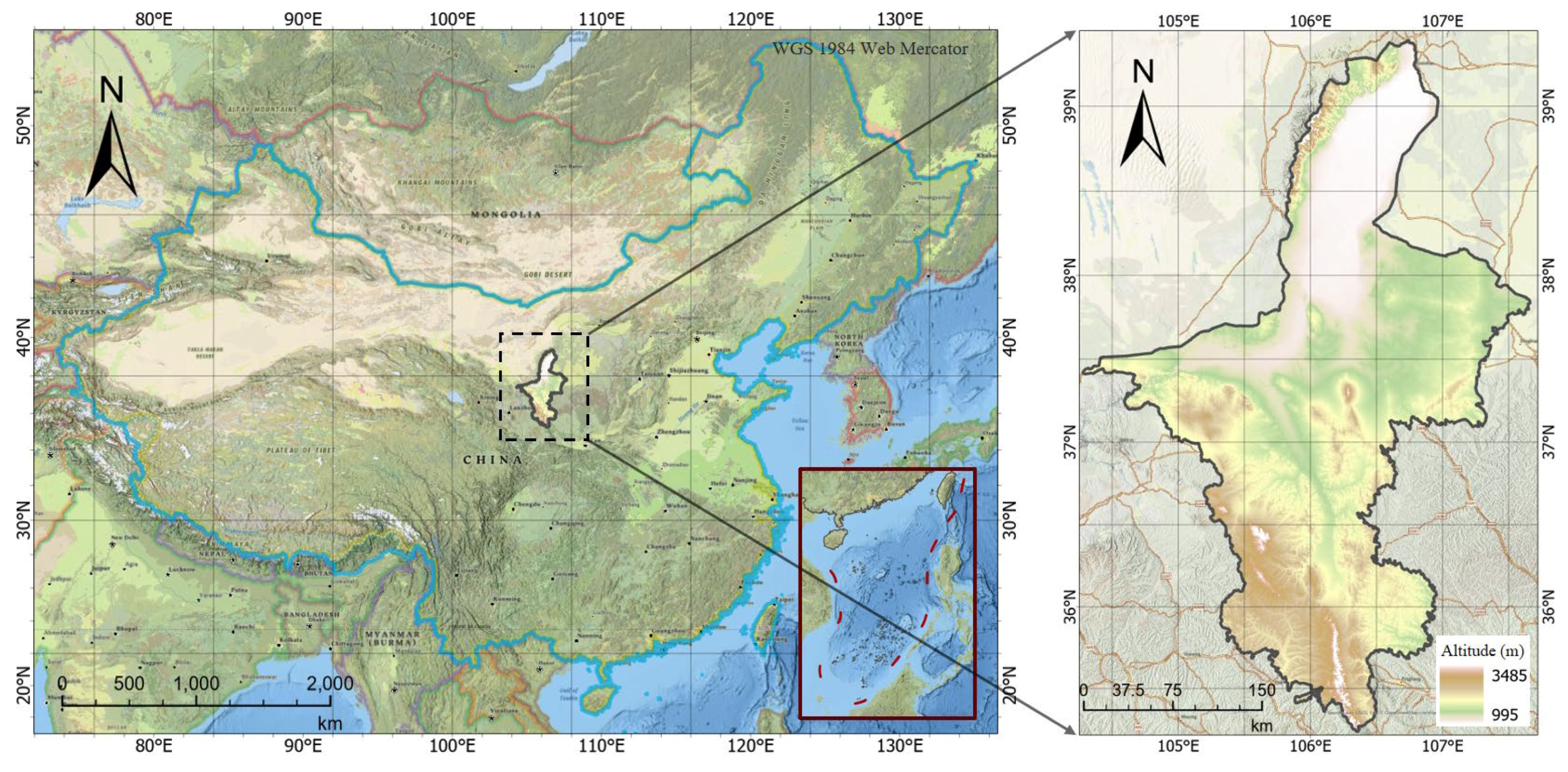
The Ningxia Hui Autonomous Region is located in the upper reaches of the Yellow River in Northwest China (35°14′ N–39°23′ N, 104°17′ E–107°39′ E), serving as a vital geographical transition zone between the Loess Plateau and the Inner Mongolia Plateau. Administratively, it comprises five prefecture-level cities, overseeing 9 districts, 2 county-level cities, and 11 counties. The region exhibits a typical temperate continental climate, where atmospheric circulation is profoundly influenced by seasonal monsoons: summers are characterized by sparse precipitation despite the influence of the southeast monsoon, while winters experience sharp temperature fluctuations driven by the northwest monsoon. The annual precipitation ranges from 150 to 600 mm, displaying a significant north–south climatic gradient. Specifically, the Liupan Mountain area in the south is characterized by a humid climate with abundant rainfall and lower temperatures, whereas the Yellow River irrigation area in the north features intense sunshine, high evaporation rates, and substantial diurnal temperature variations. Furthermore, Ningxia is one of China’s most resource-rich regions for solar energy, boasting an average of 3000 sunshine hours annually. This abundant solar radiation not only provides a unique natural endowment for modern agriculture but also establishes the region as a critical national base for new energy development. Such a complex environment, spanning multiple climatic zones and topographical units, renders Ningxia an ideal empirical case for investigating the spatiotemporal evolution of cropland and its associated spatial competition in ecologically fragile regions. The location of the study area is illustrated in
Figure 1.
2.2. Data Sources and Preprocessing
Multi-source datasets were obtained from official public channels of national and local authorities or reputable research institutions. Land-use data were derived from the Ningxia Land-Use Status Survey (2000–2024) and annual land-change survey data from the Department of Natural Resources of Ningxia, supporting cropland analysis for 2009–2024. Classification logic at key time nodes was cross-verified using the Main Data Bulletin of the Third National Land Survey of Ningxia. Administrative boundary data provided a unified platform for clipping and zonal statistics.
Administrative datasets were documented with explicit year coverage and reporting units. Socioeconomic indicators were compiled at the county level for 2009–2024 and aligned year-by-year to the study period. Sources included the Ningxia Statistical Yearbook (2010–2024), the Statistical Bulletin of National Economic and Social Development of Ningxia (2009–2019), and other annual releases from the Bureau of Statistics. These records supported population, economic, and industrial-structure variables. Policy records were linked to their effective years before spatialization. Cross-year consistency checks were applied to reduce discontinuities.
Biophysical constraints were represented by annual mean precipitation and temperature from the National Meteorological Data Center, interpolated from station observations. Nighttime light data from Luojia-1 (LJ1-01) were used to proxy human-activity intensity and urban expansion.
Non-spatial statistics were spatialized using constrained areal-weighting downscaling. Annual values were joined to the reporting unit and disaggregated to the modeling grid. Land-cover masks constrained allocation, excluding built-up areas and water bodies. Dasymetric weights reduced uniform spreading. All driver rasters were aligned to the 50 m × 50 m simulation grid and normalized when needed.
Policy factors were represented as spatial proxy rasters using the same workflow. Subsidy intensity and industry support were downscaled from administrative records. Eco-migration influence combined implementation intensity with proximity to relocation destinations. Cropland protection was encoded using protected or controlled zones as restricted areas or higher resistance. All policy rasters were resampled to the 50 m × 50 m modeling grid and normalized to comparable ranges.
Preprocessing followed a fixed pipeline. Tables were cleaned and units harmonized. Missing values were screened using consistent rules. Spatial layers were projected to WGS84 and UTM Zone 48N and resampled to a 50 m × 50 m grid. Bilinear interpolation was used for continuous variables and nearest-neighbor resampling for categorical variables. Land-use raster codes started at 0, and the 2010 map was reclassified in ArcGIS10.8. Restriction zones, such as ecological redlines, used a mask value of −9998. All layers were converted from GeoTIFF to ASCII for CLUMondo.
Administrative statistics may include cross-year inconsistencies due to reporting changes and category revisions. Definitions were harmonized across 2009–2024, outliers were screened, and inputs were mapped to a unified land-category system. Residual uncertainty may affect effect magnitudes.
2.3. Overall Technical Framework
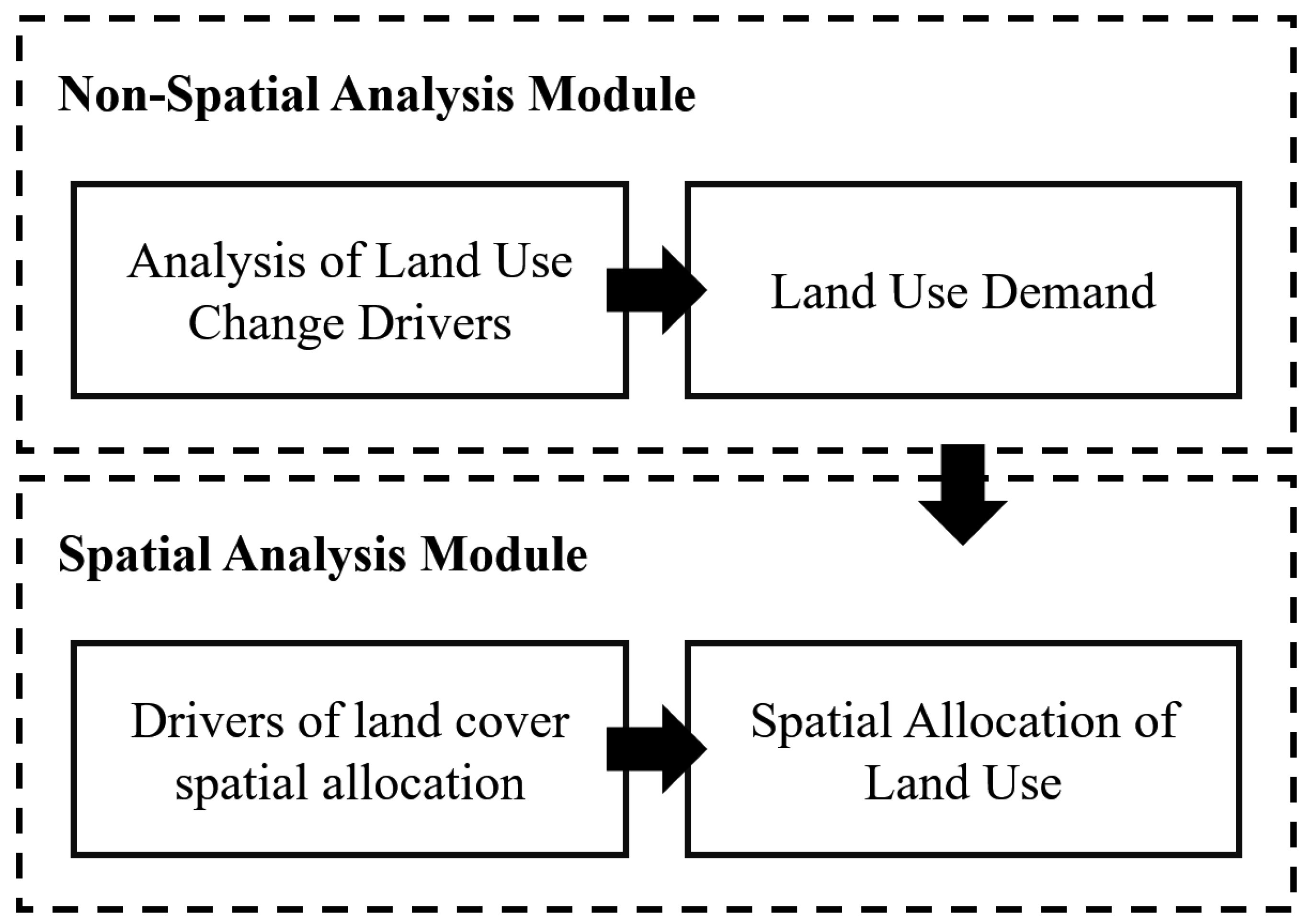
This study constructed an integrated simulation framework coupling “quantitative prediction” and “spatial allocation” to analyze the spatiotemporal evolution of cropland in Ningxia. The overall technical route was divided into two core stages. First, non-spatial demand forecasting was conducted. An improved grey prediction model (Improved GM(1,1)) was used to estimate land-use demands under different scenarios for 2025–2040. These results served as quantitative demand inputs for subsequent simulation. Second, spatial dynamic allocation was performed. The projected demands were provided to CLUMondo as non-spatial inputs. CLUMondo was applied as an established allocation model to generate grid-scale spatial patterns under the specified suitability settings and ecological constraints. Under this setup, the demand-forecasting component provides the quantity targets, and CLUMondo implements the spatial allocation given those targets. The model structure is shown in
Figure 2:
In the spatial allocation module, the CLUMondo model followed a rigorous dynamic competition mechanism. The model first extracted valid grid units where land-use change was permitted based on predefined spatial policies and restricted area files. For each specific grid cell, the model calculated the total transition potential by synthesizing location suitability, neighborhood effects, transition resistance, and the relative competitive capacity of different land types. The calculation formula is as follows
where
represents the total probability of grid cell
converting to land-use type
;
denotes the location suitability calculated via logistic regression based on driving factors;
is the transition resistance parameter set for the specific land category; and
is the dynamic competition coefficient for the land type, reflecting its competitive advantage during the iteration process.
After obtaining the transition potential, the model allocated probabilities to grid units based on the established cropland transfer matrix and monitored the deviation between the allocated area and the external demand in real time. Through iterative adjustments, the CLUMondo model performed up to 20,000 iterations under the specified constraints. If the final allocation met the predefined quantitative requirements for cropland, a spatial land-use pattern map for that time step was generated. Failure to converge within limited iterations indicated logical contradictions in parameter settings, necessitating the recalibration of transition elasticity or transfer matrices to ensure the scientific validity of the simulation.
2.3.1. Calibration of Transition Elasticity
Transition elasticity parameters were calibrated using a backcasting test from 2010 to 2020. The model used the 2010 land-use map as the base map and the observed demand for the target year as input. Elasticity values were tuned within plausible ranges. The tuning aimed to improve agreement in land-system totals and grid-level patterns. Kappa-based agreement and overall accuracy were used as calibration criteria.
2.3.2. Convergence Assessment
Convergence was assessed by monitoring stability of allocation outcomes during the iterative procedure. Two criteria were tracked. The first was the change in allocated area for each land system between successive iterations. The second was the change in the overall allocation score used by the model. Convergence was declared when both criteria remained below a small relative tolerance for a fixed number of successive iterations. The maximum of 20,000 iterations was used as an upper bound safeguard.
2.4. Improved Grey Prediction Model (GM(1,1))
The Grey Forecast Model is a mathematical method that establishes differential equations using small, incomplete datasets to explore internal evolutionary laws. Due to the high complexity and uncertainty of land-use systems, traditional models often suffered from a significant decline in accuracy for mid- to long-term forecasts (2025–2040) due to the accumulation of errors known as “grey plane” divergence. To address this, a combined optimization strategy integrating a metabolism mechanism and residual correction was adopted.
First, a metabolism mechanism was introduced to dynamically update the modeling sequence. During each iteration, the oldest data point in the original sequence was discarded, and the latest predicted value was added as the new modeling foundation. This dynamic update allowed the model to capture the latest trends in land-use change more sensitively. In the metabolism updating step, one-step-ahead forecasting was performed iteratively over the evaluation period, with the modeling sequence updated by removing the oldest observation and adding the latest forecast.
Second, a residual correction sub-model was constructed to compensate for simulation biases. The process first calculated the simulation residual sequence of the initial GM(1,1) model:
where
is the actual observed value; and
is the simulated value generated by the initial model.
Subsequently, a secondary GM(1,1) model was established for the residual sequence
to obtain the residual predicted value
. The final corrected forecast
was derived by summing the original predicted value and the residual correction term:
The metabolism update and residual correction are used to mitigate grey-plane divergence and limit error accumulation in mid- to long-horizon forecasting. The module takes the annual cropland area series in Ningxia as input. We apply a fixed training–testing split for evaluation. Forecast errors are reported using MAE, RMSE, and MAPE. After this benchmark evaluation, the module generates annual cropland demand totals for 2025–2040 under each scenario. These totals are used as exogenous demand inputs to CLUMondo.
Demand-forecasting training window and evaluation design. Annual cropland area in Ningxia from 2005 to 2020 was used as the demand series. The unit was ten thousand hectares. Calibration used observations from 2005 to 2015. Evaluation used observations from 2016 to 2020. The same split was used for all baseline methods to ensure comparability.
Parameter estimation approach. Baseline demand methods included a conventional GM model, a linear trend model, and a persistence benchmark. GM parameters were estimated by least squares using the accumulated generating sequence and the standard background value formulation. The linear trend model was estimated by ordinary least squares on the training window. The persistence benchmark used the 2015 value as the forecast for all evaluation years.
Evaluation metrics. Demand-forecast accuracy was evaluated using mean absolute error, root mean squared error, and mean absolute percentage error. MAE measures average absolute deviation. RMSE penalizes large errors. MAPE reports relative error and supports comparison across methods.
Benchmark design. Benchmark comparison was conducted under identical training and evaluation windows across all methods. We report MAE, RMSE, and MAPE under the same split. RMSE and MAPE are highlighted because they penalize large deviations and relative errors.
2.5. CLUMondo Model Construction and Parameterization
2.5.1. Model Principles
The CLUMondo model is the latest evolution of the CLUE (Conversion of Land Use and its Effects) series, first proposed by Van Asselen and Verburg in 2013. By introducing a land-system perspective, it significantly enhanced the explanatory power regarding land-use intensity changes and diversified indirect demands [
20]. Currently, CLUMondo is considered a core tool for revealing complex land-cover evolution mechanisms across various spatial hierarchies [
30].
CLUMondo links exogenous demand with spatial allocation and integrates cellular automata and system dynamics. In this study, demand totals are produced outside CLUMondo using the improved grey module under each scenario. CLUMondo allocates these demands across grid cells under transition rules and constraint masks. Each grid cell represents a land-system type. Land-system transitions are simulated using multiple drivers and dynamic competition mechanisms [
31].
2.5.2. Model Structure
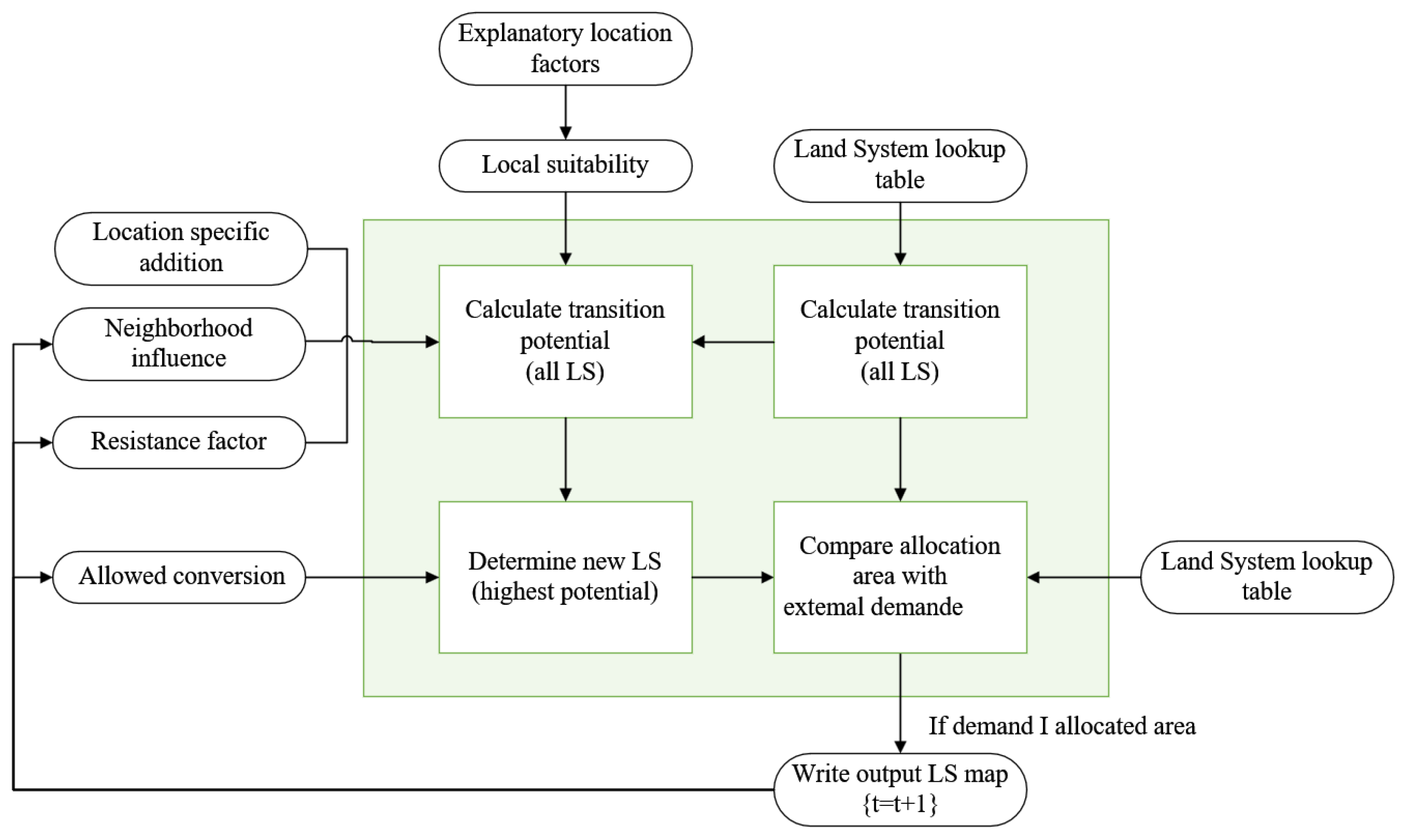
CLUMondo links non-spatial demand inputs with a spatial allocation module (
Figure 3). In this study, demand totals are generated outside CLUMondo. CLUMondo allocates these exogenous demands to grid cells. It translates macro-level quantity constraints into cell-level transitions under transition rules and competition. It simulates the spatial evolution of land-use systems over time.
In our coupled framework, the demand-forecasting stage provides annual land-use demand totals for the simulation period. We used Improved GM(1,1) to project future demands and to define scenario-specific quantity constraints. Driving factors were selected using an analytic hierarchy process. The selection reflects Ningxia’s physical conditions, socioeconomic context, and policy setting. The resulting indicator set covers physical, economic, and policy dimensions.
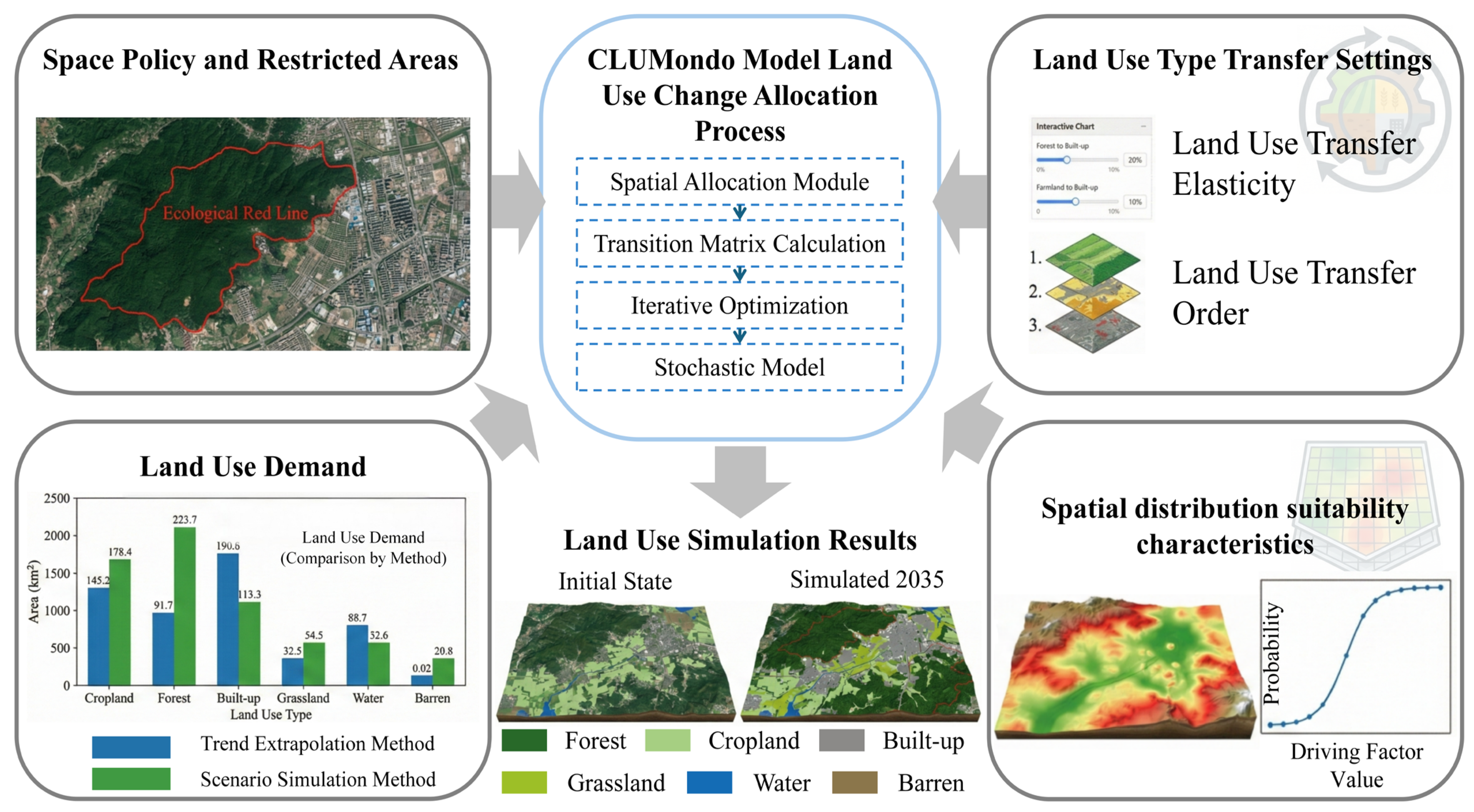
The spatial allocation module produces spatially explicit outcomes. It includes four components: spatial policies and restricted areas, land-use transition settings, land-use demand files, and suitability characteristics (
Figure 4). The module updates transition probabilities and competition among land categories at the grid scale. Suitability is estimated with logistic regression. Policy preferences and spatial constraints are applied during allocation. Iterations continue until land-use totals match the demand inputs and the constraint rules are satisfied. The final patterns reflect both quantity constraints and spatial drivers.
2.5.3. Regionally Tailored Selection of Driving Factors
In simulating cropland evolution in Ningxia, this study innovatively constructed a driving-factor selection system based on regional characteristics. Unlike the standardized or empirical factors used in traditional research, this approach involved a deep analysis of the natural endowment, social structure, market dynamics, and macro-policy environment of Ningxia’s arid, ecologically fragile zone. Core variables significantly impacting cropland transformation were specifically screened. This customized strategy enhanced the model’s ability to capture unique geographical processes, significantly improved spatial simulation precision, and ensured that results reflected the dynamics of land use under the context of ecological barrier construction and high-quality development.
Based on the regional status of Ningxia, representative factors were selected from four dimensions: physical, socioeconomic, market, and policy. The system included 15 common factors and 5 individual factors. The driver-data descriptions are provided in
Table 1.
2.5.4. Model Parameter Settings
(1) Regression Parameters. The regression parameter file is a core input for CLUMondo, recording the correlation weights between cropland distribution and driving factors determined via logistic regression. These parameters quantify the contribution of geographical environmental elements to land-use suitability. In this study, the regression parameters covered both regional common factors and individual factors tailored for the north-central plain, the central arid belt, and the southern mountainous area. The specific regression coefficients (
values) are shown in
Table 2. A positive value indicates a positive driving effect on cropland distribution, while a negative value indicates an inhibitory effect.
(2) Land-Use Transition Resistance Parameters. The land-use transition resistance parameter, also termed transfer elasticity, controls how difficult it is for a land category to be converted during competitive allocation. Values range from 0 to 1. Higher values indicate stronger resistance and higher stability. As shown in
Table 3, 0 means conversion is unconstrained, whereas 1 indicates near-irreversibility in the simulation. Resistance parameters were tuned through repeated backcasting runs over 2010–2020. This step served calibration only. The Kappa coefficient was used as a tuning criterion during the parameter search. Among the tested values, setting cropland resistance to 0.73 produced the highest agreement in the calibration runs, with Kappa = 0.87. For high-standard cropland in the north-central irrigation area, we set an ultra-high resistance to reflect rigid protection requirements. This setting follows the local policy framework in Ningxia, such as the Regulations on the Protection of High-Standard Farmland in Ningxia Hui Autonomous Region. It is used to limit conversion to non-agricultural land and ecological land during the simulation period. Other policy factors, including eco-migration, cropland protection, and eco-compensation, are quantified using logistic regression.
(3) Land-Use Transition Matrix. The transition matrix defines the permitted conversion paths for various land-use types during spatial allocation. Rows represent the current state, and columns represent the predicted future state. The numerical meanings are explained in
Table 4. For instance, 0 represents a prohibited conversion, while 1 represents a permitted one. Specific codes were used to restrict land-type changes after a certain number of years.
Based on actual observations of Ningxia’s land-use evolution from 2010 to 2020, active transition paths were set to “permitted.” The Ningxia transition matrix (
Table 5) ensured that the simulation adhered to realistic constraints; for example, construction land was set as irreversible to other land types during the simulation period.
3. Results and Analysis
3.1. Spatiotemporal Evolution of Cropland (2009–2024)
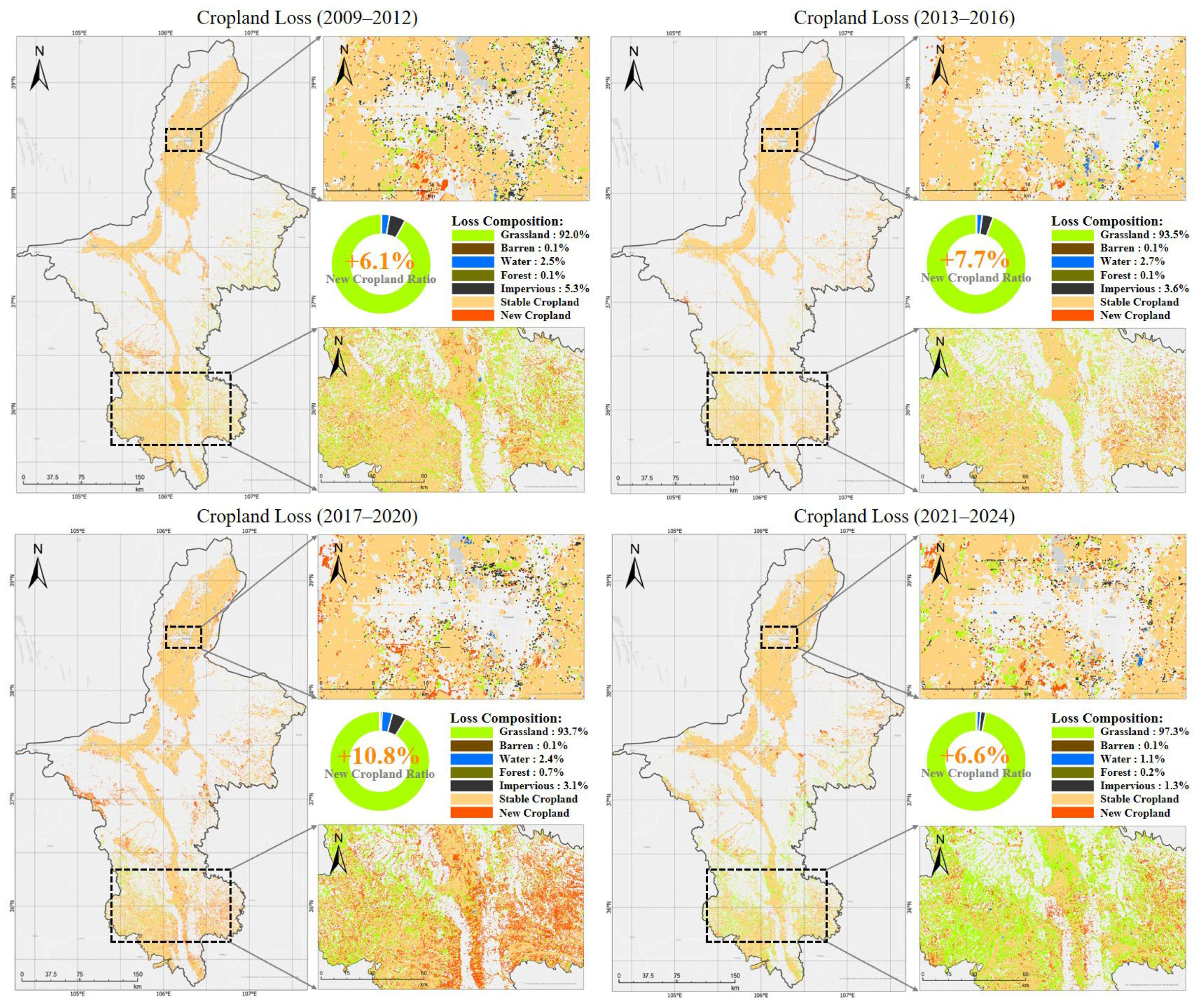
Grid-based spatial statistical analysis, based on land-use survey data, revealed that cropland resources in Ningxia between 2009 and 2024 exhibited a highly dynamic evolution pattern characterized by “intense overall fluctuations, distinct phase-specific features, and significant spatial differentiation.” The frequent interchange between cropland and ecological land constituted the primary theme of land-use change during this period. The spatial distribution and statistical results are illustrated in
Figure 5.
Based on change rates and net flow statistics, the evolution of cropland was categorized into four distinct stages:
Phase I (2009–2012)—Fluctuating Decline: Newly added cropland reached approximately ha (+6.08%), yet loss pressure remained high. Among the loss categories, conversion to grassland accounted for 91.98%, while impervious surface encroachment accounted for 5.3%.
Phase II (2013–2016)—Gentle Recovery: The scale of newly added cropland increased to ha (+7.72%), initiating an upward trend in cropland quantity. Loss pressure still originated primarily from grassland conversion (93.53%), while the proportion of impervious surface occupation decreased to 3.58%.
Phase III (2017–2020)—Significant Expansion: Cropland development reached unprecedented intensity, with newly added cropland totaling ha—a growth rate of 10.78%. This significantly exceeded the losses during the same period, indicating robust cropland replenishment driven by effective land consolidation and development.
Phase IV (2021–2024)—High-frequency Interchange: Although new cropland additions remained at ha (+6.61%), the conversion of cropland to grassland became extremely intense. Grassland accounted for a peak of 97.34% of the loss composition, while impervious surface encroachment dropped to a historic low of 1.3%. This reflects the dual characteristics of ecological restoration (returning farmland to grassland) and cropland requisition–compensation balance.
Spatial distribution and change statistics indicate significant regional disparities in Ningxia’s cropland evolution. Newly added cropland was concentrated in urban peripheries and southern Ningxia, though their evolution modes differed fundamentally. In urban peripheral areas, cropland transitions exhibited a “multi-category but small-quantity” fragmented pattern. Despite being the frontier of urbanization, cropland loss did not occur as large-scale contiguous disappearances but rather as sporadic conversions to water bodies and impervious surfaces, reflecting point-like adjustments during urban expansion. Conversely, transitions in southern Ningxia were characterized by a “single-category but large-quantity” pattern. This region served as a dual hotspot for both loss and replenishment: massive amounts of cropland were converted to grassland, aligning with persistent ecological restoration policies, while high-intensity land development also concentrated here, creating a complex coexistence of ecological withdrawal and cropland replenishment.
Driving-mechanism analysis further corroborated these spatial characteristics. Statistics showed that the contribution of impervious surfaces to cropland loss remained consistently low (1.35–5.25%) and showed a downward trend, indicating that urban construction was not the dominant driver of cropland reduction. Instead, the high-frequency conversion between cropland and grassland (consistently exceeding 90% of losses) revealed that biophysical factors and ecological policies, such as the “Grain for Green” program, were the core forces driving cropland fluctuations. Overall, Ningxia’s cropland changes exhibited a spatial pattern of “point-like adjustments in urban peripheries and intense interchange in the southern region”.
3.2. Model Calibration and Validation Results
3.2.1. Driving-Factor Significance and Optimal-Scale Selection
Prior to logistic regression, multicollinearity was assessed for the initial set of driving factors. Variables with a variance inflation factor above 5 were removed. Binary logistic regression was then fitted with cropland as the dependent variable, coded as 1. Variables were retained only when coefficient signs were consistent with regional geographic conditions and statistical significance reached p < 0.01. Explanatory power was assessed using the area under the curve. Variables with AUC below 0.7 were excluded. This procedure yielded 13 common driving factors for model construction.
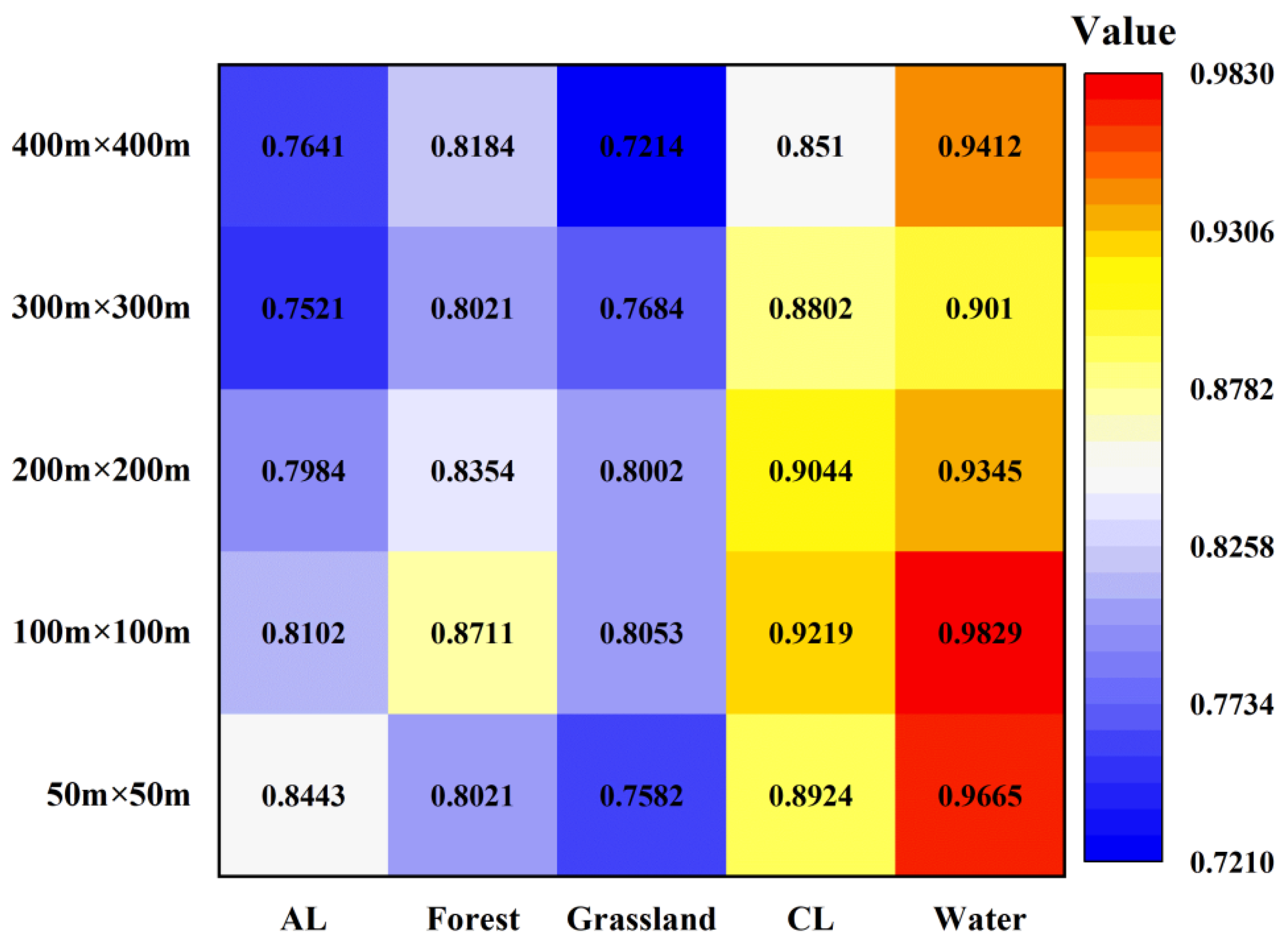
Scale sensitivity was tested by resampling the original data to five raster scales: 50 m, 100 m, 200 m, 300 m, and 400 m. Results in
Figure 6 show higher AUC values at finer scales. The 50 m scale achieves the highest AUC of 0.8443, indicating the strongest discrimination of cropland occurrence and transition suitability in Ningxia. Therefore, 50 m × 50 m was adopted as the implementation resolution for subsequent simulations and validation.
3.2.2. Simulation-Accuracy Verification
Model reliability was evaluated through four steps: collinearity testing, explanatory power filtering, scale optimization, and accuracy validation. Using the 2010 land-use map as the base period, the 2020 pattern was simulated on the 50 m × 50 m implementation grid. The simulated 2020 map was then compared cell-by-cell with the observed 2020 map using the Map Comparison Kit (MCK).
Table 6 reports validation results for the 2010–2020 simulation using the fixed parameter set. Adding regional individuality factors improves locational agreement. Overall accuracy increases from 90.34% to 93.34%. The Kappa coefficient ranges from 0.847 to 0.851 across the two settings. These results describe validation performance and support the use of CLUMondo for cropland simulation in Ningxia. These values should be distinguished from the Kappa criterion used during parameter calibration.
3.3. Future Cropland Demand Projections (2025–2040)
We first evaluated the demand module under a fixed training–testing split. We then used it for 2025–2040 scenario projections. Benchmark comparison was conducted for cropland demand forecasting under the fixed split. Calibration used annual cropland area from 2005 to 2015. Evaluation covered 2016–2020. Baselines included conventional GM(1,1), a linear trend model, and a persistence benchmark.
Table 7 reports MAE, RMSE, and MAPE for each method.
Table 7 reports the benchmark errors under the fixed split. Improved GM(1,1) yields the lowest RMSE and MAPE. The persistence baseline yields the lowest MAE over the short evaluation window. We therefore use Improved GM(1,1) to set cropland demand for subsequent scenario projections. The persistence benchmark assumes constant demand and is not used for 2025–2040 scenario projections.
3.3.1. Business-As-Usual (BAU) Scenario Demand Projection
The BAU scenario assumes continuation of recent trends from 2009 to 2024 without major new policy interventions. Projections (
Table 8) indicate slow cropland contraction and steady expansion of impervious surfaces under the BAU setting.
3.3.2. Ecological-Protection (EP) Scenario
The EP scenario applies stronger ecological constraints. It doubles the historical annual growth rate of forestland and restricts transitions out of protected areas. Projections (
Table 9) indicate higher forest and grassland demand than BAU. Cropland demand declines more slowly under the EP setting.
3.3.3. Rapid-Urbanization (URE) Scenario
The URE scenario represents accelerated urbanization. It increases the impervious surface growth rate to two times the historical rate. Projections (
Table 10) indicate faster cropland contraction and greater conversion pressure on high-quality cropland during the rapid-urbanization period.
3.4. Multi-Scenario Spatial Pattern Simulation
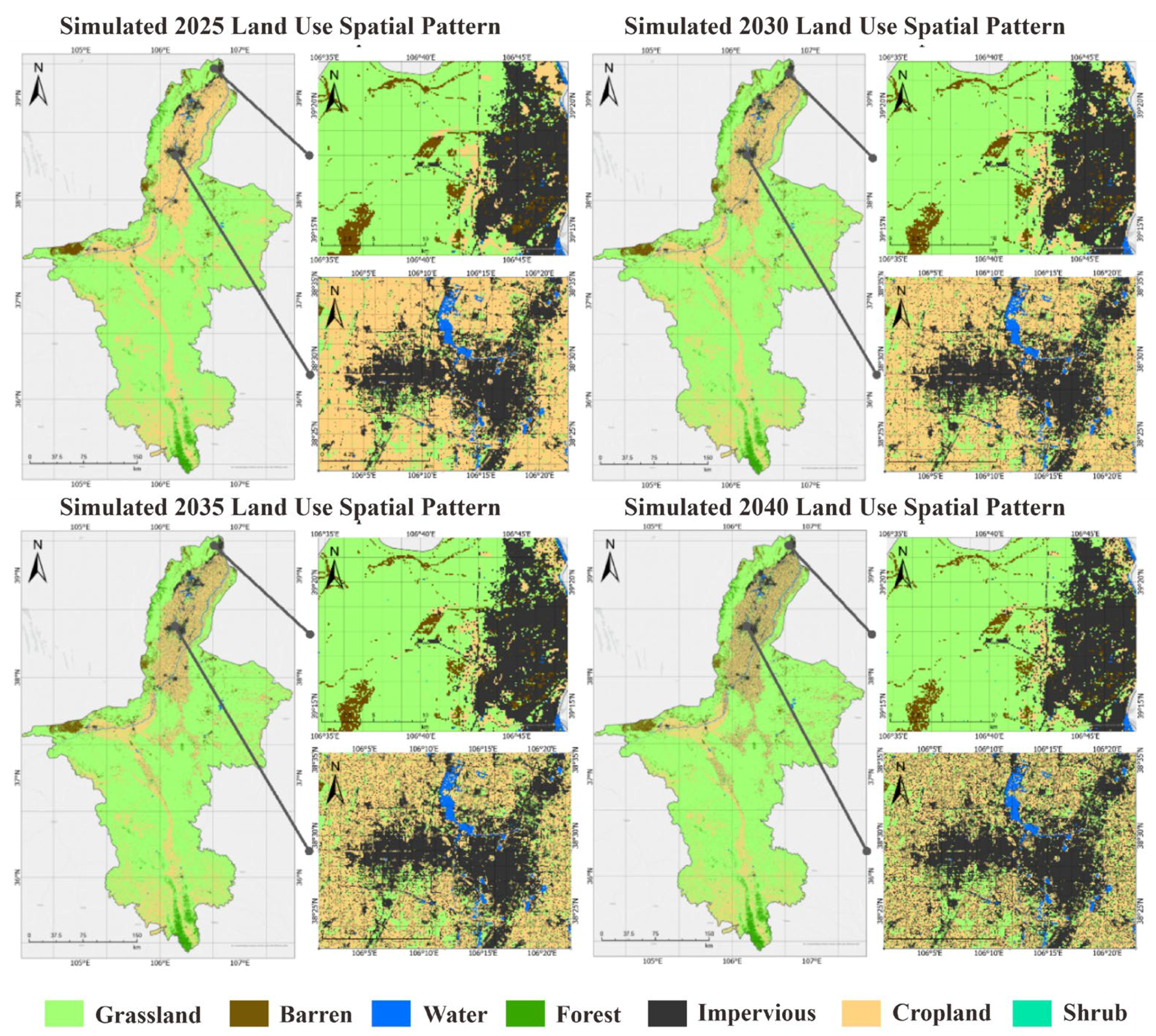
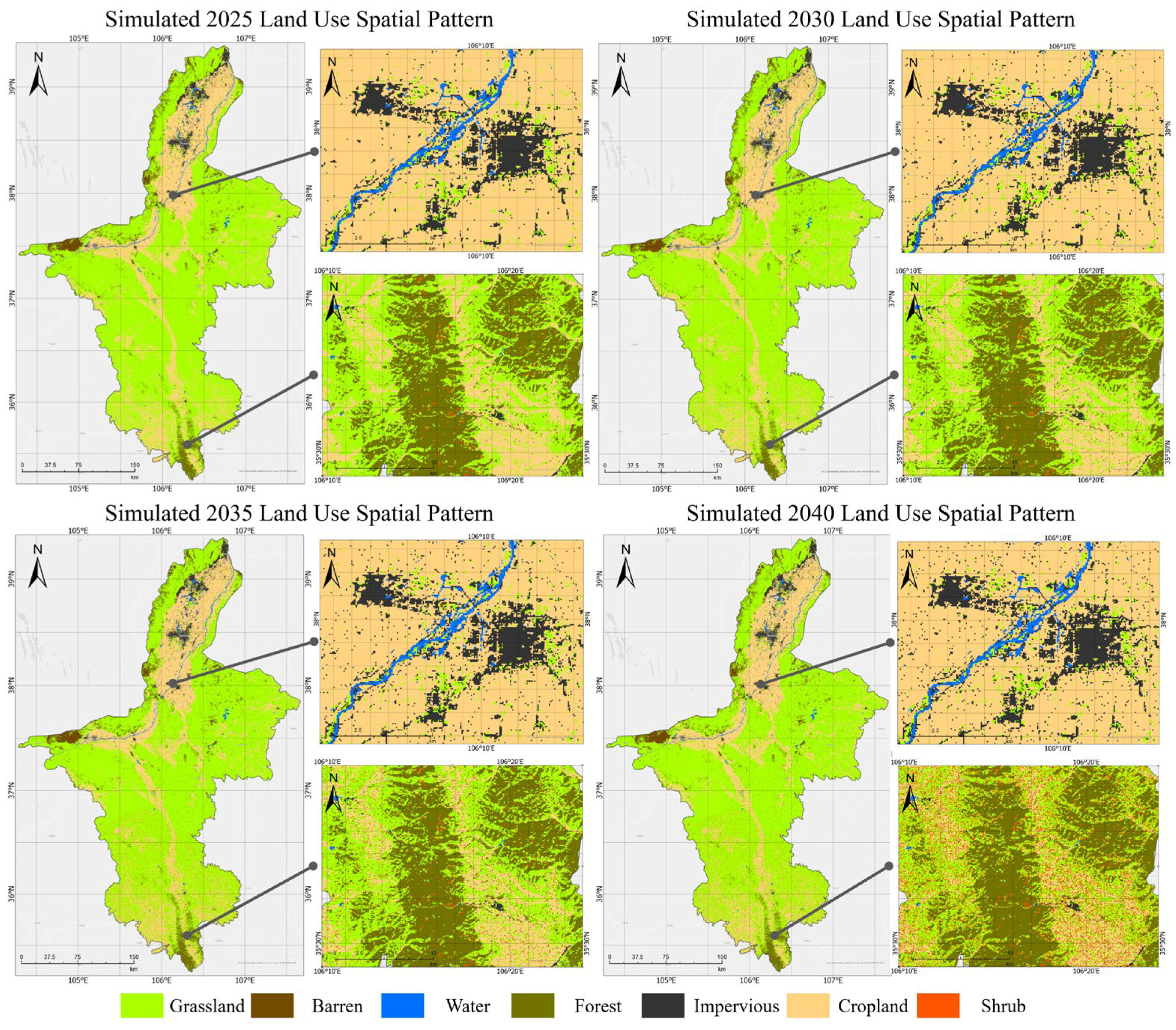
Based on the total demand for various land types determined by the improved model, this study used the CLUMondo model to dynamically allocate the spatial pattern of land use in Ningxia in 2040. By simulating geographical processes under different development orientations, the evolution of cultivated land resources in a complex competitive environment was revealed.
3.4.1. Business-As-Usual (BAU) Scenario Spatial Simulation
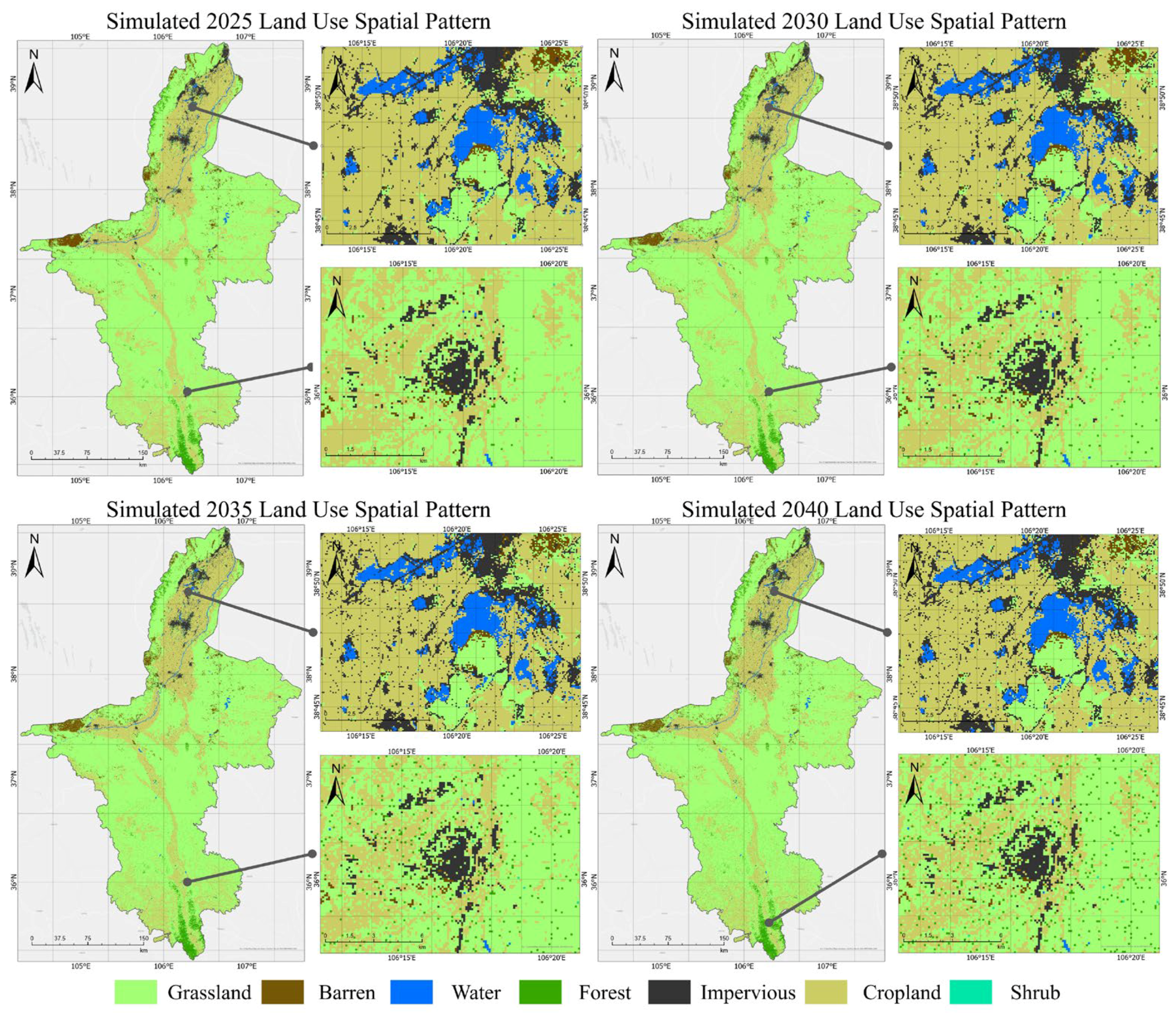
The business-as-usual (BAU) scenario, also referred to as the natural growth scenario, assumes that regional land-use changes continue the historical inertia observed from 2009 to 2024, in the absence of extreme policy interventions or external shocks. The model employs the land-use transition matrix and conversion elasticity parameters from the baseline period to reveal the intrinsic patterns of land-system evolution under prevailing development trajectories. As illustrated in
Figure 7, the simulated land-use spatial pattern under the BAU scenario in 2040 exhibits pronounced path dependence, with cropland serving as the core competing land-use type and displaying distinct regional variations in spatial transfer.
Under this scenario, cropland loss is primarily concentrated in two hotspot areas. First, in the southern mountainous region, the persistent inertia of ecological cropland retirement policies drives the steady conversion of slope cropland to forestland and grassland. Second, in the peri-urban fringes of core cities such as Yinchuan and Wuzhong, as well as key towns, high-quality cropland is continually eroded by urban and rural construction expansion due to advantageous location factors. Meanwhile, cropland replenishment occurs mainly in the arid central zone, including Hongsibao District and Yanchi County, through the development of reserve resources and grassland reclamation. This process embodies the spatial dynamic equilibrium of “southern retreat and northern compensation, urban reduction and rural increase.” Construction land expands slowly, with new patches closely adhering to existing built-up areas and extending along major transportation corridors, forming a typical corridor-style expansion pattern.
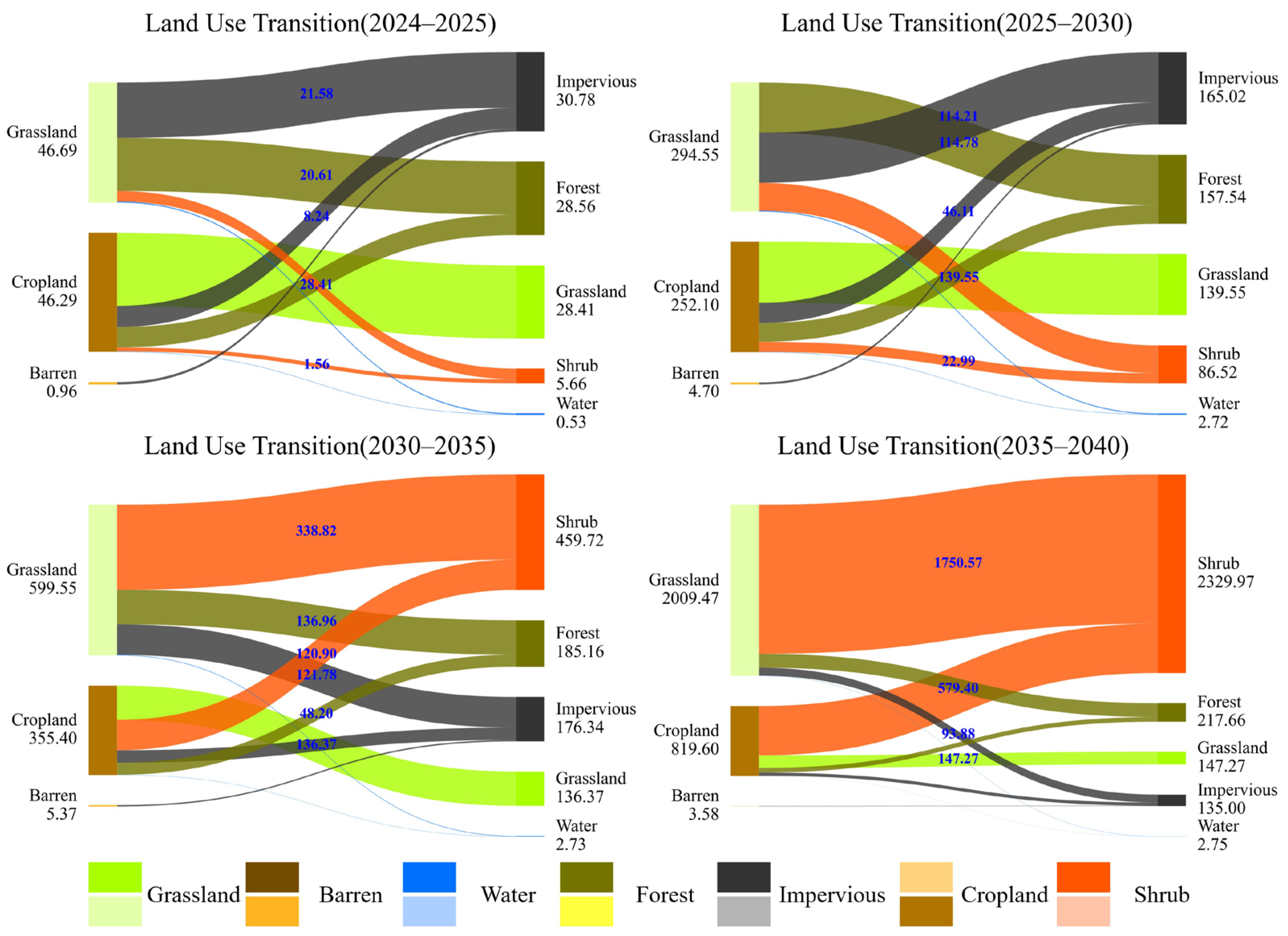
The land-use-type transitions under the natural growth scenario are presented in
Figure 8. Overall, this scenario reveals an inertial evolutionary trajectory grounded in historical patterns. Although measures such as land consolidation partially compensate for cropland quantity, the ongoing occupation of high-quality cropland by urban expansion and the passive pressure on ecological land remain unmitigated. While this development mode reflects continuity with the status quo, it harbors uncertainties that could exacerbate human–land conflicts and ecological risks.
3.4.2. Ecological-Protection Scenario Simulation
To achieve optimized land spatial allocation under ecological-protection objectives, this study implemented targeted parameter adjustments in the CLUMondo model. The land-use transition matrix was modified to restrict conversions from forestland and water bodies to other land types, with their conversion resistance parameters elevated to 0.95 to confer exceptionally high spatial stability. Additionally, forestland within national nature reserves was designated as restricted conversion zones to ensure rigid protection of core ecological-function areas. The resulting spatial pattern under the ecological-protection scenario in 2040 is shown in
Figure 9.
In this scenario, ecological land is effectively safeguarded. Forestland maintains spatial stability with slight expansion, primarily concentrated in key water conservation areas such as the Liupanshan and Yueliangshan in the south, as well as ecological restoration zones in the central arid belt. Compared with the BAU scenario, construction land expansion is significantly curtailed, manifesting primarily as infill development at existing urban edges, thereby effectively preventing disorderly encroachment into surrounding high-quality farmland and ecological spaces. Cropland evolution displays pronounced regional differentiation: southern mountainous areas continue steady cropland retirement for afforestation, while cropland loss rates in the northern irrigated plains decline substantially, with stricter protection afforded to high-quality farmland around urban peripheries. Detailed transition trajectories for relevant land types are presented in
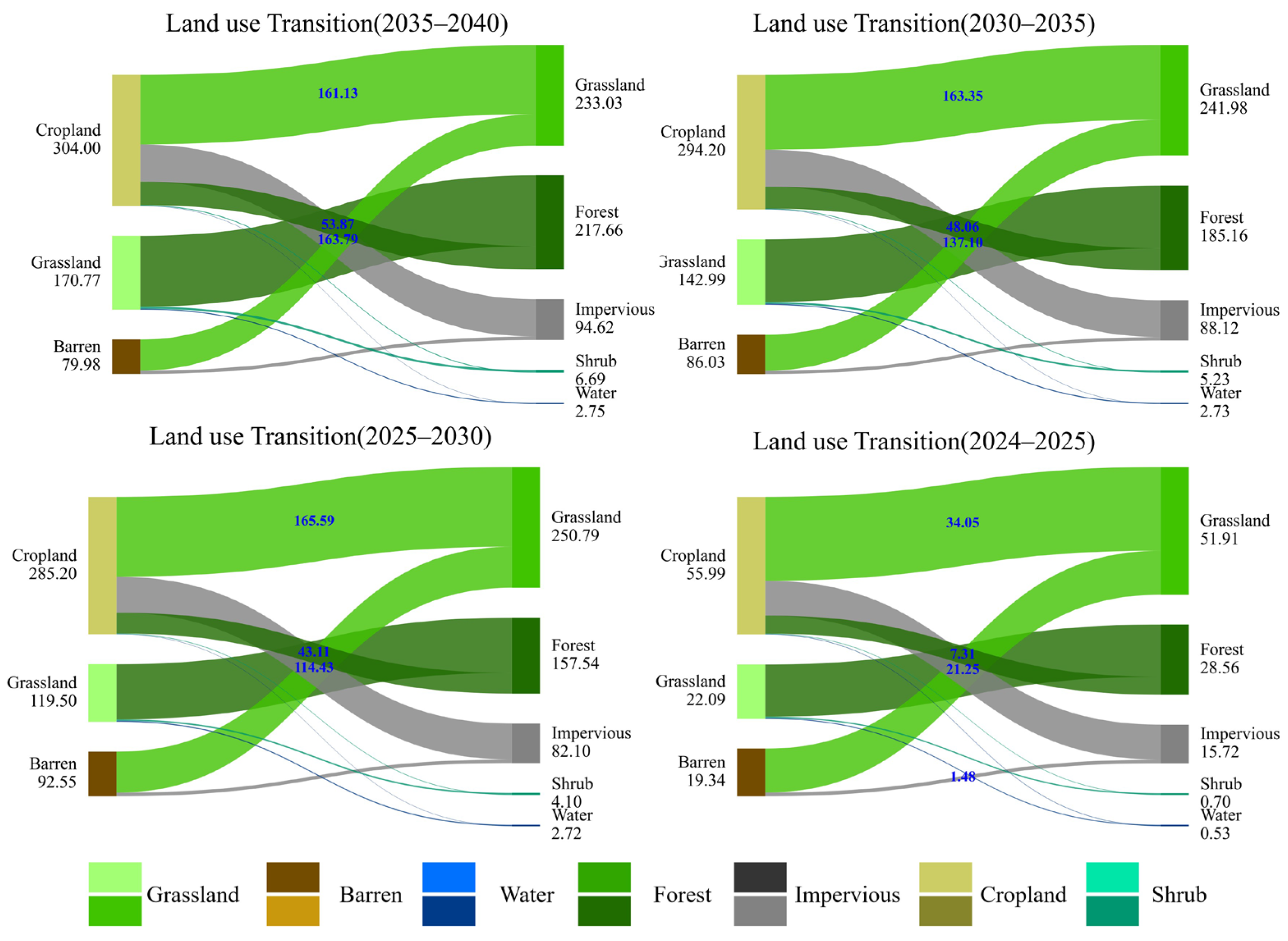
Figure 10.
The simulation results under the ecological-protection scenario demonstrate that assigning higher conversion resistance to ecological land and strengthening spatial access restrictions effectively directs land use toward pathways that enhance ecological security and sustainable development. This scenario maintains necessary development space while maximizing the integrity of the regional ecosystem, providing a scientifically grounded spatial framework for Ningxia’s construction as a pioneer zone for ecological protection and high-quality development in the Yellow River Basin.
3.4.3. Rapid-Urbanization Scenario
The rapid-urbanization scenario assesses land resource evolution risks under a development-priority orientation. In this scenario, the land-use transition matrix was modified to prioritize conversions from cropland and grassland to construction land, with construction land elasticity set to a low value (0.1) to facilitate expansion. Meanwhile, higher elasticity values were assigned to cropland and forestland in ecologically sensitive zones to reflect baseline protection levels. The spatial simulation results for 2040, shown in
Figure 11, reveal an aggressive construction land expansion pattern primarily at the expense of cropland.
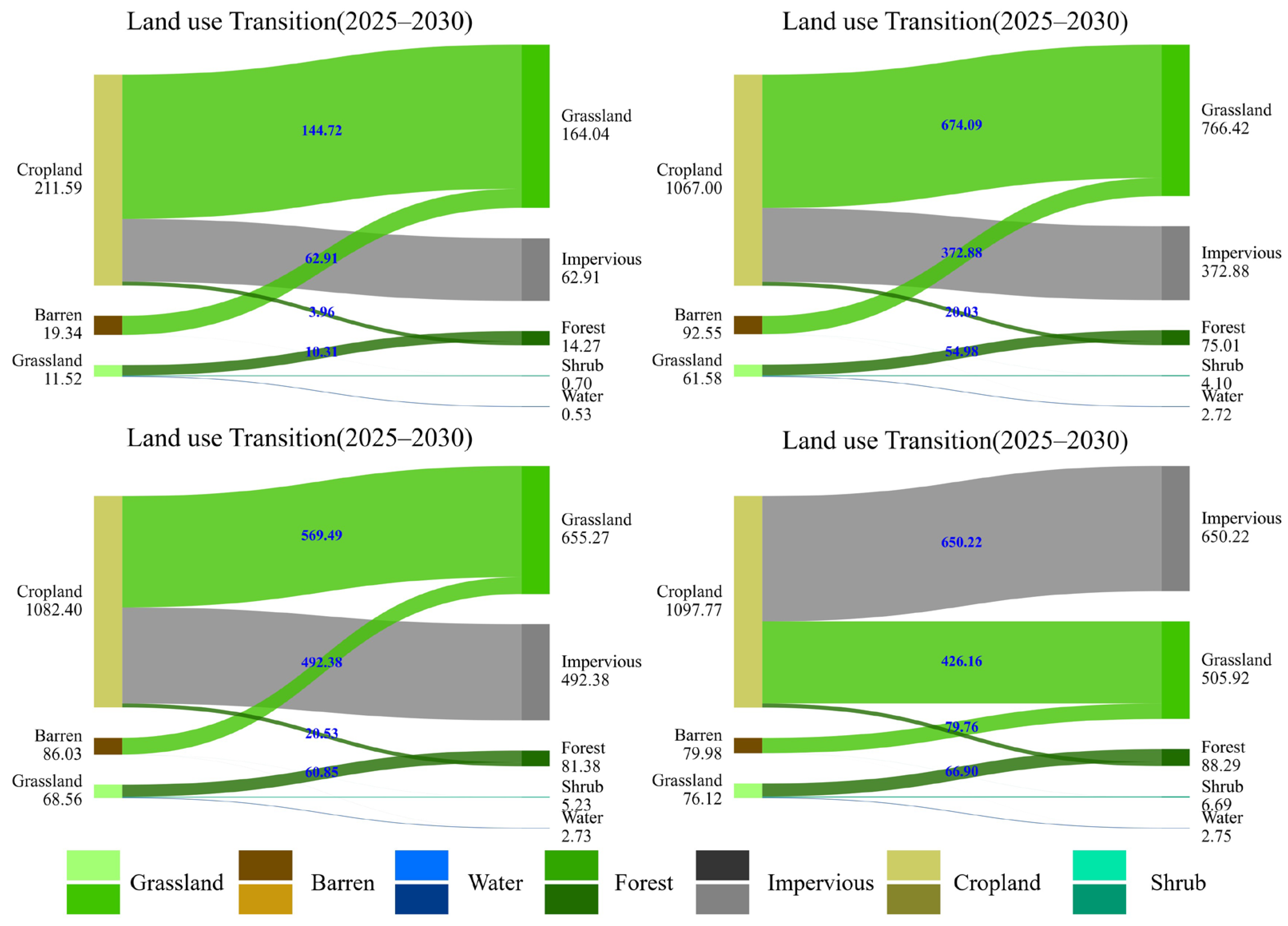
New construction land exhibits strong spatial agglomeration, concentrating mainly in the Yinchuan metropolitan area (particularly Jinfeng and Xingqing Districts), Lingwu City, and peri-urban areas along major transportation corridors such as the Beijing–Tibet Expressway and Baotou–Lanzhou Railway. These regions, benefiting from superior locational advantages, become primary targets for urban sprawl. Consequently, high-quality cropland loss is most severe in the agriculturally rich plains of central–northern Ningxia, which overlap substantially with the core economic development axis. This spatial coincidence between premium resources and expansion hotspots underscores the fundamental conflict between economic growth and agricultural protection. Under this scenario, forestland growth is severely constrained, limited to existing southern ecological function areas, rendering it inadequate to meet region-wide ecological demands. Land-conversion characteristics under the urbanization scenario are depicted in
Figure 12.
3.4.4. Comparison of Simulation Results Across Scenarios and Policy Implications
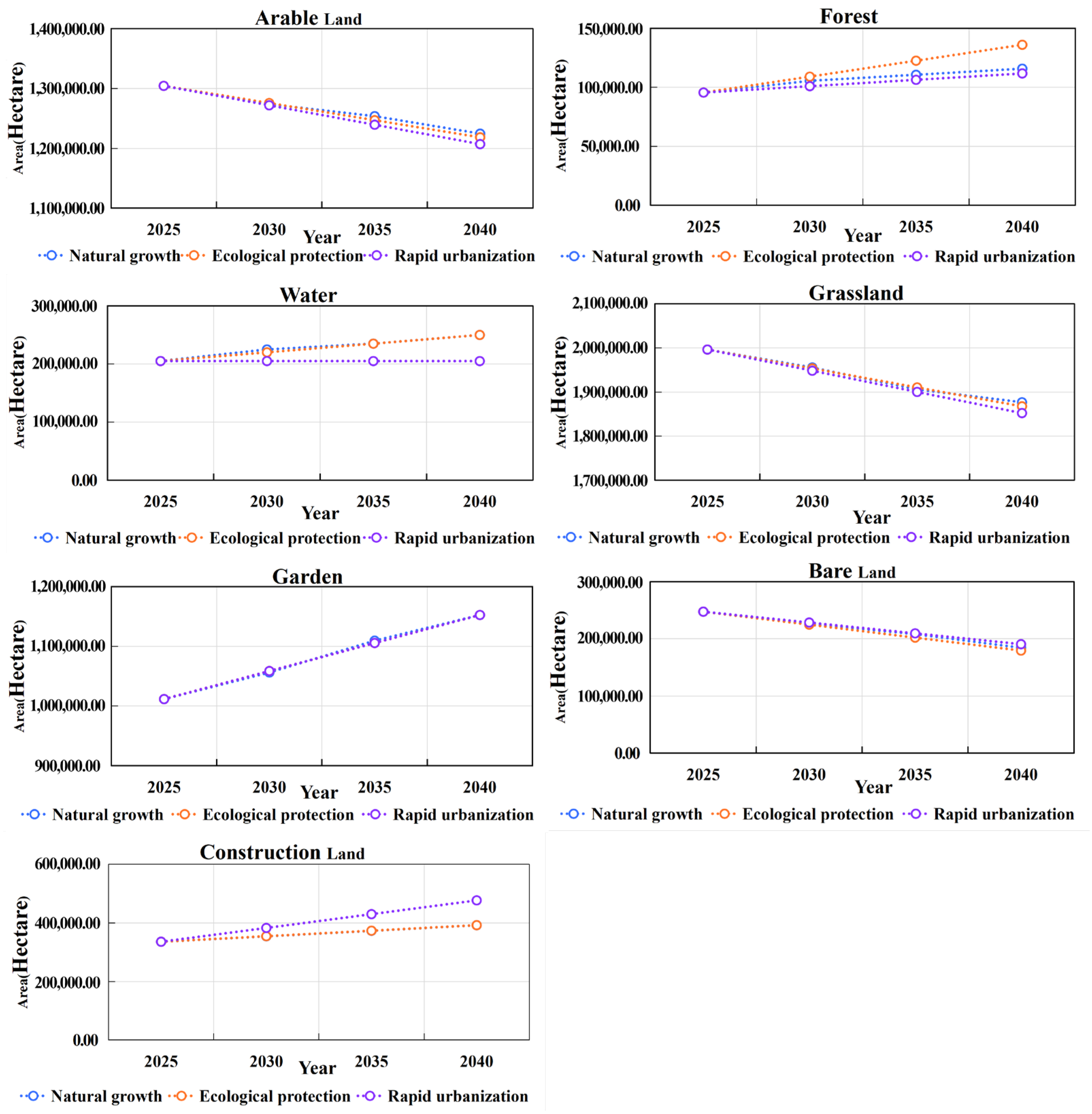
A cross-scenario comparison of the simulated outcomes for the business-as-usual (BAU), ecological-protection (EP), and rapid-urbanization (URE) scenarios (
Figure 13) systematically elucidates the response mechanisms of Ningxia’s territorial spatial patterns to divergent development pathways. This comparison quantifies differences in land-use structure changes and, through spatially explicit visualization, identifies potential conflicts and coordination pathways among cropland protection, ecological restoration, and urban expansion under varying policy orientations.
In terms of quantitative structural dynamics, all three scenarios exhibit the common feature of bidirectional contraction in cropland and grassland alongside sustained expansion of construction land, albeit with substantial differences in magnitude and rate. The URE scenario shows the most drastic cumulative cropland reduction, reflecting the direct encroachment of high-intensity infrastructure and urban development on high-productivity farmland, posing a severe threat to regional food security. In contrast, the EP scenario mitigates cropland loss rates through strict ecological control lines and enhanced ecological land stability. Notably, forestland and water body growths are most pronounced under the EP scenario, with stronger spatial clustering of forestland, achieving dual improvements in ecological asset quantity and quality. The BAU scenario, reliant on historical inertia, occupies an intermediate level in both environmental improvement and cropland-protection intensity.
Spatially, the three scenarios reflect distinct governance orientations. The BAU scenario embodies a typical “inertia-dependent” mode, with cropland loss and construction land expansion hotspots aligning closely with historical trends—ongoing retirement in southern mountains, passive occupation around northern core cities, and sporadic replenishment in the central arid belt. While consistent with historical logic, this mode lacks forward-looking guidance for future complex human–land conflicts. The URE scenario adopts a “development-first, premium occupation” strategy, featuring intense patchwork and corridor-style expansion that targets agriculturally optimal and economically vibrant zones, resulting in the most direct and acute spatial conflict between grain-producing areas and urban development zones. Conversely, the EP scenario achieves an optimized layout of “core stability and conflict mitigation” by assigning high conversion resistance to ecologically sensitive areas, thereby locking and protecting key ecological barriers in southern Liupanshan and central desertification control zones while indirectly safeguarding large contiguous high-quality cropland in the Yellow River irrigated plains through restrictions on disorderly outward urban sprawl.
The policy implications derived from the integrated simulation results indicate that Ningxia must seek a scientifically balanced point among “development, protection, and security” in future land-resource management and spatial planning. The natural-growth pathway, though stable, struggles to alleviate continuous pressure on resource and environmental carrying capacity, while the rapid-urbanization pathway is unsustainable due to excessive ecological and food security costs. Therefore, the “ecology-first development, redline-protected baseline” approach revealed by the EP scenario represents the optimal spatial allocation scheme for Ningxia’s pioneer zone in Yellow River Basin ecological protection and high-quality development.
Accordingly, this study proposes the following policy recommendations: First, strengthen the rigid constraints of territorial spatial planning by delineating permanent protection zones for high-quality cropland in Yellow River irrigated plains and strictly prohibiting disorderly urban expansion. Second, leverage the “southern retreat and northern compensation” spatial dynamic to advance ecological migration follow-up land management and restoration in southern mountainous areas, while implementing scientific land consolidation in central–northern reserve agricultural resources to ensure balanced cropland occupation and supplementation in terms of quality and ecological benefits. Finally, establish a dynamic monitoring and early-warning platform based on spatial simulations, utilizing models such as CLUMondo to periodically assess land-system responses to major policy implementations, thereby providing scientific support for achieving intensive and efficient production spaces, livable and moderate living spaces, and scenic ecological spaces within Ningxia’s limited territorial resources.
4. Discussion
This study simulated cropland trajectories in Ningxia under multiple scenarios by coupling an improved grey demand forecast with CLUMondo spatial allocation. The main contribution is an explicit link between demand dynamics and spatial reallocation. Demand is defined as a constrained trajectory. Allocation is defined as rule-governed competition among land systems. This separation clarifies where assumptions enter. It also reduces the risk that reasonable totals generate spatial artifacts.
Dryland land systems pose a specific modeling problem. Time series are short and noisy. Water and terrain restrict feasible transitions. Policy can induce regime shifts that are not extrapolations of past trends. Under these conditions, demand estimation is sensitive to sample length and structural breaks. The improved grey model reduces instability in medium- to long-horizon demand forecasts under small samples and nonlinear change. CLUMondo then translates demand into spatial outcomes under explicit conversion rules and constraint masks. Allocation remains consistent with institutional and biophysical boundaries defined in the scenario settings.
A key implication concerns the role of constraints. Constraints are not margins around an unconstrained system. They act as institutions that reshape transition probabilities and spatial opportunity sets. Tightening constraints in one location reallocates pressure to other locations. This induces displacement and leakage. It also creates redistribution of exposure and conflict even when area totals change little. Scenario interpretation therefore requires spatial outcomes. Area summaries alone can conceal constraint-induced reallocation.
Scale dependence is another implication. Model performance is not monotonic with resolution. In drylands, transitions follow irrigation networks, river corridors, oasis margins, and accessibility gradients. These structures operate at intermediate ranges. Very fine grids amplify local noise and classification error. Very coarse grids smooth corridor processes and neighborhood effects. Scale selection is therefore not a technical afterthought. It is part of model specification. It affects inferred drivers, transition elasticities, and the stability of hotspot identification.
The spatial mechanisms in Ningxia indicate differentiated transition regimes. Conversion pressure concentrates in irrigated plains with higher accessibility and development intensity. Retreat concentrates in mountainous and ecologically constrained zones where restoration priorities and terrain limits dominate. This pattern aligns with a broader dryland logic. Irrigated cores face competition among production, settlement, and infrastructure. Marginal lands become the adjustment margin for ecological targets. This creates asymmetric risk. Protection policies reduce local conversion but can shift pressure spatially if demand persists.
Comparative interpretation suggests both commonalities and context specificity relative to other global drylands. Corridor concentration of land change around irrigation and infrastructure is widely reported. Conservation-driven land retirement in fragile zones is also common. Ningxia differs in the strength of spatial governance and in the role of large projects. Binding rules can sharpen spatial reconfiguration relative to weakly enforced systems. Infrastructure and water engineering can generate abrupt local change. These changes resemble policy shocks more than incremental responses to gradual drivers. Residual local mismatches between simulations and observations are consistent with such discontinuities.
Uncertainty remains material. Socioeconomic projections are conditional inputs rather than outcomes of endogenous feedback. Population and economic trajectories may deviate under macro shocks or structural transitions. This propagates to land demand and changes effect magnitudes. Policy implementation is also variable. Enforcement intensity, compliance, and timing differ across jurisdictions and fiscal cycles. Assumed constraints may therefore be applied unevenly in practice. External drivers add further uncertainty. Climate variability and climate change alter water availability, yield stability, and suitability. They also shift the opportunity cost of cropland in arid regions. These processes are not explicitly coupled into the current demand module. Results should be treated as conditional scenario outcomes under stated assumptions, not as point forecasts.
Several limitations follow. Some parameters retain expert judgment after calibration. Automated optimization could reduce subjectivity and improve reproducibility. Demand is treated as exogenous to spatial feedback. Yet yields, water stress, and governance responses can feed back into demand and transition rules. Coupling water constraints and climate-sensitive productivity signals would strengthen inference in drylands. External benchmarking across dryland regions with contrasting governance regimes would also test transferability and reveal context-dependent components of the coupled framework.
5. Conclusions
Taking the Ningxia Hui Autonomous Region as the study area, this paper developed an integrated simulation framework combining an improved grey prediction model with the CLUMondo spatial model. It systematically analyzed historical cropland evolution characteristics from 2009 to 2024 and projected patterns under multiple scenarios from 2025 to 2040. The findings indicate that cropland changes in Ningxia during 2009–2024 exhibited intense phased fluctuations, forming a pronounced spatial dynamic equilibrium of “southern retreat and northern compensation, urban reduction and rural increase”. Logistic regression analysis further confirms that population density growth, economic expansion proxied by nighttime light indices, and policy regulation jointly drive the spatiotemporal reconfiguration of cropland in Ningxia.
In model construction and scale optimization, a driving-factor system was established, comprising 10 domain-wide common factors and six region-specific factors. Multi-scale regression tests show the highest AUC at 50 m, with AUC values exceeding 0.8 across land types. Therefore, 50 m × 50 m was used as the implementation resolution for subsequent simulations and validation. Model performance is supported by agreement-based and classification-based evaluation metrics reported in the results. These outcomes demonstrate the capacity of the CLUMondo model to reproduce cropland patterns in Ningxia and support its applicability for long-term scenario forecasting in arid, ecologically fragile regions.
Comparative simulations across natural-growth, ecological-protection, and rapid-urbanization pathways indicate that divergent policy orientations yield markedly different territorial spatial patterns. Continuation of historical inertia sustains pressure on cropland protection and ecological security, while rapid urban expansion increases the risk of cropland loss in central–northern irrigated zones. In contrast, the ecological-protection scenario strengthens constraints on construction land expansion and secures critical ecological spaces, thereby slowing the loss of high-quality cropland while maintaining development capacity.
In summary, an ecology-first orientation is recommended for future territorial spatial governance in Ningxia. Rigid redline constraints should be strengthened to protect cropland in the central–northern Yellow River irrigated zones and key ecological barriers. Intensive urban growth should be promoted with explicit ceilings for construction land expansion. Dynamic spatial simulation should be used as a decision-support tool for scenario-based assessments of ecological impacts and food security risks associated with major projects. The proposed framework offers a transferable reference for sustainable land use and spatial governance in arid and semi-arid regions.
Author Contributions
Conceptualization, Y.C. and X.H.; methodology, Y.C. and Y.L. (Yanfang Liu).; software, Y.C. and X.H.; validation, D.L. and L.C.; formal analysis, D.L. and L.C.; investigation, Y.C.; resources, Y.C. and Y.L. (Yaolin Liu); data curation, D.L. and Q.L.; writing—original draft, Y.C.; writing—review and editing, Y.C. and D.L.; visualization, Y.C. and X.H.; supervision, Y.L. (Yanfang Liu); funding acquisition, Y.L. (Yaolin Liu). All authors have read and agreed to the published version of the manuscript.
Funding
This work was supported by the National Natural Science Foundation of China (NSFC) through the following grants: (1) Key Program, Grant No. 42230107, “Modeling theory and methodology of land use spatial optimization allocation based on coupling of natural–human geographic processes”; (2) Grant No. 42471454, “Identification and cause inference of imbalanced interactive relationship between residents’ travel and urban land based on integrated sensing data”.
Data Availability Statement
The original contributions presented in the study are included in the article, further inquiries can be directed at the corresponding author.
Conflicts of Interest
Author Xiankang Hua was employed by the company Xi’an Lvhuan Forestry Technology Service Co., Ltd. The remaining authors declare that the research was conducted in the absence of any commercial or financial relationships that could be construed as a potential conflict of interest.
References
- Foley, J.A.; DeFries, R.; Asner, G.P.; Barford, C.; Bonan, G.; Carpenter, S.R.; Chapin, F.S.; Coe, M.T.; Daily, G.C.; Gibbs, H.K.; et al. Global Consequences of Land Use. Science 2005, 309, 570–574. [Google Scholar] [CrossRef] [Scilit]
- Verburg, P.H.; Crossman, N.; Ellis, E.C.; Heinimann, A.; Hostert, P.; Mertz, O.; Nagendra, H.; Sikor, T.; Erb, K.-H.; Golubiewski, N.; et al. Land System Science and Sustainable Development of the Earth System: A Global Land Project Perspective. Anthropocene 2015, 12, 29–41. [Google Scholar] [CrossRef] [Scilit]
- Long, H.; Qu, Y. Land Use Transitions and Land Management: A Mutual Feedback Perspective. Land Use Policy 2018, 74, 111–120. [Google Scholar] [CrossRef] [Scilit]
- Lambin, E.F.; Meyfroidt, P. Global Land Use Change, Economic Globalization, and the Looming Land Scarcity. Proc. Natl. Acad. Sci. USA 2011, 108, 3465–3472. [Google Scholar] [CrossRef] [Scilit] [PubMed]
- Bryan, B.A.; Gao, L.; Ye, Y.; Sun, X.; Connor, J.D.; Crossman, N.D.; Stafford-Smith, M.; Wu, J.; He, C.; Yu, D.; et al. China’s Response to a National Land-System Sustainability Emergency. Nature 2018, 559, 193–204. [Google Scholar] [CrossRef] [Scilit]
- Li, Z.; Song, K.; Peng, L.; Li, Z.; Song, K.; Peng, L. Flood Risk Assessment under Land Use and Climate Change in Wuhan City of the Yangtze River Basin, China. Land 2021, 10, 878. [Google Scholar] [CrossRef] [Scilit]
- Findell, K.L.; Berg, A.; Gentine, P.; Krasting, J.P.; Lintner, B.R.; Malyshev, S.; Santanello, J.A., Jr.; Shevliakova, E. The impact of anthropogenic land use and land cover change on regional climate extremes. Nat. Commun. 2017, 8, 989. [Google Scholar] [CrossRef] [Scilit]
- Bao, C.; Fang, C. Water Resources Constraint Force on Urbanization in Water Deficient Regions: A Case Study of the Hexi Corridor, Arid Area of NW China. Ecol. Econ. 2007, 62, 508–517. [Google Scholar] [CrossRef] [Scilit]
- Bürgi, M.; Hersperger, A.M.; Schneeberger, N. Driving Forces of Landscape Change—Current and New Directions. Landsc. Ecol. 2005, 19, 857–868. [Google Scholar] [CrossRef] [Scilit]
- Yong, X.; Chuansheng, W. Ecological Protection and High-Quality Development in the Yellow River Basin: Framework, Path, and Countermeasure. Bull. Chin. Acad. Sci. 2020, 35, 875–883. [Google Scholar] [CrossRef]
- Restrepo, A.M.C.; Yang, Y.R.; Hamm, N.A.S.; Gray, D.J.; Barnes, T.S.; Williams, G.M.; Magalhães, R.J.S.; McManus, D.P.; Guo, D.; Clements, A.C.A. Land cover change during a period of extensive landscape restoration in Ningxia Hui Autonomous Region, China. Sci. Total Environ. 2017, 598, 669–679. [Google Scholar] [CrossRef] [Scilit] [PubMed]
- Hernandez, R.R.; Easter, S.B.; Murphy-Mariscal, M.L.; Maestre, F.T.; Tavassoli, M.; Allen, E.B.; Barrows, C.W.; Belnap, J.; Ochoa-Hueso, R.; Ravi, S.; et al. Environmental Impacts of Utility-Scale Solar Energy. Renew. Sustain. Energy Rev. 2014, 29, 766–779. [Google Scholar] [CrossRef] [Scilit]
- Yang, Y.; Feng, Z.; Wang, L.; You, Z. Research on the Suitability of Population Distribution at the Provincial Scale in China. J. Geogr. Sci. 2014, 24, 889–906. [Google Scholar] [CrossRef] [Scilit]
- Veldkamp, A.; Lambin, E.F. Predicting Land-Use Change. Agric. Ecosyst. Environ. 2001, 85, 1–6. [Google Scholar] [CrossRef] [Scilit]
- De Rosa, M.; Knudsen, M.T.; Hermansen, J.E. A Comparison of Land Use Change Models: Challenges and Future Developments. J. Clean. Prod. 2016, 113, 183–193. [Google Scholar] [CrossRef] [Scilit]
- Guan, D.; Li, H.; Inohae, T.; Su, W.; Nagaie, T.; Hokao, K. Modeling Urban Land Use Change by the Integration of Cellular Automaton and Markov Model. Ecol. Model. 2011, 222, 3761–3772. [Google Scholar] [CrossRef] [Scilit]
- Rounsevell, M.D.A.; Reginster, I.; Araújo, M.B.; Carter, T.R.; Dendoncker, N.; Ewert, F.; House, J.I.; Kankaanpää, S.; Leemans, R.; Metzger, M.J.; et al. A Coherent Set of Future Land Use Change Scenarios for Europe. Agric. Ecosyst. Environ. 2006, 114, 57–68. [Google Scholar] [CrossRef] [Scilit]
- van Asselen, S.; Verburg, P.H. Land Cover Change or Land-Use Intensification: Simulating Land System Change with a Global-Scale Land Change Model. Glob. Change Biol. 2013, 19, 3648–3667. [Google Scholar] [CrossRef] [Scilit]
- Verburg, P.H.; Soepboer, W.; Veldkamp, A.; Limpiada, R.; Espaldon, V.; Mastura, S.S.A. Modeling the Spatial Dynamics of Regional Land Use: The CLUE-S Model. Environ. Manag. 2002, 30, 391–405. [Google Scholar] [CrossRef] [Scilit]
- Liu, X.; Liang, X.; Li, X.; Xu, X.; Ou, J.; Chen, Y.; Li, S.; Wang, S.; Pei, F. A Future Land Use Simulation Model (FLUS) for Simulating Multiple Land Use Scenarios by Coupling Human and Natural Effects. Landsc. Urban Plan. 2017, 168, 94–116. [Google Scholar] [CrossRef] [Scilit]
- Xu, X.; Kong, W.; Wang, L.; Wang, T.; Luo, P.; Cui, J. A novel and dynamic land use/cover change research framework based on an improved PLUS model and a fuzzy multiobjective programming model. Ecol. Inform. 2024, 80, 102460. [Google Scholar] [CrossRef] [Scilit]
- Wu, L.; He, Y.; Tan, Q.; Zheng, Y. Land-use simulation for synergistic pollution and carbon reduction: Scenario analysis and policy implications. J. Environ. Manag. 2024, 356, 120603. [Google Scholar] [CrossRef] [Scilit] [PubMed]
- Wang, Q.; Guan, Q.; Lin, J.; Luo, H.; Tan, Z.; Ma, Y. Simulating land use/land cover change in an arid region with the coupling models. Ecol. Indic. 2021, 122, 107231. [Google Scholar] [CrossRef] [Scilit]
- Geng, J.; Shen, S.; Cheng, C.; Dai, K. A hybrid spatiotemporal convolution-based cellular automata model (ST-CA) for land-use/cover change simulation. Int. J. Appl. Earth Obs. Geoinf. 2022, 110, 102789. [Google Scholar] [CrossRef] [Scilit]
- Koko, A.F.; Han, Z.; Wu, Y.; Zhang, S.; Ding, N.; Luo, J. Spatiotemporal analysis and prediction of urban land use/land cover changes using a cellular automata and novel patch-generating land use simulation model: A study of Zhejiang Province, China. Land 2023, 12, 1525. [Google Scholar] [CrossRef] [Scilit]
- Seto, K.C.; Fragkias, M.; Güneralp, B.; Reilly, M.K. A Meta-Analysis of Global Urban Land Expansion. PLoS ONE 2011, 6, e23777. [Google Scholar] [CrossRef] [Scilit]
- Gao, L.; Tao, F.; Liu, R.; Wang, Z.; Leng, H.; Zhou, T. Multi-scenario simulation and ecological risk analysis of land use based on the PLUS model: A case study of Nanjing. Sustain. Cities Soc. 2022, 85, 104055. [Google Scholar] [CrossRef] [Scilit]
- Turner, B.L., II. Land System Architecture for Urban Sustainability: New Directions for Land System Science Illustrated by Application to the Urban Heat Island Problem. J. Land Use Sci. 2016, 11, 689–697. [Google Scholar] [CrossRef] [Scilit]
- Gislason, P.O.; Benediktsson, J.A.; Sveinsson, J.R. Random Forests for Land Cover Classification. Pattern Recognit. Lett. 2006, 27, 294–300. [Google Scholar] [CrossRef] [Scilit]
- Moeck, C.; von Freyberg, J.; Schirmer, M. Groundwater Recharge Predictions in Contrasted Climate: The Effect of Model Complexity and Calibration Period on Recharge Rates. Environ. Model. Softw. 2018, 103, 74–89. [Google Scholar] [CrossRef] [Scilit]
- Pandey, S.S.; Maraseni, T.N.; Reardon-Smith, K.; Cockfield, G. Analysing Foregone Costs of Communities and Carbon Benefits in Small Scale Community Based Forestry Practice in Nepal. Land Use Policy 2017, 69, 160–166. [Google Scholar] [CrossRef] [Scilit]
Figure 1.
Location of the study area.
Figure 1.
Location of the study area.
Figure 2.
CLUMondo Model Allocation Process.
Figure 2.
CLUMondo Model Allocation Process.
Figure 3.
CLUMondo model structure.
Figure 3.
CLUMondo model structure.
Figure 4.
CLUMondo model land-use change allocation process.
Figure 4.
CLUMondo model land-use change allocation process.
Figure 5.
Statistical analysis of cultivated land-type change and spatial distribution in the study area.
Figure 5.
Statistical analysis of cultivated land-type change and spatial distribution in the study area.
Figure 6.
AUC values for different land-use types at various simulation scales.
Figure 6.
AUC values for different land-use types at various simulation scales.
Figure 7.
Simulated land-use spatial pattern under the natural growth (BAU) scenario in 2040.
Figure 7.
Simulated land-use spatial pattern under the natural growth (BAU) scenario in 2040.
Figure 8.
Land-use transition map and Sankey diagram under the BAU scenario from 2025 to 2040.
Figure 8.
Land-use transition map and Sankey diagram under the BAU scenario from 2025 to 2040.
Figure 9.
Simulated land-use spatial pattern under the ecological-protection (EP) scenario in 2040.
Figure 9.
Simulated land-use spatial pattern under the ecological-protection (EP) scenario in 2040.
Figure 10.
Land-use transition map and Sankey diagram under the EP scenario from 2025 to 2040.
Figure 10.
Land-use transition map and Sankey diagram under the EP scenario from 2025 to 2040.
Figure 11.
Simulated land-use spatial pattern under the rapid-urbanization (URE) scenario in 2040.
Figure 11.
Simulated land-use spatial pattern under the rapid-urbanization (URE) scenario in 2040.
Figure 12.
Land-use transition map and Sankey diagram under the URE scenario from 2025 to 2040.
Figure 12.
Land-use transition map and Sankey diagram under the URE scenario from 2025 to 2040.
Figure 13.
Comparison of land-use quantity and structure changes under different simulation scenarios.
Figure 13.
Comparison of land-use quantity and structure changes under different simulation scenarios.
Table 1.
Driver-data descriptions.
Table 1.
Driver-data descriptions.
| Category | Variable (Code) | Spatial Extent | Key Description/Proxies |
|---|
| Natural | Elevation (a) | Entire Region | Topographic relief (DEM) |
| | Slope (b) | Southern Mountain | Terrain steepness |
| | Temperature (c) | Entire Region | Annual mean temperature |
| | Precipitation (d) | Entire Region | Annual mean precipitation |
| | Canal Density (e) | Entire Region | Irrigation infrastructure accessibility |
| | Desertification (f) | Central Arid Belt | Land degradation intensity |
| | Salinization (g) | North-Central Plain | Soil salt accumulation degree |
| | Dist. to Towns/Roads (h, i) | Entire Region | Proximity to urban centers and transport |
| Socio-econ | Pop. Density (j) | Entire Region | Human settlement intensity |
| | Nighttime Light (k) | Entire Region | Socioeconomic vitality index |
| | GDP (l) | Entire Region | Economic development level |
| Market | Price Fluctuations (m, n) | Entire Region | Grain prices and agricultural input costs |
| Policy | Cropland Protection (o) | Entire Region | Protection redlines and requisition compensation |
| | Agr. Subsidies (p) | Entire Region | Incentives for stable farming |
| | Specialty Industry (q) | Entire Region | Support for local crops (e.g., Grapes, Goji) |
| | Eco-Migration (r) | Southern Mountain | Human pressure reduction via relocation |
| | Land Consolidation (s) | North-Central Plain | High-standard farmland and remediation |
| | Eco-Compensation (t) | Central Arid Belt | Grain for Green and ecological withdrawal |
| | High-Standard Cropland Protection (u) | North-Central Irrigation Area | Rigid protection policy: prohibits conversion to non-agricultural land (e.g., construction land) |
Table 2.
Driver factor regression parameter table.
Table 2.
Driver factor regression parameter table.
| Category | Driving Factor | Common | North | Central | South |
|---|
| Physical | Elevation | −0.0011 | −0.001 | −0.0015 | −0.002 |
| | Slope | −0.0255 | −0.0188 | −0.0221 | −0.0319 |
| | Temperature | 0.0005 | 0.0059 | 0.0038 | 0.0025 |
| | Precipitation | 0.0005 | 0.0005 | 0.0009 | 0.0012 |
| | Canal Density | 0.0009 | 0.0013 | 0.0006 | 0.0003 |
| Eco-stress | Desertification Rate | −0.0156 | — | −0.0189 | — |
| | Salinization Rate | −0.0129 | −0.0146 | — | — |
| Socio-econ | Dist. to Urban Areas | 0 | −0.0001 | 0 | 0 |
| | Dist. to Roads | −0.0003 | −0.0003 | −0.0002 | −0.0002 |
| | Population Density | −0.0001 | −0.0002 | −0.0001 | −0.0001 |
| | GDP | −0.0032 | −0.0036 | −0.0029 | −0.0023 |
| Market | Agr. Input Price | −0.0168 | −0.0162 | −0.0175 | −0.0151 |
| Policy | Cropland Protection | 0.0424 | 0.0419 | 0.043 | 0.0395 |
| | Agr. Subsidies | 0.0289 | 0.0298 | 0.0278 | 0.0261 |
| | Specialty Industry | 0.0157 | 0.0164 | 0.015 | 0.0173 |
| | Ecological Migration | — | — | — | 0.0322 |
| | Land Consolidation | 0.0365 | 0.0379 | 0.0351 | — |
| | Eco-Compensation | 0.0215 | — | 0.0233 | 0.0201 |
| | High-Standard Cropland Protection | 0.0512 | 0.0538 | — | — |
Table 3.
Logical meaning of transfer elasticity values.
Table 3.
Logical meaning of transfer elasticity values.
| Value | Logical Meaning and Spatial Evolution Significance |
|---|
| 0 | Transition resistance is extremely low. Conversion is relatively easy and is not restricted by the current land-use status. |
| (0, 1) | Land-type conversion is permitted. The higher the value, the stronger the stability and competitive advantage of the current land-use type in the spatial competition process. |
| 0.73 | Moderate-high resistance: Applied to general cropland, reflecting the basic protection policy and certain conversion flexibility. |
| 0.95 | Ultra-high resistance: Applied to high-standard cropland (concentrated in the north-central irrigation area), almost irreversible (strictly prohibits conversion to non-agricultural land). |
Table 4.
Explanation of transfer matrix numerical meanings.
Table 4.
Explanation of transfer matrix numerical meanings.
| Numerical Code | Simulation Transition Rule |
|---|
| 0 | Prohibited: No land-type conversion process is allowed to occur. |
| 1 | Permitted: Conversion between different land-use categories is allowed. |
| 10x | Time-Delayed Conversion: The land type can only be converted to other categories after a specific preset number of years (x) has been reached. |
| −10x | Stability Requirement: The land type within the grid must maintain stability for a specific duration (x) before any subsequent conversion can take place. |
Table 5.
Ningxia Hui autonomous region land-use transition matrix.
Table 5.
Ningxia Hui autonomous region land-use transition matrix.
| Origin/Target | Cultivated Land | Forestland | Grassland | Water Body | Construction Land |
|---|
| Cultivated Land | — | 1 | 1 | 1 | 1 |
| Forestland | 1 | — | 1 | 1 | 0 |
| Grassland | 1 | 1 | — | 1 | 1 |
| Water Body | 1 | 1 | 1 | — | 0 |
| Construction Land | 0 | 0 | 0 | 0 | — |
Table 6.
Comparison of Kappa coefficients and simulation accuracy results.
Table 6.
Comparison of Kappa coefficients and simulation accuracy results.
| Driving Factors | Kappa Coefficient | KLoc | KHis | Simulated Pixels | Actual Pixels | Accuracy |
|---|
| Public Factors | 0.847 | 0.85 | 0.997 | 971,255 | 877,435 | 90.34% |
| All Factors | 0.851 | 0.892 | 0.998 | 895,527 | 877,435 | 93.34% |
Table 7.
Benchmark comparison of cropland demand forecasts in Ningxia, evaluation years 2016–2020, unit ten thousand hectares. (Improved GM(1,1) is included for comparison).
Table 7.
Benchmark comparison of cropland demand forecasts in Ningxia, evaluation years 2016–2020, unit ten thousand hectares. (Improved GM(1,1) is included for comparison).
| Method | MAE | RMSE | MAPE Percent |
|---|
| GM baseline | 13.214 | 15.670 | 10.772 |
| Linear trend baseline | 10.185 | 12.648 | 8.335 |
| Persistence baseline | 3.960 | 5.931 | 3.287 |
| Improved GM(1,1) | 4.109 | 4.678 | 3.222 |
Table 8.
Predicted land-use demand under the natural growth (BAU) scenario (km2).
Table 8.
Predicted land-use demand under the natural growth (BAU) scenario (km2).
| Year | Barren | Cropland | Forest | Grassland | Impervious | Shrub | Water |
|---|
| 2025 | 1313.52 | 13,088.5 | 898.15 | 35,854.2 | 1131.15 | 19.8 | 363.03 |
| 2030 | 1215.21 | 12,836.4 | 1055.68 | 35,792.8 | 1296.17 | 106.32 | 365.74 |
| 2035 | 1114.6 | 12,481 | 1240.85 | 35,424.9 | 1472.51 | 566.05 | 368.47 |
| 2040 | 982.39 | 11,661.4 | 1458.5 | 33,691.3 | 1607.5 | 2896.01 | 371.22 |
Table 9.
Predicted land-use demand under the ecological-protection (EP) scenario (km2).
Table 9.
Predicted land-use demand under the ecological-protection (EP) scenario (km2).
| Year | Barren | Cropland | Forest | Grassland | Impervious | Shrub | Water |
|---|
| 2025 | 1314.29 | 13,078.8 | 898.15 | 35,883.1 | 1116.09 | 14.85 | 363.03 |
| 2030 | 1221.74 | 12,793.6 | 1055.68 | 36,014.4 | 1198.18 | 18.95 | 365.74 |
| 2035 | 1135.71 | 12,499.4 | 1240.85 | 36,113.4 | 1286.31 | 24.18 | 368.47 |
| 2040 | 1055.73 | 12,195.4 | 1458.5 | 36,175.7 | 1380.92 | 30.87 | 371.22 |
Table 10.
Predicted land-use demand under the rapid-urbanization (URE) scenario (km2).
Table 10.
Predicted land-use demand under the rapid-urbanization (URE) scenario (km2).
| Year | Barren | Cropland | Forest | Grassland | Impervious | Shrub | Water |
|---|
| 2025 | 1314.29 | 12,923.2 | 883.86 | 36,005.8 | 1163.28 | 14.85 | 363.03 |
| 2030 | 1221.74 | 11,856.2 | 958.87 | 36,710.7 | 1536.15 | 18.95 | 365.74 |
| 2035 | 1135.71 | 10,773.8 | 1040.25 | 37,297.4 | 2028.54 | 24.18 | 368.47 |
| 2040 | 1055.73 | 9676.03 | 1128.54 | 37,727.2 | 2678.75 | 30.87 | 371.22 |
| Disclaimer/Publisher’s Note: The statements, opinions and data contained in all publications are solely those of the individual author(s) and contributor(s) and not of MDPI and/or the editor(s). MDPI and/or the editor(s) disclaim responsibility for any injury to people or property resulting from any ideas, methods, instructions or products referred to in the content. |