3. Results
3.1. Analysis of Urban–Rural Integration Development Based on Land Use Data and NTL Data
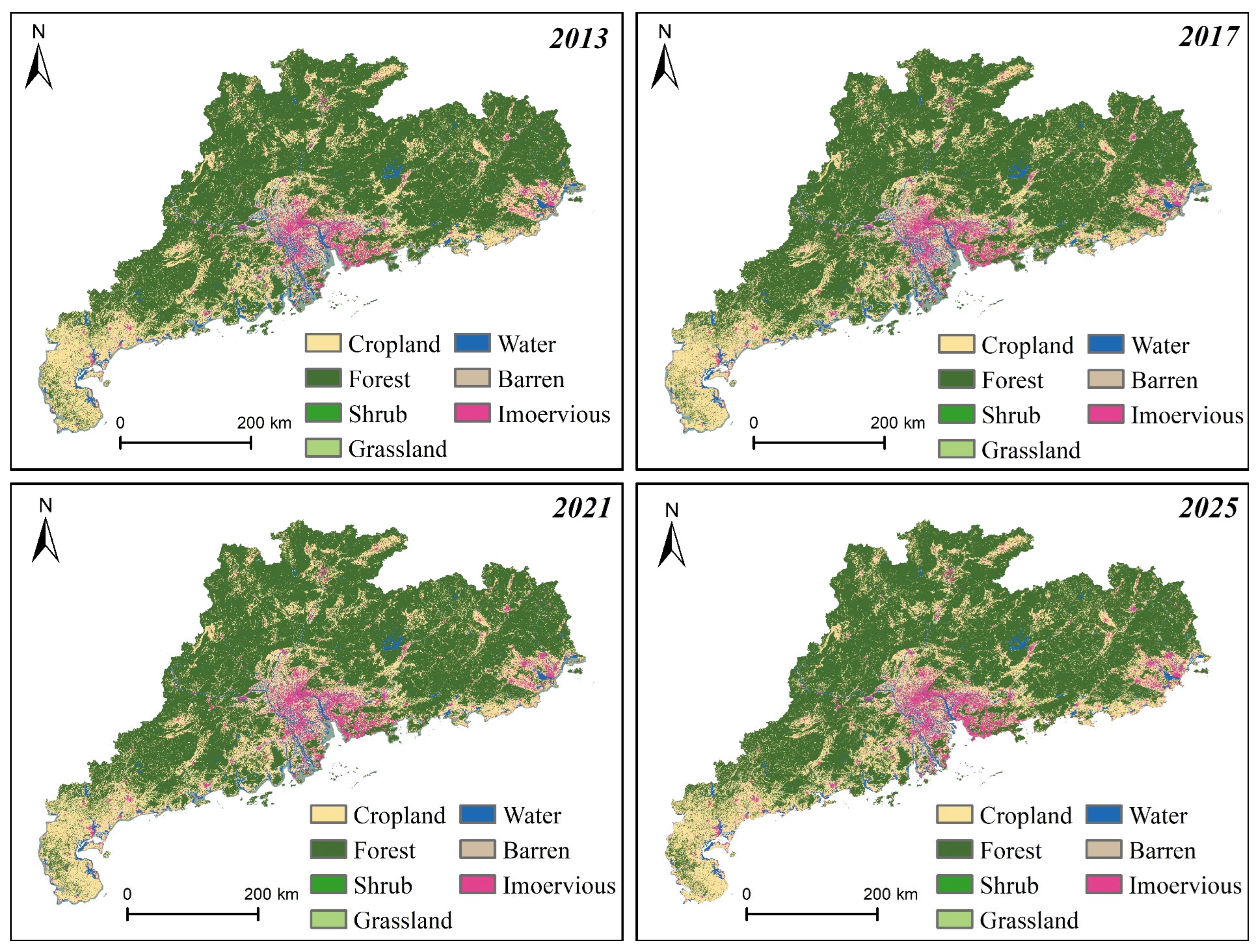
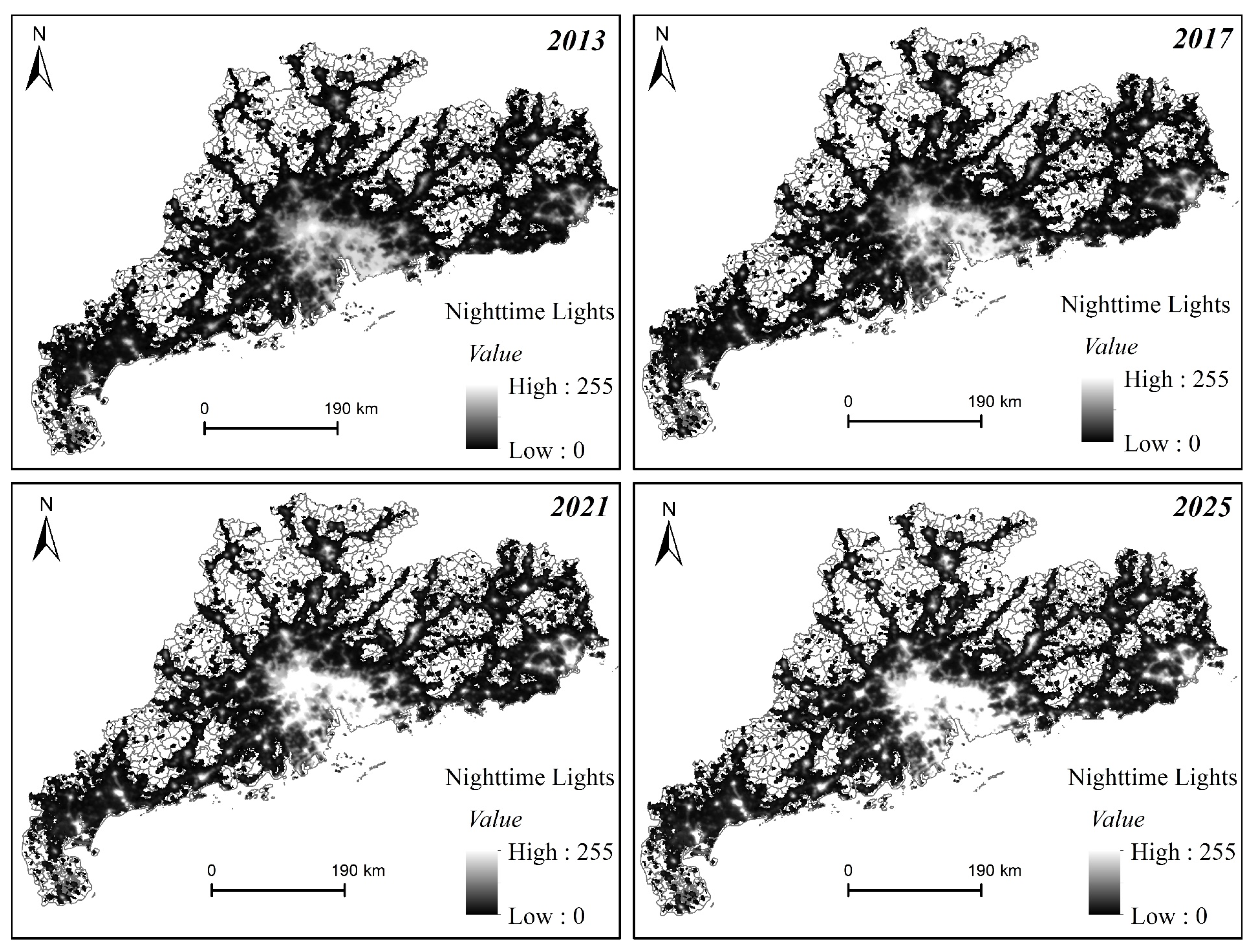
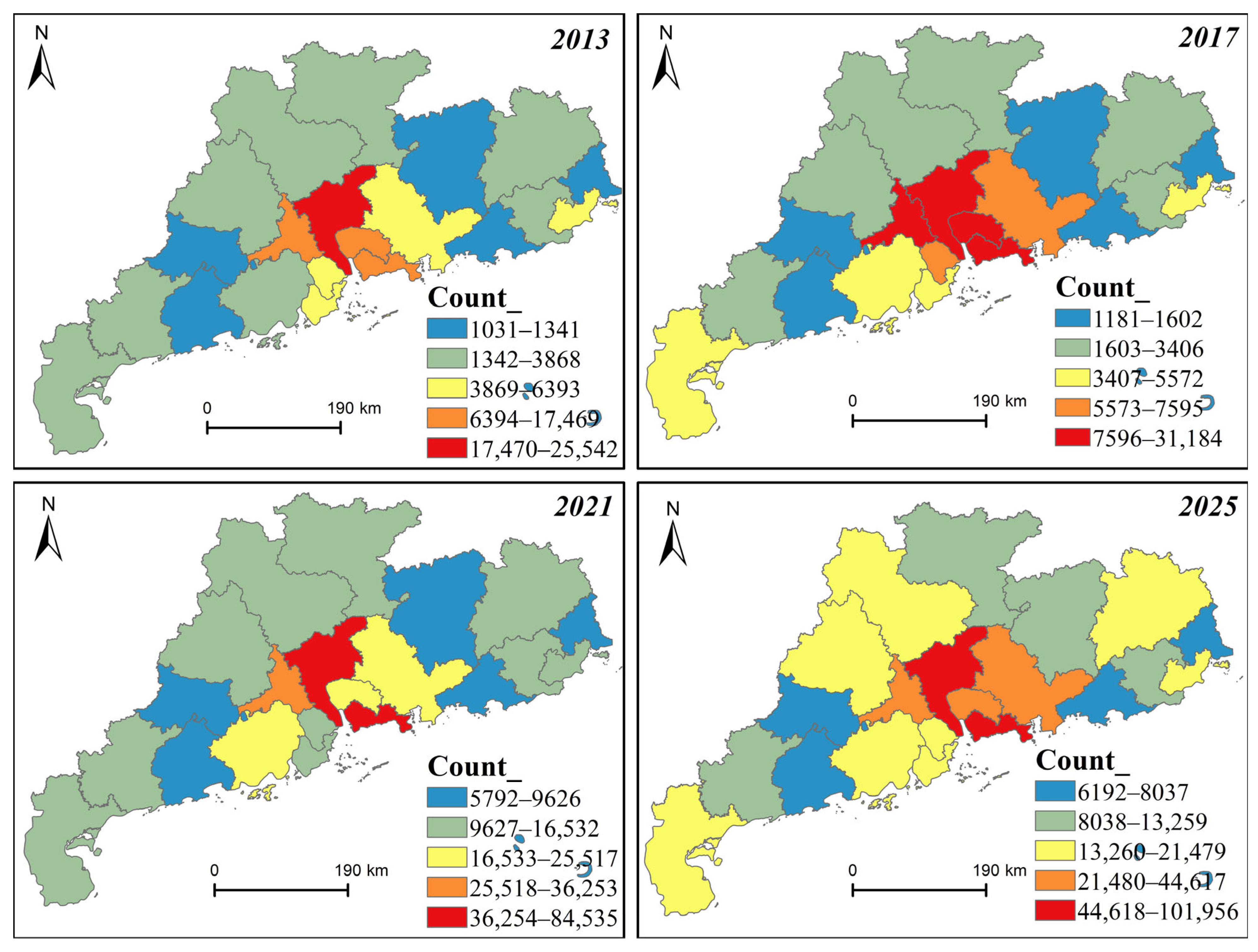
Based on the analysis of land use data for urban–rural spatial changes in 2013, 2017, 2021, and 2025, it can be observed that the urban–rural spatial pattern underwent significant changes during the study period. Overall, the scale of urban built-up land continued to expand, showing distinct outward expansion characteristics, with urban boundaries continuously extending into surrounding areas. In contrast, changes in rural built-up land and agricultural land were relatively slow, with some areas exhibiting a trend of being encroached upon by urban space or undergoing functional transformation. These results indicate that the urban–rural spatial structure underwent substantial adjustment during the study period, with the dominant role of urban space in the overall spatial pattern continuously strengthening. Further analysis of urban–rural spatial differences based on NTL data reveals that, as shown in
Figure 5, the intensity of urban–rural economic activities showed a continuous upward trend from 2013 to 2025, reflecting the overall improvement in economic levels and residents’ income levels in the study area. However, this upward trend exhibited significant spatial imbalance among different spatial units. In urban areas, especially the core cities of the Pearl River Delta, the increase in NTL intensity was substantial, demonstrating highly concentrated economic activities and rapid income growth. In contrast, non-core cities and vast rural areas also saw an increase in NTL intensity, but the rate of growth was relatively limited. The disparities between urban and rural areas, as well as among different regions, did not show a corresponding synchronous reduction.
The spatial and economic disparities in the process of urban–rural integration originate from the dual differentiation of regional development foundations and policy orientation. First, inherent differences in development foundations determine the capacity for factor agglomeration. The core cities of the Pearl River Delta leverage their port advantages, industrial foundations, and early policy benefits to form manufacturing services linked industrial clusters. Their capacity to attract factors such as capital, technology, and high-end talent is significantly higher than that of non-Pearl River Delta regions. This factor agglomeration effect further drives the expansion of urban construction land, creating a positive feedback cycle of factor agglomeration to spatial expansion and economic growth. The non-Pearl River Delta regions rely primarily on agriculture and resource-based industries. Their industrial chains are short with low added value, making it difficult to create a siphoning effect for factor agglomeration. The labor force in rural areas even continues to outflow to the Pearl River Delta, resulting in insufficient momentum for rural development. The second issue is that differentiated policy guidance intensifies spatial polarization. During the study period, Guangdong Province’s development policies have long favored the core areas of the Pearl River Delta, with major industrial projects and infrastructure investments concentrated in cities like Guangzhou and Shenzhen, driving a rapid increase in their night-time light intensity. In contrast, policy support for non-Pearl River Delta regions primarily focuses on addressing shortcomings and emphasizing infrastructure improvement, and has a relatively limited effect on promoting industrial upgrading and endogenous economic growth. Furthermore, differences in urban and rural land policies constrain rural development. The efficiency of market-based allocation for urban construction land is high, while the transfer mechanisms for rural land are still not well-developed. This prevents the full release of the economic value of rural land, further widening the gap in economic activity intensity between urban and rural areas.
Overall, urban–rural integration development promoted the improvement in the overall economic level and the enhancement in spatial connections during the study period. However, its actual outcomes are more manifested as a further strengthening of urban advantages, with significant differences persisting between core cities and rural areas in terms of economic activity intensity and income growth.
3.2. Analysis of Common Prosperity Based on POI Data
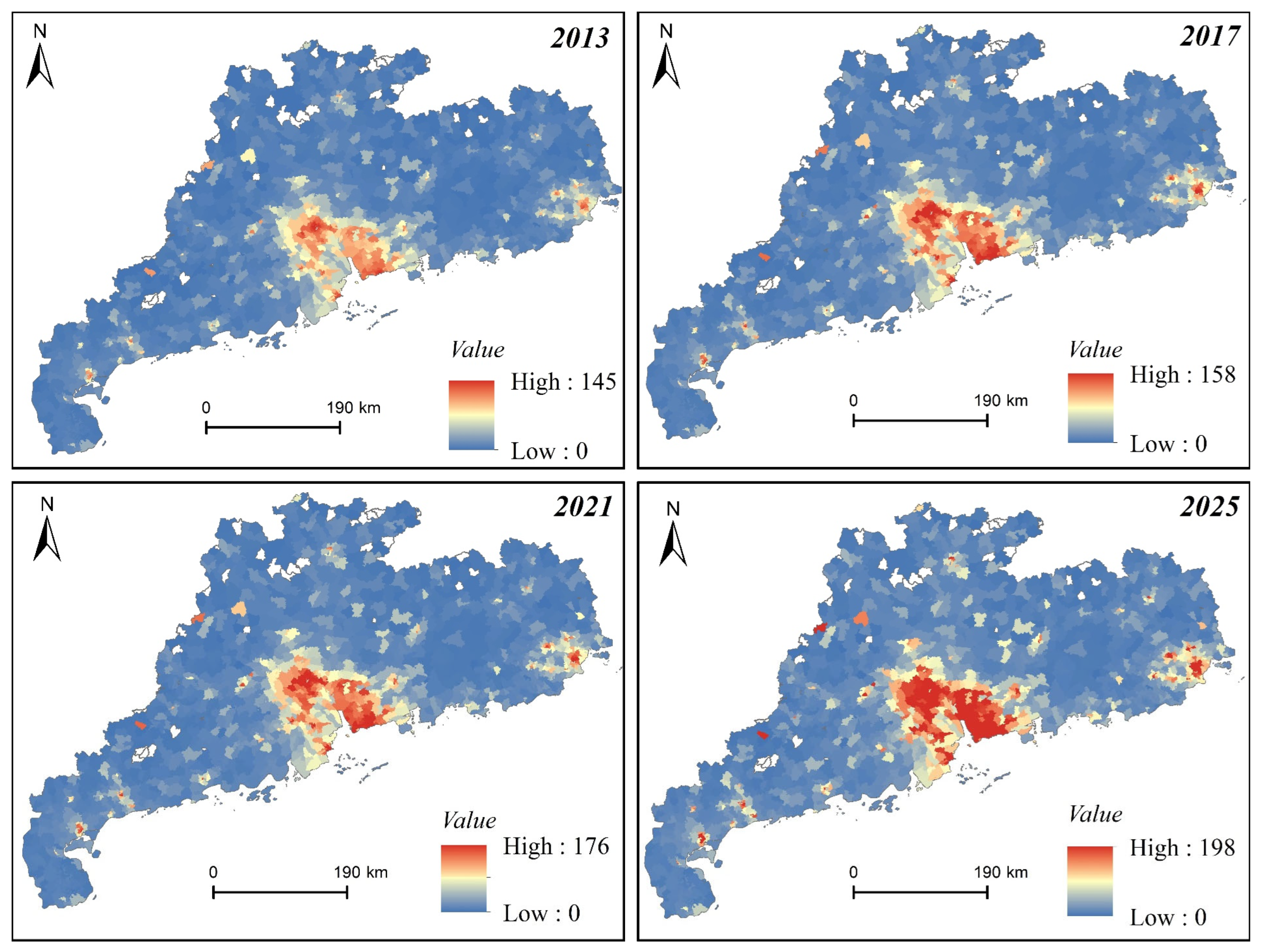
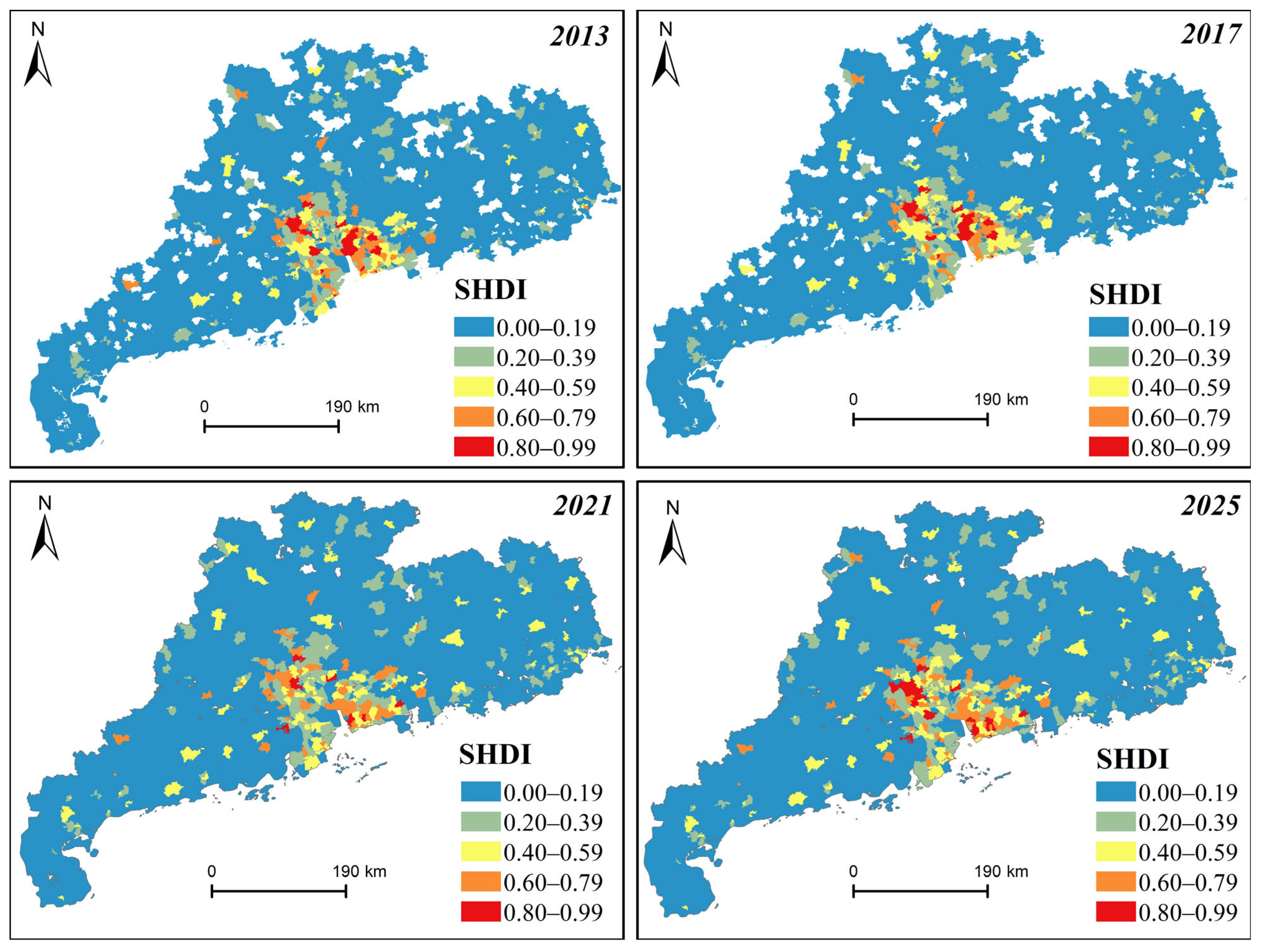
By measuring the level of common prosperity based on the POI-related facility diversity index, it can be observed that its spatial distribution exhibits significant imbalance characteristics, as shown in
Figure 6. Overall, areas with high diversity index values are mainly concentrated in the Pearl River Delta region, and within non-Pearl River Delta areas, they are primarily distributed in municipal and county-level central urban areas. In contrast, vast rural areas far from central urban areas generally have low diversity index values. This spatial pattern indicates that significant gaps still exist between different regions and different spatial levels in terms of public service provision, living convenience, and development opportunities. The degree of achieving common prosperity varies markedly across space. From the perspective of temporal evolution, the POI facility diversity index shows differentiated change characteristics across different periods. During the period from 2017 to 2021, the overall increase in the diversity index was the largest, reflecting the most pronounced rise in the level of common prosperity during this stage. In comparison, changes in the diversity index were relatively moderate during the remaining periods, with limited overall improvement, indicating a relatively weaker degree of improvement in the level of common prosperity during these two phases.
The spatiotemporal pattern differences in POI facility diversity are essentially the result of combined effects from resource allocation logic and the degree of supply–demand matching. The layout of public service facilities follows the principle of efficiency first. Core cities of the Pearl River Delta and central urban areas of cities and counties have high population densities and strong economic strength, giving their facility construction significant scale effects that can attract high-quality resources like education, healthcare, and commerce to agglomerate. In contrast, rural areas have dispersed populations and weak fiscal support capabilities, making facility construction costly with low utilization rates, which leads to insufficient supply of public welfare facilities. This allocation logic forms a public service gradient of central urban areas to townships to rural villages, creating a certain tension with the equalization goal of common prosperity. The period from 2017 to 2021 was a key phase for Guangdong Province in advancing its Action Plan for Equalization of Basic Public Services. Policy dividends drove the extension of facilities such as education and healthcare to counties and key towns, directly leading to a rapid increase in the POI diversity index. In contrast, from 2013 to 2017, policies were in a pilot and exploratory stage, resulting in a slower pace of facility expansion. From 2021 to 2025, a bottleneck of hardware was easy to supplement, but software was difficult to improve emerged. Although facilities were added in rural areas, they lacked professional personnel and operational funding, making it difficult for service quality to align with urban standards, which led to a convergence in the growth rate of the POI diversity index. Additionally, POI facilities in rural areas primarily focus on basic services, with insufficient supply of high-quality services such as elderly care, child care, and culture. This creates a gap with residents’ demand for a better life and constrains the further enhancement in common prosperity.
Overall, although the level of common prosperity showed a general improvement trend during the study period, it exhibited significant imbalances in both spatial distribution and temporal evolution.
3.3. Analysis of the Differential Effects of Urban–Rural Integration Development on Common Prosperity
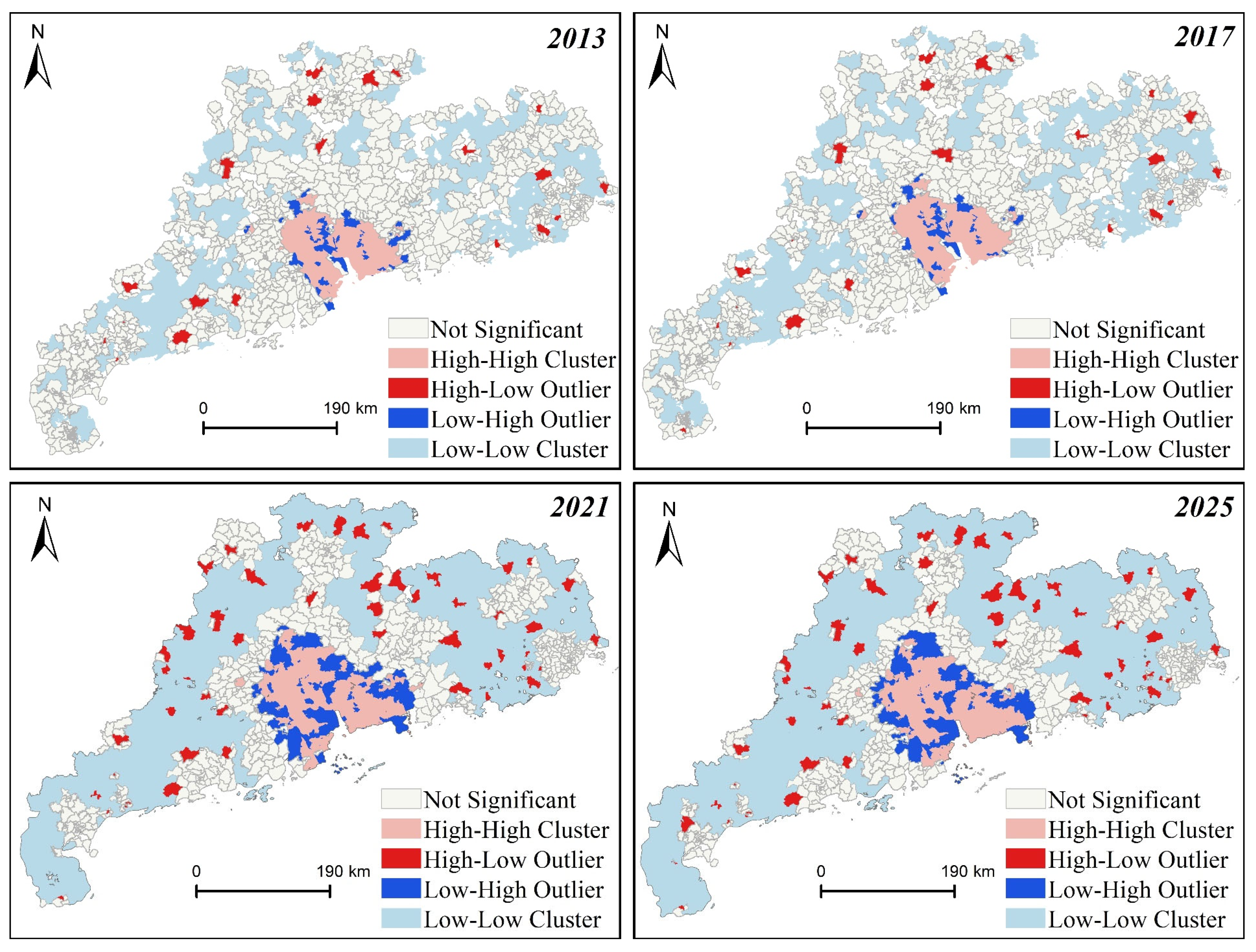
Based on the local spatial autocorrelation (LISA) method, a cluster analysis of the coupling relationship between urban–rural integration development and the level of common prosperity reveals that the spatial association patterns of urban–rural integration and common prosperity show significant differences across different stages, as illustrated in
Figure 7. From 2013 to 2017, HH clusters were mainly concentrated in the Pearl River Delta region, indicating that this area simultaneously exhibited high levels of both urban–rural integration and common prosperity. HL clusters were primarily distributed in municipal and county centers of non-Pearl River Delta areas, showing a certain degree of asynchrony between the advancement of urban–rural integration and the improvement in common prosperity. From 2017 to 2021, the clustering pattern underwent significant changes. First, the HH cluster area in the Pearl River Delta region expanded notably, indicating a further strengthening of the synergistic improvement trend between urban–rural integration and common prosperity. Second, LH clusters in the surrounding areas of the Pearl River Delta increased significantly, reflecting that some regions experienced a relatively rapid improvement in common prosperity even with a relatively lower level of urban–rural integration. Finally, the number of HL clusters in non-Pearl River Delta areas increased, indicating a rise in spatial units where urban–rural integration advanced more quickly but the improvement in common prosperity lagged relatively behind.
From the perspective of stage transition conditions, the promotion effect of urban–rural integration on common prosperity depends on whether the transmission chain of factor mobility, industrial upgrading to universal accessibility of public services is smooth.
From 2013 to 2017, it was the early stage of integration dominated by factor mobility, and the lag of common prosperity became prominent. During this stage, the core of urban–rural integration was the flow of population and capital to cities, driving urban spatial expansion and enhanced economic activities, but the supply of public services does not follow up synchronously. Although non-Pearl River Delta cities and counties advanced urban–rural integration through land development, industrial upgrading lagged, failing to create sufficient high-quality employment opportunities, resulting in slow growth in residents’ income. Coupled with insufficient public service facilities, this formed an HL cluster characterized by high integration and low prosperity. In contrast, core cities in the Pearl River Delta leveraged their industrial advantages to achieve simultaneous progress in factor mobility and public service supply, thus presenting a stable HH cluster pattern.
From 2017 to 2021 is a period characterized by a smooth transmission chain driven by policy, leading to accelerated improvement in common prosperity. With the implementation of Guangdong Province’s public service equalization policy, the focus of urban–rural integration shifts from factor agglomeration to universal access to resources. The industrial spillover effects of Pearl River Delta core cities begin to appear. Surrounding areas, while undertaking industrial transfers, receive more investment in public service resources, driving an increase in LH clusters. Meanwhile, Pearl River Delta core cities further consolidate the scope of HH clusters by optimizing their public service structure. The key in this stage is that policy intervention unblocks the transmission path from integration to prosperity, transforming the outcomes of urban–rural integration into a tangible welfare improvement for residents.
From 2021 to 2025 is a period of structural optimization with diminishing marginal effects, where conversion efficiency encounters obstacles. After the hardware layout of public service facilities approaches saturation, the promoting effect of urban–rural integration on common prosperity begins to rely on software upgrades, such as improvements in service quality and the refinement of equalization mechanisms. However, due to limited fiscal capacity in some non-Pearl River Delta areas, it is difficult to continuously invest resources in software optimization, leading to diminishing marginal returns from urban–rural integration and a stabilization of the clustering patterns. This phenomenon indicates that a model of integration relying solely on spatial expansion and facility increases cannot sustainably drive common prosperity, and a shift to a quality and efficiency-oriented, connotative development model is necessary.
Based on the spatial clustering results of urban–rural integration and common prosperity, it can be further observed that the impact of urban–rural integrated development on common prosperity does not manifest immediately, nor does a simple linear correspondence exist. Instead, it exhibits distinct characteristics of being staged, lagging, and being subject to marginal effects.
First, the achievement of common prosperity exhibits significant lag characteristics. The results showing the basic stability and insignificant changes in the clustering patterns of urban–rural integration and common prosperity from 2013 to 2017 indicate that, in its early stages, urban–rural integration is more reflected in spatial form adjustments and accelerated factor mobility. Its direct effects are mainly concentrated on land use changes and enhanced economic activities, while core aspects of common prosperity such as the improvement in the public service system and the enhancement in quality of life are not yet fully manifested. This sequential characteristic of integration first, prosperity later results in some areas still exhibiting the HL clustering pattern, where the improvement in common prosperity lags behind even as the level of urban–rural integration rises. Second, the significant changes in clustering types from 2017 to 2021 reflect the concentrated release phase of the impact of urban–rural integration on common prosperity. Combined with the substantial increase in the POI diversity index during this stage, it can be inferred that as the degree of urban–rural integration continuously accumulates, its promoting effect on the structure of public service provision, facility allocation, and improvements in residents’ welfare gradually becomes apparent. This drives a noticeable leap in the level of common prosperity within a relatively short period. The simultaneous expansion of HH and LH clusters during this stage reflects the phased amplification effect of converting urban–rural integration outcomes into common prosperity. Finally, the clustering pattern tends to stabilize from 2021 to 2025, reflecting a certain degree of diminishing marginal effects in the impact of urban–rural integration on common prosperity. Following the rapid improvement in infrastructure and the public service system in the earlier period, new investments in urban–rural integration contribute more to structural optimization rather than quantitative expansion in the improvement in common prosperity. Their potential for enhancing indicators such as POI diversity becomes relatively limited, leading to a slowdown in the growth rate of the common prosperity level and a gradual solidification of the spatial pattern. This result indicates that relying solely on the scale expansion of urban–rural integration can no longer sustainably drive a significant improvement in common prosperity.
Overall, the impact of urban–rural integration development on common prosperity exhibits typical characteristics such as temporal lag, phased concentration, and diminishing marginal effects. Its actual outcomes are profoundly constrained by the regional development foundation and structural conditions. This finding not only explains the differentiated patterns observed in the spatial clustering of urban–rural integration and common prosperity, but also provides an important basis for subsequent efforts to promote the synergistic deepening of urban–rural integration and common prosperity from the perspectives of mechanisms and policies.
4. Discussion
Based on land use data, NTL data, and POI facility data, this study systematically analyzes the level of urban–rural integration development and common prosperity from 2013 to 2025 across multiple dimensions, including urban–rural spatial evolution, economic activity intensity, and public service diversity. This study finds that urban–rural integration significantly promoted urban spatial expansion and overall economic level improvement during the study period, but the extent of development varied markedly among different regions.
From the perspective of urban–rural integration development research, the existing literature often reveals the impact of urban–rural integration on economic growth and spatial pattern evolution from the perspectives of factor mobility, spatial structure adjustment, and regional coordinated development. It is generally believed that urban–rural integration can enhance the overall regional development level by promoting the rational allocation of population, industrial, and land factors [
52,
53]. The findings of this study are consistent with the above research in terms of the overall trend, indicating that urban–rural integration significantly drives urban spatial expansion and enhances economic activities during the study period [
54]. By integrating land use and NTL data, this study characterizes the outcomes of urban–rural integration from both spatial form and economic activity perspectives, further revealing significant differences in the advancement speed and spatial manifestations of urban–rural integration across different regions, thereby providing more spatially heterogeneous empirical evidence for urban–rural integration research [
6]. From the perspective of common prosperity research, existing studies often focus on dimensions such as income distribution, public service provision, and equality of opportunity [
55], emphasizing the structural disparities in common prosperity among regions and groups. It is widely found that developed regions and central cities possess obvious advantages in achieving common prosperity [
56,
57]. This study characterizes the level of common prosperity based on the POI facility diversity index, and its spatial distribution characteristics show high consistency with existing research conclusions, namely that the level of common prosperity tends to cluster in core cities and central areas [
58]. However, by spatially measuring common prosperity based on the structure of public services and living convenience, this study supplements the relative inadequacy in characterizing the outcome structure of common prosperity in existing research.
The existing literature generally recognizes urban–rural integration as an important pathway to promote common prosperity. However, most studies employ linear regression or policy effect evaluation methods, implying the assumption that urban–rural integration has a synchronous and positive effect on common prosperity [
9,
59]. However, such research has neither revealed the spatial–temporal heterogeneity of their effects, nor has it answered the core question of how does urban–rural integration translate into common prosperity. The incremental value and innovative insights of this study, compared to previous work, are mainly reflected in the following points. First, this study breaks through the single perspective of factor mobility and builds a trinity analytical framework of space, economy and society. Previous studies mostly focus on the impact of urban–rural factor mobility on income disparity, essentially remaining at a single-dimensional economic analysis [
14,
20]. This study innovatively integrates multi-source data including land use, NTL, and POI to characterize the coupling relationship between urban–rural integration and common prosperity from three dimensions: spatial form evolution, economic activity intensity, and equalization of public services. It is the first to incorporate spatial structure optimization and universal accessibility of public services into the mechanism through which urban–rural integration promotes common prosperity, addressing the deficiency of insufficient attention to the social dimension in existing research. Moreover, we reveal the nonlinear interaction patterns, correcting the traditional perception that urban–rural integration necessarily promotes common prosperity. Existing studies often assume a positive linear correlation between urban–rural integration and common prosperity [
6,
7]. However, through long-term time-series spatial clustering analysis, this study finds that the impact of urban–rural integration on common prosperity exhibits three major characteristics: regional heterogeneity, temporal lag, and diminishing marginal effects. This finding indicates that urban–rural integration does not necessarily or synchronously translate into common prosperity; its effectiveness depends on regional development foundations and public service supply capacity. This conclusion breaks through the idealized perception of urban–rural integration policy outcomes and provides a new explanation for understanding the real-world dilemma of high integration levels but low prosperity levels in some regions. Finally, this study proposes a policy orientation of differentiated by region and by stage, moving beyond the mere verification of spatial inequality issues. Previous studies have mostly stopped at verifying the current state of urban–rural and regional development inequalities [
5,
35], but have failed to propose targeted optimization paths. This study distinguishes four types of regions based on clustering results, such as high integration–high prosperity (HH) and high integration–low prosperity (HL), and clarifies the core constraints of each region. Core Pearl River Delta areas need to address the issue of diminishing marginal effects by optimizing public service structure rather than expanding scale to promote common prosperity. Non-Pearl River Delta regions need to overcome the problem of lagging integration conversion by strengthening urban–rural industrial synergy and infrastructure connectivity to accelerate the transformation of integration outcomes into resident welfare. This approach of targeted policies for different categories provides actionable policy references for promoting the synergistic development of urban–rural integration and common prosperity. The findings of this paper extend this understanding to some extent. On one hand, the expansion of HH clusters in the Pearl River Delta region confirms that urban–rural integration can effectively promote common prosperity under specific conditions. On the other hand, the existence of cluster types such as HL and LH indicates that the effect of urban–rural integration on common prosperity has significant regional heterogeneity and stages. It does not translate into an increase in common prosperity levels immediately and proportionally in all regions. Further combining the temporal evolution results, this study reveals the characteristics of lagging common prosperity and diminishing marginal effects, which are relatively less systematically discussed in existing research [
60]. Some research pays attention to the stage differences in the implementation effects of urban–rural integration policies, but lacks explanations for this phenomenon from the perspectives of spatial structure and outcome transformation [
61,
62]. Using long-term time-series data and spatial clustering analysis, this study shows that the initial stage of urban–rural integration primarily reflects factor and spatial integration. Its promoting effect on common prosperity often concentrates in the mid-term and shows a trend of diminishing marginal effects in the later stage, thus providing new empirical support for understanding the nonlinear relationship between urban–rural integration and common prosperity [
63].
By placing urban–rural integrated development and common prosperity goals within a unified analysis framework and systematically examining the actual effect of urban–rural integrated development on common prosperity from the perspectives of structure and spatial correlation, this study breaks through the analysis paradigm in existing research that relatively separates the two or only tests linear relationships, thereby providing a new research perspective for understanding the complex relationship between urban–rural integration and common prosperity. This study, through multi-source data analysis, reveals that the impact of urban–rural integration development on common prosperity exhibits significant characteristics of being phased, lagging, and exhibiting diminishing marginal effects. It indicates that urban–rural integration does not necessarily and immediately translate into an increase in common prosperity levels. Its effect is profoundly constrained by regional development foundations and structural conditions. This provides targeted empirical evidence for promoting the coordinated development of urban–rural integration and common prosperity by region and by stage.
While this study systematically explores the relationship between urban–rural integration development and common prosperity from the perspectives of multi-source data and spatial analysis, there are still aspects that require further refinement. Although this study systematically explores the relationship between urban–rural integrated development and common prosperity from the perspectives of multi-source data and spatial analysis, there are still some aspects that require further improvement. This study adopts the POI facility diversity index to represent the level of common prosperity, with its core basis being that the accessibility of public services and the convenience of life are important dimensions of common prosperity. However, there remains a certain deviation between this indicator and the core connotation of common prosperity. On the one hand, POI data can only reflect the spatial distribution and quantity supply of public service facilities; it cannot capture demand-side characteristics such as residents’ actual usage frequency and satisfaction with service quality. On the other hand, there is also bias in the type of coverage of POI data; in the Amap and Baidu POI data used in this study, the collection coverage for commercial and transportation facilities is relatively high, while public welfare facilities such as elderly care, childcare, and cultural services are often not fully included, especially in remote rural areas. This may lead to insufficient recording of facilities closely related to people’s well-being, thereby potentially underestimating the level of common prosperity in rural areas. Furthermore, the core connotation of common prosperity includes key dimensions such as income distribution equity, improvement of social security, and enhancement in subjective well-being. Due to limited access to high-spatial-resolution microdata, this study does not incorporate direct measurement indicators like household income, the gap in property income, pension insurance coverage, and residents’ sense of happiness. This limitation further confines the research findings to a surface-level analysis of spatial equilibrium of public services, making it difficult to deeply reveal the mechanism through which urban–rural integration affects residents’ actual income growth and the enhancement in their welfare perception. Finally, it needs to be clarified that this study primarily adopts descriptive analysis and spatial clustering methods, aiming to reveal the spatial correlation characteristics between urban–rural integration and common prosperity, and has not conducted rigorous empirical identification of the causal relationship and underlying mechanism between the two. This research design is based on the core positioning of this paper, which focuses on typical fact identification and phenomenon description. The core objective of this study is to characterize the spatiotemporal coupling features between urban–rural integration and common prosperity, and to reveal the phased and heterogeneous patterns of their association, which belongs to the basic research stage of phenomenon identification and mechanism exploration. Correlation analysis can clearly present the spatial distribution and temporal evolution characteristics of both, providing typical facts support for subsequent causal analysis. Future research can introduce spatial econometric models, panel regressions, or quasi-natural experiment methods to further test the impact pathways and internal mechanisms of urban–rural integration on common prosperity, thereby deepening the understanding of the synergistic advancement path between urban–rural integration and common prosperity from multiple dimensions.
5. Conclusions
Based on land use data, NTL data, and POI data from 2013 to 2025, this study comprehensively applies spatial analysis and deep learning methods to systematically study the spatiotemporal evolution characteristics and mutual relationships of urban–rural integrated development and common prosperity levels. This study characterizes the actual results of urban–rural integration and common prosperity from multiple dimensions such as urban–rural spatial form evolution, economic activity intensity, and public service diversity, and identifies the coupling types and evolution processes of the two in different regions and different periods through spatial clustering. This study finds that urban–rural integration significantly promotes urban spatial expansion and the improvement in overall economic activity levels during the study period, but its development results show obvious spatial imbalance. The common prosperity level generally improves, but it highly concentrates in the Pearl River Delta and city–county center areas. Further analysis finds that the promotion effect of urban–rural integrated development on common prosperity possesses significant characteristics of regional heterogeneity, stages, and time lags. It manifests as synergistic improvement in core city areas, while insufficient conversion efficiency and structural differentiation phenomena exist in some non-core areas. The above findings indicate that urban–rural integration does not necessarily and immediately translate into an improvement in the common prosperity level, and factors such as regional development foundation, industrial structure, and public service supply capability profoundly constrain its effect.
This study provides empirical evidence for understanding the complex relationship between urban–rural integration and common prosperity, holding significant practical implications. It aids in examining the actual effects of urban–rural integration policies from spatial and structural perspectives, preventing the simplistic equation of urban–rural integration with the achievement of common prosperity. Furthermore, it offers decision-making references for optimizing the development path of urban–rural integration by region and by stage, and for improving the efficiency of converting integration outcomes into common prosperity. This contributes certain policy insights for promoting the synergistic advancement of urban–rural integration and common prosperity.