Urban Green Spaces and Their Role in Enhancing Liveability: Lessons from a Lisbon Neighbourhood During the COVID-19 Pandemic




Abstract
1. Introduction
2. Green Spaces as Health Promoters
Theoretical Framework: Restorative Theories and Well-Being
3. The Concept of Urban Green Space and Its Association with the Portuguese Context
- Recreation and production: Permeable areas designated for urban agriculture and recreational activities, including collective amenities and infrastructure for leisure and tourism.
- Protection and conservation: Areas dedicated to conserving ecosystems, habitats, and valuable vegetation, with restrictions on construction except for recreational support and fire-control infrastructure.
- Road infrastructure frames: Spaces under different levels of restriction that only allow support facilities.
- Riverside spaces: Areas providing ecological balance and recreational opportunities, ensuring pedestrian access to riverbanks and landscape enjoyment.
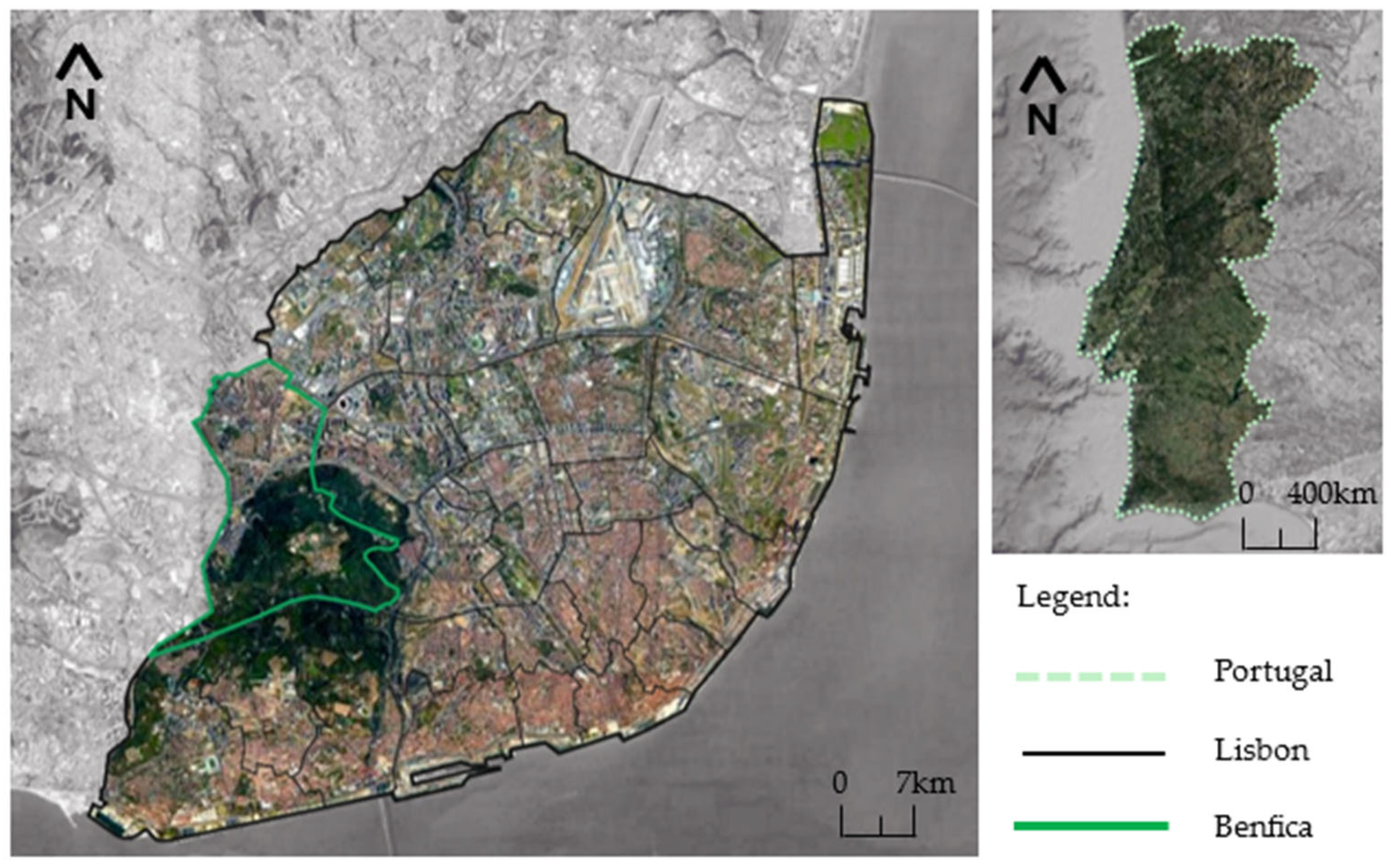
4. Study Area and Methodology
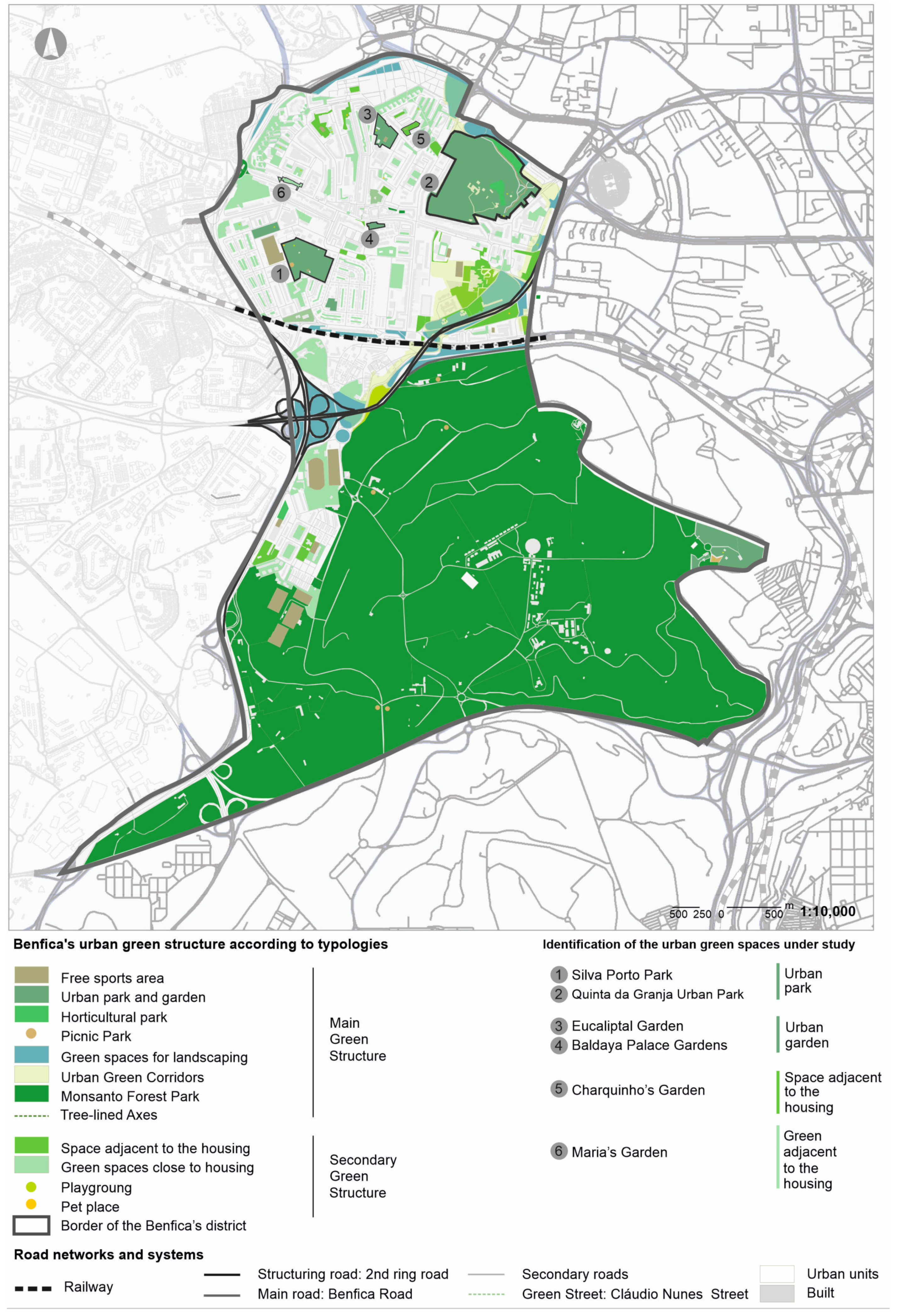
- Cartographic observation: Mapping of UGSs using geographic information systems (GISs) to identify the spatial distribution and typologies.
- Quantitative surveys: Structured surveys were conducted with UGS users to collect data on demographics, usage patterns, and health impacts. The survey included 80% closed questions on the frequency of use, reasons for visiting, and perceived health benefits. A total of 120 surveys were conducted from August to September 2021, via on-site intercept sampling with voluntary participation, across different locations, days, and time periods. Approximately 20 surveys were conducted in each of the six analysed urban green spaces, ensuring balanced representation across different locations within Benfica.
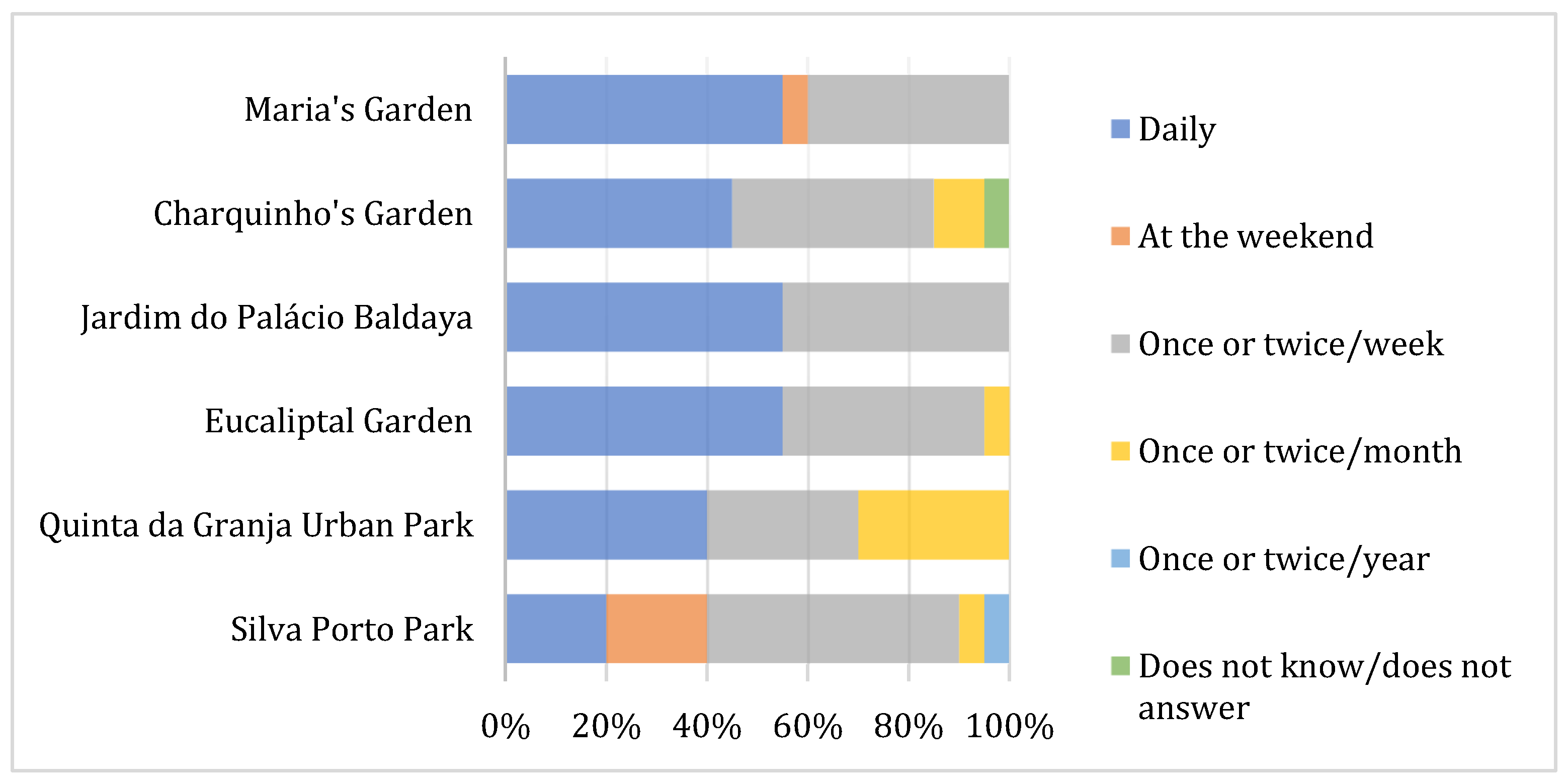
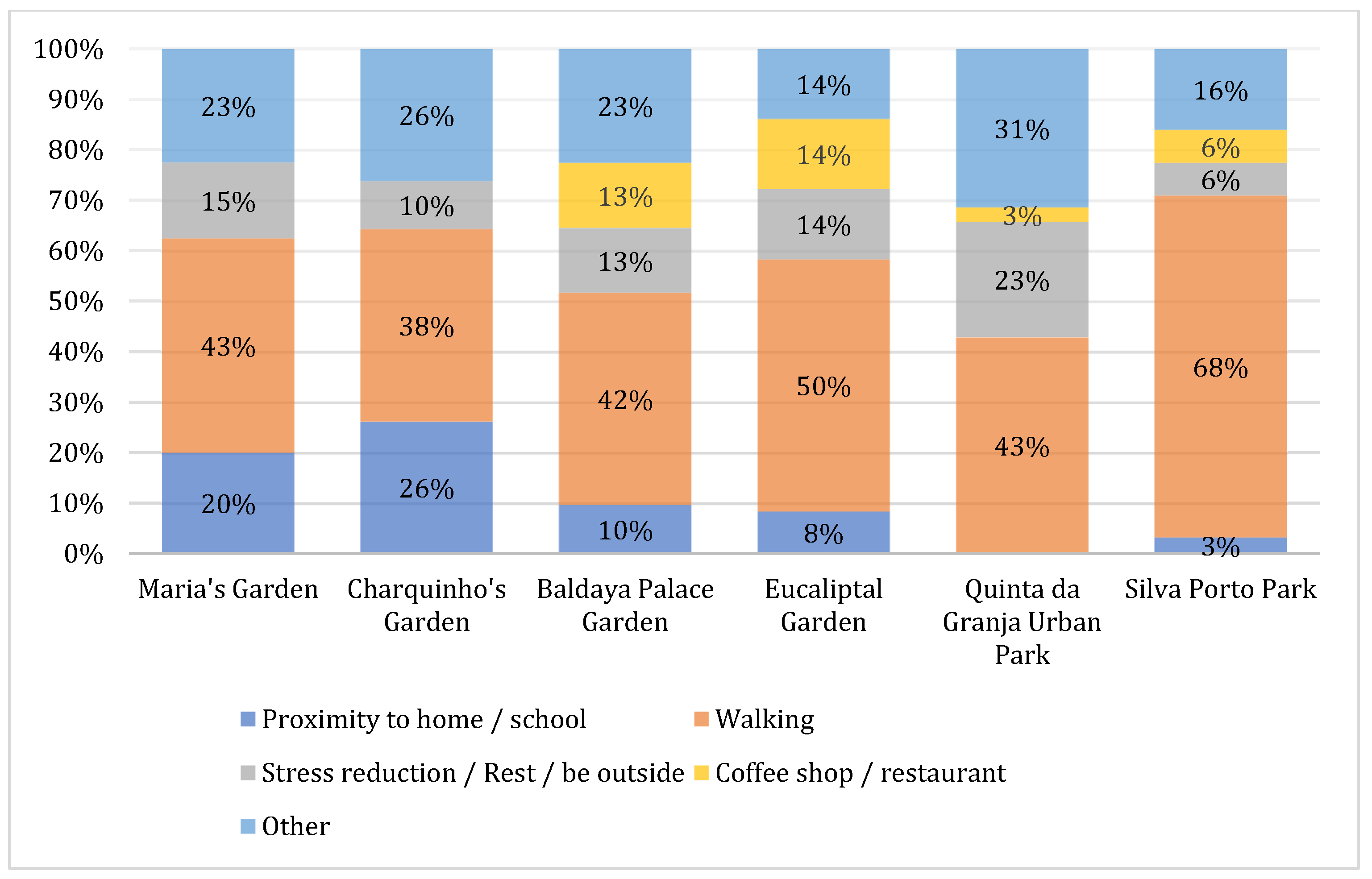
- The questionnaire comprised 25 questions divided into three thematic blocks: (1) users’ socio-demographic profile; (2) patterns of use—frequency, duration, activities, and travel modes; and (3) self-perceived health and well-being before, during, and after the COVID-19 restrictions. Although the questionnaire did not ask for the exact home-to-UGS distance, proximity was indirectly captured through respondents’ reported mode of access (predominantly walking) and travel time to each park. These indicators are commonly used as proxies for walkable proximity in urban green space studies. A five-point Likert scale was applied to evaluate the perceived quality attributes, such as cleanliness, safety, maintenance, comfort, lighting, and diversity of facilities. These quality indicators were not defined arbitrarily; rather, they were adapted from established frameworks in the literature that identify the perceived safety, cleanliness, maintenance, comfort, lighting, and availability of facilities as core determinants of UGS quality and restorativeness. These parameters have been shown to influence usage patterns, perceived well-being, and the likelihood of experiencing restorative benefits in urban green environments [18,19,31]. Accordingly, our survey grid translated these theoretically grounded quality dimensions into an operational tool adapted to the Benfica context. Surveys were conducted in six UGSs across Benfica on weekdays and the weekends between them, covering different times of the day. Although the sampling strategy was designed as simple random sampling, participation relied on voluntary availability, which is consistent with an on-site intercept sampling approach commonly used in neighbourhood-scale exploratory studies. Although participation was voluntary, on-site observation revealed that most respondents were habitual users of the selected UGSs, regularly visiting these spaces before, during and after the COVID-19 restrictions. This constraint limits the application of inferential statistical tests; however, the approach remains methodologically robust and appropriate for an exploratory, neighbourhood-scale case study focused on usage patterns and user perceptions rather than statistical generalisation. This reduces the likelihood that the survey captured only occasional or COVID-19-specific visitors. Nevertheless, the diversity of sites and schedules ensured representativeness across age and gender groups, enabling reliable characterisation of the usage patterns. Similar post-lockdown studies have confirmed that the frequency of visits to nearby green areas is closely related to psychological recovery and life satisfaction across user groups [46,47].
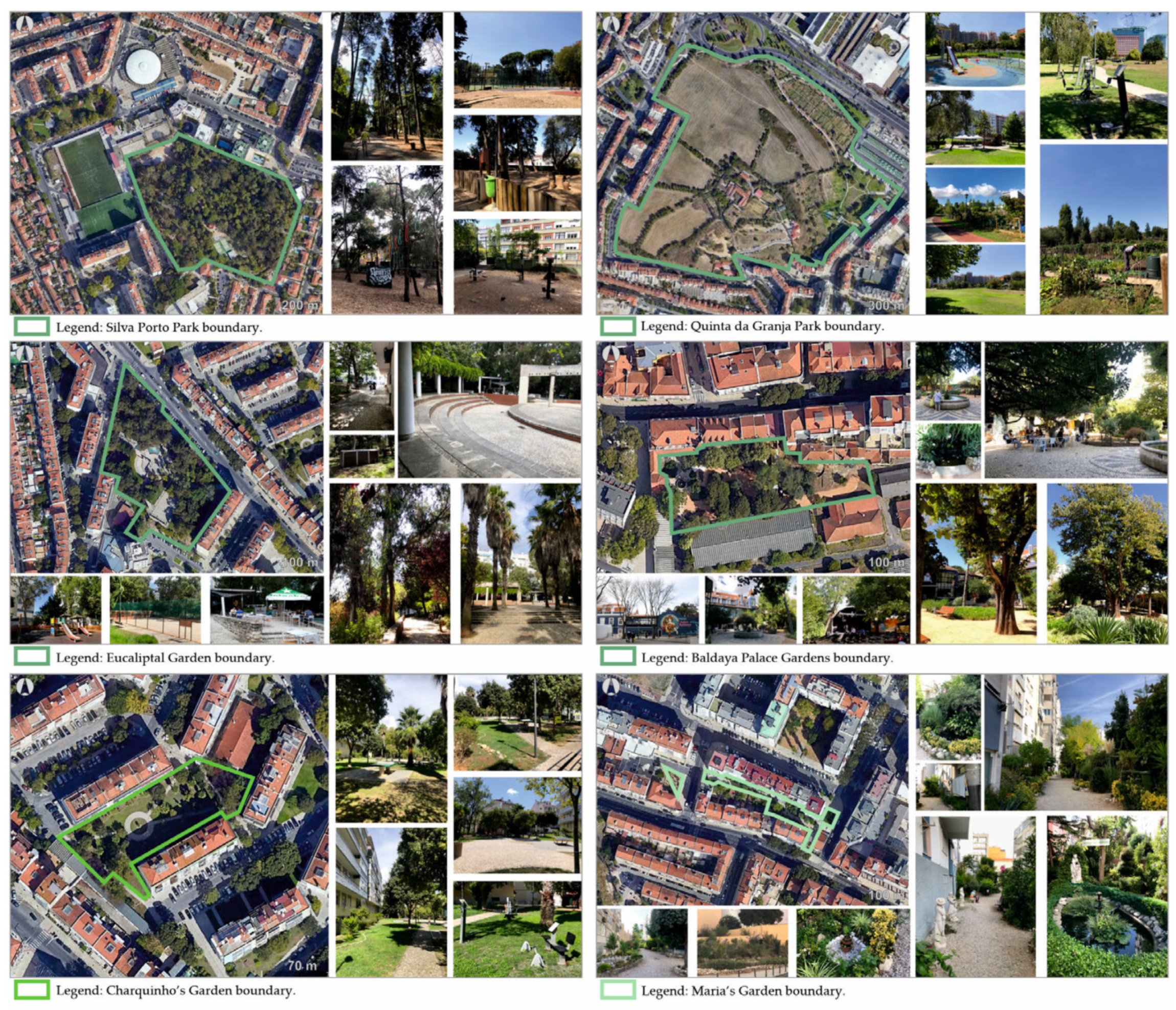
- Qualitative observations: On-site observations of UGSs were conducted to evaluate the accessibility, infrastructure, and variety of activities offered. This involved examining both internal and external access, maintenance quality, and user interactions. The qualitative observations were based on a grid that traduced these aspects, as translated into Table 3 and Table 4.
5. Results and Discussion
6. Conclusions
Author Contributions
Funding
Institutional Review Board Statement
Informed Consent Statement
Data Availability Statement
Conflicts of Interest
References
- Ma, Y.; Yang, Y.; Jiao, H. Exploring the Impact of Urban Built Environment on Public Emotions Based on Social Media Data: A Case Study of Wuhan. Land 2021, 10, 986. [Google Scholar] [CrossRef]
- da Costa, E.M.; Fumega, J.; Louro, A. Defining Sustainable Communities: Development of a Toolkit for Policy Orientation. J. Urban Regen. Renew. 2013, 6, 278–292. [Google Scholar]
- Lawrence, R.J. Urban health challenges in Europe. J. Urban Health Bull. 2013, 90, 23–36. [Google Scholar] [CrossRef] [PubMed]
- Cunha, J.; Morgado, S.; Marques da Costa, E. Towards Healthier Cities. Urban Green Spaces (UGS) in the Neighbourhood of Benfica, Lisbon. In Proceedings of the 57th World Planning Congress of the International Society of City and Regional Planners “Planning Unlocked: New Times, Better Places, Stronger Communities”, Doha, Qatar, 8–11 November 2021; pp. 670–680, ISBN/EAN 978-90-75524-69-7. Available online: https://doha2021.dryfta.com/programme/discussions/sponsor-lounge/proceedings (accessed on 10 February 2022).
- Cunha, J. Urban Green Spaces of Proximity and Healthy City: A Reading from the District of Benfica—Lisbon. Master’s Thesis, University of Lisbon, Lisbon, Portugal, February 2022. Available online: http://hdl.handle.net/10451/51741 (accessed on 11 April 2022).
- Morgado, S.; Cunha, J.d.C. Grounded in the Landscape—Climate Action, Well-being and Public Space in a Small Town in the Lisbon Metropolitan Area. Land 2023, 12, 1687. [Google Scholar] [CrossRef]
- Harding, D.; Lukman, K.M.; Jingga, M.; Uchiyama, Y.; Quevedo, J.M.D.; Kohsaka, R. Urban Gardening and Wellbeing in PandemicEra: Preliminary Results from a Socio-Environmental Factors Approach. Land 2022, 11, 492. [Google Scholar] [CrossRef]
- Alirol, E.; Getaz, L.; Stoll, B.; Chappuis, F.; Loutan, L. Urbanisation and infectious diseases in a globalised world. Lancet Infect. Dis. 2011, 11, 131–141. [Google Scholar] [CrossRef] [PubMed]
- World Health Organization. Global Status Report on Non-Communicable Diseases 2014: Attaining the Nine Global Non-Communicable Diseases Targets; A Shared Responsibility; World Health Organization: Geneva, Switzerland, 2014. [Google Scholar]
- Brooks, S.K.; Webster, R.K.; Smith, L.E.; Woodland, L.; Wessely, S.; Greenberg, N.; Rubin, G.J. The psychological impact of quarantine and how to reduce it: Rapid review of the evidence. Lancet 2020, 395, 912–920. [Google Scholar] [CrossRef]
- Evandrou, M.; Falkingham, J.; Qin, M.; Vlachantoni, A. Changing living arrangements and stress during COVID-19 lockdown: Evidence from four birth cohorts in the UK. SSM—Popul. Health 2021, 13, 100761. [Google Scholar] [CrossRef]
- Pouso, S.; Borja, A.; Fleming, L.E.; Gomez-Baggethun, E.; White, M.P.; Uyarra, M.C. Contact with blue-green spaces during the COVID-19 pandemic lockdown beneficial for mental health. Sci. Total Environ. 2021, 756, 143984. [Google Scholar] [CrossRef]
- Wang, C.; Li, C.; Wang, M.; Yang, S.; Wang, L. Environmental justice and park accessibility in urban China: Evidence from Shanghai. Asia Pac. Viewp. 2021, 63, 236–249. [Google Scholar] [CrossRef]
- Louro, A.; Marques da Costa, N.; Marques da Costa, E. From Livable Communities to Livable Metropolis: Challenges for Urban Mobility in Lisbon Metropolitan Area (Portugal). Int. J. Environ. Res. Public Health 2021, 18, 3525. [Google Scholar] [CrossRef]
- Lachowycz, K.; Jones, A.P. Towards a better understanding of the relationship between greenspace and health: Development of a theoretical framework. Environ. Urban. 2019, 32, 1095–1113. [Google Scholar] [CrossRef]
- European Commission. New Leipzig Charter—The Transformative Power of Cities for the Common Good; New Leipzig Charter: Leipzig, Germany, 2020; Available online: https://ec.europa.eu/regional_policy/en/information/publications/brochures/2020/new-leipzig-charter-the-transformative-power-of-cities-for-the-common-good (accessed on 10 February 2022).
- World Health Organization. Road Traffic Injuries. Fact Sheet No. 358, Reviewed September 2016. Available online: http://www.who.int/mediacentre/factsheets/fs358/en/ (accessed on 10 February 2022).
- Marques da Costa, E.; Kállay, T. Impacts of Green Spaces on Physical and Mental Health. URBACT Health & Greenspace. Urbact.eu. 2020. Available online: https://urbact.eu/sites/default/files/media/thematic_report_no1_impacts_on_health_healthgreenspace_2910.pdf (accessed on 10 February 2022).
- World Health Organization. Urban Green Spaces and Health: A Review of Evidence; OMS; WHO Regional Office for Europe: Copenhagen, Denmark, 2016; Available online: http://www.euro.who.int/en/health-topics/environment-and-health/urbanhealth/publications/2016/urban-green-spaces-andhealth-a-review-of-evidence-2016 (accessed on 11 April 2022).
- Markevych, I.; Schoierer, J.; Hartig, T.; Chudnovsky, A.; Hystad, P.; Dzhambov, A.M.; de Vries, S.; Triguero-Mas, M.; Brauer, M.; Nieuwenhuijsen, M.J.; et al. Exploring pathways linking greenspace to health: Theoretical and methodological guidance. Environ. Urban. 2023, 35, 761–780. [Google Scholar] [CrossRef]
- Mitchell, G. Selecting the best theory to implement planned change. Nurs. Manag. 2013, 20, 32–37. [Google Scholar] [CrossRef]
- Kaplan, S. The restorative benefits of nature: Toward an integrative framework. J. Environ. Psychol. 1995, 15, 169–182. [Google Scholar] [CrossRef]
- Ulrich, R.S. Aesthetic and affective response to natural environment. In Behavior and the Natural Environment; Altman, I., Wohlwill, J.F., Eds.; Springer: New York, NY, USA, 1993; pp. 85–125. [Google Scholar]
- Hartig, T.; Evans, G.; Jamner, L.D.; Davis, D.S.; Garling, T. Tracking restoration in natural and urban field settings. J. Environ. Psychol. 2003, 23, 109–123. [Google Scholar] [CrossRef]
- Berto, R. Avaliando o valor restaurador do ambiente: Um estudo sobre idosos em comparação com adultos jovens e adolescentes. Int. J. Psicol. 2007, 42, 331–341. [Google Scholar] [CrossRef]
- Ulrich, R.S.; Simons, R.F.; Losito, B.D.; Fiorito, E.; Miles, M.A.; Zelson, M. Stress recovery during exposure to natural and urban environments. J. Environ. Psychol. 1991, 11, 201–230. [Google Scholar] [CrossRef]
- Hartig, T.; Staats, H. Guest’s editors’ introduction: Restorative environments. J. Environ. Psychol. 2003, 23, 103–107. [Google Scholar] [CrossRef]
- Grigoletto, A.; Toselli, S.; Zijlema, W.; Marquez, S.; Triguero-Mas, M.; Gidlow, C.; Grazuleviciene, R.; Van de Berg, M.; Kruize, H.; Maas, J.; et al. Restoration in Mental Health after Visiting Urban Green Spaces: Who Is Most Affected? Comparison between Good/Poor Mental Health in Four European Cities. Environ. Res. 2023, 223, 115397. [Google Scholar] [CrossRef]
- Spiteri, G.; Fielding, J.; Diercke, M.; Campese, C.; Enouf, V.; Gaymard, A.; Bella, A.; Sognamiglio, P.; Moros, M.J.S.; Riutort, A.N.; et al. First cases of coronavirus disease 2019 (COVID-19) in the WHO European Region, 24 January to 21 February 2020. Euro Surveill. 2020, 25, 2000178. [Google Scholar] [CrossRef]
- Zhang, L.; Tan, P.Y.; Diehl, J.A. A conceptual framework for studying urban greenspaces effects on health. J. Urban Ecol. 2017, 3, jux015. [Google Scholar] [CrossRef]
- Yessoufou, K.; Sithole, M.; Elansary, H.O. Effects of urban green spaces on human perceived health improvements: Provision of green spaces is not enough but how people use them matters. PLoS ONE 2020, 15, e0239314. [Google Scholar] [CrossRef]
- Lee, A.C.K.; Jordan, H.C.; Horsley, J. Value of urban green spaces in promoting healthy living and well-being: Prospects for planning. J. Risk Manag. Healthc. Policy 2015, 8, 131–137. [Google Scholar] [CrossRef] [PubMed]
- Song, C.; Ikei, H.; Igarashi, M.; Miwa, M.; Takagaki, M.; Miyazaki, Y. Physiological and psychological responses of young males during springtime walks in urban parks. J. Physiol. Anthropol. 2014, 33, 8. [Google Scholar] [CrossRef] [PubMed]
- Morgado, S. Lisbon: Metropolis and Urbanised Landscape. In Urban Developments in Brazil and Portugal; Nova Publisher: Hauppauge, NY, USA, 2012; pp. 95–111. [Google Scholar]
- Ramos-Lorente, M.M. O Papel dos Espaços Verdes Urbanos na Promoção da Saúde: Uma Revisão Atualizada. Rev. Saúde Urbana 2022, 10, 87–102. [Google Scholar]
- Magalhães, M.M. A Evolução do Conceito de Espaço Verde Público Urbano. Agros 1992, 75, 10–18. [Google Scholar]
- Decreto Lei nº 70/2020, of 4 September 2020. Diário da Repúlblica No. 173/2020 II Series. Alteration by Adaptation of the Lisbon Municipal Master Plan. Available online: https://diariodarepublica.pt/dr/detalhe/declaracao/70-2020-141967637 (accessed on 10 February 2022).
- Telles, G.R. Plano Verde de Lisboa: Componente do Plano Director Municipal de Lisboa; Colibri: Lisboa, Portugal, 1997; ISBN 978-9728288747. [Google Scholar]
- Lin, B.B.; Andersson, E. A Transdisciplinary Framework to Unlock the Potential Benefits of Green Spaces for Urban Communities Under Changing Contexts. BioScience 2023, 73, 196–205. [Google Scholar] [CrossRef] [PubMed] [PubMed Central]
- Câmara Municipal de Lisboa (CML). Estratégia de Biodiversidade Urbana de Lisboa; CML: Lisboa, Portugal, 2020. Available online: https://www.lisboa.pt/temas/ambiente/estrategia (accessed on 10 February 2022).
- European Commission. European Green Capital 2020: Lisbon—Summary Report; European Commission: Brussels, Belgium, 2020; Available online: https://environment.ec.europa.eu/topics/urban-environment/european-green-capital-award/winning-cities/lisbon-2020_en (accessed on 10 February 2022).
- Instituto Nacional de Estatística (INE). 2011 Population and Housing Census: Resident Population by Place of Residence and Demographic Indicators (Population Change, Population Density, Youth Dependency Ratio, Elderly Dependency Ratio); INE: Lisbon, Portugal, 2012. [Google Scholar]
- Instituto Nacional de Estatística (INE). 2021 Population and Housing Census: Resident Population by Place of Residence and Demographic Indicators (Population Change, Population Density, Youth Dependency Ratio, Elderly Dependency Ratio); INE: Lisbon, Portugal, 2022. [Google Scholar]
- Instituto Nacional de Estatística (INE). 2011 Population and Housing Census: Resident Population by Age Group and Sex, Benfica Parish; INE: Lisbon, Portugal, 2012. [Google Scholar]
- Instituto Nacional de Estatística (INE). 2021 Population and Housing Census: Resident Population by Age Group and Sex, Benfica Parish; INE: Lisbon, Portugal, 2022. [Google Scholar]
- Patwary, M.M.; Hasan, M.K.; Uddin, M.N. Exposure to Urban Green Spaces and Mental Health During Post-Lockdown Recovery. Front. Public Health 2024, 12, 1334425. [Google Scholar] [CrossRef]
- Refisch, M.; Kurz, K.; Hartmann, J. Urban Green Space Usage and Life Satisfaction during the COVID-19 Pandemic. Appl. Res. Qual. Life 2024, 19, 1139–1171. [Google Scholar] [CrossRef]
- Tomitaka, M.; Takano, Y.; Suzuki, M.; Sasaki, T. Shifting Roles of Urban Greenspace Types in Supporting Subjective Well-Being Before and During the COVID-19 Pandemic. Wellbeing Space Soc. 2025, 9, 100284. [Google Scholar] [CrossRef]
- Zhu, C.; Li, J.; Luo, J.; Li, X.; Li, T.; Wang, W.; Fu, S.; Zeng, W. An Investigation of the Restorative Benefits of Different Spaces in an Urban Riverside Greenway for College Students—A Simple Autumn Outdoor Experiment. Sustainability 2024, 16, 7968. [Google Scholar] [CrossRef]
- Agência Europeia do Ambiente. Construir o Futuro que Queremos Ter, 1st ed.; Serviço das Publicações da União Europeia: Luxemburg, 2012; ISBN 978-92-9213-269-9. [Google Scholar] [CrossRef]
- Kim, J.; Ko, Y.; Kim, W.; Kim, G.; Lee, J.; Eyman, O.T.G.; Chowdhury, S.; Adiwal, J.; Son, Y.; Lee, W.-K. Understanding the Impact of the COVID-19 Pandemic on the Perception and Use of Urban Green Spaces in Korea. Int. J. Environ. Res. Public Health 2023, 20, 3018. [Google Scholar] [CrossRef] [PubMed]
- Rodriguez Castañeda, N.; Pineda-Pinto, M.; Gulsrud, N.M.; Cooper, C.; O’Donnell, M.; Collier, M. Exploring the Restorative Capacity of Urban Green Spaces and Their Biodiversity through an Adapted One Health Approach: A Scoping Review. Urban For. Urban Green. 2024, 100, 128489. [Google Scholar] [CrossRef]


| Data Reference Period | Place of Residence | Total Resident Population | Population Change 2011–2021 | Population Density | Youth Dependency Ratio | Elderly Dependency Ratio |
|---|---|---|---|---|---|---|
| N. º | % | (Inhab./km2) | N. º | N. º | ||
| 2011 | Portugal | 10,562,178 | −2.03 | 114.5 | 22.5 | 28.8 |
| Lisbon | 547,733 | −0.53 | 6448.2 | 20.4 | 37.8 | |
| Benfica | 36,821 | −4.19 | 4639.5 | 18.4 | 48.2 | |
| 2021 | Portugal | 10,347,892 | - | 112.2 | not available | |
| Lisbon | 544,851 | - | 5455.23 | |||
| Benfica | 35,362 | - | 4409.23 | |||
| Data Reference Period | Age Groups | Number of Residents | % | ||||
|---|---|---|---|---|---|---|---|
| Inhabitants | Gender | Inhabitants | Gender | ||||
| Male | Female | Male | Female | ||||
| 2011 | 0 to 14 years | 4062 | 2097 | 1965 | 11% | 5.70% | 5.34% |
| 15 to 24 years | 3380 | 1687 | 1693 | 9.18% | 4.58% | 4.60% | |
| 25 to 64 years | 18,725 | 8496 | 10,229 | 50.85% | 23.07% | 27.78% | |
| 65 to 74 years | 5633 | 2349 | 3284 | 15.30% | 6.38% | 8.92% | |
| 75 and older | 5021 | 1858 | 3163 | 13.64% | 5.05% | 8.59% | |
| Total | 36,821 | 16,487 | 20,334 | 100% | 44.78% | 55.22% | |
| 2021 | 0 to 14 years | 4101 | 2115 | 1986 | 11.6% | 6.00% | 5.60% |
| 15 to 24 years | 3193 | 1579 | 1614 | 9.0% | 4.50% | 4.60% | |
| 25 to 64 years | 17,593 | 8170 | 9423 | 49.8% | 23.10% | 26.60% | |
| 65 to 74 years | 4399 | 1719 | 2680 | 12.4% | 4.90% | 7.60% | |
| 75 and older | 6076 | 2225 | 3851 | 17.2% | 6.30% | 10.90% | |
| Total | 35,362 | 15,808 | 19,554 | 100% | 44.70% | 55.30% | |
| Definition of Existing Typologies in Benfica | Identification of Spaces Under Study | Area | Size | Base Pop. (inhab.) | Diversity of Uses | Types of Vegetation | |
|---|---|---|---|---|---|---|---|
| MGS | Free Sports | - | ≥5 inha | 20 m2/ inab. | 10,000 | Sectors of leisure and recreation | Not applicable |
| Urban Park and Garden | Silva Porto Park; Quinta da Granja Urban Park; Eucaliptal Garden; Baldaya Palace Garden; | ≥3 inha | 10,000 | Sectors for leisure, rest, and recreation (playgrounds, cultural activities); isolated from noise 3 | Diversified, long-lasting, forest, vegetation, natural. Clumps of bushes, meadows, and lawns. | ||
| Garden Park | Quinta da Granja Urban Park | 200 m2/each | 10,000 | Sectors of leisure and rest; secluded from noise 3 | Diversified, plants, vegetables, fruit trees, intuitive. | ||
| Picnic Park | Silva Porto Park | - | - | Sectors of leisure and recreation 3 | Varied, landscaped, shade trees. | ||
| Urban Green Corridors | - | - | - | - | - | Diversified, long-lasting, forest, vegetation, natural, clumps of bushes, meadow, lawns. | |
| SGS | Proximity Green spaces 1 | Charquinho’s Garden | Variable | 10 m2/ inab. | 2500 | Sectors for leisure, recreation, and rest; isolated from noise 3 | Diversified long-lasting, garden, shrubs, lawns, shady trees. |
| Proximity Green spaces 2 | Maria’s Garden | - | Sectors for leisure, recreation, and rest; isolated from noise 3 | Varied, hard-wearing, garden, vegetables, fruit trees, intuitive. | |||
| Accessibility and Mobility | Silva Porto Park | Quinta da Granja Urban Park | Eucaliptal Garden | Baldaya Palace Gardens | Charquinho’s Garden | Maria’s Garden | ||||||
|---|---|---|---|---|---|---|---|---|---|---|---|---|
| Yes | No | Yes | No | Yes | No | Yes | No | Yes | No | Yes | No | |
| Free access | x | x | x | x | x | x | ||||||
| Paid access | x | x | x | x | x | x | ||||||
| Easy access to the park | x | x | x | x | x | x | ||||||
| Internal accessibility | x | x | x | x | x | x | ||||||
| Lifts | x | x | x | x | x | x | ||||||
| Lifting platform | x | x | x | x | x | x | ||||||
| High traffic intensity on surrounding roads | x | x | x | x | x | x | ||||||
| Nearby access/stops | ||||||||||||
| Bus | x | x | x | x | x | x | ||||||
| Bicycle use is allowed | x | x | x | x | x | x | ||||||
| Easy access on foot | x | x | x | x | x | x | ||||||
| Areas for pedestrian walks | x | x | x | x | x | x | ||||||
| Activities that Can Be Conducted | Silva Porto Park | Quinta da Granja Urban Park | Eucaliptal Garden | Baldaya Palace Gardens | Charquinho’s Garden | Maria’s Garden | ||||||
|---|---|---|---|---|---|---|---|---|---|---|---|---|
| Yes | No | Yes | No | Yes | No | Yes | No | Yes | No | Yes | No | |
| Space for hiking | x | x | x | x | x | x | ||||||
| Cycling space | x | x | x | x | x | x | ||||||
| Space for sports practice | x | x | x | x | x | x | ||||||
| Activities organised for groups | x | x | x | x | x | x | ||||||
| Playground | x | x | x | x | x | x | ||||||
| Pet-friendly spaces | x | x | x | x | x | x | ||||||
| Main Theme/ Sub-Recommendation | Objective/ Expected Effect | Source of Evidence |
|---|---|---|
| 1. Repair and reinforce the quality of UGSs | ||
| 1.1 Increase vegetation cover in Quinta da Granja, Charquinho’s Garden, Maria’s Garden and Eucaliptal Garden | Strengthen green and blue resources; improve ecological resilience | Field observation: low vegetation density and limited biodiversity in these UGSs. |
| 1.2 Implement “scented trails” and herb/vegetable beds in Eucaliptal and Charquinho’s Gardens | Enhance sensory experience and biodiversity | Survey: users value relaxing, multisensory experiences (stress reduction, rest); observation: underused peripheral areas suitable for sensory planting and literature review. |
| 1.3 Utilise water mirrors and rainwater systems in selected UGSs | Promote biodiversity and climate adaptation | Observation: lack of shade and water elements; survey: users associate freshness and tranquillity with comfort. |
| 2. Promote social interaction through nature-based activities | Organise community days and horticulture workshops to foster inclusion and well-being | Survey high interest in social and collective activities; observation: few organised events currently available and literature review. |
| 3. Establish green pedestrian routes between buildings and UGSs | Create continuous walkable links; enhance accessibility and integration | Survey: predominance of elderly users and walkers; observation: discontinuous or steep access paths. |
| 4. Expand UGSs by integrating adjacent buildings | Reuse disused buildings (e.g., Eucaliptal and Baldaya Palace Gardens) for community purposes | Field observation: presence of underused facilities near UGSs; survey: demand for indoor meeting or cultural spaces and literature review. |
| 5. Improve accessibility | Ensure all residents can easily reach and enjoy UGSs | Survey: elderly users report mobility difficulties; observation: barriers such as slopes and missing ramps. |
| 6. Enhance safety and quality | Improve lighting, comfort, maintenance, and cleanliness to create a welcoming environment | Survey: lower scores for lighting and maintenance; observation: uneven surfaces and worn furniture. |
| 7. Explore and connect infrastructure and culture | ||
| 7.1 Promote sports and sociocultural activities (e.g., fitness classes in Eucaliptal Garden) | Encourage community engagement and healthy lifestyles | Survey: strong interest in physical activity and cultural events; observation: existing open areas suitable for classes. |
| 7.2 Enable integration of domestic animals (e.g., dog parks in Quinta da Granja and Eucaliptal Garden) | Improve inclusiveness for pet owners and reduce conflicts of use | Survey: demand for pet-friendly areas; observation: absence of designated spaces. |
| 8. Increase diversity of equipment and services | Introduce cafés, kiosks, and small commerce to enhance user experience and satisfaction | Survey: users highlight cafés and rest areas as important quality attributes; observation: limited-service offer and literature review |
Disclaimer/Publisher’s Note: The statements, opinions and data contained in all publications are solely those of the individual author(s) and contributor(s) and not of MDPI and/or the editor(s). MDPI and/or the editor(s) disclaim responsibility for any injury to people or property resulting from any ideas, methods, instructions or products referred to in the content. |
© 2025 by the authors. Licensee MDPI, Basel, Switzerland. This article is an open access article distributed under the terms and conditions of the Creative Commons Attribution (CC BY) license.
Share and Cite
Cunha, J.d.C.; Costa, E.M.d.; Morgado, S. Urban Green Spaces and Their Role in Enhancing Liveability: Lessons from a Lisbon Neighbourhood During the COVID-19 Pandemic. Land 2026, 15, 78. https://doi.org/10.3390/land15010078
Cunha JdC, Costa EMd, Morgado S. Urban Green Spaces and Their Role in Enhancing Liveability: Lessons from a Lisbon Neighbourhood During the COVID-19 Pandemic. Land. 2026; 15(1):78. https://doi.org/10.3390/land15010078
Chicago/Turabian StyleCunha, Jeanna de Campos, Eduarda Marques da Costa, and Sofia Morgado. 2026. "Urban Green Spaces and Their Role in Enhancing Liveability: Lessons from a Lisbon Neighbourhood During the COVID-19 Pandemic" Land 15, no. 1: 78. https://doi.org/10.3390/land15010078
APA StyleCunha, J. d. C., Costa, E. M. d., & Morgado, S. (2026). Urban Green Spaces and Their Role in Enhancing Liveability: Lessons from a Lisbon Neighbourhood During the COVID-19 Pandemic. Land, 15(1), 78. https://doi.org/10.3390/land15010078