A Methodological Proposal for Implementing Dark Infrastructure Within the Ecological Network of an Urban Forest


Abstract
1. Introduction
2. Literature Review
2.1. Biodiversity Challenges
2.2. Human Challenges
2.3. Observation of ALAN Using Remote-Sensing Imagery
2.4. Designing a Dark Infrastructure
3. Materials and Methods
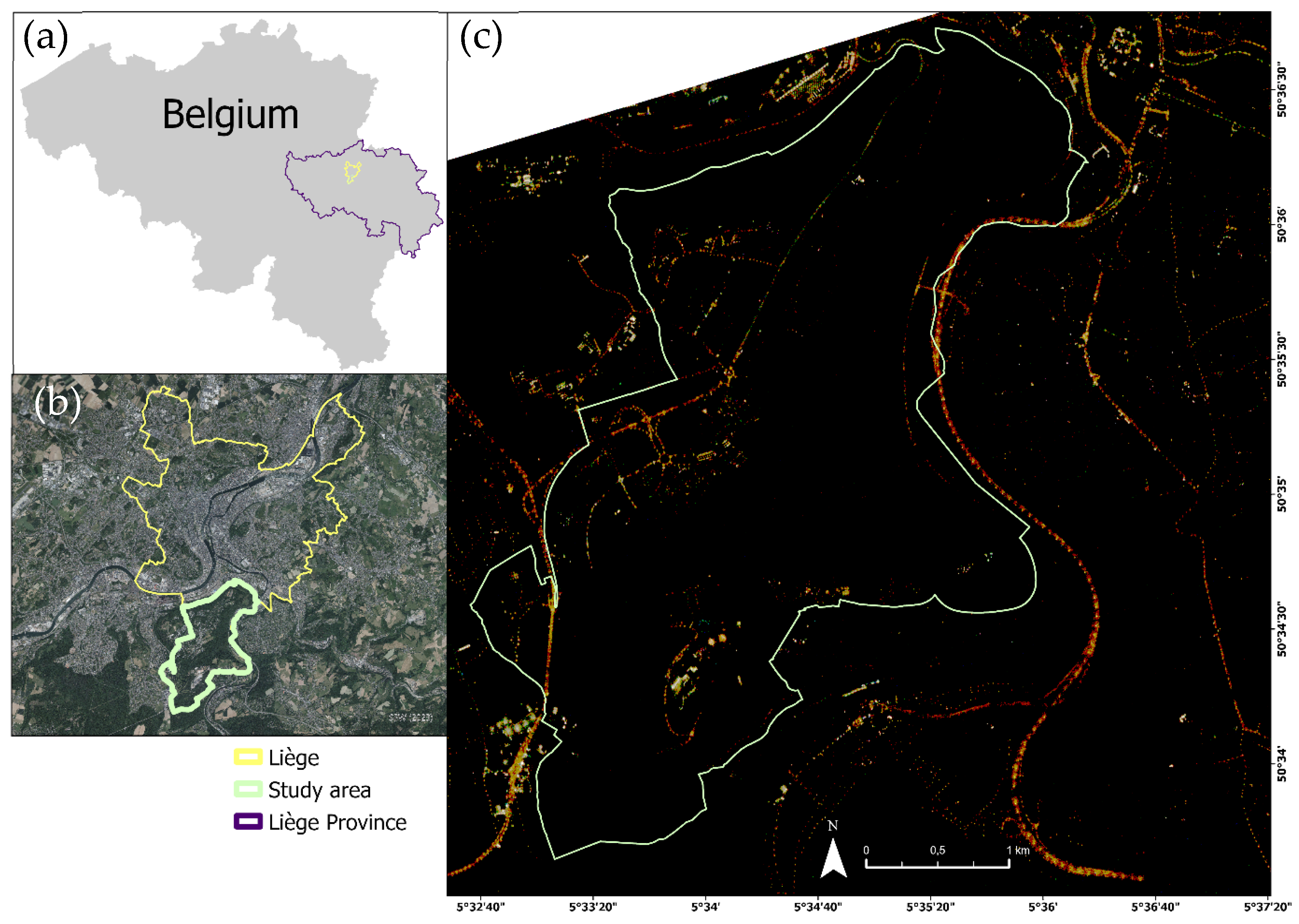
3.1. Study Area
3.2. Data
3.2.1. Satellite Data
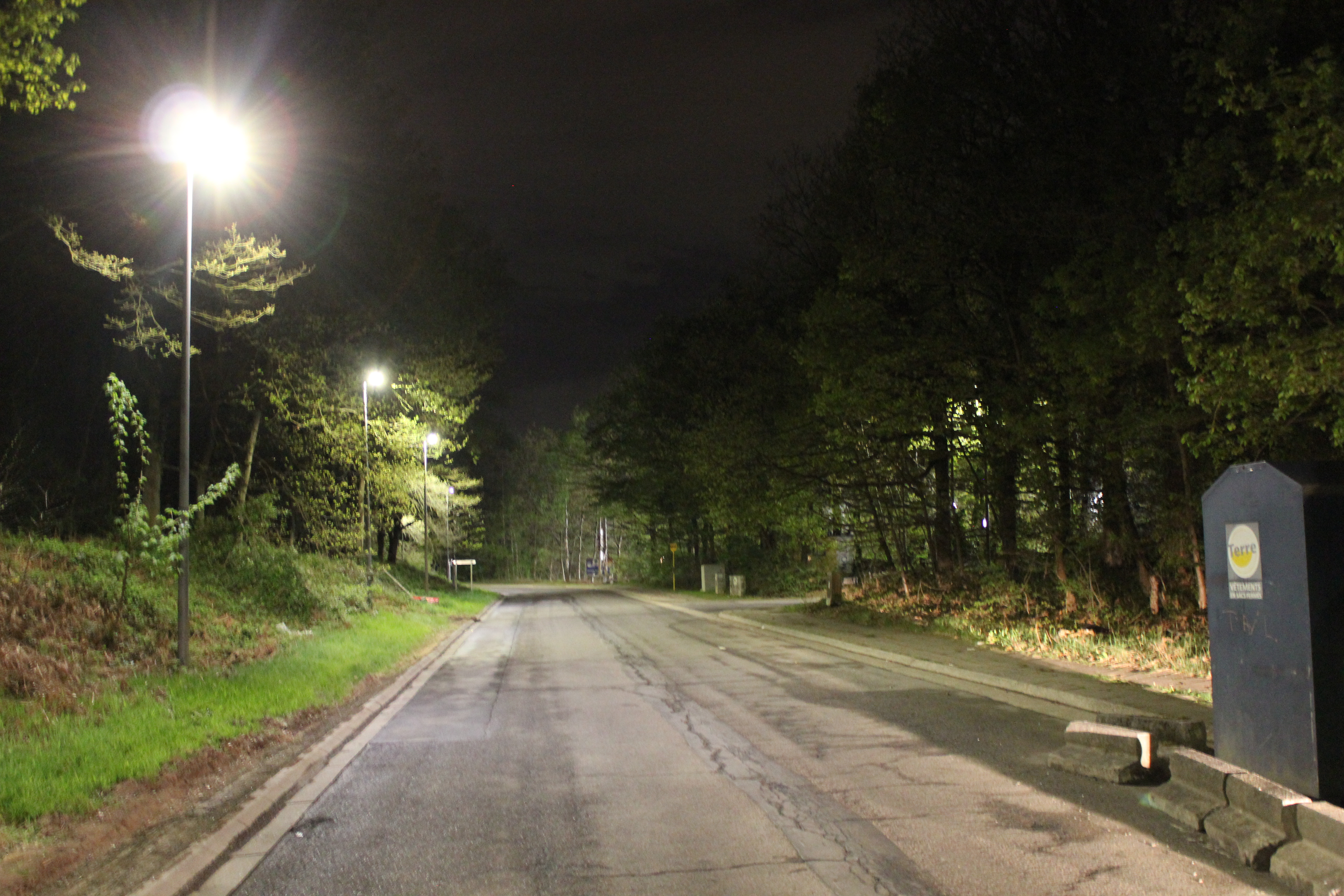
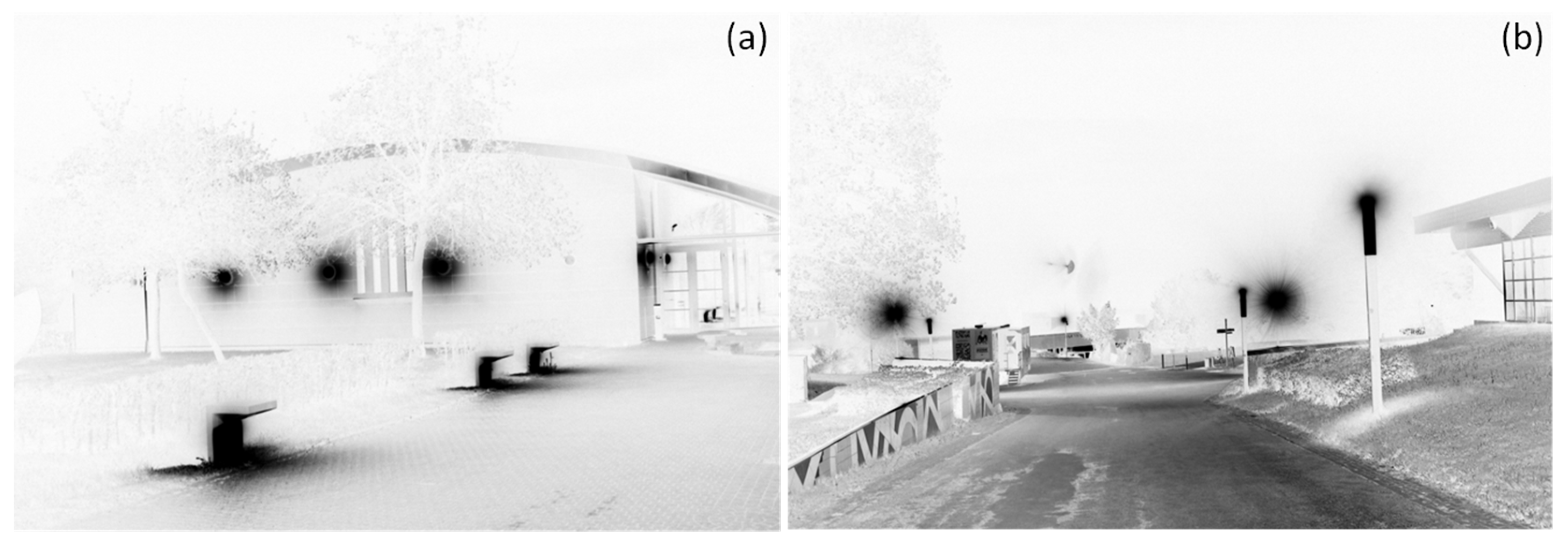
3.2.2. Nighttime Photography
3.2.3. Light Points
3.2.4. Land Cover
3.2.5. Ecological Network Mapping
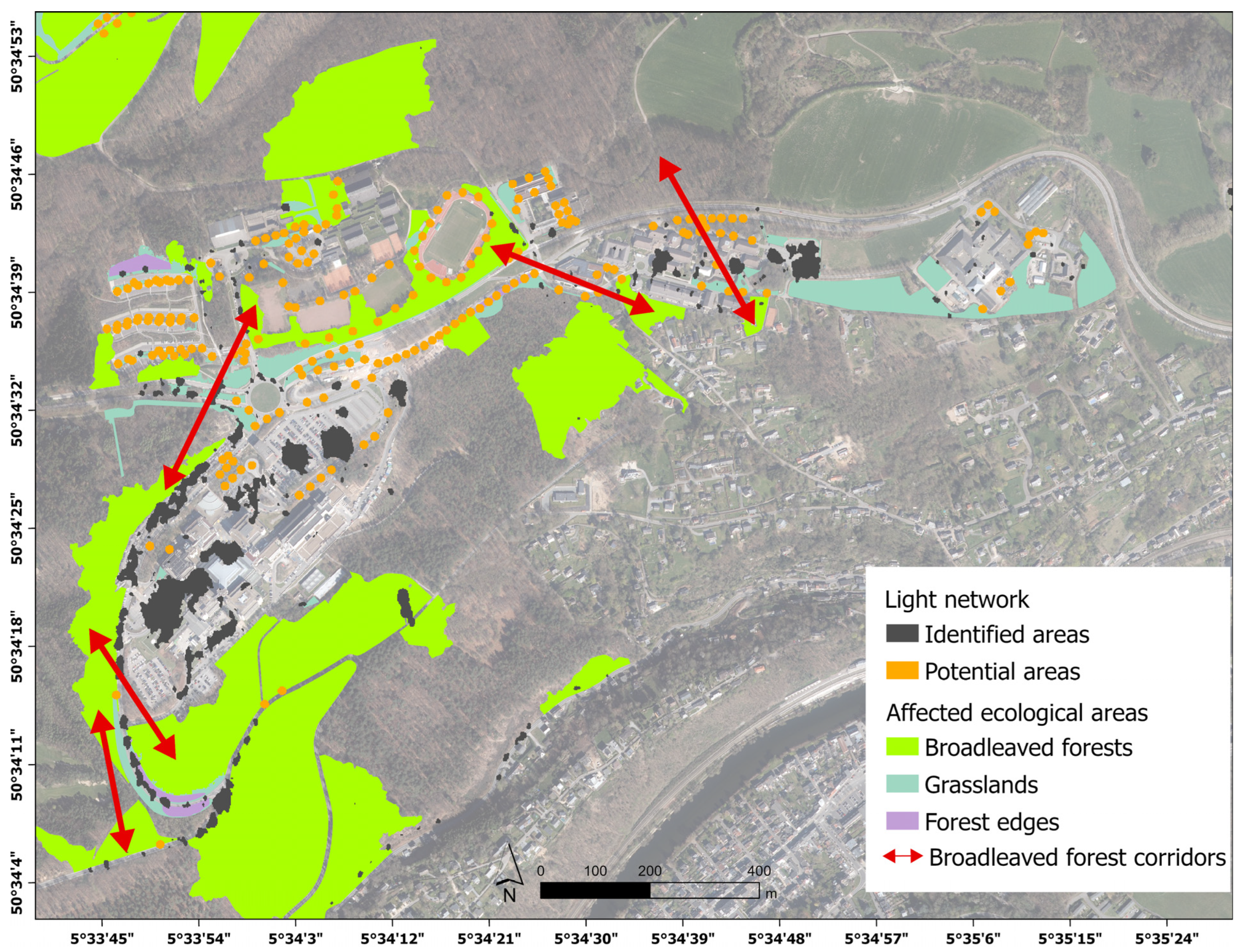
- Broadleaved forests, comprising habitats with at least 75% native species. They are divided into two subnetworks. The first includes broadleaved forests adapted to intermediate moisture levels, known as mesophilic forests. The model species for this infrastructure is the stag beetle (Lucanus cervus). The second consists of wet forests, which must include streams; the model species here is the fire salamander (Salamandra salamandra).
- Dry open habitats, which include dry grasslands and heathlands. The model species is the blue-winged grasshopper (Oedipoda caerulescens).
- Grasslands, which are also open habitats but are mesophilic, with richer soils supporting denser herbaceous vegetation.
- Forest edges, forming a transition zone between forested areas and open habitats.
3.3. Methodology
3.3.1. Satellite Image Preprocessing
3.3.2. Spatial Description of the Illuminated Area
3.3.3. Light Infrastructure
3.3.4. Conflict Areas
4. Results
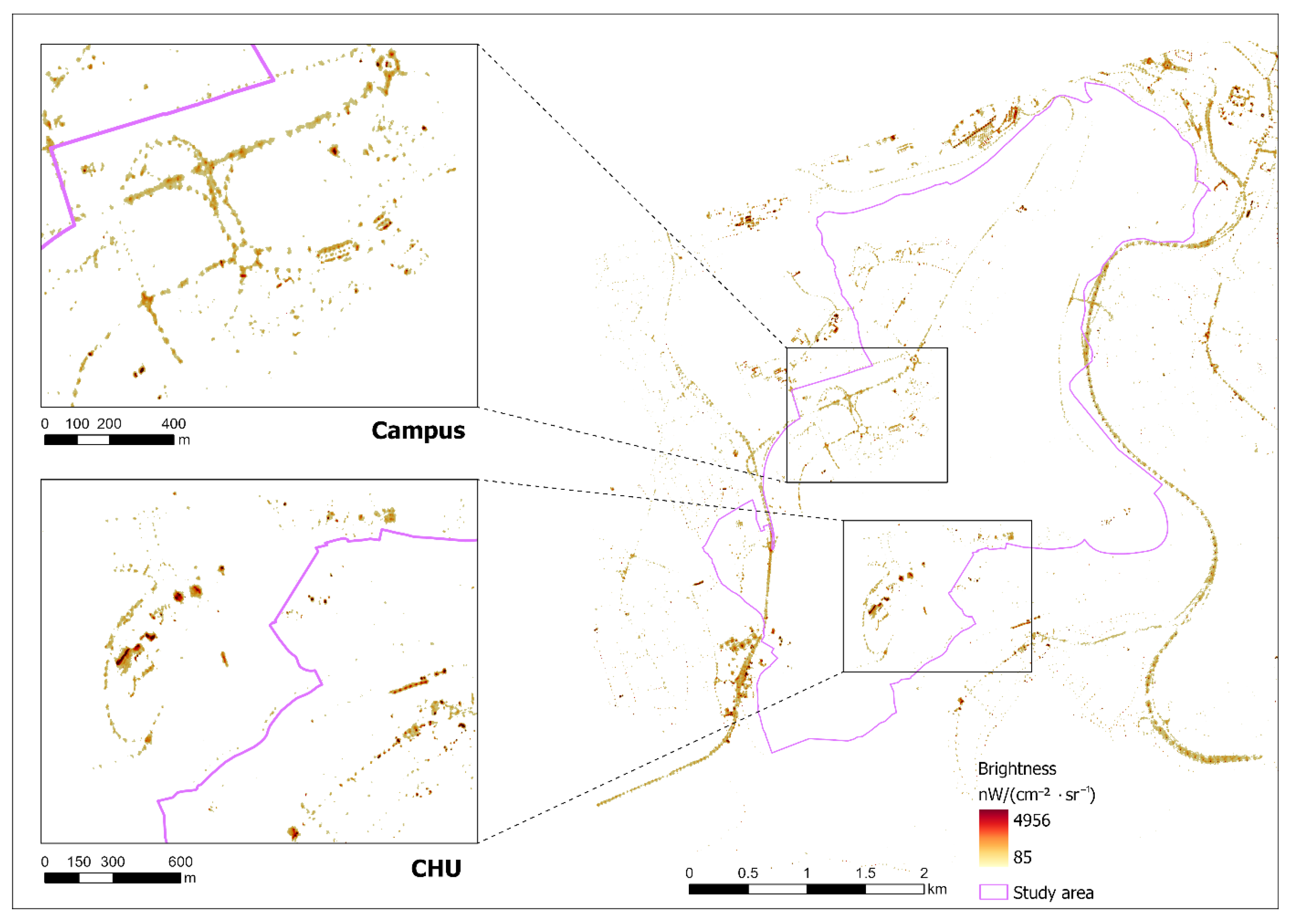
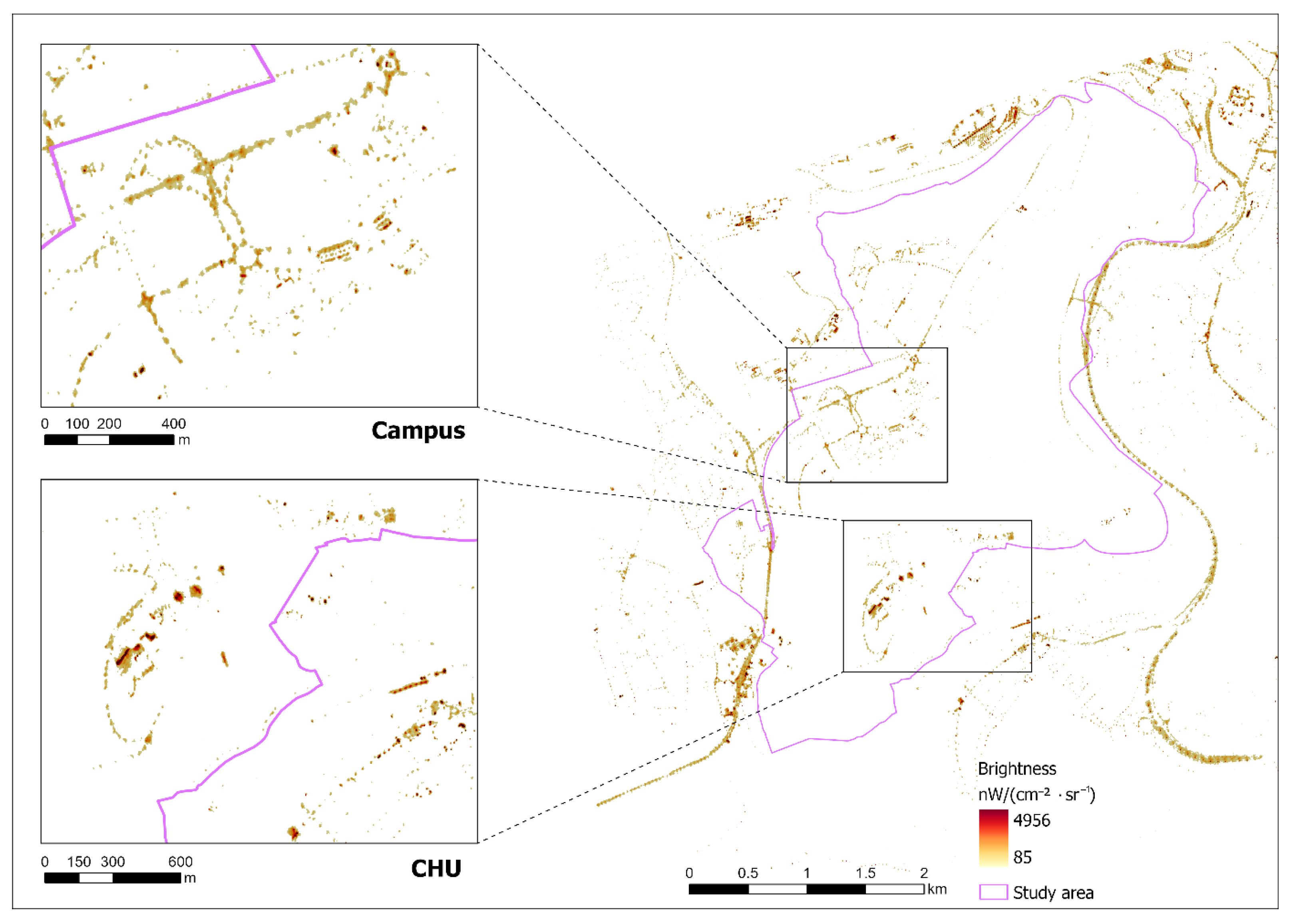
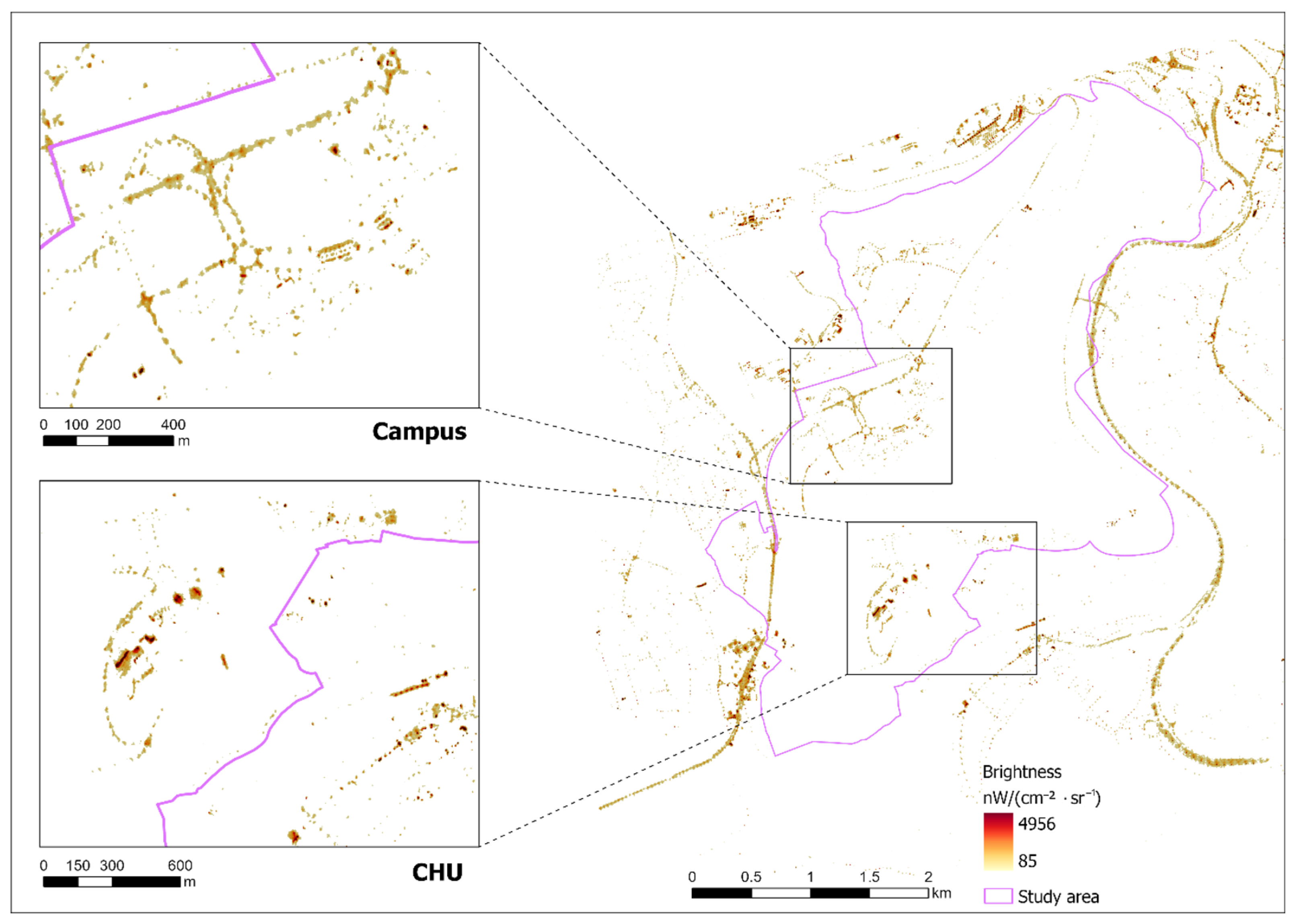
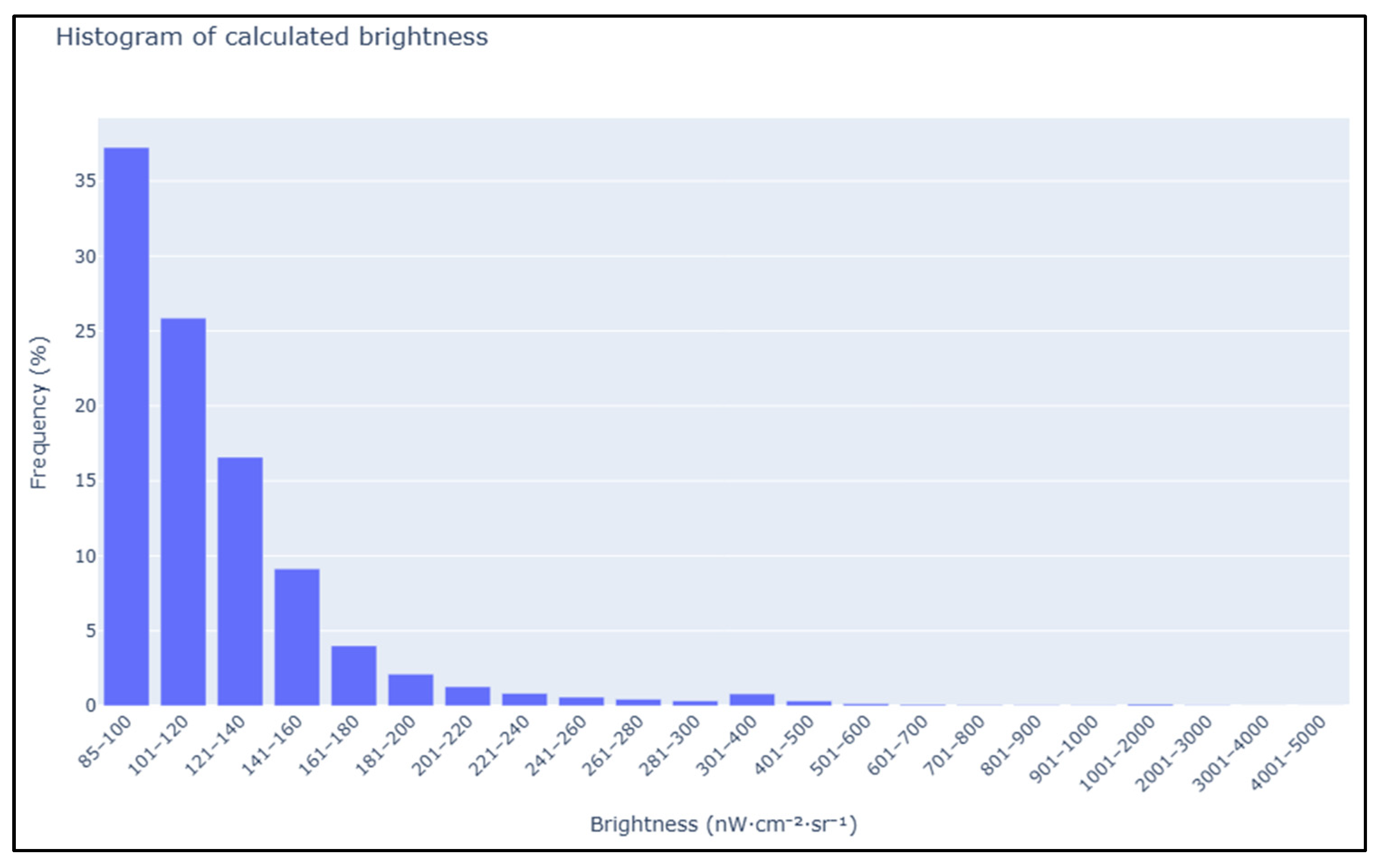
4.1. Spatial Description of the Light Footprint
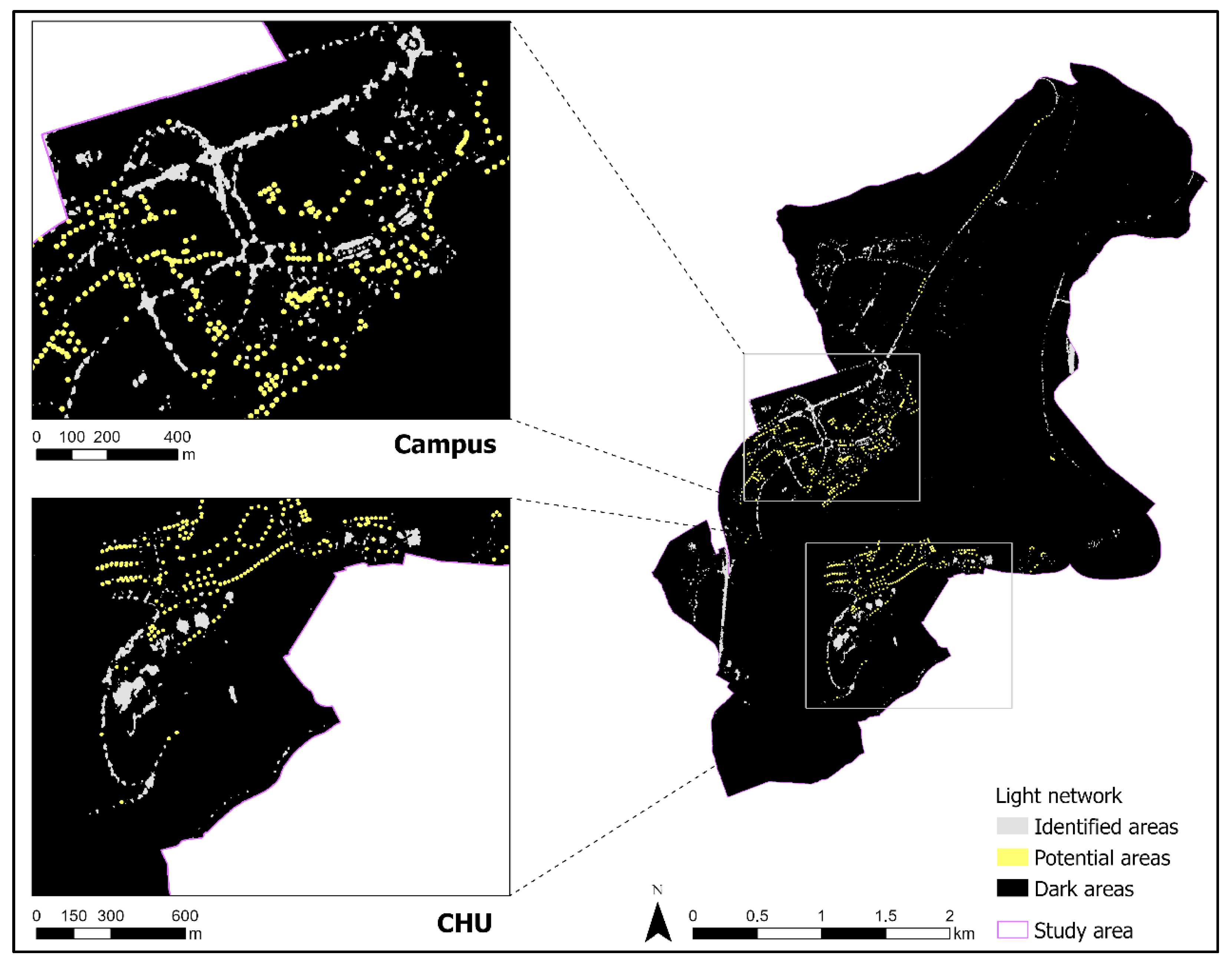
4.2. Light Infrastructure
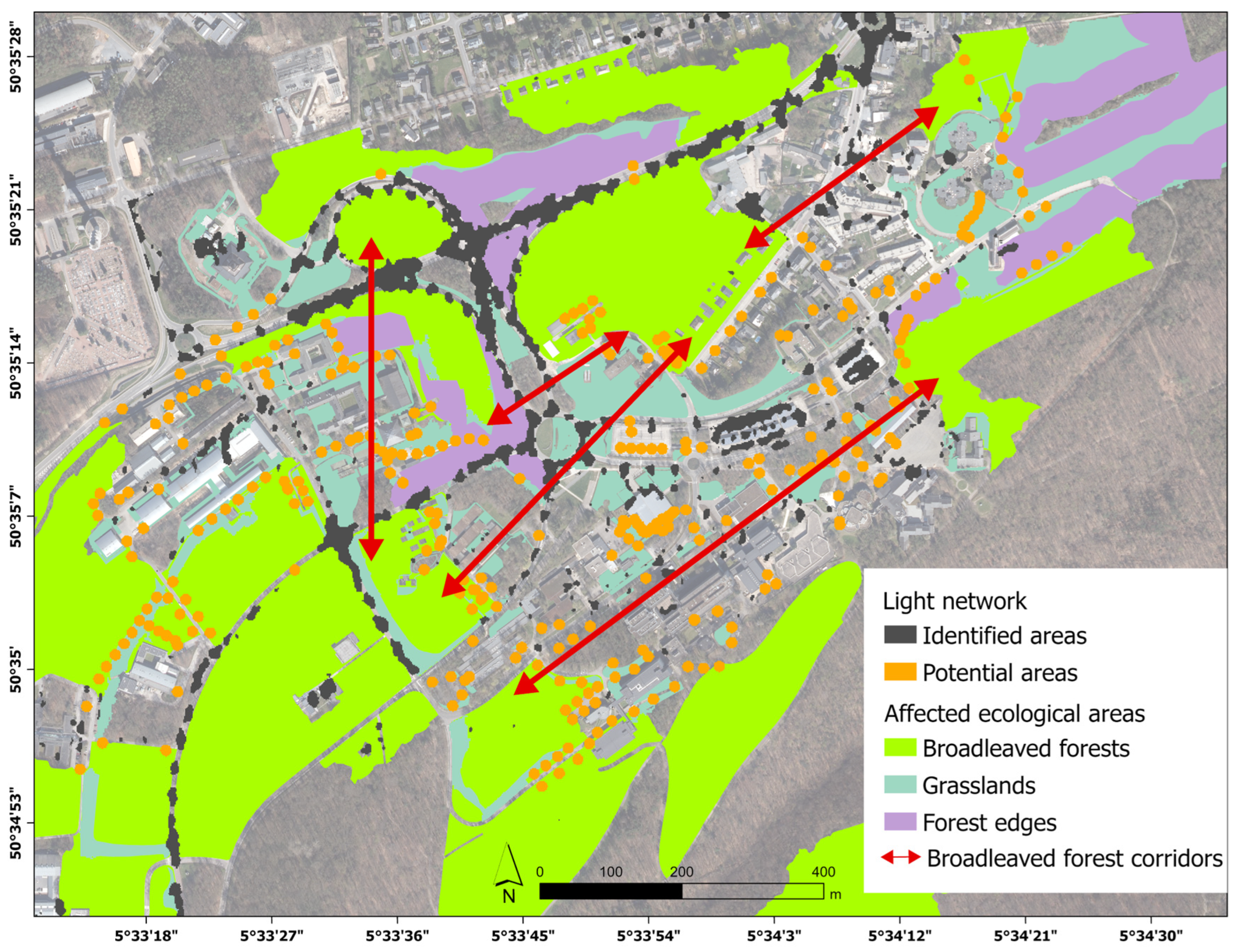
4.3. Conflict Zones
5. Discussion
5.1. The Footprint of ALAN on the Sart-Tilman
5.2. Relevance of Integrating a Dark Infrastructure
5.3. Methodological Considerations
5.4. Contributions and Perspectives
6. Conclusions
Author Contributions
Funding
Data Availability Statement
Conflicts of Interest
Abbreviations
| ALAN | Artificial Light at Night |
Appendix A

| Landscape matrix | The dominant land cover within which biodiversity nuclei (reservoirs) are embedded [6]. |
| Core areas | Surfaces accommodating target species populations and biotopes within each thematic network. These sites require a protection status and are exclusively dedicated to nature conservation [38]. |
| Development areas | Areas where socio-economic activities are permitted, provided they are compatible with the promotion of biodiversity development. Sites of known biodiversity interest but smaller than the minimum vital size required for the species are also considered development areas [38]. |
| Corridors | Elements ensuring ecological continuity and connectivity between different biodiversity reservoirs within the landscape matrix. They correspond to the theoretical optimal paths that connect the reservoirs within the matrix. |
Appendix B

References
- Battisti, C. Habitat fragmentation, fauna and ecological network planning: Toward a theoretical conceptual framework. Ital. J. Zool. 2003, 70, 241–247. [Google Scholar] [CrossRef]
- Fischer, J.; Lindenmayer, D.B. Landscape modification and habitat fragmentation: A synthesis. Glob. Ecol. Biogeogr. 2007, 16, 265–280. [Google Scholar] [CrossRef]
- Haddad, N.M.; Brudvig, L.A.; Clobert, J.; Davies, K.F.; Gonzalez, A.; Holt, R.D.; Lovejoy, T.E.; Sexton, J.O.; Austin, M.P.; Collins, C.D.; et al. Habitat fragmentation and its lasting impact on Earth’s ecosystems. Sci. Adv. 2015, 1, 9. [Google Scholar] [CrossRef] [PubMed]
- MacArthur, R.H.; Wilson, E.O. The Theory of Island Biogeography; Princeton University Press: Princeton, NJ, USA, 2001; p. 220. [Google Scholar]
- Connor, E.F.; McCoy, E.D. The Statistics and Biology of the Species-Area Relationship. Am. Nat. 1979, 113, 791–833. [Google Scholar] [CrossRef]
- Opdam, P. Metapopulation theory and habitat fragmentation: A review of holarctic breeding bird studies. Landsc. Ecol. 1991, 5, 93–106. [Google Scholar] [CrossRef]
- Jongman, R.H.G. Nature conservation planning in Europe: Developing ecological networks. Landsc. Urban Plan. 1995, 32, 169–183. [Google Scholar] [CrossRef]
- Sordello, R. Pollution lumineuse et trame verte et bleue: Vers une trame noire en France? Territ. Mov. 2017, 35, 24. [Google Scholar] [CrossRef]
- Mander, Ü.; Kull, A.; Uuemaa, E.; Mõisja, K.; Külvik, M.; Kikas, T.; Raet, J.; Tournebize, J.; Sepp, K. Green and brown infrastructures support a landscape-level implementation of ecological engineering. Ecol. Eng. 2018, 120, 23–35. [Google Scholar] [CrossRef]
- Sordello, R.; Reyjol, Y.; Amsallem, J.; Bas, Y.; Billon, L.; Borner, L.; Comolet-Tirman, J.; Daoz, A.; Dugué, A.-L.; Guinard, É.; et al. Les déplacements des espèces volantes: Vers la mise en œuvre d’une « Trame aérienne » dans le cadre de la politique Trame verte et bleue ? Naturae 2022, 2022, 169–192. [Google Scholar] [CrossRef]
- Tiwary, A.; Kumar, P. Impact evaluation of green–grey infrastructure interaction on built-space integrity: An emerging perspective to urban ecosystem service. Sci. Total Environ. 2014, 487, 350–360. [Google Scholar] [CrossRef]
- Vincent, Q.; Mangin, N.; Rigolot, R.; Blanchart, A. Étude de la biodiversité des sols (macrofaune épigée) urbains et péri-urbains dans le cadre de la création d’une trame brune. Etude Gest. Sols 2022, 29, 275–294. [Google Scholar]
- Laforge, A.; Pauwels, J.; Faure, B.; Bas, Y.; Kerbiriou, C.; Fonderflick, J.; Besnard, A. Reducing light pollution improves connectivity for bats in urban landscapes. Landsc. Ecol. 2019, 34, 793–809. [Google Scholar] [CrossRef]
- Stone, T. The Value of Darkness: A Moral Framework for Urban Nighttime Lighting. Sci. Eng. Ethics 2018, 24, 607–628. [Google Scholar] [CrossRef]
- Rodrigo-Comino, J.; Seeling, S.; Seeger, M.K.; Ries, J.B. Light pollution: A review of the scientific literature. Anthr. Rev. 2023, 10, 367–392. [Google Scholar] [CrossRef]
- Anderson, S.J.; Kubiszewski, I.; Sutton, P.C. The Ecological Economics of Light Pollution: Impacts on Ecosystem Service Value. Remote Sens. 2024, 16, 2591. [Google Scholar] [CrossRef]
- Longcore, T.; Rich, C. Ecological Light Pollution. Front. Ecol. Environ. 2004, 2, 191–198. [Google Scholar] [CrossRef]
- Challéat, S. La nuit, une nouvelle question pour la géographie: Nighttime: A new topic for geography. Bull. Assoc. Géogr. Fr. 2011, 88, 183–196. [Google Scholar] [CrossRef]
- Falchi, F.; Cinzano, P.; Elvidge, C.D.; Keith, D.M.; Haim, A. Limiting the impact of light pollution on human health, environment and stellar visibility. J. Environ. Manag. 2011, 92, 2714–2722. [Google Scholar] [CrossRef] [PubMed]
- Falcón, J.; Torriglia, A.; Attia, D.; Viénot, F.; Gronfier, C.; Behar-Cohen, F.; Martinsons, C.; Hicks, D. Exposure to Artificial Light at Night and the Consequences for Flora, Fauna, and Ecosystems. Front. Neurosci. 2020, 14, 39. [Google Scholar] [CrossRef]
- Levin, N.; Kyba, C.C.M.; Zhang, Q.; Sánchez de Miguel, A.; Román, M.O.; Li, X.; Portnov, B.A.; Molthan, A.L.; Jechow, A.; Miller, S.D.; et al. Remote sensing of night lights: A review and an outlook for the future. Remote Sens. Environ. 2020, 237, 111443. [Google Scholar] [CrossRef]
- Huang, C.; Ye, Y.; Jin, Y.; Liang, B. Research Progress, Hotspots, and Evolution of Nighttime Light Pollution: Analysis Based on WOS Database and Remote Sensing Data. Remote Sens. 2023, 15, 2305. [Google Scholar] [CrossRef]
- Gaston, K.J.; Bennie, J.; Davies, T.W.; Hopkins, J. The ecological impacts of nighttime light pollution: A mechanistic appraisal. Biol. Rev. 2013, 88, 912–927. [Google Scholar] [CrossRef]
- Sanders, D.; Hirt, M.R.; Brose, U.; Evans, D.M.; Gaston, K.J.; Gauzens, B.; Ryser, R. How artificial light at night may rewire ecological networks: Concepts and models. Philos. Trans. R. Soc. B Biol. Sci. 2023, 378, 20220368. [Google Scholar] [CrossRef]
- Azam, C.; Le Viol, I.; Julien, J.-F.; Bas, Y.; Kerbiriou, C. Disentangling the relative effect of light pollution, impervious surfaces and intensive agriculture on bat activity with a national-scale monitoring program. Landsc. Ecol. 2016, 31, 2471–2483. [Google Scholar] [CrossRef]
- Azam, C.; Le Viol, I.; Bas, Y.; Zissis, G.; Vernet, A.; Julien, J.-F.; Kerbiriou, C. Evidence for distance and illuminance thresholds in the effects of artificial lighting on bat activity. Landsc. Urban Plan. 2018, 175, 123–135. [Google Scholar] [CrossRef]
- Mosser, S. Eclairage et sécurité en ville: L’état des savoirs. Déviance Société 2007, 31, 77–100. [Google Scholar] [CrossRef]
- Dunn, N. Dark Design: A New Framework for Advocacy and Creativity for the Nocturnal Commons. Int. J. Des. Soc. 2020, 14, 19–30. [Google Scholar] [CrossRef]
- Falchi, F.; Cinzano, P.; Duriscoe, D.; Kyba, C.C.M.; Elvidge, C.D.; Baugh, K.; Portnov, B.A.; Rybnikova, N.A.; Furgoni, R. The new world atlas of artificial night sky brightness. Sci. Adv. 2016, 2, e1600377. [Google Scholar] [CrossRef]
- Hölker, F.; Wolter, C.; Perkin, E.K.; Tockner, K. Light pollution as a biodiversity threat. Trends Ecol. Evol. 2010, 25, 681–682. [Google Scholar] [CrossRef]
- Ji, M.; Xu, Y.; Yan, Y.; Zhu, S. Evaluation of the light pollution in the nature reserves of China based on NPP/VIIRS nighttime light data. Int. J. Digit. Earth 2024, 17, 2347442. [Google Scholar] [CrossRef]
- Aulsebrook, A.E.; Jones, T.M.; Mulder, R.A.; Lesku, J.A. Impacts of artificial light at night on sleep: A review and prospectus. J. Exp. Zool. Part A Ecol. Integr. Physiol. 2018, 329, 409–418. [Google Scholar] [CrossRef]
- Cinzano, P.; Falchi, F. Quantifying light pollution. J. Quant. Spectrosc. Radiat. Transf. 2014, 139, 13–20. [Google Scholar] [CrossRef]
- Sánchez de Miguel, A.; Kyba, C.C.M.; Aubé, M.; Zamorano, J.; Cardiel, N.; Tapia, C.; Bennie, J.; Gaston, K.J. Colour remote sensing of the impact of artificial light at night (I): The potential of the International Space Station and other DSLR-based platforms. Remote Sens. Environ. 2019, 224, 92–103. [Google Scholar] [CrossRef]
- Bará, S.; Rigueiro, I.; Lima, R.C. Monitoring transition: Expected night sky brightness trends in different photometric bands. J. Quant. Spectrosc. Radiat. Transf. 2019, 239, 106644. [Google Scholar] [CrossRef]
- Guk, E.; Levin, N. Analyzing spatial variability in night-time lights using a high spatial resolution color Jilin-1 image—Jerusalem as a case study. ISPRS J. Photogramm. Remote Sens. 2020, 163, 121–136. [Google Scholar] [CrossRef]
- Sordello, R.; Paquier, F.; Daloz, A. Trame Noire—Méthodes D’élaboration et Outils Pour sa Mise en Œuvre; Office Français de la Biodiversité: Paris, France, 2021; p. 116. [Google Scholar]
- Gillet, L.; Coppée, T.; Mahy, G.; Dufrêne, M. Analyse du Réseau Écologique et des Fonctions de Connectivité, en Regard du Plan D’urbanisation, du Site du Sart Tilman, Rapport Final; Gembloux Agro-Bio Tech, Liège Université: Gembloux, Belgique, 2024; p. 109. [Google Scholar]
- Tini, M.; Bardiani, M.; Campanaro, A.; Chiari, S.; Mason, F.; Maurizi, E.; Toni, I.; Audisio, P.; Carpaneto, G.M. A stag beetle’s life: Sex-related differences in daily activity and behaviour of Lucanus cervus (Coleoptera: Lucanidae). J. Insect Conserv. 2017, 21, 897–906. [Google Scholar] [CrossRef]
- Denoël, M. Phénologie et domaine vital de la salamandre terrestre Salamandra salamandra terrestris (Amphibia, Caudata) dans un bois du Pays de Herve (Belgique). Cah. Ethol. 1996, 16, 291–306. Available online: https://hdl.handle.net/2268/3224 (accessed on 10 March 2025).
- Kral, K. Escape behaviour in blue-winged grasshoppers, Oedipoda caerulescens. Physiol. Entomol. 2010, 35, 240–248. [Google Scholar] [CrossRef]
- Grundland, M.; Dodgson, N.A. Decolorize: Fast, contrast enhancing, color to grayscale conversion. Pattern Recognit. 2007, 40, 2891–2896. [Google Scholar] [CrossRef]
- Zheng, Q.; Weng, Q.; Huang, L.; Wang, K.; Deng, J.; Jiang, R.; Ye, Z.; Gan, M. A new source of multispectral high spatial resolution night-time light imagery—JL1-3B. Remote Sens. Environ. 2018, 215, 300–312. [Google Scholar] [CrossRef]
- Xue, X.; Lin, Y.; Zheng, Q.; Wang, K.; Zhang, J.; Deng, J.; Abubakar, G.A.; Gan, M. Mapping the finescale spatial pattern of artificial light pollution at night in urban environments from the perspective of bird habitats. Sci. Total Environ. 2020, 702, 134725. [Google Scholar] [CrossRef] [PubMed]
- Challéat, S.; Barré, K.; Laforge, A.; Lapostolle, D.; Franchomme, M.; Sirami, C.; Le Viol, I.; Milian, J.; Kerbiriou, C. Grasping darkness: The dark ecological network as a social-ecological framework to limit the impacts of light pollution on biodiversity. Ecol. Soc. 2021, 26, 15. [Google Scholar] [CrossRef]
- Hao, Q.; Wang, L.; Liu, G.; Ren, Z.; Wu, Y.; Yu, Z.; Yu, J. Exploring the construction of urban artificial light ecology: A systematic review and the future prospects of light pollution. Environ. Sci. Pollut. Res. 2023, 30, 101963–101988. [Google Scholar] [CrossRef] [PubMed]
- Angerand, C. Étude de la Pollution Lumineuse Dans le Cadre de la Création D’une Trame Noire. Approche Transversale Pour la Valorisation des Paysages Nocturnes. Le cas du Parc Naturel Burdinale-Mehaigne, Wallonie. Unpublished Master’s Thesis, Université de Liège, Liège, Belgium, 2021; 103p. Available online: http://hdl.handle.net/2268.2/11891 (accessed on 3 December 2024).


| Red | Green | Blue | |
|---|---|---|---|
| Gain | 0.000574 | 0.000644 | 0.000895 |
| Offset | 0.009202 | 0.009854 | 0.011851 |
| Land Cover Classes | Min | Max | Mean | Median | SD | CV | Skewness | Surface (%) |
|---|---|---|---|---|---|---|---|---|
| Bare soil | 86 | 254 | 132 | 118 | 43 | 0.33 | 1.1 | 0.1 |
| Forest | 85 | 4781 | 119 | 100 | 115.5 | 0.97 | 20.3 | 7 |
| Grove | 85 | 1078 | 121 | 106 | 58 | 0.48 | 8.2 | 1 |
| Railway | 85 | 817 | 137 | 121 | 62.6 | 0.46 | 3.6 | 3.9 |
| Primary road | 85 | 4371 | 118 | 106 | 48.2 | 0.41 | 21.8 | 42.5 |
| Communal road | 85 | 4897 | 133 | 112 | 103 | 0.78 | 17.4 | 25.5 |
| Path | 86 | 471 | 112 | 100 | 40 | 0.36 | 4.7 | 0.2 |
| Water body | 85 | 547 | 121 | 104 | 48.5 | 0.40 | 3.8 | 0.3 |
| Herbaceous cover | 85 | 3799 | 128 | 104 | 102.1 | 0.80 | 15.3 | 9.1 |
| Built-up | 85 | 4956 | 143 | 113 | 144.1 | 1.01 | 14.9 | 10.4 |
Disclaimer/Publisher’s Note: The statements, opinions and data contained in all publications are solely those of the individual author(s) and contributor(s) and not of MDPI and/or the editor(s). MDPI and/or the editor(s) disclaim responsibility for any injury to people or property resulting from any ideas, methods, instructions or products referred to in the content. |
© 2026 by the authors. Licensee MDPI, Basel, Switzerland. This article is an open access article distributed under the terms and conditions of the Creative Commons Attribution (CC BY) license.
Share and Cite
Wynants, J.; Schmitz, S. A Methodological Proposal for Implementing Dark Infrastructure Within the Ecological Network of an Urban Forest. Land 2026, 15, 168. https://doi.org/10.3390/land15010168
Wynants J, Schmitz S. A Methodological Proposal for Implementing Dark Infrastructure Within the Ecological Network of an Urban Forest. Land. 2026; 15(1):168. https://doi.org/10.3390/land15010168
Chicago/Turabian StyleWynants, Julien, and Serge Schmitz. 2026. "A Methodological Proposal for Implementing Dark Infrastructure Within the Ecological Network of an Urban Forest" Land 15, no. 1: 168. https://doi.org/10.3390/land15010168
APA StyleWynants, J., & Schmitz, S. (2026). A Methodological Proposal for Implementing Dark Infrastructure Within the Ecological Network of an Urban Forest. Land, 15(1), 168. https://doi.org/10.3390/land15010168