Article

Identification of Potential Supplementary Cultivated Land Based on a Markov-FLUS Model and Cultivation Suitability Evaluation Under the New Occupation and Compensation Balance Policy: A Case Study of Jiangsu Province

1
School of Business, Yangzhou University, Yangzhou 225125, China
2
College of Public Administration, Nanjing Agricultural University, Nanjing 210095, China
3
School of Land Science and Technology, China University of Geosciences, Beijing 100083, China
4
Key Laboratory of Land Consolidation, Ministry of Natural Resources, Beijing 100035, China
5
School of International Affairs and Public Administration, Ocean University of China, Qingdao 266100, China
6
School of Environment Science and Engineering, Tiangong University, Tianjin 300387, China
7
Institute of Political Science and Law, Zhengzhou University of Light Industry, Zhengzhou 450001, China
*
Authors to whom correspondence should be addressed.
Land 2026, 15(1), 169; https://doi.org/10.3390/land15010169
Submission received: 17 November 2025 / Revised: 6 January 2026 / Accepted: 9 January 2026 / Published: 15 January 2026

Abstract

The identification of supplementary cultivated land as a reserve resource is of great significance for ensuring implementation of the new mechanism of land occupation and compensation balance in China. Using Jiangsu Province as a case study, here, we use a “multi-period land use change patterns–multi-scenario land use simulation–cultivation suitability evaluation–identification of supplementary cultivated land” framework to explore identification of supplementary cultivated land. A single land use dynamic index and a land use transfer matrix were used to analyze land use pattern changes in Jiangsu Province and showed that the area of cultivated land in Jiangsu Province decreased significantly, mainly by being converted into land used for buildings, and waters and conservancy facilities. A Markov-FLUS model was used to simulate and predict land use quantity and spatial distribution under four scenarios: an inertial development scenario, a cultivated land protection scenario, an economic development priority scenario, and an ecological protection priority scenario. Sixteen factor indicators were selected from the four dimensions of natural land quality, social economy, management, and the ecological condition of the land, and the degree of suitability of cultivated land in Jiangsu was evaluated by multi-factor stepwise correction. The southern and central parts of Jiangsu had higher suitability, while the northern part had lower suitability. By superimposing these data on current land use data from 2023, the plots of land that were converted to or from cultivated land were identified. Combined with the suitability degree, the potential three major categories and eight types of sources for supplementary cultivated land, totaling 29,015.92 km2, were identified, along with their distribution. A time sequence arrangement for these sources was initially set up. Corresponding management suggestions were proposed based on the adaptability of different supplementary cultivated land sources, with the aim of providing scientific references for the acquisition of supplementary cultivated land sources in the implementation of the national and local government’s farmland balance management.

1. Introduction

Under the current severe international circumstances, such as extreme climate, regional conflicts, resource scarcity, intensified trade barriers, rising material costs, and increasing dietary needs, the global food security issue has become even more severe [1,2]. The report “The state of food security and nutrition in the world in 2024” states that approximately 733 million people worldwide were facing hunger in 2023 and further warns that there are significant differences in severity among countries, making it difficult to achieve the sustainable development goal of zero hunger by 2030 [3]. As cultivated land is an important resource for farming, protecting cultivated land is a long-term focus that draws global attention. The report “The state of the world’s land and water resources for food and agriculture” indicates that the global farmland area is only approximately 1.3 billion hectares, and its distribution is extremely uneven among countries. Due to factors such as soil quality decline, excessive human cultivation, and climate change, about 33% of global farmland has experienced moderate to severe degradation [4]. Therefore, how to ensure the quantity of farmland, stabilize the quality of farmland, and support food security have become key focuses in the current global land science research field.
Since the reform and opening-up, the scale of towns in China has continuously expanded, which led to the decrease in the quantity and quality of cultivated land, after which the “one-for-one” land occupation and compensation balance system was implemented [5,6]. The traditional policy for managing the balance of cultivated land occupation and compensation has gone through the stages of balancing the quantity of cultivated land and then balancing both the quantity and quality of cultivated land. Supplementary land is usually sourced from the local reserve pool of supplementary land, mainly through measures such as land reclamation, comprehensive land improvement, and agricultural structure adjustment [7,8]. Due to significant differences in economic development and resource distribution among various regions in China, the uneven distribution of arable land reserves has affected implementation of the policy; therefore, scholars have begun to study cross-regional mechanisms of identifying supplementary farmland [9,10]. In 2018, the Ministry of Natural Resources issued the “Notice on Implementing Cross-Provincial Supplementary Cultivated Land National Coordination”, proposing a cross-regional system of supplementary cultivated land indicators of “mainly county-level balance, supplemented by provincial-level adjustment, and supplemented by national coordination”, with the aim of alleviating contradictions in ways of identifying supplementary cultivated land. With the acceleration of land transfer and the comparatively low income generated by farming, farmers are more willing to plant economical crops on cultivated land, thereby causing the phenomenon of “non-grainization” of cultivated land [11]. In November 2021, the “access-exit balance” policy was proposed to strictly restrict the conversion of high-standard farmland to poor-quality farmland while allowing general cultivated land to be converted to forests, grassland, gardens, and other agricultural facilities upon request. The policy also requires cross-regional “one-for-one” replacement to ensure national food security. The implementation of these two policies has achieved considerable results in terms of protecting farmland and increasing grain production; however, it has also led to problems such as the marginalization and fragmentation of farmland, and phenomena such as “reclaiming farmland from mountains and lakes” are quite prominent. Moreover, in the implementation of the farmland “access-exit balance”, due to the limited types of land that can be converted into farmland within each region’s agricultural area, and given that different departments having jurisdiction over different types of land, it is difficult to find sources of supplementary farmland [12]. In September 2024, the Ministry of Natural Resources and the Ministry of Agriculture and Rural Affairs in China issued the “Notice on reforming and improving the management of land occupation and compensation balance”, proposing to uniformly incorporate all types of activities that occupy arable land into the management of arable land balance. This new policy has expanded the scope of the balance between occupation and compensation, strictly restricted the indicators of this balance, and increased sources of supplementary farmland. It emphasizes the need to stabilize the utilization of supplementary farmland, and evaluation of suitability for cultivation is an important prerequisite to ensure that the quality of supplementary farmland is equal to or better than that of the occupied farmland. Therefore, in the current context of extensive reform of occupation and compensation, how to identify supplementary farmland is a practical issue that needs to be urgently studied.
Supplementary cultivated land in China mostly came from the reserve resources of cultivated land, which refers to undeveloped or slightly developed land resources reserved or managed during the land use process to maintain sustainable land use [13]. Scholars have focused on investigation and evaluation of cultivated land reserves [14], implementation and policy optimization of the balance between occupation and supplementation, the sequence of development and utilization, utilization mode, regional layout, and protection policy [15,16,17,18,19]. They aim to systematically grasp the quantity, quality, and spatial distribution of cultivated land reserves, thereby providing a decision-making basis for implementation of the policy of balance between occupation and supplementation of cultivated land. With the development of China’s social economy and the acceleration of urbanization, cultivated land reserves in various regions are not sufficient, and the land consolidation method has begun to be relied on to supplement cultivated land. Subsequent research mainly focuses on evaluation of the quantity and quality of supplementary cultivated land, evaluation of suitability and consolidation of zoning, cross-regional index trading, the abandonment of cultivated land, and the restoration and governance of supplementary cultivated land [20,21,22,23,24]. However, facing the rigid requirement of “one-for-one” compensation, there may be cases of blind land reclamation, such as converting dry land into paddy fields, or moving from mountains to lakes to obtain supplementary cultivated land indicators. This leads to problems such as a decline in farmland quality and damage to the ecological environment. Therefore, against the background of the new mechanism of balance between occupation and supplementation of cultivated land, it is urgent to consider the overall suitability of all regional land for cultivation and to identify supplementary cultivated land in combination with the long-term land use change situation, land stability, and development laws.
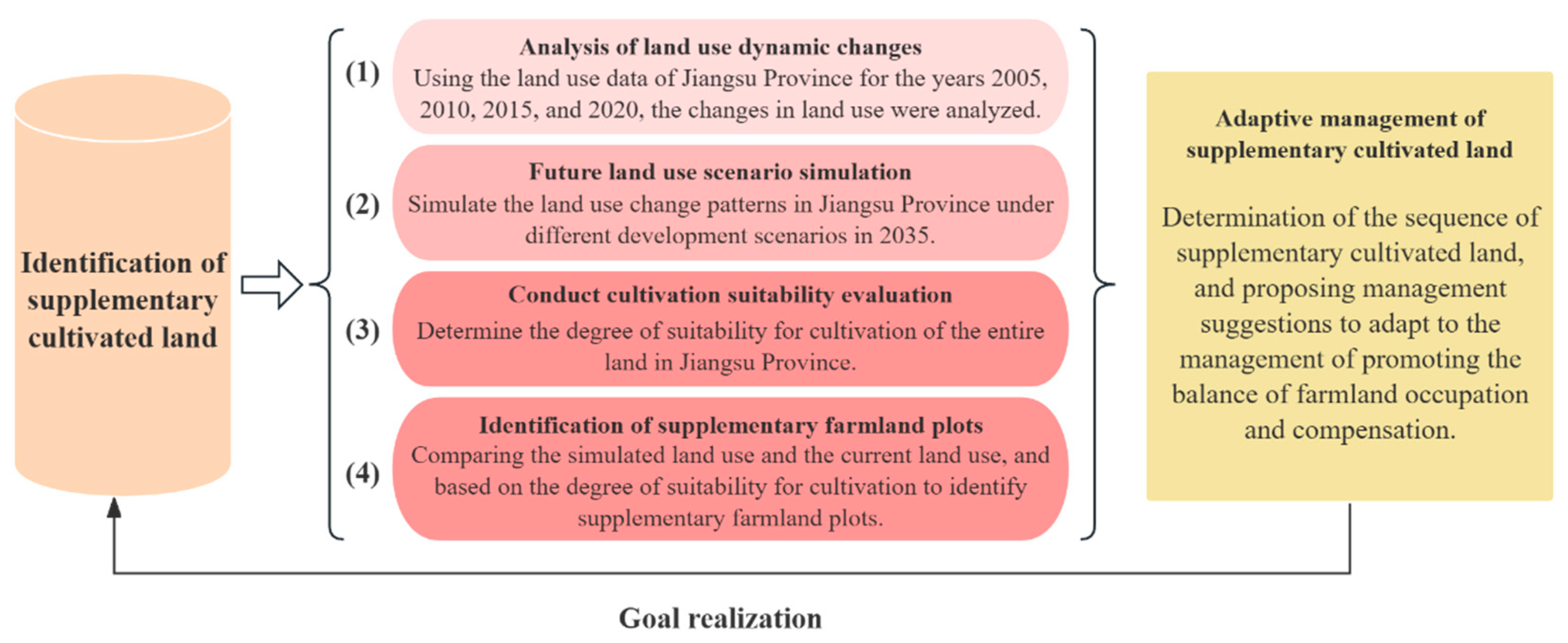
Jiangsu Province, as a major agricultural and economic province in China, plays a significant role in national food security and urban economic development, and it also holds a typical representative significance in the new cultivated land occupation and compensation balance studies. Therefore, against the new policy background, Jiangsu Province was taken as a case study, and this study was carried out according to the following four parts (Figure 1): (1) land use data for Jiangsu from 2005, 2010, 2015, and 2020 were used to analyze the temporal and spatial dynamic changes in land use in Jiangsu Province; (2) based on a Markov-FLUS model, land use change patterns in 2035 were simulated under four scenarios, including inertia development, cultivated land protection, economic development priority, and ecological protection priority; (3) the suitability of land in Jiangsu Province was evaluated to determine the degree of suitability for cultivation; (4) the simulated distribution of land use types in Jiangsu Province in 2035 in the above four scenarios and the land use status in 2023 were compared to identify land blocks that have been converted from farmland and those that have been converted back to farmland. By analyzing these land blocks’ suitability for cultivation and according to the principle of strictly restricting the transfer of suitable farmland and giving priority to the transfer of suitable farmland, the future supplementary farmland scope can be identified, and a preliminary supplementary time arrangement and management measures can be proposed. The study results can provide a reference for determining supplementary farm land in the process of farmland occupation and compensation management in Jiangsu Province and provide ideas for future farmland use control, protection, and food security.

2. Materials and Methods

2.1. Study Area

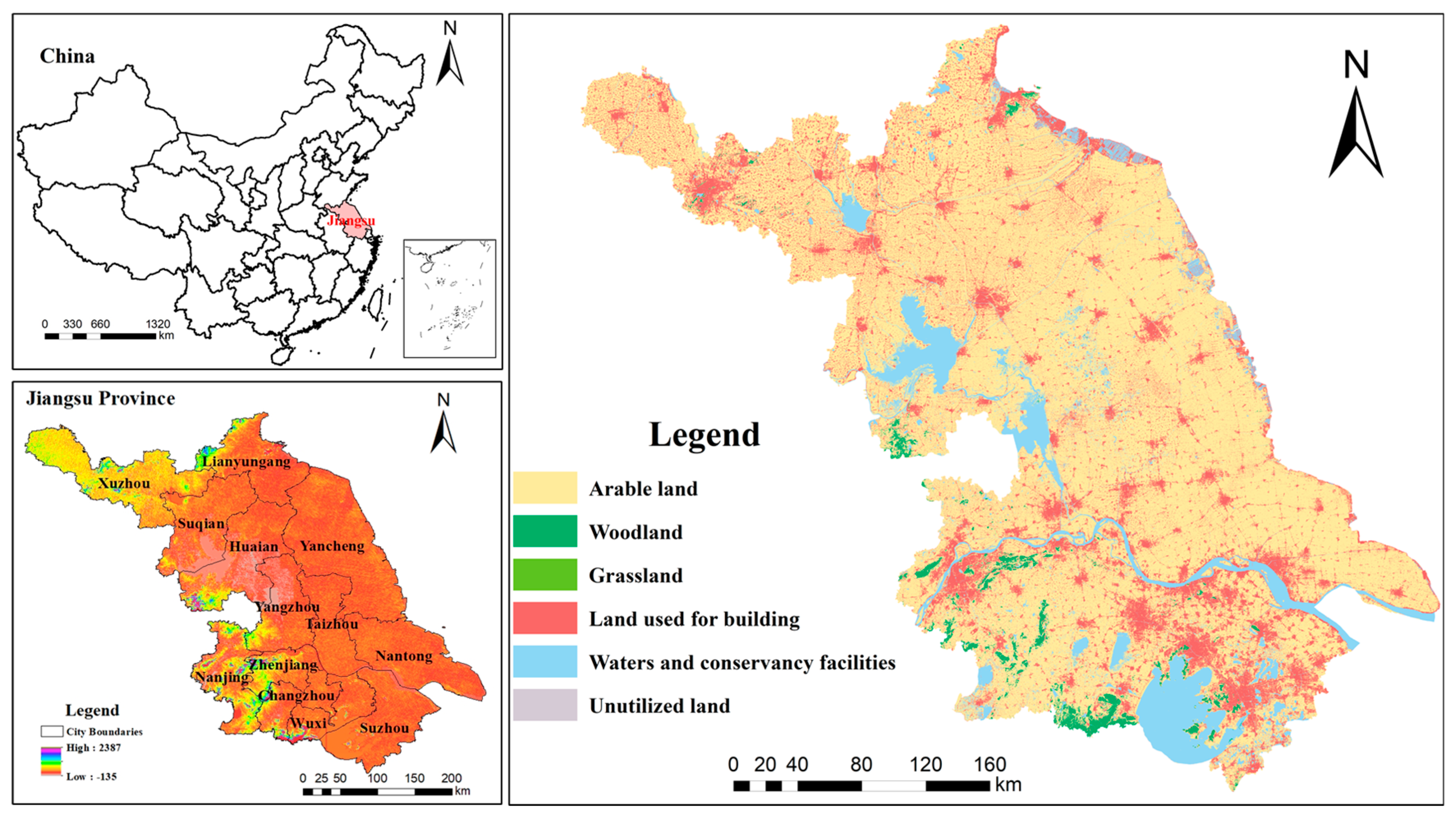
Jiangsu Province (30°45′~35°08′ N, 116°21′~121°56′ E), located in the eastern part of the Yangtze River Delta region of China (Figure 2), has a total land area 107,200 km2. The terrain of the province is flat, with plains accounting for 86.90% of the total area. As it is located in the transitional zone between the subtropical zone and the warm temperate zone, the climate in Jiangsu has distinct monsoon climate characteristics. The annual average temperature ranges from 12 to 17 °C, and the annual average precipitation is approximately 700–1250 mm. At the end of 2023, Jiangsu Province had 13 prefecture-level cities and 95 districts and counties, the proportion of cultivated land area to total area was 38.20%, the proportion of land occupied by buildings was 18.05%, and the forest coverage rate was 24.10%. The total population of the province was 85.26 million, the GDP was 12,822.2 billion yuan, and the urbanization rate was 75.04%. As an economic powerhouse, the strong demand for land that can be built on has continuously exerted pressure on the protection of cultivated land and ecological land, and as an agricultural powerhouse, the unique and suitable climatic and topographical features mean that protecting cultivated land is of paramount importance. Therefore, Jiangsu Province was used as a typical case in this study, as it is of representative significance and has strategic value for national food security.

2.2. Methods

2.2.1. Dynamic Changes in Land Use

Remote sensing monitoring data for land use in Jiangsu Province for 2005, 2010, 2015, and 2020 were used in this study, and the analytical methods of single land use dynamic index and land use transfer matrix were adopted to analyze the changes in land use in Jiangsu Province from 2005 to 2020. The single land use dynamic index can reflect the intensity of change in a certain type of land use [25], and the land use transfer matrix can clearly express the conversion between various land types in the study area at the beginning and the end of the period [26].
(1)
The single land use dynamic index is
L D = S b S a S a × 1 T × 100 %
where L D is the single land use dynamic index during the research period. S a and S b are the areas of a certain land use type at the beginning and end of the research period, respectively, and T is the study duration. The larger the value of L D , the more frequent the evolution of this land use type; smaller values indicate more stability.
(2)
The land use transfer matrix is
S i j = S 11   S 12 S 1 n S 21   S 22 S 2 n               S n 1 S n 2 S n n
where I and j are the land use types at the beginning and end of the study period (i, j = 1, 2, ..., n), respectively, and S i j is the area of land use type i converting to land use type j during the study period.

2.2.2. Land Use Change Simulation Based on the Markov-FLUS Model

The FLUS model, an improved model based on cellular automata (CA model), incorporates an artificial neural network (ANN) algorithm, which can simulate the future multiple scenarios of land use changes under the dual influence of natural and human factors [27]. That is, based on the initial land use situation and driving factors, it can obtain the suitability probabilities of various land type changes and effectively handle the uncertainties in land use changes through the adaptive inertia competition mechanism based on roulette selection. Although this model has strong spatial simulation capabilities, it is relatively general in estimating future land development effects and requires prior input of the scale of future land use for different land types before making a prediction, therefore, it cannot be used alone as a land use simulation and prediction analysis method. The Markov model is a statistical model based on the transition probability matrix; it is based on multi-period land use transition matrix data and analyzes future land use development status by calculating its probability matrix [28]. It is relatively effective for quantitative prediction, and the historical land use status is independent of the future status. It can predict future land use conditions without continuous historical data. However, it lacks consideration of spatial changes in land use. The Markov model and the FLUS model are complementary to each other. By coupling the models and setting multiple development scenarios, future land use can be simulated.
(1)
Different development scenario settings
Based on the historical development characteristics, future development positioning of Jiangsu Province, and the requirements of this study, four scenarios were set: the inertial development scenario, the cultivated land protection scenario, the economic development priority scenario, and the ecological protection priority scenario. The basic land use data for Jiangsu Province from 2005 and 2020 and a Markov model were used to predict the land scale requirements under the above four scenarios in 2035. The four development scenarios are described below.
Inertial development scenario: reference baseline scenario, which is set based on historical data (such as trends in economic and population growth) and serves as the basis for the predictions of other scenarios. This study assumes that the land use changes from 2005 to 2020 will continue until 2035, following the same land development pattern, without any new economic or environmental policy changes. The Markov model is used to predict the scale of various land types and is taken as the demand parameters for the FLUS model.
Cultivated land protection scenario: Jiangsu Province, as a major agricultural province in China, enjoys favorable geographical conditions that support agricultural production. The “Jiangsu Province Land Space Planning (2021–2035)” report stipulates that, by 2035, the amount of cultivated land in Jiangsu should not be less than 59.77 million mu. Based on this requirement for the amount of cultivated land and in accordance with the inertia development scenario, referring to relevant studies and considering the quantity and quality of ensuring cultivated land resources, the probability of converting cultivated land to construction land in the Markov model’s probability transition matrix is adjusted to the original 40%, and strict implementation of cultivated land protection is ensured.
Economic development priority scenario: the focus is on urban and rural development, and all types of land are assumed to be convertible to land used for buildings. In accordance with the requirements of the “Jiangsu Province Land Space Planning (2021–2035)” report, the expansion multiple of the urban development boundary must be less than or equal to 1.3 times the 2020 urban construction land scale. Based on this requirement, in this study, the probability of converting other land types to construction land is increased by 30%.
Ecological protection priority scenario: nowadays, low-carbon and circular development are advocated, so, in this study, based on the inertia development scenario and under the constraints of ecological red lines in China, the transfer of woodland, grassland, wetlands, water bodies, etc., with ecological functions, to other land types is restricted. According to the requirements of the “Jiangsu Province Land Space Planning (2021–2035)” report, by 2035, the ecological protection red line in Jiangsu should not be less than 18,200 square kilometers. To ensure the ecological security of Jiangsu Province, in this study, the probability of converting woodland, grassland, waters and conservancy facilities, and unutilized land into land available for building construction has been revised to 40% of the original.
(2)
Land use simulation in different scenarios
(a)
Prediction of land use demand scale
The land use simulation data obtained quantitatively through the Markov model are input as the change parameters of the FLUS model to obtain the future spatial changes in land use. The land use prediction formula is as follows:
L t + 1 = P i j L t
where L t + 1 is the land use status at time t + 1, P i j is the land use transition probability matrix from land type i to land type j, and L t is the land use status at time t of the initial period of this study.
(b)
Suitability probability, domain influence factor, adaptive inertia coefficient, and cost of land type conversion
The FLUS model is based on neural network algorithms and consists of an input layer, a hidden layer, and an output layer [29]. It can effectively fit the relationships between various driving factors and land types. Due to the influence of grid size on the simulation effect, the resolution of the source of driving factor acquisition, and the issue of software operation caused by the large spatial scale of provincial regions, after debugging, a 1 km × 1 km grid size was adopted to uniformly sample and normalize each driving factor, thereby obtaining the suitability probability of various land types in the spatial distribution. Its calculation formula is as follows:
p p , k , t = j W j k × 1 1 + e n e t j ( p , t )
where p p , k , t is the suitability probability, W j k   is the adaptive weight coefficient, and n e t j ( p , t ) is the signal information input by unit j from raster p at time t.
The domain influence factor represents the interactions among various land types, and its formula is as follows:
θ p , k t = N × N c o n ( c p t 1 = k ) N × N 1 × W k
where θ p , k t is the domain influence factor, N × N c o n ( c p t 1 = k ) is the number of grid cells for the k-th type of land use in the last iteration t − 1, and W k (0–1) is the domain factor parameter for the k-th type of land use. This parameter reflects the expansion capability of each land use type: the larger the parameter value is, the stronger the expansion ability will be. The domain influence factors have been set according to the degree of influence of each land use type by human activities, and the factors vary in different scenarios, as shown in Table 1.
The adaptive inertia coefficient is dynamically adjusted during the iteration process based on the difference between the current quantities of various land types and the target size, towards the target value. The formula is as follows:
A k t = = A k t 1                                                             D k t 2 D k t 1 = A k t 1 × D k t 2 D k t 1                                   0 > D k t 2 > D k t 1   = A k t 1 × D k t 1 D k t 2                                   D k t 1 > D k t 2 > 0      
where A k t is the adaptive inertia coefficient of the k-th type of land use at the iteration time t. D k t 1 and D k t 2 are the differences between the area of the k-th type of land use and the target simulation prediction quantity at t − 1 and t − 2, respectively.
The cost of land type conversion reflects whether various land types can be converted into each other [30]. The situations of land type conversion among different development scenarios vary: as the inertia development scenario is set based on the current trend of social and economic development, according to the analysis of land use changes, there are mutual conversions among various land types in this scenario; in the cultivated land protection scenario, farmland is not allowed to be converted into other land types; in the economic development priority scenario, land used for buildings is not allowed to be converted into other land types; in the ecological protection priority scenario, woodland, grassland, and waters and conservancy facilities are not allowed to be converted into land used for buildings or unutilized land.
(c)
Overall conversion probability
Taking into account the scale prediction of land use demand, the probability of suitability, the domain influencing factors, the adaptive inertia coefficient, and the cost conversion between land types, the overall conversion probability formula for a certain land type during the iterative process is as follows:
T = p p , k , t × θ p , k t × A k t × ( 1 s c c k )
where T is the overall conversion probability of a certain land category, s c c k is the probability of land use type c transforming into type k, and 1 s c c k is the difficulty level of the land use type transformation.
Based on the overall conversion probability, the FLUS model uses the roulette selection mechanism to determine the type of land to which the cells are converted. Cells with a higher overall conversion probability are more likely to be assigned to the target land type, while cells with a lower overall conversion probability also have the possibility of being assigned to the target land type.
(d)
Accuracy test of prediction
The spatial distribution simulation data for land use types in 2020 under the inertial development scenario simulated by the Markov-FLUS model was verified for quantitative consistency with the actual land use status data in 2020 (Table 2). The spatial distribution accuracy was empirically evaluated through the Kappa coefficient, which ranges from 0 to 1; the higher the value, the better the simulation accuracy. Based on relevant studies, when the value is higher than 0.81, the simulation is accurate [31,32]. The overall accuracy of the FLUS model simulation was 87.82%, and the Kappa coefficient was 0.853, indicating good spatial simulation and suggesting that the simulation results can be used as the basis for future land use change analysis in this study.

2.2.3. Cultivation Suitability Evaluation

Cultivation suitability evaluation is an evaluation of land for its use as cultivated land, classifying land grades based on land conditions to determine the suitability of the land [33,34]. It involves assessment of various aspects of the land’s environment, including climate, topography, soil, and hydrology [35]. Given that land development has reached a certain stage, cultivation suitability evaluation needs to be based on the current status of land use and development to optimize land use. While considering natural conditions, it is also necessary to take into account social and economic factors, as well as management methods, and, under the concept of sustainable development, ecological safety is also an important factor [36,37,38,39]. Therefore, 16 factors were selected from four aspects—natural land quality, social and economic factors, management factors, and ecological conditions—to construct a cultivation suitability evaluation index system (Table 3). Natural land quality is the main consideration for agricultural land use, and eight factors were mainly selected, including average annual temperature, average annual precipitation, elevation, slope, soil layer thickness, soil texture, soil organic matter, and soil pH. Social and economic factors are also necessary for agricultural land use, and three factors were mainly selected, including average agricultural output value per-unit area, agricultural population density, and farming distance. Management factors are necessary measures to optimize agricultural production output, and three factors were mainly selected, including irrigation conditions, drainage conditions, and multiple cropping types. Ecological conditions also need to be considered in agricultural land use, and two factors were selected, including soil erosion degree and normalized difference vegetation index (NDVI).
A multi-factor comprehensive evaluation model with stepwise attenuation correction for the evaluation of cultivation suitability in Jiangsu Province has been used, and the formula is as follows:
e i = f j w j
C = i = 1 n e i  
where C is cultivation suitability index of a single evaluation unit within Jiangsu Province, e i is the cultivation suitability sub-index corresponding to the i-th factor of a single evaluation unit, n is the number of factors (n = 1, 2, 3, 4), f j is the grading index of the j-th indicator of a single evaluation unit, and w j   is the weight of the j-th evaluation indicator.
The grading standard indices for various indicators are determined based on the regulation for gradation on agriculture land quality (CB/T 28407-2012) [40] in the middle and lower reaches of the Yangtze River, cultivated land quality grade (GB/T 33469-2016) [41] in the middle and lower reaches of the Yangtze River, regulations for classification on agriculture land (GB/T 28405-2012) [42], and technical regulation of the third nationwide land and resources survey (TD/T 1055-2019) [43]. The determination of the weights of each indicator is based on the regulation for gradation on agriculture land quality (CB/T 28407-2012) regarding the weights of cultivated land in plains and mountainous and hilly areas in the middle and lower reaches of the Yangtze River and is determined using the analytic hierarchy process. The specific index system for cultivation suitability is shown in Table 3. Based on the calculated cultivation suitability index, the suitability grades can be classified. In this study, the land in Jiangsu Province is classified as highly suitable (85–100), moderately suitable (75–85), marginally suitable (65–75), or temporarily unsuitable (<65).

2.2.4. Supplementary Cultivated Land Identification Scheme

The spatial data for simulated land use in 2035 under four scenarios, namely the inertial development scenario, the cultivated land protection scenario, the economic development priority scenario, and the ecological protection priority scenario, were superimposed and compared with the spatial data for land use in 2023 to obtain data for cultivated land transfer-in and transfer-out plots under different scenarios. Then, these data were superimposed and analyzed with the spatial data of cultivation suitability evaluation.
Based on the superimposed results, we established a scheme for identifying supplementary cultivated land based on two aspects. For the cultivated land transfer-in plots: (1) if the plot is a transfer-in plot in all four scenarios and its suitability category is highly suitable, moderately suitable, or marginally suitable, it can be preferentially included in the area for supplementary cultivated land; (2) if the plot is a transfer-in plot in the inertial development scenario, the cultivated land protection scenario, and the ecological protection priority scenario, and its suitability category is highly suitable or moderately suitable, it can also be preferentially included in the area for supplementary, while marginally suitable plots should be considered as candidate areas for supplementary improvement; (3) if the plot is a transfer-in plot in the inertial development scenario and the cultivated land protection scenario and its suitability category is highly suitable, it also can be preferentially included in the area for supplementary cultivation, while moderately suitable or marginally suitable plots should be considered as candidate areas for supplementary improvement; (4) if the plot is a transfer-in plot in the cultivated land protection scenario/inertial development scenario/ecological protection priority scenario/economic development priority scenario and its suitability category is highly suitable, it can be included in the area for supplementary cultivation, while moderately suitable or marginally suitable plots should be considered candidate areas for supplementary improvement. For the cultivated land transfer-out plots, regardless of what kind of scenario it is, if the plot’s suitability category is highly suitable, efforts should be made to avoid its conversion to other uses, and it should be included in the candidate area for supplementary cultivation.
Due to the different sources of the supplementary cultivated land range set, the parts that are more autonomously driven to be converted to cultivated land in the prediction simulation have a greater possibility of being converted to cultivated land in the future. Therefore, corresponding arrangements for the sequence of supplementary cultivated land based on the above supplementary cultivated land identification scheme can been made, and countermeasures and suggestions for the management and adaptation of various supplementary cultivated land improvements in accordance with the results of cultivation suitability evaluation and the restrictive degree of its factor indicators can been put forward.
Areas that are temporarily not suitable for farming have not been taken into consideration in the supplementary cultivated land identification scheme. Regarding rectification, if it is difficult to select supplementary cultivated land plots, under the condition of cost feasibility, various improvement measures can be adopted for plots in the unsuitable areas to meet the requirements for supplementary cultivated land quantity.

2.3. Data Sources

The basic data required for this study include the land-use dataset, the driving force factors dataset for simulation prediction, and the cultivability evaluation dataset (Table 4).

3. Results

3.1. The Results of Land Use Change

3.1.1. Changes in the Quantity of Land Use

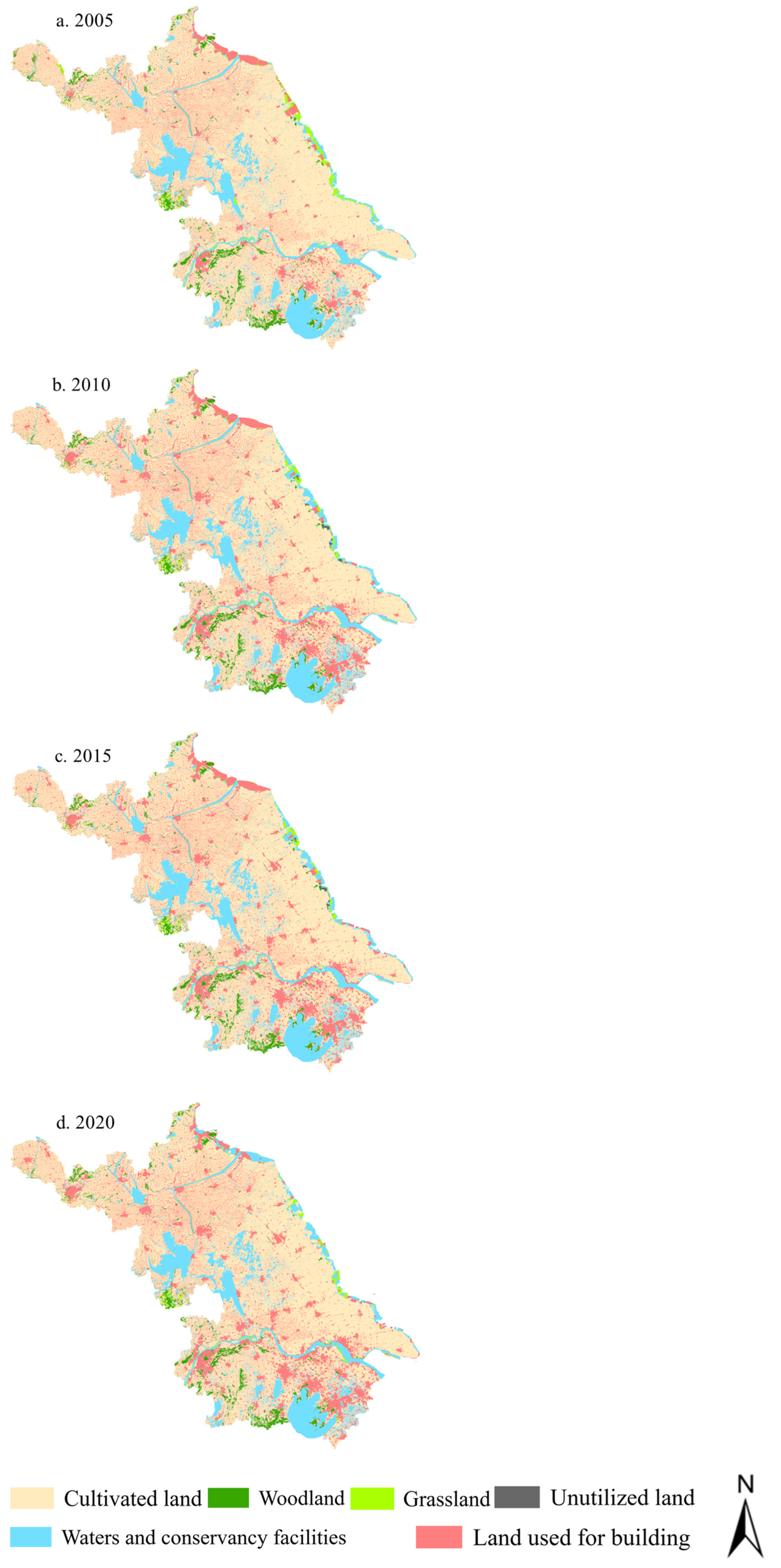
The overall land use variation characteristics in Jiangsu Province from 2005 to 2020 showed that the area of cultivated land decreased, while the land used for buildings increased (Figure 3). It can be seen from Figure 3 that the area of cultivated land occupies a large proportion within Jiangsu Province and remained around 60% over the 15-year period. Its area decreased by 6137.74 km2, resulting in a land use dynamic index of −0.60%. The area of the land used for buildings changed significantly over the 15 years, increasing from 0.15% to 0.20% of the total area, an increase of 5816.12 km2, with a dynamic index of 2.49%. The unutilized land had a smaller area of 17.20 km2 in 2005, increasing to 215.02 km2 in 2010, then gradually decreasing to 183.53 km2 in 2015, and further decreasing to 115.57 km2 in 2020. The area of waters and conservancy facilities showed stable growth, with an increase of 1059.93 km2 over the 15-year period, with a dynamic index of 0.53%. The woodland area showed a decreasing trend, with a total reduction of 312.34 km2 and a dynamic index of −0.62%, while the grassland area decreased sharply by −499.81 km2 (dynamic index −7.66%) from 2005 to 2010, and the reduction rate slowed down from 2010 to 2015, with a reduction of −26.34 km2 (dynamic index −0.65%) and then slowly increased by 114.42 km2 (dynamic index is 2.94%) from 2015 to 2020. Over the 15-year period, the total area of grassland decreased by −411.72 km2, with a dynamic index of −2.10%.

3.1.2. Land Use Types Transfer Analysis

From Table 5 it can be seen that, from 2005 to 2010, the main types of land use transformation in Jiangsu Province were the conversion of cultivated land to land used for buildings and waters and conservancy facilities, among which 4821.02 km2 of cultivated land was converted to land used for buildings, and 689.64 km2 of cultivated land was converted to waters and conservancy facilities. From 2010 to 2015, the main types of land use transformation were the mutual conversion between cultivated land and land used for buildings, among which 1153.55 km2 of cultivated land was converted to land used for buildings, while the area of land used for buildings converted to cultivated land was 439.84 km2. From 2015 to 2020, the main types of land use transformation were the mutual conversion between cultivated land and land used for buildings and the conversion of land used for buildings to waters and conservancy facilities, among which 1933.07 km2 of cultivated land was converted to land used for buildings, while the area of land used for buildings converted to cultivated land was 969.47 km2, and the area of land used for buildings converted to waters and conservancy facilities areas was 624.78 km2.
Overall, during these 15 years, the conversion of cultivated land to land used for buildings and waters and conservancy facilities, as well as the conversion of land used for buildings to cultivated land and waters and conservancy facilities, accounted for the main proportion. In total, 51.78% of the cultivated land converted to land used for buildings was converted to urban construction land and 41.21% to rural residential areas; 58.30% of the land used for buildings converted to cultivated land was converted to paddy fields and 41.70% to dry farms, and 87.60% of the cultivated land converted to waters and conservancy facilities was converted to reservoir ponds, while 97.30% of land used for buildings converted to waters and conservancy facilities was converted to reservoir ponds. The main reason for this transformation was that, during the period from 2005 to 2010, coastal areas such as those in southern Jiangsu, central Jiangsu, and Lianyungang City, which were close to the Yellow Sea, had abundant tidal flat resources. To increase economic benefits and reduce regional disparities, Chinese government departments strengthened the development of coastal areas in its policies, and, in June 2009, the State Council approved the report of “Development plan for Jiangsu’s coastal areas”, which led to a significant increase in the area of land used for buildings and fish ponds in the coastal areas of Jiangsu Province.

3.2. Land Use Changes Under Different Development Scenario Simulations

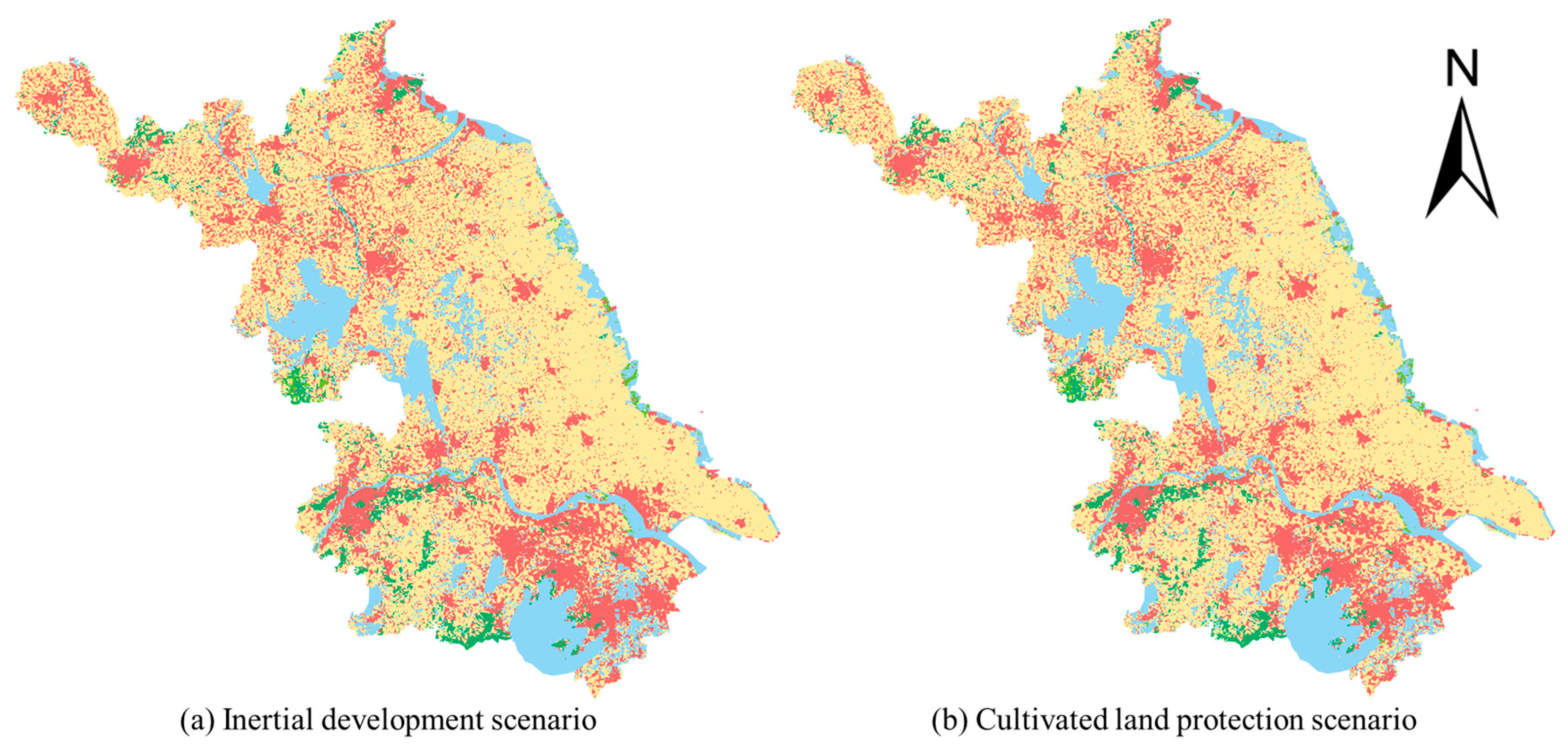
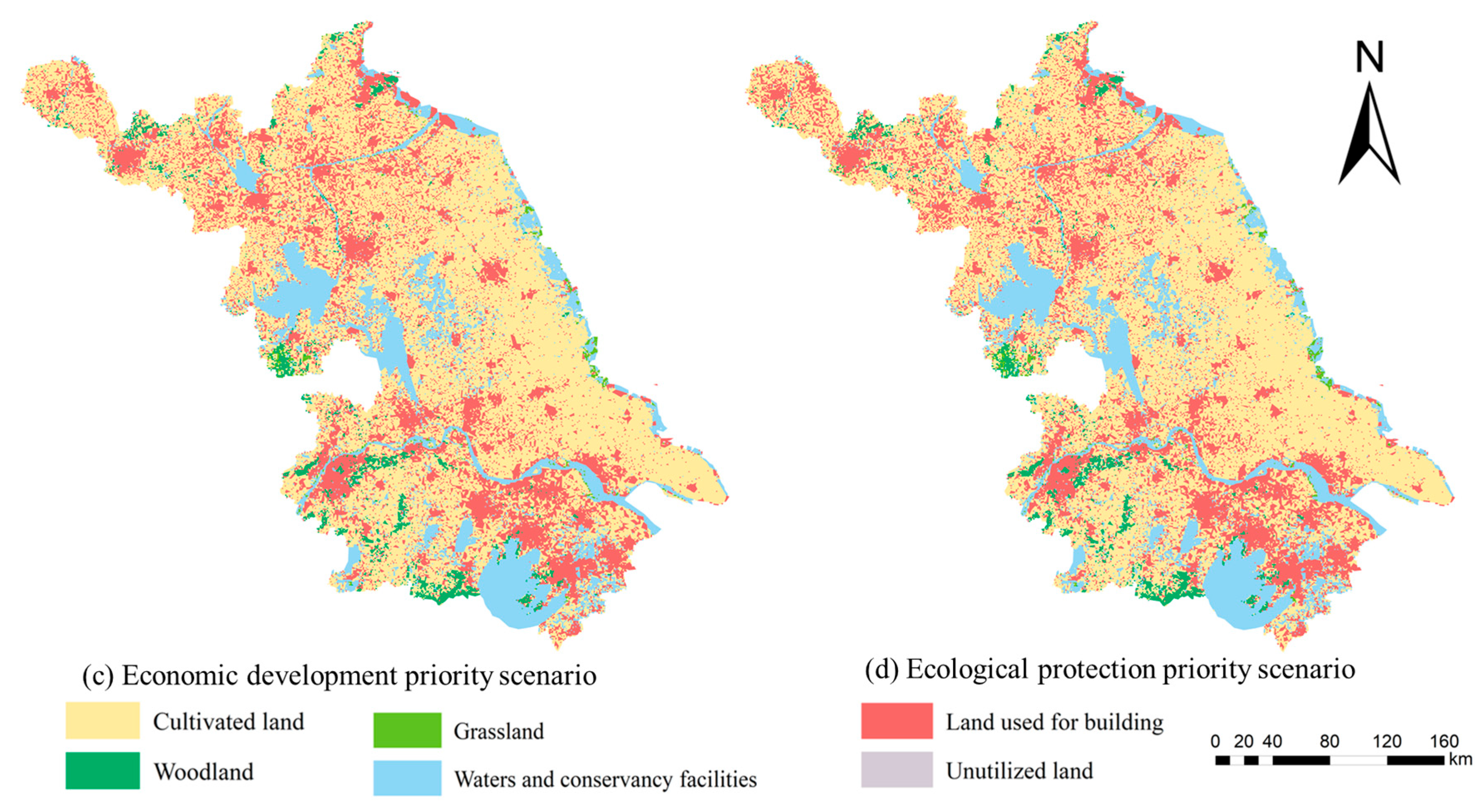
Based on the above four scenarios, the area of each type of land use in Jiangsu in 2035 was predicted (Table 6). The land use data for 2005 were used as the starting year for simulation, and eight driving factors, including elevation, slope, precipitation, temperature, population density, GDP, distance to railway, and distance to highway, were used to simulate the land use spatial pattern in 2035 using the FLUS model (Figure 4). In the inertial development scenario, land use development continued the policy trend from 2005 to 2020, and by 2035, the cultivated land area in Jiangsu would become 59,560.93 km2, a decrease of 4.73% compared to 2020, while the land used for buildings would increase to 24,439.59 km2, an increase of 14.14%, mainly showing an expansion trend around urban areas in various cities, especially in the southern part of Jiangsu. In addition, the area of waters and conservancy facilities would increase to 15,098.24 km2, an increase of 4.48%, while the areas of woodland, grassland, and unutilized land would all decrease compared to 2020, with reduction rates of 13.57%, 31.08%, and 21.51%, respectively. In the cultivated land protection scenario, to ensure food security and meet agricultural production needs, the conversion of high-quality cultivated land to other uses was avoided as much as possible, and by 2035, the cultivated land area in Jiangsu would become 59,719.11 km2, with a reduction rate of 0.25% compared to the inertial development scenario; thus, a certain amount of high-quality cultivated land was guaranteed, mainly in the northern part of Jiangsu and in some areas along the middle and lower reaches of the Yangtze River. The changes in other land use types were similar to those in the inertial development scenario, while the change amounts were different. The increase rates of land used for buildings and waters and conservancy facilities were 13.48% and 4.34%, respectively, while the reduction rates of woodland, grassland, and unutilized land were 13.29%, 31.21%, and 23.64%, respectively. In the economic development priority scenario, construction and development were given priority; so, the increase in land used for buildings was more obvious. Compared to the inertial development scenario, the rate of land used for buildings in 2035 rose by 1.87%, mainly showing an expansion trend from the urban centers, while the proportions of cultivated land, woodland, and grassland increased by 0.50%, 0.75%, and 1.01%, respectively. In the ecological protection priority scenario, the reduction rates of woodland and grassland were significantly lower than those in the inertial development scenario, decreasing by 0.60% and 0.74%, respectively, mainly concentrated in the western part of Jiangsu, especially in the southwestern part. The changes in other land use categories were not significantly different from those in the inertial development scenario.

3.3. Cultivation Suitability Evaluation Results

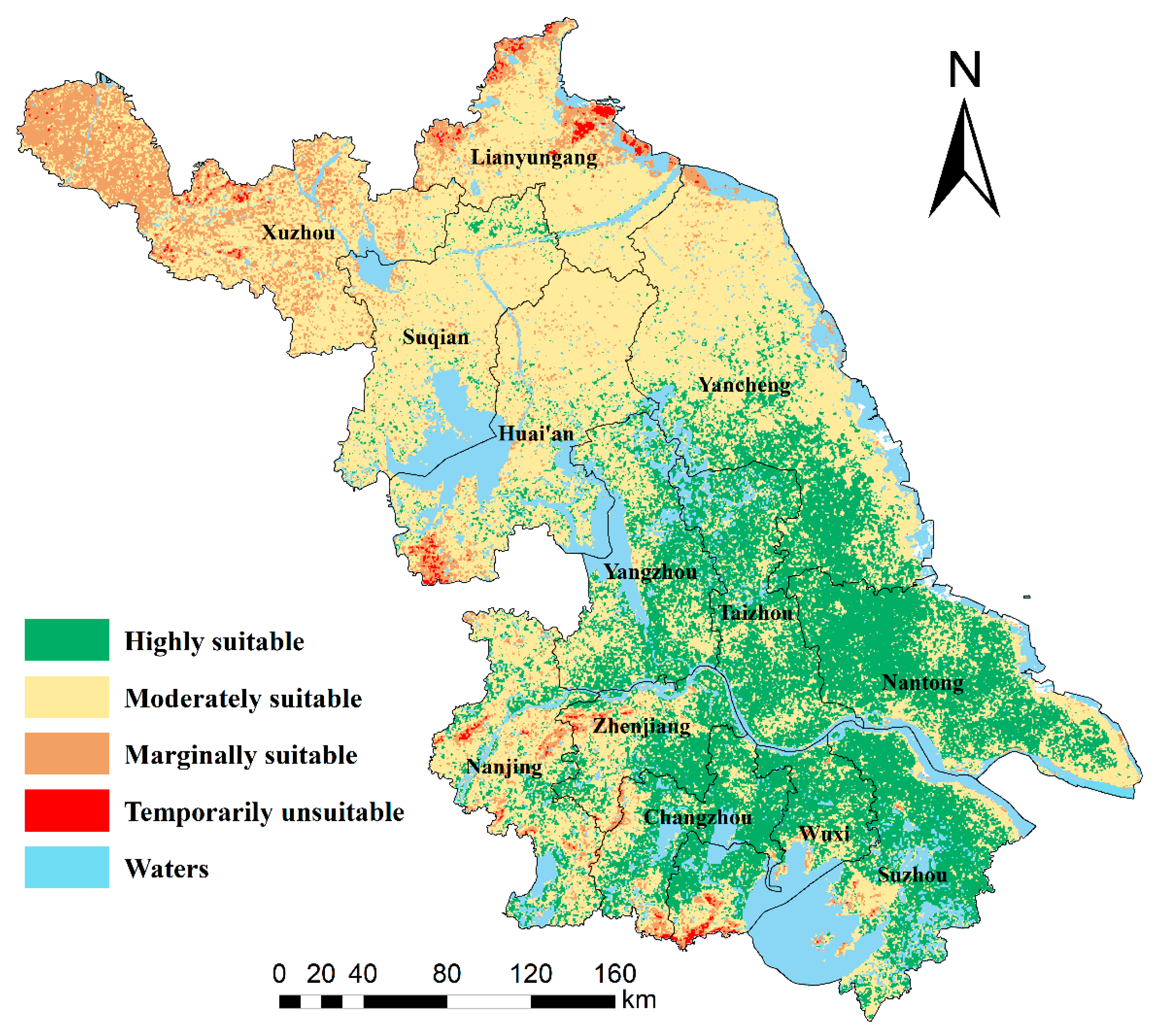
Based on the index system and method of cultivation suitability evaluation, the degree of suitability for cultivation in Jiangsu Province has been calculated (Figure 5), and the degree of suitability for cultivation in each city has been obtained by superimposing the spatial boundaries of administrative regions of various cities (Table 7). The area of highly suitable land for cultivation in Jiangsu Province is 29,274.45 km2, accounting for 29.25% of the total area of the province, and it is mainly distributed in most areas of southern and central Jiangsu, as well as a small part of northern Jiangsu. The area of moderately suitable land for cultivation is 58,814.96 km2, accounting for 58.77% of the total area of the province, and it is distributed throughout the province, but is more concentrated in southern and central Jiangsu. The area of marginally suitable land for cultivation is 11,396.16 km2, accounting for 11.39% of the total area of the province, and it is mainly distributed in most areas of northern Jiangsu and some areas in the southwest of Jiangsu. The area of temporarily unsuitable land for cultivation is 585.35 km2, accounting for 0.58% of the total area of the province, and it is mainly scattered in some areas of northern Jiangsu and the southwest of Jiangsu.
From the perspective of distribution across various cities, among the 13 cities in Jiangsu Province, Nantong City has the largest area of highly suitable land for cultivation, followed by Suzhou City and Taizhou City. As can be seen from Table 7, 66.64% of the area of Taizhou City and 64.48% of the area of Nantong City is highly suitable for cultivation. Yancheng City has the largest area of moderately suitable land for cultivation, exceeding 10,000 km2, and its proportion in Yancheng City ranks fourth in Jiangsu Province, while 81.60% of the land in Suqian City is in the moderately suitable category for cultivation, followed by Huai’an City (79.21%) and Lianyungang City (73.69%). Xuzhou City has the largest area of marginally suitable land for cultivation, and its proportion is also the largest (42.75%), followed by Lianyungang City (22.46%). Lianyungang City has the largest area of temporarily unsuitable land for cultivation, and its proportion is also the largest (3.18%), followed by Wuxi City (1.42%).

3.4. Identification of Supplementary Cultivated Land

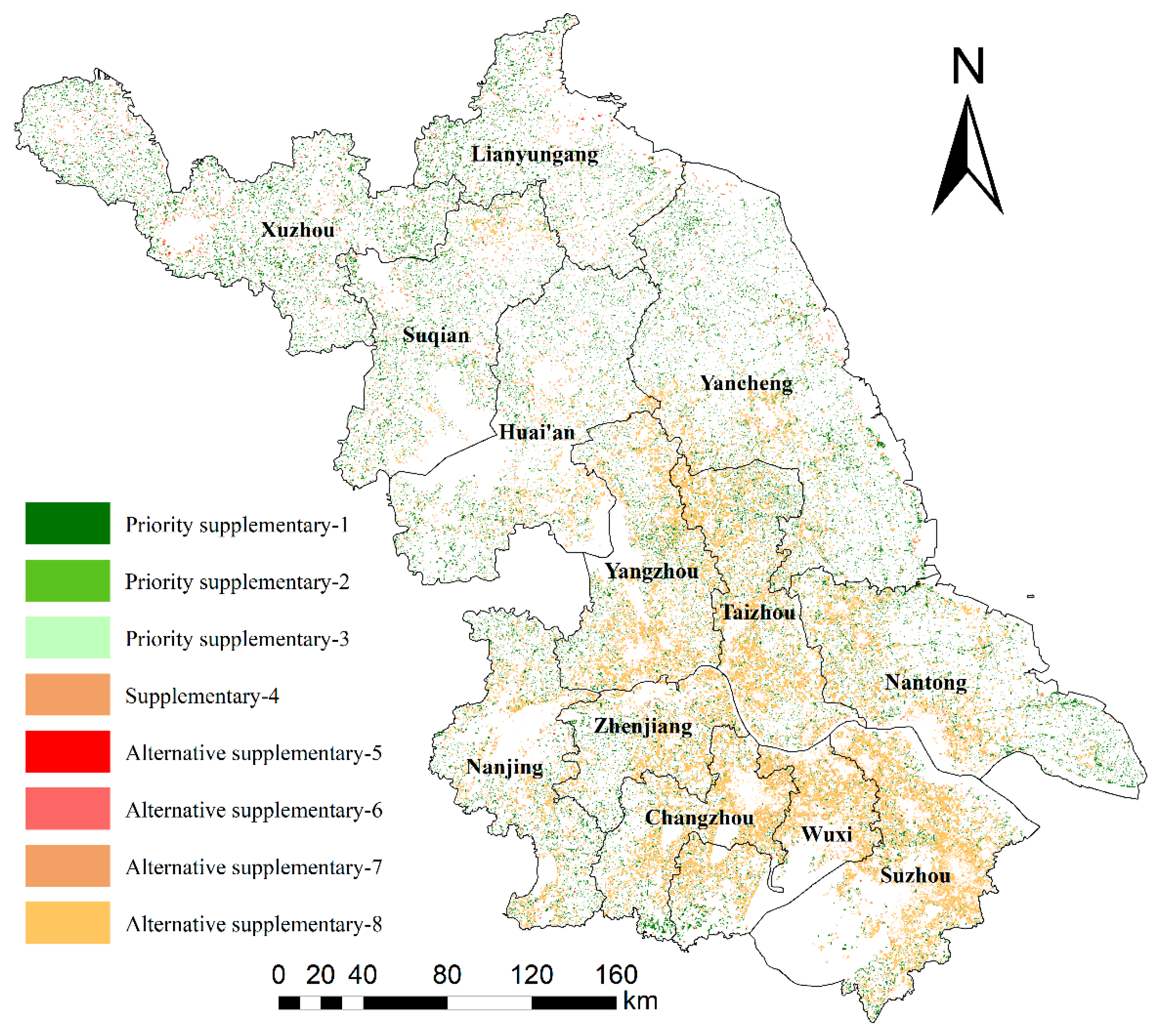
Based on the above identification of supplementary cultivated land and its time sequence, this study divides the supplementary cultivated land into three major categories: priority supplementary cultivated land plots, supplementary cultivated land plots, and alternative supplementary cultivated land improvement plots. Corresponding supplementary time sequences are set for each category according to their different sources (Figure 6). Adaptive management suggestions for different supplementary cultivated land plots are proposed based on the differences in degree in the cultivation suitability evaluation and restriction of the factor indicators, as shown in Table 8.

4. Discussion

4.1. Study Summary and Policy Implications

The proposal of the new policy for balancing cultivated land occupation and compensation has put forward new requirements for the utilization and management of cultivated land in China. To implement the policy and effectively control the phenomena of “non-agriculturalization” and “non-grainization” of cultivated land, identifying the scope of supplementary cultivated land is of paramount importance before implementation of the policy. The traditional sources of supplementary cultivated land mainly come from reserve resources or land consolidation methods, and it is difficult to ensure that the quality of supplementary cultivated land is no less than that of occupied cultivated land [44,45]; so, determination of supplementary cultivated land has become a key problem. Previous studies have investigated aspects such as evaluation of supplementary farmland quality, potential evaluation or improvement in quality, and suitability [20,46]. Local governments have addressed the issue of supplementary farmland through cross-regional indicator trading. However, the area of supplementary farmland in China is limited, and resources are scarce. Therefore, this study starts from multi-period land use change patterns and conducts multi-scenario simulation of future land use changes, which can more comprehensively reflect the future land use situation. By analyzing land suitability for cultivation, from the perspective of cultivated land transfer in and out, we judged the degree of suitability for cultivation of plots, thereby identifying the distribution of supplementary cultivated land plots, providing a new idea for the identification path of supplementary cultivated land. The idea of the identification scheme is to coordinate within Jiangsu Province to comprehensively evaluate multiple aspects such as the natural environment, social and economic conditions, and the ecological conditions of the land. Therefore, the utilization potential of supplementary cultivated land is measured in terms of quality, and cross-regional evaluation of supplementary cultivation can be realized according to the national policy can be realized.
During implementation of the management of land occupation and compensation balance, as it is required to follow the principle of “compensation first, then occupation” [47], the primary task is to find land plots that can be used as supplementary cultivated land. The approach in this study of analyzing changes in land use to determine transfer in and out is beneficial in this regard. After identifying supplementary cultivated land, a corresponding dynamic provincial supplementary cultivated land reserve database needs to be established for long-term effective monitoring to ensure that the supplementary cultivated land can be effectively utilized. In local land occupation and development projects, this can ensure timely implementation of supplementary cultivation. If there are many low-quality plots in the supplementary cultivated land reserve database, corresponding improvement measures need to be taken to enhance their overall quality. In addition, timely implementation of the supplementary cultivated land price mechanism is required to ensure that the corresponding land prices, development and improvement costs, etc. in the reserve database can be queried in real time, facilitating transparent and convenient cross-regional indicator transactions. During the management and implementation process, corresponding technical and management personnel training is needed, and regular maintenance of the reserve database system and supervision of the improvement effect are required, to provide support for the management of supplementary cultivated land.

4.2. Innovation, Limitations, and Prospects for Future Studies

The main innovations of this study are as follows: (1) based on quantitative and spatial changes in land use, changes in land use were simulated under four scenarios, which served as the basic data for determining the future stability of cultivated land during identification of supplementary cultivated land; (2) based on the evaluation of land suitability for cultivation, plots suitable for farming were identified, according to the national requirement of utilizing resources in a local manner. Combined with future trends in cultivated land changes, supplementary cultivated land was identified, and a time sequence for supplementary cultivation was initially set, which is novel and provides a reference for implementation of the new mechanism of cultivated land occupation and compensation balance in China.
However, this study has some limitations. In the analysis of land use dynamic changes, we used remote sensing monitoring data for land use, and the land use types at the first level included cultivated land, woodland, grassland, waters and conservancy facilities, land used for buildings, and unutilized land, but did not cover more detailed land types such as orchards. Especially in the cultivated land category, there were also some orchards included; therefore, in subsequent simulation predictions and supplementary land use identification results, this would be affected to some extent. In the simulation of land use, due to the limited driving factor data that were obtained, the simulation results still need further optimization. In the process of supplementary land use identification, the transformation rules of land types in various scenarios and the suitability for cultivation were considered to determine the timing arrangement of supplementary land use. As the issue of “occupation” in the balance was not taken into account, the timing arrangement did not specify the specific supplementary years. However, this study provides a useful analytical approach for supplementary land use identification and timing arrangement. In the future, based on supplementary land use quantity, we will further explore improving the quality of supplementary land use, considering the demand for farmland from the perspective of current dietary needs to determine the quantity of supplementary cultivated land that is required.

5. Conclusions

This study was conducted based on the concepts of land use change analysis, land use scenario simulation, cultivation suitability evaluation, and identification of supplementary farmland. The scope and timing arrangement of supplementary farmland were determined. Over the past 15 years, due to rapid social and economic development in Jiangsu, the area of cultivated land has decreased significantly, mainly by being converted into land used for buildings and waters and conservancy facilities. The areas converted into urban construction land, rural residential land, and reservoir ponds are relatively large. A Markov-FLUS model was used to simulate land use changes in four scenarios—an inertial development scenario, a farmland protection scenario, an economic development priority scenario, and an ecological protection priority scenario—and the simulation accuracy was high after simulation verification. The cultivation suitability evaluation indicated that the land suitability in Jiangsu was relatively high, and the suitability in southern Jiangsu was higher than that in northern Jiangsu. This study classified the identified supplementary cultivated land into three categories: priority supplementary cultivated land plots, supplementary cultivated land plots, and alternative supplementary cultivated land improvement plots. Eight different sources correspond to eight different time arrangements and management measures. This study embodies the principle of adapting measures to local conditions in the process of national development, and the identified supplementary farmland provides a reference for the Jiangsu provincial government in exploring supplementary farmland and cultivated land reserves. In addition, the study concept and results can provide useful references for other regions in China to carry out supplementary farmland identification and policy implementation when implementing farmland occupation and compensation balance management. In the future, we will focus on supplementary farmland identification at the county level to better guide regional practice.

Author Contributions

Conceptualization, Y.L., K.W. and W.Z.; methodology, Y.L., X.L. (Xiaoliang Li) and X.L. (Xiao Li); formal analysis, Y.L. and H.S.; funding acquisition, Y.L.; software, Y.L., X.L. (Xiaoliang Li) and X.L. (Xiao Li); original draft, Y.L.; review and editing, Y.L., X.L. (Xiaoliang Li), X.L. (Xiao Li) and R.S. All authors have read and agreed to the published version of the manuscript.

Funding

This study was funded by the National Natural Science Foundation of China (42401307, 42201277, and 42501325) and the General Project of Philosophy and Social Science Research in Colleges and Universities in Jiangsu Province (2023SJYB2055).

Data Availability Statement

Data presented in this study are available from Figshare at DOI:10.6084/m9.figshare.30656741.

Conflicts of Interest

The authors declare no conflicts of interest.

References

  1. Liang, X.Y.; Jin, X.B.; Liu, J.; Yin, Y.X.; Gu, Z.M.; Zhang, J.Y.; Zhou, Y.K. Formation mechanism and sustainable productivity impacts of non-grain croplands: Evidence from Sichuan Province, China. Land Degrad. Dev. 2023, 34, 1120–1132. [Google Scholar] [CrossRef]
  2. Zhu, Y.Y.; Wang, Z.W.; Zhu, X.H. New reflections on food security and land use strategies based on the evolution of Chinese dietary patterns. Land Use Policy 2023, 126, 106520. [Google Scholar] [CrossRef]
  3. FAO; IFAD; UNICEF; WFP; WHO. The State of Food Security and Nutrition in the World 2024-Financing to End Hunger, Food Insecurity and Malnutrition in All Its Forms; Food and Agriculture Organization of the United Nations: Rome, Italy, 2024. [Google Scholar]
  4. FAO. The State of the World’s Land and Water Resources for Food and Agriculture-Systems at Breaking Point; Synthesis report 2021; Food and Agriculture Organization of the United Nations: Rome, Italy, 2021. [Google Scholar]
  5. Wu, Y.Z.; Shan, L.P.; Guo, Z.; Peng, Y. Cultivated land protection policies in China facing 2030: Dynamic balance system versus basic farmland zoning. Habitat Int. 2017, 69, 126–138. [Google Scholar] [CrossRef]
  6. Meng, F.; Tan, Y.Z.; Chen, H.; Xiong, W.Y. Spatial-temporal evolution patterns and influencing factors of “non-grain” utilization of cultivated land in China. China Land Sci. 2022, 36, 97–106. [Google Scholar]
  7. Yuan, C.C.; Zhang, D.X.; Liu, L.M.; Ye, J.W. Regional characteristics and spatial-temporal distribution of cultivated land change in China during 2009-2018. Trans. Chin. Society Agric. Eng. 2021, 37, 267–278. [Google Scholar]
  8. Chen, M.Q.; Liu, T.J. Improving the effectiveness of the protection of farmland in the new era of China. Res. Agric. Modern. 2018, 39, 1–8. [Google Scholar]
  9. Pu, J. Several theoretical issues on the cross-provincial trading of farmland occupation and compensation indicators. Theor. Reform 2017, 1, 8–18. [Google Scholar]
  10. Chen, Y.; Meng, R.L.; Wu, J.L. Cross-regional replenishment of cultivated land under the requisition-compensation balance policy based on “suitability and cost- benefit” coupling. Shanghai Land Resour. 2025, 46, 7–17. [Google Scholar]
  11. Zhang, D.J.; Yang, W.J.; Kang, D.R.; Zhang, H. Spatial-temporal characteristics and policy implication for non-grain production of cultivated land in Guanzhong region. Land Use Policy 2023, 125, 106466. [Google Scholar] [CrossRef]
  12. Jin, X.B.; Huang, C.K.; Yang, S.H.; Wang, S.L. The obstacles and coping strategies for the implementation of the “access and exit balance” system for cultivated land. China Land 2023, 22–24. [Google Scholar]
  13. Guo, Y.K.; Yao, M.; Zhou, J.J.; Meng, F.R.; Yu, H.Y. Research on automatic identification technology for compliance of supplementary cultivated land based on spatial big data. Trans. Chin. Society Agric. Mach. 2024, 55, 159–167. [Google Scholar]
  14. Shen, J.; Zhang, F.; Siddique, K. Sustainable resource use in enhancing agricultural development in China. Engineering 2018, 4, 588–589. [Google Scholar] [CrossRef]
  15. Liu, L.; Liu, Z.J.; Gong, J.Z.; Lu, W.; Hu, Y.M. Quantifying the amount, heterogeneity, and pattern of farmland: Implications for China’s requisition compensation balance of farmland policy. Land Use Policy 2019, 81, 256–266. [Google Scholar] [CrossRef]
  16. Qie, L.; Pu, L.J.; Tang, P.F.; Liu, R.J.; Huang, S.H.; Xu, F.; Zhong, T.Y. Gains and losses of farmland associated with farmland protection policy and urbanization in China: An integrated perspective based on goal orientation. Land Use Policy 2023, 129, 106643. [Google Scholar] [CrossRef]
  17. Song, M.; Peng, J.Y.; Yi, L.P.; Fu, J.H. Quantity and quality balance of farmland in Hubei Province in the context of “compensation for comprehensive occupation” and its impact on grain production capacity. China Popul. Resour. Environ. 2024, 34, 173–186. [Google Scholar]
  18. Hu, Y.C.; Zheng, X.Q.; Xu, J.Y.; Zheng, Y.M. Regional difference for newly increased cultivated land area through land consolidation in China. Trans. Chin. Society Agric. Eng. 2012, 28, 1–6. [Google Scholar]
  19. Chen, F.; Liu, J.N.; Guo, W.H.; Ma, J.; Yang, B.; Zhu, X.H. Spatio-temporal pattern changes and interfering factors of transferred farmland in China in the past 20 years. Resour. Environ. Yangtze Basin 2024, 33, 1793–1804. [Google Scholar]
  20. Zou, L.L.; Liang, Y.F.; Xiong, L.; Hu, X.D.; Chao, Z.H. Suitability evaluation and consolidation zoning of supplementary cultivated land in Guangdong Province. J. Agric. Resour. Environ. 2025, 42, 57–65. [Google Scholar]
  21. Zhou, J.; Li, C.; Zhang, B.L.; Zhou, Q.H. Land use change of newly increased cultivated land at typical county under different geomorphic types in the Loess Plateau. Trans. Chin. Society Agric. Eng. 2023, 39, 254–260. [Google Scholar]
  22. Hai, W.J.; Liu, X.L.; Ren, J. Estimation of new cultivated land and calculation of effective cultivated land area in land consolidation program. J. Yunnan Agric. Univ. (Nat. Sci.) 2018, 33, 539–546. [Google Scholar]
  23. Lin, L.; Ye, Z.R.; Gan, M.Y.; Shahtahmassebi, A.R.; Weston, M.; Deng, J.S.; Lu, S.G.; Wang, K. Quality perspective on the dynamic balance of cultivated land in Wenzhou, China. Sustainability 2017, 9, 95. [Google Scholar] [CrossRef]
  24. Song, W.; Pijanowski, B.C. The effects of China’s cultivated land balance program on potential land productivity at a national scale. Appl. Geogr. 2014, 46, 158–170. [Google Scholar] [CrossRef]
  25. Sun, L.; Wei, J.; Duan, D.H.; Guo, Y.M.; Yang, D.X.; Jia, C.; Mi, X.T. Impact of land-use and land-cover change on urban air quality in representative cities of China. J. Atmos. Sol-Terr. Phys. 2016, 142, 43–54. [Google Scholar] [CrossRef]
  26. Tang, C.C.; Li, Y.P. Geo-information Tupu process of land use/cover change in polycentric urban agglomeration: A case study of Changsha-Zhuzhou-Xiangtan urban agglomeration. Geogr. Res. 2020, 39, 2626–2641. [Google Scholar]
  27. Liu, X.P.; Liang, X.; Li, X.; Xu, X.C.; Ou, J.P.; Chen, Y.M.; Li, S.Y.; Wang, S.J.; Pei, F.S. A future land use simulation model (FLUS) for simulating multiple land use scenarios by coupling human and natural effects. Landsc. Urban Plan. 2017, 168, 94–116. [Google Scholar] [CrossRef]
  28. Chen, Z.Z.; Huang, M.; Zhu, D.Y.; Altan, O. Integrating remote sensing and a Markov-FLUS model to simulate future land use changes in Hokkaido, Japan. Remote Sens. 2021, 13, 2621. [Google Scholar] [CrossRef]
  29. Xu, X.; Ding, D.; Liu, X. A three-dimensional future land use simulation (FLUS-3D) model for simulating the 3D urban dynamics under the shared socio-economic pathways. Landsc. Urban Plan. 2024, 250, 105135. [Google Scholar] [CrossRef]
  30. Gao, H.; Qin, T.; Luan, Q.; Feng, J.; Zhang, X.; Yang, Y.; Xu, S.; Lu, J. Characteristics analysis and prediction of land use evolution in the source region of the Yangtze River and Yellow River based on improved FLUS model. Land 2024, 13, 393. [Google Scholar] [CrossRef]
  31. Chen, X.W.; Li, H.B.; Zhang, W.B.; Ge, X.P. The impact of land use transition on ecosystem service value in Lixiahe area: Multi-scenario simulation based on Markov-FLUS model. Resour. Sci. 2025, 47, 182–195. [Google Scholar]
  32. Deng, H.; Shao, J.A.; Wang, J.L.; Gao, M.; Wei, C.F. Land use driving forces and its future scenario simulation in the Three Gorges Reservoir area using CLUE-S model. Acta Geogr. Sin. 2016, 71, 1979–1997. [Google Scholar]
  33. FAO. Land Evaluation: Towards a revised framework. In Land and Water Discussion Paper 6; FAO: Rome, Italy, 2007. [Google Scholar]
  34. Liu, Y.; Wu, K.; Li, X.; Li, X.; Cao, H. Adaptive management of cultivated land use zoning based on land types classification: A case study of Henan Province. Land 2022, 11, 346. [Google Scholar] [CrossRef]
  35. Yang, X.H.; Zhou, X.; Yang, J.; Zhang, C.Z. Potentiality for cultivated function recovery of non-grain cropland on the perspective of limitation-suitability-acceptability. Trans. Chin. Society Agric. Eng. 2025, 41, 264–273. [Google Scholar]
  36. Luo, X.; Ao, X.H.; Zhang, Z.; Wan, Q.; Liu, X.J. Spatiotemporal variations of cultivated land use efficiency in the Yangtze River Economic Belt based on carbon emission constraints. J. Geogr. Sci. 2020, 30, 535–552. [Google Scholar] [CrossRef]
  37. Tan, Y.Z.; Chen, H.; Lian, K.; Yu, Z.N. Comprehensive evaluation of cultivated land quality at county scale: A case study of Shengzhou, Zhejiang Province, China. Int. J. Environ. Res. Public Health 2020, 17, 1169. [Google Scholar]
  38. Nouri, H.; Mason, R.J.; Moradi, N. Land suitability evaluation for changing spatial organization in Urmia County towards conservation of Urmia Lake. Appl. Geogr. 2017, 81, 1–12. [Google Scholar] [CrossRef]
  39. Han, C.; Chen, S.B.; Yu, Y.; Xu, Z.Y.; Zhu, B.X.; Xu, X.T.; Wang, Z.B. Evaluation of agricultural land suitability based on RS, AHP, and MEA: A case study in Jilin province, China. Agriculture 2021, 11, 370. [Google Scholar] [CrossRef]
  40. Ministry of Land and Resources of the People’s Republic of China. GB/T 28407-2012; Regulation for Gradation on Agriculture Land Quality. Standards Press of China: Beijing, China, 2012.
  41. Ministry of Agriculture of the People’s Republic of China. GB/T33469-2016; Cultivated Land Quality Grade. Standards Press of China: Beijing, China, 2016.
  42. Ministry of Land and Resources of the People’s Republic of China. GB/T 28405-2012; Regulations for Classification on Agriculture Land. Standards Press of China: Beijing, China, 2012.
  43. Ministry of Natural Resources of the People’s Republic of China. TD/T 1055-2019; Technical Regulation of the Third Nationwide Land Survey. Standards Press of China: Beijing, China, 2019.
  44. Zhou, Y.; Li, X.H.; Liu, Y.S. Cultivated land protection and rational use in China. Land Use Policy 2021, 106, 105454. [Google Scholar] [CrossRef]
  45. Wei, X.; Liu, L.M.; Zhang, D.X.; Yuan, C.C.; Xia, Z.Y. Performance evaluation on the policy of balancing paddy field occupation and reclamation in Hunan Province. China Land Sci. 2022, 36, 57–67. [Google Scholar]
  46. Zhang, X.X.; Tian, H.W.; Bi, R.T. Farmland consolidation potential evaluation and consolidation zoning in mining areas. Trans. Chin. Soc. Agric. Eng. 2020, 36, 249–258. [Google Scholar]
  47. Chen, M.Q.; Yan, Z.X. A new policy of balancing the occupation and replenishment of arable land: Internal logic and implementation pathways. J. Jishou Univ. (Soc. Sci.) 2025, 46, 9–16. [Google Scholar]
Figure 1. Study flowchart.
Land 15 00169 g001
Figure 2. The location (upper left), elevation (bottom left), and land use (right) of Jiangsu Province in 2023.
Land 15 00169 g002
Figure 3. Spatiotemporal distribution map of land use changes in Jiangsu Province from 2005 to 2020.
Land 15 00169 g003
Figure 4. Land use simulation map for different scenarios in 2035.
Land 15 00169 g004aLand 15 00169 g004b
Figure 5. Spatial distribution map of the cultivation suitability evaluation results for Jiangsu Province.
Land 15 00169 g005
Figure 6. Distribution map for supplementary cultivated land. (Note: for convenience, the names of various supplementary cultivated land types in the legend are abbreviated, where “Priority supplementary” represents “Priority supplementary cultivated land plots”, “Supplementary” represents “Supplementary cultivated land plots”, and “Alternative supplementary” represents “Alternative supplementary cultivated land improvement plots”. The numbers “1–8” indicate the sequence of various types of supplementary cultivated land.).
Land 15 00169 g006
Table 1. Parameters of domain influence factors under different development scenarios.
Land TypesCultivated LandWoodlandGrasslandWaters and Conservancy FacilitiesLand Used for
Buildings
Unutilized Land
Different Scenarios
Inertial development0.1500.0100.0200.1700.6500.010
Cultivated land protection0.2240.0160.0370.2670.4420.014
Economic development priority0.1180.0090.0190.1400.7070.007
Ecological protection priority0.1370.0500.1000.2500.5800.008
Table 2. Comparison of real and simulated land use in Jiangsu Province in 2020.
Land Use TypeNumber of Actual Grid CellsNumber of Simulated GridsNumber of Simulate Correct GridsAccuracy
Cultivated land62,62762,62756,90090.86%
Woodland29953030246782.37%
Grassland91292866673.03%
Waters and conservancy facilities14,48614,43911,79281.10%
Land used for buildings21,31021,31018,03884.65%
Unutilized land13112712091.60%
Table 3. Cultivation suitability evaluation index system and grading standard for indicators for Jiangsu Province.
FactorsIndicator1009075604530Weight
Natural land quality factorsAverage annual temperature/°C≥15.9[15.4, 15.9)[14.9, 15.4)[14.3, 14.9)[13.4, 14.3)<13.40.083
Average annual precipitation/mm≥1089.0[1022.2, 1089.0)[946.5, 1022.2)[856.0, 946.5)[769.5, 856.0)<769.50.083
Elevation/m<50[50, 150)[150, 250)[250, 350)[350, 450)≥4500.034
Slope/°<3[3, 6)[6, 10)[10, 15)[15, 25)≥250.191
Soil layer thickness/cm≥180[150, 180)[120, 150)[90, 120)[60, 90)<600.183
Soil textureLoam, clay loamSilty clay loam, silt loamSandy clay loam, sandy loamClay, loamy sandSilt, silt-claySand clay0.059
Soil organic matter/(g/kg)≥15[12, 15)[10, 12)[8, 10)[6, 8)<60.051
soil pH[6.5, 7.0) [7.0, 7.5) or [6.0, 6.5)[7.5, 8.0) or [5.5, 6.0) ≥8.0 or <5.50.051
Social and economic factorsAverage agricultural output value per-unit area/(yuan/square meter)≥8.5[5.5, 8.5)[4.0, 5.5)[3.0, 4.0)[1.5, 3.0)[0, 1.5)0.012
Agricultural population density/(persons per hectare)≥0.95[0.75, 0.95)[0.50, 0.75)[0.35, 0.50)[0.18, 0.35)[0.00, 0.18)0.028
Farming distance/m≤200(200, 500](500, 1000](1000, 1500](1500, 2000]>20000.036
Management factorsIrrigation conditionsFully meet Basically meetGenerally meet No condition0.054
Drainage conditionsExcellentVery goodGoodOrdinary Poor0.045
Multiple cropping typesThree crops a yearTwo crops a yearTwo crops in 3 yearsOne crops a year 0.012
Ecological factorsSoil erosion degree Micro Mild ModerateSevere0.043
Normalized difference vegetation index (NDVI)≥0.85[0.75, 0.85)[0.60, 0.75)[0.45, 0.60)[0.25, 0.45)[0.00, 0.25)0.035
Table 4. Descriptions of the datasets used in this study.
Dataset TypeDataset NameDescriptionData Source
Land use datasetLand use remote sensing monitoring data in 2005, 2010, 2015, 2020, and 2023Raster; 30 × 30 mChinese Academy of Sciences
Resource and Environment Science and Data Center (https://www.resdc.cn/, accessed on 6 June 2025)
Driving factors dataset for land use simulation and cultivation suitability evaluation dataset Average annual temperature, average annual precipitationAverage values from 1980 to 2020; raster data; 30 × 30 m
Soil erosion degree, normalized difference vegetation index (NDVI)Raster; 1 × 1 km
Elevation, slopeExtracted from DEM data; raster; 30 × 30 mGeospatial Data Cloud (http://www.gscloud.cn/, accessed on 16 Marth 2025)
Soil layer thickness, soil texture, soil organic matter, soil pHExtracted from the basic attribute dataset of the national soil information grid with high resolution in China (2010–2018); raster; 1 × 1 kmNational Earth System Science Data Center (http://www.geodata.cn/, accessed on 15 December 2023)
GDP value per-unit area, average agricultural output value per-unit area, population density, agricultural population densityObtained from the summary of statistical yearbooks of Jiangsu Province over the yearsJiangsu Provincial Bureau of Statistics (http://tj.jiangsu.gov.cn/, accessed on 8 September 2025)
Irrigation conditions, drainage conditionsObtained by collecting statistical yearbook data, and utilizing the ArcGIS 10.8 buffer analysis function
Distance to railway, distance to highwayCalculate the distance by establishing buffer zones for railways and highwaysNational geomatics center of China (http://www.ngcc.cn/, accessed on 5 October 2025)
Farming distanceEstablish buffer zones centered around residential areas to measure distances
Multiple cropping typesThe number of crop stubbles harvested from the same cultivated land in a year; obtained from the regulations for classifying the quality of cultivated land (CB/T 28407-2012)Ministry of Natural Resources of the People’s Republic of China
(https://www.mnr.gov.cn/, accessed on 7 October 2025)
Table 5. Land use transfer matrix of Jiangsu Province from 2005 to 2020 (unit: km2).
2010Cultivated LandWoodlandGrasslandWaters and Conservancy FacilitiesLand Used for BuildingsUnutilized Land
2005
Cultivated land——86.8112.81689.644821.0264.88
Woodland207.46——1.6110.79117.1333.81
Grassland84.823.18——341.6291.2465.21
Waters and conservancy facilities139.763.3539.76——285.810.53
Land used for buildings555.6722.0432.16277.85——36.94
Unutilized land0.101.400.020.491.55——
2015Cultivated LandWoodlandGrasslandWaters and Conservancy FacilitiesLand Used for BuildingsUnutilized Land
2010
Cultivated land——24.293.20160.441153.550.47
Woodland24.30——1.122.4516.731.163
Grassland14.641.15——14.6111.960.13
Waters and conservancy facilities99.471.899.90——146.803.27
Land used for buildings439.847.621.7838.04——1.33
Unutilized land10.180.820.1716.6810.02——
2020Cultivated LandWoodlandGrasslandWaters and Conservancy FacilitiesLand Used for BuildingsUnutilized Land
2015
Cultivated land——39.3527.81246.181933.078.80
Woodland59.67——3.867.0139.661.13
Grassland79.272.14——104.8525.080.62
Waters and conservancy facilities389.254.85238.94——174.8322.26
Land used for buildings969.4713.9332.12624.78——2.83
Unutilized land58.921.1722.1613.77.61——
2020Cultivated LandWoodlandGrasslandWaters and Conservancy FacilitiesLand used for BuildingsUnutilized Land
2005
Cultivated land——89.2942.63804.656806.3231.94
Woodland230.25——3.6814.54154.9033.18
Grassland175.283.47——422.2589.655.28
Waters and conservancy facilities301.614.75208.56——423.8018.81
Land used for buildings927.5223.3615.58712.60——13.01
Unutilized land0.111.420.020.761.58——
Table 6. Land use types area under different development scenarios (unit: km2).
Different ScenariosCultivated LandWoodlandGrasslandWaters and Conservancy FacilitiesLand Used for BuildingsUnutilized Land
The scenario in 202062,518.333067.36893.8514,450.3721,411.08115.57
Inertial development scenario in 203559,560.932651.09616.0015,098.2424,439.5990.71
Cultivated land protection scenario in 203559,719.112659.68614.8415,077.6024,297.0888.25
Economic development priority scenario in 203559,247.502628.12606.9715,112.6224,839.0222.34
Ecological protection priority scenario in 203559,531.762669.74622.5715,086.9524,473.4572.10
Table 7. Evaluation results of cultivation suitability in various cities in Jiangsu (unit: km2, %).
CitiesHighly SuitableProportionModerately SuitableProportionMarginally SuitableProportionTemporarily
Unsuitable
Proportion
Nanjing1392.6721.71%4343.1667.69%627.849.79%52.110.81%
Wuxi2429.0052.81%1872.8740.72%232.575.06%65.451.42%
Xuzhou21.420.20%6100.9456.21%4639.4442.75%91.540.84%
Changzhou2464.3756.74%1664.1738.32%196.654.53%17.710.41%
Suzhou3925.5447.36%4081.9349.25%274.003.31%7.100.09%
Nantong5663.9264.48%2981.2933.94%132.521.51%6.310.07%
Lianyungang48.980.68%5345.4373.69%1629.0422.46%230.713.18%
Huai’an643.856.47%7882.4379.21%1354.6013.61%70.210.71%
Yancheng3709.0024.88%10,418.8969.90%758.605.09%18.980.13%
Yangzhou2996.8545.66%3448.4952.54%118.511.81%0.000.00%
Zhenjiang1734.6845.15%1841.0947.92%243.776.34%22.550.59%
Taizhou3857.5266.64%1914.0233.07%17.060.29%0.000.00%
Suqian385.644.55%6918.2581.60%1171.1613.81%2.680.03%
Table 8. Adaptive management suggestions for different supplementary cultivated land plots.
CategorySourceArea (km2)Sequence OrderDegree of Cultivation Suitability and Cultivability and Limiting FactorsManagement Suggestions
Priority supplementary cultivated land plotsTransfer-in plots in the all four scenarios5219.241Highly suitable areas are distributed throughout the province, with few limiting factors; moderately suitable areas are scattered across various cities in Jiangsu, with the main limiting factors being precipitation, soil organic matter content and farming distance; marginally suitable areas are mainly distributed in northern Jiangsu and some areas in the southwest, with the main limiting factors being precipitation, slope, soil organic matter content and farming distance.These plots are the most prioritized reserve resource for serving as supplementary cultivated land sources and should be incorporated into the reserve database for cultivated land occupation and compensation balance management in accordance with land utilization status and development trends. The soil layer of the highly suitable and moderately suitable plots needs to be protected for farming, so it can be regarded as high-quality supplementary farmland, while the marginally suitable plots can adopt certain improvement measures to enhance the land quality.
Transfer-in plots in the all three scenarios, except for the economic development priority scenario514.282Highly suitable areas are distributed across all cities in Jiangsu, with few limiting factors; moderately suitable areas are concentrated in northern and central Jiangsu, and a small amount is scattered in southern Jiangsu, with limiting factors mainly including precipitation, soil organic matter content, and farming distance.
Transfer-in plots only in the inertial development scenario and the cultivated land protection scenario62.713Highly suitable areas are mainly located in the central and southern parts of Jiangsu, with few limiting factors.
Supplementary cultivated land plotsTransfer-in plots only in the inertial development scenario/the cultivated land protection scenario/the economic development priority scenario/the ecological protection priority scenario517.214Highly suitable areas are mainly concentrated in the southern part of Jiangsu, and some are located in the central part of Jiangsu, with few limiting factors.These plots can be included in the reserve database for supplementary cultivation. In cases where there is a shortage of available farmland resources, supplementary cultivated land plots can be selected from these plots in sequence based on demand, as some plots have relatively high suitability and do not require extensive renovation measures.
Alternative supplementary cultivated land improvement plotsTransfer-in plots in the all three scenarios, except for the economic development priority scenario68.405Marginally suitable areas are mainly distributed in the northern part of Jiangsu, with limiting factors including precipitation, slope, soil organic matter content, and farming distance.These plots can be included in the reserve supplementary resource database. However, for the plots in moderately suitable and marginally suitable areas, certain improvement measures need to be considered to improve their quality. If the above plots of supplementary cultivated land are insufficient, these plots can be used as supplementary cultivated land.
Transfer-in plots only in the inertial development scenario and the cultivated land protection scenario165.746Moderately suitable areas are mainly distributed in the northern and central parts of Jiangsu, and a small amount distributed in the southern part of, with the limiting factors including precipitation and soil organic matter content; marginally suitable areas are mainly distributed in the northern part of Jiangsu, with the limiting factors including precipitation and soil organic matter content.
Transfer-in plots only in the inertial development scenario/the cultivated land protection scenario/the economic development priority scenario/the ecological protection priority scenario165.747Moderately suitable areas are mainly distributed in all cities of Jiangsu, with the limiting factors including precipitation, soil organic matter content, and farming distance; marginally suitable areas are mainly distributed in the northern part of Jiangsu, with the limiting factors mainly include precipitation, soil organic matter content, irrigation conditions, and farming distance.
Transfer-out plots in the inertial development scenario/the cultivated land protection scenario/the economic development priority scenario/the ecological protection priority scenario22,302.608Highly suitable land plots, mainly located in the southern and central parts of Jiangsu Province, and with few limiting factors.These plots can be included in the reserve supplementary database; however, the future land use situation should be taken into consideration. As some of the land in these plots is highly suitable for development and construction, the renovation process is costly. Nevertheless, due to the high suitability and good farming conditions, if the aforementioned supplementary cultivated land
sources are insufficient, these plots can be considered as supplementary.
Note: The various sources of supplementary cultivated land have no overlapping distribution in space.
Disclaimer/Publisher’s Note: The statements, opinions and data contained in all publications are solely those of the individual author(s) and contributor(s) and not of MDPI and/or the editor(s). MDPI and/or the editor(s) disclaim responsibility for any injury to people or property resulting from any ideas, methods, instructions or products referred to in the content.