Article

Multi-Scenario Assessment of Ecological Network Resilience and Community Clustering in the Yellow River Delta

1
Institute for Advanced Study of Coastal Ecology, School of Resource and Environmental Engineering, Ludong University, Yantai 264025, China
2
National School of Surveying, University of Otago, Dunedin 9016, New Zealand
*
Author to whom correspondence should be addressed.
Land 2026, 15(1), 170; https://doi.org/10.3390/land15010170
Submission received: 26 November 2025 / Revised: 29 December 2025 / Accepted: 10 January 2026 / Published: 15 January 2026

Abstract

The rapid economic and urban development in the Yellow River Delta Efficient Ecological Economic Zone (YRDEEZ) has intensified land use changes and aggravated ecological patch fragmentation. Constructing ecological networks (ENs) can reconnect fragmented patches and enhance ecosystem services. This study simulated land use patterns for 2040 under three scenarios: Natural Development (NDS), Ecological Protection (EPS), and Urban Development (UDS). Results indicated a consistent decline in agricultural land and an expansion of urban land across all scenarios, with the most pronounced urban growth under UDS (6.79%) and the largest ecological land area under EPS (5178.96 km2). Since 2000, the number of EN sources and corridors had decreased, with sources mainly concentrated along coastal areas. The source and corridor under UDS exhibited the highest area ratio (20.08%), while NDS showed the lowest (18.72%), with UDS demonstrating the strongest resilience. Through community detection, the UDS EN was divided into five ecological clusters, encompassing 127 intra-cluster corridors (2285.95 km) and 34 inter-cluster corridors (1171.32 km), among which the cluster near the Yellow River estuary was determined to be the most critical (Level 1). These findings will provide valuable insights for managing landscape fragmentation and biological habitat protection in YRDEEZ. Meanwhile, the multi-scenario simulations of ENs could play an important role in constructing ecological security patterns and protecting ecosystems.

1. Introduction

With ongoing climate change and the rapid pace of global urbanization, land use and land cover have experienced significant transformations. In particular, the continuous expansion of construction land, the reduction in ecological land, and the decreasing resistance and resilience of ecological spaces to external disturbances have led to a range of ecological security issues, such as the fragmentation and loss of ecological resources [1,2,3]. These changes have seriously impaired ecosystem services and have posed a threat to regional sustainable development [4,5]. Consequently, there is an urgent need to implement rational land development and protection strategies. Given the constraints of limited land resources and the challenges of restoring large-scale ecological patches, the construction of ecological networks (ENs) that connect fragmented ecological areas offers an effective solution to address these pressing issues [6,7].
An ecological network (EN) is a complex system composed of various ecological elements, including sources, corridors, and nodes. Through the connection and coordination of these components, ENs serve as a critical spatial strategy for addressing regional ecological security challenges. In recent years, ENs have emerged as a prominent perspective and a growing research focus in global ecological and environmental studies [8]. ENs aim to address the ecological demands of regional socio-economic development under the constraint of limited ecological land. They represent a baseline approach to macro-scale ecosystem management and serve as a vital means for ecosystem restoration and protection [9]. The construction of ENs helps mitigate the conflict between environmental protection and economic growth. Furthermore, it promotes a balance among ecological integrity, human well-being, and production safety. It also offers critical spatial guidance for optimizing the ecological conservation red line [10].
Currently, the construction of ENs generally follows a basic framework consisting of source identification, resistance surface construction, and corridor extraction [8]. There are two main approaches to identifying ecological sources. The first is based on comprehensively calculated ecological value, which is typically generated from evaluation of ecological sensitivity, ecological importance, ecological services or the designation of nature reserves as source areas [6,11,12]. The second approach, which generally employs Morphological Spatial Pattern Analysis (MSPA) or landscape ecological indices, focuses on connectivity analysis at the landscape scale [3,9,13]. These two approaches are sometimes combined in practical applications. Ecological corridors are primarily identified using methods such as the Minimum Cumulative Resistance (MCR) model [13] and circuit theory [3]. Other techniques include hydrological analysis principles and algorithms such as the ant colony algorithm [14]. Among them, circuit theory, often implemented via tools such as Linkage Mapper 3.1 [3], can simulate ecological flow processes and is particularly advantageous for extracting ecological corridors and nodes under varying width thresholds. Moreover, it helps compensate for the limitations of MSPA in identifying energy and material flows between habitat patches [15].
ENs also exhibit sensitivity and vulnerability, making them susceptible to disturbances from human activities and natural disasters. These disturbances can lead to a decline or even a collapse of the ecological functions [10]. Such sensitivity and vulnerability can be interpreted through resilience-related indicators. Therefore, resilience analysis is essential for protecting and enhancing the ecological functions of ENs. The concept of resilience was first introduced into the field of ecology in the 1970s [16]. In recent years, with the advancement of complex network theory, resilience has gradually become an important metric for evaluating EN performance. For example, some studies have constructed resilience assessment frameworks for ENs to examine changes in network resilience under different node failure scenarios [17], while others have applied complex network theory to assess the resilience of regional ecological spaces and to inform hierarchical optimization strategies for ecological spatial structures [18].
However, ENs should not be regarded merely as static landscape configurations, but rather as dynamic, adaptive systems for ongoing ecological management and optimization. Most current studies focus on constructing or optimizing ENs based on present or historical geographical patterns [6], analyzing the historical evolution of ENs to identify key areas for protection and restoration [13,19]. While these approaches reflect the structural characteristics of regional ecological systems, they often overlook the driving or inhibiting factors within ecological development processes such as land use changes induced by both anthropogenic and natural forces, and lack consideration of future ecological landscape scenarios. Likewise, the majority of evaluations of EN resilience are confined to a singular historical timeframe [4,20], with few studies exploring the spatiotemporal evolution of EN resilience from a landscape dynamics perspective. Therefore, when constructing ENs, it is essential to evaluate whether existing ENs are adaptable to ongoing and future landscape changes.
The emergence of land use change dynamic models offers an effective solution to the insufficient consideration of landscape dynamics in geographic analyses [21]. These models enable the construction of long-term “past–present–future” landscape evolution sequences by simulating future land use patterns. In particular, forecasting future land use development provides forward-looking insights that are highly valuable for guiding spatial planning and management strategies.
Currently, mainstream models for exploring future land use changes include CLUE-S [22], FLUS [5], and the PLUS model [23]. Among them, the PLUS model stands out by utilizing historical land use transition patterns and employing a random forest algorithm to analyze the relationships between land use changes and their driving factors. In addition, it incorporates a land expansion analysis strategy to estimate the growth probability of different land use types. This approach effectively overcomes limitations in capturing historical land use distribution patterns [24], and is particularly advantageous for simulating the spatial and temporal evolution of multiple land use patches. It also demonstrates relatively high simulation accuracy across large spatial scales [25,26].
Given the high cost associated with EN construction, coupling land use change models with EN planning enables better integration of future landscape dynamics, thereby minimizing the need for costly post-construction adjustments. At regional and larger spatial scales, ENs are inherently complex systems whose construction and maintenance require careful consideration of priorities and hierarchical structures [2,24,27]. Network community detection offers an effective approach to address this challenge. By partitioning the EN into distinct clusters, this method identifies groups with denser internal connections and higher connectivity, while connections between clusters remain relatively sparse. This process refines large ENs into smaller, manageable cluster units and supports the establishment of multi-level hierarchical EN management frameworks [28]. Moreover, the identification of ecological clusters helps pinpoint critical cluster regions, providing scientific guidance for hierarchical protection and management at the cluster scale [29]. For instance, based on community detection results, dominant and subordinate communities are identified, and targeted network enhancement modes are developed [30]. Additionally, special attention is paid to the misaligned areas between community detection results and geopolitical boundaries, thereby providing a flexible zoning basis for regional conservation and resource management [31].
The Yellow River Delta Efficient Ecological Economic Zone (YRDEEZ) is characterized by abundant wetland resources and unique ecosystems, serving as a crucial ecological security barrier for the Yellow River Basin [32]. In recent years, climate change and intensified human activities have led to wetland degradation, disruption of hydrological connectivity, reduction in ecological land, and increased landscape fragmentation [33,34]. These changes have resulted in habitat loss, weakened ecosystem functions, and threats to biodiversity. Therefore, it is urgent to develop a comprehensive blueprint for ecological protection and restoration from an ecosystem-wide perspective. To address this need, this study simulates land-use changes under different development scenarios and constructs multi-scenario ENs. The resilience of these networks is then evaluated to identify the scenario with the optimal disturbance resistance. Based on this scenario, community detection is conducted to identify clusters, providing scientific support for the construction of regional ecological security patterns and biodiversity conservation.

2. Study Area and Data Sources

2.1. Study Area

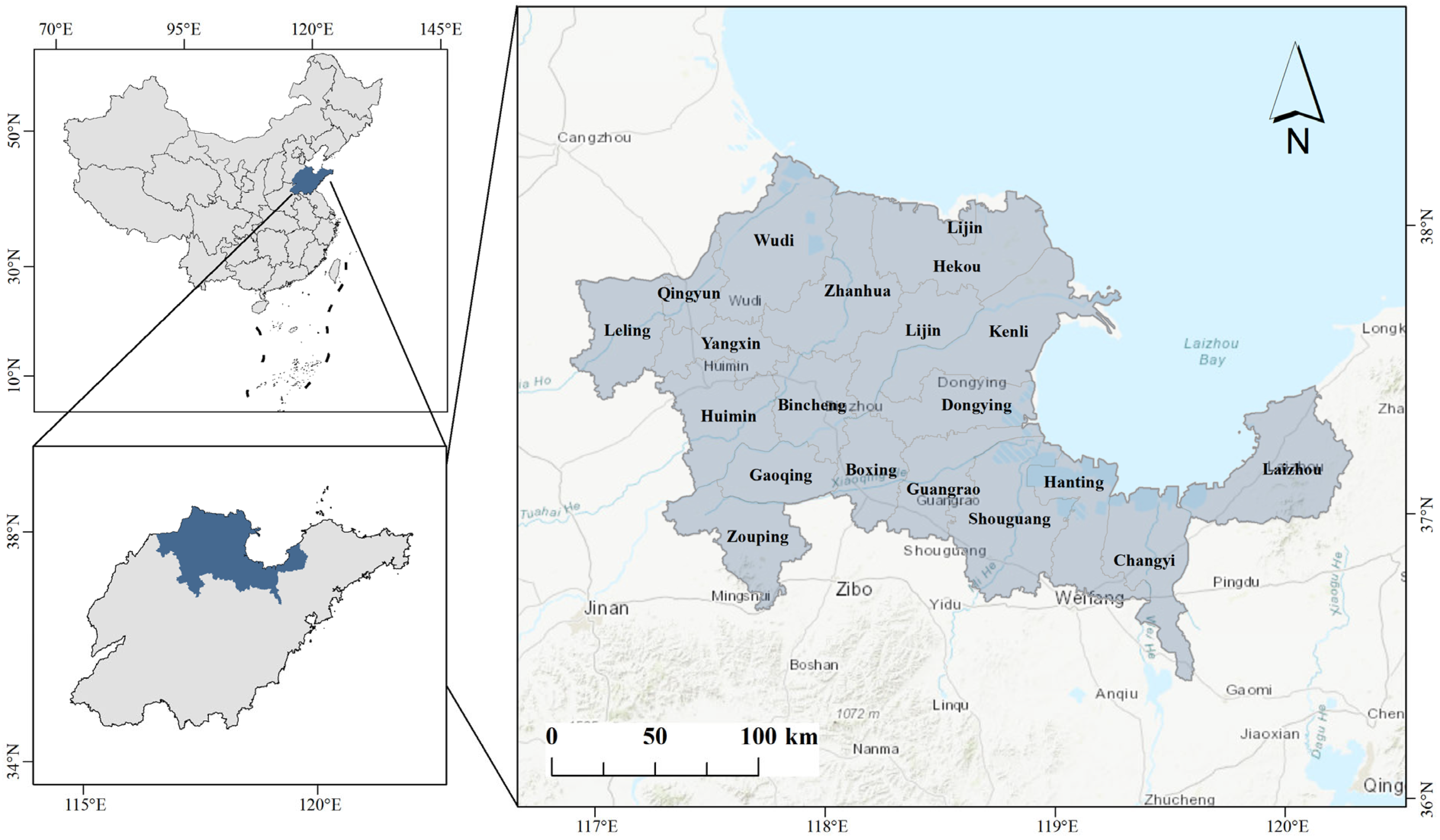
YRDEEZ (37°20′–38°10′ N, 118°17′–119°10′ E) is located in the northern part of Shandong Province, encompassing the cities of Dongying and Binzhou, as well as parts of Weifang, Dezhou, Zibo, and Yantai, covering 19 counties with a total area of 26,500 square kilometers (Figure 1). This region is rich in natural resources, including abundant undeveloped land, wetlands, and oil and gas resources, with significant land reserves and a distinctive ecosystem. It hosts two national nature reserves, the Yellow River Delta and the Binzhou Shell Dike Island and Wetland, which boast diverse flora and fauna and serve as crucial breeding and wintering grounds for millions of migratory waterbirds. Additionally, the region includes two national forest parks, the Yellow River Estuary and Heban Mountain [28,35,36]. As a national strategic region, the YRDEEZ is committed to achieving a balance between economic development and ecological protection, making it a vital ecological economic area in the Bohai rim region.

2.2. Data Sources

This study primarily utilizes three categories of data: land use data, driving factor data for land use prediction models, and resistance factor data for constructing ecological resistance surfaces. The sources and applications of these datasets are detailed in Table 1. The land use data cover three time points: 2000, 2010, and 2020, with a spatial resolution of 30 m. Building on the original data and referencing the production-living-ecological land use classification framework [37], the study area’s data were updated through reclassification, reintegration, and manual visual interpretation into eight classes (Table 2). This process yielded a land use dataset tailored to the requirements of this study.

3. Methods

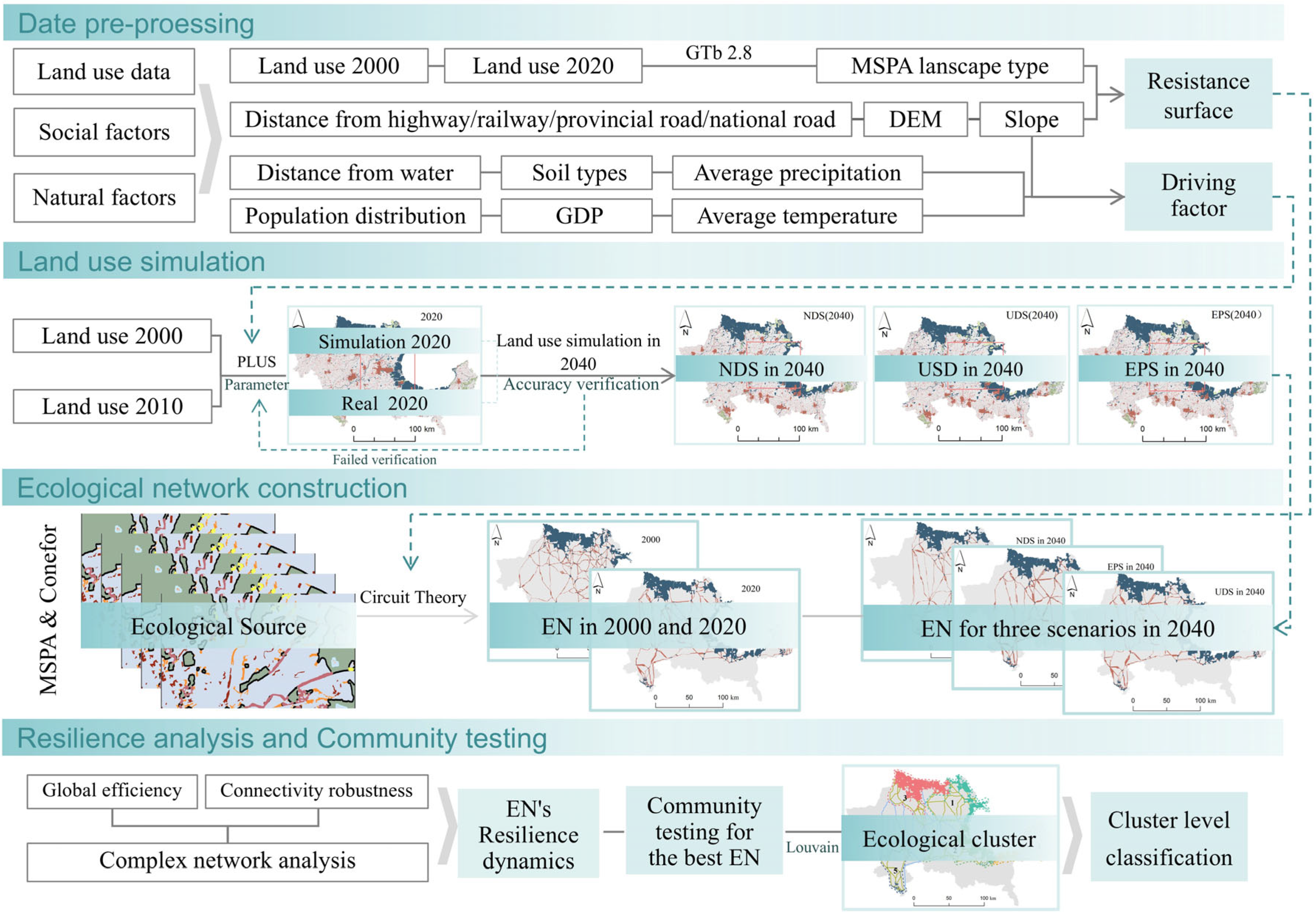
This section begins with the use of the PLUS model to simulate land use patterns based on corrected land use data and multiple driving factors. Subsequently, three land use scenarios for the year 2040 were developed to implement the model-generated predictions. For each scenario in 2040, as well as for the years 2000 and 2020, ENs were constructed by integrating MSPA, connectivity analysis, and circuit theory. Finally, network robustness simulations based on complex network theory were conducted to explore the dynamic characteristics of EN resilience. Community detection was then applied to the EN under the scenario with the highest projected resilience, allowing for the identification and classification of key clusters at the community scale. The overall research framework is illustrated in Figure 2.

3.1. Simulation of Land Use

3.1.1. Land Use Simulation and Accuracy Assessment

This study primarily integrated the Markov Chain model [39] with the PLUS model, utilizing its Land Expansion Analysis Strategy (LEAS) module and Cellular Automata module based on multi-type random patch seeds (CARS) [23]. The LEAS module was utilized to conduct a comparative analysis of land use data from 2000 and 2010. This process identified areas where specific land use types had expanded during that period. Subsequently, a random forest algorithm was applied to examine the relationships between land expansion and its driving factors, leading to the generation of development probability data for each land use category [26].
The CARS module was then employed to simulate future land use scenarios. The 2010 land use data served as the starting point for this simulation. Large, permanent water bodies, such as major reservoirs, were defined as restricted conversion zones to prevent their change in the model. The development probabilities for each land use type, derived from the preceding 2000–2010 LEAS analysis, were incorporated to represent their respective development potential. Future land use demand was estimated using the Markov Chain model, and neighborhood weights were configured according to Table 2. Finally, the land use data of 2020 was predicted and subsequently compared with the legacy land use data from that year to validate the simulation accuracy.

3.1.2. Scenarios Settings

Based on existing national land-use planning policies [32,40] for the study area and with reference to relevant studies, three future land use scenarios were developed: the Natural Development Scenario (NDS), the Ecological Protection Scenario (EPS), and the Urban Development Scenario (UDS) [24,39]. The year 2040 was selected as the target for simulating land use patterns under each scenario. The corresponding land use transition matrices are provided in Table 3. Under the NDS, future land use demands were projected using the Markov Chain model. The EPS was constructed by modifying the NDS, assuming that the transition probabilities from forest, grassland, and unused land to industrial, urban, and rural land would be reduced by 50%. In addition, the probability of agricultural land converting to urban, rural, and industrial land was reduced by 30%, while the probabilities of grassland and agricultural land converting to forest were increased by 30% [15,41]. Similarly, the UDS was derived from the NDS, but assumes a 30% increase in the conversion probabilities from forest, grassland, and agricultural land to urban and rural land, and a 30% decrease in the conversion probabilities from urban and rural land to non-agricultural categories [21].

3.2. Process of Building an EN

At present, the construction of ENs has gradually evolved into a foundational structure comprising three key components: ecological sources, ecological resistance surfaces, and ecological corridors. Ecological sources serve as core areas within ecosystems that play a critical regulatory role, controlling species dispersal and the flow of ecosystem services. Resistance surfaces quantify landscape resistance, intuitively illustrating the potential pathways and relative ease or difficulty of species movement between different ecological sources. Ecological corridors, functioning as essential conduits for the flow of materials and energy, help maintain biodiversity and represent a vital component of ENs.

3.2.1. Selection of Ecological Source

The Morphological Spatial Pattern Analysis (MSPA) method, implemented using the Guidos Toolbox software, was employed to identify ecological source patches. MSPA enables the classification of landscape structure and composition at the pixel level [13]. In this study, forest, grassland, water bodies, and other ecological land types were designated as foreground elements, while all other land use types were treated as background. The foreground was then classified into seven mutually exclusive landscape categories. Among these categories, core which provide extensive habitats for species serve as the primary components of ecological sources within the ecological security pattern [12].
The importance level of each ecological source was further determined based on its landscape connectivity. In this study, two widely used connectivity indices were adopted: the Probability of Connectivity (PC) (Equation (1)) and the Integral Index of Connectivity (IIC) (Equation (2)) [1,13]. Landscape connectivity analysis was conducted using the Conefor 2.6 software. The connection probability was set to 0.5 [13], drawing on the experience of relevant studies and through multiple iterative tests, the distance threshold was finally set at 12 km [3,42].
In summary, core patches were first identified through MSPA, and the final ecological sources were determined based on the landscape connectivity of these core patches.
P C = i = 1 n j = 1 n a i a j p i j * A L     2
I I C = i = 1 n j = 1 n a i . a j 1 + n l i j A L     2
In the formula: PC refers the Probable Connectivity Index of the ecological source. pij represents the maximum distance over which species can disperse between source patches. ai and aj denote the area of source patch i and j, respectively. AL2 is the total area of the landscape, and n is the number of ecological sources. IIC denotes Integral Index of Connectivity, and nlij represents the number of connections between source patch i and j.
Furthermore, to exclude small ecological patches, on the basis of the aforementioned analysis, the minimum area threshold of ecological sources was ultimately set at 1 km2 by integrating the distribution characteristics of ecological sources in the study area and relevant literature [9,43], as well as conducting multiple area threshold experiments.

3.2.2. Construction Procedures of Resistance Surface

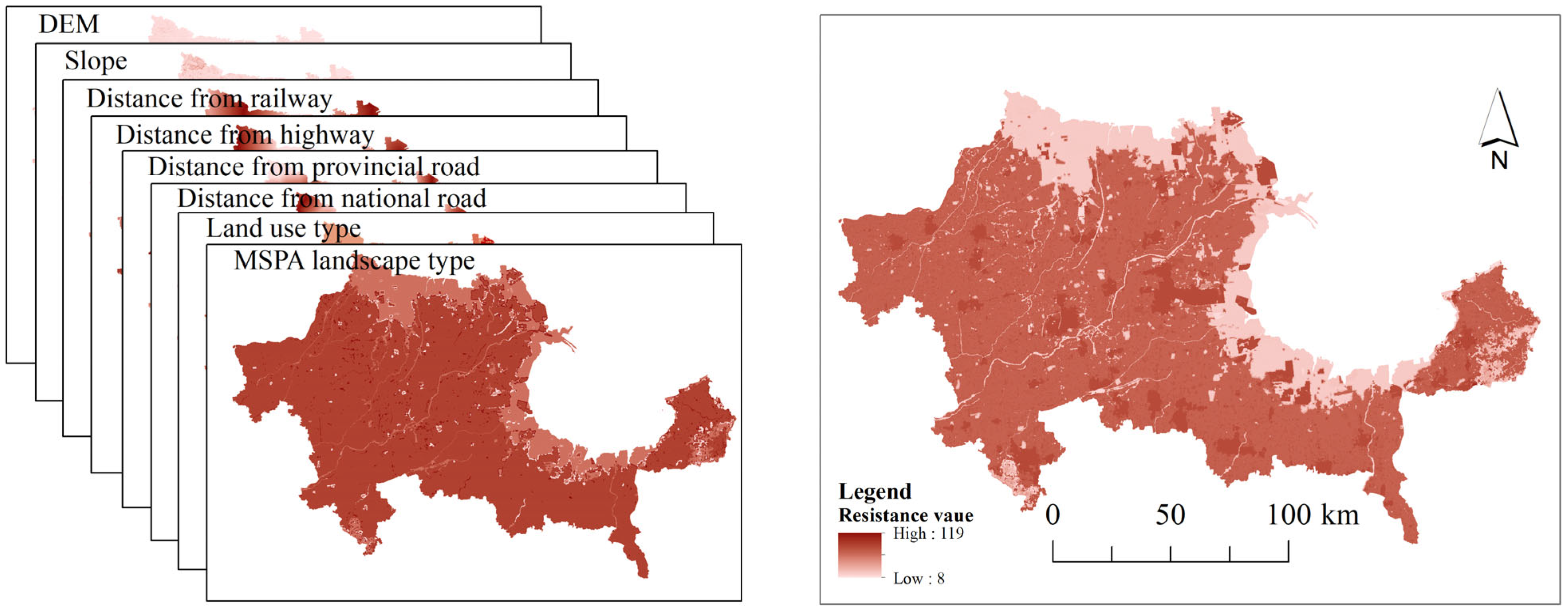
During the migration and transfer of organisms and energy between habitat patches, various environmental and anthropogenic factors may impede or interfere with these processes. The ecological resistance surface intuitively reflects the difficulty species face when moving across different landscape units, and serves as a critical foundation for constructing ecological corridors [28]. In this study, eight resistance factors were selected based on the ecological and environmental characteristics of the study area, including DEM, slope, land use type, and MSPA-derived landscape categories. The construction of the resistance surface involved three main steps. First, land use types and MSPA landscape categories were classified and assigned resistance values. These assignments were determined primarily based on existing literature and expert judgment [12,13,28]. Other resistance factors were also assigned values based on their ecological relevance and data characteristics. Specifically, DEM and slope were normalized in a positive direction, indicating that higher values correspond to greater resistance. In contrast, the distance to transportation networks was normalized in a negative direction, meaning that larger values represent lower resistance. All resistance values were rescaled to a range between 0 and 100 [3,12]. Second, all eight resistance layers were normalized to eliminate dimensional inconsistencies among different data sources. Finally, the weights of each resistance factor were determined based on the characteristics of the study area, using the expert scoring method and with reference to relevant research findings [3,12]. weighted resistance values were calculated for each factor based on their assigned resistance values and relative weights (Table 4). Through spatial overlay analysis of all single-factor resistance layers, an integrated ecological resistance surface was generated.

3.2.3. Selection of Ecological Corridors

Ecological corridors serve as critical pathways for species migration and ecological flows between ecological sources, functioning as essential linkages within the landscape [1]. In this study, ecological corridors were constructed using the Circuitscape module [3], and implemented via the “Build Network and Map Linkages” module within the Linkage Mapper toolkit. First, based on the identified ecological sources and the integrated resistance surface, the minimum-cost paths between habitat patches were calculated using Linkage Mapper. This tool generates a cost-weighted distance (CWD) raster by incorporating both distance and adjacency data. The CWD raster reflects current density, which quantifies the intensity of energy flow between ecological sources. Based on this information, areas with the highest current density were extracted to delineate ecological corridors, incorporating corridor width [3,7,42].

3.3. Resilience Analysis of EN

This study aims to quantify the resilience strength of the EN by evaluating its structural robustness. The robustness analysis was conducted using the NetworkX graph analysis library (https://networkx.org/) within the Python 3.13.1 environment (https://www.python.org/), in combination with complex network theory. The method begins by abstracting the actual EN into an undirected graph: the centroids of ecological sources are defined as nodes, while the ecological corridors are represented as edges. Based on graph theory principles, the topological structure of the network was extracted to construct a comprehensive undirected network comprising all nodes and edges. On this basis, we calculated the betweenness centrality of each node and ranked the nodes in descending order of importance [10,18]. Finally, we simulated the connectivity robustness and global efficiency of the network under a targeted attack scenario. Targeted attacks refer to the deliberate removal of nodes in descending order of their structural importance—aiming to cause the greatest disruption to the network’s functionality and connectivity [20].
The resilience assessment of ENs primarily focuses on two core indicators: connectivity robustness and global efficiency. Connectivity robustness (Equation (3)) is a graph-theory-based structural connectivity metric used to quantify the compactness and structural stability of ENs under spatial constraints. The index is calculated by normalizing the observed number of links in the EN by the theoretical maximum number of links of a planar graph, thereby characterizing the degree of structural redundancy and the network’s resistance to the loss of nodes or corridors. The index ranges from 0 to 1, with higher values indicating a more compact network structure and greater structural robustness. This metric has been widely applied in EN construction, ecological security pattern analysis, and scenario-based assessments of network stability, and is particularly suitable for large-scale evaluations of macroscopic structural connectivity [4]. Compared with conventional connectivity metrics (e.g., the Probability of Connectivity, PC), connectivity robustness explicitly evaluates the persistence of network connectivity under progressive node removal, enabling the assessment of network stability under disturbance scenarios. This indicator complements static connectivity measures and is particularly suited for resilience-oriented analyses of ENs under alternative land-use scenarios [17].
The calculation of connectivity robustness is expressed as follows:
R C = D i 3 V i 6
where Rc denotes Connectivity Robustness of EN. i is the node index in the network (i = 1, 2, 3... n). |Di| represents the number of remaining edges after node i is removed. |Vi| is the number of remaining nodes in the network after node i is removed. 3|Vi| − 6 is the maximum possible number of edges of a graph under planar conditions.
Global efficiency (Equation (4)) reflects the efficiency of energy transfer within the network under conditions of disturbance. A higher value indicates greater operational efficiency of the system [18].
The global efficiency is calculated using the following formula:
E f = 1 n ( n 1 ) i 1 1 f i j
where Ef denotes the global efficiency of the EN. n is the total number of nodes in the network. i and j represent distinct nodes within the same network. fij is the shortest path length between nodes i and j.
To conclude, the resilience evaluation framework for the EN integrates two core indicators: the initial connectivity robustness and the initial global efficiency of the network. Beyond these baseline metrics, the framework also incorporates the attenuation patterns of both indicators under targeted attack scenarios, where the node removal proportion is gradually increased. This multi-dimensional assessment enables a more holistic understanding of the networks disturbance resistance and recovery capacity. In addition, the network resilience analysis in this study is mainly carried out based on graph-theoretic topological structures, with a focus on the structural resilience of ENs.

3.4. Cluster Identification and Classification

Clustering of the EN is a crucial step in uncovering its internal structure and functional characteristics. In this study, we employed community detection, also known as modularity partitioning, to delineate clusters within the EN. Community detection aims to divide a complex network into multiple sub-networks (clusters) characterized by dense internal connections and sparse external linkages [44]. This approach effectively reveals the modular structure of the ecosystem, which is essential for understanding its stability and resilience to disturbances [29]. We applied the Louvain algorithm for community detection, which is known for its computational efficiency. The algorithm iteratively merges nodes and communities to maximize network modularity, thereby identifying multi-level cluster structures [45,46]. The implementation was conducted using the python-louvain package within the Python 3.13.1 environment [29].
The modularity is calculated using the following formula:
Q = 1 2 m i , j ( A i j k i k j 2 m ) δ ( c i , c j )
where Aij denotes the element of the adjacency matrix (indicating whether there is a connection between nodes i and j). ki and kj represent the degrees of nodes i and j, respectively (i.e., the number of connections), and m is the total number of edges in the network. δ(ci,cj) is the Kronecker delta function, which equals 1 if nodes i and j belong to the same cluster, and 0 otherwise.
Through community detection, the EN was divided into multiple ecological clusters characterized by strong internal connectivity. To evaluate the relative importance of these clusters, a comprehensive assessment framework (Equation (6)) was developed, incorporating the following indicators: the number of nodes within each cluster, node degree centrality, eigenvector centrality, the number of inter-cluster connections, and the number of internal versus external corridors associated with each cluster. All indicators were subjected to normalization standardization, and the simple averaging method was adopted for indicator aggregation. By integrating these indicators, we ranked the ecological clusters according to their importance, enabling the precise identification of critical regions within the EN at the cluster level.
C = i = 1 n w i   ×   x i ( c )
where C denotes a given cluster, n represents the number of indicators, Wi is the weight of the ith indicator, and xi′ is the normalized value of the ith indicator for cluster C.

4. Results

4.1. Simulation Results of Land Use

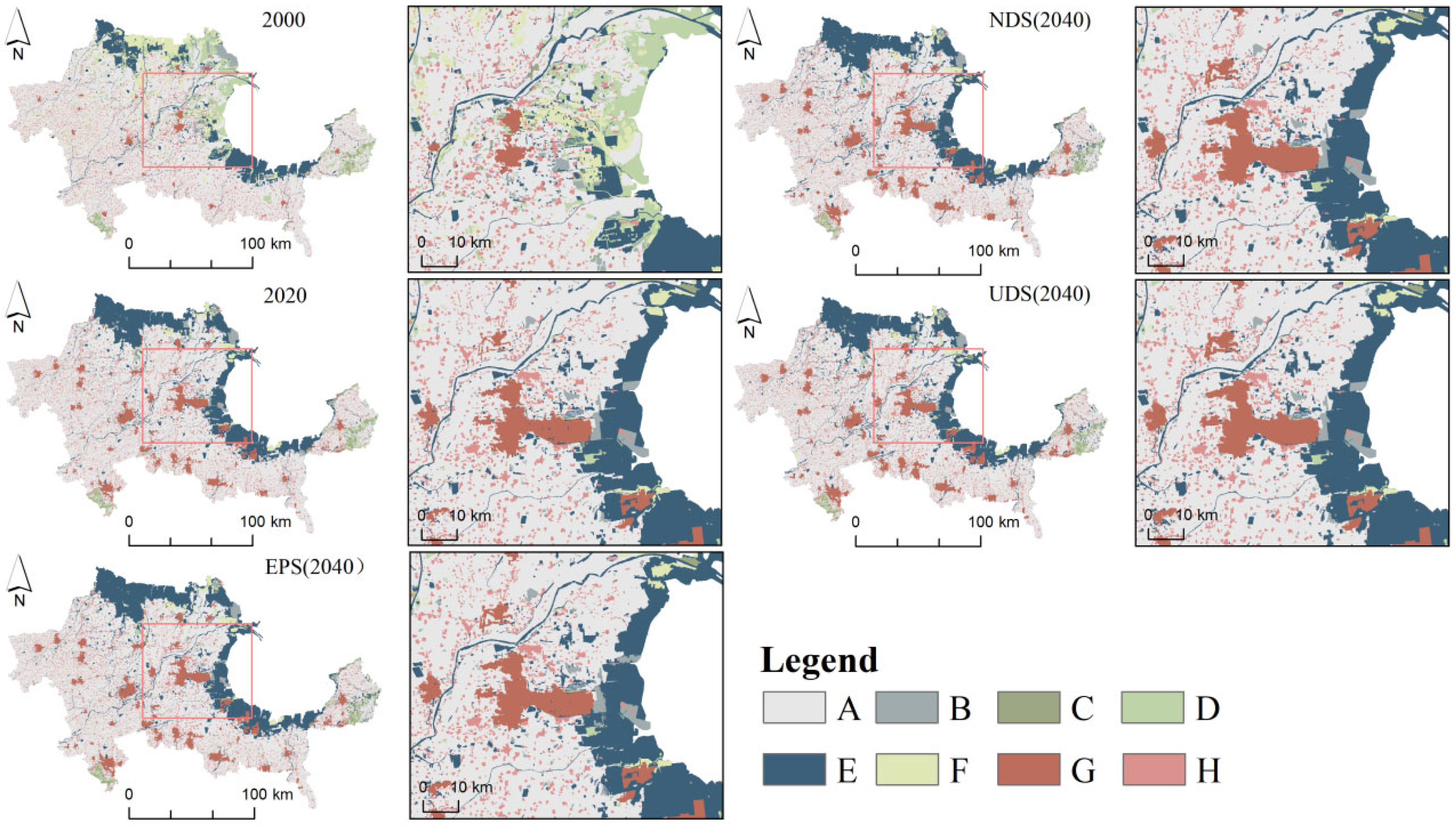
The predictive performance of the PLUS model was validated by comparing its simulated land use for 2020 with the actual land use data for the same year. The results showed an overall accuracy of 0.926 and a Kappa coefficient of 0.866, indicating a high level of reliability for the model in forecasting future land use in the study area. Figure 3 illustrates the actual land use types in 2000, 2010, and 2020, along with the simulated land use areas, proportions, and spatial distributions under three future scenarios for 2040. The land use pattern in the study area was predominantly characterized by agricultural production land, which consistently accounted for more than 60% across all years and scenarios (Table 5).
Between 2000 and 2010, land use change was relatively intense, with urban residential land experiencing the most notable expansion. However, the rate of urban expansion slowed after 2010, and the overall land use change tended to stabilize. From 2000 to 2020, water ecological land increased significantly by 1387.58 km2, while urban land grew by 1108.14 km2. In contrast, grassland decreased by 1430.95 km2, and other ecological land types declined by 1310.65 km2 (Table 5). With the exception of forest ecological land, which showed a slight decrease, most other land use types exhibited relatively stable or slightly increasing trends over time.
By 2040, agricultural production land in the study area is projected to show a declining trend, while urban residential land is expected to increase (Table 5). Across the different scenarios, the UDS results in the most significant expansion of urban residential land, with an increase of 358.98 km2 compared to 2020. In contrast, under the EPS, the increase is more modest, at only 212.92 km2 (Table 5). Forest, grassland, and other ecological land types all exhibit a decreasing trend in area, but the reductions are smallest under the EPS. Water ecological land is the only ecological land category to demonstrate a marked increase across all scenarios; even under the UDS, where the growth is smallest, it still increases by 392.13 km2 (Table 5).
Spatially, water ecological land is primarily concentrated in the coastal zones of the study area, which is likely related to the presence of extensive coastal wetlands and aquaculture ponds. Forest ecological land is mainly distributed in the mountainous areas of Laizhou and Zouping, forming the few forest-concentrated zones within the region. The main urban area of Dongying City constitutes the largest urban residential land patch within the study area. Under the UDS in 2040, urban residential land in Dongying and surrounding areas expands more significantly, with larger and more cohesive patches. Similarly, industrial and mining land patches appear more intact in the UDS. In contrast, under the EPS, industrial and mining land patches are more fragmented and generally smaller in size (Figure 3).

4.2. Construction of EN Across Different Scenarios and Periods

4.2.1. Identification of Ecological Sources

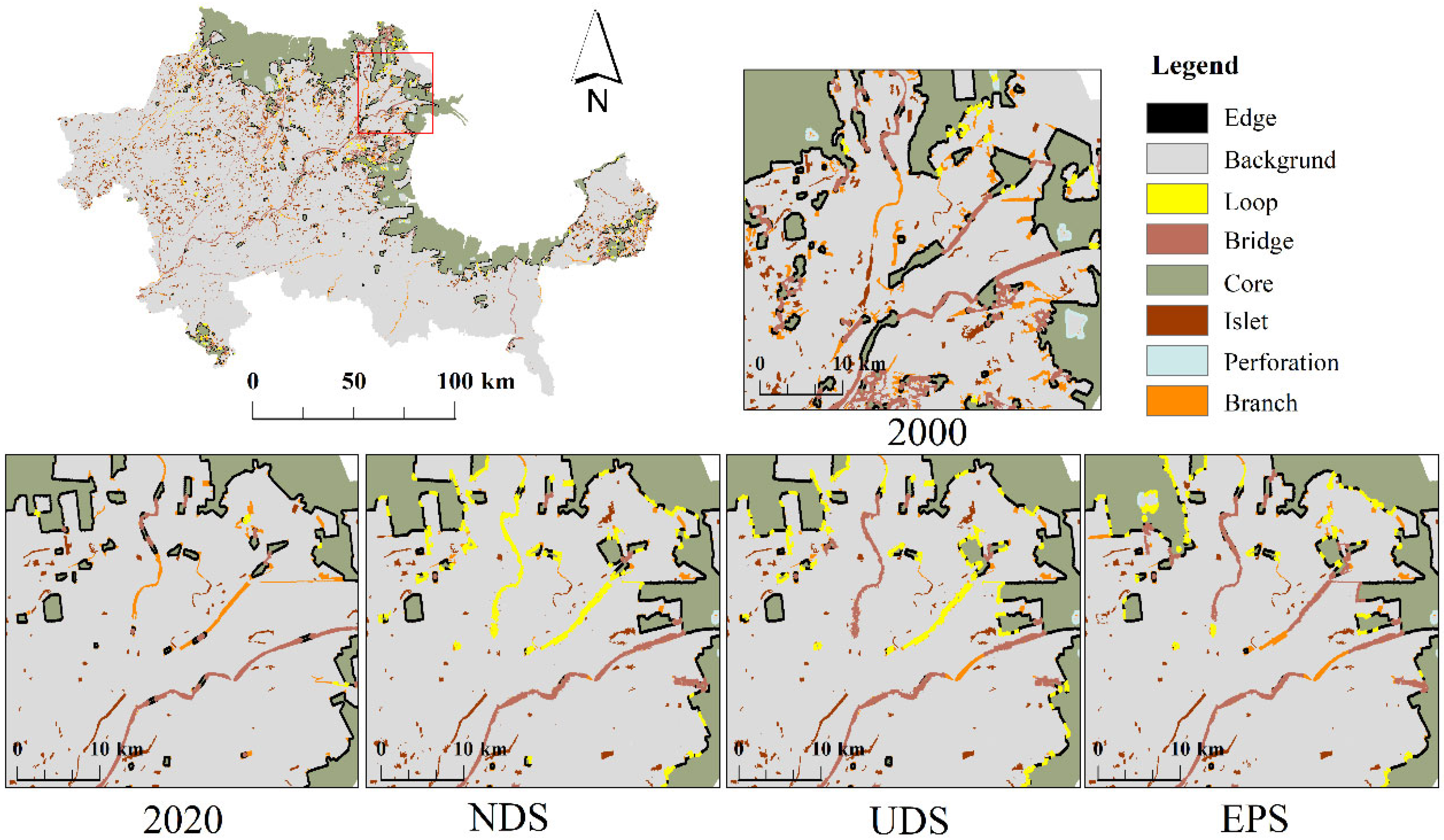
Based on MSPA and landscape connectivity analysis (Figure 4), this study determined a minimum area threshold of 1 km2 for the identification of ecological sources. The number and total area of ecological sources extracted under each time point and scenario are presented in Table 6.
From a temporal perspective, the number and total area of ecological sources exhibited a clear declining trend between 2000 and 2020, with a reduction of 555.57 km2 in total area (Table 6). However, projections for 2040 indicate a slight increase in total area across all scenarios, although the number of ecological sources continues to decline. In terms of spatial distribution, ecological sources maintained a relatively stable spatial pattern over time. Large patches of ecological sources were consistently concentrated in the coastal areas of the study region.

4.2.2. Construction of Resistance Surface

Through multi-factor overlay analysis, this study constructed five composite resistance surfaces for different years and scenarios (Figure 5). In terms of spatial distribution, areas with high resistance values were primarily concentrated in urban and other built-up lands. For instance, extensive high-resistance zones were observed in and around the urban areas of Binzhou and Dongying. In contrast, low-resistance areas were mainly distributed along river systems and coastal zones.

4.2.3. Extraction of Ecological Corridor and Construction of EN

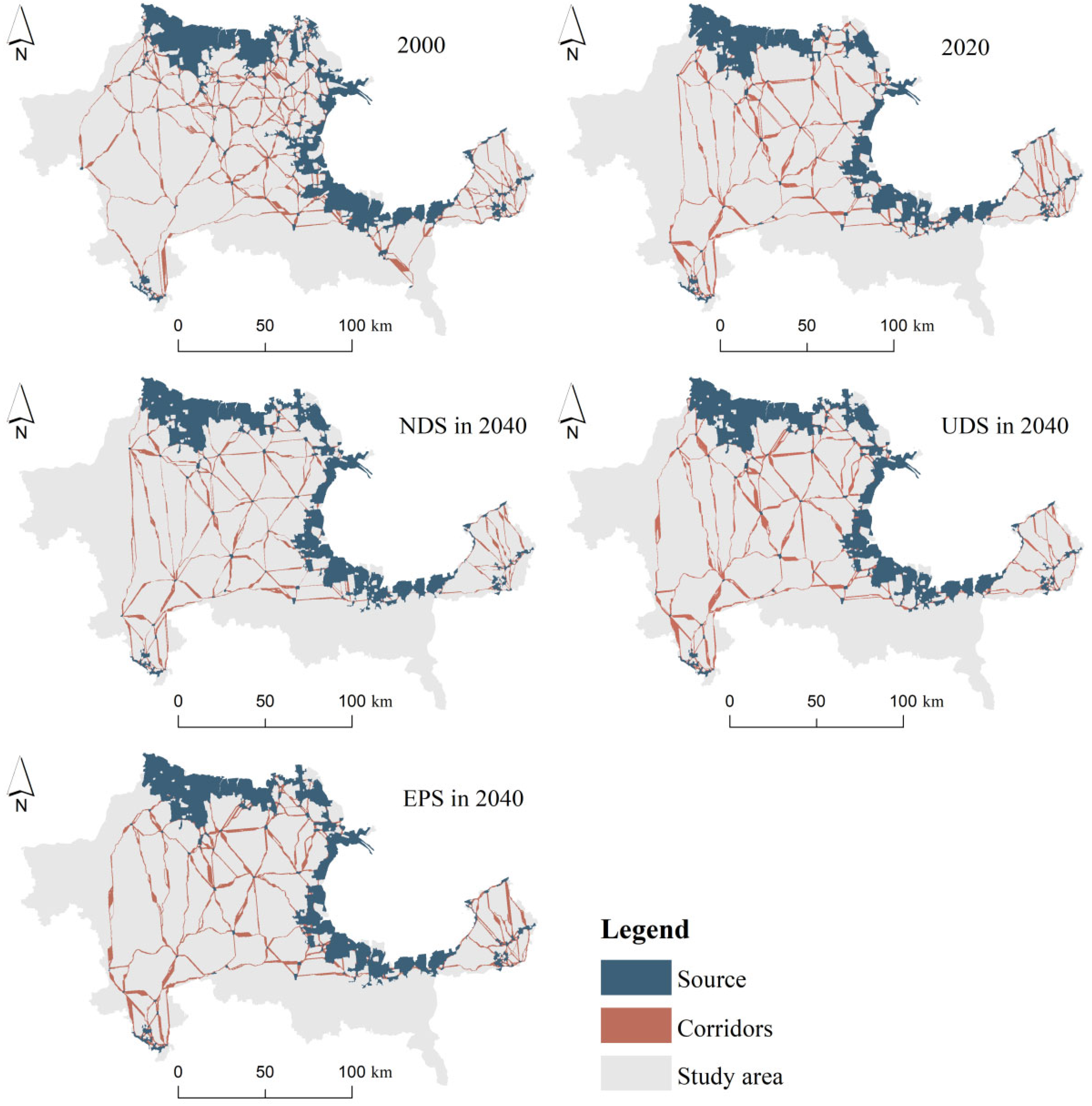
Based on the Linkage Mapper tool, this study extracted ecological corridors for the years 2000 and 2020, as well as for three projected scenarios in 2040, including the NDS, the UDS, and the EPS. Five ENs were subsequently constructed (Figure 6). The results showed that in terms of corridor number, total length, area, and overall EN coverage, the EN in 2000 exhibited the highest values among all five groups (Table 6). Compared to 2000, the number of corridors in 2020 decreased by 37, the total length was reduced by 675.98 km, and the total area of source and corridor declined by 749.41 km2 (Table 6). By 2040, both the number and total length of corridors continued to decrease relative to 2020. However, under all three future scenarios, the total area of the area of source and corridor showed an upward trend. Notably, the UDS demonstrated the most significant increase, with the area of source and corridor expanding by 387.52 km2 compared to 2020, and also accounting for the highest proportion of the study area among the three scenarios (Table 6).
Regarding spatial distribution, ecological corridors across the five EN groups were predominantly concentrated in the central part of the study area, forming a fan-shaped pattern aligned with the flow direction of the Yellow River. The Laizhou region also displayed a relatively dense network of corridors. In contrast, the southern areas of Hanting District and Changyi City, along with most of the western LeLing region, exhibited a significant lack of corridor coverage. Over the period of EN evolution from 2000 to 2040, ecological corridors in the western part of the study area have shown a pronounced trend of contraction, while those in the central region have become increasingly fragmented and sparse (Figure 6).

4.3. EN Resilience Analysis

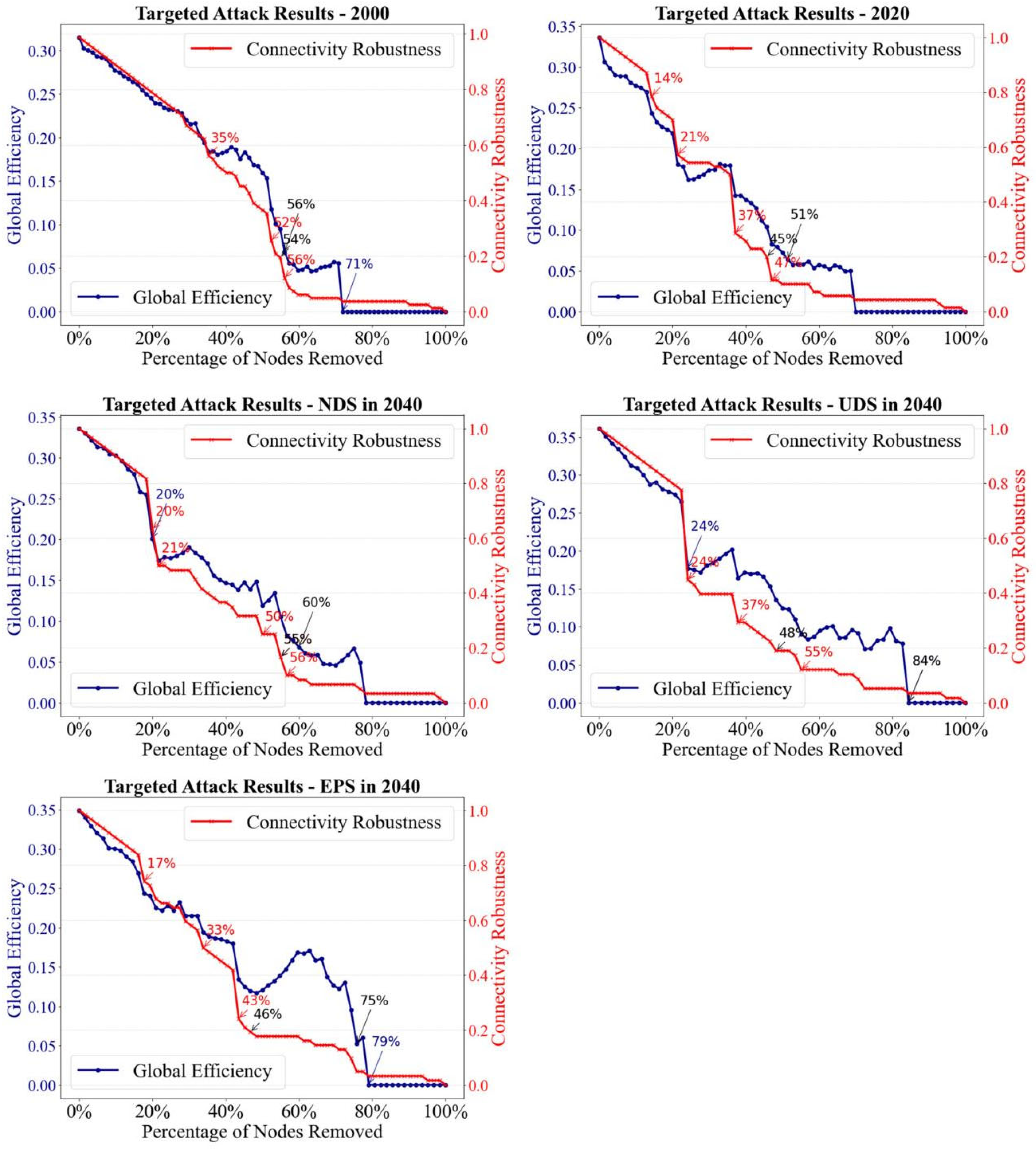
The resilience of the EN was assessed by simulating connectivity robustness and global efficiency under targeted attack scenarios (Figure 7). In 2000, the initial connectivity robustness of the EN was observed to be 0.987, demonstrating a marginal connectivity loss. Conversely, the initial robustness values for 2020 and all three projected 2040 scenarios (NDS, UDS, and EPS) uniformly reached 1.000, indicating complete connectivity preservation (Figure 7).
Regarding global efficiency, the initial value in 2000 was 0.315, which increased to 0.336 in 2020. The average global efficiency across the three 2040 scenarios reached 0.346, with NDS at 0.328, UDS at 0.361, and EPS at 0.349 (Figure 7). Among the five networks, the UDS in 2040 showed the highest initial global efficiency, while the 2000 network exhibited the lowest values for both connectivity robustness and global efficiency. Overall, the global efficiency of the EN demonstrated a consistent upward trend from 2000 to 2040 (Figure 7).
In the 2040 scenario-based analysis of key node failures, significant declines in connectivity robustness and global efficiency were observed when 20% of nodes failed in NDS, 24% in UDS, and 17% in EPS (Figure 7). Further analysis revealed that in the NDS, failure of 60% of nodes reduced connectivity robustness to below 20% of its initial value, compared to 48% in UDS and 43% in EPS (Figure 7). As for global efficiency, a decline to below 20% of the initial value occurred when 55% of nodes failed in NDS, while in UDS and EPS, the thresholds were 84% and 75%, respectively (Figure 7).
In summary, the UDS in 2040 exhibited the highest initial global efficiency and the greatest structural resilience to disturbances. Under UDS, both connectivity robustness and global efficiency remained stable until approximately 24% of nodes failed, and the thresholds for a 20% performance drop in both metrics were significantly higher than in the NDS and EPS.

4.4. Community Detection Within the EN

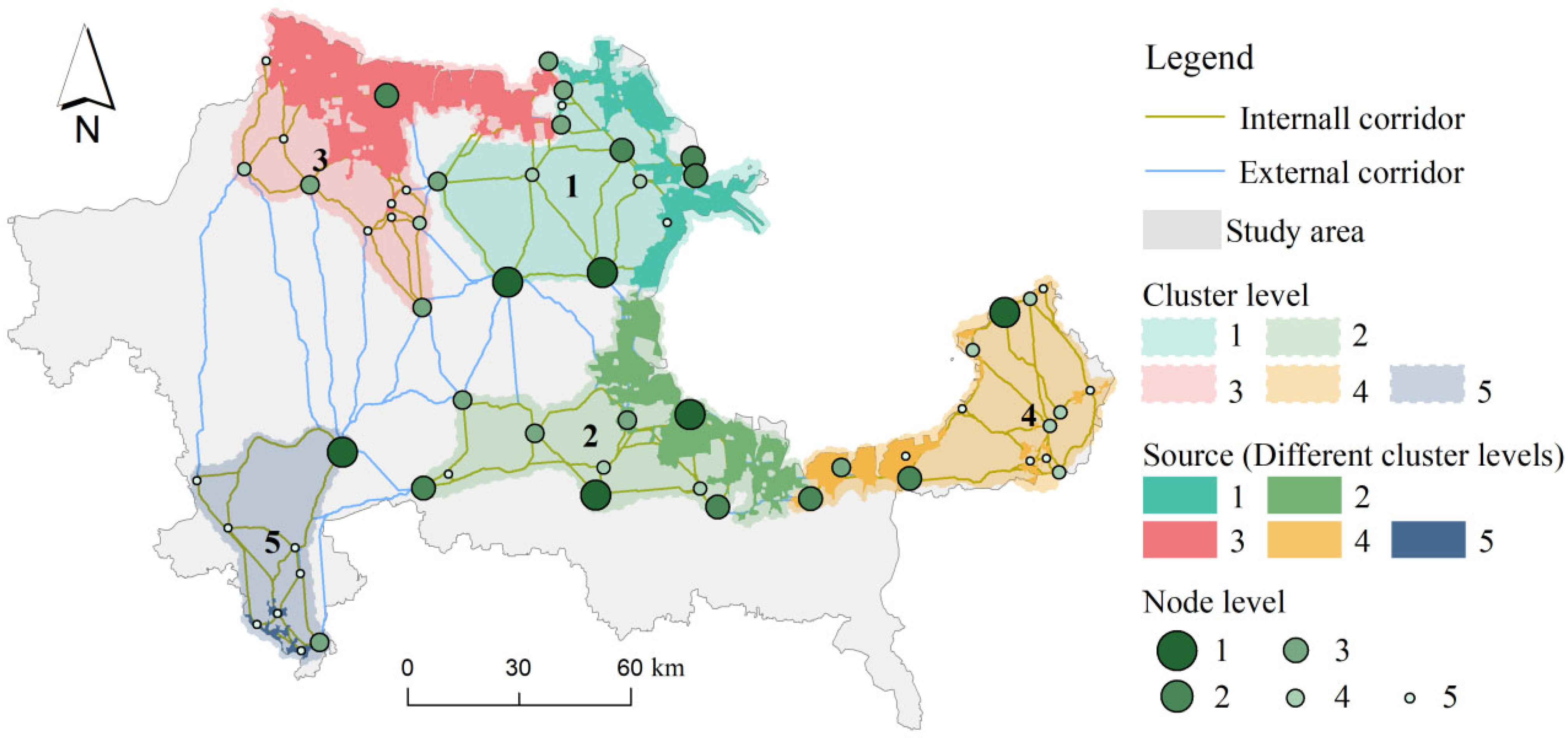
Based on the preceding analysis, the EN of the UDS can be regarded as the most ideal construction model for future scenarios. Subsequent community detection will also be based on the UDS EN. The analysis identified five clusters within the study area (Figure 8), with these clusters being spatially dispersed and non-overlapping. Within the clusters, there are 127 ecological corridors with a total length of 2285.95 km, while between the clusters, there are 34 ecological corridors with a total length of 1171.35 km (Table 7). This indicates that the corridors within clusters are denser and have shorter average lengths, whereas the corridors between clusters are relatively sparse with longer average lengths. However, the inter-cluster corridors play a critical role in enhancing the connectivity of the entire network across the study area by linking different clusters, making them highly significant. In addition, the ecological sources were classified into different node levels within the EN based on their degree centrality (Figure 8). Specifically, six nodes were identified as Level 1 and eight as Level 2. A higher node level indicates greater importance of the corresponding ecological source in maintaining overall network connectivity, and therefore, higher-level nodes should be prioritized for conservation and restoration efforts.
Based on the importance evaluation system, clusters were classified into five levels. The Level-1 cluster was located in the Yellow River Estuary and surrounding areas, containing 13 ecological sources, including two top-level nodes. This region, covering the entire Yellow River Delta National Nature Reserve, featured extensive coastal and estuarine wetlands, reaffirming its core ecological role in the study area. The Level-2 cluster, mainly distributed in Guangrao, Shouguang, and Hanting, also included two Level-1 nodes. As several rivers, such as the Xiaoqing River and Wei River, flow into the sea here, large estuarine wetland landscapes have formed. Its central location enhances its role as a key ecological corridor linking other clusters. The Level-3 cluster, located in the northwest, contained the largest ecological source area, mainly coastal wetlands in Wudi and northern Zhanhua. It encompassed the Binzhou Shell Dike Island and Wetland National Nature Reserve, highlighting the importance of protected areas in cluster formation. Although the Level-4 and Level-5 clusters were relatively small and mainly located at the verge of the study area, they hosted forest ecological sources whose internal corridors served as critical bridges for material and energy exchange between coastal and inland mountainous ecosystems.

5. Discussion

5.1. Relationship Between Land Use and EN Patterns

This study revealed that land use patterns in the study area had undergone significant changes in response to urbanization. Between 2000 and 2010, rapid urban expansion was observed, primarily driven by increasing demands for urban living space, reflecting a period of intense population agglomeration [34]. After 2010, urban expansion slowed and the spatial structure began to stabilize, indicating a transition from extensive land development to internal optimization. From 2000 to 2020, water-related ecological land experienced substantial growth, while grassland and other ecological land types were markedly reduced due to urban encroachment, highlighting the coexistence of urban development and ecological conservation during this period [41]. By 2040, the UDS projected the largest increase in urban residential land (an increase of 358.98 km2, Table 5), reflecting a development-first approach that significantly exacerbated the loss of forest, grassland, and other ecological land types. In contrast, the EPS showed more restrained urban expansion (an increase of 212.92 km2, Table 5) and the smallest reduction in ecological land, emphasizing a conservation-oriented planning strategy. Across all three scenarios, water-related ecological land increased, which can be attributed to ongoing coastal wetland restoration efforts and the construction of new aquaculture ponds, as noted in Yu et al.’s (2024) study, the area of artificial wetlands (e.g., reservoirs and ponds) in the Yellow River Delta increased significantly during this period, emerging as the primary contributor to the overall wetland expansion [41].
Land use patterns fundamentally determined the spatial distribution and size of ecological sources [7]. Differences in land use across time periods indirectly led to variations in the spatial configuration of ecological corridors. Between 2000 and 2020, rapid urbanization coincided with a significant reduction in ecological land, directly manifesting in the EN as decreased number and area of ecological sources, as well as shortened and fewer ecological corridors. This result is consistent with the findings reported by Li et al. (2024) [2]. These findings indicated that the structure of ENs were closely tied to the underlying land use patterns of each period.

5.2. Factors Influencing the Resilience of EN

The structure and resilience of ENs are influenced by multiple factors, primarily due to environmental heterogeneity [47]. A higher number of ecological sources or a greater total corridor length does not necessarily equate to greater network resilience [17]. For instance, the EN in 2000 had the highest number of ecological sources, total area, and corridor length among the five evaluated time points (Table 6, Figure 7), yet it exhibited relatively low initial connectivity robustness. This phenomenon might be attributed to the extensive and relatively undisturbed ecological land in 2000, which may have promoted a more fragmented and spatially dispersed distribution of ecological sources. This, in turn, could have created a more complex corridor structure, rendering it more susceptible to connectivity loss [10].
The encroachment of urbanization onto ecological land led to a decline in the number of ecological sources and localized source loss. As a result, the EN exhibited an overall downward trend in both corridor number and total length throughout the study period (Table 6). Under comparable conditions, a greater number of connected nodes tended to predispose networks to higher structural complexity, which can, in some cases, led to a reduction in global efficiency [20]. Therefore, the observed simplification of EN structure over time corroborated the consistent increase in global efficiency (Section 4.3). This trend is particularly evident in the UDS for 2040, which exhibited a slightly higher global efficiency than the other two scenarios. Correspondingly, another counterintuitive result is that, under the EPS, a larger extent of ecological land is associated with lower network resilience. These contrasting results can be jointly explained by structural trade-offs shaping EN resilience [4,17]. Under EPS, source expansion is primarily area-oriented, yet newly added patches tend to be spatially dispersed or weakly connected, resulting in limited improvements in connectivity and structural redundancy. In contrast, urban development constrains ecological land into a more compact and centralized configuration, enhancing connectivity efficiency by reducing average path length among key nodes, albeit at the cost of reduced redundancy. Together, these findings indicate that EN resilience is governed by trade-offs between source area and connectivity, as well as between network efficiency and redundancy, rather than by source extent alone. This highlights the multidimensional nature of EN robustness and underscores the importance of integrating spatial configuration and topological structure into connectivity-oriented planning beyond area-based conservation.
In this study, the resilience assessment of the EN emphasized both network connectivity and its capacity to withstand disturbances. Among the scenarios, the EN under UDS demonstrated the highest structural resilience, primarily because UDS more effectively mitigated patch fragmentation and connectivity loss through targeted ecological planning during urbanization. By contrast, while the EPS scenario may achieve higher ecological patch quality (e.g., greater vegetation cover, higher species richness) and an overall increase in patch area and number, its network connectivity tended to decline owing to longer inter-patch distances or pathway interruptions [4,17]. This contrast suggested that in rapidly urbanizing regions, improvements in EN resilience depended more on structural optimization than on patch quality alone [10]. Furthermore, because UDS involved more substantial expansion of urban, industrial, and other built-up areas compared with other scenarios, ecological corridors often needed to circumvent larger high-resistance zones. As a result, the total corridor length and area proportion were slightly higher under UDS than under EPS. Significantly, this pattern indicated the capacity of the EN under the UDS to maintain ecological security, despite increased encroachment from production and residential land [15].

5.3. Priority Area Management Guided by Clustering

This study employed community detection to partition the EN into distinct, non-overlapping clusters. Subsequently, an evaluation framework was developed to rank the importance of these clusters (Figure 8). This approach elucidated the network’s modular structure, identified core units, and supports targeted conservation and restoration planning [28].
Unlike methods based on cumulative current values [3] or corridor heterogeneity [48], it explicitly differentiated between inter- and intra-cluster corridors, enabling tailored corridor design and clearer understanding of local circulation and cross-system exchanges [44]. Cluster-scale management can also mitigate fragmentation caused by administrative boundaries. Based on the classification of cluster, node, and corridor grades, conservation efforts should prioritize higher-grade clusters under limited resource conditions. Specifically, first-grade clusters should be designated as core protected areas, within which all exploitative activities are strictly prohibited. In parallel, ecological sources containing higher-grade nodes should receive enhanced protection and restoration, incorporating integrated measures targeting vegetation, soil, and hydrological processes. Ecological isolation zones should also be established around the peripheries of these sources to mitigate external disturbances. Particular attention should be given to inter-cluster corridors, where discontinuities at fragmented sections should be removed to restore structural connectivity. In areas intersected by transportation infrastructure, eco-friendly crossing facilities—such as wildlife overpasses, underground culverts, and fish passage systems—should be implemented to maintain ecological flows. Overall, community detection offered a structured means to decode complex ENs, linking local processes with global connectivity, and was particularly applicable to large, heterogeneous landscapes [29].

5.4. Limitations and Future Directions

This work integrated land-use simulation, EN construction, and multi-scenario cluster analysis to provide a spatiotemporal framework for understanding EN resilience and guiding conservation planning. However, it is mainly applicable to rapidly changing urban-rural and human-natural mixed landscapes with significant land-use dynamics. Its effectiveness may be limited in regions dominated by large, undisturbed ecosystems such as tropical rainforests or deserts. Although the resistance surface weights and scenario assumptions (e.g., land-use transition probabilities) were derived from relevant studies using expert-based scoring methods [24,39], a certain degree of subjectivity is unavoidable. Moreover, the PLUS model employed in this study does not explicitly account for the impacts of extreme climate events on land-use patterns. While the PLUS model, in combination with the Markov chain model, is effective in simulating gradual land-use changes driven by socio-economic and natural processes, it is unable to capture abrupt land-use transitions triggered by low-probability, high-impact events, such as extreme floods, tsunamis, or sudden policy interventions.
The accuracy of results is constrained by data resolution and completeness. Low-resolution land-use data may omit small ecological patches, while outdated driving factor datasets reduce scenario reliability. Future studies could enhance scientific rigor by incorporating higher-resolution, more comprehensive, and timely data, and integrating additional methods, such as incorporating ecosystem service values [49] and source quality metrics [50] in source identification. Additionally, this study primarily focuses on the structural resilience of ENs. Future research could integrate functional attributes, such as source quality, corridor quality, and ecological sensitivity, to further explore functional resilience. Furthermore, incorporating species-specific source analyses and corridor width thresholds would facilitate the construction of ENs targeted at specific species, thereby enhancing the ecological relevance and practical applicability of the research.

6. Conclusions

In this study, we integrated land use prediction models, landscape ecology theory, and complex network analysis methods to evaluate the resilience performance of the EN in the YRDEEZ under multiple scenarios. Meanwhile, this research framework is well suited to medium- and large-scale regions where urban and ecological land uses are closely integrated and land-use changes are pronounced. In contrast, in regions with negligible land-use type changes (e.g., extensive pristine forests or desert areas), the framework’s advantages in capturing dynamic variations across temporal scales cannot be effectively demonstrated. Moreover, for small-scale regions, the significance of its community detection function in identifying internal cluster differentiation is limited.
It was found that the study area is dominated by agricultural land. From 2000 to 2020, the areas of water bodies and urban land increased, while grasslands and other ecological land types declined, accompanied by significant shifts in spatial patterns. By 2040, all three simulated scenarios project a continued reduction in agricultural land and an expansion of urban land relative to 2020. Urban growth is most prominent under the UDS, whereas ecological land is best conserved under the EPS. Overall, land use changes in this stage appear more stable compared to the previous period. This reflects the continued strengthening of ecological land-use control policies and the gradual institutionalization and normalization of land-use governance, implying that future ecological conservation and spatial optimization should shift from controlling land expansion toward the refined regulation of EN structure and spatial configuration.
During the construction of ENs, it was observed that ecological source areas are predominantly concentrated in coastal regions. Since 2000, both the number of source areas and ecological corridors have exhibited a declining trend. Among the scenarios, the UDS demonstrated the highest area ratio of source and corridor, while the NDS showed the lowest. Resilience assessments of the five EN configurations indicated an overall decline in EN resilience after 2000, with the UDS exhibiting the strongest structural resilience performance among the three future simulations. Taken together with the resilience assessment under the EPS, these results demonstrate that EN resilience is not determined by source area alone, but by inherent trade-offs with network redundancy, emphasizing the decisive importance of spatial configuration and topological structure for effective ecological conservation and planning in the study area.
Based on the UDS, which demonstrated the highest structural resilience in 2040, ecological cluster community detection identified five distinct cluster groups. Ecological corridors were categorized into internal and external types, and nodes were classified according to their relative importance within the network. According to a comprehensive importance evaluation, the first- to third-level clusters hold greater significance due to the presence of nature reserves, wetlands, or their location at critical ecological nodes. By characterizing ecological connectivity, these clusters define hierarchical management zones that facilitate ecological conservation and management beyond conventional administrative boundaries. Notably, the cluster located near the Yellow River estuary emerged as the most critical first-level cluster, reaffirming the estuary’s central ecological role within the entire study area. These findings enable the implementation of regionally differentiated and hierarchical ecological conservation and management strategies at large spatial scales. By prioritizing clusters and sources of higher importance under limited resources, the results provide forward-looking scientific support for regional ecological security pattern planning, thereby contributing to biodiversity conservation and regional sustainable development.

Author Contributions

Conceptualization, Y.Z. and Y.L.; methodology, Y.Z.; software, Y.L.; validation, Z.D.; formal analysis, Z.D.; investigation, Y.Z.; resources, B.G.; data curation, F.Q.; writing—original draft preparation, Y.Z.; writing—review and editing, Y.L.; visualization, Z.W.; supervision, J.Y.; project administration, Y.Z.; funding acquisition, C.Y. All authors have read and agreed to the published version of the manuscript.

Funding

This study was supported by the National Natural Science Foundation of China (42271055, U1806218) and Project of the Cultivation Plan of Superior Discipline Talent Teams of Universities in Shandong Province “the Coastal Resources and Environment team for Blue-Yellow Area”.

Data Availability Statement

The original research data is not disclosed due to privacy concerns; however, selected elements of the database used for this research can be requested from the corresponding author.

Acknowledgments

We would like to thank the National Natural Science Foundation of China for supporting this research. We would also want to thank the Institute for Advanced Study of Coastal Ecology, School of Resource and Environmental Engineering, Ludong University, and the National School of Surveying, University of Otago.

Conflicts of Interest

All authors declare that the research was conducted in the absence of any commercial or financial relationships that could be construed as a potential conflict of interest.

Abbreviations

The following abbreviations are used in this manuscript:
ENEcological Network
NDSNatural Development Scenario
EPSEcological Protection Scenario
UDSUrban Development Scenario

References

  1. Huang, X.; Wang, H.; Shan, L.; Xiao, F. Constructing and Optimizing Urban Ecological Network in the Context of Rapid Urbanization for Improving Landscape Connectivity. Ecol. Indic. 2021, 132, 108319. [Google Scholar] [CrossRef]
  2. Li, C.; Su, K.; Yu, S.; Jiang, X. Multi-Scenario Ecological Network Conservation Planning Based on Climate and Land Changes: A Multi-Species Study in the Southeast Qinghai–Tibet Plateau. Forests 2024, 15, 1506. [Google Scholar] [CrossRef]
  3. Zhai, T.; Huang, L. Linking MSPA and Circuit Theory to Identify the Spatial Range of Ecological Networks and Its Priority Areas for Conservation and Restoration in Urban Agglomeration. Front. Ecol. Evol. 2022, 10, 828979. [Google Scholar] [CrossRef]
  4. Huang, L.; Wang, J.; Lu, Y.; Ye, Y.; Zhai, T. Measuring the Resilience of Mountain City Ecological Network: A Methodological Framework Integrating Real Disaster Shocks and Simulated Disturbance Scenarios. J. Environ. Manag. 2025, 384, 125573. [Google Scholar] [CrossRef]
  5. Liu, X.; Liang, X.; Li, X.; Xu, X.; Ou, J.; Chen, Y.; Li, S.; Wang, S.; Pei, F. A Future Land Use Simulation Model (FLUS) for Simulating Multiple Land Use Scenarios by Coupling Human and Natural Effects. Landsc. Urban Plan. 2017, 168, 94–116. [Google Scholar] [CrossRef]
  6. Men, D.; Pan, J. Incorporating Network Topology and Ecosystem Services into the Optimization of Ecological Network: A Case Study of the Yellow River Basin. Sci. Total Environ. 2024, 912, 169004. [Google Scholar] [CrossRef]
  7. Zhou, G.; Huan, Y.; Wang, L.; Lan, Y.; Liang, T.; Shi, B.; Zhang, Q. Linking Ecosystem Services and Circuit Theory to Identify Priority Conservation and Restoration Areas from an Ecological Network Perspective. Sci. Total Environ. 2023, 873, 162261. [Google Scholar] [CrossRef]
  8. Jiang, J.; Cai, J.; Peng, R.; Li, P.; Chen, W.; Xia, Y.; Deng, J.; Zhang, Q.; Yu, Z. Establishment and Optimization of Urban Ecological Network Based on Ecological Regulation Services Aiming at Stability and Connectivity. Ecol. Indic. 2024, 165, 112217. [Google Scholar] [CrossRef]
  9. Feng, X.; Haiwei, Y.; Fanhua, K.; Jiangang, X. Developing Ecological Networks Based on Mspa and the Least-Cost Path Method a Case Study in Bazhong Western New District. Acta Ecol. Sin. 2015, 35, 6425–6434. [Google Scholar]
  10. Wang, T.; Li, H.; Huang, Y. The Complex Ecological Network’s Resilience of the Wuhan Metropolitan Area. Ecol. Indic. 2021, 130, 108101. [Google Scholar] [CrossRef]
  11. Jia, Q.; Jiao, L.; Lian, X.; Wang, W. Linking Supply-Demand Balance of Ecosystem Services to Identify Ecological Security Patterns in Urban Agglomerations. Sustain. Cities Soc. 2023, 92, 104497. [Google Scholar] [CrossRef]
  12. Tang, F.; Zhou, X.; Wang, L.; Zhang, Y.; Fu, M.; Zhang, P. Linking Ecosystem Service and MSPA to Construct Landscape Ecological Network of the Huaiyang Section of the Grand Canal. Land 2021, 10, 919. [Google Scholar] [CrossRef]
  13. Zhang, F.; Jia, Y.; Liu, X.; Li, T.; Gao, Q. Application of MSPA-MCR Models to Construct Ecological Security Pattern in the Basin: A Case Study of Dawen River Basin. Ecol. Indic. 2024, 160, 111887. [Google Scholar] [CrossRef]
  14. Xu, B.; Min, H. Solving Minimum Constraint Removal (MCR) Problem Using a Social-Force-Model-Based Ant Colony Algorithm. Appl. Soft Comput. 2016, 43, 553–560. [Google Scholar] [CrossRef]
  15. Luo, J.; Fu, H. Construct the Future Wetland Ecological Security Pattern with Multi-Scenario Simulation. Ecol. Indic. 2023, 153, 110473. [Google Scholar] [CrossRef]
  16. Holling, C.S. Resilience and Stability of Ecological Systems. Annu. Rev. Ecol. Evol. Syst. 1973, 4, 1–23. [Google Scholar] [CrossRef]
  17. Wu, Z.; Cheng, S.; Xu, K.; Qian, Y. Ecological Network Resilience Evaluation and Ecological Strategic Space Identification Based on Complex Network Theory: A Case Study of Nanjing City. Ecol. Indic. 2024, 158, 111604. [Google Scholar] [CrossRef]
  18. Hou, Q.; Li, Q.; Yang, Y.; Zhou, J.; Du, Y.; Zhang, Y. Evaluation and Optimization of Ecological Spatial Resilience of Yanhe River Basin Based on Complex Network Theory. Sci. Rep. 2024, 14, 1361. [Google Scholar] [CrossRef]
  19. Liu, H.; Wang, Z.; Zhang, L.; Tang, F.; Wang, G.; Li, M. Construction of an Ecological Security Network in the Fenhe River Basin and Its Temporal and Spatial Evolution Characteristics. J. Clean. Prod. 2023, 417, 137961. [Google Scholar] [CrossRef]
  20. Zhao, Y.; Fang, Y.; Zou, Y.; Li, G.; Li, B. Research on the Resilience of Ecological Networks from the Perspective of Ecological Security Pattern: A Case Study of Wuhan Metropolitan Area. Sci. Rep. 2025, 16, 441. [Google Scholar] [CrossRef]
  21. Wang, Q.; Guan, Q.; Sun, Y.; Du, Q.; Xiao, X.; Luo, H.; Zhang, J.; Mi, J. Simulation of Future Land Use/Cover Change (LUCC) in Typical Watersheds of Arid Regions under Multiple Scenarios. J. Environ. Manag. 2023, 335, 117543. [Google Scholar] [CrossRef] [PubMed]
  22. Verburg, P.H.; Soepboer, W.; Veldkamp, A.; Limpiada, R.; Espaldon, V.; Mastura, S.S.A. Modeling the Spatial Dynamics of Regional Land Use: The CLUE-S Model. Environ. Manag. 2002, 30, 391–405. [Google Scholar] [CrossRef] [PubMed]
  23. Liang, X.; Guan, Q.; Clarke, K.C.; Liu, S.; Wang, B.; Yao, Y. Understanding the Drivers of Sustainable Land Expansion Using a Patch-Generating Land Use Simulation (PLUS) Model: A Case Study in Wuhan, China. Comput. Environ. Urban Syst. 2021, 85, 101569. [Google Scholar] [CrossRef]
  24. Xu, X.; Wang, S.; Rong, W. Construction of Ecological Network in Suzhou Based on the PLUS and MSPA Models. Ecol. Indic. 2023, 154, 110740. [Google Scholar] [CrossRef]
  25. Guo, P.; Wang, H.; Qin, F.; Miao, C.; Zhang, F. Coupled MOP and PLUS-SA Model Research on Land Use Scenario Simulations in Zhengzhou Metropolitan Area, Central China. Remote Sens. 2023, 15, 3762. [Google Scholar] [CrossRef]
  26. Xu, L.; Liu, X.; Tong, D.; Liu, Z.; Yin, L.; Zheng, W. Forecasting Urban Land Use Change Based on Cellular Automata and the PLUS Model. Land 2022, 11, 652. [Google Scholar] [CrossRef]
  27. Luo, X.; Le, F.; Zhang, Y.; Zhang, H.; Zhai, J.; Luo, Y. Multi-Scenario Analysis and Optimization Strategy of Ecological Security Pattern in the Weihe River Basin. J. Environ. Manag. 2024, 366, 121813. [Google Scholar] [CrossRef]
  28. Lu, C.; Cai, X.Q.; Hao, C.S.; Liu, Y.Z.; Wang, Z.Y.; Ma, Y.N. Ecosystem Service Tradeoff and Synergistic Relationship in the Yellow River Delta High-Efficiency Eco-Economic Zone. Chin. J. Appl. Ecol. 2024, 35, 457–468. [Google Scholar]
  29. Luo, Y.; Zhu, Z.; Wu, J.; Zhang, Y.; Li, X.; Zhao, W.; Yuan, Y.; Duanmu, Z.; Li, M. Exploring Habitat Patch Clus-ters Based on Network Community Detection to Identify Restored Priority Areas of Ecological Networks in Urban Areas. Urban For. Urban Green. 2022, 78, 127771. [Google Scholar] [CrossRef]
  30. Jin, Y.; Zhang, M.; Yan, D.; Li, K.; Zhou, C.; Chen, X. Ecological Network Construction and Community Resilience Analysis of Nocturnal Birds: A Case Study of Hangzhou City, Zhejiang Province, China. Ecol. Indic. 2025, 175, 113613. [Google Scholar] [CrossRef]
  31. Pastor Rollan, A.; Berlow, E.L.; Williams, R.; Treml, E.A. Managing the Fuzzy Boundaries and Partitions of Marine Ecological Systems Using Network Theory. Sci. Rep. 2025, 15, 25803. [Google Scholar] [CrossRef]
  32. Zhai, T.; Chang, M.; Ma, Y.; Huang, L.; Li, L. Exploring the Changes and Driving Mechanisms in the Production-Transport-Consumption Process of Ecosystem Services Flow in the Yellow River Basin under the Background of Policy Changes. Ecol. Indic. 2023, 151, 110316. [Google Scholar] [CrossRef]
  33. Dou, X.; Guo, H.; Zhang, L.; Liang, D.; Zhu, Q.; Liu, X.; Zhou, H.; Lv, Z.; Liu, Y.; Gou, Y.; et al. Dynamic Landscapes and the Influence of Human Activities in the Yellow River Delta Wetland Region. Sci. Total Environ. 2023, 899, 166239. [Google Scholar] [CrossRef] [PubMed]
  34. Kong, X.; Kong, F.; Li, Y.; Sun, J.; Zhu, W.; Han, M. Assessment of Coastal Landscape Fragmentation and Its Driving Factors Based on Optimal Scale: A Case Study of the Yellow River Delta, China. Ecol. Indic. 2024, 166, 112537. [Google Scholar] [CrossRef]
  35. Li, J.; Gong, Y.; Jiang, C. Spatio-Temporal Differentiation and Policy Optimization of Ecological Well-Being in the Yellow River Delta High-Efficiency Eco-Economic Zone. J. Clean. Prod. 2022, 339, 130717. [Google Scholar] [CrossRef]
  36. Cheng, Y.; Ren, J.; Hou, C.; Ren, M. Meaning of Space Balance and Assessing the State of the Coastal Ecological Regions: A Case of the Yellow River Delta Efficient Ecological Economic Zone. Geogr. Sci. 2017, 37, 83–91. [Google Scholar] [CrossRef]
  37. Yu, R.; Qin, Y.; Xu, Y.; Chuai, X. Study on the Optimization of Territory Spatial “Urban–Agricultural–Ecological” Pattern Based on the Improvement of “Production–Living–Ecological” Function under Carbon Constraint. Int. J. Environ. Res. Public Health 2022, 19, 6149. [Google Scholar] [CrossRef]
  38. Zhou, L.; Dang, X.; Sun, Q.; Wang, S. Multi-Scenario Simulation of Urban Land Change in Shanghai by Random Forest and CA-Markov Model. Sustain. Cities Soc. 2020, 55, 102045. [Google Scholar] [CrossRef]
  39. Hou, Y.; Wu, J. Land-Use and Habitat Quality Prediction in the Fen River Basin Based on PLUS and InVEST Models. Front. Environ. Sci. 2024, 12, 1386549. [Google Scholar] [CrossRef]
  40. Qin, J.; Zhang, F.; Zhu, J.; Wu, Y. Study on the Measurement of High-Quality Development Efficiency and Influencing Factors in the Yellow River Basin, China. Sci. Rep. 2025, 15, 7928. [Google Scholar] [CrossRef]
  41. Yu, B.; Zang, Y.; Wu, C.; Zhao, Z. Spatiotemporal Dynamics of Wetlands and Their Future Multi-Scenario Simulation in the Yellow River Delta, China. J. Environ. Manag. 2024, 353, 120193. [Google Scholar] [CrossRef]
  42. Yang, L.; Suo, M.; Gao, S.; Jiao, H. Construction of an Ecological Network Based on an Integrated Approach and Circuit Theory: A Case Study of Panzhou in Guizhou Province. Sustainability 2022, 14, 9136. [Google Scholar] [CrossRef]
  43. Wang, T.; Zhou, L. The spatial-temporal patterns of bird diversity and its determinants in the small wetlands in Hefei City. Biodivers. Sci. 2022, 30, 21445. [Google Scholar] [CrossRef]
  44. Lu, Y.; Huang, D.; Liu, Y.; Zhang, Y.; Jing, Y.; Chen, H.; Zhang, Z.; Liu, Y. Exploring the Optimization and Management Methods of Ecological Networks Based on the Cluster Mode: A Case Study of Wuhan Metropolis, China. Land Use Policy 2024, 137, 107021. [Google Scholar] [CrossRef]
  45. Mohammadi, M.; Fazlali, M.; Hosseinzadeh, M. Accelerating Louvain Community Detection Algorithm on Graphic Processing Unit. J. Supercomput. 2021, 77, 6056–6077. [Google Scholar] [CrossRef]
  46. Zhang, Z.; Pu, P.; Han, D.; Tang, M. Self-Adaptive Louvain Algorithm: Fast and Stable Community Detection Algorithm Based on the Principle of Small Probability Event. Phys. A Stat. Mech. Its Appl. 2018, 506, 975–986. [Google Scholar] [CrossRef]
  47. Martins, L.P.; Garcia-Callejas, D.; Lai, H.R.; Wootton, K.L.; Tylianakis, J.M. The Propagation of Disturbances in Ecological Networks. Trends Ecol. Evol. 2024, 39, 558–570. [Google Scholar] [CrossRef]
  48. Kang, J.; Li, C.; Li, M.; Zhang, T.; Zhang, B. Identifying Priority Areas for Conservation in the Lower Yellow River Basin from an Ecological Network Perspective. Ecosyst. Health Sustain. 2022, 8, 2105751. [Google Scholar] [CrossRef]
  49. Yang, L.; Zhang, F.; Qin, L. Construction and Stability Evaluation of Ecological Networks in the Loess Plateau. Ecol. Indic. 2024, 159, 111697. [Google Scholar] [CrossRef]
  50. Qu, J.; Dong, B.; Liu, X.; Xu, Z. Study on Habitat Quality of Chongming Dongtan Based on InVEST Model in Shanghai, China. J. Indian Soc. Remote Sens. 2025, 53, 3237–3250. [Google Scholar] [CrossRef]
Figure 1. Location of the study area.
Land 15 00170 g001
Figure 2. Methodological framework.
Land 15 00170 g002
Figure 3. Spatial patterns of land use in 2000, 2020, and 2040.
Land 15 00170 g003
Figure 4. Results of landscape types using MSPA.
Land 15 00170 g004
Figure 5. Development of the resistance surface.
Land 15 00170 g005
Figure 6. EN patterns in 2000, 2020, and 2040 across NDS, UDS, and EPS scenarios.
Land 15 00170 g006
Figure 7. Resilience trends of the EN across multiple years and scenarios.
Land 15 00170 g007
Figure 8. Spatial distribution of ecological clusters and node hierarchies within the EN.
Land 15 00170 g008
Table 1. Data sources and related applications.
DataData SourcesRelated Uses
Land usehttp://www.resdc.cn/DOl,2018.https://doi.org/10.12078/2018070201 (accessed on 24 November 2025)LULC simulation and Resistance factor
MSPAGenerated from land use (http://www.resdc.cn/DOl,2018.https://doi.org/10.12078/2018070201 (accessed on 24 November 2025)) using Guidos Toolbox 3.3Resistance factor
DEMGeospatial Data Cloud (https://www.gscloud.cn/ (accessed on 24 November 2025))Resistance factor and driving factor
Slope
Distance from highwayOpen Street Map (https://www.openstreetmap.org/ (accessed on 24 November 2025))Resistance factor and driving factor
Distance from railway
Distance from provincial road
Distance from national road
Distance from water areadriving factor
Distribution data of soil typesResource and Environmental Science Data Platform (https://www.resdc.cn (accessed on 24 November 2025))driving factor
Annual average precipitation
Annual average temperature
Gross domestic product
Population distribution data
Table 2. Land classification system and neighborhood weights.
Land Classification and CodeSecondary Classification of Land Use Classification SystemNeighborhood Weight Values
Agricultural production land (A)Dryland and paddy fields0.5
Industrial production land (B)Other construction land1
Forest ecological land (C)Forest land, shrubland, sparse forest land, other forest land0.5
Grassland Ecosystem Land (D)High coverage grassland, medium coverage grassland, low coverage grassland0.8
Aquatic Ecological Land (E)Rivers, canals, reservoirs, and ponds0.6
Other ecological land (F)Beach land, swamp land0.3
Urban residential land (G)Urban land1
Rural residential land (H)Rural residential areas1
Neighborhood weight values were adopted and improved from Hou and Wu [38].
Table 3. Scenario conversion settings.
Land TypeNDSEPSUDS
ABCDEFGHABCDEFGHABCDEFGH
A110110111111111111011111
B011111110101111101010011
C011111110011111111111111
D111111110011111111111111
E011111110101111101011111
F111111110111111111111111
G000000110000001000000010
H011111110111111101000011
1 indicates that the land use types can be converted between the two periods, and 0 indicates that the land use types cannot be converted.
Table 4. Weights of resistance factors.
ResistanceClassification/Grading of FactorsResistance ValueWeightResistanceClassification/Grading of FactorsResistance ValueWeight
MSPACore100.35Land typeAgricultural production land500.25
Bridge10Industrial production land90
Edge20Forest ecological land10
Islet20Grassland Ecosystem Land20
Branch30Aquatic Ecological Land40
Loop30Other ecological land50
Perforation40Urban residential land90
Background90Rural residential land70
DEM 0–1000.1Slope0–1000.1
Distance from highway0–1000.05Distance from railway0–1000.05
Distance from provincial road0–1000.05Distance from national road0–1000.05
Table 5. Area (km2) of various land use types across multiple years and scenarios.
ABCDEFGH
200015,904.54405.48258.001773.052584.311652.22270.482076.75
63.81%1.63%1.04%7.11%10.37%6.63%1.09%8.33%
201016,329.62591.35187.40355.733749.87401.431232.012077.41
65.52%2.37%0.75%1.43%15.04%1.61%4.94%8.33%
202015,981.00605.66199.23342.103971.88341.571378.622104.76
64.12%2.43%0.80%1.37%15.94%1.37%5.53%8.44%
NDS15,322.48630.34177.77318.474364.81295.031664.332151.59
61.47%2.53%0.71%1.28%17.51%1.18%6.68%8.63%
UDS15,194.04629.96172.46316.494364.02303.441737.612206.79
60.96%2.53%0.69%1.27%17.51%1.22%6.97%8.85%
EPS15,470.41582.83189.11318.594357.24314.021591.542101.06
62.07%2.34%0.76%1.28%17.48%1.26%6.39%8.43%
Table 6. Characteristics of source areas, corridors, and ENs.
Source
Amount
Source
Area/km2
Corridor
Amount
Corridor Total Length/kmCorridor Area/km2Source and Corridor Area/km2Proportion of EN Area in the Study Area
2000823593.112324226.761773.555366.6721.53%
2020703036.901953550.781580.364617.2618.52%
NDS in 2040603327.741573483.571337.834665.5718.72%
UDS in 2040583338.291613457.301666.485004.7820.08%
EPS in 2040623401.041743436.541543.044944.0819.84%
Table 7. Summary of source areas, corridors, and EN metrics.
Cluster LevelSource
Amount
Internal Corridor AmountExternal Corridor
Amount
Connect Clusters AmountDegree CentralityEigenvector CentralityComprehensive Score
113291730.750.570.72
210216410.540.60
31125830.750.430.46
41535220.50.260.34
5917120.50.360.06
Disclaimer/Publisher’s Note: The statements, opinions and data contained in all publications are solely those of the individual author(s) and contributor(s) and not of MDPI and/or the editor(s). MDPI and/or the editor(s) disclaim responsibility for any injury to people or property resulting from any ideas, methods, instructions or products referred to in the content.