


Abstract
This study is situated at the critical stage of comprehensive implementation of China’s territorial spatial planning system, addressing the strategic need for planning evaluation and optimization. We innovatively construct a Computable General Equilibrium Model for China’s Territorial Spatial Planning (CTSPM-CHN) that integrates dual factors of construction land costs and energy consumption costs. Through designing two policy scenarios of rigid constraints and structural optimization, we systematically simulate and evaluate the dynamic impacts of different territorial spatial governance strategies on macroeconomic indicators, residents’ welfare, and carbon emissions, revealing the multidimensional effects and operational mechanisms of territorial spatial planning policies. The findings demonstrate the following: First, strict implementation of land use scale control from the National Territorial Planning Outline (2016–2030) could reduce carbon emission growth rate by 12.3% but would decrease annual GDP growth rate by 0.8%, reflecting the trade-off between environmental benefits and economic growth. Second, industrial land structure optimization generates significant synergistic effects, with simulation results showing that by 2035, total GDP under this scenario would increase by 4.8% compared to the rigid constraint scenario, while carbon emission intensity per unit GDP would decrease by 18.6%, confirming the crucial role of structural optimization in promoting high-quality development. Third, manufacturing land adjustment exhibits policy thresholds: moderate reduction could lower carbon emission peak by 9.5% without affecting economic stability, but excessive cuts would lead to a 2.3 percentage point decline in industrial added value. Based on systematic multi-scenario analysis, this study proposes optimized pathways for territorial spatial governance: the planning system should transition from scale control to a structural optimization paradigm, establishing a flexible governance mechanism incorporating anticipatory constraint indicators; simultaneously advance efficiency improvement in key sector land allocation and energy structure decarbonization, constructing a coordinated “space–energy” governance framework. These findings provide quantitative decision-making support for improving territorial spatial governance systems and advancing ecological civilization construction.
1. Introduction
The Report to the 19th National Congress of the Communist Party of China stated, “China’s economy has been transitioning from a phase of rapid growth to a stage of high-quality development” [1]. As the fundamental carrier of economic activities, the allocation of land resources profoundly influences regional high-quality development. From 2000 to 2021, China’s construction land area increased from 36.206 million hectares to 41.7001 million hectares, an increase of 15.2%, averaging an annual increase of approximately 733,000 hectares. While this trend facilitated rapid economic growth, it simultaneously triggered reductions in arable land and intensified pressure on ecological land. To address these challenges, the central government formulated master land use plans, including the National Urban System Plan (2006–2020) and the National Territorial Planning Programme (2011–2030), establishing a top-down land quota allocation system. This system aims to rationally allocate construction land, agricultural land, and ecological land through binding targets for cultivated land preservation, permanent basic farmland protection, and construction land scale control, ensuring the hierarchical implementation and control of these tasks. While these policies have partially mitigated excessive land development and promoted balanced land use, goal in-congruence between central and local governments during quota allocation may lead to supply–demand imbalances, impairing inter-regional land allocation efficiency [2,3,4]. Furthermore, issues like fragmented governance structures severely constrain resource allocation efficiency and the scientific planning of production–living–ecological spaces. These challenges not only undermine the effectiveness of land resource management but also impose higher demands for optimal land use layout during the national economic transition.
To resolve implementation conflicts, the central government adopted the “integration of multiple plans” reform strategy and established the Ministry of Natural Resources to consolidate previously dispersed planning functions, fundamentally optimizing the territorial spatial management framework. To provide clearer guidance, policy documents such as the Opinions on Unifying the Planning System to Enhance the Strategic Guidance of National Development Plans and the Opinions on Establishing and Supervising the Implementation of the Territorial Spatial Planning System were issued, offering policy support and explicit guidelines for constructing and implementing the territorial spatial planning system. The strategic objective of these institutional innovations is to achieve modernization of the territorial spatial governance system and capacity by 2035, characterized by an “intensive and efficient, livable and moderate, ecologically secure” territorial spatial pattern. While land resources have provided a solid foundation and significant impetus for China’s economic growth, the current land use model exhibits characteristics of high cost, high consumption, and low efficiency, causing resource misallocation and related negative impacts. Consequently, optimizing land resource allocation, rigorously evaluating land policy effectiveness, and guiding local governments in implementing development plans are urgently crucial for advancing nationwide high-quality development. China is currently in the comprehensive implementation phase of territorial spatial master plans, coinciding historically with the strategic window for national economic transformation and upgrading. How the territorial spatial planning system achieves a dynamic balance between rigid constraints, economic development, and ecological protection, as well as the systematic quantitative evaluation of its policy transmission mechanisms and comprehensive effectiveness, remains an area requiring further exploration.
Building upon this, this study establishes a national single-region, multi-scale and multi-type territorial spatial planning simulation model for China (CTSPM-CHN) based on the Computable General Equilibrium (CGE) framework. By fully accounting for the spatial interaction between land and industry, the model integrates land use into the CGE framework and incorporates a land transition module that considers conversion probabilities between different land types. In addition to improving upon the assumption of unlimited land supply in traditional models, it performs predictive simulations of construction land utilization. Furthermore, an energy and carbon emission module has been integrated, aiming to support the assessment of land-use-related policies under various national development scenarios and the analysis of their impacts on the economy, society, and the ecological environment.
The structure of the rest of the paper is as follows: Section 2 provides a literature review on land resource allocation and CGE model applications in land use, highlighting the current research trends and the necessity of this study. Section 3 describes the construction of the China Territorial Spatial Planning Simulation Model (CTSPM-CHN), systematically introducing the endogenous relationships between its main modules, analyzing the innovative land module in detail, and specifying the data sources. Section 4 describes the settings for different territorial spatial planning scenarios and the sources of the parameters. Section 5 discusses the impacts of these planning scenarios on China’s future economic development, ecological environment, and social welfare. Section 6 further analyzes the results, discussing the model’s generalizability and future research directions. Section 7 concludes with a summary of the research findings.
2. Literature Review
Early research on land resource allocation primarily focused on urban spatial layout, where urban expansion is based on land use expansion, and different functional zones generate distinct land use types. As urban spatial studies deepened, land resource allocation research progressed significantly. Initial methodological approaches centered on linear programming models [5,6]. Researchers used these to predict distribution probabilities of multiple land use types and simulate land use patterns. This technique remains influential, with scholars still employing linear programming to discuss land use structure issues [7,8]. While traditional optimization models achieved successes in land use allocation, their limitations in spatial layout are evident. Advances in computing and information technology fostered the development of geographic models based on GIS (Geographic Information Systems) and RS (Remote Sensing), such as CLUE [9,10], CLUE-S [11,12,13] and IMAGE [14,15], significantly contributing to land use research. Additionally, integrating algorithm models like genetic algorithms, particle swarm optimization, and ant colony algorithms with land use problems to resolve quantitative and spatial layout issues has become a research hot spot [16,17,18,19]. Geographic models and algorithmic simulations can enhance realism through micro-mechanisms but may be sub-optimal for economic policy simulation due to insufficient economic foundations. This study selects the CGE model for its strong economic interoperability, adaptability to multi-scale, multi-factor analysis, and robust explanatory power in policy assessment.
Walras first proposed general equilibrium theory in Éléments d’économie politique pure. Subsequent economists and mathematicians refined Walras’s work [20,21,22], transforming abstract functions into economically meaningful equations, thereby grounding the theory in reality and enabling its practical application. Johnson [23] introduced the CGE model concept, constructing a simple multi-sector growth model. By the mid-late 1970s, CGE models became vital economic analysis tools. Compared to mainstream econometric models, CGE models excel by building the macro-economy from micro-economic agents with clear linkages between the two levels. After nearly half a century of development, CGE models are widely applied globally due to their economic logic and solubility.
Overall, CGE models are predominantly applied in international trade, tax policy, ecological protection, and labor mobility research [24,25,26,27,28], with relatively fewer studies on land resource allocation. Theoretically, land resource allocation CGE models focus on how changes in different land use areas and their conversion processes impact the economic system, particularly agriculture and related sectors. They also examine potential effects on other economic sectors, international trade, and environmental factors.
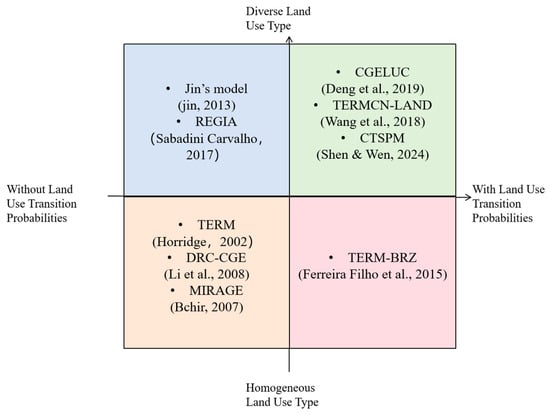
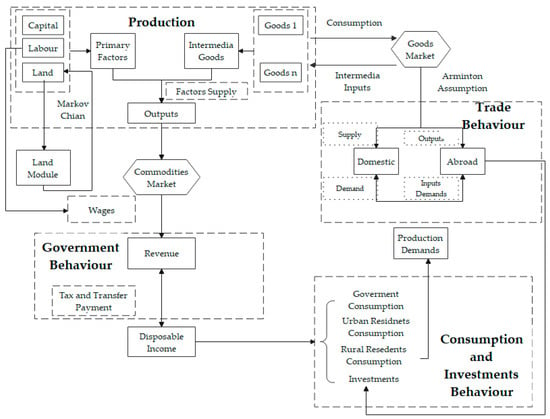
Existing land-related CGE models include FARM (The Future Agricultural Resource Model) [29], GTAPE-L [30], MIRAGE (Modelling International Relationships in Applied General Equilibrium) [31], Jin’s Model [32], REGIA [33], TERM [34], DRC-CGE [35], CGELUC [36], TERM-BRZ [37], TERMCN-Land [38], and CTSPM [39]. This study further refines land use CGE models, classifying them based on land factor diversity and whether they incorporate conversion probabilities between land types. This detailed classification aims to provide more precise theoretical guidance for land resource allocation and deepen understanding of CGE models’ role in policy formulation and practical application (see Figure 1).
Figure 1.
Classification of Land Use CGE Models Distinguishing Land Types and Conversion Probabilities [31,32,33,34,35,36,37,38,39].
A review of the existing literature reveals the following: (1) Research on the current land resource allocation model centered on land quota distribution still contains a ‘black box’. Determining how to reasonably assess land use demand represents the most effective approach to resolving this ‘black box’. However, most existing studies on the criteria and methods for land quota allocation adopt a single perspective, analyzing how to distribute land quotas under either economic development or ecological protection objectives. This approach is incompatible with China’s current multi-objective development strategy. (2) Research concerning land resource allocation, particularly on the optimal allocation of land use considering socio-economic transformation, should emphasize the market attributes of land as a factor. This constitutes a primary reason why this study employs a CGE model. (3) While the application of CGE models in land use simulation is gradually increasing, most studies lack sufficient consideration for the diversity of land use types and land conversion probabilities. Although the CGELUC model and the TERMCN-LAND model have contributed to enhancing model realism, both models still possess room for improvement regarding their technical scope and the treatment of land factors.
Therefore, this study establishes a multi-scale, multi-type China Territorial Spatial Planning Simulation Model (CTSPM-CHN), which ground in economic theory. This model supports evaluating land use policies and their socio-economic and eco-environmental impacts under diverse national development scenarios. It aims to provide policymakers with simulation tools before planning strategies, offer a scientific basis for negotiation and decision-making among stakeholders, and create a platform for “debating” inter-departmental land quota allocation “games,” thereby promoting the construction of a natural resource and territorial spatial governance system with Chinese characteristics.
3. Methodology and Data Sources
3.1. General Structure of the CGE Model
The China’s Territorial Spatial Planning Simulation Model (CTSPM-CHN) is a national single-region CGE, which distinguishes 11 industrial sectors1 (Crop Cultivation, Forestry, Animal Husbandry, Other Agriculture, Mining, Manufacturing, Production and Supply of Electricity/Gas/Water, Public Administration, Real Estate, Other Services, Transport), 2 types of household consumers (Urban, Rural), and identifies 5 major categories comprising 11 sub-categories of industrial land types corresponding to the sector classification.
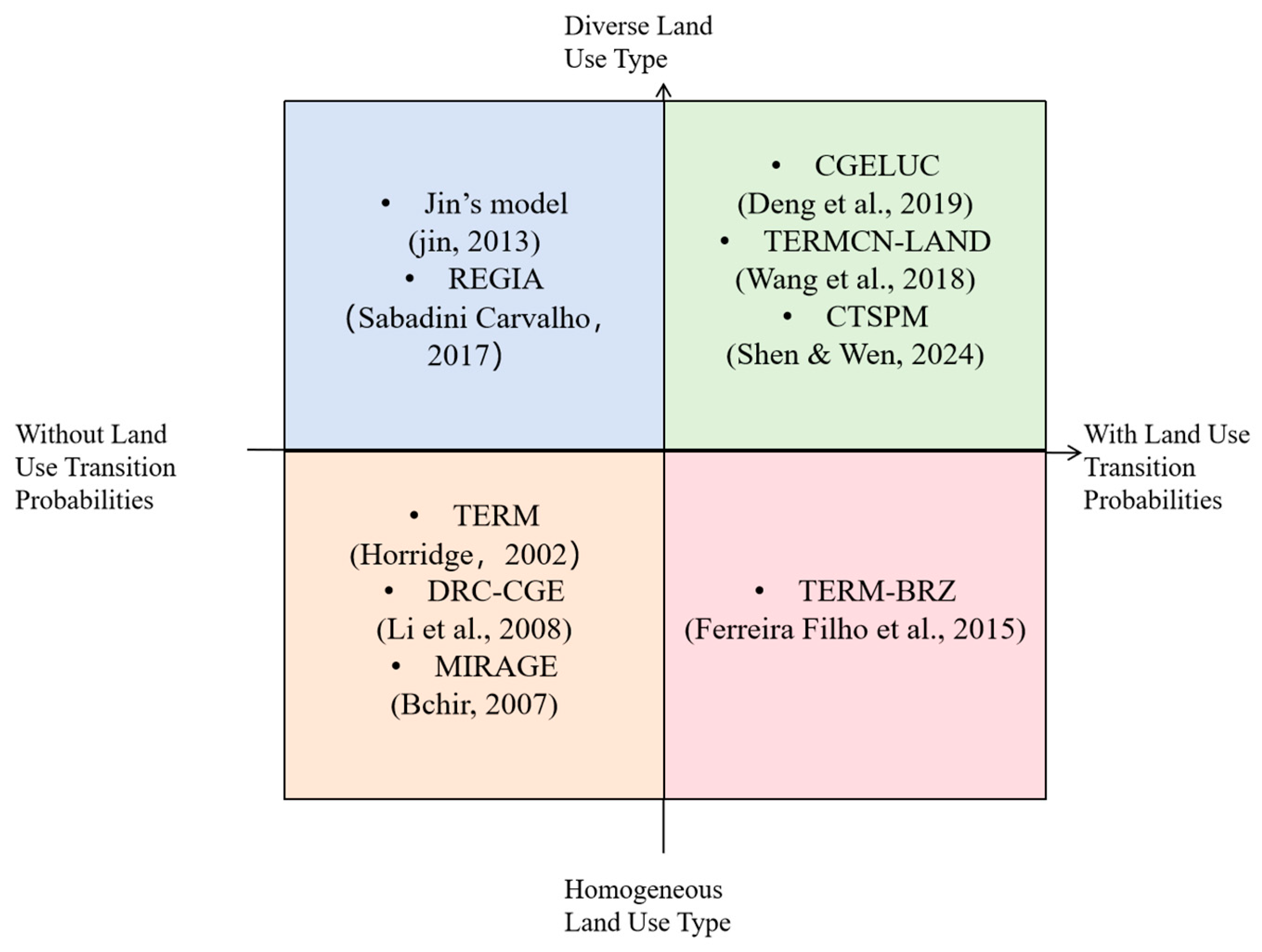
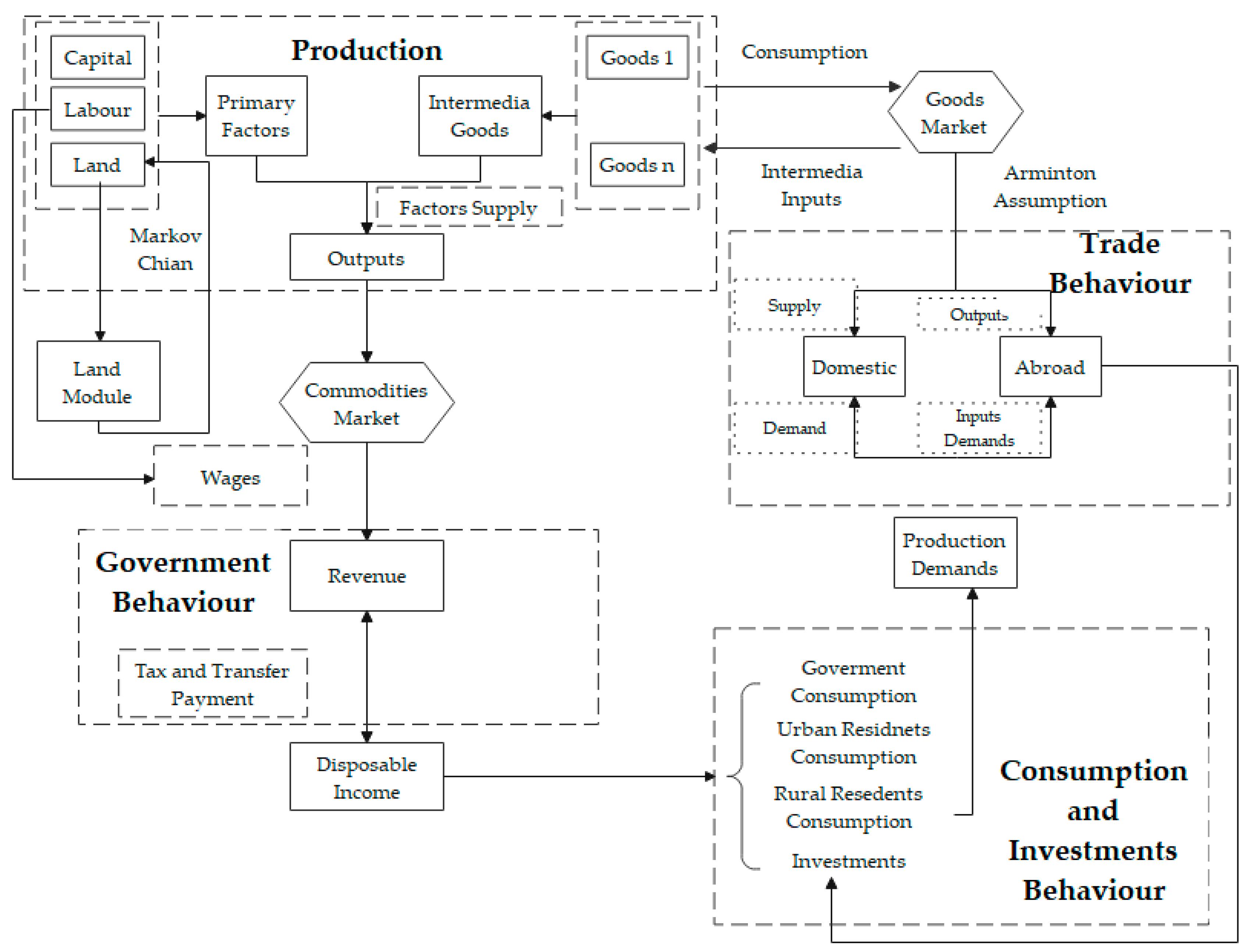
By establishing linkages between consumption, production, and other economic system modules, the model examines how changes in parameters within one or more modules affect others based on agent behaviors. CTSPM-CHN operates on the principle of optimizing agent behavior, enabling spontaneous adjustments. It employs linear expressions to depict relationships between supply and demand. The CGE structure comprises five modules: Production, Consumption and Investment Behaviour, Government Behaviour, Trade Behaviour, and Supply–Demand Equilibrium of each module (see Figure 2). Each module contains supply equations, demand equations, and relational equations. During equation solving, exogenous variables represent shocks to the economic system, while endogenous variables represent quantities and prices of goods and factors. Changes in exogenous variables impact parts of the system, propagating throughout, altering factors and good quantities/prices, and transitioning the entire economy from one equilibrium state to another.
Figure 2.
Basic Structure Diagram of the Computable General Equilibrium Model.
Specifically, economic activities will be conducted by four main sectors. In the production sector, firms, primarily within agriculture and manufacturing, utilize production functions to manufacture goods. Besides consuming primary factors like labor, capital, and land, they require goods produced by other firms as intermediate inputs to produce final goods, while firms do not set the prices of goods. Consumers (households) obtain income by selling primary factors of production (labor, capital, and land) to firms and then use this income to purchase goods, with demand for each product influenced by a utility function subject to a budget constraint, adhering to the Constant Elasticity of Substitution (CES) principle. The government acquires revenue by taxing firms and households and implements consumption activities by providing services for social activities and public goods, as well as making transfer payments to households and firms. Within the trade module, transportation modes are treated as marginal goods, emphasizing their role in inter-regional trade, and furthermore, a bottom-up trade flow module explains the trade relationships for goods between multiple regions.
Furthermore, recognizing the long-term dynamics of land use change and carbon emissions, the model incorporates a detailed recursive dynamic mechanism based on capital dynamics. Specifically, in this recursive dynamic CGE model, agents make decisions based on specific exogenous assumptions without influence from future price expectations. The capital endowment dynamic function is expressed as
where is the capital stock of product in period , is the depreciation rate of product in period , is the total fixed capital investment in product in period , and is the capital stock of product in period .
3.2. Land Sector Specification in the CGE Model
The mechanistic foundation of CTSPM-CHN is the SinoTERM model. In SinoTERM, the land module is analyzed by adding land as a primary input factor in the production function. However, SinoTERM only simulates land demand, assuming an unlimited land supply. Land is only considered an input factor for Agriculture, Forestry, Animal Husbandry, and Fishery sectors, excluding other industries. To study the impact of economic development policies on regional land resource allocation, CTSPM-CHN enhances the SinoTERM model [40] by adding a land conversion module. This improves the original assumption of unlimited land supply and incorporates prediction/simulation of construction land use. The land module of CTSPM-CHN is detailed in two parts.
3.2.1. Industry–Land Matching Standards
The model comprises 11 industries corresponding to 11 land types. While data for cultivated land, forest land, and grassland are available from the China Statistical Yearbook, construction land data lacks public release. Therefore, this study references the China Urban-Rural Construction Statistical Yearbook, the Second National Land Survey data, and the Third National Land Survey data to match and estimate other land areas. Specific estimation methods and data sources are shown in Table 1.
Table 1.
Land–Industry Matching Table and Data Sources Used in CTSPM-CHN.
3.2.2. Land Module
Compared to the original SinoTERM model, this study refines the setting of urban and rural construction land value:
- (a)
- Differentiated Agricultural Land Value: The original Sino TERM model uniformly set rents for cultivated land, forest land, and grassland as 1/3 of fixed capital investment, an overly strong assumption. Considering variations in land rent/return rates and the absence of sub-classifications for cultivated land in this study’s sectors [41], cultivated land value is set at 0.33 times the fixed capital investment of “Crop Cultivation,” forest land value at 0.4 times the gross output value of “Forestry,” and grassland value at 0.45 times the gross output value of “Animal Husbandry.”
- (b)
- Construction Land Value Setting: Following existing research and China’s context, construction land value is set equal to 0.24 times [42] the fixed capital investment of all industries excluding “Crop Cultivation,” “Animal Husbandry,” “Forestry,” and “Other Agriculture.”
Secondly, a land use transition matrix is introduced to calculate land conversion probabilities, enabling prediction of land changes in the next period. The land conversion module considers five land types: Cultivated Land, Forest Land, Grassland, Construction Land, and Unused Land. Construction land is treated as largely irreversible due to low/slow conversion probability. The initial land use transition matrix (Markov probabilities) was calibrated using 1 km grid data on land share changes for four land types from the Institute of Geographic Sciences and Natural Resources Research, CAS (2010 & 2020) [43]. This matrix drives land movement between uses in the model, determining annual supply of Cultivated Land, Forest Land, and Grassland. The Markov matrix endogenously evolves based on changes in the average unit rent of different land types in each region, following:
where denotes the proportion of type land in region r at the initial observation time converting to type land by the end of the period. is a slack variable ensuring . is a constant term for calibration, set to the initial value of . is the average rent price of type land in region r, and is a sensitivity parameter initially set to 1.25. is a shift variable initially set to 1.
3.3. Carbon Emission Sector Specification in the CGE Model
Following Lou’s approach [44], the CTSPM-CHN model primarily considers carbon emissions from fossil fuel combustion during production. Emissions for each of the 11 industrial sectors are calculated by multiplying the quantity of fossil fuel used as intermediate input by the corresponding carbon emission coefficient. Total system emissions are obtained by summation:
where is the physical consumption of energy , is the monetary value of energy , is the conversion parameter between value and physical units for energy ; is total energy consumption; is CO2 emissions from energy used by industry , is the monetary value of energy used by industry , is the CO2 emission coefficient for energy in industry ; and are the CO2 emissions of industry and total emissions, respectively.
4. Scenario Design
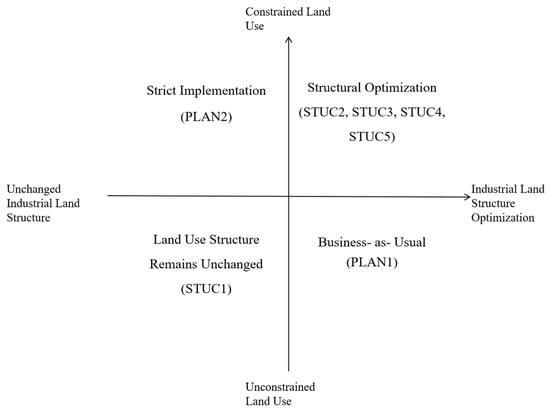
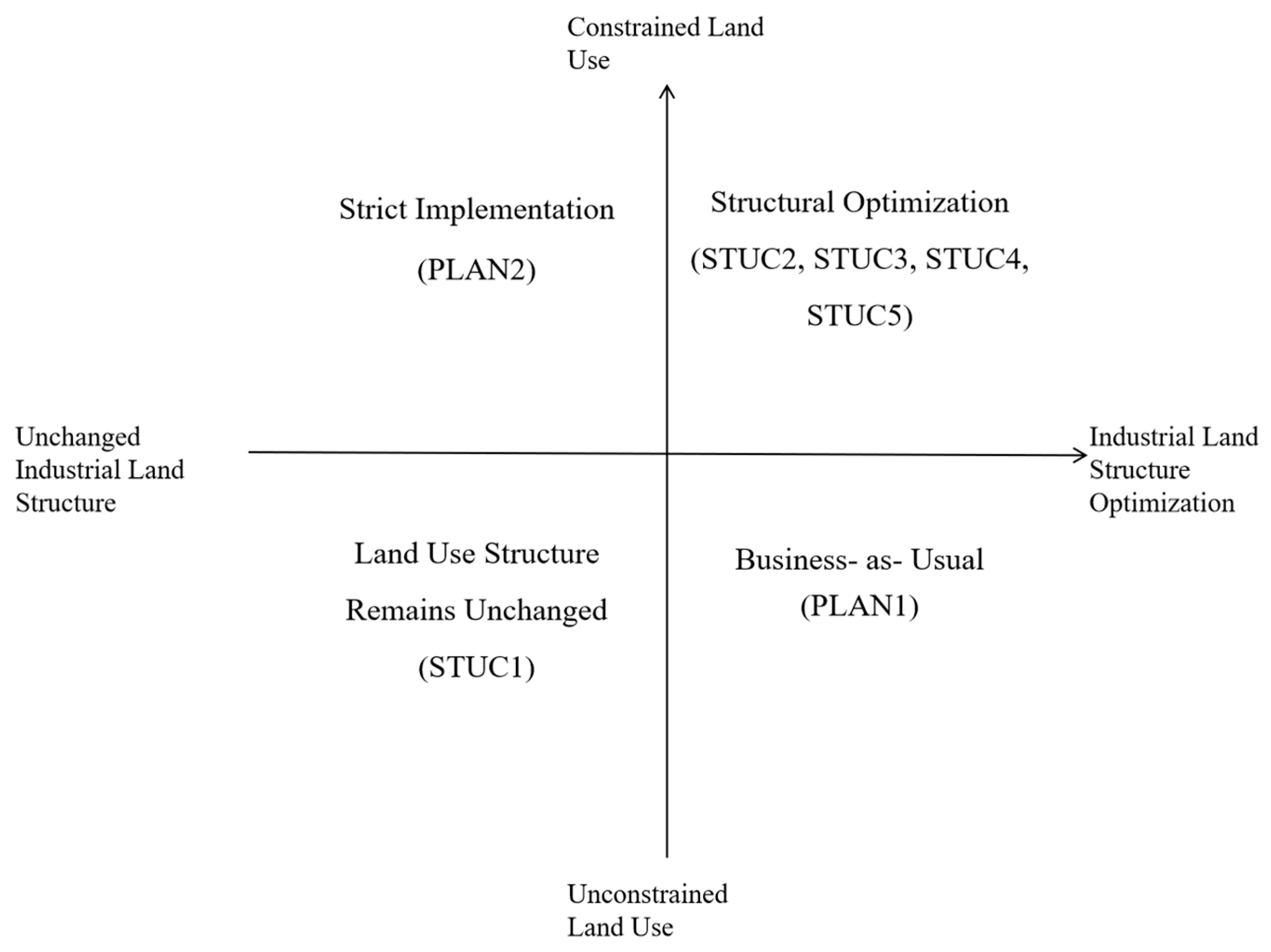
Figure 3 shows the spatial distribution of the fitness between land supply policy and economic development across Chinese cities in 2010 and 2017.
Figure 3.
Categorization of Scenario Design.
This study simulates two major categories comprising four sub-scenarios using CTSPM-CHN to model “Land Use Constraint” (PLAN) and “Structural Adjustment” (STUC) scenarios. These scenarios assign values to factors like arable land area, construction land area, industrial structure, and population growth to analyze China’s industrial development patterns, land use efficiency, and ecological conservation levels by 2035, proposing corresponding policy recommendations. The interrelationships are shown in Figure 3.
4.1. Land Use Constraint (PLAN) Scenarios Setting
In this scenario setting, we define two distinct scenarios: ‘Business-as-Usual Growth (PLAN1)’ and ‘Strict Implementation (PLAN2)’.
- Under the PLAN1 scenario: Drawing on the growth rates of cropland and construction land observed over the decade from 2007 to 2017, we set the area growth rates for these two land types. Based on an analysis of land use data from the China Statistical Yearbook, the overall growth rate for China’s cropland area from 2017 to 2035 is set at 0.4%, while the growth rate for construction land area is set at 2%.
- Under the PLAN2 scenario: We primarily reference the binding targets for ‘arable land retention’ and ‘land development intensity’ outlined in the National Land Planning Outline (2016–2030)2 (hereafter referred to as the Outline) to set the cropland area and construction land area. Specifically, according to the requirements of the Outline, the average annual growth rates for China’s overall arable land retention target and land development intensity from 2015 to 2020 were set at 0% and 1%, respectively. The growth rates for China’s overall arable land retention target and land development intensity from 2020 to 2035 were set at −0.2% and 0.9%, respectively3. Consequently, for the period 2017 to 2020, this paper sets the average annual growth rates for the arable land retention target and construction land growth at 0% and 1%, respectively. Assuming the constraints from 2020 to 2030 remain in effect until 2035, the growth rates for the arable land retention target and construction land growth from 2021 to 2035 are set at −0.2% and 0.9%, respectively. Additionally, within this scenario, this paper also sets corresponding values for other socioeconomic indicators.
4.2. Structural Adjustment (STUC) Scenarios Setting
Similarly to the ‘Land Constraint’ scenario, in the ‘Structural Adjustment’ scenario, we define two distinct scenarios, ‘Land Use Structure Remains Unchanged (STUC1)’ and ‘Structural Optimization (STUC2)’, with further discussions on the settings for the ‘Structural Optimization’ scenario.
- Under the STUC1 scenario: Referencing the average annual growth rates of land for secondary industry and land for tertiary industry observed over the decade from 2007 to 2017, and based on PLAN2, we set the area growth for these two land use categories within the model—land for secondary industry (including Manufacturing Land) and land for tertiary industry (Public Facility Land, Residential Land, and Other Services Land). Specifically, the average annual growth rate for Manufacturing Land is set at 3.2%, and the average annual growth rate for land for tertiary industry is set at 3.8%.
- Under the STUC2 scenario: This paper adopts the approach of Wang et al. (2019) [45] to first measure land use efficiency for land for secondary industry and land for tertiary industry (construction land) across China at the overall average level during the period 2007 to 2017 by calculating land output per unit area. Furthermore, by comparing the changes in the growth rates of land use efficiency for these two land types, the year with the fastest change in growth rate is identified. Subsequently, the growth rates for these two land types during this specific period are calculated and assigned. As can be seen from the figure, from 2009 to 2012, the land use efficiency for both secondary industry and tertiary industry increased relatively rapidly. Therefore, in this paper, within the STUC2 scenario, in addition to setting the growth of cropland area and construction land area according to the binding constraints of the Outline, the growth rates for land for secondary industry and land for tertiary industry are set at −0.3% and 2.5%, respectively.
To better analyze the impact of land structure optimization strategies, this study further simulates future national average land structure growth using regional land structure data under “Further Optimization Discussion”. Specific parameter settings are detailed in Table 2. It should be noted that all scenarios are implemented within a national single-region CGE framework. Scenarios STUC3–STUC5 represent national strategic alternatives inspired by the differentiated industrial transition trajectories of China’s Eastern, Central, and Western regions, rather than regional-specific simulations.
Table 2.
Parameter Settings for Land Constraint (PLAN) and Structural Adjustment (STUC) Scenarios.
5. Scenario Simulation Results
This section focuses on analyzing the outcomes of the PLAN1, PLAN2, STUC1, and STUC2 scenarios to evaluate the comprehensive impacts of plan implementation on China’s economy, society, and ecological environment, while examining whether land use structural adjustments facilitate positive economic development and decelerated growth in carbon emissions. Building upon this foundation, through simulating configuration changes in industrial land use structures, it further investigates the effects of different land structure allocations on China’s macroeconomy and ecological environment, thereby providing empirical support for land use planning and environmental protection policies.
5.1. Impact of Planning Implementation and Industrial Land Restructuring on Development of China’s Economy, Society, and Ecology
Table 3 reports changes in China’s overall GDP and carbon emissions in 2030 and 2035 under PLAN and STUC scenarios.
Table 3.
Changes in China’s Overall GDP and Carbon Emissions under Land Constraint and Industrial Land Restructuring Scenarios.
Simulation results demonstrate that in the short term, the effects of plan implementation and land use structural adjustments appear to have limited impact on China’s overall economic development; however, from a long-term perspective, strict plan enforcement may cause some delay in China’s economic growth rate, while optimized land structure allocation holds potential to become a new driver for economic development. Specifically, under the PLAN2 scenario, simulations indicate that China’s total GDP is projected to reach 1,779,931.395 billion yuan by 2035, representing a relatively modest increase among the four scenarios. In contrast, under the STUC2 scenario—which incorporates optimized industrial land structure allocation based on PLAN2—the total real GDP is projected to reach 1,864,513.38 billion yuan in 2035, representing an approximately 4.8% increase compared to the GDP under PLAN2 and the most significant growth across all scenarios. This outcome demonstrates the substantial promoting effect of optimized land structure adjustments on economic growth. Further analysis comparing PLAN1 and STUC1 scenarios reveals that under baseline simulation conditions, China’s total real GDP is expected to increase to 1,844,513 billion yuan by 2035; however, when presuming disordered development of land structure, the total real GDP in 2035 would decline by 1.8% relative to the baseline projection. This finding underscores the potential negative economic impacts of imbalanced land resource allocation, thus confirming the importance of optimizing land utilization and structural adjustments for achieving sustained and healthy economic growth.
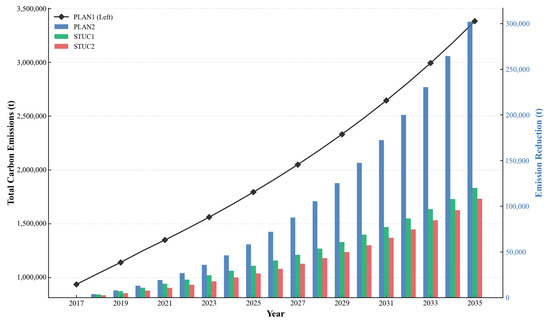
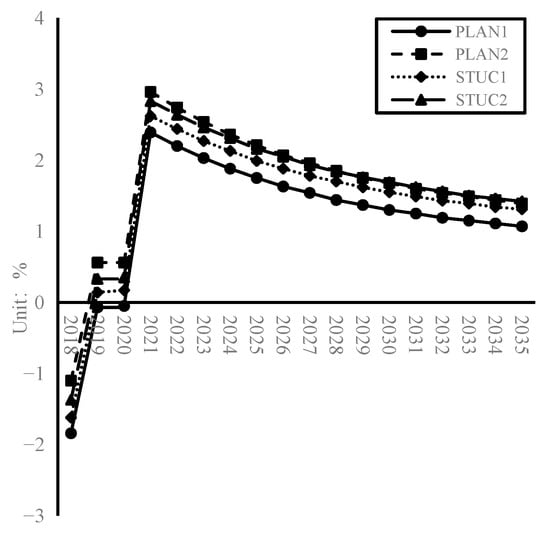
Analysis of data from Table 3 and Figure 4, total carbon emissions follow an upward trend across all projected scenarios through 2035; however, the growth momentum varies significantly under different policy interventions. Compared to the baseline (PLAN1), strict spatial planning (PLAN2) and optimized industrial structure adjustments (STUC1 and STUC2) effectively decelerate the rate of emission expansion. Under the STUC2 scenario—configured with nationwide average industrial land structure optimization—while partially curbing rapid growth in total carbon emissions, its mitigating effect proves less pronounced than that of strict plan implementation. This finding not only highlights the necessity to holistically consider long-term impacts on economic growth, resident welfare, and environmental consequences during policy formulation and implementation, but also underscores the critical need for meticulous design and optimization of land use planning to coordinate economic, social, and environmental sustainability throughout industrial restructuring and ecological civilization construction. Subsequently, this study will further investigate the impacts of varying industrial land allocation structures on China’s future economic development and ecological conservation.
Figure 4.
Total Carbon Emissions of PLAN1 and Carbon Emission Reduction in Different Scenarios with PLAN1 in China (2017–2035).
Furthermore, this paper compares labor wage growth and real GDP growth across scenarios, which is a key metric for societal harmony emphasized in the 14th Five-Year Plan and 2035 Long-Range Objectives Outline. Figure 5 indicates that both real resident wage growth rates and GDP growth rates will exhibit an initial increase followed by gradual decline. Although short-term impacts of plan implementation and land structure optimization on resident welfare appear limited, long-term simulations demonstrate that rigorous plan execution and optimized industrial land allocation significantly enhance resident income levels.
Figure 5.
Difference between Real GDP Growth Rate and Real Wage Growth Rate under Land Constraint (PLAN1, PLAN2) and Structural Adjustment (STUC1, STUC2) Scenarios.
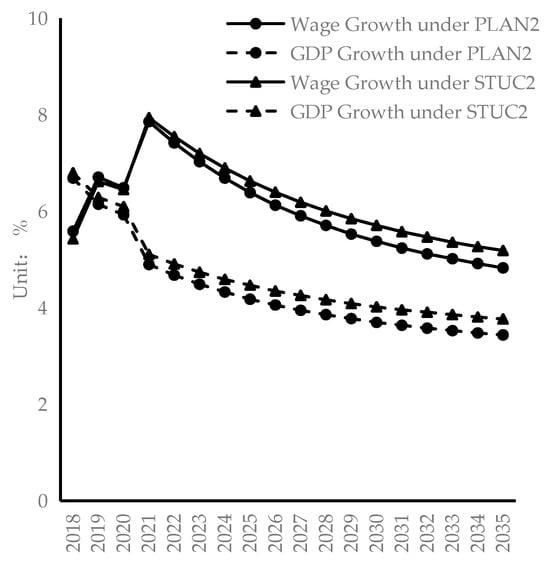
Additionally, this research examines the synergy between aggregate GDP growth and resident wage growth under strict plan implementation versus industrial land optimization scenarios. Analysis of Figure 6 data shows that pre-2030, strict plan implementation delivers the most substantial welfare improvements; post-2030, however, its advantage gradually narrows relative to industrial land optimization scenarios and is ultimately surpassed. This outcome not only accentuates the importance of plan enforcement and land use optimization for public welfare enhancement but particularly emphasizes the pivotal role of refined land management in synchronizing economic growth with resident welfare over the long term.
Figure 6.
Trends in Real GDP Growth Rate and Real Wage Growth Rate under Strict Land Constraint (PLAN2) and Optimized Structure Allocation (STUC2) Scenarios.
Analysis of Figure 6 reveals that wage growth under structural optimization (STUC2) is relatively stable. Under strict planning (PLAN2), wage growth persists but decelerates noticeably, explaining why STUC2 ultimately surpasses PLAN2 in welfare improvement.
5.2. Further Discussion on Optimized Industrial Land Structure Adjustment
The preceding analysis reveals that this study demonstrates the critical role of industrial land structure allocation in advancing China’s socioeconomic development and improving its ecological environment. Effective and rational land structure configuration not only accelerates positive trends in China’s socioeconomic development but also exerts a beneficial influence on decelerating carbon emission growth. Consequently, this study further investigates land structure allocation approaches to assess the specific impacts of distinct optimized configurations on China’s overall socioeconomic progress and ecological changes.
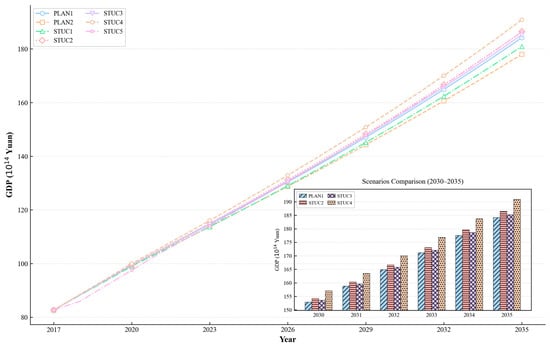
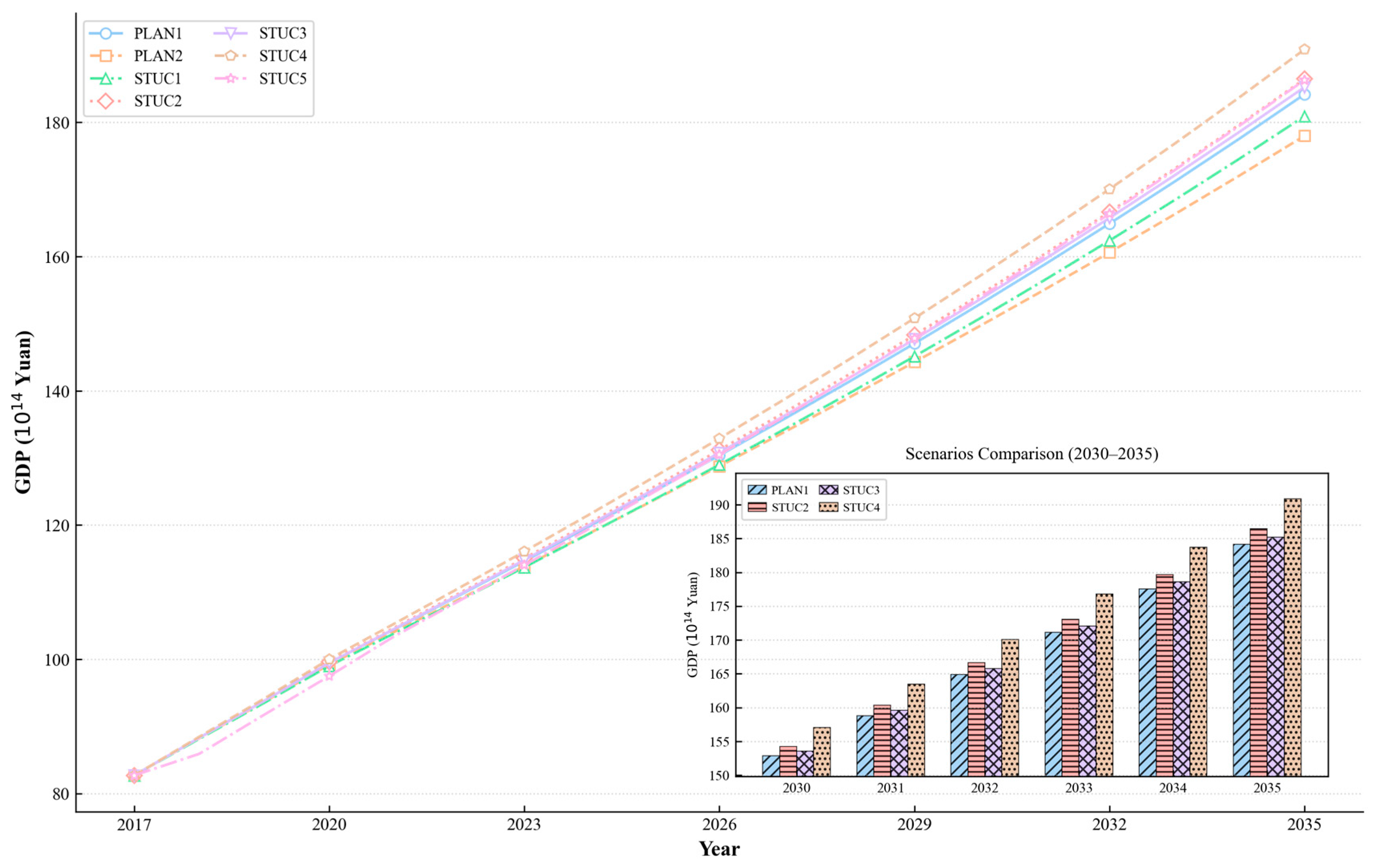
Figure 7 displays the trajectory of China’s real GDP growth under simulated industrial land structure adjustment scenarios from 2017 to 2035. For comparative analysis, trend lines of GDP growth under other scenarios are also plotted. Through integrated analysis with scenario settings in Table 1, this study finds that the scenario adopting the Central Region’s average industrial land structure configuration (STUC4) yields significantly higher aggregate GDP growth than other optimization strategies. Specifically, under STUC4, China’s real GDP is projected to reach 1,908,633.147 billion yuan by 2035. By contrast, the scenario employing the Eastern Region’s average configuration (STUC3) exhibits relatively slower GDP growth, with real GDP projected at 1,852,927 billion yuan in 2035. Furthermore, comparative analysis of GDP growth rates across scenarios reveals that under STUC3, China’s GDP growth rate declines substantially, registering an average reduction rate of 2.5%. Additionally, when implementing the Western Region’s average allocation, the resulting GDP growth trajectory largely aligns with that of the nationwide average industrial land structure scenario.
Figure 7.
GDP Change Trends in China (2017–2035) under Land Constraint Scenarios (PLAN1, PLAN2) and Structural Adjustment Scenarios (STUC1–STUC5).
Through further analysis of scenario configurations (as presented in Table 2), under conditions of comparable tertiary industry land allocation, this study finds that from a long-term perspective, moderately reducing manufacturing land does not exert excessive negative impacts on China’s overall economic development. However, excessive reduction in manufacturing land allocation would constrain sustainable economic growth. This analysis underscores the critical importance of optimized industrial land structure configuration for driving China’s economic expansion. Selecting appropriate regional benchmarks for industrial land allocation—particularly rational distribution between secondary and tertiary industry land—not only facilitates robust GDP growth but also ensures developmental sustainability. These findings emphasize the necessity of balanced industrial structure allocation in regional development strategies to promote long-term economic health.
Table 4 presents the annual carbon emission growth rates from 2017 to 2035. Analysis of Table 4 data reveals that under STUC4, China experiences the most rapid carbon emission growth, with an average annual growth rate of 7.54% during 2017–2035. By contrast, STUC3 exhibits the second-slowest emission growth after strict plan implementation among all examined industrial optimization scenarios, registering an average annual growth rate of 7.16%. Furthermore, integrating results from Table 4, this study observes that simultaneously increasing allocations for both manufacturing and tertiary industry land across structural adjustment scenarios, while significantly accelerating economic growth, imposes substantial pressure on China’s ecological environment. Notably, moderately increasing tertiary industry land allocation while reducing manufacturing land causes no adverse economic effects and concurrently alleviates ecological pressure. Nevertheless, excessive manufacturing sector reduction may not immediately suppress economic growth short-term but would substantially decelerate China’s long-term economic expansion, threatening national sustainable development. This outcome highlights how industrial structure optimization balances economic growth with ecological conservation. Strategic decisions regarding industrial land allocation must therefore consider not only immediate economic stimulation but also meticulously evaluate long-term ecological implications. Consequently, establishing an equilibrium between economic advancement and environmental pressure mitigation proves paramount for achieving China’s future sustainable development.
Table 4.
Changes in China’s Total Carbon Emissions (2018–2035) under Land Constraint and Structural Adjustment Scenarios.
6. Discussion
6.1. Policy Transmission and Socio-Ecological Trade-Offs
The simulation results of this study reveal complex correlations between spatial governance and environmental outcomes, emphasizing that structural optimization is not a singular pathway to immediate emission reduction, a finding consistent with Mi et al. [46]. Specifically, in the STUC4 scenario, the average annual growth rate of carbon emissions is 7.55%, slightly exceeding the 7.49% observed in the business-as-usual (PLAN1) scenario. This deviation stems from the specific parameterization of STUC4, characterized by the rapid expansion of tertiary industrial land (4.9%) coexisting with a stabilized allocation for secondary industrial land (0.2%). These results indicate that if the optimization of territorial spatial structure is not synchronized with accelerated green technological innovation, the mere expansion of the industrial and service sectors may inadvertently elevate total emission pressures during the transition phase [47,48]. Particularly during rapid urbanization, the sustained dependence of the service sector and urban spaces on energy infrastructure implies that, without breakthroughs in energy efficiency, such structural adjustments may create new emission growth points [49,50].
Under the strict enforcement scenario (PLAN2), the decline in carbon sink capacity—a 8.07% reduction by 2035 compared to the baseline—unveils a core spatial trade-off. As territorial spatial planning enforces a rigid ‘cropland red line’ ceiling, development activities are effectively concentrated within constrained boundaries. This ‘squeeze effect’ may drive development land to encroach upon secondary ecological buffer zones or intensify land use at urban peripheries, thereby weakening net carbon sink capacity. These findings are highly consistent with global research in ecological economics, suggesting that land-use policies must transition from simple scale control toward an integrated governance framework that harmonizes economic, social, and ecological objectives [51]. Achieving synergies between economic growth and environmental mitigation requires profound coordination between land allocation efficiency and the decarbonization of the energy structure [52], thereby avoiding ‘policy silos’ in territorial spatial planning [53].
6.2. Common Challenges in Land Use Policy and Model Generalizability
Situating China’s Territorial Spatial Planning (CTSP) system within a global comparative governance perspective reveals that its core logic resonates deeply with international mainstream spatial governance tools. First, the strategic coordination framework of ‘hierarchical management and level-by-level transmission’ established by CTSP significantly echoes the ‘counter-current principle’ in the German spatial planning system, both strive for an institutional balance between national strategy and local developmental autonomy [54]. Second, regarding spatial boundary constraints, China’s ‘Urban Development Boundary’ aligns closely with the regulatory intentions of the UK’s Green Belt policy [55] and Portland’s Urban Growth Boundaries (UGBs) in suppressing urban sprawl [56].
Despite the emergence of diverse spatial planning paradigms worldwide, both mature developed economies and rapidly transitioning low-to-middle-income countries face a common, systematic scientific challenge: the absence of an analytical framework that can dynamically, quantitatively, and systematically assess the non-linear feedback effects of policy implementation on the economy–society–ecology complex system. Traditional spatial planning methodologies often lean toward static geometric blueprints or qualitative policy descriptions. This physical space thinking makes it difficult to accurately capture the internal negative feedback mechanisms between spatial access restrictions and industrial structural evolution within complex macroeconomic cycles. As Dietz & Neumayer (2007) [57] noted, spatial policies that remain at the level of static constraints without a systematic quantitative feedback loop are highly prone to policy failure or negative spillover effects. For instance, Portland’s 2024 Urban Growth Report reflects that, under rigid physical boundary constraints, the policy focus has shifted from spatial restriction to improving internal development efficiency [58]. Against this backdrop, the CTSPM-CHN model establishes a systematic quantitative framework by innovatively coupling land transition, carbon emission, and dynamic simulation modules within a CGE framework. This not only supports the transformation of China’s spatial governance but also enriches the global toolkit for sustainable development assessment. The model features a modular design that facilitates cross-regional migration by updating localized core datasets (e.g., Input–Output tables, substitution elasticity parameters, land transition matrices, and IPCC-standard carbon emission factors) while maintaining the integrity of the underlying algorithmic logic. Furthermore, capital stocks measured via the Perpetual Inventory Method (PIM) allow for the precise reconfiguration of the dynamic module. This data-and-algorithm-driven architecture enables the model to transcend a single-region empirical scope, providing a highly transferable governance template for global regions facing the dual pressures of resource scarcity and rigid emission constraints. By extracting and parameterizing policy-specific indicators from different countries, the model is capable of conducting scientific impact simulations for heterogeneous spatial planning policies worldwide.
6.3. Future Research Directions
Although the CTSPM-CHN model developed in this study establishes a systematic quantitative framework for evaluating territorial spatial planning policies by coupling a land-use transition module with a Computable General Equilibrium (CGE) system—a framework that possesses a degree of global universality—it must be acknowledged that limitations remain in characterizing the inherent complexity of socio-ecological systems. Traditional CGE frameworks typically operate under quasi-linear assumptions; however, in reality, marginal costs of land conversion may exhibit non-linear surges when ecological or administrative constraints reach their thresholds. Furthermore, due to the current lack of high-resolution spatial data for specific industrial land types, 149 economic sectors were aggregated into 11 broad categories to align with available land-use statistics. Such high-level aggregation may smooth over structural disparities between energy-intensive heavy industries and low-carbon high-end manufacturing, thereby masking the significantly divergent carbon emission intensities across sub-sectors to some extent.
To further enhance the forward-looking and scientific rigor of this framework, future research will be directed along four key directions:
- (1)
- In terms of model optimization, we aim to deeply integrate Agent-Based Model (ABM) into the CGE framework to capture non-linear feedbacks and path dependency. By simulating the heterogeneous decision-making of upstream, midstream, and downstream firms under output fluctuations and embedding these micro-behaviors into the CTSPM-CHN model through an aggregation mechanism, we seek to achieve real-time interaction between micro-level behaviors and macroeconomic equilibrium, thereby offering granular insights into inter-sectoral information flows and non-linear mechanisms.
- (2)
- Regarding the spatial dimension, the research plan involves extending the CTSPM-CHN model from the national to the provincial scale—covering 31 provinces—to facilitate more targeted analysis of policy heterogeneity.
- (3)
- For the ecological module, we will strengthen the energy-carbon component by dis-aggregating clean energy from the broader power sector and incorporating the dynamic evolution of clean energy transitions to improve the model’s empirical fidelity.
- (4)
- In terms of data acquisition, future studies will leverage satellite remote sensing and machine learning to identify more granular land-use types, enabling refined land value assessments and providing a more robust scientific foundation for territorial spatial planning and sustainable development strategies.
7. Conclusions and Recommendations
This study achieves a technical breakthrough in territorial spatial planning policy simulation by constructing the CTSPM-CHN model system coupling land use and carbon emission modules, innovatively incorporating land use conversion mechanisms and dynamic land valuation equations. Utilizing this system, we systematically simulate the impact mechanisms of territorial spatial planning implementation and industrial land structure optimization strategies on China’s sustainable development pathway from an economy–society–environment nexus perspective, yielding the following core findings:
First, results demonstrate that strict territorial spatial planning implementation significantly curbs carbon emission growth. Simulations indicate a 9-percentage-point reduction in total carbon emissions by 2035 under strict planning implementation compared to the baseline scenario. Notably, rigid constraints on construction land scale and disordered land structure may impede sustained economic growth.
Second, analysis of ‘Planning Implementation’ and ‘Structural Adjustment’ scenarios reveals that structural optimization strategies dynamically adjusting land allocation ratios for manufacturing, real estate, and public facilities—compared to solely regulatory control measures—not only enhance economic development quality but also generate substantial social welfare improvements, providing dual drivers for sustainability.
Third, further examination of diverse ‘Structural Optimization’ scenarios uncovers time-lag effects in industrial land supply strategies. While short-term reduction in manufacturing land supply minimally impacts economic growth, persistent implementation causes growth momentum attenuation, highlighting the imperative for long-term equilibrium in spatial resource allocation.
Accordingly, this study proposes the following policy recommendations:
To achieve more effective territorial spatial governance, an integrated policy framework should be established by organically combining total quantity control, structural optimization, and dynamic adaptation. Within this system, construction land quotas serve as non-negotiable baselines, aiming to establish an anticipatory constraint mechanism for the meticulous allocation of industrial land. By embedding industry-specific and regional land-use efficiency thresholds into core regulatory systems, supported by flexible dynamic adjustment procedures, authorities can manage the pace of development with greater precision. Furthermore, leveraging a multi-agency monitoring platform allows for the creation of a synergistic link between land structure assessments, quota allocations, and conveyance fee adjustments. This approach effectively utilizes market-based instruments to guide land resources away from inefficient sectors and toward high-efficiency, low-consumption industrial clusters.
Simultaneously, the collaborative logic between green energy transition and land use must be deepened. In the formulation of territorial spatial plans, exploring new models of composite land use—by adding dedicated collaborative planning chapters—can enable the same spatial unit to support the dual functions of energy production and industrial manufacturing. Incorporating energy transition targets directly into industrial land access standards, complemented by appropriate policy incentives, can effectively drive the green transformation of enterprises. At the level of institutional innovation, establishing an industrial land carbon performance assessment system alongside a linked land carbon quota trading mechanism can help resolve governance challenges through market mechanisms. Supported by risk mitigation from a national green transition fund, these measures will significantly accelerate the deployment of renewable energy, ultimately achieving deep synergy between economic growth and environmental quality.
Author Contributions
Conceptualization, L.W.; Data curation, L.W., Y.S. and T.Z.; Formal analysis, L.W. and T.Z.; Funding acquisition, T.S.; Methodology, L.W.; Project administration, T.S.; Resources, L.W. and T.Z.; Software, L.W.; Supervision, T.S.; Validation, L.W.; Visualization, Y.S. and T.Z.; Writing—original draft, L.W. and Y.S.; Writing—review & editing, T.Z. All authors have read and agreed to the published version of the manuscript.
Funding
This research was funded by the Major Project of Beijing Social Science Fund, grant number 24JCA003.
Data Availability Statement
The original contributions presented in this study are included in the article. Further inquiries can be directed to the corresponding author.
Conflicts of Interest
The authors declare no conflicts of interest.
Appendix A
Table A1.
Sector correspondence between current input–output table and the original 149 sectors input–output table.
Notes
| 1 | It should be noted that the original data used in this paper is the 2017 input–output table for 149 sectors in China. Due to the difficulty in obtaining land use data, the original industrial sectors have been merged into 11 industrial sectors based on the available data and research needs. The complete industrial classification correspondence table is provided in the Appendix A. |
| 2 | It should be noted that while the title of this paper is “Simulating the Implementation Effects of National Land Spatial Planning Policies based on CTSPM-CHN”, the nationwide spatial planning outline has not yet been officially released. Therefore, this study uses the latest publicly available version, the National Land Planning Outline (2016–2030), as the subject to evaluate planning implementation outcomes. |
| 3 | This assumes that by 2035, the growth trends for China’s overall cropland area and construction land area strictly follow the binding constraints specified in the Outline for the period 2020 to 2030. |
References
- Xi, J. Secure a decisive victory in building a moderately prosperous society in all respects and strive for the great success of socialism with Chinese characteristics for a new era. People’s Daily, 28 October 2017; p. 001.
- Li, M.; Cao, Y.; Wang, C. Interest game analysis between central and local governments in land vertical management reform. China Land Sci. 2010, 24, 9–13. [Google Scholar]
- Lu, M.; Xiang, K. Resolving the conflict between efficiency and balance: On China’s regional development strategy. Comp. Econ. Soc. Syst. 2014, 04, 1–16. [Google Scholar]
- Lu, M.; Zhang, H.; Liang, W. How land supply bias toward central and western regions pushes up wages in eastern China. Soc. Sci. China 2015, 05, 59-83+204-205. [Google Scholar]
- Dökmeci, V. An optimization model for a hierarchical spatial system. J. Reg. Sci. 1973, 73, 439–451. [Google Scholar] [CrossRef] [Scilit]
- Barber, G. Land-Use Plan Design via Interactive Multiple-Objective Programming. Environ. Plan. A: Econ. Space 1976, 8, 625–636. [Google Scholar] [CrossRef] [Scilit]
- Storbeck, J. The Spatial Structuring of Central Places. Geogr. Anal. 2010, 20, 93–110. [Google Scholar] [CrossRef] [Scilit]
- Aghakhani, S.; Rajabi, M. A New Hybrid Multi-Objective Scheduling Model for Hierarchical Hub and Flexible Flow Shop Problems. Appl. Math 2022, 2, 721–737. [Google Scholar] [CrossRef] [Scilit]
- Veldkamp, A.; Fresco, L. CLUE-CR: An integrated multi-scale model to simulate land use change scenarios in Costa Rica. Ecol. Model. 1996, 91, 231–248. [Google Scholar] [CrossRef] [Scilit]
- De Koning, G.H.; Verburg, P.H.; Veldkamp, A.; Fresco, L.O. Multi-scale modelling of land use change dynamics in Ecuador. Agric. Syst. 1999, 61, 77–93. [Google Scholar] [CrossRef] [Scilit]
- Zhang, Y.; Zhao, S.; Verburg, P.H. CLUE-S and its application for simulating temporal and spatial change of land use in Naiman Banner. J. Nat. Resour. 2003, 18, 310–318. [Google Scholar]
- Veldkamp, A.; Verburg, P. Modelling land use change and environmental impact. J. Environ. Manag. 2004, 72, 1–3. [Google Scholar] [CrossRef] [Scilit] [PubMed]
- Wu, G.; Zeng, Y.; Feng, X.; Xiao, P.; Wang, K. Dynamic simulation of land use change based on the improved CLUE-S model: A case study of Yongding County, Zhangjiajie. Geogr. Res. 2010, 29, 460–470. [Google Scholar]
- Alcamo, J.; Battjes, C.; Van den Born, G.J.; Bouwman, A.F.; De Haan, B.J.; Klein Goldewijk, K.; Klepper, O.; Kreileman, G.J.J.; Krol, M.; Leemans, R.; et al. Overview of IMAGE 2.0: An integrated model of climate change and the global environment. Stud. Environ. Sci. 1995, 65, 1395–1399. [Google Scholar]
- Doelman, J.C.; Stehfest, E.; Tabeau, A.; van Meijl, H.; Lassaletta, L.; Gernaat, D.E.; Hermans, K.; Harmsen, M.; Daioglou, V.; Biemans, H.; et al. Exploring SSP land-use dynamics using the IMAGE model: Regional and gridded scenarios of land-use change and land-based climate change mitigation. Glob. Environ. Change 2018, 48, 119–135. [Google Scholar] [CrossRef] [Scilit]
- Yuan, M.; Liu, Y. Land use optimization allocation based on multi-agent genetic algorithm. Trans. Chin. Soc. Agric. Eng. 2014, 30, 191–199. [Google Scholar]
- Wang, Y.; Song, G.; Lv, B. Optimization of land-use pattern based on multi-agent particle swarm optimization in the Song-Nen Plain region. Resour. Sci. 2019, 41, 729–739. [Google Scholar]
- Xu, E.; Li, Q. Spatial optimization of ecological cropland conversion and trade-off analysis under water resources Spatial optimization of ecological cropland conversion and trade-off analysis under water resources. Geogr. Res. 2021, 40, 627–642. [Google Scholar]
- Shen, T.; Cui, N.; Wang, Y. Location Market Design Studies: Redesigning China’s Industrial Land Markets; Science Press: Beijing, China, 2022. [Google Scholar]
- Arrow, K. Le rôle des valeus boursières pour la répartition la meilleure des risques. In Econométrie; Centre National de la Recherche Scientifique: Paris, France, 1953; pp. 41–48. [Google Scholar]
- Arrow, K.; Debreu, G. Existence of an equilibrium for a competitive economy. Econometrica 1954, 22, 265–290. [Google Scholar] [CrossRef] [Scilit]
- Debreu, G. Theory of Value: An Axiomatic Analysis of Economic Equilibrium; Wiley: New York, NY, USA, 1959. [Google Scholar]
- Johansen, L. A Multi-Sectoral Study of Economic Growth; North-Holland: Amsterdam, Netherlands, 1964; Volume 196. [Google Scholar]
- Horridge, J.; Pearce, D. Modelling the Effects on Australia of Interventions in World Agricultural Trade. In 1988 Centre of Policy Studies/IMPACT Centre Working Papers op-65; Victoria University: Melbourne, VIC, Australia, 1988. [Google Scholar]
- Siriwardana, M.; Yang, J. GTAP model analysis of the economic effects of an Australia–China FTA: Welfare and sectoral aspects. Glob. Econ. Rev. 2008, 37, 341–362. [Google Scholar] [CrossRef] [Scilit]
- Li, Z.; Wu, L. Impact of the Doha Round on China’s agriculture: A preliminary assessment based on the Global Trade Analysis Model (GTAP). World Econ. 2007, 02, 32–39. [Google Scholar]
- Li, N.; Shi, M.; Wang, F. The role of regional differences and regional linkages on the effectiveness of regional policies in China: Based on the CGE model of eight regions in China. Syst. Eng. Theory Pract. 2009, 29, 35–44. [Google Scholar] [CrossRef] [Scilit]
- Bohlmann, H.; Horridge, J.; Inglesi-Lotz, R.; Roos, E.; Stander, L. Regional employment and economic growth effects of South Africa’s transition to low-carbon energy supply mix. Energy Policy 2019, 128, 830–837. [Google Scholar] [CrossRef] [Scilit]
- Darwin, R.; Tsigas, M.; Lewandrowski, J.; Raneses, A. Land use and cover in ecological economics. Ecol. Econ. 1996, 17, 157–181. [Google Scholar] [CrossRef]
- Burniaux, J.; Lee, H. Modelling Land Use Changes in GTAP; Conference papers 331145; Purdue University, Center for Global Trade Analysis, Global Trade Analysis Project: West Lafayette, Indiana, 2003. [Google Scholar]
- Bchir, M.H.; Decreux, Y.; Guérin, J.L.; Jean, S. MIRAGE, a Computable General Equilibrium Model for Trade Policy Analysis; Technical Report 2007-15; Centre d’Etudes Prospectives et d’Informations Internationales: Paris, France, 2007. [Google Scholar]
- Jin, Q. Multi-regional Dynamic CGE Modeling and Application: Equilibrium Analysis of the Relationship between Industrial Structure and Land Use. Master’s Thesis, China University of Geosciences (Wuhan), Wuhan, China, June 2013. [Google Scholar]
- Sabadini Carvalho, T.; Domingues, E. Economic Impacts and Land Use Change from a Policy To Control Deforestation in the Brazilian Amazon. In Proceedings of the 18th Annual Conference on Global Economic Analysis, Melbourne, VIC, Australia, 17–19 June 2015. [Google Scholar]
- Horridge, M.; John, M.; Glyn, W. The impact of the 2002–2003 drought on Australia. J. Policy Model. 2005, 27, 285–308. [Google Scholar] [CrossRef] [Scilit]
- Li, S.; Liu, Y. China’s Economy in 2030; Economic Science Press: Beijing, China, 2011. [Google Scholar]
- Jin, G.; Chen, K.; Wang, P.; Guo, B.; Dong, Y.; Yang, J. Trade-offs in land-use competition and sustainable land development in the North China Plain. Technol. Forecast. Soc. Change 2019, 141, 36–46. [Google Scholar] [CrossRef] [Scilit]
- Bento de Souza Ferreira Filho, J.B.; Ribera, L.; Horridge, M. Deforestation Control and Agricultural Supply in Brazil. Am. J. Agric. Econ. 2015, 97, 589–601. [Google Scholar] [CrossRef] [Scilit]
- Wang, C.; Siriwardana, M.; Meng, S. Effects of the Chinese arable land fallow system and land-use change on agricultural production and on the economy. Econ. Model. 2019, 79, 186–197. [Google Scholar] [CrossRef] [Scilit]
- Wen, L.; Shen, T.; Huang, Y. A multi-regional CGE model for the optimization of land resource allocation: A simulation of the impact of high-quality development policies in China. Land 2025, 14, 450. [Google Scholar] [CrossRef] [Scilit]
- Horridge, M.; Wittwer, G. SinoTERM, a multi-regional CGE model of China. China Econ. Rev. 2008, 19, 628–634. [Google Scholar] [CrossRef] [Scilit]
- World Bank. The Changing Wealth of Nations 2021: Managing Assets for the Future; World Bank: Washington, DC, USA, 2021. [Google Scholar]
- World Bank. Where Is the Wealth of Nations? Measuring Capital for the 21st Century; World Bank: Washington, DC, USA, 2006. [Google Scholar]
- National Earth System Science Data Center, National Science & Technology Infrastructure of China. Available online: http://www.geodata.cn (accessed on 7 January 2026).
- Lou, F. Simulating impacts of carbon tax on China’s macro-economy and emission reduction. J. Quant. Tech. Econ. 2014, 31, 84–96+109. [Google Scholar]
- Wang, B.; Yang, X.; Zhang, Y.; Wang, Y. The impact of interactive intervention of local government land grant on industrial land use efficiency—A spatial econometric model test based on 262 cities. China Land Sci. 2019, 33, 55–63. [Google Scholar]
- Mi, Z.F.; Pan, S.Y.; Yu, H.; Wei, Y.M. Potential impacts of industrial structure on energy consumption and CO2 emission: A case study of Beijing. J. Clean. Prod. 2015, 103, 455–462. [Google Scholar] [CrossRef] [Scilit]
- Acemoglu, D.; Aghion, P.; Bursztyn, L.; Hemous, D. The environment and directed technical change. Am. Econ. Rev. 2012, 102, 131–166. [Google Scholar] [CrossRef] [Scilit]
- Cheng, Z.; Li, L.; Liu, J. Industrial structure, technical progress and carbon intensity in China’s provinces. Renew. Sustain. Energy Rev. 2018, 81, 2935–2946. [Google Scholar] [CrossRef] [Scilit]
- Sun, Y.; Qian, L.; Liu, Z. The carbon emissions level of China’s service industry: An analysis of characteristics and influencing factors. Environ. Dev. Sustain. 2022, 24, 13557–13582. [Google Scholar] [CrossRef] [Scilit]
- Li, L.; Huang, X.; Yang, H. Optimizing land use patterns to improve the contribution of land use planning to carbon neutrality target. Land Use Policy 2023, 135, 106959. [Google Scholar] [CrossRef] [Scilit]
- Seddon, N.; Chausson, A.; Berry, P.; Girardin, C.A.; Smith, A.; Turner, B. Understanding the value and limits of nature-based solutions to climate change and other global challenges. Philos. Trans. R. Soc. B 2020, 375, 20190120. [Google Scholar] [CrossRef] [Scilit]
- Lambin, E.F.; Meyfroidt, P. Global land use change, economic globalization, and the looming land scarcity. Proc. Natl. Acad. Sci. USA 2011, 108, 3465–3472. [Google Scholar] [CrossRef] [Scilit]
- Jackson, R.B.; Le Quéré, C.; Andrew, R.M.; Canadell, J.G.; Peters, G.P.; Roy, J.; Wu, L. Warning signs for stabilizing global CO2 emissions. Environ. Res. Lett. 2017, 12, 110202. [Google Scholar] [CrossRef] [Scilit]
- Pahl-Weber, E.; Henckel, D. The Planning System and Planning Terms in Germany: A Glossary; Studies in Spatial Development; ARL: Hanover, Germany, 2008; No 7.
- Amati, M. Green belts: A twentieth-century planning experiment. In Urban Green Belts in the Twenty-First Century; Routledge: London UK, 2016; pp. 1–17. [Google Scholar]
- Abbott, C. The Portland region: Where city and suburbs talk to each other—And often agree. Hous. Policy Debate 1997, 8, 11–51. [Google Scholar] [CrossRef] [Scilit]
- Dietz, S.; Neumayer, E. Weak and strong sustainability in the SEEA: Concepts and measurement. Ecol. Econ. 2007, 61, 617–626. [Google Scholar] [CrossRef] [Scilit]
- Metro. 2024 Urban Growth Report: Capacity for a Growing Region; Oregon Metro: Portland, OR, USA, 2024. [Google Scholar]

Disclaimer/Publisher’s Note: The statements, opinions and data contained in all publications are solely those of the individual author(s) and contributor(s) and not of MDPI and/or the editor(s). MDPI and/or the editor(s) disclaim responsibility for any injury to people or property resulting from any ideas, methods, instructions or products referred to in the content. |
© 2026 by the authors. Licensee MDPI, Basel, Switzerland. This article is an open access article distributed under the terms and conditions of the Creative Commons Attribution (CC BY) license.