A Land Sustainability Model for Identifying Strategic Agricultural Areas: Application to Novo Mesto Municipality, Slovenia



Abstract
1. Introduction
2. Materials and Methods
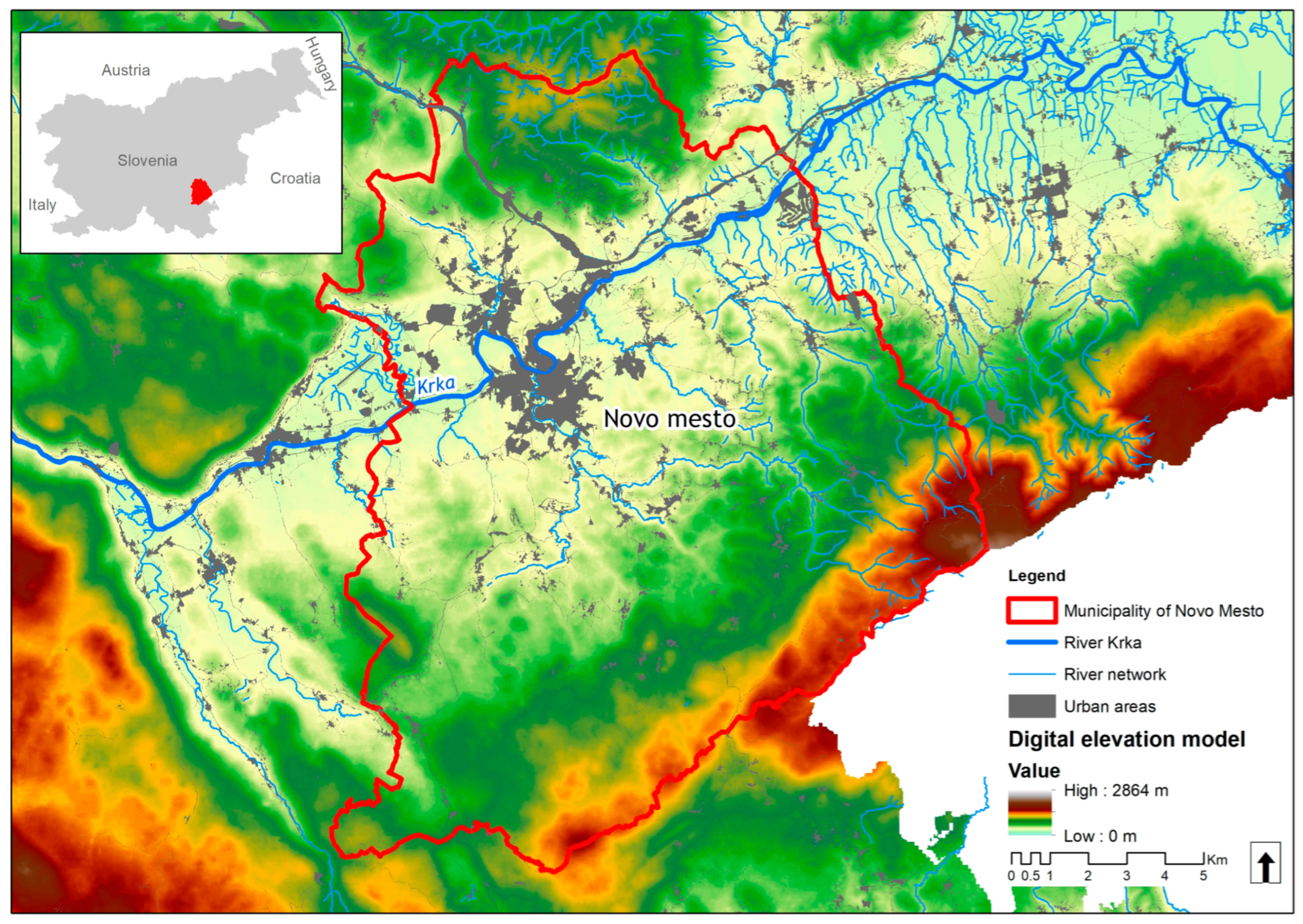
2.1. Study Area
2.2. Databases
2.3. Suitability Model Classification Framework
- SM—land suitability model (a sum of points);
- LQCP—land quality credit points;
- SL—slope inclination;
- CL—land consolidated;
- DS—drainage systems in function;
- IS—irrigation systems in function;
- PP—permanent plantations defined from actual land use (vineyard, intensive orchard, olive grove, extensive or meadow orchard, mother plants, and other permanent plantations);
- LC—land with specific local characteristics of agricultural production and use of agricultural land.
2.4. Suitability Model Evaluation Criteria
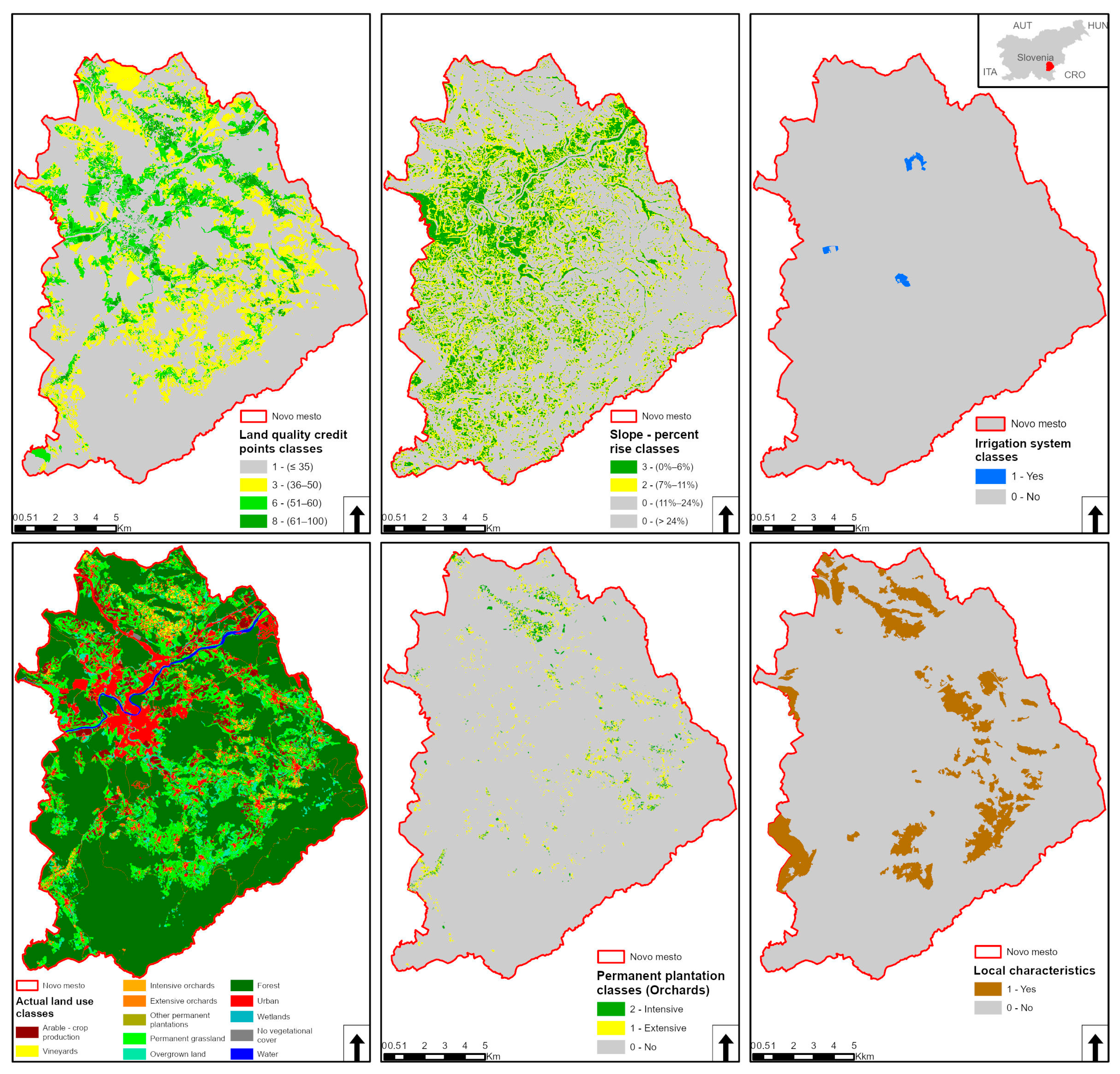
2.4.1. Land Quality Credit Points (LQCP)
2.4.2. Slope
2.4.3. Land Consolidation
2.4.4. Drainage Systems
2.4.5. Irrigation Systems
2.4.6. Permanent Plantations
2.4.7. Local Characteristics of Agricultural Production and Use of Agricultural Land
2.5. Evaluation Scenarios
3. Results and Discussion
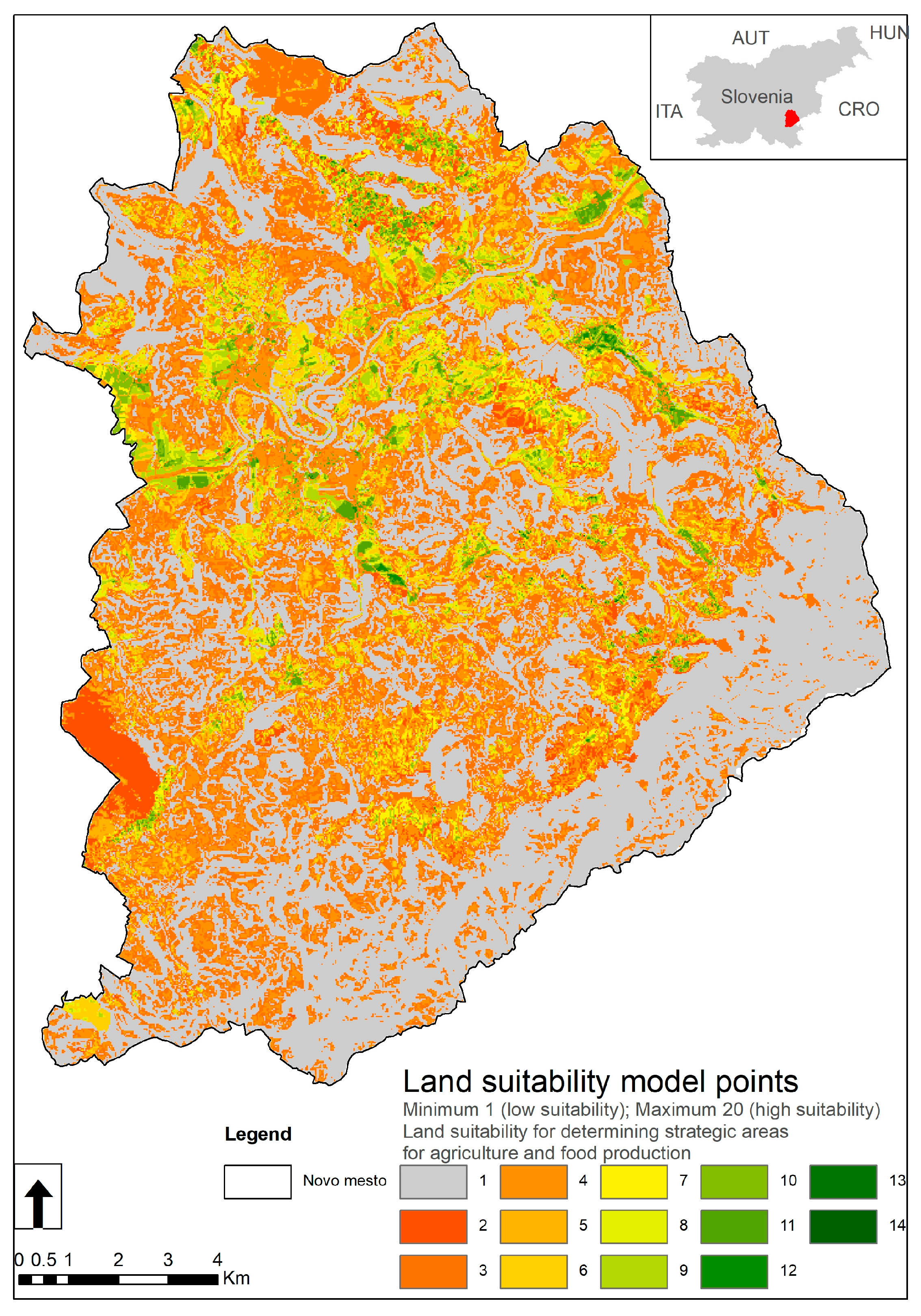
3.1. Suitability of Land for Strategic Areas for Agriculture and Food Production
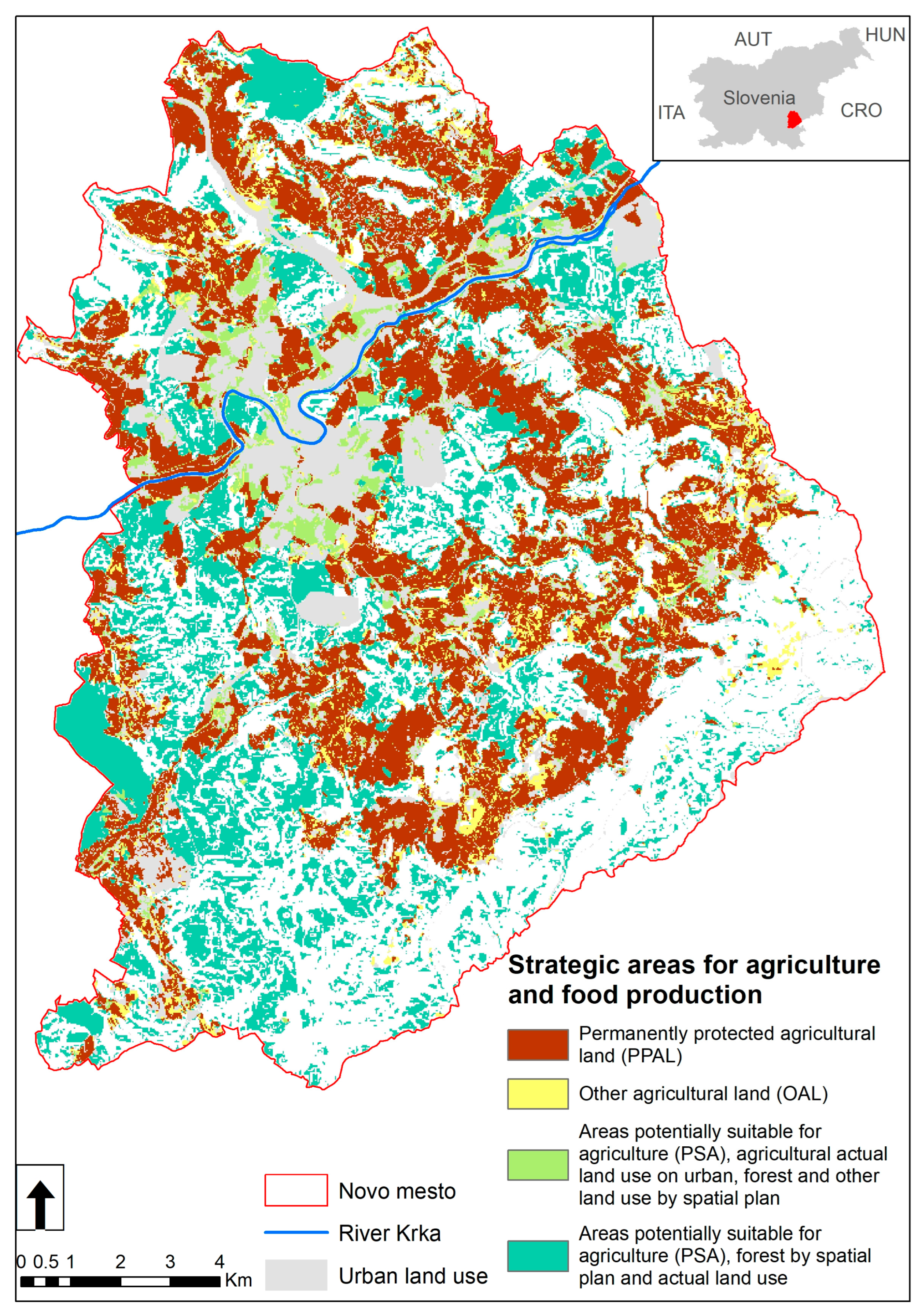
3.2. Permanently Protected (PPAL) and Other (OAL) Agricultural Land
3.3. Potentially Suitable Agricultural Land (PSA)
3.4. Suitability of Land for PPAL, OAL and PSA
3.5. Assessment of Strategic Implications for Agricultural Land Protection and Spatial Planning
3.6. Model Robustness and Limitations
3.7. Research Technical Roadmap
4. Conclusions
Author Contributions
Funding
Data Availability Statement
Acknowledgments
Conflicts of Interest
References
- Viana, C.M.; Freire, D.; Abrantes, P.; Rocha, J.; Pereira, P. Agricultural land systems importance for supporting food security and sustainable development goals: A systematic review. Sci. Total Environ. 2022, 806, 150718. [Google Scholar] [CrossRef]
- The Success of Agricultural Land Protection as a Condition for Self-Sufficiency; Audit Report; The Court of Audit of the Republic of Slovenia: Ljubljana, Slovenia, 2013; p. 87. Available online: https://www.rs-rs.si/fileadmin/user_upload/revizija/295/KmetZemSP.pdf (accessed on 27 January 2026).
- Tobias, S.; Price, B. How Effective Is Spatial Planning for Cropland Protection? An Assessment Based on Land-Use Scenarios. Land 2020, 9, 43. [Google Scholar] [CrossRef]
- Smiraglia, D.; Cavalli, A.; Giuliani, C.; Assennato, F. The Increasing Coastal Urbanization in the Mediterranean Environment: The State of the Art in Italy. Land 2023, 12, 1017. [Google Scholar] [CrossRef]
- Namiotko, V.; Galnaityte, A.; Krisčiukaitiene, I.; Balezentis, T. Assessment of agri-environmental situation in selected EU countries: A multi-criteria decision-making approach for sustainable agricultural development. Environ. Sci. Pollut. Res. 2021, 28, 25961–25973. [Google Scholar] [CrossRef]
- te Boveldt, G.; Keseru, I.; Macharis, C. How can multi-criteria analysis support deliberative spatial planning? A critical review of methods and participatory frameworks. Evaluation 2021, 27, 325–350. [Google Scholar] [CrossRef]
- Vavatsikos, A.P.; Demesouka, O.E.; Anagnostopoulos, K. GIS-based suitability analysis using fuzzy PROMETHEE. J. Environ. Plan. Manag. 2020, 63, 645–661. [Google Scholar] [CrossRef]
- Sylla, M.; Solecka, I. Highly valued agricultural landscapes and their ecosystem services in the urban-rural fringe—An integrated approach. J. Environ. Plan. Manag. 2020, 63, 883–911. [Google Scholar] [CrossRef]
- Fanfani, D.; Duží, B.; Mancino, M.; Rovai, M. Multiple evaluation of urban and peri-urban agriculture and its relation to spatial planning: The case of Prato territory (Italy). Sustain. Cities Soc. 2022, 79, 103636. [Google Scholar] [CrossRef]
- He, S.; Lin, L.; Xu, Q.; Cheng, L. Farmland Zoning Integrating Agricultural Multi-Functional Supply, Demand and Relationships: A Case Study of the Hangzhou Metropolitan Area, China. Land 2021, 10, 1014. [Google Scholar] [CrossRef]
- Jiang, P.; Li, M.; Sheng, Y. Spatial regulation design of farmland landscape around cities in China: A case study of Changzhou City. Cities 2020, 97, 102504. [Google Scholar] [CrossRef]
- Sun, R.; Jin, X.; Han, B.; Liang, X.; Zhang, X.; Li, H.; Zhou, Y.; Bryan, B.A. Stakeholder-Driven Spatial Targeting for Cultivated Land Consolidation: Managing Trade-Offs Between Urbanisation, Food Security, and Environment in China. Land Degrad. Dev. 2025, 36, 245–261. [Google Scholar] [CrossRef]
- Marinković, G.; Ilić, Z.; Nestorović, Ž.; Božić, M.; Trifković, M. Sensitivity of Multi-Criteria Analysis Methods in Rural Land Consolidation Project Ranking. Land 2024, 13, 245. [Google Scholar] [CrossRef]
- Tapia, J.F.D.; Promentilla, M.A.B.; Smarandache, F. Addressing Uncertainties in Planning Sustainable Systems Through Multi-criteria Decision Analysis (MCDA). Process Integr. Optim. Sustain. 2023, 7, 333–347. [Google Scholar] [CrossRef]
- Marušič, J.; Ogrin, D.; Jančič, M.; Kolšek, A. Landscapes of the Subpannonian Region—Krajine Subpanonske Regije; Ministry of Environment and Spatial Planning of the Republic of Slovenia, Office of Spatial Planning of the Republic of Slovenia: Ljubljana, Slovenia, 1998; Volume 3, p. 96. Available online: http://www.krajinskapolitika.si/wp-content/uploads/2018/10/3-subpanonske.pdf (accessed on 20 December 2022).
- Agriculture, Forestry and Fishery, Statistical Office of the Republic of Slovenia. SI-STAT Database. Available online: https://www.stat.si/StatWeb/en/Field/Index/11 (accessed on 22 October 2025).
- Geodetic Survey of the Republic of Slovenia. Digital Elevation Model (DEM 12.5 × 12.5 m). Ljubljana, Slovenia. Available online: https://ipi.eprostor.gov.si/jgp/data (accessed on 12 November 2025).
- Geodetic Survey of the Republic of Slovenia. Land Cadastre (Digital Cadastral Plan—DKP). Ljubljana, Slovenia. Available online: https://ipi.eprostor.gov.si/jgp/data (accessed on 12 November 2025).
- Geodetic Survey of the Republic of Slovenia. Land Quality Credit Points (Bonitetne Točke). Ljubljana, Slovenia. Available online: https://ipi.eprostor.gov.si/jgp/data (accessed on 12 November 2025).
- Geodetic Survey of the Republic of Slovenia. State Border and Municipal Boundaries. Ljubljana, Slovenia. Available online: https://ipi.eprostor.gov.si/jgp/data (accessed on 12 November 2025).
- Geodetic Survey of the Republic of Slovenia. Digital Orthophoto (DOF). Ljubljana, Slovenia. Available online: https://ipi.eprostor.gov.si/jgp/data (accessed on 12 November 2025).
- Ministry of Agriculture, Forestry and Food. Actual Land Use (RABA Kmetijskih Zemljišč). Ljubljana, Slovenia. Available online: https://rkg.gov.si/vstop/ (accessed on 6 September 2025).
- Ministry of Agriculture, Forestry and Food. Land Consolidation Areas. Ljubljana, Slovenia. Available online: https://rkg.gov.si/vstop/ (accessed on 6 September 2025).
- Ministry of Agriculture, Forestry and Food. Drainage Systems (Hidromelioracije—Drenaža). Ljubljana, Slovenia. Available online: https://rkg.gov.si/vstop/ (accessed on 6 September 2025).
- Ministry of Agriculture, Forestry and Food. Irrigation Systems (Namakanje). Ljubljana, Slovenia. Available online: https://rkg.gov.si/vstop/ (accessed on 6 September 2025).
- Ministry of Culture. Cultural Landscape Areas (Kulturna Krajina). Ljubljana, Slovenia. Available online: https://podatki.gov.si/dataset/register-nepremicne-kulturne-dediscine (accessed on 6 October 2025).
- Municipality of Novo Mesto. Municipal Spatial Plan (OPN)—Land Use Designations. Novo Mesto, Slovenia. Available online: https://pis.eprostor.gov.si/pis (accessed on 1 March 2025).
- Municipality of Novo Mesto. Municipal Spatial Plan (OPN)—Local Agricultural Characteristics (VIN, IKR). Novo Mesto, Slovenia. Available online: https://pis.eprostor.gov.si/pis (accessed on 1 March 2025).
- Slovenian Forestry Institute. Protected Forests (Varovalni Gozdovi). Ljubljana, Slovenia. Available online: https://www.zgs.si/gozdovi-slovenije/varovalni-gozdovi (accessed on 15 August 2025).
- Government of the Republic of Slovenia. Agricultural Land Act—Zakon o Kmetijskih Zemljiščih. Official Gazette of the Republic of Slovenia, No. 71/11-100/25. Ljubljana, Slovenia. Available online: https://pisrs.si/pregledPredpisa?id=ZAKO541 (accessed on 19 February 2026).
- Government of the Republic of Slovenia. Rules on Detailed Conditions for Determining the Proposal for Areas of Permanently Protected Agricultural Land and on the Detailed Content of Expert Bases in the Field of Agriculture—Pravilnik o Podrobnejših Pogojih za Določitev Predloga Območij Trajno Varovanih Kmetijskih Zemljišč Ter o Podrobnejši Vsebini Strokovnih Podlag s Področja Kmetijstva; Official Gazette of the Republic of Slovenia, No. 15/17; Government of the Republic of Slovenia: Ljubljana, Slovenia, 2017. Available online: https://pisrs.si/pregledPredpisa?id=PRAV12299 (accessed on 19 February 2026).
- Bagheri Bodaghabadi, M.; Martínez-Casasnovas, J.A.; Khakili, P.; Masihabadi, M.H.; Gandomkar, A. Assessment of the FAO traditional land evaluation methods, A case study: Iranian Land Classification method. Soil Use Manag. 2015, 31, 384–396. [Google Scholar] [CrossRef]
- Han, C.; Chen, S.; Yu, Y.; Xu, Z.; Zhu, B.; Xu, X.; Wang, Z. Evaluation of Agricultural Land Suitability Based on RS, AHP, and MEA: A Case Study in Jilin Province, China. Agriculture 2021, 11, 370. [Google Scholar] [CrossRef]
- Verburg, P.H.; Erb, K.-H.; Mertz, O.; Espindola, G. Land System Science: Between Global Challenges and Local Realities. Curr. Opin. Environ. Sustain. 2013, 5, 433–437. [Google Scholar] [CrossRef] [PubMed]
- Meyfroidt, P.; De Bremond, A.; Ryan, C.M.; Archer, E.; Aspinall, R.; Chhabra, A.; Camara, G.; Corbera, E.; DeFries, R.; Díaz, S.; et al. Ten Facts about Land Systems for Sustainability. Proc. Natl. Acad. Sci. USA 2022, 119, e2109217118. [Google Scholar] [CrossRef] [PubMed]
- Simič, S.; Hočevar, I.; Jerin, T.; Simončič, L.; Kralj, T.; Kovač, J. Determining the Quota and Proposing Areas of Permanently Protected Agricultural Land in the Case of the Municipalities of Novo Mesto, Črenšovci and Šenčur—Določitev Kvote ter Predloga Območij Trajno Varovanih Kmetijskih Zemljišč na Primeru Občin Novo Mesto, Črenšovci in Šenčur; Acer Novo Mesto d.o.o.: Novo Mesto, Slovenia, 2013. [Google Scholar]
- Foley, J.A.; DeFries, R.; Asner, G.P.; Barford, C.; Bonan, G.; Carpenter, S.R.; Chapin, F.S.; Coe, M.T.; Daily, G.C.; Gibbs, H.K.; et al. Global Consequences of Land Use. Science 2005, 309, 570–574. [Google Scholar] [CrossRef] [PubMed]
- Law, B.E.; Hudiburg, T.W.; Berner, L.T.; Kent, J.J.; Buotte, P.C.; Harmon, M.E. Land Use Strategies to Mitigate Climate Change in Carbon Dense Temperate Forests. Proc. Natl. Acad. Sci. USA 2018, 115, 3663–3668. [Google Scholar] [CrossRef]
- Seidl, R.; Schelhaas, M.J.; Rammer, W.; Verkerk, P.J. Increasing Forest Disturbances in Europe and Their Impact on Carbon Storage. Nat. Clim. Change 2014, 4, 806–810. [Google Scholar] [CrossRef]
- Power, A.G. Ecosystem Services and Agriculture: Tradeoffs and Synergies. Philos. Trans. R. Soc. B 2010, 365, 2959–2971. [Google Scholar] [CrossRef]
- Godfray, H.C.J.; Beddington, J.R.; Crute, I.R.; Haddad, L.; Lawrence, D.; Muir, J.F.; Pretty, J.; Robinson, S.; Thomas, S.M.; Toulmin, C. Food Security: The Challenge of Feeding 9 Billion People. Science 2010, 327, 812–818. [Google Scholar] [CrossRef]
- Opdam, P.; Steingröver, E.; van Rooij, S. Ecological Networks: A Spatial Concept for Multi-Actor Planning of Sustainable Landscapes. Landsc. Urban Plan. 2006, 75, 322–332. [Google Scholar] [CrossRef]
- Margules, C.R.; Pressey, R.L. Systematic Conservation Planning. Nature 2000, 405, 243–253. [Google Scholar] [CrossRef] [PubMed]
- Perrin, C.; Nougarèdes, B.; Sini, L.; Branduini, P.; Salvati, L. Governance changes in peri-urban farmland protection following decentralisation: A comparison between Montpellier (France) and Rome (Italy). Land Use Policy 2017, 70, 535–546. [Google Scholar] [CrossRef]
- Demir, S. Determination of suitable agricultural areas and current land use in Isparta Province, Türkiye, through a linear combination technique and geographic information systems. Environ. Dev. Sustain. 2024, 26, 8987–9003. [Google Scholar] [CrossRef]
- Liu, Y.; de Vries, W.T.; Zhang, G.; Cui, X. From tradition to smart: A comprehensive review of the evolution and prospects of land use planning tools. Heliyon 2024, 10, e40857. [Google Scholar] [CrossRef] [PubMed]
- Topping, C.J.; Dalby, L.; Valdez, J.W. Landscape-scale simulations as a tool in multi-criteria decision making to support agri-environment schemes. Agric. Syst. 2019, 176, 102671. [Google Scholar] [CrossRef]
- Unger, M.; Lakes, T. Land Use Conflicts and Synergies on Agricultural Land in Brandenburg, Germany. Sustainability 2023, 15, 4546. [Google Scholar] [CrossRef]
- Fattoruso, G.; Toscano, D.; Venturo, A.; Scognamiglio, A.; Fabricino, M.; Di Francia, G. A Spatial Multicriteria Analysis for a Regional Assessment of Eligible Areas for Sustainable Agrivoltaic Systems in Italy. Sustainability 2024, 16, 911. [Google Scholar] [CrossRef]
- Klein, N.; Adde, A.; Grêt-Regamey, A.; Guisan, A.; Herzog, F.; Jeanneret, P.; Kay, S. Identifying focus zones for the conservation and promotion of priority birds in Swiss farmland. Conserv. Sci. Pract. 2024, 7, e13286. [Google Scholar] [CrossRef]
- Kouriati, A.; Tafidou, A.; Lialia, E.; Prentzas, A.; Moulogianni, C.; Dimitriadou, E.; Bournaris, T. A Multicriteria Decision Analysis Model for Optimal Land Uses: Guiding Farmers under the New European Union’s Common Agricultural Policy (2023–2027). Land 2024, 13, 788. [Google Scholar] [CrossRef]
- Muchová, Z.; Petrovič, F. Prioritisation and Evaluation of Land Consolidation Projects—Žitava River Basin in a Slovakian Case. Sustainability 2019, 11, 2041. [Google Scholar] [CrossRef]
- Schär, S.; Pohl, E.; Geldermann, J. Analysing the compensatory properties of the outranking approach PROMETHEE. J. Multi-Criteria Decis. Anal. 2025, 32, e70013. [Google Scholar] [CrossRef]
- Arman, A.; Arman, H.; Hadi-Vencheh, A. The homogeneous MADM methods: Is trade-off between attributes important? Comput. Intell. Neurosci. 2022, 2022, 8629986. [Google Scholar] [CrossRef]
- Lantto, E. MCDA applications in chemical alternatives assessment: A narrative review. Environ. Syst. Decis. 2025, 45, 50. [Google Scholar] [CrossRef]
- Kheybari, S. Adjusting trade-offs in multi-criteria decision-making problems. Int. J. Inf. Technol. Decis. Mak. 2021, 20, 1499–1517. [Google Scholar] [CrossRef]
- Lienert, J.; Andersson, J.C.M.; Hofmann, D.; Silva Pinto, F.; Kuller, M. The role of multi-criteria decision analysis in a transdisciplinary process co-developing a flood forecasting system in western Africa. Hydrol. Earth Syst. Sci. 2022, 26, 2899–2922. [Google Scholar] [CrossRef]
- Kujawski, E.; Triantaphyllou, E.; Yanase, J. Additive multicriteria decision analysis models: Misleading aids for life-critical shared decision making. Med. Decis. Mak. 2019, 39, 437–449. [Google Scholar] [CrossRef]
- Figueira, J.R.; Greco, S.; Roy, B. Electre-Score: A first outranking based method for scoring actions. Eur. J. Oper. Res. 2022, 297, 986–1005. [Google Scholar] [CrossRef]
- Daher, S.D.; de Almeida, A.T. The use of ranking veto concept to mitigate the compensatory effects of additive aggregation in group decisions on a water utility automation investment. Group Decis. Negot. 2012, 22, 1179–1197. [Google Scholar] [CrossRef]
- Chelariu, O.-E.; Minea, I.; Iațu, C. Geo-hazards assessment and land suitability estimation for spatial planning using multi-criteria analysis. Heliyon 2023, 9, e18159. [Google Scholar] [CrossRef] [PubMed]
- Salunkhe, S.; Nandgude, S.; Tiwari, M.; Bhange, H.; Chavan, S.B. Land suitability planning for sustainable mango production in vulnerable region using geospatial multi-criteria decision model. Sustainability 2023, 15, 2619. [Google Scholar] [CrossRef]
- Hussain, S.; Nasim, W.; Mubeen, M.; Fahad, S.; Tariq, A.; Karuppannan, S.; Alqadhi, S.; Mallick, J.; Almohamad, H.; Abdo, H.G. Agricultural land suitability analysis of Southern Punjab, Pakistan using analytical hierarchy process (AHP) and multi-criteria decision analysis (MCDA) techniques. Cogent Food Agric. 2024, 10, 2294540. [Google Scholar] [CrossRef]
- Shaw, S.K.; Sravani, N.; Sharma, A.; Anand, J. Assessment of probable zones of agricultural land suitability based on MCDM, probabilistic, and data-driven approach in Krishna District, India. Environ. Monit. Assess. 2025, 197, 339. [Google Scholar] [CrossRef]
- Rossiter, D.G. Economic land evaluation: Why and how. Soil Use Manag. 1995, 11, 132–140. [Google Scholar] [CrossRef]
- Samranpong, C.; Ekasingh, B.; Ekasingh, M. Economic land evaluation for agricultural resource management in Northern Thailand. Environ. Model. Softw. 2009, 24, 1381–1390. [Google Scholar] [CrossRef]
- Denisova, E. Geoinformation methodology of agricultural land evaluation for agricultural economic analysis. AGRIS-Line Pap. Econ. Inform. 2021, 13, 41–54. [Google Scholar] [CrossRef]
- Metzger, J.; Soneryd, L.; Linke, S. The legitimization of concern: A flexible framework for investigating the enactment of stakeholders in environmental planning and governance processes. Environ. Plan. A Econ. Space 2017, 49, 2517–2535. [Google Scholar] [CrossRef]
- Ros-Tonen, M.A.F.; Willemen, L.; McCall, M.K. Spatial tools for integrated and inclusive landscape governance: Toward a new research agenda. Environ. Manag. 2021, 68, 611–630. [Google Scholar] [CrossRef]
- Agger, A. Democratic innovations in municipal planning: Potentials and challenges of place-based platforms for deliberation between politicians and citizens. Cities 2021, 17, 103317. [Google Scholar] [CrossRef]
- Qian, F.; Lal, R.; Wang, Q. Land evaluation and site assessment for the basic farmland protection in Lingyuan County, Northeast China. J. Clean. Prod. 2021, 314, 128097. [Google Scholar] [CrossRef]
- Koschke, L.; Fürst, C.; Frank, S.; Makeschin, F. A multi-criteria approach for an integrated land-cover-based assessment of ecosystem services provision to support landscape planning. Ecol. Indic. 2012, 21, 54–66. [Google Scholar] [CrossRef]
- Fontana, V.; Radtke, A.; Fedrigotti, V.B.; Tappeiner, U.; Tasser, E.; Zerbe, S.; Buchholz, T. Comparing land-use alternatives: Using the ecosystem services concept to define a multi-criteria decision analysis. Ecol. Econ. 2013, 93, 128–136. [Google Scholar] [CrossRef]
- Nguyen, T.T.; Verdoodt, A.; Van, Y.T.; Delbecque, N.; Tran, T.C.; Van Ranst, E. Design of a GIS and multi-criteria based land evaluation procedure for sustainable land-use planning at the regional level. Agric. Ecosyst. Environ. 2015, 200, 1–11. [Google Scholar] [CrossRef]
- Wang, N.; Hao, J.; Zhang, L.; Duan, W.; Shi, Y.; Zhang, J.; Wusimanjiang, P. Basic Farmland Protection System in China: Changes, Conflicts and Prospects. Agronomy 2023, 13, 651. [Google Scholar] [CrossRef]
- Chen, Y.; Yao, M.; Zhao, Q.; Chen, Z.; Jiang, P.; Li, M.; Chen, D. Delineation of a basic farmland protection zone based on spatial connectivity and comprehensive quality evaluation: A case study of Changsha City, China. Land Use Policy 2021, 101, 105145. [Google Scholar] [CrossRef]



| Spatial Layer | Source | Spatial Accuracy |
|---|---|---|
| Digital elevation model [17] | Geodetic Survey of the Republic of Slovenia | 12.5 m raster resolution |
| Land cadaster [18] | Parcel-level accuracy (≤1 m positional accuracy) | |
| Land quality credit points [19] | ||
| State and Municipality borders [20] | ||
| Digital ortho-photo [21] | 0.25 m pixel resolution | |
| Actual land use [22] | Ministry of Agriculture, Forestry and Food | Parcel-level accuracy (≤1 m positional accuracy) |
| Land consolidation [23] | ||
| Drainage systems [24] | ||
| Irrigation systems [25] | ||
| Local characteristics of agricultural production and use of agricultural land—data on areas labelled “cultural landscape.” [26] | Ministry of Culture | 1:5000 scale thematic polygons |
| Municipal Spatial Plan land use [27] | Municipality of Novo mesto | Parcel-level accuracy (≤1 m positional accuracy) |
| Local characteristics of agricultural production and land use—data on areas labelled “VIN” and “IKR.” [28] | ||
| Protected forests [29] | Forestry Institute of Slovenia |
| Land Suitability Model Classification Criteria | Area in the Case Study (Municipality of Novo Mesto) | ||
|---|---|---|---|
| Descriptive (Class) | Numerical (Point) | ha | % |
| Land quality credit points (LQCP) | |||
| ≤35 | 1 | 16,244 | 68.90 |
| 36–50 | 3 | 4314 | 18.30 |
| 51–60 | 6 | 2267 | 9.61 |
| 61–100 | 8 | 751 | 3.19 |
| Total | 23,576 | 100.00 | |
| Slope (SL) | |||
| ≤6 | 3 | 3717 | 15.77 |
| 7–11 | 2 | 4530 | 19.21 |
| 12–24 | 0 | 9335 | 39.60 |
| ≥25 | 0 | 5994 | 25.42 |
| Total | 23,576 | 100.00 | |
| Land consolidation (LC) | |||
| Yes | 1 | 0 | 0 |
| No | 0 | 23,576 | 100.00 |
| Drainage system (DR) | |||
| Yes | 2 | 0 | 0 |
| No | 0 | 23,.576 | 100.00 |
| Irrigation system (IR) | |||
| Yes | 1 | 85 | 0.36 |
| No | 0 | 23,491 | 99.64 |
| Total | 23,576 | 100.00 | |
| Permanent plantations (PP) | |||
| Intensive | 2 | 286 | 1.22 |
| Extensive | 1 | 392 | 1.66 |
| No | 0 | 22,898 | 97.12 |
| Total | 23,576 | 100.00 | |
| Local characteristics (LC) | |||
| Yes | 1 | 2516 | 10.67 |
| No | 0 | 21,060 | 89.33 |
| Total | 23,576 | 100.00 | |
| Scenario | Description | Strategic Area Type |
|---|---|---|
| A | Meets at least one criterion according to the suitability model, land suitability model (SM) sum of points is >1 | PPAL |
| Does not meet any criterion, land suitability model (SM) sum of points is ≤1 | OAL | |
| B | Scenario A, without LQCP ≤ 35 | PPAL |
| Scenario A, with LQCP ≤ 35 | OAL | |
| C | Scenario A, without slope ≥ 12% | PPAL |
| Scenario A, with a slope ≥ 12% | OAL | |
| D | Scenario A, without LQCP ≤ 35 and slope ≥ 12% | PPAL |
| Scenario A, with LQCP ≤ 35 and slope ≥ 12% | OAL | |
| E | Scenario A, without LQCP ≤ 35, slope ≥ 12% and VIN | PPAL |
| Scenario A, with LQCP ≤ 35, slope ≥ 12% and VIN | OAL | |
| F | The suitability model calculation is >1 point, but for lands that, according to their use in the spatial plan, are designated as buildings, forests and other land areas, but according to their actual use, they are agricultural land and land that is a forest according to its use in the spatial plan and actual land use, unless it is defined as a protected forest or a forest of special importance | PSA |
| G | Scenario F, without BT ≤ 35 and slope ≥ 12% | PSA |
| H | Scenario G, only actual agricultural land use | PSA |
| Suitability Model Sum of Points | Study Area | |
|---|---|---|
| ha | % | |
| 1 | 10,321 | 43.78 |
| 2 | 666 | 2.82 |
| 3 | 4909 | 20.82 |
| 4 | 3005 | 12.75 |
| 5 | 824 | 3.50 |
| 6 | 1410 | 5.98 |
| 7 | 377 | 1.60 |
| 8 | 648 | 2.75 |
| 9 | 748 | 3.17 |
| 10 | 262 | 1.11 |
| 11 | 328 | 1.39 |
| 12 | 46 | 0.20 |
| 13 | 11 | 0.05 |
| 14 | 20 | 0.08 |
| Total | 23,576 | 100.00 |
| Scenario | Strategic Area Type | Area (ha) | ||
|---|---|---|---|---|
| Total Study Area | Actual Land Use (Agriculture) | Spatial Plan Land Use (Agriculture) | ||
| A | PPAL | 13,255 | 6921 | 6490 |
| OAL | 10,321 | 923 | 1020 | |
| B | PPAL | 7332 | 6024 | 5628 |
| OAL | 16,244 | 1820 | 1882 | |
| C | PPAL | 8247 | 3073 | 4750 |
| OAL | 15,329 | 4771 | 2761 | |
| D | PPAL | 3059 | 2535 | 2265 |
| OAL | 20,517 | 5309 | 5246 | |
| E | PPAL | 2991 | 2478 | 2208 |
| OAL | 20,585 | 5366 | 5303 | |
| Scenario | Strategic Area Type | Area (ha)—Municipal Spatial Plan Land Use | |||
|---|---|---|---|---|---|
| Urban Land | Forest Land | Other Lands | Total | ||
| Scenario F | PSA | 730 | 4347 | 0.69 | 5078 |
| Scenario G | PSA | 337 | 190 | 0.35 | 527 |
| Scenario H * | PSA | 229 | 129 | 0.24 | 358 |
| Strategic Area Type by a Suitability Model | Total | |||
|---|---|---|---|---|
| PPAL | OAL | PSA | ||
| Area (ha) | 6490 | 1020 | 5078 | 12,588 |
| Share of the case study total area (%) | 27.53 | 4.33 | 21.54 | 53.39 |
Disclaimer/Publisher’s Note: The statements, opinions and data contained in all publications are solely those of the individual author(s) and contributor(s) and not of MDPI and/or the editor(s). MDPI and/or the editor(s) disclaim responsibility for any injury to people or property resulting from any ideas, methods, instructions or products referred to in the content. |
© 2026 by the authors. Licensee MDPI, Basel, Switzerland. This article is an open access article distributed under the terms and conditions of the Creative Commons Attribution (CC BY) license.
Share and Cite
Glavan, M.; Hrastnik, A. A Land Sustainability Model for Identifying Strategic Agricultural Areas: Application to Novo Mesto Municipality, Slovenia. Land 2026, 15, 386. https://doi.org/10.3390/land15030386
Glavan M, Hrastnik A. A Land Sustainability Model for Identifying Strategic Agricultural Areas: Application to Novo Mesto Municipality, Slovenia. Land. 2026; 15(3):386. https://doi.org/10.3390/land15030386
Chicago/Turabian StyleGlavan, Matjaž, and Anja Hrastnik. 2026. "A Land Sustainability Model for Identifying Strategic Agricultural Areas: Application to Novo Mesto Municipality, Slovenia" Land 15, no. 3: 386. https://doi.org/10.3390/land15030386
APA StyleGlavan, M., & Hrastnik, A. (2026). A Land Sustainability Model for Identifying Strategic Agricultural Areas: Application to Novo Mesto Municipality, Slovenia. Land, 15(3), 386. https://doi.org/10.3390/land15030386