


Abstract
In the context of urban development transforming from external expansion to internal improvement, identifying the patterns and characteristics of urban industrial land shrinkage and proposing response strategies are crucial for achieving high-quality and sustainable urban development. Unlike previous studies that focused on the expansion of industrial land based on absolute changes in land area, we propose a formation mechanism for urban industrial land shrinkage from the perspectives of both absolute and potential shrinkage. We quantitatively identified the Chinese cities that experienced shrinkage between 2006 and 2020, and developed a comprehensive indicator system to investigate the changes in the structural and functional characteristics of industrial land use during this process. The results indicated that urban industrial land shrinkage has become a widespread phenomenon nationwide. Absolute shrinkage was predominantly attributed to resource depletion and a lack of economic development, while potential shrinkage was mainly influenced by high-quality development and a lack of economic development. Cities exhibiting potential shrinkage experienced more severe structural deterioration, while cities with absolute shrinkage faced greater functional degradation. Extensive land use remains a serious challenge that must be addressed in industrial land redevelopment. Finally, we propose that more attention should be given to the utilization of stock urban industrial land, in particular in cities with relatively low administrative levels, small populations, and remote locations. Urban land redevelopment projects need to be conducted in accordance with the principle of intensive land use to promote the sustainable development of cities.
1. Introduction
Urban industrial land, primarily utilized by manufacturing enterprises, is an important type of urban built-up land [1]. Many major cities in developed countries have adopted shrinkage policies for abandoned and inefficient industrial land, also known as brownfields, in response to deindustrialization and the transformation of industrial structures as they progress into the later stages of industrialization [2,3,4]. These brownfield sites are often converted into ecological spaces and heritage parks, or redeveloped into commercial and residential areas [5,6,7].
China, like other developing countries, has implemented a shrinkage policy for urban industrial land [8,9,10]. The shrinkage in China aims to facilitate intensive and sustainable land development in accordance with high-quality development guidelines [11,12]. High-quality development requires urban industrial land use that conserves resources, increases output, and protects the environment. To achieve this goal, the Ministry of Natural Resources of China introduced the Strategy for Controlling and Reducing Total Built-Up Land in 2014 and implemented the Guiding Opinions on Deeply Promoting the Redevelopment of Inefficient Urban Land in 2016. Urban industrial land characterized by outdated technology, low output, low development intensity, and high pollution emissions has been targeted for reconstruction or repurposing. Many cities have begun to explore the redevelopment of inefficient industrial land. These policies are expected to accelerate the transformation of industrial land and ultimately alter the total area of urban industrial land [13]. If new industrial land areas are smaller than the existing reduced areas, the overall regional industrial land area experiences absolute shrinkage. If the expansion of industrial land areas slows, there is a potential shrinkage in the industrial land area.
The industrial land area in many cities is absolutely or potentially shrinking due to efforts to promote the redevelopment of inefficient urban land. For example, the rate of industrial land expansion in rapidly industrializing cities has slowed considerably. The industrial land area is exhibiting a shrinking trend (potential shrinkage). Cities experiencing deindustrialization and economic recession may exhibit substantial urban industrial land absolute shrinkage [14,15,16]. Local governments hope to achieve the optimization of land structure and function through this contraction. Land structure refers to industrial land use intensity and the linked industrial structure. The recycling and reuse of inefficient land can enhance the compactness of land use and optimize the types of enterprises attached to land, resulting in transformations in land structure. Land function refers to the economic output and ecological impacts related to land use. Alterations in the structure of industrial land use can further influence land function.
Accurately identifying the patterns and the structural and functional characteristics of urban industrial land shrinkage, and proposing targeted response strategies for industrial land use, is crucial for national spatial planning and supporting high-quality economic development. This approach reflects the actual demand for regional industrial land use, providing a scientific basis for territorial space planning. Furthermore, it aids in understanding the mechanisms driving industrial land shrinkage in China and directly guides the redevelopment of industrial land projects.
Although both the absolute and potential shrinkage of urban industrial land have become common in China, most previous studies focused on the perspective of expansion. To address this gap, this study qualitatively analyzed the formation mechanisms of urban industrial land shrinkage. It then took 233 prefecture-level cities in China as research objects and quantitatively identified the cities that experienced absolute and potential industrial land shrinkage between 2006 and 2020 based on official data related to the urban land area. We explored the spatial patterns of these cities using ArcGIS 10.1 software and statistical methods. Subsequently, we developed a comprehensive indicator system to investigate the changes in the structural and functional characteristics of industrial land use during the shrinkage process. Finally, we proposed response strategies for urban industrial land shrinkage from the aspects of land supply, recycling, and redevelopment. We aimed to clearly identify the spatial and temporal patterns of urban industrial land shrinkage in China and promote the efficient development of industrial land projects.
The remainder of the paper is organized as follows. Section 2 presents a literature review highlighting the need for this study. Section 3 discusses the formation mechanisms of urban industrial land shrinkage. Section 4 describes the study area, data sources, and the basic model. Section 5 presents the results of the study. Section 6 presents a discussion and Section 7 summarizes the research conclusions.
2. Literature Review
2.1. Formation Mechanisms of Urban Industrial Land Shrinkage
Various factors contribute to urban industrial land shrinkage. First, extensive research on brownfield recycling and utilization has suggested that deindustrialization after a certain stage of economic development is reached leads to a large amount of industrial land being abandoned. The industrial land area gradually decreases during the recycling and reuse of abandoned land [2,3,4]. Several Chinese studies have examined megacities such as Shanghai, Shenzhen, Wuhan, and Beijing, suggesting that extensive land development, industrial structure upgrading, and deindustrialization are important drivers of urban industrial land shrinkage [10,17]. Second, some researchers have proposed that industrial land will gradually be cleared from city centers and become concentrated in suburban industrial parks through the optimization of urban spatial layout. Under intensive and large-scale use, the industrial land area tends to exhibit a decreasing trend [18]. Third, some researchers are concerned about the sustainable development of resource-based cities and have reported that these cities face problems of stagnant industrial development and population migration after resource depletion, leading to a gradual reduction in industrial land area [19]. Finally, policies are also an important factor. Chinese researchers have proposed that urban spatial expansion is hindered under the rigid control of policies such as national spatial planning and the construction of an ecological civilization, leading to reduced and more efficient industrial land use [20,21].
Overall, urban industrial land shrinkage is primarily influenced by factors such as the regional economy, urban planning, industrial development, population migration, and resource policies.
2.2. The Evolution of Urban Industrial Land Layout
Many researchers have examined the spatial expansion patterns of urban industrial land at a regional scale based on statistical data. A few studies have analyzed the evolution of urban industrial land layout at the plot scale using remote sensing and land use maps [22,23,24]. At the regional scale, researchers have used statistical data on industrial land area to analyze the spatiotemporal changes in the total area. For example, based on an analysis of the spatiotemporal changes of industrial land area, Wang et al. found that the distribution of industrial land in China is denser in the southeast and sparser in the northwest. After 2011, its center of gravity shifted westward [25]. Li et al. explored the spatial distribution center, regional Gini coefficient, and cold–hot spots of newly developed industrial land in the Yangtze River Economic Belt, using land supply data from 2010 to 2018 [26]. Their findings indicated that the supply of new industrial land exhibited a trend of fluctuating reduction, with the spatial distribution center shifting upstream along the Yangtze River. Zhu et al. [27] analyzed the spatial pattern of municipal industrial land expansion in the middle reaches of the Yangtze River and discovered a substantial imbalance in its distribution. The increasing of industrial land in three metropolitan areas strengthened constantly, meanwhile it was lagging relatively in other cities [27]. Zhao et al. [28] found that the industrial land of Xi’an City in China initially expanded outward but later shifted toward a more concentrated development pattern. Spatially, industrial land gradually suburbanized over time [28].
At the plot scale, some researchers have used spatial distribution vector maps or remote sensing maps of industrial land parcels to explore the spatiotemporal evolution of industrial land spots, or conduct a theoretical analysis of the changing patterns of industrial land distribution based on experience and interviews. Zhu et al. [27] summarized the common forms of industrial land evolution in urban agglomerations, including core agglomeration, gradient distribution, zonal distribution, and scattered distribution. Liu and Rao found that industrial plots in Wuhan were concentrated in the peripheral industrial new towns, while those in the central area were diminishing in area [29,30]. Shi et al. identified four stages of urban industrial land use: initial development, rapid expansion, outward diffusion, and upgrading and transformation. Spatially, it spread from the ancient city core toward new districts such as the high-tech zone and industrial park [31]. Zhang et al. indicated that manufacturing space was undergoing restructuring, characterized by a notable decline in industrial land within the central city and the emergence of industrial clusters in suburban areas [32]. Wen et al. [33] studied the evolution of industrial land use across various sectors in Beijing. They found that industrial land was mainly concentrated in industrial parks located 20–40 km from downtown, with the spatial focus shifting from the northeast to the southwest [33].
2.3. Redevelopment Strategies for Urban Industrial Land
Many researchers have analyzed redevelopment strategies for urban industrial land in various cities. They have proposed targeted approaches based on regional spatial information and interviews with stakeholders. Rizzo et al. identified stakeholders’ perceptions, concerns, attitudes, and informational needs regarding brownfield regeneration [34]. De Sousa summarized the successful experiences of transforming Toronto’s brownfields into green spaces and proposed policy recommendations for brownfield redevelopment in North America, focusing on identifying brownfields and coordinating stakeholders [5]. Thomas discussed a geographic information system (GIS)-based decision support system that provides access to state, regional, and local geospatial databases, which could be used to better understand the issues, options, and alternatives related to brownfield redevelopment [4].
In China, research has particularly focused on major metropolises such as Shanghai, Beijing, Guangzhou, and Wuhan. Response strategies for urban industrial land shrinkage have been proposed that focus on urban planning, supply-side reform, redevelopment timing, and compensation mechanisms [35]. For example, Gu et al. suggested the optimal timing and location for the recovery of industrial land in Shanghai based on a suitability evaluation [10]. Similarly, Gao et al. identified inefficient industrial land use in Huai’an, Jiangsu Province, to promote intensive use, and proposed strategies for recovering inefficient industrial land based on scale and timing [18]. Notably, these strategies often differentiate among cities at varying development stages; for example, for high-density megacities, there is an emphasis on intensive redevelopment and functional replacement, while for growing industrial cities, there is a focus on optimizing layout and eliminating inefficient land use. However, these studies primarily focused on big cities, with a lack of in-depth research on small cities.
2.4. A Comprehensive Review
Researchers have identified the evolution of urban industrial land layouts, explored the functional characteristics of urban industrial land shrinkage, and proposed several response strategies to address this shrinkage; however, there are limitations to their findings. First, studies at the regional scale have primarily concentrated on analyzing the evolution of industrial land use from the perspective of expansion rather than shrinkage. We argue that quantitative studies on urban industrial land shrinkage are better suited for informing policies related to the management of industrial land in the context of high-quality development. Second, existing research on the evolution of urban industrial land area tends to focus on absolute changes, without integrating these changes into the overall transformation of urban space. This approach limits the analysis of trends in urban industrial land change against the dual backdrop of sustained industrialization and the promotion of inefficient industrial land redevelopment projects [36]. Third, there is a scarcity of studies exploring the structural and functional characteristics of industrial land use shrinkage. While previous studies have established a connection between urban industrial land shrinkage and industrial land use structure in certain megacities, few studies have directly investigated these relationships. Finally, the response strategies for industrial land shrinkage predominantly focus on independent research in megacities such as Beijing, Shanghai, and Wuhan, lacking a systematic nationwide analysis that includes cities at various stages of urbanization and industrialization.
3. Theoretical Analysis
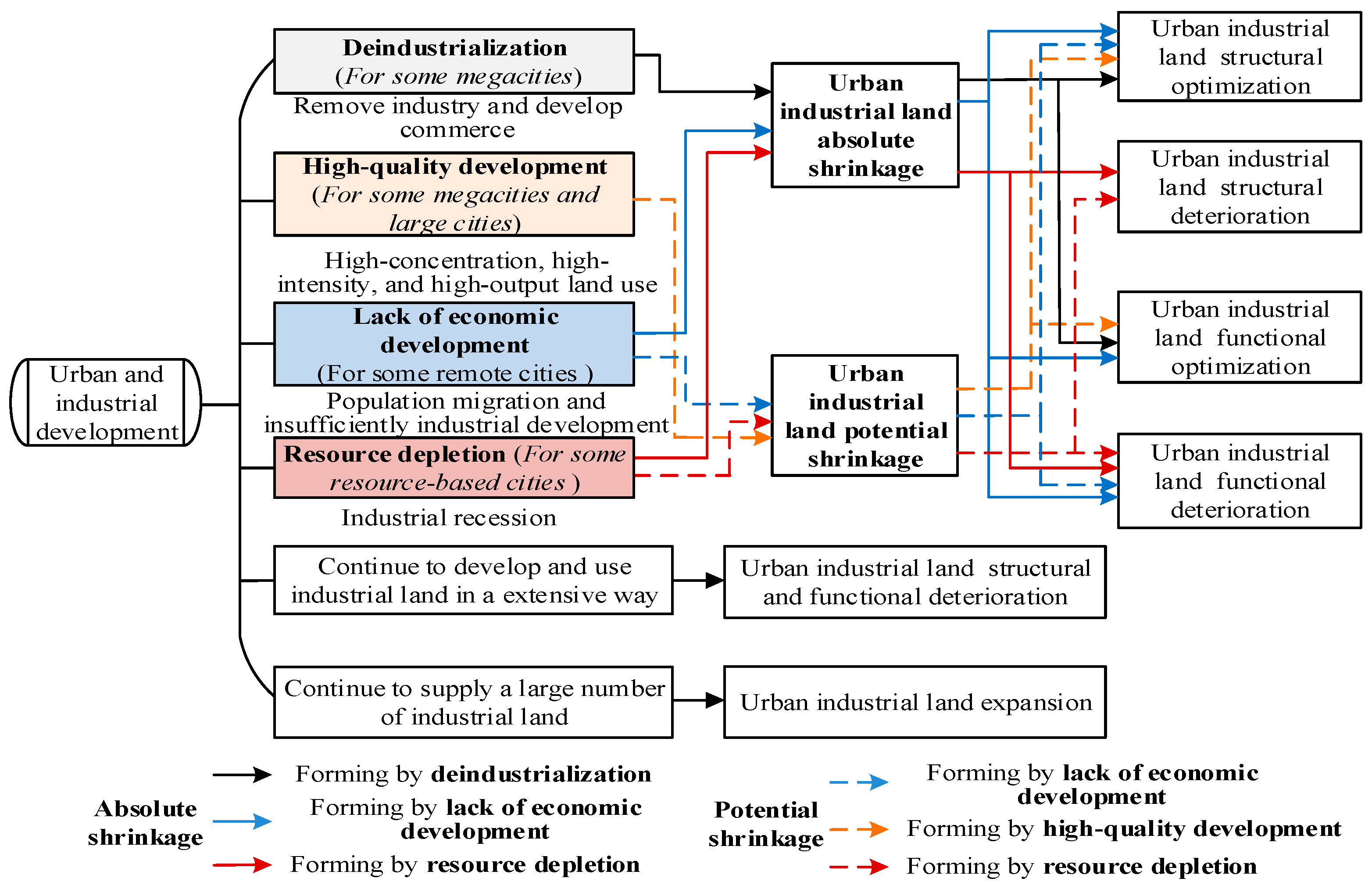
The formation mechanism of urban industrial land shrinkage is a central topic in regional development and industrial transformation research. Its pathways are closely related to city type, development stage, and policy orientation. First, different cities follow distinct development trajectories due to varying conditions: some megacities promote industrial exit and commercial development through deindustrialization, thereby optimizing industrial land structure. Some large and megacities pursue high-quality development, promoting intensive and efficient land use. Conversely, some remote cities experience population outflow and insufficient industrial development due to a lack of economic development, and some resource-based cities face industrial decline due to resource depletion. These different development trajectories collectively influence the demand for urban industrial land.
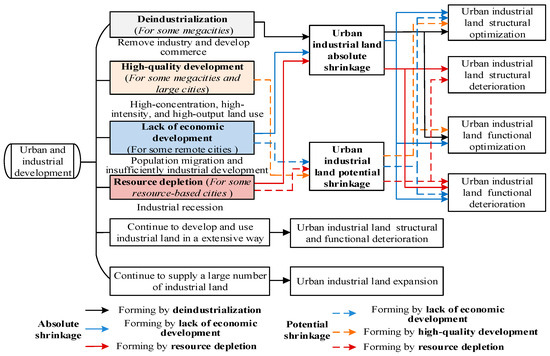
Urban industrial land shrinkage can be categorized into two types. First, absolute shrinkage, where there is an actual decrease in industrial land. Second, potential shrinkage, where industrial land continues to increase, but the rate of increase slows relative to the growth of the urban area. The formation mechanisms of urban industrial land shrinkage are shown in Figure 1.
Figure 1.
The formation mechanisms of urban industrial land shrinkage.
Deindustrialization. In some megacities that are in the later stages of industrialization, there is a trend toward reducing industrial activity and promoting commercial development. Industrial land that offers diminishing returns and generates high levels of pollution is being repurposed and redeveloped into various types of land, including natural spaces, public service facilities, and commercial zones. As a result, the amount of industrial land in these cities is decreasing, leading to an optimized land use structure and function [37].
High-Quality Development. In metropolises and large cities experiencing rapid economic growth, urban land use is becoming increasingly intensive due to the constraints on urban expansion boundaries. Inefficient industrial land in city centers is being repurposed, while new industrial land is allocated to high-tech and green industries through the establishment of development zones in suburban areas. Industrial land use is evolving to exhibit high concentration, intensity, and output. Consequently, industrial land is expected to demonstrate potential shrinkage alongside the continuous optimization of its structure and function [38].
Lack of Economic Development. Remote cities experience substantial population migration and insufficient industrial development. The actual demand for industrial land may decline in these areas due to the difficulties in attracting investment. According to the progress reported in the redevelopment of urban inefficient land, the availability of industrial land is likely to face potential shrinkage or absolute shrinkage. In this context, while the structure of industrial land use may be optimized, its functionality could either improve or deteriorate due to a lack of momentum in economic development.
Resource Depletion. Resource depletion will lead to industrial recession and population outmigration away from resource-based cities. Industrial land may experience potential or absolute shrinkage, accompanied by structural and functional deterioration [39].
Additionally, some cities continue to develop and utilize industrial land in a traditional, extensive manner despite the current landscape and industrial land management trends. Furthermore, industrial land shrinkage presents challenges related to structural and functional deterioration.
4. Materials and Methods
4.1. Data and Processing
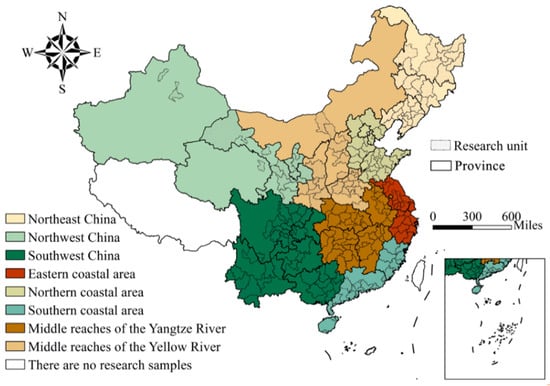
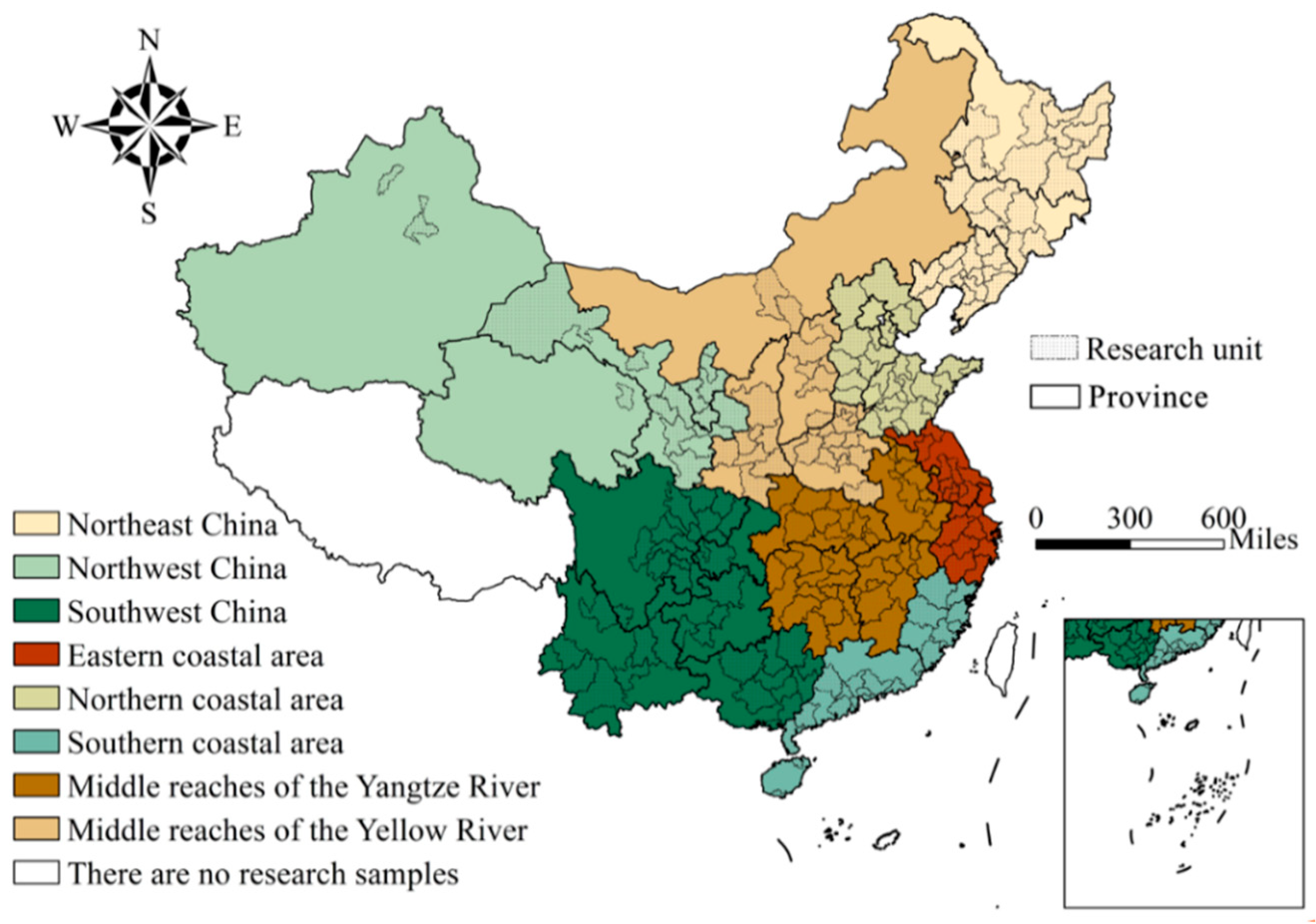
Urban industrial land shrinkage is a gradual process that should be identified based on specific time periods. We selected the years 2006 to 2020 due to the availability of a long span of statistical data. Shrinkage was analyzed in three sub-periods: 2006 to 2010, 2010 to 2015, and 2015 to 2020. The definition of urban industrial land used in this study was derived from the Urban Land Use and Planning Standards of Development Land, published by China’s Ministry of Housing and Urban-Rural Development in 2011. Data on urban industrial land area and urban built-up land area for each sample were collected from the China Urban Construction Statistical Yearbook (2006 to 2021). Additional data on urban industrial employees, urban industrial fixed asset investment, expenditures for science and technology, employees in the scientific research and technical service industry, urban industrial employees, urban industrial output value, urban industrial SO2 discharges, urban industrial soot discharges, and urban industrial solid waste were obtained from the China Urban Statistical Yearbook (2006 to 2021). These statistical yearbooks contain official data related to urban development. To account for price changes, data linked to prices were adjusted to constant 2006 currency using the corresponding price indices published on the National Bureau of Statistics website. Panel data from 233 cities were used after excluding samples with null values and outliers (Figure 2). As of 2020, the China Urban Statistical Yearbook contains recorded data for 297 cities, including municipalities directly under central government administration, vice-provincial cities, and prefecture-level cities. We removed 64 cities with missing data.
Figure 2.
The distribution of research units in the eight economic zones of China. Note: Review number GS(2020)4630 (http://bzdt.ch.mnr.gov.cn/).
China can be divided into eight economic zones according to the level of industrial development and geographical location [40]. Northeast China is a base for heavy equipment manufacturing, with many resource-based cities. The northern coastal area is a major center of research, development, and manufacturing of high-tech products. The eastern coastal area is a multi-functional manufacturing center. The southern coastal area is the most important base for foreign economic development and is a manufacturing center for high-tech products. The middle reaches of the Yellow River are characterized by coal mining and processing, natural gas and hydropower development, the iron and steel industry, and non-ferrous metal industry. The middle reaches of the Yangtze River are a base for raw material extraction, dominated by iron, steel, and non-ferrous metallurgy. Southwest China is dominated by both heavy chemical industries and textile industries. Northwest China is an important base for the deep processing of cotton, fruit, grain, and livestock products. In total, 32 of our research units were located in northeast China, 27 in the northern coastal area, 22 in the eastern coastal area, 23 in the southern coastal area, 30 in the middle reaches of the Yellow River, 43 in the middle reaches of the Yangtze River, 40 in southwest China, and 16 in northwest China.
4.2. Methods
4.2.1. Identifying the Pattern of Urban Industrial Land Shrinkage
The following two indicators were used to identify the two types of shrinkage. The patterns of cities experiencing absolute and potential shrinkage of industrial land were analyzed separately.
where PS1 and PS2 are the areas of urban industrial land at the end and beginning of the study period for one research unit, respectively; PUS1 and PUS2 are the areas of urban built-up land at the end and beginning of the study period for one research unit, respectively; ΔPS is the rate of change in the area of urban industrial land; and ΔPS0 is the deviation between the rates of change of urban industrial land and urban built-up land. According to the ΔPS and ΔPS0, the research units can be divided into three categories of absolute shrinkage, potential shrinkage, and growth of the industrial land area. The classification criteria are shown in Table 1.
Table 1.
The classification of cities according to urban industrial land shrinkage.
4.2.2. Identifying the Characteristics of Urban Industrial Land Shrinkage
The characteristics of urban industrial land shrinkage were examined in relation to the structure and function of industrial land use. The structural characteristics were the changes in the industrial land use structure, including land development intensity, land layout, and the proportion of various land types. The functional characteristics reveal changes in the functions of industrial land use, such as economic outputs and ecological impacts [41,42].
We initially evaluated the structure and function of urban industrial land use. A comprehensive indicator system was developed based on existing research (Table 2) [18,43,44,45]. Urban industrial land shrinkage primarily results in changes to the regional industrial structure and intensity of industrial land use. The Chinese government aims to enhance the economic output of industrial land while reducing pollutant emissions in high-quality developments. Therefore, we assessed the structure of urban industrial land use using two variables: the degree of intensity and the industrial structure. We also evaluated the function of urban industrial land using two variables: output level and pollutant emissions. Eight observable indices were employed to quantify these variables, five for positive effects and three for negative effects.
Table 2.
The indicator system used to measure urban industrial land use structure and function.
After standardizing the indices using Formula (3), Formula (4) was used to calculate the comprehensive score of structure (yks) and function (ykf).
where xkj is the original value of index j for research unit k; xjmax and xjmin are the maximum and minimum values of index j, respectively; xkj′ is the standardized value of index j for research unit k; wj is the weight of index j; yk is the comprehensive score of research unit k; and n is the number of indices. We used a principal component analysis (PCA) to assign index weights, as this multivariate statistical technique summarizes patterns in multivariate data and is an objective method of weight determination based on data patterns [46].
The structural and functional characteristics of urban industrial land shrinkage were analyzed by the changes in yks and ykf over the research period. If the score increased, the urban industrial land use structure and function were optimized during the shrinkage.
5. Results
5.1. The Pattern of Urban Industrial Land Shrinkage
5.1.1. The Statistics of Urban Industrial Land Shrinkage
The cities were classified according to the changes in urban industrial land area and urban built-up land area. The results are shown in Table 3. From 2006 to 2010, the urban industrial land in 36 cities showed absolute shrinkage. Potential shrinkage was identified in 103 cities. In these 103 cities, industrial land area continued to grow, but at a slower rate than that of built-up land. The number of cities with absolute shrinkage of industrial land areas initially increased but then decreased during the three sub-periods. The number of cities experiencing potential shrinkage decreased. At all stages, industrial land in most cities was shrinking or displayed a trend toward shrinkage.
Table 3.
The classification of cities according to changes in urban industrial land area and urban built-up land area.
5.1.2. The Spatial Distributions of Urban Industrial Land Shrinkage
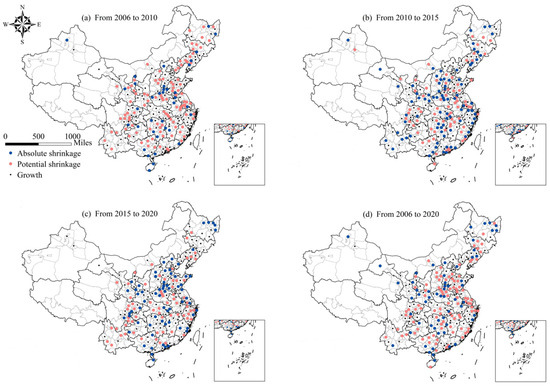
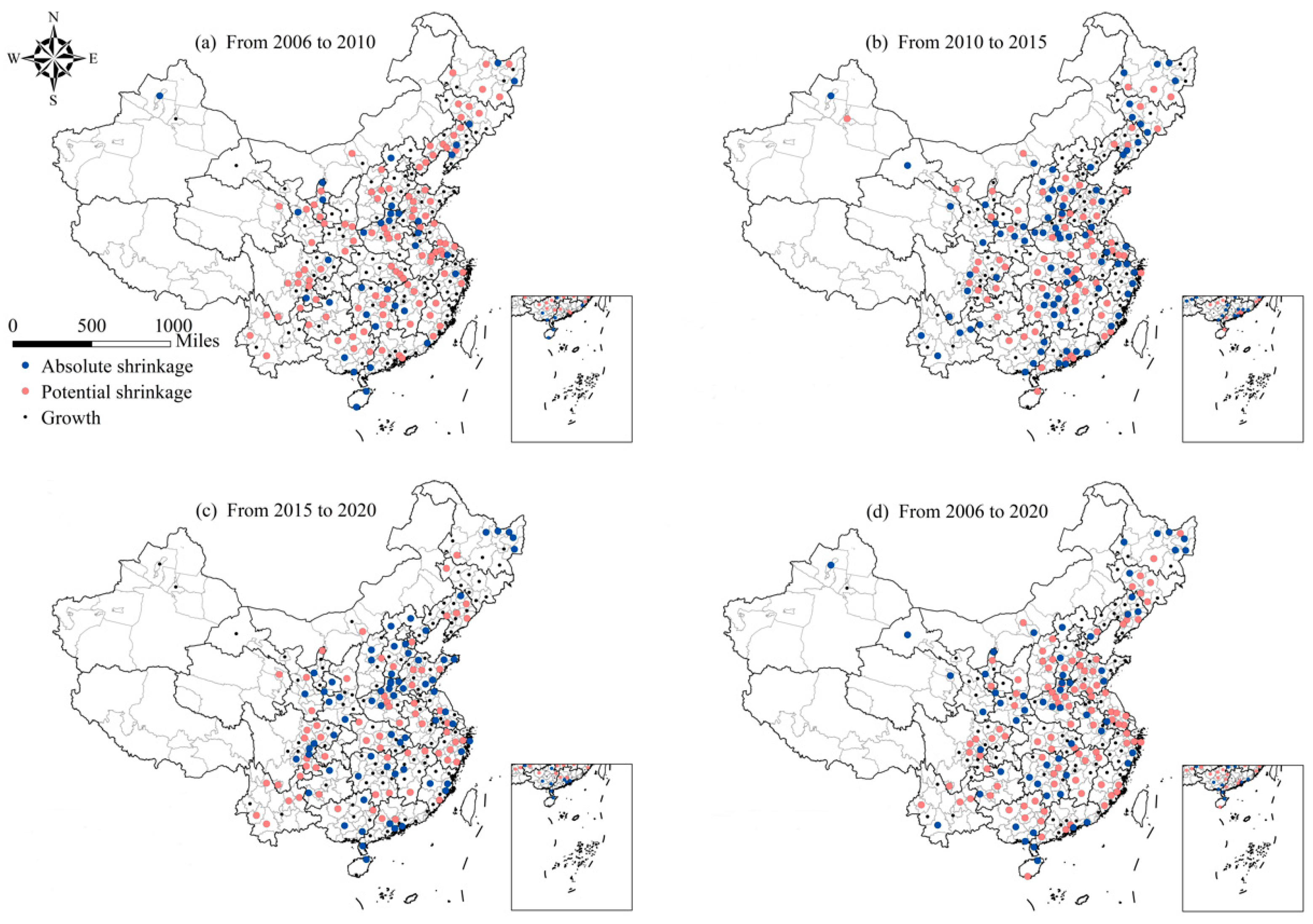
The spatial distributions of cities with absolute and potential industrial land shrinkage in China are shown in Figure 3. Figure 3a–c show the spatial distribution during the three sub-periods. Cities with absolute shrinkage were mainly located in Central China and South China from 2006 to 2010, but the number increased significantly nationwide from 2010 to 2015; and were concentrated in the eastern and central regions and less widely distributed in the western region from 2015 to 2020. Cities with potential shrinkage of industrial land were widely distributed throughout the country from 2006 to 2010, with no obvious agglomeration characteristics. They were concentrated in the central region from 2010 to 2015 and in the south from 2015 to 2020. Cities with absolute shrinkage of industrial land were primarily located in remote areas near provincial borders, whereas cities with potential industrial land shrinkage were typically large cities distributed around the major metropolises. Figure 3d shows the spatial distribution for the whole study period. From 2006 to 2020, urban industrial land shrinkage was a common phenomenon throughout the country.
Figure 3.
The spatial distribution of cities with absolute and potential industrial land shrinkage in China.
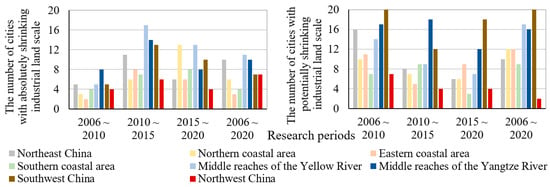
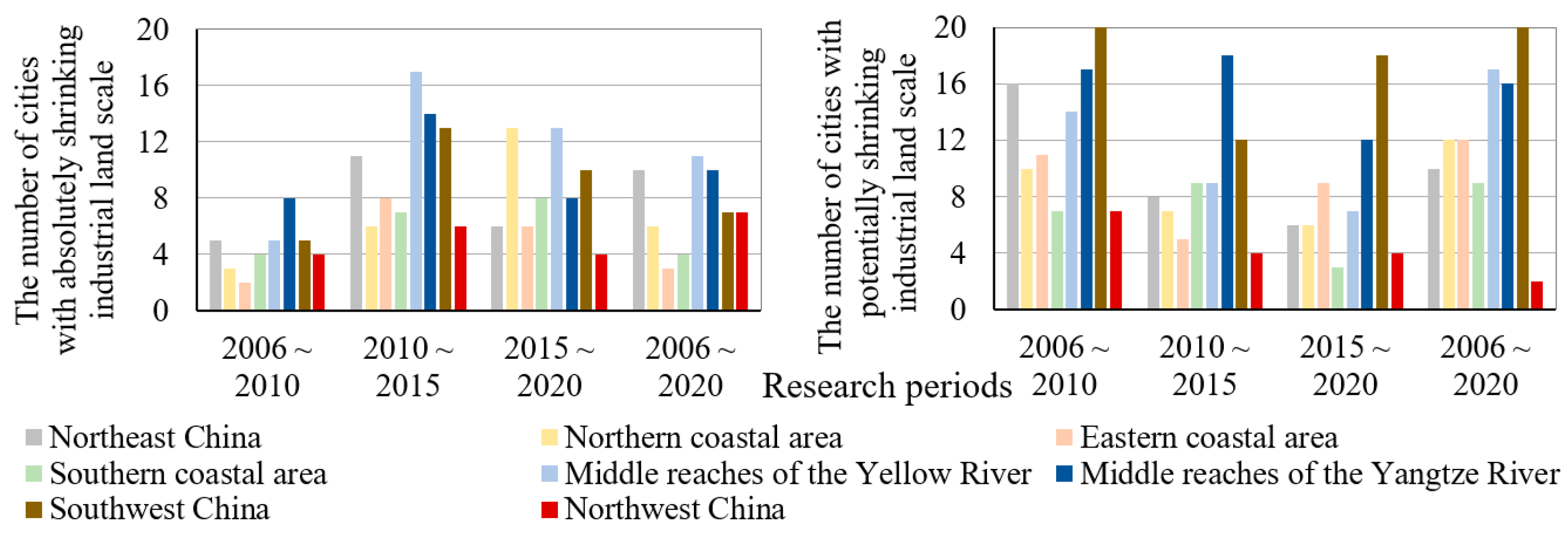
We further determined the number of cities experiencing both absolute and potential shrinkage of industrial land across the eight economic zones (Figure 4). Shrinkage was observed in all zones, albeit at varying frequencies. From 2006 to 2020, absolute shrinkage was most prevalent in Northeast China, the middle reaches of the Yellow River, and the middle reaches of the Yangtze River, while it was relatively uncommon in the three coastal areas. The cities in Northeast China were primarily resource-based, whereas those in the middle reaches of the Yellow and Yangtze rivers were dominated by outdated industrial activities. Resource-based cities reduced their demand for industrial land as their resources gradually depleted. Potential shrinkage was more frequently noted in the middle reaches of the Yellow River, the middle reaches of the Yangtze River, and Southwest China, whereas it was relatively rare in the southern coastal areas and Northwest China. The phenomenon appeared to be more common in areas characterized by poorly developed industrial structures. Over the three sub-periods, the number of cities experiencing the absolute shrinkage of industrial land increased in both the northern and southern coastal areas, while it increased and then declined in other regions. Conversely, the number of cities with potential shrinkage decreased in Northeast China, the northern coastal areas, the middle reaches of the Yellow River, the middle reaches of the Yangtze River, and Northwest China, with fluctuations observed in other regions.
Figure 4.
The number of cities with absolute and potential shrinkage of industrial land in the eight economic zones.
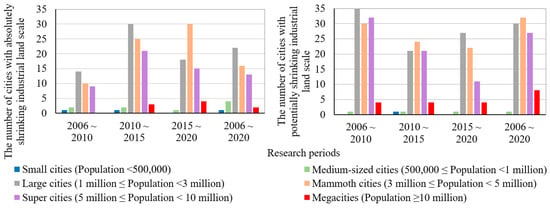
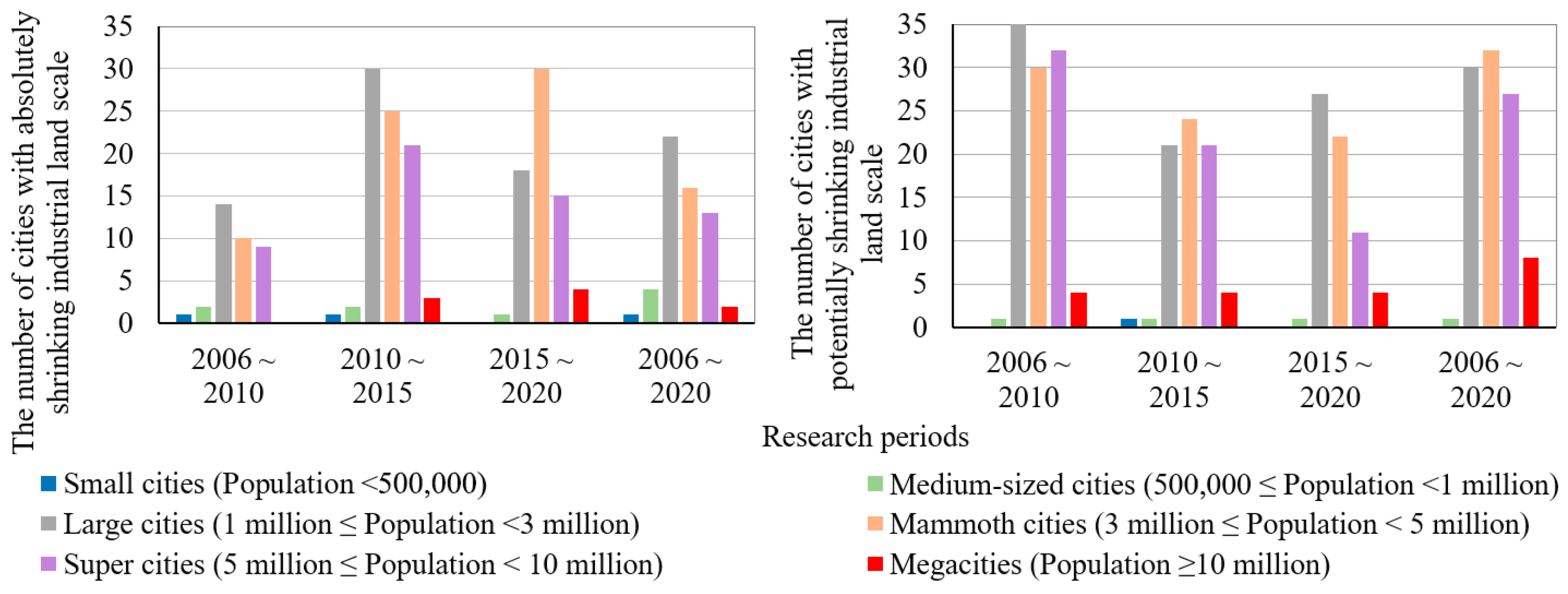
Figure 5 shows the number of cities experiencing both absolute and potential shrinkage of industrial land across six city size categories. Cities exhibiting absolute and potential shrinkage were predominantly large cities, mammoth cities, and super cities, with populations ranging from 1 million to 10 million. In terms of absolute shrinkage, cities with populations between 1 million and 3 million experienced more severe population migration as their industrial production factors were absorbed by larger cities, resulting in the most severe urban industrial land shrinkage. Potential shrinkage was most pronounced in cities with populations between 1 million and 5 million, primarily because the pace of industrial economic development in these cities was relatively slow compared to super cities and megacities. Furthermore, there was an increasing number of megacities facing absolute shrinkage of industrial land. This trend could be attributed to many megacities entering an era of deindustrialization, characterized by a diminished demand for industrial land and a shift in regional industrial structures from industry to commerce. In summary, cities with populations between 1 million and 5 million were more likely to experience a shrinkage in the scale of industrial land.
Figure 5.
The number of cities with absolute and potential shrinkage of industrial land for six sizes of cities.
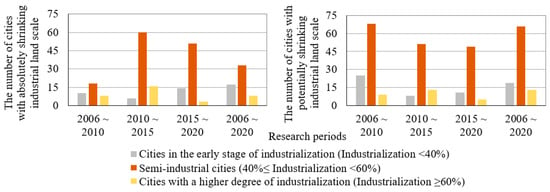
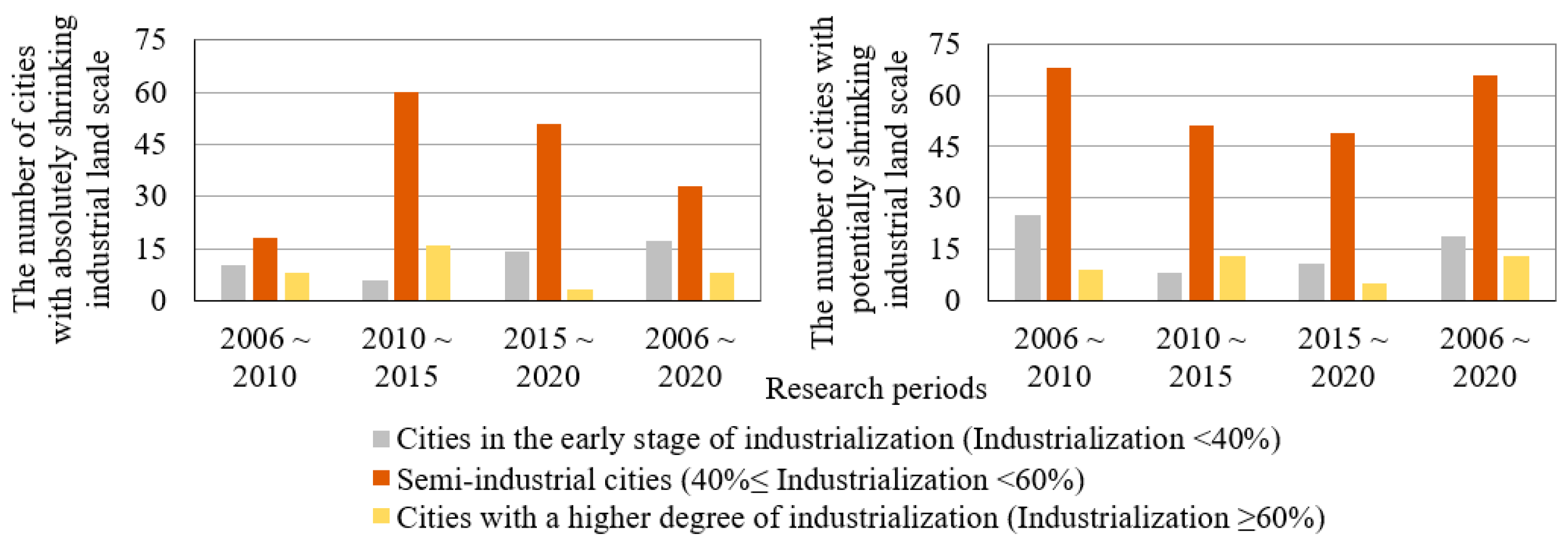
Figure 6 shows the number of cities experiencing absolute and potential shrinkage of industrial land across three different industrialization rates. Semi-industrial cities experienced the most severe urban industrial land shrinkage, followed by cities in the early stages of industrialization. This trend was consistent throughout the entire study period as well as in each of the three sub-periods analyzed. Semi-industrial cities, undergoing rapid industrialization, required an increase in their industrial land area. However, with a focus on high-quality development, some of these cities began to moderate their demand for industrial land by promoting compact development, thereby allocating more space for other land uses, such as parks, green spaces, and transportation routes. Conversely, cities with a higher rate of industrialization were less likely to decrease their industrial land area, as they typically engaged in more intensive industrial land use, and in some cases, robust industrial growth continued to drive a high demand for new industrial land.
Figure 6.
The number of cities with absolute and potential shrinkage of industrial land under three distinct industrialization rates.
Based on the above analysis, it is evident that China is experiencing substantial absolute and potential shrinkage of urban industrial land. The absolute shrinkage primarily results from resource depletion and lack of economic development, while potential shrinkage is largely driven by the pursuit of high-quality development and lack of economic development. Notably, several metropolises are experiencing the absolute shrinkage of urban industrial land as they navigate the process of deindustrialization.
5.2. The Characteristics of Urban Industrial Land Shrinkage
5.2.1. Structural Characteristics
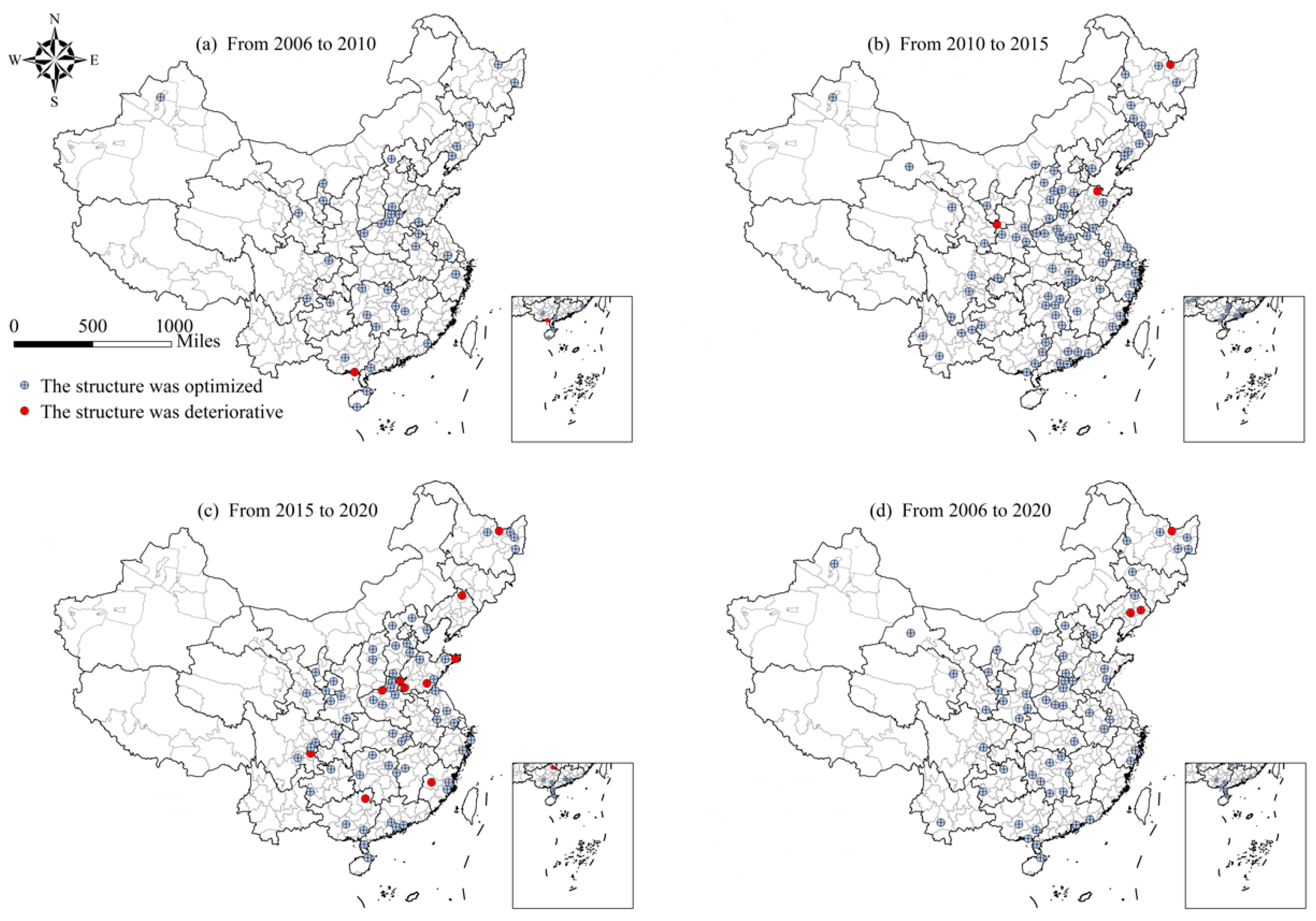
Figure 7 shows the changes in industrial land use structure in cities experiencing absolute shrinkage of industrial land. In most cities, the industrial land use structure was optimized. Although the number of cities experiencing a deteriorating industrial land use structure was small, it did show an upward trend. During the three sub-periods, one, three, and ten cities experienced deterioration, respectively. From 2006 to 2010, only one city in the southern region exhibited a deteriorating industrial land use structure (Figure 7a). From 2010 to 2015, this trend shifted northward (Figure 7b). Between 2015 and 2020, instances of deteriorating industrial land use structure appeared sporadically across the country (Figure 7c).
Figure 7.
The changes in industrial land use structure in cities with absolute shrinkage of industrial land.
Throughout the study period, the cities with a deteriorating industrial land use structure were primarily resource-based cities in Northeast China (Figure 7d). These cities experienced economic decline after their resources were depleted.
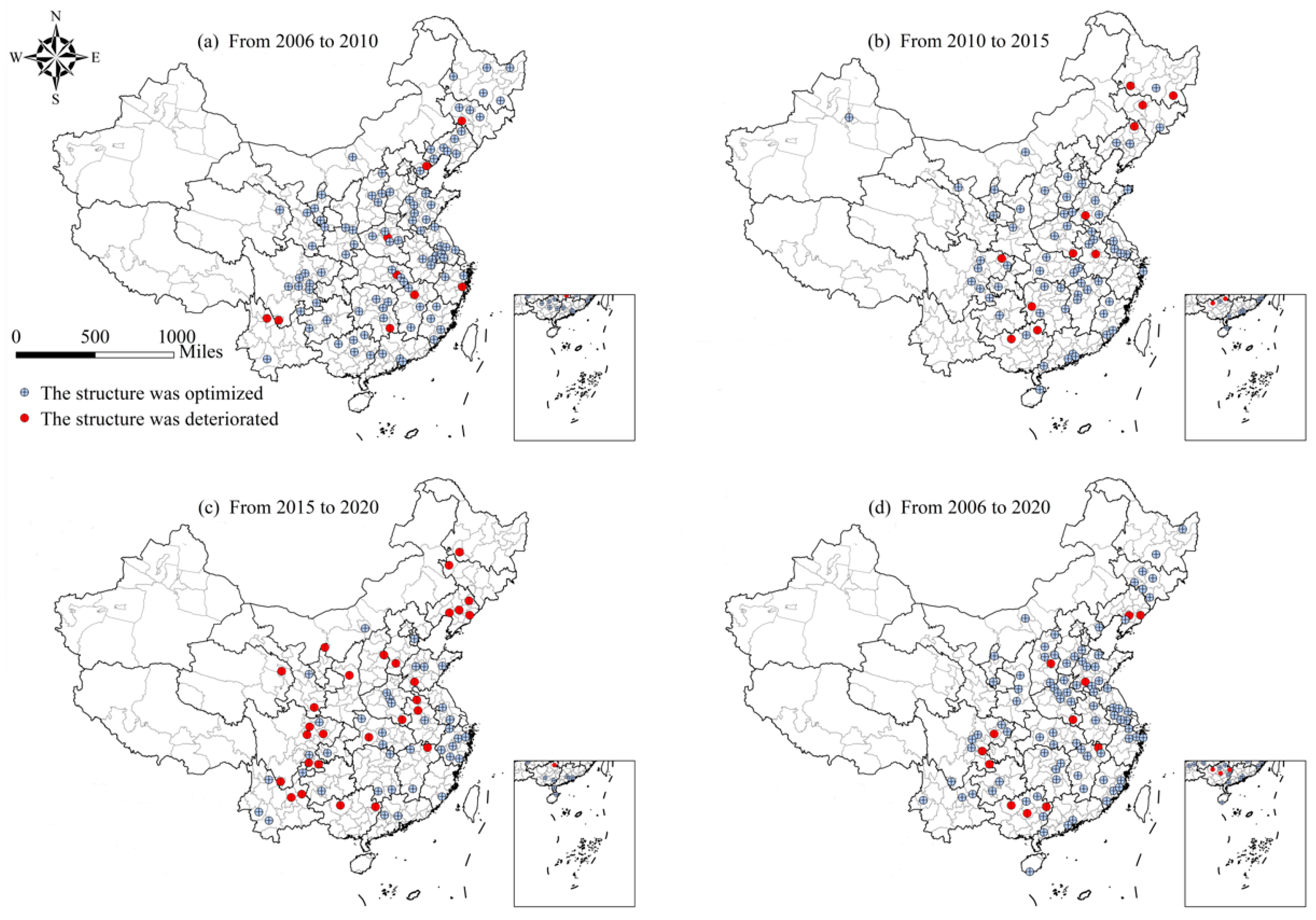
Figure 8 shows the changes in the industrial land use structure in cities experiencing potential shrinkage of industrial land. The cities exhibiting a deteriorating industrial land use structure were primarily located in remote areas, and the number of such cities increased over time. Over the three sub-periods, nine, 11, and 28 cities experienced deterioration, respectively. From 2006 to 2010, the cities with a declining industrial land use structure were predominantly located in the central and eastern regions, but this trend later shifted to the western and northeastern areas (Figure 8a–c). The inefficient utilization of industrial land and outdated industrial structures are pervasive issues in the redevelopment of industrial land in China (Figure 8d).
Figure 8.
The changes in industrial land use structure in cities with potential shrinkage of industrial land.
To assess whether urban industrial land shrinkage contributes to the optimization of industrial land use structure, we compared the number and proportion of cities with degraded industrial land use structure across the three categories of cities. Table 4 shows that cities with an expanding industrial land area experienced more serious deterioration of industrial land use structure both for the three sub-periods and the whole study period. In the three sub-periods, the proportion of cities with a degraded industrial land use structure in cities with growing industrial land area was 9%, 25%, and 11% higher, respectively, than for cities with potentially shrinking industrial land. These proportions were 15%, 37%, and 39% higher, respectively, than for cities with absolute shrinkage. Therefore, we infer that urban industrial land shrinkage contributes to the optimization of industrial land use intensity and industrial structure.
Table 4.
The degradation of industrial land use structure relative to changes in industrial land area.
5.2.2. Functional Characteristics
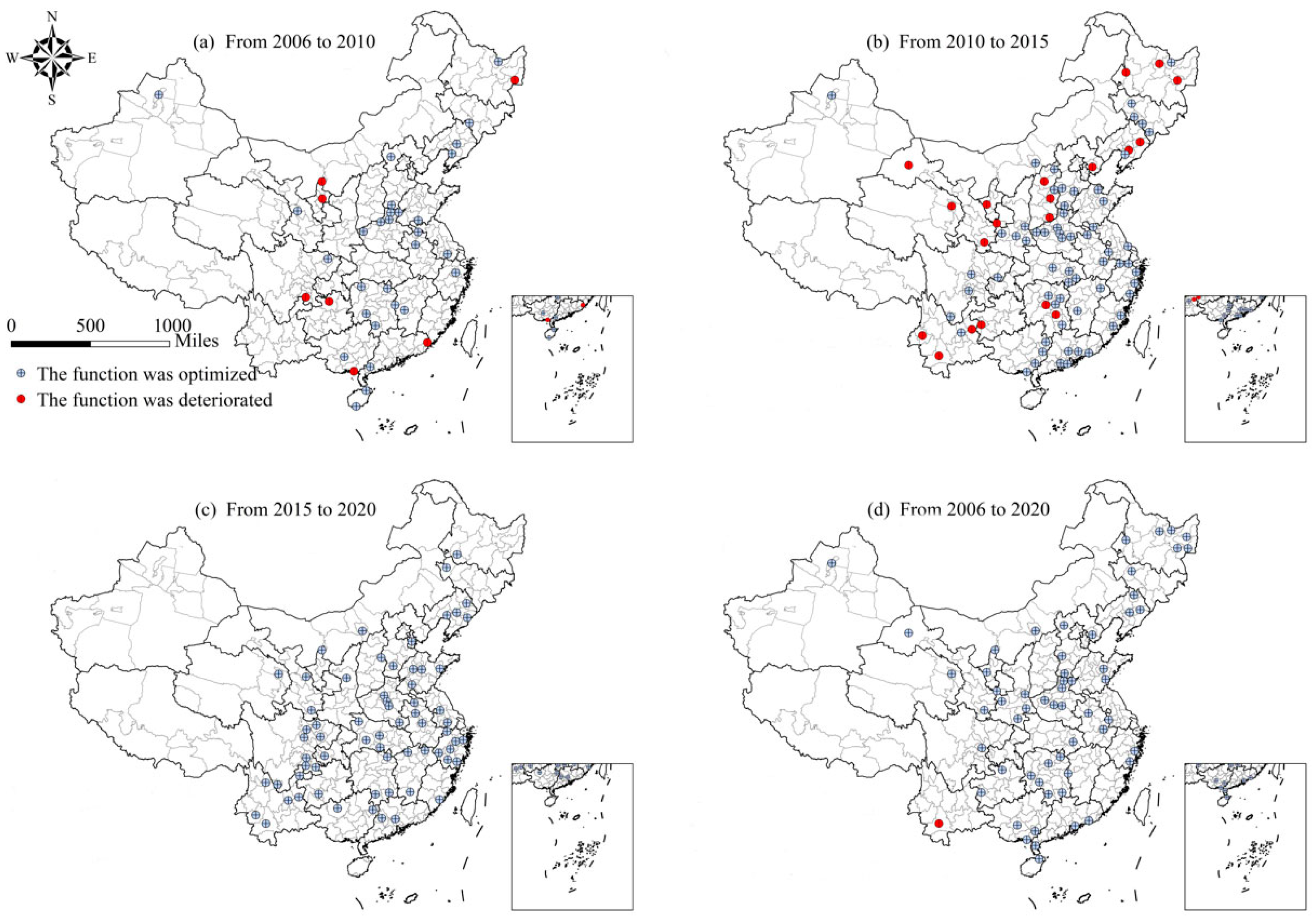
Figure 9 shows the changes in industrial land use function in cities experiencing absolute shrinkage of industrial land. While most cities experienced improvements in industrial land use function, it deteriorated in some. Throughout the three sub-periods, significant differences were observed in the changes to urban industrial land use function. The number of cities with declining industrial land use function initially increased and then decreased. Specifically, seven, 20, and zero cities experienced functional deterioration during the three sub-periods, respectively. In the first sub-period, the cities with degraded industrial land use function were primarily located in remote areas, concentrated in the western region (Figure 9a). In the second sub-period, the focus shifted to northeast China, where resource-based cities were prevalent (Figure 9b). By the third sub-period, the industrial land use function in all cities showed an improvement (Figure 9c). Over the entire period, the only city that experienced a decline in industrial land use function was located in southwest China (Figure 9d).
Figure 9.
The changes in industrial land use function in cities experiencing absolute shrinkage of industrial land.
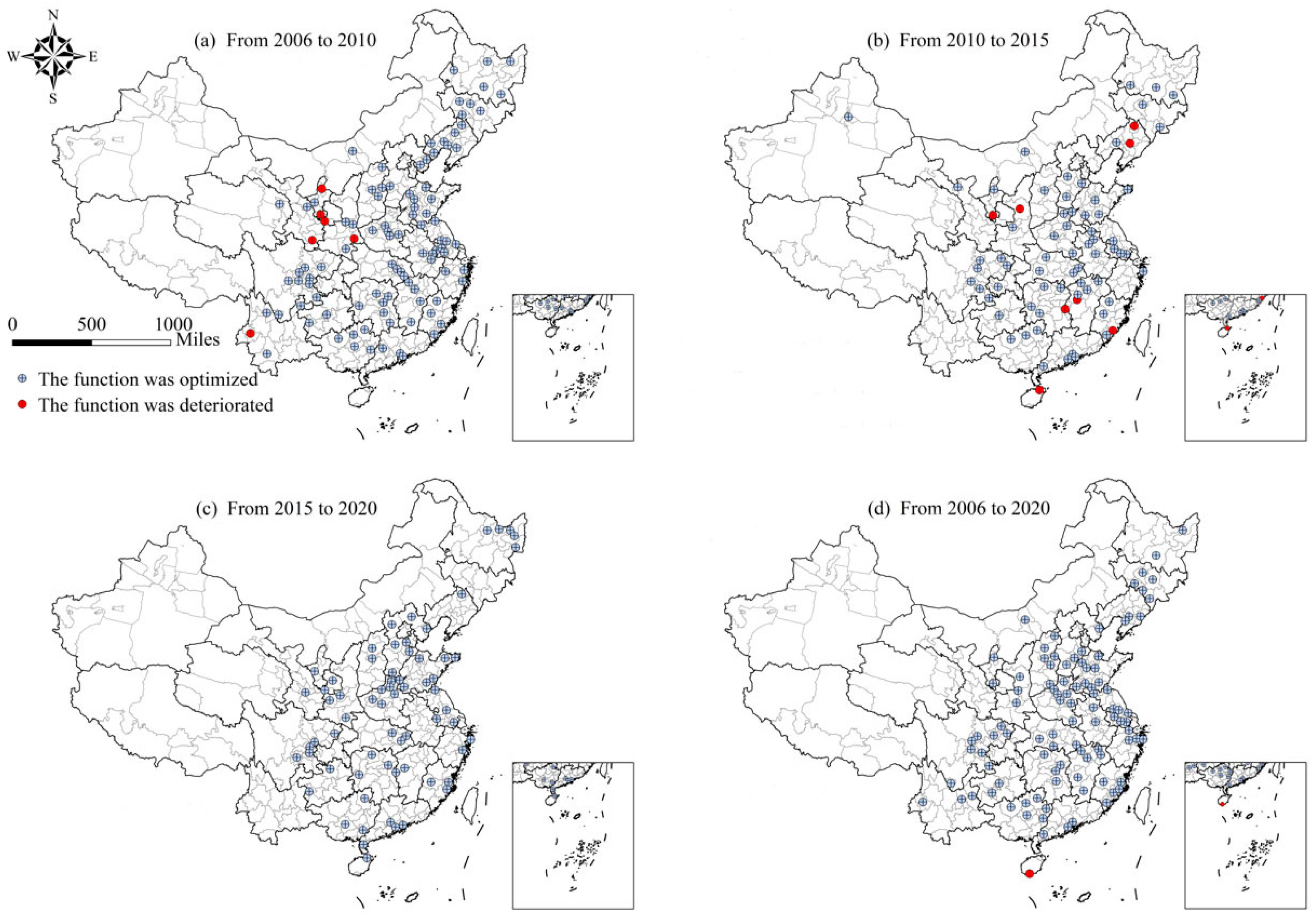
Figure 10 shows the changes in industrial land use function in cities with potential shrinkage of industrial land. The industrial land use function of most cities improved over the whole study period and each of the three sub-periods. There were six, eight, and zero cities that experienced functional deterioration in the three sub-periods, respectively. In the first sub-period, the cities with a degraded industrial land use function were mainly located in the west (Figure 10a). In period two, the trend shifted significantly to the east (Figure 10b). In the third sub-period, the industrial land use function was enhanced in all cities (Figure 10c). For the whole period, only one city’s function deteriorated (Figure 10d). This was the tourist destination of Hainan, where gradual deindustrialization led to the transformation of the industrial structure.
Figure 10.
The changes in industrial land use function in cities experiencing potential shrinkage of industrial land.
We also compared the number and proportion of cities with degraded industrial land use function across three city categories to determine whether urban industrial land shrinkage contributed to the optimization of industrial land use function. Table 5 shows that cities with expanding industrial land areas experienced a more significant deterioration in industrial land use function than cities with potentially shrinking industrial land areas. The proportions of cities with degraded industrial land use functions were 3%, 15%, and 22% higher in the three sub-periods analyzed, respectively. We therefore inferred that industrial land scale shrinkage helped mitigate the deterioration of industrial land use functions, although cities experiencing absolute shrinkage of industrial land exhibited the most severe functional degradation throughout the study period. Notably, the proportion of cities with degraded industrial land use functions among those experiencing absolute shrinkage decreased substantially in the third sub-period, whereas this proportion remained consistently high in cities with expanding industrial land areas. In summary, we conclude that urban industrial land shrinkage has contributed to increased land outputs and a reduction in industrial pollution in China.
Table 5.
The degradation of industrial land use function relative to industrial land area changes.
Overall, urban industrial land shrinkage contributes to the optimization of the structure and function of industrial land use; however, it is still accompanied by issues of structural and functional degradation. It is important to note that problems related to structural degradation are becoming increasingly severe in the context of land redevelopment projects.
5.3. Response Strategies for Urban Industrial Land Shrinkage
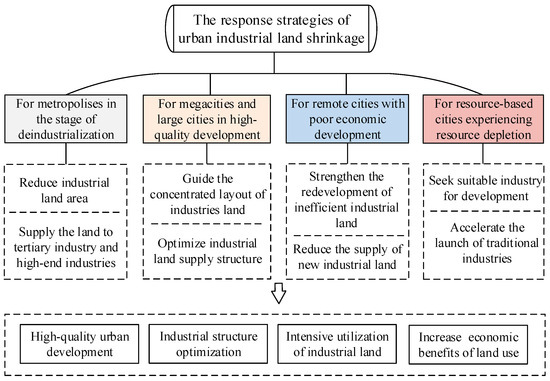
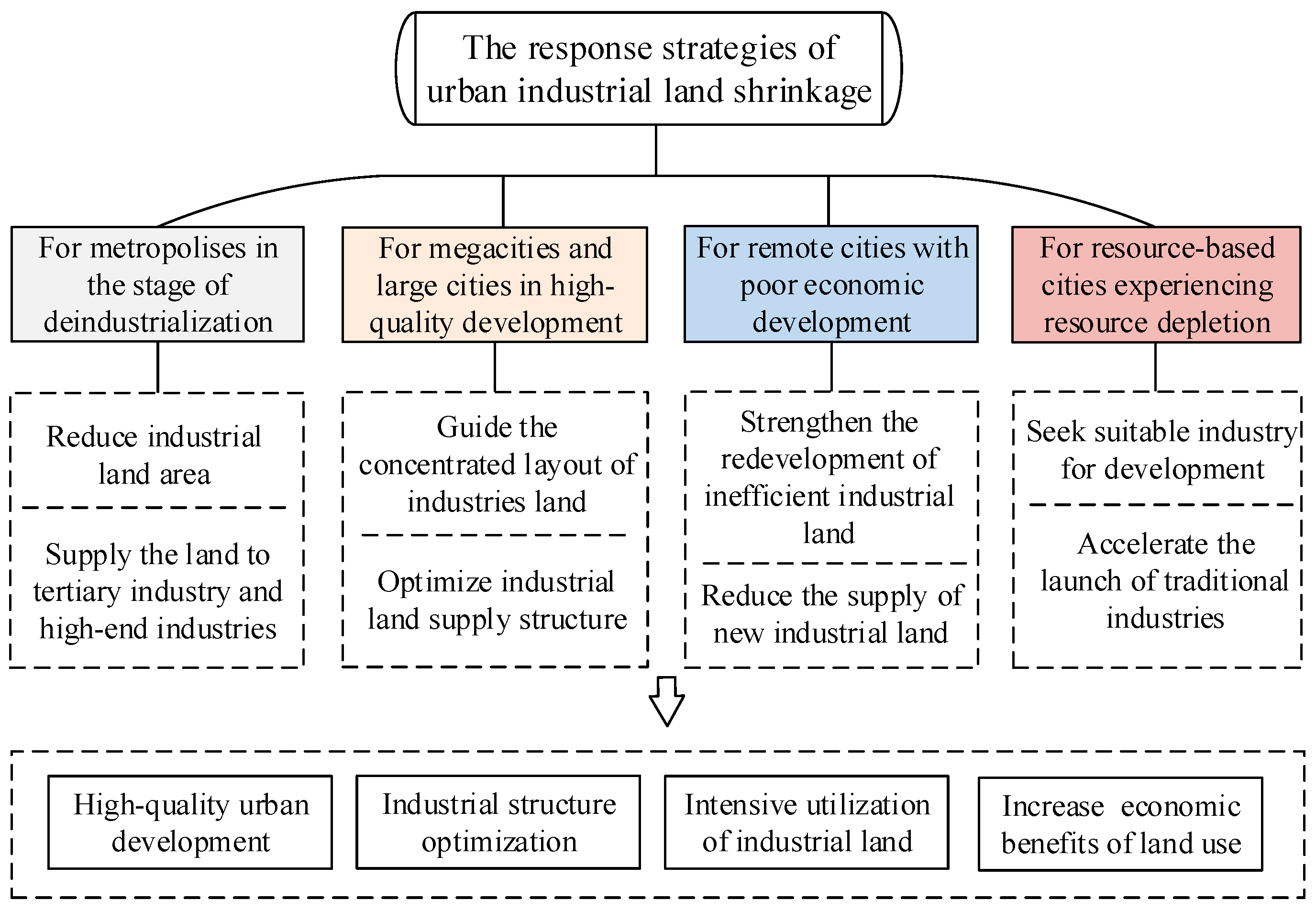
Based on the spatial distribution, structure, and functional characteristics of urban industrial land shrinkage, we propose the following response strategies for addressing urban industrial land shrinkage tailored to the four different formation mechanisms (Figure 11).
Figure 11.
The response strategies for urban industrial land shrinkage.
For metropolises undergoing deindustrialization, it is essential to gradually implement policies aimed at reducing the area designated for industrial use. Local governments should promote the systematic recycling of industrial land. This process should be phased to avoid sudden economic disruption, while leveraging the existing infrastructure for adaptive reuse. Additionally, the industrial structure should be reoriented to focus on the tertiary sector and high-end industries, capitalizing on the region’s strengths in skills, information, and economic development.
For some megacities and large cities that prioritize high-quality development, a strong momentum for industrial growth remains. Local governments should avoid implementing overly strict policies regarding restrictions on the scale of industrial land. Instead, differentiated land-use policies should be adopted, allowing strategic expansion in high-value industrial corridors while tightening control in core urban zones. Collaborative efforts should promote the optimization of industrial structure and industrial land layout. Optimizing the layout and supply of industrial land is a crucial objective in land management. In terms of layout, guiding the concentrated arrangement of industrial land will promote more intensive land use. Clustering industries in designated zones enhances synergies, reduces logistical costs, and facilitates shared infrastructure. Regarding supply, local governments should phase out outdated industries and support the development of high-tech and high-end industries by optimizing the structure of land supply. This could be achieved through preferential leasing, streamlined approval for priority sectors, and stricter environmental benchmarks for new industrial projects.
Cities in remote locations with limited economic development and a lack of technological innovation are key areas of potential industrial land shrinkage. The degradation of the industrial land structure and function requires urgent attention, especially given that structural degradation is increasingly pronounced. Although these cities are still in a phase of ongoing industrial economic development, they face challenges due to outdated production technologies and a delay in advancing high-tech industries. This has resulted in a decline in the intensity of industrial land use and has hindered the transformation and upgrading of the industrial structure. However, these cities have substantial potential for industrial land recycling. The focus should shift from expansion to revitalization, modernizing existing facilities rather than adding new land. Governments should prioritize the redevelopment of inefficient industrial land and continue to limit the supply of new industrial land to encourage the intensive use of existing land resources.
Resource-based cities represent critical areas experiencing absolute shrinkage of urban industrial land. The degradation of industrial land structure and function in these cities requires urgent attention, with functional degradation being particularly prominent. Unlike structural issues, functional decline reflects a loss of economic purpose and environmental viability, and is often accompanied by soil pollution and infrastructure decay. These cities face industrial economic decline due to the rapid depletion of natural resources utilized in industrial production. Local governments are advised to identify appropriate industries for development and create comprehensive industrial development plans, rather than indiscriminately pursuing growth. Transition pathways may include tourism centered on industrial heritage, renewable energy projects, or precision processing industries based on local assets. Additionally, local authorities should expedite the recovery of inefficient industrial land that is unsuitable for regional development and establish stringent criteria for the allocation of new industrial land. Urban land should be prioritized for green industries, profitable sectors, and emerging industries.
6. Discussion
Our study revealed that urban industrial land shrinkage has become a widespread phenomenon across China. Most urban areas have experienced either absolute or potential shrinkage of industrial land, indicating a shift in urban industrial land use from the incremental development of new areas toward more intensive utilization of existing stock. Therefore, we argue it is essential to analyze and understand urban industrial land shrinkage in the context of high-quality development. Current research on the redevelopment of urban industrial land in China has primarily focused on metropolises such as Shenzhen, Shanghai, and Beijing. Our findings revealed that urban industrial land shrinkage is more prevalent in semi-industrial cities and those with populations ranging from 1 million to 5 million. Accordingly, governments should prioritize the redevelopment of industrial land in cities with lower administrative levels, smaller populations, and more remote geographical locations.
We propose that urban industrial land shrinkage should be guided appropriately in accordance with industrialization processes, economic development, and resource endowments. Our research findings indicated that the characteristics of shrinkage differed across the four generational mechanisms. Metropolises and resource-based cities are primarily experiencing absolute shrinkage, necessitating an increase in the recycling of inefficient land, together with strict controls on the supply of new industrial land. Megacities and large cities are likely to experience potential shrinkage due to the intensive utilization of industrial land. Some geographically remote cities display both absolute and potential shrinkage trends during urbanization. Local governments should therefore enhance the consolidation of industrial land and optimize its layout based on the needs of industrial development.
Extensive or inefficient land use remains a serious issue that must be addressed regarding urban industrial land shrinkage. The number of cities experiencing deterioration in their industrial land use structure gradually increased over the three sub-periods. This trend was evident in cities facing both absolute and potential shrinkage of industrial land, highlighting a critical issue. Cities experiencing potential shrinkage exhibited more severe structural deterioration issues. Between 2015 and 2020, nearly half of these cities reported a decline in their industrial land use structure. There is a need to further investigate the challenges associated with redeveloping inefficient urban land in China. The government must establish stringent redevelopment criteria that meet or exceed the original standards and implement a comprehensive set of reward and penalty measures. Urban land redevelopment projects should genuinely promote more intensive land use.
7. Conclusions
In a departure from the focus of previous research, which has primarily examined the expansion of industrial land, our study analyzed the mechanisms controlling urban industrial land shrinkage. We identified the spatial patterns and characteristics of shrinkage at the municipal scale in China from 2006 to 2020 and proposed response strategies. Our analysis considered changes in the area of both urban industrial land and urban built-up land, providing a comprehensive examination of absolute and potential shrinkage.
The results indicated that the urban industrial land shrinkage is primarily driven by the deindustrialization of metropolises, high-quality development of megacities and large cities, lack of economic development in cities located in remote areas, and resource depletion in resource-based cities. This phenomenon has become widespread across the country, indicating a shift in urban industrial land use from the incremental development of new areas toward the enhanced utilization of existing stock. Absolute shrinkage is predominantly attributed to resource depletion and lack of economic development, while potential shrinkage is mainly influenced by high-quality development and a lack of economic development. Increasingly, metropolises are experiencing the absolute shrinkage of urban industrial land as a result of deindustrialization.
Urban industrial land shrinkage contributes to the optimization of the structure and function of industrial land use, but it is still accompanied by problems of structural and functional degradation. Cities with potential shrinkage exhibit more serious structural deterioration, while cities with absolute shrinkage face more serious functional degradation. The problem of structural degradation is becoming increasingly severe in the promotion of land redevelopment projects.
Going forward, more attention needs to be given to the re-utilization of stock urban industrial land. Urban land redevelopment projects need to be conducted in accordance with the principle of intensive use. Local governments can gradually implement policies to reduce industrial land in metropolises undergoing deindustrialization, optimize the layout and supply of industrial land in megacities and large cities, strengthen the redevelopment of inefficient industrial sites, limit the supply of new industrial land in remote cities, and develop suitable types of industries in resource-based cities.
This study had some limitations that need to be improved in future research. We identified the overall state of urban industrial land shrinkage in 233 cities based solely on statistical data related to the urban area. If we could obtain a specific spatial distribution of industrial sites, the spatial characteristics of industrial land shrinkage could be analyzed in more depth. Additionally, we have simply calculated the changes in the structure and function of industrial land use during shrinkage. In the future, econometric models could be used to establish the relationship between shrinkage and these changes.
Author Contributions
Conceptualisation, B.L.; methodology, W.L.; software, W.L.; validation, H.Z.; formal analysis, B.L.; investigation, B.L.; data curation, W.L.; writing—original draft preparation, B.L.; writing—review and editing, H.Z.; visualisation, B.L.; supervision, B.L.; project administration, B.L.; funding acquisition, B.L. All authors have read and agreed to the published version of the manuscript.
Funding
This work was financially supported by the National Natural Science Foundation of China (No. 42401312), and the Natural Science Foundation of Hubei Province, China (No. 2023AFB100).
Data Availability Statement
The original contributions presented in the study are included in the article. Further inquiries can be directed to the corresponding author.
Conflicts of Interest
The authors declare no conflicts of interest.
References
- Needham, B.; Louw, E.; Metzemakers, P. An economic theory for industrial land policy. Land Use Policy 2013, 33, 227–234. [Google Scholar] [CrossRef] [Scilit]
- Mahammedi, C.; Mahdjoubi, L.; Booth, C.A.; Butt, T.E. Framework for preliminary risk assessment of brownfield sites. Sci. Total Environ. 2022, 807, 151069. [Google Scholar] [CrossRef] [Scilit] [PubMed]
- Song, Y.; Lyu, Y.; Qian, S.; Zhang, X.; Lin, H.; Wang, S. Identifying urban candidate brownfield sites using multi-source data: The case of Changchun City, China. Land Use Policy 2022, 117, 106084. [Google Scholar] [CrossRef] [Scilit]
- Thomas, M.R. A GIS-based decision support system for brownfield redevelopment. Landsc. Urban Plan. 2002, 58, 7–23. [Google Scholar] [CrossRef] [Scilit]
- De Sousa, C.A. Turning brownfields into green space in the City of Toronto. Landsc. Urban Plan. 2003, 62, 181–198. [Google Scholar] [CrossRef] [Scilit]
- Preston, P.D.; Dunk, R.M.; Smith, G.R.; Cavan, G. Not all brownfields are equal: A typological assessment reveals hidden green space in the city. Landsc. Urban Plan. 2023, 229, 104590. [Google Scholar] [CrossRef] [Scilit]
- Sessa, M.R.; Russo, A.; Sica, F. Opinion paper on green deal for the urban regeneration of industrial brownfield land in Europe. Land Use Policy 2022, 119, 106198. [Google Scholar] [CrossRef] [Scilit]
- Gao, J.; Chen, W. Spatial restructuring and the logic of industrial land redevelopment in urban China: III. A case study of the redevelopment of a central state-owned enterprise in Nanjing. Cities 2020, 96, 102460. [Google Scholar] [CrossRef] [Scilit]
- Lai, Y.; Zhang, X. Redevelopment of industrial sites in the Chinese ‘villages in the city’: An empirical study of Shenzhen. J. Clean. Prod. 2016, 134, 70–77. [Google Scholar] [CrossRef] [Scilit]
- Gu, X.-K.; Zhou, X.-P.; Liu, B.-Y.; Zhang, S.-L.; Liu, R. Using ‘Situation-Structure-Implementation-Outcome’ framework to analyze the reduction governance of the inefficient industrial land in Shanghai. J. Nat. Resour. 2022, 37, 1413–1424. [Google Scholar] [CrossRef] [Scilit]
- Wang, H.; Shen, Q.; Tang, B.-S.; Skitmore, M. An integrated approach to supporting land-use decisions in site redevelopment for urban renewal in Hong Kong. Habitat Int. 2013, 38, 70–80. [Google Scholar] [CrossRef] [Scilit]
- Zhou, L. Optimization of Industrial Land Allocation from the Perspective of High-quality Development During the 14th Five-Year Plan. China Soft Sci. 2020, 10, 156–164. [Google Scholar]
- Cheng, F.; Geertman, S.; Kuffer, M.; Zhan, Q. An integrative methodology to improve brownfield redevelopment planning in Chinese cities: A case study of Futian, Shenzhen. Comput. Environ. Urban Syst. 2011, 35, 388–398. [Google Scholar] [CrossRef] [Scilit]
- Deng, X.; Huang, J.; Rozelle, S.; Uchida, E. Growth, population and industrialization, and urban land expansion of China. J. Urban Econ. 2006, 63, 96–115. [Google Scholar] [CrossRef] [Scilit]
- Guo, F.; Qu, X.; Ma, Y.; Tong, L. Spatiotemporal pattern evolution and influencing factors of shrinking cities: Evidence from China. Cities 2021, 119, 103391. [Google Scholar] [CrossRef] [Scilit]
- Sun, P. Urban shrinkage: Connotation-sinicization-framework of analysis. Prog. Geogr. 2022, 41, 1478–1491. [Google Scholar] [CrossRef] [Scilit]
- Cheng, H.; Lai, Y.; Tong, D. Decoding the decision-making in the new wave of urban redevelopment in China: A case study of a bottom-up industrial land redevelopment in Shenzhen. Land Use Policy 2021, 111, 105774. [Google Scholar] [CrossRef] [Scilit]
- Gao, J.; Qiao, W.; Ji, Q.; Yu, C.; Sun, J.; Ma, Z. Intensive-use-oriented identification and optimization of industrial land readjustment during transformation and development: A case study of Huai’an, China. Habitat Int. 2021, 118, 102451. [Google Scholar] [CrossRef] [Scilit]
- Wang, W.; Liu, Z.; Liu, C.; Zhang, Y.; Chen, Y. Spatial change characteristics and smart shrinkage strategies in resource-exhausted cities: A case study of Zaozhuang City. Resour. Sci. 2024, 46, 1131–1143. [Google Scholar]
- Chen, W.; Shen, Y.; Wang, Y.; Wu, Q. The effect of industrial relocation on industrial land use efficiency in China: A spatial econometrics approach. J. Clean. Prod. 2018, 205, 525–535. [Google Scholar] [CrossRef] [Scilit]
- Guo, G.; Peng, Z.; Zhou, Z. Impact of Industrial Enterprise Type of Macro Perspective on Industrial Land Use Efficiency. Resour. Environ. Yangtze Basin 2019, 28, 241–249. [Google Scholar] [CrossRef]
- Fujita, M.; Thisse, J.-F. New Economic Geography: An appraisal on the occasion of Paul Krugman’s 2008 Nobel Prize in Economic Sciences. Reg. Sci. Urban Econ. 2008, 39, 109–119. [Google Scholar] [CrossRef] [Scilit]
- Frantál, B.; Greer-Wootten, B.; Klusáček, P.; Krejčí, T.; Kunc, J.; Martinát, S. Exploring spatial patterns of urban brownfields regeneration: The case of Brno, Czech Republic. Cities 2015, 44, 9–18. [Google Scholar] [CrossRef] [Scilit]
- Zhang, X.; Zhang, Q.; Zhang, X.; Gu, R. Spatial-temporal evolution pattern of multidimensional urban shrinkage in China and its impact on urban form. Appl. Geogr. 2023, 159, 103062. [Google Scholar] [CrossRef] [Scilit]
- Wang, Y.; Gu, H.; Zhou, L.; Shen, T. Spatial Patterns and Evolving Characteristics of Industrial Land Conveyance in China from 2007 to 2016. Areal Res. Dev. 2017, 37, 148–154. [Google Scholar]
- Li, L.; Wang, Z.; Meng, H.; Li, J. Temporal-spatial evolution and mechanism of industrial land supply in Yangtze River Economic Zone. Resour. Ind. 2021, 23, 55–62. [Google Scholar] [CrossRef]
- Zhu, Z.; He, Q.; Qu, X. Evolution Characteristics of Industrial Land of Urban Agglomerations in the Middle Reaches of the Yangtze River. Econ. Geogr. 2021, 41, 106–114. [Google Scholar] [CrossRef]
- Zhao, W.; Li, G. Temporal-Spatial Evolution of Industrial Land in Xi’an City with Background of Rapid Urbanization. China Popul. Resour. Environ. 2009, 19, 64–69. [Google Scholar]
- Liu, W.; Yang, F. Study on the Industrial Spatial Evolution of Wuhan Urban Area from 2010 to 2020. Archit. Cult. 2021, 12, 192–194. [Google Scholar] [CrossRef]
- Rao, Y.; Yang, J. Analysis on Spatial and Temporal Evolution of Industrial Land Under Industry Classification in Wuhan City. Resour. Environ. Yangtze Basin 2020, 29, 1525–1534. [Google Scholar] [CrossRef]
- Shi, H.; Shang, Z. Spatial Layout and Evolution Law of Urban Industrial Land: Taking Central Urban Area of Suzhou as an Example. Urban Archit. Space 2025, 32, 79–83. [Google Scholar]
- Zhang, L.; Yue, W.; Liu, Y.; Fan, P.; Wei, Y.D. Suburban industrial land development in transitional China: Spatial restructuring and determinants. Cities 2018, 78, 96–107. [Google Scholar] [CrossRef] [Scilit]
- Wen, W.; Zhou, D.; Su STian, Y. The Evolution of Industrial Land in Beijing during the Transitional Period: Based on the Industrial Clarification. China Land Sci. 2017, 31, 32–39. [Google Scholar]
- Rizzo, E.; Pesce, M.; Pizzol, L.; Alexandrescu, F.M.; Giubilato, E.; Critto, A.; Marcomini, A.; Bartke, S. Brownfield regeneration in Europe: Identifying stakeholder perceptions, concerns, attitudes and information needs. Land Use Policy 2015, 48, 437–453. [Google Scholar] [CrossRef] [Scilit]
- Zhu, J. The impact of industrial land use policy on industrial change. Land Use Policy 2000, 17, 21–28. [Google Scholar] [CrossRef] [Scilit]
- Guo, Y.; Li, L. Change in the Negative Externality of the Shrinking Cities in China. Sci. Geogr. Sin. 2019, 39, 52–60. [Google Scholar] [CrossRef]
- Wei, H.; Wang, S. Phenomenon Analysis and Theoretical Reflection of China’s ‘Over De-industrialization’. China Ind. Econ. 2019, 1, 5–22. [Google Scholar] [CrossRef]
- Gong, Q. Promote high-quality development through industrial land allocation policies. China Land 2023, 4–7. [Google Scholar] [CrossRef]
- Wang, S.; Guo, S. Study on Countermeasures for Sustainable Development of Resource-Exhausted Cities. China Soft Sci. 2012, 1–13. Available online: https://kns.cnki.net/kcms2/article/abstract?v=YQFK0XGjx43NsJLUmqvNAqEI2YrPWlx6IpPGqEga7joIi9mg1wa3lIBjyOuiCHsHgPzkS-GMRhzGhjpMTE_s-Dev6qyyi3wsa0BBm7YoEnLhGfm9FmQeo1xcqSwa9ZnAvY1yrox_ziRQzbC27_qaWIq7bKZ2WPI7fz6q0QRnzOJHC_LSfURzpw==&uniplatform=NZKPT&language=CHS (accessed on 2 March 2012).
- Deng, Z.; Li, L.; Wang, J.; Cao, Y. Regional differences and driving factors of China’s industrial ecological efficiency: Based on technology heterogeneity. Resour. Sci. 2022, 44, 1009–1021. [Google Scholar] [CrossRef] [Scilit]
- Loures, L.; Vaz, E. Exploring expert perception towards brownfield redevelopment benefits according to their typology. Habitat Int. 2018, 72, 66–76. [Google Scholar] [CrossRef] [Scilit]
- Xu, W.; Zeng, Z.; Xu, Z.; Li, X.; Chen, X.; Li, X.; Xiao, R.; Liang, J.; Chen, G.; Lin, A.; et al. Public health benefits of optimizing urban industrial land layout—The case of Changsha, China. Environ. Pollut. 2020, 263, 114388. [Google Scholar] [CrossRef] [Scilit]
- Huang, Z.; Song, L.; Gao, B.; Jiang, L. Industrial land transfer, industrial selection and urban air quality. Geogr. Res. 2022, 41, 229–250. [Google Scholar] [CrossRef]
- Cheng, Z.; Li, X.; Zhang, Q. Can new-type urbanization promote the green intensive use of land? J. Environ. Manag. 2023, 342, 118150. [Google Scholar] [CrossRef] [Scilit]
- Xie, H.; Zhai, Q.; Wang, W.; Yu, J.; Lu, F.; Chen, Q. Does intensive land use promote a reduction in carbon emissions? Evidence from the Chinese industrial sector. Resour. Conserv. Recycl. 2018, 137, 167–176. [Google Scholar] [CrossRef] [Scilit]
- Li, B.; Wang, Z.; Chai, J.; Zhang, D. Index system to assess implementation of strategic land use plans in China. Land Use Policy 2019, 88, 104148. [Google Scholar] [CrossRef] [Scilit]

Disclaimer/Publisher’s Note: The statements, opinions and data contained in all publications are solely those of the individual author(s) and contributor(s) and not of MDPI and/or the editor(s). MDPI and/or the editor(s) disclaim responsibility for any injury to people or property resulting from any ideas, methods, instructions or products referred to in the content. |
© 2026 by the authors. Licensee MDPI, Basel, Switzerland. This article is an open access article distributed under the terms and conditions of the Creative Commons Attribution (CC BY) license.