Article

Structural Evolution of the Coastal Landscape in Klaipėda Region, Lithuania: 125 Years of Political and Sociocultural Transformations


by
Thomas Gloaguen
1,2,*,
Sébastien Gadal
2,
Jūratė Kamičaitytė
1 and
Kęstutis Zaleckis
1,3
1
Cultural and Spatial Environment Research Group, Faculty of Civil Engineering and Architecture, Kaunas University of Technology, LT-51367 Kaunas, Lithuania
2
UMR 7300 ESPACE, CNRS, Aix Marseille Université, Université Côte-d’Azur, Avignon Université, 84029 Avignon, France
3
NEB Research Center, Vilnius Academy of Arts, LT-01124 Vilnius, Lithuania
*
Author to whom correspondence should be addressed.
Land 2025, 14(7), 1356; https://doi.org/10.3390/land14071356
Submission received: 29 May 2025 / Revised: 21 June 2025 / Accepted: 23 June 2025 / Published: 26 June 2025
(This article belongs to the Special Issue Spatial-Temporal Evolution Analysis of Land Use)

Abstract

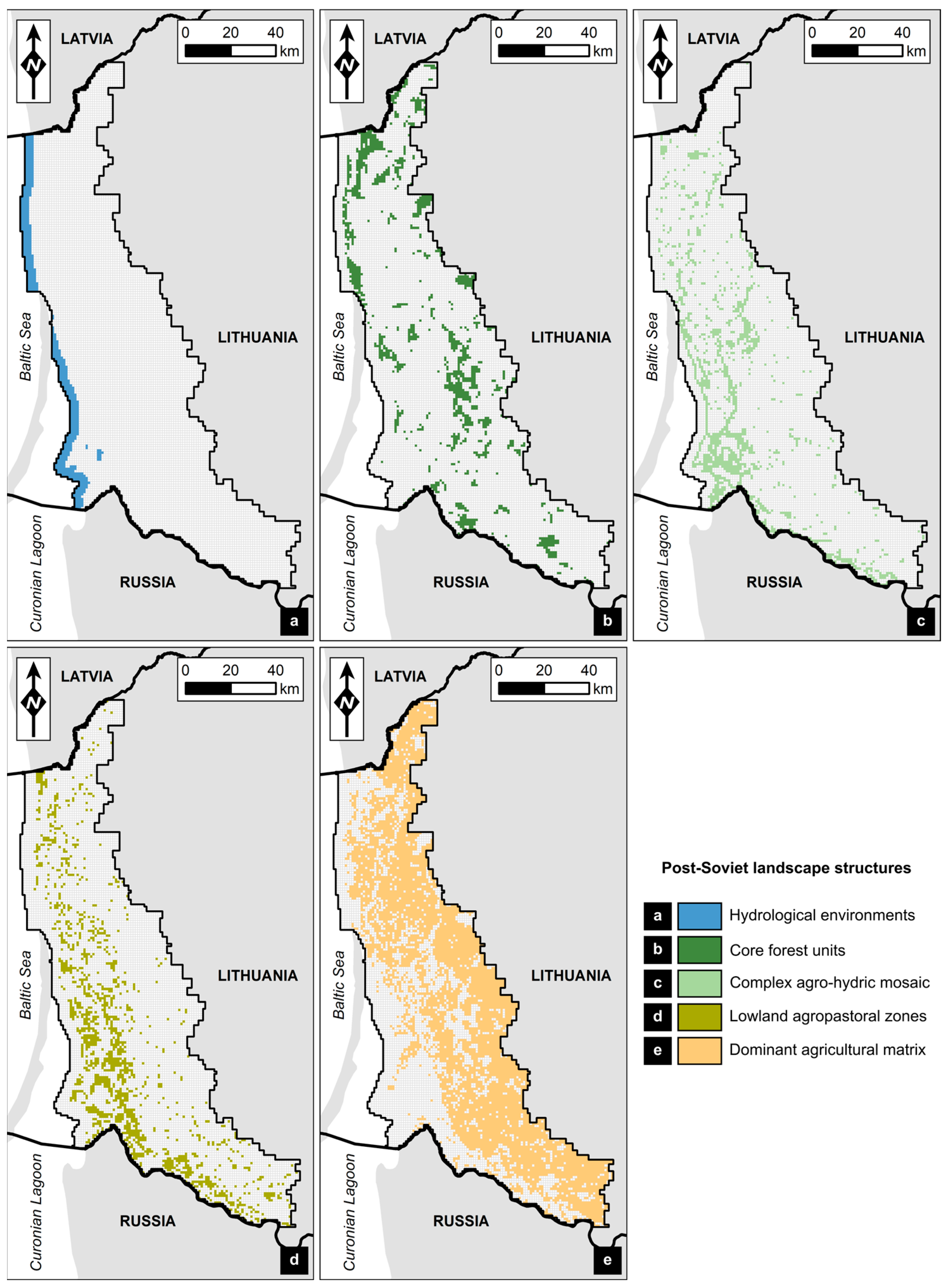
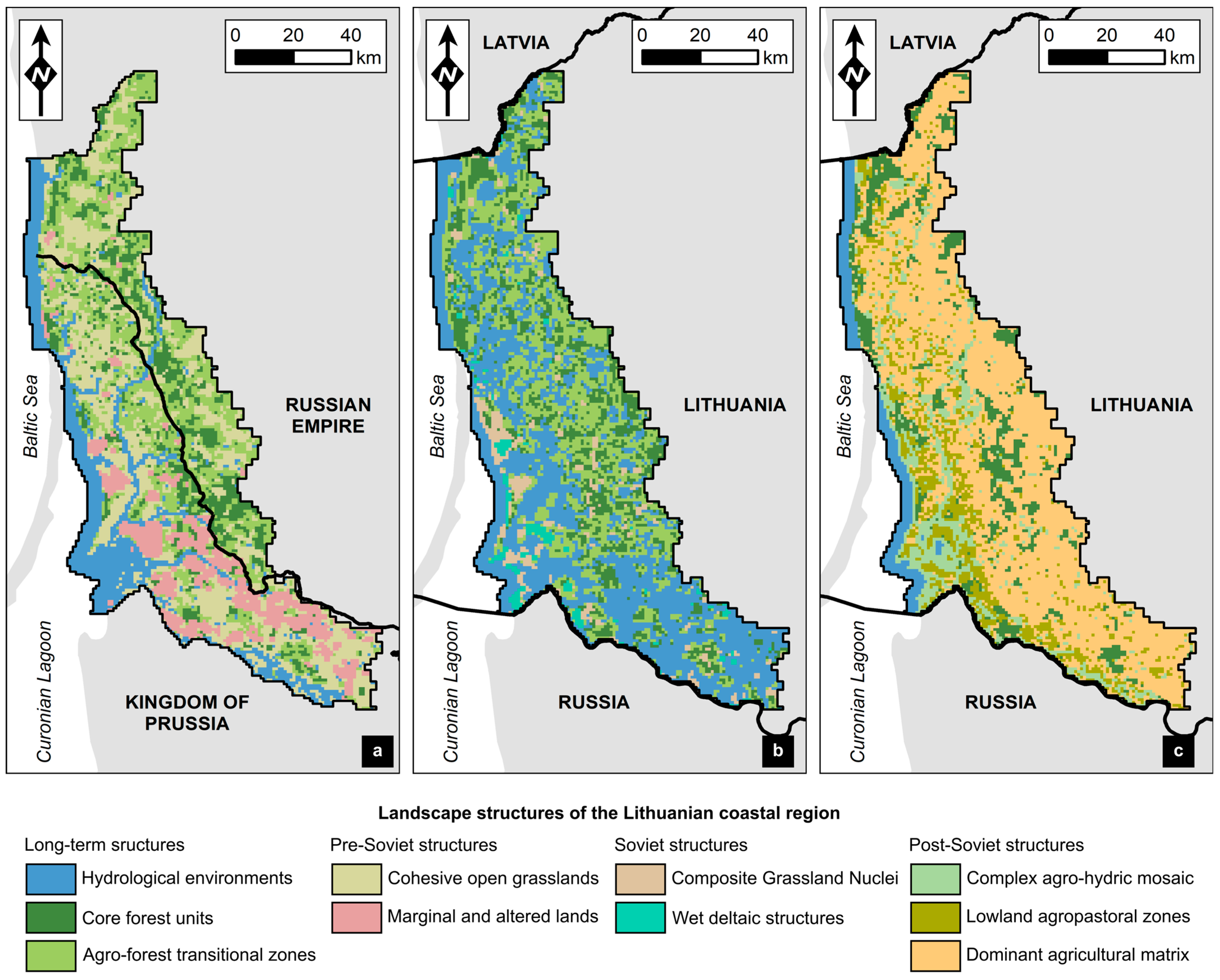
The coastal region of Klaipėda (Lithuania) has experienced major political, economic, social, and cultural transformations since the 20th century. Landscapes as evolving expressions of land use and land cover patterns offer a valuable lens to analyse these changes. This study examines the evolution of physical landscape structures across the pre-Soviet, Soviet, and post-Soviet periods, using historical maps and open-access geospatial data. An ontological approach, combined with morphological and configurational metrics, reveals four major and relatively persistent landscape structures: hydrological systems (sea, lagoon, rivers), forest cover, farming intensity (from extensive grassland use to intensive arable farming), and semi-natural environments. Their structural evolution reflects broader cultural factors, such as contrasting land use traditions between former Prussian and Russian territories. The study also highlights the impact of Soviet collectivisation, marked by irrigation networks, agricultural intensification, and forest expansion. The post-Soviet period is characterised by widespread farmland abandonment and fragmentation, revealing new spatial dynamics and challenges in land reappropriation. Landscape transformations are predominantly structured around agricultural dynamics. Although the analysis was limited by the incomplete availability of data for this specific land use class, the centrality of agriculture in shaping territorial organisation is evident and reinforces the strong rural identity associated with the landscape.
Keywords: spatial system; landscape structures; spatiotemporal modelling; territorial dynamics; geospatial ontologies; Lithuania; pre-Soviet; Soviet; post-Soviet spatial system; landscape structures; spatiotemporal modelling; territorial dynamics; geospatial ontologies; Lithuania; pre-Soviet; Soviet; post-Soviet