Seasonal and Diurnal Dynamics of Urban Surfaces: Toward Nature-Supportive Strategies for SUHI Mitigation


Abstract
1. Introduction
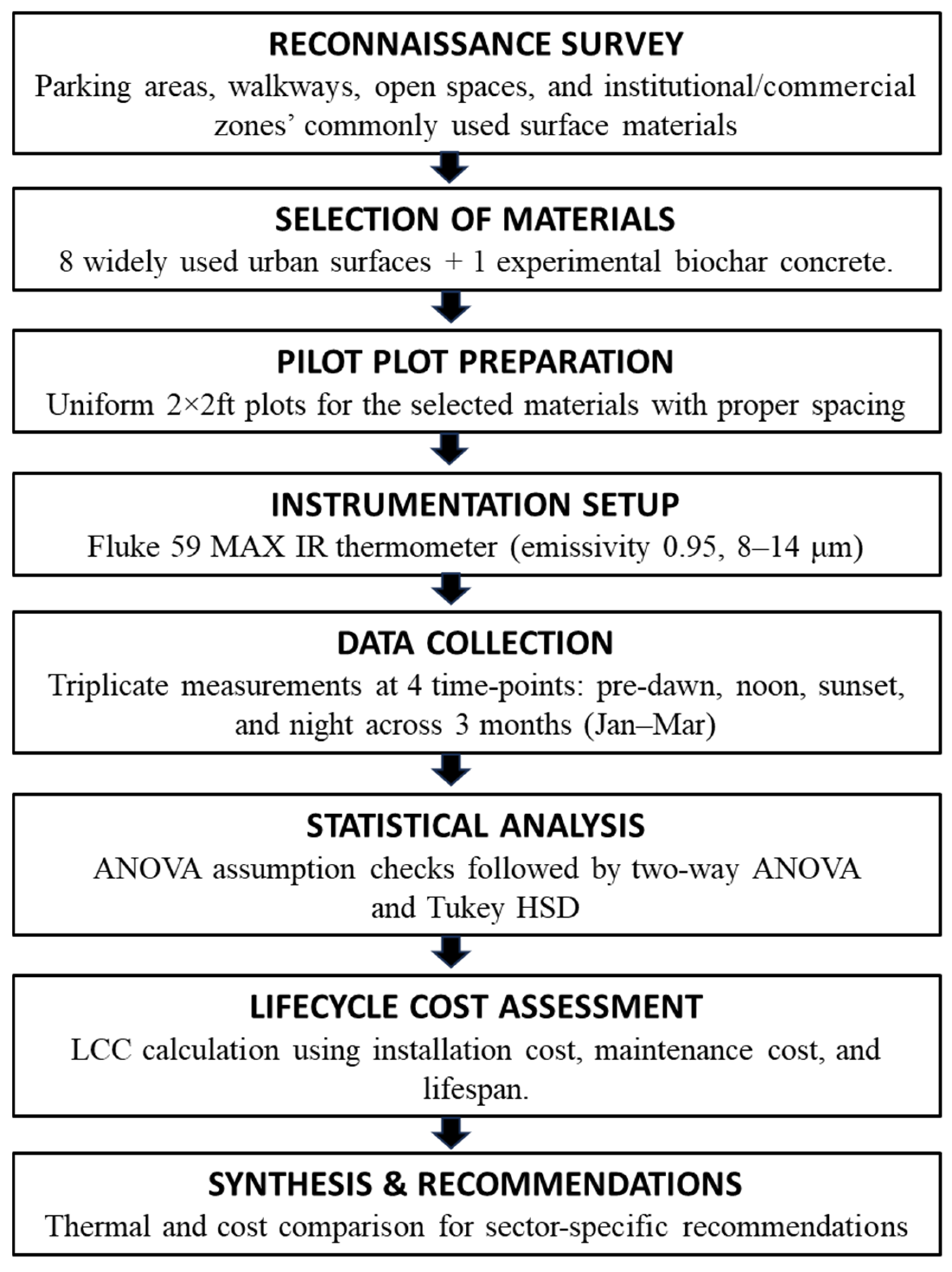
2. Materials and Methods
2.1. Biochar Concrete Preparation
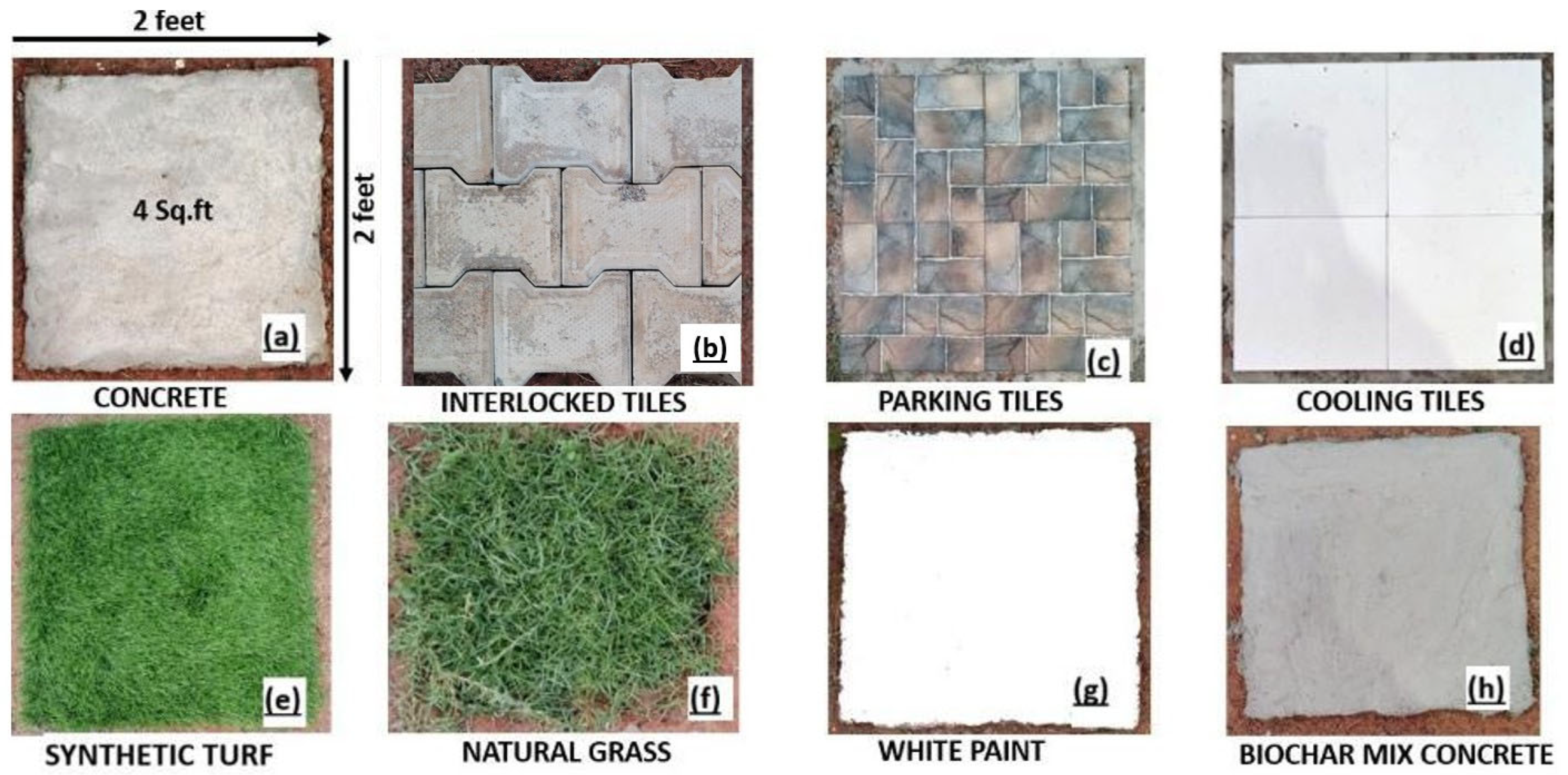
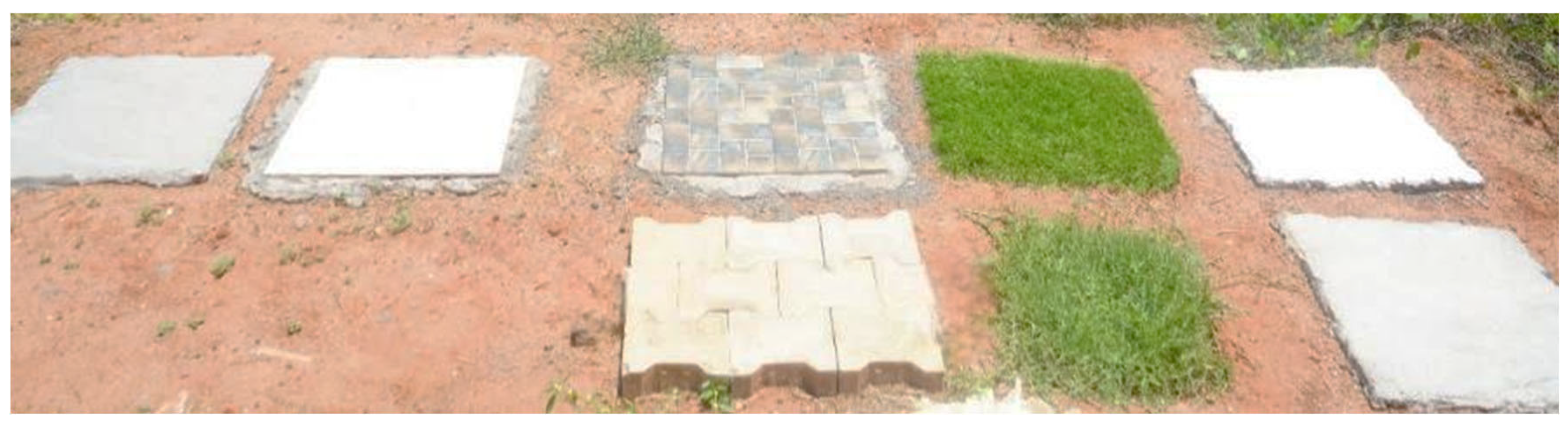
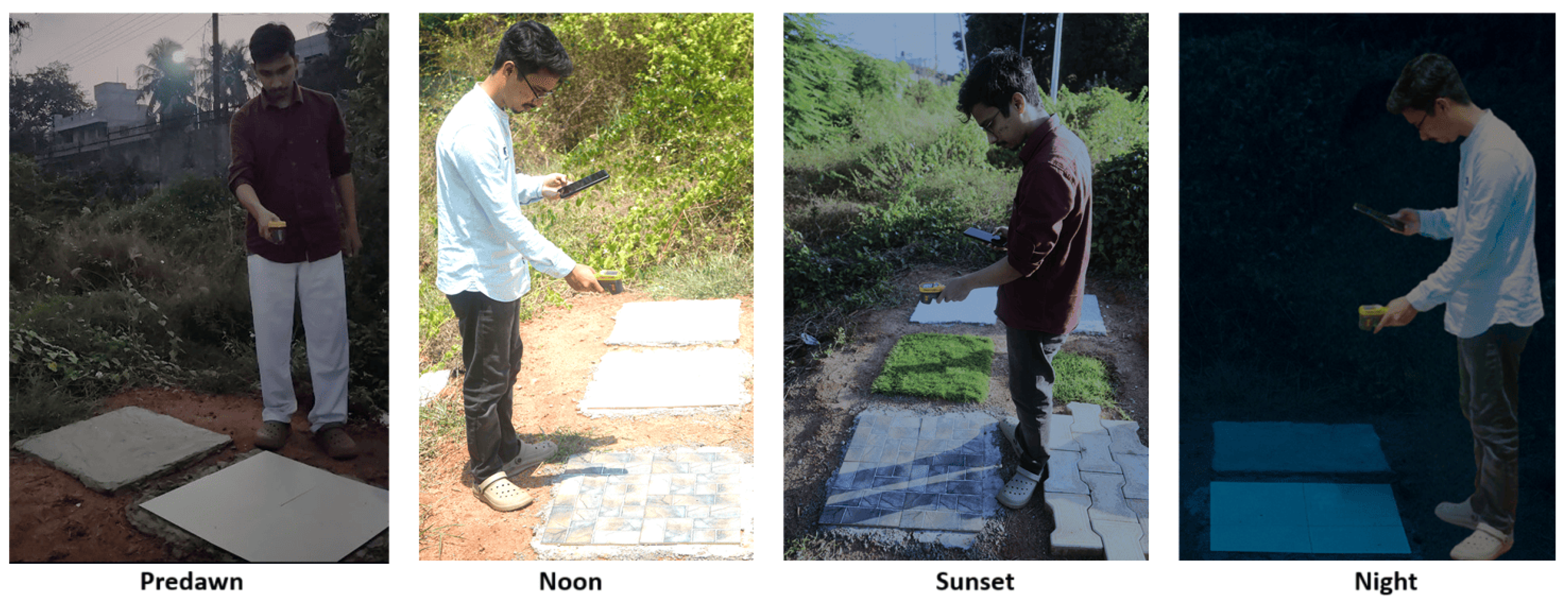
2.2. Pilot Study Preparation and Experimental Setup
2.3. Data Collection
2.4. Statistical Analysis
2.5. Evaluating Lifecycle Performance and Economic Viability
3. Results
3.1. Compressive Strength of Coconut Shell Biochar Concrete Mixes
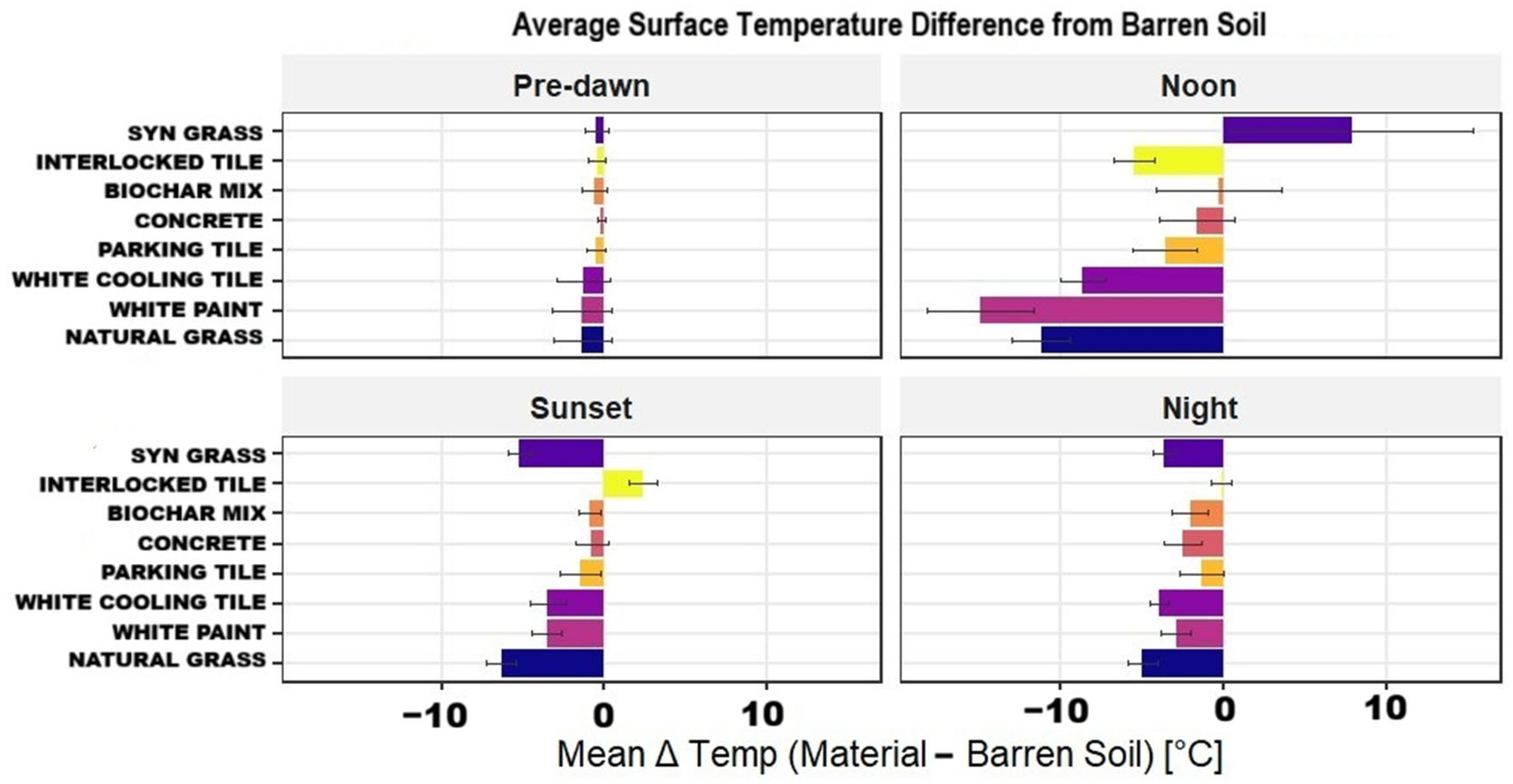
3.2. Material—Wise Surface Temperature Differences Relative to Barren Soil
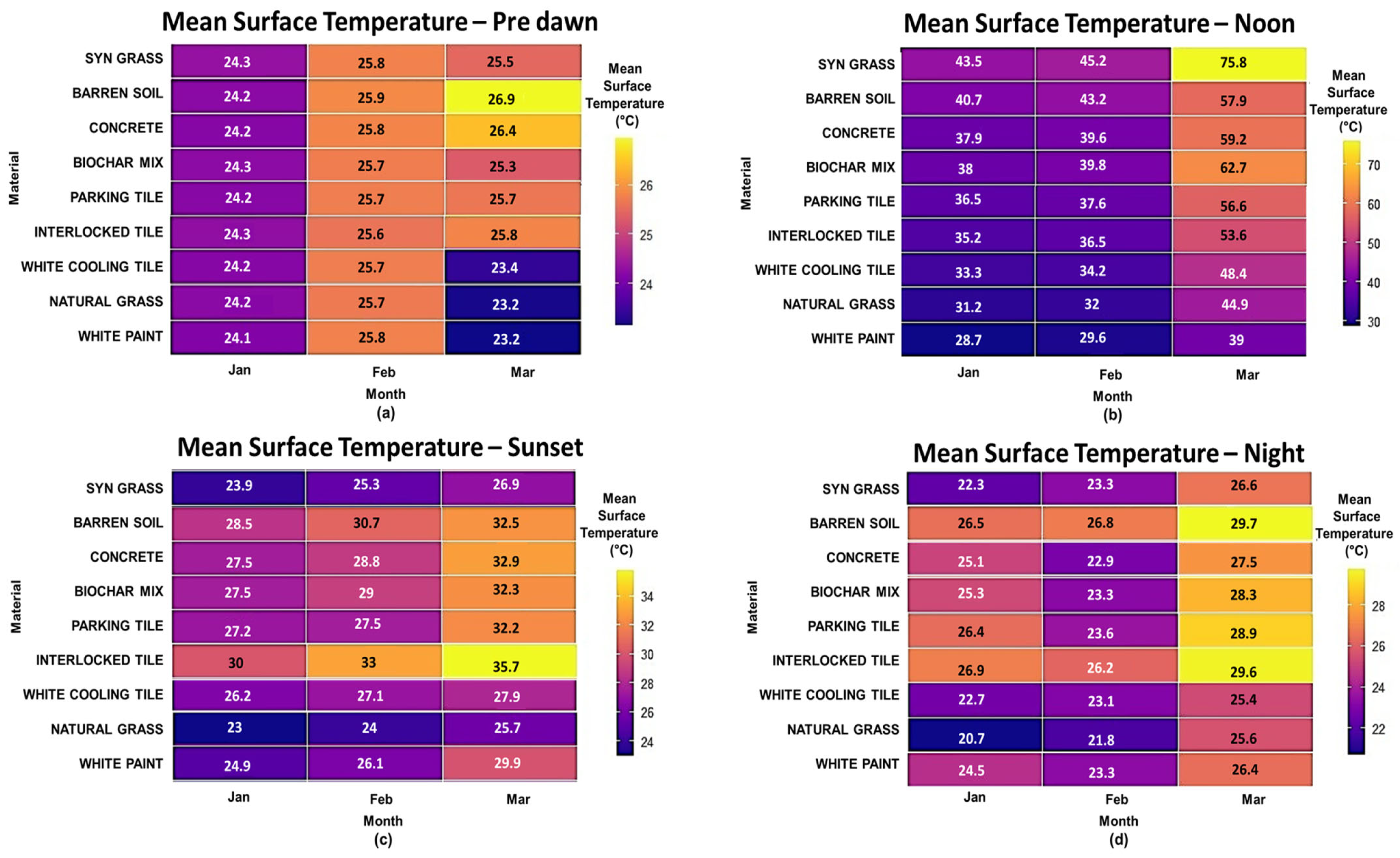
3.3. Seasonal and Diurnal Variations in Surface Temperature Across Urban Materials
- (a)
- Pre-dawn
- (b)
- Noon
- (c)
- Sunset
- (d)
- Night
3.4. Thermal Performance and Sustainability Potential of Biochar Concrete
4. Discussion
4.1. Compressive Strength of Coconut Shell Biochar Concrete Mixes
4.2. Material—Wise Surface Temperature Differences Relative to Barren Soil
4.3. Discussion—Seasonal and Diurnal Variations in Surface Temperature Across Urban Materials
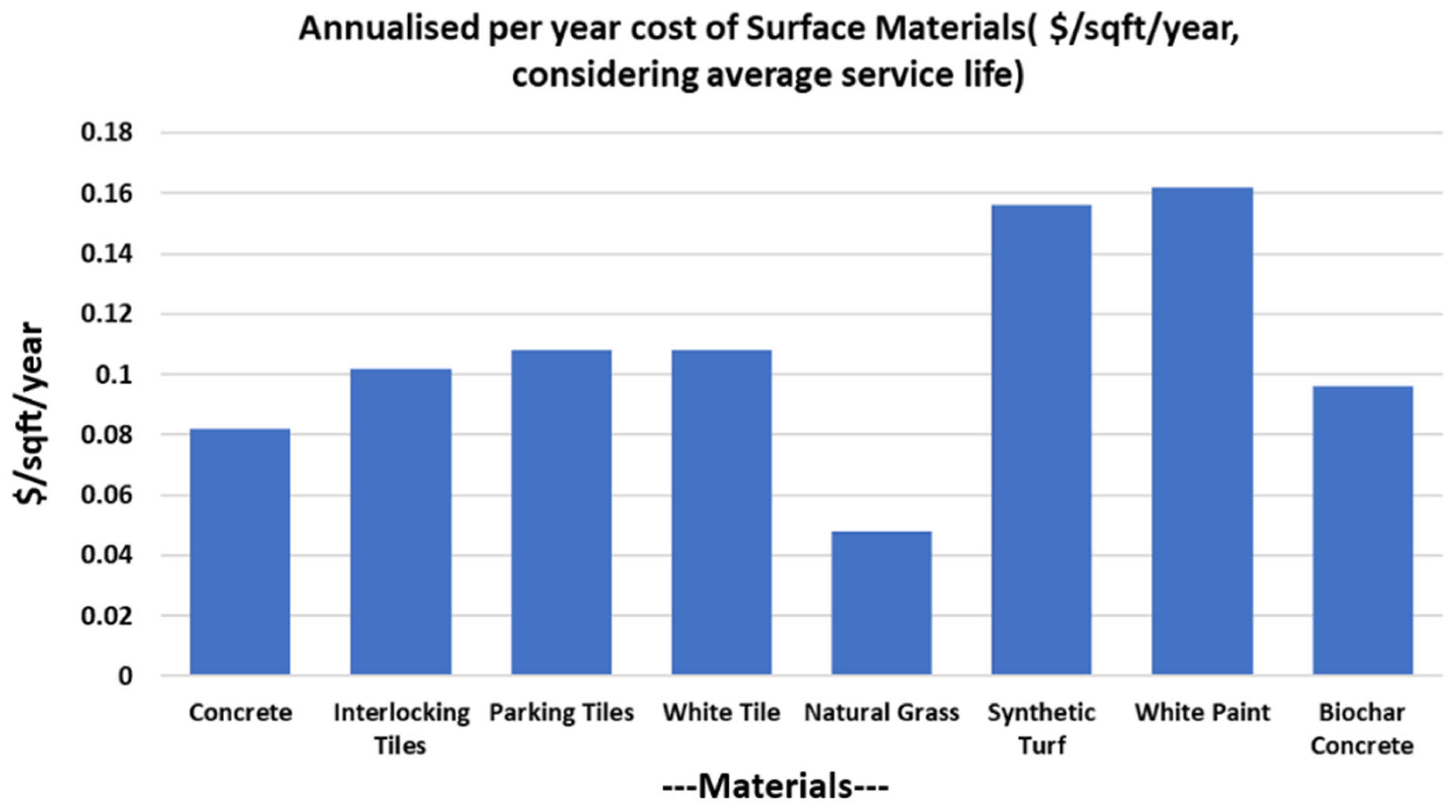
4.4. Cost—Performance Assessment of Urban Surface Materials
4.5. Sector—Wise Recommendations
- (i)
- Factories & Industrial Zones
- (ii)
- IT Parks & Technology Campuses
- (iii)
- Shopping Malls & Commercial Complexes
- (iv)
- Residential Neighbourhoods
4.6. Limitations and Future Scope
5. Conclusions
Supplementary Materials
Author Contributions
Funding
Data Availability Statement
Acknowledgments
Conflicts of Interest
Abbreviations
| UHI | Urban Heat Island |
| SUHI | Surface Urban Heat Island |
| UTM | Universal Testing Machine |
| ISO | International Organization for Standardization |
| LCC | Life-Cycle Cost |
| CSB | Coconut Shell Biochar |
References
- Santamouris, M. Using cool pavements as a mitigation strategy to fight urban heat island—A review of the actual developments. Renew. Sustain. Energy Rev. 2013, 26, 224–240. [Google Scholar] [CrossRef]
- Oke, T.R. Boundary Layer Climates, 2nd ed.; Routledge: Oxfordshire, UK, 1987. [Google Scholar]
- Wang, C.; Ren, Z.; Dong, Y.; Zhang, P.; Guo, Y.; Wang, W.; Bao, G. Efficient cooling of cities at global scale using urban green space to mitigate urban heat island effects in different climatic regions. Urban For. Urban Green. 2022, 74, 127635. [Google Scholar] [CrossRef]
- Singh, A.K.; Singh, H.; Singh, J.S. Green infrastructure of cities: An overview. Proc. Indian Natl. Sci. Acad. 2020, 86, 1–14. [Google Scholar] [CrossRef]
- Raj, A.; Anjali, A.; Singh, V.K.; Semwal, V.B. Mapping urban heat islands in Pune, India: Ecological impacts and environmental challenges. Remote Sens. Lett. 2025, 16, 654–664. [Google Scholar] [CrossRef]
- Kumar, P.; Debele, S.E.; Khalili, S.; Halios, C.H.; Sahani, J.; Aghamohammadi, N.; de Fatima Andrade, M.; Athanassiadou, M.; Bhui, K.; Calvillo, N.; et al. Urban heat mitigation by green and blue infrastructure: Drivers, effectiveness, and future needs. Innovation 2024, 5, 100588. [Google Scholar] [CrossRef]
- Li, H.; Harvey, J.T.; Holland, T.J.; Kayhanian, M. The use of reflective and permeable pavements as a potential practice for heat island mitigation and stormwater management. Environ. Res. Lett. 2013, 8, 015023. [Google Scholar] [CrossRef]
- Akbari, H.; Kolokotsa, D. Three decades of urban heat islands and mitigation technologies research. Energy Build. 2016, 133, 834–842. [Google Scholar] [CrossRef]
- Bowler, D.E.; Buyung-Ali, L.; Knight, T.M.; Pullin, A.S. Urban greening to cool towns and cities: A systematic review of the empirical evidence. Landsc. Urban Plan. 2010, 97, 147–155. [Google Scholar] [CrossRef]
- Norton, B.A.; Coutts, A.M.; Livesley, S.J.; Harris, R.J.; Hunter, A.M.; Williams, N.S. Planning for cooler cities: A framework to prioritise green infrastructure to mitigate high temperatures in urban landscapes. Landsc. Urban Plan. 2015, 134, 127–138. [Google Scholar] [CrossRef]
- Irfeey, A.M.M.; Chau, H.W.; Sumaiya, M.M.F.; Wai, C.Y.; Muttil, N.; Jamei, E. Sustainable mitigation strategies for urban heat island effects in urban areas. Sustainability 2023, 15, 10767. [Google Scholar] [CrossRef]
- Gill, S.E.; Handley, J.F.; Ennos, A.R.; Pauleit, S. Adapting cities for climate change: The role of green infrastructure. Built Environ. 2007, 33, 115–133. [Google Scholar] [CrossRef]
- Tzoulas, K.; Korpela, K.; Venn, S.; Yli-Pelkonen, V.; Kaźmierczak, A.; Niemela, J.; James, P. Promoting ecosystem and human health in urban areas using Green Infrastructure: A literature review. Landsc. Urban Plan. 2007, 81, 167–178. [Google Scholar] [CrossRef]
- Ayoub, M.; Ragheb, S.A. Parametric investigation of the solar-thermal performance of tensile membrane roofs in hot-desert climates. Energy Build. 2023, 297, 113449. [Google Scholar] [CrossRef]
- Santamouris, M. On the energy impact of urban heat island and global warming on buildings. Energy Build. 2014, 82, 100–113. [Google Scholar] [CrossRef]
- Cohen, P.; Potchter, O.; Matzarakis, A. Daily and seasonal climatic conditions of green urban open spaces in the Mediterranean climate and their impact on human comfort. Build. Environ. 2012, 51, 285–295. [Google Scholar] [CrossRef]
- Li, D.; Bou-Zeid, E.; Oppenheimer, M. The effectiveness of cool and green roofs as urban heat island mitigation strategies. Environ. Res. Lett. 2014, 9, 055002. [Google Scholar] [CrossRef]
- De Cristo, E.; Evangelisti, L.; Barbaro, L.; De Lieto Vollaro, R.; Asdrubali, F. A systematic review of green roofs’ thermal and energy performance in the Mediterranean region. Energies 2025, 18, 2517. [Google Scholar] [CrossRef]
- Maurer, B.; Lienert, J.; Cook, L.M. Comparing PV-green and PV-cool roofs to diverse rooftop options using decision analysis. Build. Environ. 2023, 245, 110922. [Google Scholar] [CrossRef]
- Mensah, R.A.; Shanmugam, V.; Narayanan, S.; Razavi, N.; Ulfberg, A.; Blanksvärd, T.; Sayahi, F.; Simonsson, P.; Reinke, B.; Försth, M.; et al. Biochar-added cementitious materials—A review on mechanical, thermal, and environmental properties. Sustainability 2021, 13, 9336. [Google Scholar] [CrossRef]
- Watts, N.; Scrivener, K. Making Concrete Change: Innovation in Low-Carbon Cement and Concrete; Chatham House—The Royal Institute of International Affairs: London, UK, 2018. [Google Scholar]
- Cuce, P.M.; Cuce, E.; Santamouris, M. Towards sustainable and climate-resilient cities: Mitigating urban heat islands through green infrastructure. Sustainability 2025, 17, 1303. [Google Scholar] [CrossRef]
- Imran, H.M.; Shammas, M.I.; Rahman, A.; Jacobs, S.J.; Ng, A.W.M.; Muthukumaran, S. Causes, modeling and mitigation of urban heat island: A review. Earth Sci. 2021, 10, 244–264. [Google Scholar] [CrossRef]
- Matias, M.; Mills, G.; Silva, T.; Girotti, C.; Lopes, A. The underestimated impact of parked cars in urban warming. City Environ. Interact. 2025, 28, 100232. [Google Scholar] [CrossRef]
- ISO 15686-5:2017; Buildings and Constructed Assets—Service Life Planning—Part 5: Life-Cycle Costing. International Organization for Standardization: Geneva, Switzerland, 2017. Available online: https://www.iso.org/standard/61148.html (accessed on 10 July 2025).
- Andrew, R.M. Global CO2 emissions from cement production, 1928–2018. Earth Syst. Sci. Data 2019, 11, 1675–1710. [Google Scholar] [CrossRef]
- Thomas, C.; Setién, J.; Polanco, J.A.; Cimentada, A.I.; Medina, C. Influence of curing conditions on recycled aggregate concrete. Constr. Build. Mater. 2018, 172, 618–625. [Google Scholar] [CrossRef]
- Lehmann, J.; Joseph, S. Biochar for environmental management: An introduction. In Biochar for Environmental Management; Routledge: Oxfordshire, UK, 2015; pp. 1–13. [Google Scholar]
- Gupta, S.; Kua, H.W.; Low, C.Y. Use of biochar as carbon sequestering additive in cement mortar. Cem. Concr. Compos. 2018, 87, 110–129. [Google Scholar] [CrossRef]
- Adajar, M.A.; Galupino, J.; Frianeza, C.; Aguilon, J.F.; Sy, J.B.; Tan, P.A. Compressive strength and durability of concrete with coconut shell ash as cement replacement. Geomate J. 2020, 18, 183–190. [Google Scholar] [CrossRef]
- Vivek, S. Feasibility study on utilization of coconut shell aggregates in concrete. i-Manager’s. J. Struct. Eng. 2023, 12, 20. [Google Scholar]
- Middel, A.; Selover, N.; Hagen, B.; Chhetri, N. Impact of shade on outdoor thermal comfort—A seasonal field study in Tempe, Arizona. Int. J. Biometeorol. 2016, 60, 1849–1861. [Google Scholar] [CrossRef]
- Shashua-Bar, L.; Pearlmutter, D.; Erell, E. The influence of trees and grass on outdoor thermal comfort in a hot-arid environment. Int. J. Climatol. 2011, 31, 1498–1506. [Google Scholar] [CrossRef]



| Mix ID | Biochar Replacement (%) | Mix Proportion (Cement:Sand:Coarse Aggregate) | Average Compressive Strength (N/mm2) | % Change w.r.t. Conventional Concrete |
|---|---|---|---|---|
| M0 | 0% (Conventional) | 1:2:4 | 33.5 | 0% |
| M1 | 5% | 1:2:4 | 32.6 | −2.57% |
| M2 | 10% | 1:2:4 | 31.9 | −4.76% |
| M3 | 15% | 1:2:4 | 30.2 | −9.87% |
| Property/Aspect | Conventional Concrete | 10% Biochar-Concrete |
|---|---|---|
| CO2 Emissions | High, due to full cement usage | Lower, owing to reduced cement requirement |
| Waste Management | No reuse of agricultural residues | Recycles coconut shell waste into construction material |
| Carbon Sequestration | None | Locks biogenic carbon in a durable form |
| Local Relevance | Relies entirely on mined cement components | Promotes sustainability by valorising coconut shell waste into biochar, improving resource efficiency. |
| Material | Installed Cost ($/sqft) | Maintenance ($/sqft/yr) | Average Life (in yrs) | Overall Effective Cost ($/sqft/yr) |
|---|---|---|---|---|
| Concrete | 1.32–1.56 | 0–0.012 | 20 | 0.072–0.090 |
| Interlocking Pavers | 1.08–1.56 | 0.012–0.024 | 15 | 0.096–0.108 |
| Parking Tiles | 1.44–1.80 | 0 | 15 | 0.096–0.120 |
| White cooling Tiles | 1.44–1.80 | 0 | 15 | 0.096–0.120 |
| Natural Grass | 0.096–0.144 | 0.036–0.048 | (continuous) | 0.042–0.054 |
| Synthetic Turf | 0.72–1.80 | 0 | 8 | 0.090–0.216 |
| Cooling White Paint | 0.40–0.65 (per application) | 0.072–0.108 | 5 | 0.144–0.180 |
| Biochar Concrete | 1.56–1.68 | ~1 | 20 | 0.090–0.102 |
Disclaimer/Publisher’s Note: The statements, opinions and data contained in all publications are solely those of the individual author(s) and contributor(s) and not of MDPI and/or the editor(s). MDPI and/or the editor(s) disclaim responsibility for any injury to people or property resulting from any ideas, methods, instructions or products referred to in the content. |
© 2025 by the authors. Licensee MDPI, Basel, Switzerland. This article is an open access article distributed under the terms and conditions of the Creative Commons Attribution (CC BY) license (https://creativecommons.org/licenses/by/4.0/).
Share and Cite
Ahmed, S.Z.; La Rosa, D.; Jayakumar, S. Seasonal and Diurnal Dynamics of Urban Surfaces: Toward Nature-Supportive Strategies for SUHI Mitigation. Land 2025, 14, 2412. https://doi.org/10.3390/land14122412
Ahmed SZ, La Rosa D, Jayakumar S. Seasonal and Diurnal Dynamics of Urban Surfaces: Toward Nature-Supportive Strategies for SUHI Mitigation. Land. 2025; 14(12):2412. https://doi.org/10.3390/land14122412
Chicago/Turabian StyleAhmed, Syed Zaki, Daniele La Rosa, and Shanmuganathan Jayakumar. 2025. "Seasonal and Diurnal Dynamics of Urban Surfaces: Toward Nature-Supportive Strategies for SUHI Mitigation" Land 14, no. 12: 2412. https://doi.org/10.3390/land14122412
APA StyleAhmed, S. Z., La Rosa, D., & Jayakumar, S. (2025). Seasonal and Diurnal Dynamics of Urban Surfaces: Toward Nature-Supportive Strategies for SUHI Mitigation. Land, 14(12), 2412. https://doi.org/10.3390/land14122412