3.1. Research Area and Data Sources
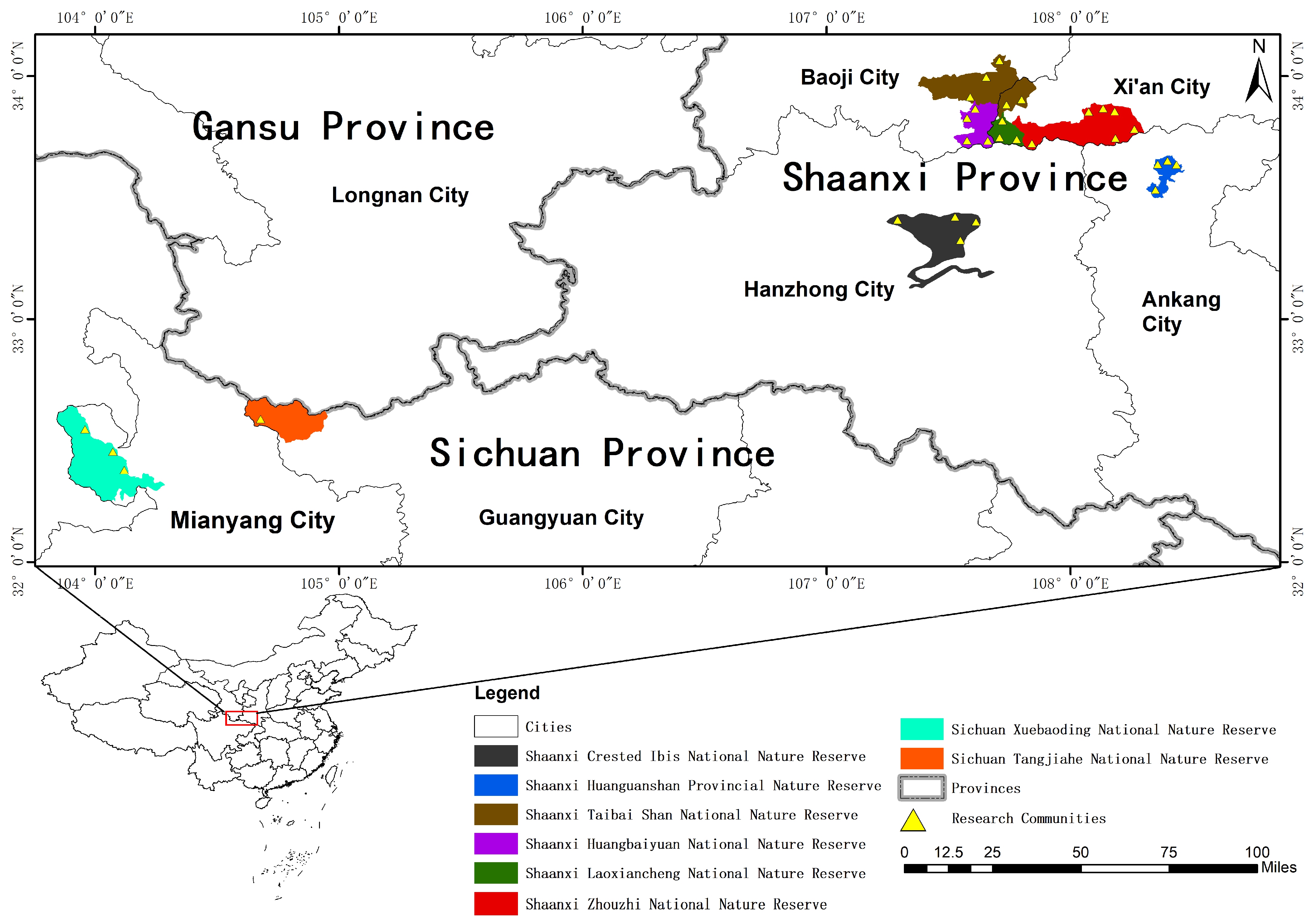
The data for this study were collected through field surveys of communities surrounding nature reserves in Sichuan Province and Shaanxi Province. The investigation scope (
Figure 1) covers two nature reserves in Sichuan Province (Xuebaoding National Nature Reserve and Tangjiahe National Nature Reserve) and six nature reserves in Shaanxi Province (Huangguanshan provincial Nature Reserve, Laoxiancheng National Nature Reserve, Crested Ibis National Nature Reserve, Taibaishan National Nature Reserve, Zhouzhi National Nature Reserve, and Huangbaiyuan National Nature Reserve) The nature reserve was established.
Based on the survey data, this study encompassed eight nature reserves covering a total area of 288,123 hectares (
Table 1). Using the random sampling method, 30 communities were selected from 151 communities located around the reserves (within 5 km of the reserve boundary and within the reserves themselves), resulting in a sampling rate of 19.8%. A questionnaire survey was administered to 437 of the 2035 households (a coverage rate of 21.5%), yielding 400 valid responses (with an effective rate of 91.5%). In terms of regional distribution, the Xuebaoding Reserve has the largest area (63,615 hectares); the Zhouzhi Reserve and the Taibai Mountain Reserve are similar in size (approximately 56,000 hectares each); and the Huangguanshan Reserve has the smallest area (12,372 hectares). There were significant differences in the sampling ratios of the surrounding communities across the protected areas included in this study. The community sampling rate in Tangjiahe Reserve was the highest (48.6%), while that in the Crested Ibis reserve was the lowest (15.5%). In terms of the effective rate of the questionnaire, the Crested Ibis reserve performed the best (95.9%), while the Taibai Mountain Reserve was relatively lower (85.8%). The survey samples show a balanced geographical distribution feature, covering not only large protected areas (such as Xuebaoding), but also medium-sized (such as Zhouzhi) and small protected areas (such as Huangguanshan), ensuring the representativeness of the research results. This scientific sampling design has laid a solid data foundation for the subsequent analysis of the interactive relationship between community livelihoods and environmental protection within the protected area.
Regarding the question about selection and exclusion criteria for the 37 invalid questionnaires among the 437 total collected, our data processing followed two key procedures. First, questionnaires with over 20% missing data in core variables (e.g., AT1-3, SN1-3) that could not be reasonably imputed were removed. These mostly included cases where respondents skipped entire sections or key demographic information. Second, responses showing clear response bias—such as straight-line answers or contradictory answers to reverse-coded items—were systematically filtered out using consistency checks. This rigorous validation ensured the final 400 valid cases maintained high reliability (Cronbach’s α: 0.695–0.856). The remaining exclusions primarily involved incomplete household income data and inconsistent spatial information about distance to protected area boundaries. This process aligns with standard practices in survey-based SEM studies to ensure data quality before model estimation.
The survey was conducted from 12 July to 25 July 2024, spanning 13 days. The questionnaire design was based on the Sustainable Livelihoods Framework (SLF) and theories of human well-being. It covers four major dimensions: characteristics of rural households (population structure, educational level, income sources), livelihood capital (natural capital, physical capital, financial capital, social capital), environment-dependent behaviors (ecological product collection, agricultural environmental protection measures), and protection awareness (policy perception, ecological value recognition). Data collection was conducted through a combination of structured interviews and scale scoring to ensure the accuracy of the information. In terms of sample distribution, respondents from Sichuan Province accounted for 38.2%, and while those from Shaanxi Province accounted for 61.8%. This study verified the representativeness of the sample through analysis of variance and ensured data reliability through rigorous reliability and validity tests, thereby providing a solid empirical foundation for the subsequent structural equation model (SEM) analysis.
3.2. Research Hypotheses
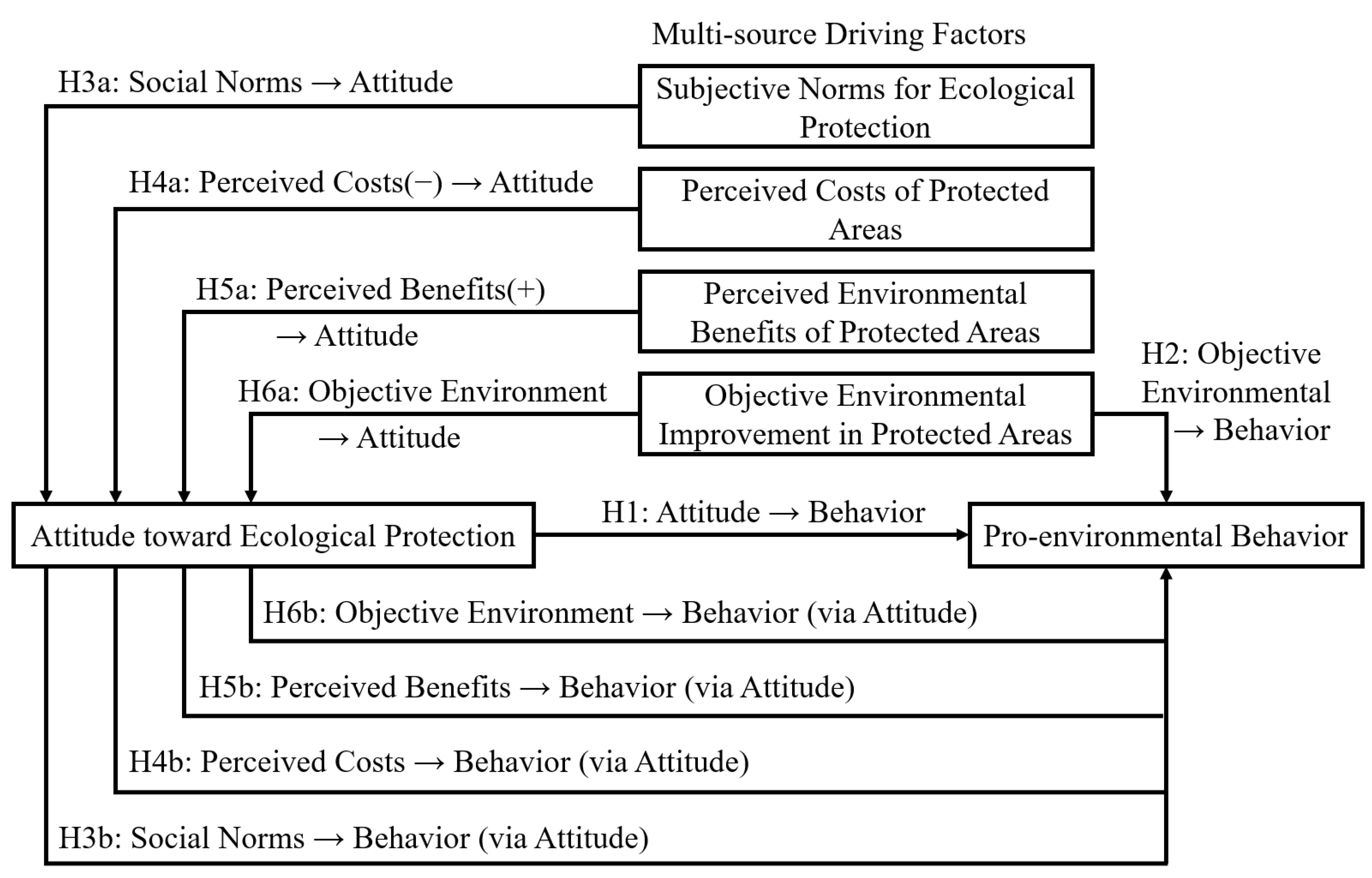
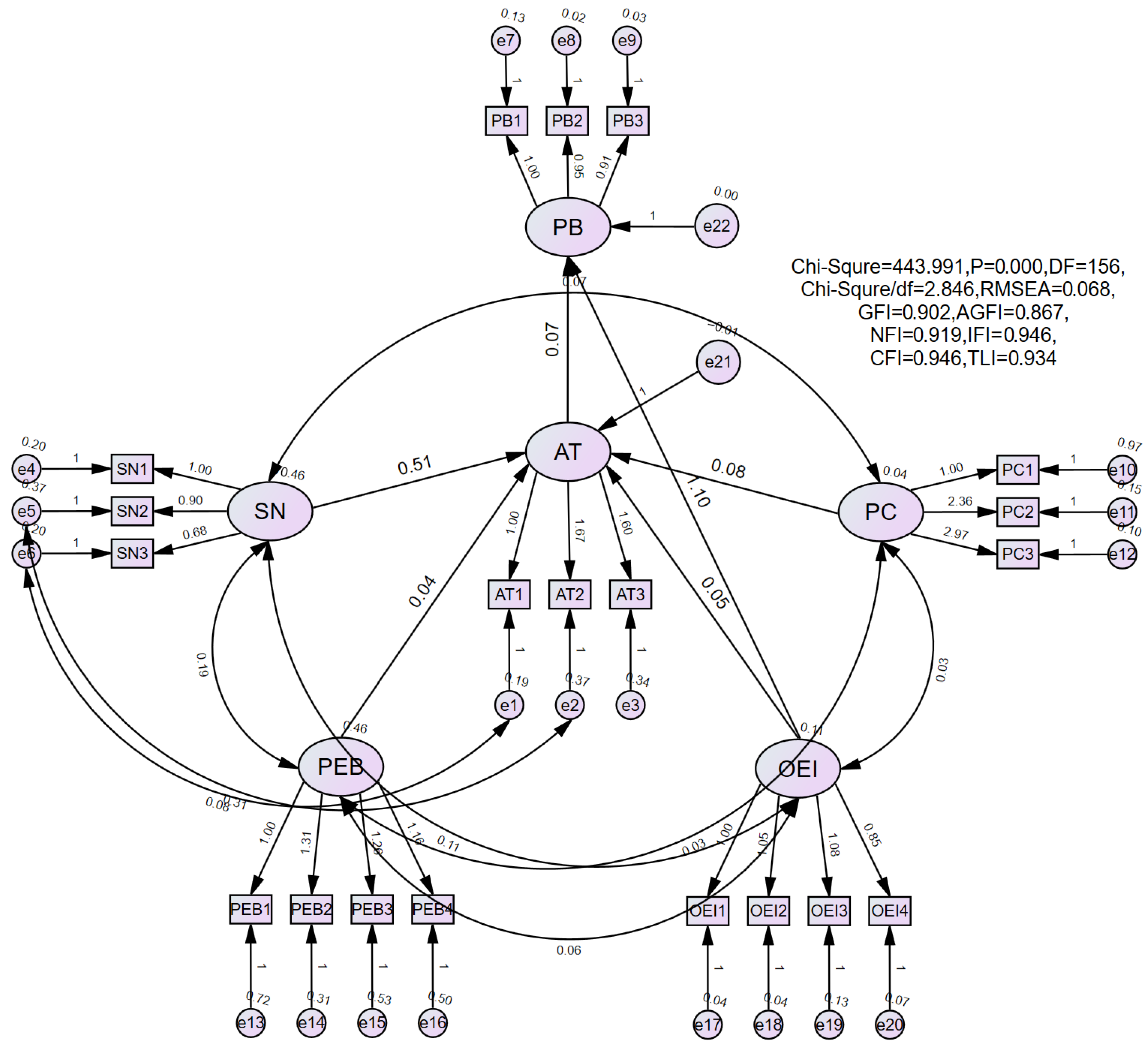
Based on the theory of planned behavior (TPB), the value–attitude–behavior (VAB) chain, and the normative activation model (NAM), this study constructed a conceptual framework with ecological protection attitude as the core mediating variable, revealing the influence mechanism of multi-source driving factors on farmers’ pro-environmental behaviors (
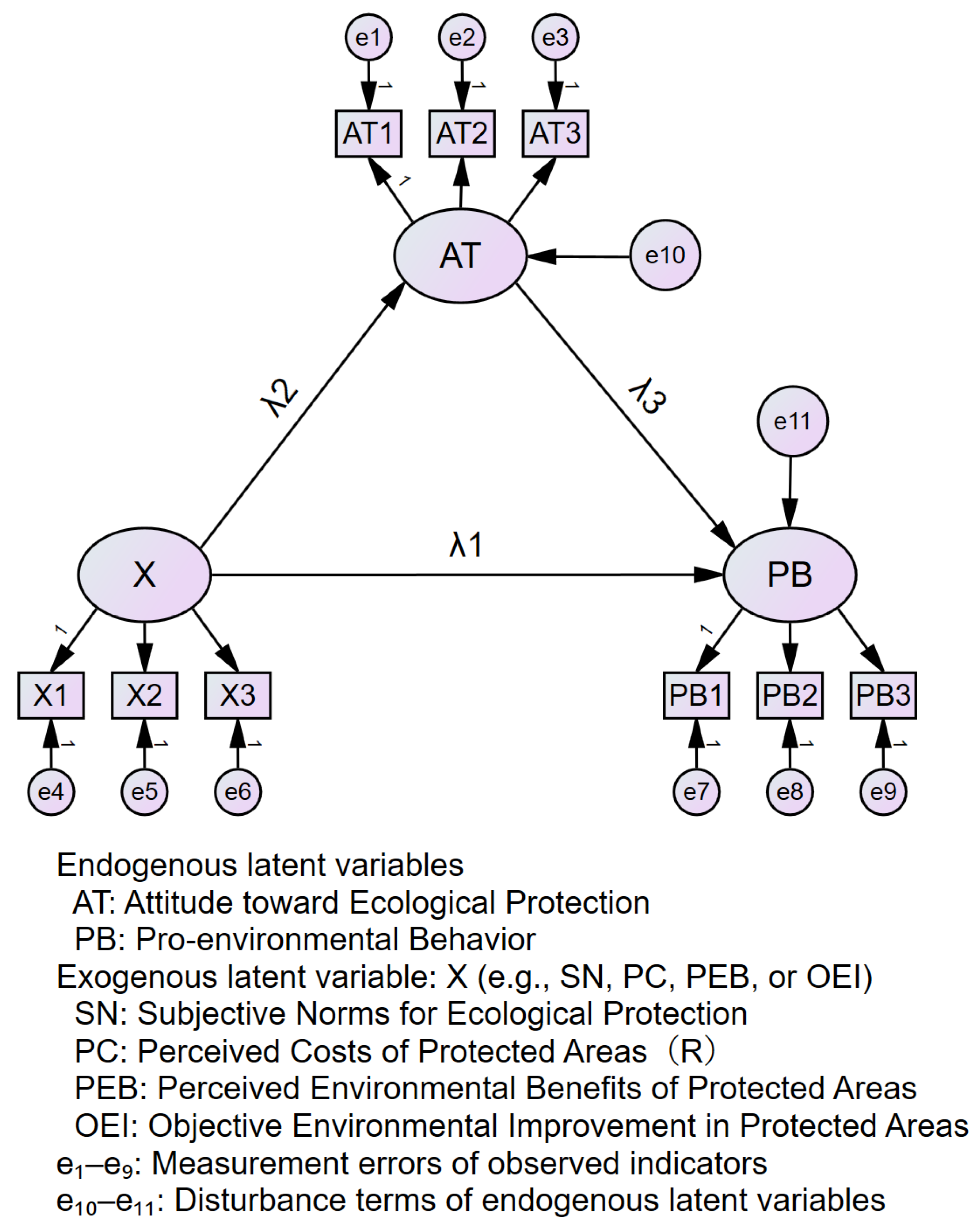
Figure 2). At the attitude level, stronger subjective norms for ecological protection, lower perceived costs for protected areas, and higher perceived environmental benefits of protected areas jointly shape farmers’ overall evaluation of ecological protection policies and practices, thereby enhancing their ecological protection attitudes (H3a–H5a). This attitude can directly enhance pro-environmental behavior (H1) and convey the influence of the above three driving factors on behavioral outcomes (H3b–H5b), forming the classic path of “norm/cost–benefit → attitude → behavior”. Furthermore, the model distinguishes the dual effects of objective environmental improvement in protected areas: On the one hand, the visible improvement of local ecological conditions can strengthen farmers’ evaluation beliefs, indirectly enhance ecological protection attitudes and promote pro-environmental behaviors (H6a–H6b). On the other hand, the improvement of the objective environment, as a significant situational cue, can directly trigger protective actions without the need for complex attitude processing, exerting additional direct effects on pro-environmental behaviors (H2). In conclusion, this framework integrates the indirect attitude mediating mechanism with the “information clue” dual-path effect of objective environment improvement, providing a theoretical basis for verifying the six sets of hypotheses (H1–H6a/b).
Hypothesis 1. The stronger an individual’s positive attitude towards ecological protection is, the more protective behaviors they will have.
From a theoretical perspective, both the Planned Behavior Theory (TPB) and the Value–attitude–behavior Chain (VAB) provide a solid basis for this hypothesis. Both point out that attitude is a direct determinant of behavioral intention and actual behavior [
30]. When an individual holds a positive attitude towards ecological protection, this attitude reflects their positive evaluation of the results of protective actions and their inner moral identification. This positive attitude can lower the psychological threshold for individuals when taking protective actions, making them more willing to put them into practice. It can also enhance individuals’ sense of self-efficacy, enabling them to believe that they have the ability to handle ecological protection-related matters well. In this way, individuals are more likely to engage in specific protective behaviors such as not discharging pollutants at will, participating in wildlife rescue, and reducing deforestation [
1]. Especially for the rural household head sample, its positive attitude also has additional weight due to the identity of role models and family decision-makers, which can further guide the family level to carry out ecological protection behaviors. Therefore, this study sets Hypothesis 1.
Hypothesis 2. The more strongly farmers perceive that the objective environment has improved, the more protective measures they are inclined to adopt.
Visibility and the “Cup-to-action” mechanism indicate that observable improvements in the public environment, such as clearer water, denser forests, and an increase in animal numbers, are extremely direct positive signals. These intuitive changes can bring immediate situational incentives to farmers and confirm the effectiveness of community norms, directly promoting them to take protective behaviors without going through complex psychological processes [
31]. For farmers, the real improvement of the objective environment has dispelled their inner doubts about whether protection is useful, making them firmly believe that “if I do it, it will work”, and greatly enhancing their sense of self-efficacy. The enhancement of this belief prompts farmers to be more willing to abide by protection rules and actively participate in collaborative protection actions, thereby promoting an increase in protection behaviors. Therefore, this study sets Hypothesis 2.
Hypothesis 3a. The stronger the subjective norm, the more positive the individual’s attitude toward ecological protection.
Hypothesis 3b. Subjective norms indirectly promote protective behaviors by strengthening individuals’ attitudes toward ecological protection.
The TPB theory explicitly regards subjective norms as important social leading variables, which means that in social situations, the expectations, norms, etc., perceived by individuals from people or groups around them will have a leading impact on their own cognition and behavior [
32]. The Normative Activation Model (NAM) also emphasizes that the expectations and exemplary behavior of significant others can evoke the moral obligations and sense of responsibility deep within an individual [
33]. In the specific living scenario of the community, the approving attitudes, active participation behaviors and clear expectations expressed by relatives, friends and neighbors towards ecological protection will play a role through a series of psychological mechanisms. Social comparison enables individuals to see the differences in their own and others’ behaviors or attitudes. The herd mentality drives individuals to draw closer to the majority, and peer pressure also, in an imperceptible way, prompts individuals to conduct self-examination and adjustment. These factors work together to internalize the positive influences from the outside world into their own positive attitudes, generating the idea that “I should also support/participate in ecological protection”. This influence is particularly significant in community contexts represented by the household head, as the household head often plays a certain decision-making and leading role in the family and community. In the closely linked chain of “norm-attitude-behavior”, subjective norms play an important initiating role [
34]. It first alters an individual’s evaluative beliefs and value commitments, enabling them to truly recognize the value and significance of ecological protection from the bottom of their hearts, and then transform this recognition into practical actions. Unlike the external and somewhat coercive influence of direct normative pressure, the path mediated by attitudes is more stable and sustainable because when norms are internalized as an individual’s attitude, the individual’s behavior is based on inner voluntariness and identification rather than external coercion. This internal drive is crucial for repetitive and voluntary behaviors [
35], such as long-term commitment to ecological protection behaviors like no pollution discharge and no deforestation. Only when individuals truly accept and identify with it in attitude can they persistently practice it. Based on the above theoretical basis and mechanism of action, this study reasonably sets Hypothesis 3a (H3a), the stronger the subjective norm, the more positive the attitude of farmers towards ecological protection, and Hypothesis 3b (H3b), subjective norms indirectly promote protective behaviors by enhancing attitudes, aiming to deeply explore the influence paths and effects of social norms on farmers’ attitudes and behaviors in the field of ecological protection.
Hypothesis 4a. The higher the perceived cost (limitation) (such as restrictions or losses in collecting firewood, planting, gathering, wildlife accidents, etc.), the more passive the farmers’ attitude towards protection tend to be.
Hypothesis 4b. Perceived costs indirectly inhibits protective behavior by lowering attitudes.
From the framework of rational choice and cost–benefit trade-off, when individuals are confronted with various policy and behavioral choices, they instinctively weigh the costs they have paid against the potential benefits they may obtain. Regarding protected area policies and ecological protection measures, when individuals perceive high costs, their internal instrumental evaluation of the policies will be greatly discounted. Instrumental evaluation refers to the extent to which an individual judges whether a policy can effectively achieve the expected goals and whether they can benefit from it. High costs mean that individuals need to invest more time, energy, material resources, etc., which makes them feel that the benefits brought by policies are difficult to offset their efforts, thereby reducing their perception of policy fairness [
36]. In their view, they have taken on too many unnecessary burdens. This psychological resistance keeps growing, eventually weakening their overall favorable impression and recognition of the entire protected area policy and ecological protection work. Especially among the groups of farmers whose production and life are highly dependent on natural resources, this opportunity cost is particularly prominent. Farmers rely on natural resources for a living. The various restrictions brought about by the protected land policy, such as the ban on random felling of trees and the restriction on planting in specific areas, have directly affected their traditional ways of making a living, leading to reduced income and lower convenience of life. This increase in opportunity cost has further intensified their dissatisfaction with the policy [
37,
38].
When farmers’ daily livelihoods are restricted, such as being unable to freely collect firewood or gather crops due to protection policies, or encountering damage to crops by wild animals, these negative experiences will quickly transform into psychological perceptions of injustice or unaffordability [
39]. They will feel that their efforts have not been rewarded as they should be, and that protecting the ecology does not seem to bring them any actual benefits, thereby weakening the attitude evaluation that “protection is worth doing”. This change in attitude will directly inhibit their compliance and cooperative behavior. For example, they will no longer actively cooperate with the regulations of protected area management, and may even take some resistance actions [
40]. If there is a lack of corresponding compensation and conflict management mechanisms at this time, the dissatisfaction of farmers cannot be reasonably guided and resolved, and this negative transmission chain will become more obvious, causing great obstacles to the advancement of ecological protection work. Based on the above analysis, Hypothesis H4a emerges: The higher the perceived cost (limitation) (such as restrictions or losses in collecting firewood, planting, gathering, wildlife accidents, etc.), the more negative an individual’s attitude towards protection will be. And Hypothesis 4b: Perceived cost indirectly inhibits protective behavior by lowering attitudes.
Hypothesis 5a. The stronger an individual’s perception of benefits such as ecological compensation, eco-tourism, and related job opportunities, the more positive their attitude toward ecological protection.
Hypothesis 5b. Benefit perception indirectly promotes protective behavior by enhancing attitudes.
The theory of the consistency of expectations, values and incentives points out that clear and achievable benefits, such as income growth and an increase in employment opportunities, play a crucial role in enhancing the instrumental value of policies and strengthening individual sense of gain. When individuals clearly recognize that policies can bring these practical benefits, their supportive attitude towards protected areas will become increasingly positive. Take family decision-makers as an example. When facing policies related to protected areas, they often weigh the costs against the benefits [
41]. The benefits predicted in advance can effectively alleviate their concerns about costs. Because in their view, even if certain costs are required, the expected benefits are sufficient to make up for or even exceed these costs, which prompts them to conduct a positive reevaluation of the cost–benefit relationship and thus be more willing to support measures related to protected areas [
42].
When farmers truly feel that they can benefit from the related activities of protected areas, such as stable and guaranteed compensation, economic driving effects brought by tourism development, and real and accessible project positions, a positive connection of “protection—accessible benefits” will be formed in their minds. This connection is not a simple cognition but will profoundly influence their attitudes, making them hold a more positive and approving attitude towards matters related to protected areas, and this attitude will naturally externalize as compliance and collaborative actions [
43]. Compared with the direct path from intention to action, this path through attitude transmission is more in line with the logic of human intention-to-action. Especially for actions like environmental protection behaviors that often require continuous investment and a high degree of self-discipline, a positive change in attitude is the key factor driving the occurrence and persistence of such behaviors. Based on this, it is hypothesized that the stronger the perception of benefits such as ecological compensation, eco-tourism and related job opportunities proposed by 5a, the more positive the individual’s attitude towards protection will be. This is in line with the logic of the positive impact of benefits on attitudes in the theory of the consistency of expectations, values and incentives. Hypothesis 5b indicates that income perception indirectly promotes protective behavior by enhancing attitude. This is precisely based on the crucial transmission role of attitude between income perception and protective behavior, that is, income perception first influences attitude, and then a positive attitude drives individuals to take protective behavior. The two are closely linked, jointly constructing a complete logical chain from income perception to protective behavior.
Hypothesis 6a. The stronger the perception of objective environmental improvement, the more positive the individual’s attitude towards protection.
Hypothesis 6b. Environmental improvement further promotes protective behavior by enhancing attitudes.
From a theoretical perspective, visible effectiveness plays an extremely crucial role in the entire environmental protection policy system, providing reliable evidence for the effectiveness and legitimacy of protection policies. When people witness the positive changes brought about by protective measures, the doubts and policy predicaments that might have existed before will gradually dissipate [
44]. This intuitive experience will continuously strengthen people’s belief that “protection is useful”. Long-term observed positive ecological changes are not merely temporary visual impacts; they will continuously accumulate at the cognitive level of people, gradually transforming into support and trust for protection policies, and thereby enhancing people’s overall attitude towards environmental protection [
45].
There is a close and logically clear connection between environmental improvement and protective behaviors. Environmental improvement is not an isolated phenomenon. By enhancing people’s attitudes, it further becomes a powerful driving force for promoting protective behaviors. When the “visible” ecological achievements are truly internalized by people as profound evaluations of “what should be done/what is worth doing”, the enhancement of attitude significantly influences behavior. This influence mechanism differs from the “direct behavior channel” described in H2. It places more emphasis on exerting its effect through the indirect channel of attitude, that is, the visible results prompt an increase in people’s belief in the effectiveness of protection policies. This enhancement of belief in turn drives a positive change in attitude, ultimately achieving an increase in behavior [
46]. It is worth noting that these two channels are not mutually exclusive but can coexist harmoniously. Together, they reflect the diverse roles of “information cues” in stimulating people’s actions, which can not only directly activate actions but also first change people’s evaluations and then transform them into actual actions. Based on such a theoretical foundation and logical deduction, Hypothesis 6a naturally emerges: The stronger an individual’s perception of objective environmental improvement, the more positive their attitude towards protection will be. And Hypothesis 6b: Benefit perception can indirectly promote the development of protective behaviors by enhancing an individual’s attitude.