Resilience Assessment and Governance Strategies for a Complex Watershed System: A Case Study of the Erhai Basin, China




Abstract
1. Introduction
2. Materials and Methods
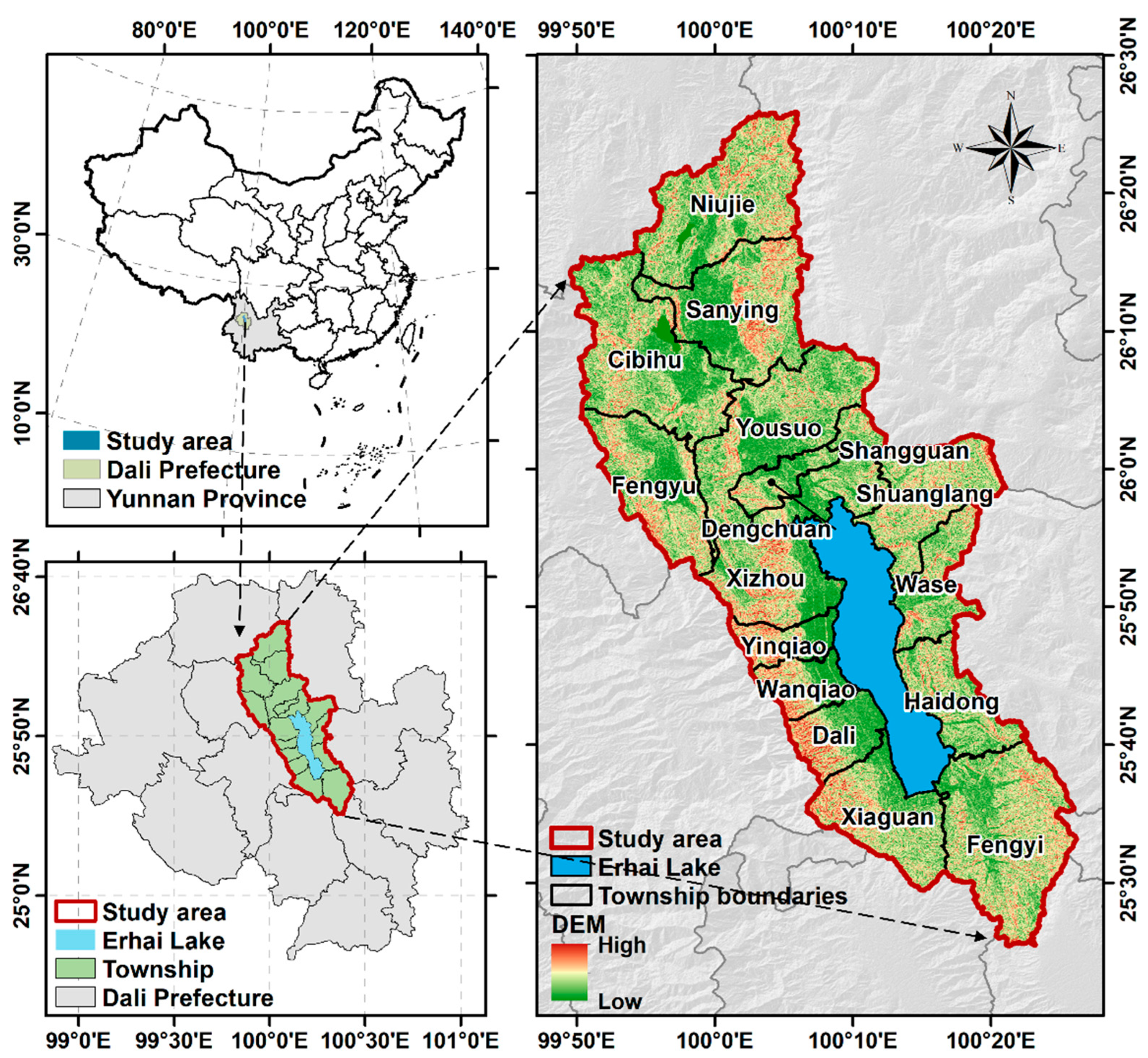
2.1. Study Area
2.2. Evaluation of Resilience of Complex Ecosystem
2.3. Data Requirement and Preparation
2.4. Methods
2.4.1. Entropy Weight Method
2.4.2. Coupling Harmonious Degree Model
2.4.3. OWA-Based Scenario Simulation
3. Results
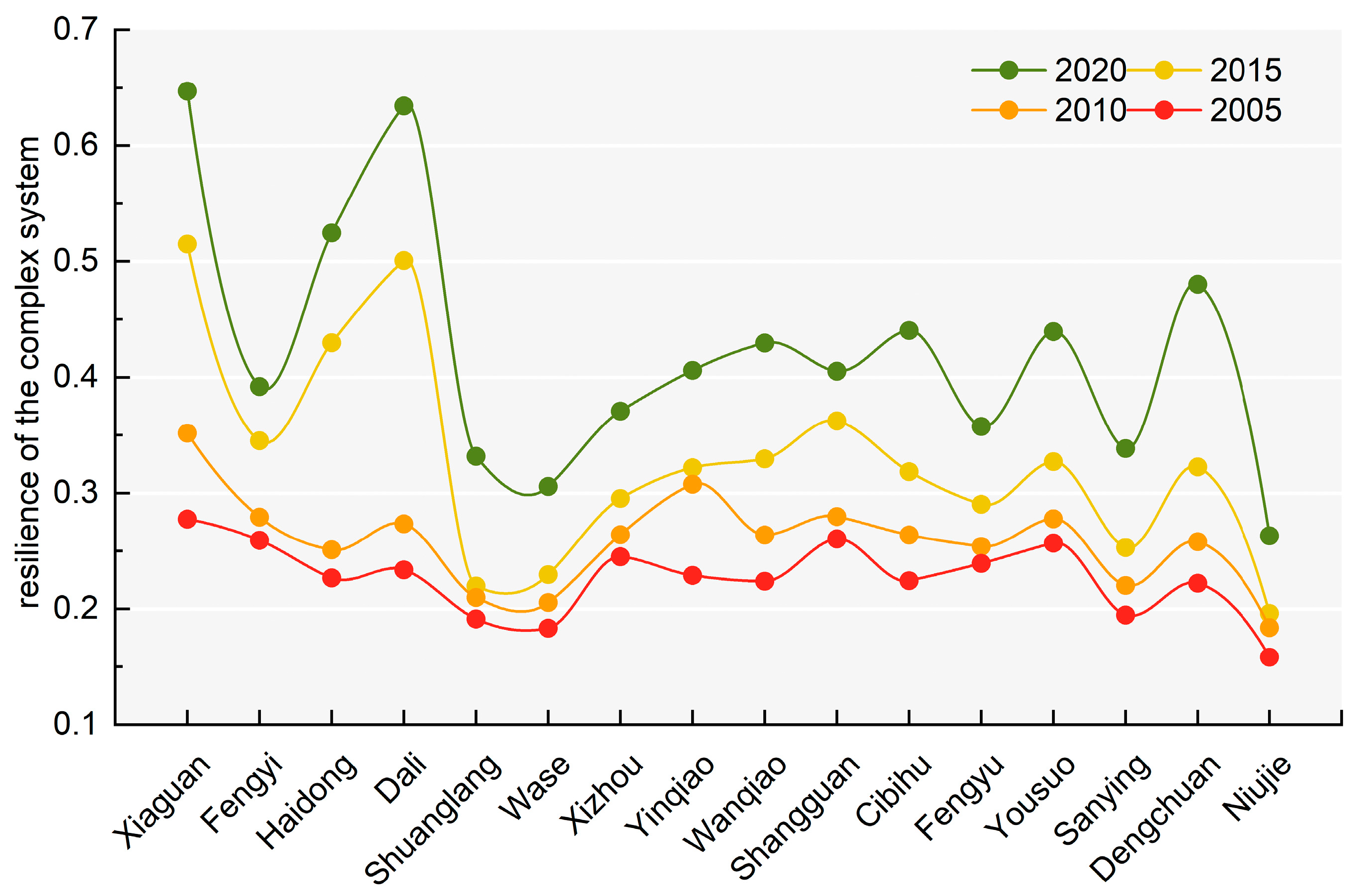
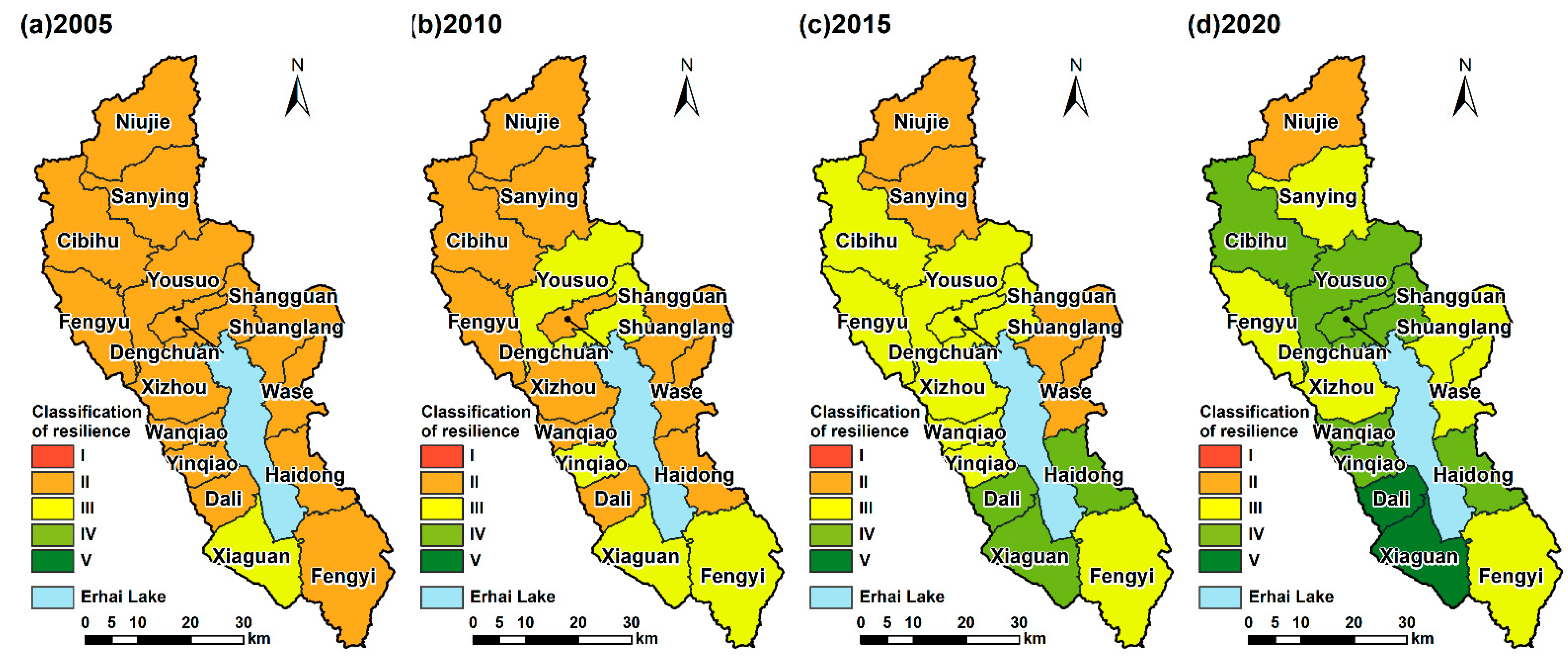
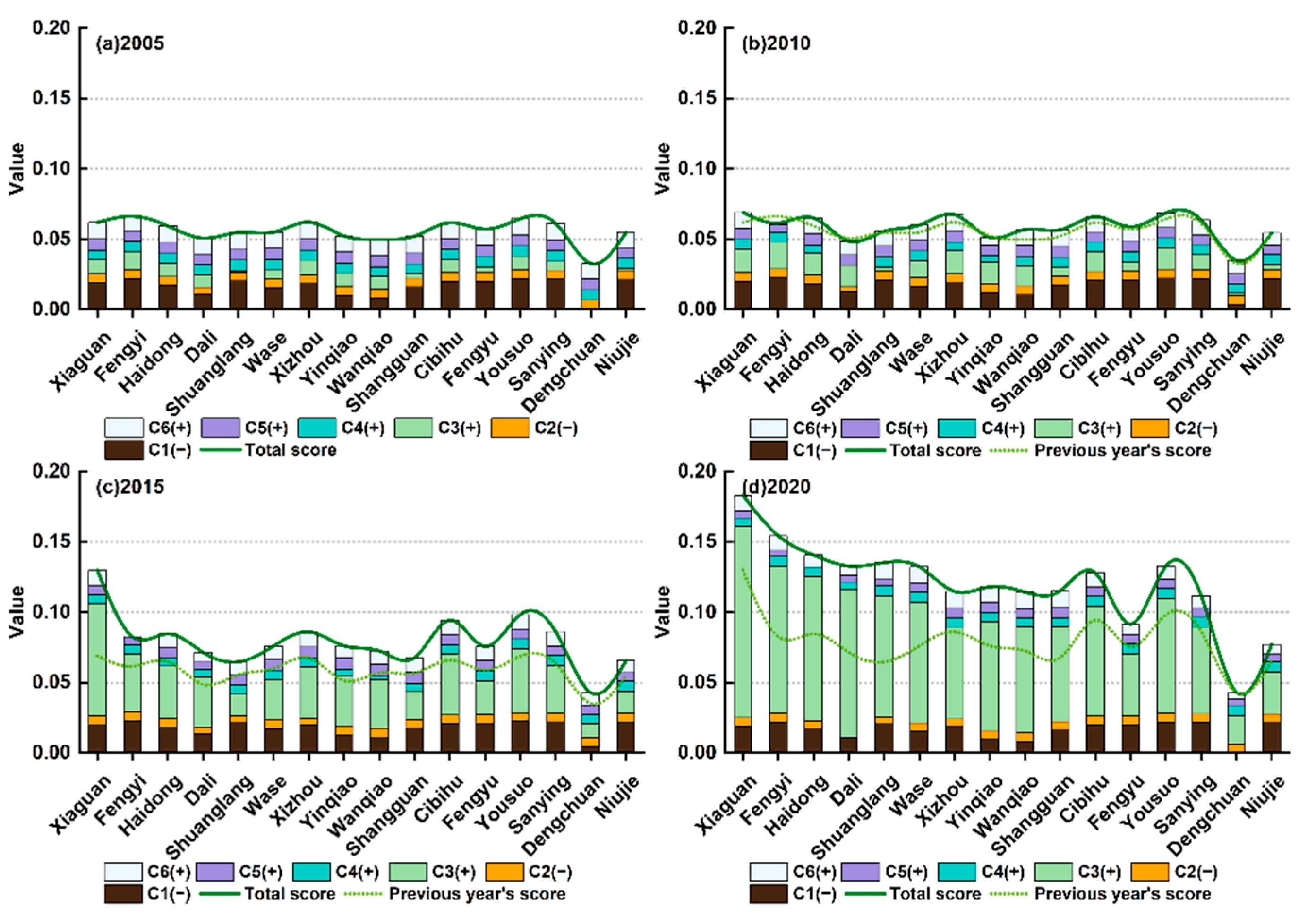
3.1. Spatial and Temporal Evolution of the Complex System Resilience in the Erhai Watershed
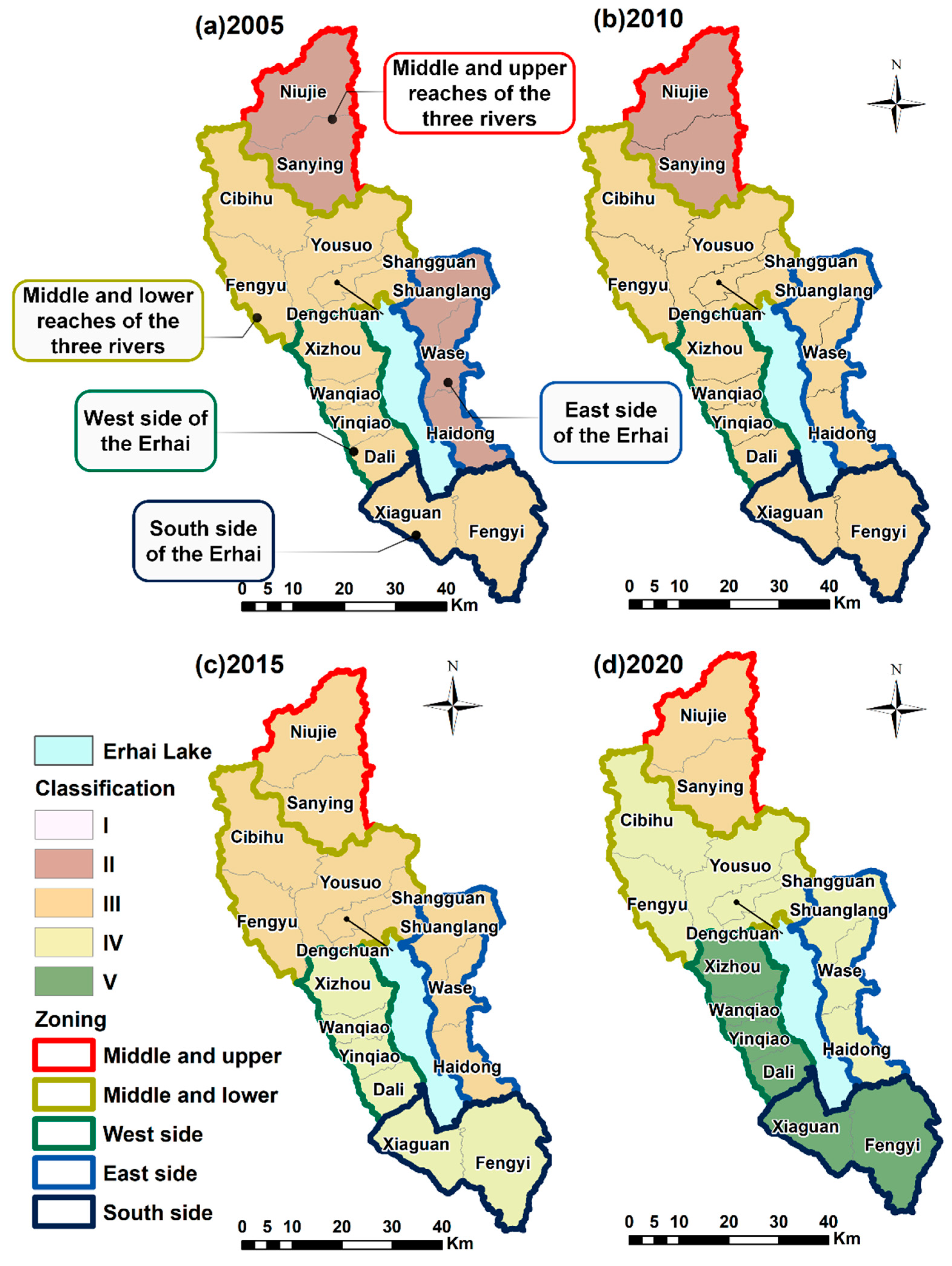
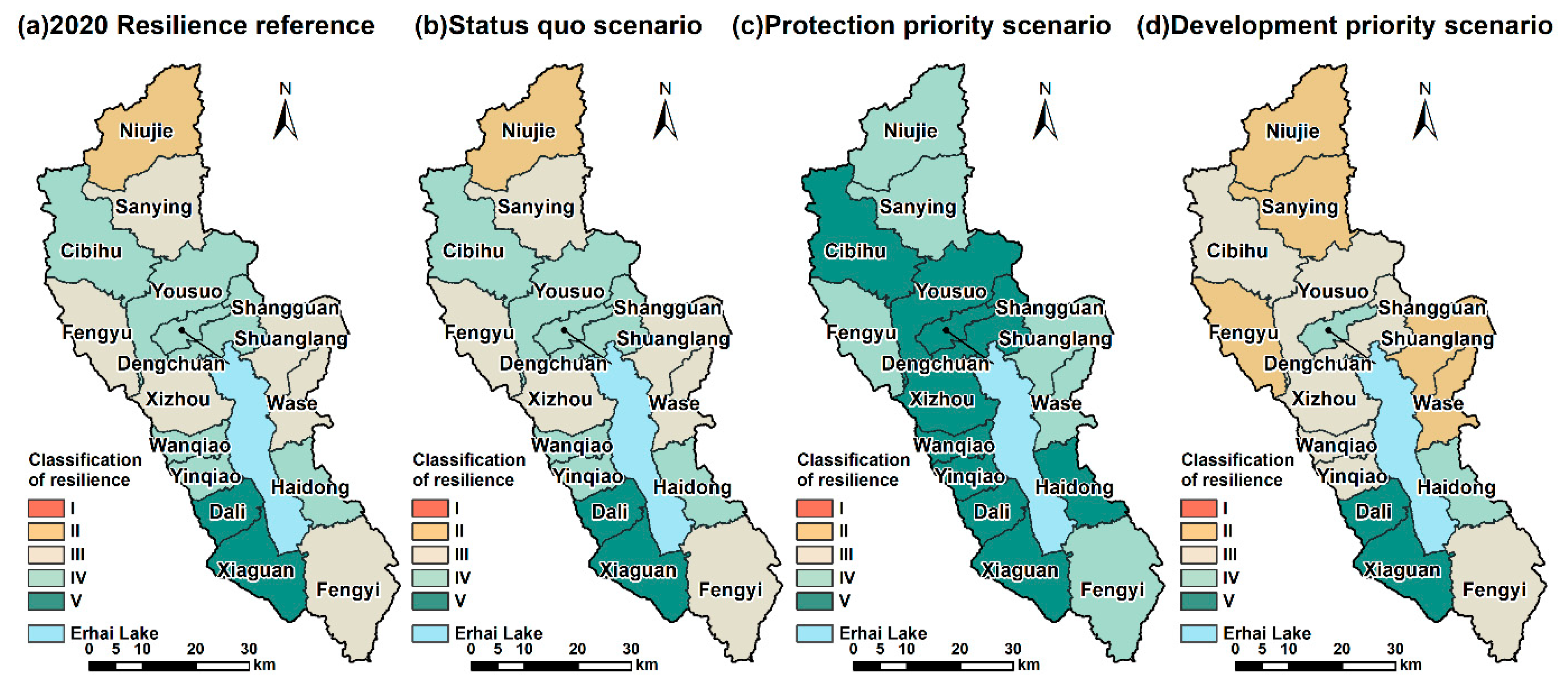
3.2. Resilience Zoning of Complex Systems in the Erhai Watershed
3.3. Coupling Coordination Degree of Individual System
3.3.1. Natural–Economic System
3.3.2. Natural–Social System
3.3.3. Socio-Economic System
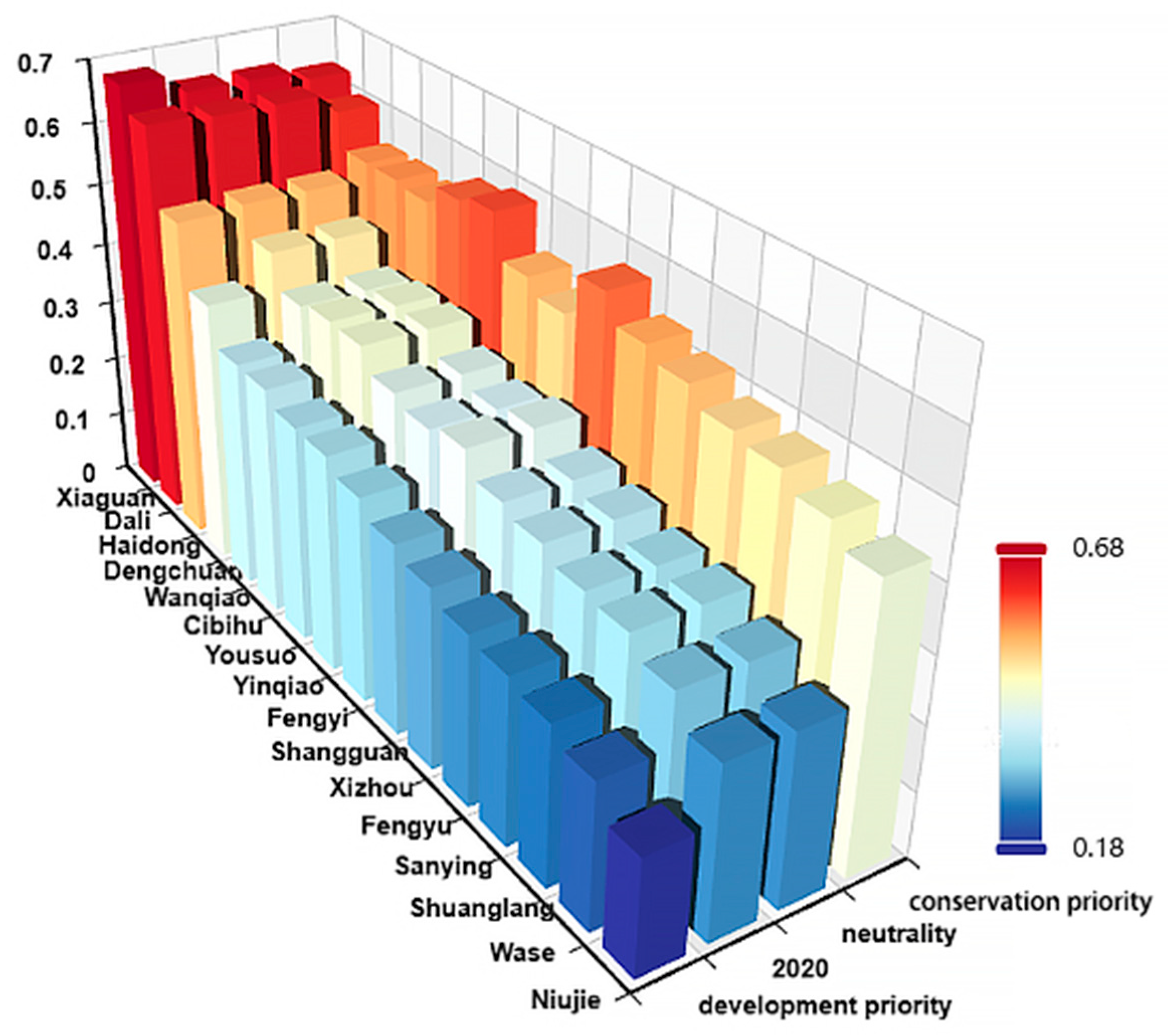
3.4. Complex Ecosystem Resilience in Different Policy Contexts
4. Discussion
4.1. What Are the Mechanisms of Change in the Resilience of the Complex Ecosystem in the Erhai Watershed?
4.1.1. The Level of Investment in Ecological Construction Directly Affects the Level of Resilience
4.1.2. Green Development Can Achieve a Win-Win Situation in Terms of Fiscal Revenue and Resilience Levels
4.1.3. The More Stable the Social System Is in Ecologically Sound Regions
4.2. What Limits the Resilience of the Complex Ecosystem in the Erhai Watershed?
4.2.1. Uncoordinated Regional Development
4.2.2. Uncoordinated Development of Composite Systems
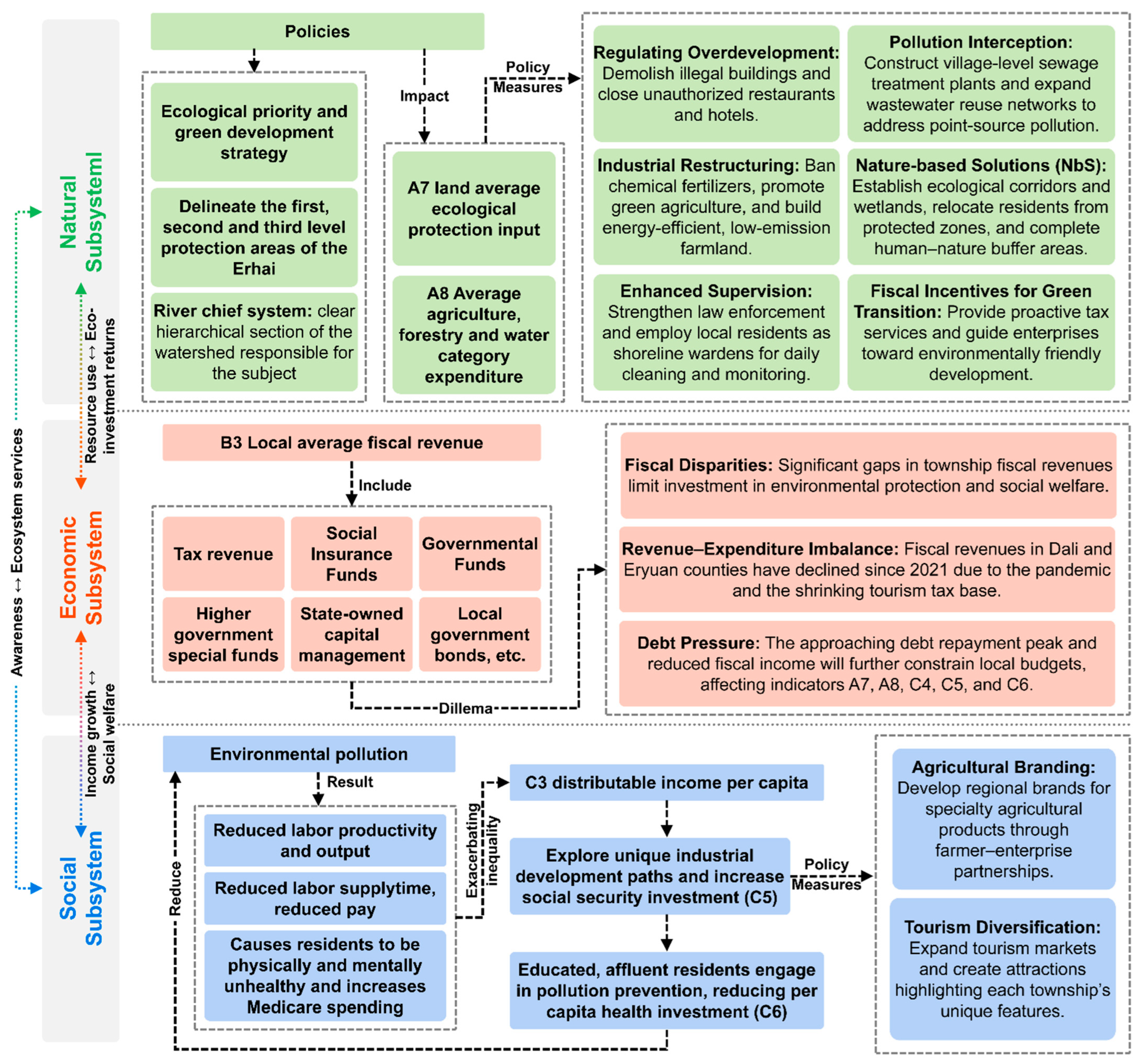
4.3. How to Improve the Resilience of Watershed Complex Ecosystems?
4.3.1. Restructuring the Economy
4.3.2. Watershed Buffer Zone Construction
4.3.3. Partition Governance
5. Conclusions
Author Contributions
Funding
Data Availability Statement
Conflicts of Interest
Abbreviation
| OWA | Ordered Weighted Averaging |
References
- Cobbinah, P.B. Urban resilience in climate change hotspot. Land Use Policy 2021, 100, 104948. [Google Scholar] [CrossRef]
- Zhang, J.M.; Wang, T. Urban resilience under the COVID-19 pandemic: A quantitative assessment framework based on system dynamics. Cities 2023, 136, 104265. [Google Scholar] [CrossRef]
- Holling, C.S. Resilience and stability of ecological systems. Annu. Rev. Ecol. Syst. 1973, 4, 1–23. [Google Scholar]
- Quinlan, A.E.; Berbés-Blázquez, M.; Haider, L.J.; Peterson, G.D. Measuring and assessing resilience: Broadening understanding through multiple disciplinary perspectives. J. Appl. Ecol. 2016, 53, 677–687. [Google Scholar] [CrossRef]
- Hughes, T.P.; Baird, A.H.; Bellwood, D.R.; Card, M.; Connolly, S.R.; Folke, C.; Grosberg, R.; Hoegh-Guldberg, O.; Jackson, J.B.C.; Kleypas, J.; et al. Climate change, human impacts, and the resilience of coral reefs. Science 2003, 301, 929–933. [Google Scholar] [CrossRef]
- McCulloch, M.; Falter, J.; Trotter, J.; Montagna, P. Coral resilience to ocean acidification and global warming through pH up-regulation. Nat. Clim. Change 2012, 2, 623–633. [Google Scholar] [CrossRef]
- Craine, J.M.; Ocheltree, T.W.; Nippert, J.B.; Towne, E.G.; Skibbe, A.M.; Kembel, S.W.; Fargione, J.E. Global diversity of drought tolerance and grassland climate-change resilience. Nat. Clim. Change 2013, 3, 63–67. [Google Scholar] [CrossRef]
- Van Looy, K.; Lejeune, M.; Verbeke, W. Indicators and mechanisms of stability and resilience to climatic and landscape changes in a remnant calcareous grassland. Ecol. Indic. 2016, 70, 498–506. [Google Scholar] [CrossRef]
- Vogel, A.; Scherer-Lorenzen, M.; Weigelt, A. Grassland Resistance and Resilience after Drought Depends on Management Intensity and Species Richness. PLoS ONE 2012, 7, e36992. [Google Scholar] [CrossRef] [PubMed]
- Liu, B.; Wang, J.M.; Jing, Z.R.; Tang, Q. Measurement of sustainable transformation capability of resource-based cities based on fuzzy membership function: A case study of Shanxi Province, China. Resour. Policy 2020, 68, 101739. [Google Scholar] [CrossRef]
- Wu, W.T.; Gao, Y.W.; Chen, C.P. CLSER: A new indicator for the social-ecological resilience of coastal systems and sustainable management. J. Clean. Prod. 2024, 435, 140564. [Google Scholar] [CrossRef]
- Huang, X.X.; Liu, Y.S.; Stouffs, R. Human-earth system dynamics in China’s land use pattern transformation amidst climate fluctuations and human activities. Sci. Total Environ. 2024, 954, 176013. [Google Scholar] [CrossRef] [PubMed]
- Adger, W.N. Social and ecological resilience: Are they related? Prog. Hum. Geogr. 2000, 24, 347–364. [Google Scholar] [CrossRef]
- Bailey, I.; Buck, L.E. Managing for resilience: A landscape framework for food and livelihood security and ecosystem services. Food Secur. 2016, 8, 477–490. [Google Scholar] [CrossRef]
- Folke, C. Resilience: The emergence of a perspective for social-ecological systems analyses. Glob. Environ. Change-Hum. Policy Dimens. 2006, 16, 253–267. [Google Scholar] [CrossRef]
- Klein, R.J.T.; Smit, M.J.; Goosen, H.; Hulsbergen, C.H. Resilience and vulnerability: Coastal dynamics or Dutch dikes? Geogr. J. 1998, 164, 259–268. [Google Scholar] [CrossRef]
- Adger, W.N.; Hughes, T.P.; Folke, C.; Carpenter, S.R.; Rockström, J. Social-ecological resilience to coastal disasters. Science 2005, 309, 1036–1039. [Google Scholar] [CrossRef]
- Cao, J.J.; Li, M.T.; Deo, R.C.; Adamowski, J.F.; Cerdà, A.; Feng, Q.; Liu, M.X.; Zhang, J.; Zhu, G.F.; Zhang, X.B.; et al. Comparison of social-ecological resilience between two grassland management patterns driven by grassland land contract policy in the Maqu, Qinghai-Tibetan Plateau. Land Use Policy 2018, 74, 88–96. [Google Scholar] [CrossRef]
- Gunderson, L.H.; Holling, C.S. Panarchy: Understanding Transformations in Human and Natural Systems; Island Press: Washington, DC, USA, 2002. [Google Scholar]
- Jin, L.L.; Kim, M.; Chon, J. Modeling the resilient supply of ecosystem function for climate change adaptive management in Wetland City. J. Environ. Manag. 2022, 322, 115788. [Google Scholar] [CrossRef]
- Spears, B.M.; Ives, S.C.; Angeler, D.G.; Allen, C.R.; Birk, S.; Carvalho, L.; Cavers, S.; Daunt, F.; Morton, R.D.; Pocock, M.J.O.; et al. FORUM: Effective management of ecological resilience—Are we there yet? J. Appl. Ecol. 2015, 52, 1311–1315. [Google Scholar] [CrossRef]
- Lambin, E.F.; Meyfroidt, P. Land use transitions: Socio-ecological feedback versus socio-economic change. Land Use Policy 2010, 27, 108–118. [Google Scholar] [CrossRef]
- Zhang, L.H.; Nie, Q.Y.; Chen, B.Y.; Chai, J.X.; Zhao, Z.Y. Multi-scale evaluation and multi-scenario simulation analysis of regional energy carrying capacity-Case study: China. Sci. Total Environ. 2020, 734, 139440. [Google Scholar] [CrossRef]
- Yang, M.; Wang, J.M.; Jing, Z.R.; Liu, B.; Niu, H.B. Evaluation and regulation of resource-based city resilience: Evidence from Shanxi Province, China. Int. J. Disaster Risk Reduct. 2022, 81, 103256. [Google Scholar] [CrossRef]
- Feng, Y.; Wu, F.L.; Zhang, F.Z. Environmental statecraft and changing spatial politics: Erhai Lake protection in China. Political Geogr. 2024, 115, 103196. [Google Scholar] [CrossRef]
- Gomiero, T.; Paoletti, M.G.; Pimentel, D. Energy and environmental issues in organic and conventional agriculture. Crit. Rev. Plant Sci. 2008, 27, 239–254. [Google Scholar] [CrossRef]
- Vleeshouwers, L.M.; Verhagen, A. Carbon emission and sequestration by agricultural land use: A model study for Europe. Glob. Change Biol. 2002, 8, 519–530. [Google Scholar] [CrossRef]
- Cheng, Y.; Awan, U.; Ahmad, S.; Tan, Z.X. How do technological innovation and fiscal decentralization affect the environment? A story of the fourth industrial revolution and sustainable growth. Technol. Forecast. Soc. Change 2021, 162, 120398. [Google Scholar] [CrossRef]
- Tang, M.; Liu, P.H.; Chao, X.R.; Han, Z.L. The performativity of city resilience for sustainable development of poor and disaster-prone regions: A case study from China. Technol. Forecast. Soc. Change 2021, 173, 121130. [Google Scholar] [CrossRef]
- Rescia, A.J.; Ortega, M. Quantitative evaluation of the spatial resilience to the B. oleae pest in olive grove socio-ecological landscapes at different scales. Ecol. Indic. 2018, 84, 820–827. [Google Scholar] [CrossRef]
- Cui, X.G.; Fang, C.L.; Liu, H.M.; Liu, X.F. Assessing sustainability of urbanization by a coordinated development index for an Urbanization-Resources-Environment complex system: A case study of Jing-Jin-Ji region, China. Ecol. Indic. 2019, 96, 383–391. [Google Scholar] [CrossRef]
- Han, H.; Guo, L.; Zhang, J.Q.; Zhang, K.Z.; Cui, N.B. Spatiotemporal analysis of the coordination of economic development, resource utilization, and environmental quality in the Beijing-Tianjin-Hebei urban agglomeration. Ecol. Indic. 2021, 127, 107724. [Google Scholar] [CrossRef]
- Hu, Z.N.; Yang, X.; Yang, J.J.; Yuan, J.; Zhang, Z.Y. Linking landscape pattern, ecosystem service value, and human well-being in Xishuangbanna, southwest China: Insights from a coupling coordination model. Glob. Ecol. Conserv. 2021, 27, e01583. [Google Scholar] [CrossRef]
- Wang, X.F.; Huang, X.; Zhang, X.R.; Yan, Y.; Zhou, C.W.; Zhou, J.T.; Feng, X.M. Analysis of the spatio-temporal change of social-ecological system coupling: A case study in the Qinghai-Tibet Plateau. Glob. Ecol. Conserv. 2022, 33, e01973. [Google Scholar] [CrossRef]
- Yu, H.; Zhang, F.; Cao, L.; Wang, J.; Yang, S. Spatial-temporal pattern of land ecological security at a township scale in the bortala mongolian autonomous prefecture. Acta Ecol. Sin. 2017, 37, 6355–6369. [Google Scholar] [CrossRef][Green Version]
- Yu, S.Y.; Kong, X.S.; Wang, Q.; Yang, Z.W.; Peng, J. A new approach of Robustness-Resistance-Recovery (3Rs) to assessing flood resilience: A case study in Dongting Lake Basin. Landsc. Urban Plan. 2023, 230, 104605. [Google Scholar] [CrossRef]
- Du, H.C.; Wang, J.M.; Wang, J.; Liu, B.; Mu, J.Y.; Zhang, X. Does ecological restoration really improve ecosystem stability?—An empirical test based on the Minjiang River Basin of China. Ecol. Eng. 2025, 221, 107757. [Google Scholar] [CrossRef]
- Wang, X.; Li, J.; Liu, Q.; Zhang, J.; Tang, X. Evaluation of Ecological Vulnerability in Xin’anjiang River Basin Based on SRP Modelling. J. Hydroecology 2024, 45, 1–9. [Google Scholar] [CrossRef]
- Wang, X.K.; Ouyang, Z.Y. Distribution and division of sensitivity to water-caused soil loss in China. Acta Ecol. Sin. 2001, 21, 14–19. [Google Scholar]
- Lu, D.; Tan, S.; Xia, J. Analysis on the ecological vulnerability of Dali city based on its landscape pattern and sensitivity to soil and water loss. Yunnan Geogr. Environ. Res. 2009, 21, 92–96. [Google Scholar] [CrossRef]
- Yin, Z.X.; Ma, T.T.; Sun, Y.L.; Yin, Z.Y. Spatio-temporal heterogeneity of urban ecological resilience in the middle reaches of the Yangtze River in China. Int. Rev. Econ. Financ. 2024, 94, 103384. [Google Scholar] [CrossRef]
- Yang, C.; Zeng, W.; Yang, X. Coupling coordination evaluation and sustainable development pattern of geo-ecological environment and urbanization in Chongqing municipality, China. Sustain. Cities Soc. 2020, 61, 102271. [Google Scholar] [CrossRef]
- Su, Y.L.; Liu, Y.C.; Zhou, Y.; Liu, J.K. Research on the Coupling and Coordination of Land Ecological Security and High-Quality Agricultural Development in the Han River Basin. Land 2024, 13, 1666. [Google Scholar] [CrossRef]
- Zhou, H.T.; Wu, X.D.; Nie, H.X.; Wang, X.C.Y.; Zang, S.Y. Coupling coordination analysis and obstacle factors identification of rural living-production-ecological functions in a farming-pastoral ecotone. Ecol. Indic. 2024, 158, 111398. [Google Scholar] [CrossRef]
- Sun, J.; Chen, J.; Huang, X. The bargain between subjects and rights negotiation in the tourism environmental governance issue of Erhai in Dali. Geogr. Sci. 2020, 40, 1468–1475. [Google Scholar]
- Niu, J.Y.; Jin, G.; Zhang, L. Territorial spatial zoning based on suitability evaluation and its impact on ecosystem services in Ezhou city. J. Geogr. Sci. 2023, 33, 2278–2294. [Google Scholar] [CrossRef]
- Wu, Q.; Cao, Y.; Zhang, Y.J.; Su, D.; Fang, X.Q. Linking ecosystem services trade-offs, human preferences and future scenario simulations to ecological security patterns: A novel methodology for reconciling conflicting ecological functions. Appl. Geogr. 2025, 176, 103534. [Google Scholar] [CrossRef]
- Jiang, H.; Eastman, J.R. Application of fuzzy measures in multi-criteria evaluation in GIS. Int. J. Geogr. Inf. Sci. 2000, 14, 173–184. [Google Scholar] [CrossRef]
- Malczewski, J.; Chapman, T.; Flegel, C.; Walters, D.; Shrubsole, D.; Healy, M.A. GIS-multicriteria evaluation with ordered weighted averaging (OWA): Case study of developing watershed management strategies. Environ. Plan. A-Econ. Space 2003, 35, 1769–1784. [Google Scholar] [CrossRef]
- Yang, S.-Y.; Tang, T.; Cai, Q.-H.; Xiao, W.; Wang, X.; Li, F.-Q.; Tang, J. Aquatic eco-regionalization of Erhai Lake Basin, Yunnan Province of Southwest China. Chin. J. Ecol. 2012, 31, 1798. [Google Scholar]
- Jin, K.; Heerink, N.; Davies, W.J.; Shen, J.B.; Zhang, Y.F.T.; Hou, Y.; Zhao, Y.Q.; Zhao, Z.X.; Zhang, F.S. Coordinating environmental protection and agricultural development: A village-based case study for promoting green transformation. Front. Agric. Sci. Eng. 2024, 11, 100–112. [Google Scholar] [CrossRef]
- Peng, L.; He, L.S.; Shen, M.T.; Zhao, M.; Armatas, C.A. Understanding stakeholder perceptions of environmental justice: A study of tourism in the Erhai Lake basin, Yunnan province, China. Ecol. Soc. 2023, 28, 1. [Google Scholar] [CrossRef]
- Lu, P.; Qu, B.; Liu, Y.; Liu, M.T. Study on Watershed Ecological Compensation for Water Pollution Considering Population Flow: A Case Study in the Lower Yellow River Basin. Water 2024, 16, 3507. [Google Scholar] [CrossRef]



| County Name | Number of Townships | Township Name | Area (km2) |
|---|---|---|---|
| Dali | 10 | Xiaguan, Fengyi, Haidong, Dali, Shuanglang, Wase, Xizhou, Yinqiao, Wanqiao, Shangguan | 1639.8 |
| Eryuan | 6 | Cibihu, Fengyu, Yousuo, Sanying, Dengchuan, Niujie | 1288.0 |
| Total | 16 | 2927.8 |
| Dimensions | Standards | Indicators | Units | Properties | Weights |
|---|---|---|---|---|---|
| Natural Subsystem (0.511) | Ecological status (0.115) | NDVI (A1) | / | + | 0.018 |
| Land use type (A2) | / | + | 0.033 | ||
| Soil texture (A3) | / | + | 0.064 | ||
| Ecological pressures (0.098) | Slope (A4) | ° | − | 0.062 | |
| Share of arable land (A5) | % | − | 0.018 | ||
| Food production per capita (A6) | kg/person | − | 0.018 | ||
| Ecological responses (0.298) | Land-average ecological protection input (A7) | 10,000 Yuan/km2 | + | 0.192 | |
| Land-average agricultural, forestry, and water inputs (A8) | 10,000 Yuan/km2 | + | 0.106 | ||
| Economic Subsystem (0.296) | Economic pressure (0.03) | Gross industrial product per land (B1) | 10,000 Yuan/km2 | − | 0.009 |
| The proportion of urban residential industrial and mining land (B2) | % | − | 0.021 | ||
| Economic Base (0.266) | Local average government revenue (B3) | 10,000 Yuan/km2 | + | 0.266 | |
| Social Subsystem (0.193) | Social pressure (0.029) | Population density (C1) | Person/km2 | − | 0.023 |
| The annual number of visitors (C2) | 10,000 people | − | 0.006 | ||
| People’s livelihood improvement (0.164) | Distributable income per capita (C3) | % | + | 0.136 | |
| Ground average infrastructure investment (C4) | 10,000 Yuan/km2 | + | 0.008 | ||
| Social security investment per capita (C5) | Yuan/person | + | 0.008 | ||
| Per capita investment in health (C6) | Yuan/person | + | 0.012 |
| D | 0 ≤ D < 0.1 | 0.1 ≤ D < 0.2 | 0.2 ≤ D < 0.3 | 0.3 ≤ D < 0.4 | 0.4 ≤ D < 0.5 |
| level | Extreme disorder | Severe disorder | Moderate disorder | Mild disorder | On the verge of disorder |
| D | 0.5 ≤ D < 0.6 | 0.6 ≤ D < 0.7 | 0.7 ≤ D < 0.8 | 0.8 ≤ D < 0.9 | 0.9 ≤ D < 1 |
| level | Barely coordinated | Primary Coordination | Mid-level coordination | Good Coordination | Quality Coordination |
| n = 17 | α | ||||||||||
|---|---|---|---|---|---|---|---|---|---|---|---|
| 0.00 | 0.10 | 0.20 | 0.30 | 0.40 | 0.50 | 0.60 | 0.70 | 0.80 | 0.90 | 1.00 | |
| B3 | 0.0000 | 0.0002 | 0.0038 | 0.0142 | 0.0323 | 0.0588 | 0.0960 | 0.1487 | 0.2292 | 0.3841 | 1.0000 |
| A7 | 0.0000 | 0.0003 | 0.0049 | 0.0165 | 0.0345 | 0.0588 | 0.0897 | 0.1284 | 0.1773 | 0.2366 | 0.0000 |
| C3 | 0.0000 | 0.0004 | 0.0063 | 0.0191 | 0.0370 | 0.0588 | 0.0838 | 0.1109 | 0.1372 | 0.1458 | 0.0000 |
| A8 | 0.0000 | 0.0007 | 0.0082 | 0.0221 | 0.0396 | 0.0588 | 0.0783 | 0.0958 | 0.1062 | 0.0898 | 0.0000 |
| A3 | 0.0000 | 0.0011 | 0.0106 | 0.0256 | 0.0424 | 0.0588 | 0.0731 | 0.0827 | 0.0821 | 0.0553 | 0.0000 |
| A4 | 0.0000 | 0.0019 | 0.0136 | 0.0296 | 0.0454 | 0.0588 | 0.0683 | 0.0714 | 0.0636 | 0.0341 | 0.0000 |
| A2 | 0.0000 | 0.0030 | 0.0176 | 0.0343 | 0.0486 | 0.0588 | 0.0638 | 0.0617 | 0.0492 | 0.0210 | 0.0000 |
| C1 | 0.0000 | 0.0049 | 0.0228 | 0.0397 | 0.0520 | 0.0588 | 0.0596 | 0.0533 | 0.0381 | 0.0129 | 0.0000 |
| B2 | 0.0000 | 0.0080 | 0.0294 | 0.0460 | 0.0557 | 0.0588 | 0.0557 | 0.0460 | 0.0294 | 0.0080 | 0.0000 |
| A1 | 0.0000 | 0.0129 | 0.0381 | 0.0533 | 0.0596 | 0.0588 | 0.0520 | 0.0397 | 0.0228 | 0.0049 | 0.0000 |
| A5 | 0.0000 | 0.0210 | 0.0492 | 0.0617 | 0.0638 | 0.0588 | 0.0486 | 0.0343 | 0.0176 | 0.0030 | 0.0000 |
| A6 | 0.0000 | 0.0341 | 0.0636 | 0.0714 | 0.0683 | 0.0588 | 0.0454 | 0.0296 | 0.0136 | 0.0019 | 0.0000 |
| C6 | 0.0000 | 0.0553 | 0.0821 | 0.0827 | 0.0731 | 0.0588 | 0.0424 | 0.0256 | 0.0106 | 0.0011 | 0.0000 |
| B1 | 0.0000 | 0.0898 | 0.1062 | 0.0958 | 0.0783 | 0.0588 | 0.0396 | 0.0221 | 0.0082 | 0.0007 | 0.0000 |
| C4 | 0.0000 | 0.1458 | 0.1372 | 0.1109 | 0.0838 | 0.0588 | 0.0370 | 0.0191 | 0.0063 | 0.0004 | 0.0000 |
| C5 | 0.0000 | 0.2366 | 0.1773 | 0.1284 | 0.0897 | 0.0588 | 0.0345 | 0.0165 | 0.0049 | 0.0003 | 0.0000 |
| C2 | 1.0000 | 0.3841 | 0.2292 | 0.1487 | 0.0960 | 0.0588 | 0.0323 | 0.0142 | 0.0038 | 0.0002 | 0.0000 |
Disclaimer/Publisher’s Note: The statements, opinions and data contained in all publications are solely those of the individual author(s) and contributor(s) and not of MDPI and/or the editor(s). MDPI and/or the editor(s) disclaim responsibility for any injury to people or property resulting from any ideas, methods, instructions or products referred to in the content. |
© 2025 by the authors. Licensee MDPI, Basel, Switzerland. This article is an open access article distributed under the terms and conditions of the Creative Commons Attribution (CC BY) license (https://creativecommons.org/licenses/by/4.0/).
Share and Cite
Liu, B.; Wang, J.; Liu, M.; Jiang, Y. Resilience Assessment and Governance Strategies for a Complex Watershed System: A Case Study of the Erhai Basin, China. Land 2025, 14, 2354. https://doi.org/10.3390/land14122354
Liu B, Wang J, Liu M, Jiang Y. Resilience Assessment and Governance Strategies for a Complex Watershed System: A Case Study of the Erhai Basin, China. Land. 2025; 14(12):2354. https://doi.org/10.3390/land14122354
Chicago/Turabian StyleLiu, Biao, Jinman Wang, Mengru Liu, and Yutong Jiang. 2025. "Resilience Assessment and Governance Strategies for a Complex Watershed System: A Case Study of the Erhai Basin, China" Land 14, no. 12: 2354. https://doi.org/10.3390/land14122354
APA StyleLiu, B., Wang, J., Liu, M., & Jiang, Y. (2025). Resilience Assessment and Governance Strategies for a Complex Watershed System: A Case Study of the Erhai Basin, China. Land, 14(12), 2354. https://doi.org/10.3390/land14122354