Article

Multi-Dimensional Driving Mechanisms and Scenario Simulation of Production-Living-Ecological Space Evolution in Urban Agglomerations of China: Evidence from the Guanzhong Plain


School of Humanities, Chang’an University, Xi’an 710061, China
*
Authors to whom correspondence should be addressed.
Land 2025, 14(11), 2201; https://doi.org/10.3390/land14112201
Submission received: 8 September 2025 / Revised: 23 October 2025 / Accepted: 4 November 2025 / Published: 5 November 2025
(This article belongs to the Special Issue Untangling Urban Analysis Using Geographic Data and GIS Technologies)

Abstract

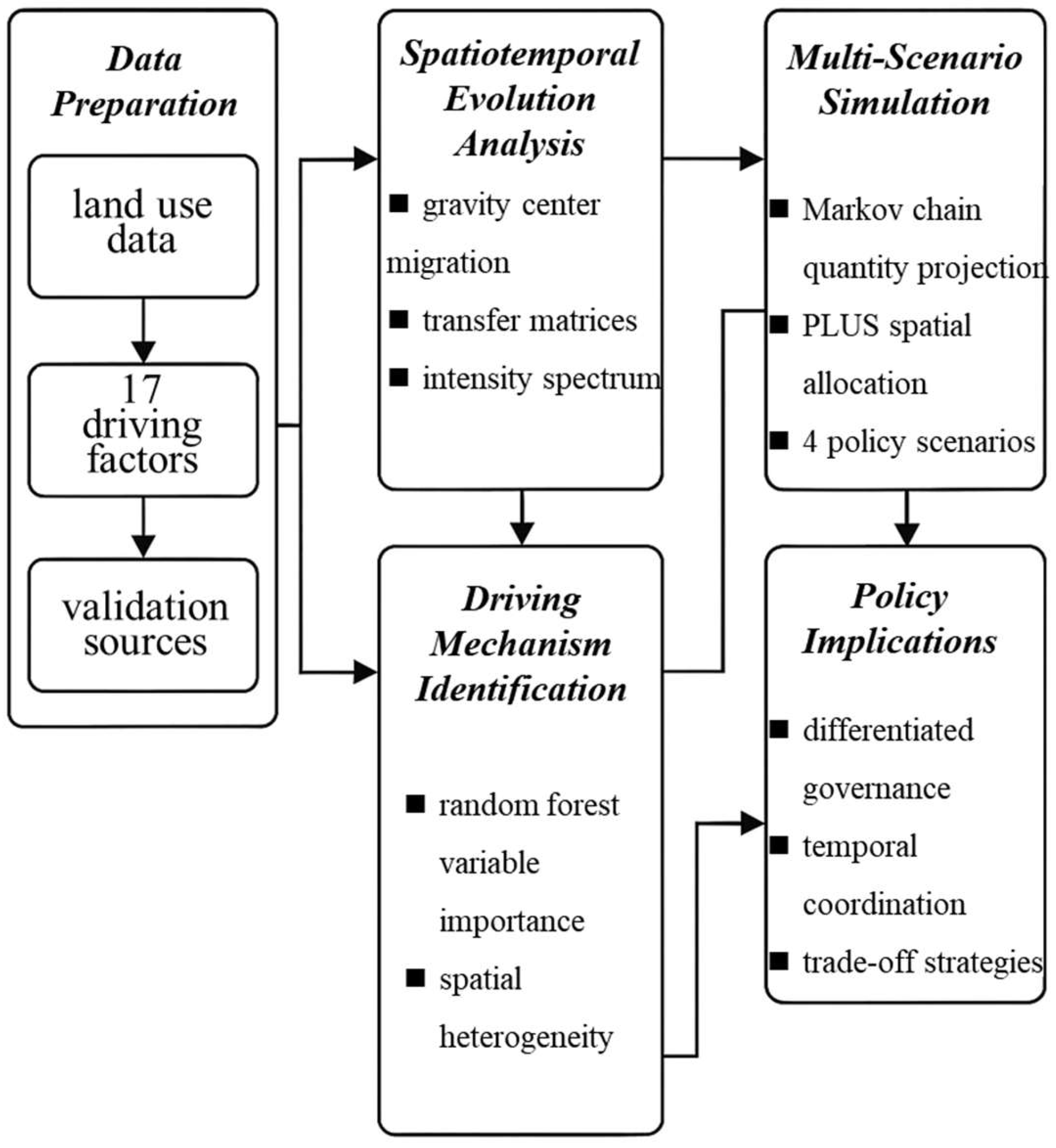
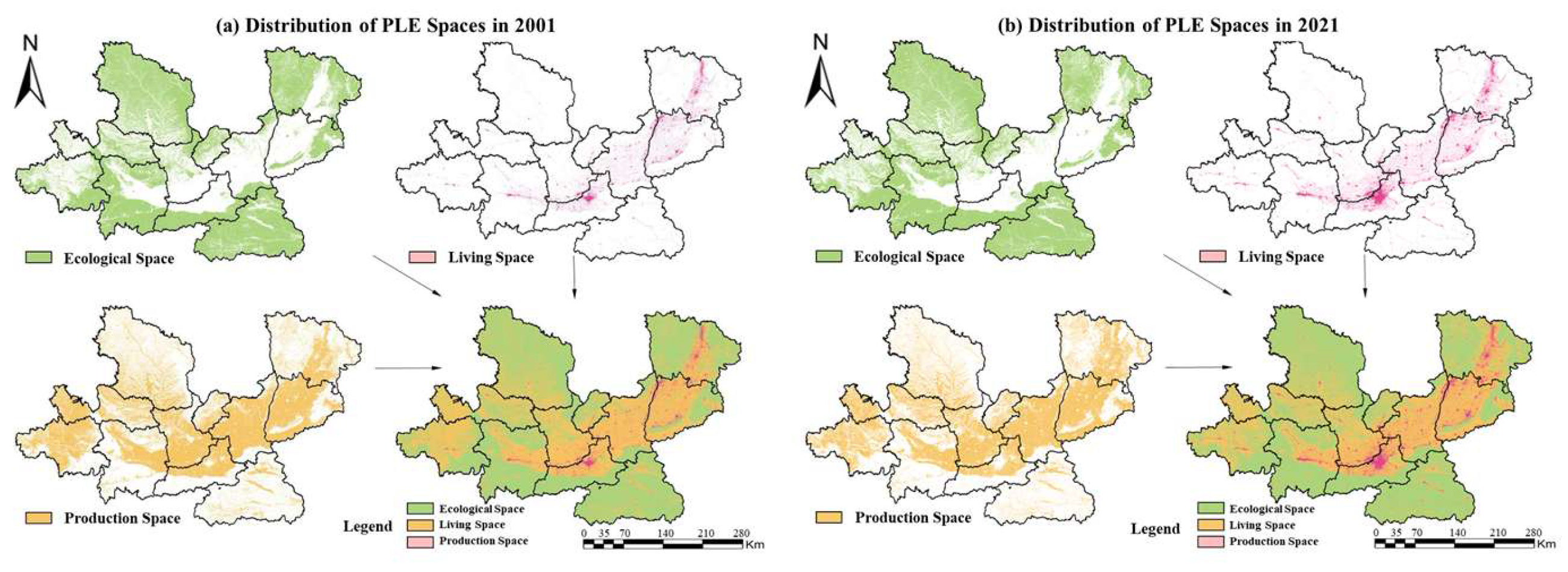
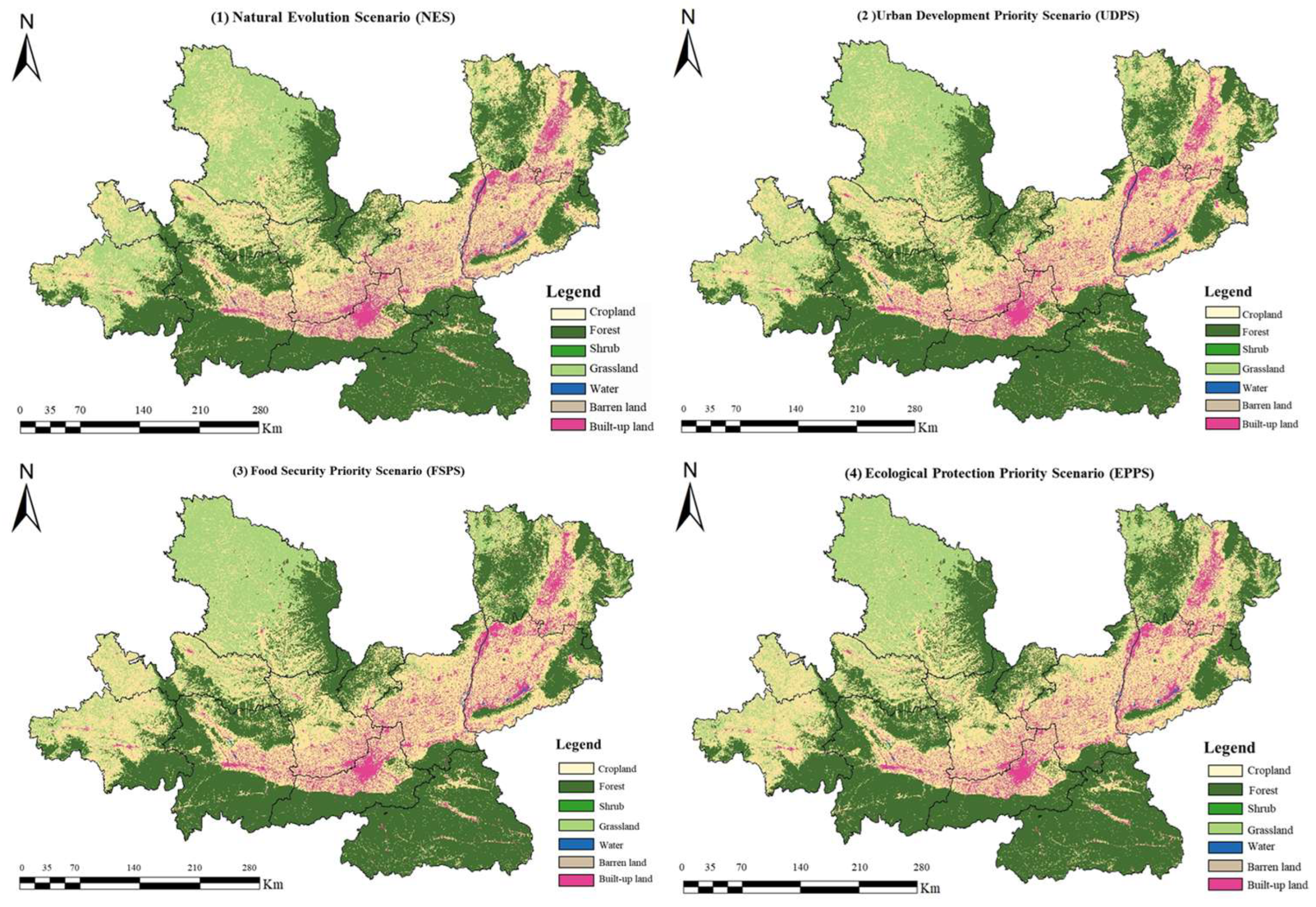
The coordinated development of Production-Living-Ecological (PLE) spaces has emerged as a core challenge for regional sustainability amid rapid urbanization processes. This study examines the Guanzhong Plain Urban Agglomeration (2001–2021) using an integrated Markov-PLUS model coupled with Random Forest algorithms and 17 driving factors to construct 4 policy scenarios for future projections. The results reveal dramatic spatial restructuring: living space expanded 73.89% while production and ecological spaces contracted 7.47% and 8.94%. Evolution occurred through four distinct phases—rapid expansion, structural adjustment, quality improvement, and green transformation—each corresponding to national policy transitions with regional lags. Driving mechanism analysis identified environmental factors contributing 45–55% of variance, population density driving 24.2% of living space expansion, and elevation thresholds constraining urban growth above 1000 m. Multi-scenario simulations revealed fundamental trade-offs: urban development scenarios achieved 55.34% built-up expansion but sacrificed 15.4% ecological space, while ecological protection scenarios maintained 92% food production capacity with optimal connectivity (0.63) and maximum carbon storage (1287 Mt C). Model validation achieved exceptional accuracy (Kappa = 0.91, FoM = 0.24). This research emphasizes three strategic imperatives: (1) differentiated spatial governance (urban priority in cores, farmland protection in plains, ecological restoration in mountains); (2) temporal coordination mechanisms accounting for 3–5-year policy transmission lags; (3) adaptive management approaches addressing nonlinear evolution characteristics. This framework provides scientific foundations for balancing economic development, food security, and ecological protection in rapidly urbanizing regions.
Keywords: Production-Living-Ecological space; spatiotemporal evolution; driving mechanisms; scenario simulation; Markov chain-PLUS model; sustainable development; Guanzhong Plain Urban Agglomeration Production-Living-Ecological space; spatiotemporal evolution; driving mechanisms; scenario simulation; Markov chain-PLUS model; sustainable development; Guanzhong Plain Urban Agglomeration