Human–Nature Interaction Pattern Design in Landscape Architecture



Abstract
1. Introduction
2. Interaction Patterns: Theory, Evidence, and Importance
2.1. What Is an Interaction Pattern?
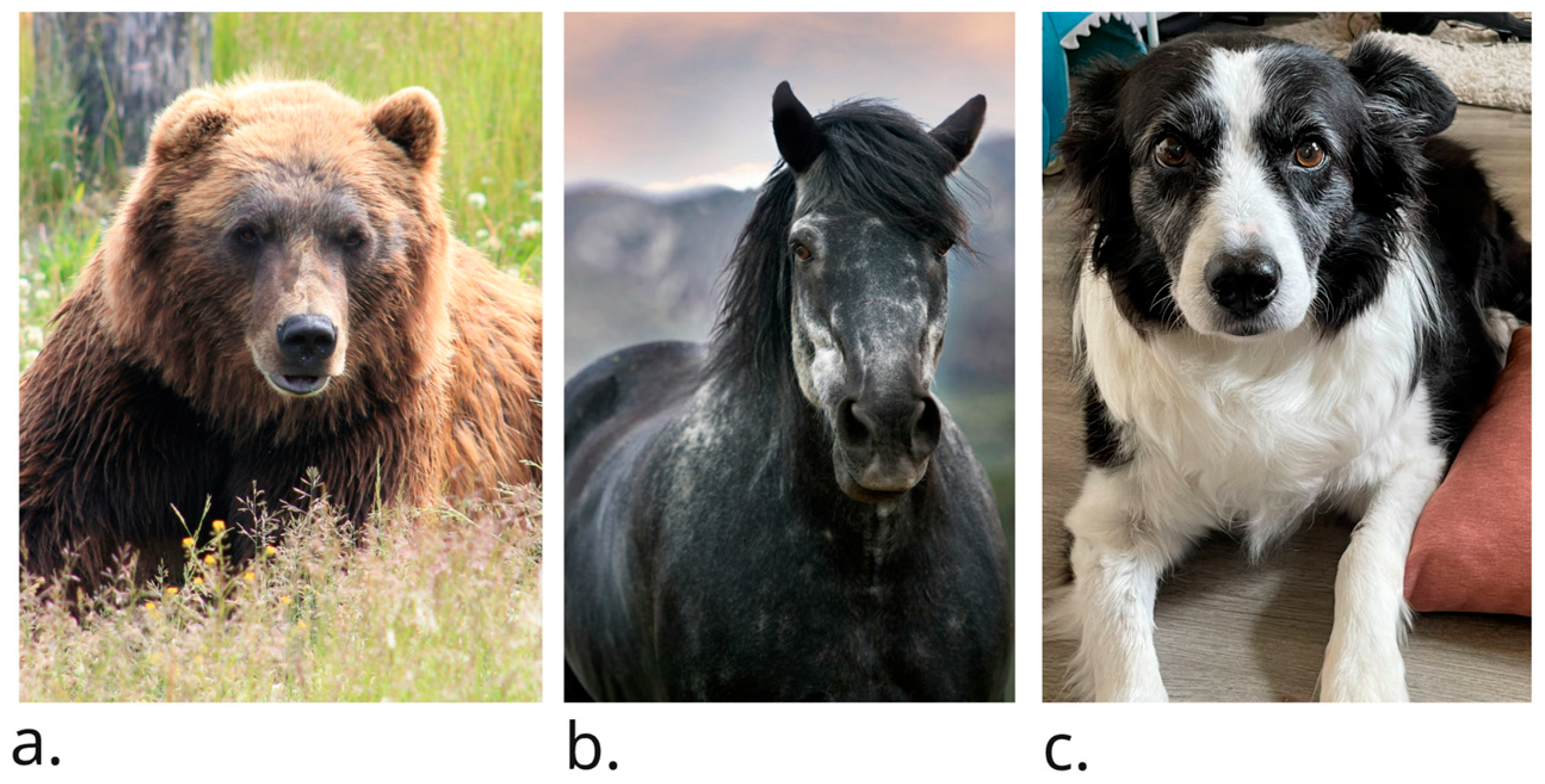
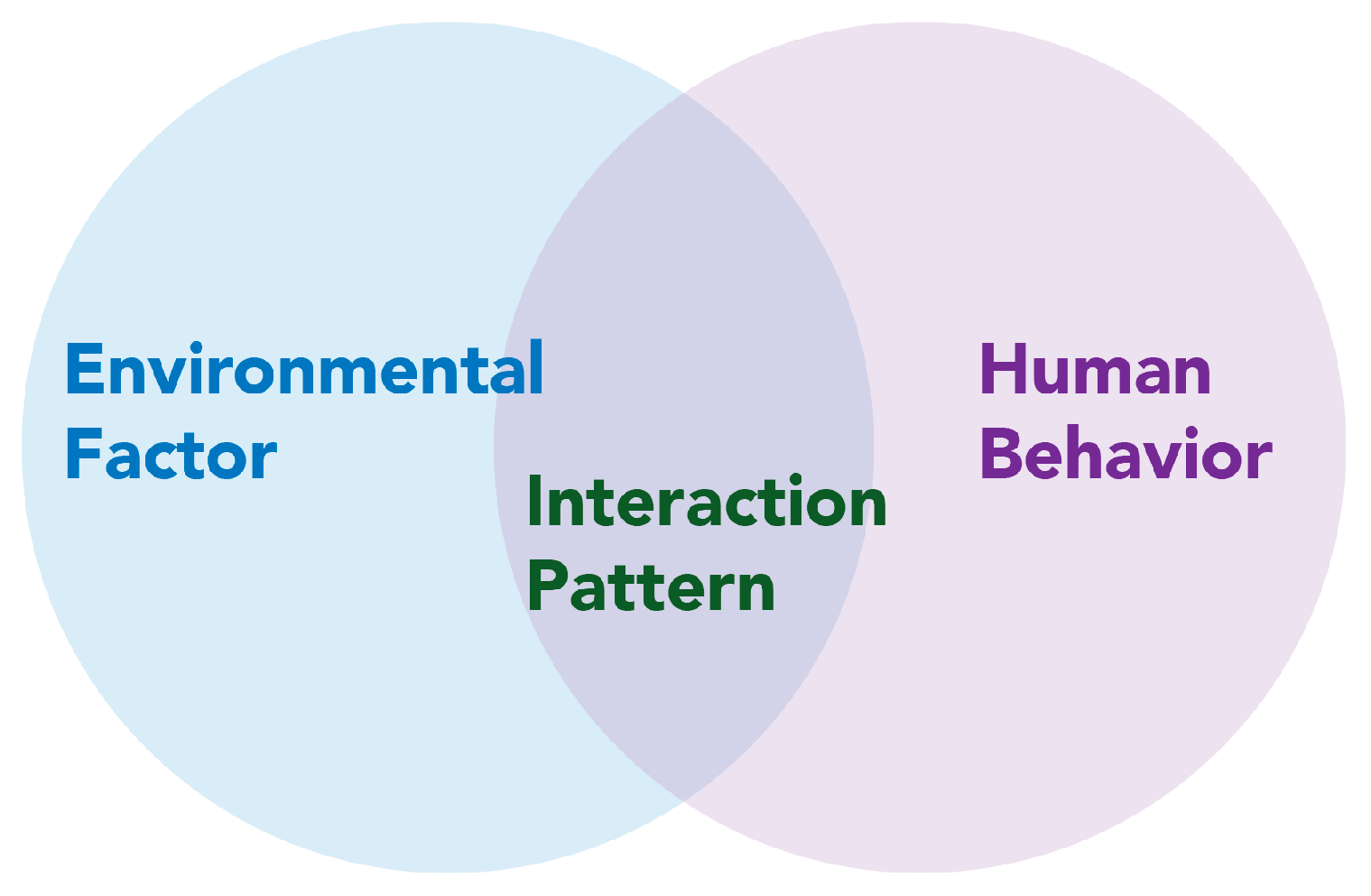
2.2. Key Characteristics of Interaction Patterns
- Structure of Engaged Activity
- Limitless Variation in Instantiation
- Distinct from Psychological Experience
- Combinatorial in Practice
- Keystone Interaction Patterns
2.3. Interaction Patterns Across the Continuum: From Relatively Wild to Highly Domestic Nature
2.4. Empirical Evidence for Interaction Patterns
2.5. Environmental Generational Amnesia: Why IP Design Is a Solution
3. Interaction Pattern Design in Practice: Designing for Deeper Engagement with Nature in Built Environments
- IPD moves beyond sensory richness as a proxy for embodiment.
- IPD reframes nature as shaping experience through dynamic conditions.
- IPD embeds developmental and evolutionary reasoning into design.
- IPD offers a systematic but flexible method.
3.1. Tools for Designing with Interaction Patterns
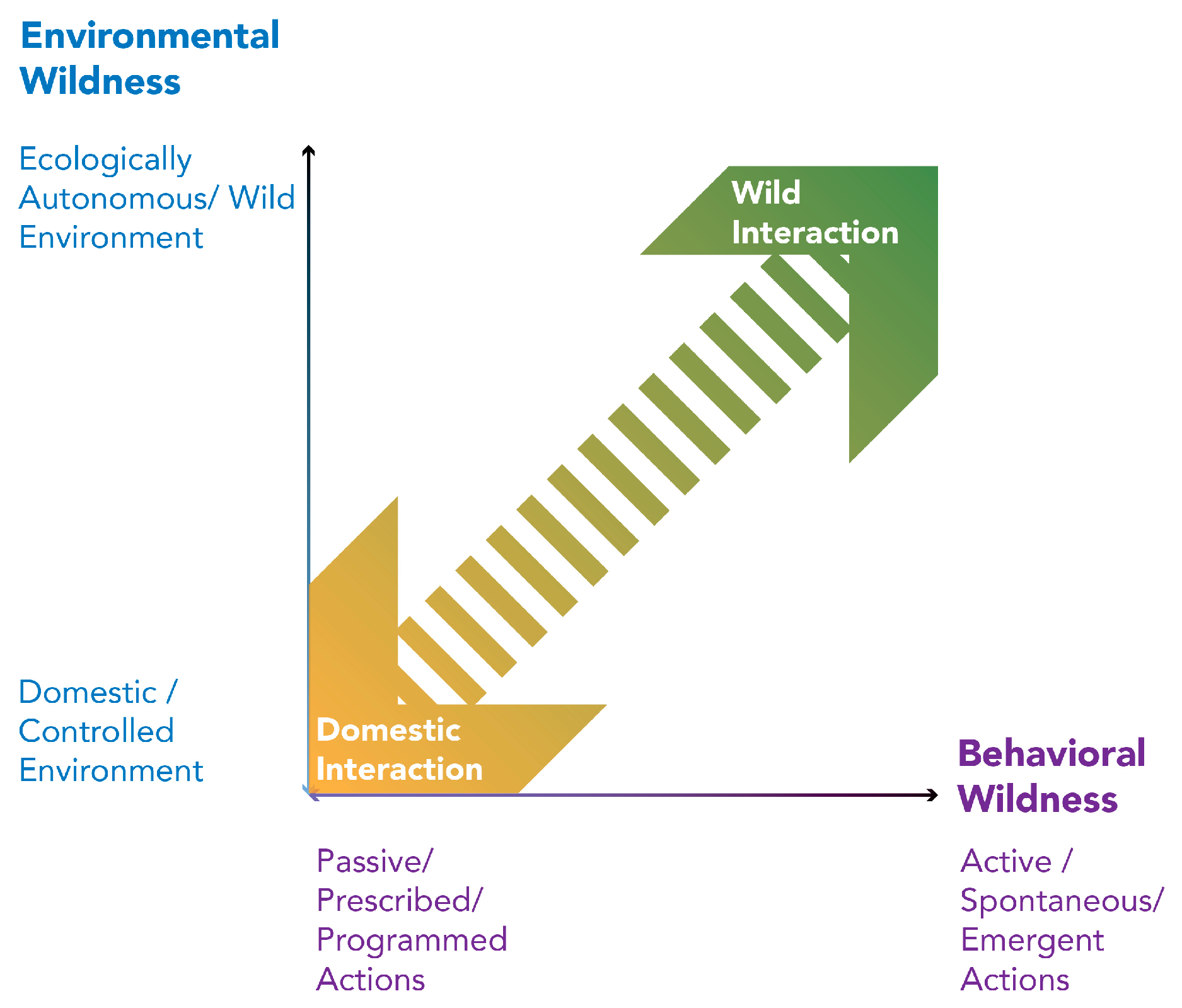
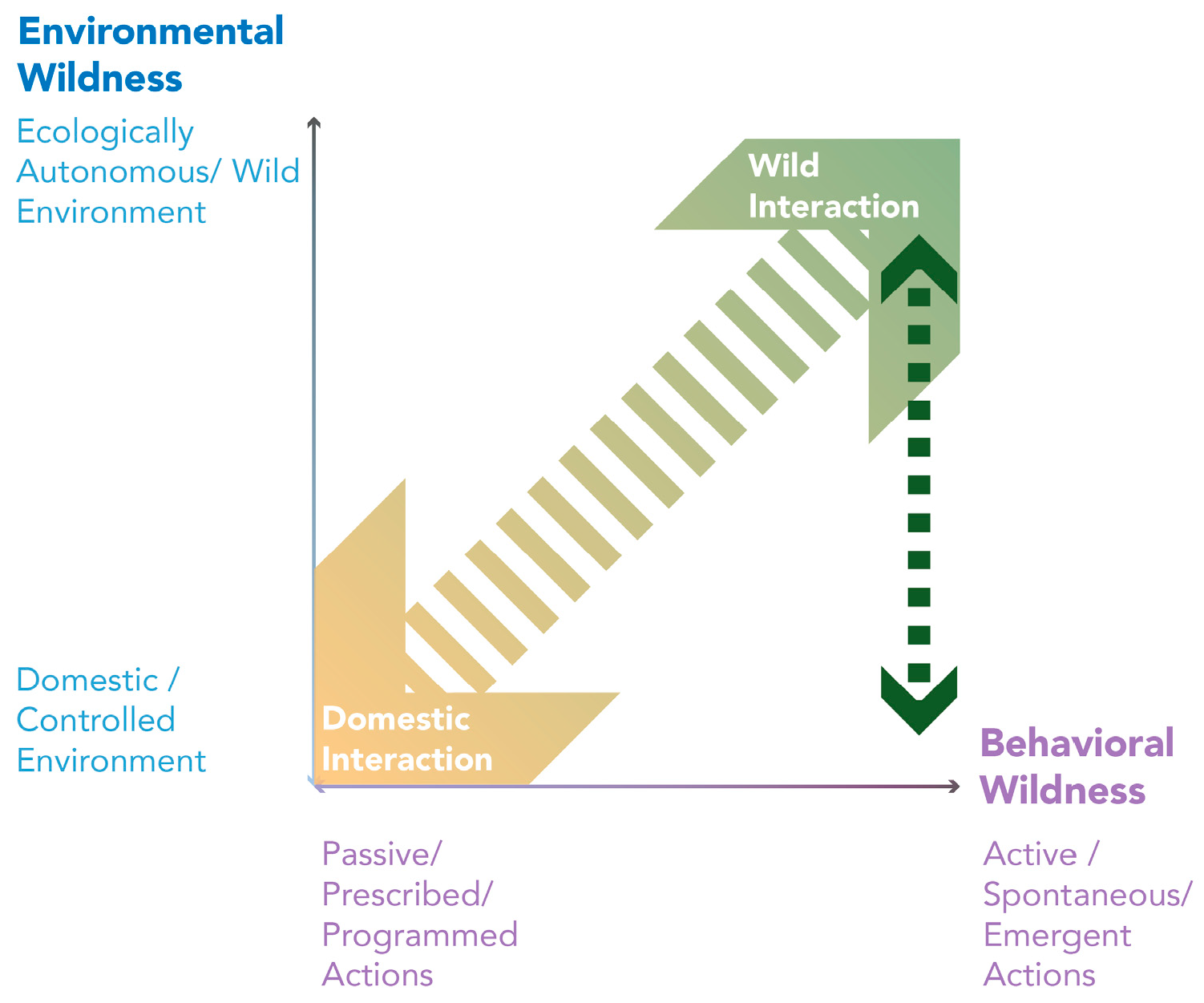
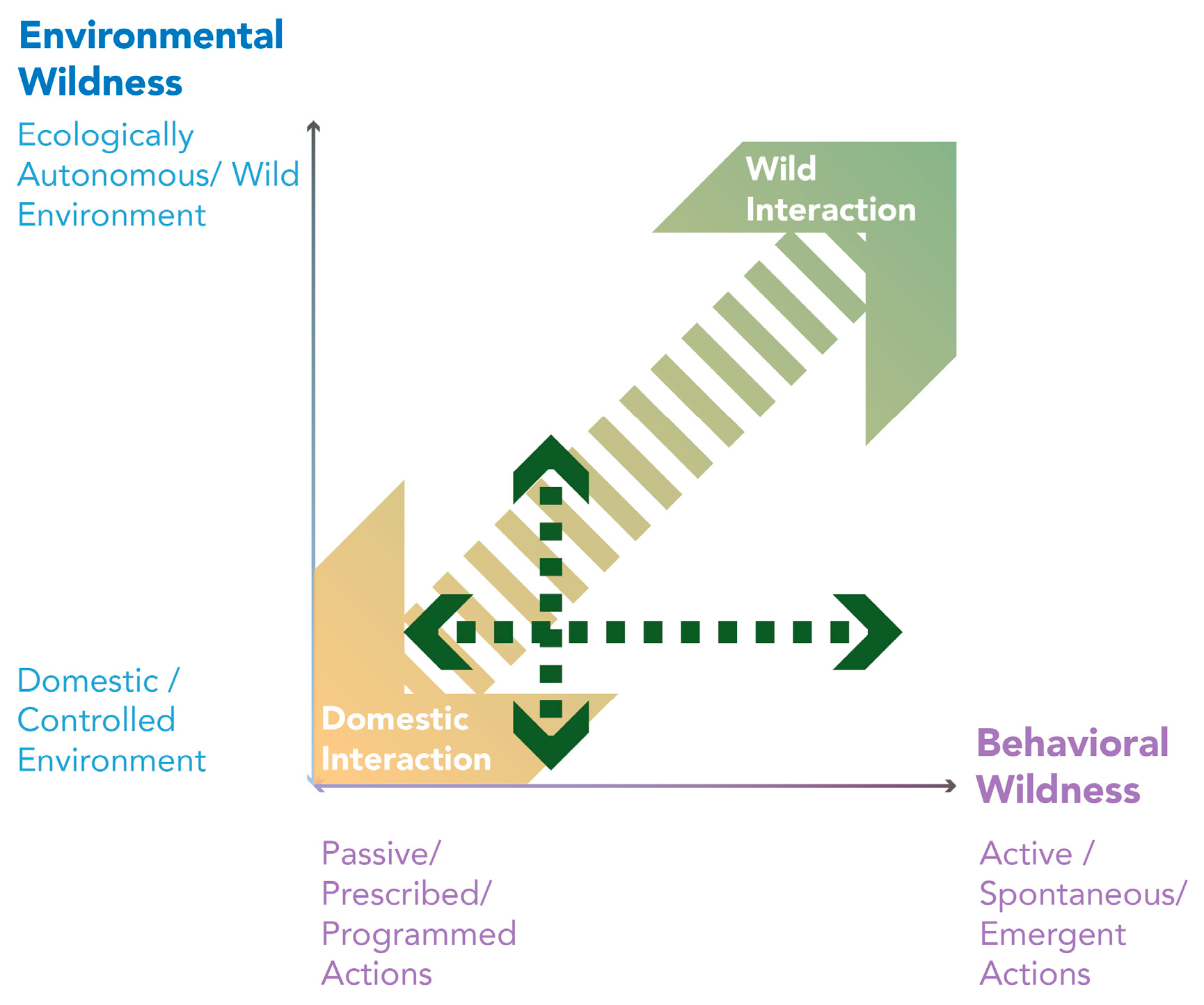
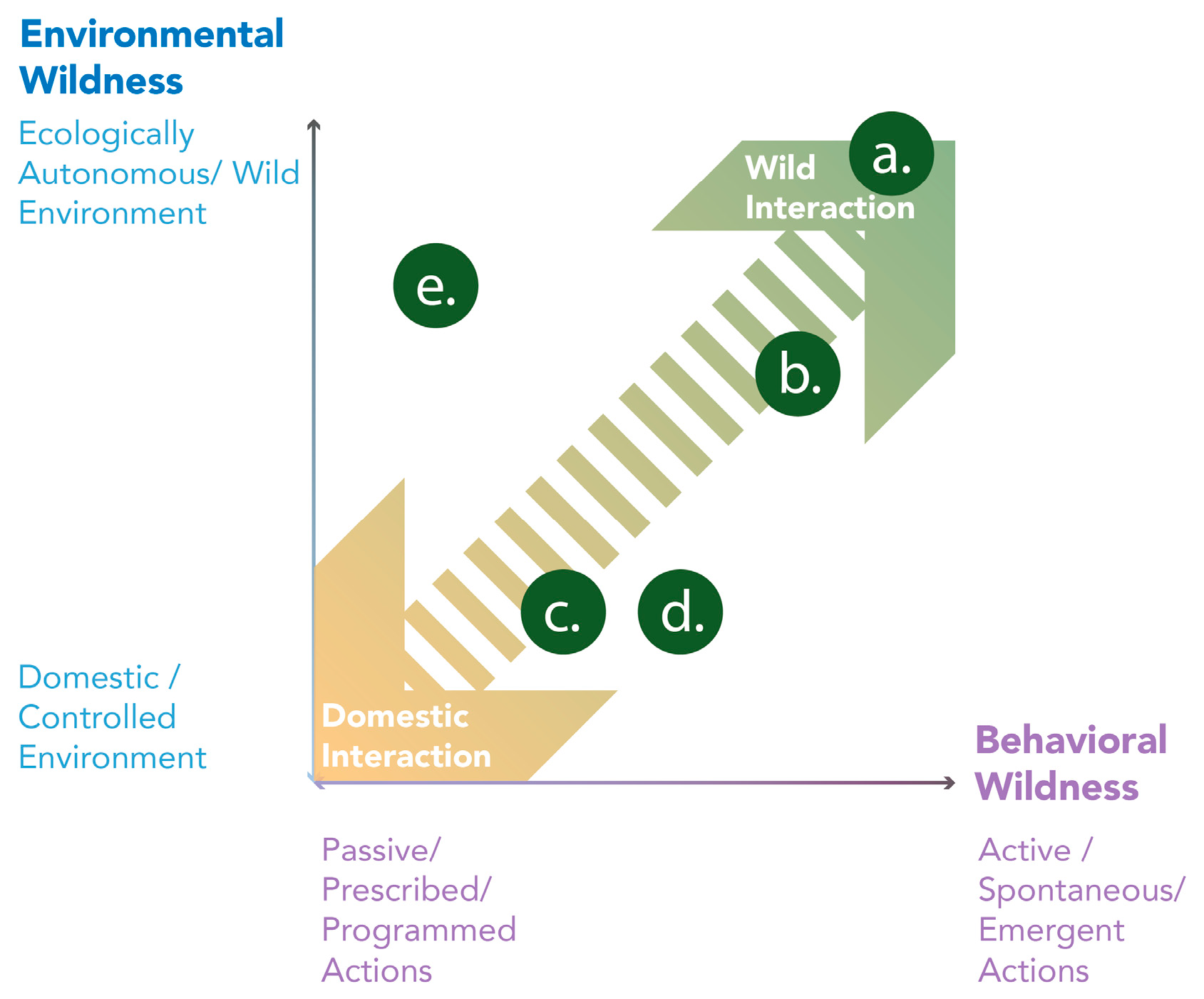
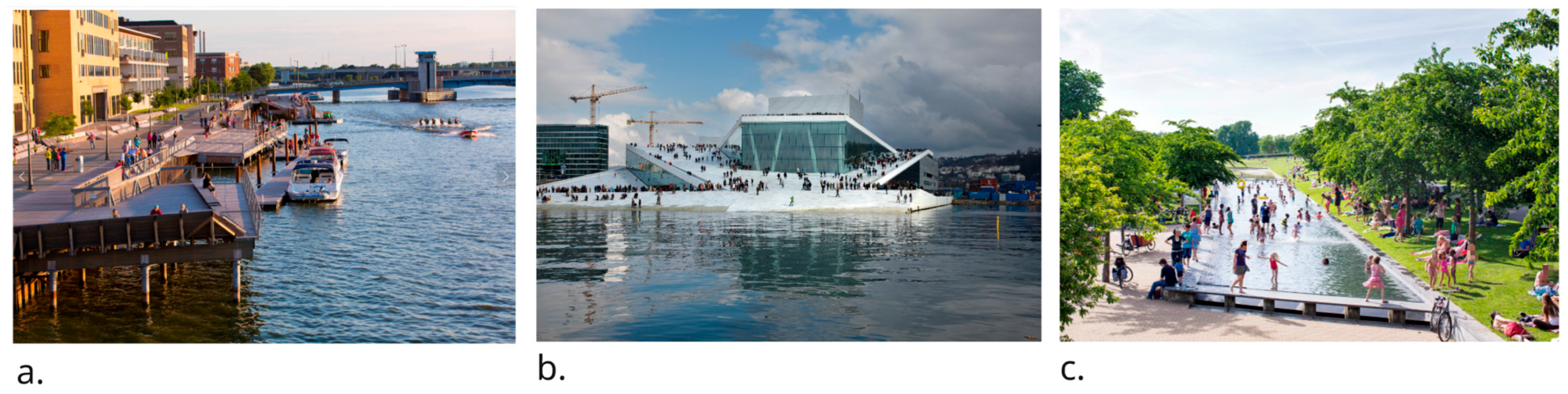
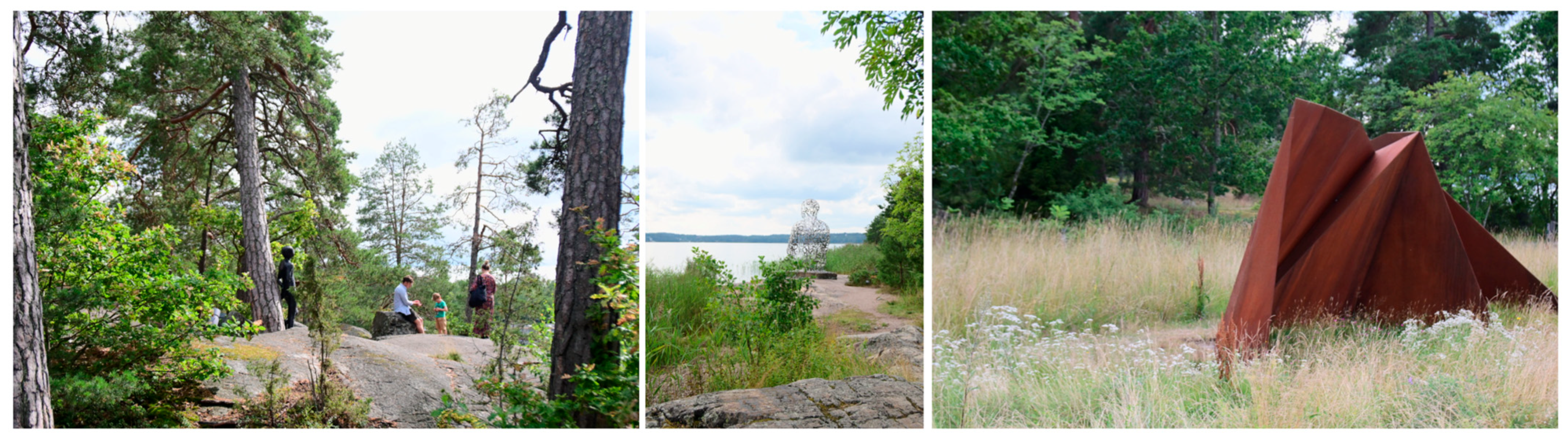
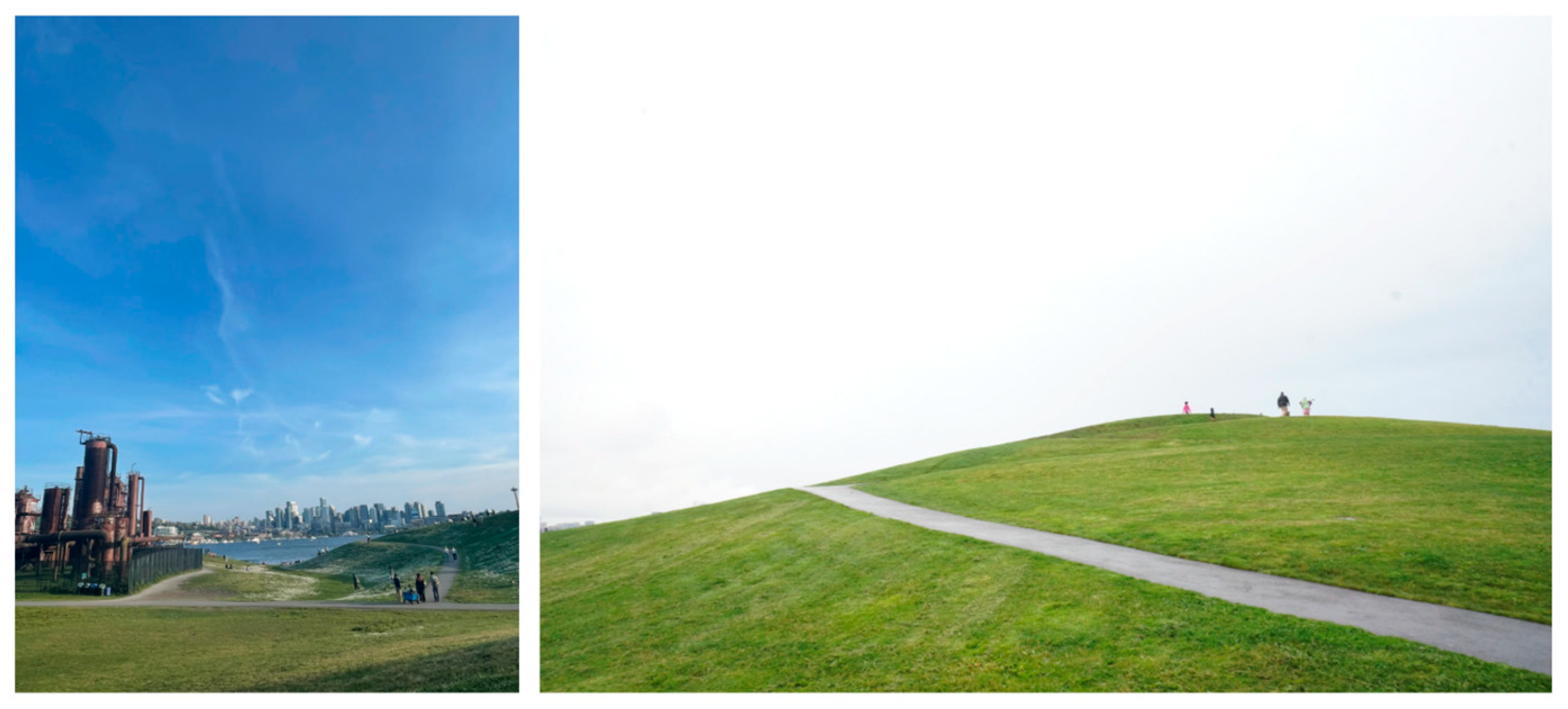
3.1.1. Quadrant Mapping (Tool 1): Designing Across Environmental and Behavioral Wildness
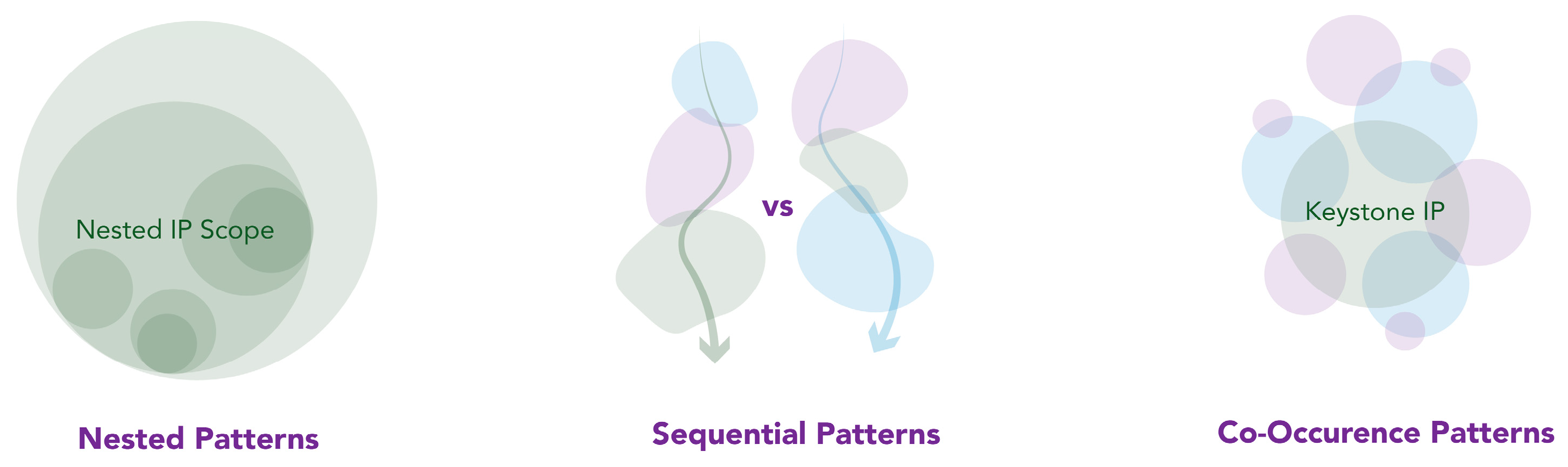
3.1.2. Structuring Interaction Patterns (Tool 2): Working with Scale, Sequence, and Co-Occurrence
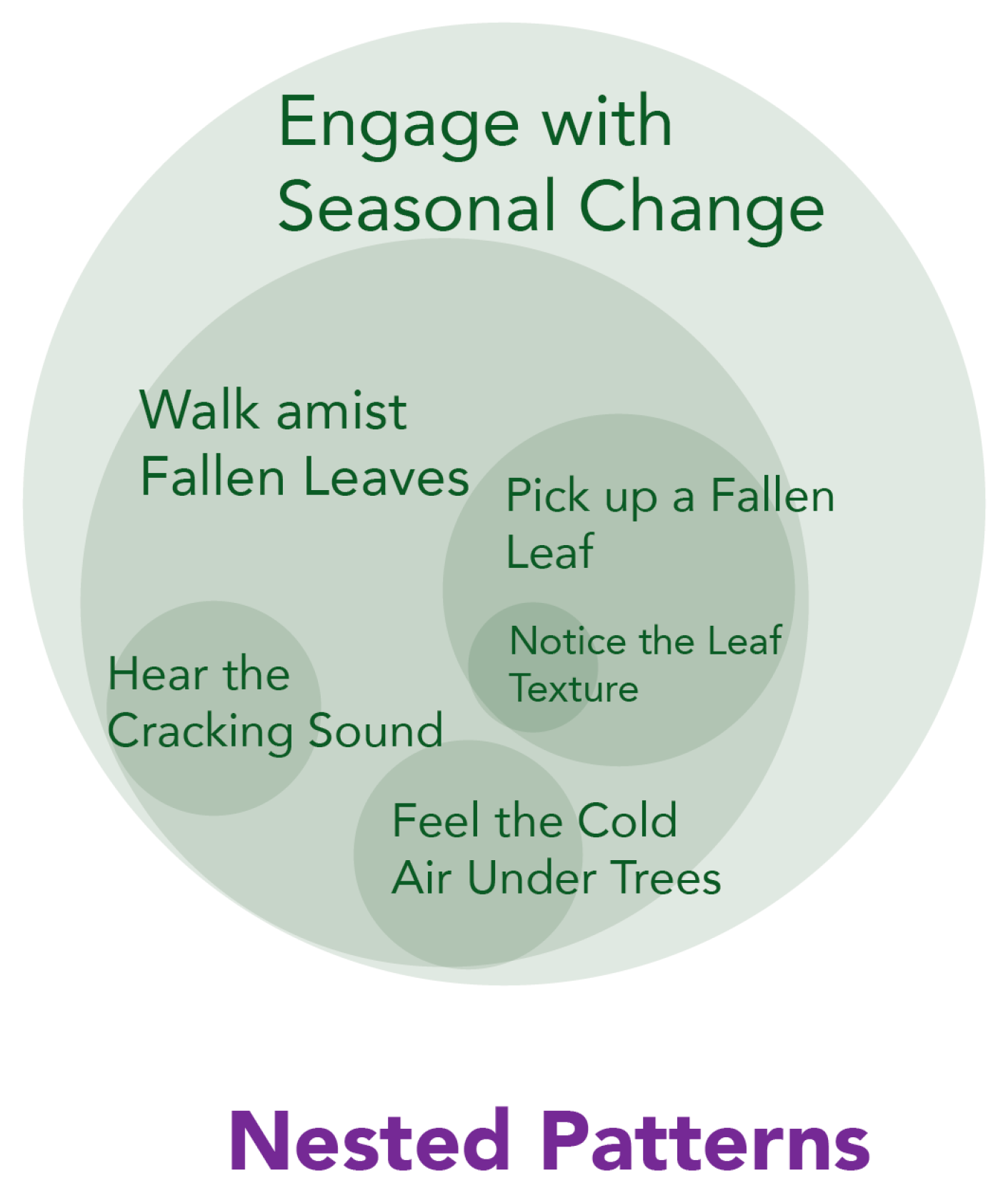
Scale: Nested Patterns
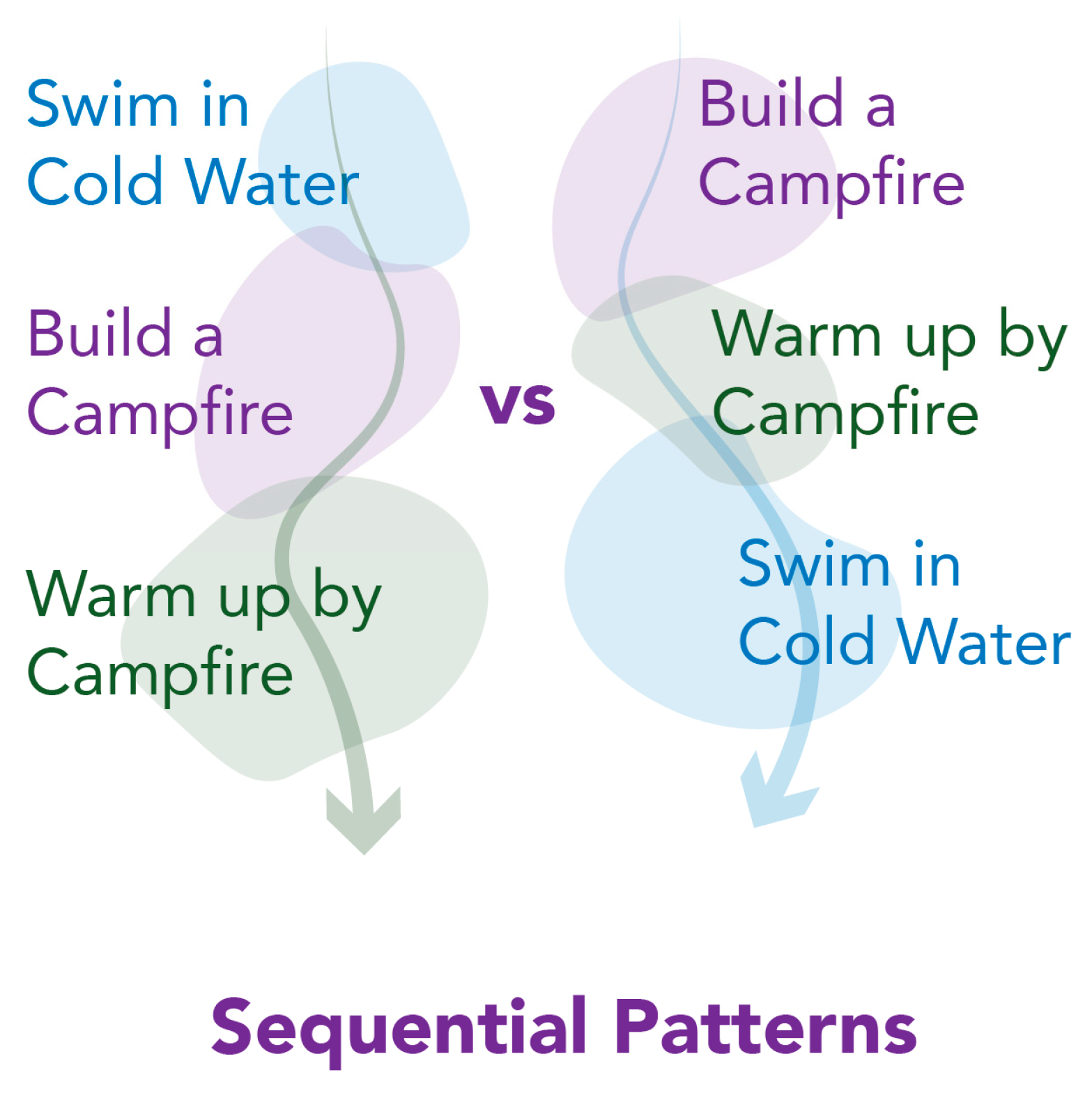
Sequence
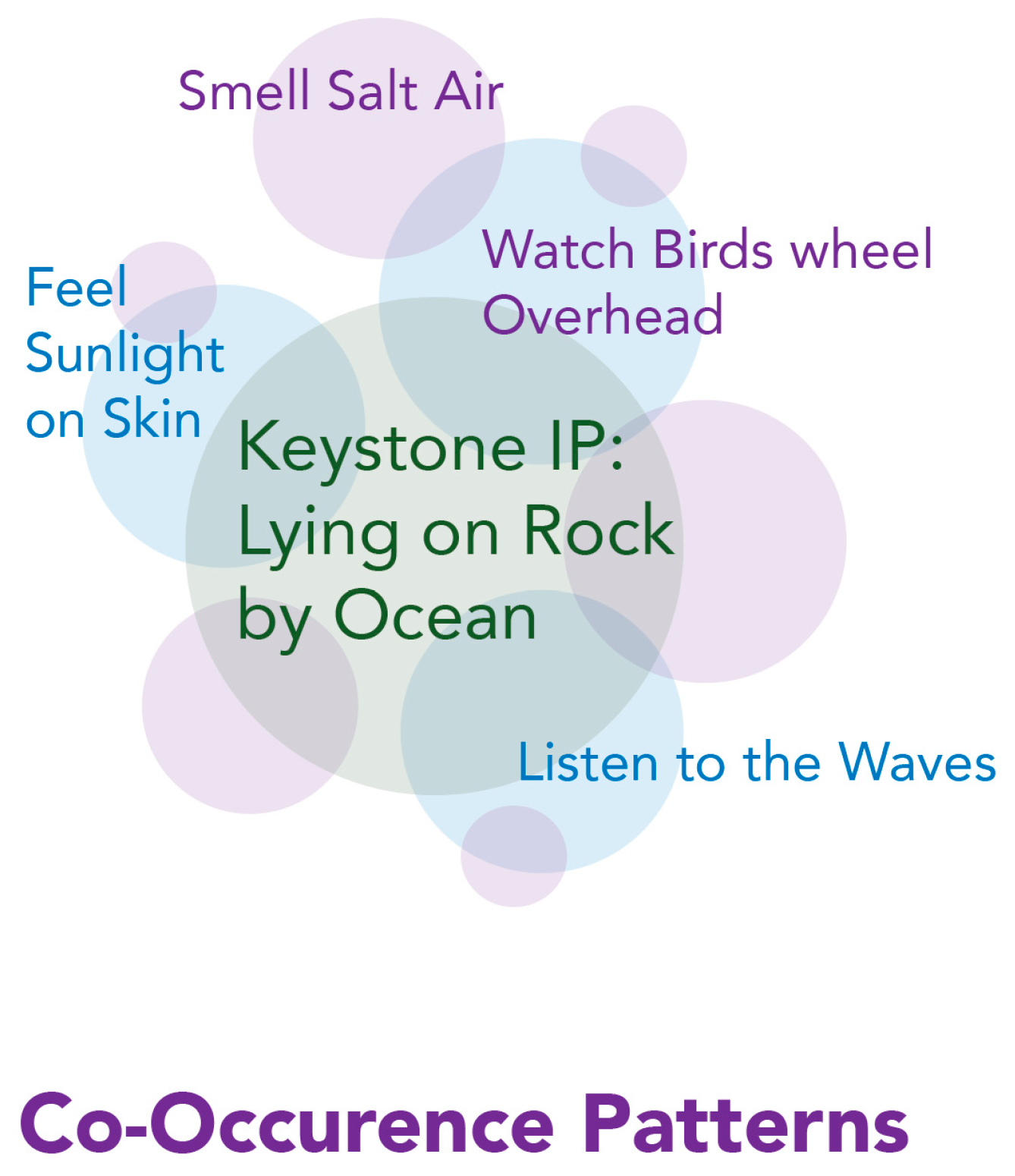
Co-Occurrence: Supporting Embodied Immersion
3.2. Applying IPD: Keystone Interaction Pattern Case Studies
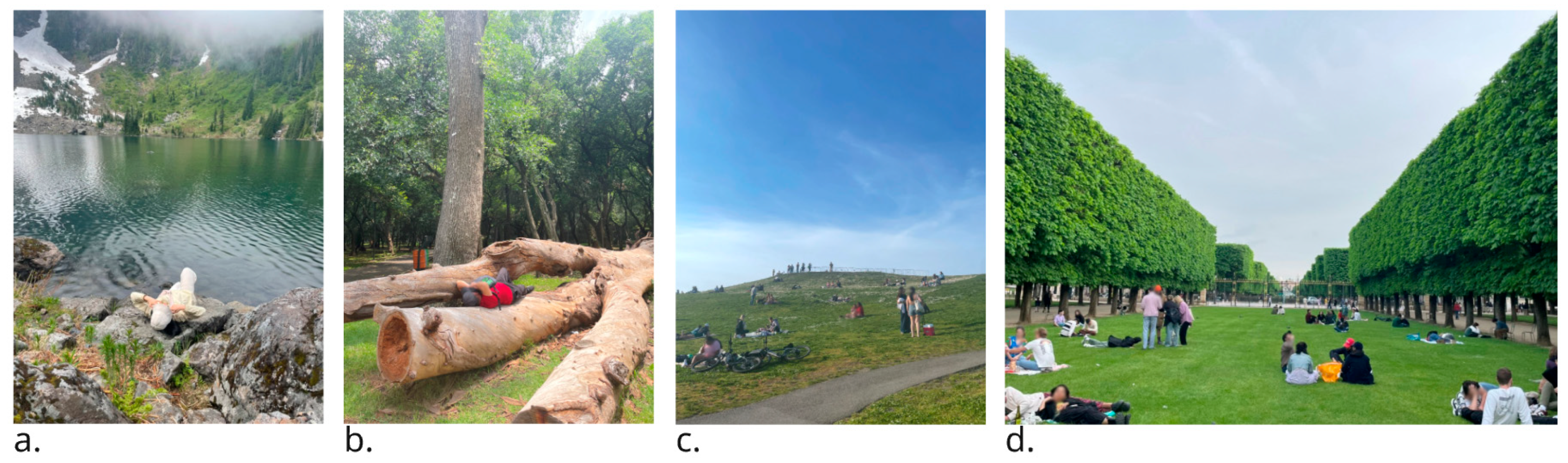
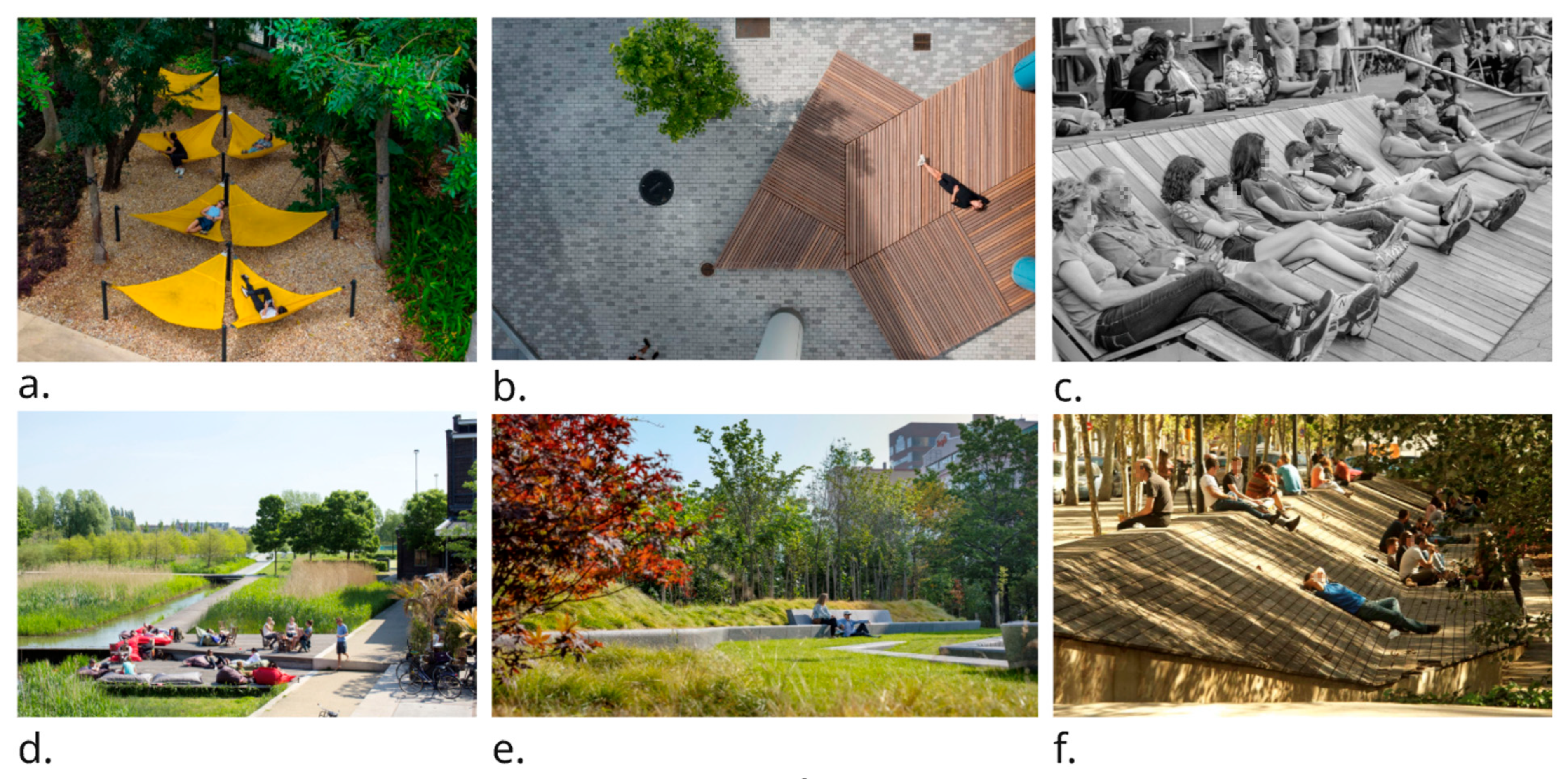
3.2.1. Lying Under the Sky: Grounding and Receptivity
- Quadrant Mapping (Tool 1): Modulating the Conditions for Rest and Reorientation
- Wild × Emergent
- Wild × Programmed
- Domestic × Emergent
- Domestic × Programmed
- Structuring Interaction Patterns (Tool 2): Scale, Sequence and Co-Occurrence
- Scale: Nested Patterns
- Sequence and Co-Occurrence:
- IPD Insight: Rewilding Rest:
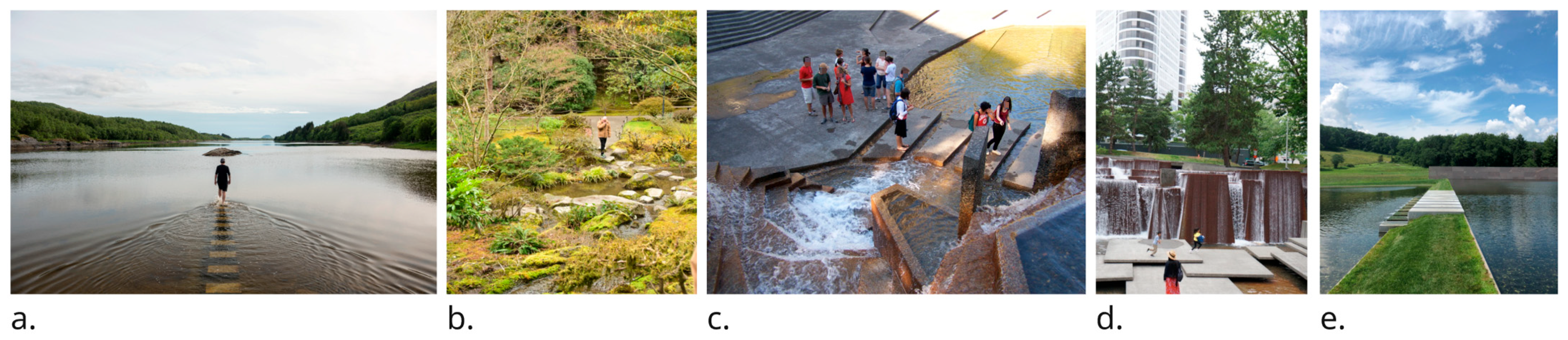
3.2.2. Engaging with Water: Immersion, Motion, Attunement, and Rejuvenation
- Quadrant Mapping (Tool 1): From Feature to Interaction
- Wild × Emergent
- Wild × Programmed
- Domestic × Emergent
- Domestic × Programmed
- Structuring Interaction Patterns (Tool 2): Scale, Sequence and Co-Occurrence
- Scale: Nested Patterns
- Sequence and Co-occurrence:
- IPD Insight: Rewilding Water Engagement
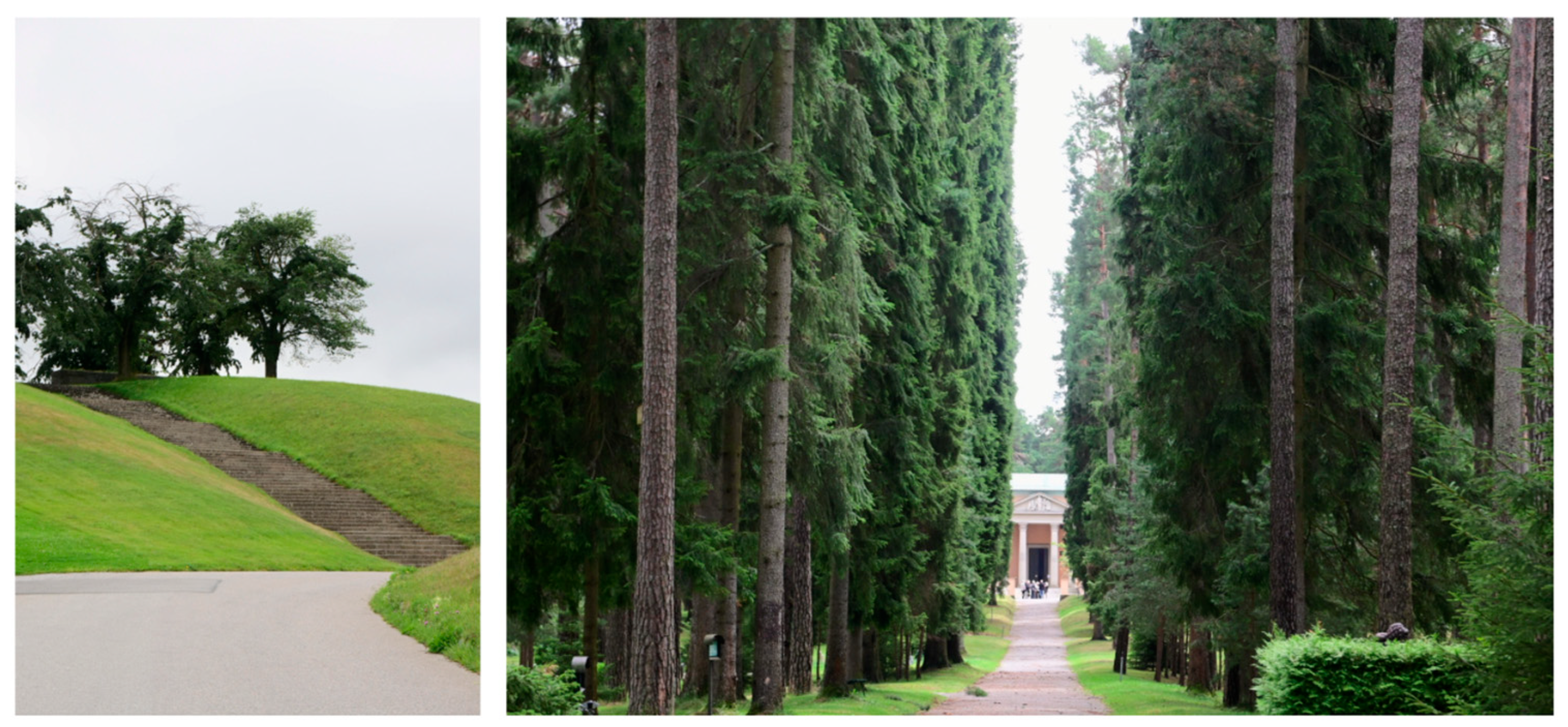
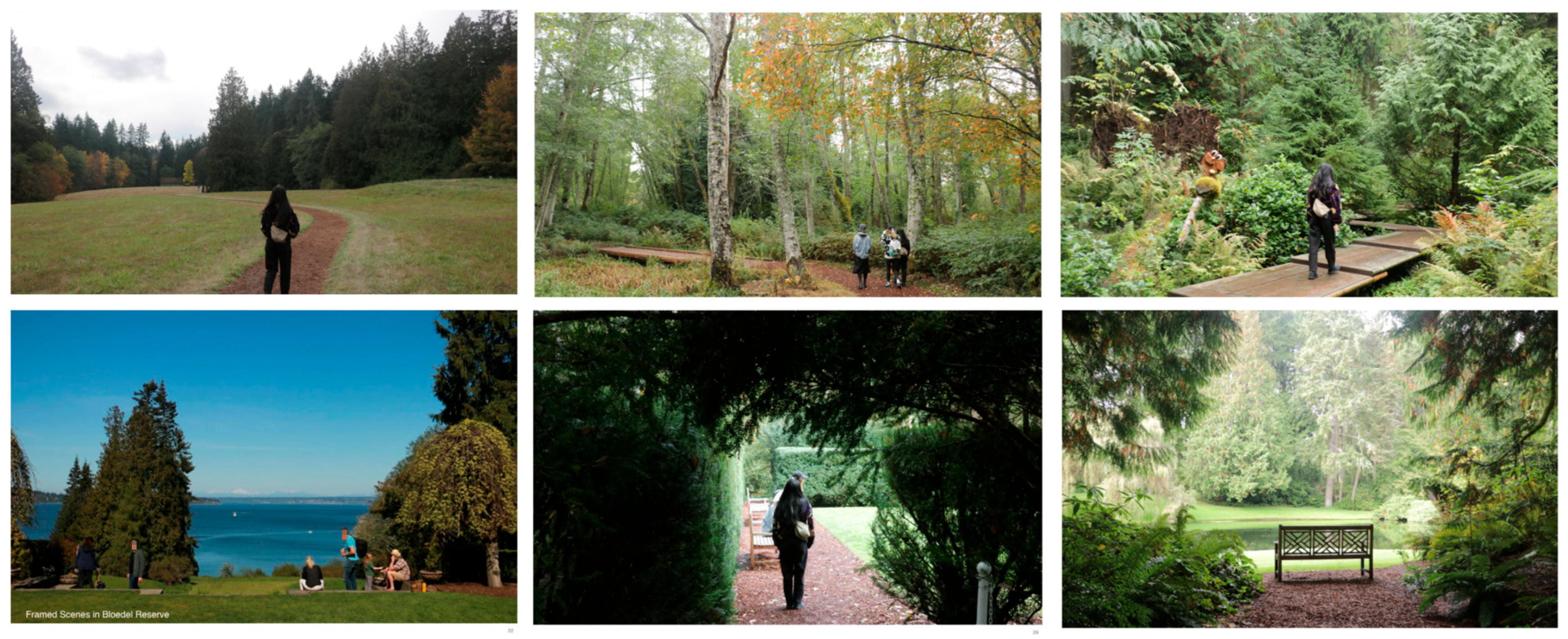
3.2.3. Moving Across Terrain: Orientation, Effort, and Encounter
- Tool 1: Quadrant Mapping—Modulating Path Conditions and Possibilities
- Wild × Emergent
- Wild × Programmed
- Domestic × Emergent
- Domestic × Programmed
- Structuring Nested Patterns (Tool 2): Scale, Sequence and Co-Occurrence
- IPD Insight: Composing Movement as Encounter
4. Discussion: Toward Relational, Rewilded Design Futures
4.1. Implications and Future Directions for Design and Pedagogy
4.2. Limitations and Scopes
4.3. Conclusions
Author Contributions
Funding
Data Availability Statement
Acknowledgments
Conflicts of Interest
Abbreviations
| IP | Interaction Pattern |
| IPD | Interaction Pattern Design |
| EGA | Environmental Generational Amnesia |
References
- Holl, S.; Pallasmaa, J.; Pérez Gómez, A. Questions of Perception: Phenomenology of Architecture, New ed.; William Stout: San Francisco, CA, USA, 2006. [Google Scholar]
- Pallasmaa, J. The Eyes of the Skin: Architecture and the Senses, 3rd ed.; Wiley: Hoboken, NJ, USA, 2012. [Google Scholar]
- Perez Gomez, A. Attunement: Architectural Meaning After the Crisis of Modern Science; MIT Press: Cambridge, MA, USA, 2016. [Google Scholar]
- Gibson, J.J. The Ecological Approach to Visual Perception; Houghton Mifflin: Boston, MA, USA, 1979. [Google Scholar]
- Varela, F.J.; Thompson, E.; Rosch, E. The Embodied Mind: Cognitive Science and Human Experience (14th Print.); MIT Press: Cambridge, MA, USA, 1993. [Google Scholar]
- Noë, A. Action in Perception, 1st MIT Press Paperback ed.; MIT Press: Cambridge, MA, USA, 2006. [Google Scholar]
- Pashman, S. A Walk in the Park: Kinesthesia in the Arts of Landscape; Brill: Leiden, The Netherlands, 2024. [Google Scholar] [CrossRef]
- Tilley, C.Y. A Phenomenology of Landscape: Places, Paths, and Monuments; Berg: Oxford, UK, 1994. [Google Scholar]
- Herrington, S. Landscape Theory in Design; Routledge: Abingdon, UK, 2017. [Google Scholar] [CrossRef]
- DeKay, M.; Brager, G. Experiential Design Schemas; Oro Editions: Novato, CA, USA, 2023. [Google Scholar]
- Serra, R.; Güse, E.-G.; Bois, Y.-A. (Eds.) Richard Serra (1. Publ); Rizzoli: New York, NY, USA, 1988. [Google Scholar]
- Kellert, S.R.; Heerwagen, J.; Mador, M. (Eds.) Biophilic Design: The Theory, Science, and Practice of Bringing Buildings to Life; Wiley: Hoboken, NJ, USA, 2008. [Google Scholar]
- Browning, W.; Ryan, C.O.; Clancy, J. 14 Patterns of Biophilic Design: Improving Health and Well-Being in the Built Environment; Terrapin Bright Green, LLC: New York, NY, USA, 2014. [Google Scholar]
- Halprin, L. The RSVP Cycles: Creative Processes in the Human Environment; G. Braziller: New York, NY, USA, 1970. [Google Scholar]
- Kahn, P.H., Jr.; Lev, E.M.; Perrins, S.P.; Weiss, T.; Ehrlich, T.; Feinberg, D.S. Human-nature interaction patterns: Constituents of a Nature Language for environmental sustainability. J. Biourbanism 2018, 1&2, 41–57. [Google Scholar]
- Kahn, P.H., Jr.; Weiss, T.; Harrington, K. Modeling child-nature interaction in a nature preschool: A proof of concept. Front. Psychol. 2018, 9, 835. [Google Scholar] [CrossRef] [PubMed]
- Kahn, P.H., Jr. In moral relationship with nature: Development and interaction. J. Moral Educ. 2022, 51, 73–91. [Google Scholar] [CrossRef]
- Alexander, C. The Timeless Way of Building; Oxford University Press: Oxford, UK, 1979. [Google Scholar]
- Alexander, C.; Ishikawa, S.; Silverstein, M.; Jacobson, M.; Fiksdahl-King, I.; Angel, S. A Pattern Language; Oxford University Press: Oxford, UK, 1977. [Google Scholar]
- Mills, L.S.; Doak, D.F. The Keystone-Species Concept in Ecology and Conservation. BioScience 1993, 43, 219–224. [Google Scholar] [CrossRef]
- Paine, R.T. A Conversation on Refining the Concept of Keystone Species. Conserv. Biol. 1995, 9, 962–964. [Google Scholar] [CrossRef]
- Kahn, P.H., Jr.; Ruckert, J.H.; Hasbach, P.H. A nature language. In Ecopsychology: Science, Totems, and the Technological Species; Kahn, P.H., Jr., Hasbach, P.H., Eds.; MIT Press: Cambridge, MA, USA, 2012; pp. 55–77. [Google Scholar]
- Shepard, P. Coming Home to the Pleistocene; Island Press: Washington, DC, USA, 1998. [Google Scholar]
- Cronon, W. The Trouble with Wilderness: Or, Getting Back to the Wrong Nature. Environ. Hist. 1996, 1, 7–28. [Google Scholar] [CrossRef]
- Yu, K. Urban wilderness: Another civilization. Landsc. Archit. (Chin. Engl.) 2021, 2021, 5–9. [Google Scholar]
- Yu, K. The conflict between two civilizations: On nature-based solutions. Landsc. Archit. Front. 2020, 8, 4–9. [Google Scholar] [CrossRef]
- Kahn, P.H., Jr.; Ruckert, J.H.; Severson, R.L.; Reichert, A.L.; Fowler, E. A nature language: An agenda to catalog, save, and recover patterns of human-nature interaction. Ecopsychology 2010, 2, 59–66. [Google Scholar] [CrossRef]
- Lev, E.; Kahn, P.H.; Chen, H.; Esperum, G. Relatively Wild Urban Parks Can Promote Human Resilience and Flourishing: A Case Study of Discovery Park, Seattle, Washington. Front. Sustain. Cities 2020, 2, 2. [Google Scholar] [CrossRef]
- Gray, C.E.; Kahn, P.H., Jr.; Lawler, J.J.; Tandon, P.S.; Bratman, G.N.; Perrins, S.P.; Boyens, F. The importance of (not just visual) interaction with nature: A study with the Girl Scouts. J. Environ. Educ. 2025, 56, 126–143. [Google Scholar] [CrossRef]
- Kahn, P.H., Jr.; Weiss, T. The importance of children interacting with big nature. Child. Youth Environ. 2017, 27, 7–24. [Google Scholar] [CrossRef]
- Weiss, T.; Kahn, P.H.; Lam, L.-W. Children’s interactions with relatively wild nature associated with more relational behavior: A model of child-nature interaction in a forest preschool. J. Environ. Psychol. 2023, 86, 101941. [Google Scholar] [CrossRef]
- Lam, L.-W.; Kahn, P.H.; Weiss, T. Children in Hong Kong interacting with relatively wild nature (vs. Domestic nature) engage in less dominating and more relational behaviors. Environ. Educ. Res. 2023, 29, 1294–1309. [Google Scholar] [CrossRef]
- Dunker, C.L. Nature Interaction Assists with Coping and Resilience: An Interaction Pattern Approach with Adolescents with Histories of Trauma in a Youth Group Home. Ph.D. Thesis, University of Washington, Seattle, WA, USA, 2025. Available online: https://aura.antioch.edu/etds/1108 (accessed on 8 October 2025).
- Kahn, P.H., Jr. Children’s affiliations with nature: Structure development the problem of environmental generational amnesia. In Children and Nature: Psychological, Sociocultural, and Evolutionary Investigations; Kahn, P.H., Jr., Kellert, S.R., Eds.; MIT Press: Cambridge, MA, USA, 2002; pp. 93–116. [Google Scholar]
- Kahn, P.H., Jr. The child who would be caged. Child. Youth Environ. 2007, 17, 255–266. [Google Scholar] [CrossRef]
- Kahn, P.H., Jr. Technological Nature: Adaptation and the Future of Human Life; MIT Press: Cambridge, MA, USA, 2011. [Google Scholar]
- Kahn, P.H., Jr. Environmental generational amnesia. In Nature, Love, Medicine: Essays on Wildness and Wellness; Fleischner, T.L., Ed.; Torrey House Press: Torrey, UT, USA, 2017; pp. 189–199. [Google Scholar]
- Walshe, L.; Evans, N. Understanding environmental generational amnesia through urban school garden learning experiences in Gimuy/Cairns, Australia. Local Environ. 2024, 30, 856–871. [Google Scholar] [CrossRef]
- Kahn, P.H.; Friedman, B. Environmental Views and Values of Children in an Inner-City Black Community. Child Dev. 1995, 66, 1403. [Google Scholar] [CrossRef]
- Craps, S. Lost words and lost worlds: Combatting environmental generational amnesia. Mem. Stud. Rev. 2024, 1, 36–55. [Google Scholar] [CrossRef]
- Straka, T.; Glahe, C.; Dietrich, U.; Bui, M.; Kowarik, I. From nature experience to pro-conservation action: How generational amnesia and declining nature-relatedness shape behaviour intentions of adolescents and adults. Ambio 2025, 54, 1165–1184. [Google Scholar] [CrossRef]
- Kahn, P.H., Jr. The child’s environmental amnesia—It’s ours. Child. Youth Environ. 2007, 17, 199–207. [Google Scholar] [CrossRef]
- Hartig, T.; Kahn, P.H., Jr. Living in cities, naturally. Science 2016, 352, 938–940. [Google Scholar] [CrossRef] [PubMed]
- Norberg-Schulz, C. Genius Loci: Towards a Phenomenology of Architecture; Rizzoli: New York, NY, USA, 1980. [Google Scholar]
- Norberg-Schulz, C. The Concept of Dwelling: On the Way to Figurative Architecture; Rizzoli: New York, NY, USA, 1985. [Google Scholar]
- Spirn, A.W. The Language of Landscape; Yale University Press: London, UK, 1998. [Google Scholar]
- Corner, J. (Ed.) Recovering Landscape: Essays in Contemporary Landscape Architecture; Princeton Architectural Press: New York, NY, USA, 1999. [Google Scholar]
- Corazon, S.S.; Sidenius, U.; Poulsen, D.V.; Gramkow, M.C.; Stigsdotter, U.K. Psycho-Physiological Stress Recovery in Outdoor Nature-Based Interventions: A Systematic Review of the Past Eight Years of Research. Int. J. Environ. Res. Public Health 2019, 16, 1711. [Google Scholar] [CrossRef]
- McDonnell, A.S.; Strayer, D.L. Immersion in nature enhances neural indices of executive attention. Sci. Rep. 2024, 14, 1845. [Google Scholar] [CrossRef] [PubMed]
- AlWaer, H.; Cooper, I. Understanding the 20-Minute Neighbourhood: Making Opportunities for People to Live Well Locally; University of Dundee: Dundee, UK, 2024. [Google Scholar] [CrossRef]
- Landis, J.R.; Koch, G.G. The measurement of observer agreement for Categorical Data. Biometrics 1977, 33, 159–174. [Google Scholar] [CrossRef] [PubMed]
- Dunker, C.L.; Gray, C.E.; Kahn, P.H., Jr. Coding Manual for: Adolescent–Nature Interactions at a Youth Group Home; University of Washington: Seattle, WA, USA, 2025; Available online: https://hdl.handle.net/1773/52888 (accessed on 8 October 2025).
- Gray, C.E.; Kahn, P.H., Jr. Coding Manual for a Study with the Girl Scouts of Western Washington on the Importance of (Not Just Visual) Interaction with Nature; University of Washington: Seattle, WA, USA, 2022; Available online: https://digital.lib.washington.edu/researchworks/handle/1773/48364 (accessed on 8 October 2025).
- Weiss, T.; Kahn, P.H., Jr.; Lam, L.W.; Koch, T.; Carrington, K.; Honson, L.; Kohring, P.K.; Ho, C.; Lev, E. Coding Manual for: Modeling Child-Nature Interaction in a Forest Preschool; University of Washington: Seattle, WA, USA, 2022; Available online: http://hdl.handle.net/1773/48589 (accessed on 8 October 2025).
- Lam, L.-W.; Weiss, T.; Kahn, P.H., Jr. Coding Manual for the Hong Kong Study of Child-Nature Interaction Patterns: Dominating and Relational Behaviors; University of Washington: Seattle, WA, USA, 2021; Available online: http://hdl.handle.net/1773/48125 (accessed on 8 October 2025).
- Kahn, P.H., Jr.; Lev, E.; Chen, H.; Esperum, G.; Piatok, H.; Aberg, N.; Weiss, T.; Grueter, A.; Koch, T. Coding Manual for “The Nature Voices of People Who Visit Discovery Park: An Interaction Pattern Approach”; University of Washington: Seattle, WA, USA, 2019; Available online: http://hdl.handle.net/1773/43788 (accessed on 8 October 2025).



| Study | Setting and Participants | Key Methods | Notable Interaction Patterns | Core Findings | Implications for Design |
|---|---|---|---|---|---|
| Discovery Park [28] | Urban wild park, Seattle; 320 adult participants | Written narratives analyzed through IP coding | Encountering wildlife, walking trails, gazing at views, exploring beach edges | 95% of meaningful IPs occurred in relatively wild areas | Preserving ecological wildness is essential to support rich and meaningful IPs |
| Girl Scout Study [29] | 127 girls, (ages 8–11) | Narrative responses and Presence survey | Embodied vs. visual-only IPs (e.g., hugging trees vs. watching birds) | Embodied IPs were linked to significantly higher Presence | Tactile, immersive interactions can deepen attentional and affective engagement |
| Fiddleheads Preschool [30,31] | 49 preschoolers over 35 weeks | Time-sampled video coding across wild and domestic outdoor areas | 26 recurring IPs including caring for, cohabiting with, and responding to nature | Relational and ethical behaviors occurred more often in relatively wild settings | Beyond physical plan, interaction with Wildness affords deeper relational development |
| Hong Kong Nature Program [32] | 54 children (mean age 4.8) in varied nature settings | Observational video coding of 708 IPs | Domination-oriented vs. relational IPs | Wild settings evoked more reciprocal, respectful interactions; domesticated ones fostered control-based behaviors | Domesticated or overly controlled environments may undermine relational ethics with nature |
| Youth Group Home [33] | Adolescents with Adverse Childhood Experiences (ACEs) | Mixed methods: 22-month observation + photovoice interviews | 62 keystone IPs (e.g., sensing periodicity, encountering animals, seeking refuge) | IPs supported emotion regulation, autonomy, meaning-making, and resilience | Nature-rich environments can act as therapeutic interventions; IPs may guide trauma-informed, healing-centered design |
| Co-Occurrence IP | Perceptual/Behavioral Description | Design Implication |
|---|---|---|
| Resting in dappled light | Choosing filtered shade beneath canopy | Use deciduous trees to modulate light seasonally; allow sun patches and shade to coexist |
| Listening to natural sound | Attuning to the ambient sound such as wind or leaves weaving | Sculpt acoustic texture with canopy, planting, and terrain |
| Feeling ground texture | Skin contact with grass, moss, warm stone or wood | Offer tactile variety through diverse materials |
| Co-resting with others | Social or animal presence during stillness | Design for plural seating or proximity without crowding; restoring ecological habitat |
| Co-Occurrence IP | Perceptual/Behavioral Description | Design Implication |
|---|---|---|
| Touching water | Dipping fingers, feeling coolness or texture | Design hand-level access, boulder edges, or shallow flow zones |
| Listening to water | Attending to drip, splash, or rush | Shape height, material, and flow rate to sculpt acoustic texture |
| Moving along the edge | Tracking or following flow | Create permeable thresholds; vary substrate and elevation |
| Immersing the body (or partially) in water | Wading, stepping, reclining in shallow water | Provide varied depth and textures to accommodate different safety needs |
| Resting near water | Pausing, observing surface dynamics | Provide informal seating or terrain-modulated rest zones |
| Evading or negotiating wetness | Skipping puddles, choosing dry paths | Design for behavioral variation and agency |
| Playing with water | Splashing, chasing ripples, spontaneous motion | Allow space and material cues for safe, unscripted play |
| Co-Occurrence IP | Perceptual/Behavioral Description | Design Implication |
|---|---|---|
| Navigating Trails | Visual tracking of path edges, obstacles, cues | Shape with edges, color variation, subtle curvature or lighting |
| Climbing or Scrambling through Topographic Changes | Engaging hands and feet to navigate slope or rock | Offer options at different physical levels; encourage exploring via material hints |
| Pausing, Ascending or Descending for Views | Drawn toward or fascinated by a view; effort amplifies anticipation and reward | Frame distant views; design sequential reveals; include places to pause, orient, and rest |
| Walking through Sensory Thresholds | Attuning to changes in dynamic sensory zones, such as visual, acoustic, olfactory or thermal | Highlight sensory transitions; curate sensory zones beyond vision. |
| Following Light through Corridors | Feeling a sense of wonder, disorientation, or anticipation as light leads forward | Use light to suggest direction; design for compression and release; layer light across surfaces |
| Noticing Others in Nature | Moving in rhythm with others; sensing presence through shared view, sound, or motion | Vary path width for shared or solitary travel; position paths for overlapping visibility; provide access to ecological flows; restore ecological habitat |
Disclaimer/Publisher’s Note: The statements, opinions and data contained in all publications are solely those of the individual author(s) and contributor(s) and not of MDPI and/or the editor(s). MDPI and/or the editor(s) disclaim responsibility for any injury to people or property resulting from any ideas, methods, instructions or products referred to in the content. |
© 2025 by the authors. Licensee MDPI, Basel, Switzerland. This article is an open access article distributed under the terms and conditions of the Creative Commons Attribution (CC BY) license (https://creativecommons.org/licenses/by/4.0/).
Share and Cite
Li, H.; Kahn, P.H., Jr. Human–Nature Interaction Pattern Design in Landscape Architecture. Land 2025, 14, 2051. https://doi.org/10.3390/land14102051
Li H, Kahn PH Jr. Human–Nature Interaction Pattern Design in Landscape Architecture. Land. 2025; 14(10):2051. https://doi.org/10.3390/land14102051
Chicago/Turabian StyleLi, Hongfei, and Peter H. Kahn, Jr. 2025. "Human–Nature Interaction Pattern Design in Landscape Architecture" Land 14, no. 10: 2051. https://doi.org/10.3390/land14102051
APA StyleLi, H., & Kahn, P. H., Jr. (2025). Human–Nature Interaction Pattern Design in Landscape Architecture. Land, 14(10), 2051. https://doi.org/10.3390/land14102051