Deliberative Democracy and Making Sustainable and Legitimate Development Plans: The Case of the Antalya Kırcami Agrihood



Abstract
1. Introduction
1.1. The Role of Deliberative Democracy in Making Sustainable and Legitimate Development Plans
1.2. Deliberative Democracy as the (Most) Legitimate Way to Collectively Reconcile Decision Makers’ Preferences on Urban Agriculture
1.3. The Qualities of a True Instrument of Deliberative Democracy
2. Materials and Methods
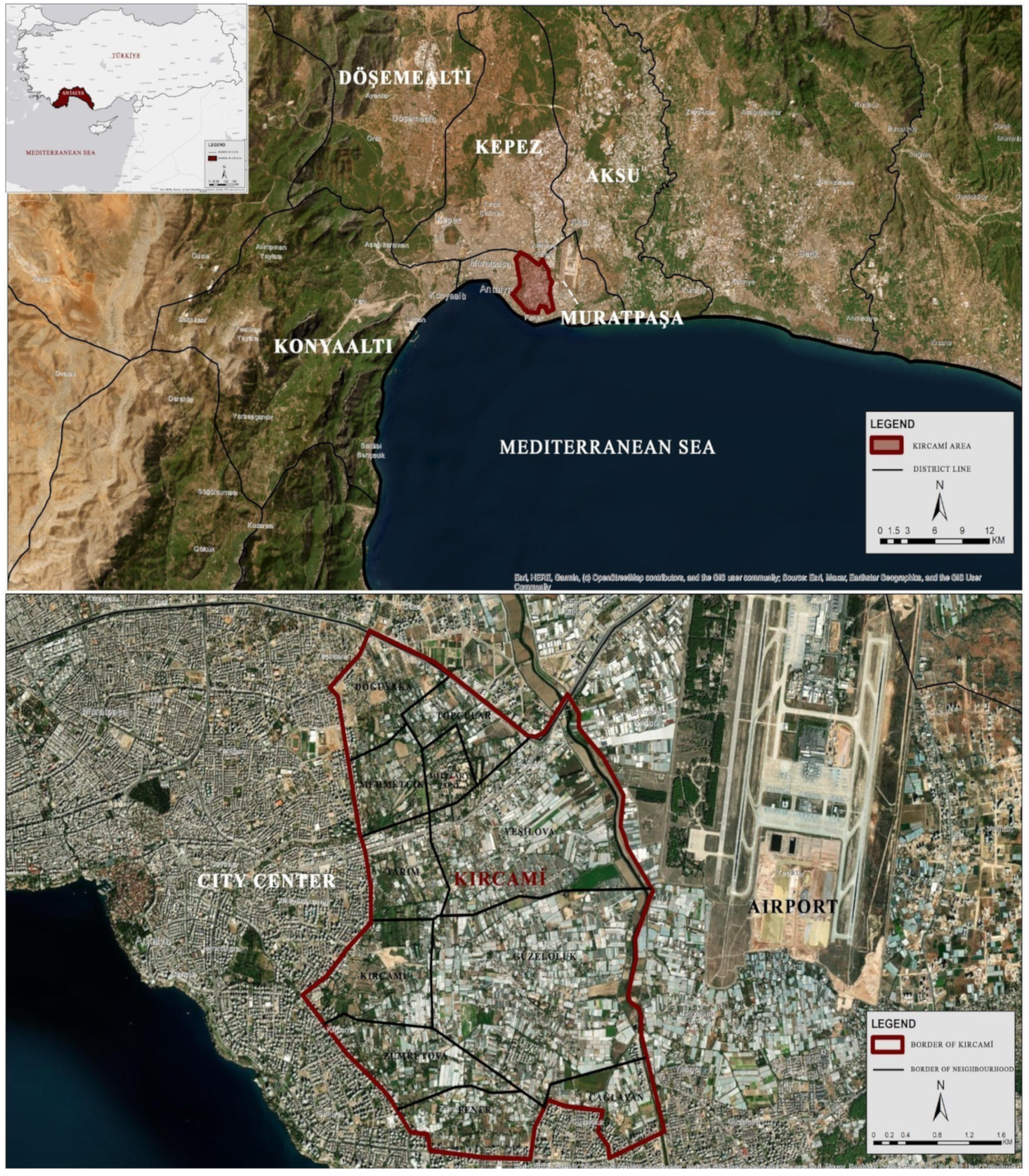
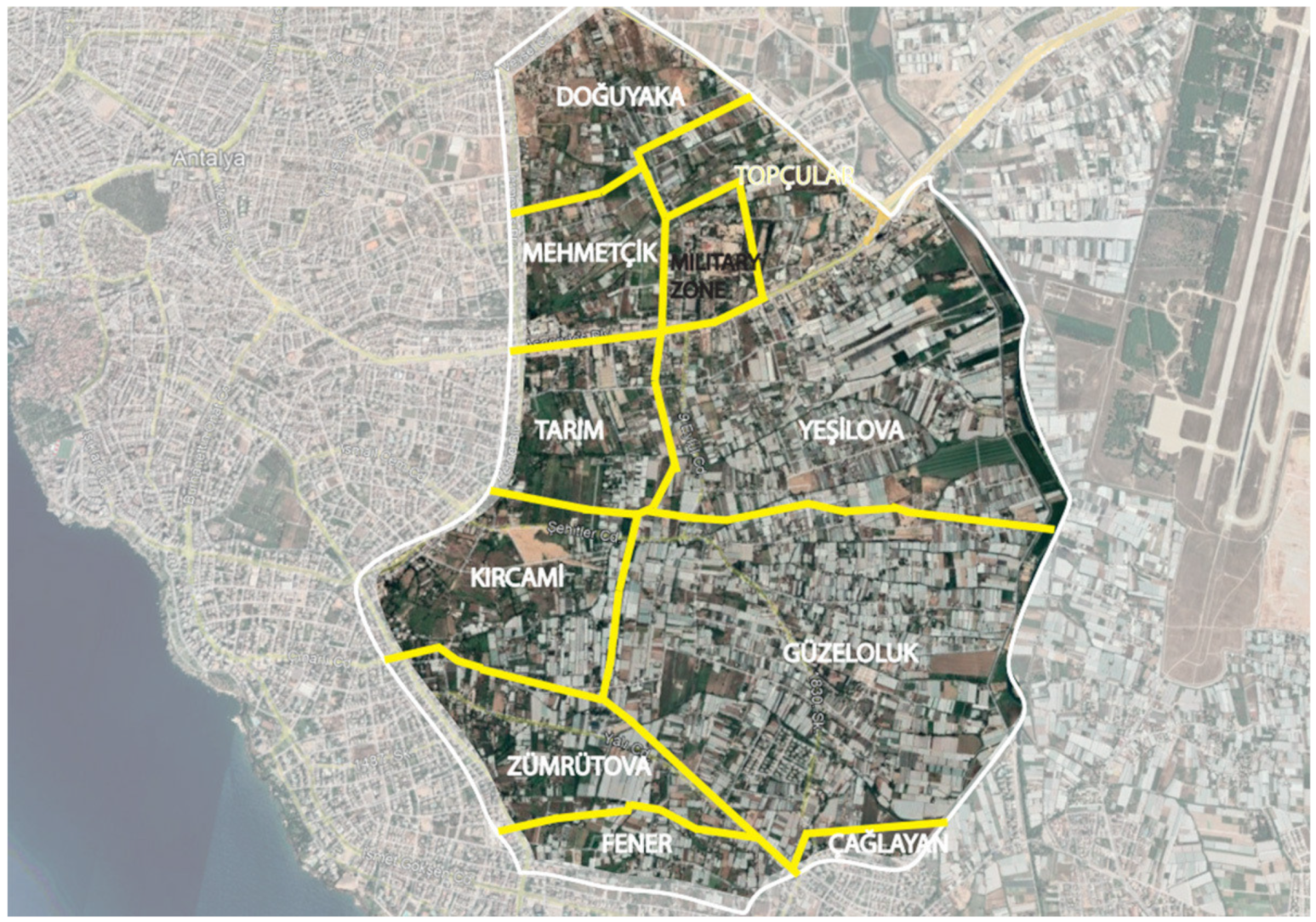
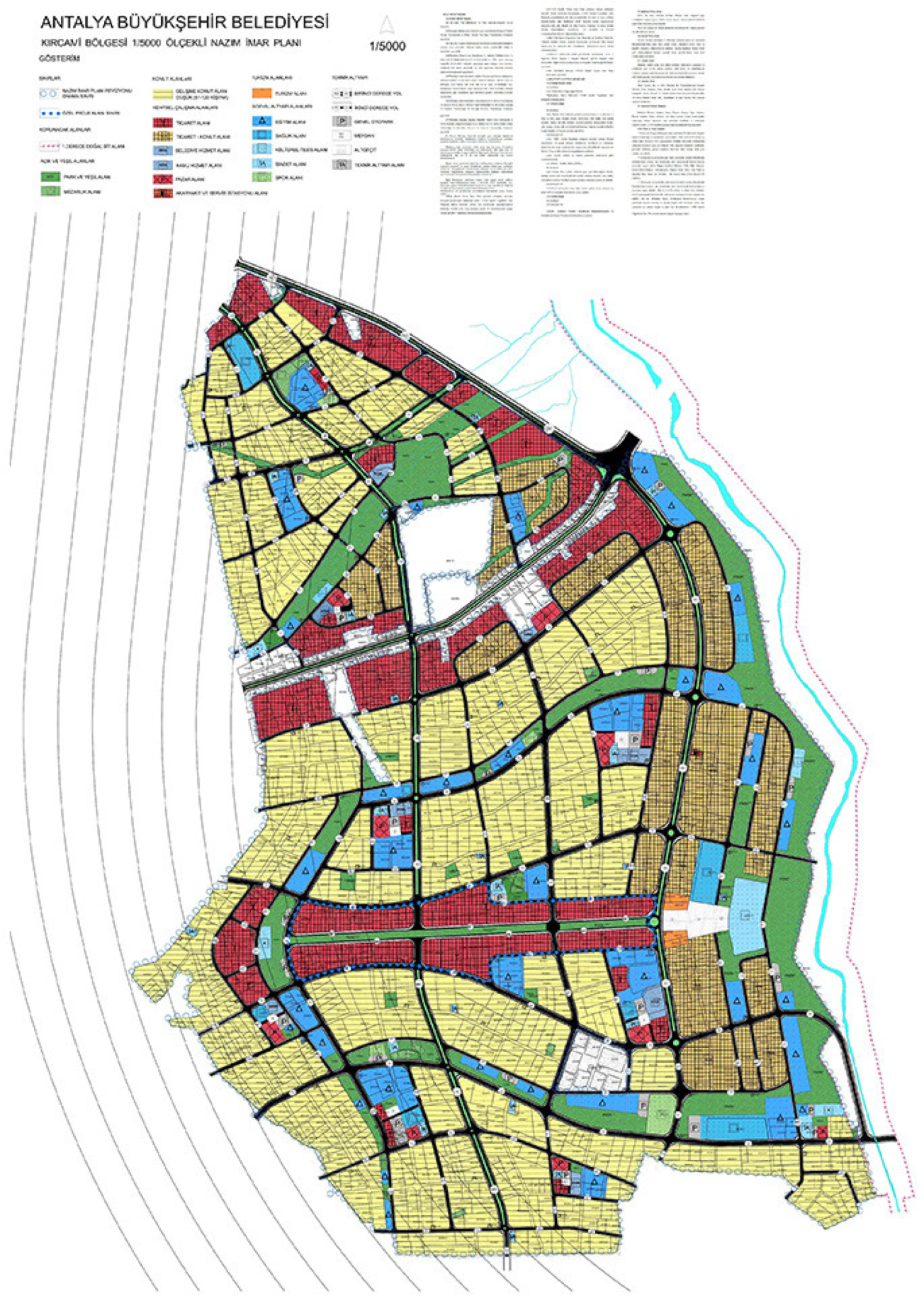
2.1. Case Study Area: Antalya Kırcami Agrihood
2.2. Design of the Research and Methodology
3. Results
3.1. Preferences and Participation of the Residents (Living/Working) for the Kırcami Area/Plan
“It’s an ancestral business. They say the land they stay on is planned for urban purposes, so we cannot sell it. We cultivate it instead of leaving it empty. I have no other professional knowledge.”
“The agriculture sector is a difficult sector. Our yield is very low, input costs are very high. In the face of this, our earnings are low.”
“Most people here are small producers. The work of small producers is difficult everywhere. Our soil is no longer fertile. This is the most difficult part. That’s why I have to use fertiliser. The price of fertiliser and seeds has increased excessively. There is no need for such a thing in the village.” (P13)
“Huge apartment blocks on one side and greenhouses on the other. Our costs are too high. And we cannot go to the market. We depend on intermediaries. Therefore, the difference between the price sold in the market and the money we receive is very high. We get a quarter of the money you pay for parsley in the market.” (P10)
“The cost is too high. And the middlemen take most of the money. Our share is very small. We cannot go to the market because we cannot find labourers. Wages are high. I sometimes go to work for daily wages to make a living myself. It is very difficult to do agriculture here now.” (P9)
“Our water is at the bottom. Duden is our lifeblood. We are also close to the wholesale market. If the trader does not buy the goods, we can sell them to the wholesale market.” (P10)
“Actually, it doesn’t have much of an advantage. But let’s say water. We have water. We are close to the wholesale market; we are in the city. But the fertility of the soil is gone. We are struggling to produce inefficient soil. What we produce and what we earn are reversing each other. We cannot make savings. Most of the money we earn goes to fertiliser, medicine, and seed. Is this necessary?” (P13)
“There would be no objection if there was an implementation plan according to the old title deeds. But the places they moved us to and the fragmentation of the land caused many objections. If it is according to the old title deeds, no one would object. Then we would not lose our neighbourly relations. We would not lose the location of our house. In the current plan, it is the same as me moving to Istanbul or Ankara. I will be in a flat, and I will not know anyone. What is the point if we do not see our neighbours.” (P18)
“I want to stay in my place. If they are going to give me rights, they should give me my rights where I am. Don’t send me 3 kilometres away. I would like the greenery not to be destroyed, and even if they can, I would like the greenhouses to be organised and kept. So what if there are greenhouses in the city? Maybe I’m wrong, but if they do it in an organised way, we can continue our work. For example, I don’t want tall buildings anymore. We became afraid after the earthquake.” (P2)
“Everyone has only one expectation: to stay on their own land. They do not want their land to be fragmented. There is not a lot of fragmentation on my plot, but I would like to stay on a single parcel. I would like to have mixed use, which they call mixed use, residential and commercial.” (P13)
“There is a need for order; that’s true. But I am not sure if high-rise apartment blocks are needed. Let them build infrastructure, build 3–4 storey buildings, keep our green areas, and encourage young people to do agriculture. Young people leave here when they get married. Let them stay; let them cultivate. Everyone should be able to stay in the same place with their neighbours.” (P11)
“We have no idea about the development. If they say it will be done in 5 years, we can no longer trust them. They tell us that Kırcami will be planned for construction when their work is done. Then there is none.” (P16)
“I have lost my faith. They make us enthusiastic and then say it has stopped. We look at road excavation in some places. One minute, they are cancelling it. My house is at the bottom of the road. The traffic and noise are too much. I would like this to be solved, but I have no hope. Big landowners always put stones in this business. There is political rent involved.” (P9)
“We have been working on this issue for 40 years. Really, both the people and the administrators are tired. We are happy when the development plan is announced, but then they file a cancellation case. No one has any trust left. This is a bad situation for the administrators. But this will be solved. It has to be solved. Yes, there is an unfair distribution, but the 18 application are like this: This is the law.” (P8)
“I’ve only been once, and I got angry. It’s like they didn’t explain it clearly. That’s why I didn’t want to go again. They should have asked us what we wanted. They didn’t. When one of them said “fragmented parcels”, they silenced them.” (P11)
“I attended meetings, neighbourhood meetings. I went to municipal meetings. Not everyone is asked for their opinion; there are those who have more to say. They ask more to educated people (he said “upper mind”). We cannot have a say. 3–5 people make decisions.” (P17)
“They come from the municipality, but their approach is not good. They do not give proper information. There is a lack of information. Participation is already low. I think they misinform the public, and I think the public is provoked against the parties and local administrators. If the local administration had acted a little more transparently, last year’s protests would not have happened. This is a very dangerous situation.” (P4)
“I always go to the meetings. I think the district municipality is making an effort on this issue. It would not have happened without their efforts. The mayor is determined on this issue. But the public is not very knowledgeable. We are primary school graduates. We won’t understand if they come and explain things at a high level. They need to explain one by one. People cannot come here because of work. If necessary, they should go to their fields and tell them.” (P13)
“They collect 100 m2–50 m2 plots from everywhere. They are influencing the development process. They will collect the plots and displace us. The land is already fragmented.” (P19)
“Of course it does. Those with 20–30 or even 70–80 hectars of land definitely affect the plan. They usually object to the process.” (P18)
“I’m sure of it. The whole neighbourhood is sure of it. Our own neighbour sold his land to an investor. They were forced to sell it. But we heard that the person they sold it to bought many plots. That’s how they collect land. Of course, they also affect the process.” (P11)
“How much will they affect it? Maybe they object, but the municipality does not accept it. There is a lot of rent here. I think this has more to do with politics than investors. It gets complicated there.” (P15)
“This situation is much talked about. Of course, those who have a lot of land should have a say. But I don’t think this will be done publicly. The plan is being prepared according to the law. Of course, those who have too much land should get their share.” (P8).
“ I was only involved in two meetings, one of which was the meeting attended by the minister in 2019, where symbolic title deeds were distributed. Only the minister spoke there and stated that the planning process would accelerate. No one could ask questions. The second meeting I attended was before the referendum in 2021. No one could ask questions, and those who stated that the plan was unfair were silenced. These meetings are for show, and no democratic process is carried out. It is important to have an equal voice and to answer questions in a language that everyone can understand. But in these meetings, only legal statements and technical statements about planning were used. For this reason, I do not think that a democratic process was carried out” (P20).
3.2. Preferences and Participation of the Investors for the Kırcami Area/Plan
“I continue agriculture because I inherited my land, but I will not make a new agricultural investment. Because this is a region that will undergo development. Investment in agriculture would be irrational.” (I7)
“The development process was not participatory. The owners of the area were not informed about what kind of plan it would be, and they were not told what advantages this plan would provide to the owners of that area. If they had been told, objections would have been made and lawsuits would have been prevented in the post-planning process. In this plan, I think that even those who have land and live there will make a profit, and if they do business, they can do it by renting other agricultural lands nearby. The real victims will be those who do not own land in that area and do business by renting it.” (I8)
“If I see a very unfair situation regarding the development process, I go myself and request information from the municipality. This development issue covers 8 neighbourhoods and there is not even 1 square metre of land without title deeds. There is neither a treasury nor an area without a title deed. Therefore, this process has dragged on for too long. In other neighbourhoods adjacent to this area, there were areas without title deeds, and they were officially plundered. There is no place for them to plunder here, so they cannot move. For example, we have some NGOs; all relevant and irrelevant NGOs are talking about this place according to their minds, which plays into the hands of politicians, and we are left in the middle without asking a single thing to the public. Unless there is a more participatory process where everyone is informed, this will take much longer.” (I5)
“The municipality has the authority to make development; it doesn’t ask anyone. I don’t think they should ask. They should do it according to the law. It doesn’t end when they ask the citizen. Experts determine things such as urban planners, architects, ground suitability, and population in accordance with the law. The citizen’s request never ends. They will do it directly without asking. The law is clear; the areas of expertise are clear.” (I3)
3.3. Preferences and Participation of the Local Government Officials for the Kırcami Area/Plan
“It’s too bad that a place so close to the city is in this state… Yes, the Kırcami Region has agricultural qualities, but there is now urban pressure, so these are no longer advantages. For this reason, it is necessary to plan to provide these advantages. The people of Kırcami do not want what you call natural life there.” (E2)
“The level of agricultural productivity of the Kırcami Region is not suitable for growing crops. In addition, agriculture is not a sufficient source of income for the residents. For this reason, the probable income from development is more advantageous for them.” (E1)
“The issue of agricultural productivity is not realistic. There is still production in the region, and it is obviously productive. In order to plan a place, it should not have an agricultural characteristic, but the region has an agricultural characteristic. But there is also urban pressure, and therefore it is necessary to make the plan in the name of the public interest.” (E2)
“Rural planning may be an alternative, but the expectations in Kırcami have changed. If you say, Let’s preserve the agricultural quality of the region, you should not make a plan. There is a precedent of 0.80 here, so there should not be large parcels; you cannot do that… The expectation of the people living there is simple: to get houses that they can live in and/or rent out… Urban agriculture is not possible for this area; I think this would never match the expectations there.” (E2)
“The current cancelled plan was prepared in accordance with the Law and Regulations, integrated with Antalya’s Transportation Master Plan, in terms of urbanisation and in accordance with the Master Plan, as confirmed by the expert report. The plan was insufficient in terms of reinforcement areas.” (E1)
“The plan has no advantages. The plan was already very bad. There is neither climate sensitivity nor disaster sensitivity. The parcellation is over now; if the parcellation was not over, maybe these sensitivities could have been included in the plan. But now the plan will go as it is… The purpose is not to open this area for development, nor is it to make a good plan. This is what the public expects. Citizens are not interested in how correct the plan is for the city.” (E2)
“We believe that both municipalities work in harmony and in coordination in line with the planning hierarchy.” (E1)
“Actually, there is not much consensus. Both institutions carry out procedures for the plan to work. There is a problem with parcellation, and the direct procedure is applied. Because this time there may be accusations, such as that we wanted to do it and they didn’t... The district municipality is firmly against any change in parcellation, but they will have to go back to the root title deed.” (E2)
“The public did not participate in this plan at all, of course. What concerned the public the most was the parceling. But the parcelling was done and approved behind closed doors. No one knows how it was done. A team should have been established for this, and this team should have had a public relations desk. And the people living in the region should have been asked… When the citizen was given an opportunity to talk to the geomatics engineer, there would have been interaction, but this was not done...The parcellation is also very bad… Honestly, I don’t know whether the parcellation is fair or not, but the plan itself and its construction were made according to the big investor. Large islands were made to minimise the loss. In other words, when we were making this island, we were trying to minimise casualties. There are parcels that are unfairly distributed now, but some of them are definitely technical necessities. I think 5–10% is unfair. In the grounds for the cancellation of the plan, there are certain criteria in the distribution principles, but the general grounds for cancellation are the issue of agricultural quality.” (E2)
“Actually, I think those neighbourhood group meetings were a bit of a formality. In the referendum issue, the aim was to gain a political front in public opinion.” (E2)
“The referendum was sufficient in terms of the number of participants. In the development process, a development plan, which ensures the participation of all stakeholders in the city as a whole and locally, was prepared.” (E1)
“The Chamber [Chamber of City Planners] has made no contribution to this issue. It has no discourse. In fact, they are making it worse. They talk about cooperation and so on. However, they do not say this plan is wrong; let’s redo this plan; we have such an alternative plan. They file a lawsuit for the cancellation of the plan without presenting an alternative.” (E2)
“We actually formed a team of ‘technical wise people’ in relation to these processes. We worked for days; we tried to put the plan together and correct the plan without changing it. The team included architects, an expert in urban design from Far Eastern countries, and planners. We made preparations and went to a presentation at the district municipality. It was a presentation that included a comparison of Kırcami and other urban spaces known in the world. However, the manager of the district municipality was disturbed by this presentation and did not allow the presentation to be finished. He replied to the presenter in English:
“It’s too late, my friend…”.”
4. Discussion
5. Conclusions
Author Contributions
Funding
Institutional Review Board Statement
Data Availability Statement
Conflicts of Interest
References
- Kelman, I. Climate change and the sendai framework for disaster risk reduction. Int. J. Disaster Risk Sci. 2015, 6, 117–127. [Google Scholar] [CrossRef] [Scilit]
- UN-Habitat III. New Urban Agenda; United Nations Press: 2017. Available online: http://habitat3.org/wp-content/uploads/NUA-English.pdf (accessed on 7 August 2021).
- UNSTATS. The Sustainable Development Goals Report 2020. Available online: https://unstats.un.org/sdgs/report/2020/ (accessed on 7 August 2021).
- Sezgin, D.; Varol, Ç. Ankara’daki kentsel büyüme ve saçaklanmanın verimli tarım topraklarının amaç dışı kullanımına etkisi [The effects of urban growth and sprawl on the misuse of fertile agricultural lands in Ankara]. METU J. Fac. Archit. 2012, 29, 273–288. [Google Scholar] [CrossRef] [Scilit]
- Bernstein, H. Tarımsal Değişimin Sınıfsal Dinamikleri [Class Dynamics of Agrarian Change]; Köymen, O., Translator; Yordam Yayınları: İstanbul, Turkey, 2014. [Google Scholar]
- Anguelovski, I. Urban gardening. In Degrowth: A Vocabulary for New Era; D’Alisa, G., Demaria, F., Kallis, G., Eds.; Routledge: New York, NY, USA, 2015. [Google Scholar]
- Zezza, A.; Tasciotti, L. Urban agriculture, poverty, and food security: Empirical evidence from a sample of developing countries. Food Policy 2010, 35, 265–273. [Google Scholar] [CrossRef] [Scilit]
- Ackerman, K.; Conard, M.; Culligan, P.; Plunz, R.; Sutto, M.; Whittinghill, L. Sustainable food systems for future cities: The potential of urban agriculture. Econ. Soc. Rev. 2014, 45, 189–206. [Google Scholar]
- Mougeot, L.J.A. Urban agriculture: Definition, presence, potentials and risks. In Growing Cities, Growing Food: Urban Agriculture at the Policy Agenda: A Reader on Urban Agriculture; Bakker, N., Dubbeling, M., Gündel, S., Sabel-Koschella, U., de Zeeuw, H., Eds.; DSE ZEL: Feldafing, Germany, 2000; pp. 1–42. [Google Scholar]
- Kaufman, J.; Bailkey, M. Farming Inside Cities: Entrepreneurial Urban Agriculture in the United States; Lincoln Institute of Land Policy Working Paper; University of Wisconsin-Madison: Madison, WI, USA, 2000; Available online: https://cltweb.org/wp-content/uploads/2022/10/farminginsidecities.pdf (accessed on 10 September 2023).
- Redwood, M. Urban agriculture and changing food market. In The Global Food Crisis; Clapp, J., Cohen, M.J., Eds.; Wilfrid Laurier University Press: Waterloo, ON, Canada, 2009. [Google Scholar]
- Alkan, Y.S. Gizli demokrasi: Temsili demokrasi krizi ve doğrudan demokrasi talebi arasındaki ilişkiye yönelik bir görüş [Stealth Democracy: A Vıew on the Relationship Between the Crisis of Representative Democracy and Demand for Direct Democracy]. Akdeniz İİBFDerg. 2018, 18, 23–43. [Google Scholar]
- Dryzek, J.S. Discursive Democracy: Politics, Policy and Political Science; Cambridge University Press: Cambridge, UK, 1990. [Google Scholar]
- Fishkin, J. Democracy and Deliberation: New Directions for Democratic Reform; Yale University Press: New York, NY, USA, 1991. [Google Scholar]
- Habermas, J. Between Facts and Norms: Contributions to a Discourse Theory of Law and Democracy; Rehg, W., Translator; The MIT Press: Cambridge, MA, USA, 1996. [Google Scholar]
- Gutmann, A.; Thompson, D. Why Deliberative Democracy? Princeton University Press: Princeton, NJ, USA, 2004. [Google Scholar]
- Drescher, A.W. Urban and Peri-Urban Agriculture. A Briefing Guide for the Successful Implementation of Urban and Peri-Urban Agriculture in Developing Countries and Countries of Transition; Special Programme for Food Security 2001; SPFS/DOC/27.8 Revision 2; Food and Agriculture Organization of the United Nations: Rome, Italy, 2001. [Google Scholar]
- Horst, M.; McClintock, N.; Hoey, L. The intersection of planning, urban agriculture, and food justice: A review of the literature. J. Am. Plan. Assoc. 2017, 83, 277–295. [Google Scholar] [CrossRef] [Scilit]
- Lovell, S.T. Multifunctional urban agriculture for sustainable land use planning in the United States. Sustainability 2010, 2, 2499–2522. [Google Scholar] [CrossRef] [Scilit]
- Legacy, C.; Curtis, C.; Neuman, M. Adapting the deliberative democracy ‘template’ for planning practice. Town Plan. Rev. 2014, 85, 319–340. [Google Scholar] [CrossRef] [Scilit]
- La Rosa, D.; Barbarossa, L.; Privitera, R.; Martinico, F. Agriculture and the city: A method for sustainable planning of new forms of agriculture in urban contexts. Land Use Policy 2014, 41, 290–303. [Google Scholar] [CrossRef] [Scilit]
- Langemeyer, J.; Madrid-Lopez, C.; Beltran, A.M.; Mendez, G.V. Urban agriculture—A necessary pathway towards urban resilience and global sustainability? Landsc. Urban Plan. 2021, 210, 104055. [Google Scholar] [CrossRef] [Scilit]
- Fantini, A. Urban and peri-urban agriculture as a strategy for creating more sustainable and resilient urban food systems and facing socio-environmental emergencies. Agroecol. Sustain. Food Syst. 2023, 47, 47–71. [Google Scholar] [CrossRef] [Scilit]
- OECD. Innovative Citizen Participation and New Democratic Institutions: Catching the Deliberative Wave; OECD Publishing: Paris, France, 2020. [Google Scholar] [CrossRef] [Scilit]
- Hartz-Karp, J.; Marinova, D.V. Modelling sustainability and the role of deliberative democracy. In Proceedings of the MODSIM2011: 19th International Congress on Modelling and Simulation, Perth, WA, USA, 12–16 December 2011. [Google Scholar]
- Maginn, P.J. Deliberative democracy or discursively biased? Perth’s dialogue with the city ınitiative. Space Polity 2007, 11, 331–352. [Google Scholar] [CrossRef] [Scilit]
- Beauvais, E.; Warren, M.E. What can deliberative mini publics contribute to democratic systems? Eur. J. Political Res. 2018, 58, 893–914. [Google Scholar] [CrossRef] [Scilit]
- Erkuş-Öztürk, H. Modes of tourism governance: A comparison of Amsterdam and Antalya. Anatolia Int. J. Tour. Hosp. Res. 2011, 22, 307–325. [Google Scholar] [CrossRef] [Scilit]
- Erkuş-Öztürk, H.; Terhorst, P. Two micro-models of tourism capitalism and the (re)scaling of state-business relations. Tour. Geogr. Int. J. Tour. Space Place Environ. 2011, 14, 494–523. [Google Scholar] [CrossRef] [Scilit]
- Gasper, R.; Blohm, A.; Ruth, M. Social and economic impacts of climate change on urban environment. Curr. Opin. Environ. Sustain. 2011, 3, 150–157. [Google Scholar] [CrossRef] [Scilit]
- Tekeli, İ. Modernite Aşılırken Kent Planlaması [Urban Planning in the Transcendence of Modernity]; İmge Kitabevi: Ankara, Turkey, 2001. [Google Scholar]
- Dalton, R.J. Citizen Politics: Public Opinion and Political Parties in Advanced Industrial Democracies; CQ Press: Washington, DC, USA, 2008. [Google Scholar]
- Tekeli, İ. Katılımcı Demokrasi ve Sivil Toplum Kuruluşları [Participatory Democracy and Civil Society Organisations]; SDD Yayınları: Ankara, Turkey, 2004. [Google Scholar]
- Saward, M. Democracy; Polity Press: Cambridge, UK, 2003. [Google Scholar]
- Smith, G.; Wales, C. Citizens’ juries and deliberative democracy. Political Stud. 2000, 48, 51–65. [Google Scholar] [CrossRef] [Scilit]
- Alkan, Y.S. İrlanda’da Gerçekleştirilen Avrupa Birliği Vatandaş Diyalogları: Müzakereci Demokrasi Perspektifinden Politik Bir Analiz [Citizens’ Dialogues of the European Union in Ireland: A Political Analysis from the Perspective of Deliberative Democracy]. J. Dipl. Res. 2021, 3, 1–23. [Google Scholar]
- Chambers, S. Deliberative democratic theory. Annu. Rev. Political Sci. 2003, 6, 307–326. [Google Scholar] [CrossRef] [Scilit]
- Macedo, S. (Ed.) Deliberative Politics Essays on Democracy and Disagreement; Oxford University Press: New York, NY, USA, 1999. [Google Scholar]
- Mansbridge, J.; Bohman, J.; Chambers, S.; Estlund, D.; Føllesdal, A.; Fung, A.; Lafont, C.; Manin, B.; Martí, J.L. The place of self-interest and the role of power in deliberative democracy. J. Political Philos. 2010, 18, 64–100. [Google Scholar] [CrossRef] [Scilit]
- Young, Y. Inclusion and Democracy; Oxford University Press: New York, NY, USA, 2000. [Google Scholar]
- Kuyper, J.; Wolkenstein, F. Complementing and correcting representative institutions: When and how to use mini publics. Eur. J. Political Res. 2019, 58, 656–675. [Google Scholar] [CrossRef] [Scilit]
- Costello, A. Meaningful, but effective? A critical evaluation of Ireland’s citizens’ dialogues on the future of Europe. Politics 2021, 41, 464–479. [Google Scholar] [CrossRef] [Scilit]
- Białożyt, W.; Quiniou, R. Europe’s deliberative instruments: Has the EU delivered? In Deliberative Democracy in the EU Countering Populism with Participation and Debate; Blockmans, S., Russack, S., Eds.; Rowman & Littlefield International: Ceps, London, UK, 2020. [Google Scholar]
- Russack, S. Pathways for Citizens to Engage in EU Policy Making. CEPS Policy Insights, No. 14. 2018. Available online: https://cdn.ceps.eu/wp-content/uploads/2018/11/PI2018_14_SR_2CU%20chapter%20on%20Pathways%20for%20Citizens%20to%20Engage%20in%20EU%20Policymaking.pdf (accessed on 12 January 2024).
- Esengil, Z.; Kahvecioğlu, H. Antalya’da 1980 sonrası yaşanan dönüşümün kıyıdaki izdüşümleri [Projections of the post-1980 transformation in Antalya on the coast]. Tasarım Kuram 2016, 12, 80–98. [Google Scholar] [CrossRef] [Scilit]
- Erkuş, H.; Terhorst, P. Devlet-Girişimci İlişkilerinin (Yeniden) Ölçeklenmesi: Turizm Kapitalizmi ve Mekânsal Etkileri Üzerine Eleştirel Bir Değerlendirme [The (Re)Scaling of State-Entrepreneur Relations: A Critical Evaluation on Tourism Capitalism and Its Spatial Effects]. In Proceedings of the 4th Kentsel ve Bölgesel Araştırmalar Sempozyumu, Neo-Liberalizm Sonrası Mekânsal Müdahale Biçimleri ve Yansımaları [4th Urban and Regional Research Symposium: Spatial Intervention Forms and Reflections after Neo-Liberalism], Mersin, Türkiye, 28–30 November 2013. [Google Scholar]
- Antalya Metropolitan Municipality. Antalya İli Muratpaşa İlçesi, Kırcami Bölgesi 1/5.000 Ölçekli Nazım İmar Planı Revizyonu Plan Açıklama Raporu. 2019. Available online: https://www.antalya.bel.tr/Content/UserFiles/Files/KentselBolgesel%2FKIRCAM%C4%B0_5000N%C4%B0P_REV_PlanRapor.pdf (accessed on 10 September 2023).
- Demirbaş Topçu, E. The Growing Problem Between Urban Expansion and Sustainability of Agricultural Lands: Kırcami Example in Antalya. Ph.D. Thesis, Middle East Technical University, Ankara, Türkiye, 2015. [Google Scholar]
- Muratpaşa Municipality’s Statement. Zorunlu Açıklama [Mandatory Disclosure]. 18 April 2023. Available online: https://muratpasa-bld.gov.tr/haber/8702/zorunlu-aciklama (accessed on 27 August 2023).
- Çağdaş Haber. İşte Kırcami’de Iptalin Nedenleri! [Here are the Reasons for the Cancellation in Kırcami!]. 20 April 2023. Available online: https://www.cagdashaber.com/iste-kircamide-iptalin-nedenleri/ (accessed on 26 August 2023).
- Muratpaşa Municipality. Kırcami için Birlik [Unity for Kırcami]. 12 June 2021. Available online: https://muratpasa-bld.gov.tr/haber/5772/kircami-icin-birlik (accessed on 27 August 2023).
- Çağdaş Haber. Kırcami Düellosu! Muratpaşa’dan bir Açıklama Daha [Kırcami duel! Another Statement from Muratpaşa]. 21 April 2023. Available online: https://www.cagdashaber.com/kircami-duellosu-muratpasadan-bir-aciklama-daha/ (accessed on 1 December 2023).
- The Muratpaşa Municipality. 2022. 1/5000 Scaled Implementation Plan. Available online: https://media.kentcepte.com/A28472488E0E/filemanager/AgendaOfParliamentary/2022/mart/20220307_149.pdf (accessed on 19 December 2023).
- Çağdaş Haber. Kırcami’de Istinaftan Yeni Karar [New Decision from the District Administrative Court in Kırcami]. 11 May 2023. Available online: https://www.cagdashaber.com/kircamide-istinaftan-yeni-karar/ (accessed on 26 August 2023).
- Filippini, R.; Mazzocchi, C.; Corsi, S. The contribution of urban food policies toward food security in developing and developed countries: A network analysis approach. Sustain. Cities Soc. 2019, 47, 101506. [Google Scholar] [CrossRef] [Scilit]
- Muratpaşa Belediyesi. Kırcami, Yüzde 87’yle ‘Evet’ dedi. 2022. Available online: https://www.muratpasa-bld.gov.tr/haber/6088/kircami-yuzde-87-yle-evet-dedi (accessed on 26 October 2023).
- TRT Haber. Kırcami’de Uygulanacak İmar Planı Kabul Edildi. 2022. Available online: https://www.trthaber.com/haber/turkiye/kircamide-uygulanacak-imar-plani-kabul-edildi-641360.html (accessed on 26 October 2023).
- Dalton, R.; Bürklin, W.; Drummond, A. Public opinion and direct democracy. J. Democr. 2001, 12, 141–154. [Google Scholar] [CrossRef] [Scilit]
- Lupia, A.; Matsusaka, J.G. Direct Democracy: New approaches to old questions. Annu. Rev. Political Sci. 2004, 7, 463–482. [Google Scholar] [CrossRef] [Scilit]
- Fung, A. Putting the public back into governance: The challenges of citizen participation and its future. Public Adm. Rev. 2015, 75, 513–522. [Google Scholar] [CrossRef] [Scilit]
- G1000. Available online: https://www.g1000.org/e (accessed on 1 December 2023).



| LAND SIZE | Groups Interviewed (I, P)• | Gender | Age | Education Level | Occupation | Amount of Land Owned | Neighbourhood |
|---|---|---|---|---|---|---|---|
| 20,000 m2 > Big Size | I10 | Male | 63 | Primary School | Contractor | 80,000 m2 | Güzeloluk, Yeşilova, Zümrütova |
| I8 | Male | 54 | Postgraduate | Medical Doctor | 39,000 m2 | Kırcami, Mehmetçik | |
| I2 | Male | 63 | High School | Retired | 30,000 m2 | Güzeloluk | |
| I4 | Male | 65 | Undergraduate | Retired | 21,000 m2 | Güzeloluk | |
| 10,000–20,000 m2 Medium Size | I3 | Male | 66 | Primary School | Retired | 20,000 m2 | Güzeloluk, Zümrütova |
| I1 | Male | 46 | High School | Artisan | 16,000 m2 | Güzeloluk, Topçular | |
| p8 | Male | 54 | Primary School | Public officer | 15,000 m2 | Güzeloluk | |
| I5 | Male | 39 | Undergraduate | Agricultural engineer | 11,000 m2 | Güzeloluk, Zümrütova | |
| I9 | Male | 37 | Undergraduate | Contractor | 10,000 m2 | Kırcami, Güzeloluk | |
| 10,000 m2 < Small Size | p13 | Male | 68 | Primary School | Retired | 8000 m2 | Fener |
| p2 | Female | 53 | Primary School | Farmer | 7000 m2 | Kırcami | |
| p16 | Male | 80 | Primary School | Retired | 5500 m2 | Güzeloluk | |
| p1 | Male | 59 | High School | Farmer | 5000 m2 | Kırcami | |
| p5 | Male | 25 | High School | Farmer | 5000 m2 | Mehmetçik | |
| I7 | Male | 41 | High School | Realty | 5000 m2 | Güzeloluk, Zümrütova, Kırcami, Yeşilova, Tarım | |
| p17 | Male | 52 | Primary School | Retired | 4500 m2 | Güzeloluk | |
| p11 | Female | 45 | High School | Farmer | 4000 m2 | Yeşilova | |
| I6 | Male | 44 | High School | Artisan | 3500 m2 | Güzeloluk | |
| p6 | Female | 65 | No Formal Education | Farmer | 3000 m2 | Tarım | |
| p20 | Female | 48 | Primary School | Farmer | 2200 m2 | Yeşilova | |
| p15 | Female | 52 | Primary School | Farmer | 2000 m2 | Çağlayan | |
| p3 | Male | 42 | High School | Realty | 2000 m2 | Güzeloluk | |
| p7 | Female | 72 | Primary School | Retired | 2000 m2 | Tarım | |
| p10 | Female | 46 | High School | Executive assistant | 2000 m2 | Doğuyaka | |
| p9 | Female | 52 | Primary School | Farmer | 1250 m2 | Topçular | |
| p4 | Male | 32 | Foundation Degree | Artisan | 1000 m2 | Zümrütova | |
| p14 | Male | 41 | High School | Worker | 1000 m2 | Yeşilova | |
| p18 | Male | 34 | Undergraduate | Nurse | 900 m2 | Güzeloluk | |
| p12 | Female | 63 | Primary School | Retired | 750 m2 | Topçular | |
| p19 | Female | 64 | Primary School | Farmer | 700 m2 | Güzeloluk | |
| Total | 308,300 m2 |
| Residents | Investors | Local Experts | |
|---|---|---|---|
| Those who are involved in the process | 5 | 3 | 2 |
| Those who are not involved in the process | 15 | 7 | 0 |
| Those who think that the investors influence and direct the development plan according to their interests | 15 | 0 | 1 |
| Those who think that the investors do not influence and direct the development plan according to their interests | 4 (1: No opinion) | 10 | 1 |
| Those who think that the development process is carried out in a deliberative democratic, collective, participatory, and inclusive way | 0 | 0 | 1 |
| Those who think that the development process is not carried out in a deliberative democratic, collective, participatory, and inclusive way | 20 | 10 | 1 |
| Participants | Type of Land Use Determined in the Area Where They Live in the Current Plan | Land-Use Type Expectations for the Area They Live in |
|---|---|---|
| P1 | Commercial Area | Low-rise residential area with a garden |
| P2 | Residential Area + Commercial Area | A development plan that can ensure the continuity of agricultural production |
| P3 | Residential Area + Commercial Area | Residential Area + Commercial Area |
| P4 | Residential Area | Residential commercial area |
| P5 | Residential Area + Commercial Area | A development plan to continue agricultural production |
| P6 | Residential Area | Residential Area |
| P7 | Residential Area | Residential Area |
| P8 | Residential Area + Commercial Area, Social Facilities | Residential Area + Commercial Area |
| P9 | Residential commercial area | Residential Area |
| P10 | Commercial Area | Residential commercial area |
| P11 | Residential commercial area | A development plan with low floors and lots of green space. |
| P12 | Residential commercial area | Residential area with garden |
| P13 | Residential Area | Residential commercial area |
| P14 | Residential Area | A development plan with lots of green space |
| P15 | Residential Area | Residential Area + Commercial Area |
| P16 | Residential commercial area | Residential Area |
| P17 | Residential Area + Social Facilities | Residential Area + Commercial Area |
| P18 | Residential commercial area | Residential Area + Commercial Area |
| P19 | Residential Area + Commercial Area | Low-rise residential areas |
| P20 | Residential commercial area | Education Facilities |
| Investors | Type of Land Use Determined for the Investment Area in the Current Plan | Type of Land Use Expected for the Plan to Give to the Investment Area | Joint/Individual İnvestments | Sector in Which Investors Make Additional Income | The Neighbourhood Where Investors Invest | Amount of Land Owned by Investors |
|---|---|---|---|---|---|---|
| I1 | Commercial Use | Residential and Commercial Area | Joint | Agriculture | Güzeloluk, | 16,000 m2 |
| Topçular | Medium-sized | |||||
| I2 | Residential and Commercial Area | Residential and Commercial Area | Joint | Agriculture | Güzeloluk | 30,000 m2 |
| Big-sized | ||||||
| I3 | Residential and Commercial Area | Residential and Commercial Area | Individual | Agriculture | Güzeloluk, | 20,000 m2 |
| Zümrütova | Medium-sized | |||||
| I4 | Public and Residential Area | Residential and Commercial Area | Individual | Agriculture | Güzeloluk | 21,000 m2 |
| Big-sized | ||||||
| I5 | Residential and Commercial Area | Residential and Commercial Area | Joint | Agriculture | Güzeloluk, Zümrütova | 11,000 m2 |
| Medium-sized | ||||||
| I6 | Residential and Commercial Area | Residential Area | Joint | Tourism | Güzeloluk | 3500 m2 |
| Small-sized | ||||||
| I7 | Residential and Commercial Area | Residential and Commercial Area | Individual | Agriculture | Güzeloluk, | 5000 m2 |
| Zümrütova, | Small-sized | |||||
| Kırcami, | ||||||
| Yeşilova, | ||||||
| Tarım | ||||||
| I8 | Housing and Social Facilities | Residential and Commercial Area | Individual | Agriculture | Mehmetçik | 39,000 m2 |
| Big-sized | ||||||
| I9 | Housing and Social Facilities | Residential and Commercial Area | Individual | Trade | Kırcami, Güzeloluk | 10,000 m2 |
| Small-sized | ||||||
| I10 | Housing, Commercial Area, Social Facilities, and Public Area | Residential and Commercial Area | Joint | Agriculture | Güzeloluk, Yeşilova, Zümrütova | 80,000 m2 |
| Big-sized |
Disclaimer/Publisher’s Note: The statements, opinions and data contained in all publications are solely those of the individual author(s) and contributor(s) and not of MDPI and/or the editor(s). MDPI and/or the editor(s) disclaim responsibility for any injury to people or property resulting from any ideas, methods, instructions or products referred to in the content. |
© 2024 by the authors. Licensee MDPI, Basel, Switzerland. This article is an open access article distributed under the terms and conditions of the Creative Commons Attribution (CC BY) license (https://creativecommons.org/licenses/by/4.0/).
Share and Cite
Erkuş, H.; Alkan, Y.S.; Tırış, G. Deliberative Democracy and Making Sustainable and Legitimate Development Plans: The Case of the Antalya Kırcami Agrihood. Land 2024, 13, 447. https://doi.org/10.3390/land13040447
Erkuş H, Alkan YS, Tırış G. Deliberative Democracy and Making Sustainable and Legitimate Development Plans: The Case of the Antalya Kırcami Agrihood. Land. 2024; 13(4):447. https://doi.org/10.3390/land13040447
Chicago/Turabian StyleErkuş, Hilal, Yavuz Selim Alkan, and Gülşah Tırış. 2024. "Deliberative Democracy and Making Sustainable and Legitimate Development Plans: The Case of the Antalya Kırcami Agrihood" Land 13, no. 4: 447. https://doi.org/10.3390/land13040447
APA StyleErkuş, H., Alkan, Y. S., & Tırış, G. (2024). Deliberative Democracy and Making Sustainable and Legitimate Development Plans: The Case of the Antalya Kırcami Agrihood. Land, 13(4), 447. https://doi.org/10.3390/land13040447