Article

The Flow Matrix Offers a Straightforward Alternative to the Problematic Markov Matrix

by
Jessica Strzempko
1,2 and
Robert Gilmore Pontius, Jr.
1,*
1
School of Geography, Clark University, 950 Main Street, Worcester, MA 01610, USA
2
Tetra Tech, 159 Bank Street, Third Floor, Burlington, VT 05401, USA
*
Author to whom correspondence should be addressed.
Land 2023, 12(7), 1471; https://doi.org/10.3390/land12071471
Submission received: 10 June 2023 / Revised: 10 July 2023 / Accepted: 17 July 2023 / Published: 24 July 2023
(This article belongs to the Special Issue New Approaches to Land Use/Land Cover Change Modeling)

Abstract

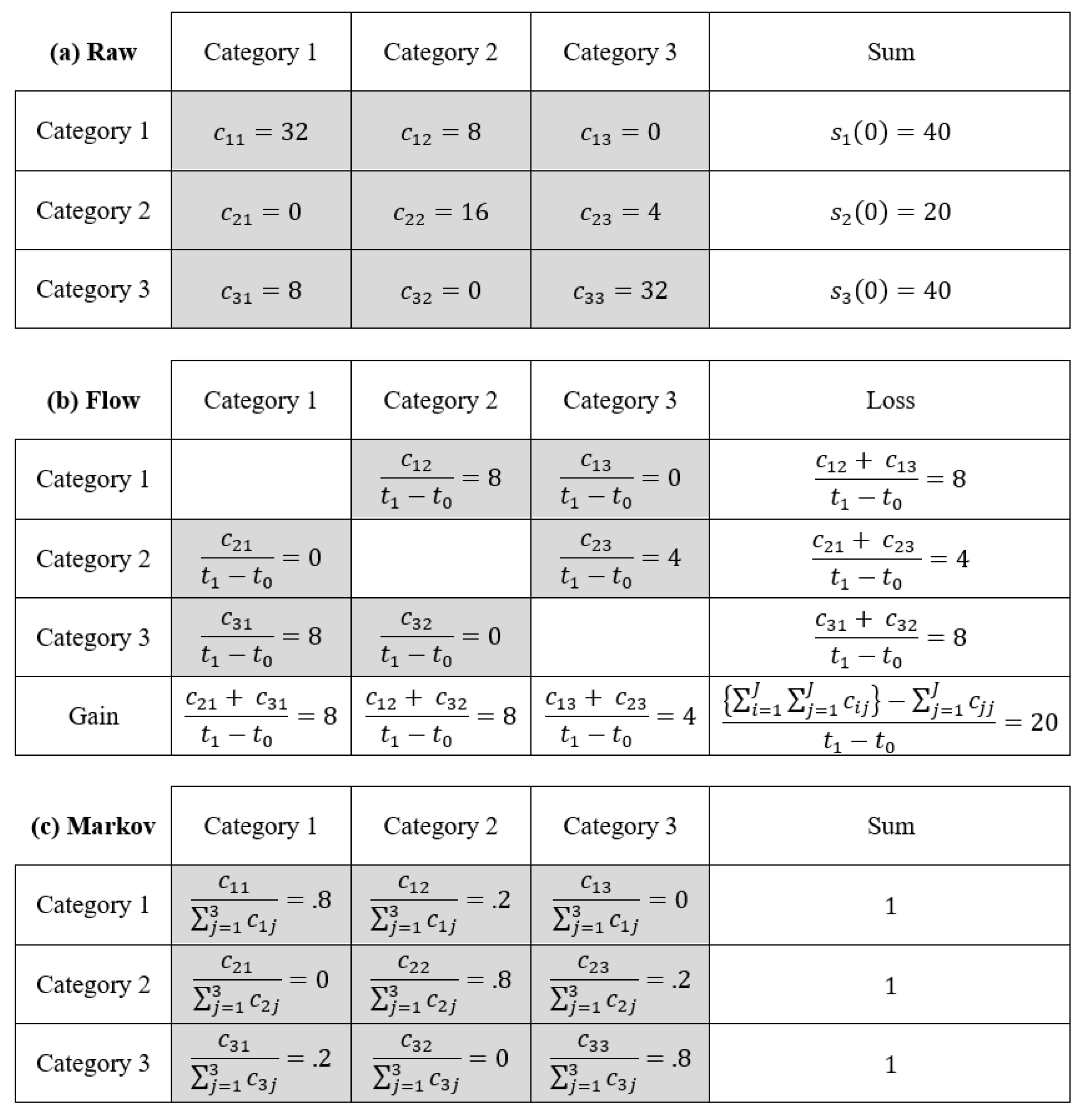
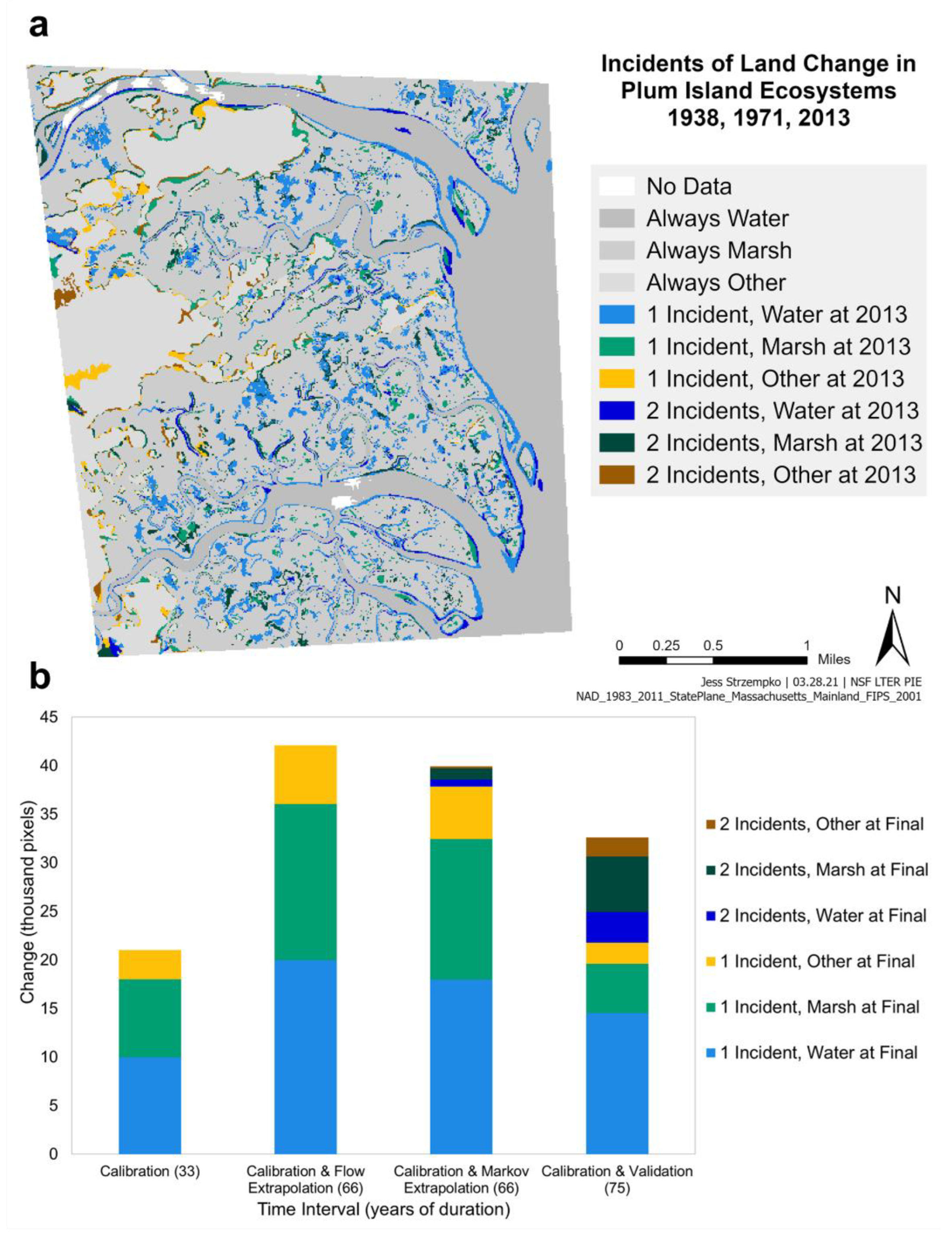
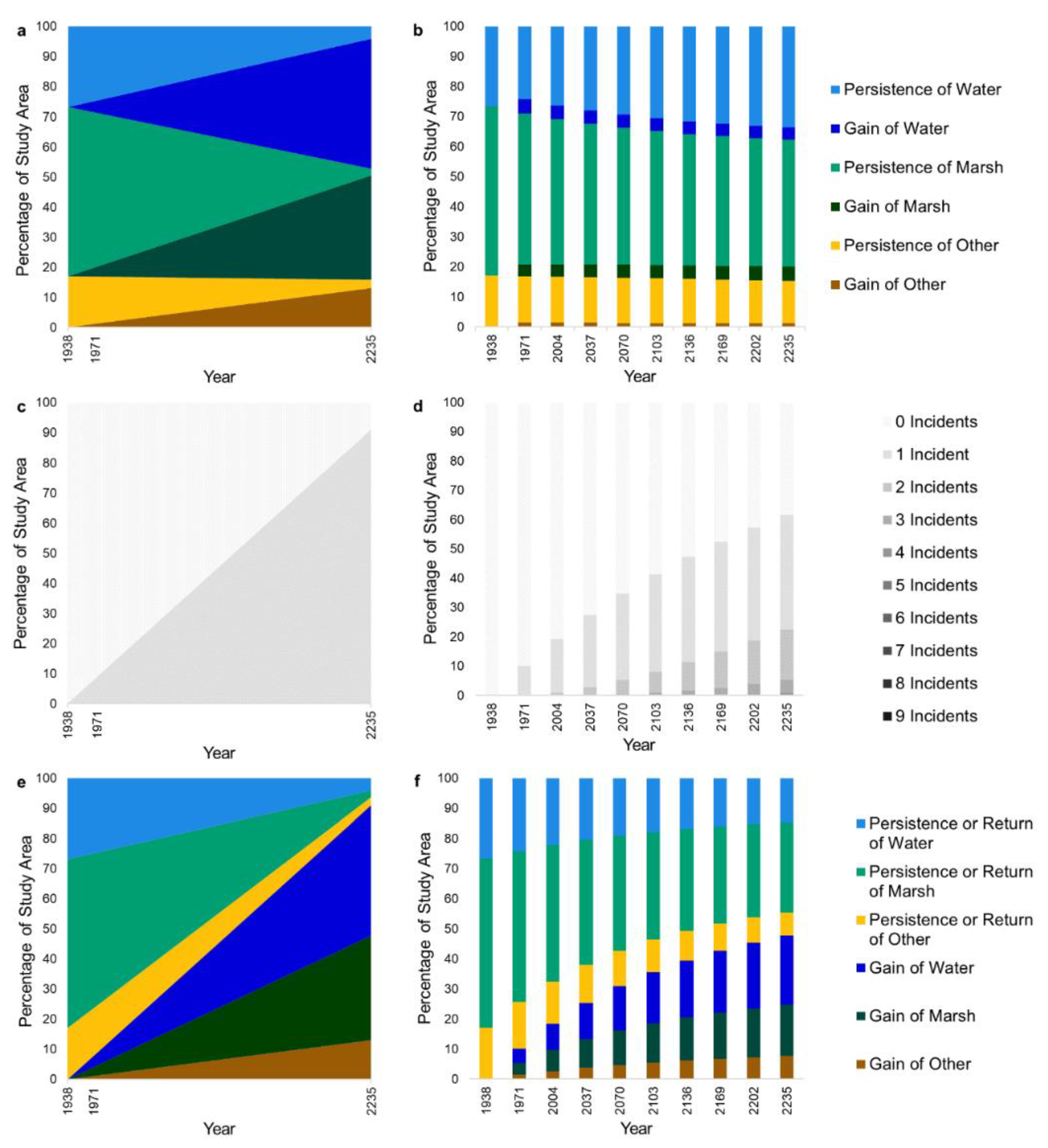
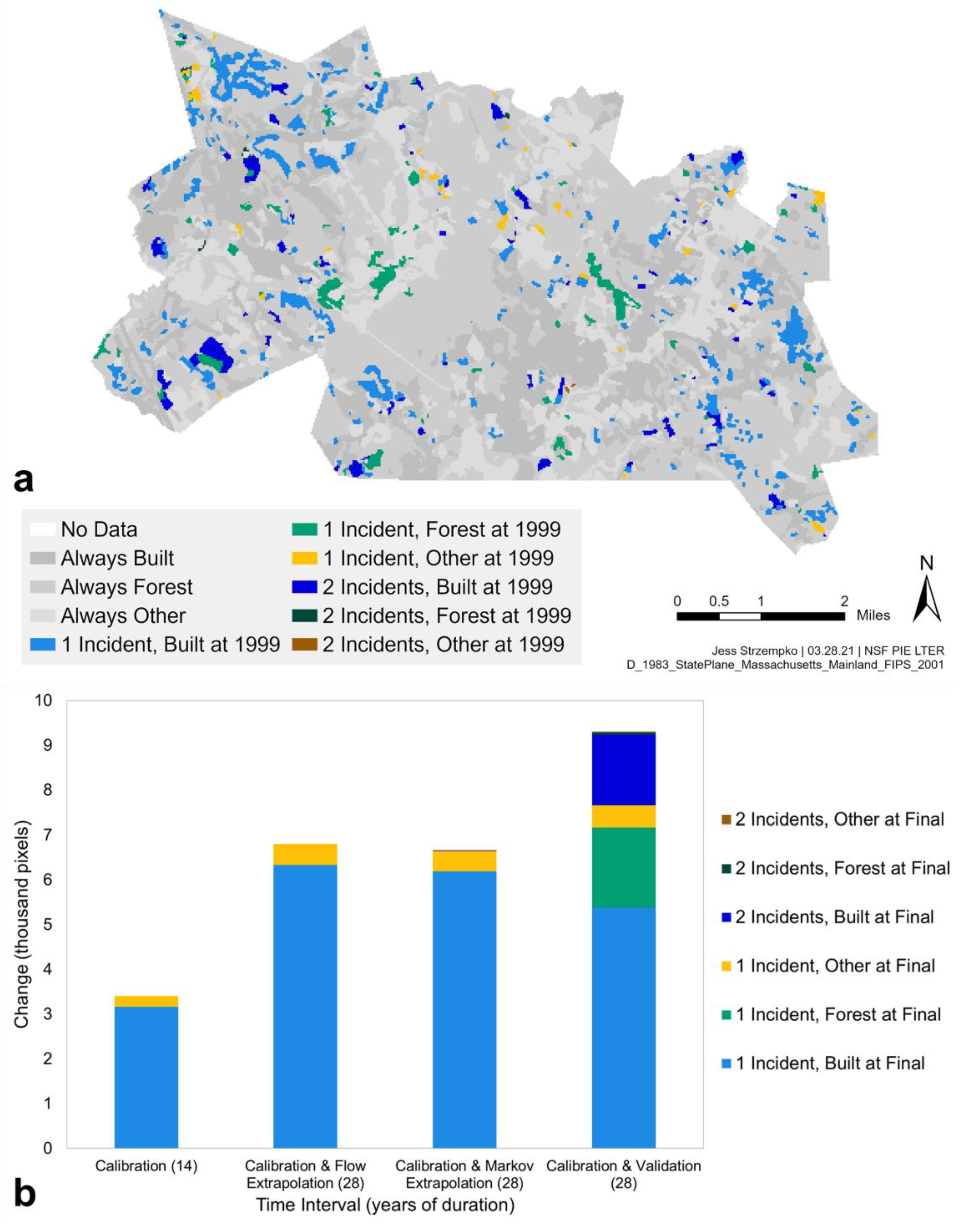
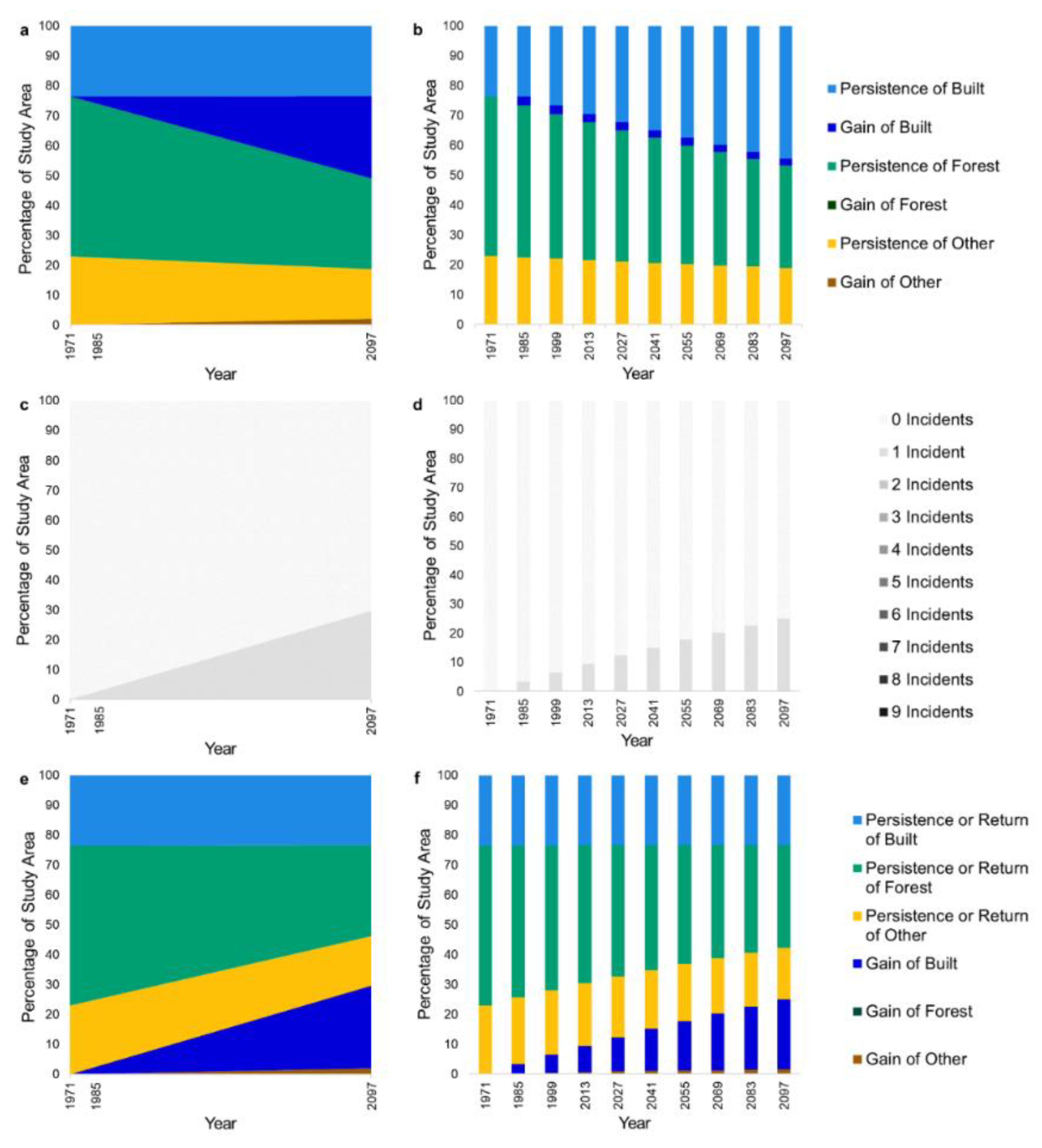
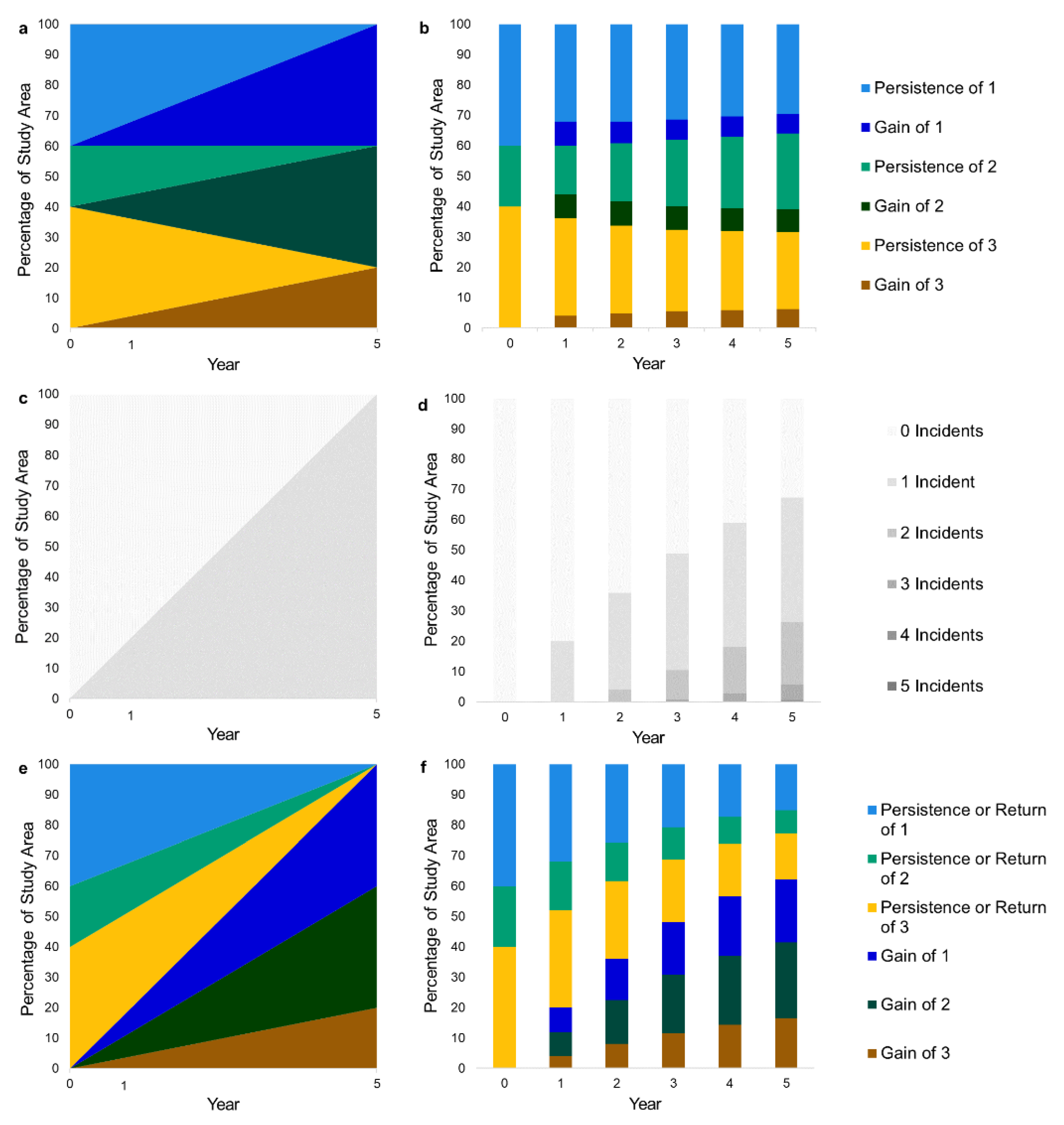
The Flow matrix is a novel method to describe and extrapolate transitions among categories. The Flow matrix extrapolates a constant transition size per unit of time on a time continuum with a maximum of one incident per observation during the extrapolation. The Flow matrix extrapolates linearly until the persistence of a category shrinks to zero. The Flow matrix has concepts and mathematics that are more straightforward than the Markov matrix. However, many scientists apply the Markov matrix by default because popular software packages offer no alternative to the Markov matrix, despite the conceptual and mathematical challenges that the Markov matrix poses. The Markov matrix extrapolates a constant transition proportion per time interval during whole-number multiples of the duration of the calibration time interval. The Markov extrapolation allows at most one incident per observation during each time interval but allows repeated incidents per observation through sequential time intervals. Many Markov extrapolations approach a steady state asymptotically through time as each category size approaches a constant. We use case studies concerning land change to illustrate the characteristics of the Flow and Markov matrices. The Flow and Markov extrapolations both deviate from the reference data during a validation time interval, implying there is no reason to prefer one matrix to the other in terms of correspondence with the processes that we analyzed. The two matrices differ substantially in terms of their underlying concepts and mathematical behaviors. Scientists should consider the ease of use and interpretation for each matrix when extrapolating transitions among categories.
Keywords: category; extrapolation; land change; flow; model; Markov category; extrapolation; land change; flow; model; Markov