Abstract
Microplastic (MP) pollution poses a significant and emerging threat to global marine ecosystems; however, regional data for the Caribbean remain limited. This study presents a spatial and temporal characterization of MPs in surface and mid-waters of the Colombian Caribbean (Atlántico and Magdalena departments), which were analyzed as independent compartments due to methodological differences in sampling strategies. Sixteen sampling stations were established across two anthropogenic influence zones: Zone 1 (nearshore/bather zone) and Zone 2 (offshore). MPs were quantified and characterized according to shape, color, size, and polymer composition using attenuated total reflectance Fourier transform infrared microspectroscopy (µATR-FTIR) and multivariate techniques. MPs were detected in 100% of samples. Surface water MP abundance was higher in Magdalena (4.5 MPs m−3) than in Atlántico (1.7 MPs m−3). Mid-water MP concentrations reached maximum values during the high rainfall season in Atlántico, reflecting localized hydrological and anthropogenic influences rather than vertical gradients. Higher concentrations were generally observed in the nearshore Zone 1 compared to offshore Zone 2, although these differences were not consistently statistically significant. Fibers and fragments were the predominant shapes, and synthetic–natural polymer blends, polyethylene terephthalate (PET), polypropylene (PP), and polyacrylic acid (PAA) were the most prevalent. Generalized Additive Models (GAM) indicated that strong fluvial inputs and proximity to urban and riverine sources were factors driving MP distribution. Additionally, the detection of polymers reported in the literature as rare and high-risk, such as acrylonitrile butadiene styrene (ABS), acrylonitrile styrene acrylate (ASA), styrene–ethylene–butylene–styrene (SEBS), and polyvinyl stearate (PVS), highlights the complexity of MP sources in the region. Overall, these results provide the first spatial and temporal characterization of MPs in the surface and mid-water of the Colombian Caribbean and identify critical contamination hotspots that warrant targeted mitigation strategies.
1. Introduction
Microplastics (MPs), defined as plastic particles smaller than 5 mm, are pervasive across nearly all marine ecosystems worldwide [1]. These particles originate either as primary MPs, which are intentionally manufactured at this size and directly released into the environment, or as secondary MPs, which are formed through the physical and chemical degradation of larger plastic debris. The extensive use of plastics in packaging and disposable products drives their widespread occurrence. Low production costs, high demand, inadequate solid waste management, and low recycling rates in many countries contribute to the accumulation of these contaminants [2,3].
Plastics are among the most widely used synthetic materials worldwide, with a global production of 430.9 million tons in 2024 [4]. Unfortunately, at the end of their useful life, these plastics account for up to 90% of marine debris, with MPs representing approximately 92% of marine plastic pollution [5,6,7]. MP sources primarily link to anthropogenic activities, such as untreated wastewater discharges, urban and industrial effluents, commercial fishing and aquaculture, and agricultural practices. Transport pathways, including stormwater runoff and extreme hydrometeorological events (e.g., floods, storms, or hurricanes), facilitate their mobilization and dispersal into aquatic and marine environments [8,9,10]. Once released, MPs can persist in aquatic ecosystems for centuries, undergoing continuous fragmentation and redistribution through mechanical abrasion and photochemical processes [11].
Colombia produced approximately 1.4 million tons of plastic in 2024, representing a 12% increase compared to 2023, with packaging accounting for over half of this volume. However, only 3% of these materials are recycled, and nearly 800,000 tons are disposed of in landfills annually without treatment. Consequently, plastic waste represents approximately 10.78% of the country’s 12 million tons of annual waste generation [12,13]. In coastal regions, an estimated 65% of solid waste is inadequately managed and ultimately reaches natural water bodies, including rivers that discharge into the sea [14]. The Colombian Caribbean coast, driven by a growing plastic industry, intensive tourism, and insufficient waste management policies, illustrates this challenge [15]. Previous studies in the Magdalena and Atlántico departments have reported significant environmental degradation, with substantial debris loads associated with tourism activities, riverine transport, and other anthropogenic pressures [16,17].
For communities in both departments, tourism represents one of the main sources of employment and income [18], supported by beaches with high natural value [19], including proximity to the largest coastal lagoon in Colombia, a designated RAMSAR site (Ciénaga Grande de Santa Marta), as well as national natural parks (Tayrona) and the world’s highest coastal mountain range (Sierra Nevada de Santa Marta, SNSM). Despite this ecological and socioeconomic relevance, limited information on MP pollution in the Colombian Caribbean hinders the development of effective waste reduction and prevention strategies, especially in highly impacted ecosystems [7,17,20].
While several studies have focused on MPs in surface waters (typically < 50 cm depth), important knowledge gaps persist regarding MP occurrence in the water column. However, it is important to note that differences in sampling strategies, filtered volumes, and analytical approaches often limit the direct comparability of MP concentrations between water layers. Consequently, water compartments at different depths should be addressed independently to avoid misinterpretation of vertical patterns [21].
Research on MP pollution in marine waters of the Caribbean Sea has been conducted mainly in Colombia [22,23,24,25], Costa Rica [26,27], Cuba [28], and Jamaica [29]. However, multivariate analyses addressing MP distribution processes and polymer composition within the water column are still lacking. Within this context, the present study aims to provide a spatial and temporal characterization of MPs in the surface and mid-water of the Colombian Caribbean Sea, focusing on the Atlántico and Magdalena departments. Specifically, the objectives were as follows: (1) to assess MP abundance and distribution in surface and mid-water across two contrasting climatic seasons (high and low rainfall), treating each compartment independently due to methodological constraints; (2) to characterize the physical (shape, color, size) and chemical (polymer composition) properties of the detected MPs; and (3) to identify key environmental drivers influencing MP occurrence, particularly proximity to anthropogenic activities and riverine inputs. We hypothesized that MP abundance would be higher in areas with stronger anthropogenic influence and during the high rainfall season, reflecting increased terrestrial inputs.
2. Materials and Methods
2.1. Study Area
The coastal area of the Magdalena department, extending 220 km, exhibits a high diversity of strategic ecosystems that influence local climate conditions, with ambient temperatures ranging from 28 to 34 °C and low rainfall from 0 mm to 300 mm [30]. Numerous rivers from the SNSM and the submarine outfall in Santa Marta city discharge into the Magdalena coast, collectively shaping its marine-coastal dynamics [31]. Conversely, the coastline of the Atlántico department, with a length of 90 km, is characterized by interactions with coastal lagoons, urban streams, and the Magdalena River, the largest river in South America that flows into the Caribbean Sea. It has varied topography, including low-slope mountains, plains, coastal lagoons, sand dunes, and mangroves. The climate is tropical semi-arid, with temperatures between 24 °C and 28 °C, but can exceed 34 °C, and total monthly rainfall between 0 mm and 500 mm [32].
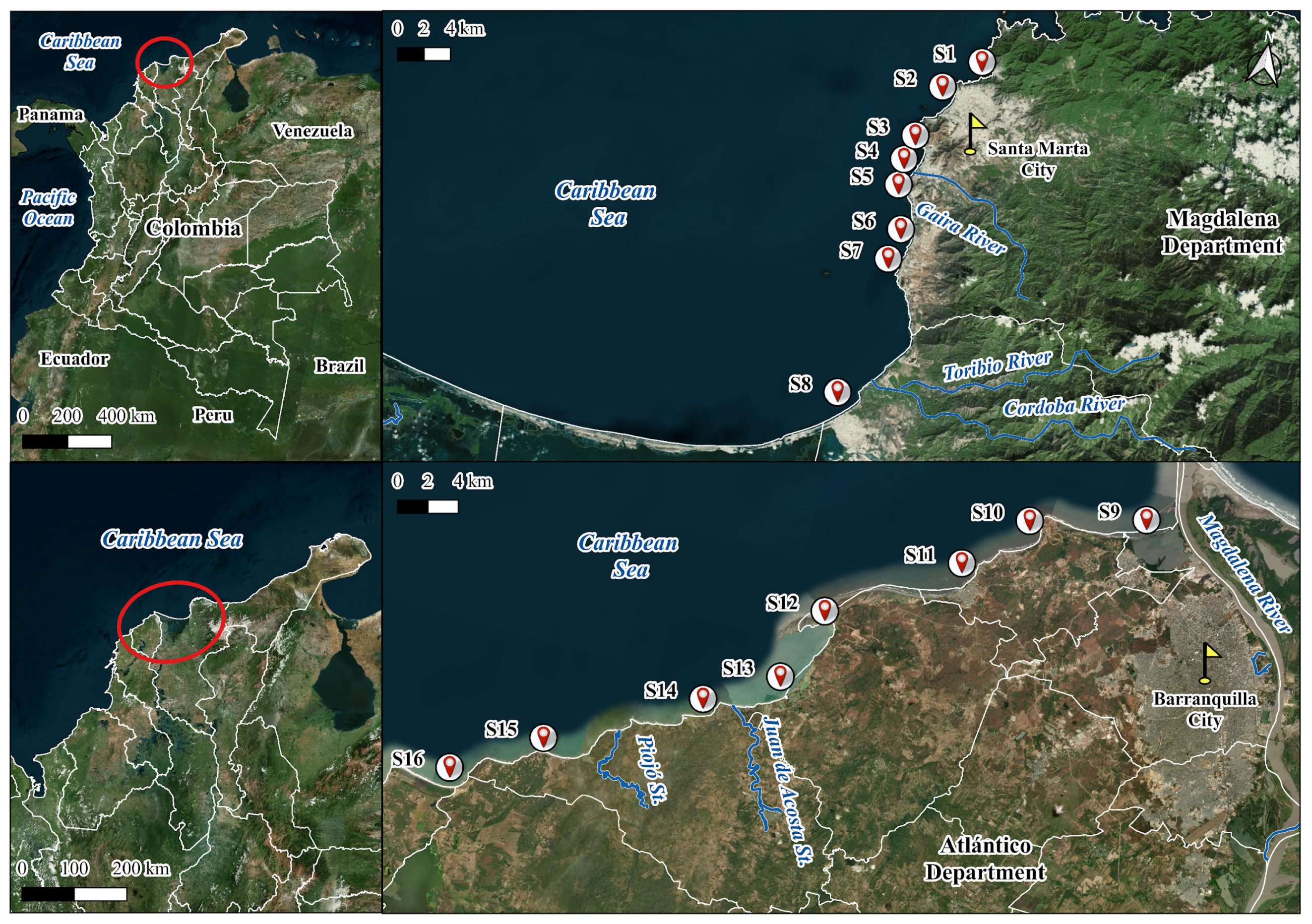
This study established sixteen sampling stations along the coast of the Magdalena and Atlántico departments in the Colombian Caribbean Region (Figure 1, Table 1). Monitoring stations were established at beaches selected for their ecological, touristic, and economic importance, building upon insights from previous regional studies [11,22].
Figure 1.
Location of monitoring stations for microplastic sampling in the Magdalena and Atlántico departments, Caribbean region, northern Colombia. Red outlined circle: Study area within the Colombian Caribbean Sea, spanning the Atlántico and Magdalena departments. White circles with red logo: Monitoring stations. Yellow flag: Urban centers of Santa Marta (Magdalena) and Barranquilla (Atlántico).
Table 1.
Characteristics of the sampling stations in the departments of Magdalena and Atlántico, Colombian Caribbean coast. Beach type was determined based on the anthropogenic dimensions described by Williams and Micallef [33]. The total population was obtained from the census projection of the National Administrative Department of Statistics (DANE, Spanish acronym).
2.2. Field Sampling
Two sampling campaigns were conducted in each department: one in November 2022 (during the high rainfall season) and another in July 2023 (during the low rainfall season) to capture the temporal variability associated with tidal regimes and seasonal climatic conditions in the region. In situ physicochemical variables such as salinity (ppt), surface water temperature (°C), pH, total conductivity (mS cm−1), dissolved oxygen (mg L−1), and oxygen saturation (%) were measured using a multiparameter probe (YSI ProPlus, YSI Inc., Yellow Springs, OH, USA). Water transparency (m) and depth (m) were determined using a Secchi disk. The ambient temperature (°C) was recorded using a digital thermo-hygrometer. Surface and mid-water samples were collected from two zones with differing degrees of anthropogenic influence: Zone 1, located near the shoreline (direct anthropogenic influence-bather zone), and Zone 2, approximately 400 m offshore (moderate anthropogenic influence-offshore zone), to assess the aquatic contamination gradient. Surface samples were obtained by filtering 10 m3 of seawater per station using a 23 µm mesh plankton net, attached laterally to the vessel to minimize turbulence, following circular transects at 2–3 knots (non-discrete method) [34]. Mid-water samples were collected using a 4 L Van Dorn bottle deployed at a mid-depth and activated with a messenger (discrete method), repeated five times to obtain a total volume of 20 L. The 20 L of water was filtered through a 23 µm mesh net. Mid-water sampling was conducted in the pelagic zone at half the total depth of each monitoring station, approximately 2 m (1–5 m). Paired duplicate samples were collected for each water type (surface and mid-water) to ensure replication, stored in ultrapure water-rinsed glass bottles, and kept refrigerated [35]. A total of 128 surface water samples and 128 mid-water samples were collected. It is important to emphasize that surface and mid-water samples were collected using fundamentally different sampling strategies. Surface waters were sampled using a non-discrete net-based approach with a filtered volume of approximately 10 m3, whereas mid-water samples were obtained using discrete bottle sampling with a total volume of 20 L. Consequently, despite the use of the same mesh size (23 μm), the resulting MP abundances are not directly comparable between depths.
2.3. Quality Assurance
All field and laboratory equipment were pre-cleaned with laboratory-grade detergent and rinsed thoroughly with ultrapure or distilled water before and after each use. All solutions were prepared using ultrapure water and filtered prior to use. Throughout all procedures, the samples and filters were consistently covered with aluminum foil to prevent airborne contamination. Procedural blanks (filter blanks) were included, located at the bow, stern, and inside the boat during sampling and on the laboratory benches during the digestion phase to monitor potential MP contamination from the working environment. Additional measures for methodological standardization and cross-contamination prevention were implemented according to Rojas-Luna et al. [36].
2.4. Laboratory Procedures
Samples were digested with 125 mL of 30% hydrogen peroxide (H2O2) solution using an orbital shaker (Heidolph Incubator 1000 coupled with Heidolph Unimax 1010, Heidolph Instruments, Schwabach, Germany) at 60 °C and 600 rpm for 72 h. After digestion, the samples were vacuum filtered through 1.2 µm cellulose filters (Whatman, Maidstone, UK). The use of cellulose filters reduces the risk of polymer-related cross-contamination compared to polyamide filters and improves spectral quality by lowering the signal-to-noise ratio during spectroscopic analysis compared to fiberglass filters. The filters were subsequently transferred to pre-labeled Petri dishes and air-dried at room temperature. MPs were analyzed using a stereomicroscope (SteREO Discovery V20, Carl Zeiss Microscopy, Oberkochen, Germany) for quantitative (abundance and size) and qualitative (morphology and color) characterization. The polymeric composition of the particles was identified using attenuated total reflectance Fourier transform infrared microspectroscopy (µATR-FTIR, LUMOS II, Bruker Optics, Ettlingen, Germany) equipped with a thermoelectrically cooled mercury-cadmium telluride (TE-MCT) detector. A total of 256 scans per particle were obtained. Spectral data were compared with reference databases, (ATR–Polymer Library Complete, Vol. 1–4; KIMW ATR–IR Polymer Libraries), using a match threshold of >75% for positive identification, as described by Stockin et al. [37]. Additionally, a confirmatory analysis of the spectral overlap between the field samples and reference polymers was performed using Python-based analytical tools (Python version 3.10).
2.5. Data Analysis
The normality of the data was assessed using goodness-of-fit tests. The Shapiro–Wilk test was applied to samples with number of data points was less than 30, including physicochemical variables and MP abundance in water samples. Descriptive statistics were used to summarize the physicochemical parameters. Differences between anthropogenic influence zones were evaluated using the Kolmogorov–Smirnov and Student’s t-tests, whereas temporal variation in environmental conditions between sampling campaigns was assessed using the Wilcoxon signed-rank test and paired t-test. The selection of statistical tests was based on the distribution of the data, adjusting for parametric or non-parametric tests [38].
The physical characteristics of the MPs (shape, color, and size) were analyzed descriptively. MP abundance was expressed as the number of particles per volume of filtered water. Surface water samples were quantified as MPs m−3 and mid-water samples as MPs L−1 [39,40]. Due to the markedly different sampling volumes and collection strategies, direct quantitative comparisons of MP concentrations between surface and mid-water samples are methodologically unjustified. Any observed differences primarily reflect sampling methodology rather than true vertical variability in MP abundance. Differences in MP abundances were assessed using the Kolmogorov–Smirnov test for independent samples (applied to surface and mid-water, comparing departments and impact zones), one-way ANOVA and Kruskal–Wallis tests for differences among sampling stations, and the Wilcoxon test to evaluate seasonal variation.
To identify potential MPs pollution sources in each department, Generalized Additive Models (GAM) were used, incorporating variables such as total depth (m), Secchi’s transparency (m), surface water temperature (°C), precipitation (mm), and distance to urban centers (km). For the Magdalena department, distances to river mouths originating in the SNSM and fluvial or air transport access points were included. In the Atlántico department, additional variables included water level (m), flow rate of the Magdalena River (m3 s−1), and distance from each station to the river’s mouth and nearby wetlands or municipal streams (km). Spatial data, including distances to urban centers and river mouths, were extracted and processed using Google Earth Pro (version 7.3). Precipitation and river discharge data were obtained from the Institute of Hydrology, Meteorology, and Environmental Studies (IDEAM, Spanish acronym), and river level data were provided by the Regional Autonomous Corporation of the Río Grande de la Magdalena (Cormagdalena, Spanish acronym).
In addition, 33% of all particles were chemically characterized, of which 55.1% were from the Magdalena department and 44.9% from the Atlántico department. Furthermore, 39.1% of the particles corresponded to surface water, while 60.9% were from the mid-water. The analysis focused particularly on fragments and fibers, the most abundant types, including all colors observed to ensure coverage of typological diversity [32,41,42]. The blends were classified according to their nature: “synthetic–natural polymer blends”, which are a combination of a hydrocarbon-based polymer with a cellulose-based polymer (e.g., polyethylene terephthalate [PET]/cotton); and “Synthetic polymer blends”, which are a mixture of two or more hydrocarbon-based polymers (e.g., PET/polyamide [PA]). The “resin” category includes epoxy (EP), alkyd, poly(dianol-33 tetrahydrophthalate) (PES resin), and vinyl ester (VE) resins. The “other thermoplastics” category comprises acrylonitrile butadiene styrene (ABS), acrylonitrile styrene acrylate (ASA), polytetrafluoroethylene (PTFE), ethylene vinyl acetate (EVA), polyethyl acrylate (PEA), ethylene acrylic elastomer (AEM), starch-based thermoplastics (TPS), and thermoplastic vulcanizate (TPV). In contrast, the “other” category includes unsaturated polyester (UP) and polyvinyl stearate (PVS).
The chemical characterization of MPs was performed using µATR-FTIR, with spectral signals preprocessed through standard normal variate transformation. Two linear discriminant analysis (LDA) models were constructed. The first used reference polymers, PET, polyvinyl chloride (PVC), polypropylene (PP), PA, polyethylene (PE), and polystyrene (PS), which achieved over 95% spectral match with reference databases, enabling the clustering of experimental MPs according to their spectral characteristics. The second approach focused on classifying synthetic–natural polymer blends and synthetic polymer blends, using PET and cotton as reference spectra. Both models were implemented in Rstudio (Version 2023.03.0+386) using the MASS, pracma, ggplot2, and caret packages, including confusion matrix analysis and accuracy estimation.
3. Results
3.1. Physicochemical Properties of Seawater
Seasonal variations were observed in the physicochemical properties of seawater in both the Atlántico and Magdalena departments (Table 2). In the Magdalena department, seasonal patterns were less pronounced. The temperature did not differ significantly between seasons, whereas pH was slightly higher during the high rainfall season (p < 0.001 **). Conductivity and salinity were substantially greater during the low rainfall season (p < 0.001 ** and p < 0.0001 ***, respectively), although the magnitude of these differences was smaller than those observed in Atlántico. No significant differences were observed in the dissolved oxygen and oxygen saturation, suggesting more stable oxygenation conditions in this coastal region. No statistically significant differences were observed in the physicochemical properties between the areas of anthropogenic influence (Zones 1 and 2). In Atlántico, temperature and salinity were significantly higher during the high rainfall season than during the low rainfall season (p < 0.0001 ***). Similarly, the dissolved oxygen and oxygen saturation showed a significant decrease during the low rainfall season. Conversely, conductivity was significantly higher during the low rainfall season (p < 0.0001 ***). No significant seasonal differences in pH were detected.
Table 2.
Physicochemical properties of seawater in the Magdalena and Atlántico departments during high and low rainfall seasons. Values are expressed as means and ranges. Differences between seasons were tested using the t-test and the Wilcoxon test. Significance levels: *** p < 0.0001, ** p < 0.001, * p < 0.05.
3.2. Microplastic Abundance in Surface Water
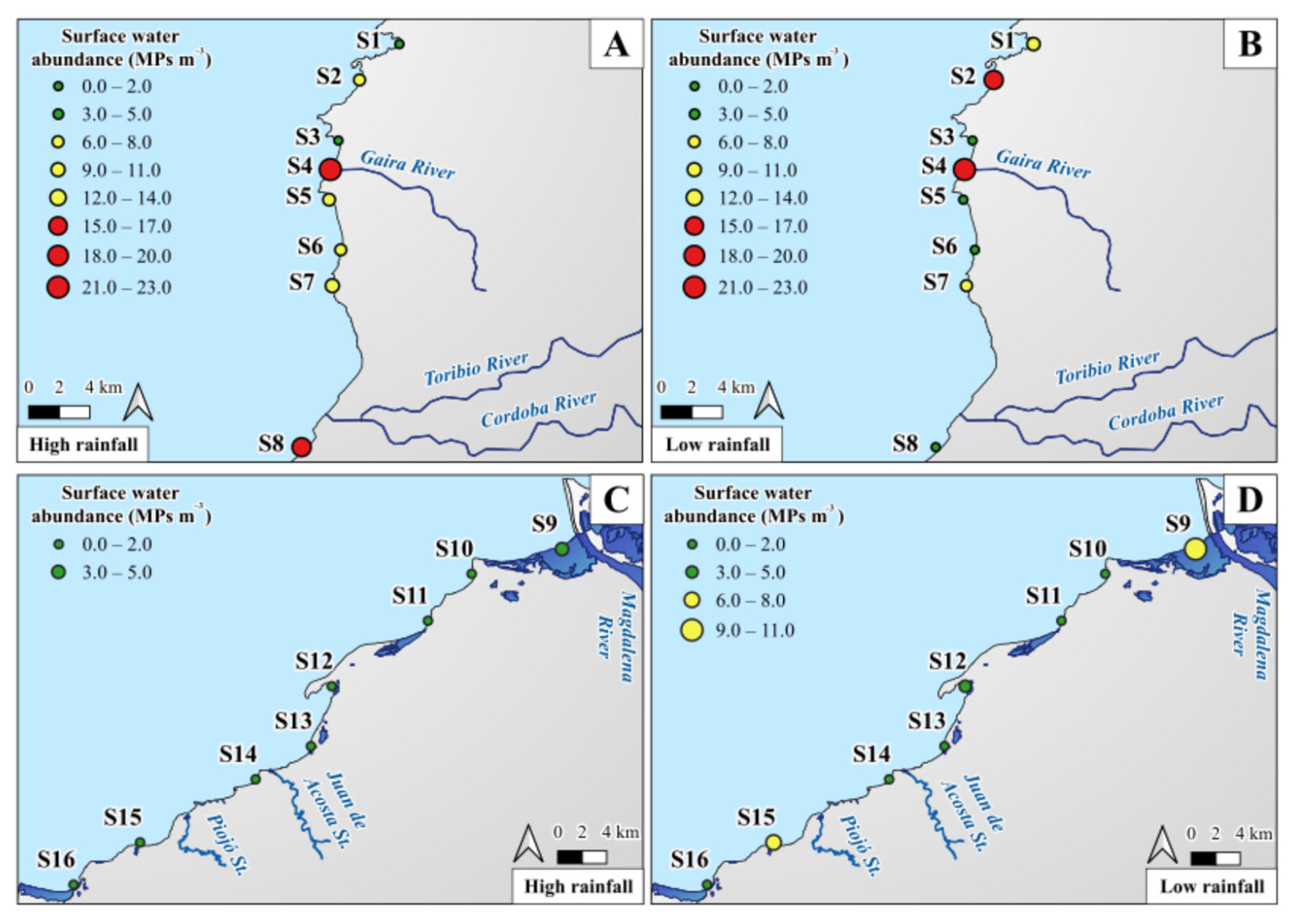
MPs were detected in all surface water samples from both departments (Magdalena and Atlántico) and across both climatic seasons (high and low rainfall). In Magdalena, MP concentrations ranged from 0.5 to 41.9 MPs m−3. The highest abundances were recorded at stations S2 (Marina, 9.1 MPs m−3), S4 (Playa Salguero, 7.8 MPs m−3), S7 (Airport, 7.3 MPs m−3), and S8 (Ciénaga, 5.4 MPs m−3). The lowest values were observed at S1 (Taganga, 2.5 MPs m−3) and S3 (Rodadero, 2.6 MPs m−3). While Cabo Tortuga (S5, 3.2 MPs m−3) and Irotama (S6, 3.1 MPs m−3) also exhibited the presence of MPs, no statistically significant differences were found among the stations. Nevertheless, stations located near river mouths and historically impacted coastal areas exhibited higher MP abundance. Mean MP abundance was again higher in the bather zone (Z1, 6.2 MPs m−3) than in the offshore zone (Z2, 3.3 MPs m−3), although the difference was not statistically significant. Mean MP abundance was also greater in the high rainfall season (5.3 MPs m−3) than in the low rainfall season (3.9 MPs m−3), but the difference was not significant (Figure 2A,B).
In Atlántico, the concentrations ranged from 0.2 to 11.8 MPs m−3. The highest average abundances were observed at stations S9 (Ciénaga de Mallorquín coast, 4.8 MPs m−3), S10 (Salgar, 2.1 MPs m−3), and S15 (Aguamarina, 2.1 MPs m−3). The lowest abundances were recorded at S16 (Punta Astilleros, 0.7 MPs m−3), S11 (Puerto Colombia, 1.0 MPs m−3), and S14 (Santa Verónica, 1.1 MPs m−3). Intermediate levels were found at S12 (Puerto Velero, 2.0 MPs m−3) and S13 (Playa Mendoza, 2.0 MPs m−3). Notably, two of the three stations with the highest MP abundances (S9 and S10) were located near the mouth of the Magdalena River, suggesting a significant contribution of fluvial inputs to coastal MP contamination. No significant differences were observed among the sampling stations. Although higher mean concentrations were observed in the offshore zone (Z2, 1.8 MPs m−3) than in the bather zone (Z1, 1.6 MPs m−3), this difference was not statistically significant. MP abundance was slightly higher during the high rainfall season (1.9 MPs m−3) than during the low rainfall season (1.5 MPs m−3), but this difference was not statistically significant (Figure 2C,D).
Figure 2.
Spatial and temporal distribution of microplastic abundances in surface water at monitoring stations in the departments of Magdalena (A,B) and Atlántico (C,D). Where (A,C) correspond to the high rainfall season (2022), and (B,D) correspond to the low rainfall season (2023).
Figure 2.
Spatial and temporal distribution of microplastic abundances in surface water at monitoring stations in the departments of Magdalena (A,B) and Atlántico (C,D). Where (A,C) correspond to the high rainfall season (2022), and (B,D) correspond to the low rainfall season (2023).

MP abundance in surface water was significantly higher in the Magdalena department (4.5 MPs m−3; range: 0.5–41.9 MPs m−3) than in the Atlántico department (1.7 MPs m−3; range: 0.2–11.8 MPs m−3), as confirmed by the Kolmogorov–Smirnov test (p = 0.002 ***).
3.3. Physical and Chemical Characterization of Microplastics in Surface Water
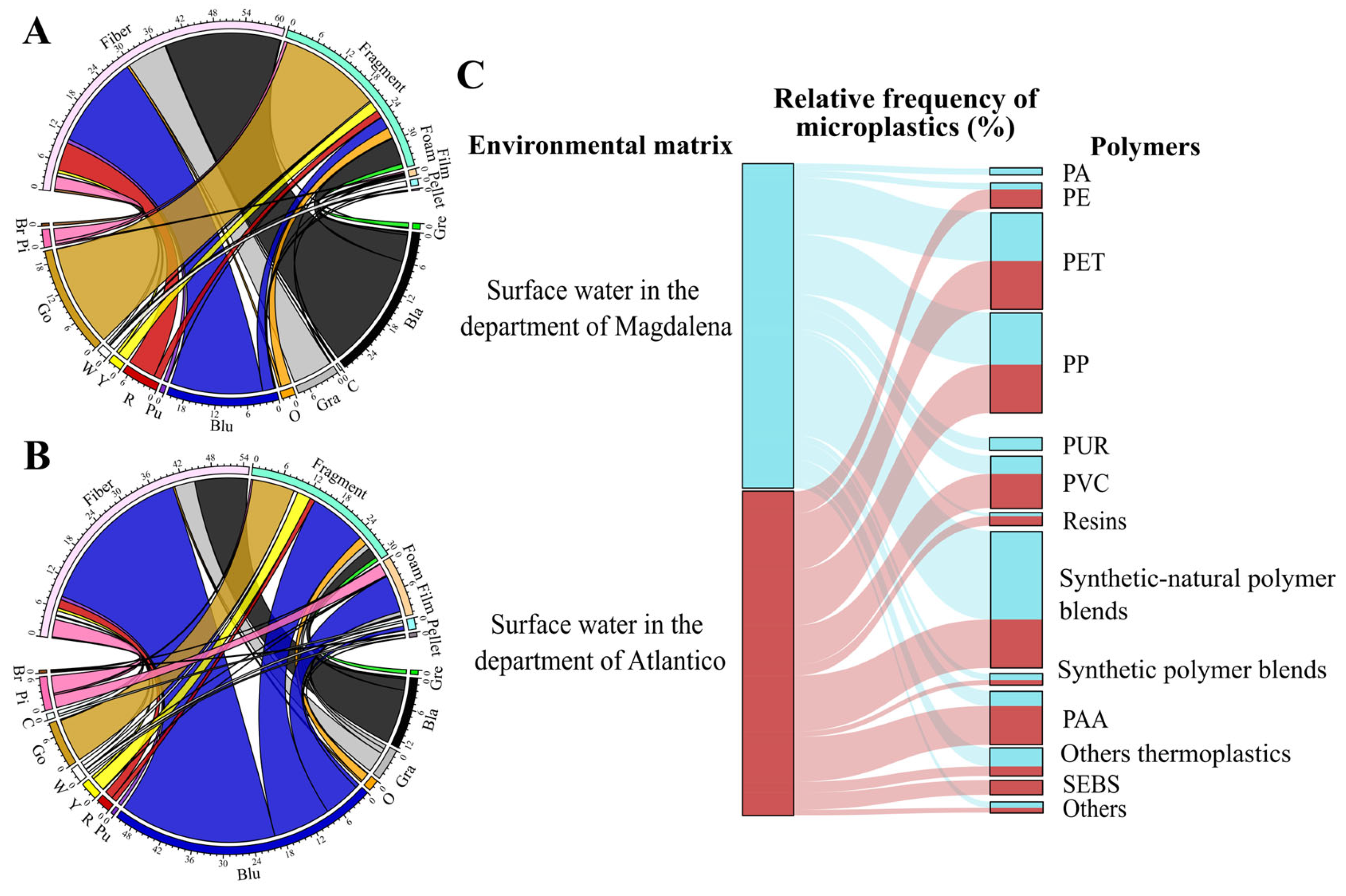
MP shapes varied between departments and seasons. In the Magdalena department, five distinct MP shapes were identified in surface waters. Fibers were the dominant form (62.3%), followed by fragments (34.8%), while foam, films (both 1.3%), and pellets (0.3%) represented minor contributions (Figure 3A). The predominance of fibers and fragments was consistent across sampling events, although seasonal differences were observed. During the low rainfall season, the proportion of fibers and films increased, whereas the proportion of fragments decreased relative to that during the high rainfall season. Pellets were detected exclusively during the low rainfall season.
Figure 3.
Shapes and colors of microplastics identified in surface water samples from monitoring stations in the departments of Magdalena (A) and Atlántico (B). Relative polymer composition of microplastics identified in surface water samples from the Magdalena and Atlántico departments (C). Br: brown; Pi: pink; C: colorless; Go: gold; W: white; Y: yellow; R: red; Pu: purple; Blu: blue; O: orange; Gra: gray; Bla: black; Gre: green.
Similarly, five shapes were recorded in the surface waters of the Atlántico department. Fibers were again the predominant form (55.1%), followed by fragments (30.7%), foam (11.3%), films (2.1%), and pellets (0.8%) (Figure 3B). Seasonal variability was also observed, with fragments and foam being more abundant during the high rainfall season, whereas fibers and films were more prevalent during the low rainfall season. Pellets were observed only during the high rainfall season.
Thirteen MP colors were identified across both departments. Black (Magdalena: 29.2%; Atlántico: 19.3%) and blue (Magdalena: 21.2%; Atlántico: 57.4%) were the most frequent colors, followed by gray, gold, pink, white, red, yellow, salmon, purple, green, colorless, and brown. In Magdalena, fibers and fragments exhibited the greatest color diversity, with noticeable changes between the sampling seasons. Films were mostly white and blue, pellets were black and blue, and foam appeared primarily in black, blue, and gray tones (Figure 3A). In Atlántico, the fibers displayed the widest color range, dominated by blue and black. Fragment colors varied seasonally, with blue and gold prevailing during the high rainfall season and black, blue, and gray dominating during the low rainfall season. The foam was mainly blue and pink during the high rainfall season and shifted to gray and black during the low rainfall season. The film colors varied with precipitation conditions, ranging from colorless and white during periods of high rainfall season to predominantly blue and white under low rainfall season conditions. The pellets showed varied colors, including white, brown, and salmon (Figure 3B).
MP sizes varied between regions and seasons. In Magdalena, MP sizes ranged from 0.054 to 4.816 mm, with pellets being the smallest and fibers the largest. The mean MP size was slightly greater during the high rainfall season (1.036 mm) than during the low rainfall season (0.973 mm). In Atlántico, MP sizes ranged from 0.037 to 3.914 mm, with fragments being the smallest and fibers the largest size. Here, MPs were larger during the low rainfall season (1.198 mm) than during the high rainfall season (0.506 mm). On average, MPs were slightly larger in Magdalena (0.996 mm) than in Atlántico (0.900 mm).
Regarding polymer composition, Magdalena was dominated by synthetic–natural polymer blends (31.5%), followed by PP (18.5%), PET (17.4%), and PVC (6.5%). Minor contributions included other thermoplastics (6.5%), polyacrylic acid (PAA, 5.4%), polyurethane (PUR, 4.3%), PE (2.2%), and PA (2.2%). In contrast, surface-water MPs in Atlántico were dominated by PET (17.2%), PP (17.2%), and synthetic–natural polymer blends (17.2%), with moderate contributions from PAA (13.8%), PVC (12.1%), PE (6.9%), styrene-ethylene-butylene-styrene (SEBS, 5.2%), resins (3.4%), and others (1.7%). Polymers such as PA and PUR were predominantly or exclusively detected in Magdalena (Figure 3C). Overall, both departments were characterized by high proportions of PET, PP, and blends. However, Magdalena exhibited a stronger contribution of synthetic–natural polymer blends, whereas Atlántico showed greater diversity, particularly due to the presence of SEBS.
In the Magdalena, the fibers were mainly composed of synthetic–natural polymer blends and PET, whereas PVC, synthetic polymer blends, and PUR predominated in foams, and PVC and PAA predominated in films. The pellets were composed exclusively of PAA, and the fragments included PP and other thermoplastics (TPV and ASA), PUR, PAA, PET, and synthetic–natural polymer blends. In the Atlántico department, the fibers were mostly synthetic–natural polymer blends and PET, while PVC, SEBS, and PAA predominated in foams, PE, and PAA in films. The pellets were composed of PVS, and the fragments were mainly composed of PP, PAA, and PE.
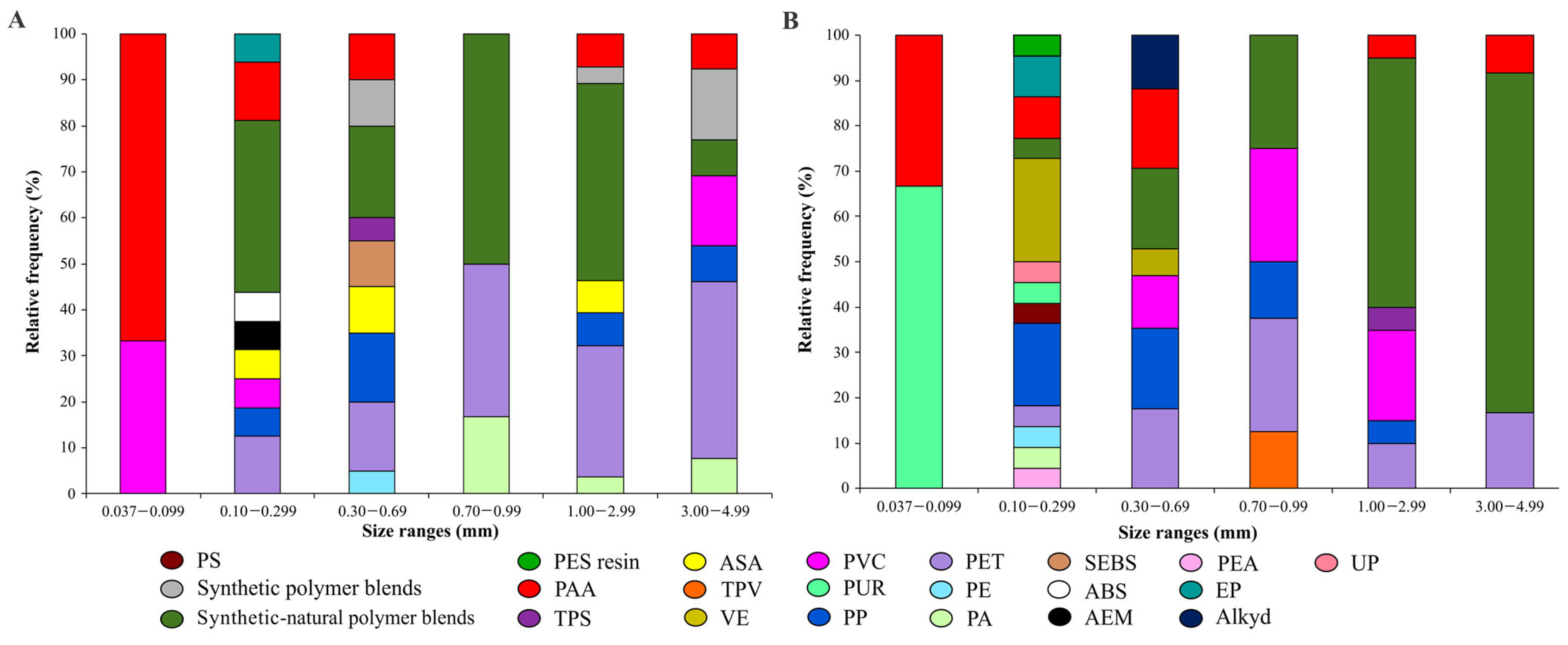
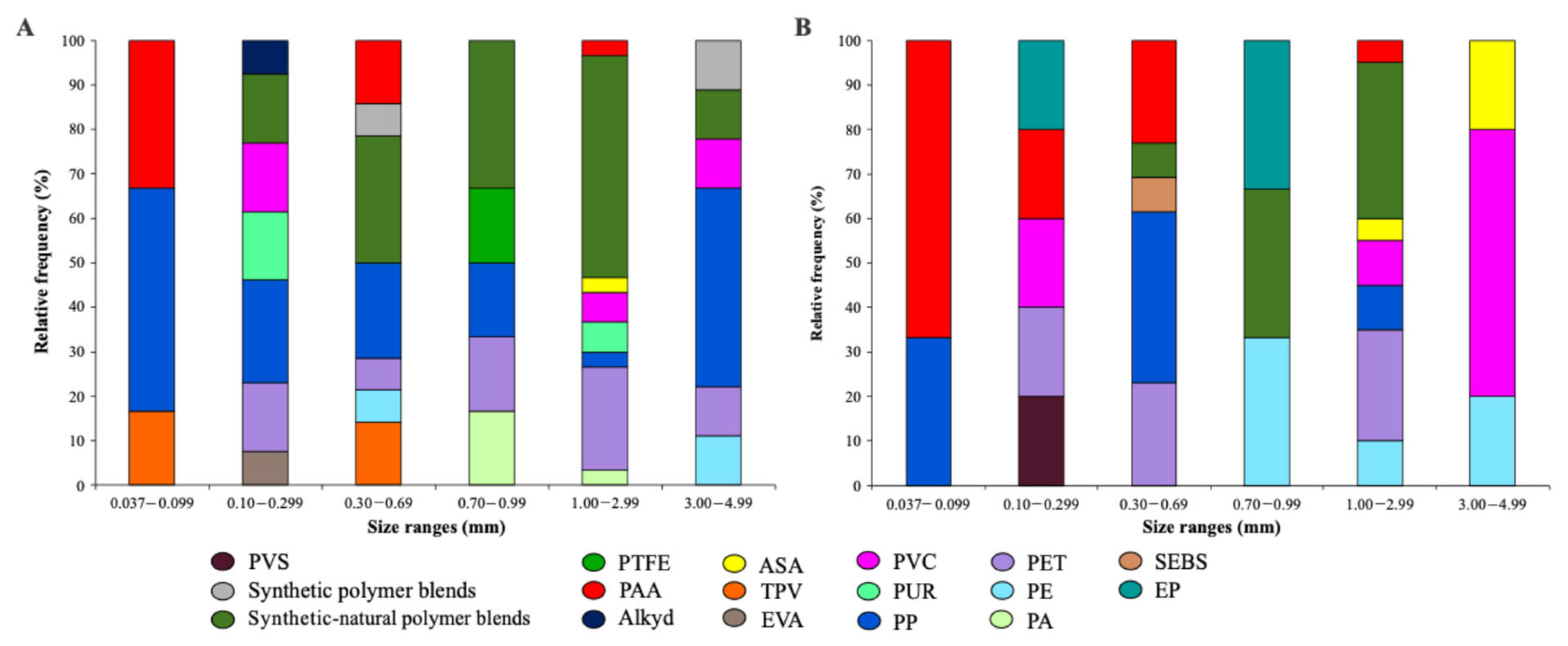
In the Magdalena, the smallest MPs (<0.10 mm) were mainly composed of less common polymers such as PP (50.0%), PAA (33.3%), and TPV (16.7%). Intermediate-sized MPs (0.70–0.99 mm) were mainly composed of synthetic–natural polymer blends (33.3%), followed by PET, PP, PA, and PTFE, each accounting for 16.7%. Larger MPs (>3.0 mm) were predominantly composed of typical polymers such as PP (44.4%), PVC, PET, PE, blends of synthetic polymers, and synthetic–natural polymer blends with 11.1% each (Figure 4A). This pattern was consistent in the department of Atlántico, with large MPs composed of PVC (60.0%), PE (20.0%), and ASA (20.0%), while the smaller ones were PAA (66.7%) and PP (33.3%). Intermediate-sized MPs were mainly composed of PE, synthetic–natural polymer blends, and EP, each accounting for 33.3% (Figure 4B).
Figure 4.
Plastic polymers distributed across size ranges, recorded in surface water of the coast of the Magdalena (A) and Atlántico (B) departments, Caribbean region, Colombia.
3.4. Microplastic Abundance in Mid-Water
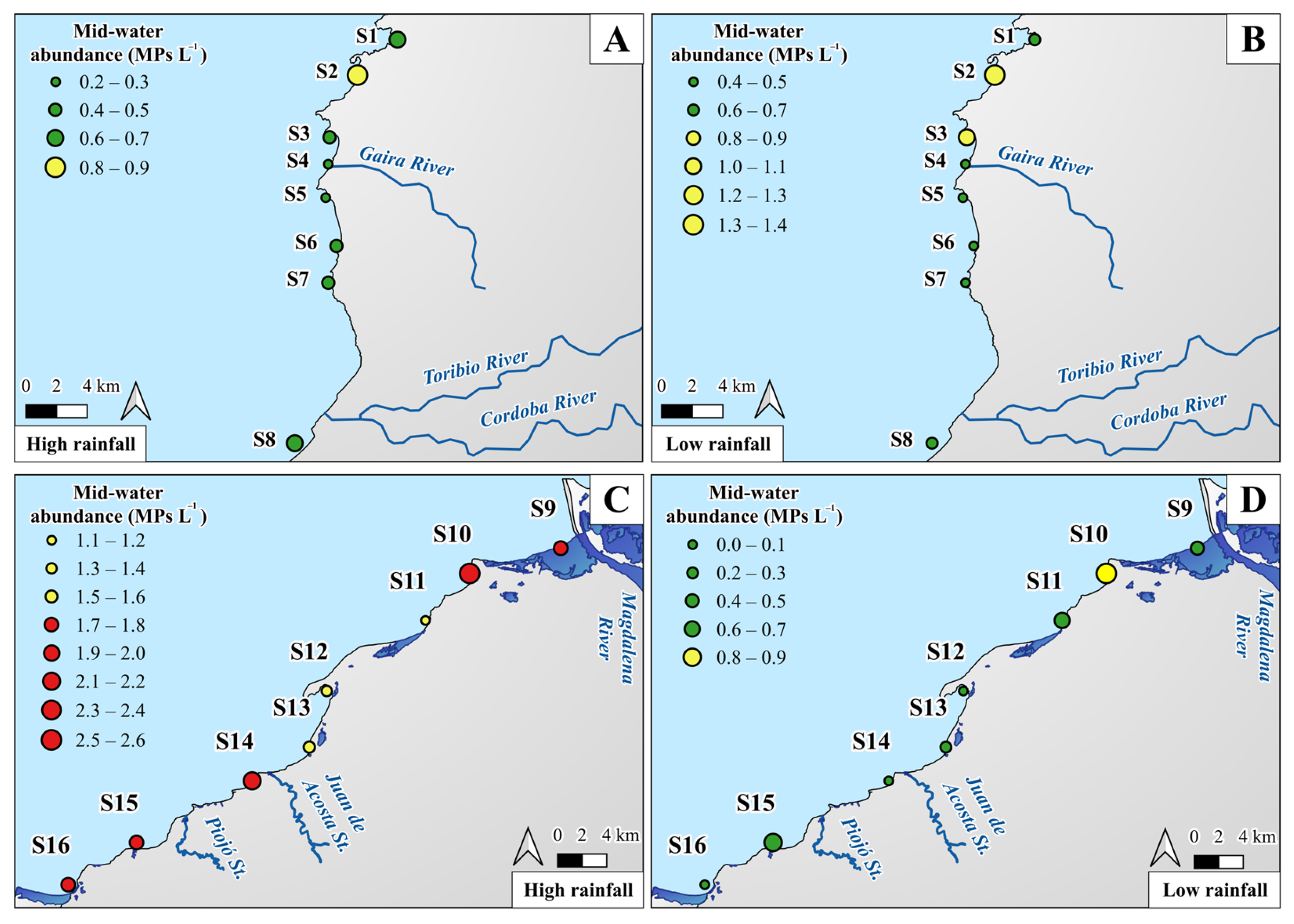
Consistent with the findings in surface waters, MPs were also detected in mid-water samples. In the Magdalena department, MP concentrations ranged from 0.2 to 1.8 MPs L−1, with the highest values recorded at S2 (0.9 MPs L−1), S3 (0.7 MPs L−1), and S8 (0.7 MPs L−1). The lowest concentrations were observed at S4 and S5 (0.3 MPs L−1 each), while Irotama (S6) registered an intermediate value of 0.5 MPs L−1. No statistically significant differences were found among stations. MP abundance was greater in the bathing zone, with an average of 0.6 MPs L−1 (range: 0.2–1.3 MPs L−1), than in offshore waters, which averaged 0.5 MPs L−1 (range: 0.2–1.8 MPs L−1), although this difference was not statistically significant. The highest amounts of suspended MPs in the mid-water were recorded during the low rainfall season, with 0.7 MPs L−1, compared to 0.4 MPs L−1 during the high rainfall season, although there were no significant differences. In this region, river discharge from the SNSM into the Caribbean Sea increases during the high rainfall season, playing a key role in transporting debris from upland areas (Figure 5A,B).
Figure 5.
Spatial and temporal distribution of microplastic abundances in mid-water at monitoring stations in the departments of Magdalena (A,B) and Atlántico (C,D). Where (A,C) correspond to the high rainfall season (2022), and (B,D) correspond to the low rainfall season (2023).
In the Atlántico department, MP abundance ranged from 0.1 to 3.6 MPs L−1. The highest concentrations were recorded at stations S10 (1.2 MPs L−1), S15 (1.0 MPs L−1), and S9 (0.8 MPs L−1). Stations S16, S14, and S12 exhibited the lowest MP abundance, all measuring 0.5 MPs L−1. No significant differences were observed among the sampling stations. The average MP abundance was 0.7 MPs L−1 (range: 0.1–3.6 MPs L−1) in Zone 1 and 0.6 MPs L−1 (range: 0.1–2.6 MPs L−1) in Zone 2, with no statistically significant difference. A significantly greater abundance of MPs was observed in the mid-water during the high rainfall season, with an average abundance of 1.6 MPs L−1, compared to 0.3 MPs L−1 during the low rainfall season (p = 0.0004 ****). These results are consistent with the influence of the Magdalena River plume, which intensifies during peak rainfall periods and contributes to the transport of MPs into the Caribbean Sea (Figure 5C,D).
The Atlántico department exhibited a higher abundance of mid-water MPs (0.7 MPs L−1; range: 0.1–3.6 MPs L−1) than Magdalena (0.5 MPs L−1; range: 0.2–1.8 MPs L−1); however, this difference was not statistically significant.
3.5. Physical and Chemical Characterization of Microplastics in Mid-Water
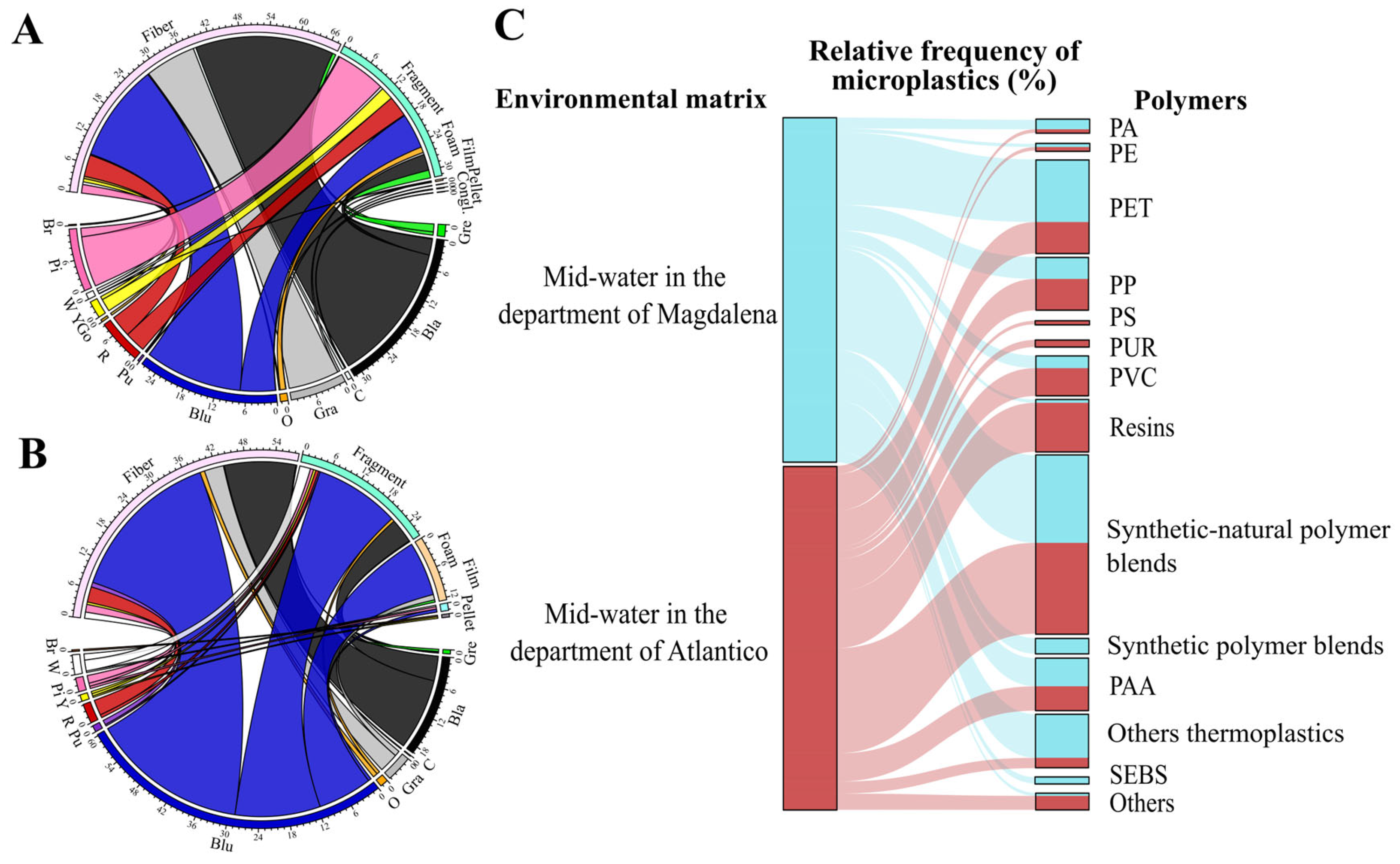
In the Magdalena department, six MP shapes were identified in mid-water samples, with a clear predominance of fibers (69.2%) and fragments (30.2%). Foams, films, pellets, and fiber aggregates were present in nearly negligible proportions (≤0.3%). Fibers remained the dominant shape across all sampling events. During the low rainfall season, fiber abundance increased, whereas fragments decreased, and the remaining shapes persisted at minimal levels. Films and pellets were detected exclusively during the high rainfall season, whereas fiber aggregates appeared only during the low rainfall season (Figure 6A). In the Atlántico department, the distribution of shapes was also fiber-dominated, but with greater temporal variability than in Magdalena. During the high rainfall season, fibers accounted for 59.5%, followed by fragments (23.5%) and foam (15.3%), whereas films and pellets contributed less than 1%. During the low rainfall season, fibers decreased slightly to 55.6%, whereas fragments increased to 36.0%, becoming the second most abundant category. The foam declined markedly to 5.8%, and the remaining categories remained below 1%. Overall, Atlántico exhibited stronger seasonal shifts than Magdalena, particularly because of the reduction in foam and the increase in fragment abundance during the low rainfall season (Figure 6B).
Figure 6.
Shapes and colors of microplastics identified in mid-water samples from monitoring stations in the departments of Magdalena (A) and Atlántico (B). Relative polymer composition of microplastics identified in mid-water samples from the Magdalena and Atlántico departments (C). Br: brown, Pi: pink, C: colorless, Go: gold, W: white, Y: yellow, R: red, Pu: purple, Blu: blue, O: orange, Gra: gray, Bla: black, Gre: green.
Across both departments, 13 colors were recorded among MPs, with black (41.6% in Magdalena; 24.6% in Atlántico) and blue (29.3% in Magdalena; 54.0% in Atlántico) as the predominant hues, followed by gray, gold, pink, white, red, yellow, salmon, purple, green, colorless, and brown. In Magdalena, the fibers and fragments displayed the highest color diversity. In both seasons, the fibers were dominated by dark and cool tones, especially blue and black, with an increased proportion of black fibers during the low rainfall season. The fragments showed the widest chromatic range, with recurring red, blue, black, pink, green, yellow, and salmon tones. The foam exhibited a more restricted palette: predominantly black and salmon during the high rainfall season and black and white during the low rainfall season (Figure 6A). In Atlántico, fibers also showed substantial color diversity, dominated by blue and black, particularly during the high rainfall season. Fragment coloration varied seasonally, with blue and gold prevailing during the high rainfall season and black, blue, and gray becoming dominant during the low rainfall season. Foam showed an almost exclusive dominance of blue in the high rainfall season, shifting toward a more diverse palette (blue, green, and gray) during the low rainfall season. Films made minor contributions but were notably blue and white during the low rainfall season (Figure 6B).
The size of MPs in the Magdalena department ranged from 0.042 to 3.800 mm, with fragments being the smallest and fibers the largest particles. MPs were slightly larger during the low rainfall season (0.796 mm) than during the high rainfall season (0.691 mm). In the Atlántico department, sizes ranged from 0.053 to 4.929 mm, also with fragments as the smallest and fibers as the largest category. The MP content was marginally larger during the low rainfall season (0.884 mm) than during the high rainfall season (0.873 mm). On average, MPs were larger in the Atlántico department (0.878 mm) than in Magdalena (0.753 mm).
Regarding polymer composition, MPs in the Magdalena department were dominated by synthetic–natural polymer blends (29.5%), followed by PET (21.1%), other thermoplastics (14.7%), PAA (9.5%), PP (7.4%), synthetic polymer blends (5.3%), and PVC (4.2%). Minor contributions included PA, PE, resins, and SEBS. In the Atlántico department, polymer composition was dominated by synthetic–natural polymer blends (30.6%) and resins (16.5%), along with PET (10.6%) and PP (10.6%), along with contributions from PVC, PAA, PS, PA, PE, PUR, and others (Figure 6C). Overall, both departments showed a strong influence of synthetic–natural polymer blends and PET; however, the Atlántico department displayed a higher proportion of resins, whereas the Magdalena department exhibited a greater relative presence of PAA and other thermoplastics, highlighting distinct MP compositional profiles between regions.
In the Magdalena department, fiber aggregates were mainly composed of synthetic polymer blends, whereas fibers were composed of synthetic–natural polymer blends and PET. The films were exclusively PE, and the fragments were mostly other thermoplastics (ASA, ABS, and AEM) and PAA. In the Atlántico department, the fibers were synthetic–natural polymer blends. In contrast, the films were composed of PVC, and the foams and fragments were resins, with foams being the only ones with PS records.
In the Magdalena department, the polymers represented in MP < 0.10 mm were PAA (66.7%) and PVC (33.3%), in contrast, whereas MP (0.700–0.99 mm) were dominated by synthetic–natural polymer blends (50.0%), with PET (33.3%) and PA (16.7%). MP > 3.0 mm belonged to PET (38.5%), PVC (15.4%), synthetic polymer blends (15.4%), and finally, PA, PP, PAA, and synthetic–natural polymer blends with 7.7% each (Figure 7A). In the Atlántico department, the largest MPs were dominated by synthetic–natural polymer blends (75.0%), followed by PET (16.7%) and PAA (8.3%). In contrast, the smallest size fraction was mainly composed of PUR (66.7%) and PAA (33.3%). Intermediate-sized MPs were primarily represented by synthetic–natural polymer blends, PET, and PVC (25.0% each), whereas PP and TPV were present in lower proportions (12.5% each) (Figure 7B).
Figure 7.
Plastic polymers distributed across size ranges, recorded in mid-water of the coast of the Magdalena (A) and Atlántico (B) departments, Caribbean region, Colombia.
3.6. Influence of Hydrological and Anthropogenic Factors on Microplastic Distribution
The GAM identified key environmental predictors of MPs contamination in coastal waters. In the Atlántico department, the most influential variable was the distance between the sampling stations and the mouth of the Magdalena River (p < 0.1 *), suggesting a strong fluvial input that intensified during the high rainfall season due to increased river discharge. Additionally, stations located on the western coast of Atlántico appeared to be affected by discharges from streams descending from upland areas that passed through urbanized zones of the region. Similarly, in the Magdalena department, MPs concentrations were significantly influenced by proximity to river mouths originating from the SNSM and by proximity to densely populated urban centers (p < 0.1 *) (Table 3).
Table 3.
Estimated effects of environmental variables on MPs abundance in seawater from the coastal departments of Magdalena and Atlántico, Colombia, based on the GAM. S.E.: Standard Error. Significance levels: *** p < 0.01, * p < 0.10.
3.7. LDA-Based Classification of Marine Microplastics
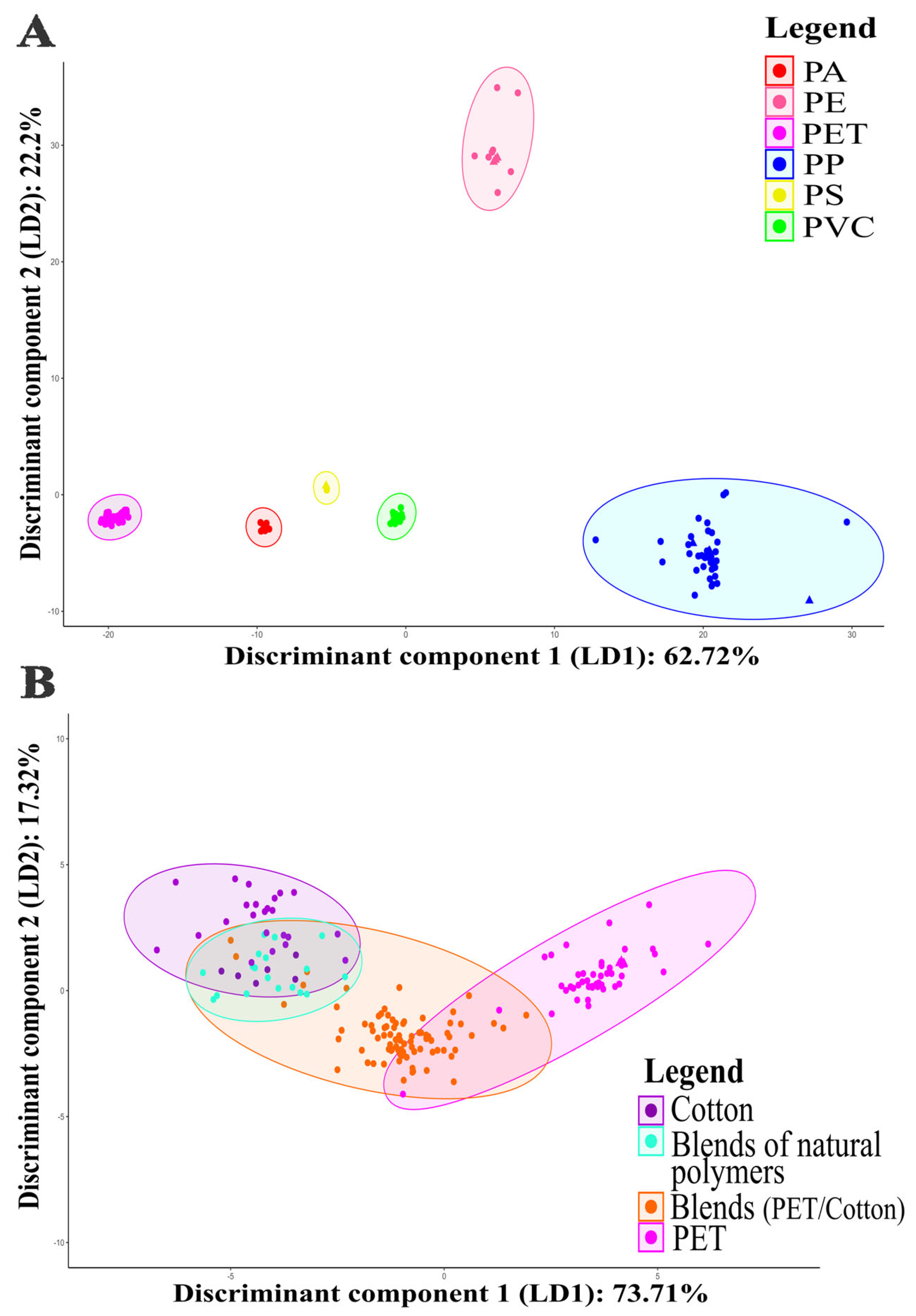
The first LDA successfully differentiated plastic polymers (e.g., PA, PE, PET, PP, PS, and PVC). This model achieved over 95% classification accuracy and accounted for 84.9% of the total data variability within the first two discriminant components (Figure 8A). Early-phase learning within the model enabled the identification of the chemical spectra of MPs in seawater samples based on reference spectra. Consequently, the use of multivariate statistical techniques proved to be an effective tool for interpreting µATR-FTIR spectra. The second LDA showed the spectral distribution of blends between PET and cellulose-derived polymers. The ordination indicated that these mixtures exhibited spectral characteristics more closely aligned with those of synthetic polymers than with cotton. Therefore, particles chemically composed of these mixtures should be classified as MPs (Figure 8B).
Figure 8.
LDA ordination of infrared spectra from microplastics detected in seawater samples from two coastal departments in northern Colombia, compared to reference spectra. (A) Discrimination of major plastic polymers (PA, PE, PET, PP, PS, and PVC); (B) spectral relationship among the cellulose-derived polymers (cotton), blends of natural polymers, PET/cotton blends, and synthetic polymer (PET).
4. Discussion
This study established baseline information on MPs contamination and its physicochemical characterization in surface waters and mid-water depths of the Colombian Caribbean Sea. These findings complement previous research that quantified MP abundances in beach sediments of Atlántico [11] and in surface waters of selected beaches in Magdalena and Atlántico [23,24].
4.1. Surface Water
At the national level, the coastal stations analyzed in the departments of Magdalena and Atlántico stand out as “hot spots” of MPs contamination in surface waters, with concentrations ranging from 0.5 MPs m−3 to 41.9 MPs m−3 and from 0.2 MPs m−3 to 11.8 MPs m−3, respectively. These abundances significantly exceed those reported for other Colombian Caribbean and Pacific departments, where 95.1% of beaches show concentrations below 1.0 MPs m−3 [22]. Globally, the MP abundance reported in this study even exceeds those found in the polar Arctic Ocean (0.34 MPs m−3) and the Mediterranean Sea (1.00 MPs m−3) and is comparable to those in the East Asian Seas (3.74 MPs m−3) [34,43,44].
In Magdalena, greater environmental degradation associated with MPs was observed at sampling stations linked to transport and cabotage activities (S2 and S7), as well as near the mouths of rivers such as Gaira, Manzanares (S3 and S4), Toribio, and Córdoba (S8). This pattern aligns with previous reports of environmental deterioration and poor physicochemical and microbiological quality in these rivers, attributed to inadequate wastewater and solid waste discharges resulting from intense anthropogenic activities [22]. In Atlántico, the highest MP abundance was found at stations closest to the mouth of the Magdalena River, specifically at Bocas de Ceniza (S9 and S10) in the northeastern part of the department. This is linked to the substantial solid waste load transported by the Magdalena-Cauca Basin, which serves 70% of Colombia’s population. As a result, the Magdalena River ranks among the 15 most plastic-polluted rivers globally, with an estimated annual discharge of 16,700 tons of plastic into the Caribbean Sea [45].
River discharges into the Caribbean Sea are conduits for the dispersion of emerging pollutants. Changes in river flows are important for understanding pollution processes [46]. In the Magdalena, high mountain rivers that drain into the sea tend to be seasonal, with high flows during the high rainfall season and low flows when there is no rain [22]. Meanwhile, in the Atlántico department, the Magdalena River is a mighty river all year round, but its flow doubles during the high rainfall season [47]. Areas under strong anthropogenic influence with elevated MP abundance not only reflect the aesthetic degradation of marine ecosystems but also pose a latent risk to swimmers who use these beaches for recreational activities [23].
In addition to anthropogenic sources, once rivers flow into the Caribbean Sea, surface currents play a crucial role in MP dispersal. In this study, the Caribbean current and the Panama-Colombia countercurrent were identified as key modulators of MPs distribution, interacting with coastal geomorphology [48,49,50]. Horizontal MP transport, mediated by ocean currents, is a well-documented phenomenon [51]. The presence of natural or artificial structures forming inlets or bays, as in Marina (Magdalena) and Puerto Velero (Atlántico), can significantly influence local MP accumulation. The influence of these ocean currents on the transport of MPs has been previously documented for marine-coastal ecosystems in the Colombian Caribbean [11].
At the sampling stations in both departments, fibers were the predominant MP shape, consistent with findings reported for various marine ecosystems worldwide [52]. These microfibers primarily originate from the fragmentation of larger particles associated with laundry and textile industry activities, as well as the degradation of monofilaments from fishing nets [28,53,54]. Fragments were also a significant source of MP contamination, linked to poor solid waste management, where physical and chemical degradation lead to smaller particles [11,23,53]. Pellets and fragments smaller than 150 µm pose potential risks to marine organisms in the Colombian Caribbean because of their capacity for translocation from the digestive tract to other tissues such as the circulatory, lymphatic, and hepatic systems [55,56,57,58,59]. Color analysis revealed a greater abundance of blue particles, whose pigments absorb long-wavelength, low-energy light, thereby accelerating plastic photoaging and promoting fragmentation [60]. Additionally, the reduced size of these blue particles increases the risk of human exposure during aquatic activities [61].
Chemical characterization is essential for accurately identifying the polymeric composition of MPs and avoiding confusion with non-plastic particles [62]. µATR-FTIR spectroscopy is a valuable tool for this purpose, as it enables polymer identification through the analysis of molecular bond vibrations, producing a unique spectral fingerprint for each material [63]. Blends of synthetic and biodegradable polymers, such as cellulose, have been promoted as sustainable alternatives for reducing plastic pollution in aquatic ecosystems [64]. However, several studies have shown that MPs composed of synthetic–natural mixtures can persist in marine environments, maintaining their structural integrity with no evidence of biodegradation unless exposed to controlled conditions, such as those used in industrial or composting processes [65].
4.2. Mid-Water
Before interpreting the mid-water MP data, it must be clearly stated that direct quantitative comparisons with surface-water concentrations are methodologically unjustified. The observed differences are largely driven by methodological factors, particularly sampling strategy and filtered volume, rather than by true vertical heterogeneity in MP distribution.
For the first time, MPs were characterized in Colombian oceanic mid-water [25,66]. These findings complement previous records from the open waters off the coast of central California (Monterey Bay), which reported median concentrations of 2.9 MPs L−1 [67], and from subsurface waters of the Arctic Ocean with concentrations ranging from 0 to 0.0075 MPs L−1 [68], at depths between 5.0 and 8.5 m.
In addition to the influence of the Magdalena River on the most polluted stations, northwestern stations (e.g., S15) are affected by high-flow municipal streams, such as the Piojó stream, which carries large amounts of sediment and plastic waste from urban highlands to the ocean during the high rainfall season. In the Magdalena department, intense tourist and recreational activities increased the abundance of MPs in the mid-water of Rodadero Beach (S3) [22,23].
The detection of MPs in mid-water of Colombian Caribbean beaches highlights the role of vertical transport processes in the redistribution of MPs within marine systems, without implying quantitative vertical gradients between water compartments. In the Atlántico department, high concentrations of suspended particulate matter, primarily carried by the Magdalena River into the Caribbean Sea, appear to be a key driver of the distribution and retention of MPs in mid-water marine environments. This influence is particularly notable during the high rainfall season, as previously reported [69]. MP concentrations detected in mid-water, within ranges reported globally, suggest that despite the intrinsic buoyancy of many polymers, processes such as biofouling, degradation, and aggregation can alter particle density, promoting their redistribution toward deeper water layers [51].
The high frequency of MPs in mid-water in areas frequented by swimmers (bathers), combined with the size of the particles, represents an individual risk because of human exposure to MP contamination in the water due to possible oral or dermal ingestion during recreational activities such as swimming [64]. During swimming, accidental ingestion of seawater containing these contaminants may occur via the oral route. Estimates have even been made that take into account the type of polymer present and calculate exposure via the dermal route in a range of 0.04–0.50 mm [70,71].
Large fiber aggregates were recorded, characterized by a wide diversity of polymeric blends, both synthetic–natural (e.g., PET/rayon and PA/cotton) and synthetic–synthetic (e.g., PA/PTFE, PA/PET, and PP/ethylene propylene diene monomer [EPDM]), with PET being the most common blend [55]. In terms of polymer composition, the most common synthetic polymers found in the samples were PP, PE, PVC, PA, and PET. Additionally, there is a notable predominance of synthetic–natural polymer blends, materials commonly used in the textile industry for their functional properties and cost-effectiveness [72]. Although Acharya et al. [52] reported that such blends generally release fewer MPs than pure synthetic polymers, our study revealed a significant proportion of these mixtures along Colombia’s northern coast, which persisted after oxidative digestion, suggesting their resilience in the marine environment. This represents the first report on the presence of such polymer blends in MPs in this region of the Colombian Caribbean [22].
Additionally, plastic polymers not previously reported in this geographic area were identified, including PVS, ASA, PEA, PAA, SEBS, and resins such as VE. These materials are relevant to public health because of their potential cytotoxic effects on aquatic organisms and humans [25,73,74]. Many of these polymers fall into the category of those with low or very low global annual waste generation (RF1), making them rare in aquatic ecosystems. They also exhibit a high average density (RF2), which reduces the likelihood of fragmentation into micro-sized particles, and moderate to high chemical risk scores due to the toxicity of their monomers (RF5). Examples include EVA, ABS, PTFE, UP, and PAA, which are categorized as resins, copolymers, thermoplastics, acrylics, or blends [75].
4.3. Limitations and Advantages
While this study employed standardized analytical techniques, it is important to acknowledge that methodological variability across MP research can substantially affect data representation and comparability, a factor we considered during interpretation [21,40,76,77]. A key limitation of the present study is the markedly different volumes of water filtered for surface (10 m3) and subsurface (20 L) samples, which precludes direct quantitative comparisons of MP abundances between water compartments sampled at different depths. The use of pumping systems capable of filtering large water volumes (m3) is therefore recommended to improve comparability with surface net tows [78].
Despite this limitation, the study presents several methodological strengths. The application of fine-mesh nets (23 μm) enabled a detailed quantitative and qualitative assessment of small-sized MPs, which are often underrepresented in marine surveys. The combination of stereomicroscopy, µATR-FTIR spectroscopy, and multivariate statistical analyses provided robust polymer identification and improved discrimination between synthetic polymers and polymer blends. Additionally, the spatially extensive sampling design, encompassing contrasting anthropogenic influence zones and two climatic seasons, allowed for the identification of contamination hotspots and key environmental drivers of MP occurrence.
Future research should aim to increase temporal resolution beyond two seasonal campaigns and expand chemical characterization to a larger proportion of detected particles. Overall, methodological standardization remains a major challenge for assessing MP distribution across water compartments sampled at different depths, as differences in sampling devices, filtered volumes, and discrete versus non-discrete approaches can strongly influence reported concentrations [21,79]. Therefore, methodological standardization remains a major challenge for assessing vertical patterns of MPs in the marine environment.
5. Conclusions
This study provides the first comprehensive characterization of MP contamination in the coastal surface and mid-water areas of the Colombian Caribbean, incorporating spatial (Atlántico vs. Magdalena department; bather zone vs. offshore zone) and temporal (high and low rainfall seasons) variability. MPs were detected in all samples across both departments, confirming their widespread presence in the region. In Magdalena, surface water concentrations ranged from 0.5 to 41.9 MPs m−3, while mid-water concentrations ranged from 0.2 to 1.8 MPs L−1. In Atlántico, surface water concentrations varied between 0.2 and 11.8 MPs m−3, and mid-water concentrations between 0.1 and 3.6 MPs L−1.
Surface water MP abundances were significantly higher in Magdalena than in Atlántico, whereas elevated mid-water MP concentrations were observed in Atlántico during the high rainfall season, highlighting the role of river discharge and seasonal hydrological dynamics. Higher MP abundances were consistently recorded in the bather zone compared to offshore stations, indicating strong local anthropogenic inputs.
Fibers and fragments were the dominant MP shapes, and the most prevalent materials included synthetic–natural polymer blends, PET, PP, and resins. MP occurrence and distribution were significantly associated with proximity to river mouths and urban centers, particularly the Magdalena River and rivers draining the Sierra Nevada de Santa Marta, underscoring the importance of riverine systems as major pathways for plastic transport to coastal waters.
A key contribution of this study is the identification of a high diversity of polymeric materials, including rare and potentially hazardous polymers such as ABS, SEBS, ASA, and PVS, which are seldom reported and not routinely monitored in marine environments. Moreover, the notable presence and persistence of synthetic–natural polymer blends challenge the perception of these materials as environmentally benign and highlight the need to reassess their classification, environmental behavior, and ecological risk.
Overall, these findings emphasize the necessity of strengthening regulatory frameworks that prioritize river basin waste management and coastal pollution control, particularly in urbanized and ecologically sensitive areas.
Supplementary Materials
The following supporting information can be downloaded at: https://www.mdpi.com/article/10.3390/w18040508/s1, Table S1: Abundance of microplastics in surface and mid-water samples from the Magdalena and Atlántico departments by sampling station (S1 to S16), climatic season (M1: high rainfall season and M2: low rainfall season), and anthropogenic influence zone (Z1: nearshore/bather zone and Z2: offshore).
Author Contributions
Conceptualization, C.A.G.-A., R.G.-A., J.T., J.H.M.-C., A.S.-M., J.E.M.P., C.A.S., and V.A.A.; Data curation, V.A.A.; Formal analysis, R.A.R.-L., J.D.A.-R., and C.A.G.-A.; Funding acquisition, A.S.-M. and V.A.A.; Investigation, R.A.R.-L., J.D.A.-R., C.A.G.-A., R.G.-A., J.T., J.H.M.-C., J.E.M.P., and C.A.S.; Methodology, R.A.R.-L., J.D.A.-R., C.A.G.-A., and V.A.A.; Project administration, V.A.A.; Resources, A.S.-M. and V.A.A.; Validation, C.A.G.-A. and V.A.A.; Visualization, R.A.R.-L. and J.D.A.-R.; Writing—original draft, R.A.R.-L. and V.A.A.; Writing—review and editing, C.A.G.-A., R.G.-A., J.T., J.H.M.-C., A.S.-M., J.E.M.P., C.A.S., and V.A.A. All authors have read and agreed to the published version of the manuscript.
Funding
This research was funded by Fondo de Ciencia, Tecnología e Innovación del Sistema General de Regalías de Colombia (FCTeI-SGR), grant BPIN 2020000100065, the Universidad del Atlántico and the Universidad Nacional de Colombia, sedes Caribe y Bogotá. The APC was funded by FCTeI-SGR.
Data Availability Statement
The original contributions presented in this study are included in the article and Supplementary Materials. Further inquiries can be directed to the corresponding author.
Acknowledgments
During the preparation of this manuscript, the authors used ChatGPT (OpenAI, GPT-5.2) for the purposes of language translation from Spanish to English. The authors have reviewed and edited the output and take full responsibility for the content of this publication.
Conflicts of Interest
The authors declare no conflicts of interest.
References
- Calderon, E.A.; Hansen, P.; Rodríguez, A.; Blettler, M.C.M.; Syberg, K.; Khan, F.R. Microplastics in the Digestive Tracts of Four Fish Species from the Ciénaga Grande de Santa Marta Estuary in Colombia. Water Air Soil Pollut. 2019, 230, 257. [Google Scholar] [CrossRef]
- Geyer, R.; Jambeck, J.R.; Law, K.L. Production, use, and fate of all plastics ever made. Sci. Adv. 2017, 3, e1700782. [Google Scholar] [CrossRef]
- Margallo, M.; Ziegler-Rodriguez, K.; Vázquez-Rowe, I.; Aldaco, R.; Irabien, Á.; Kahhat, R. Enhancing waste management strategies in Latin America under a holistic environmental assessment perspective: A review for policy support. Sci. Total Environ. 2019, 689, 1255–1275. [Google Scholar] [CrossRef] [PubMed]
- Plastics Europe. Plastics—The Fast Facts 2025. 2025. Available online: https://plasticseurope.org/nl/knowledge-hub/plastics-the-fast-facts-2025/ (accessed on 27 December 2025).
- Eriksen, M.; Lebreton, L.; Carson, H.; Thiel, M.; Moore, C.J.; Borrero, J.C.; Galgani, F.; Ryan, P.G.; Reisser, J. Plastic pollution in the world’s oceans: More than 5 trillion plastic pieces weighing over 250,000 tons afloat at sea. PLoS ONE 2014, 9, e111913. [Google Scholar] [CrossRef] [PubMed]
- Jambeck, J.R.; Geyer, R.; Wilcox, C.; Siegler, T.R.; Perryman, M.; Andrady, A.; Narayan, R.; Law, K.L. Plastic waste inputs from land into the ocean. Science 2015, 347, 768–771. [Google Scholar] [CrossRef]
- Garcés-Ordóñez, O.; Castillo-Olaya, V.A.; Granados-Briceño, A.F.; Blandón García, L.M.; Espinosa Díaz, L.F. Marine litter and microplastic pollution on mangrove soils of the Ciénaga Grande de Santa Marta, Colombian Caribbean. Mar. Pollut. Bull. 2019, 145, 455–462. [Google Scholar] [CrossRef] [PubMed]
- Li, W.C.; Tse, H.F.; Fok, L. Plastic waste in the marine environment: A review of source, occurrence and effects. Sci. Total Environ. 2016, 566–567, 333–349. [Google Scholar] [CrossRef]
- Dris, R.; Gasperi, J.; Mirande, C.; Mandin, C.; Guerrouache, M.; Langlois, V.; Tassin, B. A first overview of textile fibers, including microplastics, in indoor and outdoor environments. Environ. Pollut. 2017, 221, 453–458. [Google Scholar] [CrossRef]
- Cowger, W.; Gray, A.B.; Eriksen, M.; Moore, C.; Thiel, M. Evaluating wastewater effluent as a source of microplastics in environmental samples. In Microplastics in Water and Wastewater, 2nd ed.; Karapanagioti, H.K., Kalavrouziotis, I.K., Eds.; IWA Publishing: London, UK, 2020; pp. 109–131. [Google Scholar] [CrossRef]
- Rangel-Buitrago, N.; Arroyo-Olarte, H.; Trilleras, J.; Arana, V.A.; Mantilla-Barbosa, E.; Gracia, C.A.; Mendoza, A.V.; Neal, W.J.; Williams, A.T.; Micallef, A. Microplastics pollution on Colombian Central Caribbean beaches. Mar. Pollut. Bull. 2021, 170, 112685. [Google Scholar] [CrossRef]
- Molpack. Plastic-Free Colombia, a Realistic Goal by 2030? Available online: https://molpack.net/en/plastic-free-colombia-a-realistic-goal-by-2030/ (accessed on 5 December 2025).
- PROCOLOMBIA. Razones Para Invertir en Colombia. Available online: https://investincolombia.com.co/es (accessed on 5 December 2025).
- Garcés-Ordóñez, O.; Castillo, V.; Rueda, R.; Ríos, M.; Bayona, M.; Molina, F.; Escobar, M. Diagnóstico de residuos microplásticos en las zonas marinas de Colombia. In Formulación de Lineamientos, Medidas de Conservación, Manejo y uso de Ecosistemas Marinos y Costeros, con la Intención de Apoyar Acciones de Fortalecimiento en la Gestión Ambiental de las zonas Costeras de Colombia; Resolución No. 646 de 2017; Ministry of Environment and Sustainable Development: Bogotá, Colombia, 2017; pp. 108–166. [Google Scholar]
- Acosta-Coley, I.; Duran-Izquierdo, M.; Rodriguez-Cavallo, E.; Mercado-Camargo, J.; Mendez-Cuadro, D.; Olivero-Verbel, J. Quantification of microplastics along the Caribbean Coastline of Colombia: Pollution profile and biological effects on Caenorhabditis elegans. Mar. Pollut. Bull. 2019, 146, 574–583. [Google Scholar] [CrossRef]
- Gracia, C.A.; Rangel-Buitrago, N.; Flórez, P. Beach litter and woody-debris colonizers on the Atlántico department Caribbean coastline, Colombia. Mar. Pollut. Bull. 2018, 128, 185–196. [Google Scholar] [CrossRef]
- Garcés-Ordóñez, O.; Espinosa, L.F.; Cardoso, R.P.; Issa Cardozo, B.B.; Meigikos dos Anjos, R. Plastic litter pollution along sandy beaches in the Caribbean and Pacific coast of Colombia. Environ. Pollut. 2020, 267, 115495. [Google Scholar] [CrossRef] [PubMed]
- Rangel-Buitrago, N.; Mendoza, A.V.; Gracia, C.A.; Mantilla-Barbosa, E.; Arana, V.A.; Trilleras, J.; Arroyo-Olarte, H. Litter impacts on cleanliness and environmental status of Atlántico department beaches, Colombian Caribbean coast. Ocean Coast. Manag. 2019, 179, 104835. [Google Scholar] [CrossRef]
- Manjarrés, L.; Meneses, T.; Orlando, L.; De la Hoz, J. ¿Cuánto se extrae y cuánto vale la pesca en Colombia? In La Pesca en Colombia: Del Agua a la Mesa; Zapata Padilla, L.A., Ed.; Nomos Impresores: Bogotá, Colombia, 2019; pp. 42–47. [Google Scholar]
- Garcés-Ordóñez, O.; Mejía-Esquivia, K.A.; Sierra-Labastidas, T.; Patiño, A.; Blandón, L.M.; Espinosa Díaz, L.F. Prevalence of microplastic contamination in the digestive tract of fishes from mangrove ecosystem in Cispata, Colombian Caribbean. Mar. Pollut. Bull. 2020, 154, 111085. [Google Scholar] [CrossRef] [PubMed]
- Shi, H.; Wang, X.; Zhu, L.; Li, D. Comprehensive Comparison of Various Microplastic Sampling Methods in Sea Water: Implications for Data Compilation. Water 2023, 15, 1035. [Google Scholar] [CrossRef]
- Garcés-Ordóñez, O.; Espinosa, L.F.; Costa Muniz, M.; Salles Pereira, L.B.; Meigikos dos Anjos, R. Abundance, distribution, and characteristics of microplastics in coastal surface waters of the Colombian Caribbean and Pacific. Environ. Sci. Pollut. Res. 2021, 28, 43431–43442. [Google Scholar] [CrossRef]
- Franco-Herrera, A.; Polania-Zenner, P.I.; Otálora-Rincón, C.D.; Tigreros-Benavides, P.C. Distribución espacial y temporal de microplásticos flotantes en aguas del Caribe central colombiano. Rev. Acad. Colomb. Cienc. Exactas Fis. Nat. 2022, 46, 406–425. [Google Scholar] [CrossRef]
- Paternina-Ramos, A.; Gracia, A.; Rangel-Buitrago, N. Zooplankton assemblage and microplastics associated with a coastal sandspit (Tubará, Atlántico). Mar. Pollut. Bull. 2025, 215, 117853. [Google Scholar] [CrossRef]
- Galindo Montero, A.A.; Costa-Redondo, L.C.; Vasco-Echeverri, O.; Arana, V.A. Microplastic pollution in coastal areas of Colombia: Review. Mar. Environ. Res. 2023, 190, 106027. [Google Scholar] [CrossRef]
- Madureira, E.A.L.; da Silva, A.L.C.; Barrantes-Castillo, G.; de Araújo, F.V. Occurrence and distribution of microplastics on the beaches of Limón on the Southern Caribbean Coast of Costa Rica. Micro 2025, 5, 1. [Google Scholar] [CrossRef]
- Zúñiga Umaña, J.M.; Paniagua, S.A.; Corrales Brenes, R.; Vega Baudrit, J.R. Microplastic pollution in Costa Rican marine ecosystems: Origins, ecotoxicological impacts, and mitigation strategies. Marine Policy 2025, 179, 106772. [Google Scholar] [CrossRef]
- García-Chamero, A.; Alonso Hernández, C.M.; Chamero Lago, D. Primera evidencia de microplásticos en la bahía de Cienfuegos, Cuba. Ecosistemas 2020, 29, 2085. [Google Scholar] [CrossRef]
- Rose, D.; Webber, M. Characterization of microplastics in the surface waters of Kingston Harbour. Sci. Total Environ. 2019, 664, 753–760. [Google Scholar] [CrossRef] [PubMed]
- Garcés-Ordóñez, O.; Arteaga, E.; Obando, P.; Vivas-Aguas, L.J.; Espinosa, L.; González, M.; Giraldo, C.; Ricaurte, C. Atención a Eventuales Emergencias Ambientales en la Zona Marino-Costera del Departamento del Magdalena. 2016. Available online: https://goo.su/eBMeFjv (accessed on 9 August 2025).
- INVEMAR. Diagnóstico de calidad ambiental marina REDCAM. In Diagnóstico y Evaluación de la Calidad de las Aguas Marinas y Costeras en el Caribe y Pacífico Colombianos. Red de Vigilancia para la Conservación y Protección de las Aguas Marinas y Costeras de Colombia—REDCAM: INVEMAR, MinAmbiente, CORALINA, CORPOGUAJIRA, CORPAMAG, CRA, CARDIQUE, CARSUCRE, CVS, CORPOURABÁ, CODECHOCÓ, CVC, CRC y CORPONARIÑO; Cusba, J., Obando, P., Espinosa, L., Eds.; Serie de Publicaciones Periódicas; INVEMAR: Magdalena, Colombia, 2024; pp. 75–116. [Google Scholar]
- Rojas-Luna, R.A.; Rueda-Reyes, P.A.; García-Alzate, C.A.; García-Alzate, R.; Trilleras, J.; Medina-Calderon, J.H.; Santos-Martínez, A.; Mancera Pineda, J.E.; Sierra, C.A.; Arana, V.A. Widespread microplastic ingestion in Colombian Caribbean marine fish: Trophic influence, spatial-temporal trends, and polymer composition. Mar. Pollut. Bull. 2025, 221, 118603. [Google Scholar] [CrossRef]
- Williams, A.; Micallef, A. Beach Management: Principles and Practice; Earthscan: London, UK, 2009; pp. 1–30. [Google Scholar]
- Lusher, A.L.; Tirelli, V.; O’Connor, I.; Officer, R. Microplastics in Arctic polar waters: The first reported values of particles in surface and sub-surface samples. Sci. Rep. 2015, 5, 14947. [Google Scholar] [CrossRef]
- Rojas-Luna, R.A.; Oquendo-Ruiz, L.; García-Alzate, C.A.; Arana, V.A.; García-Alzate, R.; Trilleras, J. Identification, Abundance, and Distribution of Microplastics in Surface Water Collected from Luruaco Lake, Low Basin Magdalena River, Colombia. Water 2023, 15, 344. [Google Scholar] [CrossRef]
- Rojas-Luna, R.A.; Oquendo-Ruiz, L.; García-Alzate, C.A.; Arana, V.A.; García-Alzate, R.; Trilleras, J. Methods to characterize Microplastics: Case study on freshwater fishes from a tropical lagoon in Colombia. Environ. Sci. Pollut. Res. 2024, 31, 64171–64184. [Google Scholar] [CrossRef]
- Stockin, K.A.; Pantos, O.; Betty, E.L.; Pawley, M.D.M.; Doake, F.; Masterton, H.; Palmer, E.I.; Perrott, M.R.; Nelms, S.E.; Machovsky-Capuska, G.E. Fourier transform infrared (FTIR) analysis identifies microplastics in stranded common dolphins (Delphinus delphis) from New Zealand waters. Mar. Pollut. Bull. 2021, 173, 113084. [Google Scholar] [CrossRef]
- Guisande-Gonzáles, C.; Vaamonde Liste, A.; Barreiro Felpeto, A. Tratamiento de Datos con R, STATISTICA y SPSS; Ediciones Díaz de Santos: Madrid, Spain, 2013. [Google Scholar]
- Campanale, C.; Savino, I.; Pojar, I.; Massarelli, C.; Uricchio, V.F. A practical overview of methodologies for sampling and analysis of microplastics in riverine environments. Sustainability 2020, 12, 6755. [Google Scholar] [CrossRef]
- Gimiliani, G.T.; Izar, G. Difficulties in Comparison Among Different Microplastic Studies: The Inconsistency of Results and Lack of Guide Values. Environ. Toxicol. Chem. 2022, 41, 820–821. [Google Scholar] [CrossRef]
- Atamanalp, M.; Köktürk, M.; Uçar, A.; Duyar, H.A.; Özdemir, S.; Parlak, V.; Alak, G. Microplastics in tissues (brain, gill, muscle and gastrointestinal) of Mullus barbatus and Alosa immaculata. Arch. Environ. Contam. Toxicol. 2021, 81, 460–469. [Google Scholar] [CrossRef] [PubMed]
- Abad-López, A.P.; Orozco-Pérez, K.K.; Arana, V.A.; Grande-Tovar, C.D. Microplastics suspended in dust from different indoor environments in Barranquilla, Colombia: Predominant microparticles? Environ. Pollut. 2024, 350, 124023. [Google Scholar] [CrossRef]
- Isobe, A.; Uchida, K.; Tokai, T.; Iwasaki, S. East Asian seas: A hot spot of pelagic microplastics. Mar. Pollut. Bull. 2015, 101, 618–623. [Google Scholar] [CrossRef] [PubMed]
- Suaria, G.; Avio, C.G.; Mineo, A.; Lattin, G.L.; Magaldi, M.G.; Belmonte, G.; Moore, C.J.; Regoli, F.; Aliani, S. The Mediterranean Plastic Soup: Synthetic polymers in Mediterranean surface waters. Sci. Rep. 2016, 6, 37551. [Google Scholar] [CrossRef]
- Lebreton, L.C.M.; Van Der Zwet, J.; Damsteeg, J.W.; Slat, B.; Andrady, A.; Reisser, J. River plastic emissions to the world’s oceans. Nat. Commun. 2017, 8, 15611. [Google Scholar] [CrossRef]
- Mojica, J.I.; González-Afanador, E.; Donato-Rondón, J.; Guillot-Monroy, G.H. Magdalena. In Rivers of South America, 1st ed.; Graça, M., Callisto, M., Teixeira de Mello, F., Rodríguez-Olarte, D., Eds.; Elsevier: Amsterdam, The Netherlands, 2025; pp. 55–88. [Google Scholar] [CrossRef]
- Rojas-Luna, R.A.; Pardo-Castañeda, D. Diversidad del fitoplancton en la cuenca baja del río Magdalena con relación a su régimen hidrológico. Caldasia 2024, 46, 113–129. [Google Scholar] [CrossRef]
- Andrade Amaya, C.A. Las corrientes superficiales en la cuenca de Colombia observadas con boyas de deriva. Rev. Acad. Colomb. Cienc. Exactas Fis. Nat. 2001, 25, 321–336. [Google Scholar] [CrossRef]
- Ruiz-Ochoa, M.A. Variabilidad de la Cuenca Colombia (Mar Caribe) Asociada con El Niño-Oscilación del Sur, Vientos Alisios y Procesos Locales. Ph.D. Thesis, Universidad Nacional de Colombia, Sede Medellín, Bogotá, Colombia, 2011. [Google Scholar]
- Dueñas-Lagos, A.; Bastidas-Salamanca, M.; Ricaurte-Villota, C. Región 2: Contracorriente. In Regionalización Oceanográfica: Una Visión Dinámica del Caribe. Instituto de Investigaciones Marinas y Costeras José Benito Vives De Andréis (INVEMAR); Ricaurte-Villota, C., Bastidas Salamanca, M.L., Eds.; Serie de Publicaciones Especiales de INVEMAR #14; INVEMAR: Santa Marta, Colombia, 2017; pp. 48–61. [Google Scholar]
- Sangiolo, E. Microplastics in the Marine Environment and Deep-Sea Sediment Contamination: A Review. 2022. Available online: https://vc.bridgew.edu/honors_proj/563 (accessed on 26 December 2025).
- Acharya, S.; Rumi, S.S.; Hu, Y.; Abidi, N. Microfibers from synthetic textiles as a major source of microplastics in the environment: A review. Text. Res. J. 2021, 91, 321–336. [Google Scholar] [CrossRef]
- Napper, I.E.; Thompson, R.C. Release of synthetic microplastic plastic fibres from domestic washing machines: Effects of fabric type and washing conditions. Mar. Pollut. Bull. 2016, 112, 39–45. [Google Scholar] [CrossRef]
- Hernandez, E.; Nowack, B.; Mitrano, D.M. Polyester Textiles as a Source of Microplastics from Households: A Mechanistic Study to Understand Microfiber Release during Washing. Environ. Sci. Technol. 2017, 51, 7036–7046. [Google Scholar] [CrossRef]
- Avilés-Galera, M.G.; Arana, V.A.; Grande-Tovar, C.D. Microplastics in settled dust from university indoor environments: Puerto Colombia, Colombia. Environ. Sci. Atmos. 2025, 5, 332–347. [Google Scholar] [CrossRef]
- Vidal, L.; Molina Sandoval, A.E.; Duque, G. Incremento de la contaminación por microplásticos en aguas superficiales de la bahía de Buenaventura, Pacífico colombiano. Bol. Investig. Mar. Cost. 2021, 50, 113–132. [Google Scholar] [CrossRef]
- Volkheimer, G. Hematogenous dissemination of ingested polyvinyl chloride particles. Ann. N. Y. Acad. Sci. 1975, 246, 164–171. [Google Scholar] [CrossRef] [PubMed]
- Hussain, N.; Jaitley, V.; Florence, A.T. Recent advances in the understanding of uptake of microparticulates across the gastrointestinal lymphatics. Adv. Drug Deliv. Rev. 2001, 50, 107–142. [Google Scholar] [CrossRef]
- World Health Organization (WHO). Microplastics in Drinking-Water; WHO: Geneva, Switzerland, 2019. [Google Scholar]
- Zhao, S.; Mincer, T.J.; Lebreton, L.; Egger, M. Pelagic microplastics in the North Pacific Subtropical Gyre: A prevalent anthropogenic component of the particulate organic carbon pool. PNAS Nexus 2023, 2, pgad070. [Google Scholar] [CrossRef]
- Enyoh, C.E.; Wirnkor Verla, A.; Refat, M.; Rakib, J. Application of Index Models for Assessing Freshwater Microplastics Pollution. World News Nat. Sci. 2021, 38, 37–48. [Google Scholar]
- Yang, L.; Zhang, Y.; Kang, S.; Wang, Z.; Wu, C. Microplastics in freshwater sediment: A review on methods, occurrence, and sources. Sci. Total Environ. 2021, 754, 141948. [Google Scholar] [CrossRef]
- Primpke, S.; Christiansen, S.H.; Cowger, W.; De Frond, H.; Deshpande, A.; Fischer, M.; Wiggin, K.J. Critical assessment of analytical methods for the harmonized and cost-efficient analysis of microplastics. Appl. Spectrosc. 2020, 74, 1012–1047. [Google Scholar] [CrossRef]
- Wei, X.F.; Hedenqvist, M.S.; Zhao, L.; Barth, A.; Yin, H. Risk for the release of an enormous amount of nanoplastics and microplastics from partially biodegradable polymer blends. Green Chem. 2022, 24, 8742–8750. [Google Scholar] [CrossRef]
- United Nations Environment Programme. From Pollution to Solution: A Global Assessment of Marine Litter and Plastic Pollution—Synthesis. 2021. Available online: https://wedocs.unep.org/20.500.11822/36965 (accessed on 27 December 2025).
- Quirós-Rodríguez, J.A.; Nisperuza-Pérez, C.; Yepes-Escobar, J. Los microplásticos, una amenaza desconocida para los ecosistemas marinos de Colombia: Perspectivas y desafíos a enfrentar. Gest. Ambient. 2021, 24, 91615. [Google Scholar] [CrossRef]
- Choy, C.A.; Robison, B.H.; Gagne, T.O.; Erwin, B.; Firl, E.; Halden, R.U.; Hamilton, J.A.; Katija, K.; Lisin, S.E.; Rolsky, C.; et al. The vertical distribution and biological transport of marine microplastics across the epipelagic and mesopelagic water column. Sci. Rep. 2019, 9, 7843. [Google Scholar] [CrossRef] [PubMed]
- La Daana, K.K.; Gårdfeldt, K.; Lyashevska, O.; Hassellöv, M.; Thompson, R.C.; O’Connor, I. Microplastics in sub-surface waters of the Arctic Central Basin. Mar. Pollut. Bull. 2018, 130, 8–18. [Google Scholar] [CrossRef] [PubMed]
- Sullivan, E.; Cole, M.; Atwood, E.C.; Lindeque, P.K.; Chin, P.T.; Martinez-Vicente, V. In situ correlation between microplastic and suspended particulate matter concentrations in river-estuary systems support proxies for satellite-derived estimates of microplastic flux. Mar. Pollut. Bull. 2023, 196, 115529. [Google Scholar] [CrossRef] [PubMed]
- Saedi, N.; Petrell, K.; Arndt, K.; Dover, J. Evaluating facial pores and skin texture after low-energy nonablative fractional 1440-nm laser treatments. J. Am. Acad. Dermatol. 2013, 68, 113–118. [Google Scholar] [CrossRef]
- Flament, F.; Francois, G.; Qiu, H.; Ye, C.; Hanaya, T.; Batisse, D.; Cointereau-Chardon, S.; Seixas, M.D.G.; Belo, S.E.D.; Bazin, R. Facial skin pores: A multiethnic study. Clin. Cosmet. Investig. Dermatol. 2015, 8, 85–93. [Google Scholar] [CrossRef]
- Peets, P.; Leito, I.; Pelt, J.; Vahur, S. Identification and classification of textile fibres using ATR-FT-IR spectroscopy with chemometric methods. Spectrochim. Acta Mol. Biomol. Spectrosc. 2017, 173, 175–181. [Google Scholar] [CrossRef]
- Ricciardi, M.; Pironti, C.; Motta, O.; Miele, Y.; Proto, A.; Montano, L. Microplastics in the aquatic environment: Occurrence, persistence, analysis, and human exposure. Water 2021, 13, 973. [Google Scholar] [CrossRef]
- Gong, H.; Li, R.; Li, F.; Guo, X.; Xu, L.; Gan, L.; Wang, J. Toxicity of nanoplastics to aquatic organisms: Genotoxicity, cytotoxicity, individual level and beyond individual level. J. Hazard. Mater. 2023, 443, 130266. [Google Scholar] [CrossRef]
- Yuan, Z.; Nag, R.; Cummins, E. Ranking of potential hazards from microplastics polymers in the marine environment. J. Hazard. Mater. 2022, 429, 128399. [Google Scholar] [CrossRef]
- Campanale, C.; Massarelli, C.; Savino, I.; Locaputo, V.; Uricchio, V.F. A detailed review study on potential effects of microplastics and additives of concern on human health. Int. J. Environ. Res. Public Health. 2020, 17, 1212. [Google Scholar] [CrossRef]
- Hung, C.; Klasios, N.; Zhu, X.; Sedlak, M.; Sutton, R.; Rochman, C.M. Methods Matter: Methods for Sampling Microplastic and Other Anthropogenic Particles and Their Implications for Monitoring and Ecological Risk Assessment. Integr. Environ. Assess. Manag. 2021, 17, 282–291. [Google Scholar] [CrossRef]
- Li, C.; Zhu, L.; Wang, X.; Liu, K.; Li, D. Cross-oceanic distribution and origin of microplastics in the subsurface water of the South China Sea and Eastern Indian Ocean. Sci. Total Environ. 2022, 805, 150243. [Google Scholar] [CrossRef]
- Green, D.S.; Kregting, L.; Boots, B.; Blockley, D.J.; Brickle, P.; da Costa, M.; Crowley, Q. A comparison of sampling methods for seawater microplastics and a first report of the microplastic litter in coastal waters of Ascension and Falkland Islands. Mar. Pollut. Bull. 2018, 137, 695–701. [Google Scholar] [CrossRef]
Disclaimer/Publisher’s Note: The statements, opinions and data contained in all publications are solely those of the individual author(s) and contributor(s) and not of MDPI and/or the editor(s). MDPI and/or the editor(s) disclaim responsibility for any injury to people or property resulting from any ideas, methods, instructions or products referred to in the content. |
© 2026 by the authors. Licensee MDPI, Basel, Switzerland. This article is an open access article distributed under the terms and conditions of the Creative Commons Attribution (CC BY) license.