Article

Microplastic and Microfibre Pollution in Greenland Surface Ice: A Preliminary Study

by
Valentina Balestra
1,2,*,
Sinem Hazal Akyildiz
2,
Peter Wadhams
2,3,4 and
Rossana Bellopede
2
1
Department of Agricultural, Forest and Food Sciences, University of Turin, 10095 Grugliasco, Italy
2
Department of Environment, Land and Infrastructure Engineering, Politecnico di Torino, 10129 Turin, Italy
3
Department of Applied Mathematics and Theoretical Physics, University of Cambridge, Cambridge CB2 1TN, UK
4
XE Scientific Committee Extreme E Ltd., London W6 8DA, UK
*
Author to whom correspondence should be addressed.
Water 2026, 18(7), 848; https://doi.org/10.3390/w18070848
Submission received: 5 February 2026 / Revised: 15 March 2026 / Accepted: 23 March 2026 / Published: 1 April 2026
(This article belongs to the Special Issue Microplastics and Microfiber Pollution in Aquatic Environments)

Highlights

What are the main findings?
  • A preliminary survey was conducted by collecting samples during the Extreme E expedition.
  • The Greenland surface ice samples were found to be polluted by microplastics and microfibres.
  • Cellulosic microfibres are more abundant than synthetic ones.
What are the implications of the main findings?
  • Microplastics reach remote regions via various sources of pollution.
  • Textile-derived fibres appear to be a major source of microfibres.
  • Microfibres on ice may affect albedo and accelerate melting.

Abstract
Microplastics (MPs) and microfibres (MFs) are widespread contaminants that are found in natural environments worldwide. Although their presence has been documented in Arctic snow, sea ice and marine systems, data on their occurrence in Greenland glacier surface ice remain limited. Because of their small size, persistence, and mobility, MPs and MFs pose significant risks to both habitats and species, reaching even the most remote areas. Monitoring these environments is crucial for assessing the extent of pollution, while dissemination activities are essential for transferring scientific knowledge to local communities and fostering active engagement in adopting sustainable behaviours. A preliminary survey was conducted on a glacier in Greenland, collecting samples along the routes travelled by the Extreme E staff during the electric off-road racing series expedition in the region. Preliminary results confirmed the presence of MPs and MFs in the study area with high abundances. Fibrous and small-sized microparticles were the most prevalent types detected. The most common synthetic material was polyethylene terephthalate (PET), while natural and regenerated MFs were predominantly cellulosic. A deeper understanding of MP and MF contamination in extreme environments was achieved, highlighting the importance of environmental education and public awareness as key tools in mitigating pollution and promoting sustainable strategies. The integration of different sectors can synergistically promote sustainability efforts and address the urgent challenges of climate change and environmental pollution.

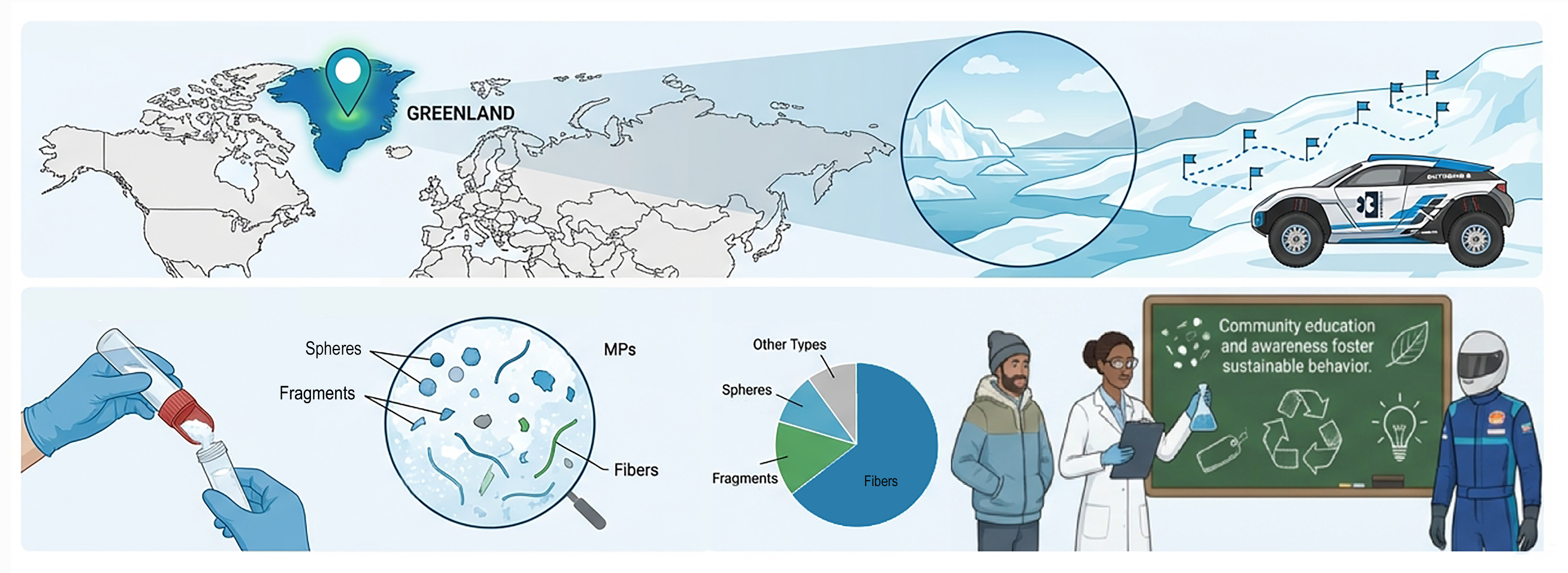
Graphical Abstract

1. Introduction

Microplastic (MP) pollution has emerged as a critical environmental problem that affects ecosystems worldwide. The widespread use of plastic materials, driven by their durability, chemical resistance and low production costs, has led to a dramatic increase in plastic production in recent decades. However, the same properties make plastic debris highly persistent in natural environments. Their tiny size and different shapes allow them to disperse efficiently over long distances [1,2]. MPs can be assimilated by a wide range of organisms, entering the trophic networks and posing serious risks to ecosystems and human health [3,4,5,6,7,8,9]. In addition, MPs can act as vectors for other environmental contaminants, such as pesticides, flame-retardant Bisphenol A, persistent organic pollutants (POPs), heavy metals, or antibiotics, which increase the environmental risks [10,11,12,13,14,15,16]. After reaching the environment through various sources, whether intentionally or inadvertently, plastic waste breaks down into small pieces via physical, chemical, or biological degradation processes. Synthetic particles with dimensions ranging from 1 μm to 5 mm [17,18] are called MPs, and can derive from big plastic fragmentation or may be directly manufactured with such dimensions (e.g., care products). However, the definition is still subject to debate.
Recently, different studies highlighted concerns about microfibres (MFs) [19,20,21,22,23,24,25,26,27,28,29]. The definition of MFs remains debated too, depending on the application field (environmental pollution, textile industry, etc.) [26,30]. In the field of environmental pollution, the first definition of MF taking into account both size and diameter and all previous MF definitions was described by Liu et al. [31], who defined MFs as any natural or artificial fibrous materials of threadlike structure with a diameter less than 50 µm, length ranging from 1 µm to 5 mm, and a length-to-diameter ratio greater than 100. The term microfibre is broadly used to describe any fibrous particle released from textiles into the environment, regardless of its composition—whether natural, regenerated, or synthetic—or its specific textile fineness. It is therefore crucial to distinguish this general usage from fibrous microplastics, which are defined more narrowly as fibres composed of synthetic polymers or those chemically altered to be environmentally persistent [32]. To support standardization in this field, ISO 4484-2 (2023) defines fibrous microplastics as solid polymer fibres with lengths ranging from 300 nm to 15 mm and a length-to-diameter ratio exceeding 3 [30].
MFs mainly originated from textile production, cigarette filters, personal care products and wet wipes [24]. Textile fibres originate from both natural and manufactured (man-made) sources. Manufactured fibres are further divided into organic and inorganic types, with organic fibres classified as either regenerated or synthetic. Regenerated fibres, such as rayon and viscose, are produced by chemically processing natural cellulose-based raw materials. In contrast, synthetic fibres like polyester and polyamide are entirely derived from petrochemical sources, offering enhanced durability, strength, and environmental resistance [32]. In the past, natural and regenerated MFs were often misclassified as MPs, due to their industrial processing and colouring which visually resemble synthetic fibres [33,34]. However, in some recent definitions of MPs, these materials can also be included [35,36].
Recent studies raised concerns about non-synthetic microparticles, showing a prevalence of natural and regenerated MFs in the environment [20,27] and in the gastrointestinal system of different animal taxa, [37,38]. Natural fibres originate from plant-based (cellulosic) sources (e.g., cotton, hemp) and animal-derived (proteinaceous) materials (e.g., silk, wool). Regenerated fibres, such as rayon and viscose, are produced by chemically processing natural polymers such as cellulose to form fibre structures [39]. Biodegradable processes of natural and regenerated MFs are different to synthetic ones and represent an accessible carbon source for microorganisms [40]. However, different copolymers are used in textile production, combining different plastics and cellulosic materials. As MPs, MFs are ubiquitously distributed across a range of environmental compartments [20,21,23,27,41], as well as in numerous organisms [9,37,38,42,43]. Consequently, the importance of analyzing MPs and MFs pollutants in the environment is increasing.
MP and MF pollution research in extreme environments, such as Arctic and Antarctic regions [44,45,46], is at an early stage; therefore, any new information is fundamental. Greenland is the largest island in the world, with the lowest population, as 81% of the territory is covered by ice. However, previous studies highlighted the presence of MP pollution in snow, sea ice, water column and surface sediments from across the Arctic [47,48,49,50]. Possible sources of transport were linked to ocean currents, landfill, incinerators and atmospheric long-distance transport [49,50,51].
Public awareness and environmental education have been recognized as important factors influencing attitudes toward plastic pollution [52]. In this context, involving society actively in generating and sharing scientific knowledge can foster environmentally conscious attitudes and reduce plastic pollution in the environment [53]. Environmental education, as a result, serves as a cost-effective and impactful tool for driving social change and developing sustainable strategies [54].
Dissemination initiatives addressing environmental issues have been more widely implemented in schools in recent years, raising awareness and encouraging more responsible behaviours among young individuals, with cascading effects on their families and friends [54,55]. Greater public involvement in the scientific research process has developed, for example, through Citizen Science initiatives, particularly in plastic pollution studies. The opening of the science has successfully engaged the public, also contributing to scientific publications [56,57]. Additionally, activities such as beach clean-ups and television programmes have proven successful in educating the general public about pollution [58]. Within this context, even Extreme E, an innovative off-road racing series working in the most remote corners of the planet impacted by climate change and pollution, has started to highlight global issues, trying to inspire the next generation.
The series leverages its sporting platform to promote electrification, environmental sustainability, and equality. The series’ goals are to raise awareness about the impact of climate change on some of the world’s most endangered and vulnerable environments, to encourage the adoption of electric vehicles as a means of facilitating a lower-carbon future, and to provide the world’s first gender-equal motorsport platform. The series is linked to the UNICEF education program in the racing areas, supporting Greenland’s children in understanding and tackling the climate-related issues which threaten future generations.
The championship shed light on the environmental health of the country over the years, with melting ice sheets and glaciers being the principal result of the rising global temperatures, suggesting that the continually increasing rate of melt water and melting ice sheets could mean that sea levels will rise by around five metres by 2100 [59]. Moreover, when the snow melts on the top of the Greenland ice cap in summer, the dirt embedded in the ice remains, while the meltwater drains away. This darkens the surface, causing the ice to melt more rapidly.
In this study, MP and MF contamination in Greenland glacier surface ice was preliminarily investigated. Surface ice samples were collected one day prior to the Extreme E race event in the region. The aim of this study was to provide preliminary baseline data on the occurrence, composition, and characteristics of MPs and MFs in Greenland glacier surface ice.

2. Materials and Methods

2.1. Study Area and Sampling

Extreme E raced in Kangerlussuaq, Greenland, in August 2021, during its inaugural season. In the 2021 Arctic X Prix race location, with direction from Prof. Peter Wadhams, the drivers and Extreme E staff collected 86 micro-samples of surface ice (2 mL sampling tubes) from the Russell Glacier (67°09′16.5″ N 50°01′45.5″ W) (Figure 1), to minimize the weight and volumes required by the drivers. Russell Glacier (Danish: Russells Gletscher) is located in the Qeqqata municipality of central-western Greenland. Flowing westward from the Greenland ice sheet (Greenlandic: Sermersuaq), its terminus lies approximately 25 km east of Kangerlussuaq. The glacier is active, advancing 25 m annually. As it is easily accessible from Kangerlussuaq, it remains a popular destination for tourists.
Sampling was conducted in a single session one day prior to the race event. The selected icefield was located in the vicinity of the race area but was not part of the racetrack and had not been subjected to racing or tourist activities. The sampling site consisted of undisturbed surface ice, minimizing the likelihood of direct contamination associated with the race itself. Nevertheless, given the touristic accessibility of the area, potential contributions could be linked to broader anthropogenic activities or atmospheric deposition.

2.2. Laboratory Analysis

Samples were divided into five macro-samples for analysis (Table 1), taking into the account the presence of visible impurities (WA: less impurities; B: more impurities), and analyzed according to an adapted version of the process described by Balestra et al. [60]. The samples were pre-treated with a 1:1 30% H2O2 solution, covered with aluminum foil, and allowed to react under ambient conditions for ten days. Subsequently, each sample was filtered under a vacuum pump through a 0.2 μm pore size ANODISC filter (Cytiva, MA, USA, 47 mm diameter) then placed in glass Petri dishes, covered with aluminum foil, and dried in an oven at 40 °C until complete dehydration was achieved.

2.3. Contamination Control

Whenever possible, plastic laboratory tools were substituted with glass or metal alternatives and rigorous contamination prevention protocols were followed. These included the use of nitrile gloves, cotton laboratory coats, aluminum foil coverings, and meticulous cleaning procedures employing ethanol and MilliQ water.
The sampling tubes used were composed of pure polypropylene (PP). Despite this polymer exhibiting low wettability, high stability and mechanical strength across a broad temperature range, contamination control specifically targeted toward potential PP contamination on samples was performed.
Blank controls were conducted on all reagents used, including 30% H2O2 (Merck, Germany), absolute ethanol (Avantor, VWR Chemicals, PA, USA), and MilliQ water. Blank control on air was performed using one open pre-cleaned Petri dish during the analysis. Once the analysis was completed, the Petri was washed with MilliQ water and filtered using the same procedure as the other samples. The blank correction approach adopted in this study consisted of quantifying MP and MF contamination subtracting the blank contribution [61]. The detected pollutants were summed and deducted from the overall sample amounts. All chemicals and MilliQ water underwent analysis following protocols identical to those used for ice samples. While this correction method is widely implemented and straightforward, it adjusts only quantitative data and does not allow differentiation between particles arising from procedural contamination and those that naturally occur in the sample matrix [61]. Consequently, data in this study about MP and MF characteristics remain uncorrected.

2.4. Microparticle Identification and Characterization

Microscopy coupled with spectroscopic analyses was employed to identify MPs and natural and regenerated MFs ranging from 5 to 0.1 mm.
A preliminary microscopic screening analysis was conducted to assess the nature of the collected materials. Particles were examined using a Leitz, Wetzlar, Germany, ORTHOLUX II POL-MK microscope equipped with a DeltaPix, Glostrup, Denmark, Invenio 12EIII 12 Mpx camera, under both visible and UV illumination (365 nm, Alonefire, China, SV10 5W flashlight) [27,28,60,62,63,64,65], according to strict selection criteria [66,67,68,69]. Microparticles were observed at 2.5× magnification, enlarged to 10× or higher magnifications for identification and characterization. Particles that could not be confidently identified as MPs or MFs were excluded from the analysis. Particles smaller than 0.1 mm were cut off as suggested by the European Commission (2013) for visual identification under a microscope [69]. For MFs, morphological comparisons were performed using longitudinal and cross-sectional features to distinguish among natural, regenerated, and synthetic fibres [70]. Observed MPs were categorized according to the standardized size and colour-sorting system (SCS) [66]. MFs were categorized as synthetic (MPs) or non-synthetic, encompassing both natural and chemically processed regenerated materials.
For spectroscopic analyses, it is generally recommended that 5–10% of the particles be routinely verified in order to confirm the reliability of the visual identification [18,71]. According to the time for analyses and the number of particles found on the filters, 40% of random microparticles underwent μFTIR analysis using a Shimadzu AIM-9000 microscope coupled with an IRTracer-100 spectrophotometer. Measurements were carried out in ATR mode with a germanium prism across the spectral range 4000–700 cm−1, acquiring 40 scans per sample. Atmospheric corrections were applied and spectra were compared against the Shimadzu Lab Solution Library ATR Polymer 2 and checked by expert researchers. Only spectra exhibiting match scores ≥ 70% were considered reliable for particle identification [71].

3. Results

MPs and natural and regenerated MFs were found in all samples. The average concentration of the full procedural blank was 22.6 ± 0.4 items/L for natural and regenerated materials and 0.8 ± 0.1 items/L for synthetic ones. After blank correction, a total of 894.3 microparticles were found in 50 mL in total of melted ice, of which 135.0 were MPs (2700 items/L), and 678.3 natural and regenerated MFs (13,566.4 items/L) (Table 2).
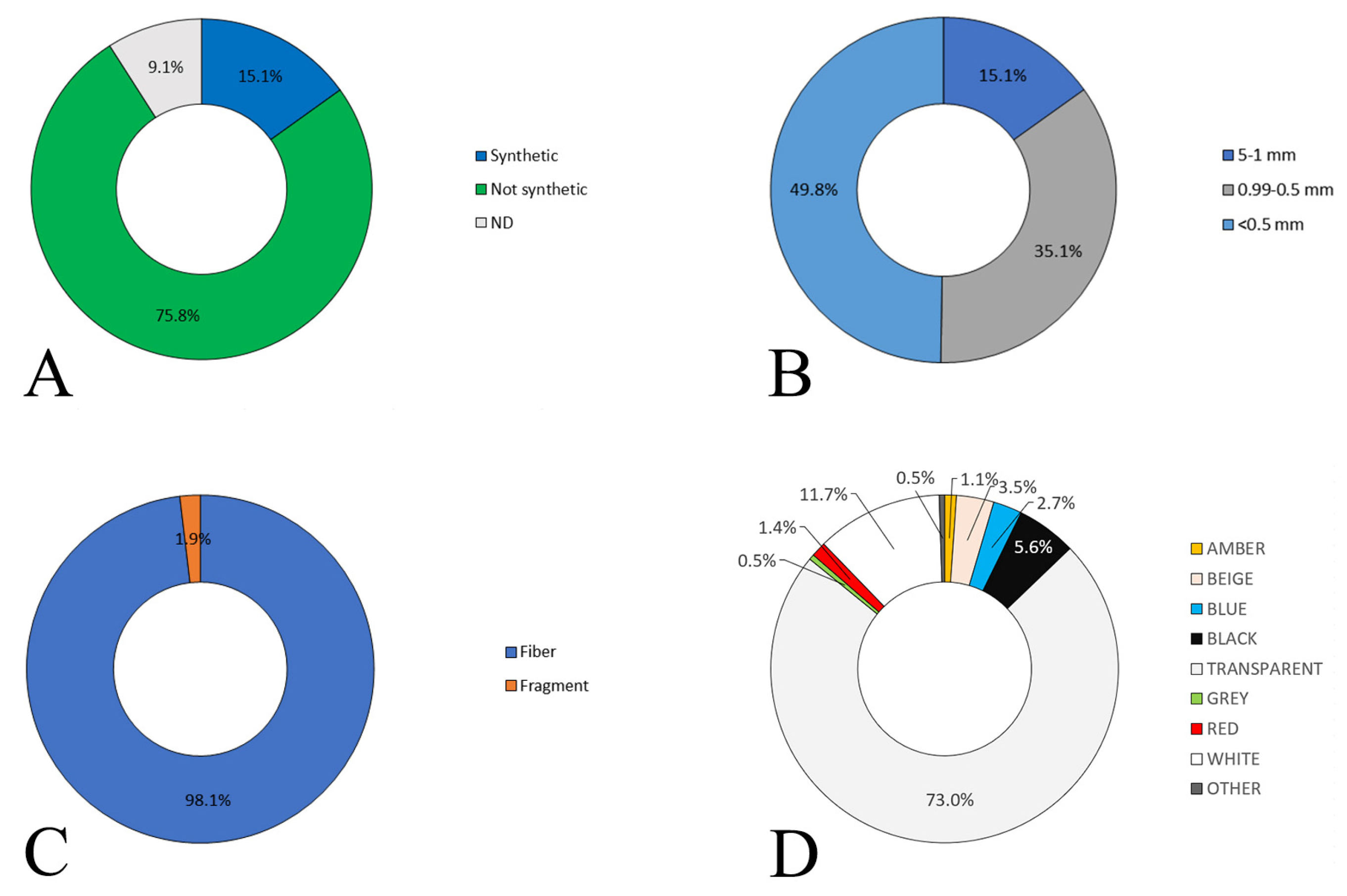
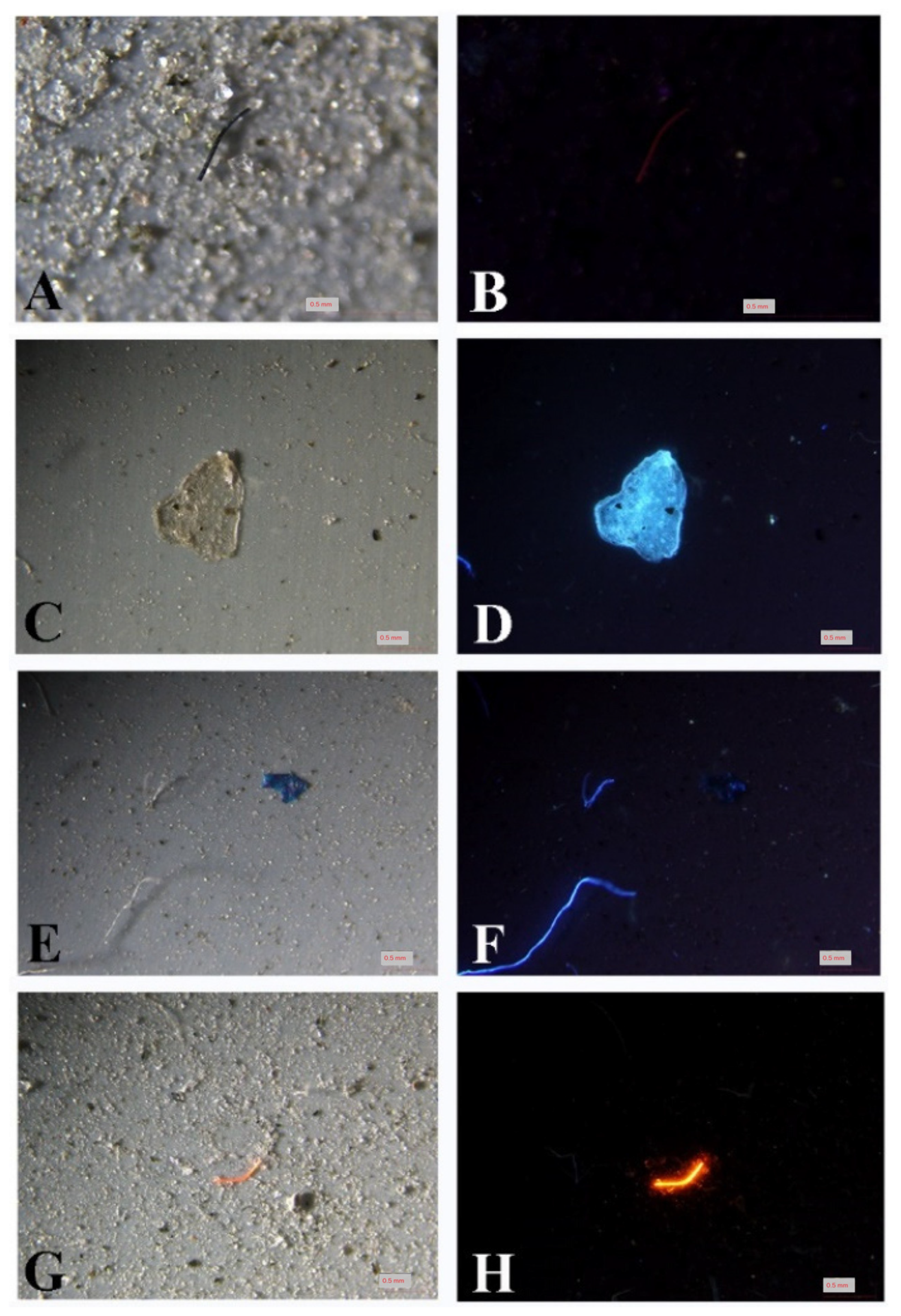
Microparticles found in the samples showed a high degradation degree; therefore, spectroscopic analyses were challenging. Analysis highlighted that 75.8% of microparticles were natural and regenerated materials, and only 15.1% were synthetics (Figure 2A and Figure 3), while 9.1% was not clearly identifiable (ND). Among the natural and regenerated MFs, major part was identified as cotton, with the remaining materials classified as methyl cellulose, cuprammonium rayon, and other cellulosic fibres. From the synthetic materials, the presence of polyethylene terephthalate (PET) and polyethylene (PE) was confirmed.
Microparticles < 1 mm were the most abundant (84.9%) (Figure 2B). The number of particles increased as the size range considered decreased (Figure 2B).
Fibrous particles dominated all samples (98.1%), followed by fragments (1.9%) (Figure 2C and Figure 3).
It was noted that 91.1% of the total microparticles were fluorescent under UV light. Regarding the colour, 73% of microparticles were transparent/clear, followed by white (11.7%), and black (5.6%) ones; particles with other colours had percentages lower than 3.5% (Figure 2D).
With the obtained preliminary data, the Extreme E working team created a video on the problem of MP and MF pollution in extreme environment (in the documentary series “Electric Odyssey”). Dissemination activities by involved researchers regarding this collaborative project were performed at “Festival della Virtù Civica” in Casale Monferrato (Alessandria), November 2023 (https://festivalvirtucivica.it/perche-un-festival-della-virtu-civica/#), and at “Biennale della Tecnologia”, for the Earth Day, Turin, April 2024 (https://www.biennaletecnologia.it/evento/la-plastica-invisibile-cosa-si-nasconde-in-quello-che-ingeriamo/).

4. Discussion

4.1. Methodological Considerations

Research on MPs and MFs presents numerous challenges, including the risk of external contamination. Although sampling was conducted according to established protocols, potential contamination during collection cannot be excluded, particularly in cold environments where synthetic technical clothing is commonly used. Although procedural blanks were included and subtracted from sample counts, a dedicated field blank during sampling was not performed due to logistical constraints. Therefore, minor airborne fibre deposition during sample collection cannot be entirely excluded. However, blank-corrected concentrations remained substantially higher than procedural blank levels, suggesting that contamination alone is unlikely to explain the observed abundances. Future studies should incorporate field blanks and larger sample volumes to further strengthen quantitative robustness.
Analyses performed on the chemicals and solutions used in this study revealed significant MP and MF contamination, emphasizing the necessity of pre-filtering all laboratory reagents to minimize artefacts. This finding highlights the urgent need to raise awareness among both scientists and manufacturers regarding the potential for these materials to introduce contamination, underscoring the importance of improving product purity and reducing environmental release.
Removal of organic matter (OMR) is a crucial preparatory step; however, the chemicals employed may partially degrade MPs and partially or completely degrade non-synthetic MFs [24,72]. Hydrogen peroxide (H2O2) is among the most widely used reagents for OMR [24]; however, it can alter the physical integrity of microparticles, modify infrared spectra, and increase the fragility of fibres, particularly cellulosic types. This degradation may lead to fibre fragmentation, potentially resulting in an overestimation of particle abundances [72].
A combination of different microscopic and spectroscopic methods is recommended [73] as detected in this study. Microscopy remains a widely used and cost-effective method for the characterization of MPs and MFs; however, it does not provide information on their chemical composition. Although visual analysis enables detailed observation of particle morphology and colour, facilitating differentiation between synthetic and natural or regenerated materials, it is labour-intensive and not recommended as a standalone approach for small particles [67,69,73,74]. Spectroscopic analyses provide essential information about the chemical composition of MPs and MFs; however, these methods are time-consuming, require expensive instrumentation, and demand specialized expertise. Additionally, pollutants recovered from natural environments are often coated with other materials or contaminated with additional substances, which complicates spectral acquisition and interpretation [73]. Finally, natural polymers show lower signal intensities compared to synthetic ones and are more susceptible to interference from dyes. The FTIR spectra of natural and regenerated polymers are nearly identical [75]. The dyes or the presence of oxidation, and microbial degradation can alter the absorption bands of cellulose in the FTIR spectra [38,40,76]. Therefore, distinguishing between them is extremely challenging. Misestimations in library matches could pose significant issues, which is why only high-quality matches (over 70%) of spectra were used in this research.
Concentrations were expressed as items/L to allow comparison with previous MP studies. However, it should be noted that the relatively small analyzed volume (50 mL) may increase the uncertainty of the extrapolated concentrations when normalized to litre units.

4.2. Pollution

MP and MF pollution represents a potential threat to environments and species, making it a critical concern for conservation. Monitoring MPs and MFs in extreme environments is essential for evaluating their health and is a key element in understanding how human activity can directly or indirectly affect them.
Working in extreme and cold environments is not easy, and may present multiple challenges, especially during a race. In fact, in this case it was not possible to collect large volumes of samples, and PP sampling tubes were used to facilitate transport during the race. However, there is still too little data regarding this type of pollution on surface ice in Greenland; therefore, any new information about these pollutants is crucial for a better understanding of the environmental possible threats.
Making data comparisons is generally challenging because different methods can influence the results and different sizes are often investigated. Moreover, the location of the sampling and environmental conditions, such as season or meteorological conditions, may also lead to fluctuations in pollutant concentrations over time. Nevertheless, some assumptions can be made regarding the presence of MPs and MFs in Greenland surface ice.
The concentration of MPs found in the collected surface ice was two orders of magnitude higher than a previous study in Antarctica, near McMurdo research station, showing an average of 29 MPs/L, ranging from 4 to 82 MPs/L [44]. However, our data are similar to the MP concentrations found in the remote Antarctic camps of Union Glacier, Schanz Glacier and the South Pole, ranging from 73 to 3099 MPs/L (average of 817 ± 310 MPs/L) [45], or in Arctic snow deposited on ice floes drifting in Fram Strait and on Svalbard, with a mean of 1760 ± 1580 MPs/L, and a maximum recorded value of 14,400 MPs/L on an ice floe [46]. The same study also analyzed snow close to urban sites in northern Europe (Bremen City, Isle of Heligoland) and the Alps (Davos, Tschuggen, Bavaria), highlighting a mean of 24,600 ± 18,600 MPs/L, with a maximum value of 154,000 MPs/L [46].
Regarding MFs, the maximum amount found in the same study highlighted 10,200 MFs/L detected in snow from an ice floe, with a mean of 1380 ± 1100 MFs/L from Arctic ice floes, and a maximum value of 2750 MFs/L in the Isle of Heligoland, with a mean of 1431 ± 325 MFs/L in snow from Europe [46].
These data are particularly interesting considering that the monitored Russell Glacier is rather a popular destination for tourists, while similar or higher pollution values have been found in remote areas of the Arctic and Antarctic.
Fibrous particles were the most prevalent, as in Aves et al. [44]. Conversely, Jones-Williams et al. [45] found that particles were the most dominant MP morphotype. Differences could be linked to the different analytical techniques, or sources and transport. The prevalence of the fibrous material—natural, regenerated and synthetic—may be associated with touristic activities and fibre shedding from clothing, as well as long-range atmospheric transport. Despite the presence of the car race, not many fragments were found, suggesting sources of prevalent pollution of another nature.
The most frequently found synthetic particles were PET, material also found in Aves et al. [44] and Jones-Williams et al. [45]. However, in our case these materials were predominantly fibres. The types of plastics found, especially PET, regenerated materials and cotton, would further underline the possibility of local contamination linked to tourism. However, remote sources of pollution, such as atmospheric transport, could not be excluded [44]. To ascertain whether microplastics in Antarctic snow originate predominantly from local sources, long-range atmospheric transport, or a combination of both, further research incorporating broader spatial and temporal coverage is required.
The high abundance of MPs and MFs detected in surface ice in this study may have significant climatic and ecological implications. Of particular concern is the potential for MPs, due to their light-absorbing properties, to alter snow albedo and consequently accelerate melting processes in ice-covered regions [77,78]. The elevated concentrations of MPs observed in surface ice underscore the need for further research to elucidate their effects on the physical properties and melt dynamics of snow and ice in these regions.
Advancing political and societal reforms is essential to support effective plastic reduction initiatives and to incentivize manufacturers to adopt sustainable, environmentally friendly materials across all product lines. Comprehensive education at all levels, rooted in environmental sustainability principles, is fundamental for the management and conservation of water resources, protected habitats, and biodiversity [28,52,55]. Moreover, the media have historically influenced culture, shaping social attitudes and public perceptions regarding environmental issues.
Regarding the car industry, advertisements evolved over time, providing the industry with a platform to push the automobile as a requisite for modern life with car-centred lifestyles in affluent societies. These aspects can also be used to convey messages for environmental purposes. The electric racing leagues have stressed their commitment to sustainability efforts, racing in extreme locations to raise awareness about climate change and pollution, initiating a range of public outreach initiatives. Different ways to popularize these racing leagues were implemented, expanding television coverage, social media presence, and documentary films [79].
Extreme E’s activities frame both the adoption of electric vehicles and the fight against climate change and pollution as challenges to overcome. By positioning the electric transition, climate change and pollution as challenges rather than threats, this kind of dissemination activities foster optimism and collective action, encouraging audiences to reflect on lessons learned and consider actionable solutions for sustainability.

5. Conclusions

A preliminary survey was conducted on a glacier in Greenland, where micro samples were collected along the routes used by the Extreme E drivers and staff during the electric off-road racing series in the region. This collaborative research contributed to improving our understanding of MP and MF contamination in extreme glacial environments, highlighting the need for further investigations. The result confirmed the presence of MPs and MFs in the studied area with high abundances. Fibrous and small-dimension microparticles were the most prevalent and were predominantly cellulosic. The high abundance of MPs and MFs detected in surface ice in this study may have significant climatic and ecological implications. MP concentrations observed in surface ice underscore the necessity for further research to elucidate their effects on the physical properties and melt dynamics of snow and ice in these regions. This work is meant to be the first assessment of MP and MF pollution during a race in extreme environments, emphasizing how the merging of research and racing can contribute to understanding how to tackle the issues of climate change and pollution. Any new information is crucial to help us better understand the threat to ecosystems, inform environmental studies on pollution, and implement dissemination, with the aim of promoting appropriate conservation measures. Promoting political and social changes, together with education, will be key to the management and conservation of water resources, protected habitats, and species.

Author Contributions

Conceptualization, V.B., P.W. and R.B.; methodology, V.B., P.W., S.H.A. and R.B.; validation, V.B.; formal analysis, V.B. and S.H.A.; resources, P.W. and R.B.; data curation, V.B. and S.H.A.; writing—original draft preparation, V.B. and P.W.; writing—review and editing, V.B., S.H.A., P.W. and R.B.; visualization, V.B.; funding acquisition, P.W. and R.B. All authors have read and agreed to the published version of the manuscript.

Funding

This work was realized with funding from Extreme E, with the support of the Multimodal Analysis Laboratory (LAM) of DIATI—Politecnico di Torino.

Data Availability Statement

The data presented in this study are available on request from the corresponding author due to a sharing agreement with Extreme E.

Acknowledgments

The authors are grateful to Extreme E team for performing the sampling and dissemination activities.

Conflicts of Interest

The authors declare no conflicts of interest. The authors declare that this study received funding from Extreme E for the lab analyses. The funder had the following involvement with the study: sampling, dissemination activities to show pollution in extreme areas. The funder was not involved in the analysis, interpretation of data and the writing of this article. Author Peter Wadhams was part of the Scientific Committee of Extreme E, a group of academics from the Universities of Oxford and Cambridge involved in the series’ education and research programmes, even logistics and impact as well as the recommendation of positive legacy initiatives which support local communities in each race location. The remaining authors declare that the research was conducted in the absence of any commercial or financial relationships that could be construed as a potential conflict of interest.

Abbreviations

The following abbreviations are used in this manuscript:
MPMicroplastic.
MFMicrofibre.
PETPolyethylene terephthalate.
PPPolypropylene.
PEPolyethylene.
SCSStandardized size and colour sorting system.

References

  1. Liu, K.; Wang, X.; Fang, T.; Xu, P.; Zhu, L.; Li, D. Source and potential risk assessment of suspended atmospheric microplastics in Shanghai. Sci. Total Environ. 2019, 675, 462–471. [Google Scholar] [CrossRef] [PubMed]
  2. Allen, S.; Allen, D.; Phoenix, V.R.; Le Roux, G.; Durántez Jiménez, P.; Simonneau, A.; Binet, S.; Galop, D. Atmospheric transport and deposition of microplastics in a remote mountain catchment. Nat. Geosci. 2019, 12, 339–344. [Google Scholar] [CrossRef]
  3. Barceló, D.; Picó, Y.; Alfarhan, A.H. Microplastics: Detection in human samples, cell line studies, and health impacts. Environ. Toxicol. Pharmacol. 2023, 101, 104204. [Google Scholar] [CrossRef]
  4. Cox, K.D.; Covernton, G.A.; Davies, H.L.; Dower, J.F.; Juanes, F.; Dudas, S.E. Human consumption of microplastics. Environ. Sci. Technol. 2019, 53, 7068–7074. [Google Scholar] [CrossRef]
  5. Kannan, K.; Vimalkumar, K. A review of human exposure to microplastics and insights into microplastics as obesogens. Front. Endocrinol. 2021, 12, 978. [Google Scholar] [CrossRef]
  6. Assas, M.; Qiu, X.; Chen, K.; Ogawa, H.; Xu, H.; Shimasaki, Y.; Oshima, Y. Bioaccumulation and reproductive effects of fluorescent microplastics in medaka fish. Mar. Pollut. Bull. 2020, 158, 111446. [Google Scholar] [CrossRef]
  7. Devereux, R.; Hartl, M.G.; Bell, M.; Capper, A. The abundance of microplastics in cnidaria and ctenophora in the North Sea. Mar. Pollut. Bull. 2021, 173, 112992. [Google Scholar] [CrossRef] [PubMed]
  8. Romeo, T.; Pietro, B.; Pedà, C.; Consoli, P.; Andaloro, F.; Fossi, M.C. First evidence of presence of plastic debris in stomach of large pelagic fish in the Mediterranean Sea. Mar. Pollut. Bull. 2015, 95, 358–361. [Google Scholar] [CrossRef]
  9. Sforzi, L.; Tabilio Di Camillo, A.; Di Lorenzo, T.; Galassi, D.M.P.; Balestra, V.; Piccini, L.; Cabigliera, S.B.; Ciattini, S.; Laurati, M.; Chelazzi, D. (Micro-) Plastics in Saturated and Unsaturated Groundwater Bodies: First Evidence of Presence in Groundwater Fauna and Habitats. Sustainability 2024, 16, 2532. [Google Scholar] [CrossRef]
  10. Zhou, Y.; Liu, X.; Wang, J. Characterization of microplastics and the association of heavy metals with microplastics in suburban soil of central China. Sci. Total Environ. 2019, 694, 133798. [Google Scholar] [CrossRef] [PubMed]
  11. Wanner, P. Plastic in agricultural soils–a global risk for groundwater systems and drinking water supplies?—A review. Chemosphere 2021, 264, 128453. [Google Scholar] [CrossRef] [PubMed]
  12. Selvam, S.; Jesuraja, K.; Venkatramanan, S.; Roy, P.D.; Kumari, V.J. Hazardous microplastic characteristics and its role as a vector of heavy metal in groundwater and surface water of coastal south India. J. Hazard. Mater. 2021, 402, 123786. [Google Scholar] [CrossRef]
  13. Rochman, C.M.; Hoh, E.; Kurobe, T.; Teh, S.J. Ingested plastic transfers hazardous chemicals to fish and induces hepatic stress. Sci. Rep. 2013, 3, 3263. [Google Scholar] [CrossRef]
  14. Cheng, Z.; Lin, X.; Wu, M.; Lu, G.; Hao, Y.; Mo, C.; Li, Q.; Wu, J.; Wu, J.; Hu, B.X. Combined Effects of Polyamide Microplastics and Hydrochemical Factors on the Transport of Bisphenol A in Groundwater. Separations 2023, 10, 123. [Google Scholar] [CrossRef]
  15. He, D.; Zeng, Y.; Zhou, G. The influence of microplastics on the toxic effects and biodegradation of bisphenol A in the microalgae Chlorella pyrenoidosa. Aquat. Ecol. 2022, 56, 1287–1296. [Google Scholar] [CrossRef]
  16. Narevski, A.C.; Novaković, M.I.; Petrović, M.Z.; Mihajlović, I.J.; Maoduš, N.B.; Vujić, G.V. Occurrence of bisphenol A and microplastics in landfill leachate: Lessons from South East Europe. Environ. Sci. Pollut. Res. 2021, 28, 42196–42203. [Google Scholar] [CrossRef]
  17. Frias, J.P.; Nash, R. Microplastics: Finding a consensus on the definition. Mar. Pollut. Bull. 2019, 138, 145–147. [Google Scholar] [CrossRef]
  18. CEN ISO/TR 21960:2020; Plastics—Environmental Aspects—State of Knowledge and Methodologies. International Organization for Standardization: Geneva, Switzerland; European Committee for Standardization: Brussels, Belgium, 2020.
  19. Hasenmueller, E.A.; Baraza, T.; Hernandez, N.F.; Finegan, C.R. Cave sediment sequesters anthropogenic microparticles (including microplastics and modified cellulose) in subsurface environments. Sci. Total Environ. 2023, 893, 164690. [Google Scholar] [CrossRef]
  20. Stanton, T.; Johnson, M.; Nathanail, P.; MacNaughtan, W.; Gomes, R.L. Freshwater and airborne textile fibre populations are dominated by ‘natural’, not microplastic, fibres. Sci. Total Environ. 2019, 666, 377–389. [Google Scholar] [CrossRef] [PubMed]
  21. Suaria, G.; Achtypi, A.; Perold, V.; Lee, J.R.; Pierucci, A.; Bornman, T.G.; Aliani, S.; Ryan, P.G. Microfibers in oceanic surface waters: A global characterization. Sci. Adv. 2020, 6, eaay8493. [Google Scholar] [CrossRef] [PubMed]
  22. Dris, R.; Gasperi, J.; Saad, M.; Mirande, C.; Tassin, B. Synthetic fibers in atmospheric fallout: A source of microplastics in the environment? Mar. Pollut. Bull. 2016, 104, 290–293. [Google Scholar] [CrossRef] [PubMed]
  23. Finnegan, A.M.D.; Süsserott, R.; Gabbott, S.E.; Gouramanis, C. Man-made natural and regenerated cellulosic fibres greatly outnumber microplastic fibres in the atmosphere. Environ. Pollut. 2022, 310, 119808. [Google Scholar] [CrossRef]
  24. Athey, S.N.; Erdle, L.M. Are we underestimating anthropogenic microfiber pollution? A critical review of occurrence, methods, and reporting. Environ. Toxicol. Chem. 2022, 41, 822–837. [Google Scholar] [CrossRef]
  25. Liu, J.; Liu, Q.; An, L.; Wang, M.; Yang, Q.; Zhu, B.; Ding, J.; Ye, C.; Xu, Y. Microfiber pollution in the earth system. Rev. Environ. Contam. Toxicol. 2022, 260, 13. [Google Scholar] [CrossRef]
  26. Okyere, E.Y.; Miyittah, M.K.; Danquah, J.A. Assessing the global landscape of microfibre pollution: A systematic review. Aquat. Ecol. 2025, 59, 837–848. [Google Scholar] [CrossRef]
  27. Balestra, V.; Galbiati, M.; Lapadula, S.; Barzaghi, B.; Manenti, R.; Ficetola, G.F.; Bellopede, R. The problem of anthropogenic microfibres in karst systems: Assessment of water and submerged sediments. Chemosphere 2024, 363, 142811. [Google Scholar] [CrossRef]
  28. Balestra, V.; Bellopede, R. Explorations in the dark continent: Did microplastics and microfibres get here before us? Sci. Total Environ. 2025, 977, 179328. [Google Scholar] [CrossRef] [PubMed]
  29. Akyildiz, S.H.; Bellopede, R.; Sezgin, H.; Yalcin-Enis, I.; Yalcin, B.; Fiore, S. Detection and Analysis of Microfibers and Microplastics in Wastewater from a Textile Company. Microplastics 2022, 1, 572–586. [Google Scholar] [CrossRef]
  30. ISO 4484-2:2023; Textiles and Textile Products—Microplastics from Textile Sources. Part 2: Qualitative and Quantitative Analysis of Microplastics. International Organization for Standardization: Geneva, Switzerland, 2023.
  31. Liu, J.; Yang, Y.; Ding, J.; Zhu, B.; Gao, W. Microfibers: A preliminary discussion on their definition and sources. Environ. Sci. Pollut. Res. 2019, 26, 29497–29501. [Google Scholar] [CrossRef]
  32. Akyıldız, S.H.; Balestra, V.; Drudi, L.; Marini, P.; Bellopede, R. Comparison of methodologies for microfiber analysis across different stages of wastewater from a textile dyeing company. J. Hazard. Mater. Adv. 2025, 19, 100791. [Google Scholar] [CrossRef]
  33. Obbard, R.W.; Sadri, S.; Wong, Y.Q.; Khitun, A.A.; Baker, I.; Thompson, R.C. Global warming releases microplastic legacy frozen in Arctic Sea ice. Earth’s Future 2014, 2, 315–320. [Google Scholar] [CrossRef]
  34. Woodall, L.C.; Sanchez-Vidal, A.; Canals, M.; Paterson, G.L.; Coppock, R.; Sleight, V.; Calafat, A.; Rogers, A.D.; Narayanaswamy, B.E.; Thompson, R.C. The deep sea is a major sink for microplastic debris. R. Soc. Open Sci. 2014, 1, 140317. [Google Scholar] [CrossRef]
  35. European Commission. Commission Delegated Decision (EU) 2024/1441; European Commission: Brussel, Belgium, 2024. [Google Scholar]
  36. European Commission. Commission Regulation (EU) 2023/2055—Restriction of Microplastics Intentionally Added to Products; European Commission: Brussel, Belgium, 2023. [Google Scholar]
  37. Zhao, S.; Zhu, L.; Li, D. Microscopic anthropogenic litter in terrestrial birds from Shanghai, China: Not only plastics but also natural fibers. Sci. Total Environ. 2016, 550, 1110–1115. [Google Scholar] [CrossRef] [PubMed]
  38. Remy, F.; Collard, F.; Gilbert, B.; Compère, P.; Eppe, G.; Lepoint, G. When microplastic is not plastic: The ingestion of artificial cellulose fibers by macrofauna living in seagrass macrophytodetritus. Environ. Sci. Technol. 2015, 49, 11158–11166. [Google Scholar] [CrossRef]
  39. Cherif, C. (Ed.) Textile Materials for Lightweight Constructions. Technologies—Methods—Materials—Properties; Springer: Berlin/Heidelberg, Germany, 2016. [Google Scholar]
  40. Zambrano, M.C.; Pawlak, J.J.; Daystar, J.; Ankeny, M.; Cheng, J.J.; Venditti, R.A. Microfibers generated from the laundering of cotton, rayon and polyester based fabrics and their aquatic biodegradation. Mar. Pollut. Bull. 2019, 142, 394–407. [Google Scholar] [CrossRef] [PubMed]
  41. Suaria, G.; Musso, M.; Achtypi, A.; Bassotto, D.; Aliani, S. Textile fibres in mediterranean surface waters: Abundance and composition. In Proceedings of the 2nd International Conference on Microplastic Pollution in the Mediterranean Sea, Capri, Italy, 15–18 September 2020; pp. 62–66. [Google Scholar]
  42. Le Guen, C.; Suaria, G.; Sherley, R.B.; Ryan, P.G.; Aliani, S.; Boehme, L.; Brierley, A.S. Microplastic study reveals the presence of natural and synthetic fibres in the diet of King Penguins (Aptenodytes patagonicus) foraging from South Georgia. Environ. Int. 2020, 134, 105303. [Google Scholar] [CrossRef]
  43. Pauly, J.L.; Stegmeier, S.J.; Allaart, H.A.; Cheney, R.T.; Zhang, P.J.; Mayer, A.G.; Streck, R.J. Inhaled cellulosic and plastic fibers found in human lung tissue. Cancer Epidemiol. Biomark. Prev. 1998, 7, 419–428. [Google Scholar]
  44. Aves, A.R.; Revell, L.E.; Gaw, S.; Ruffell, H.; Schuddeboom, A.; Wotherspoon, N.E.; LaRue, M.; McDonald, A.J. First evidence of microplastics in Antarctic snow. Cryosphere Discuss. 2022, 2022, 2127–2145. [Google Scholar] [CrossRef]
  45. Jones-Williams, K.; Rowlands, E.; Primpke, S.; Galloway, T.; Cole, M.; Waluda, C.; Manno, C. Microplastics in Antarctica-A plastic legacy in the Antarctic snow? Sci. Total Environ. 2025, 966, 178543. [Google Scholar] [CrossRef]
  46. Bergmann, M.; Mützel, S.; Primpke, S.; Tekman, M.B.; Trachsel, J.; Gerdts, G. White and wonderful? Microplastics prevail in snow from the Alps to the Arctic. Sci. Adv. 2019, 5, eaax1157. [Google Scholar] [CrossRef]
  47. Amélineau, F.; Bonnet, D.; Heitz, O.; Mortreux, V.; Harding, A.M.; Karnovsky, N.; Walkusz, W.; Fort, J.; Grémillet, D. Microplastic pollution in the Greenland Sea: Background levels and selective contamination of planktivorous diving seabirds. Environ. Pollut. 2016, 219, 1131–1139. [Google Scholar] [CrossRef]
  48. Jiang, Y.; Yang, F.; Zhao, Y.; Wang, J. Greenland Sea Gyre increases microplastic pollution in the surface waters of the Nordic Seas. Sci. Total Environ. 2020, 712, 136484. [Google Scholar] [CrossRef]
  49. Parga Martínez, K.; Andersen, T.J.; da Silva, V.; Strand, J.; Posth, N.R. Microplastics deposition in Arctic sediments of Greenland increases significantly after 1950. Commun. Earth Environ. 2024, 5, 584. [Google Scholar] [CrossRef]
  50. Vetter, C.B.; Hildebrandt, L.; Zimmermann, T.; Schmidt, C.E.; El Gareb, F.; Mitrano, D.; Pröfrock, D.; Thomas, H. Analysis of microplastics in the fjords of Tunu (East Greenland). Mar. Pollut. Bull. 2025, 218, 118192. [Google Scholar] [CrossRef]
  51. Ikenoue, T.; Nakajima, R.; Fujiwara, A.; Onodera, J.; Itoh, M.; Toyoshima, J.; Watanabe, E.; Murata, A.; Nishino, S.; Kikuchi, T. Horizontal distribution of surface microplastic concentrations and water-column microplastic inventories in the Chukchi Sea, western Arctic Ocean. Sci. Total Environ. 2023, 855, 159564. [Google Scholar] [CrossRef]
  52. Hartley, B.L.; Thompson, R.C.; Pahl, S. Marine litter education boosts children’s understanding and self-reported actions. Mar. Pollut. Bull. 2015, 90, 209–217. [Google Scholar] [CrossRef]
  53. Oliveira, M.; Almeida, M.; Miguel, I. A micro(nano)plastic boomerang tale: A never ending story? TrAC Trends Anal. Chem. 2019, 112, 196–200. [Google Scholar] [CrossRef]
  54. Hartley, B.L.; Pahl, S.; Veiga, J.; Vlachogianni, T.; Vasconcelos, L.; Maes, T.; Doyle, T.; Metcalfe, R.d.A.; Öztürk, A.A.; Di Berardo, M. Exploring public views on marine litter in Europe: Perceived causes, consequences and pathways to change. Mar. Pollut. Bull. 2018, 133, 945–955. [Google Scholar] [CrossRef] [PubMed]
  55. Kusumawati, I.; Setyowati, M.; Syakti, A.D.; Fahrudin, A. Enhancing millennial awareness towards marine litter through environmental education. E3S Web Conf. 2020, 147, 02019. [Google Scholar] [CrossRef]
  56. Rambonnet, L.; Vink, S.C.; Land-Zandstra, A.M.; Bosker, T. Making citizen science count: Best practices and challenges of citizen science projects on plastics in aquatic environments. Mar. Pollut. Bull. 2019, 145, 271–277. [Google Scholar] [CrossRef] [PubMed]
  57. Bergmann, M.; Lutz, B.; Tekman, M.B.; Gutow, L. Citizen scientists reveal: Marine litter pollutes Arctic beaches and affects wild life. Mar. Pollut. Bull. 2017, 125, 535–540. [Google Scholar] [CrossRef]
  58. Williams, A.; Rangel-Buitrago, N. Marine litter: Solutions for a major environmental problem. J. Coast. Res. 2019, 35, 648–663. [Google Scholar] [CrossRef]
  59. Wadhams, P. A Farewell to Ice: A Report from the Arctic; Oxford University Press: Oxford, UK, 2017. [Google Scholar]
  60. Balestra, V.; Galbiati, M.; Lapadula, S.; Zampieri, V.; Cassarino, F.; Gajdošová, M.; Barzaghi, B.; Manenti, R.; Ficetola, G.F.; Bellopede, R. Microplastic pollution calls for urgent investigations in stygobiont habitats: A case study from Classical karst. J. Environ. Manag. 2024, 356, 120672. [Google Scholar] [CrossRef]
  61. Shruti, V.; Kutralam-Muniasamy, G. Blanks and bias in microplastic research: Implications for future quality assurance. Trends Environ. Anal. Chem. 2023, 38, e00203. [Google Scholar] [CrossRef]
  62. Balestra, V.; Vigna, B.; De Costanzo, S.; Bellopede, R. Preliminary investigations of microplastic pollution in karst systems, from surface watercourses to cave waters. J. Contam. Hydrol. 2023, 252, 104117. [Google Scholar] [CrossRef]
  63. Ehlers, S.M.; Maxein, J.; Koop, J.H. Low-cost microplastic visualization in feeding experiments using an ultraviolet light-emitting flashlight. Ecol. Res. 2020, 35, 265–273. [Google Scholar] [CrossRef]
  64. Klein, M.; Fischer, E.K. Microplastic abundance in atmospheric deposition within the Metropolitan area of Hamburg, Germany. Sci. Total Environ. 2019, 685, 96–103. [Google Scholar] [CrossRef] [PubMed]
  65. Qiu, Q.; Peng, J.; Yu, X.; Chen, F.; Wang, J.; Dong, F. Occurrence of microplastics in the coastal marine environment: First observation on sediment of China. Mar. Pollut. Bull. 2015, 98, 274–280. [Google Scholar] [CrossRef] [PubMed]
  66. Crawford, C.B.; Quinn, B. Microplastic Pollutants; Elsevier: Amsterdam, The Netherlands, 2016. [Google Scholar]
  67. Hidalgo-Ruz, V.; Gutow, L.; Thompson, R.C.; Thiel, M. Microplastics in the marine environment: A review of the methods used for identification and quantification. Environ. Sci. Technol. 2012, 46, 3060–3075. [Google Scholar] [CrossRef] [PubMed]
  68. Noren, F. Small Plastic Particles in Coastal Swedish Waters; N-Research Report; KIMO: Billdal, Sweden, 2007. [Google Scholar]
  69. European Commission. Guidance on Monitoring of Marine Litter in European Seas; European Commission: Brussel, Belgium, 2013; 126p. [Google Scholar] [CrossRef]
  70. Khan, A.; Abir, N.; Rakib, M.A.N.; Bhuiyan, E.S.; Howlader, M.R. A review paper on Textile Fiber Identification. IOSR J. Polym. Text. Eng. IOSR-JPTE 2017, 4, 14–20. [Google Scholar] [CrossRef]
  71. Gago, J.; Galgani, F.; Maes, T.; Thompson, R.C. Microplastics in seawater: Recommendations from the marine strategy framework directive implementation process. Front. Mar. Sci. 2016, 3, 219. [Google Scholar] [CrossRef]
  72. Treilles, R.; Cayla, A.; Gasperi, J.; Strich, B.; Ausset, P.; Tassin, B. Impacts of organic matter digestion protocols on synthetic, artificial and natural raw fibers. Sci. Total Environ. 2020, 748, 141230. [Google Scholar] [CrossRef]
  73. Song, Y.K.; Hong, S.H.; Jang, M.; Han, G.M.; Rani, M.; Lee, J.; Shim, W.J. A comparison of microscopic and spectroscopic identification methods for analysis of microplastics in environmental samples. Mar. Pollut. Bull. 2015, 93, 202–209. [Google Scholar] [CrossRef]
  74. Huang, Z.; Hu, B.; Wang, H. Analytical methods for microplastics in the environment: A review. Environ. Chem. Lett. 2023, 21, 383–401. [Google Scholar] [CrossRef] [PubMed]
  75. Comnea-Stancu, I.R.; Wieland, K.; Ramer, G.; Schwaighofer, A.; Lendl, B. On the identification of rayon/viscose as a major fraction of microplastics in the marine environment: Discrimination between natural and manmade cellulosic fibers using Fourier transform infrared spectroscopy. Appl. Spectrosc. 2017, 71, 939–950. [Google Scholar] [CrossRef] [PubMed]
  76. Li, L.; Frey, M.; Browning, K.J. Biodegradability study on cotton and polyester fabrics. J. Eng. Fibers Fabr. 2010, 5, 155892501000500406. [Google Scholar] [CrossRef]
  77. Revell, L.E.; Kuma, P.; Le Ru, E.C.; Somerville, W.R.; Gaw, S. Direct radiative effects of airborne microplastics. Nature 2021, 598, 462–467. [Google Scholar] [CrossRef]
  78. Zhang, Y.-L.; Kang, S.-C.; Gao, T.-G. Microplastics have light-absorbing ability to enhance cryospheric melting. Adv. Clim. Change Res. 2022, 13, 455–458. [Google Scholar] [CrossRef]
  79. Gray, E. Electric automobility and the race to road transfer: ‘Formula E’ and ‘Extreme E’ in documentary film. Mobilities 2024, 20, 67–88. [Google Scholar] [CrossRef]
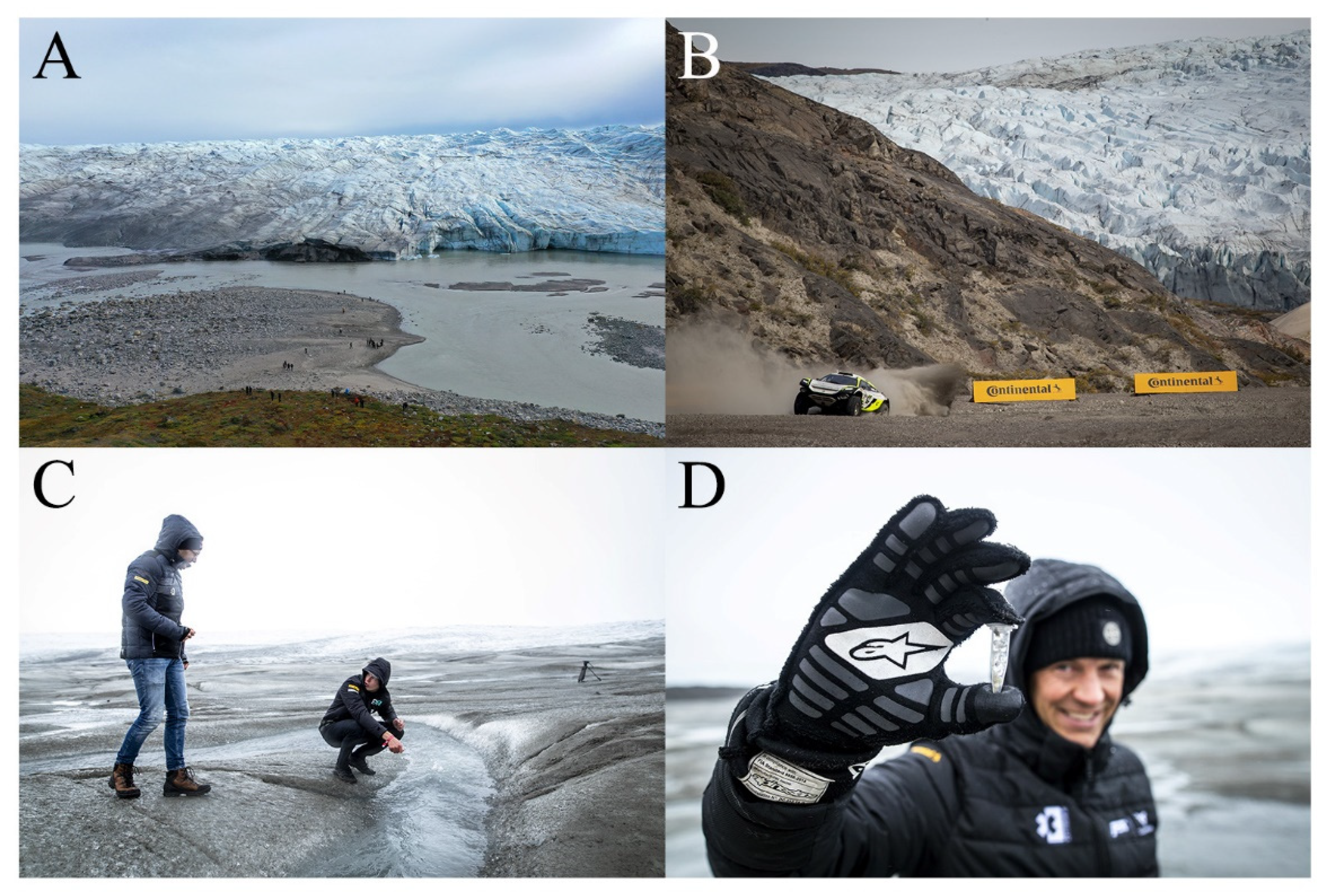
Figure 1. Extreme E sampling in Greenland (photos by Extreme E/LAT Images). (A,B): Extreme E road racing; (C,D): Extreme E after sampling on ice.
Water 18 00848 g001
Figure 2. Characteristics of microparticles found in Greenland’s surface ice. (A): composition (synthetic; not synthetic; ND = not identifiable); (B): size; (C): shape; (D): colour.
Water 18 00848 g002
Figure 3. Anthropogenic microparticles found in Greenland’s surface ice under a microscope, with and without UV light (bar scale 0.5 mm). (A,B): cotton black fibre not fluorescent; (C,D): synthetic beige fragment with blue fluorescence; (E,F): cotton transparent fibres with blue fluorescence and synthetic blue fragment with hinted blue fluorescence; (G,H): regenerated red fibre with red fluorescence.
Water 18 00848 g003
Table 1. Table of macro-sample characteristics from surface ice of Greenland.
Macro-Samples’ NamesNumber of Micro-Samples UsedmL
WA155.5
WB2114
IA158
IB2012.5
B1510
TOTAL8650
Table 2. Characteristics of microparticles found in Greenland’s surface ice for the macro-sample (synthetic; not synthetic; ND = not identifiable).
FiltermLSyntheticNot SyntheticNDTotalSynthetic
(Items/L)
Not Synthetic
(Items/L)
ND
(Items/L)
Total
(Items/L)
WA5.519.3119.020.0158.33507.321,641.83636.428,785.5
WB1445.1254.80.0300.03222.918,202.90.021,425.7
IA89.20.03.012.21155.00.0375.01530.0
IB12.511.2198.142.0251.2892.015,844.03360.020,096.0
B1050.2106.416.0172.65020.010,640.01600.017,260.0
Total concentration50135.0678.381.0894.32700.013,566.41620.017,886.4
mean1027.0135.716.2178.92759.413,265.71794.317,819.4
st dev3.017.386.814.998.11545.77537.31491.18990.0
Disclaimer/Publisher’s Note: The statements, opinions and data contained in all publications are solely those of the individual author(s) and contributor(s) and not of MDPI and/or the editor(s). MDPI and/or the editor(s) disclaim responsibility for any injury to people or property resulting from any ideas, methods, instructions or products referred to in the content.