You are currently viewing a new version of our website. To view the old version click .
Water
  • Article
  • Open Access

8 December 2025

Sustainable Water Use in Banana Export Systems: A Water Footprint Analysis of Bananas in Guayas, Ecuador


and
1
Facultad de Ciencias Agrarias, Universidad Agraria del Ecuador (UAE), Av. 25 de Julio, Guayaquil 090104, Ecuador
2
Facultad de Agronomía, Universidad Nacional Agraria La Molina, Lima 15024, Peru
*
Author to whom correspondence should be addressed.
This article belongs to the Special Issue Water Footprint and Energy Sustainability

Abstract

The lack of knowledge regarding the water footprint (WF) of bananas in the Guayas province of Ecuador, assessed in local terms, creates an information gap concerning the consumptive and sustainable use of water. Therefore, this study aimed to determine the WF of the cultivation and packaging process of this fruit. The Hoekstra methodology was followed, using the evaporation pan procedure for crop evapotranspiration based on a 43-year historical record (1980–2023) and the USDA method for effective precipitation, selecting nine banana farms within the zone. The grey WF was assessed following two approaches: a simple procedure assuming a 10% leaching rate of agrochemicals was followed during the rainy season, and water losses through percolation were accounted for during the dry season. Nitrogen was considered as the pollutant element, while for the grey WF assessment in packaging, active chlorine in wastewater was measured. The WF was determined to be 351.4 m3 t−1, distributed as 45.0% green WF, 49.0% blue WF, and 6.0% grey WF. The grey WF is distributed as 74.7% in the field and 25.3% in the packaging process. Consequently, a moderate impact on groundwater and surface water resources is inferred; however, the irrigation management applied in the zone contributes to reduced contamination of these sources.

1. Introduction

The intensification of agricultural trade has renewed interest in metrics capable of capturing both consumptive use and potential water pollution throughout the supply chain. In this context, the water footprint (WF) proposed by the Water Footprint Network (WFN) has gained traction as an operational framework to disaggregate water use into green, blue, and grey components and to enable comparisons across crops and territories [1]. However, even as its proponents emphasise its accounting transparency and traceability at both the product and territorial levels, there are reservations about its impact-oriented scope. When used alone, the WF does not explicitly consider local scarcity or the magnitude of impacts. Therefore, several authors suggest integrating it with life cycle impact assessment frameworks (e.g., ISO14046) or incorporating hydrological context indicators [1,2].
In sum, while one strand of the literature emphasises the comparative utility of the WF for structuring decision-making, another warns against decontextualised interpretations and advocates complementing the accounting process with local water stress metrics [3].
From a methodological standpoint, the WF relies on daily water balances and on evapotranspiration and effective precipitation parameters to assign the green, blue, and grey components [1]. The water footprint defined for banana cultivation provides component-resolved information on freshwater use, following Hoekstra et al. [1]. This enables a local identification of potential water deficit risk by quantifying the magnitude of the blue component on which production depends, and it also characterises the pollution pressure indicated by the grey component. Nevertheless, strategies derived from this assessment are more effective when the inputs used to estimate the water footprint closely reflect local conditions rather than the method’s generalised defaults [4].
Nonetheless, there are points of friction that affect inter-study comparability: on the one hand, some argue for the inclusion of postharvest water (washing and packing) within the blue component to reflect relevant uses in export-oriented chains; on the other, critics question that such inclusion may inflate results when consumption, return flows, and recirculation are not distinguished [1,5]. Similarly, the estimation of the grey component depends on assumptions about nutrient loss rates and regulatory concentration thresholds; some contend that its omission underestimates diffuse nitrogen pressure, whereas others downplay its weight due to the absence of empirical evidence at certain stages [2,6].
In Ecuador, banana cultivation is one of the agricultural activities with the highest demand for freshwater due to its elevated consumptive use [7] which can reach up to 2690 mm year−1 [8]. This condition is compounded by the significant area dedicated to planting this Musa species, representing 12.7% of permanent crops in the country and covering 184,034 hectares, with the province of Guayas standing out by possessing 31.4% of Ecuador’s banana cultivation area [9], owing to its suitable edaphoclimatic conditions for crop development [10].
At the national level, there is a lack of information regarding the efficiency levels of water use in banana irrigation management. Studies on irrigation and effective applied volumes for this crop are practically nonexistent. The local literature barely registers the observations by Muñoz et al. [11], who mentioned that banana requires 3.6 mm day−1 during peak demand periods (sunny days) in Vinces (Los Ríos province), though the methodology used for this estimation remains unspecified. Although the species is predominantly irrigated through sprinkler systems where water application can be better controlled, the actual irrigation doses extracted from freshwater sources remain unknown. Consequently, it is not possible to verify the sustainability of water resource use in the irrigation of banana, a crop whose cultivated area grew by 9.6% between 2021 and 2023 alone [9]. This lack of knowledge also extends to the environmental impact generated by banana production, particularly related to irrigation inefficiency that, according to [12], contaminates groundwater with nitrates and pesticides.
Recent empirical evidence for banana production illustrates these tensions between comparative potential and contextual limits. In insular systems with drip irrigation and high yields, such as in the Canary Islands, an average WF close to 341 m3 t−1 has been reported, attributable in part to irrigation efficiency and productivity [13]. By contrast, studies in Southeast Asia estimate an average WF of around 842 m3 t−1 and identify on-farm irrigation as the primary lever for reduction, while noting the absence of a grey component when no evidence of contamination is found or when the scope excludes it [6]. In opposition, research on smallholders in the Andean tropical contexts of Peru and Ecuador shows that once washing/packing water is incorporated, the blue fraction becomes decisive, increasing total WF and bringing visibility to a stage frequently underestimated [5].
The grey component also exhibits heterogeneity and sparks debate. In areas with intensive management and controlled fertilisation, modest grey contributions to the total WF of banana have been observed, consistent with efficiency practices and the predominance of the green/blue fractions [13]. However, other studies caution that underestimating nitrogen losses or adopting lax–strict regulatory thresholds can substantially alter calculations; therefore, an explicit reporting of assumptions, data sources, and sensitivity is recommended [2,6].
Building on this discussion, a situated analysis is warranted for a strategic export crop such as Ecuadorian banana in a province of high productive relevance such as Guayas. On the one hand, WFN standards and the empirical literature allow the structured comparison of components (green, blue, and grey) at the product and territorial scales [1,2]; on the other, regional experience suggests that the explicit inclusion of water consumption in packing/washing and the traceability of assumptions are key to international comparability [5,13]. Within this framework, the objective of this study is to determine the WF of banana up to the postharvest stage in the province of Guayas, Ecuador, integrating on-farm and postharvest processes under the WFN standard and discussing the results critically against the comparative evidence.

2. Materials and Methods

2.1. Study Area

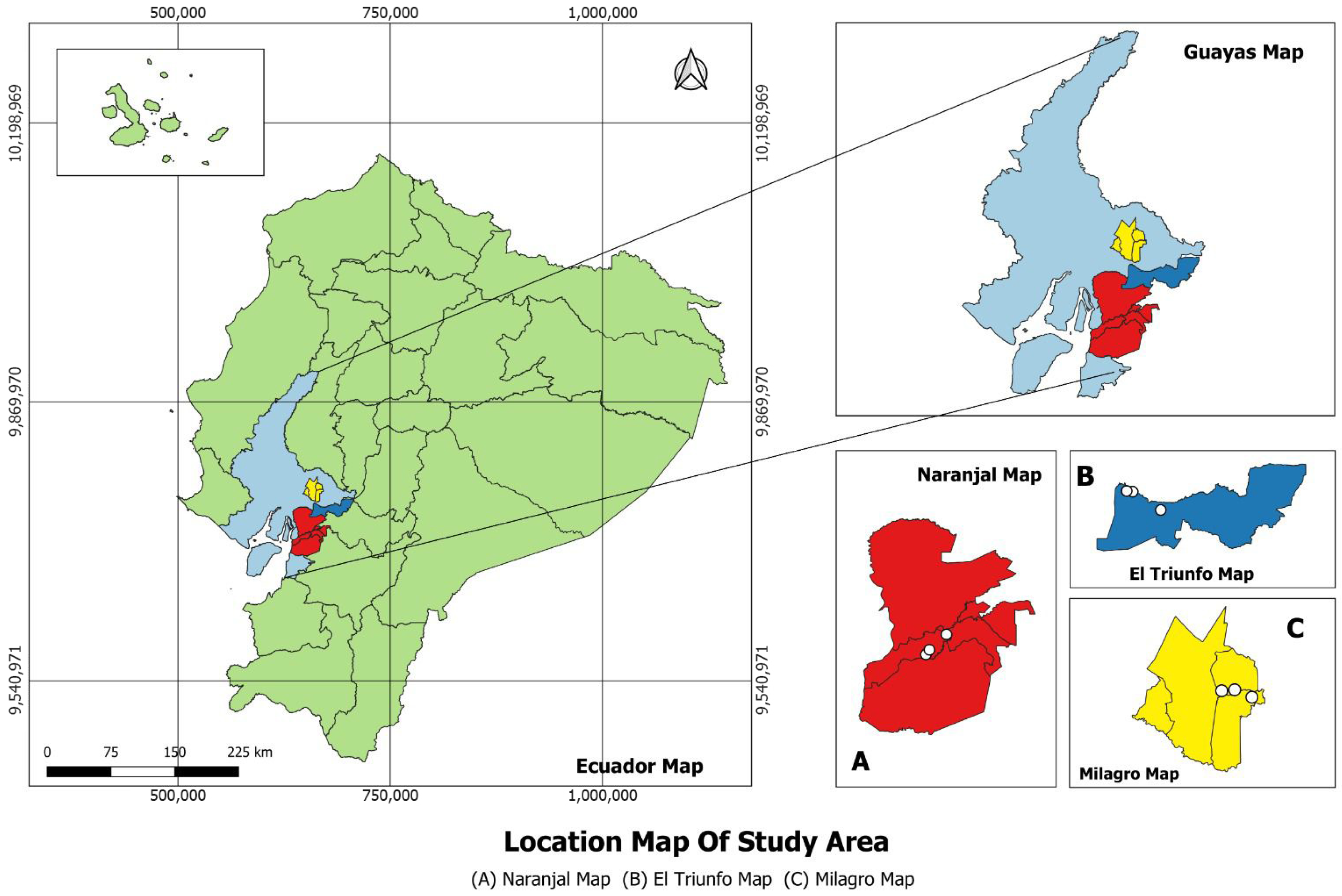
Nine commercial banana plantations were selected for water footprint analysis, categorised into three groups representing the agricultural zones of the cantons of Milagro, El Triunfo, and Naranjal within the Guayas province (Figure 1). These farms are located in a tropical humid climate where mean temperatures range from 20 to 30 °C, relative humidity varies between 77% and 85%, the average daily sunshine lasts 2.4–4.3 h, and the mean wind speed is 1.2 m s−1. All farms cultivate the Cavendish variety, using sprinkler irrigation systems. Table 1 summarises the UTM coordinates of each farm, the cultivated area, and the average soil properties (sand, silt, clay, organic matter (OM), field capacity (FC), and bulk density (BD)).
Figure 1. Geographic location of the study area in Ecuador. The map on the left shows Ecuador with the province of Guayas highlighted in light blue. The inset maps display the cantons of Naranjal (red), El Triunfo (blue), and Milagro (yellow), where the field samplings were conducted.
Table 1. Study area, cultivated area, and soil characteristics of selected farms.

2.2. Green and Blue Water Footprints

The total annual water footprint (WF) of banana production from farm to field was calculated as the sum of the green, blue, and grey components [1], expressed in cubic metres per ton of product (Equation (1)):
WF = WF green + WF blue + WF grey
Green and blue WFs were estimated as
WF green = 10 ET green Y , WF blue = 10 ET blue Y
where ET green and ET blue represent the crop evapotranspiration derived from rainfall and irrigation water (from groundwater sources), respectively, in equation (2), and Y is the crop yield, expressed in tons per hectare per year (t ha−1 yr−1). The conversion factor 10 is applied to change units from millimetres to cubic metres per hectare.
The crop evapotranspiration ( E T c ) was estimated using the Class A evaporation pan method, based on the availability of data for each farm. According to the FAO Manual 56 [7], the pan coefficient ( K t a n ) was defined as 0.85, considering average wind speed conditions (<2 m s−1), relative humidity (>70%), and the crop’s windward distance of 10 m. Regarding the crop coefficient ( K c ), given that banana is a perennial species under continuous production, a fixed value of 1.20 was set following the recommendation in the mentioned manual. Therefore, the E T c , expressed in mm month−1, derived from the evaporation recorded by the pans ( E t a n ), was calculated according to Equation (3).
E T c = 1.02 × E tan
Based on the records of monthly precipitation (P), the effective precipitation ( P e ) (mm month−1) was obtained using the USDA Soil Conservation Service method [14], according to Equations (4) and (5). The irrigation requirement, or blue evapotranspiration ( E T c b l u e ), was defined as the positive values of the difference E T c P e , while green evapotranspiration ( E T c g r e e n ) corresponded to the total E T c when that difference was negative [15]. It is important to note that the climatic data records, including evaporation, precipitation, wind speed, and relative humidity, cover a 43-year period (1980–2023) obtained from meteorological stations within the study area.
P e = P ( 125 0.2 P ) / 125 if P 250 mm month 1
P e = 125 + 0.1 P if P > 250 mm month 1

2.3. Calculation of On-Farm Grey Water Footprint

The grey water footprint was computed separately for rainy and dry seasons. For the rainy season, the method recommended for agricultural products based on the leaching–runoff rate of the chemical products was applied [1], considering nitrogen as one of the most widely used chemical substances applied to agricultural fields [16]. A proportion ( α ) of 10% of this nutrient was assumed as the amount of fertiliser that comes into contact with surface and/or groundwater [17].
Equation (6) was used to calculate the grey water footprint ( W F g r e y ) during the rainy season. The value of C m a x represents the maximum permissible concentration for nitrogen, expressed as Total Kjeldahl Nitrogen (NTK), according to the Ecuadorian environmental quality standard for water resources and effluent discharge into freshwater bodies [18], of which the value is 50 mg L−1:
WF grey , rainy = α × T A C max Y
where T A is nitrogen application rate (kg ha−1), considering only the rainy period.
During the dry season (with irrigation), the grey WF was determined directly using the contaminant NTK ( C C ) analysed in the laboratory, as shown in Equation (7). Water samples were collected from percolated water in observation wells or drainage channels within the farms seven days after the application of nitrogen fertiliser, expressed in mg L−1.
WF grey , dry = A p × C c C max Y
Percolation water ( A p ) in m3 ha−1 was obtained from the difference between the total irrigation depth ( L r ) (mm) and the total replenishment depth ( L Rep ) (mm), as shown in Equation (8), considering an eight-month irrigation season.
A p = 10 L r L Rep
The total irrigation depth L r (Equation (9)) was evaluated on each farm by sampling three irrigation modules. The mean sprinkler discharge ( q i ) was obtained from 16 emission points per module by direct measurements (L h−1). The average irrigation time ( t r , 1.5–2 h) was recorded, as well as the distances between sprinklers ( d a ) and between laterals ( d l ) (m).
L r = q i × t r d a × d l
The replenishment depth ( L Rep ) (mm) (Equation (10)), defined as the portion of the irrigation depth that raises soil water content from a given level to field capacity ( H c c ), after which any additional depth is assumed to be water loss [7], was established based on the irrigation calendars of the nine farms (intervals of 2–3 days), adopting a 10% irrigation threshold. An effective rooting depth ( P r ) of 400 mm was considered.
L Rep = 0.1 H c c 100 × B D × P r
Both H c c (%) and bulk density ( B D , g cm−3) were obtained indirectly using the Soil Water Characteristics model [19], based on the soil texture and organic matter content for each farm (Table 1).

2.4. Calculation of Grey Water Footprint in Packing Facility

The grey WF for packing operations was calculated from volumetric wastewater discharge at the outlet of the packing facility on each farm to obtain the respective volumes ( V i ) (m3) over the average duration of a packing process. The contaminant considered in this case, given its widespread use, was active chlorine in wastewater samples [20]. The C m a x value for this contaminant, according to the Ecuadorian standard for discharges into freshwater bodies, is 0.5 mg L−1 [18]:
WF grey , packing = V i × C p A × C max Y
Note that Equation (11) explicitly includes the farm area (A, ha) because production derives from the entire surface, and C p is the chlorine concentration in the water samples.

3. Results and Discussion

3.1. Green and Blue Evapotranspiration

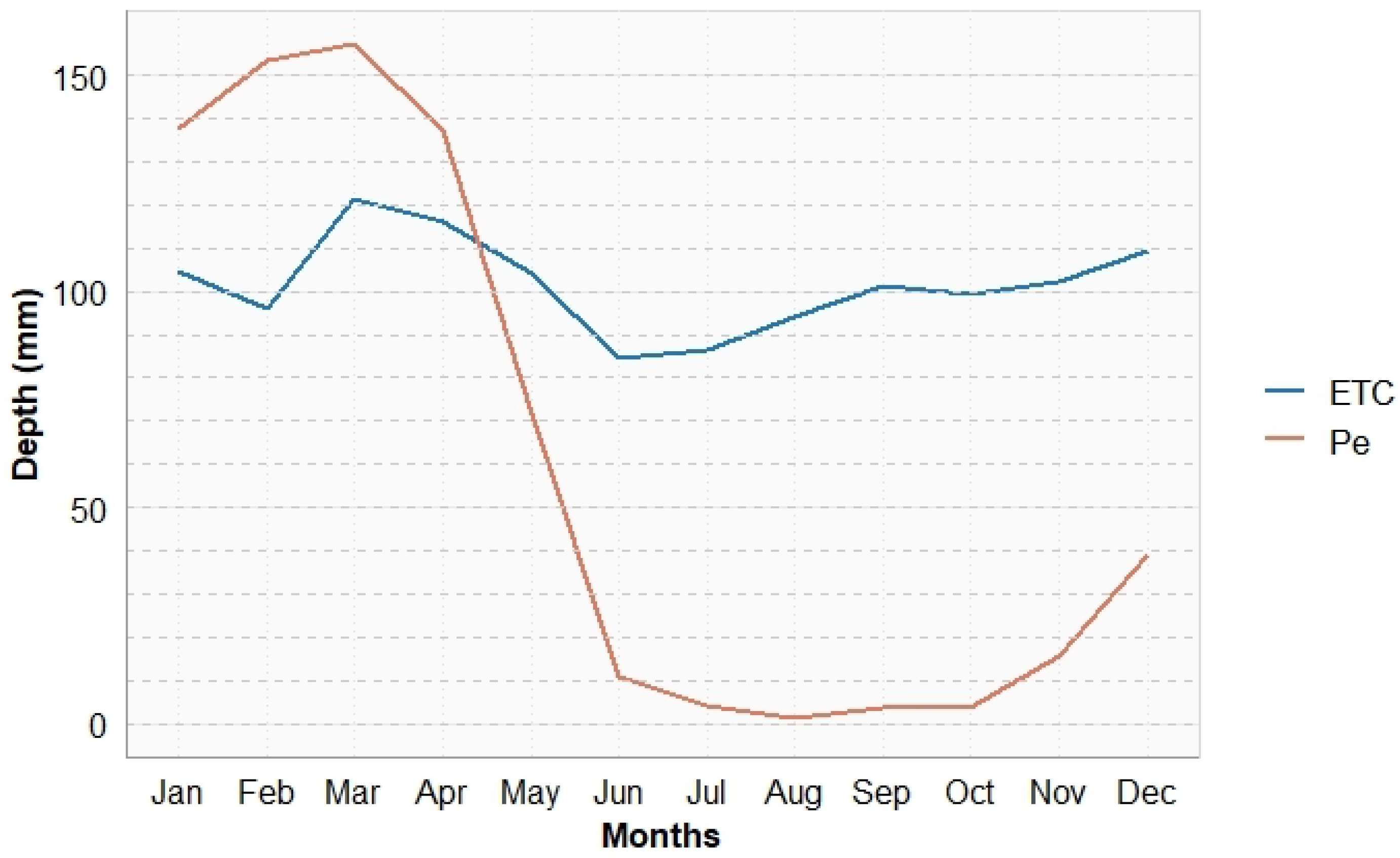
The annual water demand of banana cultivation within the study area ranged between 1078 mm and 1302 mm (Table 2, Figure 2), consistent with the values reported for this crop in semi-humid regions of the Ecuadorian coast [21]. This demand was supplied by 48.3% rainfall-derived water (green ETc), mainly concentrated from December to April, while the remaining 51.7% was covered through irrigation (blue ETc).
Table 2. Crop evapotranspiration (ETc) and differentiation between green and blue ETc.
Figure 2. Interaction between crop evapotranspiration (ETc) and effective precipitation ( P e ) in the study area.
These proportions in banana water supply are relatively close to one of the few records found in the literature for the southern region of the country, the El Oro province, that reported 56.0% green E T c and 44.0% blue E T c [22]. This suggests that banana cultivation exerts a moderate level of pressure on water sources, contrasting with semi-arid regions such as Northeastern Brazil, where 78.0% of the water demand is supplied by surface and groundwater sources [23].
The annual rainfall pattern in the study area follows the general behaviour of Ecuador’s coastal region [24], clearly delineating the irrigation season. Irrigation begins in May and ends in December, covering 52% (blue ETc) of the total annual water requirement of 1220 mm (Table 2), a value typical of humid tropical zones [20]. The green ETc is mostly concentrated in the first four to five months of the year, during which effective precipitation fully meets crop demand.

3.2. Irrigation and Replacement Depth

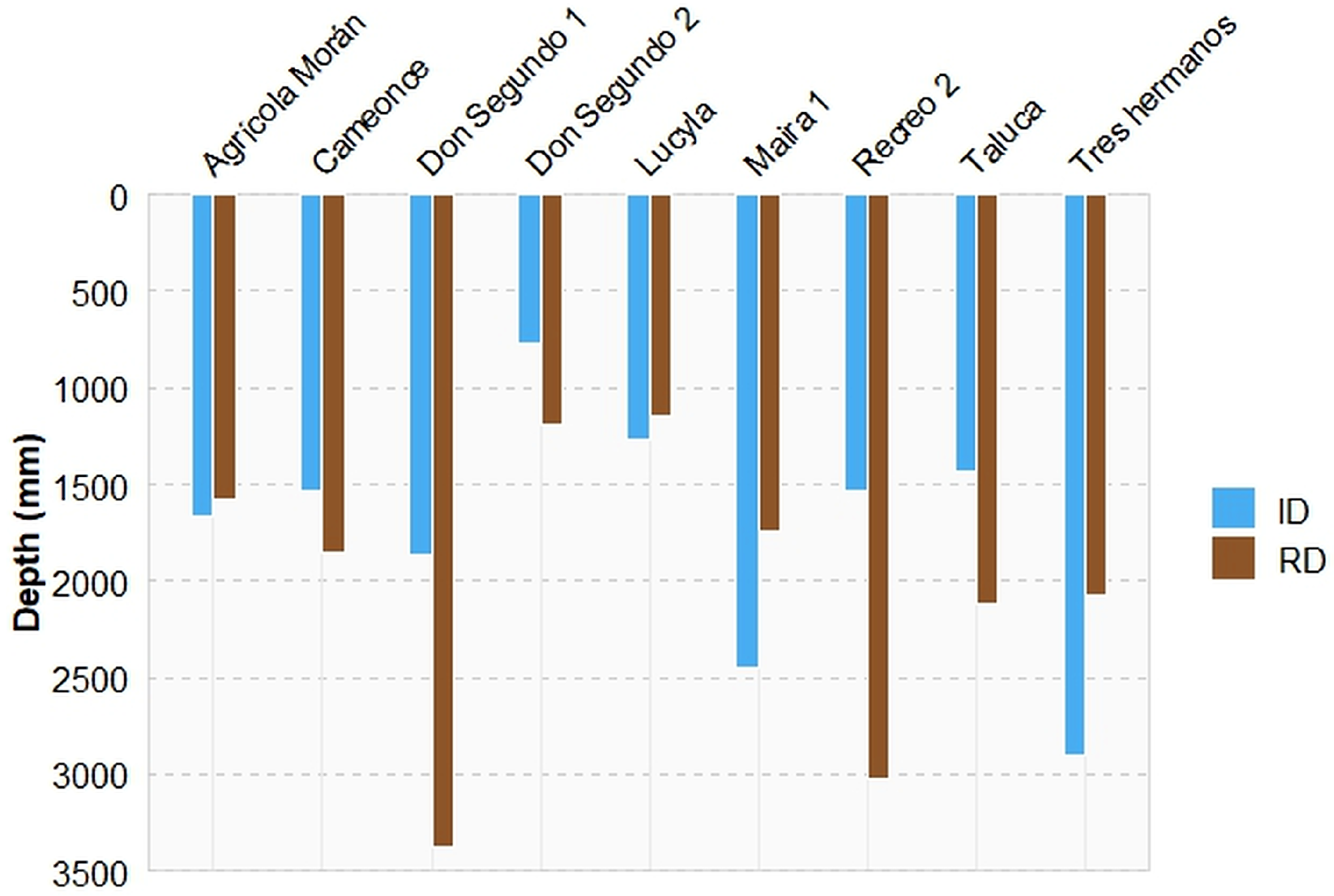
Although none of the farms quantified the crop’s water demand (irrigation management), using generally indirect methods that estimate the species’ evapotranspiration, the practice of irrigating at intervals no longer than three days and for short durations (2 to 3 h) mimics drip irrigation conditions, which promote greater efficiency in water resource use. This management approach simulates the operation of drip irrigation systems, which enhance water use efficiency by minimising percolation and runoff losses [25].
Among the surveyed farms, only two exhibited notable percolation losses (Figure 3, Table 3). However, in the overall analysis, these losses constituted about 18%, which in turn suggests an approximate efficiency of 82% (95% CI: 72–92%), consistent with well-managed sprinkler irrigation systems [26].
Figure 3. Irrigation depth (ID) and replacement depth (RD) in each of the farms.
Table 3. Irrigation depths, replenishment, percolation, and grey water footprint in dry season (irrigation) in the field.
These findings highlight a relatively efficient use of water across most production units, where irrigation frequency and duration are empirically adjusted according to crop conditions, soil texture, and local microclimate. Nevertheless, the adoption of soil moisture monitoring tools (e.g., tensiometres or capacitive sensors) is recommended to further optimise irrigation scheduling and reduce variability among farms.

3.3. Grey Water Footprint During Dry and Rainy Seasons

The irrigation management observed on the evaluated farms suggests a relatively adequate level of efficiency, reflected in very low grey water footprint values during the irrigation period (May–December). In most cases, this component was practically null; however, sporadic increases were detected in some farms, with values between 13.5 and 13.7 m3 t−1 (Table 3), possibly associated with greater water losses in specific sectors. These results should be interpreted with caution, as they may be influenced by the spatial variability of the soil and the specific management conditions of each plot; therefore, additional assessments are recommended to confirm this trend.
Considering what occurred during the dry and rainy seasons, in terms of the grey water footprint at the field stage (production), we can conclude that it is generated primarily during the rainy period (Table 4), when precipitation continuously exceeds the water holding capacity of the soil and produces diffuse contamination by agrochemicals such as nitrogen, which is difficult to quantify using more detailed procedures such as those applied in the dry season [1]. The sum of the grey water footprint values from the dry and rainy seasons yielded a minimum of 5.7 and a maximum of 27.7 m3 t−1 (Table 3 and Table 4), comparatively lower than those reported by several authors [20,27] in studies that used a simpler method with generalised information, assuming a constant water surplus and a fixed 10% leaching rate of applied agrochemicals [17].
Table 4. Amount of nitrogen applied and grey water footprint in the rainy season in the field.

3.4. Crop Water Footprint

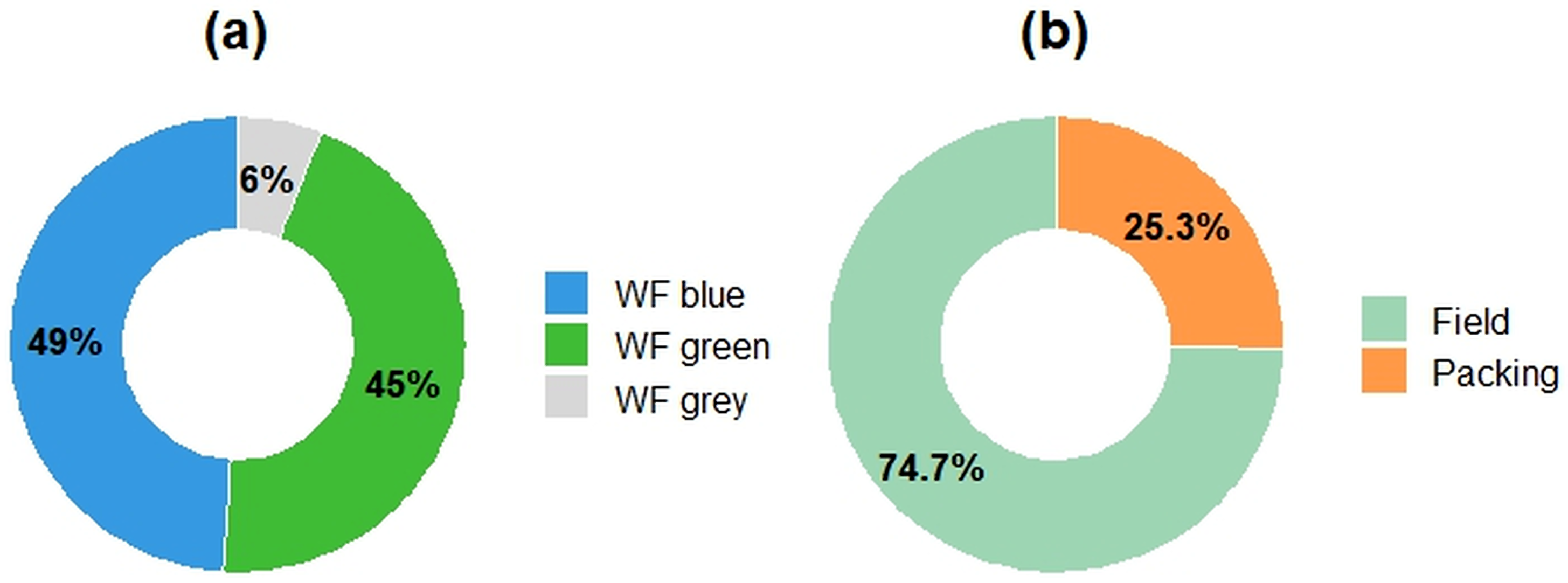
The average total water footprint (WF) of banana cultivation in the study area was 351.4 m3 t−1 (Table 5), distributed as follows: 45.0% green WF, 49.0% blue WF, and 6.0% grey WF (Figure 4a). This value is lower than that reported by Zárate and Kuiper [22] for Southern Ecuador (576 m3 t−1), later cited by the Food and Agriculture Organization of The United Nations (FAO) [20].
Table 5. Water footprint of banana cultivation for each farm.
Figure 4. Distribution of water footprint (WF) within the study area. (a) Share of green, blue, and grey WF; (b) relative contribution of field and packing processes to total grey WF.
Such differences can be attributed to the production context: Those authors recorded highly variable yields (1–43 t ha−1 yr−1) across 15 farms, which on average were significantly lower than those in this study. Given that WF is inversely related to yield, lower productivity results in higher green and blue WF values even under similar evapotranspiration levels.
In this research, the sum of green + blue WF (330.2 m3 t−1) exceeds the 289 m3 t−1 reported by Roibás et al. [27] for conventional banana systems in Ecuador, though their estimates were based on secondary data and the simplified approach by Hoekstra et al. [1].
A key methodological distinction in this work was the in situ quantification of percolation losses during the irrigation period, allowing a direct estimation of the grey WF of the dry season. Results indicated that, in five of the nine farms, no grey WF was recorded during the irrigation months (Table 3).
By integrating the grey WF from the rainy season [17] and that from the packing process, a total average of 21.1 m3 t−1 was obtained (Table 5), equivalent to 6.0% of the total WF (Figure 4a). This value is markedly lower than the 103.7 m3 t−1 reported by the Food and Agriculture Organization of The United Nations (FAO) [20] and the 135.0 m3 t−1 by Roibás et al. [27] for conventional banana systems.
Overall, these results show that assuming a fixed 10% nitrogen leaching rate, as proposed in global models, significantly overestimates the grey WF in tropical regions where agronomic management and soil characteristics mitigate nutrient leaching. Locally derived data thus provide a more realistic basis for sustainable water management in export-oriented banana systems [28,29].

3.5. Grey Water Footprint in the Packing Process

A final aspect evidenced from the in situ evaluation is that the average grey water footprint (WFgrey) during packing is 5.3 L kg−1, corresponding to 25.3% of the total grey WF of the crop (Figure 4b). This result differs from that reported by the Food and Agriculture Organization of The United Nations (FAO) [20], which establishes the grey WF of packing at 1.3 L kg−1, and differs from the value of 1.96 L kg−1 reported by Zárate and Kuiper [22] for banana plantations in Southern Ecuador. The latter studies considered different pollutants (BOD, COD, and sulphates) from those evaluated in this study (active chlorine). This finding underscores the need for efficient water management in packing operations, as none of the evaluated farms employ recirculation procedures that could reduce water use by up to 55% [20].
When economic conditions and resources permit, it is always preferable to assess the water footprint on-site under the specific conditions of a crop. This approach allows the verification of the true strengths of producers in water management and protects the corporate reputation of a company regarding environmental care, as remotely calculated results may be detrimental to the company’s image.
Finally, it is important to note that the results of this study are not conclusive. Extending the analysis to other key producing areas, such as Los Ríos and El Oro [30], was not possible at this stage due to logistical constraints and the scope of the project, which was limited to the Guayas province because of its representativeness in national banana production. Although the climatic conditions in these provinces are relatively similar to those in Guayas, local differences in management practices and soil properties could influence the results. In addition, the substantial contribution of the grey water footprint associated with the packing process is highlighted, underscoring the need to implement alternatives that mitigate the pollution generated.

4. Conclusions

The total water footprint of banana cultivation in the Guayas province was 351.4 m3 t−1, comprising 45.0% green, 49.0% blue, and 6.0% grey components. Of the grey fraction, 74.7% originated from field operations and 25.3% from packing. These values point to a comparatively low potential nitrogen pollution load, likely linked to efficient local fertilisation and irrigation practices. While nitrogen measurements in percolated water are consistent with this interpretation, they primarily indicate a regional tendency toward water use efficiency and do not provide definitive confirmation of leaching rates.

Author Contributions

F.C.G.L.: writing—original draft, writing—review and editing, calculating, and data curation. F.d.R.R.J.: data curation, formal analysis, and investigation. All authors have read and agreed to the published version of the manuscript.

Funding

This research was funded by the Universidad Agraria del Ecuador through its research funds.

Data Availability Statement

The data that support the findings of this study are available from the corresponding author upon reasonable request.

Acknowledgments

The authors would like to thank the owners and field managers of the nine farms studied in this research for generously sharing their time and providing the necessary data. The authors have reviewed and edited the output and take full responsibility for the content of this publication.

Conflicts of Interest

The authors declare that the research was conducted in the absence of any commercial or financial relationships that could be construed as a potential conflict of interest.

Abbreviations

The following abbreviations are used in this manuscript:
WFNWater Footprint Network
WFWater Footprint
ETEvapotranspiration
ETcCrop Evapotranspiration
ETgreenGreen Evapotranspiration
ETblueBlue Evapotranspiration
ETcCrop Evapotranspiration (general)
PeEffective Precipitation
TATotal Application (nitrogen fertiliser rate)
CmaxMaximum Permissible Concentration
NTKTotal Kjeldahl Nitrogen
LRIrrigation Depth (Lr)
LrepRefill Depth
ApPercolation Volume
CpPercolate Concentration
ViWastewater Volume
ACActive Chlorine
OMOrganic Matter
HccField Capacity
BDBulk Density

References

  1. Hoekstra, A.Y.; Chapagain, A.K.; Aldaya, M.M.; Mekonnen, M.M. The Water Footprint Assessment Manual: Setting the Global Standard; Earthscan/Routledge: London, UK, 2011. [Google Scholar] [CrossRef]
  2. Mekonnen, M.M.; Hoekstra, A.Y. The green, blue and grey water footprint of crops and derived crop products. Hydrol. Earth Syst. Sci. 2011, 15, 1577–1600. [Google Scholar] [CrossRef]
  3. Vanham, D.; Hoekstra, A.; Hoekstra, A.; Wada, Y.; Bouraoui, F.; Roo, A.D.; Mekonnen, M.; Bund, W.; Batelaan, O.; Pavelic, P.; et al. Physical water scarcity metrics for monitoring progress towards SDG target 6.4: An evaluation of indicator 6.4.2 “Level of water stress”. Sci. Total Environ. 2018, 613–614, 218–232. [Google Scholar] [CrossRef] [PubMed]
  4. Romero, M.; Quintero, M.; Monserrate, F. Elementos Técnicos para la Medición de Huella Hídrica en Sistemas Agrícolas; Centro Internacional de Agricultura Tropical (CIAT): Cali, Colombia; Palmira, Colombia, 2016. [Google Scholar]
  5. Clercx, L.; Ríos, R.A.; van Dijk, J.; Calón, A.; Boelee, P. Water footprint assessment of bananas produced by small banana farmers in Peru and Ecuador. In Acta Horticulturae; International Society for Horticultural Science: Korbeek-Lo, Belgium, 2016; Volume 1112, pp. 1–8. [Google Scholar]
  6. Rattanapan, C.; Ounsaneha, W. Water Footprint Assessment of Thai Banana Production. Int. J. Environ. Sci. Dev. 2021, 12, 103–109. [Google Scholar] [CrossRef]
  7. Allen, R.; Pereira, L.; Raes, D.; Smith, M. Evapotranspiración del Cultivo: Guías para la Determinación de los Requerimientos de Agua de los Cultivos; FAO: Rome, Italy, 2006. [Google Scholar]
  8. Panigrahi, N.; Thompson, A.J.; Zubelzu, S.; Knox, J.W. Identifying opportunities to improve management of water stress in banana production. Sci. Hortic. 2021, 276, 10735. [Google Scholar] [CrossRef]
  9. Instituto Nacional de Estadísticas y Censos (INEC). Encuesta de Superficie y Producción Agropecuaria Continua; INEC: Quito, Ecuador, 2024. [Google Scholar]
  10. Elbehri, A.; Calberto, G.; Staver, C.; Hospido, A.; Roibás, L.; Skully, D.; Siles, P.; Arguello, J.; Sotomayor, I.; Bustamante, A. Cambio Climático y Sostenibilidad del Banano en el Ecuador: Evaluación de Impacto y Directrices de políTica; Technical Report; FAO: Rome, Italy, 2015. [Google Scholar]
  11. Muñoz, J.; Gentili, B.; Bustos, R. Uso agrícola del suelo y demanda de agua para riego en la cuenca del río Vinces (Ecuador) durante el período 1990–2014. Rev. Investig. Geogr. 2020, 59, 91–104. [Google Scholar] [CrossRef]
  12. Bilgili, A.V.; Yeşilnacar, I.; Akihiko, K.; Nagano, T.; Aydemir, A.; Sefa, H.; Bilgili, A. Post-irrigation degradation of land and environmental resources in the Harran plain, southeastern Turkey. Environ. Monit. Assess. 2018, 190, 660. [Google Scholar] [CrossRef] [PubMed]
  13. Cruz-Pérez, N.; Ortega-Gaucin, M.; Castillo-Rey, J.E.; Pérez-Pérez, J.A. Water footprint of representative agricultural crops on volcanic islands: The case of the Canary Islands. Renew. Agric. Food Syst. 2023, 38, e36. [Google Scholar] [CrossRef]
  14. Villazón, J.; Noris, P.; Martín, G. Determinación de la precipitación efectiva en áreas agropecuarias de la provincia de Holguín. IDESIA 2021, 39, 85–90. [Google Scholar] [CrossRef]
  15. Peñaloza-Sánchez, A.; Bustamante-González, T.; Vargas-López, S.; Jaramillo-Villanueva, J.; Quevedo-Nolasco, A. Huella hídrica de los cultivos de cebolla (Allium cepa L.) y tomate de cáscara (Physalis ixocarpa Brot.) en la región de Atlixco, Puebla, México. Tecnología y Ciencias del Agua 2020, 11, 1–30. [Google Scholar] [CrossRef]
  16. Mestanza, S.; Mite, F.; Arreaga, J.; Alcívar, S.; Carrera, J.; Laínez, J. Como Fertilizar Banano en Ecuador; Instituto Nacional Autónomo de Investigaciones Agropecuarias (INIAP): Quito, Ecuador, 1993. [Google Scholar]
  17. Hoekstra, A.Y.; Chapagain, A.K. Globalization of Water: Sharing the Planet’s Freshwater Resources; Blackwell Publishing: Oxford, UK, 2007. [Google Scholar] [CrossRef]
  18. Ministerio del Ambiente. Anexos del Texto Unificado de Legislación Secundaria del Ministerio del Ambiente (Acuerdo Ministerial 097-A); Registro Oficial 387; Ministerio del Ambiente: Magdalena del Mar, Peru, 2015.
  19. Saxton, K.; Rawls, W. Soil water characteristic estimates by texture and organic matter for hydrologic solutions. Soil Sci. Soc. Am. J. 2006, 70, 1569–1578. [Google Scholar] [CrossRef]
  20. Food and Agriculture Organization of The United Nations (FAO). Huella de Agua en la Industria Bananera; FAO: Rome, Italy, 2017. [Google Scholar]
  21. Caicedo, O.; Balmaseda, C.; Proaño, J. Programación del riego del banano (Musa paradisiaca) en finca San José 2, Los Ríos, Ecuador. Rev. Cienc. Tec. Agropecu. 2015, 24, 18–22. [Google Scholar]
  22. Zárate, E.; Kuiper, D. Evaluación de Huella Hídrica del Banano para Pequeños Productores en Perú y Ecuador; Technical Report; Good Stuff International: ‘s-Hertogenbosch, The Netherlands, 2013. [Google Scholar]
  23. Oliveira, V.R.d.; Costa, R.N.; Gonçalves, K.G.; Barros, V.D.S. Water footprint of banana in the Brazilian semi-arid region. Rev. Cienc. Agron. 2022, 53. [Google Scholar] [CrossRef]
  24. Organización de las Naciones Unidas para la Alimentación y la Agricultura (FAO). Perfil de País—Ecuador. AQUASTAT; FAO: Rome, Italy, 2015. [Google Scholar]
  25. Wang, L.; Wu, W.; Xiao, J.; Huang, Q.; Hu, Y. Effects of different drip irrigation modes on water use efficiency of pear trees in Northern China. Agric. Water Manag. 2021, 245, 106660. [Google Scholar] [CrossRef]
  26. Organización de las Naciones Unidas para la Alimentación y la Agricultura (FAO). Elementos para el Proyecto de Drenajes; Technical Report; FAO: Rome, Italy, 1985. [Google Scholar]
  27. Roibás, L.; Elbehri, A.; Hospido, A. Evaluating the sustainability of Ecuadorian bananas: Carbon footprint, water usage and wealth distribution along the supply chain. Sustain. Prod. Consum. 2015, 2, 3–16. [Google Scholar] [CrossRef]
  28. Vergé, X.; VanderZaag, A.; Smith, W.; Grant, B.; Gordon, R. The consideration of time step in calculating grey water footprints of agricultural cropping systems. Ecol. Indic. 2017, 78, 31–36. [Google Scholar] [CrossRef]
  29. Muratoglu, A. Grey water footprint of agricultural production: An assessment based on nitrogen surplus and high-resolution leaching runoff fractions in Turkey. Sci. Total Environ. 2020, 742, 140553. [Google Scholar] [CrossRef] [PubMed]
  30. Instituto Nacional de Estadísticas y Censos (INEC). Información Ambiental y Tecnificación Agropecuaria (Módulo Métodos de Producción y Ambiente); INEC: Quito, Ecuador, 2024. [Google Scholar]
Disclaimer/Publisher’s Note: The statements, opinions and data contained in all publications are solely those of the individual author(s) and contributor(s) and not of MDPI and/or the editor(s). MDPI and/or the editor(s) disclaim responsibility for any injury to people or property resulting from any ideas, methods, instructions or products referred to in the content.

Article Metrics

Citations

Article Access Statistics

Multiple requests from the same IP address are counted as one view.