Article

Research on Stage-Divided Flood-Limited Water Level Under Pre-Release Rules During Flood Season

1
Jiangxi Academy of Water Science and Engineering, Nanchang 330029, China
2
Jiangxi Hydraulic Safety Engineering Technology Research Center, Nanchang 330029, China
3
Jiangxi Key Laboratory of Flood and Drought Disaster Defense, Nanchang 330029, China
4
Jiangxi Provincial Technology Innovation Center for Ecological Water Engineering in Poyang Lake Basin, Nanchang 330029, China
5
School of Civil and Surveying & Mapping Engineering, Jiangxi University of Science and Technology, Ganzhou 341000, China
6
School of Business Administration, Jiangxi University of Water Resources and Electric Power, Nanchang 330099, China
7
College of Water Conservancy, Jiangxi University of Water Resources and Electric Power, Nanchang 330099, China
*
Author to whom correspondence should be addressed.
Water 2025, 17(23), 3348; https://doi.org/10.3390/w17233348
Submission received: 10 September 2025 / Revised: 17 November 2025 / Accepted: 20 November 2025 / Published: 22 November 2025
(This article belongs to the Special Issue Flood Risk Identification and Management, 2nd Edition)

Abstract

Flood Limited Water Level (FLWL) serves as the core control parameter for the synergistic optimization of flood control operation and beneficial water utilization efficiency in reservoirs during the flood season. Addressing the critical issue of insufficient adaptability in static control schemes, this study innovatively proposes a staged dynamic FLWL regulation model based on pre-release rules. This methodology combines hydrometeorological division theory with frequent flood control mechanisms and establishes a dual-threshold control equation with safe pre-release discharge (qpre) and effective pre-release duration (tpre) as sensitive factors. The dynamic FLWL scheme is designed to ensure that no additional risk is imposed on the reservoir and its upstream/downstream regions, and it incorporates a set of hierarchical rules for the strategic pre-release and standard safety modes. Taking the Wuxikou Reservoir in Jiangxi Province as a case study, the safe pre-release discharge value under regular flood conditions and the effective pre-release duration are determined. Additionally, a dynamic FLWL control model is developed according to the reservoir’s characteristics. The verification results demonstrate the significant benefits of the dynamic FLWL model in reducing peak water levels and shortening flood duration. Compared with the original operation plan, the proposed model effectively lowers the maximum water level of the reservoir by 10% and simultaneously shortens the duration of high water levels by nearly 24 h. The research results provide a reference for the efficient utilization of water resources in reservoir basins in monsoon humid areas.

1. Introduction

Reservoirs serve as critical infrastructure for balancing flood control, water supply, hydropower generation, and ecological protection in river basins worldwide [1,2,3]. Reservoir rule curves—widely applied in long-term reservoir management [4,5]—are static or seasonally fixed upper/lower bounds on reservoir storage/level, serving as strategic benchmarks to guide basic operational decisions.
During the reservoir’s operation in the flood season, the water level of reservoirs cannot be kept too high due to the possibility that large floods may occur, while the water level of the reservoir cannot be kept too low due to water storage requirements [6,7]. As a key operational parameter, the flood-limited water level enables a reservoir to strike a balance between flood control safety and water storage capacity [8]. The flood-limited water level (FLWL)—a core operational parameter defining the maximum allowable water level during flood seasons—directly governs the balance of flood control, water supply, and other water demands [9,10].
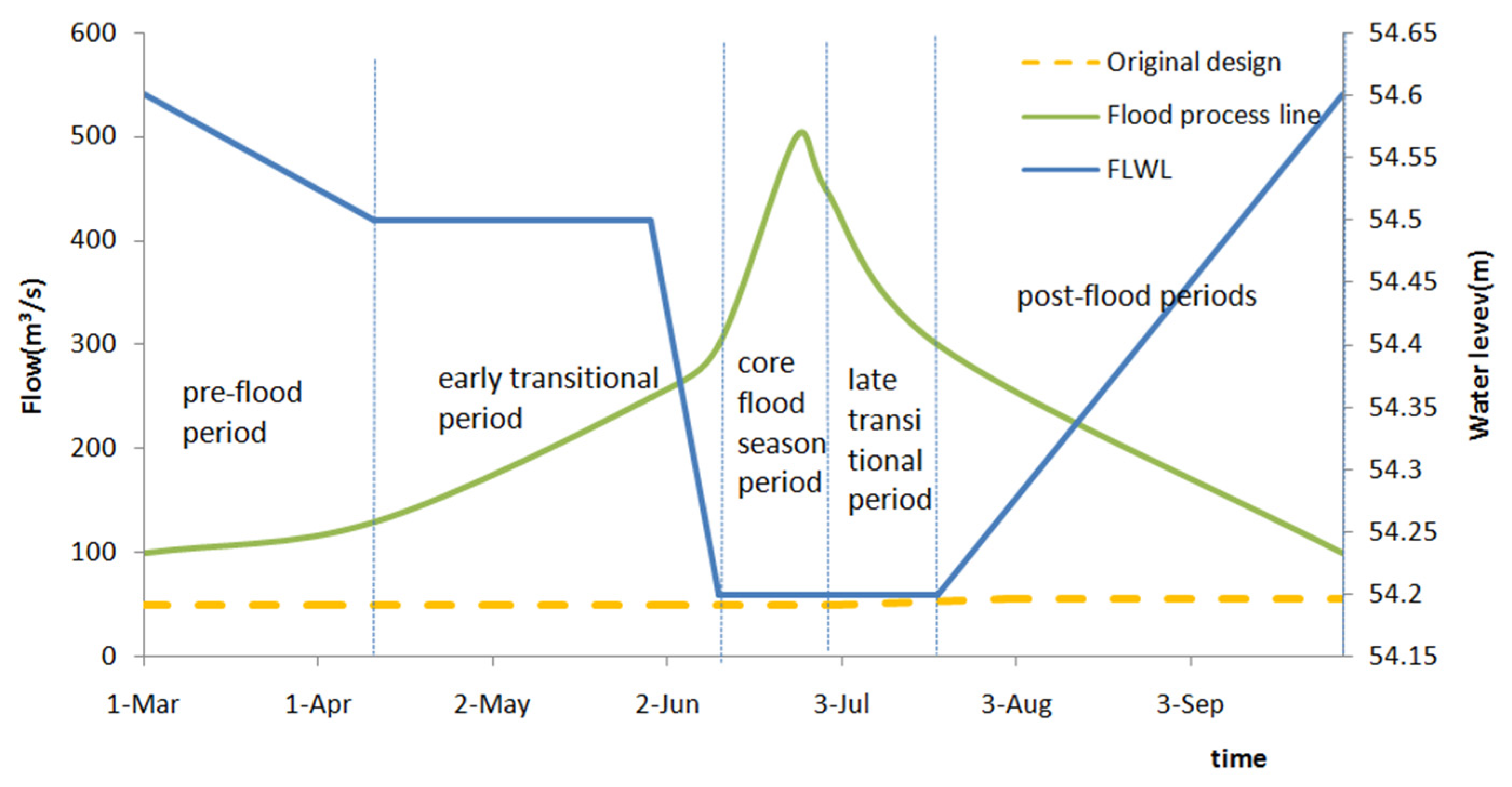
Flood season division [11,12,13], a methodological approach that segments the entire flood season into distinct phases based on hydrometeorological characteristics and risk levels, establishes the foundational framework for achieving comprehensive reservoir benefits and flood control safety [14]; this is accomplished through the subsequent implementation of dynamic control of phase-specific FLWL. The reservoirs in Jiangxi Province have implemented flood season division, from 1 April to 30 June as the core flood season and from 1 July to 30 September as the post-flood season. From Figure 1, it can be seen that the flood season (March–September) is divided into five intervals, namely pre-flood (1 March–10 April), early transitional (11 April–10 June), core flood season (11 June–30 June), late transitional (1 July–20 July), and post-flood (21 July–30 September).
Cunderlik et al. [15] developed a novel framework integrating vector statistical analysis and relative frequency quantification, employing the Annual Maximum Method (AMM) and Peaks Over Threshold (POT) sampling paradigms to investigate spatiotemporal variations in flood seasonality across the UK. Beurton et al. [16] applied cluster analysis to observed maximum flood data from hydrological stations across Germany, classifying the catchment into three distinct hydrological zones based on flood event timing and magnitude. These methods integrate the theoretical framework of flood season division with staged FLWL control strategies.
The methods for determining FLWL during flood seasons primarily encompass static control and dynamic control methods [17]. Static control methods are further subdivided into static control of annual FLWL (SC-AFLWL) [18] and static control of seasonal FLWL (SC-SFLWL) according to different FLWL determination methods [19,20,21]. Static control methods, widely applied in the planning and construction of water conservancy projects, SC-AFLWL is designed as an annual design flood, while the SC-SFLWL is designed as a seasonal design storm. However, the application of static scheduling parameters throughout flood seasons may result in suboptimal allocation of water resources, thereby reducing the efficiency of floodwater utilization and exacerbating downstream ecological risks [8]. At present, most reservoirs in Jiangxi Province adopt SC-SFLWL, which is generally divided into core flood season and post-flood season. The Wuxikou Reservoir in this case adopts SC-SFLWL. Against this backdrop, dynamic FLWL control methods have emerged to address static schemes’ rigidity. Yun and Singh [20] identified two methodologies for enhancing reservoir storage capacity while maintaining flood control security. The first strategy employs a multi-period limited water level analogous to seasonal FLWL, derived from design storms of varying durations. The second approach implements dynamic control of FLWL (DC-FLWL), permitting reservoir stage fluctuations within a predefined range bounded by upper and lower control domains. This study focuses on analyzing the upper limit, with FLWL obtained through the pre-release method as the upper limit and the lower limit as the original flood control water level.
Conventional FLWL management relies primarily on static control schemes, which set a fixed water level for the entire flood season or phases based on historical frequency analysis of design floods [22]. However, this approach fails to account for the temporal heterogeneity of hydrometeorological risks—a critical limitation in regions with distinct seasonal flood patterns (e.g., monsoon humid areas), where early flood periods (low risk) and core flood periods (high risk) demand divergent operational strategies [3].
Advances in the accuracy of short-term weather and hydrological forecasts have enabled dynamic FLWL regulation methods incorporating predictive information. Wang et al. [23,24,25] implemented rainfall forecast-driven FLWL control, where forecast error impacts were analyzed to determine operational levels through pre-release and pre-storage operations. This method focuses on analyzing the practical probabilities of forecast failures—specifically, the non-occurrence of predicted no-rain, light-rain, and moderate-rain events. Based on the classification level of the rainfall forecast information, the real-time dynamic control thresholds for the reservoir’s flood limit water level are determined. Acknowledging the relatively high accuracy of contemporary rainfall forecasting, this study recognizes that while the probability of forecast omission exists, the overall utility of forecast information remains considerable. The breakthrough in this approach lies in its safety analysis of the key parameter. Guo et al. [2,26,27] developed a Copula-based optimization framework for seasonal FLWL, where Pareto-optimal scheduling schemes balancing flood control and conservation objectives were derived through the NSGA-II multi-objective genetic algorithm. The copula function is employed to construct the joint distribution of seasonal floods, with its primary focus being to clarify the relationship between seasonal flood characteristics and annual maximum flood frequency. This approach ensures that the derived design flood combinations under various seasonal scenarios satisfy the required flood control standards. This study integrates qualitative and quantitative methods to comprehensively determine the seasonal distribution patterns of floods within designated flood seasons. By applying distinct operational rules to different seasonal periods, it emphasizes the determination of FLWL through the implementation of varying pre-release rules under the established flood season division framework. Pre-release rules mean that in reservoir operation, upon issuance of rainfall forecasts, reservoir operators implement pre-release by discharging a portion of stored water in advance to lower the operational water level, creating enhanced storage capacity for impending flood events.
FLWL can fluctuate in a specific domain based on real-time flood forecast information [28]. The theoretical foundation for dynamic control of FLWL is principally constructed upon the conceptual framework of pre-storage and pre-discharge operations [29]. This encompasses several methodological approaches: (1) the flood forecast-based operation [30,31,32], (2) the pre-discharge capacity constraint method [2,33,34], and (3) risk-benefit multi-objective optimization [35,36,37]. Reservoir-specific parameters and forecast uncertainties constrain the universal applicability of current methodologies. The flood forecast-based operation implementation requires forecasted cumulative net rainfall as a fundamental input parameter [38]. However, this parameter is often difficult to obtain for reservoirs that do not implement cumulative net rainfall forecasting, limiting the method’s general applicability. The pre-release capacity constraint method synthesizes key factors, including flood forecast information, rainfall forecast data, the initial recession flow [39], and downstream discharge allowances, to derive a dynamic control domain for the FLWL to varying degrees. While this approach emphasizes flood management during the recession phase, the initial recession flow itself is challenging to determine precisely.
Reservoir-specific parameters and forecast uncertainties constrain the universal applicability of current methodologies. The flood forecast-based operation implementation requires to be forecasted cumulative net rainfall as a fundamental input parameter [38]. However, this parameter is often difficult to obtain for reservoirs that do not implement cumulative net rainfall forecasting, limiting the method’s general applicability. The pre-release capacity constraint method synthesizes key factors, including flood forecast information, rainfall forecast data, the initial recession flow [39], and downstream discharge allowances, to derive a dynamic FLWL control domain to varying degrees. While this approach emphasizes flood management during the recession phase, the initial recession flow itself is challenging to determine precisely.
The pre-release index-based reservoir operation method [33] requires the integration of reservoir storage capacity, forecasted flood volume, peak discharge, and time-to-peak to calculate a real-time pre-release index. After comparing these indicators with the pre-discharge depth threshold, forecast-based operation is implemented, which imposes high requirements on both the accuracy of forecasts and the completeness of forecast elements. Alternatively, another approach employs deep learning models to extract nonlinear relationships from long-term reservoir operational data under complex temporal dynamics, enabling multi-scenario dispatching strategies. However, such approaches remain constrained by operational feasibility during real-time decision-making by reservoir operators [40]; the model may generate physically implausible results when making long-term extrapolations beyond the training data domain. Similarly, while multi-objective comprehensive analysis prioritizes balancing benefits against risks, it fails to fully consider the seasonal variation characteristics of the basin and the comprehensive application of division results.
Prior research [4,22] has also proposed optimization-driven frameworks—such as gradient descent-based rule curve generation and Model Predictive Control (MPC)—to adjust FLWL in response to real-time or forecasted hydrological conditions. However, these methods face two key barriers to practical implementation. First, many dynamic models depend on high-precision real-time forecasts (e.g., cumulative net rainfall, initial recession flow) or complex parameterization (e.g., stochastic inflow scenario ensembles), which are often unavailable for reservoirs in data-constrained regions [5]. Second, even data-sufficient models rarely prioritize operational feasibility; overly complex optimization outputs (e.g., continuous FLWL adjustments) are difficult for on-site operators to interpret and execute, leading to implementation gaps between theoretical optimality and real-world practice [22].
Compounding these challenges is the non-stationarity of hydrological systems under climate change. Cuvelier et al. [5] note that traditional optimization—relying on stationary historical inflow data—fails to robustly address extreme events (e.g., unprecedented heavy rainfall) or long-term shifts in runoff patterns. For reservoirs in monsoon regions, this non-stationarity exacerbates the trade-off between flood safety and water utilization: static FLWL schemes either over-release water in mild flood periods (wasting resources) or lack storage space for sudden extreme inflows (increasing flood risk). The dynamically Zoned Target Release (DZTR) model proposed in Yassin et al. [3] partially addresses this by linking storage zones to context-specific release rules, but it focuses on release parameterization rather than FLWL control—leaving a gap in dynamic level regulation for flood season management.
To fill these gaps, this study proposes a staged dynamic FLWL regulation model based on pre-release rules, tailored to the operational needs of reservoirs in monsoon humid regions. The model adheres to three core principles derived from prior optimization best practices as follows [4,22]: (1) no additional flood risk to the reservoir or downstream areas, ensuring alignment with design safety standards; (2) operator-friendly parameterization, avoiding over-reliance on real-time forecasts by prioritizing actionable variables (safe pre-release discharge) and effective pre-release duration; and (3) phase-specific optimization, integrating hydrometeorological division theory to divide the flood season into distinct risk periods (pre-flood, early transitional, core flood, late transitional, and post-flood) and calibrate FLWL targets accordingly. By coupling iterative trial-and-verification optimization with pre-release constraint validation, inspired by gradient descent methods [4], the model balances scientific rigor and practicality.
Taking the Wuxikou Reservoir (Jiangxi Province, China)—a Class II large-scale reservoir with flood control as the primary function and water supply/hydropower as secondary benefits—as a case study, this research aims to perform the following: (1) determine site-specific values of the safety pre-release capacity and effective pre-release duration using downstream channel capacity and hydrological forecast lead time data; (2) derive phase-specific dynamic FLWL ranges via constraint-coupled optimization; (3) validate the model’s performance in reducing peak water levels and shortening high-water duration using historical flood events; and (4) provide a scalable framework for dynamic FLWL control that addresses data constraints and operational feasibility. The findings are expected to advance reservoir management theory by reconciling flood safety and water utilization while offering practical guidance for monsoon region reservoirs facing climate-driven hydrological non-stationarity.

2. Materials and Methods

2.1. Site Description

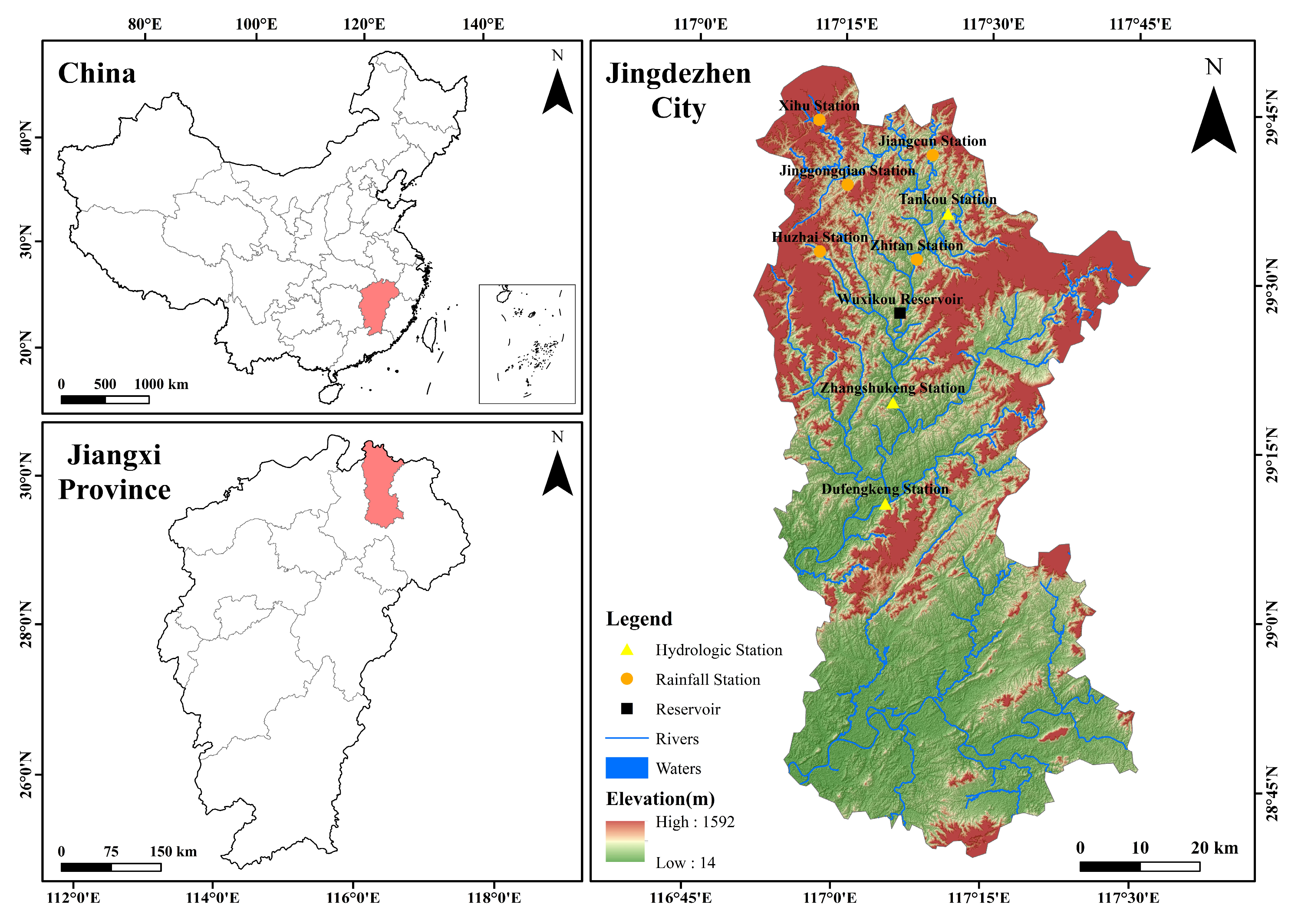
The Wuxikou Reservoir is situated in Jiaotan Town, Fuliang County, Jiangxi Province China (Figure 2), on the middle reaches of the Changjiang River mainstream. Its dam controls a catchment area of 2915 km2. Functioning primarily for flood control, this Class II large-scale water conservancy project also integrates water supply and power generation benefits. Its operational principle is that, under the precondition of ensuring dam safety, the flood storage capacity of the reservoir is fully utilized to retain floods for downstream flood control before subsequently meeting the requirements for water supply and power generation. The reservoir lies within a subtropical humid monsoon climate zone, characterized by abundant precipitation, ample sunshine, distinct seasons, and a long frost-free period. The characteristic values of the reservoir are shown in Table 1.
The reservoir’s flood season is divided into two distinct periods: the main flood season (from 1 April to 31 July), during which the SC-SFLWL is set at 50.00 m, corresponding to a storage capacity of 81.10 million m3 (81.10 × 10⁶ m3); and the other period (from 1 August to 1 March of the following year), when the SC-SFLWL coincides with the normal water level of 56.00 m, corresponding to a storage capacity of 173.00 million m3 (173.00 × 10⁶ m3).
A significant water level differential of 6.0 m exists between these two operational stages, resulting in a storage capacity difference of nearly 90 million m3 (90 × 106 m3). This large scheduling window, coupled with the extended duration between operational shifts, poses operational challenges for reservoir managers while simultaneously demonstrating significant potential for implementing dynamic control of the FLWL.

2.2. Hydrological Data

The primary driving factors for reservoir flood-season division are heavy rainfall and flood events. These factors primarily reflect the temporal distribution characteristics and variation patterns of the flood season. Specifically, rainfall emphasizes meteorological influences, whereas floods represent the integrated response of meteorological conditions combined with underlying surface characteristics. In this study, flow rate data from three hydrological stations on the main stream of the Changjiang River were used, including Tankou Station (1957–2018), Zhangshukeng Station (1952–2018), and Dufengkeng Station (1953–2018). For the partially missing data of Tankou Station and Zhangshukeng Station, the peak–discharge correlation and stage–discharge relationship were adopted for interpolation and extension. For rainfall data, comprehensive analysis was conducted using data from rainfall stations including Huzhai, Jiangcun, Jinggongqiao, Tankou, Xihu, Zhangshukeng, and Zhitan during the period of 1973–2018. The basic information of the site is shown in Table 2.
Data serves as the foundation for analytical calculations and is crucial for the accuracy of the resulting outcomes. The data employed in this study have all passed tests for reliability, consistency, and representativeness. The research data were derived from the provincial hydrological basin authority and have undergone processes of compilation, review, and consolidation. The data series used are continuous and complete, and the resulting products comply with standard requirements, ensuring data reliability. The Kendall’s rank correlation test and the Hurst coefficient method were adopted to analyze the consistency of the runoff and rainfall data, revealing no significant trends in basin precipitation and runoff. Furthermore, the residual mass curve method and the reverse-time sequential average method were utilized to examine the patterns of high-flow and low-flow variations in rainfall and runoff within the Wuxikou Reservoir basin. The analysis indicates the existence of consecutive wet, normal, and dry periods in the annual precipitation and runoff of the basin. Moreover, as time progresses, the fluctuation amplitude of the cumulative average process curve gradually diminishes, suggesting that the series has essentially stabilized. Therefore, it can be concluded that the rainfall and runoff series in the Wuxikou Reservoir basin possess satisfactory representativeness.

2.3. Method

2.3.1. General Principles

This study develops a dynamic control method for FLWL during staged flood seasons, operating under pre-release rules.
Based on the identification of seasonal flood patterns within the basin, the reservoir’s flood season is precisely delineated through qualitative and quantitative analysis of flood season division into the following phases: pre-flood, early transitional, core flood season, late transitional, and post-flood periods.
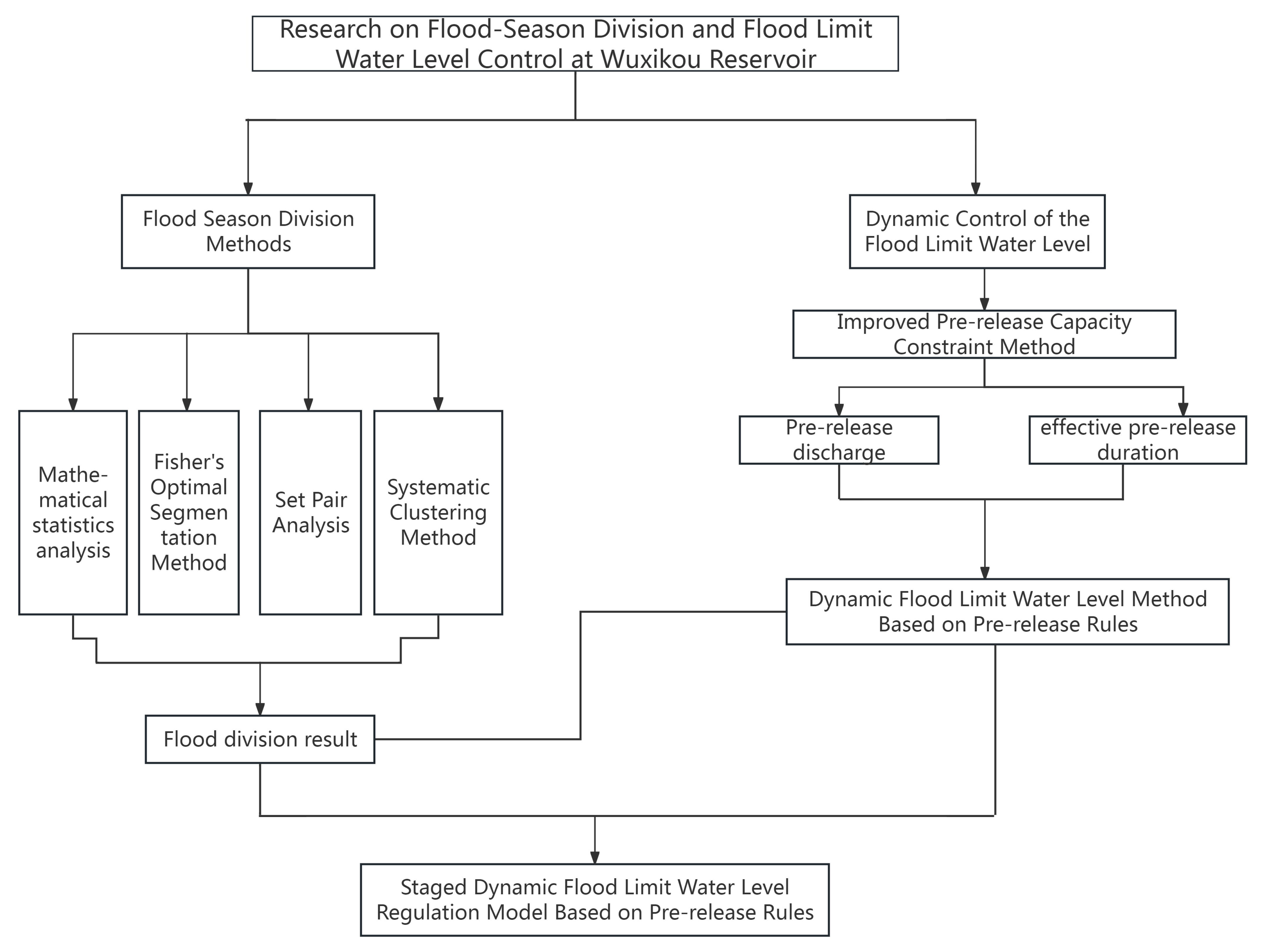
The results of flood season division are integrated into the theoretical framework for dynamic control of flood limit water levels, thus enabling phase-specific regulation strategies. Based on the core idea of the pre-discharge capacity constraint theory, the method constructs a dual-control parameter FLWL dynamic regulation model. The approach systematically analyzes key constraints, including design floods of varying return periods at the reservoir, characteristic parameters of flood hydrographs, downstream channel safety discharge capacities, and the original flood control safety framework. The methodology establishes a constraint-coupled solution framework characterized by “parameter determination-scheme validation-feedback adjustment”. The results of flood season division are synthesized with the dynamic control methodology for flood limit water levels under pre-release rules, ultimately generating spatiotemporally differentiated dynamic FLWL control schemes for staged flood seasons. Figure 3 presents the methodology flowchart.

2.3.2. Flood Season Division Methodology

Flood season division for reservoir basins initiates with identifying seasonal hydro-meteorological patterns, followed by precise delineation of membership intervals for distinct flood phases. This methodology permits FLWL adjustments within defined upper and lower thresholds across partitioned seasons, thereby enabling dynamic control of staged flood limit water levels.
Flood season division methods comprise qualitative and quantitative approaches. Qualitative analysis determines temporal distribution patterns of storm floods through meteorological causation analysis and mathematical statistics [41]. Its core principle involves identifying division thresholds using integrated statistical atlas data analysis. Quantitative methods, predominantly clustering-based techniques, establish characteristic indicator systems for flood seasons. These algorithms partition flood seasons by calculating the distance between feature vectors of individual periods and the clustering center of the main flood season phase. Common quantitative approaches include fuzzy set analysis [42], hierarchical clustering analysis [43], the Fisher optimal partition method [44], and set pair analysis [45].
This study adopts mathematical analysis, Fisher optimal partition, set pair analysis, and hierarchical clustering to determine flood season division for Wuxikou Reservoir. A comprehensive division scheme is derived through comparative rationality assessment of these integrated methodologies.

2.3.3. Pre-Release-Based Dynamic Control Methodology for FLWL

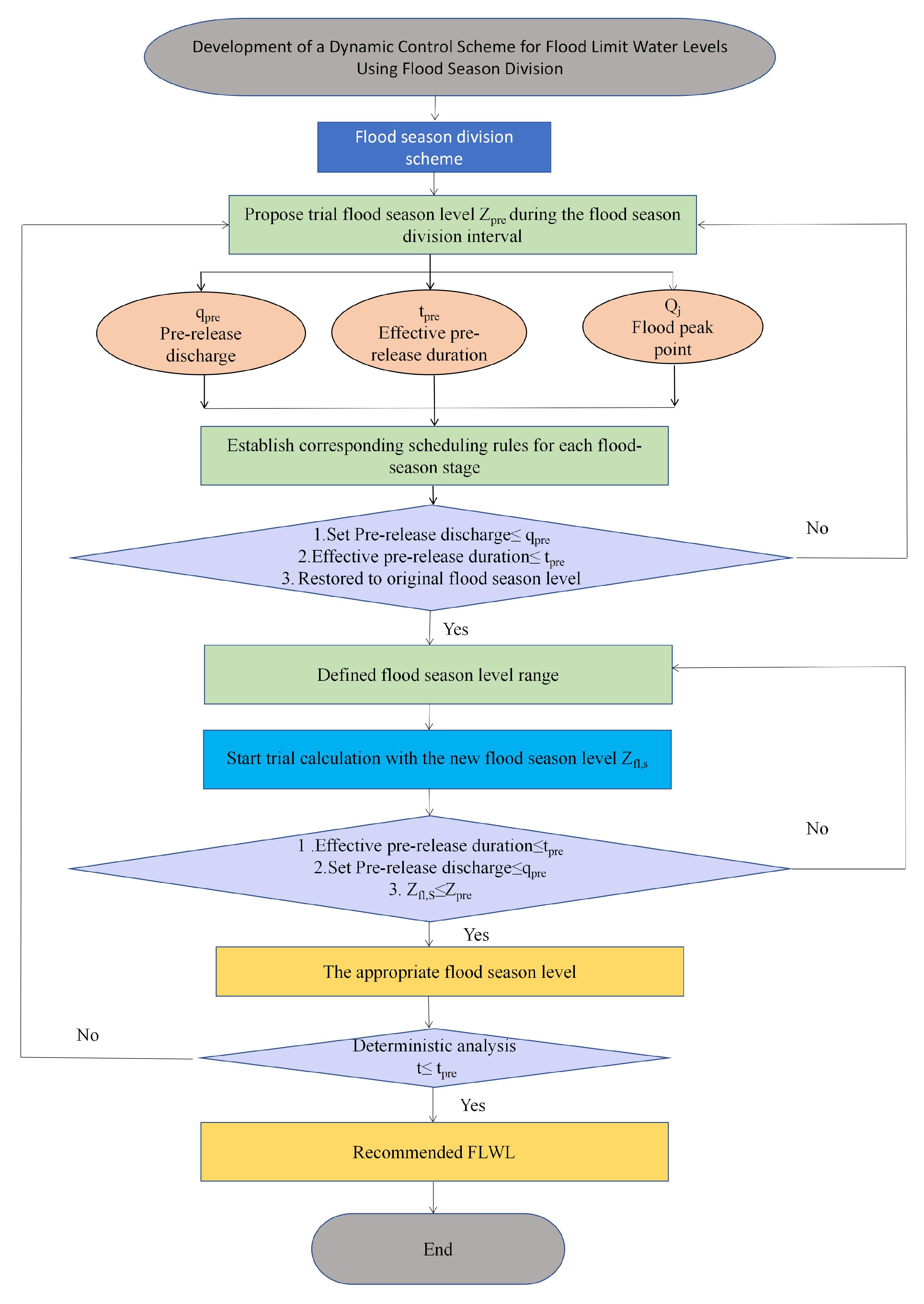
The method constructs a dual-control-parameter FLWL dynamic regulation model. Figure 4 presents pre-release-based dynamic control methodology. This model uses the safe pre-release discharge (qpre) and effective pre-release duration (tpre) as its sensitive control factors. This model employs a multi-stage iterative algorithm. The framework sets initial values for FLWL adjustment based on hydrometeorological division characteristics, determines key sensitive parameters (including safe pre-release discharge qpre and effective pre-release duration tpre) and operational constraints, and then verifies through water balance calculations whether reservoir levels can be restored to the original FLWL via pre-release operations within the tpre timeframe.
If all safety constraints are satisfied, the model confirms the dynamically adjusted FLWL value for that specific stage. Otherwise, the feedback correction mechanism activates, triggering renewed sensitivity analysis of parameters and constraint re-evaluation. This iterative process continues until all flood control safety requirements are met.
1. Key Parameter Analysis
The dynamic FLWL scheme is designed to ensure that no additional risk is imposed on the reservoir and its upstream/downstream regions. Critical parameters subject to analysis include the following: effective pre-release duration (tpre), pre-release discharge (qpre), and flood peak point (Qj).
(1) Effective pre-release duration (tpre)
tpre is influenced by multiple factors: hydrological forecast validity period, data transmission latency, rainfall forecast error duration, and operational response time. The effective pre-release duration is quantified as follows:
t p r e = T h y d Δ T e r r Δ T c o m Δ T o p + T m e t
where Thyd represents the basin flood propagation time. Integrated time presents the overall delay time from the generation to the activation of reservoir gate operation instructions; it includes forecast model error bias (ΔTerr), data acquisition/transmission duration (ΔTcom), decision-making, and mechanical response time (ΔTop). Tmet represents the effective lead time of rainfall forecasts.
(2) Pre-release Discharge (qpre)
Reservoir operation rules establish qpre with the downstream control section’s safety discharge capacity as the benchmark, governed by the principle of no additional downstream risk.
(3) Flood peak point (Qj)
Flood peak point Qj is defined as a statistically recurrent release magnitude derived from historical reservoir discharge analysis. This parameter is determined by correlating frequently recurring flood events with corresponding operational discharge patterns.
2. Trial Calculation of FLWL
(1) Constraint Criteria
Following the initial determination of FLWL (Zfl,1), subsequent water levels Zfl,n must satisfy restoration to the original FLWL within the pre-release duration tpre as follows:
q n q p r e Z f l , n Z p r e t t 1 , t p r e
(2) Methodology
The initial FLWL (Zfl,1) is determined based on design flood hydrographs Q(t) for different return periods. Reservoir operations follow:
When inflow peak discharge Q1Qj, outflow q1 maintains mass equilibrium with inflow.
When Q2 > Qj, outflow qn at time t2 is constrained by qpre and calculated through water balance.
V n = V 1 + t 1 t n ( Q i n q n ) d t   ( q n < q p r e )
The resulting storage V2 yields water level Z2. Iterative computation generates subsequent storage trajectories. Zfl,1 is validated if Zfl,n restores to the original FLWL (Zpre) within tpre; otherwise, recalibration is performed until convergence criteria are met.
Zfl,1 is validated if Zfl,n restores to the original FLWL (Zpre) within tpre; otherwise, recalibration is performed until convergence criteria are met.
3. Verification Calculation of FLWL
(1) Constraint Criteria
The proposed Zfl,s must achieve restoration to the original FLWL (Zfl,1) within tpre during validation. Core constraints include the following:
q n q p r e , Z f l , s Z p r e ( t t 1 , t p r e )
(2) Methodology
For design flood hydrographs Q(t) across return periods, computations are executed using proposed Zfl,s as follows:
When inflow peak Q1Qj, outflowq11 is maintained at mass equilibrium with inflow.
When Q2 > Qj, outflow qn at tn is constrained by qpre and solved via water balance as follows:
V n = V 1 + t 1 t n ( Q i n q n ) d t   ( q n < q p r e )
Resultant storage Vn yields water level Zfl,n. Iterative computation generates storage trajectories. Zfl,s is validated only if restoration to Zfl,1 occurs within tpre and qnqpre simultaneously. Recalibration is initiated until both criteria are satisfied.
4. Deterministic Analysis
Through three sequential phases—key parameter analysis, trial calculation, and verification—the flood limit water levels for respective flood seasons are established. A deterministic analysis of the effective pre-release duration is then conducted to validate the FLWL configuration. The verification requires that the newly determined FLWL must achieve restoration to the original design level within the allocated pre-release window. If the actual restoration time is less than the pre-release duration (ttpre), the parameter set is validated; otherwise, the process returns to the trial calculation phase for iterative refinement.

2.3.4. Scheme Verification

During the scheme optimization phase, historical flood events are employed for verification. Three operational scenarios undergo comparative analysis to scientifically operationalize feasibility and scientific validity.
The three schemes are specified as follows: (1) actual operation process, replicating historically implemented decisions to diagnose process deficiencies in observed floods; (2) adjusted water level and maintained actual operation, adopting this study’s optimized FLWL while retaining original design operation rules to isolate impacts of water-level adjustment on flood characteristics; and (3) implement the scheduling the following rules for this study: improved operation and dynamic FLWL (modified rules and adjusted FLWL), implementing both optimized FLWL and dynamic operation rules to validate flood retention capacity and peak staggering/shaving effectiveness. Final scheme determination integrates reservoir-specific constraints and management requirements through multi-criteria analysis, ensuring operational viability while maintaining flood control safety margins.

3. Results

3.1. Flood Season Division Scheme

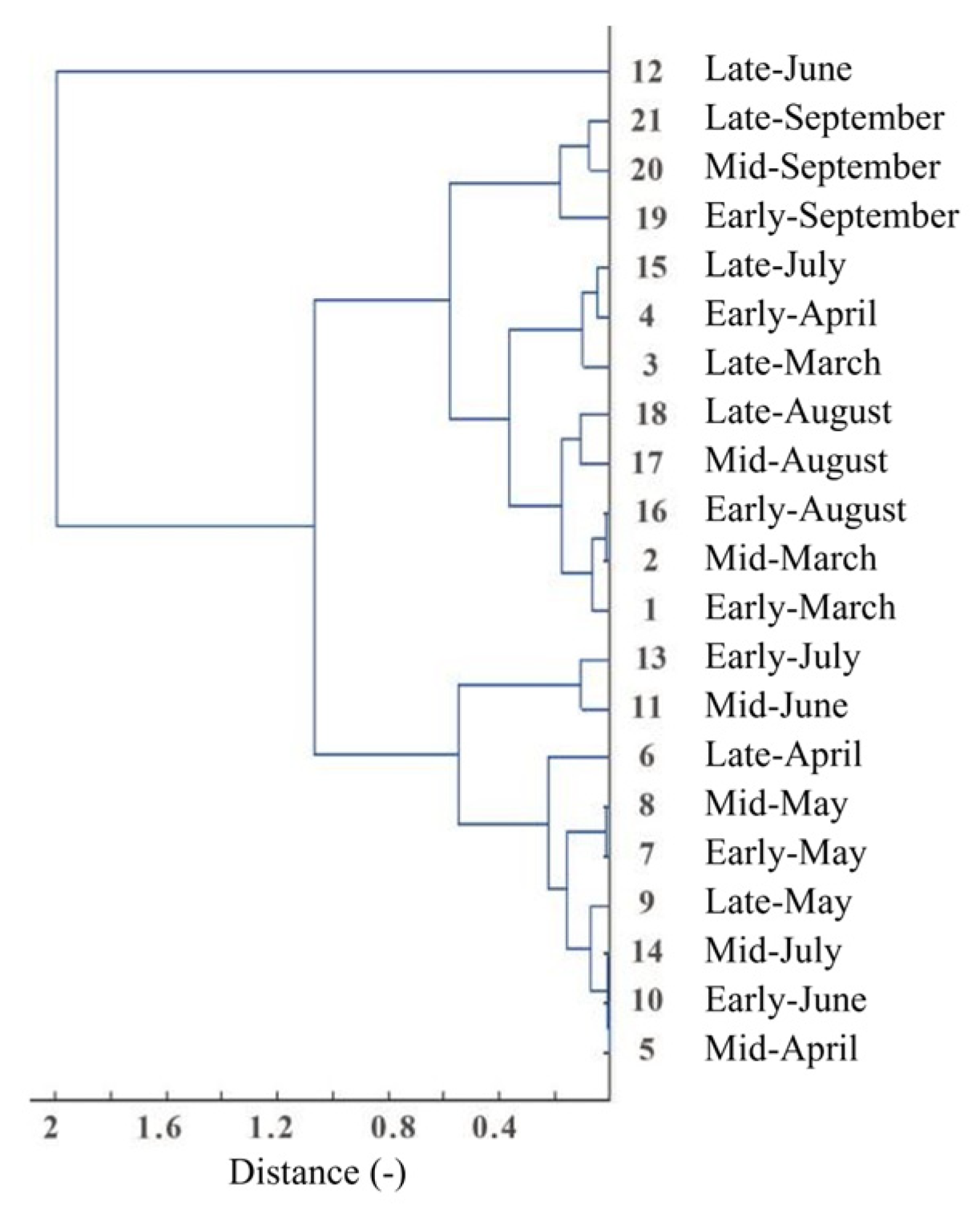
Based on 45 year daily rainfall data from rainfall stations (Zhitan, Jiangcun, Xihu, Jinggongqiao, Huzhai, Tankou, and Zhangshukeng) and 67 year daily streamflow data from hydrological station stations (Zhangshukeng, Tankou, and Dufengkeng), this study conducted flood season division for Wuxikou Reservoir using decadal indicators including maximum daily flow, mean daily flow, number of storm days, maximum 1 day rainfall, maximum 3 day rainfall, and mean rainfall through multiple analytical methods (Fisher’s optimal partitioning, set pair analysis, hierarchical clustering, and mathematical statistics), with the optimal scheme determined by selecting the approach demonstrating the highest relative membership degree. The validated scheme is presented in Figure 5 and Table 3.
The distance in Figure 5 refers to the degree of similarity between different ten-day periods calculated using the Euclidean distance after sample normalization. It is a dimensionless value. The lines in the figure represent the clustering degree between ten-day periods, where connected lines indicate periods with more similar flood characteristics.
Integrated analysis using mathematical statistics and hierarchical clustering methods reveals that June exhibits the highest precipitation and runoff levels, particularly during mid-to-late June. Consequently, the period from 11 June to 30 June is identified as the core flood season. Furthermore, early July demonstrates significantly higher rainfall and runoff compared to subsequent periods (mid July through September), justifying its classification as a distinct post-flood transition phase. The consistency between statistical analysis and hierarchical clustering results validates the rationality of the hierarchical clustering methodology for flood season division.
The Wuxikou Reservoir flood season division scheme delineates five hydrometeorological phases: pre-flood (1 March–10 April), early transitional (11 April–10 June), core flood season (11 June–30 June), late transitional (1 July–20 July), and post-flood (21 July–30 September).

3.2. FLWL Scheme

3.2.1. Key Parameter Determination

In the study of dynamic FLWL control under pre-release rules with staged flood seasons, the critical parameters for Wuxikou Reservoir include effective pre-release duration (tpre), pre-release discharge (qpre), and flood peak point (Qj).
The effective pre-release duration (tpre) at Wuxikou Reservoir is governed by hydrological forecast duration and integrated operational delay components. Historical rainfall data and flood forecast modeling indicate a basin response time of approximately 24 h from initial rainfall to flood peak formation at the dam site. The interval between cessation of dominant rainfall and flood peak generation is quantified as 12 h, representing the basin’s critical hydrological concentration period. Flood wave propagation from Tankou Station to the reservoir dam exhibits a 4 h translation lag. Hydrological forecasting protocols adopt the 12 h post-rainfall-to-peak interval as the standardized effective forecast horizon (Thyd). Operational analysis reveals an integrated system delay including ΔTerr, ΔTcom, and ΔTop; empirical measurements constrain to 1–2 h.
The time allowance was extended to 4 h to account for potential uncertainties in the implementation timeline following the issuance of the dispatching operation plan. Furthermore, accounting for potential meteorological forecast inaccuracies, synthesizing meteorological forecast precision (σ = ±2 h) and engineering safety factors, the effective pre-release duration is finalized as 8 h. The research objective of this study is to establish a strategic operational mode and standard safety mode, focusing on the analysis of regular flood events in the strategic operational mode. The flood peak point Qj derives from daily mean flow analysis (1952–2018), revealing flows below 1000 m3/s exhibit 99% recurrence probability, establishing Qj = 1000 m3/s as the activation benchmark.
The pre-release discharge of a reservoir is closely related to its primary flood-protection target. The flood control protected object of the Wuxikou Reservoir is Jingdezhen City, and the flood control projects in Jingdezhen City are constructed to withstand the 20 year return period flood of the Changjiang River. In the event of a 50 year return period flood, after the flood is regulated by the Wuxikou Reservoir, the released discharge should not exceed the safe discharge capacity of the 20 year return period for the urban river section of Jingdezhen. Specifically, the maximum released discharge of the Wuxikou Reservoir should be controlled within the range of 3500–5400 m3/s. Based on the comprehensive dispatching principles and safety analysis, the minimum controlled discharge of the Wuxikou Reservoir, which is 4300 m3/s, is designated as its pre-release discharge, set at 4300 m3/s.

3.2.2. Pre-Release-Based Dynamic Control of FLWL

Computational Principles and Methodology for Wuxikou Reservoir
The computational methodology for FLWL control with pre-release operations in stage flood seasons incorporates trial computation and verification computation as its dual modes. During trial computation, flood hydrographs across phase-specific frequencies are analyzed. When peak discharge exceeds 1000 m3/s, iterative calculation initiates under the pre-release discharge precondition postcondition that reservoir levels must restore to 50.00 m within 8 h. Failure to satisfy both conditions triggers recalibration until feasible Zfl values are identified. Phase-differentiated FLWLs (Zfl) are preliminarily set for each flood season stage, prioritizing safety and operational feasibility.
In verification computation, initially proposed Zfl serves as the starting water level. Analyses trigger when peak flows > 1000 m3/s, mandating reservoir restoration to 50.00 m within 8 h as the precondition while constraining releases ≤ 4300 m3/s as the postcondition. Meeting both conditions validates Zfl; otherwise, recalibration iterates until convergence. The final FLWL synthesis integrates outcomes from both computational phases.
Computational Analysis
This section takes the period from 11 June to 30 June (the most critical scenario) as an example to calculate and analyze dynamic control of FLWL. The preliminary and verification calculation processes are shown in Table 4.
Preliminary calculation phase, using the 0.1% + δ scenario as an example, with an initial reservoir level of 54.52 m, pre-release commences at the 8th time interval. A maximum discharge rate of 4300 m3/s achieves a reduction in the reservoir level to 50.00 m by the end of the 16th time interval. Analysis of flood events across various return periods during the main flood season confirms that discharge rates remain below 4300 m3/s under all operational scenarios, with water levels restored to 50.00 m within 8 h. Iterative simulations establish an initial FLWL threshold range of 54.26–54.72 m. Considering operational safety, a provisional FLWL of 54.20 m is designated for the period spanning 11–30 June.
Verification phase, during the main flood season, verification using 54.20 m as the initial level, all simulated discharges across tested return periods remain below 4300 m3/s. For the 0.1% + δ scenario, initiating pre-release at the 8th time interval with a discharge rate of 4020 m3/s achieves the target level of 50.00 m by the 16th time interval, thereby validating the feasibility of the 54.20 m initial level.
Integrated results from both preliminary calculation and verification phases demonstrate that during 11–30 June, reservoir operations satisfy dual constraints: maintaining discharge rates below 4300 m3/s during pre-release and achieving water level recovery to 50.00 m within 8 h. Consequently, establishing the FLWL at 54.20 m is operationally reasonable and technically feasible.
From the two stages of preliminary calculation and verification of dynamic control of FLWL, it can be concluded that during the period of 11 June–30 June, the discharge can be carried out at a pre-release discharge lower than 4300 m3/s, and the water level can recover to 50.00 m within 8 h under this constraint. Therefore, setting the flood control water level at 54.20 m is basically feasible.
Deterministic Analysis
Through trial calculation and verification, the effective pre-release duration (tpre) was determined to be 8 h, with a corresponding pre-release discharge (qpre) of 4300 m3/s. For the operational period from 11 June to 30 June, the formulated FLWL was set at 54.20 m. Time factor deterministic analysis results confirm that under all operational scenarios, the reservoir level can be restored to 50.00 m within the 8 h, with the maximum actual restoration duration being 7.86 h (Table 5). This demonstrates the operational feasibility and rationality of implementing the 54.20 m FLWL during this period.
Scheduling Rule Formulation
The operation rules employ a dual-mode coordination mechanism (“strategic operational mode-standard safety mode”). The dual-mode mechanism refers to the switching of operational strategies between frequent flood events and major flood events. This mechanism determines the flood peak point (Qj) for frequent floods through hydrological analysis, whereby pre-release scheduling based on the “pre-release–peak shaving–peak staggering” theory is implemented during medium-to-low frequency floods. Once actual flood conditions exceed the major flood event threshold, the system automatically transitions to the original flood control protocol.
Taking the main flood season (11–30 June) as an example, pre-release rules were established under the dual constraints of the absence of additional risk to the reservoir and its upstream/downstream regions and the maintenance of the designated FLWL at 54.20 m. Operational protocols are defined as shown in Table 6.
1. During the flood rising stage, the reservoir level is to be maintained within the range of 50.0 < Z ≤ 62.3 m.
(1) When dam inflow Qin ≤ 1000 m3/s, reservoir release Qout = Qin stabilizes water levels at 54.20 m.
(2) For 1000 < Qin ≤ 4300 m3/s (or the discharge at Dufengkeng Station remains below 5000 m3/s) with reservoir level at 50.00 m, forecasted rainfall ≥ 50 mm/24 h (storm threshold), control the downstream discharge to not exceed 4300 m3/s and reduce water levels to 50.00 m within 8 h.
(3) When 4300 < Qin ≤ 4800 m3/s (or Dufengkeng Station has a discharge of 5000–5640 m3/s), Qout is maximized within 4300–4800 m3/s per discharge capacity.
(4) For Qin > 4800 m3/s (or QD > 5640 m3/s) with 0 ≤ ΔQ4h < 1000 m3/s, Qout ≤ 4800 m3/s; under identical inflow with 1000 ≤ ΔQ4h < 2000 m3/s, Qout = 4600 m3/s; for ΔQ4h ≥ 2000 m3/s, Qout = 3500 m3/s.
2. During the flood recession stage, the reservoir level is to be maintained within the range of 50.0 < Z ≤ 62.3 m.
(1) For Qin > 4800 m3/s (or QD > 5640 m3/s), with ΔQ4h < 0, typically interval flood < 3280 m3/s, Qout = 5400 m3/s.
(2) For Qin ≤ 4800 m3/s, QD ≤ 5640 m3/s, ΔQ4h < 0, Qout = 5000 m3/s until level recovery to 54.20 m.
3. Z > 62.3 m
Qout equals maximum discharge capacity without exceeding natural peak inflow.

3.3. Implementation Schemes and Verification

3.3.1. Staged FLWL Implementation Scheme

Based on the aforementioned calculation methodology, the determined FLWL outcomes for Wuxikou Reservoir across distinct temporal intervals are presented in Table 7.

3.3.2. Model Verification and Case Analysis

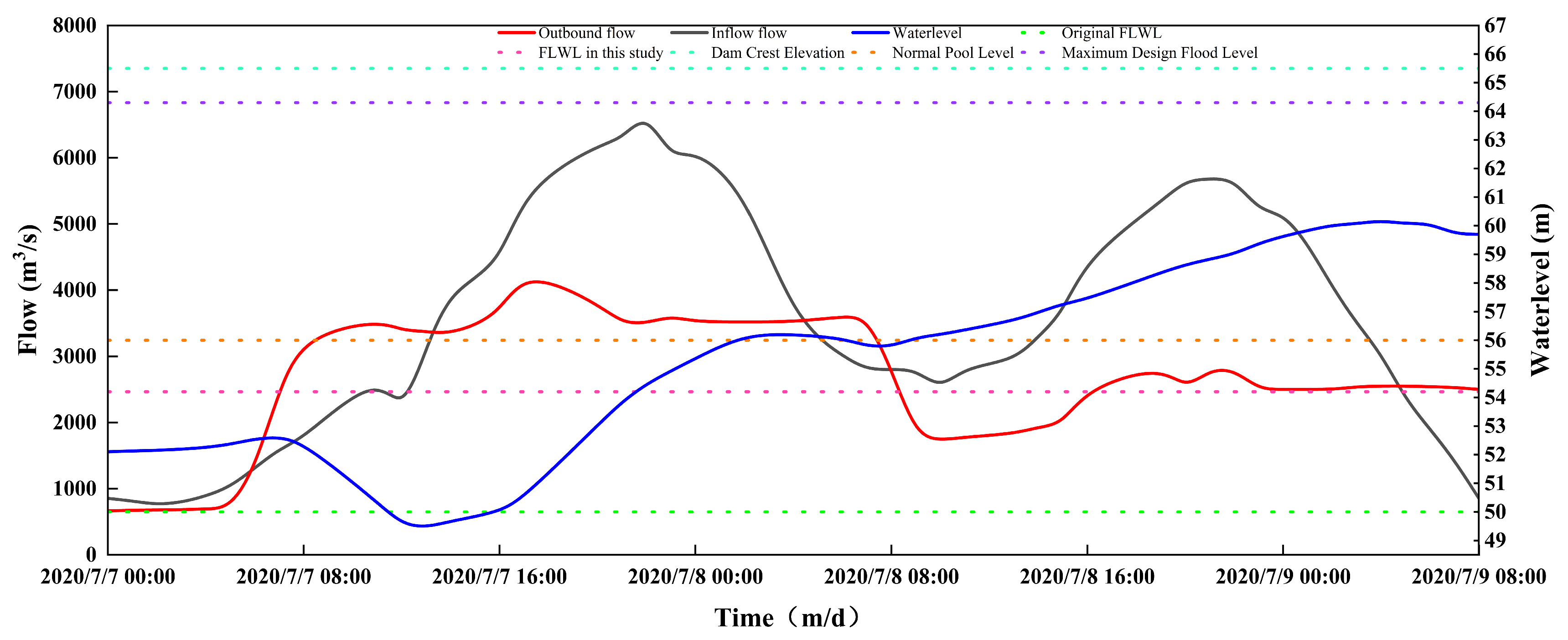
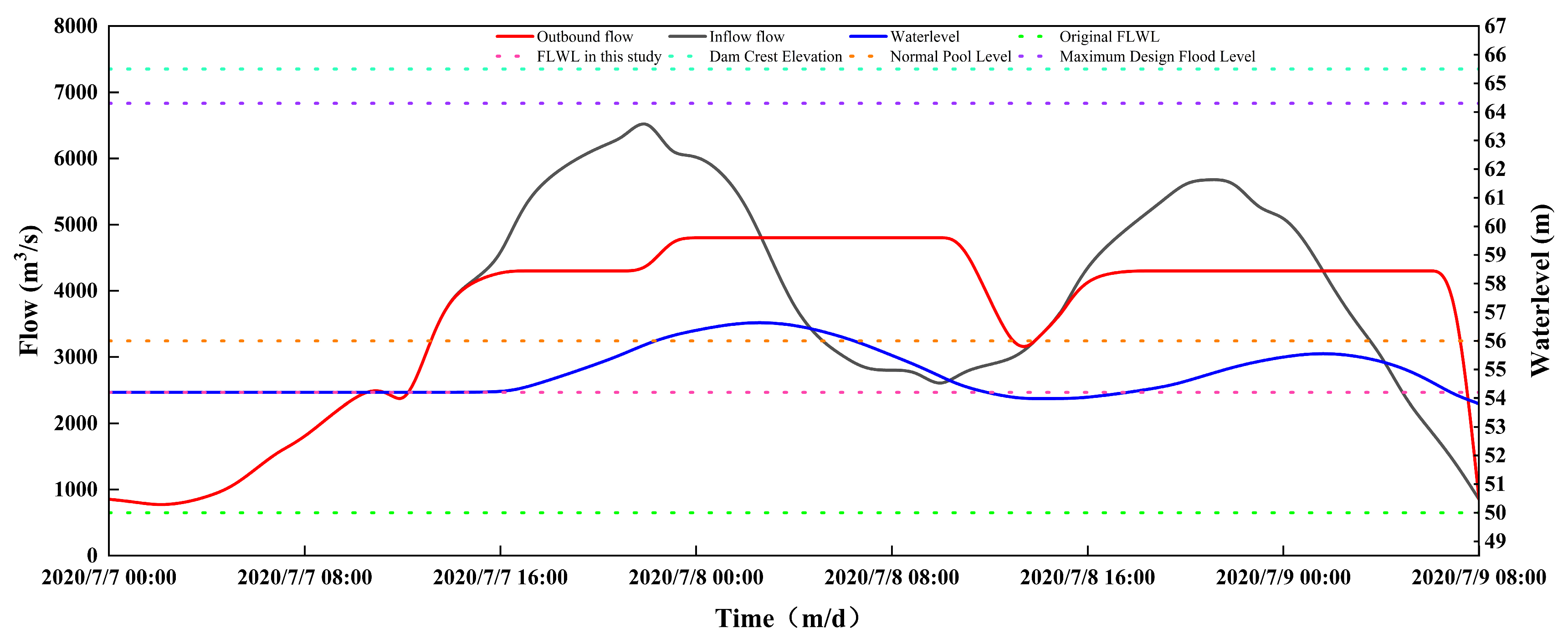
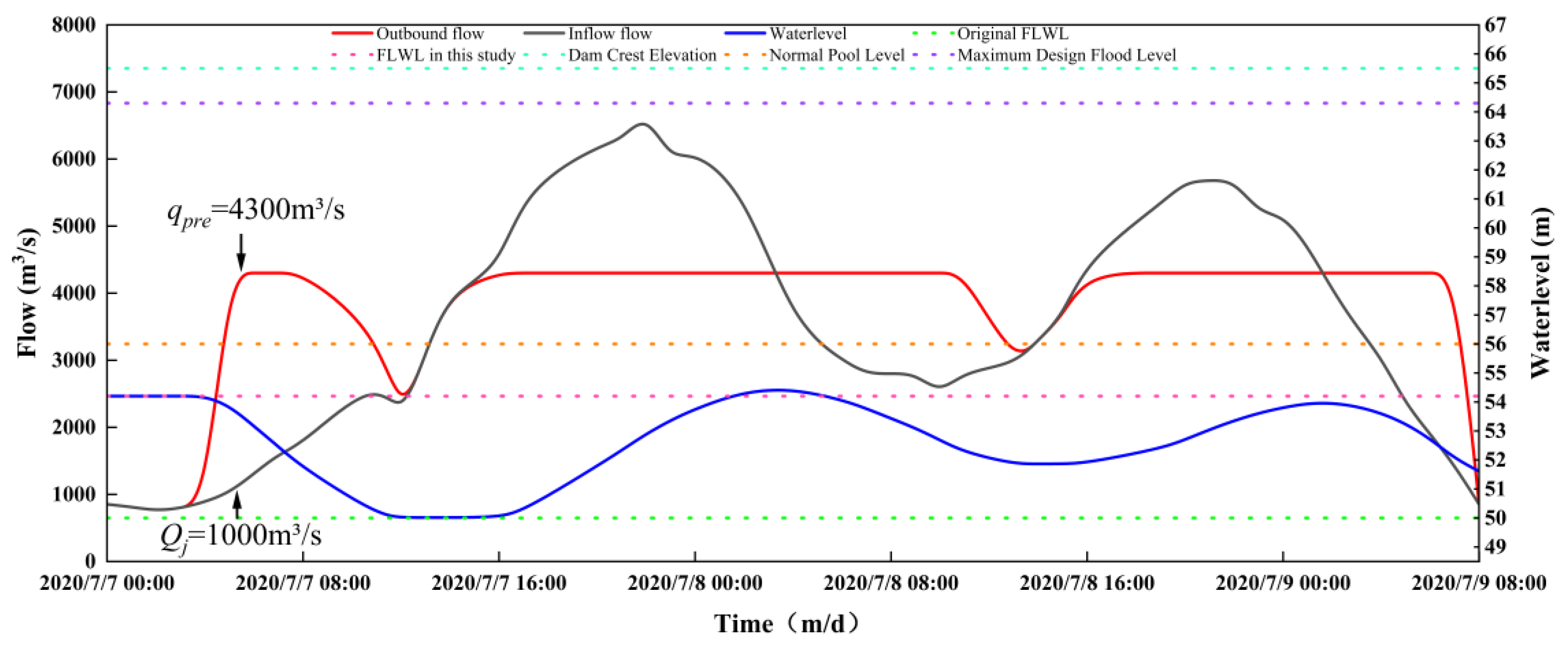
To validate the rationality of the FLWL operation scheme, historical flood events were employed for verification. The Changjiang River Basin experienced four distinct flood events within one week during July 2020. A flood event exceeding the 50 year return period has occurred in the Changjiang River, during which the Dufengkeng Hydrometric Station recorded the second-largest historical peak discharge. This qualifies the July 2020 flood series as a representative case for validation. Three operational scenarios were comparatively analyzed as follows: 1. actual operational process; 2. adjusted water level and actual operation process (original operating rules retained); and 3. improved operation, dynamic FLWL process (modified rules and adjusted FLWL). The comparative analysis of the three scheduling schemes is shown in Table 8, while Figure 6, Figure 7 and Figure 8 present the comparative analysis of different operation modes under the three schemes.
Scheme 1 reflects the actual dispatching process at Wuxikou Reservoir. The flood hydrograph commenced its rising limb on 7 July, with discharge surging from 853 m3/s (00:00) to 6700 m3/s (22:00). After the primary peak recession, a secondary rise occurred on 8 July, reaching 5680 m3/s (22:00). Throughout this event, the reservoir level rose continuously from 52.10 m (7 July, 00:00) to 60.18 m (9 July, 04:00), with a maximum outflow of 4330 m3/s.
Scheme 2 adjusted the FLWL to 54.20 m (as determined in this study) while retaining the original dispatching rules. Although the maximum outflow slightly increased to 4800 m3/s, the peak water level decreased to 56.68 m.
Scheme 3 implemented the proposed FLWL (54.20 m) coupled with a dynamic regulation (modified rules and adjusted FLWL). This scheme achieved both the lowest peak water level and the smallest maximum discharge among all three scenarios. The optimized FLWL and dispatching rules resulted in significantly reduced peak water levels and outflow rates compared to the other schemes, adequately demonstrating the operational applicability of the proposed methodology for flood management during flood season.

4. Discussion

4.1. Application of Flood Season Division Methodology

This research advances dynamic FLWL control through refined division of the flood season at Wuxikou Reservoir. Multiple methodologies are employed for flood season division, such as mathematical statistics, Fisher optimal partition, set pair analysis, and hierarchical clustering. Evaluation metrics included storm event frequency, mean precipitation, maximum daily rainfall, and temporal distribution of annual peak discharges. The optimal division scheme was determined through maximum membership degree validation, confirming hierarchical clustering as the preferred approach.
This method constructs fuzzy similarity matrices by computing inter-sample distances (or proximity indices), effectively integrating cluster analysis with fuzzy mathematics under multi-factor influences. Coupling mathematical statistics with quantitative analysis enhances the reliability and scientific rigor of division outcomes compared to single-method approaches [46].

4.2. Benefits of Dynamic Flood Limit Water Levels

Dynamic control of the FLWL facilitates synergistic integration of flood prevention and water resource utilization, thereby enhancing comprehensive reservoir operational efficiency [28,47]. This study proposes an improved pre-release capacity constraint method. Comparative analyses demonstrate that this approach optimizes reservoir operations while ensuring flood safety, effectively increases flood storage capacity utilization, creates storage space for subsequent floods, reduces high-level duration, and alleviates flood control pressure.
The method introduces three operational parameters. These are effective pre-release duration, pre-release volume, and flood peak nodes, and they exhibit three distinct advantages. First, the method does not require specific data beyond the usual reservoir operation data, as all parameters can be directly extracted from historical reservoir operation data. Second, they offer enhanced practicality compared to conventional methods requiring forecast-dependent parameters (e.g., predicted flood volume [33] and initial recession flow [39]). Third, all parameters are explicitly designed for management needs, prioritizing decision-making feasibility for operators. Critically, this methodology incorporates operator-centered design as a pivotal risk control element, effectively addressing the prevalent gap in forecast uncertainty research where operational feasibility for water managers is often overlooked [40,48].
Regarding flood control efficacy, the method significantly reduces peak water levels and shortens high-level duration. Through dynamic FLWL adjustment and optimized operation rules, Scheme 3 and Scheme 2 reduce maximum water levels by 5.73 m and 3.5 m, respectively, compared to operations according to the current operational protocol while effectively maintaining a maximum discharge for the reservoir release. During actual operations, the reservoir maintained levels > 55.00 m for 56 h; Scheme 2 shortened this duration to 14% of the original, while Scheme 3 reduced it to 11%. Dynamic FLWL control essentially balances flood prevention and water utilization to minimize risks and maximize benefits. Traditional static FLWL designs assume stationary hydrometeorological processes [49], determining characteristic water levels via historical frequency analysis primarily to prevent extreme floods [50]. However, with global climate change and the construction of regional water conservancy projects, the non-stationarity of runoff sequences has been reported in many regions [51]. Dynamic FLWL reconciles upstream inflow and downstream flood control needs, enabling new flood routing calculations that emphasize post-flood resource utilization. Results confirm its effectiveness in reducing peak levels and shortening high-level duration, significantly improving flood control benefits. The peak-level reduction achieved by dynamic FLWL schemes is 1.65 times greater than that of only adjusted water level schemes.
Regarding floodwater resource utilization, this study enhances the pre-release capacity constraint method [21,33,34] by implementing a “pre-release–peak shaving–peak staggering” operational strategy to optimize reservoir scheduling. Results demonstrate that pre-releasing the reservoir level to 50.00 m at 13:00 on 7 July created substantial flood storage capacity for subsequent events. During implementation, peak water levels during both flood events were rigorously controlled below 55.00 m, effectively achieving flood peak attenuation while significantly improving operational efficiency.
Raising the flood limit water level increases the reservoir’s storage capacity during the flood season, thereby enhancing its water impoundment capability. The additional stored water can be utilized for power generation, which not only boosts the economic benefits of the reservoir but also enhances its social and ecological benefits. Taking the adjustment of the flood limit level to 54.20 m during a flood event in July as an example, this operational change resulted in an additional storage volume of 5.57 million cubic meters compared to the original design. At Wuxikou Reservoir’s feed-in tariff of 0.36 CNY/kWh, this increase in storage enables the generation of approximately 2 million kWh of additional electricity. Furthermore, the elevated water level effectively expands the reservoir’s surface area and storage volume. This enhancement facilitates a quicker return to the normal pool level after the flood season, helps maintain ecological baseflow in the downstream river channel, and contributes to an overall improvement in the reservoir’s ecological environment. This approach can achieve both flood control safety and water resource utilization [47,52].

4.3. Limitations and Future Research

The three key parameters in the improved pre-release capacity constraint method are effective pre-release duration, pre-release discharge, and flood peak point. Balancing scientific rigor and operational practicality, these parameter values were derived through analysis of historical reservoir operation records and hydrometeorological data. However, climate change may alter local precipitation patterns [53], where extreme rainfall events could introduce deviations in effective pre-release duration and flood peak point; for instance, heavy rainfall may prolong effective lead duration while advancing flood peaks, potentially compromising dynamic FLWL operations and flood safety for both reservoir and downstream areas. These factors will directly influence key sensitivity parameters such as qpre and tpre, potentially compromising the applicability of the proposed operational rules in the context of cascade reservoir joint operations [21]. In such complex systems involving basin-wide design flood analysis, the range of sensitivity factors that must be considered expands beyond singular extreme events such as heavy rainfall, encompassing a greater number and variety of elements. Consequently, future research must prioritize systematic refinement of the model by identifying and incorporating multiple key sensitivity factors at the basin scale, thereby enhancing its adaptability to complex hydrological and operational conditions.
The present study deliberately excluded AI algorithms, primarily due to their substantial data requirements and tendency toward over-reliance on specific datasets [54]. AI algorithms predominantly capture statistical correlations within data while failing to incorporate governing physical laws (such as the reservoir water balance equation). This makes AI algorithms basically not appropriate for modeling physical processes [34]. Given that flood season division constitutes a classical methodology in statistical hydrology, future research will explore the development of deep learning-based division models through AI algorithms to enable dynamic updates of seasonal thresholds. The established model will serve as a benchmark for comparative analysis with proposed AI-driven approaches [55]. This direction will further integrate hydro-meteorological basin data with reservoir operation records to develop adaptive dispatch frameworks with enhanced predictive capabilities.
Although reservoir pre-release enhances flood control capacity, excessive discharge may escalate downstream flood risks. Insufficient post-flood inflows could further exacerbate water scarcity [47]. Additionally, while the method prioritizes reservoir safety and critical downstream protection targets, it inadequately addresses constraints related to riverbed evolution, bank stability, and ecological water requirements [56]. Future research should incorporate these factors to enhance the scientific applicability of dynamic FLWL in reservoir operations.
This study establishes a pre-release calculation model centered on pre-discharge, peak shaving, and staggering. Building upon previous research, it refines pre-release modeling by defining universal reservoir parameters and implementing dynamic FLWL scheduling through flood season division. The current study concentrates exclusively on flood control pre-release operations during flood seasons, with limited attention to benefit-oriented regulation aspects. Future work will bridge flood-control and benefit-driven pre-release strategies [52,57] to enhance the applicability of pre-release-based FLWL methods, achieving optimal risk–benefit equilibrium.

4.4. Practical Recommendations

This study is grounded in enhancing the practicality and operability of reservoir operation systems, prioritizing the actual needs of managers. It establishes a dual-threshold control equation with safe pre-release discharge (qpre) and effective pre-release duration (tpre) as sensitive factors. Developed from the operator’s perspective, the model focuses on key performance indicators of primary concern to practitioners, aiming to transform complex operational processes into straightforward and actionable decision criteria. During management operations, reservoir operators should pay attention to the two key parameters. Particularly when releasing water through gates, it is essential to closely monitor downstream conditions, analyze the impact on villages after each regulation, and observe whether key cross-sections have changed. Additionally, attention should be paid to the time required for implementing dispatching decisions. Future dispatch systems should explore methods to optimize the effective pre-release duration for enhanced operational efficiency.
To enhance the system’s predictive capacity and adaptability, this research will integrate quantitative precipitation forecasts (QPFs) from meteorological agencies, including short-term (1–3 days) and medium-term (3–7 days) projections. By leveraging rolling updates at 6 or 12 h intervals, the system will dynamically adjust warning thresholds, thereby streamlining input requirements. Building on this foundation, the study will synthesize multi-objective flood operation optimization, real-time flood forecasting [58], and decision support systems [32] to establish an integrated operational framework. This framework aims to provide reservoir operators with explicit decision criteria and formulation principles, enabling dynamic flood limit water level control that enhances storage capacity while maintaining flood safety, thereby harmonizing water conservation and flood control objectives.
The technical pathway unfolds as follows: A decision support system grounded in real-time meteorological and hydrological forecasts will incorporate AI algorithms to efficiently analyze massive datasets related to flood season division, creating hybrid models that merge AI with conventional division methods. Subsequently, by integrating historical operational data, real-time hydrological information, flood forecasting results, and existing operating rules, a self-learning and adaptive dispatch model will be established. Through continuous optimization and interactive interface design, this model will evolve into a user-friendly operational system with real-time update capabilities, ultimately aligning with reservoir managers’ operational practices to enhance the feasibility and effectiveness of dispatch decisions.

5. Conclusions

This study develops a novel dynamic FLWL control model under pre-release rules, structured around three core principles as follows: (1) no additional risk is imposed on the reservoir and its upstream/downstream regions; (2) operator-friendly decision rules are established; and (3) safe pre-release capacity and effective pre-release duration are utilized as sensitivity control parameters. Methodologically, it inherits the flood control safety core of the original design system and achieves hierarchical response through a differentiated scheduling mechanism.
For regular flood events, a dynamic water level control strategy based on rainfall and flood forecasting period is employed, with an operational focus on pre-release during the early stages of low-frequency flood events, leveraging rainfall forecasts to effectively implement peak shaving and flood peak staggering. In case of over-design floods, it seamlessly switches to the original flood control plan system.
This dual-mode coordination framework (“strategic operational mode-standard safety mode”) inherits traditional design safety margins while significantly enhancing floodwater resource utilization efficiency through integration of flood season division theory. Case verifications demonstrate that compared to actual operational schemes, this model reduces peak flood–stage water levels by up to 10% and shortens high-water-level duration by approximately 24 h. The research provides new methodological insights for reservoir dynamic flood limit level control, offering theoretical contributions toward resolving the flood safety versus water utilization dichotomy.

Author Contributions

Writing—original draft preparation, H.Y. and X.L.; data curation, Y.W. and C.L.; writing—review and editing, H.Y., X.L. and Q.H.; supervision, H.Y.; funding acquisition, H.Y. and Q.H. All authors have read and agreed to the published version of the manuscript.

Funding

This research was funded by the National Key R&D Program of China (Grant No.2023YFC3012200), the Science and Technology Project of the Water Resources Department of Jiangxi Province (Grant No. KT201705).

Data Availability Statement

The original contributions presented in this study are included in the article. Further inquiries can be directed to the corresponding author.

Conflicts of Interest

The authors declare no conflicts of interest.

References

  1. Liu, D.; Li, X.; Guo, S.; Rosbjerg, D.; Chen, H. Using a Bayesian probabilistic forecasting model to analyze the uncertainty in real-time dynamic control of the flood limiting water level for reservoir operation. J. Hydrol. Eng. 2015, 20, 04014036. [Google Scholar] [CrossRef]
  2. Liu, P.; Li, L.; Guo, S.; Xiong, L.; Zhang, W.; Zhang, J.; Xu, C.-Y. Optimal design of seasonal flood limited water levels and its application for the Three Gorges Reservoir. J. Hydrol. 2015, 527, 1045–1053. [Google Scholar] [CrossRef]
  3. Yassin, F.; Razavi, S.; Elshamy, M.; Davison, B.; Sapriza-Azuri, G.; Wheater, H. Representation and improved parameterization of reservoir operation in hydrological and land-surface models. Hydrol. Earth Syst. Sci. 2019, 23, 3735–3764. [Google Scholar] [CrossRef]
  4. Marth, I.; Becker, B. Gradient descent optimization supports the generation of reservoir operation plan. STAtOR 2023, 24, 3–4. [Google Scholar]
  5. Cuvelier, T.; Archambeau, P.; Dewals, B.; Louveaux, Q. Comparison between robust and stochastic optimisation for long-term reservoir management under uncertainty. Water Resour. Manag. 2018, 32, 1599–1614. [Google Scholar] [CrossRef]
  6. Jain, S.K.; Yoganarasimhan, G.N.; Seth, S.M. A risk-based approach for flood control operation of a multipurpose reservoir 1. Jawra J. Am. Water Resour. Assoc. 1992, 28, 1037–1043. [Google Scholar] [CrossRef]
  7. Ding, W.; Zhang, C.; Peng, Y.; Zeng, R.; Zhou, H.; Cai, X. Ananalytical frame work for flood water conservation considering forecast uncertainty and acceptable risk. Water Resour. 2015, 51, 4702–4726. [Google Scholar] [CrossRef]
  8. Cheng, C.T.; Wang, W.C.; Xu, D.M.; Chau, K.W. Optimizing hydropower reservoir operation using hybrid genetic algorithm and chaos. Water Resour. Manag. 2008, 22, 895–909. [Google Scholar] [CrossRef]
  9. Zhou, L.; Kang, L.; Hou, S.; Guo, J. Research on Flood Risk Control Methods and Reservoir Flood Control Operation Oriented towards Floodwater Utilization. Water 2024, 16, 43. [Google Scholar] [CrossRef]
  10. Li, Y.; Li, Y.; Feng, K.; Tian, K.; Huang, T. Dynamic Control of Flood Limited Water Levels for Parallel Reservoirs by Considering Forecast Period Uncertainty. Sustainability 2023, 15, 16765. [Google Scholar] [CrossRef]
  11. Jiang, H.; Wang, Z.; Ye, A.; Liu, K.; Wang, X.; Wang, L. Hydrological characteristic-based methodology for dividing flood seasons: An empirical analysis from China. Environ. Earth Sci. 2019, 78, 1–9. [Google Scholar] [CrossRef]
  12. Wu, P.; Chen, G.; Wang, Y.; Li, J. Applying the Improved Set Pair Analysis Method to Flood Season Staging in Tropical Island Rivers: A Case Study of the Hainan Island Rivers in China. Water 2024, 16, 3418. [Google Scholar] [CrossRef]
  13. Tang, L.; Zhang, Y. Considering Abrupt Change in Rainfall for Flood Season Division: A Case Study of the Zhangjia Zhuang Reservoir, Based on a New Model. Water 2018, 10, 1152. [Google Scholar] [CrossRef]
  14. Mo, C.; Deng, J.; Lei, X.; Ruan, Y.; Lai, S.; Sun, G.; Xing, Z. Flood Season Staging and Adjustment of Limited Water Level for a Multi-Purpose Reservoir. Water 2022, 14, 775. [Google Scholar] [CrossRef]
  15. Cunderlik, J.M.; Ouarda, T.B.; Bobee, B. Determination of flood seasonality from hydrological records. Hydrol. Sci. J. 2004, 49, 511–526. [Google Scholar] [CrossRef]
  16. Beurton, S.; Thieken, A.H. Seasonality of floods in Germany. Hydrol. Sci. J. 2009, 54, 62–76. [Google Scholar] [CrossRef]
  17. Qiu, R.; Wang, B.; Zhou, H. New Idea for controlling the limited elevation of reservoirs in flood season. Adv. Water 2004, 15, 68–72. [Google Scholar]
  18. Chen, J.H.; Guo, S.L.; Li, Y.; Liu, P.; Zhou, Y.L. Joint operation and dynamic control of flood limiting water levels for cascade reservoirs. Water Resour. Manag. 2013, 27, 749–763. [Google Scholar] [CrossRef]
  19. Tan, Q.F.; Wang, X.; Liu, P.; Lei, X.H.; Cai, S.Y.; Wang, H.; Ji, Y. The Dynamic Control Bound of Flood Limited Water Level Considering Capacity Compensation Regulation and Flood Spatial Pattern Uncertainty. Water Resour. Manag. 2017, 31, 143–158. [Google Scholar] [CrossRef]
  20. Yun, R.; Singh, V.P. Multiple duration limited water level for flood control with implication water supply. J. Hydrol. 2008, 354, 160–170. [Google Scholar] [CrossRef]
  21. Liu, G.; Qin, H.; Shen, Q.; Tian, R.; Liu, Y. Multi-objective optimal scheduling model of dynamic control of flood limit water level for cascade reservoirs. Water 2019, 11, 1836. [Google Scholar] [CrossRef]
  22. Becker, B.P.J.; Jagtenberg, C.J.; Horvath, K.; Mitchell, A.; Rodríguez-Sarasty, J.A. Optimization methods in water system operation. Wiley Interdisciplinary Reviews. Water 2024, 11, e1756. [Google Scholar]
  23. Wang, B.; Zhou, H.; Wang, G. Theory, Method and Application on Dynamic Control of Reservoir Limit Water Level; China Water Power Press: Beijing, China, 2006. [Google Scholar]
  24. Yuan, J.; Wang, B.; Wang, F.; Li, F. Study on real-time dynamic operation of reservoir water level in flood season based on short-term rainfall forecast information. J. Hydroelectr. Eng. 2008, 27, 15–19. [Google Scholar]
  25. Zhang, G.; Zhou, H.; Wang, B. Real-time dynamic control of the limited water level of reservoir in flood period and its risk analysis. J. Hydroelectr. Eng. 2009, 29, 51–55. [Google Scholar]
  26. Liu, P.; Li, L.; Chen, G.; Rheinheimer, D.E. Parameter uncertainty analysis of reservoir 362 operating rules based on implicit stochastic optimization. J. Hydrol. 2014, 514, 102–113. [Google Scholar] [CrossRef]
  27. Liu, P.; Guo, S.; Xiong, L.; Li, W.; Zhang, H. Deriving reservoir refill operating rules 368 by using the proposed DPNS model. Water Resour. Manag. 2006, 20, 337–357. [Google Scholar] [CrossRef]
  28. Ding, W.; Zhang, C.; Lin, J.; Zhao, X.; Ning, Y.; Zhou, H. Flood risk quantification, transmission, and propagation analysis for flood water utilization of parallel reservoirs. J. Hydrol. 2023, 618, 129202. [Google Scholar] [CrossRef]
  29. Xiong, F.; Guo, S.; Chen, K.; Yin, J.; Liu, Z.; Zhong, Y.; Hong, X. Design flood and control water levels for cascade reservoirs during operation period in the downstream Jinsha River. Adv. Water 2019, 30, 401–410. [Google Scholar]
  30. Albo-Salih, H.; Mays, L. Testing of an Optimization-Simulation Model for Real-Time Flood Operation of River-Reservoir Systems. Water 2021, 13, 1207. [Google Scholar] [CrossRef]
  31. Zhang, J.; Min, Y.; Feng, B.; Duan, W. Research and Application of Key Technologies for Dynamic Control of Reservoir Water Level in Flood Season. Water 2021, 13, 3576. [Google Scholar] [CrossRef]
  32. Che, D.; Mays, L.W. Development of an optimization/simulation model for real-time flood-control operation of river-reservoirs systems. Water Resour. Manag. 2015, 29, 3987–4005. [Google Scholar] [CrossRef]
  33. Huang, C.; Li, W.; He, S.; Yang, Y. Development and Application of Reservoir Operation Method Based on Pre-Release Index for Control of Exceedance Floods. Water 2024, 16, 3229. [Google Scholar] [CrossRef]
  34. Lee, E.; Yi, S.; Ji, J.; Hong, J.; Lee, S.; Yoon, J.; Yi, J. Development of a reservoir operation model determining the pre-release strategy for the flood events. J. Hydroinform. 2025, 27, 700–722. [Google Scholar] [CrossRef]
  35. Meng, X.; Chang, J.; Wang, X.; Wang, Y.; Wang, Z. Flood control operation coupled with risk assessment for cascade reservoirs. J. Hydrol. 2019, 572, 543–555. [Google Scholar] [CrossRef]
  36. Zhang, X.; Liu, P.; Xu, C.Y.; Gong, Y.; Cheng, L.; He, S. Real-time reservoir flood control operation for cascade reservoirs using a two-stage flood risk analysis method. J. Hydrol. 2019, 577, 123954. [Google Scholar] [CrossRef]
  37. Cuevas-Velásquez, V.; Sordo-Ward, A.; García-Palacios, J.H.; Bianucci, P.; Garrote, L. Probabilistic model for real-time flood operation of a dam based on a deterministic optimization model. Water 2020, 12, 3206. [Google Scholar] [CrossRef]
  38. Wang, X.; Liu, Z.; Zhou, W.; Jia, Z.; You, Q. A Forecast-Based Operation(FBO) Mode for Reservoir Flood Control Using Forecast Cumulative Net Rainfall. Water Resour. Manag. 2019, 33, 2417–2437. [Google Scholar] [CrossRef]
  39. Ding, W.; Liang, G.H.; Zhou, H.C. Real-time dynamic control of limited water level of reservoir based on flood forecast information. J. Hydroelectr. Eng. 2013, 32, 41–47. [Google Scholar]
  40. Liu, Y.; Hou, G.; Wang, B.; Xu, Y.; Tian, R.; Wang, T.; Qin, H. Many-Objective Hierarchical Pre-Release Flood Operation Rule Considering Forecast Uncertainty. Water 2024, 16, 785. [Google Scholar] [CrossRef]
  41. Zhang, H.; He, X.; Ma, R. Study on the Flood Season Staging of the Altash Water Control Project in Xinjiang. Sustainability 2025, 17, 2716. [Google Scholar] [CrossRef]
  42. Jiang, H.; Yu, Z.; Mo, C. Reservoir flood season segmentation and optimal operation of flood-limiting water levels. J. Hydrol. Eng. 2015, 20, 05014035. [Google Scholar] [CrossRef]
  43. Mulaomerović-Šeta, A.; Blagojević, B.; Mihailović, V.; Petroselli, A. A silhouette-width-induced hierarchical clustering for defining flood estimation regions. Hydrology 2023, 10, 126. [Google Scholar] [CrossRef]
  44. Wang, H.; Xiao, W.; Wang, J.; Wang, Y.; Huang, Y.; Hou, B.; Lu, C. The Impact of Climate Change on the Duration and Division of Flood Season in the Fenhe River Basin, China. Water 2016, 8, 105. [Google Scholar] [CrossRef]
  45. Mo, C.; Mo, G.; Liu, P.; Zhong, H.; Wang, D.; Huang, Y.; Jin, J. Reservoir operation by staging due to climate variability. Hydrol. Sci. J. 2018, 63, 926–937. [Google Scholar] [CrossRef]
  46. Li, Y.; Li, Y.; Feng, K.; Sun, K.; Cheng, Z. The Influence of Time Domain on Flood Season Segmentation by the Fisher Optimal Partition Method. Water 2024, 16, 580. [Google Scholar] [CrossRef]
  47. Jain, S.K.; Shilpa, L.S.; Rani, D.; Sudheer, K.P. State-of-the-art review: Operation of multi-purpose reservoirs during flood season. J. Hydrol. 2023, 618, 129165. [Google Scholar] [CrossRef]
  48. Liu, Y.; Qin, H.; Zhang, Z.; Yao, L.; Wang, Y.; Li, J.; Zhou, J. Deriving reservoir operation rule based on Bayesian deep learning method considering multiple uncertainties. J. Hydrol. 2019, 579, 124207. [Google Scholar] [CrossRef]
  49. Sen, S.; He, J.; Kasiviswanathan, K.S. Uncertainty quantification using the particle filter for non-stationary hydrological frequency analysis. J. Hydrol. 2020, 584, 124666. [Google Scholar] [CrossRef]
  50. Guo, S.; Liu, P.; Wang, J.; Zhou, Y. Revisiting necessity and feasibility for dynamic control of reservoir water level during flood season. J. Hydraul. Eng. 2023, 54, 1–12. [Google Scholar]
  51. Vidrio-Sahagun, C.T.; He, J.; Kasiviswanathan, K.S.; Sen, S. Stationary hydrological frequency analysis coupled with uncertainty assessment under nonstationary scenarios. J. Hydrol. 2021, 598, 125725. [Google Scholar] [CrossRef]
  52. Hua, L.; Wan, X.; Wang, X.; Zhao, F.; Zhong, P.A.; Liu, M.; Yang, Q. Floodwater utilization based on reservoir pre-release strategy considering the worst-case scenario. Water 2020, 12, 892. [Google Scholar] [CrossRef]
  53. Lenderink, G.; de Vries, H.; van Meijgaard, E.; de Rooy, W.; van Ulft, L.; Thompson, V.; Qiu, X.; Fowler, H.J. A pseudo global warming based system to study how climate change affects high impact rainfall events. Weather Clim. Extrem. 2025, 49, 100781. [Google Scholar] [CrossRef]
  54. Arpit, D.; Jastrzębski, S.; Ballas, N.; Krueger, D.; Bengio, E.; Kanwal, M.S.; Maharaj, T.; Fischer, A.; Courville, A.; Bengio, Y.; et al. A closer look at memorization in deep networks. In Proceedings of the 34th International Conference on Machine Learning, Sydney, Australia, 6–11 August 2017; PMLR: Cambridge, MA, USA, 2017; pp. 233–242. [Google Scholar]
  55. Kratzert, F.; Klotz, D.; Brenner, C.; Schulz, K.; Herrnegger, M. Rainfall–runoff modelling using long short-term memory (LSTM) networks. Hydrol. Earth Syst. Sci. 2018, 22, 6005–6022. [Google Scholar] [CrossRef]
  56. He, J.; Guo, X.; Wang, S.; Chen, H.; Chai, F.X. Study on reservoir optimal operation based on coupled adaptive ε constraint and multi strategy improved Pelican algorithm. Sci. Rep. 2023, 13, 14093. [Google Scholar] [CrossRef]
  57. Hui, R.; Lund, J.; Zhao, J.; Zhao, T. Optimal pre-storm flood hedging releases for a single reservoir. Water Resour. Manag. 2016, 30, 5113–5129. [Google Scholar] [CrossRef]
  58. Huang, X.; Xu, B.; Zhong, P.A.; Yao, H.; Yue, H.; Zhu, F.; Lu, Q.; Sun, Y.; Mo, R.; Li, Z.; et al. Robust multiobjective reservoir operation and risk decision-making model for real-time flood control coping with forecast uncertainty. J. Hydrol. 2022, 605, 127334. [Google Scholar] [CrossRef]
Figure 1. Schematic diagram of flood season division and FLWL.
Water 17 03348 g001
Figure 2. Geographical location map of Wuxikou Reservoir.
Water 17 03348 g002
Figure 3. Schematic of the flood season division methodology with pre-release rules for dynamic FLWL control.
Water 17 03348 g003
Figure 4. Pre-release-based dynamic control method.
Water 17 03348 g004
Figure 5. Flood season division results using hierarchical clustering, numbers on the vertical axis represent the periods from March to September in ten-day units.
Water 17 03348 g005
Figure 6. Actual process (Scheme 1).
Water 17 03348 g006
Figure 7. Adjusted water level and actual operation process (Scheme 2).
Water 17 03348 g007
Figure 8. Improved operation and dynamic FLWL process (Scheme 3).
Water 17 03348 g008
Table 1. Characteristic value table of reservoir.
ItemUnitValueItemUnitValue
Catchment Areakm22915Dam Crest Elevationm65.5
Design Flood Standard%1Maximum Flood Standard%0.05
Normal High Water Levelm56.00Weir crest elevationm47.00
Flood Control Levelm62.30Total Storage Capacity106 m4474.7
Design Flood Levelm62.3Storage Capacity at Normal Level106 m4173
Maximum Design Flood Levelm64.30Flood Regulation Capacity106 m4346
Flood Limit Water Levelm50.00Flood Control Capacity106 m4296.4
Dead Water Levelm45.00Dead Storage Capacity106 m442.6
Table 2. Basic information table of the site.
Station NameStation TypeEstablishment
Year
Drainage Area
(km2)
Monitoring
Parameters
TankouHydrological19561760Water Level, Discharge, Precipitation
ZhangshukengHydrological19513327Water Level, Discharge,
Sediment Concentration, Precipitation
DufengkengHydrological19415013Water Level, Discharge,
Sediment Concentration, Precipitation
ZhitanRain Gauge1965/Precipitation
JiangcunRain Gauge1965/Precipitation
XihuRain Gauge1963/Precipitation
JinggongqiaoRain Gauge1955/Precipitation
HuzhaiRain Gauge1965/Precipitation
Table 3. Validation results of flood season division methodologies for Wuxikou Reservoir.
SchemeDivision MethodologyFirst ThresholdSecond ThresholdThird
Threshold
Fourth
Threshold
Relative
Superiority Degree
1Mathematical Statistics10 April10 June10 JulyJuly 310.690
2Fisher optimal partition10 AprilJune 2030 JuneJuly 310.790
3Set Pair AnalysisMarch 31April 3030 JuneJuly 310.790
4Hierarchical Clustering10 April10 June30 June20 July0.870
Table 4. Preliminary and verification calculations of FLWL for different frequencies in main flood season.
Calculation PhaseItem p = 5%p = 2%p = 1%p = 0.1% + δp = 0.05% + δ
Flood Frequency
Preliminary Calculation
Stage
Initial Water Level (m)54.6954.2654.2754.5254.36
Start Time (h)16 h16 h12 h8 h8 h
End Time (h)24 h24 h20 h16 h16 h
Maximum Discharge (m3/s)43004300430043004300
Verification Calculation
Stage
Initial Water Level (m)54.2054.2054.2054.2054.20
Start Time (h)16 h16 h12 h8 h8 h
End Time (h)24 h24 h20 h16 h16 h
Maximum Discharge (m3/s)38714248384540204163
Table 5. Time factor deterministic analysis.
Table Item p = 5%p = 2%p = 1%p = 0.1% + δp = 0.05% + δ
Flood Frequency
Initial Water Level (m)54.2054.2054.2054.2054.20
Start Time (h)16161288
End Time (h)23.0723.8618.9715.3315.64
Maximum Discharge (m3/s)43004300430043004300
actual restoration time (h)7.077.866.977.337.64
Table 6. Operational protocols table.
Water Level
Condition
Flow ConditionOriginal Design RulesProposed Operational Rules
50.0 < Z ≤ 62.3 m
(Rising Stage)
Qin ≤ 1000 m3/s/Qout = Qin
1000 < Qin ≤ 4300 m3/s
QD ≤ 5000 m3/s
Qout = Qin
Z = 50.00 m
Qout ≤ 4300 m3/s
tpre ≤ 8 h
Z = 54.20 m
4300 < Qin ≤ 4800 m3/s
5000 < QD ≤ 5640 m3/s
Qout = 4300–4800 m3/s
Qin > 4800 m3/s
QD > 5640 m3/s
0 ≤ ΔQ4h < 1000 m3/s, Qout ≤ 4800 m3/s
1000 ≤ ΔQ4h < 2000 m3/s, Qout = 4600 m3/s
ΔQ4h ≥ 2000 m3/s, Qout = 3500 m3/s
50.0 < Z ≤ 62.3 m
(Recession Stage)
Qin > 4800 m3/s ΔQ4h < 0
QD > 5640 m3/s
Qout = 5400 m3/s
Qin ≤ 4800 m3/s ΔQ4h < 0
QD > 5640 m3/s
Qout = 5000 m3/s
Z > 62.3 mRelease at Maximum Discharge Capacity
Table 7. Analysis results of FLWL for different staged periods.
Temporal IntervalFLWL Control Range
(m)
Recommended Upper
FLWL (m)
Lower FLWL Limit
(m)
1 March–10 April
(pre-flood)
54.66–54.9054.6050.00
11 April–10 June
(early transitional)
54.59–54.8254.5050.00
11 June–30 June
(core flood season)
54.26–54.7254.2050.00
1 July–20 July
(late transitional)
54.15–54.7454.2050.00
21 July–30 September
(post-flood)
54.59–54.7854.6050.00
Table 8. Comparison of three operation schemes for the July 2020 observed flood event.
ItemScheme 1:
Actual Operation
Scheme 2: Adjusted Water
Level and Actual Operation
Scheme 3:
Improved Operation,
Dynamic FLWL
Peak inflow (m3/s)6700
Occurrence time20:50, 7 July 2020
Initial water level (m)52.1054.2054.20
Peak outflow (m3/s)433048004300
Occurrence time17:00, 7 July 202023:00, 7 July 202005:00, 7 July 2020
Maximum water
level (m)
60.1856.6854.46
Occurrence time04:00, 9 July 202002:00, 8 July 202004:00, 8 July 2020
Disclaimer/Publisher’s Note: The statements, opinions and data contained in all publications are solely those of the individual author(s) and contributor(s) and not of MDPI and/or the editor(s). MDPI and/or the editor(s) disclaim responsibility for any injury to people or property resulting from any ideas, methods, instructions or products referred to in the content.