Article

Prolonged Summer Daytime Dissolved Oxygen Recovery in a Eutrophic Lake: High-Frequency Monitoring Diel Evidence from Taihu Lake, China

1
Co-Innovation Center for Sustainable Forestry in Southern China, College of Ecology and Environment, Nanjing Forestry University, Nanjing 210037, China
2
The National Wetland Ecosystem Field Station of Taihu Lake, National Forestry and Grassland Administration, Suzhou 215000, China
3
Suzhou Wetland Protection and Management Station, Suzhou 215000, China
*
Authors to whom correspondence should be addressed.
Water 2025, 17(22), 3221; https://doi.org/10.3390/w17223221
Submission received: 11 October 2025 / Revised: 30 October 2025 / Accepted: 10 November 2025 / Published: 11 November 2025

Abstract

In eutrophic shallow lakes, dissolved oxygen (DO) exhibits significant temporal variations, regulated by the combined effects of photosynthesis and water temperature (WT). High-frequency monitoring enables a detailed capture of DO diel cycles, providing a more comprehensive understanding of the dynamic changes within lake ecosystems. This study involved high-frequency (10 min intervals) in situ monitoring of DO over a three-year period (2020–2022) in the littoral zone of Taihu Lake, China. Random forest regression analysis identified WT, photosynthetically active radiation (PAR), and relative humidity (RH) as the three most influential variables governing DO dynamics. The relative importance of these factors varied seasonally (0.117–0.392), with PAR dominating in summer (0.383), whereas WT had the highest importance in other seasons (0.312–0.392). Cusum analysis further revealed that the DO-WT relationship changed from a dome-shaped pattern in spring, autumn, and winter to a bowl-shaped pattern in summer, indicating that thermal stratification intensified oxygen gradients. In addition, the majority of DO recovery occurred in the late afternoon during summer, suggesting that severe oxygen consumption delayed the daytime accumulation of DO. Our findings emphasize the critical roles of photosynthesis, respiration, and abiotic factors in shaping DO dynamics. This research enhances our understanding of DO fluctuations in eutrophic shallow lakes and provides valuable insights for ecosystem management, supporting the development of effective strategies to prevent and mitigate hypoxia.

1. Introduction

Dissolved oxygen (DO) is an important indicator of water quality, playing a crucial role in the survival, metabolism, and reproduction of aquatic organisms, and is also a key parameter for assessing the health of aquatic ecosystems [1,2,3]. DO concentrations in natural waters are highly dynamic and often exhibit pronounced diel fluctuations driven by the balance between oxygen-producing and oxygen-consuming processes [4]. This daily oscillation of oxygen has significant impacts on the structure and function of aquatic ecosystems [5,6,7]. Consequently, understanding DO dynamics is critical for accurate water quality assessment, effective ecosystem monitoring, and informed resource management.
In aquatic environments, during daylight hours, aquatic plants and algae produce oxygen through photosynthesis, raising DO levels; while at night, respiration consumes oxygen, leading to a decline in concentrations [8,9,10]. For example, in Sweden’s Laver pit lake, DO concentrations fluctuated by as much as 0.5 mg/L between day and night during the summer, highlighting the influence of these biological processes [11]. In tropical and subtropical regions, higher temperatures may amplify these diel fluctuations due to accelerated biological metabolism [12]. The intensity of photosynthetically active radiation (PAR) during the day is closely related to the increase in DO concentration, especially around dusk when the concentration of chlorophyll-a and DO reaches peaks [10,13], and dissolved photosynthate produced during the day may also impact the consumption of DO at night [14]. Moreover, physical factors such as water temperature (WT), rainfall, and flow dynamics also critically shape DO levels. For instance, in Minnesota’s shallow lakes, variations in DO are influenced by changes in temperature and wind, which affect water mixing and oxygen distribution [15]. WT affects DO by reducing oxygen solubility and increasing metabolic rates, especially during summer, when thermal stratification exacerbates hypoxia in deeper waters, e.g., [16,17]. Such findings indicate that DO fluctuations result from complex interactions between biological and physical processes [18,19,20]. However, current research are mostly focused on marine ecosystems, with fewer studies conducted in freshwater environments.
The ecological consequences of diel DO variations can be significant. At night, when oxygen consumption exceeds production, many aquatic organisms experience hypoxic conditions, particularly in stratified water bodies where lower depths become oxygen-depleted [21,22,23]. In extreme cases, hypoxia can cause mass mortality events among fish and other aerobic organisms. For example, research in Long Island Sound showed that bottom waters frequently experience low oxygen levels at night, leading to stress and habitat loss for marine organisms [24]. This phenomenon is especially pronounced in eutrophic systems, where nutrient runoff fuels algal blooms, exacerbating oxygen depletion during decomposition [25,26]. In addition to its effects on higher trophic levels, diel DO fluctuations also influence microbial and planktonic communities. For instance, in the Sundarbans estuary in India, diel DO changes were closely tied to variations in bacterioplankton populations, with certain microbial groups thriving in low-oxygen conditions [27]. These shifts in microbial activity can, in turn, affect nutrient cycling and organic matter decomposition, further impacting DO concentrations. Despite the ecological importance of diel DO dynamics they have received far less research attention than larger-scale temporal (seasonal) oxygen variations [28,29,30].
New monitoring technologies have recently enabled real-time, high-resolution tracking of DO, offering fresh insights into its diel behavior. High-frequency monitoring systems, combined with numerical models, are increasingly used to capture the complex interactions between biological and physical processes that affect DO levels [31]. For example, in Chesapeake Bay, a combination of real-time data and high-resolution modeling allowed precise tracking of diel DO fluctuations, providing actionable insights for improving water quality and managing nutrient inputs [32]. Similar approaches are applied in aquaculture, where maintaining adequate DO levels is critical for the health and growth of farmed species. In shrimp farming, effective monitoring and management of DO prevent nighttime oxygen depletion, which can otherwise result in high mortality rates [33]. Recent studies have further demonstrated that high-frequency observations can capture fine-scale diel and vertical fluctuations in DO concentration that are often overlooked by conventional monitoring [34]. Modeling studies underscore the importance of accounting for both biological and physical processes in understanding DO dynamics. Deterministic models simulating diel and nocturnal variations in shallow lakes demonstrate how factors such as wind speed, WT, and light availability interact to influence DO fluctuations [15]. These advanced tools are crucial for predicting how aquatic ecosystems will respond to environmental changes, such as warming temperatures and altered precipitation regimes under climate change.
However, even though previous studies have documented typical diel DO patterns and their ecological effects, the mechanisms driving DO dynamics in eutrophic shallow lakes remain inadequately understood—particularly under high-temperature conditions [35,36]. In summer, longer daylight exposure extends the period of phytoplankton photosynthesis [37], while elevated water temperatures accelerate metabolic activity and oxygen consumption [38]. This combination of prolonged oxygen production during the day and intensified oxygen demand at night could lead to unique diel DO dynamics in shallow, nutrient-rich lakes, yet it is not well quantified. Eutrophic shallow lakes are also increasingly subject to high-temperature extremes with ongoing climate warming, making it imperative to address this knowledge gap.
This study aims to fill that gap by conducting high-frequency DO monitoring (10 min intervals) in Taihu Lake over a three-year period (2020–2022) and analyzing the resulting data across multiple temporal scales. To this end, we hypothesize: (1) in summer, extended daylight hours and higher water temperatures enhance phytoplankton photosynthesis, prolonging the period of oxygen production and leading to higher daytime DO levels; and (2) sustained high water temperatures also accelerate biological respiration, increasing oxygen consumption at night, which in turn lowers nocturnal DO levels and lengthens the time required the next day to reoxygenate the lake. This study aims to reveal the mechanisms driving DO fluctuations in eutrophic shallow lakes, providing new perspectives for understanding DO dynamics in such environments. The research findings will deepen our understanding of DO dynamics and provide valuable insights for the management and protection of freshwater ecosystems amid ongoing environmental changes.

2. Materials and Methods

2.1. Study Area

This study is conducted in Taihu Lake, which is the third-largest freshwater lake in China, situated in the Yangtze River Delta region, spanning Jiangsu and Zhejiang provinces. The Taihu Lake covers an area of approximately 2338 square kilometers with an average depth of 1.9 m, and is characterized as a typical eutrophic shallow lake [39]. The surrounding area includes several wetland conservation zones and ecological restoration projects, making it of significant ecological, economic, and social importance [40].
The hydrological characteristics of Taihu Lake are influenced by seasonal variations, precipitation, and anthropogenic activities. Issues such as eutrophication and water quality degradation have been persistent concerns. Within the research area, the temporal and spatial variations of key water quality indicators, such as dissolved oxygen (DO), total phosphorus (TP), and total nitrogen (TN), along with their interactions with environmental factors, are crucial for understanding the health of the lake ecosystem and developing effective management strategies.

2.2. Measurements

From 2020 to 2022, 10 min interval meteorological and water quality data were collected at The National Wetland Ecosystem Field Station of Taihu Lake, located on the Sanshandao island, Suzhou City, China. Meteorological parameters, including air temperature (°C), near-surface wind (m/s), relative humidity (%), rainfall (mm), and density of photosynthetically active radiation (µmol/s/m2), were obtained from a meteorological station (31°1′36.45″ N, 120°17′48.56″ E) (Met One Instruments Inc., Grants Pass, OR, USA). Water quality parameters, including dissolved oxygen (mg/L), water temperature (°C), pH, electrical conductivity (mS/cm) and oxidation-reduction potential (mV), were measured using in situ sensors installed in a water quality buoy (31°1′16.97″ N, 120°16′48.25″ E) (WTW, Xylem Inc., Weilheim, Germany) (Figure 1).
To ensure accurate measurements, the buoy is positioned 5 m away from the shoreline in waters deeper than 1.5 m, with sensors installed 20 cm below the water surface. Regular maintenance, including sensor cleaning and calibration, is performed every one to two weeks.

2.3. Statistical Analysis

Initial 10 min data underwent quality control procedures to remove outliers that were excessively high or low for each parameter. Data points exceeding three standard deviations from the mean were excluded. Hourly averages for all parameters were then calculated. To analyze the diel cycle of DO concentrations, average DO values were examined for three-month seasons: December to February (DJF), and so forth.
DO saturation (%) was calculated for each quality-controlled measurement, using the formula proposed by Truesdale and Downing [41], which estimates saturated DO based on water temperature. The 10 min DO saturation data were computed using the following formula:
Q s a t = 100 × D O 14.625 0.41022 × T + 0.007991 × T 2 0.0000777774 × T 3
where T represents water temperature in degrees Celsius (°C).
To identify the key environmental drivers of diel dissolved oxygen (DO) dynamics, a Random Forest regression model was first applied using the RandomForestRegressor algorithm in Scikit-learn [42]. The predictor variables included water temperature (WT), photosynthetically active radiation (PAR), relative humidity (RH), wind speed (WS), sunshine duration (SH), and rainfall (P). Random Forest is an ensemble learning method that constructs multiple decision trees and aggregates their predictions to improve generalization performance. In regression tasks, each split within a decision tree reduces the mean squared error (MSE) of the prediction. The importance of each variable was quantified as the normalized sum of all MSE reductions attributed to that variable across all trees, such that the total importance values sum to one. This approach enables the assessment of the relative contribution of each meteorological or hydrological factor to diel DO variability.
To further investigate the mechanisms underlying DO variations revealed by the feature importance analysis, the cumulative sums (Cusums) method was employed. Each value was standardized using the variable’s mean and standard deviation, and the cumulative sum of these standardized values was calculated, resulting in a dataset with a mean of 0 and a standard deviation of 1 [37,43]. In Cusum trends, decreasing and increasing slopes indicate values below and above the dataset mean, respectively. Transitions from negative to positive slopes (or vice versa) indicate changes in data values relative to the dataset mean.
Regier et al. [43] applied Cusums to quantify driver-response relationships using environmental time series, and Regier et al. [37] examined the relationship between DO, air temperature, and water depth. In this study, Cusums were calculated with DO as the response variable, ordered by the driver variables WT, RH and PAR.

3. Results

3.1. Annual and Seasonal Variations

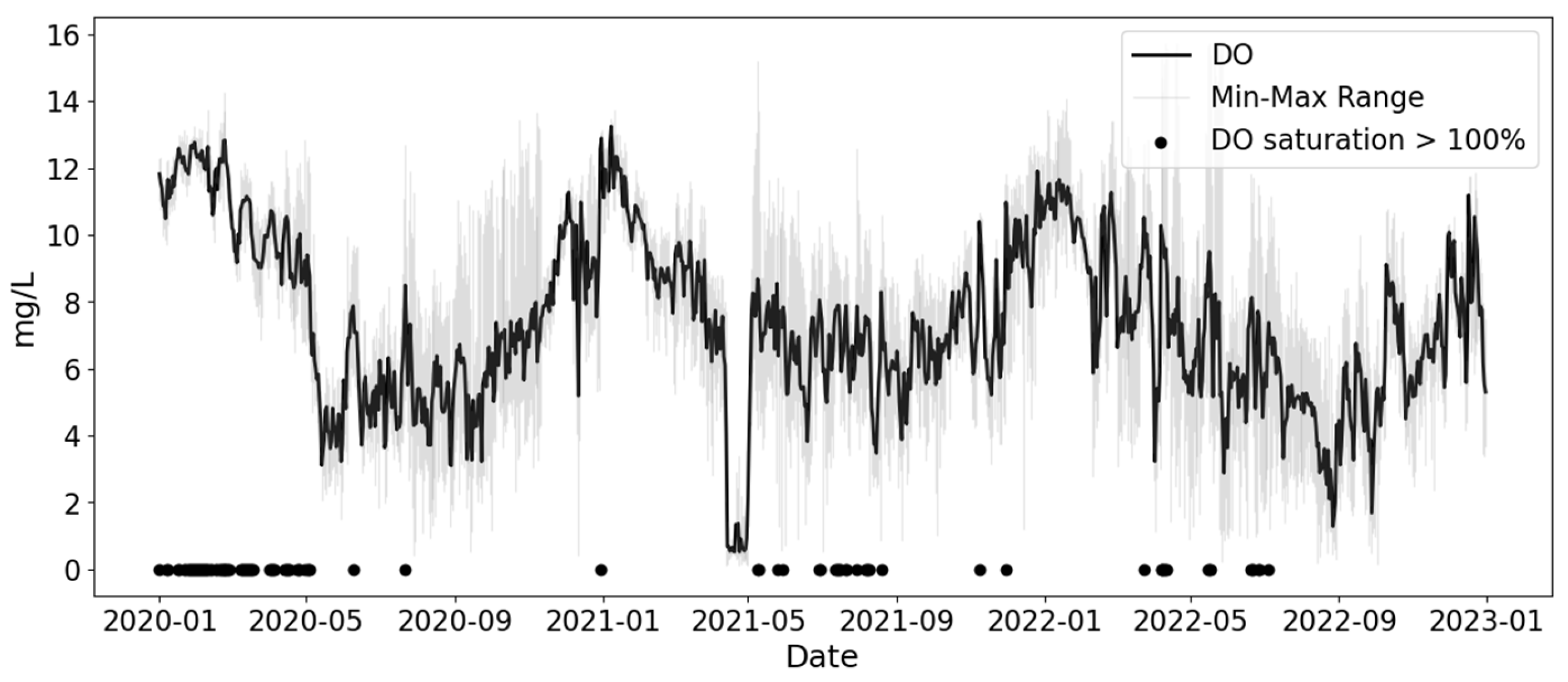
Figure 2 illustrates the annual pattern of DO at the study site from 2020 to 2022. In 2020, the highest daily average DO value occurred on 23 February at 12.81 mg/L, while the lowest value was on 14 May at 3.11 mg/L. In 2021, the highest value was on 8 January at 13.24 mg/L, and the lowest was on 24 April at 0.52 mg/L. For 2022, the highest value was on 13 January at 11.65 mg/L, with the lowest on 27 August at 1.28 mg/L. Generally, daily mean DO values are higher in winter and lower in summer. Conversely, diel DO ranges are greater in summer and smaller in winter. In 2020, DO saturation reached 100% for each month from January to May, and several days in June, July and December. In 2021, over-saturation occurred in May, June, and November. Each month from March to July in 2022 experienced DO saturation exceeding 100%. The annual mean DO has declined from 7.85 mg/L in 2020 to 6.92 mg/L in 2022, while the DO saturation has dropped from approximately 82% to 73%.
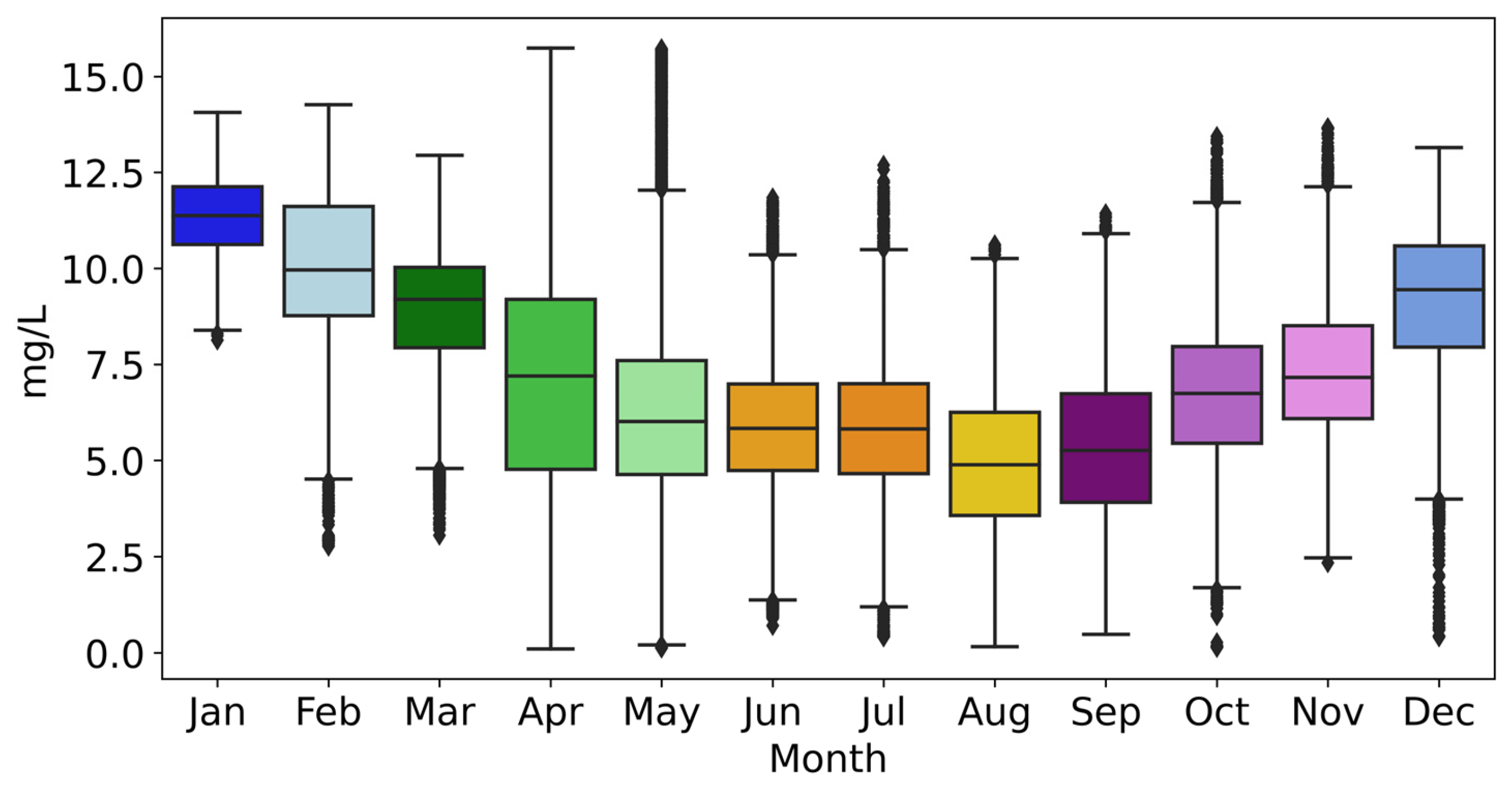
Seasonal fluctuations in DO concentrations are depicted in Figure 3, which shows the annual cycle of monthly averaged DO levels throughout the study period. Variability during winter is relatively small compared to other seasons, especially in January. The most significant fluctuations in DO concentrations occurred in April, due to the early onset of cyanobacterial blooms in the spring of 2021. The lowest median DO concentration was observed in August at 4.89 mg/L. It is important to note that DO values of 5 mg/L are considered the minimum requirement for supporting aquatic life. Hence, the observation that more than half of the DO concentrations in August fall below this threshold is concerning. Similar concerns arise for certain instances from April to September. During colder months, however, most DO values exceeded this critical threshold.

3.2. Diel Variations

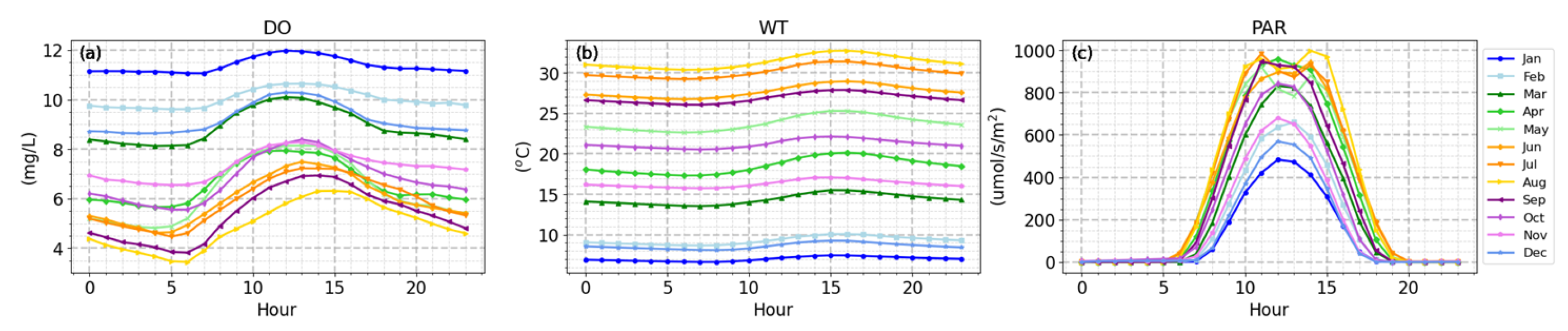
To capture the finer temporal variations in DO, Figure 4 depicts the diel cycle of DO in each month, alongside the corresponding diel cycle of water temperature (WT) and density of photosynthetically active radiation (PAR). These variables display substantial seasonal fluctuations and notable day-night discrepancies, underscoring the variations on a smaller temporal scale compared to broader annual and seasonal changes.
Throughout the year, diel patterns in DO, WT and PAR exhibit distinctive characteristics. In winter months (January, February, and December), daytime PAR is the lowest, especially in January and December, with the maximum hourly PAR values below 600 µmol/s/m2. Hourly averaged WT in these months remains below 10 °C, peaking at 1500–1600 local time (LT) and hitting the lowest point at 0700 LT. DO concentrations are highest in January, with hourly averages exceeding 11 mg/L, while in February, they hover around 10 mg/L. Although hourly averaged WT and PAR in March are higher than those in December, DO concentrations in these two months are similar, ranging from 8 to 10 mg/L.
In April and May, daytime PAR increases rapidly, with peaks exceeding 800 µmol/s/m2, much higher than in October and November. Despite variations in PAR, WT in these four months ranges between 15 °C and 25 °C, peaking at 1400–1500 LT and hitting the lowest point at 0600 LT. Corresponding DO concentrations range from 5 to 8 mg/L, peaking at 1200–1300 LT and reaching a minimum at 0500 LT.
From June to September, hourly averaged WT generally exceeds 25 °C, peaking at 1500–1600 LT and reaching its lowest at 0600 LT. PAR in these months rises sharply from 0600 LT to 1000 LT, with peaks around 1000 µmol/s/m2. DO concentrations are lowest during these four months, peaking at 1300–1400 LT and reaching a minimum at 0500–0600 LT.
On a daily basis, WT exhibits relatively minor variability throughout the year. Diel variation ranges are modest in spring and summer, with the largest value (2.82 °C) in April. This variability is lower in winter and fall, with the smallest value (0.82 °C) in January. Maximum WT consistently occurs in the late afternoon (1400–1600 LT), while the minimum typically occurs in the early morning (0600–0700 LT).
In contrast, DO displays minimal diel variability only in winter months, with the smallest range (0.92 mg/L) in January. For late spring, summer, and early fall, this range varies from 2.8 to 3.3 mg/L. Maximum DO is typically recorded at noon (1200 LT) in winter and spring, four hours earlier than the corresponding WT peaks. In summer and fall, the maximum DO occurs at 1300 LT and 1400 LT, respectively, two hours earlier than the corresponding WT peaks. The minimum DO is observed at 0500 LT in winter and spring, two hours earlier than the corresponding WT minima. In summer and fall, the minimum DO occurs at 0500 LT and 0600 LT, respectively, one hour earlier than the corresponding WT minima.

3.3. DO Diel Cycle Associations

It is widely recognized that DO concentrations decrease with increasing WT due to reduced gas solubility, as illustrated in the seasonal variations depicted in Figure 2 and Figure 3. However, contrary to this pattern, the diel variations in DO (Figure 4) reveal an increase in DO concentrations with higher WT on a daily basis, which can be attributed to oxygen production from photosynthesis during the daytime. To decipher the primary drivers of diel changes in DO concentrations at the study station, we focused on examining the variations in the density of photosynthetically active radiation (PAR) and WT, as well as DO responses to their variations.
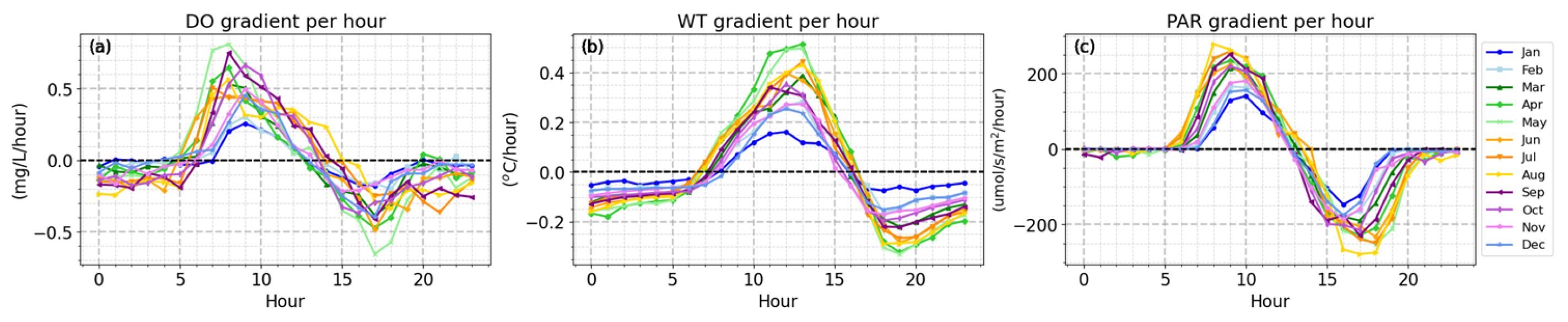
The PAR density serves as a metric for characterizing the photosynthetic activity of aquatic organisms. We conducted a daily comparison of the hourly rate of changes in DO concentration (Figure 5a) with the density of PAR (Figure 5c) and WT (Figure 5b) in each month (different colors) over three years. Generally, all three variables show similar daily changes throughout the year. Changes in cold months are slight, with smaller slopes, while changes in warmer months are relatively sharp, with higher slopes. The occurrence times of maximum and minimum gradients in DO and PAR are close (Figure 5a,c), while there is a several-hour delay for WT gradients to reach their peaks (Figure 5b).
The gradients of both DO and the density of PAR exhibit a consistent positive trend in the morning, initiating at 0600 LT and peaking around 0800–0900 LT. This coherence suggests that oxygen production from photosynthesis predominantly influences DO concentration during this phase. Subsequently, both DO concentration and PAR density gradients decrease, indicating a slower rate of increase for both parameters from 1000 to 1300 LT. At 1300 LT, the gradient of PAR density reaches zero, signifying a decline in PAR density thereafter (Figure 5c). Correspondingly, the DO concentration gradient turns negative at 1400 LT (Figure 5a). In other words, DO concentration peaks around 1400 LT, aligning with the results depicted in Figure 4. The gradient of WT shows an increasing trend from 0700 LT to around 1200–1300 LT, four hours later than the occurrence time of DO and PAR gradient maxima.
The negative gradients for both DO and PAR reach their maximum around 1700 LT, possibly due to the consumption of more DO through respiration than is produced through photosynthesis, even though irradiance remains strong in the middle of the afternoon. Consequently, DO concentration decreases during this stage. The density of PAR drops to zero around 2000 LT, and changes in DO concentrations become slight. From 2000 LT to midnight and midnight to 0500 LT, PAR density remains near zero, while the gradient of DO concentration shows minimal change. The maximum negative gradient of WT usually occurs around 1900 LT, two hours later than the occurrence time of DO and PAR gradient minima.
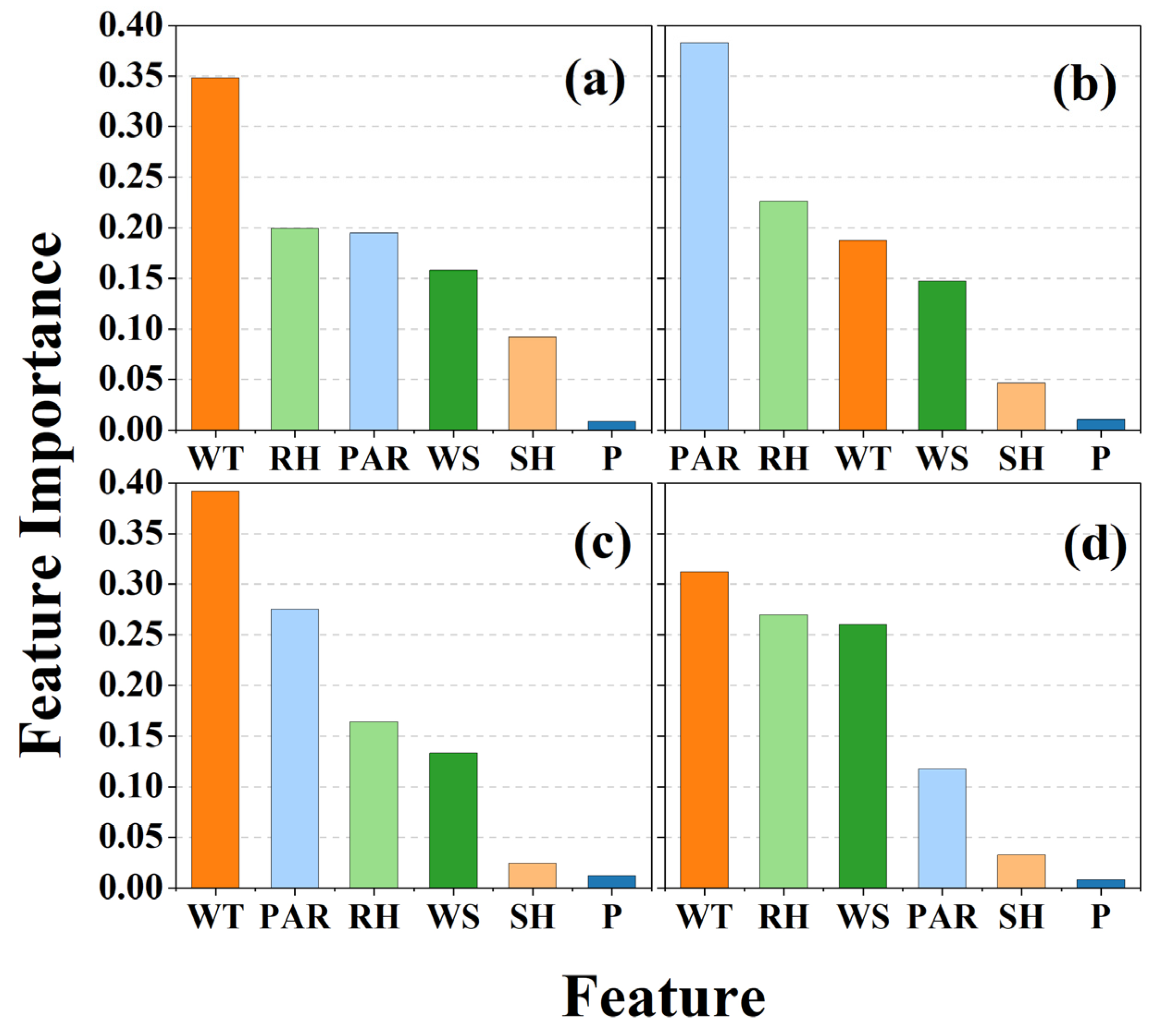
Figure 6 shows the feature importance values of six environmental variables estimated by the Random Forest regression model across the four seasons. WT exhibited the highest importance in spring, autumn, and winter, while PAR ranked first in summer. In spring, RH and PAR followed WT with comparable scores. During summer, RH ranked second, and WT dropped to third. In autumn, PAR ranked second with a much higher importance than RH, which ranked third. In winter, RH and WS had scores close to that of WT, suggesting that these three variables exerted comparable influences. SH and P consistently showed low importance across all seasons, implying that their contributions to diel DO dynamics were limited.
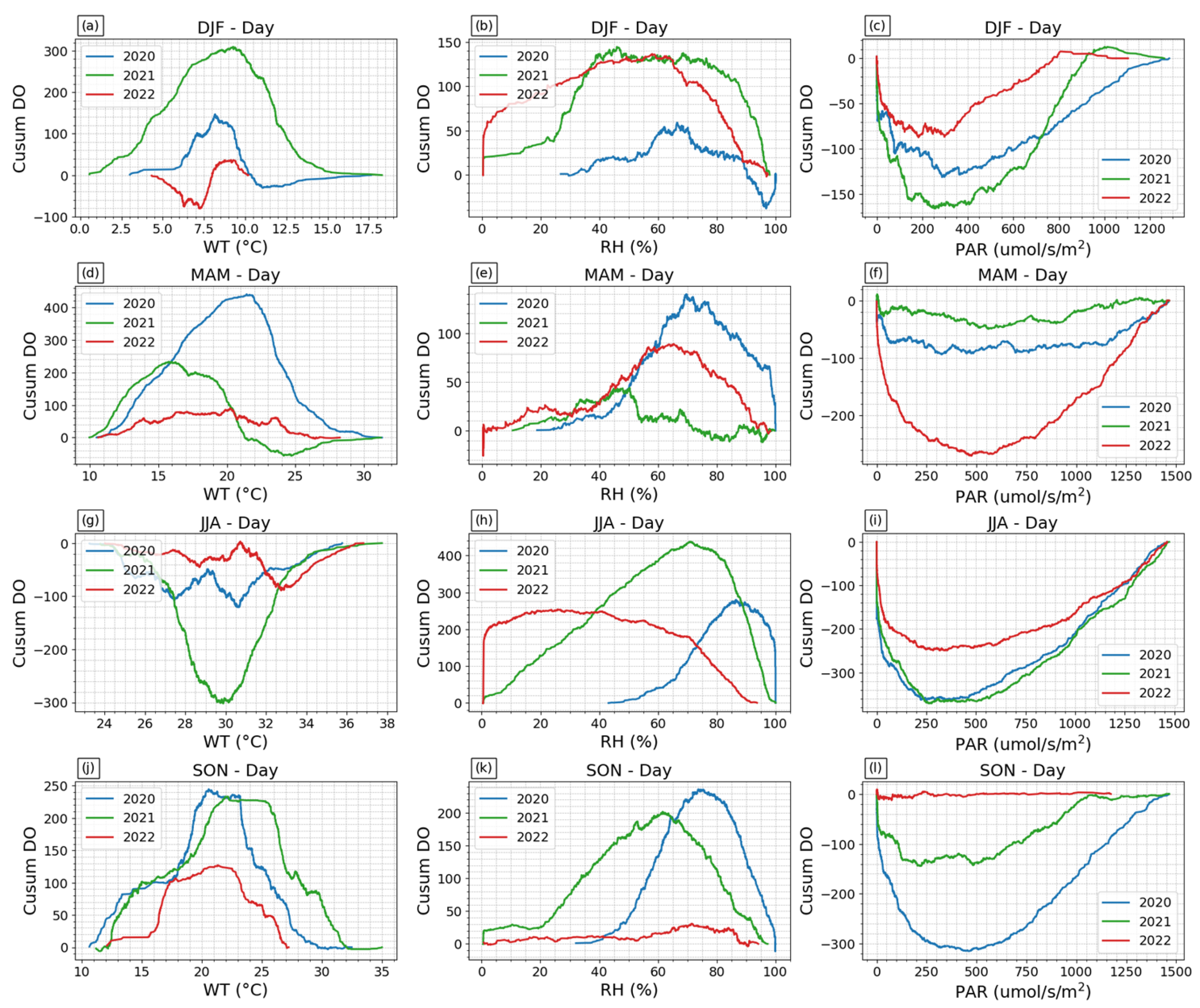
Given the seasonal differences in feature importance identified by the Random Forest analysis, we further examined how the top three predictors were associated with diel DO variations using the Cusum method. Based on these results, Cusum analyses were conducted for the three leading predictors (i.e., WT, RH, and PAR) focusing on the daytime period (Figure 7). PAR was only available during daylight hours, and the Cusum curves for WT and RH showed similar shapes between daytime and nighttime, justifying the use of daytime results for comparison. Regarding the driver-response plot, first, the paired series are ordered so the driver variable (DO) is organized in ascending order; the reordered response variable (WT, PAR) is then Cusum-transformed.
Figure 7 shows the Cusums analyses of DO in response to WT, RH and PAR during the daytime across four seasons for the period of 2020–2022. In general, DO changes with WT and RH mostly present dome-shaped Cusums, while DO changes with PAR consistently show bowl-shaped Cusums.
DO concentrations shift from below average to above average around 250 µmol/s/m2 PAR in winter (Figure 7c) and summer (Figure 7i). For spring and fall, clear minima only present in 2022 spring (Figure 7f) and 2020 fall (Figure 7l), with the value around 500 µmol/s/m2. This indicates that DO increases with larger PAR and PAR below 250 µmol/s/m2 in winter and summer usually correspond to lower DO concentrations. There is no consistent pattern in spring and fall (Figure 7f,l) among the three years, implying that a clear monotonic relationship between DO and PAR is not present in these two seasons.
For the DO–RH relationships, DO generally decreases with increasing RH, showing a dome-shaped Cusum pattern across all seasons (Figure 7b,e,h,k). Although the RH values corresponding to the inflection points vary seasonally, the overall patterns remain consistent among the three years. This suggests that moderate humidity favors oxygen exchange and photosynthetic processes, whereas excessive RH (often linked to lower atmospheric exchange efficiency) reduces DO concentrations.
In contrast, DO dynamics respond differently to changes in WT across four seasons in different years. Generally, DO decreases with higher WT in winter (Figure 7a), spring (Figure 7d) and fall (Figure 7j). However, the breakpoints (maxima) of WT differ across time periods. Interestingly, the associations between DO and WT show a bowl-shaped Cusums in 2021 (Figure 7g), opposite to the other three seasons. Additionally, a less clear pattern and lack of a single prominent breakpoint is found in 2020 and 2022 summer time. This distinct summer pattern aligns with the Random Forest results, suggesting that the divergent feature importance observed in summer primarily originates from WT-driven processes.
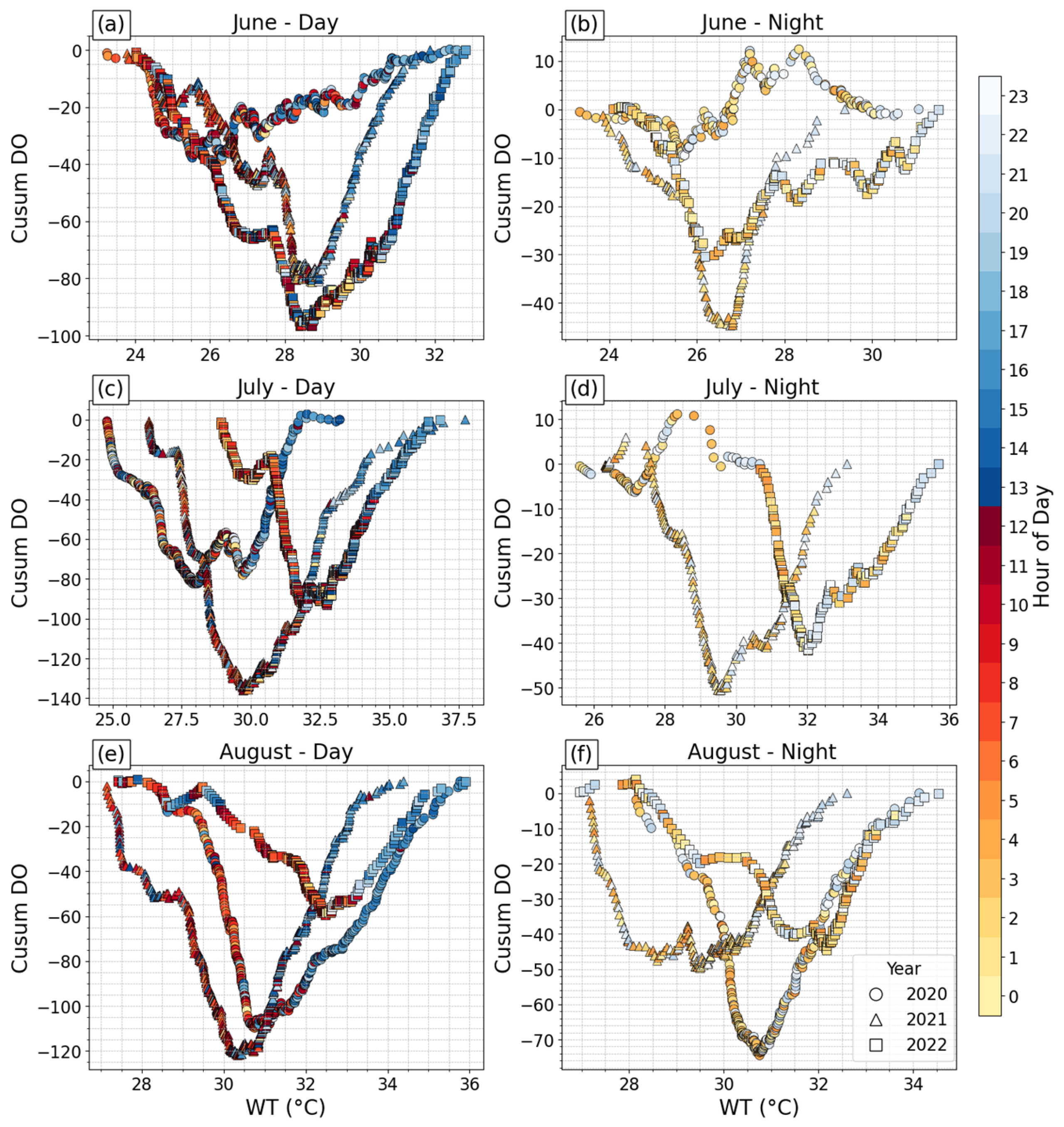
To understand this discrepancy in summer (JJA), we investigated the Cusums of DO in response to WT during the daytime (Figure 8a,c,e) and nighttime (Figure 8b,d,f) in June, July, and August for the years 2020 (circle), 2021 (triangle), and 2022 (square). Surprisingly, most Cusums present a bowl-shaped pattern in these three months both in the daytime and nighttime. The color in each scatter indicates the DO concentration and WT measured at the corresponding hour. It is apparent that DO concentration shifts from below average to above average at noon around 30–32 °C in July and August and around 28 °C in June.

4. Discussion

In this study, we conducted high-frequency monitoring (at 10 min intervals) of DO in the littoral zone of Taihu Lake over a three-year period. The results reveal significant variations in DO concentration dynamics across different temporal scales (i.e., annual, seasonal, and diel) in eutrophic lakes, especially in shallow water zones. At both diel and seasonal scales, changes in DO concentration exhibit complex, nonlinear patterns driven by interactions among PAR and WT levels. As WT increases in summer, thermal stratification intensifies the oxygen distribution gradient within the water body, leading to oxygen-rich surface layers and potentially hypoxic bottom layers. Cumulative sum (Cusum) analysis reveals a non-monotonic relationship between DO and WT, with significant annual and seasonal variability likely influenced by climatic and environmental changes. These variations highlight not only the influence of biotic factors (photosynthesis and respiration) but also the dynamic effects of abiotic factors (PAR and WT) at different temporal intervals.
In the diel cycle, the synchronous peaks of PAR and DO indicate that photosynthesis is the primary driver of DO increases during daylight hours, even though rising temperatures can affect DO solubility to some extent [44]. As PAR intensifies in the morning, surface DO concentrations rise rapidly due to enhanced photosynthetic activity and gradually diffuse to deeper layers, alleviating hypoxia at the lake bottom [7,45]. This pattern was evident in our study, with a positive gradient of DO and PAR observed from 0600 to 1300 (Figure 5a,c), and DO concentrations peaking between 1200 and 1400 (Figure 4a). However, following the midday peak, PAR levels declined, leading to a slowdown in photosynthesis and a gradual decrease in DO concentrations. This afternoon decline may be attributed to two factors: the reduced availability of dissolved inorganic carbon (DIC) for photosynthesis, known as “afternoon depression” [46], and increased respiration rates due to rising temperatures, which enhance metabolic activity and oxygen consumption [47]. Indeed, a recent study revealed that DIC from sediment microbial respiration can significantly influence the algal biomass in eutrophic shallow freshwater lakes [48].
During the late afternoon, continuous respiration by aquatic organisms led to greater oxygen consumption than oxygen production, particularly as photosynthetic activity diminished. This elevated oxygen consumption persisted into the early night until microbial decomposition of organic matter decreased, thereby curbing respiratory oxygen depletion [47]. Consequently, DO levels reached their minimum just before sunrise (around 0500–0600), when PAR was negligible, and oxygen production had ceased entirely. Although we did not directly measure dissolved CO2 in this study, prior research demonstrates an inverse relationship between DO and dissolved CO2 concentrations [49]. In both winter and summer, dissolved CO2 peaks occurred at dawn and reached valleys in the late afternoon, aligning with our observed DO patterns [50]. Furthermore, our Cusum analysis of DO against PAR consistently exhibited a bowl-shaped trend, indicating that DO stabilized or decreased beyond a certain PAR threshold. These findings underscore the critical role of photosynthesis in shaping DO dynamics, particularly during daylight hours when PAR levels are highest [51].
It is noteworthy that a significant decline in DO was observed from 15 April to 30 April 2021, earlier than the typical onset of cyanobacterial blooms in May [52]. Rising temperatures and low precipitation in spring led to a substantial increase in algae in Taihu Lake since April [53]. The extensive proliferation of cyanobacteria in the upper water layers hindered oxygen dissolution, causing depletion in the lower layers and resulting in aquatic organism mortality [54]. The decomposition of dying cyanobacteria further consumed DO [55]. Therefore, the early decline in DO in April was likely due to this premature cyanobacterial outbreak. Additionally, weaker sunlight and reduced photosynthetic intensity in aquatic plants during spring made the decrease in DO more pronounced compared to typical summer blooms. Although no direct phytoplankton or satellite data were available in this study, the timing and pattern of DO decline in April 2021, together with previous reports of early cyanobacterial proliferation in Taihu Lake, suggest that bloom-related processes likely contributed to the observed oxygen dynamics.
At the seasonal scale, according to the random forest (RF) regression analysis (Figure 6), the consistently high importance of WT in spring, autumn, and winter suggests that temperature-driven processes (e.g., oxygen solubility, metabolic rates, and mixing intensity) play a dominant role during these seasons. In summer, however, PAR emerged as the most important factor, followed by RH and WT, highlighting the critical role of light availability and atmospheric moisture in regulating photosynthetic oxygen production under high-temperature conditions. This pattern implies that DO dynamics in summer are primarily governed by the combined effects of enhanced photosynthesis and thermal stress. This seasonal pattern motivated a closer examination of DO-WT interactions through Cusum analysis, which provided a clearer depiction of their nonlinear dynamics.
Cusum analysis reveals a complex relationship between DO and WT. During winter, spring, and autumn, under variable weather conditions, the DO-WT relationship displays a dome-shaped pattern (Figure 7a,d,j), indicating a significant negative correlation. This negative correlation likely results from the reduced solubility of oxygen at higher WT and increased respiration by microorganisms and aquatic organisms, which further depletes oxygen [37,56]. Conversely, during daylight hours in seasons with high photosynthetic activity (e.g., winter 2021 and autumn 2020), increases in PAR and WT lead to more pronounced DO fluctuations [57]. Intense photosynthesis generates large amounts of oxygen, causing marked increases in DO concentrations. The oxygen accumulated during the day can then be utilized by organisms through respiration at night, helping to maintain ecosystem balance. Additionally, higher daytime temperatures and strong light conditions may enhance phytoplankton photosynthetic efficiency, further amplifying diel DO variations [58]. During autumn and winter, DO distribution tends to be more uniform throughout the water column. Lower WT increases oxygen solubility and promote vertical and horizontal mixing, resulting in more stable DO concentrations [59,60,61]. Additionally, reduced temperatures may slow down the metabolic rates of microorganisms and aquatic organisms, decreasing oxygen consumption. This temperature-driven mixing, combined with higher oxygen solubility in colder conditions, helps maintain a more stable DO distribution during these seasons.
In summer, thermal stratification frequently occurs in water bodies, particularly in eutrophic environments [62]. Due to direct sunlight, the surface water warms and holds higher DO concentrations. This warming creates a density gradient that inhibits mixing with cooler, denser bottom waters, leading to stratification. Consequently, the bottom layers, lacking convective exchange, often remain in a prolonged hypoxic state [18]. In shallow eutrophic waters, rapid algal growth shifts the system’s primary metabolic processes from heterotrophic to autotrophic in daytime, leading to intense diel DO fluctuations [63,64]. Although previous studies have shown that substantial production escapes immediate respiration and is instead buried or exported in eutrophic lakes [65], in lakes dominated by cyanobacteria, amino acids, carboxylic acids and lipids utilization might accelerate respiration and increase oxygen consumption [66]. Furthermore, active daytime photosynthesis greatly increases oxygen in the surface layers, which can diffuse during the high-temperature period from afternoon to evening, helping maintain DO levels in localized areas through the night. Overall, a positive correlation between DO and WT in our study also highlights the pattern that higher WT may extend the time required during the day to accumulate enough oxygen for nighttime replenishment. This could be due to accelerated metabolic rates under warm conditions, which significantly increase oxygen consumption and create a higher demand for oxygen within the water body.
Furthermore, eutrophication combined with elevated temperatures notably boosts respiration rates in aquatic ecosystems, substantially lowering net ecosystem productivity (NEP), which represents the balance between photosynthesis and respiration [67]. Some research suggests that temperature alone may not significantly impact respiration in aquatic environments; however, when nutrient levels also rise, CO2 concentrations increase markedly while DO declines, highlighting the critical role of eutrophication in warm waters [68]. During our cumulative curve analysis for June 2020, we observed no clear monotonic relationship or prominent inflection points between DO and WT, indicating a complex interaction. This complexity may be due to external factors like rainfall and strong winds in summer, which induce mixing effects in the water body and disrupt thermal stratification [69,70]. The observed Cusum curve showed bowl-shaped patterns with inflection temperatures ranging from 26 to 33 °C during the day and 25–32 °C at night (Figure 8), suggesting interannual variability in the transition temperature from low to high DO. Such variability likely reflects the interplay of thermal stratification, mixing, and episodic weather events, indicating that factors beyond temperature and nutrient levels also exert substantial influence on DO dynamics.
While this study was conducted at a single littoral site (Sanshandao) in Lake Taihu, the results provide valuable insights into the diel and seasonal variability of DO dynamics in shallow eutrophic zones. Previous measurements at other sites in Taihu have shown spatial heterogeneity in DO patterns, reflecting differences in hydrodynamics, nutrient conditions, and algal composition. Nevertheless, the present findings highlight mechanisms that are likely applicable to other littoral areas with similar environmental settings, while acknowledging that site-specific factors may influence the magnitude of these responses.

5. Conclusions

This study investigated diel and seasonal DO dynamics in the littoral zone of Taihu Lake, highlighting the complexity of oxygen variability in eutrophic waters. Random forest regression analysis identified water temperature (WT), photosynthetically active radiation (PAR), and relative humidity as the dominant factors controlling diel DO fluctuations, with their effects varying markedly among seasons. Notably, WT exerted an anomalous influence in summer compared with other seasons. Subsequent Cusum analysis confirmed that this anomaly originated from the distinct DO–WT relationship, indicating that temperature-driven metabolic processes dominated DO variability during summer. Meanwhile, intensive cyanobacterial blooms and thermal stratification further constrained vertical oxygen diffusion, resulting in pronounced oxygen gradients and frequent hypoxia in deeper layers. These findings reveal that the unique summer DO behavior stems from the synergistic effects of elevated temperature, eutrophication, and biological activity, providing important implications for understanding and managing oxygen dynamics in eutrophic lakes under future warming scenarios. Furthermore, the combination of high-frequency DO monitoring with advanced analytical techniques (e.g., random forest regression and Cusum analysis) demonstrates strong potential for integration into real-time water quality monitoring and early warning systems, thereby supporting proactive lake ecosystem management.

Author Contributions

Conceptualization, D.X.; methodology, D.X.; software, X.C.; validation, X.C. and Y.Q.; formal analysis, D.X.; investigation, D.X. and X.C.; resources, D.X.; data curation, X.C.; writing—original draft preparation, D.X.; writing—review and editing, D.X. and Y.Q.; visualization, D.X. and Y.Q.; supervision, D.X. and Y.F.; project administration, D.X. and Y.F.; funding acquisition, D.X. All authors have read and agreed to the published version of the manuscript.

Funding

This research was supported by a project funded by the Priority Academic Program Development of Jiangsu Higher Education Institutions [PAPD], a start-up fund of Nanjing Forestry University, grant number GXL035, Jiangsu Students’ platform for innovation and entrepreneurship training program, grant number 202410298205Y and Project on Health Assessment and Ecological Quality Grading of Municipal Important Wetlands in Suzhou, grant number JSZC-320500-SZWK-C2025-0279.

Data Availability Statement

The data that support the findings of this study were obtained from the National Wetland Ecosystem Field Station of Taihu Lake. The dataset covers the period from 2020 to 2022 and includes parameters such as air temperature, near-surface wind, relative humidity, rainfall, density of photosynthetically active radiation, and dissolved oxygen. Due to data ownership and confidentiality agreements with the monitoring institution, these data are not publicly available but can be obtained from the corresponding author upon reasonable request.

Acknowledgments

We thank Yi Zhang and Xitao Yu for providing field assistance and participating in the helpful discussions. We also greatly appreciate the anonymous reviewers for their valuable comments on the early version of the manuscript.

Conflicts of Interest

The authors declare no conflicts of interest.

References

  1. Venkiteswaran, J.J.; Wassenaar, L.I.; Schiff, S.L. Dynamics of Dissolved Oxygen Isotopic Ratios: A Transient Model to Quantify Primary Production, Community Respiration, and Air–Water Exchange in Aquatic Ecosystems. Oecologia 2007, 153, 385–398. [Google Scholar] [CrossRef]
  2. Ahmed, S.; Abdul-Aziz, O.I. Metabolic Scaling of Stream Dissolved Oxygen across the U.S. Atlantic Coast. Sci. Total Environ. 2022, 821, 153292. [Google Scholar] [CrossRef] [PubMed]
  3. Xu, Y.; Zhou, T.; Su, Y.; Fang, L.; Naidoo, A.R.; Lv, P.; Lv, S.; Meng, X.-Z. How Anthropogenic Factors Influence the Dissolved Oxygen in Surface Water over Three Decades in Eastern China? J. Environ. Manag. 2023, 326, 116828. [Google Scholar] [CrossRef]
  4. Gammons, C.H.; Babcock, J.N.; Parker, S.R.; Poulson, S.R. Diel Cycling and Stable Isotopes of Dissolved Oxygen, Dissolved Inorganic Carbon, and Nitrogenous Species in a Stream Receiving Treated Municipal Sewage. Chem. Geol. 2011, 283, 44–55. [Google Scholar] [CrossRef]
  5. Hanson, P.C.; Carpenter, S.R.; Armstrong, D.E.; Stanley, E.H.; Kratz, T.K. Lake Dissolved Inorganic Carbon and Dissolved Oxygen: Changing Drivers from Days to Decades. Ecol. Monogr. 2006, 76, 343–363. [Google Scholar] [CrossRef]
  6. Nielsen, A.; Liboriussen, L.; Trolle, D.; Landkildehus, F.; Søndergaard, M.; Lauridsen, T.L.; Søndergaard, M.; Larsen, S.E.; Jeppesen, E. Daily Net Ecosystem Production in Lakes Predicted from Midday Dissolved Oxygen Saturation: Analysis of a Five-year High Frequency Dataset from 24 Mesocosms with Contrasting Trophic States and Temperatures. Limnol. Oceanogr. Methods 2013, 11, 202–212. [Google Scholar] [CrossRef]
  7. Andersen, M.R.; Kragh, T.; Sand-Jensen, K. Extreme Diel Dissolved Oxygen and Carbon Cycles in Shallow Vegetated Lakes. Proc. R. Soc. B Biol. Sci. 2017, 284, 20171427. [Google Scholar] [CrossRef] [PubMed]
  8. Laursen, A.E.; Seitzinger, S.P. Diurnal Patterns of Denitrification, Oxygen Consumption and Nitrous Oxide Production in Rivers Measured at the Whole-reach Scale. Freshw. Biol. 2004, 49, 1448–1458. [Google Scholar] [CrossRef]
  9. Mulholland, P.J.; Houser, J.N.; Maloney, K.O. Stream Diurnal Dissolved Oxygen Profiles as Indicators of In-Stream Metabolism and Disturbance Effects: Fort Benning as a Case Study. Ecol. Indic. 2005, 5, 243–252. [Google Scholar] [CrossRef]
  10. Nicholson, D.P.; Wilson, S.T.; Doney, S.C.; Karl, D.M. Quantifying Subtropical North Pacific Gyre Mixed Layer Primary Productivity from Seaglider Observations of Diel Oxygen Cycles. Geophys. Res. Lett. 2015, 42, 4032–4039. [Google Scholar] [CrossRef]
  11. Paulsson, O.; Widerlund, A. Diel Variations in Dissolved Oxygen Concentration and Algal Growth in the Laver Pit Lake, Northern Sweden. Appl. Geochem. 2023, 155, 105725. [Google Scholar] [CrossRef]
  12. Ma, Y.; Lee, J.H.W.; Chang, L.; Tang, H.; Liu, H. Field Measurements of the Carbon to Chlorophyll-a Ratio Using Imaging FlowCytobot: Implications for Dissolved Oxygen Modeling. Estuar. Coast. Shelf Sci. 2023, 285, 108304. [Google Scholar] [CrossRef]
  13. Das, S.; Sil, S. Diel Variations in the Upper Layer Biophysical Processes Using a BGC-Argo in the Bay of Bengal. Deep Sea Res. Part II Top. Stud. Oceanogr. 2024, 216, 105392. [Google Scholar] [CrossRef]
  14. Hitchcock, G.L.; Kirkpatrick, G.; Lane, P.V.Z.; Langdon, C. Comparative Diel Oxygen Cycles Preceding and during a Karenia Bloom in Sarasota Bay, Florida, USA. Harmful Algae 2014, 38, 95–100. [Google Scholar] [CrossRef]
  15. Tasnim, B.; Jamily, J.A.; Fang, X.; Zhou, Y.; Hayworth, J.S. Simulating Diurnal Variations of Water Temperature and Dissolved Oxygen in Shallow Minnesota Lakes. Water 2021, 13, 1980. [Google Scholar] [CrossRef]
  16. Tadesse, I.; Green, F.B.; Puhakka, J.A. Seasonal and Diurnal Variations of Temperature, pH and Dissolved Oxygen in Advanced Integrated Wastewater Pond System® Treating Tannery Effluent. Water Res. 2004, 38, 645–654. [Google Scholar] [CrossRef]
  17. Cui, J.; Wang, Y.; Ding, S.; Chen, M.; Li, D.; Hao, X.; Wang, Y. High-Resolution Diurnal Variation Mechanism of Oxygen and Acid Environments at the Water–Sediment Interface during Cyanobacterial Decomposition. J. Clean. Prod. 2024, 435, 140605. [Google Scholar] [CrossRef]
  18. Zhang, Y.; Wu, Z.; Liu, M.; He, J.; Shi, K.; Zhou, Y.; Wang, M.; Liu, X. Dissolved Oxygen Stratification and Response to Thermal Structure and Long-Term Climate Change in a Large and Deep Subtropical Reservoir (Lake Qiandaohu, China). Water Res. 2015, 75, 249–258. [Google Scholar] [CrossRef]
  19. Liu, M.; Zhang, Y.; Shi, K.; Zhang, Y.; Zhou, Y.; Zhu, M.; Zhu, G.; Wu, Z.; Liu, M. Effects of Rainfall on Thermal Stratification and Dissolved Oxygen in a Deep Drinking Water Reservoir. Hydrol. Process. 2020, 34, 3387–3399. [Google Scholar] [CrossRef]
  20. Abdul Azeez, S.; Gireeshkumar, T.R.; Muraleedharan, K.R.; Vignesh, E.R.; Jaleel, A.K.U.; Arya, K.S.; Ravikumar Nair, C.; Ratheesh, R. Factors Influencing Nearshore Hypoxia in the Southeastern Arabian Sea: A Sensor-Based Study. Mar. Pollut. Bull. 2023, 197, 115696. [Google Scholar] [CrossRef]
  21. Brooks, B.W.; Lazorchak, J.M.; Howard, M.D.A.; Johnson, M.V.; Morton, S.L.; Perkins, D.A.K.; Reavie, E.D.; Scott, G.I.; Smith, S.A.; Steevens, J.A. Are Harmful Algal Blooms Becoming the Greatest Inland Water Quality Threat to Public Health and Aquatic Ecosystems? Environ. Toxicol. Chem. 2016, 35, 6–13. [Google Scholar] [CrossRef]
  22. Lokhande, S.; Tare, V. Spatio-Temporal Trends in the Flow and Water Quality: Response of River Yamuna to Urbanization. Environ. Monit. Assess. 2021, 193, 117. [Google Scholar] [CrossRef]
  23. Yang, F.; Zheng, X.; Wang, D.; Yao, E.; Li, Y.; Huang, W.; Zhang, L.; Wang, J.; Zhong, J. Significant Diurnal Variations in Nitrous Oxide (N2O) Emissions from Two Contrasting Habitats in a Large Eutrophic Lake (Lake Taihu, China). Environ. Res. 2024, 261, 119691. [Google Scholar] [CrossRef] [PubMed]
  24. Duvall, M.S.; Hagy, J.D.; Ammerman, J.W.; Tedesco, M.A. High-Frequency Dissolved Oxygen Dynamics in an Urban Estuary, the Long Island Sound. Estuaries Coasts 2024, 47, 415–430. [Google Scholar] [CrossRef]
  25. Volkmar, E.C.; Henson, S.S.; Dahlgren, R.A.; O’Geen, A.T.; Van Nieuwenhuyse, E.E. Diel Patterns of Algae and Water Quality Constituents in the San Joaquin River, California, USA. Chem. Geol. 2011, 283, 56–67. [Google Scholar] [CrossRef]
  26. Zhang, H.; Chen, J.; Han, M.; An, W.; Yu, J. Anoxia Remediation and Internal Loading Modulation in Eutrophic Lakes Using Geoengineering Method Based on Oxygen Nanobubbles. Sci. Total Environ. 2020, 714, 136766. [Google Scholar] [CrossRef]
  27. Mukherjee, R.; Acharya, A.; Gupta, V.K.; Bakshi, S.; Paul, M.; Sanyal, P.; Mukhopadhyay, S.K. Diurnal Variation of Abundance of Bacterioplankton and High and Low Nucleic Acid Cells in a Mangrove Dominated Estuary of Indian Sundarbans. Cont. Shelf Res. 2020, 210, 104256. [Google Scholar] [CrossRef]
  28. Rajwa-Kuligiewicz, A.; Bialik, R.J.; Rowiński, P.M. Dissolved Oxygen and Water Temperature Dynamics in Lowland Rivers over Various Timescales. J. Hydrol. Hydromech. 2015, 63, 353–363. [Google Scholar] [CrossRef]
  29. Utz, R.M.; Bookout, B.J.; Kaushal, S.S. Influence of Temperature, Precipitation, and Cloud Cover on Diel Dissolved Oxygen Ranges among Headwater Streams with Variable Watershed Size and Land Use Attributes. Aquat. Sci. 2020, 82, 82. [Google Scholar] [CrossRef]
  30. Xu, C.; Luo, P.; Wu, P.; Song, C.; Chen, X. Detection of Periodicity, Aperiodicity, and Corresponding Driving Factors of River Dissolved Oxygen Based on High-Frequency Measurements. J. Hydrol. 2022, 609, 127711. [Google Scholar] [CrossRef]
  31. Fernández Castro, B.; Chmiel, H.E.; Minaudo, C.; Krishna, S.; Perolo, P.; Rasconi, S.; Wüest, A. Primary and Net Ecosystem Production in a Large Lake Diagnosed from High-resolution Oxygen Measurements. Water Resour. Res. 2021, 57, e2020WR029283. [Google Scholar] [CrossRef]
  32. Tian, R.; Cai, X.; Testa, J.M.; Brady, D.C.; Cerco, C.F.; Linker, L.C. Simulation of High-Frequency Dissolved Oxygen Dynamics in a Shallow Estuary, the Corsica River, Chesapeake Bay. Front. Mar. Sci. 2022, 9, 1058839. [Google Scholar] [CrossRef]
  33. Araujo, A.N.; San Andres, C.F.; Nguyen, K.Q.; Corby, T.L.; Rhodes, M.A.; García, J.; Roy, L.A.; Davis, D.A. Effects of Minimum Dissolved Oxygen Setpoints for Aeration in Semi-Intensive Pond Production of Pacific White Shrimp (Litopenaeus vannamei). Aquaculture 2025, 594, 741376. [Google Scholar] [CrossRef]
  34. Röder, E.; Licht, G.; Fahle, M.; Weber, A.; Zug, S.; Lau, M.P. Spatial Heterogeneity of Dissolved Oxygen and Sediment Fluxes Revealed by Autonomous Robotic Lakewater Profiling. Limnol. Oceanogr. 2025, 70, 2829–2843. [Google Scholar] [CrossRef]
  35. Bartosiewicz, M.; Przytulska, A.; Lapierre, J.; Laurion, I.; Lehmann, M.F.; Maranger, R. Hot Tops, Cold Bottoms: Synergistic Climate Warming and Shielding Effects Increase Carbon Burial in Lakes. Limnol. Oceanogr. Lett. 2019, 4, 132–144. [Google Scholar] [CrossRef]
  36. Woolway, R.I.; Sharma, S.; Weyhenmeyer, G.A.; Debolskiy, A.; Golub, M.; Mercado-Bettín, D.; Perroud, M.; Stepanenko, V.; Tan, Z.; Grant, L.; et al. Phenological Shifts in Lake Stratification under Climate Change. Nat. Commun. 2021, 12, 2318. [Google Scholar] [CrossRef] [PubMed]
  37. Regier, P.J.; Ward, N.D.; Myers-Pigg, A.N.; Grate, J.; Freeman, M.J.; Ghosh, R.N. Seasonal Drivers of Dissolved Oxygen across a Tidal Creek–Marsh Interface Revealed by Machine Learning. Limnol. Oceanogr. 2023, 68, 2359–2374. [Google Scholar] [CrossRef]
  38. Ni, W.; Li, M.; Ross, A.C.; Najjar, R.G. Large Projected Decline in Dissolved Oxygen in a Eutrophic Estuary Due to Climate Change. JGR Ocean. 2019, 124, 8271–8289. [Google Scholar] [CrossRef]
  39. Pu, J.; Song, K.; Lv, Y.; Liu, G.; Fang, C.; Hou, J.; Wen, Z. Distinguishing Algal Blooms from Aquatic Vegetation in Chinese Lakes Using Sentinel 2 Image. Remote Sens. 2022, 14, 1988. [Google Scholar] [CrossRef]
  40. Xie, D.; Li, X.; Zhou, T.; Feng, Y. Estimating the Contribution of Environmental Variables to Water Quality in the Postrestoration Littoral Zones of Taihu Lake Using the APCS-MLR Model. Sci. Total Environ. 2023, 857, 159678. [Google Scholar] [CrossRef]
  41. Truesdale, G.A.; Downing, A.L. Solubility of Oxygen in Water. Nature 1954, 173, 1236. [Google Scholar] [CrossRef]
  42. Pedregosa, F.; Varoquaux, G.; Gramfort, A.; Michel, V.; Thirion, B.; Grisel, O.; Blondel, M.; Prettenhofer, P.; Weiss, R.; Dubourg, V.; et al. Scikit-Learn: Machine Learning in Python. J. Mach. Learn. Res. 2011, 12, 2825–2830. [Google Scholar]
  43. Regier, P.; Briceño, H.; Boyer, J.N. Analyzing and Comparing Complex Environmental Time Series Using a Cumulative Sums Approach. MethodsX 2019, 6, 779–787. [Google Scholar] [CrossRef] [PubMed]
  44. Villamizar, S.R.; Segura, C.; Warren, D.R. Using Stream Dissolved Oxygen and Light Relationships to Estimate Stream Primary Production on Mountainous Headwater Stream Ecosystems. Ecohydrology 2024, 17, e2699. [Google Scholar] [CrossRef]
  45. Martinsen, K.T.; Zak, N.B.; Baastrup-Spohr, L.; Kragh, T.; Sand-Jensen, K. Ecosystem Metabolism and Gradients of Temperature, Oxygen and Dissolved Inorganic Carbon in the Littoral Zone of a Macrophyte-dominated Lake. JGR Biogeosci. 2022, 127, e2022JG007193. [Google Scholar] [CrossRef]
  46. Kragh, T.; Andersen, M.R.; Sand-Jensen, K. Profound Afternoon Depression of Ecosystem Production and Nighttime Decline of Respiration in a Macrophyte-Rich, Shallow Lake. Oecologia 2017, 185, 157–170. [Google Scholar] [CrossRef]
  47. Kreling, J.; Bravidor, J.; Engelhardt, C.; Hupfer, M.; Koschorreck, M.; Lorke, A. The Importance of Physical Transport and Oxygen Consumption for the Development of a Metalimnetic Oxygen Minimum in a Lake. Limnol. Oceanogr. 2017, 62, 348–363. [Google Scholar] [CrossRef]
  48. Xu, Y.; Wei, Q.; Wei, Z.; Ruan, A. Key Roles of Carbon Metabolic Intensity of Sediment Microbes in Dynamics of Algal Blooms in Shallow Freshwater Lakes. Hydrobiologia 2024, 851, 4873–4889. [Google Scholar] [CrossRef]
  49. Naslund, L.C.; Mehring, A.S.; Rosemond, A.D.; Wenger, S.J. Toward More Accurate Estimates of Carbon Emissions from Small Reservoirs. Limnol. Oceanogr. 2024, 69, 1350–1364. [Google Scholar] [CrossRef]
  50. Potter, L.; Xu, Y.J. Can a Eutrophic Lake Function as a Carbon Sink? Case Study of a Subtropical Eutrophic Lake in Southern USA. J. Hydrol. 2023, 625, 130071. [Google Scholar] [CrossRef]
  51. Li, H.; Moon, H.; Kang, E.J.; Kim, J.-M.; Kim, M.; Lee, K.; Kwak, C.-W.; Kim, H.; Kim, I.-N.; Park, K.Y.; et al. The Diel and Seasonal Heterogeneity of Carbonate Chemistry and Dissolved Oxygen in Three Types of Macroalgal Habitats. Front. Mar. Sci. 2022, 9, 857153. [Google Scholar] [CrossRef]
  52. Yin, Z.; Li, J.; Zhang, B.; Liu, Y.; Yan, K.; Gao, M.; Xie, Y.; Zhang, F.; Wang, S. Increase in Chlorophyll-a Concentration in Lake Taihu from 1984 to 2021 Based on Landsat Observations. Sci. Total Environ. 2023, 873, 162168. [Google Scholar] [CrossRef]
  53. Zhang, K.; Gu, Y.; Cheng, C.; Xue, Q.; Xie, L. Changes in Microcystin Concentration in Lake Taihu, 13 Years (2007–2020) after the 2007 Drinking Water Crisis. Environ. Res. 2024, 241, 117597. [Google Scholar] [CrossRef]
  54. Yan, X.; Xu, X.; Wang, M.; Wang, G.; Wu, S.; Li, Z.; Sun, H.; Shi, A.; Yang, Y. Climate Warming and Cyanobacteria Blooms: Looks at Their Relationships from a New Perspective. Water Res. 2017, 125, 449–457. [Google Scholar] [CrossRef] [PubMed]
  55. Shi, L.; Huang, Y.; Zhang, M.; Yu, Y.; Lu, Y.; Kong, F. Bacterial Community Dynamics and Functional Variation during the Long-Term Decomposition of Cyanobacterial Blooms in-Vitro. Sci. Total Environ. 2017, 598, 77–86. [Google Scholar] [CrossRef] [PubMed]
  56. Cao, M.; Rivas-Ruiz, P.; Trapote, M.D.C.; Vegas-Vilarrúbia, T.; Rull, V.; Rosell-Melé, A. Seasonal Effects of Water Temperature and Dissolved Oxygen on the isoGDGT Proxy (TEX86) in a Mediterranean Oligotrophic Lake. Chem. Geol. 2020, 551, 119759. [Google Scholar] [CrossRef]
  57. Chen, Y.; Zhai, F.; Gu, Y.; Cao, J.; Liu, C.; Liu, X.; Liu, Z.; Li, P. Seasonal Variability in Dissolved Oxygen in the Bohai Sea, China. J. Oceanol. Limnol. 2022, 40, 78–92. [Google Scholar] [CrossRef]
  58. Liu, G.; He, W.; Cai, S. Seasonal Variation of Dissolved Oxygen in the Southeast of the Pearl River Estuary. Water 2020, 12, 2475. [Google Scholar] [CrossRef]
  59. Xue, P.; Chen, C.; Qi, J.; Beardsley, R.C.; Tian, R.; Zhao, L.; Lin, H. Mechanism Studies of Seasonal Variability of Dissolved Oxygen in Mass Bay: A Multi-Scale FVCOM/UG-RCA Application. J. Mar. Syst. 2014, 131, 102–119. [Google Scholar] [CrossRef]
  60. Iriarte, A.; Villate, F.; Uriarte, I.; Alberdi, L.; Intxausti, L. Dissolved Oxygen in a Temperate Estuary: The Influence of Hydro-Climatic Factors and Eutrophication at Seasonal and Inter-Annual Time Scales. Estuaries Coasts 2015, 38, 1000–1015. [Google Scholar] [CrossRef]
  61. Siriwardana, C.; Cooray, A.T.; Liyanage, S.S.; Koliyabandara, S.M.P.A. Seasonal and Spatial Variation of Dissolved Oxygen and Nutrients in Padaviya Reservoir, Sri Lanka. J. Chem. 2019, 2019, 5405016. [Google Scholar] [CrossRef]
  62. Su, X.; He, Q.; Mao, Y.; Chen, Y.; Hu, Z. Dissolved Oxygen Stratification Changes Nitrogen Speciation and Transformation in a Stratified Lake. Environ. Sci. Pollut. Res. 2019, 26, 2898–2907. [Google Scholar] [CrossRef]
  63. Istvánovics, V.; Honti, M. Coupled Simulation of High-Frequency Dynamics of Dissolved Oxygen and Chlorophyll Widens the Scope of Lake Metabolism Studies: Coupled Simulation of DO and Chl Dynamics. Limnol. Oceanogr. 2018, 63, 72–90. [Google Scholar] [CrossRef]
  64. Baxa, M.; Musil, M.; Kummel, M.; Hanzlík, P.; Tesařová, B.; Pechar, L. Dissolved Oxygen Deficits in a Shallow Eutrophic Aquatic Ecosystem (Fishpond)—Sediment Oxygen Demand and Water Column Respiration Alternately Drive the Oxygen Regime. Sci. Total Environ. 2021, 766, 142647. [Google Scholar] [CrossRef] [PubMed]
  65. Solomon, C.T.; Bruesewitz, D.A.; Richardson, D.C.; Rose, K.C.; Van De Bogert, M.C.; Hanson, P.C.; Kratz, T.K.; Larget, B.; Adrian, R.; Babin, B.L.; et al. Ecosystem Respiration: Drivers of Daily Variability and Background Respiration in Lakes around the Globe. Limnol. Oceanogr. 2013, 58, 849–866. [Google Scholar] [CrossRef]
  66. Guo, Y.; Gu, S.; Wu, K.; Tanentzap, A.J.; Yu, J.; Liu, X.; Li, Q.; He, P.; Qiu, D.; Deng, Y.; et al. Temperature-mediated Microbial Carbon Utilization in China’s Lakes. Glob. Change Biol. 2023, 29, 5044–5061. [Google Scholar] [CrossRef]
  67. Cross, W.F.; Hood, J.M.; Benstead, J.P.; Huryn, A.D.; Welter, J.R.; Gíslason, G.M.; Ólafsson, J.S. Nutrient Enrichment Intensifies the Effects of Warming on Metabolic Balance of Stream Ecosystems. Limnol. Oceanogr. Lett. 2022, 7, 332–341. [Google Scholar] [CrossRef]
  68. Yuan, D.; Xu, Y.J.; Ma, S.; Le, J.; Zhang, K.; Miao, R.; Li, S. Nitrogen Addition Effect Overrides Warming Effect on Dissolved CO2 and Phytoplankton Structure in Shallow Lakes. Water Res. 2023, 244, 120437. [Google Scholar] [CrossRef]
  69. D’Autilia, R.; Falcucci, M.; Hull, V.; Parrella, L. Short Time Dissolved Oxygen Dynamics in Shallow Water Ecosystems. Ecol. Model. 2004, 179, 297–306. [Google Scholar] [CrossRef]
  70. Robbins, C.J.; Sadler, J.M.; Trolle, D.; Nielsen, A.; Wagner, N.D.; Scott, J.T. Does Polymixis Complicate Prediction of High-frequency Dissolved Oxygen in Lakes and Reservoirs? Limnol. Oceanogr. 2024, 70, S121–S135. [Google Scholar] [CrossRef]
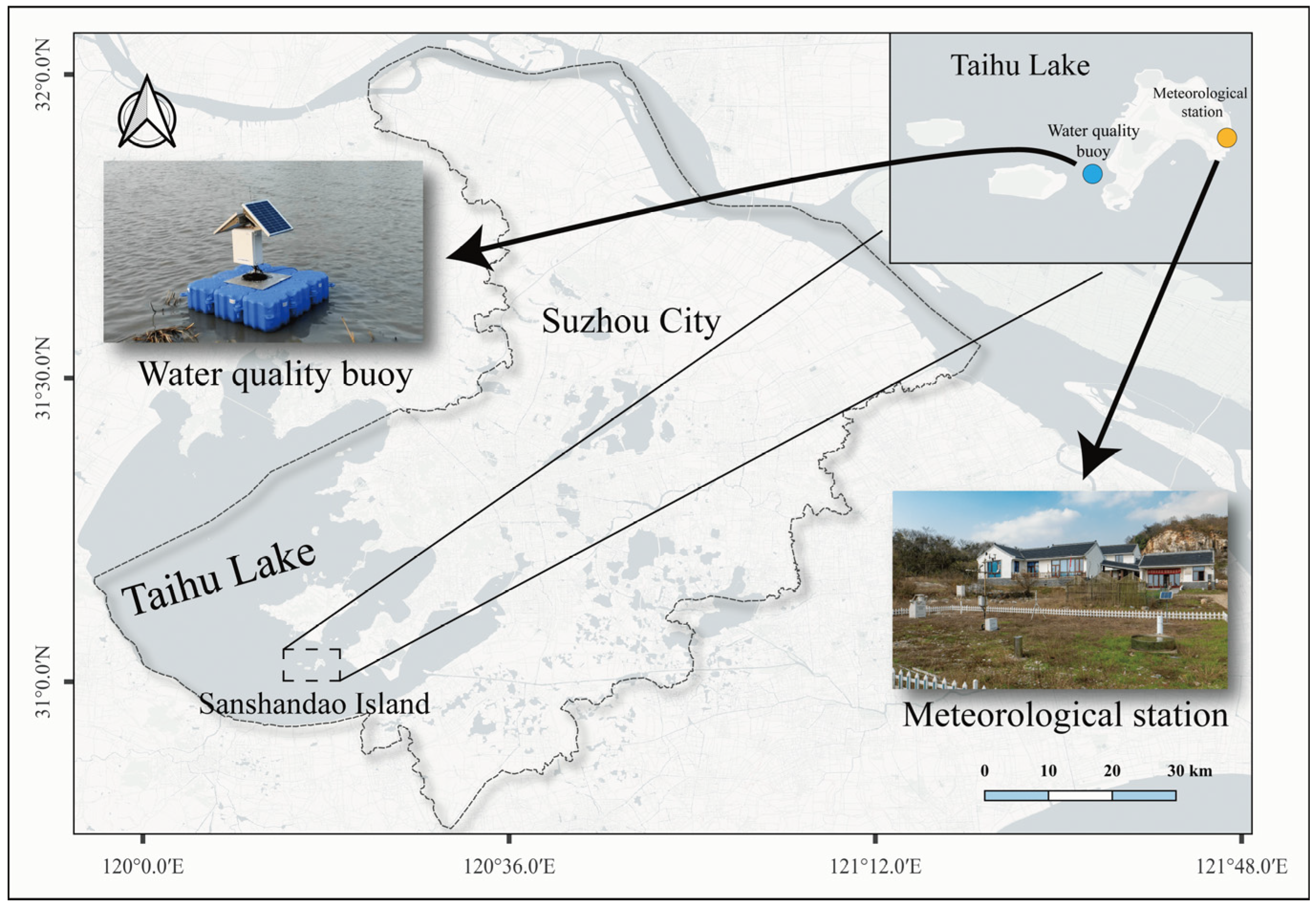
Figure 1. Map of study area and the photos of meteorological station and water quality buoy.
Water 17 03221 g001
Figure 2. Time series of dissolved oxygen (DO) over the study period (2020–2022). The black line denotes the daily mean values and gray bands represent diel ranges (minimum to maximum). Filled circle below the curve denotes dates in which DO saturation exceeded 100%.
Water 17 03221 g002
Figure 3. Boxplot of monthly averaged DO over the study period (2020–2022).
Water 17 03221 g003
Figure 4. Diel cycle of averaged (a) DO, (b) WT, and (c) PAR in each month over the study period (2020–2022).
Water 17 03221 g004
Figure 5. Diel variations of (a) DO concentration gradient per hour, (b) WT gradient per hour and (c) PAR gradient per hour in each month over the study period (2020–2022).
Water 17 03221 g005
Figure 6. Importance values of six predictor variables—water temperature (WT), photosynthetically active radiation (PAR), relative humidity (RH), wind speed (WS), sunshine duration (SH), and precipitation (P)—derived from the Random Forest regression model in (a) spring, (b) summer, (c) autumn, and (d) winter.
Water 17 03221 g006
Figure 7. Cumulative sum (Cusum) analyses of DO in response to WT (a,d,g,j) and RH (b,e,h,k), as well as PAR during the daytime (c,f,i,l) across four seasons in 2020 (blue), 2021 (green), and 2022 (red).
Water 17 03221 g007
Figure 8. Cumulative sum (Cusum) scatter plots of DO in response to WT during the daytime (a,c,e) and nighttime (b,d,f) in June, July, and August for the years 2020 (circle), 2021 (triangle), and 2022 (square). The color indicates the DO concentration and WT measured at the corresponding hour.
Water 17 03221 g008
Disclaimer/Publisher’s Note: The statements, opinions and data contained in all publications are solely those of the individual author(s) and contributor(s) and not of MDPI and/or the editor(s). MDPI and/or the editor(s) disclaim responsibility for any injury to people or property resulting from any ideas, methods, instructions or products referred to in the content.