Quantifying Meteorological and Emission-Control Contributions to PM2.5 and Ozone Changes During the 2023 G20 Summit in New Delhi

 ,
,  and
and
Abstract
1. Introduction
2. Materials and Methods
2.1. Model Configuration and Study Domain
2.2. Emission Inventories and Scenario Design
2.3. Observational Data and Model Evaluation
2.4. Attribution Framework and Data Analysis
3. Results
3.1. Model Performance
3.2. Evolution of PM2.5 and O3 During the G20 Period
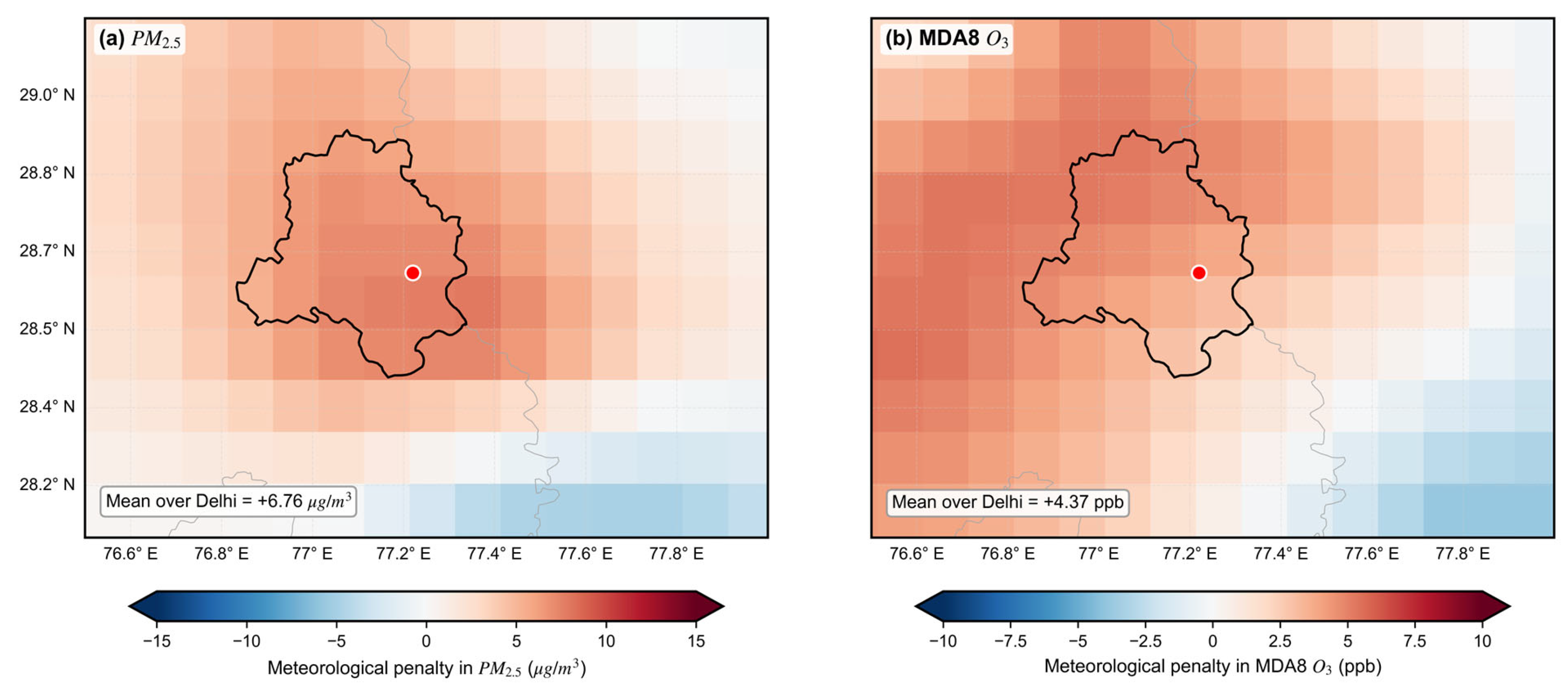
3.3. Meteorological Penalty During the Monsoon Withdrawal Period
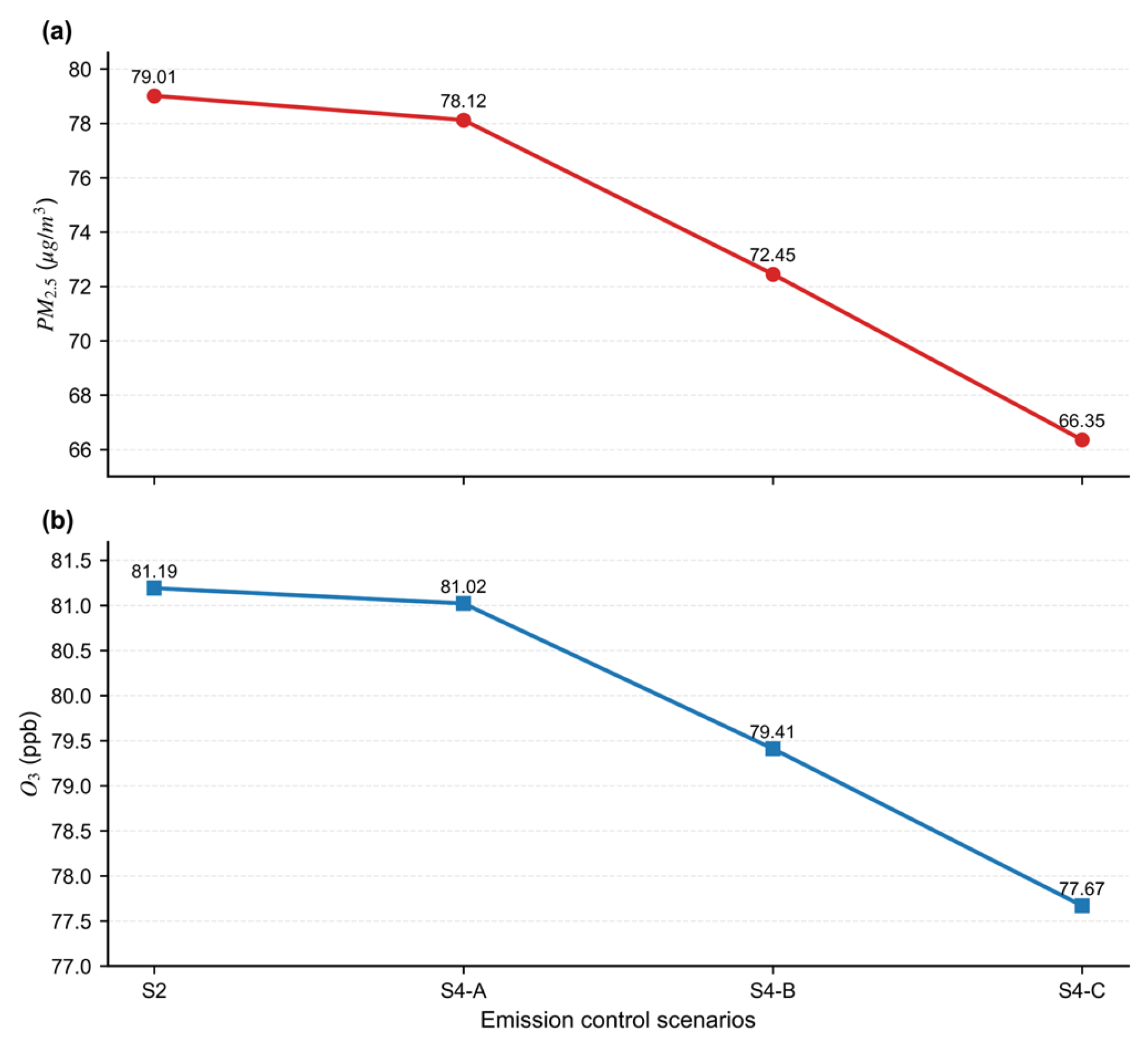
3.4. Response of PM2.5 and O3 to Graded Emission Control Scenarios
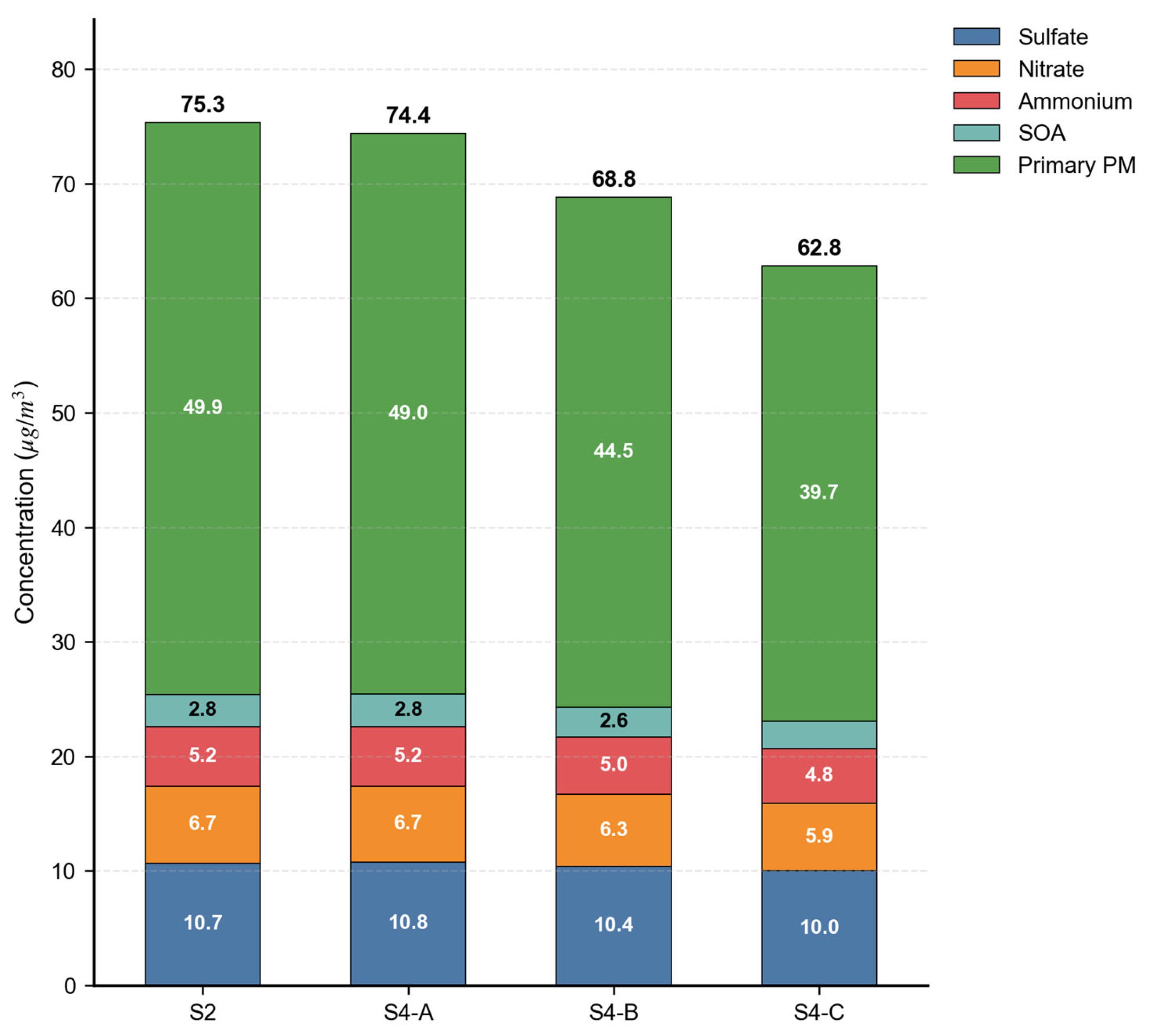
3.5. PM2.5 Component Response to Coordinated Emission Controls
3.6. Spatial Benefits of Deep Emission Reduction and Co-Control Implications
4. Discussion
4.1. Role of Adverse Meteorology During the Monsoon Withdrawal Period
4.2. Different Sensitivities of PM2.5 and O3 to Short-Term Coordinated Controls
4.3. Strengthened Reduction Benefits After S4-B
4.4. Implications for Co-Control and Study Limitations
5. Conclusions
Supplementary Materials
Author Contributions
Funding
Institutional Review Board Statement
Informed Consent Statement
Data Availability Statement
Acknowledgments
Conflicts of Interest
Abbreviations
| AERO6 | Sixth-generation CMAQ aerosol module |
| CMAQ | Community Multiscale Air Quality |
| CPCB | Central Pollution Control Board |
| EC | Elemental Carbon |
| EDGAR | Emissions Database for Global Atmospheric Research |
| FAC2 | Factor of Two |
| FINN | Fire Inventory from NCAR |
| FNL | Final Analysis |
| G20 | Group of Twenty |
| GE | Gross Error |
| HCHO | Formaldehyde |
| MB | Mean Bias |
| MDA8 | Maximum Daily 8 h Average |
| MEGAN | Model of Emissions of Gases and Aerosols from Nature |
| MFB | Mean Fractional Bias |
| MFE | Mean Fractional Error |
| NAAQS | National Ambient Air Quality Standards |
| NCEP | National Centers for Environmental Prediction |
| NH3 | Ammonia |
| NMB | Normalized Mean Bias |
| NO2 | Nitrogen dioxide |
| NOx | Nitrogen oxides |
| O3 | Ozone |
| OBS | Observed mean concentration |
| OC | Organic Carbon |
| PBL | Planetary Boundary Layer |
| PEC | Particulate elemental carbon |
| PM2.5 | Fine particulate matter with aerodynamic diameter ≤ 2.5 μm |
| PNO3 | Particulate nitrate |
| POC | Particulate organic carbon |
| PRE | Predicted mean concentration |
| PSO4 | Particulate sulfate |
| R | Correlation coefficient |
| RH | Relative Humidity |
| RMSE | Root Mean Square Error |
| SAPRC-11 | Statewide Air Pollution Research Center 2011 mechanism |
| SNA | Sulfate–nitrate–ammonium |
| SO2 | Sulfur dioxide |
| SOA | Secondary Organic Aerosol |
| T2 | 2 m temperature |
| VOCs | Volatile Organic Compounds |
| WD | Wind Direction |
| WHO | World Health Organization |
| WRF | Weather Research and Forecasting |
| WS | 10 m Wind Speed |
References
- Lal, R.M.; Nagpure, A.S. Evaluation of India’s National Clean Air Program Performance and Potential Health Benefits. Environ. Sci. Technol. Lett. 2026. [Google Scholar] [CrossRef]
- Pandey, A.; Brauer, M.; Cropper, M.L.; Balakrishnan, K.; Mathur, P.; Dey, S.; Turkgulu, B.; Kumar, G.A.; Khare, M.; Beig, G.; et al. Health and Economic Impact of Air Pollution in the States of India: The Global Burden of Disease Study 2019. Lancet Planet. Health 2021, 5, e25–e38. [Google Scholar] [CrossRef] [PubMed]
- He, C.; Liu, J.; Zhou, Y.; Zhou, J.; Zhang, L.; Wang, Y.; Liu, L.; Peng, S. Synergistic PM2.5 and O3 Control to Address the Emerging Global PM2.5-O3 Compound Pollution Challenges. Eco-Environ. Health 2024, 3, 325–337. [Google Scholar] [CrossRef] [PubMed]
- Kumari, S.; Verma, N.; Lakhani, A.; Kumari, K.M. Severe Haze Events in the Indo-Gangetic Plain during Post-Monsoon: Synergetic Effect of Synoptic Meteorology and Crop Residue Burning Emission. Sci. Total Environ. 2021, 768, 145479. [Google Scholar] [CrossRef]
- Krishnaveni, A.S.; Madhavan, B.L.; Jain, C.D.; Venkat Ratnam, M. Spatial, Temporal Features and Influence of Meteorology on PM2.5 and O3 Association across Urban and Rural Environments of India. Atmos. Environ. X 2024, 22, 100265. [Google Scholar] [CrossRef]
- Venkataraman, C.; Anand, A.; Maji, S.; Barman, N.; Tiwari, D.; Muduchuru, K.; Sharma, A.; Gupta, G.; Bhardwaj, A.; Haswani, D.; et al. Drivers of PM2.5 Episodes and Exceedance in India: A Synthesis From the COALESCE Network. J. Geophys. Res. Atmos. 2024, 129, e2024JD040834. [Google Scholar] [CrossRef]
- Express News Service. In Bid to Control Air Quality for G20 Summit in Delhi, Govt to Deploy 30 Mobile Pollution Control Teams; The Indian Express: Noida, India, 2023; Available online: https://indianexpress.com/article/cities/delhi/delhi-pollution-control-committee-g20-summit-30-teams-lg-saxena-8878963/ (accessed on 1 June 2026).
- Chen, Y.; Wild, O.; Ryan, E.; Sahu, S.K.; Lowe, D.; Archer-Nicholls, S.; Wang, Y.; McFiggans, G.; Ansari, T.; Singh, V.; et al. Mitigation of PM2.5 and Ozone Pollution in Delhi: A Sensitivity Study during the Pre-Monsoon Period. Atmos. Chem. Phys. 2020, 20, 499–514. [Google Scholar] [CrossRef]
- Wang, P.; Dai, X.-G. “APEC Blue” Association with Emission Control and Meteorological Conditions Detected by Multi-Scale Statistics. Atmos. Res. 2016, 178–179, 497–505. [Google Scholar] [CrossRef]
- Ji, Y.; Qin, X.; Wang, B.; Xu, J.; Shen, J.; Chen, J.; Huang, K.; Deng, C.; Yan, R.; Xu, K.; et al. Counteractive Effects of Regional Transport and Emission Control on the Formation of Fine Particles: A Case Study during the Hangzhou G20 Summit. Atmos. Chem. Phys. 2018, 18, 13581–13600. [Google Scholar] [CrossRef]
- Zhou, M.; Xie, Y.; Wang, C.; Shen, L.; Mauzerall, D. Impacts of Current and Climate Induced Changes in Atmospheric Stagnation on Indian Surface PM2.5 Pollution. Nat. Commun. 2024, 15, 7448. [Google Scholar] [CrossRef]
- Beig, G.; Rathod, A.; Tikle, S.; Maji, S.; Sobhana, S.B. Association of Retreating Monsoon and Extreme Air Pollution in a Megacity. J. Environ. Sci. 2021, 106, 97–104. [Google Scholar] [CrossRef]
- Kota, S.H.; Guo, H.; Myllyvirta, L.; Hu, J.; Sahu, S.K.; Garaga, R.; Ying, Q.; Gao, A.; Dahiya, S.; Wang, Y.; et al. Year-Long Simulation of Gaseous and Particulate Air Pollutants in India. Atmos. Environ. 2018, 180, 244–255. [Google Scholar] [CrossRef]
- Zhou, M.; Mauzerall, D.L.; Velamuri, V.; Kota, S.H.; Nambiar, M.; Xie, Y. Surface PM2.5 Air Pollution in 2022 India: Emission Updates, WRF-Chem Model Evaluation, and Source Attribution. EGUsphere 2025. preprint. [Google Scholar] [CrossRef]
- Santra, S. PM2.5 in India: Spatiotemporal Trends, Source Contributions, and Health Impacts. Environ. Monit. Assess. 2025, 197, 1382. [Google Scholar] [CrossRef]
- Xiao, Q.; Zheng, Y.; Geng, G.; Chen, C.; Huang, X.; Che, H.; Zhang, X.; He, K.; Zhang, Q. Separating Emission and Meteorological Contributions to Long-Term PM2.5 Trends over Eastern China during 2000–2018. Atmos. Chem. Phys. 2021, 21, 9475–9496. [Google Scholar] [CrossRef]
- Mogno, C.; Palmer, P.I.; Marvin, M.R.; Sharma, S.; Chen, Y.; Wild, O. Road Transport Impact on PM2.5 Pollution over Delhi during the Post-Monsoon Season. Atmos. Environ. X 2023, 17, 100200. [Google Scholar] [CrossRef]
- Carter, W.P.L.; Heo, G. Development of Revised SAPRC Aromatics Mechanisms. Atmos. Environ. 2013, 77, 404–414. [Google Scholar] [CrossRef]
- Binkowski, F.S.; Roselle, S.J. Models-3 Community Multiscale Air Quality (CMAQ) Model Aerosol Component 1. Model Description. J. Geophys. Res. Atmos. 2003, 108, 4183. [Google Scholar] [CrossRef]
- Ying, Q.; Li, J.; Kota, S.H. Significant Contributions of Isoprene to Summertime Secondary Organic Aerosol in Eastern United States. Environ. Sci. Technol. 2015, 49, 7834–7842. [Google Scholar] [CrossRef]
- Crippa, M.; Guizzardi, D.; Pagani, F.; Schiavina, M.; Melchiorri, M.; Pisoni, E.; Graziosi, F.; Muntean, M.; Maes, J.; Dijkstra, L.; et al. Insights into the Spatial Distribution of Global, National, and Subnational Greenhouse Gas Emissions in the Emissions Database for Global Atmospheric Research (EDGAR v8.0). Earth Syst. Sci. Data 2024, 16, 2811–2830. [Google Scholar] [CrossRef]
- Wang, D.; Hu, J.; Xu, Y.; Lv, D.; Xie, X.; Kleeman, M.; Xing, J.; Zhang, H.; Ying, Q. Source Contributions to Primary and Secondary Inorganic Particulate Matter during a Severe Wintertime PM2.5 Pollution Episode in Xi’an, China. Atmos. Environ. 2014, 97, 182–194. [Google Scholar] [CrossRef]
- U.S. Environmental Protection Agency. SPECIATE 4.3: Addendum to SPECIATE 4.2 Speciation Database Development Documentation; U.S. Environmental Protection Agency: Washington, DC, USA, 2011.
- Wang, S.; Zhang, M.; Gao, Y.; Wang, P.; Fu, Q.; Zhang, H. Diagnosing Drivers of PM2.5 Simulation Biases in China from Meteorology, Chemical Composition, and Emission Sources Using an Efficient Machine Learning Method. Geosci. Model Dev. 2024, 17, 3617–3629. [Google Scholar] [CrossRef]
- Zhang, M.; Wang, S.; Han, Z.; Tao, C.; Wang, Y.; Kumar, M.N.; Dahiya, S.; Wang, P.; Zhang, H. Widening Cost-Benefits Gap of Emission Control Measures in India from 2017 to 2022. Atmos. Pollut. Res. 2025, 16, 102615. [Google Scholar] [CrossRef]
- Guenther, A.B.; Jiang, X.; Heald, C.L.; Sakulyanontvittaya, T.; Duhl, T.; Emmons, L.K.; Wang, X. The Model of Emissions of Gases and Aerosols from Nature Version 2.1 (MEGAN2.1): An Extended and Updated Framework for Modeling Biogenic Emissions. Geosci. Model Dev. 2012, 5, 1471–1492. [Google Scholar] [CrossRef]
- Thongsame, W.; Henze, D.K.; Kumar, R.; Barth, M.; Pfister, G. Evaluation of WRF-Chem PM2.5 Simulations in Thailand with Different Anthropogenic and Biomass-Burning Emissions. Atmos. Environ. X 2024, 23, 100282. [Google Scholar] [CrossRef]
- Wiedinmyer, C.; Kimura, Y.; McDonald-Buller, E.C.; Emmons, L.K.; Buchholz, R.R.; Tang, W.; Seto, K.; Joseph, M.B.; Barsanti, K.C.; Carlton, A.G.; et al. The Fire Inventory from NCAR Version 2.5: An Updated Global Fire Emissions Model for Climate and Chemistry Applications. Geosci. Model Dev. 2023, 16, 3873–3891. [Google Scholar] [CrossRef]
- Song, Y.; Lin, C.; Li, Y.; Lau, A.K.H.; Fung, J.C.H.; Lu, X.; Guo, C.; Ma, J.; Lao, X.Q. An Improved Decomposition Method to Differentiate Meteorological and Anthropogenic Effects on Air Pollution: A National Study in China during the COVID-19 Lockdown Period. Atmos. Environ. 2021, 250, 118270. [Google Scholar] [CrossRef]
- Zhang, H.; Tang, K.; Feng, W.; Yan, X.; Liao, H.; Li, N. Impact of Short-Term Emission Control Measures on Air Quality in Nanjing During the Jiangsu Development Summit. Front. Environ. Sci. 2021, 9, 693513. [Google Scholar] [CrossRef]
- Boylan, J.W.; Russell, A.G. PM and Light Extinction Model Performance Metrics, Goals, and Criteria for Three-Dimensional Air Quality Models. Atmos. Environ. 2006, 40, 4946–4959. [Google Scholar] [CrossRef]
- Li, J.; Yuan, B.; Yang, S.; Peng, Y.; Chen, W.; Xie, Q.; Wu, Y.; Huang, Z.; Zheng, J.; Wang, X.; et al. Quantifying the Contributions of Meteorology, Emissions, and Transport to Ground-Level Ozone in the Pearl River Delta, China. Sci. Total Environ. 2024, 932, 173011. [Google Scholar] [CrossRef]
- Duncan, B.N.; Yoshida, Y.; Olson, J.R.; Sillman, S.; Martin, R.V.; Lamsal, L.; Hu, Y.; Pickering, K.E.; Retscher, C.; Allen, D.J.; et al. Application of OMI Observations to a Space-Based Indicator of NOx and VOC Controls on Surface Ozone Formation. Atmos. Environ. 2010, 44, 2213–2223. [Google Scholar] [CrossRef]
- Zhang, M.; Katiyar, A.; Zhu, S.; Shen, J.; Xia, M.; Ma, J.; Kota, S.H.; Wang, P.; Zhang, H. Impact of Reduced Anthropogenic Emissions during COVID-19 on Air Quality in India. Atmos. Chem. Phys. 2021, 21, 4025–4037. [Google Scholar] [CrossRef]
- Emery, C.; Liu, Z.; Russell, A.G.; Odman, M.T.; Yarwood, G.; Kumar, N. Recommendations on Statistics and Benchmarks to Assess Photochemical Model Performance. J. Air Waste Manag. Assoc. 2017, 67, 582–598. [Google Scholar] [CrossRef]
- EPA. Guidance on the Use of Models and Other Analyses in Attainment Demonstrations for the 8-Hour Ozone NAAQS; U.S. Environmental Protection Agency, Office of Air Quality Planning and Standards: Durham, NC, USA, 2005.
- Lu, Z.; Zhang, Q.; Streets, D.G. Sulfur Dioxide and Primary Carbonaceous Aerosol Emissions in China and India, 1996–2010. Atmos. Chem. Phys. 2011, 11, 9839–9864. [Google Scholar] [CrossRef]
- Zhang, H.; Surratt, J.D.; Lin, Y.H.; Bapat, J.; Kamens, R.M. Effect of Relative Humidity on SOA Formation from Isoprene/NO Photooxidation: Enhancement of 2-Methylglyceric Acid and Its Corresponding Oligoesters under Dry Conditions. Atmos. Chem. Phys. 2011, 11, 6411–6424. [Google Scholar] [CrossRef]
- Roozitalab, B.; Carmichael, G.R.; Guttikunda, S.K. Improving Regional Air Quality Predictions in the Indo-Gangetic Plain–Case Study of an Intensive Pollution Episode in November 2017. Atmos. Chem. Phys. 2021, 21, 2837–2860. [Google Scholar] [CrossRef]
- Mogno, C.; Palmer, P.I.; Knote, C.; Yao, F.; Wallington, T.J. Seasonal Distribution and Drivers of Surface Fine Particulate Matter and Organic Aerosol over the Indo-Gangetic Plain. Atmos. Chem. Phys. 2021, 21, 10881–10909. [Google Scholar] [CrossRef]
- Roozitalab, B.; Carmichael, G.R.; Guttikunda, S.K.; Abdi-Oskouei, M. Elucidating the Impacts of COVID-19 Lockdown on Air Quality and Ozone Chemical Characteristics in India. Environ. Sci. Atmos. 2022, 2, 1183–1207. [Google Scholar] [CrossRef]
- Chutia, L.; Wang, J.; Zhang, H.; Chen, X.; Castro Garcia, L.; Janechek, N. Elucidating the Impacts of Aerosol Radiative Effects for Mitigating Surface O3 and PM2.5 in Delhi, India during Crop Residue Burning Period. Atmos. Environ. 2024, 339, 120890. [Google Scholar] [CrossRef]
- Sillman, S. The Relation between Ozone, NOx and Hydrocarbons in Urban and Polluted Rural Environments. Atmos. Environ. 1999, 33, 1821–1845. [Google Scholar] [CrossRef]
- Ojha, N.; Soni, M.; Kumar, M.; Gunthe, S.S.; Chen, Y.; Ansari, T.U. Mechanisms and Pathways for Coordinated Control of Fine Particulate Matter and Ozone. Curr. Pollut. Rep. 2022, 8, 594–604. [Google Scholar] [CrossRef]
- Guo, H.; Kota, S.; Sahu, S.; Hu, J.; Ying, Q.; Gao, A.; Zhang, H. Source Apportionment of PM2.5 in North India Using Source-Oriented Air Quality Models. Environ. Pollut. 2017, 231, 426–436. [Google Scholar] [CrossRef]
- Guo, H.; Kota, S.H.; Sahu, S.K.; Zhang, H. Contributions of Local and Regional Sources to PM2.5 and Its Health Effects in North India. Atmos. Environ. 2019, 214, 116867. [Google Scholar] [CrossRef]
- Mishra, R.K.; Pandey, A.; Pandey, G.; Kumar, A. The Effect of Odd-Even Driving Scheme on PM2.5 and PM1.0 Emission. Transp. Res. Part D Transp. Environ. 2019, 67, 541–552. [Google Scholar] [CrossRef]
- Jiang, Y.; Yu, S.; Chen, X.; Zhang, Y.; Li, M.; Li, Z.; Song, Z.; Li, P.; Zhang, X.; Lichtfouse, E.; et al. Large Contributions of Emission Reductions and Meteorological Conditions to the Abatement of PM2.5 in Beijing during the 24th Winter Olympic Games in 2022. J. Environ. Sci. 2024, 136, 172–188. [Google Scholar] [CrossRef] [PubMed]
- Nandi, I.; Ganguly, D.; Habib, G.; Dey, S. Delhi Cannot Clean Its Air Alone: Airshed-Scale Mitigation Outperforms Local Controls Even under Unfavourable Winter Meteorology. npj Clean Air 2026, 2, 27. [Google Scholar] [CrossRef]
- Zhang, Y.; He, J.; Zhu, S.; Gantt, B. Sensitivity of Simulated Chemical Concentrations and Aerosol-Meteorology Interactions to Aerosol Treatments and Biogenic Organic Emissions in WRF/Chem. J. Geophys. Res. Atmos. 2016, 121, 6014–6048. [Google Scholar] [CrossRef]
- Ghude, S.D.; Kumar, R.; Jena, C.; Debnath, S.; Kulkarni, R.G.; Alessandrini, S.; Biswas, M.; Kulkrani, S.; Pithani, P.; Kelkar, S.; et al. Evaluation of PM2.5 Forecast Using Chemical Data Assimilation in the WRF-Chem Model: A Novel Initiative Under the Ministry of Earth Sciences Air Quality Early Warning System for Delhi, India. Curr. Sci. 2020, 118, 1803–1815. [Google Scholar] [CrossRef]



| Scenario | Meteorology | Emissions | Control Setting | Purpose |
|---|---|---|---|---|
| S1 | 2022 | 2022 | No additional control | Baseline |
| S2 | 2023 | 2023 | No additional control | Baseline |
| S3 | 2022 | 2023 | No additional control | Meteorological sensitivity |
| S4-A | 2023 | 2023 | Onroad 1 −20%, res 2 −15% | Initial control |
| S4-B | 2023 | 2023 | Onroad −40%, res −30%, ind 3 −15% | Co-control |
| S4-C | 2023 | 2023 | Onroad −60%, res −50%, ind −30% | Deep control |
| Scale | Pollutant | Unit | OBS 1 | PRE 2 | MFB | MFE |
|---|---|---|---|---|---|---|
| Regional | PM2.5 | μg/m3 | 56.98 | 60.71 | −0.05 | 0.65 |
| Regional | O3 | ppb | 68.52 | 82.36 | 0.19 | 0.38 |
| New Delhi | PM2.5 | μg/m3 | 76.51 | 56.92 | −0.26 | 0.55 |
| New Delhi | O3 | ppb | 71.69 | 78.57 | 0.12 | 0.39 |
Disclaimer/Publisher’s Note: The statements, opinions and data contained in all publications are solely those of the individual author(s) and contributor(s) and not of MDPI and/or the editor(s). MDPI and/or the editor(s) disclaim responsibility for any injury to people or property resulting from any ideas, methods, instructions or products referred to in the content. |
© 2026 by the authors. Licensee MDPI, Basel, Switzerland. This article is an open access article distributed under the terms and conditions of the Creative Commons Attribution (CC BY) license.
Share and Cite
Han, Z.; Tao, C.; Zhang, M.; Wang, S.; Chen, Y.; Zhang, H. Quantifying Meteorological and Emission-Control Contributions to PM2.5 and Ozone Changes During the 2023 G20 Summit in New Delhi. Atmosphere 2026, 17, 584. https://doi.org/10.3390/atmos17060584
Han Z, Tao C, Zhang M, Wang S, Chen Y, Zhang H. Quantifying Meteorological and Emission-Control Contributions to PM2.5 and Ozone Changes During the 2023 G20 Summit in New Delhi. Atmosphere. 2026; 17(6):584. https://doi.org/10.3390/atmos17060584
Chicago/Turabian StyleHan, Zhiwei, Chenliang Tao, Mengyuan Zhang, Shuhuan Wang, Ying Chen, and Hongliang Zhang. 2026. "Quantifying Meteorological and Emission-Control Contributions to PM2.5 and Ozone Changes During the 2023 G20 Summit in New Delhi" Atmosphere 17, no. 6: 584. https://doi.org/10.3390/atmos17060584
APA StyleHan, Z., Tao, C., Zhang, M., Wang, S., Chen, Y., & Zhang, H. (2026). Quantifying Meteorological and Emission-Control Contributions to PM2.5 and Ozone Changes During the 2023 G20 Summit in New Delhi. Atmosphere, 17(6), 584. https://doi.org/10.3390/atmos17060584