1. Introduction
Mountain regions are particularly sensitive to climate change because of their complex topography, strong land–atmosphere interactions, and cryospheric feedback. As the highest and most extensive plateau in the world, the Tibetan Plateau (TP) exerts a profound influence on regional and large-scale climate through its thermal forcing, snow and ice cover, and interactions with the Asian monsoon system [
1,
2,
3]. Temperature changes over the TP therefore have far-reaching implications for regional hydrology, ecosystems, and downstream socio-economic systems across Asia [
4,
5]).
Observational studies consistently indicate that the TP has experienced pronounced warming over recent decades, often exceeding the global mean rate [
6,
7,
8,
9]. This amplified warming has been attributed to a combination of processes, including snow–albedo feedback, changes in atmospheric water vapor and clouds, land–atmosphere coupling, and large-scale circulation adjustments [
10,
11]. Nevertheless, uncertainties remain regarding the detailed spatial pattern, seasonal dependence, and temporal evolution of TP warming, partly due to sparse in situ observations at high elevations and discrepancies among observational and reanalysis datasets. A robust characterization of historical temperature changes based on reliable observations remains a necessary foundation for assessing future climate change over the TP.
Climate models provide the primary tool for interpreting observed temperature changes and projecting future warming. Simulations from CMIP5 and CMIP6 suggest that most models capture the large-scale warming signal over the TP, but substantial biases persist in the magnitude and spatial distribution of temperature trends, with particularly large inter-model spread in some regions and seasons [
8]. These uncertainties limit confidence in future projections and highlight the need for a systematic evaluation of model performance against observations before applying models to future assessments.
Future temperature changes over the TP have traditionally been examined under specific emission or concentration scenarios and for predefined future periods [
12,
13,
14]. While this scenario-based framework is widely used, it complicates the interpretation of regional climate responses in relation to global warming targets. An alternative approach is to frame regional climate change in terms of global warming levels, which allows regional temperature responses to be directly linked to the magnitude of global mean warming and reduces dependence on individual emission scenarios.
In this study, we provide an integrated assessment of historical and future temperature changes over the Tibetan Plateau using observational datasets and CMIP6 multi-model simulations [
15]. We first characterize the spatial patterns and temporal evolution of observed temperature changes over the TP. We then evaluate the performance of CMIP6 models in simulating historical temperature trends and variability. Finally, we project future TP temperature changes corresponding to global warming levels of 1 °C, 1.5 °C, 2 °C and 3 °C relative to the period 1985–2014, focusing on the magnitude, spatial distribution, and inter-model uncertainty of the warming response. By grounding future projections in an explicit evaluation of historical model performance and framing them in terms of global warming levels, this study aims to provide a more robust and policy-relevant assessment of temperature change over the Tibetan Plateau.
2. Materials and Methods
2.1. Data
Observed surface air temperature is obtained from the monthly CN05.1 gridded dataset, which is developed by the National Climate Center of China and widely used for climate change studies over China [
16]. CN05.1 is constructed based on homogenized station observations using an anomaly interpolation method, with a spatial resolution of 0.25° × 0.25°. Owing to its relatively high station density, CN05.1 provides a reliable representation of temperature variability and long-term trends over the eastern TP.
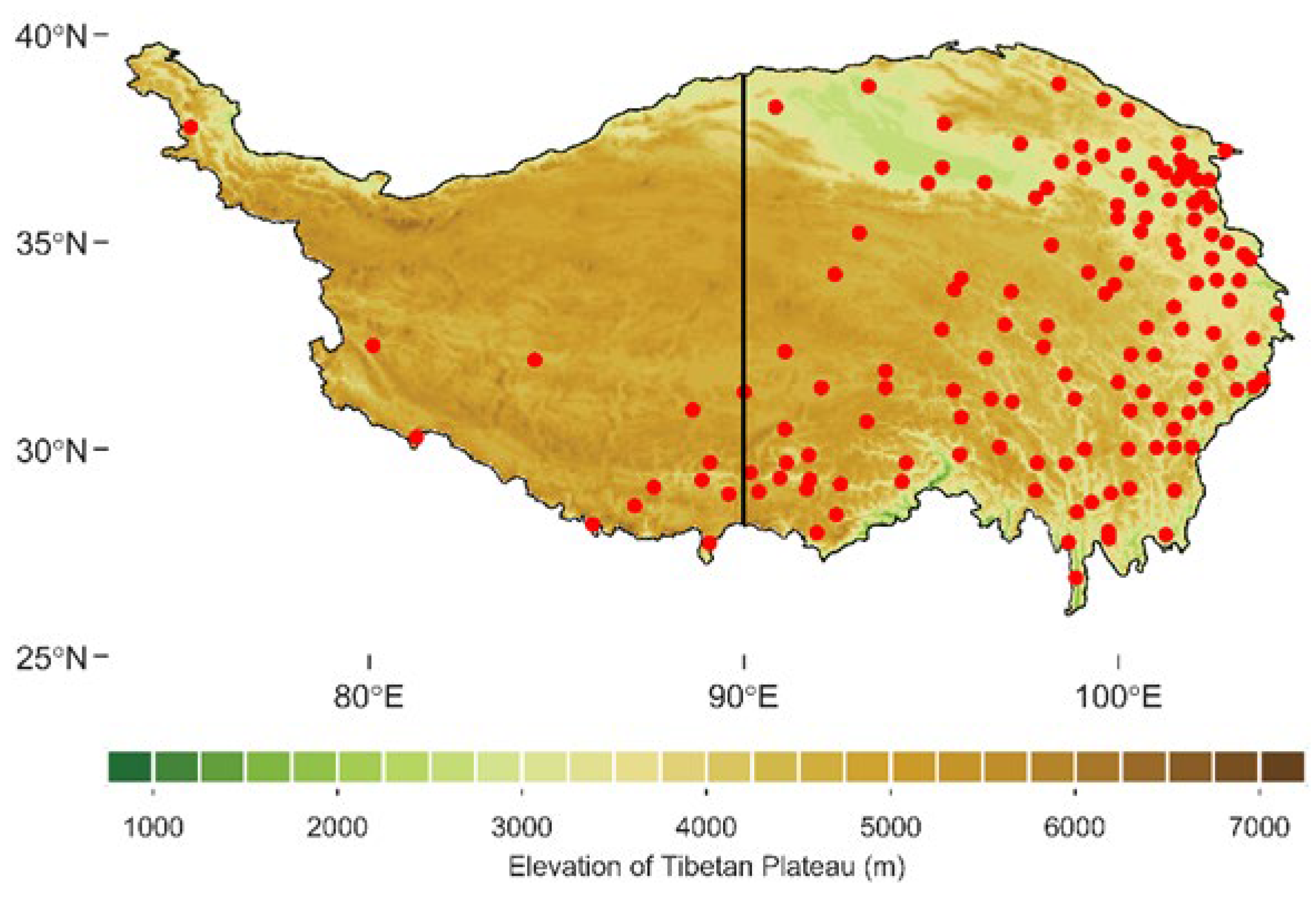
Given the sparse distribution of meteorological stations over the western TP, the evaluation of historical temperature changes and model performance is mainly conducted for the eastern Tibetan Plateau, defined as the region east of 90°E (
Figure 1). Monthly temperature data are used to calculate annual mean and seasonal mean temperature, including spring (March–May, MAM), summer (June–August, JJA), autumn (September–November, SON), and winter (December–February, DJF).
Climate model simulations are taken from 47 coupled global climate models (
Table 1) participating in Phase 6 of the Coupled Model Intercomparison Project (CMIP6). Monthly mean near-surface air temperature from historical and future Shared Socio-economic Pathways of 8.5 W/m
2 (SSP5–8.5) scenario simulations is used in this study. For each model, we average all available ensembles of monthly anomalies relative to the 1985–2014 baseline period to mitigate the influence of internal variability. All outputs are regridded to a common 1° × 1° horizontal resolution using bilinear interpolation prior to analysis. For historical evaluation, model simulations are compared with observations over the eastern TP. Future projections are analyzed for the entire Tibetan Plateau domain in order to provide a comprehensive assessment of regional warming under different global warming levels.
2.2. Method
Long-term temperature trends are quantified using the non-parametric Sen’s slope estimator [
17], which is robust to outliers and does not require assumptions about the underlying data distribution. The statistical significance of trends is assessed using the Mann–Kendall test [
18]. Trends are considered statistically significant at the 5% significance level unless otherwise stated. Trend analyses are applied to annual mean and seasonal mean temperature for both observations and model simulations. For multi-model analyses, the median trend across models is used to represent the central tendency, while the inter-model spread is quantified using the standard deviation of trends.
Future temperature changes over the Tibetan Plateau are assessed within a global warming level framework. Global mean surface air temperature is calculated for each model relative to the 1985–2014 baseline period. Following common practice, a 31-year running mean is applied to global mean temperature time series, and the periods corresponding to global warming levels of 1 °C, 1.5 °C, 2 °C, and 3 °C are identified for each model individually.
For each global warming level, regional temperature changes over the Tibetan Plateau are computed as averages over the corresponding 31-year periods. This approach allows future TP temperature responses to be directly linked to the magnitude of global warming and reduces dependence on specific emission scenarios. Analyses are conducted for both annual mean and seasonal mean temperature, focusing on the spatial patterns, regional-mean warming magnitude, and inter-model uncertainty.
3. Result
3.1. Characteristics of Historical Warming Trends
Figure 1 illustrates the geographical setting of the Tibetan Plateau, including its topography and the distribution of meteorological stations used to construct the CN05.1 observational dataset. The Tibetan Plateau is characterized by complex terrain and large elevation gradients, with elevations generally exceeding 3000 m and reaching above 5000 m in the western and central regions [
7,
19,
20,
21] (e.g., Kang et al., 2010; Kuang & Jiao, 2016; Yang et al., 2014; Yao et al., 2012). The spatial distribution of stations is highly inhomogeneous, with a much higher station density in the eastern part of the Plateau, particularly east of 90°E, while stations are sparse over the western TP. This uneven station distribution reflects long-standing observational limitations in high-elevation regions and has important implications for the reliability of gridded observational datasets. Consequently, the evaluation of historical temperature changes and model performance in this study primarily focuses on the eastern Tibetan Plateau.
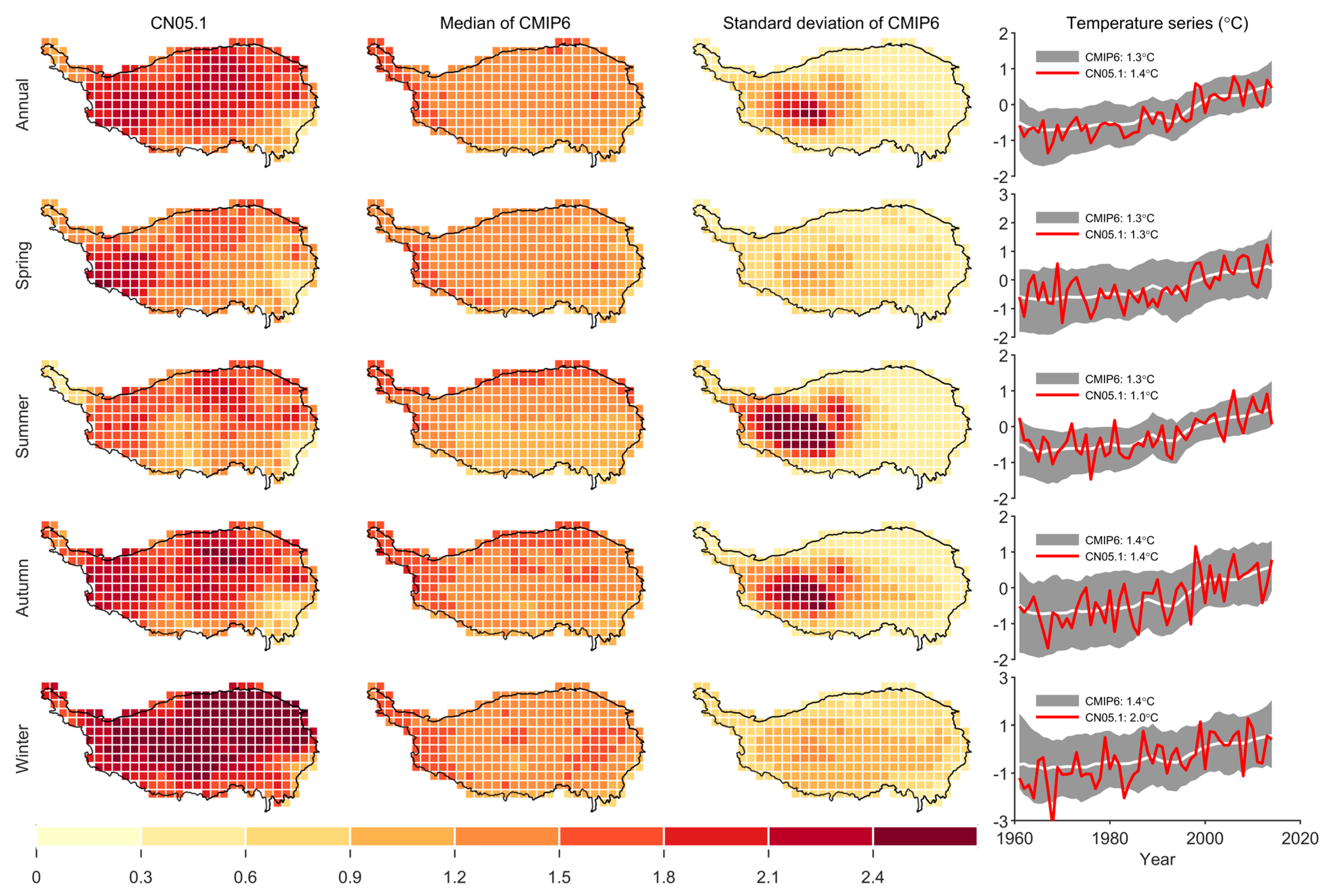
Figure 2 presents the spatial patterns of historical temperature trends over the Tibetan Plateau derived from the CN05.1 observation and CMIP6 multi-model simulations for the annual mean and four seasons. The observational results show pronounced warming over most parts of the Plateau, with relatively weaker warming rates in the southeastern TP, while strong warming is evident across the remaining regions. The seasonal analysis reveals that the strongest warming occurs in winter up to 2.0 °C in eastern TP during the historical periods, whereas spring and summer exhibit comparatively weaker warming magnitudes at 1.3 and 1.1 °C, respectively. Despite different rates, warming in all seasons is significant at the 5% level according to the Mann–Kendall test.
The CMIP6 multi-model ensemble nicely reproduces the overall warming tendency observed over the Tibetan Plateau, indicating that models capture the large-scale signal of historical temperature increase. However, substantial discrepancies remain in the magnitude of the simulated trends. For most seasons, the multi-model median underestimates the observed warming rates, suggesting a systematic cold bias in the simulated historical trends. An exception is found in summer and autumn, during which the multi-model median trends are generally comparable to the observed values, indicating a better agreement between models and observations in these seasons. Nevertheless, the spread of trends among CMIP6 covers the observed time series well, indicating the ability to reproduce observed warming trends over the TP.
Inter-model uncertainty, quantified by the standard deviation of simulated trends, exhibits a strong spatial dependence. Larger model spread is primarily concentrated over the western Tibetan Plateau as a result of poor distribution of observations, with particularly pronounced uncertainty during summer and autumn, which is likely due to the complex terrain in the western TP. In contrast, inter-model spread is relatively smaller in winter and spring. This spatial and seasonal contrast highlights the challenges in simulating temperature changes over regions with complex topography and sparse observational constraints.
3.2. Projected Warming as a Function of Global Warming Level
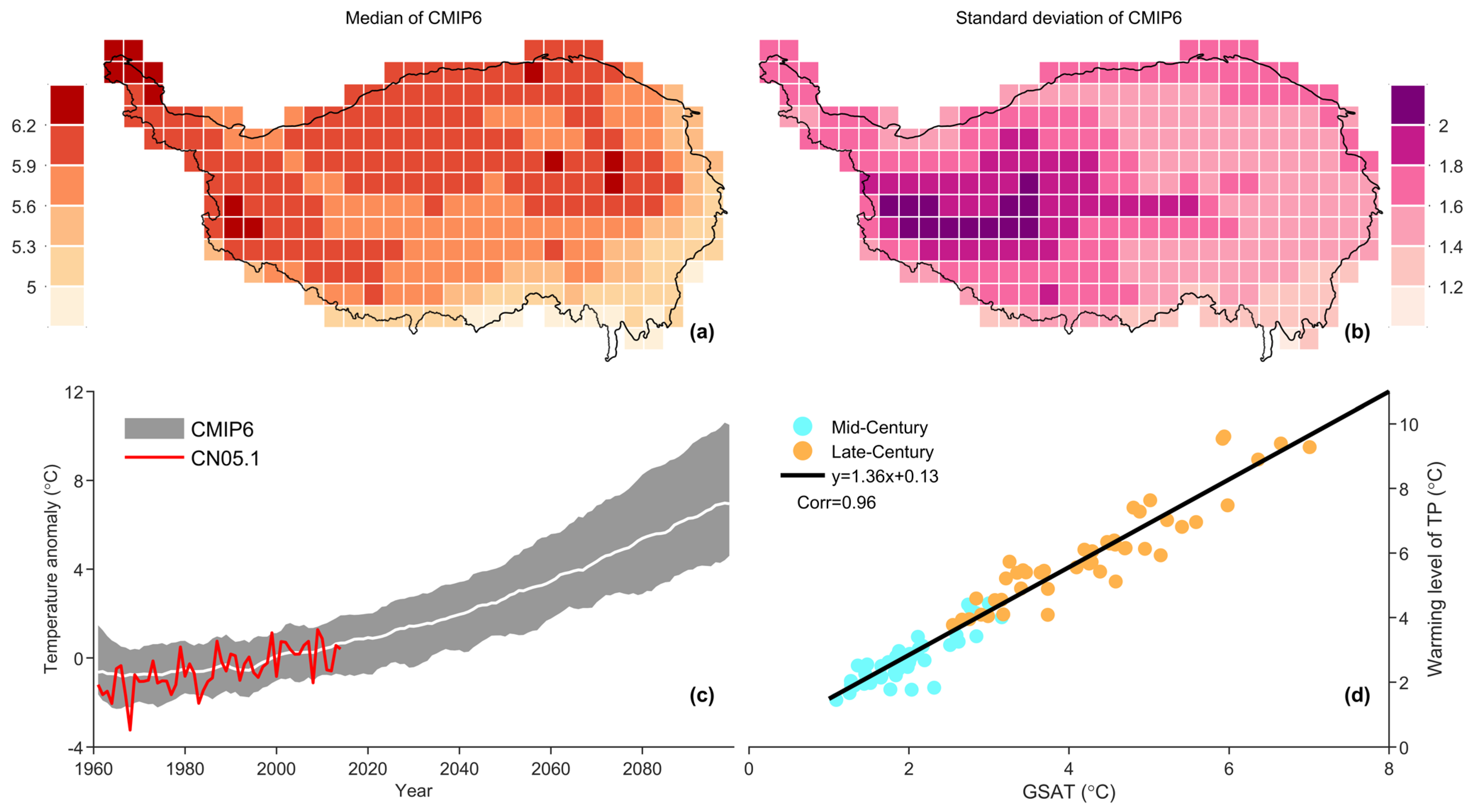
Figure 3 shows projected changes in annual mean surface air temperature over the Tibetan Plateau by the end of the 21st century (2070–2099) based on CMIP6 multi-model simulations, together with the associated inter-model uncertainty. The multi-model median projection indicates widespread warming exceeding 5 °C across most parts of the Plateau, with particularly strong warming over the western and northern regions, while relatively weaker warming is projected over the southeastern TP (
Figure 3a). This spatial pattern broadly resembles that observed during the historical period, suggesting a persistence of regional warming contrasts into the future.
Inter-model uncertainty, measured by the standard deviation of projected temperature changes, remains largest over the western Tibetan Plateau (
Figure 3b), consistent with the historical evaluation. This indicates that regions with complex topography continue to exhibit substantial uncertainty in future projections. When averaged over the entire Plateau, the projected annual mean warming by the end of the century is approximately 5.5 °C. However, the range across individual models spans from about 4 °C to 10 °C, corresponding to an inter-model spread of nearly 6 °C. This magnitude of uncertainty is comparable to the multi-model mean warming itself, posing a substantial challenge for robust climate impact assessments and decision-making.
To further explore the source of this large spread,
Figure 3d examines the relationship between Tibetan Plateau mean temperature change and global mean temperature increase across models. A strong and statistically significant linear relationship is identified, with a correlation coefficient of 0.96, indicating that inter-model differences in TP warming are closely tied to differences in global mean warming. The regression slope is approximately 1.36, suggesting that future warming over the Tibetan Plateau is amplified relative to the global mean. Notably, this scaling relationship is largely insensitive to the projection period, remaining robust for both the mid-21st century (2036–2065) and the late 21st century (2070–2099). This robust amplification and scaling suggest that constraining Tibetan Plateau warming through global mean temperature change provides a promising pathway for reducing projection uncertainty.
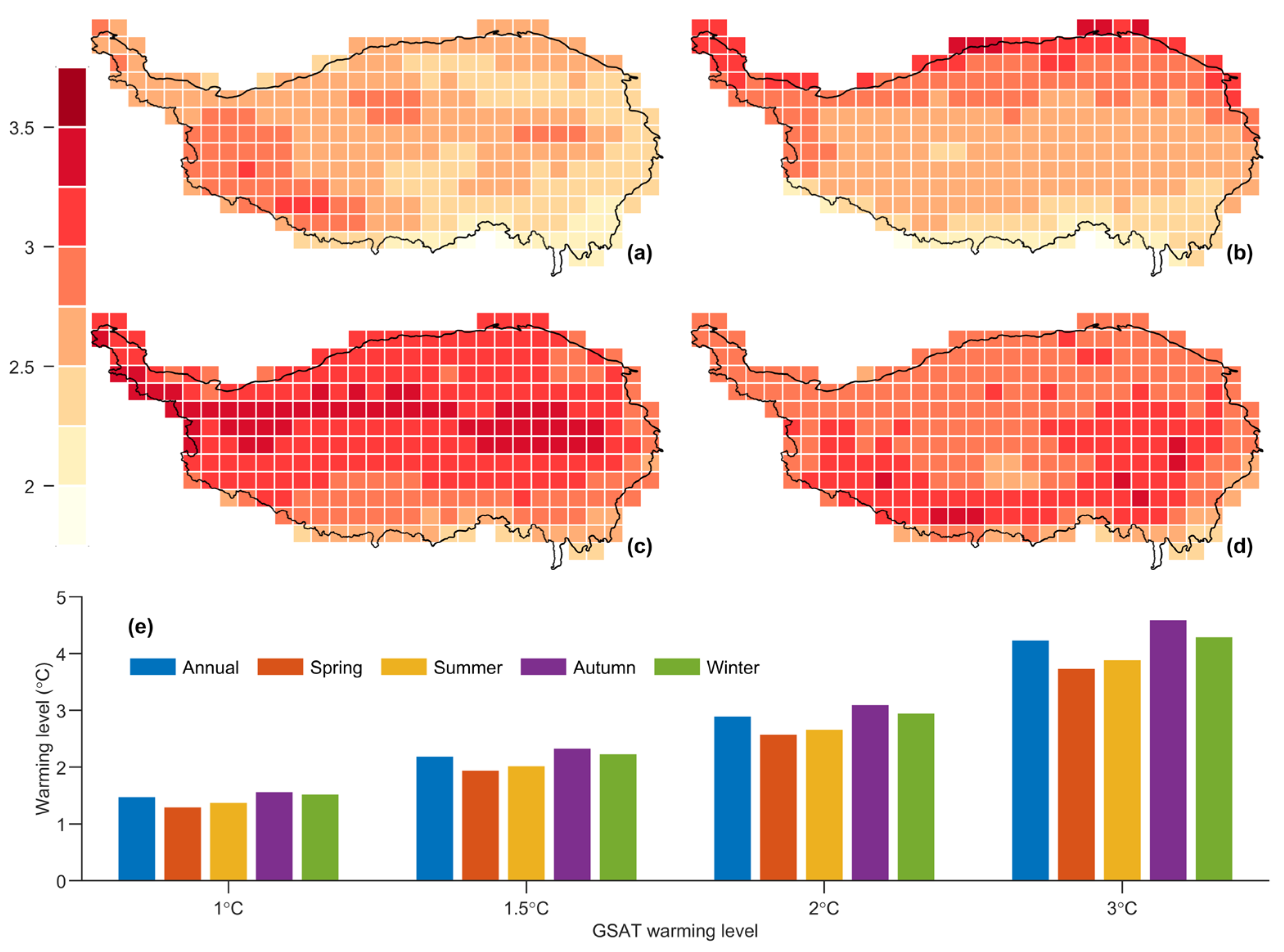
Figure 4 shows projected seasonal temperature changes over the Tibetan Plateau under a global warming level of 2 °C, together with the regional-mean warming responses associated with global warming levels of 1 °C, 1.5 °C, 2 °C, and 3 °C. Under the 2 °C warming level, the Tibetan Plateau exhibits a clear and robust seasonal contrast, characterized by weaker warming in spring and summer and stronger warming in autumn and winter. The spatial patterns of seasonal warming closely resemble those observed during the historical period, with consistent regional contrasts across the Plateau. As global mean temperature increases from 1 °C to 3 °C, the magnitude of TP warming across seasons increases nearly proportionally, indicating that future warming primarily reflects an amplification of existing patterns rather than a structural reorganization.
The persistence of these seasonal and spatial features across different global warming levels highlights the strong constraints governing temperature responses over the Tibetan Plateau and supports the applicability of the global warming level framework for regional climate assessment. This robustness enhances confidence in projected TP temperature changes under different global temperature targets and provides a clearer basis for climate impact assessment and adaptation planning.
3.3. Additional 0.5 °C Warming Risks
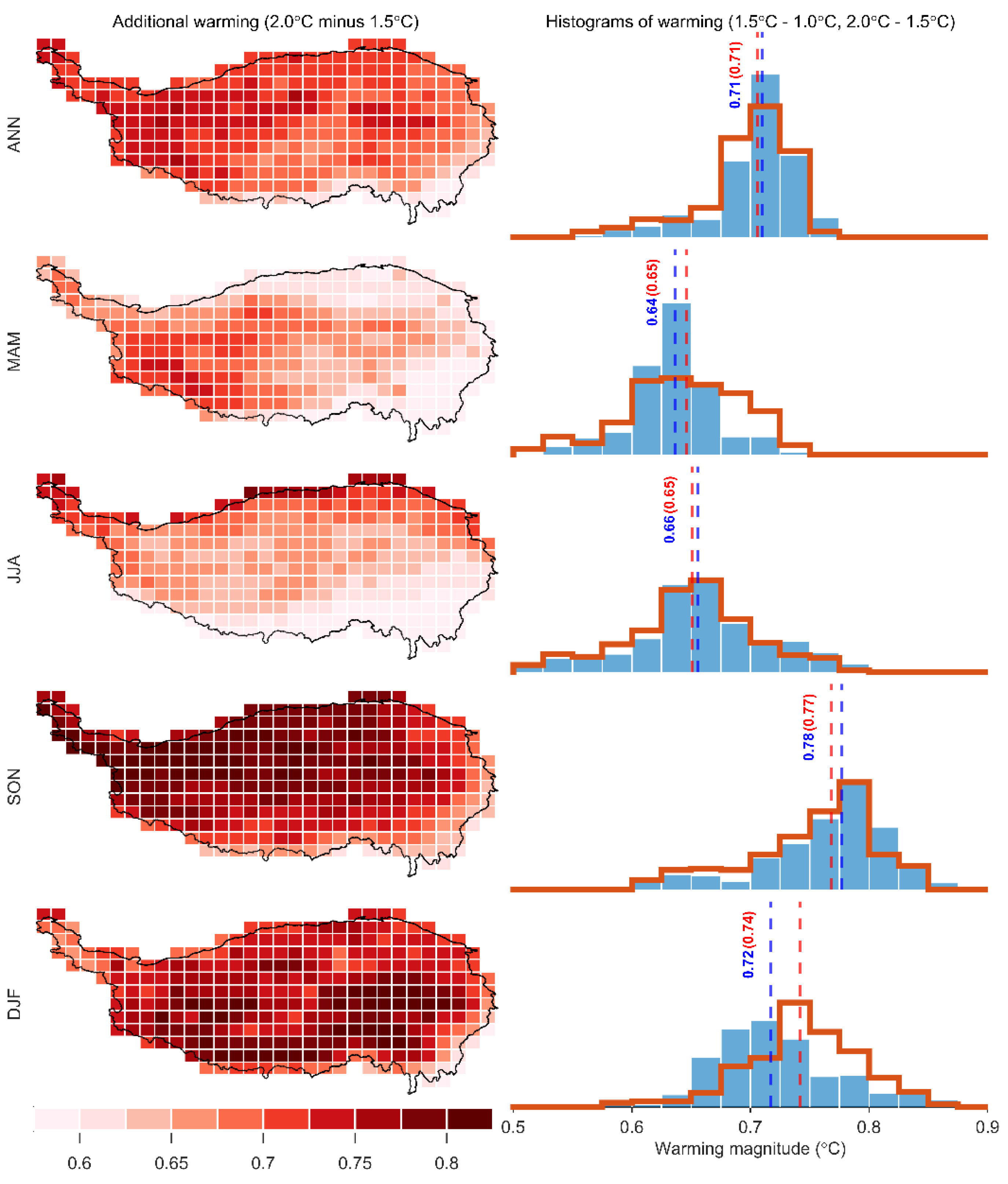
Figure 5 shows that an additional 0.5 °C increase in global mean temperature leads to a distinctly non-uniform warming response over the Tibetan Plateau. The incremental warming exhibits strong seasonal dependence, with autumn and winter showing substantially larger temperature increases than spring and summer. Over most parts of the Plateau, the additional warming exceeds 0.8 °C in the cold seasons, whereas smaller increases, generally below 0.6 °C, are found in the warm seasons, particularly over the eastern and southern regions. This highlights the heightened sensitivity of TP temperature to incremental global warming during the cold season.
Despite the similar magnitude of global warming increments, the temperature response over the Tibetan Plateau remains broadly consistent between the 2–1.5 °C and 1.5–1 °C warming intervals, indicating an approximately linear scaling of regional temperature with global mean warming. However, subtle but important seasonal differences persist. In summer, spatial variability becomes larger at higher warming levels, whereas in winter the distribution of incremental warming shifts toward higher values, implying an increased likelihood of continued and enhanced winter warming under additional global temperature increase.
4. Discussion
Although this study highlights robust spatial and seasonal warming patterns over the TP, the physical mechanisms underlying the pronounced spatial heterogeneity of warming remain an important topic for future research. In particular, land–atmosphere feedback related to snow cover, clouds, and atmospheric water vapor are likely to play a critical role. Changes in snow cover can strongly modulate surface albedo and amplify surface warming, especially during autumn and winter, while cloud radiative effects and water vapor feedback may further enhance regional warming through their influence on surface energy balance [
10]. The relative contributions of these processes, as well as their interactions with complex topography, remain incompletely understood and warrant targeted diagnostic analyses using both observations and process-based model experiments.
Another key source of uncertainty arises from internal climate variability, which can substantially influence temperature changes over the Tibetan Plateau, particularly on near-term timescales. Large-scale modes of variability, such as decadal variability in the Pacific and Atlantic oceans, may modulate regional temperature trends and temporarily enhance or offset the forced warming signal [
22]. Disentangling the contributions of external forcing and internal variability is therefore essential for improving confidence in near-future temperature projections and for interpreting recent observed changes over the Plateau in future research.
Finally, from a broader perspective, the amplified and seasonally asymmetric warming over the TP has important implications for cryospheric change, hydrological processes, and downstream climate impacts. The pronounced winter warming identified in this study may substantially alter the regional surface energy balance through changes in snow cover and surface albedo, potentially enhancing the snow–albedo feedback and further amplifying regional warming. Such thermodynamic changes over the high-elevation Tibetan Plateau can also influence large-scale atmospheric circulation, as the Plateau acts as a major heat source for the Asian climate system and modulates the strength and variability of the Asian monsoon and mid-latitude westerlies. In addition, rapid warming may have significant ecological consequences, including shifts in vegetation phenology, permafrost degradation, and changes in alpine ecosystem stability. These changes may further affect water availability and socio-economic activities in downstream regions that depend heavily on water resources originating from the Tibetan Plateau. Future studies that explicitly link temperature changes to impacts on snow, glaciers, permafrost, and regional water resources will therefore be essential for translating climate projections into actionable information. Together, these efforts will help advance a more physically grounded and decision-relevant understanding of climate change over the TP.
5. Conclusions
In this study, observational temperature data from CN05.1 and simulations from 47 CMIP6 climate models were used to examine the spatial and seasonal characteristics of warming over the Tibetan Plateau. We systematically analyzed the historical warming patterns and evaluated the ability of climate models to reproduce the observed temperature changes followed by projections of future warming over the TP as a function of global warming levels.
Observations show that the TP has experienced pronounced warming with strong spatial and seasonal heterogeneity. Warming is generally weaker in the southeastern Plateau and stronger over most other regions. Seasonally, autumn and winter exhibit the most rapid warming, while spring and summer show relatively weaker temperature increases. CMIP6 models successfully capture the overall warming tendency but display considerable biases in the magnitude of warming. For most seasons, models tend to underestimate the observed warming, although better agreement is found in summer and autumn. Inter-model uncertainty is particularly large over the western Plateau, likely associated with complex terrain and limited observational constraints.
Future projections indicate substantial warming over the TP accompanied by large inter-model spread, posing a significant challenge for reliable regional climate assessment. A robust and nearly linear relationship is identified between warming magnitude over TP and global mean temperature increase, suggesting that global warming level can serve as a potential constraint to reduce uncertainty and bias in future projections over the Plateau.
An additional 0.5 °C increase in global mean temperature leads to notable and seasonally dependent warming over the Tibetan Plateau. The extra warming is most pronounced in autumn and winter, while spring and summer show relatively weaker responses. This seasonal asymmetry implies that incremental global warming may disproportionately enhance cold-season warming over the Plateau, highlighting the increased risks associated with small increases in global mean temperature.
Author Contributions
Conceptualization, H.W.; methodology, H.W.; software, H.W., Y.Y., C.C.; validation, H.W.; formal analysis, H.W.; writing—original draft preparation, H.W.; writing—review and editing, H.W., Y.Z.; visualization, H.W.; supervision, Y.Z.; funding acquisition, Y.Z. All authors have read and agreed to the published version of the manuscript.
Funding
This research was funded by Three Gorges Jinsha River Yunchuan Hydropower Development Co., Ltd., China Yangtze Power Co., Ltd. (Project Number: 4323020006).
Data Availability Statement
Acknowledgments
We thank the World Climate Research Programme’s Working Group on Coupled Modeling and the modeling centers for the CMIP6 output (
https://esgf-node.llnl.gov/projects/cmip6/) (accessed on 1 March 2026). The CN05.1 dataset can be found in
https://ccrc.iap.ac.cn/resource/detail?id=228 (accessed on 6 January 2025). We thank anonymous reviewers for their constructional advice and suggestions for improving this paper. This paper was funded by Three Gorges Jinsha River Yunchuan Hydropower Development Co., Ltd., China Yangtze Power Co., Ltd. (Project Number: 4323020006).
Conflicts of Interest
Author Hantao Wang, Ye Yin, and Cuihua Chen were employed by China Yangtze Power Co., Ltd. The paper reflects the views of the scientists and not the company. The authors declare no conflicts of interest.
References
- Dong, W.; Jia, X.; Wu, R. Impact of summer Tibetan Plateau snow cover on the variability of concurrent compound heatwaves in the Northern Hemisphere. Environ. Res. Lett. 2023, 19, 014057. [Google Scholar] [CrossRef]
- Duan, A.; Wu, G.; Liu, Y.; Ma, Y.; Zhao, P. Weather and climate effects of the Tibetan Plateau. Adv. Atmos. Sci. 2012, 29, 978–992. [Google Scholar] [CrossRef]
- Wu, G.; Liu, Y. Impacts of the Tibetan Plateau on Asian Climate. Meteorol. Monogr. 2016, 56, 7.1–7.29. [Google Scholar] [CrossRef]
- Immerzeel, W.W.; van Beek, L.P.H.; Bierkens, M.F.P. Climate Change Will Affect the Asian Water Towers. Science 2010, 328, 1382–1385. [Google Scholar] [CrossRef] [PubMed]
- Xu, X.; Lu, C.; Shi, X.; Gao, S. World water tower: An atmospheric perspective. Geophys. Res. Lett. 2008, 35, L20815. [Google Scholar] [CrossRef]
- Duan, A.; Wu, G.; Zhang, Q.; Liu, Y. New proofs of the recent climate warming over the Tibetan Plateau as a result of the increasing greenhouse gases emissions. Chin. Sci. Bull. 2006, 51, 1396–1400. [Google Scholar] [CrossRef]
- Kuang, X.; Jiao, J.J. Review on Climate Change on the Tibetan Plateau during the last half century. J. Geophys. Res. Atmos. 2016, 121, 3979–4007. [Google Scholar] [CrossRef]
- Wang, J.; Zhai, P.; Zhou, B.; Li, C.; Chen, Y. Constraining future surface air temperature change on the Tibetan Plateau. Environ. Res. Lett. 2024, 19, 084051. [Google Scholar] [CrossRef]
- You, Q.; Min, J.; Kang, S. Rapid warming in the Tibetan Plateau from observations and CMIP5 models in recent decades. Int. J. Climatol. 2015, 36, 2660–2670. [Google Scholar] [CrossRef]
- Pepin, N.; Bradley, R.S.; Diaz, H.F.; Baraer, M.; Caceres, E.B.; Forsythe, N.; Fowler, H.; Greenwood, G.; Hashmi, M.Z.; Liu, X.D.; et al. Elevation-dependent warming in mountain regions of the world. Nat. Clim. Change 2015, 5, 424–430. [Google Scholar] [CrossRef]
- You, Q.; Cai, Z.; Pepin, N.; Chen, D.; Ahrens, B.; Jiang, Z.; Wu, F.; Kang, S.; Zhang, R.; Wu, T.; et al. Warming amplification over the Arctic Pole and Third Pole: Trends, mechanisms and consequences. Earth-Sci. Rev. 2021, 217, 103625. [Google Scholar] [CrossRef]
- Dong, Y.; Jiang, Z.; Sun, Q. Attribution of differences in observed warming among subregions of China and observationally constrained projection. Int. J. Climatol. 2023, 44, 183–195. [Google Scholar] [CrossRef]
- Hu, S.; Wang, L.; Chen, X.; Zhou, T.; Hsu, P. Emergent constraints on future projections of Tibetan plateau warming in winter. Geophys. Res. Lett. 2024, 51, e2024GL108728. [Google Scholar] [CrossRef]
- Zhang, J.; Wu, T.; Xin, X.; Lu, Y.; Yan, J.; Zhang, F.; Liu, L.; Zhao, H. Surface air temperature trend over the Tibetan Plateau inCMIP6 and its constraint infuture projection. J. Geophys. Res. Atmos. 2023, 128, e2023JD039527. [Google Scholar] [CrossRef]
- Eyring, V.; Bony, S.; Meehl, G.A.; Senior, C.A.; Stevens, B.; Stouffer, R.J.; Taylor, K.E. Overview of the Coupled Model Intercomparison Project Phase 6 (CMIP6) experimental design and organization. Geosci. Model Dev. 2016, 9, 1937–1958. [Google Scholar] [CrossRef]
- Wu, J.; Gao, X.J.; Giorgi, F.; Chen, D.L. Changes of effective temperature and cold/hot days in late decades over China based on a high resolution gridded observation dataset. Int. J. Climatol. 2017, 37, 788–800. [Google Scholar] [CrossRef]
- Sen, P.K. Estimates of the regression coefficient based on Kendall’s tau. J. Am. Stat. Assoc. 1968, 63, 1379–1389. [Google Scholar] [CrossRef]
- Kendall, M.G. Rank Correlation Methods; Oxford University Press: New York, NY, USA, 1975. [Google Scholar]
- Kang, S.; Xu, Y.; You, Q.; Flügel, W.-A.; Pepin, N.; Yao, T. Review of climate and cryospheric change in the Tibetan Plateau. Environ. Res. Lett. 2010, 5, 015101. [Google Scholar] [CrossRef]
- Yang, K.; Wu, H.; Qin, J.; Lin, C.; Tang, W.; Chen, Y. Recent climate changes over the Tibetan Plateau and their impacts on energy and water cycle: A review. Glob. Planet. Change 2014, 112, 79–91. [Google Scholar] [CrossRef]
- Yao, T.; Thompson, L.G.; Mosbrugger, V.; Zhang, F.; Ma, Y.; Luo, T.; Xu, B.; Yang, X.; Joswiak, D.R.; Wang, W.; et al. Third Pole Environment (TPE). Environ. Dev. 2012, 3, 52–64. [Google Scholar] [CrossRef]
- Deng, Z.; Zhou, S.; Wu, P.; Sun, Y. Surface Air Temperature Variation over the Eastern Tibetan Plateau from 1979 to 2018: The Role of AMO and PDO. J. Clim. 2024, 37, 979–993. [Google Scholar] [CrossRef]
| Disclaimer/Publisher’s Note: The statements, opinions and data contained in all publications are solely those of the individual author(s) and contributor(s) and not of MDPI and/or the editor(s). MDPI and/or the editor(s) disclaim responsibility for any injury to people or property resulting from any ideas, methods, instructions or products referred to in the content. |