1. Introduction
Microwaves, millimeter waves, visible and IR and even shorter wavelengths of radio waves experience absorption of electromagnetic energy by water vapor and oxygen molecules in the atmosphere, leading to energy level transitions and resulting in wave attenuation, known as atmospheric absorption attenuation. Atmospheric absorption attenuation is primarily influenced by meteorological factors such as water vapor density, temperature, and refractive index, as well as parameters of wireless systems like operating frequency, elevation, and signal propagation path length. Among the commonly used models for calculating atmospheric absorption attenuation in the troposphere, the ITU-R P.676 recommendations “Attenuation by atmospheric gases and related effects” [
1] and the GJB Z87-1997’s “Handbook of refraction and attenuation of radiowave propagation for radar” [
2] provide the prediction models for atmospheric absorption attenuation under two propagation conditions: slant paths (ground-to-air) and horizontal terrestrial paths (ground-to-ground). For slant path electromagnetic wave propagation in ground-to-air links, ITU-R recommendations offer a high-precision method involving line-by-line summation. This method precisely calculates the atmospheric specific attenuation at different heights along the propagation path by accumulating the resonant absorption spectra of oxygen and water vapor line-by-line [
1,
3,
4,
5,
6]. It also considers the non-resonant Debye absorption spectrum of oxygen below 10 GHz, nitrogen attenuation above 100 GHz caused by atmospheric pressure, and additional continuous water vapor absorption discovered in experiments. Using atmospheric temperature, humidity, and pressure profiles, this method accounts for the curvature effect of radio waves due to atmospheric refraction and calculates the path length in each layer to obtain high-precision atmospheric absorption attenuation for ground-to-air links. For over-the-horizon propagation links caused by atmospheric ducts and other abnormal refraction phenomena, ITU-R 676 and GJB Z87-1997 approximate the radio wave propagation in the duct layer as straight-line propagation near the ground and use horizontal terrestrial paths models for calculations. This model assumes constant water vapor density near the Earth’s surface, estimates specific attenuation approximately, and uses straight-line distance to approach path length to obtain atmospheric absorption attenuation for over-the-horizon links [
7,
8,
9,
10].
In maritime and coastal regions, low-altitude atmospheric ducts occur frequently, and evaporation ducts over the sea almost permanently exist. In the actual atmosphere, multiple composite ducts are also very common [
11,
12,
13,
14,
15]. Among these, evaporation ducts due to rapid decreases in water vapor near the sea surface typically occur at heights between 0 and 40 m. Surface ducts and elevated ducts are usually caused by temperature inversions and sharp decreases in humidity; surface ducts can extend to several hundred meters, and elevated ducts are up to several kilometers. When radio waves propagate in such abnormal refractive layers, especially in elevated ducts at heights of several kilometers, drastic changes in water vapor density and temperature inversions significantly impact the accuracy of traditional atmospheric absorption prediction models [
16,
17,
18]. Additionally, the propagation trajectories of radio waves in ducts differ considerably from those at high elevation angles in ground-to-air links. Instead of approximate straight-line propagation, the waves reflect periodically in the duct, bouncing between the upper and lower boundaries of the duct. Radio waves propagating in the atmosphere remain with the highest water vapor and temperature in the low-altitude region, where oxygen and water vapor absorption is strongest, and the path length is significantly longer than in ground-to-air links.
The research for atmospheric gases mostly focuses on the components. Yu. M. Timofeev estimated the trends for TCAs of 13 climatically important gases for the first time in Russia, and trends of the main greenhouse gases, CO
2, CH
4, and N
2O, determined with high accuracy (~0.02%), are positive and equal 0.52, 0.42, and 0.28% per year, respectively [
4]. Osazuwa G. Agbonlahor used nano-porous activated carbon for atmospheric passivation of the graphene channel, Extreme Gradient Boosting (XGBoost), K-nearest neighbors (KNN), and Naïve Bayes supervised ML models for atmospheric gas identification were developed, with model feature contributions studied using the Game theoretic approach, Shapley Additive explanations (SHAP) [
5]. For the method of atmospheric gas attenuation in complicated environments, WU Ling-da used the method in CCIR, which provides a simplified approach to calculating attenuation by modeling atmospheric absorption attenuation as a linear function of height, thereby enabling the determination of attenuation values at various heights based on the attenuation measured at sea level [
6,
7].
The ray tracing technology for low-elevation angles in atmospheric ducts is used to precisely trace the propagation trajectories of over-the-horizon links, which can accurately reproduce the periodic propagation trajectories of radio waves in atmospheric ducts. During the tracing process, the method retrieves actual height, path length, and other trajectory parameters at different propagation distances. Then, it extracts temperature, pressure, water vapor density, and refractive index parameters at these heights [
19,
20,
21,
22]. Using a line-by-line summation approach, the model performs high-precision calculations of atmospheric absorption attenuation for low-elevation over-the-horizon links. Based on the ray trajectories, the model also visualizes the changes in atmospheric attenuation along the propagation paths. This approach not only accurately demonstrates the electromagnetic wave propagation trajectories but also precisely reflects the trends in atmospheric absorption attenuation along different elevation angle paths [
23,
24,
25,
26,
27,
28].
2. Ray Trajectory Prediction Techniques for Over-the-Horizon Links in Ducts
The algorithm principle of ray tracing technology is the geometric optical approximation, which can vividly explain the positioning process of the radar system and accurately determine the specific position of the target. Ray tracing can not only track the propagation trajectory of electric waves in normal atmospheric environments but also track the ray trajectory of radio waves in the abnormal propagation of atmospheric ducts.
Snell’s law of the spherical layered atmosphere is [
8,
9,
22]:
Here
,
and
,
are the elevation angles and refractive index at first height layer
and higher layer
,
, is the Earth’s radius. When
,
and makes
, Formula (1) can be approximated by [
8,
9,
22]:
Formula (2) is the form of Snell’s law under flat ground, and
is called the modified refractive index. In this case, it is more convenient to deal with the atmospheric duct problem. We can get the ray trajectory parameters by [
8,
9,
22]:
In the Formula (3), and denote the elevation angles at heights and , surface distances and , respectively. The geometric optical path lengths (apparent distances) are denoted as and , while the actual path lengths are and . The corresponding geographic angles are and .
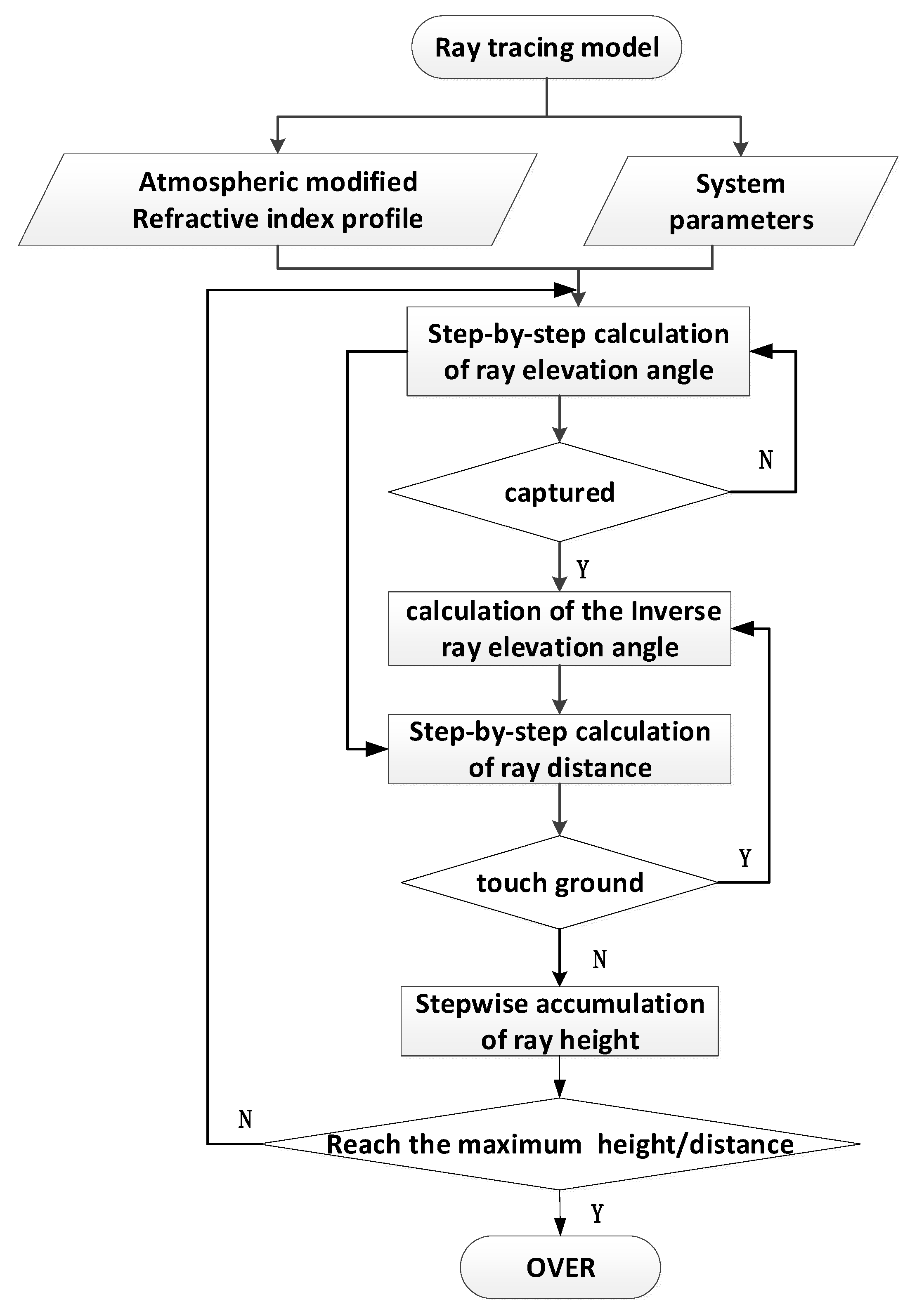
During the computation, a fixed height step is maintained. The duct capture of a ray is determined by the sign of the radical term in the equation for
. A positive value indicates the ray remains uncaptured, while a negative value signifies capture at the current position with a directional reversal. The elevation angle is then reset to 0, and propagation resumes in the opposite direction. When the detected value is ≤0, the ray is considered to have hit the ground, at which point the elevation angle is reset to 0, and the ray continues upward after total reflection off the ground. Under uniform atmospheric conditions and a flat reflective surface, the captured ray undergoes periodic jumps within the duct [
8,
9]. The algorithm flow chart is shown in
Figure 1.
3. Atmospheric Absorption Attenuation Evaluation Model
3.1. Traditional Horizontal Path Atmospheric Absorption Simple Attenuation Model
For atmospheric absorption attenuation in waveguide propagation, the GJB Z87-1997 model uses horizontal path attenuation to approximate atmospheric absorption attenuation in ducts [
2].
In the formula,
d is the ground distance from the signal emission to the target, while the ground attenuation rates of oxygen and water vapor are denoted as
and
, respectively [
2]:
as shown in the following equation:
From the above equation, it can be seen that the attenuation rate of oxygen γo in the horizontal path model is only related to frequency, while the attenuation rate of water vapor γw is only related to frequency and water vapor density ρ, which is taken at the height of the emission position.
3.2. High-Precision Implementation Method of Atmospheric Absorption Attenuation Based on Ray Trajectory of Beyond-Visual-Range Link
This paper is based on ray trajectory prediction technology of the atmospheric waveguide beyond the line-of-sight link, and uses the method of atmospheric attenuation rate of inclined path line-by-line accumulation to calculate the high precision of dry air and water vapor attenuation rate; the true path of ray in the process of line by line accumulation is obtained, and realizes the high-precision prediction of atmospheric absorption attenuation of ray trajectories of beyond the line-of-sight links in atmospheric ducts.
Atmospheric attenuation can be calculated by integrating the resonant absorption lines of oxygen and water vapor line by line, while considering the non-resonant Debye absorption of oxygen below 10 GHz, with the nitrogen attenuation mainly caused by atmospheric pressure above 100 GHz and the additional continuous water vapor absorption observed in experiments. The atmospheric attenuation rate can be precisely calculated using atmospheric temperature, humidity, and pressure parameters. The method for calculating the line-by-line integrated atmospheric attenuation rate is as follows:
In the formula:
(dB/km) represents the attenuation rate of dry air (including nitrogen caused by oxygen and atmospheric pressure, as well as non-resonant Debye attenuation);
(dB/km) denotes the attenuation rate of water vapor;
(GHz) is the frequency; and
is the imaginary part of the complex refractive index associated with frequency:
In the formula,
is the intensity of the
i-th absorption line,
is the shape factor of the absorption line, and the above expression is the sum of all spectral lines.
The following is the contribution of the continuous absorption spectrum, including atmospheric pressure-induced nitrogen absorption and Debye absorption, to the imaginary part of the refractive index:
In the formula,
represents the dry air pressure (hPa),
is the water vapor pressure (hPa), while the temperature
T is in
K; the total atmospheric pressure is
, while the temperature is in
K. The water vapor pressure can be calculated using the water vapor density:
where
is water vapor density in g/m
3. The shape factor of the absorption spectrum is:
where
is the frequency of the absorption line;
is the width of the absorption line:
Due to the Doppler broadening effect, the spectral line width requires further correction to:
The spectroscopic data for oxygen attenuation
~
and spectroscopic data for water vapor attenuation
~
are defined in
Table 1 and
Table 2:
The dry air continuous absorption caused by atmospheric pressure nitrogen absorption and Debye absorption is:
In the formula, the width coefficient in the Debye absorption spectrum is:
After obtaining the high-precision atmospheric attenuation rate, the atmospheric absorption attenuation calculated by line-by-line numerical accumulation is given by the following formula:
In this formula, represents the atmospheric attenuation rate calculated through the given equation, where n is the number of stratified layers. denotes the path length of the radio wave within the i-th layer. Here, instead of applying the ITU-R inclined path calculation method, we use the approach in Equation (3) to determine each layer’s path length. This enables us to quantify atmospheric absorption attenuation at every propagation step, ultimately accumulating these values line by line to obtain high-precision total attenuation for the entire beyond-the-horizon link.
4. Comparative Results Analysis and Visual Demonstration
4.1. Comparative Analysis of Atmospheric Absorption and Attenuation
Based on meteorological sounding data, this study employs both traditional horizontal path models and an enhanced high-precision model to predict atmospheric absorption attenuation in lines of sight beyond atmospheric ducts. The comparison of computational results between the two algorithms reveals the extent of the improvement achieved by the high-precision model.
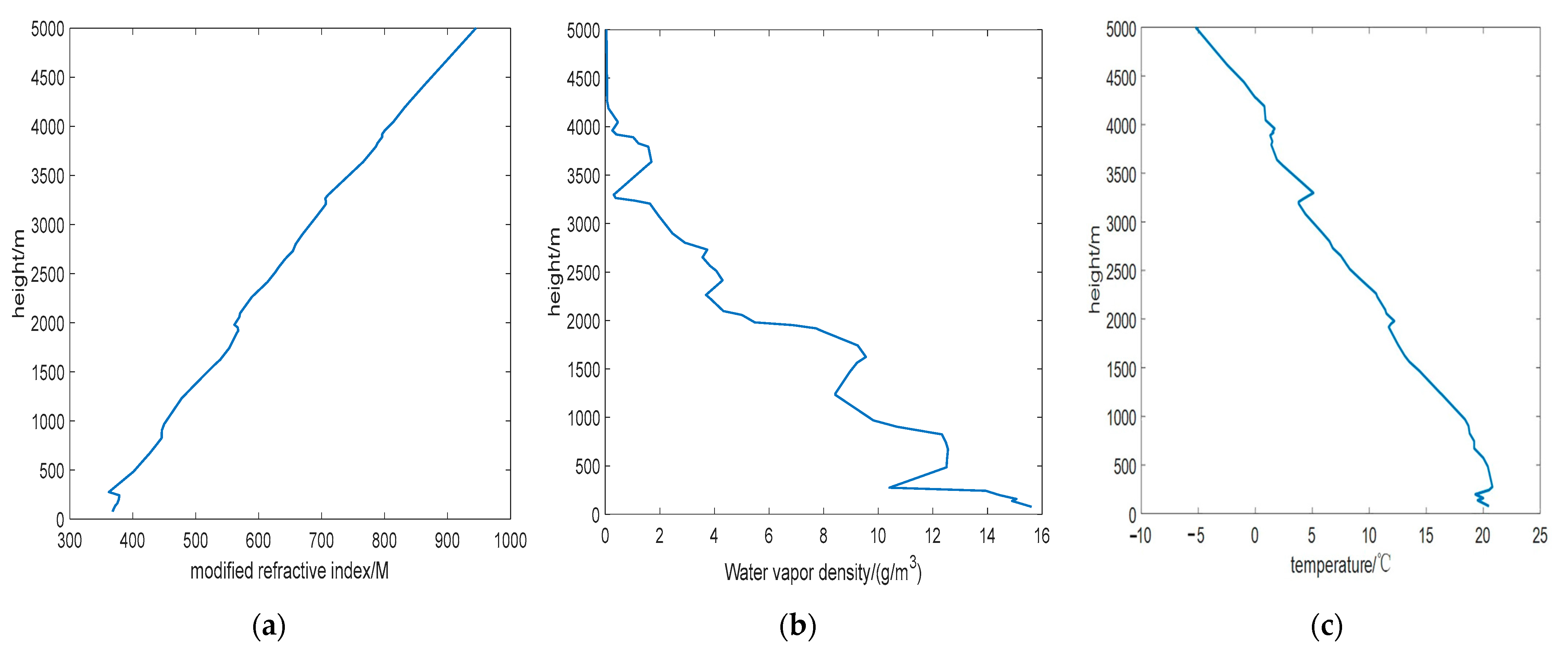
Figure 2 illustrates the temperature, water vapor density, and modified refractive index profiles measured in Qingdao on 8 June.
The modified refractive index profile reveals at least two distinct negative gradient layers along the vertical direction, indicating the stratification of composite atmospheric ducts. The surface duct layer is located at approximately 275 m above sea level, while the suspended duct layer occurs at around 2000 m. This anomalous refraction primarily results from the abrupt decrease in water vapor concentration and temperature inversion within the corresponding stratified layers, as illustrated in the figure.
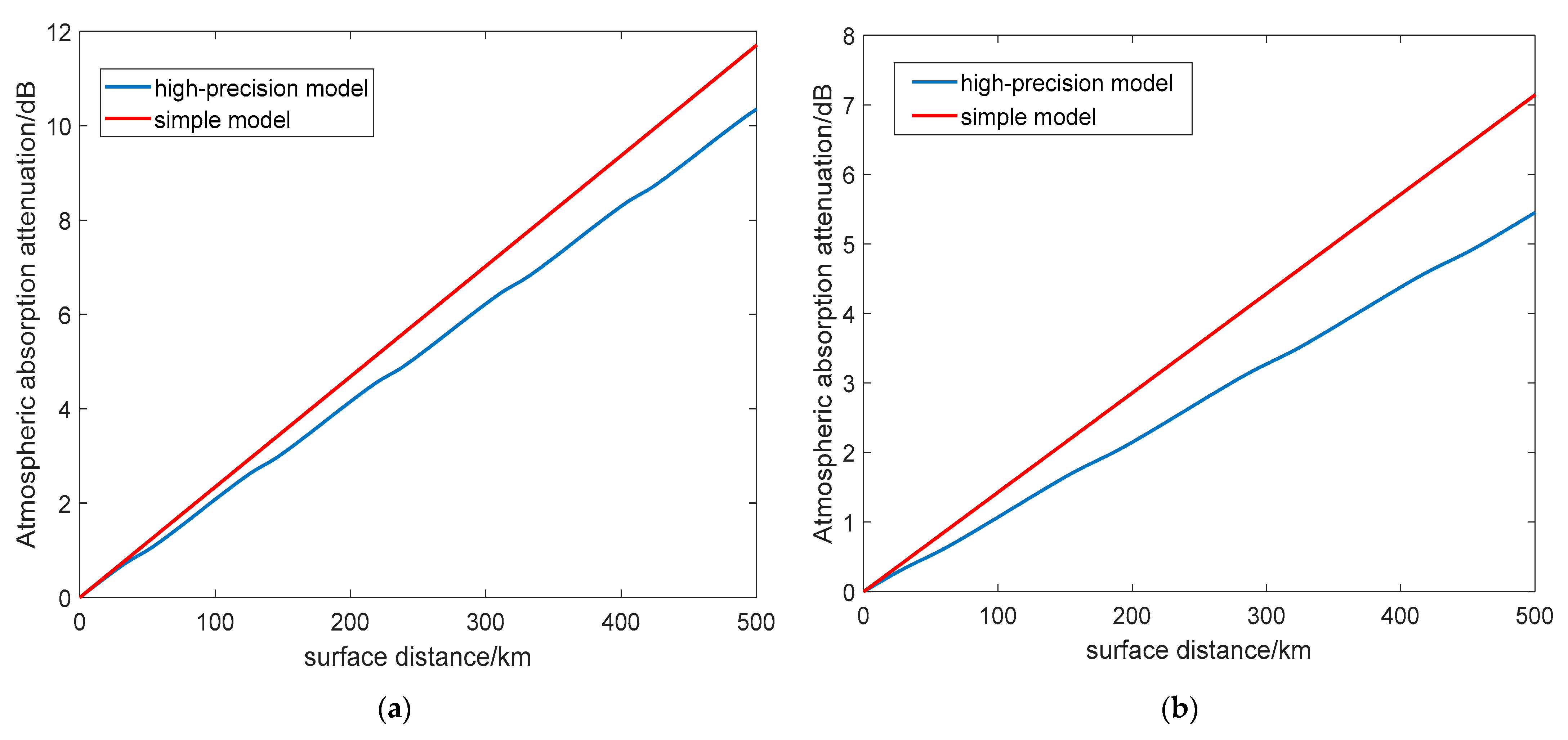
The signal source is placed at 10 m and 1800 m above the ground, and the signal frequency is 10 GHz. The atmospheric absorption attenuation of the beyond-line-of-sight link is simulated using the high-precision ray trajectory model and the simplified horizontal path model.
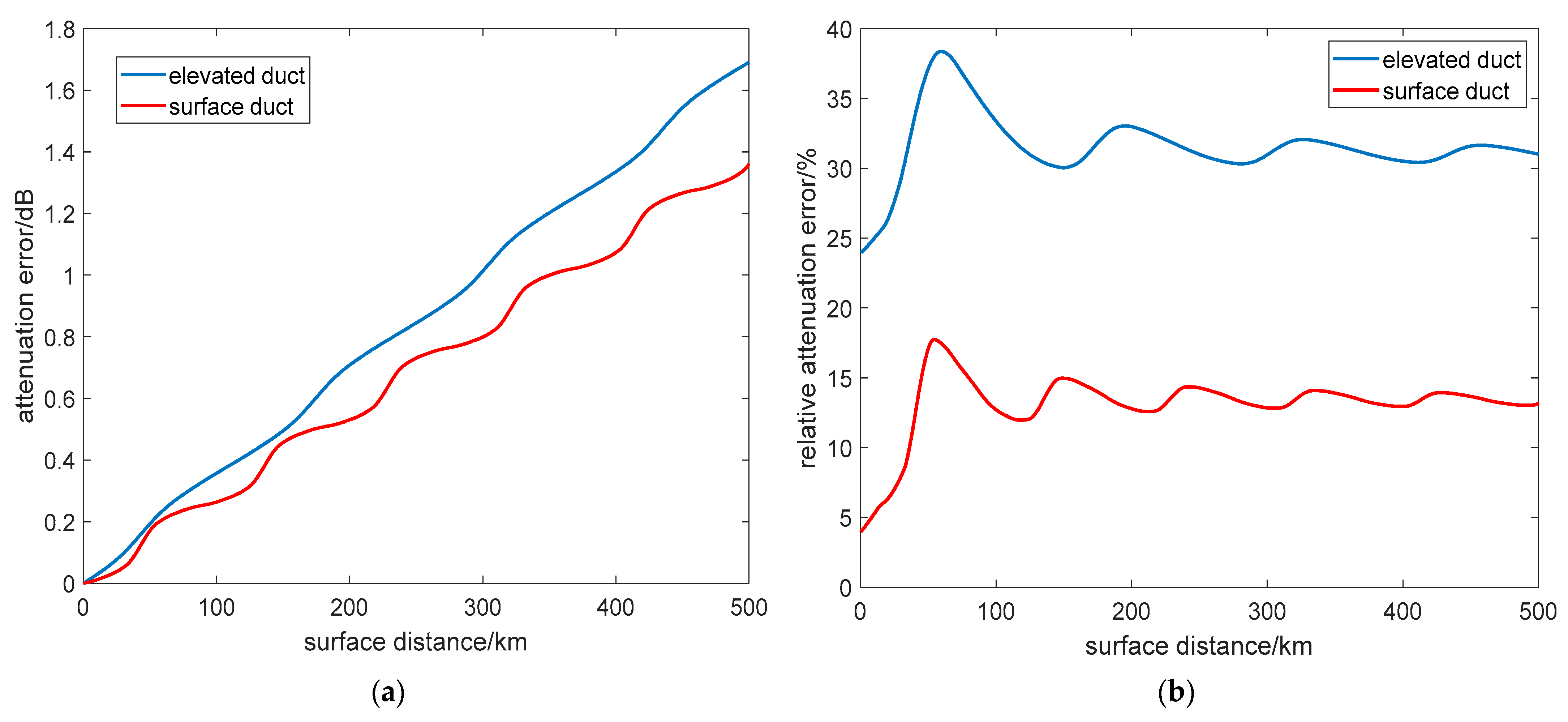
Figure 3 demonstrates that atmospheric absorption attenuation in surface ducts is significantly higher than in elevated ducts. This occurs because surface ducts are positioned at lower altitudes, trapping electromagnetic waves within near-surface (or near-sea) layers where water vapor density is markedly higher than in suspended waveguides, resulting in more pronounced atmospheric absorption effects. Analysis of both models reveals that simplified models produce larger predictions than high-precision models, with the difference linearly increasing with distance. This stems from the simplified model’s approach of treating water vapor density as a constant value at the signal emission point and approximating path length as horizontal ground distance. In contrast, the high-precision model employs a periodic jump curve trajectory, with refined stratified processing of propagation steps. It also accumulates key atmospheric parameters (temperature, water vapor density, refractive index) along the path height. Consequently, as distance increases, the discrepancy between high-precision and simplified models becomes more pronounced. Below is the attenuation error distribution of the simplified model compared to the high-precision model for horizontal paths:
Figure 4 shows that the absolute attenuation error of the simplified model increases with the propagation distance, and can reach nearly 2 dB at 500 km. Especially for the elevated duct, the relative error is significantly larger than that of the surface duct because the elevated duct usually exists at an altitude of several kilometers where the temperature and water vapor density are relatively low; this results in the actual atmospheric absorption attenuation being significantly smaller than that in the lower atmosphere. However, the simplified model still uses traditional ground average parameters for statistical evaluation and calculation. Therefore, using the simplified model to calculate the absorption attenuation in elevated ducts leads to a larger error than that in the lower atmosphere, and the error on the propagation path in elevated ducts can reach nearly 40%.
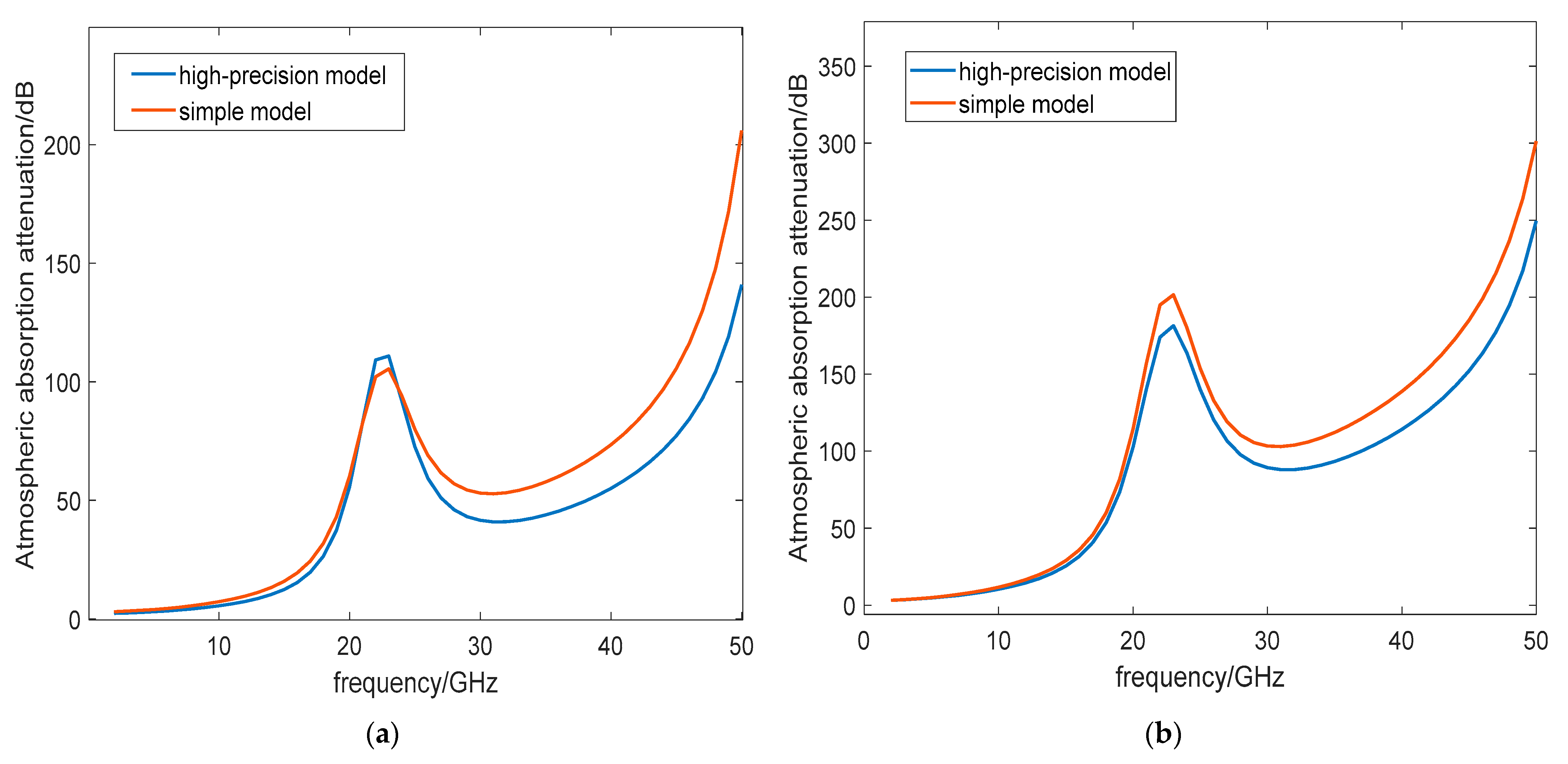
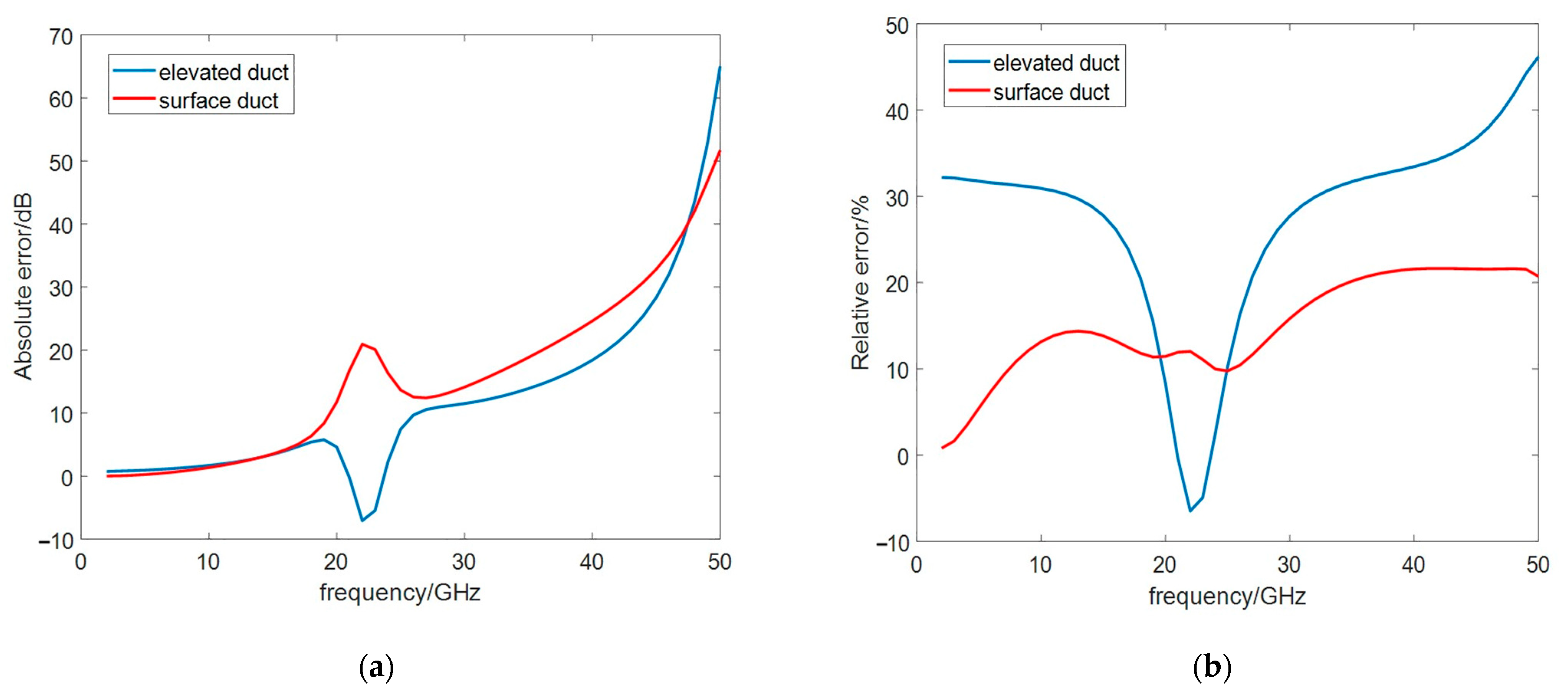
Oxygen and water vapor in the troposphere are the primary absorbers of radio waves. The atmospheric absorption attenuation caused by these gases typically increases with frequency, accompanied by multiple resonant absorption frequencies. In the frequency band below 350 GHz, oxygen exhibits a series of absorption lines around 60 GHz, forming an oxygen absorption band, with an isolated absorption line at 118.74 GHz. Water vapor absorption lines are observed at 22.3 GHz, 183.3 GHz, and 323.8 GHz. Using two models, we calculated the frequency-dependent atmospheric absorption attenuation at 500 km altitude in two types of atmospheric duct stratification layers, as shown in
Figure 5 and
Figure 6:
The prediction results demonstrate that long-distance atmospheric absorption attenuation in duct stratification significantly exceeds that in normal atmospheric environments, particularly in surface duct stratification, where it can reach approximately 20 dB in the water vapor absorption window (22 GHz). The simplified model’s predictions surpass those of the high-precision model across most frequency bands, with the latter’s improvement becoming more pronounced as frequency increases. Specifically, the average error in surface duct stratification is 26.3 dB (relative error: 14.9%), while that in elevated duct stratification is 31.7 dB (relative error: 27.9%). The enhancement in atmospheric absorption attenuation prediction for elevated ducts is particularly notable.
4.2. Visual Realization of Atmospheric Absorption Attenuation Along the Track of Over-the-Horizon Rays
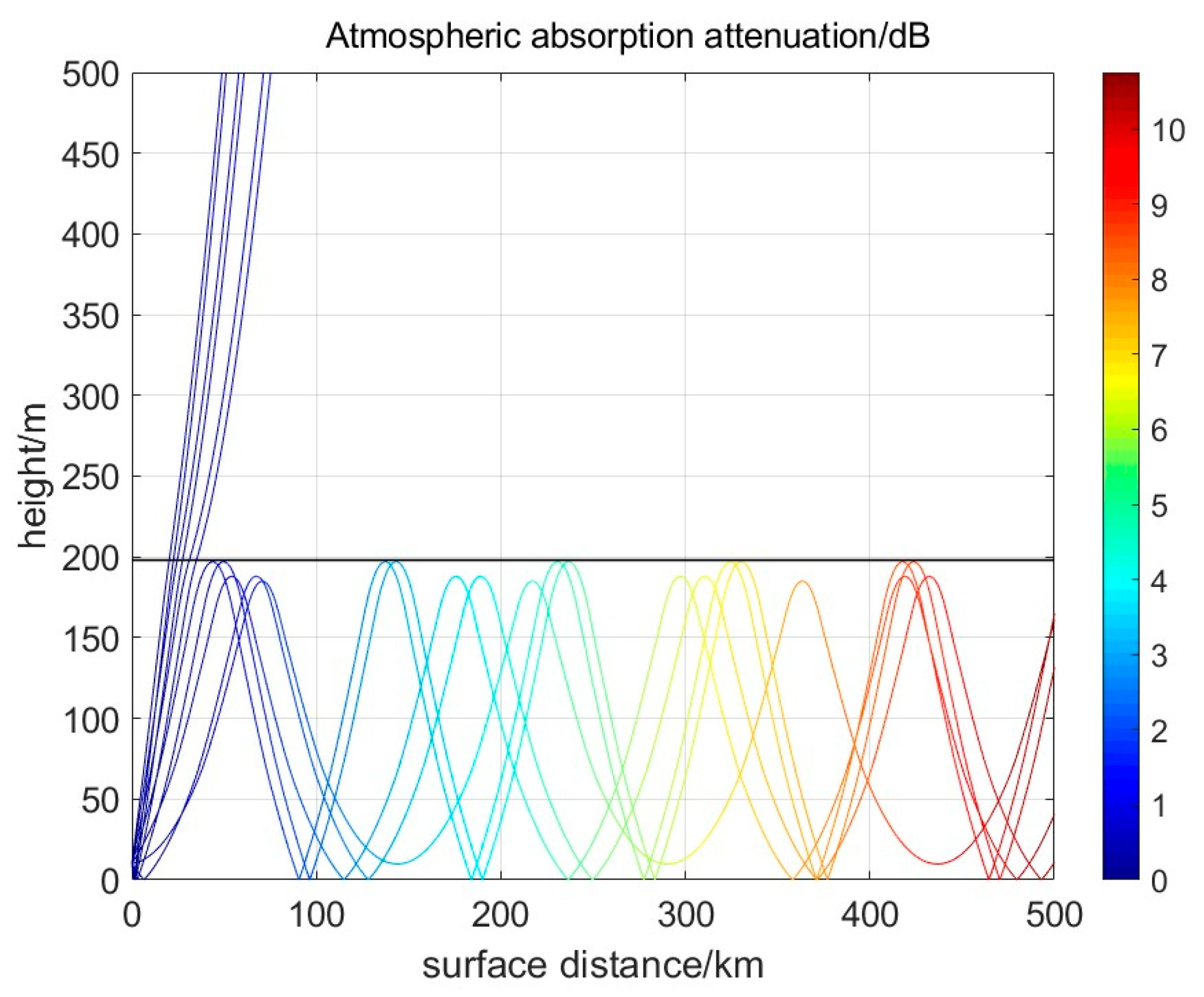
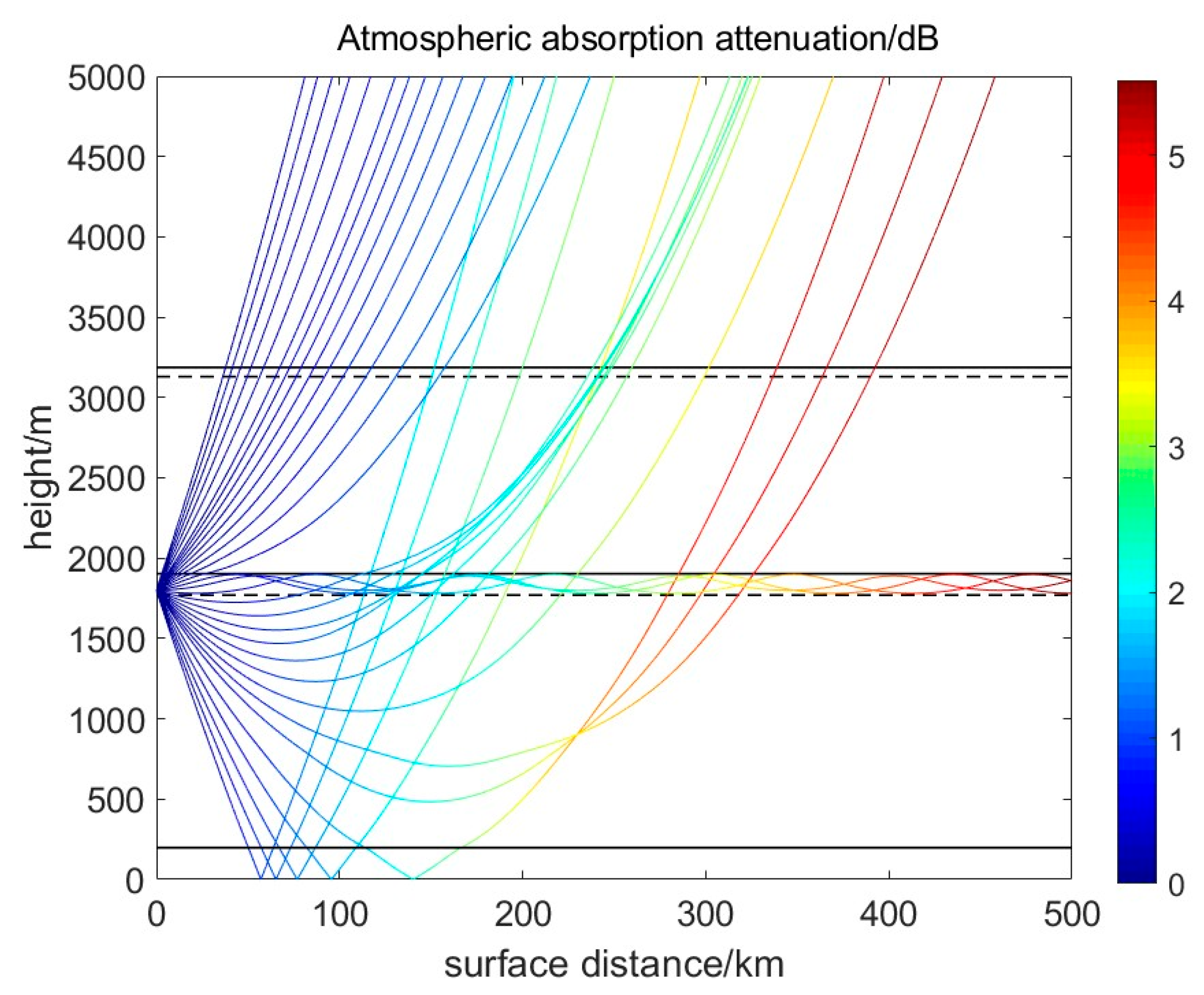
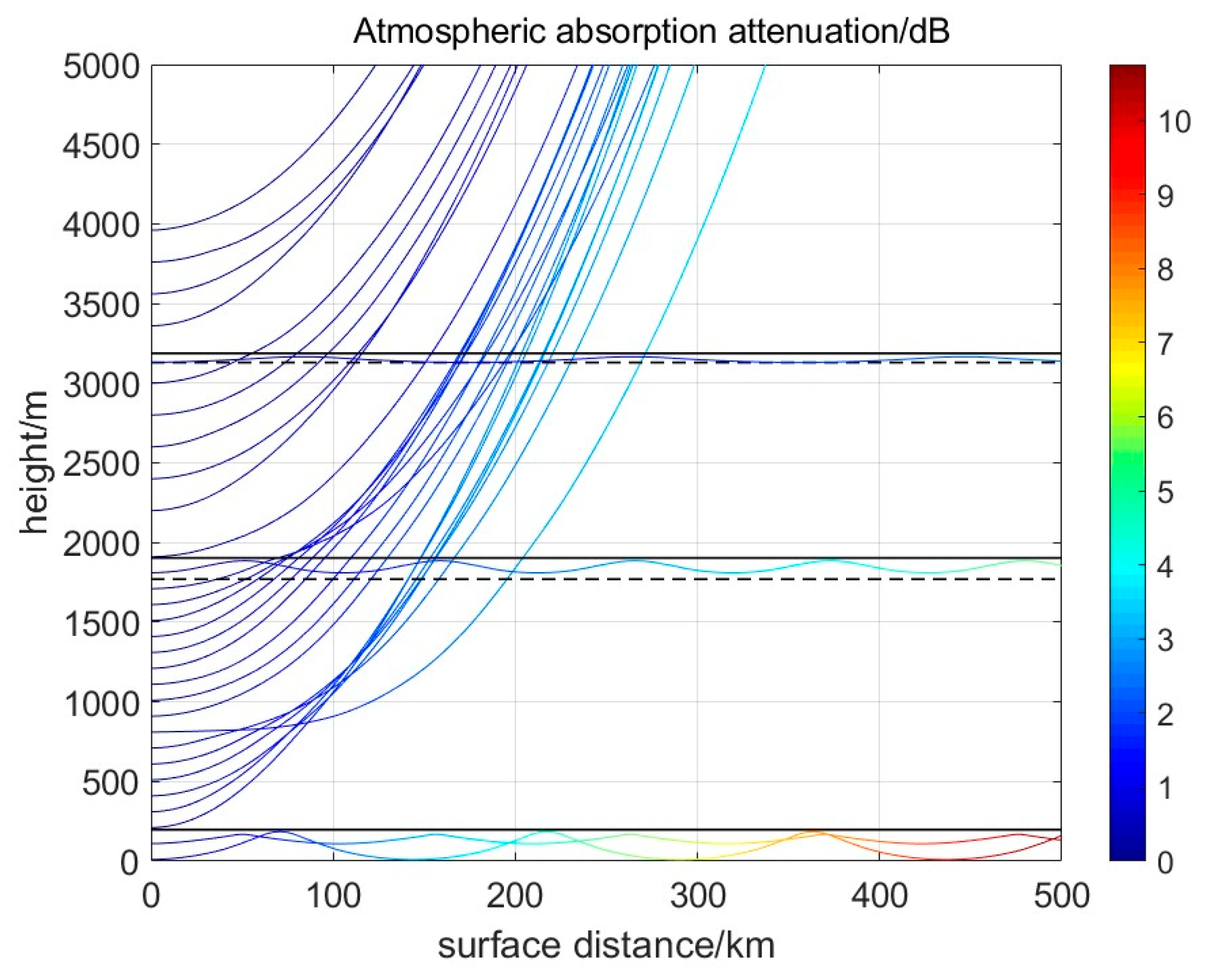
To more clearly demonstrate the variation trend of electromagnetic wave absorption attenuation within atmospheric duct stratification, this paper combines ray tracing with atmospheric absorption attenuation calculations to visually represent how low-angle electromagnetic wave attenuation changes along over-the-horizon ray paths in an atmospheric duct environment. First, it presents the visualization results of atmospheric absorption attenuation at a signal frequency of 10 GHz, with the emission source positioned at different angles within the elevated duct layer.
In
Figure 7,
Figure 8 and
Figure 9, the solid black lines represent duct top height, and the dashed black lines represent duct bottom height.
Figure 7 illustrates atmospheric absorption attenuation values using gradient colors from low to high. As shown, low-angle rays trapped by the duct form over-the-horizon propagation within it, with increasing atmospheric attenuation along their trajectories. High-angle rays penetrating the duct layer establish air-to-air links, while larger negative-angle rays reflect off the ground to form ground-to-air links. At long distances, absorption attenuation can exceed 5 dB.
Figure 8 visualizes atmospheric absorption attenuation along the ray trajectories of the emission source at different elevation angles within the surface duct layer.
In
Figure 8, the low-angle rays propagate over the horizon in the surface duct, forming a ground-to-ground link. The absorption attenuation can exceed 10 dB over long distances, with a clear visual effect.
To compare the differences in atmospheric absorption attenuation among various types of atmospheric ducts,
Figure 9 illustrates how atmospheric absorption attenuation varies with the ray trajectory when the emission source is launched at a 0° elevation angle at different altitudes.
The diagram depicts three duct layers, with surface ducts exhibiting maximum attenuation with distance. Elevated ducts at about 2000 m show moderate attenuation, while those at about 3200 m demonstrate minimal attenuation. Electromagnetic wave rays outside the duct layers exhibit varying degrees of curvature due to differing refractive index gradients at different altitudes. Significant curvature occurs when the gradient is pronounced, resulting in longer propagation paths and greater distances in the lower atmosphere. Conversely, smaller gradients lead to more linear ray trajectories, shorter propagation paths, and closer distances in the lower atmosphere. The atmospheric absorption attenuation along these paths remains relatively low, mostly within 2 dB.
5. Simulation and Accuracy Comparison Analysis of Path Propagation Loss
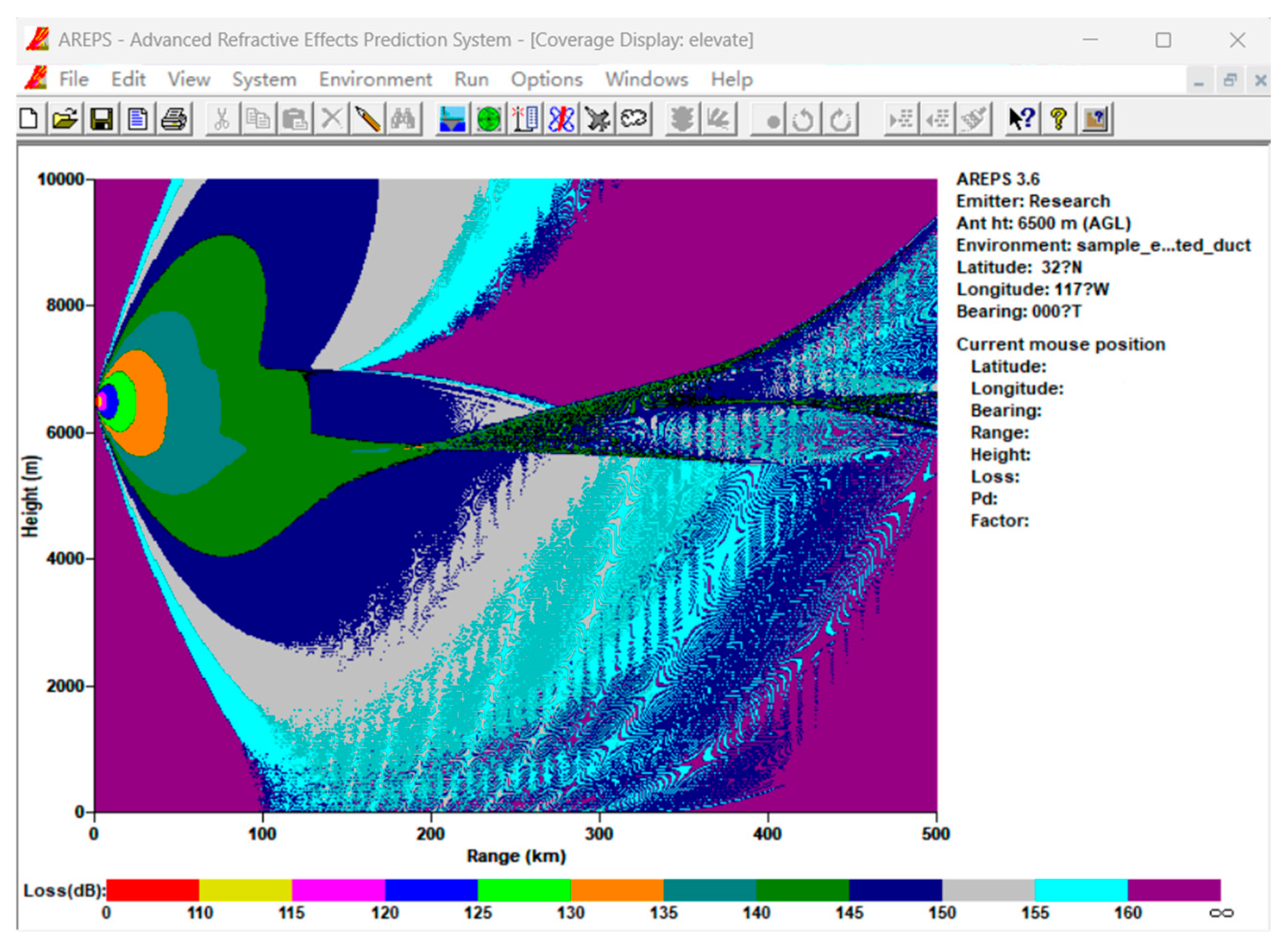
To further illustrate the accuracy of the high-precision implementation method, we use the original meteorological sounding data measured at sea level as the environment input data we use the American AREPS(3.6) software to calculate the propagation loss, and use this as the reference value to verify the accuracy of the new algorithm in this paper. The APM model of AREPS software is the only electromagnetic wave propagation model approved by N096/N61 that is applicable to the 100 MHz–57 GHz frequency band. This model combines geometric optics and the parabolic equation model, and can also include the absorption effects of oxygen and water vapor, forming an accurate hybrid model [
29].
Figure 10 is the AREPS simulation of path propagation loss in the elevated duct provided by the software.
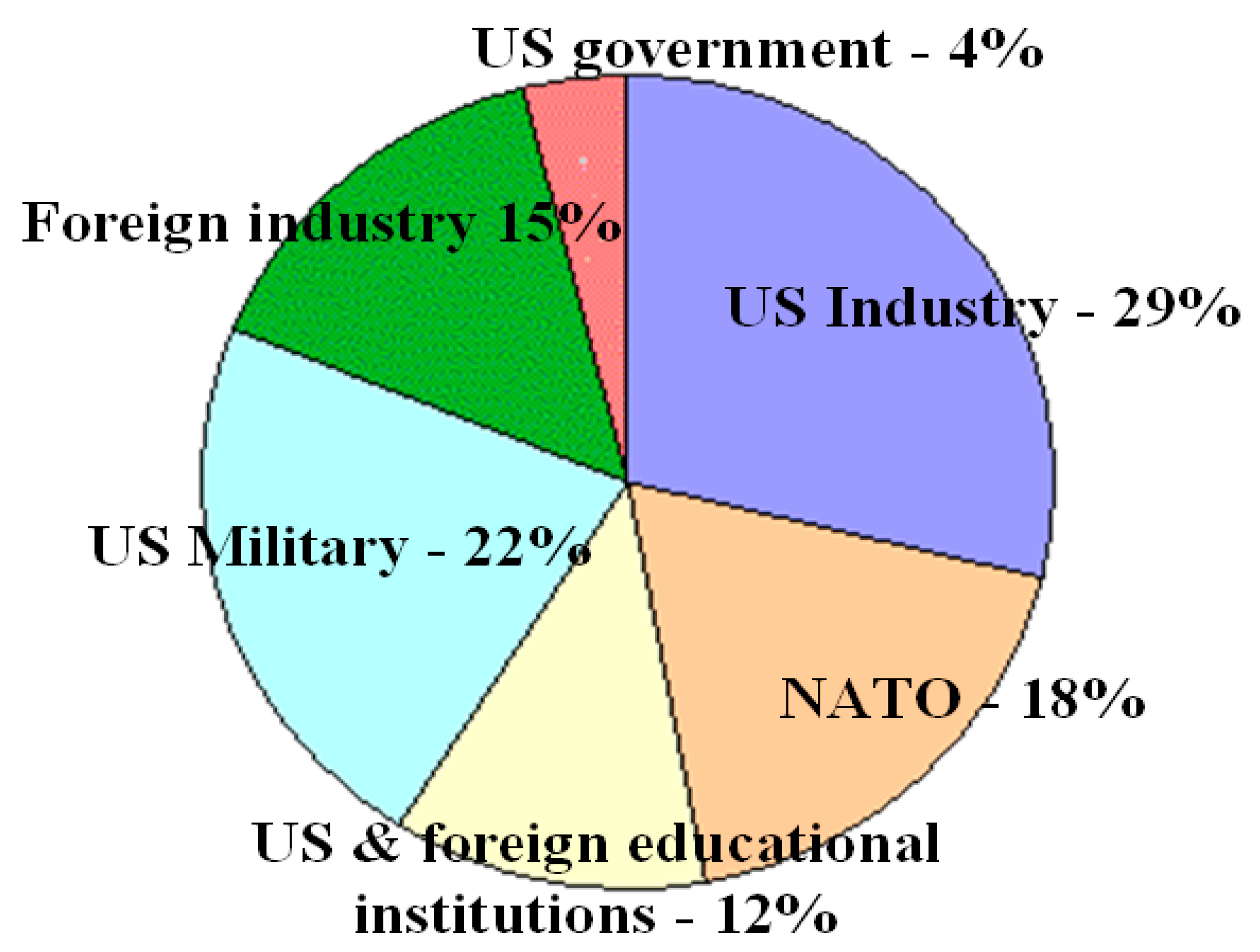
AREPS already has a large number of registered users (782 as of June 2002).
Figure 11 show the users’ distribution of AREPS soft. Its representative users include the Coast Guard’s Multi-Sensor Performance Prediction (MSPP) tool, the Navy’s Integrated Tactical Environmental Support System, the North Atlantic Treaty Organization (NATO) Joint Environmental Support System, the Royal Australian Air Force’s Tactical Decision Aid, the 84th Radar Evaluation Air Force Squadron—Coastal Defense Radar Equipment, the Federal Aviation Administration, the GPS Joint Program Office, the Army Space Command, the National Science Foundation, the Antarctic Program—Microwave Satellite Communications, etc. [
29].
In the process of comparative analysis, we also take the free space attenuation into account and combine it with the atmospheric absorption attenuation to form the propagation loss of the ray during propagation; we compare its accuracy with the output results of the AREPS software to verify the accuracy of the algorithm in this paper.
We replace the straight-line distance with the actual path length of the ray and use the free-space attenuation model to calculate the free-space attenuation [
29]:
In Formula (17),
is the frequency in MHz;
is the actual path length of the ray in km, which is obtained through step-by-step calculation using Formula (3) to replace the original straight-line distance. We synthesize and accumulate the atmospheric absorption attenuation
and free-space attenuation
to obtain the total path propagation attenuation of the ray:
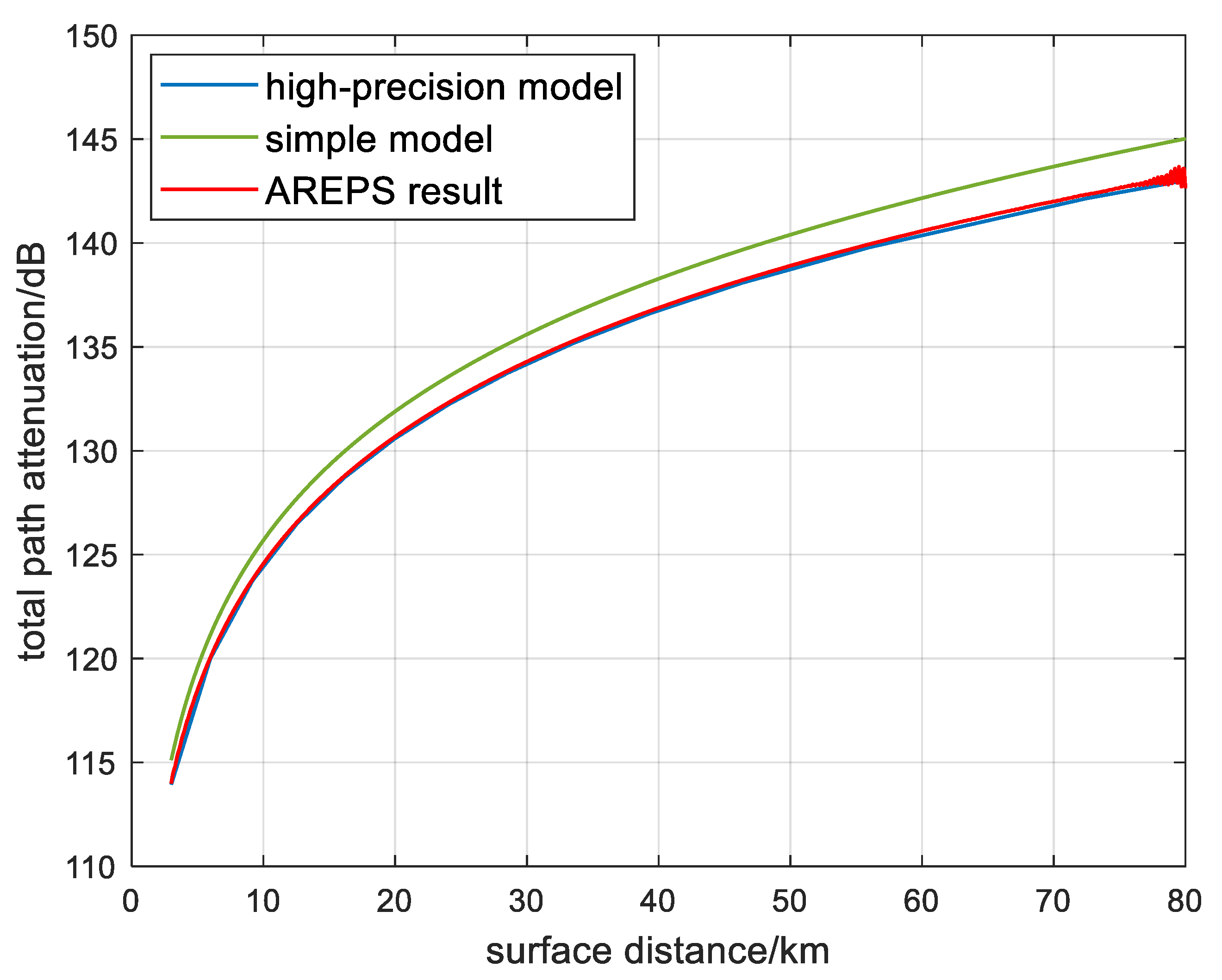
Let the frequency be 4 GHz; we still select the radiosonde meteorological data of Qingdao area on 8 June in
Figure 2 as the environmental input, with the antenna height of 800 m. The ray path attenuation at 0° elevation angle is calculated using the high-precision model, simplified model, and AREPS model in this section. The calculation results are shown in
Figure 12:
Figure 12 shows the total path attenuation calculated by different models. It can be seen from
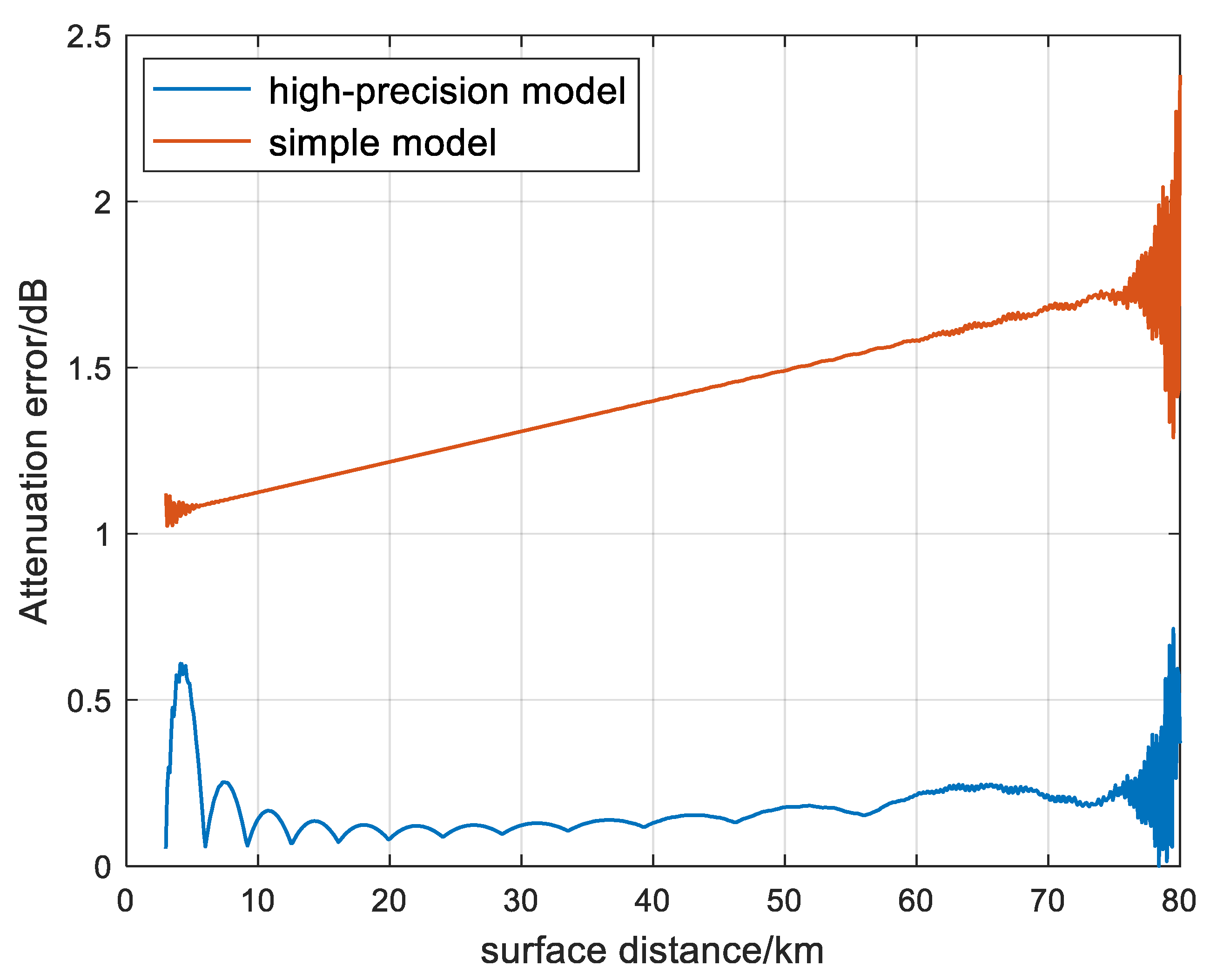
Figure 12 that the high-precision model in this paper has a significantly higher degree of agreement with the calculation results of the American AREPS software than the simplified model; especially, the total attenuation values at close distances almost completely overlap. Taking the calculation results of the AREPS software as the reference values, we calculated the errors between the high-precision model and the simplified model versus the reference values, as shown in
Figure 13:
It can be seen from
Figure 13 that the calculation accuracy of the new high-precision model proposed in this paper is significantly better than that of the simplified model, and with the results of AREPS software as the reference value, the path attenuation errors of the high-precision model and the simplified model are 0.2 dB and 1.4 dB, respectively. Since ray optics cannot calculate the multipath fading and scattering effects, there is a large error compared with the AREPS calculation results of nearly 80 km. However, it is still near the statistical mean of the fading fluctuation amplitude and is closer to the median of the fading depth compared with the simplified model. The improvement includes not only the contribution from the gradual refinement of the calculation of meteorological parameters in the atmospheric absorption attenuation model, but also the contribution from the high-precision calculation of path length in both the absorption model and the free-space attenuation model.
However, since this method is based on the calculation of propagation attenuation along the ray trajectory path, it mainly focuses on the fast propagation link prediction under atmospheric refraction and absorption effects. Moreover, the calculation process of each ray is relatively independent, so it cannot predict the electromagnetic wave interference effect on large areas such as the APM model; therefore, the high-precision model proposed in this paper is only high precision relative to the simplified model in terms of current international standards; its calculation accuracy is comparable to the APM model in non-interference regions, and still has limitations in interference regions.
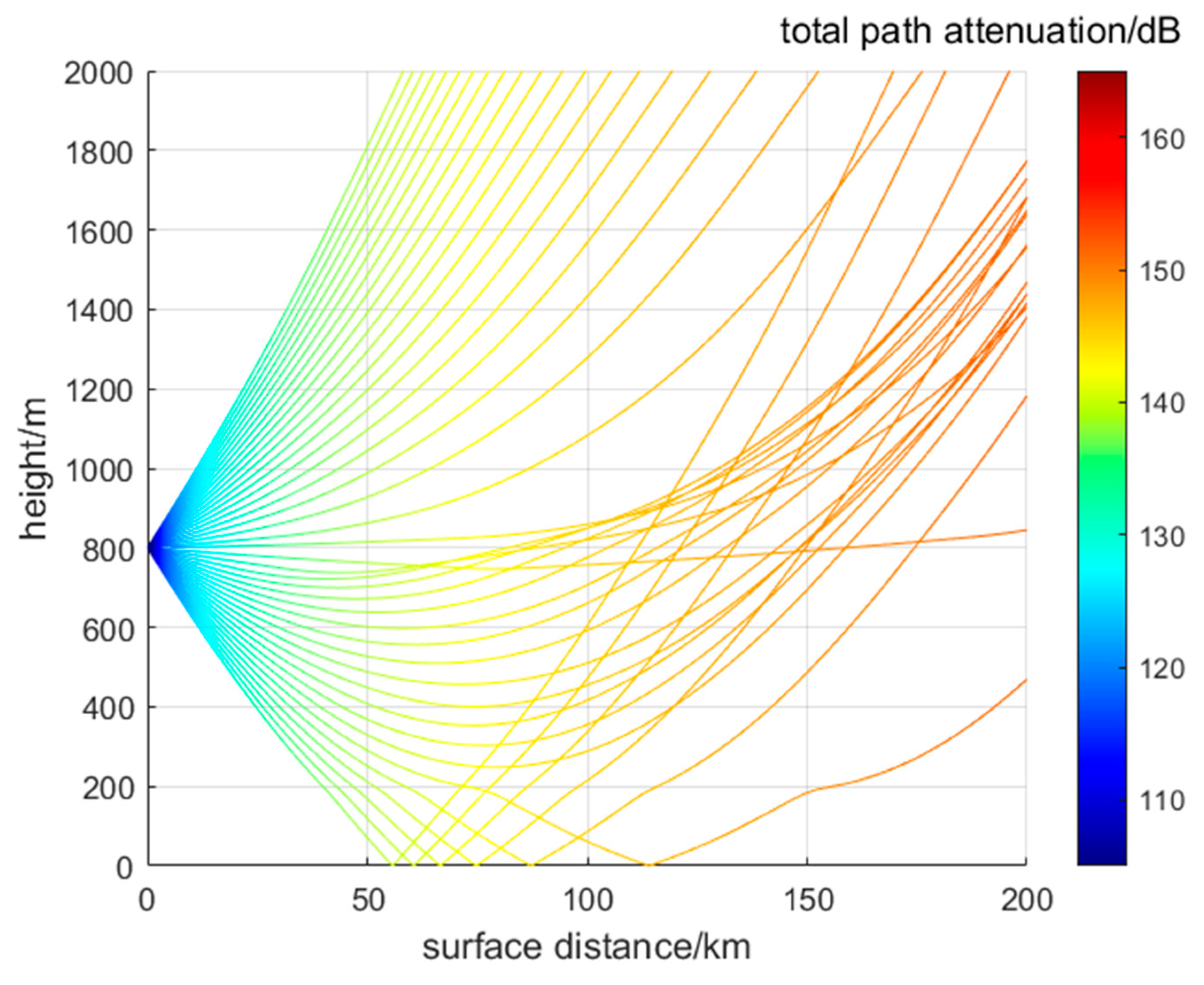
Figure 14 displays total path attenuation with ray trajectories, in which the elevation angle ranges are from −1° to 1°.
Considering free-space attenuation, the total path attenuation can be visible with trajectories; we can not only use it as a standalone tool but also in a wider range of applications, so that the method in this paper can be used as a component within a broader path loss estimation framework.
6. Conclusions
This study employed ray tracing technology based on Taylor’s second-order approximation to accurately predict low-angle ray trajectories within atmospheric ducts. During line-by-line calculations, atmospheric environmental parameters at ray passage altitudes are extracted, enabling refined accumulations of atmospheric absorption attenuation. A high-precision prediction model for atmospheric absorption attenuation in over-the-horizon propagation links is established, with visualization of attenuation variations along ray trajectories in atmospheric duct environments. Comparative analysis with current ITU-R Recommendation P.676 and the horizontal-path atmospheric absorption attenuation model from the GJB Handbook of Radar Wave Propagation, Refraction and Attenuation for Atmospheric duct Environments demonstrates that the proposed model improves prediction accuracy by approximately 15% for surface duct stratification and 28% for elevated duct stratification. To further illustrate the accuracy of the high-precision implementation method, we use the original meteorological sounding data measured at sea as the environment input data and use the American AREPS software to calculate the propagation loss, and use this as the reference value to verify the accuracy of the new algorithm in this paper. The path attenuation errors of the high-precision model and the simplified model are 0.2 dB and 1.4 dB, respectively. The improvement includes not only the contribution from the gradual refinement of the calculation of meteorological parameters in the atmospheric absorption attenuation model, but also the contribution from the high-precision calculation of path length in both the absorption model and the free-space attenuation model.
For the microwave over-the-horizon propagation effect in environments such as atmospheric ducts, traditional ray tracing algorithms are usually used to predict parameters such as ray trajectory, time delay, and grazing angle, as well as to conduct qualitative analysis of coverage. This study proposes a deterministic calculation method for propagation attenuation using ray trajectory as the carrier. It accurately calculates the ray trajectory parameters through the known distribution of atmospheric environmental parameters and uses the high-precision atmospheric absorption attenuation model and free space attenuation model to quantitatively calculate the propagation attenuation along the ray path.
The method proposed in this paper makes up for defects such as the low accuracy of statistical models and the slow calculation speed of the APM deterministic model, but there are still some limitations such as: it cannot predict the electromagnetic wave interference effect, and is just high precision relative to the simplified model in terms of the current ITU recommendation and GJB. Its calculation accuracy is comparable to the APM model in non-interference regions but weaker in interference regions. Therefore, our method’s advantages mainly lie in its more intuitive and clear visual demonstration, as well as its fast and relatively accurate propagation link calculation.
Author Contributions
Conceptualization, Q.Z. and F.S.; Methodology, H.A. and S.Z.; Validation, Q.Z.; Formal analysis, H.A., F.S. and X.D.; Investigation, Q.Z. and F.S.; Resources, H.A., J.H., X.D. and S.Z.; Data curation, J.H., X.D., S.Z., Y.C. and B.X.; Writing—original draft, F.S.; Writing—review & editing, C.L. and Y.C.; Visualization, J.H. and C.L.; Supervision, C.L., Y.C. and B.X.; Project administration, B.X. All authors have read and agreed to the published version of the manuscript.
Funding
This research received no external funding.
Institutional Review Board Statement
Not applicable.
Informed Consent Statement
Not applicable.
Data Availability Statement
Data is contained within the article. The original contributions presented in this study are included in the article. Further inquiries can be directed to the corresponding author.
Conflicts of Interest
The authors declare no conflicts of interests.
References
- ITU-R Recommendation P.676-12; Attenuation by Atmospheric Gases and Related Effects. ITU-R: Geneva, Switzerland, 2019.
- GJB/Z 87-97; Handbook of Refraction and Attenuation of Radiowave Propagation for Radar. Equipment Development Department of the Central Military Commission: Beijing, China, 1997.
- Zhao, Z.W.; Lin, L.K.; Lu, C.S.; Zhang, R.; Liu, K.; Zhang, X. Radiowave Propagation of Satellite Systems; National Defence Industry Press: Washington, DC, USA, 2020. [Google Scholar]
- Zhao, Z.; Lin, L.; Zhang, Y.; Du, P.; Wang, H.; Han, J. Progress and prospect of radio meteorology research (Invited). Chin. J. Radio Sci. 2020, 35, 801–812. [Google Scholar]
- Hou, C.; Liu, Y.; Wu, Z.; Li, Q.; Lu, C.; Lin, L.; Chen, A.; Zhang, Y. Millimeter wave channel measurement and analysis in 65.5 GHz. Chin. J. Radio Sci. 2021, 36, 630–636. (In Chinese) [Google Scholar]
- Lu, C.; Wu, Z.; Zhao, Z.; Lin, L.; Zhang, X.; Li, H. Attenuation of Terahertz-wave due to cloud and fog. Chin. J. Radio Sci. 2015, 30, 718–722. [Google Scholar]
- Li, L.; Wu, Z.; Lin, L.; Lu, C.; Zhang, L.; Wang, H. The fade slope of microwave trans-horizon propagation on oversea at 14.1 GHz. Chin. J. Radio Sci. 2015, 30, 1164–1169. [Google Scholar]
- Lin, L.; Li, L.; Zhao, Z.; Hu, R.; Zhang, Y.; Cai, W. Study on conversion of annual statistics to worst month statistics for radio wave propagation. Chin. J. Radio Sci. 2023, 38, 237–243. (In Chinese) [Google Scholar]
- Zhao, Z.W.; Lin, L.K. Research and prospect of tropospheric radio wave propagation. Chin. J. Radio Sci. 2023, 38, 591–609+656. (In Chinese) [Google Scholar]
- Agbonlahor, O.G.; Muruganathan, M.; Banerjee, A.; Mizuta, H. Machine learning identification of atmospheric gases by mapping the graphene-molecule van der waals complex bonding evolution. Sens. Actuators B Chem. 2023, 380, 133383. [Google Scholar] [CrossRef] [Scilit]
- Wu, L.-D.; Chen, P.; Yang, C. 3D representation of radar coverage in complicated environment. Syst. Eng. Electron. 2008, 30, 1448–1453. [Google Scholar]
- International Radio Consulting Committeee (CCIR) XVth Plenary Assembly Dubrovnik, Propagation in Non-Ionized Media; Recommendations and Reports of the CCIR; International Telecommunications Union: Geneva, Switzerland, 1986.
- Han, J.; Wu, J.J.; Zhu, Q.L.; Wang, H.G.; Zhou, Y.F.; Jiang, M.B.; Zhang, S.B.; Wang, B. Evaporation duct height nowcasting in China’s Yellow Sea based on deep learning. Remote Sens. 2021, 13, 1577. [Google Scholar] [CrossRef] [Scilit]
- Dong, X.; Ci, Y.; Sheng, W.G.; Sun, F.; Zhu, Q.L. Impact of atmospheric duct on time difference presision of passive location system. Chin. J. Radio Sci. 2020, 35, 847–855. [Google Scholar]
- Zhao, H.; Zhao, Z.; Wang, H.; Zhu, Q.; Han, J.; Lin, L.; Sun, F.; Wang, Q. Over-the-horizon propagation characteristics of AIS signal in the elevated duct. Chin. J. Radio Sci. 2024, 39, 100–107. (In Chinese) [Google Scholar]
- Zhang, L.; Wang, H.; Li, J.; Zhang, C.; Han, J.; Wang, Q.; Zhu, Q. Experimental analysis of lower atmospheric duct monitoring based on AIS signal. Chin. J. Radio Sci. 2023, 38, 108–113. (In Chinese) [Google Scholar]
- Zhang, L.; Li, J.; Wang, H.; Han, J.; Zhang, C.; Zhang, S. An improved evaporation duct RSHMU model and prediction performance analysis. Chin. J. Radio Sci. 2022, 37, 198–205. (In Chinese) [Google Scholar]
- Guo, X.; Lin, L.; Zhao, D.; Liu, Y.; Zhang, L.; Kang, S. Comparison of evaporation duct models and microwave transhorizon propagation experiment. Chin. J. Radio Sci. 2021, 36, 150–155+162. (In Chinese) [Google Scholar]
- Timofeev, Y.M.; Polyakov, A.V.; Virolainen, Y.A.; Makarova, M.V.; Ionov, D.V.; Poberovsky, A.V.; Imhasin, H.H. Estimates of Trends of Climatically Important Atmospheric Gases Near St. Petersburg. Atmos. Ocean. Phys. 2020, 56, 79–84. [Google Scholar] [CrossRef] [Scilit]
- Sun, F.; Wang, H.; Kang, S.; Lin, L.K. A ray tracing algorithm for duct environment. Chin. J. Radio Sci. 2008, 23, 179–183. [Google Scholar]
- Sun, F.; Zhu, Q.; Wang, H.; Dong, X.; Zhang, S.; Han, J. Positioning Correction for TDOA system in Atmospheric Duct by Using Ray Tracing. In 2024 14th International Symposium on Antennas, Propagation and EM Theory (ISAPE); IEEE: New York, NY, USA, 2014. [Google Scholar]
- Zhao, X.; Yang, P. A Simple Two-Dimensional Ray-Tracing Visual Tool in the Complex Tropospheric Environment. Atmosphere 2017, 8, 35. [Google Scholar] [CrossRef] [Scilit]
- Zhang, G.; Wang, H.; Zhu, Q.; Dong, X. Design and verification of high precision correction system for radio wave atmospheric refraction error. Chin. J. Radio Sci. 2023, 38, 1074–1081. (In Chinese) [Google Scholar]
- Hu, R.; Zhao, Z.; Sun, S.; Lin, L. Effects of the atmospheric refraction on radio line-of-sight distance near the ground in China. Chin. J. Radio Sci. 2018, 33, 14–20. [Google Scholar]
- Li, H.; Kong, P.; Zhan, J.; Wu, Z.; Bai, L. Attenuation characteristics of electromagnetic waves in nonuniform dust plasma. Chin. J. Radio Sci. 2016, 31, 654–658. [Google Scholar]
- Cheng, R.-S.; Liu, C.-G.; Cao, L.-F.; Xiao, T.; Tang, G.-P.; Huang, L.-F.; Wang, H.-G. The Influence of PE Initial Field Construction Method on Radio Wave Propagation Loss and Tropospheric Duct Inversion. Atmosphere 2024, 15, 46. [Google Scholar] [CrossRef] [Scilit]
- Li, Y.; Liu, C.G.; Zhong, M.; Wang, Y.; Yang, M. Radio Wave Propagation Path Loss in the Irregular Terrain environments. In Proceedings of the 2009 3rd IEEE International Symposium on Microwave, Antenna, Propagation and EMC Technologies for Wireless Communications, Beijing, China, 27–29 October 2009; pp. 627–630. [Google Scholar]
- Xiong, W.; Hu, J.; Zhong, K.; Sun, Y.; Xiao, X.; Zhu, G. MIMO Radar Transmit Waveform Design for Beampattern Matching via Complex Circle Optimization. Remote Sens. 2023, 15, 633. [Google Scholar] [CrossRef] [Scilit]
- Kang, S.F.; Zhang, Y.S.; Wang, H.G. Atmospheric Duct in Troposphere Environment; Science Press: Beijing, China, 2014. [Google Scholar]
| Disclaimer/Publisher’s Note: The statements, opinions and data contained in all publications are solely those of the individual author(s) and contributor(s) and not of MDPI and/or the editor(s). MDPI and/or the editor(s) disclaim responsibility for any injury to people or property resulting from any ideas, methods, instructions or products referred to in the content. |