1. Introduction
Air pollution remains one of the major environmental threats to human health, with increasing evidence that even low levels of exposure can have serious consequences [
1]. In cities, road traffic is a dominant source of pollutants such as particulate matter (PM
2.5, PM
10) [
2], nitrogen oxides (NO
x), carbon monoxide (CO), volatile organic compounds (VOCs) and ozone (O
3). Exposure to these pollutants has been linked to respiratory, cardiovascular, and neurological diseases, as well as premature mortality [
3,
4,
5]. Among them, PM
2.5 is especially relevant because it can penetrate deep into the lungs and enter the bloodstream and is closely associated with traffic emissions in urban areas. Its variability at street and neighbourhood scales makes it a useful indicator for studying how urban morphology affects pollutant dispersion [
6,
7,
8].
The layout and structure of cities, including building density, height, spatial arrangement, and street-canyon geometry, directly affect airflow, turbulence and pollutant dispersion. These effects vary across scales, with building-level features dominating at the neighbourhood scale [
9], and can depend on pollutant type, season and local meteorology [
10]. Traffic emissions are highly localized, depending on vehicle volume, mix and congestion, while meteorological conditions control dilution, residence time, and hotspot formation. Short-range dispersion models that incorporate street-canyon effects and traffic-induced turbulence are commonly used to produce high-resolution concentration maps for exposure assessment and urban planning [
11,
12]. A wide range of atmospheric dispersion modelling approaches has been applied to investigate traffic-related pollution in densely built urban environments. Gaussian-based operational models are commonly used for regulatory and exposure assessments, while CFD simulations provide high-resolution insights into airflow–pollutant interactions within street canyons and complex urban geometries. Recent reviews emphasize the importance of integrating dispersion modelling with detailed urban morphology data to better resolve near-road concentration gradients and evaluate mitigation strategies in real urban contexts [
13,
14,
15].
Urban geometry influences near-surface wind field and pollutant spread through parameters such as street-canyon aspect ratio (AR), plan area fraction (λ
p), and frontal area index (λ
f), which govern sheltering, wake formation and turbulent exchange with the overlying boundary layer. Tall buildings and dense fabric arrays can reduce ventilation and trap pollutants, while narrow canyons with high AR limit air exchange [
16,
17,
18]. Wind-tunnel, CFD (Computational Fluid Dynamics) models and field studies have formalized these mechanisms and introduced metrics such as “city breathability” to quantify urban ventilation potential [
19,
20,
21,
22,
23,
24].
Despite these advances, many studies rely on idealized geometries or focus on single sites, limiting generalization. Multi-city analyses that integrate detailed morphometric indicators, distributional methods and fine-grained dispersion data remain relatively scarce, particularly in European urban contexts. Moreover, while most studies focus on mean concentration levels, the role of urban compactness in shaping the full distribution of pollutant concentrations, including extreme events, has been comparatively less explored [
25,
26].
Recent methods, such as random forest regression, allow us to estimate complex, non-linear relationships while accounting for interactions and collinearity. Tools like partial dependence plots and quantile regression help reveal how morphology affects the full range of pollutant concentrations, including extreme events [
18,
27,
28]. In this context, random forest (RF) models have been increasingly adopted in urban air-quality research to capture complex, non-linear relationships between traffic activity, meteorological drivers and built-environment characteristics. Empirical studies have shown that RF approaches effectively identify dominant predictors and reveal interaction structures in urban pollutant variability, particularly in relation to traffic flow and seasonal meteorological variability [
29,
30]. Recent applications have further examined the influence of urban form metrics on air quality, highlighting spatial heterogeneity and context-dependent non-linear behavior [
31,
32]. These findings support the suitability of interpretable machine-learning tools for disentangling the joint effects of traffic, meteorology and morphology in heterogeneous urban environments.
In this study, we combine high-resolution, seasonal ADMS-Roads simulations with cell-level urban morphology data from Milan, Rome, Bari and Lecce. PM
2.5 fields were generated at 100 m resolution over 500 m × 500 m areas and linked to planar area fraction (λ
p), aspect ratio (AR) and mean building height. Using random forest regression, partial dependence plots and quantile regression, we examine how urban form shapes pollutant dispersion across different city layouts and seasons. The goal is to provide insights that can inform urban planning and traffic management strategies to reduce exposure and mitigate pollution hotspots. Preliminary results from this study were previously reported in Metrangolo et al. [
33].
This study advances current research on urban morphology–air pollution interactions in three key ways. It provides a harmonized multi-city analysis across contrasting urban contexts, moving beyond single-site or idealized studies. It explicitly examines distributional effects of urban form on PM2.5, highlighting impacts on high-concentration episodes rather than mean levels alone. Finally, the integration of high-resolution ADMS-Roads dispersion modelling with interpretable machine-learning techniques offers a transferable methodological framework linking physical processes and data-driven analysis. Together, these elements provide evidence directly relevant for exposure assessment and urban planning strategies.
2. Methodology
2.1. Description of the Cities and the Study Areas Investigated
This study examined four Italian cities, including three metropolitan cities, as defined by Article 1, paragraph 5, of Law No. 56/2014 [
34], selected to represent northern, central and southern Italy. The metropolitan cities considered were Milan (45°27′41″ N, 9°09′34″ E), Rome (41°53′35″ N, 12°28′58″ E) and Bari (41°07′31″ N, 16°52′00″ E). In addition, the city of Lecce (40°21′07″ N, 18°10′09″ E), which hosts the University of Salento, was included in the analysis. The selection of the four cities was made to represent contrasting climatic and morphological contexts across Italy (northern, central and southern). This design allows testing whether morphology–pollution relationships are consistent across diverse urban forms and climatic regimes within a comparable national context. Within each city, 500 m × 500 m study areas were selected to span a predefined range of building plan area fraction (λ
p) categories (see
Section 2.3).
Milan, with a population of 1,365,698 [
35], is characterized by a predominantly radial urban structure, with relatively recent developments expanding outward from the historic city center. Rome, which has 2,747,290 inhabitants, also displays a radial layout, although it is more fragmented, with multiple secondary centers and a higher proportion of green spaces. Bari, with 315,831 inhabitants, is a coastal city whose urban development extends inland. Lecce, with a population of 94,187, has experienced radial growth along three main directions: northwest towards an industrial zone, east towards the coast, and south towards predominantly residential areas. The historic center of Lecce is marked by a high degree of compactness and irregularity and is surrounded by dense districts that have developed mainly in recent decades. Similarly, the old town of Bari exhibits a compact and irregular urban fabric extending towards the sea, while the more recent neighborhoods are organized according to an orthogonal grid. In contrast, Rome presents a more structured and compact central layout, which is frequently interrupted by gardens and parks. Milan also shows a highly compact and irregular urban pattern [
36].
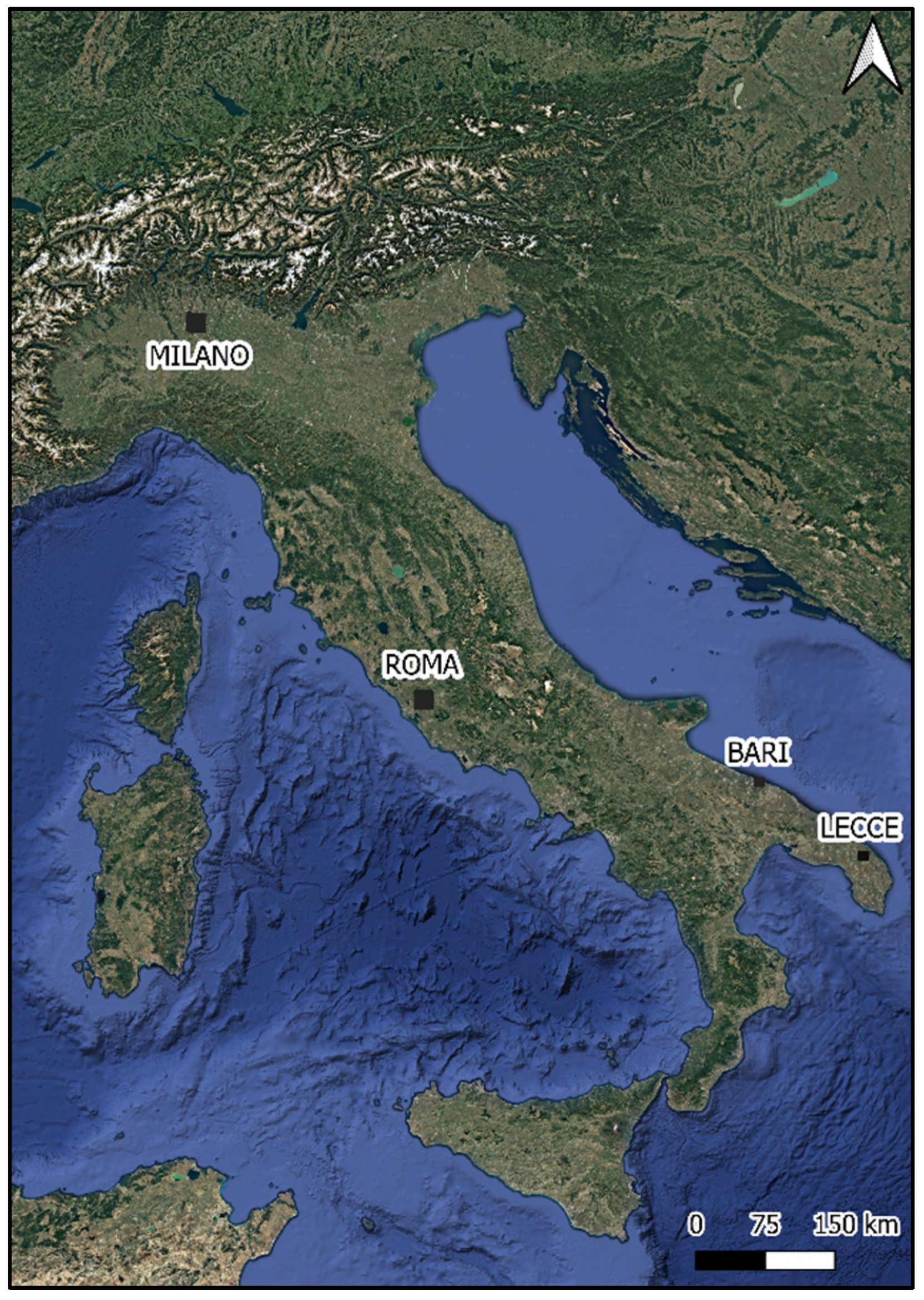
Figure 1 shows the geographical location of the four cities within Italy.
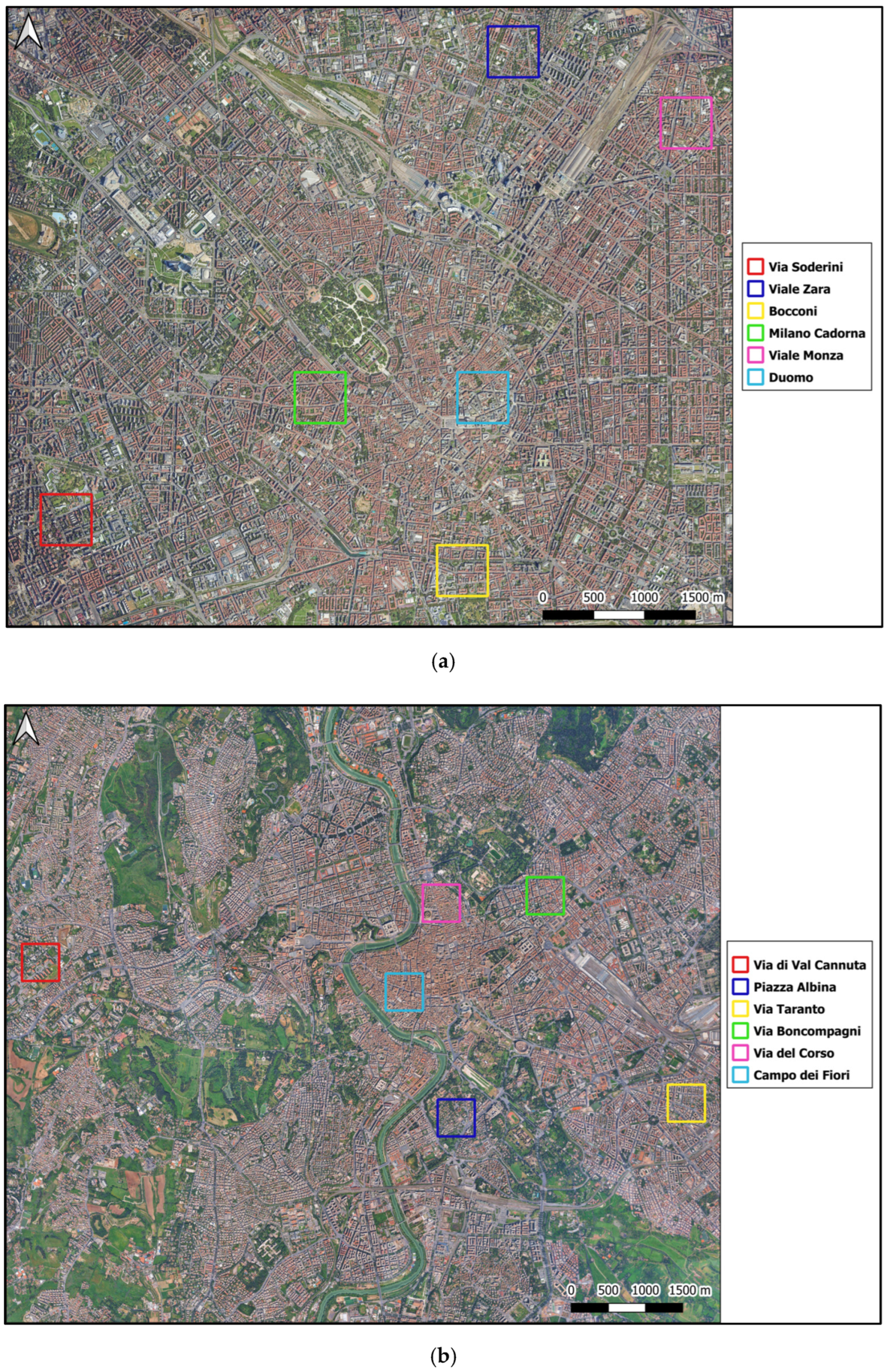
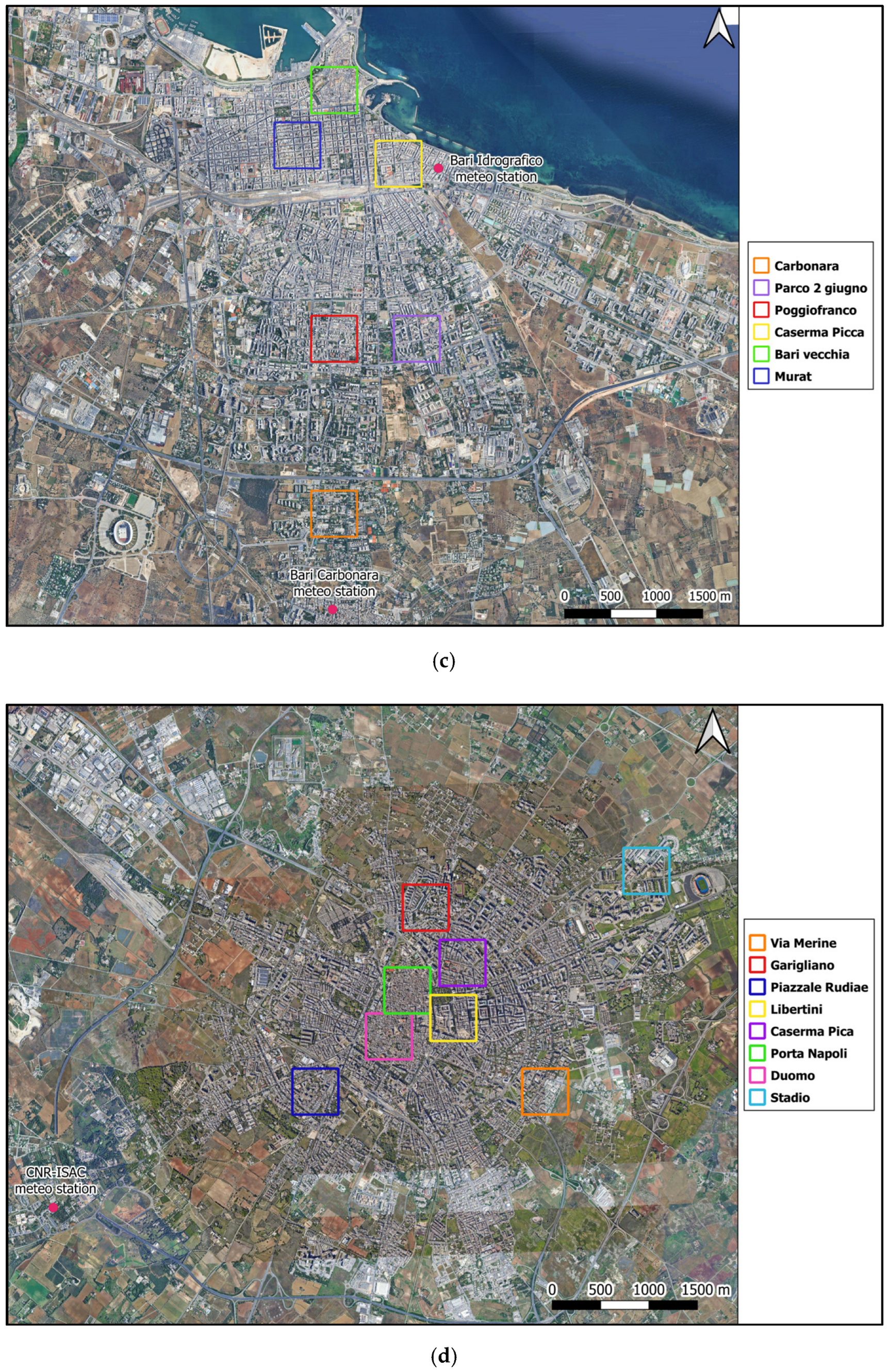
Figure 2 illustrate the selected study areas in each city: six areas in Milan (Bocconi, Duomo, Milano Cadorna, Via Soderini, Viale Monza, and Viale Zara), six in Rome (Campo dei Fiori, Piazza Albina, Via Boncompagni, Via del Corso, Via di Val Cannuta, and Via Taranto), six in Bari (Bari Vecchia, Carbonara, Caserma Picca, Murat, Parco 2 Giugno, and Poggiofranco), and eight in Lecce (Caserma Pica, Duomo, Garigliano, Libertini, Piazzale Rudiae, Porta Napoli, Stadio, and Via Merine). The selected study areas covered 500 m × 500 m horizontal domains, corresponding to the typical size of an urban block. This spatial scale was chosen because it represents areas enclosed by road canyons [
22].
Studying cities with varied street layouts, building density, and historic development patterns supports the transferability of morphology–pollution relationships to other European urban environments, as differences in street connectivity, building compactness and presence of open spaces among Milan, Rome, Bari and Lecce are expected to influence local airflow and pollutant accumulation.
2.2. ADMS-Roads Modelling
For each study area, a set of pollutant dispersion scenarios was developed using the ADMS-Roads 5.1 software (Atmospheric Dispersion Modelling System) provided by CERC [
37]. ADMS-Roads is a local-scale dispersion model designed specifically for assessing traffic-related air pollutant concentrations in urban environments. The model integrates Gaussian plume formulations with modules that consider street canyon effects, traffic-induced turbulence and surface roughness parameterisation. Urban effects are represented through aerodynamic roughness length (z
0), which modifies wind profiles and turbulence within the boundary-layer scheme. For road segments defined as street canyons, the canyon module is activated to parametrise recirculation and reduced ventilation within the canyon (see
Section 2.5). Outside canyon influence zones, dispersion follows the standard formulation. The model accepts processed meteorological inputs and detailed source geometries to produce high-resolution receptor fields. The performance of ADMS-Roads has been widely evaluated and validated in previous studies, including comparisons with measurements from the UK Automatic Urban and Rural Network (AURN) and assessments based on standardised field, laboratory, and numerical datasets [
38]. In addition, the model has been favourably benchmarked against other regulatory dispersion systems used by the European Union and the United States Environmental Protection Agency (EPA) [
39].
In the present study, ADMS-Roads was applied using a comprehensive set of input data, including detailed information on urban morphology and geometry, characterisation of traffic emission sources and local meteorological conditions, as described in the following subsections.
2.3. Selection and Characterisation of the Study Areas Using QGIS
The pronounced morphological variability observed in urban environments at micro- and local scales highlights the need for a careful and systematic delineation of study areas. The identification of measurable and clearly defined parameters is essential for capturing the spatial characteristics and geometric complexity of urban form. Morphological parameters commonly used in urban parameterisation schemes, in combination with mesoscale meteorological models, play a key role in representing urban structure and surface–atmosphere interactions [
40].
The study areas (
Figure 2) were primarily selected using QGIS 3.28.13 software, with particular emphasis on the building plan area fraction (λ
p) as the key morphological parameter. The plan area fraction is defined as the ratio between the plan area of buildings (A
p) and the total surface area of the study area (A
tot), i.e., λ
p = A
p/A
tot, consistent with standard urban canopy parameterization frameworks [
41]. Two additional morphological parameters were also considered: the aspect ratio (AR), defined as the mean ratio of street-canyon height to width, and the mean building height (H), calculated as the geometric mean of building heights within each area. The parameters λ
p, AR, and H were selected as primary morphological predictors based on their established mechanistic relevance to street-level ventilation processes and their recognised influence on pollutant concentrations, as documented in previous studies [
20,
22,
42,
43,
44]. As reported by Pappaccogli et al. [
40], λ
p typically exhibits substantial spatial variability across urban landscapes due to heterogeneous building distributions. Accordingly, the study areas were selected to span a consistent and representative range of λ
p values in each city, with a gradual increase in compactness. This approach enabled meaningful comparisons between cities and facilitated the investigation of morphology–pollution relationships across different urban contexts. Each city included at least one site from each morphological category defined by Buccolieri et al. [
20] and Oke et al. [
22]: sparse (low λ
p), intermediate (λ
p ≈ 25%), compact (λ
p ≈ 40%), and very compact (high λ
p) canopy. An initial analysis of eight sites in Lecce indicated that a smaller number of areas was sufficient for validation purposes; therefore, six study areas were selected for Bari, Milan and Rome.
The calculation of morphological parameters was performed in QGIS on a grid of square cells with a horizontal resolution of 100 m × 100 m, covering the urban areas of Lecce, Bari, Milan and Rome. Following the GIS-based methodology developed by Esposito et al. [
36], building plan area fraction (λ
p), mean building height (H) and aspect ratio (AR) were computed at the grid-cell level using building footprint, building height and street-canyon geometric information. To ensure consistency in the assignment of building attributes to individual cells, each building was assigned to all grid cells it overlapped, with its contribution proportionally accounted for in the calculation of cell-level morphometric descriptors. This approach prevents double counting while capturing the influence of partial building coverage within neighbouring cells. The resulting cell-level values of λ
p, H and AR were spatially averaged over each 500 m × 500 m study area, ensuring that study-area-level descriptors reliably represent the aggregated urban morphology while preserving information on fine-scale variations in street-canyon geometry and building density, which are critical drivers of pollutant dispersion. In parallel, the QGIS plugin “UMEP” was used to estimate the aerodynamic roughness length (z
0) for each grid cell, applying the roughness formulation proposed by Macdonald et al. [
45]. The resulting roughness values were then implemented as input parameters in ADMS-Roads to account for the effects of surface roughness and complex urban terrain on pollutant dispersion.
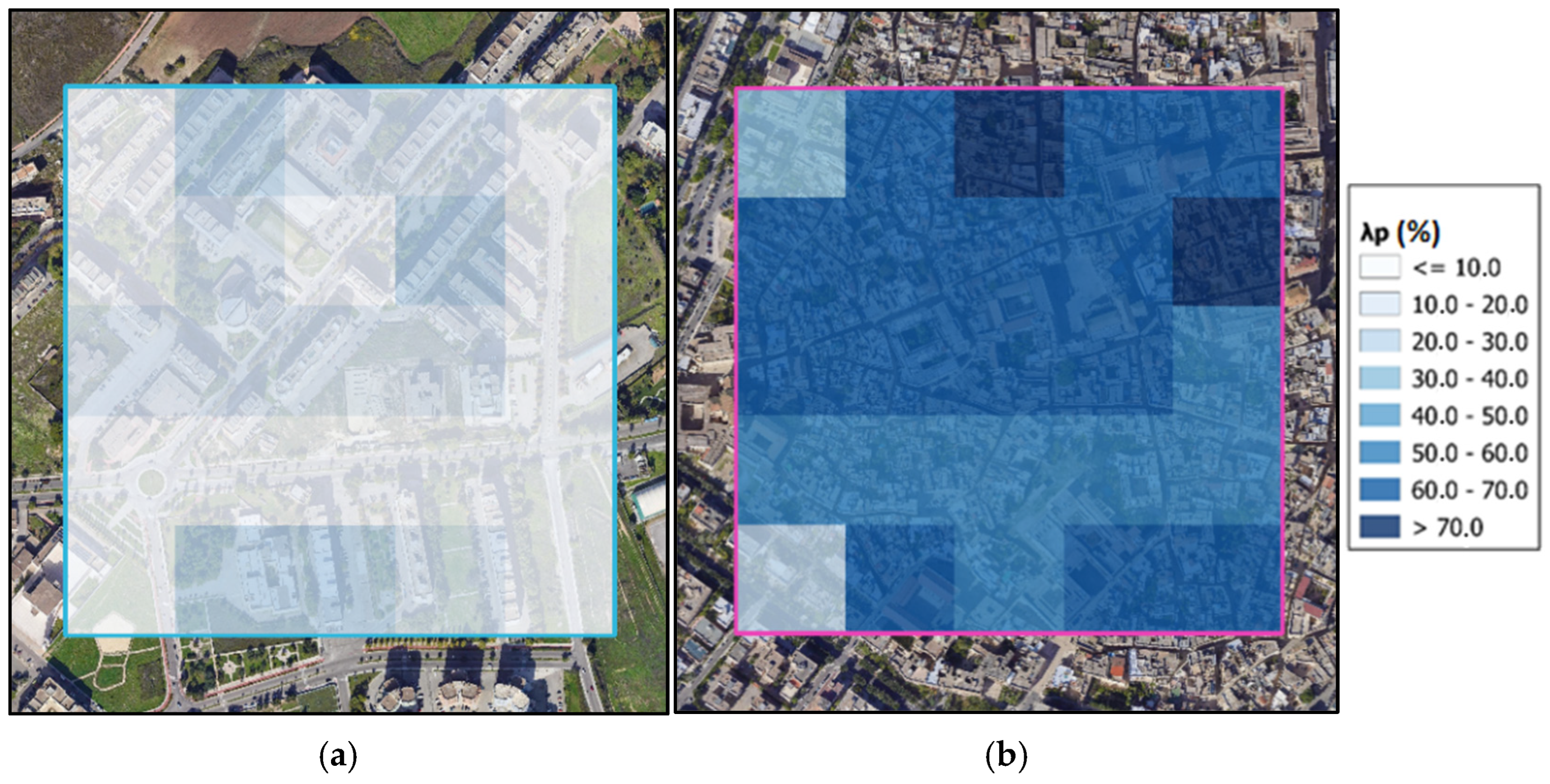
As an example,
Figure 3 shows the QGIS-based visualisation of λ
p for the Stadio and Duomo areas in Lecce, representing the lowest and highest building plan area fractions, respectively.
2.4. Processing of Meteorological Parameters
Hourly meteorological data, including wind speed (WS) and direction (WD), air temperature (T), relative humidity (RH), precipitation (P) and solar radiation (SR), were gathered for the period spanning 2019 to 2021.
Table 1 provides a list of the meteorological stations that were utilized to obtain meteorological input data. For each station, the table specifies the city for which the data were employed, the station name, its geographical coordinates, the station’s elevation and the variables derived from that specific station. Overall, the proportion of missing data was generally low across all cities and seasons. Milan showed missing data levels below 2%, Rome below 11% in the worst case, and Lecce and Bari typically below 5%. These levels were considered acceptable for the purposes of the analysis and did not compromise the robustness of the modelling results. Due to the lack of meteorological stations in each study area, data from the same station were applied to all study areas within each city. This approach is commonly adopted in urban-scale dispersion modelling when multiple monitoring stations are not available within the same metropolitan area, provided that surface roughness and land-use differences are explicitly accounted for. To account for intra-urban differences in surface characteristics, ADMS-Roads adjusts wind profiles and turbulence based on the local surface roughness length. This approach mitigates, to some extent, the limitation of using a single meteorological station per city, as the model effectively adjusts meteorological inputs to local conditions.
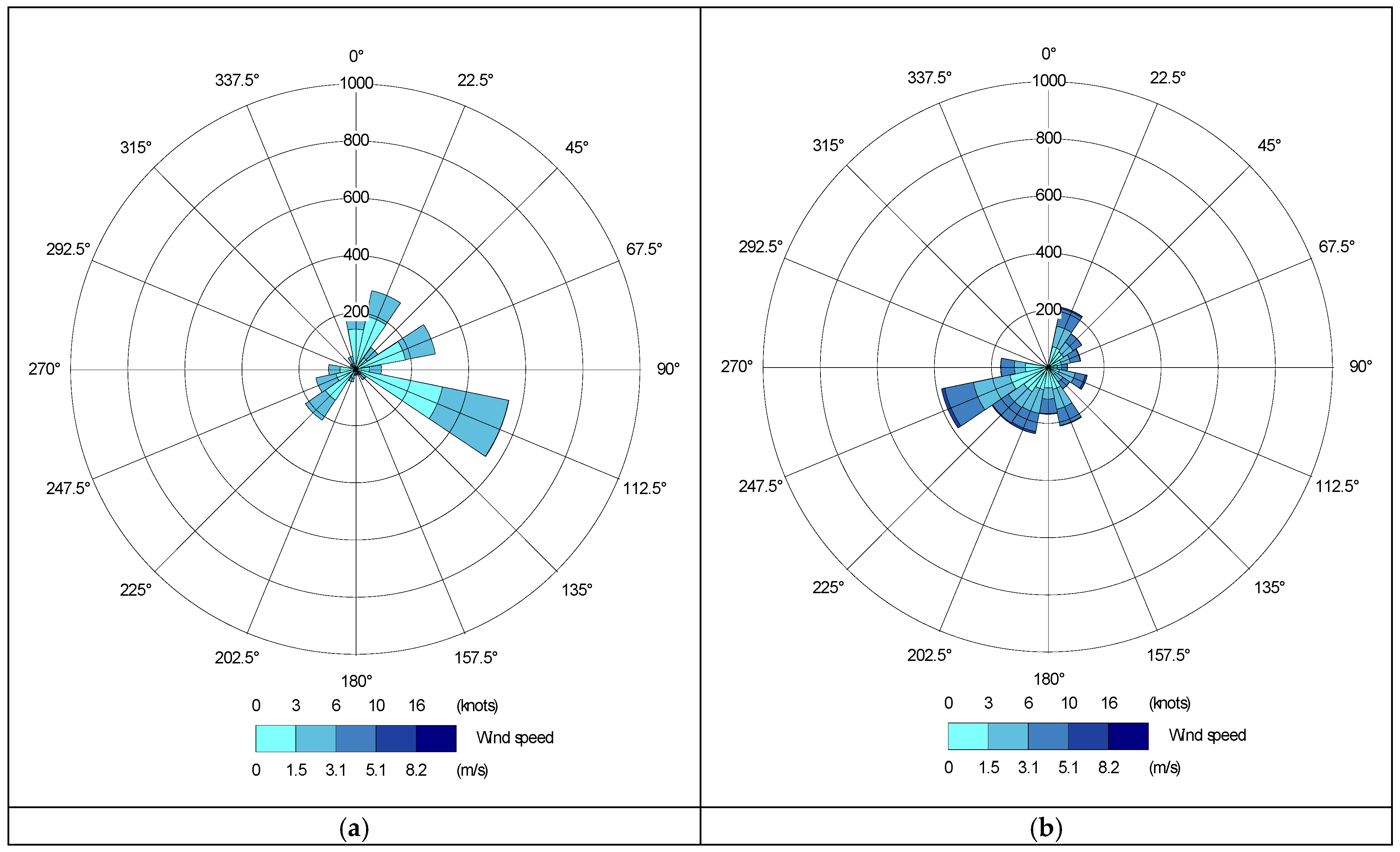
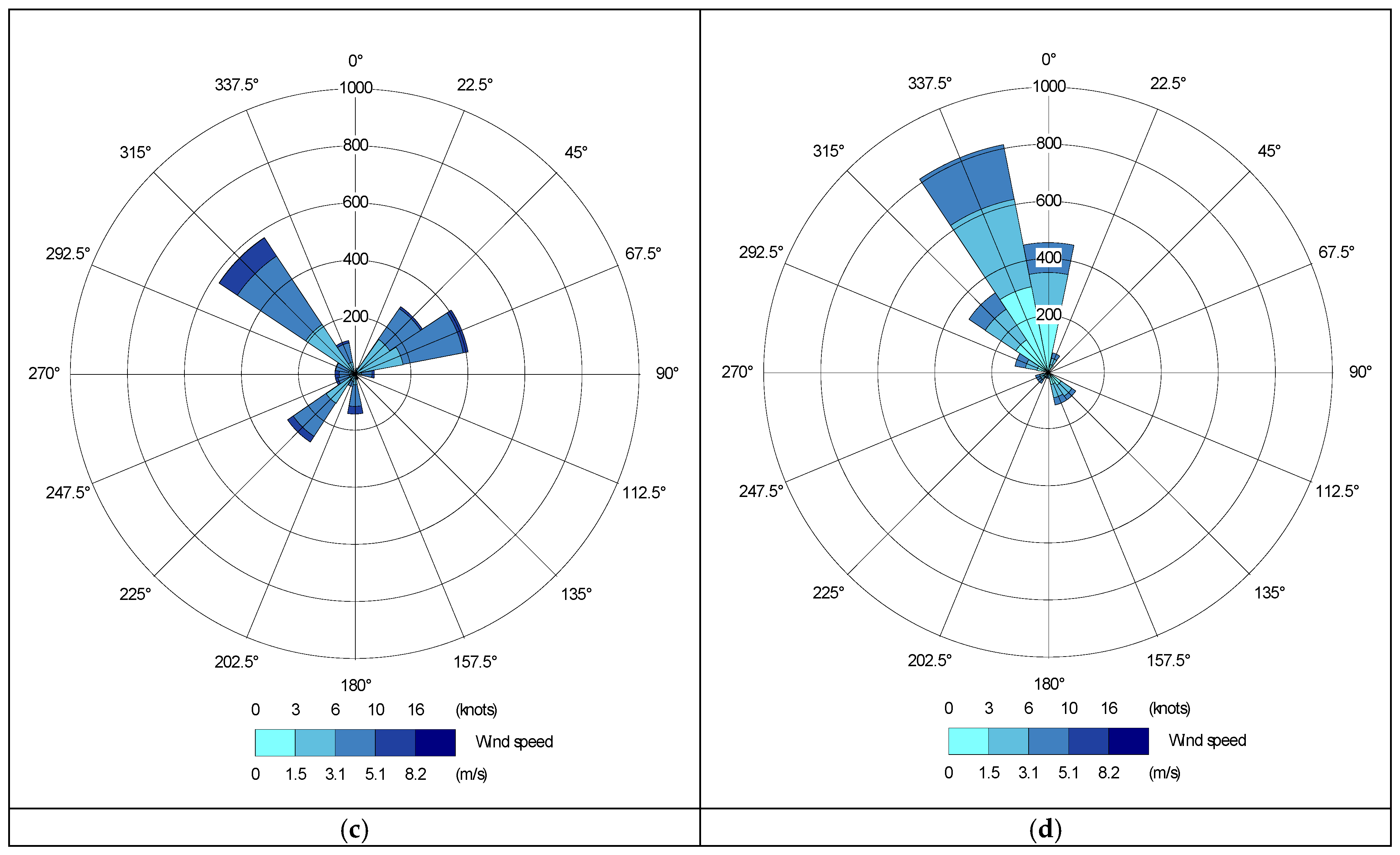
The hourly data were processed using MATLAB R2025b software to generate the meteorological input to ADMS-Roads. This involved the creation of four “typical seasons”, which have been categorized based on the conventional JFD (winter: January, February, December), MAM (spring: March, April, May), JJA (summer: June, July, August), and SON (autumn: September, October, November) seasons. These seasonal aggregations were adopted to reduce short-term meteorological variability and to focus on the dominant synoptic and local-scale circulation patterns that characterize each period. Hourly averages were calculated for wind speed, temperature, relative humidity and solar radiation, while wind direction was assigned based on the modal (most frequent) hourly direction within each seasonal dataset. The processed data was then used to produce four hourly meteorological files, which were then input into ADMS-Roads. The software’s internal meteorological pre-processor then generated additional data to improve the characterisation of local meteorology and atmospheric turbulence, both of which are critical for accurate simulation of pollutant dispersion. All simulations were performed on an hourly basis. This temporal resolution allows the model to capture the combined effects of diurnal traffic variability and meteorological conditions on pollutant dispersion.
Table 2 summarises the seasonal mean wind speed, its variability and the dominant wind direction for each city, while
Figure 4 provides a visual representation of the summer wind regimes through wind roses.
2.5. Modelling Urban Road Transport and Pollutant Dispersion
Road geometries were digitized in QGIS and key parameters such as road width, length and average street-canyon height were calculated and assigned to each modelled road segment. These descriptors ensured a realistic representation of the road network and provided the geometric basis for the dispersion modelling. The use of GIS-based digitization allowed a consistent and reproducible extraction of geometric parameters across all study areas. Each road source was also characterized by numerical inputs describing vehicle type, traffic volume and average hourly speed. To ensure comparability across heterogeneous urban contexts in the absence of harmonized, high-resolution local traffic datasets, each 500 m × 500 m study area was assigned a fixed total of 23,250 light vehicles and a representative mean speed of 30 km/h. We note that this area-level mean speed does not imply uniform traffic conditions across all road segments within a study area: slower, narrow streets and faster arterial roads coexist, while preserving the same aggregated average. Google Traffic data were used solely as a qualitative visual reference to guide the spatial allocation of emissions within each study area, without formal conversion of color classes to traffic volumes. We acknowledge that this simplified representation does not explicitly capture congestion-driven hotspots or segment-specific traffic loads, which can lead to local increases in pollutant concentrations in real-world conditions. Accordingly, the resulting PM2.5 fields should be interpreted primarily as comparative spatial patterns reflecting the influence of urban morphology under a consistent traffic framework, rather than absolute representations of human exposure.
Road-traffic emissions were estimated using the internal ADMS-Roads dataset “UK EFT v9.0 (2VC)”, with 2022 selected as the emission year and “England (urban)” specified as the road type. While these datasets are based on UK conditions, their consistent use across all study areas allows for robust comparisons of relative morphological effects on pollutant dispersion. The simulations included the effects of road canyons and traffic-induced turbulence. In particular, the street-canyon module, based on the Danish Operational Street Pollution Model (OSPM) [
46], was used to account for the influence of complex urban geometries on pollutant dispersion. In the present configuration, canyon geometry was defined using mean building height and street width derived from GIS data, assuming symmetric canyon conditions. Although the “UK EFT v9.0 (2VC)” dataset and the “England (urban)” road classification were adopted due to their availability within ADMS-Roads, their consistent application across all study areas ensured a robust and internally coherent comparison of the influence of urban morphology on dispersion patterns. Temporal variations in traffic volume were accounted for by applying the “3DayDiurnal scheme”, which represents differences between weekdays, weekends and holidays, as well as diurnal traffic patterns. This approach captures the typical weekday–weekend contrast and diurnal variability in traffic activity, thereby providing a more realistic temporal representation of transport-related emissions.
Meteorological data from the period 2019–2021 were used in simulations, while the 2022 emission dataset was selected to represent a contemporary vehicle fleet at the time the study was initiated, rather than relying on older baseline years or on forward-looking (projection-based) options available in the software. The use of different reference years for meteorology and emissions does not affect the comparative nature of the analysis, which focuses on relative spatial patterns rather than absolute concentration values. Future developments will aim to integrate region-specific emission inventories and more recent meteorological datasets to further improve model accuracy while preserving the main findings.
Model outputs included hourly mean concentrations of NO
2 (μg/m
3) and daily mean concentrations of PM
10 and PM
2.5 (μg/m
3). Although all pollutants were simulated, the present analysis focuses on PM
2.5 because of its stronger association with adverse health outcomes and its closer link to traffic-related combustion processes compared to PM
10 and NO
2 [
6,
7,
8,
47].
All simulations were performed at ground level, with receptor heights of approximately 1.5 m above the surface, to represent near-surface concentrations relevant to human exposure. This receptor height was applied consistently to all receptors and grid points. A 31 × 31 source-oriented grid of receptor points was defined within each 500 m × 500 m study area. In ADMS-Roads, this notation refers to the number of receptor points along each horizontal axis (31 in X and 31 in Y), rather than to a fixed physical distance. The spacing between points is therefore determined by the total size of the study area. When the source-oriented grid option is used, additional receptor points are automatically added near road segments to improve the resolution of concentration gradients in the vicinity of traffic sources.
2.6. Statistical Analysis
For each study area, a 5 × 5 grid of 100 m × 100 m cells was generated in QGIS. Seasonal ADMS-Roads PM2.5 raster outputs (autumn, winter, spring and summer) were overlaid on this grid and zonal statistics were computed for each cell. The spatially averaged PM2.5 value within each cell was used as the representative concentration, resulting in 25 PM2.5 observations per study area per season. λp and AR were calculated at the same 100 m × 100 m cell scale and spatially averaged for each cell. Meteorological variables (wind speed, wind direction and air temperature) were assigned as seasonal city-level values and therefore did not vary spatially within each city. Road-network characteristics, including the number of roads and total road length, were retained at the study-area scale (one value per 500 m × 500 m area). This implies that all cells within a study area share identical road-network values, which reduces within-area variability and may dampen the apparent influence of these predictors at the cell scale. The resulting analytical unit was the cell–season observation, combining local predictors (mean PM2.5, mean λp, mean AR) with area- and city-level covariates (meteorological variables and road-network metrics). All statistical analyses were conducted separately for each season.
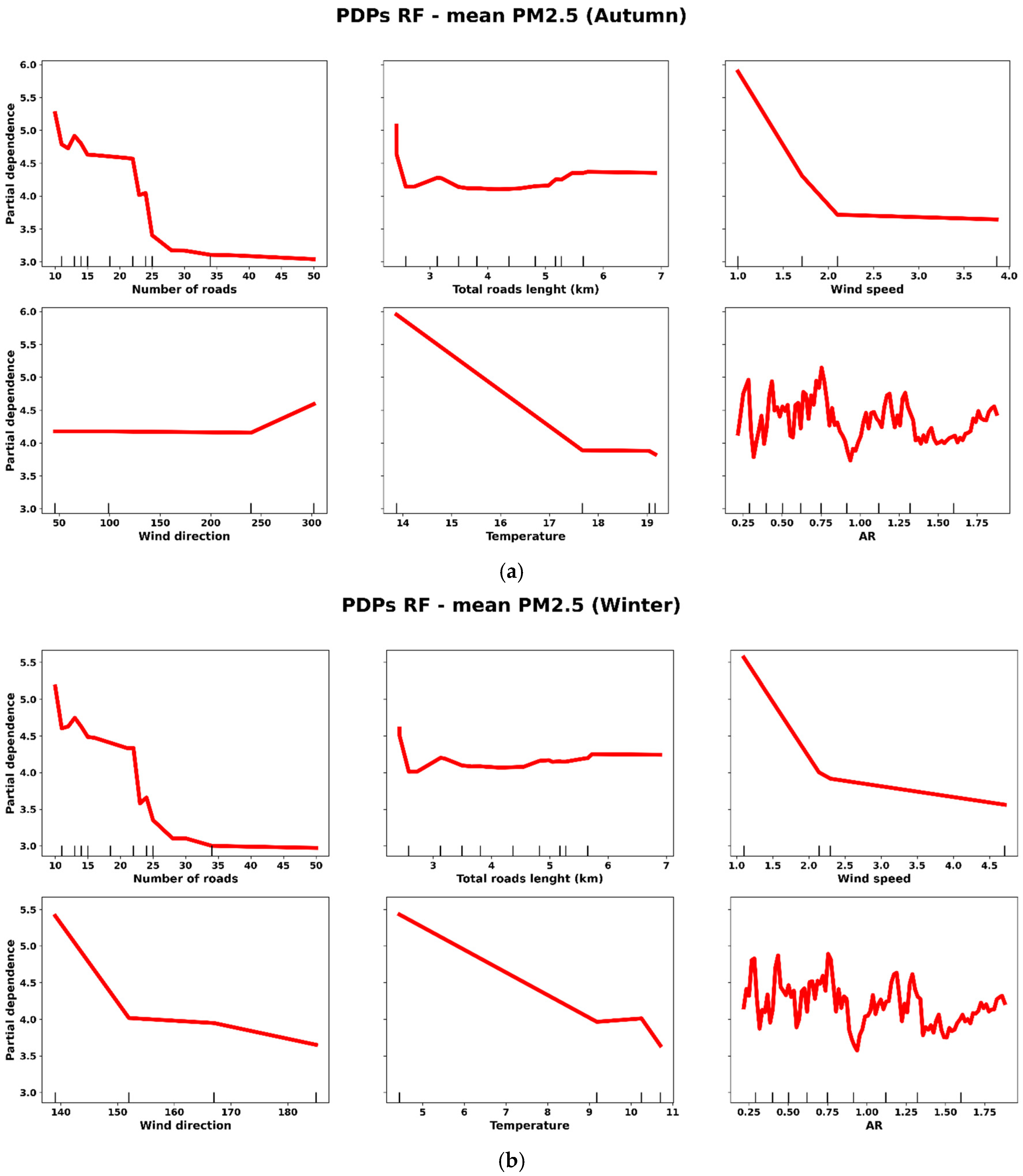
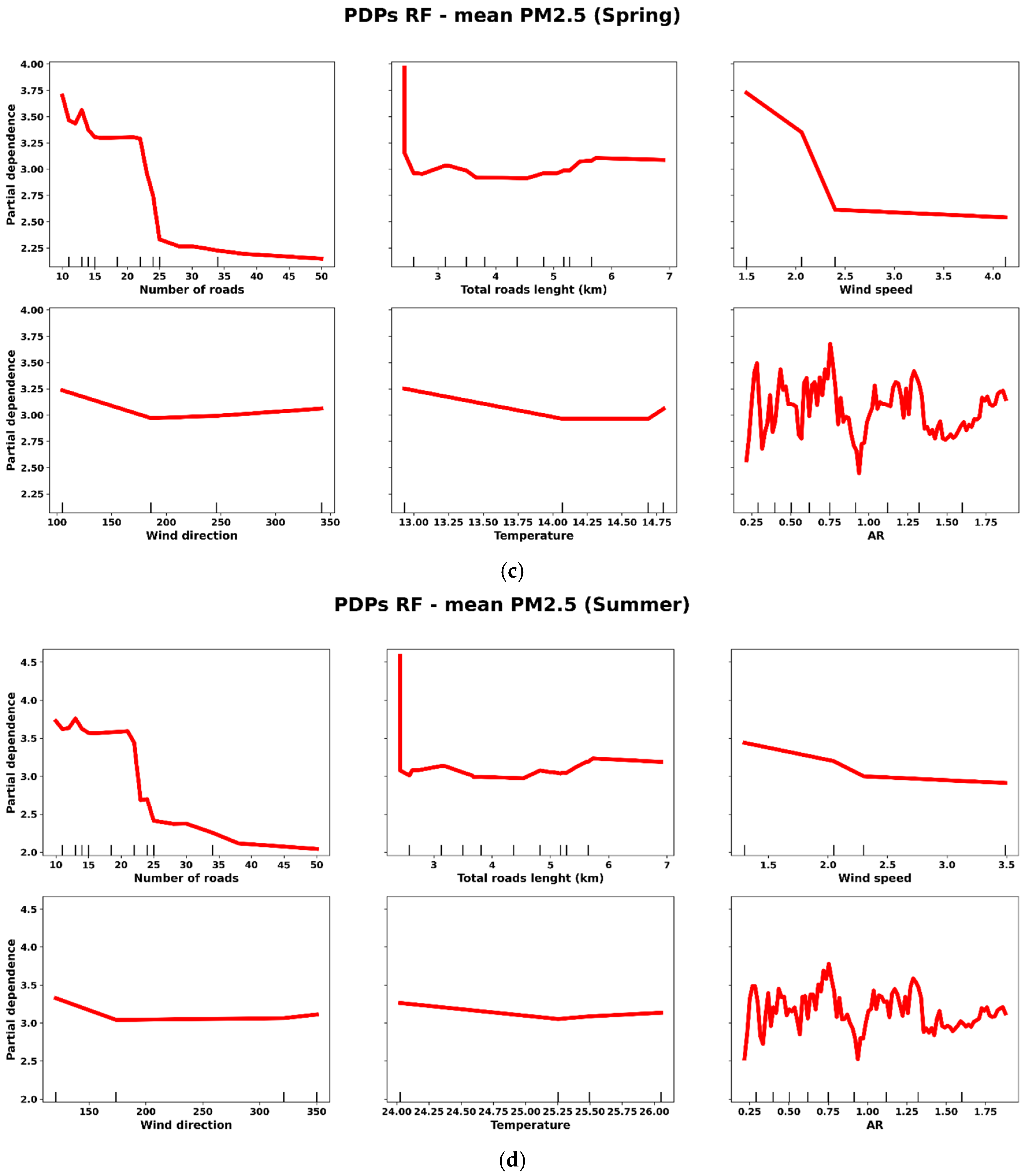
To explore the relationships between the predictors “Number of roads”, “Total road length”, “Wind speed”, “Wind direction”, “Temperature” and AR and mean PM2.5 concentrations, a random forest (RF) regression model was applied. This ensemble learning approach provides robust predictive performance for complex, non-linear relationships but operates as a “black box”, making it difficult to interpret the marginal influence of individual predictors. To address this limitation, partial dependence plots (PDPs) were generated. PDPs isolate the functional relationship between a single predictor and the model output by marginalizing the effects of all other variables, allowing the identification of linear, monotonic, or more complex response patterns.
To specifically investigate the relationship between λp and PM2.5 concentrations, a complementary multi-stage regression analysis was performed. First, three alternative models (linear, exponential, and logarithmic) were fitted to describe the central tendency of the λp-PM2.5 relationship. The model with the highest coefficient of determination (R2) was selected as the most representative of the average trend. Subsequently, quantile regression (QR) was applied to assess whether the influence of λp varies across the full distribution of PM2.5 concentrations. Unlike conventional regression, which estimates effects on the conditional mean, QR allows the estimation of predictor effects at specific quantiles of the response variable. Quantiles from 0.05 to 0.95 were analyzed to determine whether λp exerts a uniform influence or whether its effect differs for low, median, and extreme PM2.5 concentration levels.
All statistical analyses were implemented in Python 3.11 using the statsmodels and scikit-learn libraries.
3. Results
3.1. Statistical Analysis Results
For each season, random forest models were fitted by pooling all cell-level observations from the four cities; thus, the reported PDPs represent season-specific relationships across all analyzed urban contexts. To facilitate the interpretation of the complex, non-linear relationships captured by the seasonal random forest models, partial dependence plots (PDPs) were generated for the selected predictors. The PDPs reveal both seasonally consistent patterns and notable seasonal variations in the influence of these variables on PM2.5 concentrations. These analyses were used to explore how urban morphology, traffic configuration and meteorology jointly shape PM2.5 dispersion patterns across seasons and cities.
In autumn (
Figure 5a), the PDPs show a negative association between PM
2.5 and the number of roads, wind speed, and temperature. Wind direction exhibits a largely uniform response, with a slight positive tendency at higher angular values, while AR is characterised by irregular, non-monotonic fluctuations.
Winter results (
Figure 5b) show the strongest functional responses among all seasons. The PDP for the number of roads indicates a decreasing association with predicted PM
2.5 between approximately 10 and 25 roads, followed by a flattening trend beyond 30 roads. Wind speed and temperature exhibit clear negative relationships with PM
2.5, while wind direction shows a pronounced influence across its full range. In contrast, total road length remains weakly influential, and AR continues to display a non-monotonic response. These patterns are consistent with reduced boundary-layer mixing and more frequent stable atmospheric conditions during winter, which limit pollutant dispersion and amplify the sensitivity to local sources and urban form [
22,
48]. It is noted that PDPs represent marginal model responses rather than direct causal effects; therefore, counterintuitive trends, such as decreasing PM
2.5 with increasing road numbers, likely reflect confounding with other urban characteristics rather than a direct protective effect. In addition, the step-like behavior observed in the PDPs partly reflects the discrete nature of the road-network predictors, which are defined at the study-area scale and assigned uniformly to all grid cells, potentially producing artificial thresholds in tree-based models.
During spring (
Figure 5c), the dominant winter relationships persist for the number of roads, wind speed and temperature, although with reduced intensity. The influence of wind direction becomes less pronounced and exhibits a weak U-shaped response. Total road length remains nearly flat, while AR continues to show a non-monotonic pattern with lower amplitude.
In summer (
Figure 5d), the functional responses closely resemble those observed in spring. The number of roads, wind speed, and temperature remain negatively associated with PM
2.5, but with smaller effect sizes, consistent with stronger boundary-layer mixing under warm-season conditions. The marginal effect of wind direction becomes almost flat, while total road length shows minor positive deviations. AR maintains a multi-modal, non-linear behaviour.
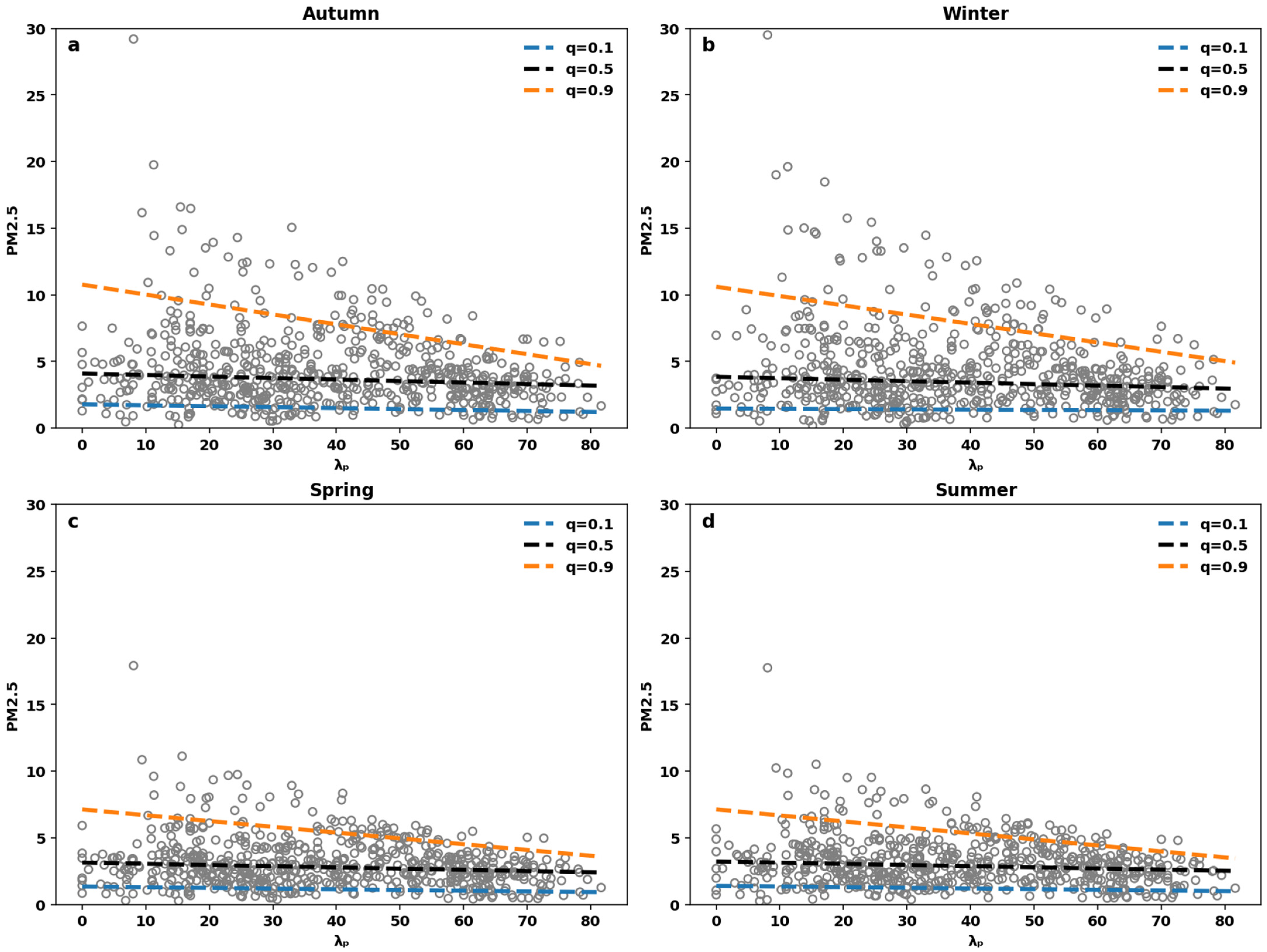
Quantile regression results (
Figure 6) provide a complementary distributional perspective, indicating a generally negative association between building plan area fraction (λ
p) and PM
2.5 across all seasons. Quantile slopes from τ = 0.1 to τ = 0.9 are predominantly negative, with steeper declines observed at higher quantiles. This suggests that λ
p is more strongly associated with reductions in elevated PM
2.5 concentrations, particularly in winter, when the inter-quantile spread is largest. These findings highlight distributional heterogeneity in the relationship between urban form and PM
2.5. However, causality cannot be inferred and results should be interpreted in light of the modelling assumptions and associated uncertainties.
Overall, seasonal differences indicate that meteorological controls dominate dispersion processes in winter, while urban morphology and traffic configuration play a relatively stronger role under summer conditions.
3.2. Summer PM2.5 Concentration Maps (Representative Sites)
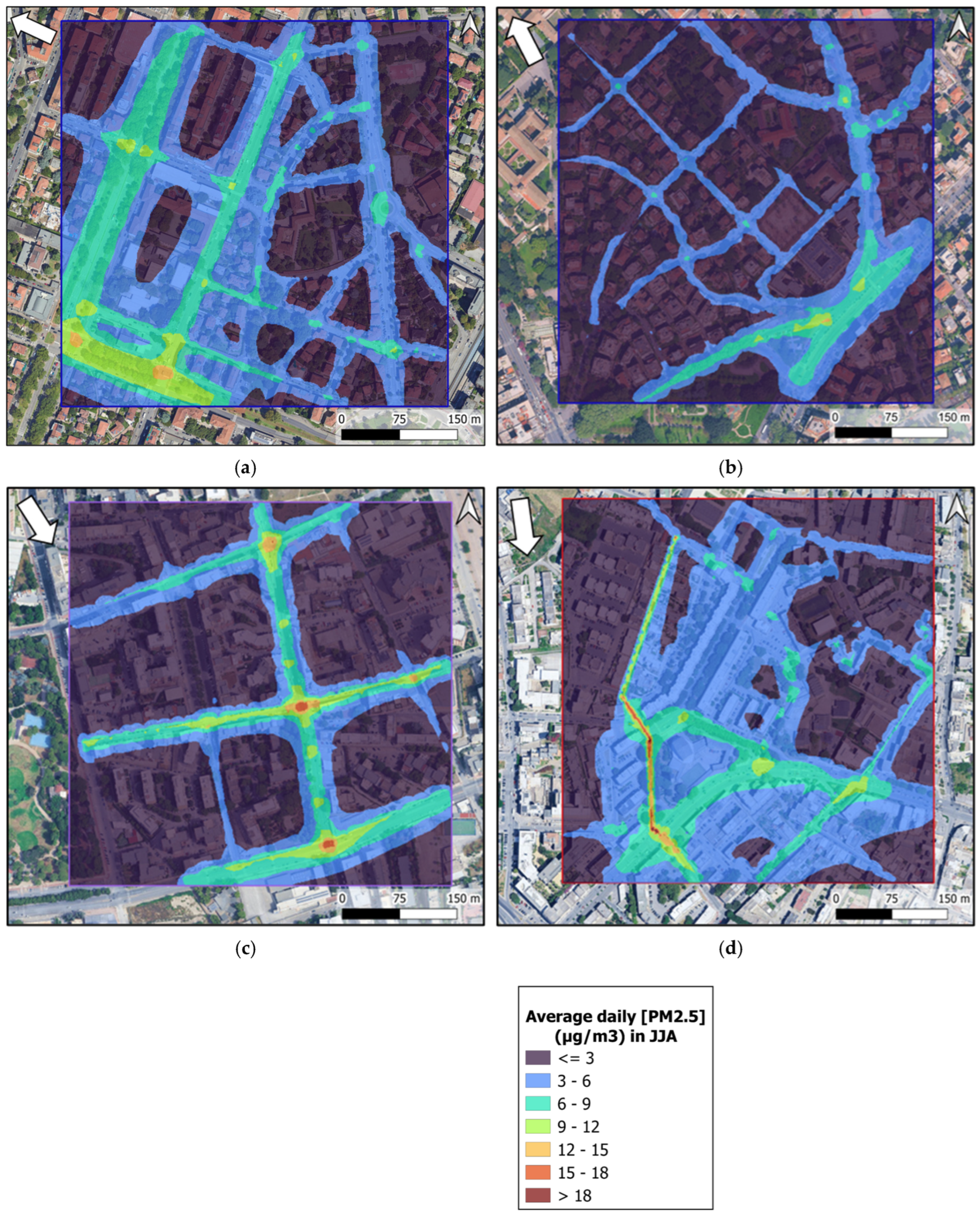
Figure 7 presents contour maps of mean summer PM
2.5 concentrations for four representative sites characterised by intermediate building plan area fractions (λ
p ≈ 25%), and their wind direction mode (white arrow): Viale Zara in Milan (a), Piazza Albina in Rome (b), Parco 2 Giugno in Bari (c), and Garigliano in Lecce (d). These sites were selected to allow comparison under similar morphological conditions while representing different urban layouts and climatic contexts. While the prevailing wind direction is reported for reference, the spatial patterns are not dominated by a clear advective plume structure. Instead, PM
2.5 distributions appear strongly controlled by local street geometry and road-network configuration.
Across all sites, high-concentration zones have been identified in the vicinity of road junctions and along canyon-like streets. This suggests that reduced ventilation and converging traffic flows play a primary role in shaping near-road exposure. This finding indicates that local morphological constraints may potentially exceed the impact of wind direction in shaping the spatial organisation of PM2.5 concentrations within neighbourhoods.
The existence of concentration maxima at intersections and within street canyons has been demonstrated in several studies, which have shown systematically higher near-road concentrations at junctions and in enclosed canyon geometries. Near-road increments in PM
2.5, when compared to the urban background, are site-dependent, yet generally fall within a range from +5% to +25% [
49,
50]. However, more significant local increases have been documented in urban canyons/intersections or in those with poor ventilation. The prevalence of this phenomenon is characterized by significant spatial variability, with local increases ranging up to tens of percent [
43,
51].
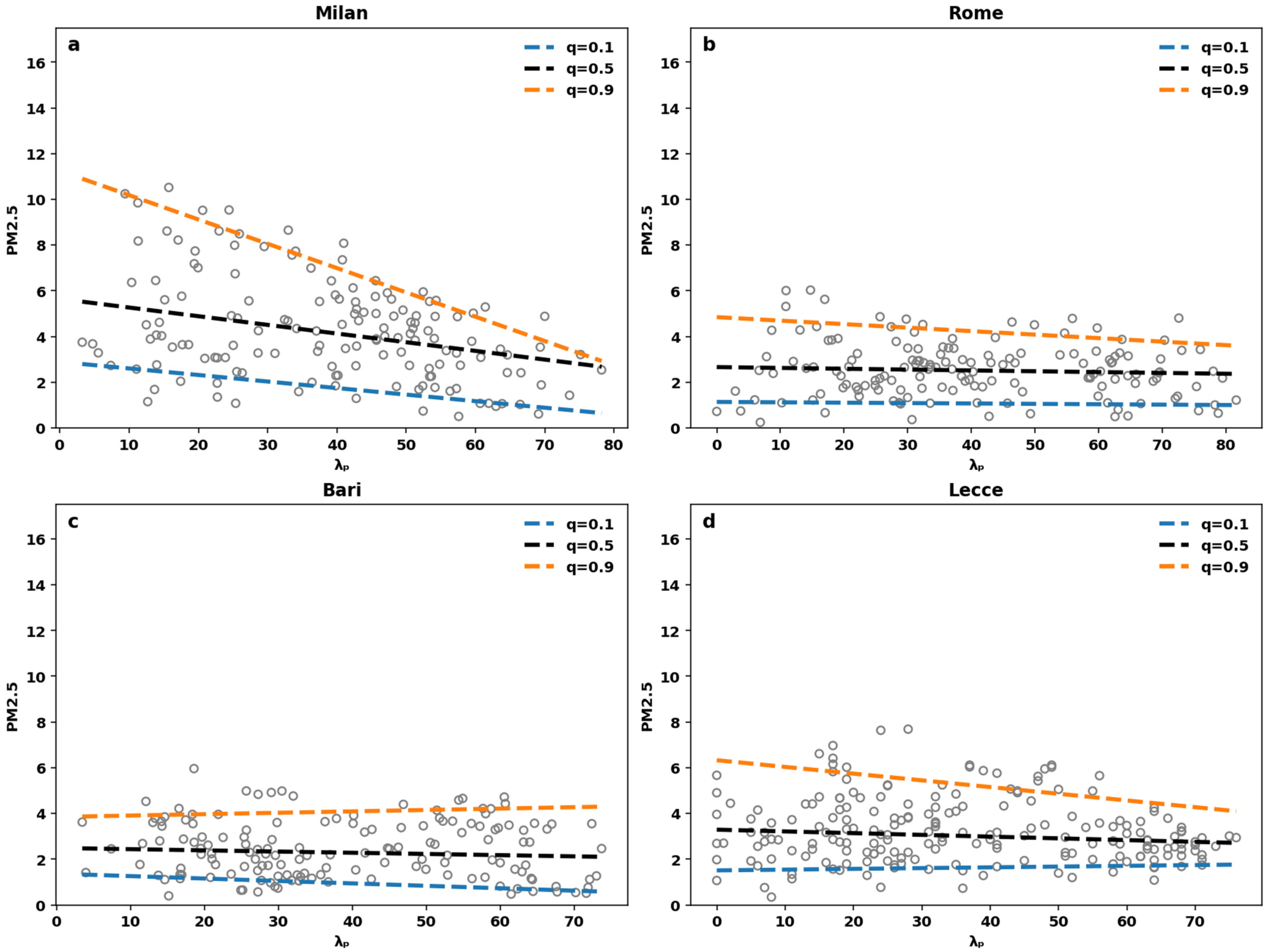
City-specific quantile regression results (
Figure 8) highlight substantial heterogeneity in the relationship between λ
p and PM
2.5 across the four cities. In Milan, Rome and Lecce, the conditional distributions show a generally negative association, with steeper slopes at higher quantiles. This indicates a stronger association between higher λ
p values and reductions in elevated PM
2.5 concentrations. In Milan, the inter-quantile spread narrows with increasing λ
p, suggesting a potential stabilising effect of the dense urban fabric on concentration variability. Rome exhibits a similar, though slightly weaker, pattern. Although Lecce displays lower overall PM
2.5 levels, it still shows consistent declines in the upper quantiles, indicating a mitigating association during episodic pollution peaks. In contrast, Bari exhibits a different distributional behaviour. Here, the median and upper quantiles remain nearly flat, while the lower quantiles show a more pronounced decline with increasing λ
p. This suggests that in Bari the influence of λ
p is more evident under relatively clean conditions but limited during higher pollution episodes. The relationship between λ
p and peak concentrations in this city may therefore be moderated by local morphological configurations, prevailing wind regimes, emission patterns or their combined interactions.
Overall, the results indicate an association between higher λp values and lower PM2.5 concentrations, particularly at the upper end of the distribution in some cities. However, both the magnitude and shape of this relationship vary substantially across urban contexts. Distributional analyses thus provide valuable, city-specific insights that would be obscured by mean-based approaches. All interpretations should be considered in light of the modelling assumptions, predictor definitions, and spatial aggregation methods adopted in this study.
4. Discussion
This multi-city, seasonal analysis reveals a generally negative association between plan area fraction (λp) and PM2.5 concentrations at the 100 m cell scale in three of the four investigated cities (Milan, Rome and Lecce), with the relationship being most pronounced at the upper quantiles of the PM2.5 distribution. In contrast, Bari exhibits a distinct pattern, with weak responses in the median and upper quantiles and a more evident decline only in the lower quantiles. This pattern is plausibly linked to the city’s coastal setting and associated wind regime, characterized by higher seasonal wind speeds and persistent ventilation driven by sea–land breeze circulations. These conditions enhance pollutant dilution and limit stagnation, reducing the sensitivity of high PM2.5 concentrations to local urban compactness.
Across all cities and seasons, the random forest models consistently identify the number of roads, wind speed and temperature as key predictors of PM2.5. However, the influence of wind direction and total road length shows marked seasonal variability, reflecting the changing role of atmospheric dispersion processes. In winter, when stable conditions and reduced mixing prevail, directional effects and local ventilation appear more influential, whereas in summer the enhanced boundary-layer mixing reduces their relative importance.
The observed negative correlation between λ
p and PM
2.5 is at variance with the outcomes of classical idealised street-canyon studies (mainly wind-tunnel studies, LES/CFD 2D), which frequently emphasise pollutant trapping in narrow, high-aspect-ratio canyons [
43,
52,
53]. It is suggested that a mechanism which may help to resolve the observed discrepancy is as follows: in the present study, high-λ
p areas frequently correspond to historic city centres characterised by dense networks of short, interconnected, narrow streets. Because total traffic volumes were standardised at the area level and distributed across all road segments, consequently traffic intensity per segment tends to be lower in such subdivided networks. A plausible mechanism that may help reconcile this discrepancy is related to the traffic activity allocation adopted in the present modelling framework. In this study, traffic activity inputs were standardised at the study-area level and subsequently distributed across all road segments within each area. As a result, high-λ
p areas, which frequently correspond to historic city centres characterised by dense networks of short, interconnected streets, distribute the same area-level traffic activity across a larger number of segments. This leads to a lower emission intensity per segment and can yield lower simulated near-road PM
2.5 concentrations under the adopted assumptions. This behaviour reflects an interaction between emission allocation and network topology, rather than an inherent improvement in ventilation associated with higher plan area fraction.
The quantile regression results further indicate that λp is more strongly associated with reductions at higher PM2.5 quantiles, particularly during winter. This suggests that urban morphology may play a role in moderating the intensity and frequency of high-pollution episodes, rather than merely shifting average concentration levels. Such distributional effects are especially relevant for exposure assessment and public health, as short-term peaks often drive acute health risks.
Nevertheless, all reported associations should be interpreted with caution. Partial dependence plots and feature importance metrics describe marginal model behavior under the fitted models rather than causal mechanisms. Correlations among predictors (for example, between λp and road-density indicators), together with the use of city-level meteorological data that do not capture intra-urban variability, may lead to confounding effects. The unexpected negative association between road density and PM2.5 is therefore more likely a proxy of road function, vehicle fleet composition, and traffic distribution, rather than evidence of a direct protective effect of denser road networks.
Although the present study is based on a parametrised dispersion modelling framework and adopts several simplifying assumptions, the results provide useful insights into the relationship between urban morphology and PM2.5 distribution. In particular, a generally negative association was observed between building plan area fraction (λp) and simulated PM2.5 concentrations, especially at the upper quantiles of the distribution and during winter conditions. Within the adopted modelling framework, this pattern likely reflects the combined influence of increased aerodynamic roughness and enhanced mechanical turbulence associated with denser urban fabrics, which may promote vertical mixing at the neighbourhood scale. It is important to emphasise that this finding should be interpreted in light of the spatial scale and parametrisation adopted in ADMS-Roads. The observed association does not necessarily imply that compact urban forms systematically reduce pollution at the individual street-canyon scale; rather, it highlights how morphology interacts with meteorology and emission configuration within a larger scale modelling context.
From an urban planning perspective, these results underline the importance of considering urban form as an active component in air-quality management. The comparative framework proposed here may support decision-makers in evaluating how variations in building density and street-network configuration influence local dispersion patterns, while recognising that detailed design strategies would require higher-resolution morphological data and complementary modelling approaches.
5. Conclusions
This study integrates seasonal ADMS-Roads dispersion modelling with cell-level urban morphometric indicators across four Italian cities to investigate how urban form relates to traffic-related PM2.5 concentrations at fine spatial scales. The main conclusions are as follows:
Plan area fraction (λp) is associated with lower PM2.5 concentrations at the cell scale in three of the four cities, particularly at the upper quantiles of the PM2.5 distribution. This relationship is strongly modulated by local traffic organisation and seasonal meteorological conditions.
Distributional approaches (quantile regression) and interpretable machine-learning tools (random forest with partial dependence plots) reveal city-specific and season-dependent behaviours that would be obscured by mean-based analyses alone.
The interaction between urban morphology, traffic distribution and meteorology plays a central role in shaping exposure patterns. As a result, morphology-based planning recommendations should be developed in conjunction with traffic management strategies and informed by local diagnostic analyses.
Several limitations should be acknowledged when interpreting the findings of this study. Owing to the lack of harmonised, high-resolution local datasets, traffic volumes and vehicle fleet compositions were standardised across areas and emissions were estimated using ADMS-Roads UK EFT factors. While this approach ensured comparability among cities, it may not fully capture local variations in traffic behaviour, vehicle technologies or driving conditions. Further, meteorological inputs were applied at the city scale, which limits the representation of intra-urban variability in wind fields, thermal stratification and boundary-layer dynamics. Moreover, some predictors vary primarily at the area or city level rather than at the individual cell scale, potentially introducing correlations among variables and reducing the ability to isolate fine-scale effects. Finally, the absence of dense, high-resolution observational data also constrains the validation of simulated concentration patterns, particularly in complex street environments. Although these limitations do not undermine the relative comparisons between cities or the robustness of the distributional analyses, they highlight areas where future research could refine the modelling framework and strengthen causal inference. In particular, future sensitivity analyses should explicitly test the robustness of the reported morphology–PM2.5 relationships by varying area-level traffic totals and speed profiles and by integrating local traffic count data, in order to quantify the potential influence of congestion and segment-specific traffic dynamics.
Future research should prioritize integrating field-based validation data and higher-resolution inputs, alongside methodological refinements to reduce structural uncertainty. Targeted observational datasets, coming from near-road and background fixed monitors, dense low-cost sensor networks, mobile transects, detailed traffic counts and meteorological profiles, would strengthen the robustness and policy relevance of future assessments.
From a policy perspective, these findings indicate that interventions aimed at reducing exposure should combine traffic management with morphology-informed urban planning, particularly in areas dominated by major roads or dense street networks and use distribution-sensitive approaches to capture high-pollution episodes. By linking urban form, traffic patterns and meteorology, these insights provide practical, context-specific guidance for planners and policymakers to mitigate traffic-related PM2.5 exposure.
Author Contributions
Conceptualization, C.M. and R.B.; methodology, R.B. and F.B.; software, C.M.; validation, C.M. and R.B.; formal analysis, C.M. and F.B.; investigation, C.M.; resources, R.B.; data curation, C.M.; writing—original draft preparation, C.M. and F.B.; writing—review and editing, A.D., G.P., A.E., P.K. and R.B.; visualization, C.M. and F.B.; supervision, A.D. and R.B.; project administration, R.B.; funding acquisition, R.B. All authors have read and agreed to the published version of the manuscript.
Funding
This research was funded by the European Union-Next Generation EU-PNRR-MISSIONE 4-COMPONENTE 2-INVESTIMENTO 1.4-Project Sustainable Mobility Center (Centro Nazionale per la Mobilità Sostenibile-CNMS) Spoke 7-Code CN00000023, CUP: F83C22000720001. PK is grateful for the support received through the UKRI-funded RECLAIM Network Plus (EP/W034034/1), GP4Streets (UKRI1281), and GreenCities (NE/X002799/1) projects.
Institutional Review Board Statement
Not applicable.
Informed Consent Statement
Not applicable.
Data Availability Statement
Data supporting the findings of this study are available from the corresponding author upon request.
Acknowledgments
The ADMS-Roads software was kindly made available by CERC—Cambridge Environmental Research Consultants.
Conflicts of Interest
The authors declare no conflicts of interest.
References
- World Health Organization (WHO). WHO Global Air Quality Guidelines: Particulate Matter (PM2.5 and PM10), Ozone, Nitrogen Dioxide, Sulfur Dioxide and Carbon Monoxide; World Health Organization: Geneva, Switzerland, 2021. [Google Scholar]
- Donateo, A.; Dinoi, A.; Pappaccogli, G. Impact on Ultrafine Particles Concentration and Turbulent Fluxes of SARS-CoV-2 Lockdown in a Suburban Area in Italy. Atmosphere 2021, 12, 407. [Google Scholar] [CrossRef]
- Manisalidis, I.; Stavropoulou, E.; Stavropoulos, A.; Bezirtzoglou, E. Environmental and Health Impacts of Air Pollution: A Review. Front. Public Health 2020, 8, 505570. [Google Scholar] [CrossRef]
- Piracha, A.; Chaudhary, M.T.A. Urban Air Pollution, Urban Heat Island and Human Health: A Review of the Literature. Sustainability 2022, 14, 9234. [Google Scholar] [CrossRef]
- Khreis, H.; Sanchez, K.; Foster, M.; Burns, J.; Nieuwenhuijsen, M.; Jaikumar, R.; Ramani, T.; Zietsman, J. Urban Policy Interventions to Reduce Traffic-Related Emissions and Air Pollution: A Systematic Evidence Map. Environ. Int. 2023, 172, 107805. [Google Scholar] [CrossRef]
- Hvidtfeldt, U.A.; Ketzel, M.; Sørensen, M.; Hertel, O.; Khan, J.; Brandt, J.; Raaschou-Nielsen, O. Evaluation of the Danish AirGIS Air Pollution Modeling System against Measured Concentrations of PM2.5, PM10, and Black Carbon. Environ. Epidemiol. 2018, 2, e014. [Google Scholar] [CrossRef]
- Stafoggia, M.; Bellander, T.; Bucci, S.; Davoli, M.; De Hoogh, K.; De’ Donato, F.; Gariazzo, C.; Lyapustin, A.; Michelozzi, P.; Renzi, M.; et al. Estimation of Daily PM10 and PM2.5 Concentrations in Italy, 2013–2015, Using a Spatiotemporal Land-Use Random-Forest Model. Environ. Int. 2019, 124, 170–179. [Google Scholar] [CrossRef]
- Fan, H.; Zhao, C.; Yang, Y.; Yang, X. Spatio-Temporal Variations of the PM2.5/PM10 Ratios and Its Application to Air Pollution Type Classification in China. Front. Environ. Sci. 2021, 9, 692440. [Google Scholar] [CrossRef]
- Huang, C.; Hu, T.; Duan, Y.; Li, Q.; Chen, N.; Wang, Q.; Zhou, M.; Rao, P. Effect of Urban Morphology on Air Pollution Distribution in High-Density Urban Blocks Based on Mobile Monitoring and Machine Learning. Build. Environ. 2022, 219, 109173. [Google Scholar] [CrossRef]
- Tian, Y.; Yao, X.; Chen, L. Analysis of Spatial and Seasonal Distributions of Air Pollutants by Incorporating Urban Morphological Characteristics. Comp. Environ. Urban Syst. 2019, 75, 35–48. [Google Scholar] [CrossRef]
- Cui, P.; Dai, C.; Zhang, J.; Li, T. Assessing the Effects of Urban Morphology Parameters on PM2.5 Distribution in Northeast China Based on Gradient Boosted Regression Trees Method. Sustainability 2022, 14, 2618. [Google Scholar] [CrossRef]
- Porwisiak, P.; Werner, M.; Kryza, M.; ApSimon, H.; Woodward, H.; Mehlig, D.; Gawuc, L.; Szymankiewicz, K.; Sawiński, T. Application of ADMS-Urban for an Area with a High Contribution of Residential Heating Emissions—Model Verification and Sensitivity Study for PM2.5. Sci. Total Environ. 2024, 907, 168011. [Google Scholar] [CrossRef]
- Ravina, M.; Esfandabadi, Z.S.; Panepinto, D.; Zanetti, M. Traffic-Induced Atmospheric Pollution during the COVID-19 Lockdown: Dispersion Modeling Based on Traffic Flow Monitoring in Turin, Italy. J. Clean. Prod. 2021, 317, 128425. [Google Scholar] [CrossRef] [PubMed]
- Pantusheva, M.; Mitkov, R.; Hristov, P.O.; Petrova-Antonova, D. Air Pollution Dispersion Modelling in Urban Environment Using CFD: A Systematic Review. Atmosphere 2022, 13, 1640. [Google Scholar] [CrossRef]
- Liang, M.; Chao, Y.; Tu, Y.; Xu, T. Vehicle Pollutant Dispersion in the Urban Atmospheric Environment: A Review of Mechanism, Modeling, and Application. Atmosphere 2023, 14, 279. [Google Scholar] [CrossRef]
- Reiminger, N.; Vazquez, J.; Blond, N.; Dufresne, M.; Wertel, J. CFD Evaluation of Mean Pollutant Concentration Variations in Step-down Street Canyons. J. Wind Eng. Ind. Aerodyn. 2020, 196, 104032. [Google Scholar] [CrossRef]
- Zhu, L.; Ranasinghe, D.; Chamecki, M.; Brown, M.J.; Paulson, S. Clean Air in Cities: Impact of the Layout of Buildings in Urban Areas on Pedestrian Exposure to Ultrafine Particles from Traffic. Atmos. Environ. 2021, 252, 118267. [Google Scholar] [CrossRef]
- Shi, H.; Yang, N.; Yang, X.; Tang, H. Clarifying Relationship between PM2.5 Concentrations and Spatiotemporal Predictors Using Multi-Way Partial Dependence Plots. Remote Sens. 2023, 15, 358. [Google Scholar] [CrossRef]
- Di Sabatino, S.; Buccolieri, R.; Pulvirenti, B.; Britter, R. Simulations of Pollutant Dispersion within Idealised Urban-Type Geometries with CFD and Integral Models. Atmos. Environ. 2007, 41, 8316–8329. [Google Scholar] [CrossRef]
- Buccolieri, R.; Sandberg, M.; Di Sabatino, S. City Breathability and Its Link to Pollutant Concentration Distribution within Urban-like Geometries. Atmos. Environ. 2010, 44, 1894–1903. [Google Scholar] [CrossRef]
- Chen, L.; Hang, J.; Sandberg, M.; Claesson, L.; Di Sabatino, S.; Wigo, H. The Impacts of Building Height Variations and Building Packing Densities on Flow Adjustment and City Breathability in Idealized Urban Models. Build. Environ. 2017, 118, 344–361. [Google Scholar] [CrossRef]
- Oke, T.R.; Mills, G.; Christen, A.; Voogt, J.A. Urban Climates; Cambridge University Press: Cambridge, UK, 2017. [Google Scholar]
- Peng, Y.; Buccolieri, R.; Gao, Z.; Ding, W. Indices Employed for the Assessment of “Urban Outdoor Ventilation”—A Review. Atmos. Environ. 2020, 223, 117211. [Google Scholar] [CrossRef]
- Zhou, J.; Liu, J.; Xiang, S.; Zhang, Y.; Wang, Y.; Ge, W.; Hu, J.; Wan, Y.; Wang, X.; Liu, Y.; et al. Evaluation of the Street Canyon Level Air Pollution Distribution Pattern in a Typical City Block in Baoding, China. Int. J. Environ. Res. Public Health 2022, 19, 10432. [Google Scholar] [CrossRef]
- Yim, S.H.L.; Fung, J.C.H.; Lau, A.K.H.; Kot, S.C. Air Ventilation Impacts of the “Wall Effect” Resulting from the Alignment of High-Rise Buildings. Atmos. Environ. 2009, 43, 4982–4994. [Google Scholar] [CrossRef]
- Ng, E.; Yuan, C.; Chen, L.; Ren, C.; Fung, J.C.H. Improving the Wind Environment in High-Density Cities by Understanding Urban Morphology and Surface Roughness: A Study in Hong Kong. Landsc. Urban Plann. 2011, 101, 59–74. [Google Scholar] [CrossRef] [PubMed]
- Koenker, R. Quantile Regression; Cambridge University Press: Cambridge, UK, 2005. [Google Scholar]
- Grange, S.K.; Carslaw, D.C.; Lewis, A.C.; Boleti, E.; Hueglin, C. Random Forest Meteorological Normalisation Models for Swiss PM10 Trend Analysis. Chem. Phys. 2018, 18, 6223–6239. [Google Scholar] [CrossRef]
- Kamińska, J.A. The Use of Random Forests in Modelling Short-Term Air Pollution Effects Based on Traffic and Meteorological Conditions: A Case Study in Wrocław. J. Environ. Manag. 2018, 217, 164–174. [Google Scholar] [CrossRef] [PubMed]
- Su, Z.; Lin, L.; Chen, Y.; Hu, H. Understanding the Distribution and Drivers of PM2.5 Concentrations in the Yangtze River Delta from 2015 to 2020 Using Random Forest Regression. Environ. Monit. Assess. 2022, 194, 284. [Google Scholar] [CrossRef]
- Sun, J.; Zhou, T.; Wang, D. Relationships between Urban Form and Air Quality: A Reconsideration Based on Evidence from China’s Five Urban Agglomerations during the COVID-19 Pandemic. Land Use Policy 2022, 118, 106155. [Google Scholar] [CrossRef]
- Wang, D.; Zhou, T.; Sun, J. Effects of Urban Form on Air Quality: A Case Study from China Comparing Years with Normal and Reduced Human Activity Due to the COVID-19 Pandemic. Cities 2022, 131, 104040. [Google Scholar] [CrossRef]
- Metrangolo, C.; Dinoi, A.; Esposito, A.; Pappaccogli, G.; Donateo, A.; Santiago, J.L.; Buccolieri, R. Assessing Urban Air Pollution Dynamics: The Impact of Traffic Emissions and Urban Morphology in Lecce and Bari, Italy. Bull. Atmos. Sci. Technol. 2024, 5, 13. [Google Scholar] [CrossRef]
- Gazzetta Ufficiale. Available online: https://www.gazzettaufficiale.it/eli/id/2014/4/7/14G00069/sg (accessed on 20 January 2026).
- Population by Istat. Available online: https://esploradati.istat.it/databrowser/#/it/dw/categories/IT1,POP,1.0/POP_POPULATION/DCIS_POPRES1/IT1,22_289_DF_DCIS_POPRES1_24,1.0 (accessed on 11 February 2026).
- Esposito, A.; Grulois, M.; Pappaccogli, G.; Palusci, O.; Donateo, A.; Salizzoni, P.; Santiago, J.L.; Martilli, A.; Maffeis, G.; Buccolieri, R. On the Calculation of Urban Morphological Parameters Using GIS: An Application to Italian Cities. Atmosphere 2023, 14, 329. [Google Scholar] [CrossRef]
- Cambridge Environmental Research Consultants (CERC). ADMS-Roads Model: Product Information and Documentation; Cambridge Environmental Research Consultants (CERC): Cambridge, UK, 2024. [Google Scholar]
- Tchepel, O.; Monteiro, A.; Dias, D.; Gama, C.; Pina, N.; Rodrigues, J.P.; Ferreira, M.; Miranda, A.I. Urban Aerosol Assessment and Forecast: Coimbra Case Study. Atmos. Pol. Res. 2020, 11, 1155–1164. [Google Scholar] [CrossRef]
- Chang, J.C.; Hanna, S.R. Air Quality Model Performance Evaluation. Meteorol. Atmos. Phys. 2004, 87, 167–196. [Google Scholar] [CrossRef]
- Pappaccogli, G.; Esposito, A.; Buccolieri, R. Summer Diurnal LST Variability Across Local Climate Zones Using ECOSTRESS Data in Lecce and Milan. Atmosphere 2025, 16, 377. [Google Scholar] [CrossRef]
- Oke, T.R. Street Design and Urban Canopy Layer Climate. Energy Build. 1988, 11, 103–113. [Google Scholar] [CrossRef]
- Edussuriya, P.; Chan, A.; Malvin, A. Urban Morphology and Air Quality in Dense Residential Environments: Correlations between Morphological Parameters and Air Pollution at Street-Level. J. Eng. Sci. Technol. 2014, 9, 64–80. [Google Scholar]
- Huang, Y.; Lei, C.; Liu, C.-H.; Perez, P.; Forehead, H.; Kong, S.; Zhou, J.L. A Review of Strategies for Mitigating Roadside Air Pollution in Urban Street Canyons. Environ. Poll. 2021, 280, 116971. [Google Scholar] [CrossRef]
- Ramponi, R.; Blocken, B.; de Coo, L.B.; Janssen, W.D. CFD Simulation of Outdoor Ventilation of Generic Urban Configurations with Different Urban Densities and Equal and Unequal Street Widths. Build. Environ. 2015, 92, 152–166. [Google Scholar] [CrossRef]
- Macdonald, R.W.; Griffiths, R.F.; Hall, D.J. An Improved Method for the Estimation of Surface Roughness of Obstacle Arrays. Atmos. Environ. 1998, 32, 1857–1864. [Google Scholar] [CrossRef]
- Hertel, O.; Berkowicz, R. Evaluation of the Dispersion Model Incorporated in the Nordic Method for Measuring Exhaust Gases from Cars. Vurdering af Spredningsmodellen i Den Nordiske Beregningsmetode for Bilavgasser; Sammenfattende Rapport; Danmarks Miljoeundersoegelse: Roskilde, Denmark, 1990. [Google Scholar]
- Bartzis, J.G.; Kalimeri, K.K.; Sakellaris, I.A. Environmental Data Treatment to Support Exposure Studies: The Statistical Behavior for NO2, O3, PM10 and PM2.5 Air Concentrations in Europe. Environ. Res. 2020, 181, 108864. [Google Scholar] [CrossRef]
- Stull, R.B. An Introduction to Boundary Layer Meteorology; Springer Science & Business Media: Berlin/Heidelberg, Germany, 2012; ISBN 978-94-009-3027-8. [Google Scholar]
- Askariyeh, M.H.; Zietsman, J.; Autenrieth, R. Traffic Contribution to PM2.5 Increment in the near-Road Environment. Atmos. Environ. 2020, 224, 117113. [Google Scholar] [CrossRef]
- Lal, R.M.; Ramaswami, A.; Russell, A.G. Assessment of the Near-Road (Monitoring) Network Including Comparison with Nearby Monitors within U.S. Cities. Environ. Res. Lett. 2020, 15, 114026. [Google Scholar] [CrossRef]
- Voordeckers, D.; Lauriks, T.; Denys, S.; Billen, P.; Tytgat, T.; Van Acker, M. Guidelines for Passive Control of Traffic-Related Air Pollution in Street Canyons: An Overview for Urban Planning. Landsc. Urban Plann. 2021, 207, 103980. [Google Scholar] [CrossRef]
- Li, X.-X.; Britter, R.E.; Norford, L.K.; Koh, T.-Y.; Entekhabi, D. Flow and Pollutant Transport in Urban Street Canyons of Different Aspect Ratios with Ground Heating: Large-Eddy Simulation. Bound.-Layer Meteorol. 2012, 142, 289–304. [Google Scholar] [CrossRef]
- Hang, J.; Chen, X.; Chen, G.; Chen, T.; Lin, Y.; Luo, Z.; Zhang, X.; Wang, Q. The Influence of Aspect Ratios and Wall Heating Conditions on Flow and Passive Pollutant Exposure in 2D Typical Street Canyons. Build. Environ. 2020, 168, 106536. [Google Scholar] [CrossRef]
| Disclaimer/Publisher’s Note: The statements, opinions and data contained in all publications are solely those of the individual author(s) and contributor(s) and not of MDPI and/or the editor(s). MDPI and/or the editor(s) disclaim responsibility for any injury to people or property resulting from any ideas, methods, instructions or products referred to in the content. |



 ,
,